


Introduction
In parliamentary systems, government formation processes are crucial time periods. Governments need the support of the legislature, but individual parties rarely control the majority of the seats. This is why they form coalition governments based on two or more parties. One of the key issues in the bargaining process is the distribution of government resources, most notably cabinet positions. Which party gets which portfolio is crucial as it has far‐reaching consequences, in particular for the cabinet parties’ influence on government policy and patronage power within different policy areas.
Portfolio allocation is one of the classic research questions in coalition studies (Bäck et al. Reference Bäck, Debus and Dumont2011; Budge & Keman Reference Budge and Keman1990; Falcó‐Gimeno & Indridason Reference Falcó‐Gimeno and Indridason2013; Franchino Reference Franchino2009; Laver & Schofield Reference Laver and Schofield1998; Verzichelli Reference Verzichelli, Strøm, Müller and Bergman2008). The bulk of the literature focuses on the numerical distribution of cabinet portfolios (Browne & Franklin Reference Browne and Franklin1973; Browne & Frendreis Reference Browne and Frendreis1980; Mershon Reference Mershon2001; Druckman & Roberts Reference Druckman and Roberts2005; Druckman & Warwick Reference Druckman and Warwick2005; Warwick & Druckman Reference Warwick and Druckman2001, Reference Warwick and Druckman2006). Yet, portfolio allocation also raises the question of which party takes which portfolio. This aspect – sometimes dubbed ‘qualitative’ portfolio allocation – has received comparatively little attention in coalition research. Moreover, it is a question ‘that has thus far eluded researchers’ (Laver & Schofield Reference Laver and Schofield1998: 186) as the empirical findings are rather mixed and much less consistent than those for the ‘quantitative’ distribution of coalition payoffs.
In this article we aim to contribute to the ‘qualitative’ strand of portfolio allocation. The main idea is to conceptualise coalition negotiations as a sequential choice process where decisions are being made in several consecutive negotiation rounds. Following previous research on qualitative portfolio allocation, we argue that parties have preferences for individual portfolios (Bäck et al. Reference Bäck, Debus and Dumont2011; Browne & Feste Reference Browne and Feste1975; Budge & Keman Reference Budge and Keman1990). Yet, rather than making all decisions on individual portfolios independently, we maintain that coalition parties first decide on the allocation of key cabinet positions before turning to less important ones (Budge & Keman Reference Budge and Keman1990; Keman Reference Keman, Bara and Weale2006; Raabe & Linhart Reference Raabe and Linhart2015). This implies that decisions made early in the process affect the allocation of the remaining portfolios. By linking party preferences for individual cabinet positions with a sequential bargaining logic, we follow recent research on government formation that incorporates the underlying processes to understand observed bargaining outcomes (Bäck & Dumont Reference Bäck and Dumont2008; Golder Reference Golder2010). We introduce several alternative sequential logics to mimic the process of dividing the cake. Coalition negotiations, as indeed most political negotiations, are conducted by a small set of individuals behind closed doors. Typically, no minutes are written or information provided about the moves of the negotiators and the conduct of the bargaining process. The attention of outdoor observers is usually focused on whether the negotiations will be successfully completed and the content of the ‘coalition deal’, while scant attention is given to how it was actually achieved. From the occasional reports and interviews with actors, we have glimpses of anecdotal information about the conduct of such negotiations. Yet, such information is rare, incomplete, probably tilted towards anecdotes of the exceptional and often focused on details of little analytical value. We thus work from stylised processes of portfolio allocation, which lead to particular allocation patterns.
We explore whether a sequential bargaining approach fits the observed empirical patterns of portfolio allocation. Specifically, we test the sequential approach against models assuming mutual independence in the allocation of individual positions (Bäck et al. Reference Bäck, Debus and Dumont2011). Using these models as a yardstick, we analyse whether combining party preferences with a sequential bargaining logic leads to substantially better predictions. The empirical analysis, based on an original dataset of 2,366 cabinet positions of 146 coalition governments in 15 European parliamentary democracies, leads to three main results. First, prediction success for the allocation of individual cabinet positions is considerably higher when enacting a sequential bargaining process compared to the assumption of mutual independence. Second, predictions for a sequential bargaining approach are also more clear‐cut (i.e., more accurate) than for alternative models assuming mutual independence. Higher accuracy means that predicted probabilities are closer to 0 or 1, and thus yield higher predictive power. Third, our empirical results suggest that party preferences for cabinet positions are based on both the objective importance of portfolios and the parties’ ideological preferences. While previous research on the allocation of individual cabinet positions focuses on the latter, we stress that parties distribute more prestigious positions early in the process and discount their ideological preferences for more prestigious posts.
A sequential allocation process of cabinet positions
We suggest that coalition talks entail a sequential logic, where the negotiating parties first decide on the most important positions and resolve conflicts over key positions before turning to less important ones. Thus, we conceptualise the distribution of individual cabinet positions as a multistage process (Budge & Keman Reference Budge and Keman1990; Keman Reference Keman, Bara and Weale2006; Raabe & Linhart Reference Raabe and Linhart2015). While party preferences for individual cabinet positions are important, parties may use portfolios of lesser importance as ‘makeshifts’ (Budge & Keman Reference Budge and Keman1990: 106) in the bargaining process. This sequential logic bears important consequences for the allocation of individual cabinet positions: decisions over portfolios early in the process affect the distribution of portfolios allocated later in the bargaining process.
This sequential approach to the distribution of cabinet positions is perhaps most evident for the prime ministership vis‐à‐vis all other cabinet positions. ‘The prime ministership … is almost certainly recognized in all countries and by all parties as the pre‐eminent post’ (Warwick & Druckman Reference Warwick and Druckman2006: 460), or, as Laver and Schofield (Reference Laver and Schofield1998: 181) put it, ‘the most glittering prize’ of being in government. When coalition negotiations start, the identity of the next prime minister to be is often quite clear, while the allocation of many other cabinet positions is still left in the dark. In instances where the allocation of the prime ministership is open for discussion, this issue is so crucial that it needs to be resolved at the outset of the formation process. A particularly telling example are the Dutch 1981 coalition talks where the Labour Party (PvdA) struggled with whether or not to accept the Christian Democrat Dries Van Agt (CDA) as prime minister. A decision was reached only after the PvdA leader Joop den Uyl became a ‘super minister’ of social affairs and the Labour Party was granted the post of the minister of education (Hillebrand & Irwin Reference Hillebrand, Irwin, Müller and Strøm1999: 120). Clearly, reaching agreement on which party will get these key positions was crucial for successfully concluding the coalition formation process.
Besides the prime ministership, there are often other key portfolios where agreement is crucial for the ongoing bargaining process. One such cabinet position is the finance ministry, where supervision of the budget goes hand in hand with its influence on the agenda‐setting power in many jurisdictions (Dunleavy & Bastow Reference Dunleavy and Bastow2001; Laver & Shepsle Reference Laver and Shepsle1994). Other portfolios, like agriculture for agrarian parties, are considered as ‘sine qua non of governmental participation’ (Budge & Keman Reference Budge and Keman1990: 109). Conflicts may emerge over fundamental ideological questions (e.g., between clerical and anti‐clerical parties over the ministry of education) or over the distribution of the most prestigious positions (e.g., foreign affairs). Oftentimes these conflicts have to be resolved before allocating other cabinet positions. The formation of the coalition government between the Christian Democrats (CDU/CSU) and the Social Democrats (SPD) following the election in Germany in 2013 provides an example. A key conflict, quite early in the bargaining process, was whether the SPD would take over the finance ministry, to counter‐balance Angela Merkel's (CDU) chancellorship in EU‐level policy making during the economic crisis, or take foreign affairs instead. The distribution of both positions was interdependent as neither party could claim both ministries. Moreover, an agreement in this debate was crucial for the allocation of other cabinet positions: if the parties’ ‘big beasts’ had failed in securing their most preferred option, they would have claimed alternatives with repercussions on the further allocation of ministries.Footnote 1 In the end, the Social Democrats agreed to abandon finance, which remained in the hands of the Christian Democrats. These examples illustrate that portfolio allocation often proceeds step‐by‐step where key decisions need to be taken before moving on.
The prevalence of distributing important positions first is also visible in coalition negotiations in Austria between 1983 and 2006. Interviews with members of the parties’ core negotiation teams support the idea that the allocation starts with the most important positions and then moves to the less important ones.Footnote 2 The interviewees stated that proposals typically start with those cabinet positions for which parties have the strongest preferences. For example, in the 1999 coalition negotiations between the Christian Democrats (ÖVP) and the Freedom Party (FPÖ), one interviewee noted that ‘three government positions – Federal Chancellor, Foreign Minister, and Minister of the Interior – were already fixed for the ÖVP. It is logical that the FPÖ also gets one of its desired portfolios.’ Similarly, one of the Freedom Party negotiators issued a similar explanation: ‘The [allocation of the] Minister of Finance was self‐evident: There was a draw in terms of parliamentary seats and the one party takes the Federal Chancellor. So, the other one must get the Minister of Finance.’ This suggests a sequential choice logic that is implicit in these mechanisms and actions.
There are indeed many instances where a sequential logic in the portfolio allocation process is fully institutionalised. In Belgium, for example, parties first agree on the numerical distribution of positions (counted as points) and then ‘each party president … chooses his most preferred portfolio(s), starting with the president of the strongest coalition party and ending with the weakest partner’ (De Winter et al. Reference Winter, Timmermans, Dumont, Müller and Strøm2000: 333). While these decisions are subject to further negotiations later in the bargaining process, this proceeding has a strong sequential flavour. In other instances, bargaining parties have even codified a sequential logic of the allocation process. Some coalitions in Romania have followed the rule to take turns in choosing their most preferred portfolios.Footnote 3 An even more formalised procedure exists in Northern Ireland and – at the municipal level – in Denmark (O'Leary et al. Reference O'Leary, Grofman and Elklit2005). Here, the choice sequence is given by a divisor method based on the seat distribution that determines the numerical distribution and the choice sequence of the cabinet positions.
Party preferences in a sequential portfolio allocation process
The examples in the previous section suggest that portfolio allocation entails a sequential logic. While the exact patterns are likely to differ from country to country (and perhaps from formation process to formation process), introducing some conditionality in the allocation process is a plausible alternative to the assumption of mutual independence. We aim to mimic this logic via a stylised representation of sequential portfolio allocation among cabinet parties. Specifically, we combine party preferences for individual cabinet positions with allocation mechanisms that define choice sequences into a sequential bargaining approach. For a given allocation mechanism, all parties involved sequentially choose cabinet positions. Parties pick their most preferred cabinet position available at the given stage of the allocation process until all portfolios are distributed among them.Footnote 4 A position chosen by one party is no longer available to any other coalition partner. This interdependent process, we argue, improves our understanding of the allocation of individual cabinet positions.Footnote 5
Party preferences
Party preferences are based on two constituent elements: a shared understanding among all parties about the objective importance of each cabinet position (hereafter u); and a party‐specific value attached to a portfolio that varies with party ideology (hereafter v). Most accounts of portfolio allocation focus on either the objective importance of ministerial posts or party‐specific policy preferences (Bäck et al. Reference Bäck, Debus and Dumont2011; Budge & Keman Reference Budge and Keman1990; Warwick & Druckman Reference Warwick and Druckman2006). However, party leaders should actually value both factors when choosing between different portfolios (Raabe & Linhart Reference Raabe and Linhart2014).
The first element reflects the ‘reasonable consensus in a given system on the pecking order of portfolios’ (Laver & Schofield Reference Laver and Schofield1998: 182) where all political parties value portfolios such as finance, foreign affairs or interior more than others (e.g., foreign aid). Because the measure is objective and does not vary across parties, it is irrelevant for discriminating party preferences for individual cabinet positions. Yet, these values are important if we apply a sequential logic in the bargaining process: parties that value positions of objective importance have incentives to secure these positions early in the distribution process. Thus, it is cabinet positions with lower objective importance where the path dependency is most crucial.
The second element adds a party‐specific component to party preferences where coalition partners may show substantially different policy concerns (Bäck et al. Reference Bäck, Debus and Dumont2011; Brown & Feste Reference Browne and Feste1975; Budge & Keman Reference Budge and Keman1990; Laver & Schofield Reference Laver and Schofield1998: 182–186). It captures the salience each party attaches to a portfolio given its issue‐policy emphasis. For instance, social democratic parties put higher emphasis on the social affairs ministry and green parties aim to fill the environment ministry post. Formally, the preferences of party i for portfolio j are given by

where uj captures the objective value (importance) of holding portfolio j relative to an average portfolio and vij indicates party i’s emphasis on policy issues related to portfolio j relative to the average issue emphasis across all policy areas. We measure these variables using data from expert surveys that indicate the overall importance (e.g., prestige) of portfolio j (uj) and party manifestos to assess the party‐specific importance of portfolio j for party i (vij) (more information below). The relative importance of ministry‐ and party‐specific preferences is indicated by the weighting factor αi. This parameter is estimated against the real allocation of individual cabinet positions. Similar to regression models, we thus obtain estimates for weighting parameters αi and predictions for correctly predicted portfolio allocations.
Allocation mechanisms
Countless generations of practitioners and scholars have provided us with an enormous range of different allocation mechanisms, many of which are based on sequential moves. To capture the logic of a sequential allocation process, we choose three sequential mechanisms from that large menu: alternation, allocation following Sainte‐Laguë, and allocation following D'Hondt. These mechanisms are simple, well known and widely used in politics. While often used for the allocation of parliamentary seats, they are in principle applicable to all kinds of office, including cabinet positions (Brams & Kaplan Reference Brams and Kaplan2004; O'Leary et al. Reference O'Leary, Grofman and Elklit2005; Raabe & Linhart Reference Raabe and Linhart2015). For our purpose it is particularly important that they represent a broad range of allocation mechanisms as they vary in how party size matters in the choice sequence. Alternation mirrors a bargaining process where discrimination against party size is minimal, while allocation following D'Hondt reflects bargaining processes where larger parties dominate smaller ones. Moreover, these mechanisms portray the sequential allocation process as if cabinet positions were allocated one‐by‐one – the arguably easiest way to allocate a set of positions sequentially. Rather than expressing the real allocation process, they are employed to add some structure to the bargaining process to compare these results against models assuming that cabinet positions are distributed independently of each other.
Under alternation each party chooses one position in succession. In each round, the largest party starts followed by the second largest party, and so on. Party size therefore plays a subordinate role as it is only decisive for the sequence rather than the number of consecutive party draws in each bargaining round. All parties are treated equally until a party has reached its proportional share of portfolios and drops out of the allocation process.Footnote 6 This proportionality constraint ensures that predictions obtained via the alternation mechanism are comparable with those based on the two following inherently proportional mechanisms.
In allocation processes according to the Sainte‐Laguë method, the parties’ seat shares are subsequently divided by uneven numbers (1, 3, 5 and so on). For each party, this results in a decreasing progression of quotas starting from a party's seat share and converging to 0. The party with the highest quota chooses first and the respective value is eliminated from the list. The right to choose goes to the party with the highest remaining quota, and so on. The Sainte‐Laguë method is used for allocating parliamentary seats (e.g., Sweden) and the distribution of committee chairs (e.g., Germany). Raabe and Linhart (Reference Raabe and Linhart2015) find that this is the most powerful method in predicting cabinet allocations for state governments in Germany. Unlike the alternation rule (where parties pick positions in succession), larger parties may have several consecutive draws. Thus, compared to the alternation method, the Sainte‐Laguë method favours larger parties over smaller ones.
Finally, allocation following the D'Hondt method also works with divisors but here seat shares are divided by an increasing progression of nonnegative integers (1, 2, 3 and so on). Similar to Sainte‐Laguë, the party with the highest quota is the first to pick a position, then the number is crossed out and the right to choose goes to the party with the second‐highest quota, and so on. This is the allocation mode used for the allocation of cabinet positions in Northern Ireland and at the municipal level in Denmark (O'Leary et al. Reference O'Leary, Grofman and Elklit2005).Footnote 7 The D'Hondt method gives larger parties more weight than Sainte‐Laguë and is thus the allocation mechanism most favourable to large parties.
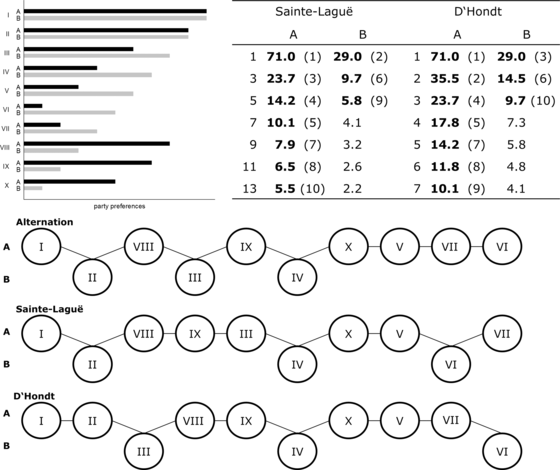
Given party preferences for individual cabinet positions, each mechanism makes predictions for the sequential allocation of individual portfolios. Figure 1 exemplifies the choice sequence of ten portfolios among two parties A (71 per cent of the cabinet seat share) and B (29 per cent of the cabinet seat share). The panel in the upper left exemplifies party A and B's hypothetical preference rank order for portfolios I to X. Both parties have strong preferences for portfolios I and II, but their preferences for other cabinet positions (e.g., IV) differ substantially. The table in the upper right illustrates the decreasing progression of quotas for the Sainte‐Laguë and the D'Hondt method, respectively. Here, the numbers in bold highlight awarded drawing rights, while the digits in parentheses indicate the successive sequence in which drawing rights are awarded to parties A and B.
Exemplifying sequential bargaining.
Notes: Example of a sequential distribution of portfolios between two parties, A and B, with cabinet seat shares of 71 and 29 per cent, respectively. Party preferences for portfolios I to X are shown in the upper left panel. The choice sequence according to the divisor methods are shown in the panel on the upper right. The predicted decisions of parties A and B in each step of the sequence are illustrated in the lower panel.

By combining the party preferences (upper left panel) with the sequence of drawing rights (upper right panel), we obtain predictions for the allocation of individual portfolios in a sequential process (lower panel). For example, under Sainte‐Laguë, party A gets to pick first and party B is second. While party A can select its most preferred ministry (I), party B chooses the most valuable of the remaining options (II). Draws 3, 4 and 5 are party A's turns again. It picks the most valuable of the remaining portfolios (VIII, IX and III), before party B chooses a portfolio in the sixth round. The bottom panel in Figure 1 illustrates the complete portfolio allocation process for each sequential mechanism (Alternation, Sainte‐Laguë and D'Hondt).
While the numeric distribution of cabinet positions remains unchanged, the choice sequence (from left to right) differs: under alternation, the junior coalition party B, in general, gets to choose earlier in the allocation process than under Sainte‐Laguë or D'Hondt. Thus, the choice sequence is a crucial aspect in determining which of its most preferred portfolios the smaller government party is able to attain: while alternation allows party B to pick some of its most preferred portfolios (II, III, and IV), both alternative allocation mechanisms result in less preferred portfolios being assigned to party B. Under Sainte‐Laguë, for instance, party B gets portfolio VI instead of III, and for D'Hondt portfolio II goes to party A while party B gets portfolio VI. Note, however, that party B's disadvantage under D'Hondt also hinges on the parties’ preferences for individual cabinet positions. If parties A and B had completely distinct preferences for portfolios, the choice sequence would be irrelevant. Thus, it is the interdependence of party‐specific preferences and the bargaining process which determines the allocation of individual portfolios among cabinet parties.
Finally, note that the choice sequences in Figure 1 could also resemble negotiation rounds where several positions are being allocated en bloc. For example, under D'Hondt the sequence is identical to a formation process where parties first decide on three positions (I, II and III), before distributing positions VIII, IX and IV in a second round of coalition talks, and the remaining four portfolios (X, V, VII and VI) in a final session. Thus, choice sequences as defined above, are also compatible with ‘clustered’ decisions as in the Dutch Van Agt example presented above.
Data and case selection
We use an original dataset covering 146 coalition governments in Western and Central Eastern Europe. Portfolio allocation data for coalition governments in Western Europe between 1980 and 1998 is taken from the Comparative Parliamentary Democracy Data Archive (Müller & Strøm Reference Müller and Strøm2000; Strøm et al. Reference Strøm, Müller and Bergman2008). Complementary data from 1999 onwards are coded from Keesing's World News Archive and the EJPR yearbooks. For Central Eastern Europe, we create a dataset covering portfolio allocations of all coalition governments that formed between 1990 and 2012 based on Keesing's World News Archive, the EJPR yearbooks and the European Representative Democracy Data Archive.Footnote 8 Overall, our sample includes 2,366 cabinet positions of 146 coalition governments in 15 parliamentary democracies between 1980 and 2012: Austria, Bulgaria, the Czech Republic, Denmark, Germany, Hungary, Iceland, Ireland, Lithuania, Luxembourg, the Netherlands, Norway, Slovakia, Slovenia and Sweden.Footnote 9
Party preferences
To these data, we add information on party preferences for individual portfolios. As outlined above, parties are assumed to be motivated by the objective gains from holding a specific cabinet post (uj) and their policy‐issue emphasis related to a specific portfolio (vij). To measure objective portfolio importance uj, we use expert survey data indicating the average relative importance of ministries in Western (Druckman & Warwick Reference Druckman and Warwick2005) and Central Eastern Europe (Druckman & Roberts Reference Druckman and Roberts2008). Here, experts code a cabinet position's importance relative to a portfolio of average importance. Positions that are more important have scores larger than 1, those with lower importance have scores smaller than 1. Thus, for each country the scores reflect relative differences in portfolio importance.
To measure party issue salience vij, we use the manifesto data from CMP/MARPOR (Volkens et al. Reference Volkens2013). Following Bäck et al. (Reference Bäck, Debus and Dumont2011), we first match the 56 issue categories with the jurisdictions of individual ministries. In a second step, we then standardise issue salience by dividing each portfolio's issue salience by the average salience across all issue areas. Thus, similar to the portfolio importance measure, a value of 1 indicates that a party values a portfolio as much as the average portfolio.
Minor changes in portfolio importance and issue‐salience ratings may change the ordinal rank order of party preferences for cabinet positions. The uncertainty surrounding these point estimates is thus particularly relevant when conceptualising portfolio allocation as an interdependent process, where decisions early in the process affect the subsequent allocation of the remaining portfolios. Consequently, all empirical results are obtained performing 1,000 simulations of the sequential allocation process of cabinet positions using random draws from the distributions reflecting the level of uncertainty of both the expert judgments and party issue salience. For portfolio importance (uj), we use draws from a t‐distribution with means, standard deviations and the number of experts to simulate how the experts’ average judgment would change for repeated, simulated expert surveys. For the level of uncertainty associated with parties’ issue‐salience ratings (vij), we follow the approach developed by Benoit et al. (Reference Benoit, Laver and Mikhaylov2009).
Each simulation is based on a new draw from these distributions, reflecting how uncertainty in these estimates affects party preferences for individual cabinet positions. Thus, for each cabinet we repeat the allocation process 1,000 times, based on slightly different preferences. In each simulation, we iteratively estimate weighting parameters αi for these preferences that optimise the allocation of individual portfolios against the observed allocation of individual cabinet positions. Repeating this process 1,000 times, we obtain distributions for the weighting parameters αi and the predicted probability (over 1,000 simulations) for each portfolio j that it is allocated to party i.Footnote 10
Empirical results
The sequential allocation process of cabinet positions results in three empirical outcomes. The first is the predictive success regarding the distribution of individual cabinet positions – that is, the agreement between predicted and observed allocations. The second aspect is predictive accuracy, indicating how conclusive the predicted probabilities are. Predictive accuracy is high if predicted probabilities approach 0 or 1. In contrast, less accurate predictions resemble a simple random allocation (e.g., a coin‐flip for portfolios in a two‐party coalition government). The final outcome in our predictions is the combination of weighting parameters αi. They indicate whether parties are primarily driven by the objective importance of portfolios, or their ideological preferences, when allocating cabinet positions.
When evaluating the predictive success of the sequential approach it is important to bear in mind that portfolios are allocated interdependently for each cabinet. We are thus primarily concerned with predictive success at the cabinet level. It is measured as the share of correctly predicted cabinet positions for each cabinet: based on the predicted probabilities for individual portfolios, each portfolio is assigned to the party with the highest predicted probability. These predictions are then compared to the empirically observed allocations, so that for each cabinet we obtain the share of correctly predicted cabinet positions.
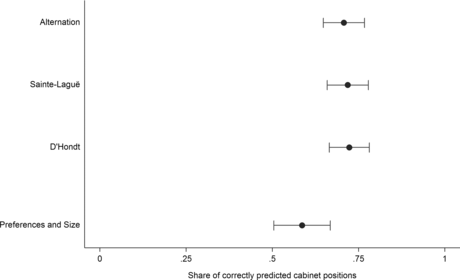
The three upper plots in Figure 2 show the share of correctly predicted cabinet positions as well as the variance in predictive success across 146 coalition governments. On average, the predictions derived from the sequential approach are correct for 71.7 per cent of all cabinet positions. Allocation following D'Hondt (72.3 per cent) performs slightly better than Sainte‐Laguë (71.9 per cent) and alternation (70.8 per cent). Albeit being small, these differences indicate that prediction success increases with the bargaining advantage of larger parties. Thus, while the numerical distribution of cabinet positions is roughly proportional for each of these mechanisms, larger parties seem to enjoy an advantage in the bargaining process as they have more options when choosing their most preferred cabinet positions.
Average share of correctly predicted cabinet positions.
Notes: Average share (dots) and standard deviation (horizontal lines) of correctly predicted cabinet positions via sequential bargaining approach and via conditional choice model based on independent process (N = 146 coalition governments).

To put the share of correctly predicted cabinet positions in perspective, we compare the prediction success of the sequential bargaining process with an alternative approach assuming mutual independence. Following Bäck et al. (Reference Bäck, Debus and Dumont2011), we estimate a conditional logit model using the empirically observed allocation as dependent variable and party size and party preferences as explanatory variables.Footnote 11 As above, predictive success is obtained via a two‐step process: first, based on the empirical results of the conditional logit model we derive the predicted probability that portfolio j is allocated to party i. Second, each portfolio j is then allocated to the cabinet party with the highest predicted probability. By comparing predicted with the actually observed allocations, we obtain the share of correctly predicted cabinet positions. The prevalent characteristic of this alternative model is that individual cabinet positions are independently distributed among cabinet parties according to each party's preferences for the respective portfolio and party size. Thus, the difference in the share of correctly predicted cabinet positions may be interpreted as the effect of substituting an independent distribution process of portfolios, where the allocation of one cabinet position (e.g., economy) does not affect that for another ministry (e.g., foreign affairs) with an interdependent sequential logic.
The lower plot in Figure 2 juxtaposes the share of correctly predicted portfolios for each cabinet based on this independent allocation process with the earlier estimates derived from an interdependent process. On average, the choice model correctly predicts 58.6 per cent of all cabinet positions. As apparent from the scheme, the estimates derived from a sequential bargaining process are substantively higher by approximately 13.1 percentage points. For a typical European cabinet with 16 portfolios, this advantage in predictive success translates to approximately two cabinet positions.
Having assessed the predictive success of the sequential approach both in absolute and relative terms, we now turn our attention to its predictive accuracy. Specifically, we study whether focusing on the share of correctly predicted cabinet positions masks any underlying differences in the estimated predicted probabilities. In any two‐party coalition, for instance, both approaches may correctly predict the allocation of a portfolio j to a coalition party i. Yet, one approach may give us a highly certain estimate (e.g., a predicted probability of 0.92 versus 0.08), while the other prediction may be derived from a probability distribution approximating a simple coin flip (e.g., a predicted probability of 0.51 versus 0.49).
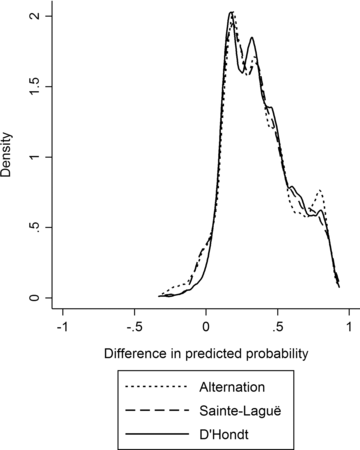
Figure 3 plots the difference in the predicted probabilities derived from the sequential allocation approach (allocation following alternation, Sainte‐Laguë and D'Hondt) and the conditional choice model based on an independent process. For a fair comparison, we include only those cabinet positions which are correctly predicted either by both or neither of them. Positive values indicate that the sequential approach is more accurate, while negative values suggest that the independent choice model is more clear‐cut. On average, the predictions of the three sequential mechanisms are more accurate for approximately 96.7 per cent of all cabinet positions. Also, the predictive accuracy is, on average, 36.6 percentage points higher than that of the selection model assuming mutual independence of portfolios. In sum, the sequential approach is superior to choice models assuming an independent allocation in terms of both predictive success and predictive accuracy.
Kernel density plot of difference in predicted probabilities.
Notes: Difference in predicted probabilities between sequential allocation approach and conditional choice model based on an independent process (Alternation: N = 1,558 portfolios; Sainte‐Laguë: N = 1,755 portfolios; D'Hondt: N = 1,785 portfolios; bandwidth = 0.04).

Finally, we turn to the empirical results concerning party preferences when choosing cabinet positions. Existing research focuses on the preferences for cabinet positions from two different perspectives: that of objective portfolio importance and that of party ideology. Analyses focusing on the quantitative portfolio distribution often highlight variation in the value of ministries (Warwick & Druckman Reference Warwick and Druckman2006) as parties pick cabinet positions with higher objective importance. In contrast, analyses on the distribution of individual cabinet positions often focus on the role of party ideology (Bäck et al. Reference Bäck, Debus and Dumont2011; Budge & Keman Reference Budge and Keman1990; Keman Reference Keman, Bara and Weale2006): accordingly, parties claim cabinet positions in charge of their core policy areas. However, it is unlikely that party preferences are exclusively driven by ministry‐ or party‐specific values attached to a cabinet position (Raabe & Linhart Reference Raabe and Linhart2014). Thus, we allow for both types of preferences and determine empirically which of these motives prevails by estimating the mixing parameters αi.
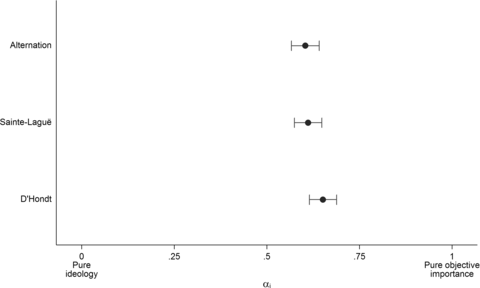
Figure 4 shows the estimated average mixing parameters αi. Higher values indicate greater emphasis given to portfolio‐specific importance, while smaller values indicate that parties pay more attention to ideological preferences when choosing cabinet positions. Although the estimates differ slightly across allocation mechanisms, they suggest that both objective importance and ideology are important when choosing cabinet positions. All estimates differ significantly from both pure motivation types – ideology (0) and portfolio importance . In particular, this means that parties are not exclusively driven by portfolio importance or by their policy‐issue emphasis, but have mixed motives.Footnote 12
Average estimates for mixing parameter αi.
Note: Point estimates (dots) and corresponding 95 per cent confidence intervals (horizontal lines) for average mixing parameters αi (N = 387 cabinet parties).

Conclusion
The distribution of cabinet positions is one of the central questions in the coalition formation process and, as such, has attracted the interest of political scientists for a long time. Most studies deal with the quantitative aspect of the bargaining outcome, analysing whether or why portfolios are allocated proportionally. In that endeavour, the more qualitative aspect of the ‘who gets what’ question has largely played the role of Gamson's ‘ugly sister’: the first attempt to predict the allocation of individual cabinet positions (Browne & Feste Reference Browne and Feste1975) was a direct response to the striking finding of almost perfect proportionality in the number of cabinet positions (Browne & Franklin Reference Browne and Franklin1973), but it never got the attention scholars attributed to the numerical division of cabinet seats.
Informed by anecdotal evidence and arguments in previous research (e.g., Budge & Keman Reference Budge and Keman1990), we propose the idea that bargaining over coalition positions follows a sequential logic: parties first bargain over cabinet positions they consider as the most important ones before turning their attention to the less important ones. This induces conditionality in the bargaining process where choices of individual cabinet positions are no longer independent of each other.
Our results based on an original dataset of Western and Central Eastern European coalition cabinets are unambiguous and provide support for the proposed sequential bargaining logic. Specifically, the empirical analysis indicates that the sequential bargaining approach is superior to assuming mutual independence in the allocation of portfolios, both in terms of prediction success and predictive accuracy. Our results also speak to the literature discussing the role of party ideology on portfolio allocation (see, e.g., Bäck et al. Reference Bäck, Debus and Dumont2011; Browne & Feste Reference Browne and Feste1975; Budge & Keman Reference Budge and Keman1990). We contend that party ideology is an important motivation for portfolio allocation, but its effect also hinges on the parties’ focus on objectively important cabinet positions and the interdependence in the allocation process.
Finally, we have seen that the sequence in coalition bargaining seems to favour larger parties over smaller ones: while the numerical distribution of cabinet positions is largely proportional, larger parties enjoy an advantage during the bargaining process as they are able to choose their most preferred positions quite early in the sequence. This suggests a ‘formateur advantage’ in the allocation of individual portfolios. While in terms of the number of cabinet positions, smaller parties may get their fair share or even get over‐compensated for their loss (Browne & Franklin Reference Browne and Franklin1973; Browne & Fendreis Reference Browne and Frendreis1980; Druckman & Roberts Reference Druckman and Roberts2005; Warwick & Druckman Reference Warwick and Druckman2001), our results suggest that larger parties are able to cherry‐pick the most desirable posts early in the allocation process.
The empirical evidence from interviews and case studies, as well as the empirical analysis of our cross‐national study, support the idea of interdependencies in the allocation process. Making reasonable assumptions about the coalition bargaining process and confronting the resulting predictions with empirical outcomes takes us some way to understand the logic of real coalition bargaining. Yet, a sequential bargaining logic is only one of many facets in the coalition bargaining process and its explanatory power is certainly limited in some contexts. One way to extend the approach put forward in this article is to consider the institutional context. For example, strong presidents may reduce the parties’ discretionary power in selecting ministers by proposing or vetoing individual ministers (Amorim Neto & Strøm Reference Amorim Neto and Strøm2006; Kang Reference Kang2009; Schleiter & Morgan‐Jones Reference Schleiter and Morgan‐Jones2009). Similarly, the rights and resources of prime ministers vary from country to country (Bergman et al. Reference Bergman, Strøm, Müller and Bergman2003), and strong prime ministers may tip the balance in the allocation process to their party's favour. Vice versa, formateur parties may devote more resources to rival actors in exchange for their support (Golder & Thomas Reference Golder and Thomas2014), especially in contexts characterised by high complexity and uncertainty (Falcó‐Gimeno & Indridason Reference Falcó‐Gimeno and Indridason2013; Laver & Schofield Reference Laver and Schofield1998) and when intraparty bargaining and factionalism affect the quantitative distribution of cabinet positions (Ceron Reference Ceron2013; Luebbert Reference Luebbert1986; Ono Reference Ono2012).
An alternative way to go forward is to increase the number of endogenous parameters. For instance, parties may change the number of portfolios and ministerial jurisdictions in the bargaining process (Mershon Reference Mershon2001; Sieberer Reference Sieberer2015; Verzichelli Reference Verzichelli, Strøm, Müller and Bergman2008). Additional ministers are often established due to arithmetic considerations when compensating hitherto under‐represented coalition parties (Budge & Keman Reference Budge and Keman1990; Indridason & Bowler Reference Indridason and Bowler2014) or in order to shadow coalition partners in key policy areas (Bergman Reference Bergman, Müller and Strøm2000). Furthermore, party preferences for individual cabinet positions may change over the course of the bargaining process. Bäck et al. (Reference Bäck, Debus and Dumont2011) show how cabinet parties use qualitative portfolio allocation and detailed policy agreements interchangeably for exerting tight control over government policies. Following their argument, one would expect decreasing returns of holding a particular portfolio when a party is successful in claiming its policy preferences in the coalition's policy agreement, and vice versa.
Another avenue for future research is to move beyond portfolio allocation and to apply the sequential bargaining logic to other allocation processes. For example, the distribution of committee chairs mimics the process laid out in this article: in most parliaments the chairs of parliamentary committees are distributed in proportion to party size (Mattson & Strøm Reference Mattson, Strøm and Döring1995). Moreover, parties have preferences for holding chairmanship over particular committees which are then used as a means to monitor cabinet ministers (Carroll & Cox Reference Carroll and Cox2012; Kim & Loewenberg Reference Kim and Loewenberg2005). Given these similarities, one could adapt the model proposed here to analyse different allocation processes beyond cabinet positions.
Acknowledgements
The authors gratefully acknowledge financial support from the Austrian Science Fund (FWF) (grant P25490) for the research project on ‘Coalition Governance in Central Eastern Europe’ in collaboration with the ‘Governments in Europe’ project (PI: Torbjörn Bergman). We thank three anonymous reviewers, Ulrich Sieberer, the panellists at the 2013 ECPR general conference, the 2014 MPSA conference, and the participants of the seminar series at the Department of Government, University of Vienna, for helpful comments and suggestions. We also thank Hannah Kieblspeck and Michael Imre for excellent research assistance.
Supporting Information
Additional Supporting Information may be found in the online version of this article at the publisher’s web-site:
Figure S1. Predictive success for different combinations of αi
Table S1. Conditional logit and mixed logit model of portfolio allocation


 Open access

