





People being treated for eating disorders have an increased risk of mortality compared with the general population. The highest mortality rates are observed in people with anorexia nervosa;Reference Arcelus, Mitchell, Wales and Nielsen1–Reference John, Marchant, Demmler, Tan and DelPozo-Banos11 however, rates appear to be elevated also in people with bulimia nervosa and eating disorders not otherwise specified (EDNOS),Reference Arcelus, Mitchell, Wales and Nielsen1,Reference Tseng, Chien, Tu and Liu5–Reference Fichter and Quadflieg7,Reference Demmler, Brophy, Marchant, John and Tan10,Reference Huas, Godart, Caille, Pham-Scottez, Foulon and Divac12,Reference Hoang, Goldacre and James13 albeit that research is more limited for these conditions.
There is also evidence that people with eating disorders have higher secondary healthcare usageReference John, Marchant, Demmler, Tan and DelPozo-Banos11,Reference Striegel-Moore, DeBar, Wilson, Dickerson, Rosselli and Perrin14–Reference Watson, Jangmo, Smith, Thornton, von Hausswolff-Juhlin and Madhoo17 and expenditureReference Tseng, Tu and Chang18 compared with the general population, but only a handful of studies have focused on physical health admissions. These found elevated risk of the latter in young people with any eating disordersReference Couturier, Gayowsky, Findlay, Webb, Sami and Chan15 and in people with binge-eating disorder,Reference Watson, Jangmo, Smith, Thornton, von Hausswolff-Juhlin and Madhoo17 and of cardiovascular admissions in women with bulimia nervosa.Reference Tith, Paradis, Potter, Low, Healy-Profitós and He16 This body of research highlights the potential clinical severity and physical health problems associated with eating disorders, but has a number of limitations. With some exceptions,Reference Demmler, Brophy, Marchant, John and Tan10,Reference John, Marchant, Demmler, Tan and DelPozo-Banos11,Reference Wood, Marchant, Allsopp, Wilkinson, Bethel and Jones19 existing studies of eating disorder mortality have been based on relatively small samples of people with eating disorders attending specialised eating disorder services; that could bias estimates if this is a subgroup of people with more severe symptoms, while also reducing statistical power. When studies have used primary care records to investigate mortality, they have either not disaggregated estimates by eating disorder diagnosisReference John, Marchant, Demmler, Tan and DelPozo-Banos11 or have not accounted for potential sociodemographic confounders, including ethnicity or deprivation.Reference Demmler, Brophy, Marchant, John and Tan10 Most research on healthcare utilisation in people with eating disorders has been based in North America,Reference Striegel-Moore, DeBar, Wilson, Dickerson, Rosselli and Perrin14–Reference Tith, Paradis, Potter, Low, Healy-Profitós and He16 has focused only on specific conditionsReference Tith, Paradis, Potter, Low, Healy-Profitós and He16–Reference Tseng, Tu and Chang18 or populations,Reference Couturier, Gayowsky, Findlay, Webb, Sami and Chan15,Reference Tith, Paradis, Potter, Low, Healy-Profitós and He16 did not disaggregate admissions by type (e.g. planned or emergency) and included relatively small sample sizes and short follow-up times.Reference Striegel-Moore, DeBar, Wilson, Dickerson, Rosselli and Perrin14,Reference Couturier, Gayowsky, Findlay, Webb, Sami and Chan15 With few exceptions, studies have also defined people with eating disorders as those receiving diagnoses in secondary settingsReference Striegel-Moore, DeBar, Wilson, Dickerson, Rosselli and Perrin14–Reference Tseng, Tu and Chang18 but, at times, have used general population controls, which could bias results.Reference Couturier, Gayowsky, Findlay, Webb, Sami and Chan15 Although several studies have investigated predictors of mortality,Reference Iwajomo, Bondy, de Oliveira, Colton, Trottier and Kurdyak2 admissionsReference Eseaton, Sanwo, Anighoro, John, Okobia and Enosolease20 and healthcare costsReference de Oliveira, Colton, Cheng, Olmsted and Kurdyak21 within eating disorder populations, inequalities in these outcomes in people with eating disorders compared with the general population have been sparsely investigated. A handful of studies investigated sex differences in mortality, with mixed findings; some found no differences,Reference Tseng, Chien, Tu and Liu5,Reference Demmler, Brophy, Marchant, John and Tan10 others observed higher mortality in womenReference Zerwas, Larsen, Petersen, Thornton, Mortensen and Bulik9,Reference Demmler, Brophy, Marchant, John and Tan10 and still others noted higher mortality in males.Reference Iwajomo, Bondy, de Oliveira, Colton, Trottier and Kurdyak2 A recent Australian study has investigated socioeconomic inequalities in hospital admissions in people with eating disorders, finding greater public out-patient and emergency admissions in those from more deprived socioeconomic backgrounds, but no other differences.Reference Ahmed, Maguire, Dann, Scheneuer, Kim and Miskovic-Wheatley22 To our knowledge, there is no evidence on whether there are ethnic differences in mortality and admissions between people with eating disorders and the general population.
Study aims
To address these limitations, we used secondary care-linked primary care electronic health records in England to investigate whether people with any and specific eating disorder diagnoses have increased mortality rates. In England, only a portion of primary care patients receive a referral to specialised services,Reference Wood, Marchant, Allsopp, Wilkinson, Bethel and Jones19 making primary care a more representative sample of all people with eating disorder compared with those presenting to eating disorder services. In this data-set, we also investigated whether people with eating disorders have increased rates of hospital admissions for physical health problems (any admissions, planned and emergency admissions and emergency admissions for accidents, injuries and substance misuse) compared with people without eating disorders. Finally, we investigated whether relative rates of mortality and admissions differed by sex, ethnicity, deprivation, age and calendar year. These have not been consistently and robustly explored in the previous literature, despite evidence of potential barriers in seeking and receiving treatment in males and people from deprived or minoritised ethnic backgrounds,Reference Sangha, Oliffe, Kelly and McCuaig23,Reference Sonneville and Lipson24 which could translate to worse outcomes for these populations.
Method
Sample
We used data from the UK Clinical Practice Research Datalink (CPRD Gold and Aurum, constituting of a subset of all English primary care practices) linked to the Hospital Episode Statistics (HES) Admitted Patient Care data-set, using pseudonymised unique patient identifiers (Supplementary Method 1). The Independent Scientific Advisory Committee of CPRD approved this study (protocol no. 18_288).
In the main analytical sample, we included people who were registered at a CPRD primary care practice in England with HES linkage between 1 January 2000 and 31 December 2018, and who had at least one clinical code for an eating disorder (list provided in Supplementary Method 2) recorded between the ages of 11–60 years, and between 1 January 2000 and 31 December 2017, to allow at least 1 year of potential follow-up. Each person was matched with up to four patients with no record of an eating disorder. Matching was performed by CPRD based on year of birth, sex, primary care practice, year of GP registration and index date. All individuals were required to have at least 1 year of follow-up data after the diagnosis date. Main analyses were restricted to people included in CPRD who had records linked to HES, to ensure sample comparability between people included in analyses of mortality and admissions (derived from HES linkage). As sensitivity analyses, we repeated the mortality analyses in the full primary care data-set (i.e. including Wales, Scotland and Northern Ireland) to increase sample size.
Eating disorder diagnoses
The primary exposure was whether an individual had any eating disorder diagnosis versus none. As a secondary exposure, we compared individual eating disorder diagnoses with not having such a diagnosis. Records of eating disorder diagnoses were derived from primary care Read codes and included the following categories: anorexia nervosa, bulimia nervosa and EDNOS (further details in Supplementary Method 3). In addition to these diagnoses there were two groups of people, one with a generic ‘eating disorder’ code and one with a code indicating that a ‘referral to an eating disorder service’ had been made, but who were never subsequently given a more specific diagnostic code. We kept these two groups separate because we were not able to link their codes to a specific diagnosis.
Outcome: mortality and hospital admissions for physical health problems
Primary study outcomes were all-cause mortality (defined using date of death recorded in primary care records) and any in-patient hospital admission (defined as a spell of continuous hospitalisation in a single hospital) for physical health problems defined using ICD-10 diagnoses as primary diagnoses. Secondary study outcomes were planned and emergency admissions for (a) physical health problems and (b) accidents, injuries and substance misuse. We identified secondary care admissions through linkage with the admitted patient care HES data-set (Supplementary Method 4). We excluded admissions for maternity, regular attenders for the same condition (e.g. cancer treatment) and any resulting from transfer from another hospital, including mental health settings.
Confounders
As potential confounders of the associations under study, we included age at eating disorder diagnosis; sex (male/female); ethnicity (categorised as Asian, Black, Mixed, Other or White); deprivation captured using the Index of Multiple Deprivation (IMD; definition given in Supplementary Method 5) associated with an individual’s home address and split in fifths of distribution; and calendar year of eating disorder diagnosis. The only variable with missing data was ethnicity and, where this was missing, we recoded it as White. Because the CPRD population has been found to be representative of the UK population in terms of ethnicity,Reference Herrett, Gallagher, Bhaskaran, Forbes, Mathur and van Staa25 93% or more of individuals with missing ethnicity would be expected to be of White ethnicity. This approach is in line with other research studies using CPRD data,Reference Launders, Kirsh, Osborn and Hayes26 and with the findings of studies showing that their results were comparable when using either this approach or multiple imputation to impute missing ethnicity data.Reference Launders, Hayes, Price and Osborn27
Data analysis
In reporting results, we followed STROBE guidelines (Supplementary Method 6). We described the sample using frequencies and proportions. To investigate whether those with any, or a specific, eating disorder diagnosis were at increased risk of all-cause mortality we used Cox regression models, after confirming that the proportionality of hazards assumption was met. To investigate whether people with any, or a specific, eating disorder diagnosis had a higher incidence of admissions, we used Poisson regression models. In both sets of analyses we first ran a univariable analysis followed by a multivariable analysis, adjusting for the patient’s sex, ethnicity, age, deprivation, region and calendar year, clustering analyses by primary care practice. Participants were followed up from the day they received an eating disorder diagnosis (the same date was used for non-exposed patients) until they died, changed practice or the end of the study, whichever occurred first.
We further investigated whether people with and without eating disorders had differential mortality and admission rates, based on sex, ethnicity, age, deprivation and calendar year, by testing for an interaction between each of these variables and the exposure in multivariable models. In these analyses we grouped all eating disorder subtypes in order to increase statistical power. Finally, for admission analyses, we also presented crude admission rates by specific condition based on broad ICD-10 code classification.
As sensitivity analyses, and to increase statistical power we re-ran analyses of all-cause mortality on the full CPRD cohort of people, i.e. without restricting to participants with HES linkage. Here, we did not adjust for IMD because the latter is available only on the subset of individuals with linked data. All analyses were conducted in R version 4.2.3. Ethical approval for this study was obtained from the Independent Scientific Advisory Committee of CPRD.
Results
Sample
A total of 33 526 people aged 11–60 years received an eating disorder diagnosis in a CPRD-registered primary care practice between 1 January 2000 and 31 December 2017. After matching these individuals to 4 people without eating disorders, we obtained a sample of 167 630 people, which we used in sensitivity analyses of all-cause mortality. Of these people, 58 735 (35.0%; 12,129 with and 46 606 without an eating disorder diagnosis) had linked HES records and were therefore included in our main analytical sample.
The majority of the sample was female (n = 52 949, 90.1%), of White ethnicity (n = 53 819, 91.6%) and under 30 years of age (n = 44 260, 75.3%). A greater proportion of people lived in the least deprived (n = 13 402, 22.8%) compared with the most deprived areas of England (n = 8973, 15.3%). The distribution of age and sex did not differ in those with and without eating disorders, because individuals were matched on these characteristics. However, there was a greater proportion of White people (94.6 v. 90.8%) and fewer people living in the most deprived areas (21.8 v. 23.1%) among those with an eating disorder than in those without, respectively (Table 1).
Sample characteristics. Participants with linked HES data (N = 58 735)

HES, Hospital Episode Statistics; EDNOS, eating disorders not otherwise specified; CPRD, Clinical Practice Research Database.
Among those with eating disorders, the most common diagnosis was EDNOS (n = 3542, 29.2%), followed by a generic eating disorder code (n = 2851, 23.5%), a diagnosis of anorexia nervosa (n = 2513, 20.8%), a diagnosis of bulimia nervosa (n = 2186, 18.0%) and a referral code only (n = 1037, 8.5%). Fewer men and people from ethnic minority backgrounds, and a greater proportions of people aged 11–20 years, were diagnosed with anorexia nervosa and bulimia nervosa compared with EDNOS and generic eating disorder diagnoses (Table 1).
All-cause mortality
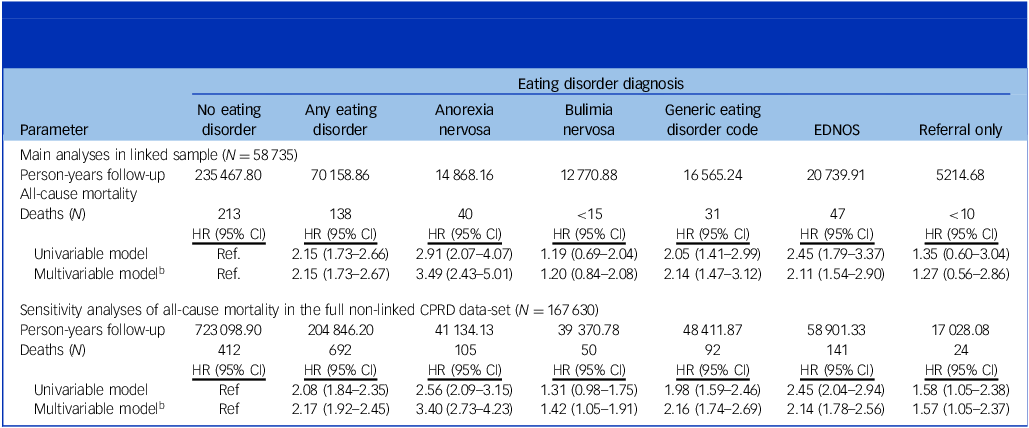
People with any eating disorder diagnoses had higher rates of all-cause mortality (multivariable hazard ratio (mHR): 2.15, 95% CI: 1.73–2.67). People with anorexia nervosa had the most elevated hazard ratios for all-cause mortality (mHR: 3.49, 95% CI: 2.43–5.01); these ratios were also elevated for those with EDNOS (mHR: 2.11, 95% CI: 1.54–2.90) and a generic eating disorder diagnosis (mHR: 2.14, 95% CI: 1.47–3.12). There was no evidence that mortality rates were elevated in people with bulimia nervosa (mHR: 1.20, 95% CI: 0.84–2.08), or in those with a single referral code (mHR: 1.27, 95% CI: 0.56–2.86; Table 2). Proportional hazards assumptions were met (Schoenfeld P = 0.87 for main analyses and P = 0.73 for diagnosis-specific analyses), suggesting that the observed increased risk of mortality was constant across the follow up period.
Univariable and multivariable Cox regression analyses for the association between eating disorder diagnoses and all-cause mortality. Main analyses based on the sample of patients with linked CPRD-HES data and complete IMDa data (N = 58 735), and sensitivity analyses based on the full non-linked CPRD sample (N = 167 630)

CPRD, Clinical Practice Research Database; HES, Hospital Episode Statistics; IMD, Index of Multiple Deprivation; EDNOS, eating disorders not otherwise specified; HR, hazard ratio.
a . In sensitivity analyses, IMD was not available across all four UK countries and was thus not adjusted for.
b . Multivariable model adjusted for gender, ethnicity, age, calendar year and IMD.
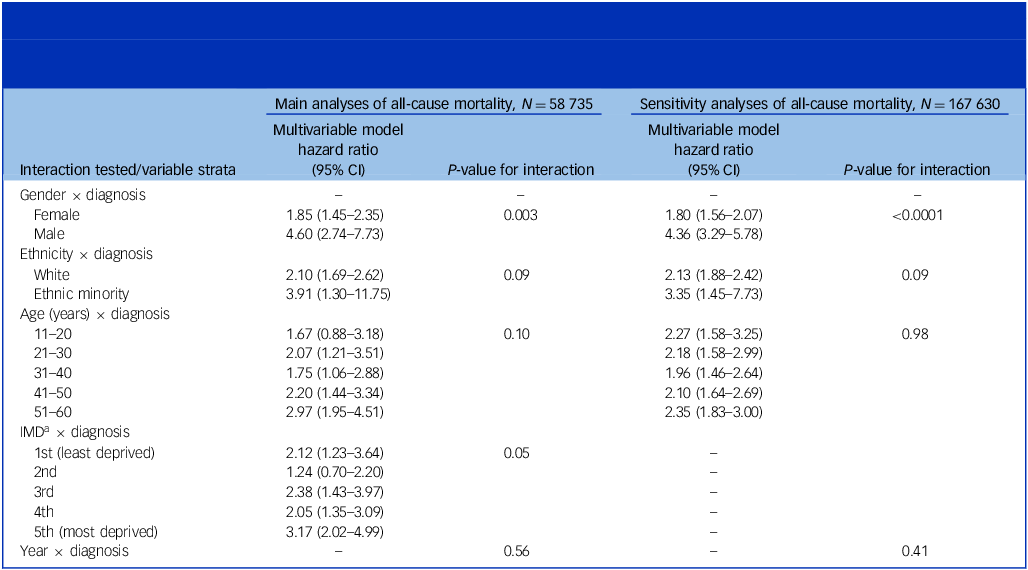
There was strong evidence that mortality hazard ratios were more elevated in males (mHR: 4.60, 95% CI: 2.74–7.73) than in females (mHR: 1.85, 95% CI: 1.45–2.35) with any eating disorder (interaction P = 0.0038). Evidence of differences by other sociodemographic characteristics was weak for deprivation (interaction P = 0.05, least deprived IMD fifth hazard ratio: 2.12, 95% CI: 1.23–3.64; most deprived IMD fifth hazard ratio: 3.17, 95% CI: 2.02–4.99) and ethnicity (P = 0.09; White ethnicity hazard ratio: 2.10, 95% CI: 1.69–2.62; ethnic minority hazard ratio: 3.91, 95% CI: 1.30–11.75). There was no evidence of other interactions (Table 3).
Stratified analyses for the association between any eating disorder diagnosis and all-cause mortality. P-values presented refer to those for the interaction between exposure (any eating disorder diagnosis versus no eating disorder) and sociodemographic characteristics fitted in the multivariable Cox regression analyses of all-cause mortality presented in Table 2. Analyses based on the main analytical sample (N = 58 735), as well as the full unlinked CPRD dataset used for sensitivity analyses (N = 167 630)

CPRD, Clinical Practice Research Database; IMD, Index of Multiple Deprivation.
a . IMD was not available across all four countries in the sample used for sensitivity analyses, and hence was not used.
Physical health admissions
Any physical health admissions
There was strong evidence that people with eating disorders had a higher incidence of any physical health hospital admissions (multivariable incidence rate ratio (mIRR): 1.99, 95% CI: 1.94–2.05). Rate ratios were most elevated in patients with anorexia nervosa (mIRR: 2.28, 95% CI: 2.17–2.40) and lowest in those with a generic eating disorder code (mIRR: 1.62, 95% CI: 1.54–1.71; Table 4).
Uni- and multivariable Poisson regression analyses for the association between eating disorder diagnoses and admissions for physical health problems. Sample of participants with linked CPRD-HES data and complete IMD data (N = 58 735)

IRR, incidence rate ratio; CPRD, Clinical Practice Research Database; HES, Hospital Episode Statistics; IMD, Index of Multiple Deprivation; EDNOS, eating disorders not otherwise specified.
a . Multivariable model adjusted for sex, ethnicity, age, calendar year and IMD.
Cause-specific admissions
There was strong evidence that people with eating disorders had elevated rates of admission across all physical health-related causes. Rate ratios were most elevated for admissions for accidents, injuries and substance misuse (mIRR: 5.26, 95% CI: 5.24–6.29), followed by emergency admissions (mIRR: 1.67. 95% CI: 1.62–1.72) and planned admissions (mIRR: 2.35, 95% CI: 2.25–2.46). Overall, we observed this pattern across all diagnoses (Table 4).
Patients with anorexia nervosa (mIRR: 7.07, 95% CI: 6.20–8.05) and bulimia nervosa (mIRR: 6.42, 95% CI: 5.53–7.42) had the most elevated rate ratios for emergency admissions for accidents, injuries and substance misuse, whereas other emergency admissions were most elevated for patients with anorexia nervosa (mIRR: 3.11, 95% CI: 2.89–3.34) and EDNOS (mIRR: 2.49, 95% CI: 2.32–2.66). Incidence rate ratios of planned admissions were highest for patients with EDNOS (mIRR: 2.16, 95% CI: 2.05–2.23; Table 4).
With the exception of ear disorders, where admission rates were low or comparable between people with and without eating disorders, the former had higher rates of physical health admissions for all other ICD-10 broad categories of disorder. People with eating disorders had particularly elevated rates of endocrine disorders (especially those with anorexia nervosa) and disorders of the digestive and genito-urinary systems. People with bulimia nervosa had the highest rates of cardiovascular diseases, and those with anorexia nervosa and EDNOS the highest rates of cancer (Supplementary Table 1).
Interactions with sociodemographic characteristics
There was evidence (interaction P = 0.01) that the association between having any eating disorder and any physical health admission was more pronounced in males (mIRR: 2.28, 95% CI: 2.07–2.51) compared with females (mIRR: 1.97, 95% CI: 1.91–2.33). There was also weak evidence that this association varied by IMD (interaction P = 0.06), with some evidence of more elevated rate ratios in those living in the more deprived areas, although 95% CIs mostly overlapped (Table 5). There was no evidence of other interactions.
Stratified analyses for the association between any eating disorder diagnosis and admissions for physical health problems. P-values presented refer to those for the interaction between exposure (any eating disorder diagnosis versus no eating disorder) and sociodemographic characteristics fitted in the multivariable Poisson regression analyses of all-cause mortality presented in Table 4. Analyses based on the main analytical sample (N = 58 735)

Sensitivity analyses
When we repeated the all-cause mortality analyses in the full primary care sample, regardless of secondary care linkages and IMD data availability (N = 167 630), results were comparable to those of the main analyses but 95% CIs were more precise around the estimates (Tables 2 and 3). In contrast to the main analyses, here we observed strong evidence of increased mortality rates in patients with bulimia nervosa (mHR: 1.42, 95% CI: 1.05–1.91) and in those who only ever received a referral code (mHR: 1.57, 95% CI: 1.05–2.37), compared with people without eating disorders.
Discussion
In this large cohort study using primary care electronic health records linked to secondary care, we describe patterns of mortality and physical health admission rates in people with eating disorders compared with a matched group of people without eating disorders. We found that people with anorexia nervosa had over threefold rates of all-cause mortality compared with those without eating disorders, and that those with a generic eating disorder code, or EDNOS, had up to twofold increased rates. These findings from a population cohort corroborate previous literature based on samples of patients in secondary care settings showing elevated mortality rates, in particular in those with anorexia nervosa.Reference Arcelus, Mitchell, Wales and Nielsen1,Reference Tseng, Chien, Tu and Liu5–Reference Fichter and Quadflieg7,Reference Huas, Godart, Caille, Pham-Scottez, Foulon and Divac12,Reference Hoang, Goldacre and James13 Our study expands on these earlier studies by observing increased mortality in patients identified in primary care and across eating disorder diagnoses, including those considered as having subthreshold levels of severity or lacking a distinct diagnosis.
As far as we are aware, this is the first study to compare patterns of admissions for physical health problems in people with and without eating disorders in England, both overall and by diagnosis. We found that people with eating disorders had high rates of admission, with progressively higher rate ratios observed for planned admissions, emergency admissions for physical health problems and emergency accidents, injuries and substance misuse. We also observed several distinct patterns. Patients with anorexia nervosa and bulimia nervosa had the most elevated rate ratios of emergency accidents, injuries and substance misuse, which could denote episodes of self-harm or attempted suicide. Clinical and general population evidence suggests that self-harm is common across eating disorder diagnoses, and particularly in people with bulimia nervosaReference Cucchi, Ryan, Konstantakopoulos, Stroumpa, Kaçar and Renshaw28,Reference Pisetsky, Thornton, Lichtenstein, Pedersen and Bulik29 and purging behaviours,Reference Warne, Heron, Mars, Moran, Stewart and Munafò30 whereas a recent systematic review found that the 12-month prevalence of substance use disorder was elevated in both bulimia nervosa (6.0%) and anorexia nervosa (12.0%).Reference Bahji, Mazhar, Hudson, Nadkarni, MacNeil and Hawken31 Finally, albeit only in descriptive analyses, we observed associations with endocrine (particularly for anorexia nervosa), digestive, genito-urinary and cardiovascular (particularly for bulimia nervosa) conditions, which have all been previously described in this population.Reference Tith, Paradis, Potter, Low, Healy-Profitós and He16,Reference Haines32–Reference Suszko, Sobocki and Imieliński37 We also found a large incidence of cancer in patients with anorexia nervosa and EDNOS. Previous studies found lower incidence of some cancers (e.g. breast cancer) in anorexia nervosa but higher incidence of other cancers (e.g. lung or oesophageal) in this population.Reference Catalá-López, Forés-Martos, Driver, Page, Hutton and Ridao38
When we investigated whether patterns of mortality and physical health admissions differed by sociodemographic characteristics, we observed some stark differences. Despite having a lower incidence of eating disorders compared with women, men had more elevated rate ratios of mortality and admissions, albeit that differences in the latter were less pronounced. This finding could mean that men might have more severe eating disorder presentations at diagnosis and/or might be less able to access eating disorder services promptly. Although research is limited, both quantitative and qualitative studies converge in showing that men might face diagnostic delays in seeking and receiving treatment, potentially due to internalised stigma, and may be faced with largely female-based eating disorder-related health information provided when receiving care, making treatment less accessible.Reference Sangha, Oliffe, Kelly and McCuaig23 Similarly, although in England the recorded incidence of eating disorders is higher in more affluent areasReference Wood, Marchant, Allsopp, Wilkinson, Bethel and Jones19 – a trend in contrast with prevalence figures coming from general population samples,Reference Solmi, Hatch, Hotopf, Treasure and Micali39,40 we observed weak evidence pointing to higher mortality in people living in the most deprived areas compared with those living in more affluent areas. However, confidence intervals were wide and overlapped with those of other estimates. There was also weak evidence of interactions by deprivation for admissions but, although point estimates were higher for people living in more deprived areas, here too confidence intervals overlapped across estimates. Lastly, we also observed weak evidence of potentially increased mortality in ethnic minority compared with White individuals with eating disorders. Although results relating to ethnicity and deprivation were inconclusive, possibly due to our sample being underpowered to detect such differences, it has been shown that people living in more deprived areas and those from ethnic minorities might experience difficulties accessing eating disorder services. A US-based study found that, among students with symptoms of eating disorders, those from more deprived socioeconomic backgrounds had lower odds of perceiving the need for, and receiving, eating disorder treatment, and that people from ethnic minority backgrounds were less likely to have received an eating disorder diagnosis and treatment.Reference Sonneville and Lipson24 People from a more disadvantaged socioeconomic position might also experience greater barriers in engaging with eating disorder treatment, due to direct and indirect costs associated with attending treatment.Reference Bailey-Straebler, Glasofer, Ojeda and Attia41 Future research should further investigate disparities in diagnostic, referral and treatment patterns by sociodemographic and socioeconomic characteristics in UK data as a way to better understand the sources and mechanisms underpinning these potential inequalities. Finally, we observed no differences in mortality and admission trends according to calendar year of diagnosis. This finding is worrying, because it suggests that, despite efforts aimed at expanding access to eating disorder services, this has not yet resulted in improvements in patients’ overall health outcomes, and leads to calls for improvement in eating disorder treatment.
Limitations
Our results need to be interpreted in light of some limitations. Despite a sample size of nearly 60 000 individuals, mortality analyses might have been underpowered due to the low number of outcome events observed, particularly in diagnosis-specific analyses. Therefore, we repeated mortality analyses on the full primary care data-set. The results of these sensitivity analyses are in line with those of the main analyses, but allowed us to detect smaller effects with greater precision. Statistical power considerations also limited our ability to investigate associations with natural and unnatural causes of death (available only in HES-linked data), because the latter represented only a small proportion of total events.
There are also potential biases associated with the use of electronic health records. For instance, there is potential for misclassification in the exposure, particularly for people with generic eating disorder codes or referral codes – who could be patients on waiting lists for eating disorder services where diagnoses might be confirmed – for whom we could not identify a specific diagnosis. We also found higher rates of cancer-related admissions in participants with anorexia nervosa and EDNOS. While associations with this outcome should be further investigated, we cannot exclude that this pattern might be observed because, in some instances, anorexia nervosa cases included in our dataset could have indicated ‘anorexia’, which is common in patients with cancer. To limit this possibility, in the anorexia nervosa definition we did not include Read codes that mentioned only ‘anorexia’ and in the EDNOS diagnosis we did not include any codes related to weight loss with organic bases. Nevertheless, we cannot exclude recording errors.
Although cases of eating disorders identified in primary care might be more representative than those seen in secondary care, since a minority of cases are referred,Reference Wood, Marchant, Allsopp, Wilkinson, Bethel and Jones19 they are nevertheless a minority of those seen in the general populationReference Solmi, Hatch, Hotopf, Treasure and Micali39 and might be a biased sample because access to care could vary across sociodemographic characteristics.Reference Sonneville and Lipson24 We also cannot exclude the potential for Berkson’s bias, which could occur if our exposed population is one with greater physical health problems, hence resulting in both greater likelihood of eating disorders being identified and physical health problems.
A large proportion of the sample had missing data on ethnicity. We took the approach, previously used in other studies, to replace missing ethnicity data with White ethnicity. However, due to small sample size, we were unable to break down ethnicity into more specific categories and explore group-specific associations. This could help inform future guidelines and policies and should be explored in the future in data-sets with larger sample sizes.
Eating disorders are a severe psychiatric condition that are marked by high mortality rates and frequent hospital admissions. Although mortality was highest for anorexia nervosa, we observed elevated mortality and admissions across the full spectrum of threshold and subthreshold eating disorder diagnoses. We also observed markedly worse outcomes for specific groups, particularly males. Future research should investigate the mechanisms underlying these inequalities in outcomes, including coexisting physical conditions and the predominant diagnoses accounting for deaths. This would help to target preventative efforts. In the meantime, our findings call not only for improvements in eating disorder treatment (including access to specialist eating disorder services) across the spectrum of diagnoses and sociodemographic groups, but also in the management of eating disorders in primary care. Currently, National Institute for Health and Care Excellence guidelines recommend only annual physical and mental health checks for people with anorexia nervosa. The extent to which these are currently undertaken should also be investigated and, given the severity in outcomes we observe, this recommendation should be extended to all eating disorder diagnoses.
Supplementary material
The supplementary material can be found online at https://doi.org/10.1192/bjp.2025.69
Data availability
The data used in this study are not publicly available, because electronic health records are considered sensitive data in the UK. As such, and in line with the Data Protection Act, they cannot be shared in open access repositories due to information governance restrictions in place to protect patient confidentiality. Clinical Practice Research Datalink and Hospital Episodes Statistics data can be accessed once approval has been obtained through an application to the Clinical Practice Research Datalink.
Author contributions
F.S. conceptualised the study, with contributions from all authors. F.S. and A.J. had access to the data-set. A.J. conducted all statistical analyses, with supervision from F.S. All authors contributed to interpretation of results. F.S. and A.J. wrote the manuscript. All authors provided comments and feedback on the manuscript at different stages, and F.S. had final responsibility for the decision to submit for publication.
Funding
This work was supported by a grant from the Former EMS (registered charity no. 1098725) to F.S., J.F.H., D.O. and G.L. A.J. was funded by the National Institute for Health and Care Research (NIHR). F.S. was funded by a Sir Henry Wellcome Fellowship (grant code 209196/Z/17/Z) and a Wellcome Career Development Award (grant code 225993/Z/22/Z) for the duration of this study. H.B. is supported by a NIHR Advanced Fellowship (no. NIHR302271). D.O. is supported by the University College London Hospitals NIHR Biomedical Research Centre and NIHR North Thames Applied Research. J.F.H. is supported by UK Research and Innovation grant no. MR/V023373/1, the University College London Hospitals NIHR Biomedical Research Centre and the NIHR North Thames Applied Research Collaboration.
Declaration of interest
J.F.H. has received consultancy fees from the Wellcome Trust and Juli Health. J.F.H. and G.L. are members of the British Journal of Psychiatry editorial board; they did not take part in the review or decision-making process of this paper. All other authors have no conflicts of interest to declare.



 Open access


eLetters
No eLetters have been published for this article.