


2.1 Introduction
The Bresciani case is one of a group of early cases in which the legal effect of Community agreements, and their nature as a source of law, was considered and the first case in which a provision of the Yaoundé Convention was explicitly found to have direct effect.Footnote 1 In Haegeman, two years earlier, the Association Agreement with Greece had been declared to be an ‘integral part of Community law’, opening the way for preliminary references on the interpretation of Community agreements, as well as the possibility of direct effect.Footnote 2 During this period (between the early 1970s and the mid 1980s) a number of issues relating to the direct effect of international agreements were thrashed out, but ambiguities remained – and still remain.
This chapter explores the way in which the specific context of the Bresciani case, the trade relations established by the Yaoundé Convention between the Community and some of its former colonies, both influenced the Court’s presentation of direct effect in Bresciani itself and raised questions about the relationship – still not transparent – between direct effect and the reciprocal (or non-reciprocal) nature of a trade agreement, in particular agreements founded on relationships of integration with the EU. In Bresciani, non-reciprocity was a signifier of the closeness of the relationship established by the Yaoundé agreement, and direct effect both a manifestation and an instrument of the integration of former colonies into the Community trading system. This reasoning has been influential in the interpretation of integration-led agreements beyond the postcolonial context of Yaoundé. In focusing on the Bresciani case, we shed light on the way the EU’s complex colonial and decolonization inheritance has shaped the legal concept of direct effect in its integration-led trade agreements, and indeed the nature of the EU’s emerging external relations in the 1970s and beyond.
The chapter starts with a brief introduction to the background to the Yaoundé Conventions which were at issue in Bresciani (Section 2.2), before going on to the judgment itself (Section 2.3), some comments on subsequent case law and practice in relation to direct effect (Section 2.4) and an assessment of the ongoing significance of the case (Section 2.5).
2.2 The Yaoundé Convention: Background and Negotiation
The Schuman Declaration of 9 May 1950 claimed that ‘with increased resources Europe will be able to pursue the achievement of one of its essential tasks, namely, the development of the African continent’.Footnote 3 The Preamble to the original Treaty of Rome included a reference to the ‘solidarity which binds Europe and overseas countries’ – a reference which is still found today in the Preamble to the Treaty on the Functioning of the European Union (TFEU). France and Belgium in particular had pressed for the inclusion of specific provision in the EEC Treaty for their colonies, or overseas countries and territories (OCTs) as they were termed,Footnote 4 and in the event the EEC Treaty’s Part IV established a ‘special system of association’ for ‘the non-European countries and territories [with] which [the Member States] have special relations’.Footnote 5
According to Article 132 EEC, ‘Such association shall have the following objects … Member States shall, in their commercial exchanges with the countries and territories, apply the same rules which they apply among themselves pursuant to this Treaty.’
Article 136 EEC provided for an initial five-year Implementing Convention, that was therefore due to expire in 1962, and for its replacement by the Council with ‘provisions … for a further period’. In addition to this deadline, some of the OCTs had become independent, and the early introduction of the common external tariff gave rise to the need to revise the import tariff regime.Footnote 6
These factors pointed to the need for a new agreement between the EEC and the newly independent former colonies.Footnote 7 The Council decided in October 1960 to embark on negotiations for a new agreement, and these opened in January 1961. The first Yaoundé Convention came into force in 1965 and was replaced after five years with Yaoundé II (1970–1975), and then – after the first EEC enlargement – with the geographically broader Lomé Convention.Footnote 8 The legal basis of these agreements was Article 238 EEC, providing for association agreements between the EEC and third countries.Footnote 9 According to Frisch, the use of the term ‘association’ in Part IV to describe the relationship between the EEC and the OCTs under colonial rule gave rise to an unwillingness on the part of some newly independent states to enter into an ‘association’ with the EEC on the basis of Article 238 EEC.Footnote 10 Indeed some chose not to do so.Footnote 11 And in fact, in Bresciani, both Advocate General Trabucchi and the Court emphasized the continuity between the original OCT association based on Article 136 EEC, and the Yaoundé Convention based on Article 238 EEC.
The French and Belgian insistence on including provision for the OCT in the Treaty of Rome was thus a significant factor in ensuring that the Community embarked upon a development policy, and the principles of that policy, being set out in the treaty itself, were (we might say) constitutionalized. Thus the Commission argued that the new association agreement – a building block of the EU’s nascent development policy – was bound to espouse the objectives set out in Article 131 EEC: close economic relations with the OCTs, their economic and social development and ‘the furthering of the interests and prosperity of the inhabitants of these countries and territories in such a manner as to lead them to the economic, social and cultural development which they expect’.Footnote 12 As we shall see, in Bresciani these objectives will be linked by the Court to the non-reciprocal character of the Yaoundé Convention.Footnote 13 Yaoundé was concluded with African countries with colonial links to France and Belgium and was therefore regional in nature. Germany and the Netherlands, and subsequently the Commission, were keen to expand EEC relations to other newly independent states in Africa and beyond (as reflected in the Arusha agreement with Kenya, Uganda, Tanzania).Footnote 14 As Bartels has pointed out, these colonial relationships shaped EU development policy over decades and the EU’s postcolonial ‘preferences’ towards some developing countries have only relatively recently been subject to challenge and adjustment.Footnote 15 The purpose of this chapter, however, is not to trace that influence, but rather to explore the ways in which the Court’s interpretation in the Bresciani case of the economic integration found in the Yaoundé Convention has shaped its approach to the direct effect of trade agreements outside the development policy context.Footnote 16
2.3 The Bresciani Case
The Bresciani case, perhaps fortuitously, concerned a public health inspection charge payable on goods (animal hides) imported into Italy from another Member State (France) and a Yaoundé party (Senegal). The question was whether the charge was a ‘charge of equivalent effect to a customs duty’ (CEE) and as such prohibited in intra-EU trade (Article 13(2) EEC) and Yaoundé trade (Article 2(1) Yaoundé). From the start, then, the Court was asked to consider Yaoundé alongside the EEC Treaty. The questions from the national court concerned the direct effect of the Yaoundé provision and whether the concept of CEE in Article 13(2) EEC also applied under Yaoundé.
In the background of the case were, on the one hand, earlier cases on the interpretation of the equivalent provision of the EEC Treaty,Footnote 17 and, on the other hand, the Haegeman judgment, according to which international agreements concluded by the Community are an ‘integral part’ of Community law and subject to the interpretational jurisdiction of the Court of Justice,Footnote 18 and the International Fruit Company cases of a few years earlier in which it had been held that The General Agreement on Tariffs and Trade (GATT) was not capable of creating directly effective rights.Footnote 19 The case prompted the question whether the potential for direct effect was a characteristic of the EEC Treaty not to be shared with other international agreements, or whether the ruling on the GATT was a particular case not necessarily to be extended to others. In its judgment, the Court initiated a line of case law on the direct effect of international agreements, an approach which – in its Bresciani foundations – owed a great deal to the way in which the EEC envisaged its relations with its Member States’ former colonies, but which has since been applied much more broadly within the EU’s sphere of influence.Footnote 20
The Commission, in its submission, based its argument on the fact that Article 2 of the Yaoundé Convention expressly referred to the corresponding provisions of the EEC Treaty; in its view, since those provisions create directly effective rights, so too must Article 2 of Yaoundé.Footnote 21 The applicants too dwelt on this point, as well as relying on the origins of the Yaoundé Convention in Articles 131–136 EEC and on the Haegeman case.Footnote 22 No Member State government made submissions in the case.Footnote 23 While these arguments of the Commission and the applicants find their way into the judgment, the broader issues of direct effect and reciprocity discussed by the Court appear to have been prompted by the advocate general.
In his opinion, Advocate General Trabucchi started from the context in which the Yaoundé Conventions were concluded, emphasizing the continuity between the association with the OCTs established by Article 136 EEC and the Yaoundé Convention, and the express reference in Article 2(1) Yaoundé I to the corresponding provisions of the EEC Treaty, including Article 13 EEC.Footnote 24 Although Yaoundé II does not make this express reference, he attached no significance to that change.Footnote 25 While accepting that provisions of international agreements would not necessarily carry all the implications of similarly worded provisions in the EEC Treaty, he argued that there is no reason to suppose that the prohibition of customs duties and CEE in the Yaoundé Conventions was intended to mean anything different from its meaning in the EEC Treaty. Trabucchi went on to consider the issue of direct effect. He argued that reciprocity (‘whether, in the light of its subject-matter and objectives, the international agreement with which we are concerned is based strictly on the principle of reciprocity’) is relevant, not because direct effect depends on reciprocal implementation, but as indicating whether the agreement is in principle capable of direct effect.Footnote 26 Rejecting the possibility that all Community agreements as a matter of principle should be capable of direct effect, and stressing the difference between international law and Community law,Footnote 27 he went on to recognize the specificity of the Yaoundé Conventions, their continuity with the treaty provisions on OCTs and their development objectives, reflected in their non-reciprocity and the fact that they offered ‘privileges’ (his word) to the associated countries.Footnote 28 He expressly reserves his views on the question whether the Community’s international agreements in general may be capable of direct effect, basing himself on the special nature of the Yaoundé Conventions. The advocate general went on to find that the provision of the Yaoundé Convention at issue in the case, Article 2(1), satisfied the conditions for the creation of directly effective rights, as did its counterpart in the EEC Treaty.Footnote 29
The Court’s judgment, as far as concerns its interpretation of the Yaoundé Convention, followed the same line of reasoning as the advocate general.Footnote 30 Its starting point is the question of direct effect and the basis on which this is to be determined: ‘regard must be simultaneously paid to the spirit, the general scheme and the wording of the Convention and of the provision concerned’.Footnote 31 Then, turning to the Convention, the Court starts with explaining its continuity with the provision for OCTs in Part IV EEC. It points to the absence of reciprocity in both Articles 2 and 3 (which provide for the removal of tariff and non-tariff barriers) and Article 61 (which envisages that provisions of the Convention, including Article 2, may be applied by the Community and Member States to countries which are as yet unable to reciprocate).Footnote 32 Whereas under Article 2 all customs duties and charges of equivalent effect will be abolished on imports into the EEC from the associated states, Article 3 provides that ‘each Associated State may retain or introduce customs duties and charges having an effect equivalent to such duties which correspond to its development needs or its industrialization requirements or which are intended to contribute to its budget’. As the Court concludes, ‘equality of obligation’ was not the aim of the Convention: ‘It is apparent from these provisions that the Convention was not concluded in order to ensure equality in the obligations which the Community assumes with regard to the associated states, but in order to promote their development in accordance with the aim of the first Convention annexed to the Treaty’.Footnote 33
However, in the Court’s view, this lack of reciprocity or ‘imbalance’ which is inherent in the ‘special nature’ of the Convention ‘does not prevent recognition by the Community that some of its provisions have a direct effect’.Footnote 34 Having decided that there is no structural barrier to direct effect, the Court turned to the specific provision. Here the Court relied on the automaticity of the obligation in Article 2 of Yaoundé, and the fact that it is not subject to any reservation on the part of the Community, as well as its explicit reference to Article 13 EEC: ‘By expressly referring, in Article 2 (1) of the Convention, to Article 13 of the Treaty, the Community undertook precisely the same obligation towards the associated states to abolish charges having equivalent effect as, in the Treaty, the Member States assumed towards each other’.Footnote 35
So, in Bresciani, directly effective rights, ‘which the national courts of the Community must protect’ – a part of the special character of Community law – may arise also from a development agreement which is special in the types of relations it establishes: based not on reciprocity of obligation and explicitly linked to the Community system. In holding that non-reciprocity of obligation is not a barrier to direct effect the Court linked the direct effect of the Convention with its ‘special nature’; and that specificity was derived from its postcolonial (and development) context, which (in the words of Trabucchi) were the basis of a ‘privileged’ relationship. This is in contrast to the fully reciprocal GATT which had been found incapable of direct effect in the International Fruit Company case.Footnote 36
Thus the non-reciprocal nature of the relationship was a signifier of its closeness, of the degree to which the associated states were integrated into the Community system, a form of integration of which direct effect was a part. Reciprocity (or its absence) was also, a few years later, to play a part in defining the ‘essential characteristics’ of Community law, the Court rejecting the idea that Member States were entitled, in the case of a breach of obligation by another Member State, to reciprocate by suspending performance of their treaty obligations.Footnote 37 In this sense, non-reciprocity is both characteristic of the special nature of European integration, and linked to the integration between the EEC and its former colonies. But in the case of Yaoundé it is integration based on imbalance, on dependence rather than equality.Footnote 38
Interestingly, though, this case was not simply regarded as specific to Yaoundé. The criteria used by the Court, and especially its references to reciprocity, were influential in later cases that were concerned with very different types of agreement.
2.4 Bresciani, Reciprocity and the Direct Effect of International Agreements
The possibility that some of the Community’s international agreements could give rise to directly effective rights had been accepted in the International Fruit Company case (although denied to the GATT in that case),Footnote 39 and some earlier cases such as Haegeman had effectively assumed direct effect.Footnote 40 In Bresciani for the first time the Court both addressed the issue explicitly and gave a positive answer. While the specificities and context of the Yaoundé Conventions helped to underpin the Court’s ruling, they also raised a number of questions.
How significant was the postcolonial character of the Yaoundé Conventions, their development objectives and the consequent ‘privileged’ nature of the relation it established? How were these ideas to be translated to other types of agreement? How significant was it whether the agreement was an association agreement, that is, one designed to establish close and ongoing links between the EEC and the partner country or countries? And how significant was it that the agreement was designed to establish a trading regime that reflected intra-EEC trade relations, with explicit reference to or replicating provisions of the EEC Treaty?
In Haegeman the agreement in question was the Association Agreement with Greece, a close neighbour.Footnote 41 Other association agreements with neighbouring countries, such as Turkey and Morocco, and – later – the European Free Trade Association States and countries of central and eastern Europe, have also been found capable of direct effect, although not every individual provision might meet the tests for direct effect.Footnote 42 In all these cases, the element of close integration with the Community/Union system is emphasized. However, Bresciani is also cited as authority for the position that direct effect is not limited to agreements with neighbours or potential future members. Thus the Bresciani reasoning was applied to the Lomé Convention, the successor to Yaoundé, again linking non-reciprocity to the development aims of the agreement, and holding that it did not prevent provisions of Lomé from having direct effect: ‘Those conventions [Yaoundé and Lomé] are characterized by a quite appreciable imbalance in the level of obligations undertaken by the contracting parties. Their general aim is to promote the economic and social development of the non-member countries participating in them, in particular through an improvement in the conditions of access for their products to the Community market’.Footnote 43
And more recently in the context of the Cooperation Agreement with the Cartagena States, the Court held:
[T]he fact that this article appears in a cooperation agreement does not mean that, as a matter of principle, individuals cannot rely upon it. It is settled case-law that the fact that such an agreement is intended essentially to promote the economic development of the non-member countries party to it, confining itself to instituting cooperation between the parties without being directed towards future accession of those countries to the European Union, is not such as to prevent certain of its provisions from being directly applicable.Footnote 44
The judgment in Bresciani, therefore, ensured that direct effect, as a potential characteristic of EU external agreements, was not to be limited to agreements establishing relations with near neighbours and possible future members but could be extended to other types of association and cooperation agreement, especially where their aim was that of the economic and social development of the partner countries. The language of economic and social development is carried over into broader development policy from Article 131 EEC where it was used in the colonial OCT context.Footnote 45 As Roes puts it, Bresciani suggests ‘that when a treaty’s objectives are this closely aligned with those of the EU Treaties, the Court was much more willing to accept that it is capable of creating rights for individuals’.Footnote 46
But what of free-trade agreements (FTA) with countries that neither establish an association nor seek to replicate the conditions of intra-EEC trade? It is here that a second group of questions raised by Bresciani is brought to the fore, since in such cases reciprocity may appear to be an important feature of the relationship.Footnote 47 The Court’s references to reciprocity in Bresciani leads us to question the significance of reciprocity in determining the direct effect of an agreement. How important is (non-)reciprocity of substantive obligation, as a stamp of a ‘privileged’ relationship which may support an argument that the agreement may create directly effective rights? How relevant is enforcement reciprocity: if direct effect is not explicitly provided for should the EU grant direct effect where the other contracting party or parties may not do so?
In Polydor and Kupferberg, decided a few months apart in 1982, these questions were raised before the Court in the context of the FTA with Portugal (not at that time a Member State) and the Court approached the answer in different, complementary, ways.Footnote 48 The Bresciani case is in the background in both cases. Advocate General Rozès, acting in both Polydor and Kupferberg, sought to distinguish the FTA with Portugal from the Yaoundé Convention, in particular the non-reciprocal nature of the obligations in the latter and its explicit references to provisions of the EEC Treaty. The FTA with Portugal, in contrast, was an example of traditional, reciprocal international law (what the advocate general called ‘the classical international legal order’) between arms-length parties and dependent on non-judicial forms of dispute settlement, and should not readily be granted direct effect where that is not an explicit part of the agreement on both sides.Footnote 49 Substantive reciprocity, she suggests, is linked to reciprocity in implementation and enforcement:
To recognize a provision of that Agreement as having direct effect without the guarantee that an individual may rely on the provision in Portugal on the same terms and with the same results in relation to legal protection would, by reason of the absence of reciprocity, lead to the Community’s being at a disadvantage and that would not correspond to the discernible intention of the Contracting Parties.Footnote 50
The Court’s judgment in Polydor, in contrast, sidestepped the question of direct effect. It did not mention the Bresciani case and instead focused on the substantive scope of the provisions in the FTA, comparing them to, and interpreting them more narrowly than, the equivalent provisions of the EEC Treaty. It refused to extend its case law on the exhaustion of intellectual property rights within the Community to the prohibition of quantitative restrictions and measures of equivalent effect in the FTA: as a result, the direct effect of those provisions did not arise. The Court stressed the different objectives of the FTA and the EEC Treaty and cautioned against the assumption that treaty provisions using similar language will necessarily carry the same meaning.Footnote 51 In particular, the absence in the FTA of the institutional mechanisms for adopting harmonized regulatory solutions to trade obstacles (‘positive integration’) militated against giving an extensive reading to the prohibition of measures of equivalent effect to quantitative restrictions (‘negative integration’).Footnote 52
In Kupferberg the Court did address the question of the direct effect of, in this case, the prohibition in the FTA of discrimination in relation to taxation. The advocate general, as we have seen, was concerned about the lack of reciprocity in the enforcement of the agreement, in the ‘legal protection’ afforded to the different Contracting Parties. The submissions of the French and Danish governments also stressed this point and sought to distinguish Bresciani on the ground that the FTA with Portugal, unlike Yaoundé, was based on the principle of reciprocity. The Court, however, held that a potential difference between the parties in recognizing direct effect (judicial enforcement) did not undermine the reciprocal nature of the agreement, since under international law all parties are under an obligation to implement their commitments in good faith, and may do so using a variety of legal means.Footnote 53
Kupferberg laid down some basic principles relating to direct effect, including the important ruling that the question of whether or not a provision of a Community (or Union) agreement is directly effective is a matter of EU law and therefore for the Court to decide.Footnote 54 No doubt prompted by the arguments of the Member States, the Commission and the advocate general who were seeking to explore the extent to which the Bresciani reasoning was relevant to a reciprocal FTA, the Court argued that, while in Bresciani a substantive imbalance ‘does not prevent’ direct effect, neither does an imbalance in enforcement reciprocity. The judgment also made clear that direct effect is not simply an attribute of a special class of non-reciprocal association agreements such as Yaoundé. The case opened the door to a widespread acceptance of direct effect of bilateral agreements in the EU’s neighbourhood, as well as the successors to the Yaoundé Conventions.Footnote 55
While these cases were not all concerned with the Union’s relations with its former colonies, the agreements in question were bilateral in nature, establishing relationships of close economic integration with the Community (and then Union).Footnote 56 As is well known, the approach of the Court to multilateral agreements, including the GATT/World Trade Organization (WTO),Footnote 57 the UN Convention on the Law of the Sea,Footnote 58 the Kyoto ProtocolFootnote 59 and even the UN Disabilities Convention,Footnote 60 has taken a different trajectory. The reasoning for denying direct effect to these agreements has varied, depending on the nature of the obligations and whether the agreement in question was concerned with establishing a general regulatory regime rather than the creation of individual rights. But in the leading case on the WTO, the question of reciprocity is given prominence. In Portugal v. Council, the WTO is distinguished from ‘the agreements concluded between the Community and non-member countries which introduce a certain asymmetry of obligations or create special relations of integration with the Community’.Footnote 61 The WTO, in contrast, depends on reciprocity and the Court – while referring to Kupferberg – highlights the need for reciprocity in enforcement: ‘[T]he lack of reciprocity in that regard on the part of the Community’s trading partners, in relation to the WTO agreements which are based on ‘reciprocal and mutually advantageous arrangements’ … may lead to disuniform application of the WTO rules’.Footnote 62
An important element in all these cases is the desire to allow scope for the political institutions to manage the implementation and enforcement of the EU’s international obligations. In recent years, EU practice has altered in respect of bilateral trade agreements concluded with developed economies such as South Korea, Japan, Singapore or Canada, expressly removing the possibility of direct effect.Footnote 63 The Comprehensive Economic and Trade Agreement (CETA) between Canada and the European Union and its Member States, for example, provides that ‘nothing in this Agreement shall be construed as … permitting this Agreement to be directly invoked in the domestic legal systems of the Parties’.Footnote 64 The agreements with Japan, Singapore and Ukraine contain similar provisions.Footnote 65 Instead, the agreements provide for arbitration-based dispute settlement and, in some cases, investor-state dispute settlement. In Opinion 1/17 on the CETA, considering the compatibility of these arrangements with the EU Treaties, the Court refers both to the exclusion of direct effect and to ‘the need to maintain the powers of the Union in international relations’ in the context of the FTA’s reciprocal enforcement mechanisms.Footnote 66 Again the absence of direct effect is linked to reciprocity, what we might call ‘equality of arms’ between the EU and its trading partner. As Advocate General Bot observed in his opinion on the CETA:
in practice all the free trade agreements recently concluded by the European Union expressly exclude their direct effect. The main reason … is to guarantee effective reciprocity between the parties, in a manner consistent with the objectives of the common commercial policy. … the approach adopted bears witness to the Court’s wish, in the interests of preserving reciprocity in the application of the agreement, not to place the European Union at a disadvantage as compared to its most important trading partners, thereby preserving the European Union’s position on the international stage.Footnote 67
So modern practice takes the view that when concluding FTAs with ‘important trading partners’ substantive reciprocity (a condition of WTO compatibility) requires enforcement reciprocity, and this tends to exclusion of direct effect and the adoption of alternative enforcement mechanisms, including investor-state arbitration.Footnote 68 This is a shift from the Kupferberg reasoning (it is actually closer to the position adopted by Advocate General Rozès in Polydor and Kupferberg) and is based on the idea that these arm’s length reciprocal FTAs are very different in character from the close relations envisaged by Yaoundé and subsequent association agreements, and also it seems from FTAs that are embedded within relationships of economic integration with the EU’s neighbours, where direct effect has been more readily accepted.
2.5 Conclusion
Are we then to regard Bresciani as a relic of history? It has indeed been argued that ‘the fact that the judgment’s holding is closely linked to the special nature of the Yaoundé Convention has attenuated its use as a precedent’.Footnote 69 Nonetheless I would want to argue that Bresciani, a case where the former colonial status of the parties to the agreement was central to the argument, has played an important part in shaping the Community’s approach to direct effect, and it is an impact which still has repercussions. In fact, while modern practice in respect of bilateral agreements seems very different to the Bresciani reasoning, that reasoning can help us to understand these shifts in practice.
First, in following on from International Fruit Company and Haegeman, Bresciani establishes both that the EU’s bilateral agreements may create directly effective rights, and that whether they do so depends not only on the nature of the specific provision but also on the nature of the agreement as a whole – or, perhaps better, of the relationship established by the agreement: the ‘spirit’ as well as the general scheme and wording of the agreement.Footnote 70 Second, by referring in Bresciani to the non-reciprocal nature of the Yaoundé Convention, the Court brought reciprocity into the picture when assessing whether or not a particular Union agreement may be directly effective. And it is still in the picture. Current agreements founded on reciprocity, whether the WTO or FTAs with developed economies such Canada, Japan or the UK, depend on (reciprocal) international dispute settlement systems such as arbitration rather than (potentially non-reciprocal) domestic judicial enforcement. The emphasis is on the ability of the EU to assert itself through the instruments of international law.
But not all the EU’s external relationships are of this kind. Many agreements, especially those with its Member States’ former colonies, other developing and emerging economies and with its neighbours involve, alongside reciprocal trade liberalisation, a relationship based on EU-directed integration – on sharing, to a greater or lesser extent, in the EU’s own logic of integration.
[T]o a greater or lesser extent, they are substantively based on EU law, aiming to export it to other places. Such treaties rarely, if at all, contain norms that the EU is uncomfortable with or that would require it to change its legislation; instead, they radiate EU law outwards, and thus hardly constitute a threat to the autonomy of the EU.Footnote 71
The Yaoundé Conventions (alongside the associations with Greece and Turkey) may be said to have set a precedent in this respect. They established a close trade relationship between the parties, deliberately reflecting the pre-existing treaty provision for the Member States’ OCTs and including references to the EEC Treaties. The particular type of non-reciprocity found in the Yaoundé Conventions is no longer a feature of EU trade agreements, but the EU-centricity of Yaoundé is a continuing characteristic of such integration agreements with the EU. These relationships based on integration with the EU model, as the Court recognized in Bresciani, are compatible with the creation of directly effective rights. The postcolonial context specific to Yaoundé becomes part of the broader legal context of these agreements, helping to clarify the part played by reciprocity in interpreting the EU’s international relationships.
3.1 Introduction
First occupied by France in 1830 and then annexed in 1847, Algeria was still French when the 1957 Treaty of Rome entered into force. As such, Algeria joined the European Economic Community (EEC) and remained an integral part of it until 1962, when the signing of the Évian Accords marked the end of a long war against French rule and ushered in Algerian independence.
The peculiarity of Algeria’s participation in the project of European legal integration has caught the attention of several scholars over the past decade – most notably Megan Brown, whose justly acclaimed book is provocatively titled The Seventh Member State.Footnote 1 This flare of scholarly attention to Algeria’s European – as opposed to just French – linkages is part of a larger wave of studies, aimed at unearthing the inherent connections between the post-Second World War implosion of the colonial order and the birth of the EEC. Since Peo Hansen and Stefan Jonsson brought the ‘untold history of European integration and colonialism’ into the limelight, many in the social sciences have taken to explore this stretch of history in depth.Footnote 2 Current historiographies connect the start of European legal integration not only to the political desire of the six founding states to intertwine their economies for the sake of peace and prosperity, or to the Cold War imperative of shoring off Soviet expansion, but also to the need to enable and legitimize through EEC structures the management of Member States’ former and extant imperial interests.Footnote 3
In such studies, Algeria can claim the centre stage for several reasons.Footnote 4 First, among the many possessions and territories of the founding members, Algeria was the only place outside of continental Europe to be specifically mentioned in the main body of the Treaty of Rome.Footnote 5 Second, for the first five years of its EEC membership, France fought against Algeria’s independence with utter violence – in stark contrast with the European aspiration to peace famously put forth by France’s own foreign minister Robert Schuman. This striking dissonance has rightly prompted research and reflection on some of the most troubling contradictions at the roots of the European integration project. Third, Algeria’s importance to European historiography has only grown with Brexit, as ‘Algexit’ provides an example avant la lettre of legal, economic, and political disentanglement from the European Union.Footnote 6
In this volume, Amel Benrejdal Boudjemaa (Chapter 12) revisits the whole arc of this riveting story, offering a most welcome Algerian perspective on the laws and policies of the EU over time and across a range of issues. This chapter zooms in, instead, on a discrete strand of the story, namely the rise and fall of the Algerian wine industry: the EEC regulation of wine production – one important facet of the Common Agricultural Policy – had a devastating impact upon the exports of Algerian wine and led to the eradication of a thriving industry.Footnote 7 In some ways, the wine saga confirms that Algeria’s path through the early days of European legal integration was one of a kind. A uniquely profitable Algerian industry, established by France for its own benefit in colonial times, was thrown out of business through EEC law; and this occurred precisely when Algeria, finally an independent nation, was poised to reap the full profits of wine exports. The extractive violence of racial capitalism, typical of colonial dynamics, leaps to the eye here.Footnote 8 At the same time, the following pages aim to show how unexceptional, in one important respect, the wine parabola was. At a higher level of abstraction, the facts and the laws briefly outlined in this chapter were anchored in a common, ubiquitous, and resilient legal framework. It is a framework that, to this day, masks asymmetries of power and enables economic actors, including states and regional entities, to ignore the negative externalities they generate.
The chapter proceeds as follows. Based on the work of scholars from other disciplines, Section 3.2 briefly recalls key events of the Algerian wine saga. This overview illustrates how at law, its special status notwithstanding, Algeria had no redress whatsoever against EEC tariff and non-tariff barriers, and highlights the legal entrenchment of an imperial pattern of centralized, unilateral rulemaking.
Section 3.3, for context, connects the collapse of Algerian wine exports to the larger dynamics of the Common Agricultural Policy and outlines the natural rivalry between Mediterranean countries – some in Europe, some beyond its borders – which share a similar climate and produce similar goods. In matters of wine, Algeria found a fierce competitor in the south of Italy, which in the 1950s and 1960s vied for access to French markets perhaps as much as Algerian exporters did. This glance at the political economy of Europe and its neighbourhood helps to highlight distributional tensions between three different types of trade relations: the deals that are struck among the Member States through common EEC policies; the external trade policies of the EEC; and the bilateral accords entered into by singular Member States with non-EU partners, which remain to this day legitimate wherever the EU lacks exclusive competence.
Section 3.4 adds a theoretical perspective to the narrative. Across a variety of legal systems, basic principles of both private and public (international) law, while having no apparent link to empire-building and colonialism, allow to this day for the perpetuation of power asymmetries redolent of colonial arrangements. The fact that the EEC, in reorganizing its own wine markets, single-handedly shut down a large stream of Algerian profit was a terribly consequential power move and a striking example of colonial wealth diversion. Yet, it also followed a very common pattern – one not confined to colonial arrangements – in which the law systematically enables and blesses agreements between two or more states, typically benefiting the parties of such agreements while extracting or diverting wealth from non-party states or nations. In many cases, this pattern breeds ruin for non-parties and allows short-term interests to prevail over geopolitical stability or transnational equity.
The chapter ends by referencing the contribution of Amel Benrejdal Boudjemaa to this volume, which offers insights not only on past events, but also on the significance of revisiting such events at the present time, when Algeria occupies a very different geopolitical place than it did when the EEC was established.Footnote 9 In hindsight, it is easy to see how the excision of Algeria from the Common Market was but a triumph of short-termism. The solar panels that now cover vast patches of Algerian desert, all made in China, attest to ever closer Sino-Algerian energy deals. This time around, Europe might be the one left out.
3.2 Wine
The story of Algerian wine – namely the rise and fall of Algerian wine exports – is a tale of epic proportions and a powerful illustration of colonial dynamics.Footnote 10 In a nutshell: at the end of the nineteenth century, wine production in Algeria turned from a fringe economic activity of ancient origin to an impressive twentieth-century operation of international proportions. The trigger for this transformation was the phylloxera epidemic that swept through the French countryside in 1879, threatening to put French winemakers out of business. Algeria’s fertile soil became then, in line with the odious colonial trope of virgin lands waiting to be conquered, the uncontaminated place where healthy grapes could grow, thanks not only to the hospitable climate of the country’s northern hills, but also to the availability of cheap labour. In line with the racialized order of colonial economies, ownership remained French; Algerian peasants worked the fields; and the French-Algerian middle class took care of management and cellar operations. To be sure, the growth of this industry into the mid twentieth century was far from linear: as soon as French agronomists managed to stem the epidemic in the metropole and resume wine production at home, Algerian wines began to be perceived as in competition with French ones. Algerian exports started to face, then, regulatory obstacles and custom duties which France would introduce from time to time to appease its own vintners. Nevertheless, Algerian producers had their supporters in France.Footnote 11 Algerian wine, therefore, continued to flow more or less abundantly to the metropole and beyond.
Of special interest to this chapter is the fact that a significant part of such flows consisted of vin de coupage (blending wine): unusually strong and unbeatably affordable, this variety was used by French wine manufacturers to enhance the alcohol content of their own brands. Algerian blending wines enjoyed a privileged export regime even at times of protectionist legislation. The French law that, in 1930, prohibited the blending of foreign wines with domestic ones affected Moroccan and Tunisian exports, but not vin de coupage coming from Algeria.Footnote 12
Overall, Algerian wine exports conquered the world’s markets. When Algeria, through France, joined the EEC, it was the largest exporter of wine in the world and the fourth biggest wine producer.Footnote 13
EEC Treaty Article 227 made it clear that Algeria would partake of the common market for goods, which meant it would soon be able to export its wine not just to France, but to the entire EEC without any tariff or non-tariff barrier.Footnote 14 Famously, such prospects did not materialize. Having gained independence, through the 1960s Algeria embarked on a journey of disentanglement from France that would involve the nationalization of local industries, including wine production, hoping to reap and keep revenues once siphoned away by French ownership. Such hopes for the economy of the newly independent country found support in the Évian Accords: in matters of trade, France and Algeria would maintain ‘privileged relations’ including low barriers to Algerian wine exports.Footnote 15 The other Member States initially followed suit.Footnote 16 But as the reality of Algeria’s independence seeped in, the idea of trade openness to Algerian products began to fade. Germany and the Benelux countries kept applying to Algerian products the tariff reductions that existed between the six founding states in 1962. Italy was instead eager to erect barriers and, by 1968, gave Algeria third-country treatment.Footnote 17 France continued to receive Algerian products mostly on a duty-free basis, but ended up buying much less Algerian wine than it had promised to do over the 1960s.Footnote 18 When Algeria clarified its intention to push France out of the management of Algerian energy resources, France used the ‘wine card’ as payback and in 1970 blocked Algerian wine imports altogether.Footnote 19
The coup de grâce for Algerian wine exports came by means of EEC law. The Common Wine Policy, as designed by the EEC in 1970, set up a system that would protect EEC wine prices from non-EEC competitors, open up borders between Member States, and introduce rules on wine production and quality.Footnote 20 The new tariffs and countervailing duties vis-à-vis third countries – a category in which Algeria would now belong – were steep, but wine-making rules and quality restrictions went even further and locked out of the EEC wines that had traditionally been imported, most prominently from Algeria. Restrictions on the practice of coupage, for instance, drew a sharp line between Community wines and imported ones – a line that could not be crossed at any price.Footnote 21 The new regime proved disastrous for Algerian exporters.Footnote 22 Algeria – a predominantly Muslim country surrounded by neighbours of similar faith – had little internal demand for wine and failed to find alternative wine purchasers abroad. This sudden loss of market share, coupled with the realization that the wine industry had always been – symbolically and at law – a purely French creation, led to a massive abandonment of Algerian wineries.Footnote 23 In 1971, an Algerian decree ordered the uprooting of 25,000 hectares of ‘useless’ vineyards – a colonial legacy that the newspaper El Moudjahid did not hesitate to define as ‘poisonous’.Footnote 24 Even visually, the change was stunning. As recounted by Albert Camus in his autobiographical last novel, extensive vineyards had been a defining feature of the Algerian countryside.Footnote 25 Within a few years, however, that picture would be replaced by sights of uprooted vines and deserted cellars.Footnote 26
3.3 South–South Rivalries
While Algeria lay to the south of the EEC, Italy was undoubtedly the southernmost of the six official founding states. Besides, Italy carried within itself the predicament of north–south divisions, and its vexed Southern Question posed a political conundrum well known to European intellectuals.Footnote 27 This economic and political imbalance could hardly go unnoticed in the 1950s. In relative terms, the destructive force of the Second World War had pummelled the fledgling industries in the south of Italy more viciously than the northern ones, thereby deepening an economic dualism as old as the 1861 unification of the Italian peninsula.Footnote 28 Since the end of the Second World War, the Allies had feared that the pockets of abject poverty typical of the southern Italian regions would be breeding grounds for communist propaganda, and the Truman administration had seen it appropriate to direct some of the Marshall funds towards the development of such areas.Footnote 29 When convened by Gaetano Martino to the 1955 Messina Conference, the foreign ministers of the other five European Coal and Steal Community states couldn’t but notice – along with the many beauties of the Sicilian landscape – the depth of devastation and the challenges of reconstruction.Footnote 30
The founders of the Community, well aware of southern poverty, knew that the Common Market would likely bring prosperity only to some areas and saw it as their joint responsibility to correct such imbalances.Footnote 31 It was clear to political elites in the 1950s that the liberalization envisaged by the early Community treaties might outlaw some of the special regimes, such as state aids, that were part of Rome’s strategy for the Mezzogiorno.Footnote 32 Italy’s entry into the Common Market came therefore with several South-friendly provisions: Article 92(3) of the EEC Treaty, which allowed for intra-national transfers to poorer regions; the European Social Fund, aimed at boosting employment; the European Investment Bank, presided by Italy in the early years of the Community;Footnote 33 and a special Protocol, annexed to the EEC Treaty upon Italian insistence, making it clear that the EEC would pay attention to the development of its southernmost flank.Footnote 34 In a Europe of six, the south of Italy had become the south of the whole Community and the inspiration for its regional policy.Footnote 35
Italian politicians, who had fought hard for such attention, were extremely wary of their Mediterranean competitors, who also vied for special treatment. In a Eurocentric perspective, facilitating agricultural expansion in post-war Italy was a matter of fairness in north–south relations. It was therefore clear that the newly established Community would have to protect southern Italian agriculture from Algerian competition. Algeria’s first president Ahmed Ben Bella was well aware of such dynamics and in the wake of independence, expressed his understandable antipathy for the nascent Common Agricultural Policy.Footnote 36
Wine was a core issue. While wine production had traditionally been abundant throughout Italy, from Piedmont to Sicily, it was in the south that blending wines and table wines were mostly produced. Per Owen White’s account, ‘[T]he Treaty of Rome in March 1957 promised integration for Algeria’s agricultural goods, but with it the ominous prospect of new competition from cheap Italian wines that tariffs had virtually excluded from the French market before’.Footnote 37
In the mid 1960s, Italian politicians made their worries known in Brussels. Megan Brown explains:
As the Six extended aid to Algeria, roadblocks arose in the form of individual state concerns. Italian representatives raised now-familiar complaints about the menace to their state were a Maghrebi accord to go forward, given that Italy’s agricultural production closely mirrored that of the southern shores of the Mediterranean. Italy’s representatives bristled at their state losing out to Algeria, a concern exacerbated by older fears about being cast as less than European. They complained that “the sacrifices to be agreed upon will be made practically by a single region – already underprivileged in relation to the rest of the Community – of a single member state.” This would be compounded by labor migration rights, which would endanger nationals from “the only country in the Community that still has an excess of laborers,” while proving advantageous to the other member states.[11]
In other words, Italian officials believed their economy and citizens had the most to lose were the EC to embrace the Maghreb too wholeheartedly.Footnote 38
And so it happened. In summer 1970, as noted, France blocked Algerian wine imports completely, and soon thereafter the EEC made sure there would no longer be special tariff arrangements with any of the Member States. Regulation 816/70 erected a comprehensive system of tariffs and countervailing duties on all imported wines, guaranteeing price protection from cheap imports to all EEC wines.Footnote 39 Qualitative barriers, such as the noted restrictions on the practice of coupage, enhanced the strength of the new regime. It is worth noting that, from the standpoint of southern Italy, where the production of strong and sweet wine was abundant, the elimination of Algerian competition would be of crucial value.Footnote 40
To be sure, the relative distributional impact of the 1970 Common Wine Policy on the different regions of Italy is a matter for debate.Footnote 41 Regulation 816/70, outlined earlier, was complemented by Regulation 817/70 of the same year, which elevated the status of ‘quality wines’ then typical of the Italian north while rare in the south.Footnote 42 There is strong evidence, however, that the dismantlement of the Algerian wine trade resulting from the 1970 EEC reforms gave a relative boost to southern Italy’s wine exports and was advantageous, at least in the short term, to winemakers in the Mezzogiorno.Footnote 43 For Algeria, by contrast, this was the end of an epoch. From an Algerian perspective, the unprecedented limitation of its exports to Europe was wrongful in multiple ways: as a French breach of the Évian Accords and other promises of preferential trade; as a form of undue French and European retaliation against just assertions of Algerian independence, such as the nationalization of its energy resources; and as a signal that the EEC was in no hurry to extend to Algeria the trade privileges that its neighbours in the Maghreb had already received in 1969.Footnote 44 Yet, by EEC law, Algeria had no remedy.
3.4 Non-parties
The regulation of wine production, distribution, and sale in the EEC is a seemingly inexhaustible fountain of Court of Justice of the European Union cases. Many of these are well known and EU jurists intuitively understand the large economic stakes of the controversies underlying them. Usually, such cases concern conflicts between two well-defined types of legal rules: on the one hand, state regulations, which reflect political settlements among local economic actors as well as local habits of wine production or consumption; on the other hand, EU law – often its primary imperatives (free movement of goods, as in Commission v. UK, Wine and Beer, or fundamental rights, as in Hauer), but other times secondary legislation demanding the approximation of state laws and practices (as most recently in Weingut A).Footnote 45 In all these cases, the EU judiciary interprets EU law only after considering an alternative legal stance reflecting the interests of national or sub-national constituencies. What is more, the judicial representation of relevant stakeholders (states or private parties) amplifies the arguments that such stakeholders may have already voiced in the process of drafting and adopting the rules in question: a double chance to be seen in the architecture of a complex legal system. To be sure, there is no guarantee that being ‘in the room where it happens’ results in net benefits for all participants: there are myriad reasons why a party fully involved in rule-drafting, or fully represented in disputes concerning such rules, could ultimately find itself holding the short end of the stick.Footnote 46 What remains, nevertheless, a prerogative of parties – as opposed to outsiders – is a relatively higher degree of visibility and voice.
Not so, however, when the impact of rules made by insiders is felt by non-parties, as when the Algerian wine industry was dealt a deadly blow by arrangements made among the six EEC states in matters of wine commerce.Footnote 47 Not only did Algeria, by then definitely a non-party, have no say whatsoever in the making of the 1970s wine rules;Footnote 48 it also had no way to challenge such rules at a later point in time and was left to its own devices in trying to make up, or not, for the lost market share.
In a way, this complete lack of representation is typical of colonial dynamics: the colony cannot but accept and receive rules made in the metropole.Footnote 49 In Amel Benrejdal Boudjemaa’s words, ‘determining the future of Algeria from the outside’ was precisely what Europe did in colonial times.Footnote 50 Yet, something else is also at work here – a diffuse legal sensibility that originates in private law but permeates legal regimes of all kinds, and works to normalize the harm that the deals concluded by some parties inflict upon non-parties. A brief detour through private law territory may efficiently illustrate why Algeria’s excision from the EEC’s wine market was deeply harmful and yet not actionable – a pattern both specifically colonial and ubiquitous in space and time.Footnote 51
In private law, contracts cause negative externalities all the time, but such harms are conceptualized as the price society must pay for the sake of competition:Footnote 52 ‘There is nothing intrinsically wrong in a contract’s benefitting its parties to the detriment of a third party. Such is the nature of a free market and the inevitable result of the principle of freedom of contract. Indeed, this should normally be expected’.Footnote 53
The rule, then, is that the harm to non-parties is privileged. It is, in old parlance, damnum absque injuria: real harm, but resulting from privileged conduct, and therefore not a trigger of legal remedies.Footnote 54 The rule has exceptions, mostly in torts law and antitrust, but a hallowed rule it remains.Footnote 55 Where actionable legal remedies (injunctions or actions for damages) exist, they are for the most part distributionally ambivalent: they can be equally mobilized by market actors of all types, including dominant ones, and therefore do not necessarily ameliorate the fate of weaker parties.Footnote 56 Theoretical support for the ‘rule’ rests on a widespread faith in the self-healing properties of free markets: it is commonly assumed that in a dynamic market with full mobility of people and resources, the non-party which was harmed by the contracts of others will reinvent herself to stay financially afloat, and might one day be even better off.
Decades of dominant neo-liberal thinking have normalized this kind of reasoning, to the point of obscuring the fact that markets are often far from seamless and that alternative business opportunities are more available to some non-parties than others.Footnote 57 All the time, non-parties suffer unredeemable loss as a consequence of deals made among others.
As noted by famed scholars of international law,Footnote 58 on the stage of the world economy, where states constantly conclude bilateral treaties or enter regional agreements, similar dynamics occur as in private markets and, more importantly, similar legal constructs – including the presumptive legality of most types of indirect economic harm – apply. And while private-law relations may be embedded in state-based systems of solidarity and mechanisms for redistribution, relations between sovereign nations often occur in a vacuum, so that losses lie where they fall. Regional free trade agreements, as well as customs unions, produce ripple effects in the world economy and predictably harmful externalities. Further, when the parties to such agreements create law- and policy-making institutions such as those of the EU, they can continue to hurt non-parties with a stream of trade-diverting rules, such as key provisions of Regulation 816/70 EEC. In limited circumstances, when trade arrangements made between two or more states hurt other nations, remedies exist in international trade law too, but they do little to offset the chasm between haves and have-nots in the global economy.Footnote 59 The institutional mechanisms for redressing global injustice remain marginal, even when – as in the case of Algeria vis-à-vis EEC members – there are seemingly strong ties between outsiders and deal makers. This means that, like Algerian vintners in the early 1970s, non-parties are regularly left without recourse. All they can do is seek alternative strategies for economic development. Algeria did just that.
3.5 Conclusion
The Algerian wine saga offers a broad cautionary tale. Like other actors with significant power in the global market economy, the EU can enter deals or make decisions hurtful to states that are, or have become, non-parties vis-à-vis Europe. One line in a technical regulation, while fully legitimate and mostly well intentioned, could be enough to wipe entire industries out of existence. There are, of course, reasons to celebrate the EU’s power to export its values and to influence the regulatory choices of other nations, for instance in matters of safety standards or data privacy.Footnote 60 But different, darker sides of the same power exist. When externalities are negative, and especially when they are felt by those with lesser bargaining power, the EU is legally privileged to ignore them, but it does so at its own peril.
The fall of the Algerian wine industry is not only an early illustration of trade diversion resulting from a ‘megaregional’ avant la lettre. Even more relevant is the distributional complexity of its background. The founders of the EEC were institutionally bound to boost trade inside the Common Market, and also inclined to ameliorate the economic conditions of Europe’s south. The complete collapse of Algerian wine exports may have seemed the natural by-product of policies designed to pursue such goals. Arguably, however, ruining Algeria’s most profitable export was not beneficial to the EEC. If anything, European leaders would have had an interest in sustaining the Maghrebi economy, not least because, were Algeria to realize its yet under-tapped mineral wealth, it would become a great market for European exports.Footnote 61 In hindsight, maintaining better relations with Algeria might have eased a variety of European worries concerning migration management, political instability in the Mediterranean, oil and gas supplies in times of shortage, and so forth.Footnote 62 Instead, with its wine policy, the EEC signalled an abrupt break from Algeria – one that affirmed President Ben Bella’s intuitive distrust of the European integration process.
Today, at times, the relation between the EU with its members on one side and Algeria, a non-party, on the other seems cooperative and coherent across sectors. As Benrejdal Boudjemaa observes about current Mediterranean partnerships, ‘one should not deny the European will to engage with Algeria in a mutually beneficial manner, based on common interests’.Footnote 63 At other times, the relation still seems to evolve ‘haphazardly’, just as it did, according to the Commission, in the 1960s.Footnote 64 Indeed, in a world characterized by an ample degree of economic liberty for states as well as corporate entities, one deal may defeat the purpose of another; insiders to one agreement will be outsiders in other contexts. Well-meaning EU gestures towards non-parties may be undercut by rules decided by the Member States among themselves (e.g. the liberalization of the energy market); and even when the parties stay the same, the benefits of the agreement reached in one area may be offset by the harms of seemingly unrelated conduct. There is, as well, the complication of independent initiatives of individual states – for instance on migration control – or large investors or multinationals. Today, as in the 1960s, such quagmires make it hard to identify distributional vectors, and difficult to devise tailored corrective strategies.
And then there is China. As Benrejdal Boudjemaa aptly remarks, we now live ‘in an era where China is emerging as a global power’.Footnote 65 China supported Algerian independence on day one, and strong economic and political ties have since developed between the two countries. While Algeria’s agricultural output is both more abundant and more diverse than in the 1960s, it is in the deserts that the real profits lie. Not only is Algeria enjoying remarkable success in the oil and gas sector, due to the upward pressure on hydrocarbon prices resulting from the war in Ukraine; but the Algerian government is also investing in green energy. Its desert lands are being equipped with solar panels at a pace with which some sunny areas in the EU (again, Italy’s deep south) cannot keep up.Footnote 66 In terms of trade balance, Algeria imports heavily from China, while being a net exporter to Europe.Footnote 67 Individual EU Member States and large investors compete for opportunities in Algeria, which is now picking and choosing its business partners simply because it can. The tables have turned, and while EU legal scholars justly dissect the past in light of postcolonial insights, the fact remains that some bridges were burnt and no amount of European soul-searching will build them up again.
4.1 Introduction
When commenting on the consequences of a possible United Kingdom (UK) accession to the European Economic Community (EEC), the eminent British legal specialist Otto Kahn Freund pointed out the risk of a dual standard regarding migration. One of the founding figures of German labour law who fled to the UK after 1933, Kahn Freund (1900–1979) had become a professor at the London School of Economics and a prominent labour and social security law specialist – serving as president of the International Association for Labor Law and Social Security from 1960 to 1966. At a 1962 conference discussing the first negotiations of the UK accession to the EEC, Kahn Freund made it clear that from a legal perspective the British accession to the EEC might tarnish ‘Britain’s good name’ by establishing a racially based migratory regime between European and extra-European migration.Footnote 1 This was, to his eyes, ‘the most serious issue the European freedom of movement poses’. This issue was not only raised during the UK accession discussions. In the 1950s, most European countries were still empires or had only recently ceased to be empires.Footnote 2 At this nascent time of European integration, the freedom of movement of workers proclaimed by the Treaty of Rome 1957 and its consequences on the workers from the colonies had already been the cause of agitation among policymakers and legal specialists alike. It was as if two competing (imperial and European) communities were raising questions of principles on the best ways to define freedom of movement, one of the core tenants of any transnational community.
This conundrum was part of a debate that caused a great deal of tension during the negotiations leading up to the Treaty of Rome, and which saw several U-turns between the 1950s and the 1970s. These U-turns were not solely European, that is to say refracted in EEC and later EC law; the national policies of the former colonial powers, which progressively ceased to consider themselves global communities, played a key role in the transformation of the migratory regimes emerging from European integration.Footnote 3 These debates were carried over (and transfigured) into EEC/EC law, paving the way towards a double standard in personal mobility and to a racialized European border: a liberal migratory regime within Europe corresponded to a less liberal one between Europe and the postcolonial countries. This chapter aims to shed light on this dual migratory regime and on how it came about.
Part IV of the Treaty of Rome establishing the EEC stated that the freedom of movement of workers would – at some point – be granted to the colonies rebranded, to use the coded colonial prose of the EEC treaty, as ‘overseas countries and territories’.Footnote 4 Article 135 EEC states: ‘Subject to the provisions relating to public health, public safety and public order, the freedom of movement in Member States of workers from the countries and territories, and in the countries and territories of workers from Member States shall be governed by subsequent conventions which shall require unanimous agreement of Member States’.Footnote 5
From a contemporary perspective, the freedom of movement of workers incorporated more than the simple right to access EEC territory. Article 51 EEC of the Treaty of Rome stated a range of provisions granting worker access to welfare and social security rights. Without social security provisions, the freedom of movement would have been mere formulae. These provisions show that the geographical scope of the EEC was by no way restricted to the European ‘mainland’ countries. The Common Market was perceived to be a new means of continuing European colonial domination: in the words of the Ghanaian and Pan-Africanist leader Kwame Nkrumah, the concept of ‘Eurafrique [was] forged in the framework of the negotiations for the Common Market’.Footnote 6 The focus of most research on Eurafrica thus far has been its economic and commercial dimensions,Footnote 7 together with the developmental ideology that legitimized the continued entanglement of the two continents.Footnote 8 Less attention has been paid to its human dimension. As some recent pioneer research on the metamorphosis of the Algerian membership to the EEC have demonstrated, the human dimension cannot, however, be overlooked.Footnote 9 In looking at the ways the EEC framed labour migrations and anchored the European project to the Eurafrican imaginary, this chapter contributes to the ongoing questioning of ‘Euro-whiteness’ and the drawing of the European frontier, resulting in racialized populations being excluded from the free movement provisions.Footnote 10
The issue of migration goes beyond the formal right to immigrate to include social rights, rights that the EEC law has guaranteed to EEC migrant workers. Indeed, the EEC treaty provisions regarding the freedom of movement encompassed social security rights as well. Under these provisions workers are guaranteed social security rights (the right to pensions, to unemployment benefits, to health insurance etc.) when they leave their employment country; the right to cross borders would mean little if workers lost their social rights by doing so. As early as 1958, European regulations ensured that social benefits (for instance, family allowances) be paid ‘beyond borders’ and that the ‘equal treatment’ between nationals and foreigners be secured in this domain.Footnote 11 In the post-Second World War era, equality of treatment and the non-discrimination principle came to be core tenets of international law. European law had hence to confront the (post-)imperial reality of most of the EEC Member States and to forge a (defensible) coherence between rights granted to European migrant workers and those granted to (post-)imperial workers. Taking the example of the pension for retired workers, should German citizens having to flee Central European countries to Germany in 1945 be treated better than Italians in the same situation? Should a Belgian citizen be treated better than a French one when both had worked in the Belgian colonies? Should racialized workers from the French Community,Footnote 12 and later from the French and British (former) colonies, enjoy freedom of movement on the EEC territories as ‘European’ citizens? These issues are of major importance if one is to understand how EEC/EC law has contributed to global inequalities, welfare institutions being crucial in redistributing wealth and exacerbating inequalities between racialized and European workers.Footnote 13
In order to explore these issues, this chapter focusses on a community of ‘artisans of legal techniques’: officials in labour ministries of the EEC/EC countries who write the international standards regarding social security law.Footnote 14 Some of these ‘artisans of legal techniques’ had had colonial experience. From the 1950s to the 1970s, social security bureaucrats in European countries with a sense of activism wrote international rules for circulation and social security, be it in Europe or in the rest of the world. In the realm of the welfare state and international policymaking, they pushed through bilateral and multilateral agreements as well as corresponding regulations.Footnote 15 They constructed a ‘legal regime’ – that is to say, the patterns structuring the relations between separate legal authorities – regarding the social rights attached to the freedom of movement of workers or more generally of migrant workers and their families.Footnote 16 Several questions arise. How did this public policy network discuss the coexistence of these two forms of communities? How was the link between the new EEC and the postcolonial communities established? How was a racialized border, severing the human ties between Europe and Africa, established?
This chapter is divided into two parts. First, it shows that from the 1950s to the 1970s two legal regimes relating to migration and social rights coexisted on a (formally) equal footing, the European and the postcolonial. Second, this chapter shows how these two legal regimes were hierarchized in the 1970s, and contributed to racializing the European border.
4.2 Competing Communities (1950s–1970s)
The sets of regulations regarding labour mobility indicate that two systems of preference coexisted: a European (EEC) system, and a post-imperial one. The latter, devoted to maintaining the extractive colonial economy, structured a relatively liberal migratory regime between the European countries and their former colonies in order to maintain transnational polities. The 1960s saw the emergence of a new global order following the ‘fall of the European international law’,Footnote 17 in which new standards promoted by the UN institutions, such as the legal imperative of ‘non-discrimination’, rendered difficult the use of explicit racial reservations within European law and administrative practices.
4.2.1 Bargaining the Imperial Privilege.
At the time the Treaty of Rome and its implementation were being negotiated, the colonial powers were eager to share the burden of developmental aid, but much less eager to grant EEC workers access to their colonial territories.Footnote 18 The administrations of the colonial powers feared uncontrolled southward migration would jeopardize their domination and reallocate colonial benefits. They developed a system within which the influx of southward migration from Europe would not unsettle the precarious colonial authority.
In the European political imaginary until the end of the 1960s, sub-Saharan Africa was a place of settlement for Europeans. Europe was considered the overcrowded continent, not Africa – with the exception of North Africa. The role of this exception should not be overlooked: some EEC Member States were reluctant to allow Algerian immigration but overcame this reluctance when they agreed to incorporate Algeria in the framework of the 1961 EEC Regulation on the Freedom of Movement.Footnote 19 Nevertheless, Africa south of the Sahara was a marginal contributor to migration to Europe. Taking the example of France, in the mid 1960s, the decade when most ‘Black African’ immigrants arrived in the country, the actual numbers were, in fact, negligible: in 1964, 73,000 sub-Saharan Africans were living in France, 11,000 of whom were students.Footnote 20 In contrast, White immigration in Africa was important. Large numbers of British immigrants had settled in their old colonial domain: in the 1960s numbering 50,000 in Kenya and 230,000 in Rhodesia, today’s Zimbabwe (to say nothing of South Africa). While the French population in France’s former colonies in sub-Saharan Africa was far smaller, it was nevertheless considerable. In 1956, nearly 90,000 ‘Europeans’ (the French administrative word meaning ‘White’, most of them being from mainland France) were part of the colonial economy and administration in French West Africa.Footnote 21 Decolonization did not put an end to this White presence. General data on this topic is lacking: as Abou Bamba notes, scholars seem to have ignored (and misnamed as ‘expatriates’) White migrants in the Global South.Footnote 22 Abou Bamba deplores this shortcoming of the literature, underlining particularly the lack of data on aid workers (‘coopérants’ in French). In 1965, nearly 10,000 ‘coopérants’ were living in sub-Saharan Africa.Footnote 23 They were not, however, the only category of Europeans (mostly French) working and living in Africa. By the mid 1970s, the French population in Côte d’Ivoire alone amounted to 40,000 (compared to 11,000 in 1960). Other studies show similar trends. In 1963, 50,000 French citizens were estimated to have been living in Dakar, the largest town of Senegal (15 per cent of its population) – even if this number was perhaps exaggerated.Footnote 24 By 1967, 3,600 French citizens had settled in Gabon, a country rich in natural resources; 1,200 living in its major port, Port-Gentil, a town of 23,000 inhabitants.Footnote 25 In 1959, more than 115,000 Europeans (most of them Belgian nationals) were living in Congo-Leopoldville.Footnote 26
At the time of the negotiations on the Treaty of Rome, scientific institutions close to colonial administrations not surprisingly stressed the risk that European integration could lead to uncontrolled southward European migration. The French Academy for Colonial Science, a scientific institution attached to the Ministry for Overseas Territories, was vocal about the threat that European immigration would pose to the overseas territories, pointing out that this view was shared by the African representatives in the French institutions.Footnote 27 They feared further that the Eurafrican community would mainly consist of immigrants from ‘overpopulated nations’ such as Germany, the Netherlands and Italy.Footnote 28 Other colonial institutions shared this worry. In the mid 1950s, a report by the Belgian ‘Congrès colonial’ (colonial congress) clearly stated that European integration would mean a demographical risk of White migration to Congo and to Rwanda-Urundi:
Two observations are immediately obvious:
Italy as well as Germany and Holland would be particularly desirous of sending their emigrants overseas because of the constant demographic pressure that these countries are experiencing within their borders;
the perception of the dangers of immigration and massive European colonization by foreign elements are serious for the development and future of the indigenous populations, as well as for the safeguarding of their national sovereignty.Footnote 29
The French delegation’s position was that the ‘free movement of workers’ should be treated as a separate issue and postponed to later negotiations. Belgian Minister for Colonies (1947–1950) and for Foreign Affairs (1958–1961) Pierre Wigny (who took part in the EEC negotiations) also feared European immigration to Black Africa. He was hostile to any situation where Belgium could lose its control over European emigration to Africa. It was concerning, he had already written in a 1949 report on the European Political Community, that Italy, Germany and the Netherlands might try to ‘flood the Belgian Congo with their migrants’. A complete integration of the French and Belgian overseas territories within the Common Market would only be possible when these territories reached a level of development deemed sufficient – the ‘lack of development’ being an argument commonly used to justify a dual standard in international law.Footnote 30 Then, as the minister of the overseas Gaston Defferre wrote, ‘a Common Market including European countries and Overseas Territories would be established’. In short, the design of this ‘Eurafrican Common Market’ had to consider the specificities of the ‘underdeveloped’ world:
One of the principles of the Common Market is the free movement of persons. Given the overpopulation and the high underemployment rate in some European countries such as Italy, we may expect that this free movement would provoke rather important movements of population to the Overseas Territories. For reasons less economic than human, it is necessary to prevent an excessive flux which would certainly give rise to negative psychological reactions. This would harm the evolution of the indigenous institutions and cause riots opposing Europeans and Africans, as we have had many examples in North Africa. It is therefore impossible to establish free movement of men between Africa and Europe as a principle without any precaution. Besides, I think that our European partners will themselves question this with the desire to prevent an inflow of the Algerian populations to their territories.Footnote 31
Controlling which European populations would benefit from this extractive economy was another reason why Article 135 EEC of the Treaty of Rome postponed the Eurafrican freedom of movement to later discussions. To French and Belgian negotiators during the preparation of the EEC treaty, allowing European immigration to Africa would have unsettled the political and economic situations. A Eurafrican freedom of movement would have multiplied ‘low quality’ White immigration to the Black continent causing social problems and general dissatisfaction. It would have counterbalanced the efforts made by the colonial powers to ‘upgrade’ White immigration by privileging the highly skilled technicians and aid workers the African governments were competing to recruit.Footnote 32 On the other hand, the presence of Europeans in Africa and the participation of the continent in the Eurafrican community was necessary. When defining the position of the Ministry for Overseas Territories in the framework of the negotiations leading to the Treaty of Rome, Gaston Defferre stated that the overseas territories had to be part of the Common Market, which he rebranded the ‘Eurafrican Common Market’.Footnote 33 If not, he was afraid the economic ties of France and its colonies would be severed, and France would rapidly lose political ground in Africa. European integration should therefore be delayed in order to ensure that the French maintained the upper hand in the region, as the presence of Europeans in Africa was (and still is) essential to the colonial extractive economy. The imperial and postcolonial community, characterized by a relatively liberal circulatory regime, guaranteed the economic structure arising from colonization. As Megan Brown shows in her book on Algeria, it took political decisions by the Algerian leadership to loosen the grasp of French industrial players over the economy in this country and to open it up to industries from other EEC countries.Footnote 34
4.2.2 Preserving Postcolonial Communities Through Eec Law.
The relations between the mainland countries and their former colonies were not severed by decolonization: former colonies might be independent, but that did not mean that their European past was left behind. EEC law responded to this perpetuation of the relationship between colonizers and colonized by treating colonial migration as a legitimate exception to the migratory ‘European preference’ EEC law strove to establish.
Former imperial powers perpetuated the human interdependencies with their former colonies. Nadine El-Enany shows how the 1948 British Nationality Act was about ‘mysticism’: the theoretical rights of Commonwealth citizens, subsumed in the same ‘nationality’, to travel to Britain was ‘a magic trick of sorts, a legal sleight of hand that would conjure a British imperial polity anew’.Footnote 35 This ‘mystical’, all-encompassing Nationality Act did not prevent Britain from bureaucratically making it more difficult for racialized Commonwealth citizens to access its territory without shutting the door to White settlers. However, it did not formally erase the imperial polity. France chose another path to maintain its imperial polity. The discussions on the nationality code of the French Community (the name given to the colonial domain by the Constitution of the Fifth French Republic adopted in 1958) were indeed just at their beginning in 1960 when the French Community was dissolved.Footnote 36 Nevertheless, with the dissolution of the French Community in 1960, the newly independent countries concluded a range of agreements with France granting, on the basis of reciprocity, freedom of movement, equality of treatment and de-territorialized rights to social security. Until the middle of the 1970s, French diplomacy sought to maintain a transnational community between France and its former African colonies.Footnote 37 French diplomats considered the freedom of movement of persons of crucial importance. A memorandum issued in 1963 recalled the paramount importance of the free circulation of persons within the former French Community as a legal ‘principle’ affirmed in a multilateral agreement concluded on 22 June 1960 with six African states. It reads: ‘[E]ach national from a member state of the Community can freely enter the territory of another one, journey in it or settle down as resident in the place of his/her choice.’Footnote 38 Where such agreements were not reached, the old liberal imperial migratory regime stood tacitly in place. Some former colonies (Côte d’Ivoire, Mali and Mauritania) did not enjoy this legal protection, but were informally included in the same mechanism granting French nationals a privileged but non-formal access to their territories, the memorandum continued.Footnote 39
This perpetuation of the defunct imperial territoriality appears in the web of treaties that the colonial powers concluded with their former colonies in the domain of social security. The issues of free migration and access to social security were, however, posed with the same ‘legal techniques’ in the EEC and postcolonial communities. At a 1963 conference on ‘Labour law and the Common Market’, focussing on the possible consequences of a British accession to the EEC, the soon-to-be Oxford professor Otto Kahn Freund stressed that the ‘freedom of migration’ promoted by the EEC would be ‘illusory if not coupled with legal and factual equality’ (he called this a ‘positive equality’, distinct from the removal of barriers). He made social insurance the first item where equality mattered and concluded by describing the European social security coordination: ‘Nothing revolutionary in this country (Great Britain). We have a network of such conventions with Commonwealth and European countries.’Footnote 40 As a matter of fact, from 1947 to the end of the 1970s, Britain had developed a social security agreements network covering twenty of its former colonies, and the other colonial powers developed the same extensive network of agreements. When the country acceded to the EC in 1973, parts of this network were already in place, especially with the countries of the old Commonwealth and the Caribbean.
The networks of agreements on social security rights illuminate the maintenance of imperial polities (see Map 4.1). These treaties served the interests of European nationals at the same time as they created a burden for the social security of their former colonies. They could represent a non-negligible part of the formal sector (the informal sector being de facto excluded from social protection). By the mid 1960s, 20 per cent of the child allowances paid in Gabon, a former French colony, benefited foreigners, with half of those French nationals.Footnote 41 Similarly, in 1977, with an eye to maintaining imperial polities, UK officials pushed for an agreement with Iran, a country where Britain had had influence since the beginning of the twentieth century. The social security officials underlined that the 200 British companies in Iran employed 5,000 British people, compared to the 300 to 400 Iranians working in Britain. Nevertheless, as self-serving as these agreements may have been, they were written in a formally egalitarian language, and did not differ much from the EEC/EC agreements themselves.
Network of social security regulations in 1974: postcolonial polities.
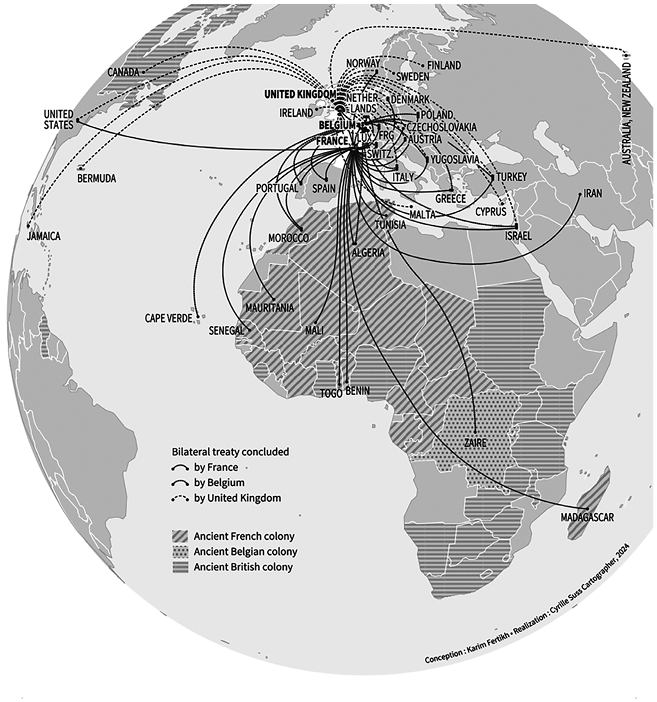
Map 4.1 Long description
Global map illustrating the network of social security regulations in 1974, highlighting postcolonial polities. The map shows bilateral treaties concluded by France, Belgium, and the United Kingdom, with lines connecting various countries. Ancient French, Belgian, and British colonies are marked with distinct patterns. Key regions include Europe, Africa, and parts of Asia and the Americas.
These postcolonial polities were a given that EEC law had to deal with. EEC law sought to preserve the liberal migratory regime between former colonial powers and newly independent countries. Under the pressure of French civil servants, the EEC forged a system where the EEC freedom of movement (and the correlative ‘European preference’ in migration) did not jeopardize the defunct imperial communities. A pinnacle of the Common Market, the freedom of movement of workers provision, aimed at rationally administering labour mobilities, authorized mobilities of unemployed workers from EEC territories without the resources to employ them to territories lacking workforce. This system was called ‘international compensation’ as it sought the rational allocation of workforce on an international level.Footnote 42 In this system, the national bureaucracies agreed on a ‘European preference’. Migration from an EEC country should be privileged if nationals were unable to satisfy the existing job offers, meaning that vacant job offers had to be first proposed to EEC recruitment offices. At the ‘European Coordination Bureau for Labour Compensation’ (in the General Directorate ‘Social Affairs’ of the EEC Commission), the EEC officials seemed, however, to have never been truly satisfied with this ‘mechanism’ of ‘compensation’. The first annual report of the European Bureau of Coordination in 1963 lamented that European workers had not truly been given any such priority.Footnote 43
The EEC freedom of movement regulations did, in fact, include a reservation: migration from within Europe could not supersede migration from former colonies. In a 1960 memorandum, the Juridical Service of the EEC Commission issued a statement regarding the ‘non-European countries and territories having special relations with Belgium, France, Italy and the Netherlands’ and the consequences of their newly acquired independence.Footnote 44 This document pushed forward the notion of ‘special relations’: the Juridical Service identified ‘political dependence’ and ‘lack of self-determination’ as the basis for the continued ‘association’ of these territories with the EEC. Given the uncertain situation of the independent countries regarding the existing set of international treaties, the legal experts of the EEC used the ‘vague’ notion of ‘special relations’ to grant these former colonies special status under EEC law (whereas the 1961 regulation applied only to Algeria). The two regulations of 1961 and 1968 relating to freedom of movement took the notion of ‘special relations’ into consideration in Article 42(3) and Article 42(3) respectively: the European freedom of movement should, according to the regulations, not jeopardize the obligation of European countries towards countries with which they have or have had ‘special relations’.Footnote 45 Legally speaking, the regulations took into account ‘existing or previously existing institutional bonds’ and stated that nothing should endanger the obligations that these bonds had generated in regard to freedom of movement. This legal concept, ‘special relations’, expressed these relations between Member States and their former European colonies, and built a legal architecture combining both postcolonial and European communities.
4.2.3 Maintaining the Unity of International Law.
During the first decade of the EEC, EEC law limited the legal inequalities towards (former) colonies in its dispositions related to freedom of movement. It did so by the effect of the non-discrimination principle, used as an argument in negotiations. At the time, the contemporaries contemplated with difficulty a dual standard regarding freedom of movement and social security.
EEC law was put under pressure by the pervasive international concept of non-discrimination. In the case of Algeria (the only country where freedom of movement applied as an effect of the 1961 regulation), Megan Brown explained the sinuous positions taken by the French authorities in the negotiations for the Treaty of Rome.Footnote 46 One of the most detailed position papers preparing the 1961 regulation stressed the discriminatory character of excluding Algerian workers from the regulation. This paper by the secretary for economic affairs at the Algiers Governorate, Salah Bouakouir, sheds light on the prevailing conception. A student of the École Polytechnique, Bouakouir is representative of the indigenous elite educated in the French system and was a member of the Académie des sciences coloniales (Academy of Colonial Sciences), the most important scientific institution of colonial France. He was probably at the time feeding secret intelligence to the Front de libération nationale (National Liberation Front), which was fighting the war in Algeria. In 1961, Bouakouir drowned in the Mediterranean Sea. Some say that his death was the result of a targeted assassination by the French military. In his 1959 paper designed to prepare the negotiations on the first regulation on the free movement of workers, he stressed that the freedom of movement of Algerians could not be denied: Algerians, like the other inhabitants of the overseas Departments, were considered French, and there was no specific information on their documents that could be used to sort them. He insisted that any such denial could only be seen as ‘racial discrimination’. But, given that this claim could be reversed and could open Algeria to European migrants, the Algerian governor would not oppose a separate negotiation. The Algerian administration would especially welcome trained workers and technicians, that is: highly skilled workers.
The debates about the EEC social security coordination illuminate the single standard of social security international law, and the reluctance to establish an openly hierarchized legal standard which would make EEC workers better off than racialized postcolonial workers. One of the fiercest struggles undertaken by the French social security officials at the time was to prevent the EEC system from becoming explicitly more generous than the agreements existing with the other countries, and especially France’s former colonies. The French agreements (formally) granted the workers from France’s former colonies the same kind of social security guarantees enjoyed by the EEC workers – that is, benefits adjusted to the local standard of living. In 1966, France was paying family allowances to 221,892 children living in Algeria whose fathers were working in France. By 1973, 689,700 children were benefiting from French allowances abroad, most of them in the former colonies.Footnote 47 In most of these countries, allowances were paid at the rate of the country where the children resided or through a complex system of reimbursement; in other words, at a lower rate than children in France. This situation was inherited from the colonial era. When they negotiated the European Convention on the Social Security of Migrant Workers (which then became EEC Regulations 3 and 4),Footnote 48 the French negotiators imposed the same mechanism (payment at the rate of the country of residence). In a file dedicated to the international relations regarding family allowances, the French social security officials fiercely defended this uniform ‘doctrine’ (as they called it) of allowances for non-resident children being inferior to those for residents. This system was seen as ‘discriminatory by other EEC states and international organizations’, and the Commission demanded that not only the Member States should enjoy full equality but overseas territories as well.Footnote 49 For the French Ministry of Social Affairs, such an attack on its doctrine was unacceptable. Its officials therefore took a hard line in the EEC negotiations on social security. They argued that aligning the allowances paid abroad with the French rate would oblige them to revise every existing agreement, and especially the agreements with France’s former colonies. The ministry established that the 689,700 children receiving family allowances abroad cost a global sum of 297 million francs in 1973 (less than 10 per cent of this total went to EC families). This represented 431 francs per child per annum, far less than what a child in France would have received. In this matter, one of the main arguments of the French Department for Social Security of the ministry was the ‘formidable risk of a contagious effect’:Footnote 50 it saw all of these agreements as inspired by a single set of principles so that better treatment of European workers from EC countries would have a domino effect on a whole series of agreements.Footnote 51 The employees of the ministry argued that the different agreements, although diverse in their shaping, derived from a single philosophy adjusting the allowances to the local standard of living: ‘in spite of the apparent diversity, there is a unity of view in the positions taken by France in its multilateral and bilateral agreements’ in social security, stated an internal report to the minister of social affairs.
In the 1960s and 1970s during the accession negotiations, the British welfare elite recognized the potentially discriminatory effects of EC law on the citizens of the Commonwealth countries as well. They feared the choice for Europe could be a choice against the Commonwealth and its racialized immigrants. The British specialists from the Department for Health and Social Security (DHSS) contemplated anxiously the dual standard arising from the EC social security regulations. Britain had already concluded twenty social security agreements with Commonwealth countries offering a lower protection than the protection provided by the EC regulations. In a note to A. Patterson, the head of the DHSS who had led numerous international negotiations on social security since the 1940s, another civil servant cautioned him about the danger of the discriminatory consequences of the EC law on the Commonwealth citizens if the UK entered the EC. In a note of 23 June 1970, he underlined the costs of the regulations should the Irish Republic join the EC as well, and stated further:
The most delicate immediate repercussion might be the repercussion on our treatment of the immigrants from India, Pakistan and West Indies of our acceptance of the obligation to provide various measures of social support, including family allowances, for the dependants of nationals of members of the Community who have come here but left their families behind. It might seem odd to do this for Italians and Germans but not for coloured immigrants from the new Commonwealth countries … Pressure may be exerted on us by other Commonwealth countries concerned about the immigrant population here. If such pressure does arise, it is not hard to envisage the emotions which it would generate, or the difficulty of finding convincing arguments with which to fend it off. On the other hand, the cost of giving in to the pressure could well be relatively heavy and adverse to the balance of payments. While obviously the risk of having to face this dilemma is quite irrelevant to our negotiations with the Community, Ministers will recognize that potentially a decision to adhere to the Treaty of Rome could produce either some embarrassing situations or considerable extra costs in this indirect way.Footnote 52
The description of the problem pointed to a moral issue. The note picked out the two EC countries, Italy and Germany, against which the UK had waged the Second World War and underlined the discrimination (‘coloured immigrants’) at a time when South African Apartheid was the subject of general reprobation. The voices of the most renowned legal specialists joined those of the bureaucrats. Otto Kahn Freund, considered the founder of social law as an academic discipline in the UK, advocated the same coherence when negotiating Britain’s accession to the EC in the 1970s. For him, freedom of movement must not be allowed to drift into a double standard of White versus racialized migration:
To conclude, let me come to the most serious issue the European freedom of movement of workers poses. This issue may not exist for the other European countries to the same extent. At the moment, the situation is so: each member of the British Commonwealth can immigrate and can seek a job here without limitation. It does not matter if he comes from a still existing colony such as the West Indies islands or from an independent member of the Commonwealth such as India or Pakistan. A law proposal is currently being debated in Parliament which seeks to severely reduce this right. Is it then surprising that many protest against the growing complication of immigration from the overseas countries and the simultaneously growing facility of the immigration of Western workers? … If the door is now open for the Italian worker for instance, but closed for the coloured West-Indian worker from Jamaica or Barbados for whom it used to be open, this could be interpreted as the influence of a racial prejudice. And this is interpreted this way in the West Indian. What is at stake here is the good name of Great Britain on the issue of the struggle against racial prejudice. It would be terrifying should the British government give the impression that it has used the EEC accession as an opportunity to stop or limit the immigration of Black or dark-skinned British citizens. The Western EEC member states should keep in mind that the freedom of movement of workers in the Common Market has to cover the British citizens of colonial (for instance West-Indian) origins living in Great Britain if the country enters the EEC.Footnote 53
In the view of the postcolonial states, European and other international rules should follow similar paths so that the change in one set of rules did not affect the other one. In the 1970s, this situation changed drastically.
4.3 A Racialized European Border (1970s–1980s)
If racial discrimination was not considered an acceptable option any longer, how has the current racially differentiated migratory regime been established? Racialization has often taken side roads, avoiding the use of openly discriminatory legal techniques.Footnote 54 Nevertheless, in the 1970s, political pressures pushed the EC bureaucrats to endorse a dualization of the international standard. The debates surrounding the accession of the UK to the EC make it clear: the issue at hand was for the contemporaries to hierarchize the freedom of movement and the related social rights. This legal dualization racialized the EC border and elevated the European workers and citizens to privileged legal subjects. This hierarchy has prevented non-European people from accessing not only European territory but also the wealth accumulated on the continent by the exploitation of the colonies.
4.3.1 The Impossible Single Standard.
The idea of a single zone between Europe and its former colonies, guaranteeing the freedom of movement of workers, was not seen as utopian. In 1962, the EEC Commission proposed opening a general negotiation on the freedom of movement with the newly independent African countries.Footnote 55 By the mid 1970s, the EC regulations on social security had a global scope: they were European only in origin (Map 4.2).Footnote 56 Following Part IV of the Treaty of Rome, the French colonies of New Caledonia, Comoros, Djibouti, Saint Pierre et Miquelon and Polynesia were not (and still are not) included in the territory of the EC (now EU) law regarding the freedom of movement and social security. Nevertheless, under pressure from its partners, France extended the scope of the EC regulations to its ‘old colonies’ in the Caribbean and in the Indian Ocean as they were considered part of the French territory (as ‘départements’). By the mid 1970s, the social dimension of the EC with its social security regulations hence covered large parts of the world: from Algeria to Congo (for European workers), from Greenland to much of the Antilles Islands and to Hong Kong. It covered some of the dependent territories of the European countries and independent countries. Megan Brown has shown that Algeria has long ‘benefited’ from a status of quasi-Member State in regard to social security.Footnote 57
‘European’ social security in 1974.
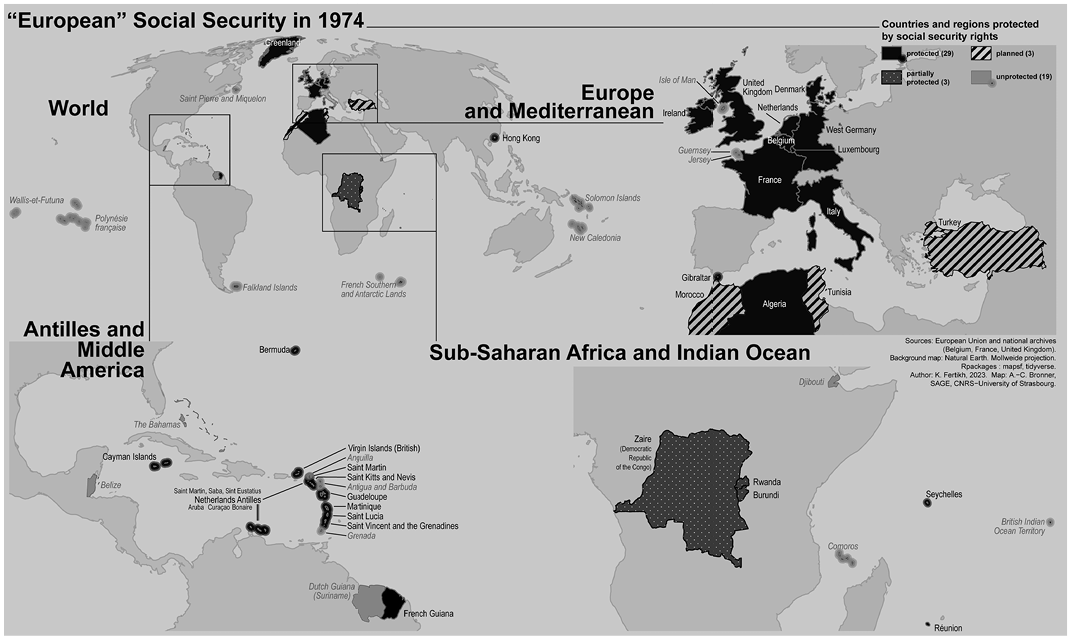
Map 4.2 Long description
Map illustrating the global distribution of ‘European’ social security rights in 1974. The map highlights regions in Europe, the Middle East, Africa, and Asia where EEC Social Security Regulations apply. Key areas include Western Europe with extensive coverage, parts of Eastern Europe, the Middle East, and specific regions in Africa and Asia. The map uses different shading and patterns to indicate the degree to which the EEC Social Security Regulations apply in each area.
The national authorities of the (former) colonial states were reluctant to expand the international European law to their former colonies with which they were linked by bilateral agreements. At the end of the 1960s, there was no clear notion of protecting the European border, and the revised Association Agreement with Turkey passed in 1970, for instance, entailed a freedom of movement for workers provision. When the EC came to negotiate Association Agreements with Morocco, Algeria and Tunisia, the EC negotiators pushed the idea of extending to them the provisions regarding the freedom of movement and social security, noting that it would not change the current situation because of the network of agreements between them and most of the EC countries. For the EC countries, however, these Association Agreements posed a serious issue.
On the one hand, an EC memorandum discussed at length opposing the equality of treatment proposed for the workers from Turkey and the Maghreb, but eventually concluded that ‘it would be difficult to exclude the principle of the equality of treatment under national legislation. Equality of treatment is the first principle of the international instruments in social security.’Footnote 58 In the minutes on a meeting of the General Secretariat of the French government on this topic, it was noted: ‘All of these association agreements entailed nevertheless an equality of treatment clause, a formula that sunk into the grammar of international social law at the time. This provision will support some decisions of the European Court of Justice relating to social security or pension rights.’Footnote 59
On the other hand, these Association Agreements did not come to shape a Euro-Mediterranean space of free circulation. The clause on free mobility for Turkey adopted in 1970 was never implemented, and other countries did not even glimpse such a clause. Colonial history played its part here, especially regarding financial repercussions in the field of social security. The British DHSS feared for the situation of Gibraltar and the costs (estimated at 2.5 million pounds) that would result for the territory if an equal standard were given to the 4,000 Moroccans working on the Rock and representing 25 per cent of the working population. Here as well, the contagious effect was a potent argument for opposing a single standard. The DHSS feared ‘the political repercussions arising from any agreement on our part to export family allowances and the costs of medical treatment outside the territory of the Community’ as well: these agreements ‘would likely give rise to demands from Commonwealth countries that their immigrant workers here should receive privileges’ of the same kind as those granted to the Maghreb countries.Footnote 60 The DHSS expressed its opposition to the export of the most expensive benefits (pensions, benefits for industrial injuries).Footnote 61 The French department was worried by the costs that would result from an integration of Algeria into the European scheme, given that the EEC project planned to export the family allowances to the rate of the country of employment. As it did with the EEC, France paid lower-rate allowances organized through a system of reimbursement. A report dramatized the costs of a new doctrine: ‘For Algeria alone, the costs would rise from 132 million francs to 500.’ It would, furthermore, put the Algerians in the situation they were in before independence. For these reasons, the department deemed the proposition unacceptable.Footnote 62 It was joined in this by other countries, such as Germany and Denmark, which feared the extension of the social security regulations to the countries associated with the EC (North African countries and Turkey especially).Footnote 63
4.3.2 Drawing the Racial Line.
The role of national bureaucracies in the formal racialization of the European border was pivotal and contrasted. Whereas bureaucracies in charge of migration (Home Offices under their various denominations) politicized their action and supported an anti-immigration policy in the 1970s, the social bureaucracies kept an eye on international regulations but did not prevent European and other international laws from going their separate ways. Because the post-imperial international law was made of bilateral agreements lacking the resilience of EC law, it progressively lost ground in the 1970s without dramatic break.
Altogether, by the end of the 1960s, the presence of racialized workers on European soil came to pose a political problem – step by step, the European integration has established a legal dual racial standard, suppressing the (unequal) competition between the postcolonial and European communities. This dual standard did not, however, come into being without debate and technical difficulties. In the 1970s, the British accession to the EC hit a stumbling block over its 1948 Nationality Act, which at the time encompassed 850 million people. Nearly every Member State opposed a British position that would have threatened – so they thought – their countries with an uncontrollable immigration of Pakistani and Indian migrants.Footnote 64 The issue at stake was how to exclude holders of a British passport (in other words, British citizens) from the Commonwealth countries. In an extensive exchange defining how to recognize a British national (contained in a file entitled ‘Definition of “Nationals of the UK” under the Treaty of Accession’), Britain put in place a special ‘endorsement’ of its national passports, carrying the mention that its carrier is ‘a British national for EC purposes’, reading: ‘Holder has the right of abode in the United Kingdom.’Footnote 65
In this period when immigration came to represent a major political issue, EC law proved more resilient than other international regulations, giving birth to an increasingly explicit dual standard. In 1975, France deployed a policy aimed at reducing the immigrant population on its soil and introduced a system to decrease the generosity of its social security benefits for non-nationals.Footnote 66 The international standards resisted some of these demands formulated within the framework of the immigration policy. The French social security officials torpedoed a project to impose on non-EC foreigners a period of one year during which they would not be granted certain social security benefits, arguing that it would be contrary to international rules. Moreover, under pressure from both the International Labour Organization and the EC, they extended maternity allowances, which had been reserved for French nationals, to all residents. Altogether, such pressure gave rise to better protection for EC citizens. The first draft of a decree granting foreigners a subsidy to return to their home country targeted both postcolonial and European migrants, especially Italian workers. Italian workers, however, because they were protected by EC legislation, disappeared from its final version. Furthermore, in its 1986 Pinna ruling, the European Court of Justice (later Court of Justice of the European Union) compelled the French administration to ‘treat equally’ EC children living abroad and to grant them the same allowances as children residing on French soil.Footnote 67 With this ruling, the Court imposed a dual legal standard which provides postcolonial workers with a lower level of social protection than that enjoyed by European workers. Meanwhile, bilateral treaties have gradually lost their relevance in this area. Currency devaluations in the countries of the South and the absence of any adjustment to benefit levels have reduced the allowances paid to the children of racialized migrant workers in those countries to token levels.
Although child support ran along different lines in Britain, the British authorities similarly cut off child benefits to the Commonwealth workers with children in their home countries through the suppression of the universal credit tax (Children Tax Allowances) in 1977. The new Child Benefit Scheme excluded non-resident children from any governmental support. Having no internationally binding agreements on family allowances with the notable exception of the EC regulations and an agreement concluded with Spain, this policy change primarily targeted postcolonial workers. A confidential note shed light on the intended unequal effect of this new piece of legislation:
A high proportion of those adversely affected – for each non-resident child the pay packet of a basic rate taxpayer would be reduced by up to £62 per week – are immigrants and the measure may well be attacked as racially discriminatory, even though the same treatment would be given to immigrants from all countries except the EEC and Spain.Footnote 68
In India and the West Indies this cut impacted 200,000 families and 560,000 children. Step by step, the protection of the post-imperial communities was withdrawn, and a dual standard in international law became established.
4.3.3 White Privilege in European Law.
As should by now be clear, EEC law and later EC law progressively established a dual standard. It translated racial considerations into legal statements. Throughout the 1970s, and especially in the Bozzone ruling in 1976, the European Court of Justice judgments cemented White privilege in dealing with two different legacies of European empires.Footnote 69 In general, the Court left African people aside to grant European workers the protection of the EC regulations but treated non-European empires differently than European ones.
Regarding the question of social security for Europeans, the European Court of Justice extended the EC territory to the former colonies. When Congo gained its independence, Belgium organized the legal status quo in regard to the regime of property in an effort to preserve European interests (meaning: the interests of the White population in Congo). Among other institutions, Belgium retained possession of the part of the Congolese social security office (Office de Sécurité Sociale de l’Outre-Mer or OSSOM) concerning the Belgian workers (civil servants, technicians, managers) as well as all its financial assets. Through a law passed two weeks prior to independence, Belgium guaranteed the rights acquired by the Belgian workforce during the colonization of Congo.Footnote 70 The Belgian State had to preserve the social security rights its nationals acquired when they worked in the Belgian colonies during the colonial era. Between 1972 and 1977, the European Court of Justice repeatedly condemned the OSSOM because of its discriminatory nature: Belgian nationality was a precondition to receive pension benefits from the OSSOM.Footnote 71 The OSSOM did not consider the EEC workers in the former Belgian colonies to be ‘migrant workers’ in the sense of the EEC/EC law as they exerted a professional activity outside the territory of the Member State. The matter was of some financial importance: 20 per cent of the more than 60,000 persons insured in 1960 by the OSSOM were foreign nationals, half of them coming from an EEC country. In the Bozzone case, the European Court of Justice referred to the disposition of the Treaty of Rome related to the freedom of movement. The Court declared the colonial law of 1960 discriminatory as Congo was considered part of the Belgian territory at the time. In doing so, the Court extended the European jurisdiction to Congo, Rwanda and Burundi, and reserved the social security benefits to EEC nationals. In the cases of Congo or of Algeria studied by Megan Brown, the Court considers the colonial territory as part of the territory of the Member State when it comes to establishing the right to social security or other types of pensions. In the case of the Belgian Congo, this benefited only EEC migrants, that is: EEC nationals having worked in an EEC colony. This jurisprudence excluded de facto the non-Europeans.
This situation constituted a dual standard and hierarchized the types of imperial belonging along a racial border. Not only colonial states had indeed been empires: Germany could be considered a continental empire until 1945 as well. The redrawing of the German borders during and after the Second World War had massive effects on the entitlements of the persons insured by institutions that either disappeared or relocated. Persons living in Poland or in Czechoslovakia would not be paid social benefits by German institutions. German refugees from Eastern Europe lost their German entitlements as they acquired their rights to pension or to unemployment benefits outside the state borders. To solve the domestic problem posed by the 20 million refugees on its soil, in 1960 Germany reformed its pension system. The main actor of this reform was Kurt Jantz. Born in Berlin, Jantz (1908–1984) had worked for the Department of Social Security at the Reichsarbeitsministerium (Reich Ministry of Labour) since 1938. After a short interlude in the aftermath of the Second World War (the reasons for which are unclear, but probably denazification related), he briefly worked as a university professor of theology before returning to state affairs in 1951. In 1953, he was appointed head of the Department of Social Reform at the Ministry of Labour. He remained in high-level positions throughout the 1960s and 1970s and represented Germany in the European social security institutions. In a nutshell, the reform he led granted German refugees on the soil of the Federal Republic social security rights as if they had never left German soil. The 1962 cover of the information bulletin of the Ministry for Labour and Social Order is a graphic representation of this legal fiction: the territory of German social security law was the whole ‘Reich’ in its 1919 borders (see Figure 4.1). In a way, social security reconstituted the defunct imperial community.
Leaflet of the Ministry for Labour and Social Order (Bundesminiterium für Arbeit und Sozialordnung), Social Security in the Federal Republic of Germany (Soziale Sicherung in der Bundesrepublik Deutschland) (1962).

Figure 4.1 Long description
Leaflet cover of the Ministry for Labour and Social Order, titled ‘Social Security in the Federal Republic of Germany’ from 1962. The cover features a stylized map of Germany with the title ‘Soziale Sicherung’ prominently displayed. The document is dated January 1962 and is published by the Bundesministerium für Arbeit und Sozialordnung.
Yet, the situation raised a European issue: how should workers from other EEC/EC countries who had worked, whether as war prisoners or as migrants, in the eastern part of the German territory be treated? Should the ‘equality of treatment’ apply? In 1977, the Fossi ruling brought this question to the table.Footnote 72 Fossi worked in the Sudeten from 1942 to 1943 and under German law was socially insured by a German institution, the Sudetendeutsche Knappschaft (miners’ association). The central question was what territory was covered under EEC/EC law, and for Germany, this could carry a heavy financial burden as all the territories annexed by the German Reich could be included (such as Luxembourg and Alsace). In a document he prepared in order to plead the German case in front of the European Court of Justice, Kurt Jantz argued that the Federal Republic of Germany and the Reich were two different states, and that there could be no comparison with colonial states – French Algeria and Belgian Congo.Footnote 73 In contrast to its legal statements regarding colonies, the European Court of Justice rejected the claim. It considered that the 1960 pension law was aimed exclusively at the German national community and was benevolent (and not a social security right), dedicated to alleviating the harshness of exile.
4.4 Conclusion
To conclude, the interdependency between European mainland countries and their former colonies had an impact on EEC law and later EC law in the fields of free migration and social security. The Treaty of Rome paved the way to a dual standard for paradoxical reasons (preventing southwards migration, i.e. European countries flooding Africa with their low-skilled migrants). It treated European (Article 48 EEC) and African territories (Article 135 EEC) separately, postponing the freedom of movement for Africa to later negotiations – with the exception of the French ‘old colonies’ and of Algeria. The two polities did not immediately part ways, and the provisions of international law (embodied in bilateral treaties between former colonial powers and independent countries) and of EEC law remained comparable. A competition between postcolonial and European policies certainly was one of the reasons the ‘European priority’ on the labour market did not prevail in the 1960s. EEC law accepted the ad hoc idea that former colonies, having enjoyed ‘special relations’ with an EEC Member State, could not lose their privileged access to the labour market of their former mainland country for the benefit of EEC workers.
However, their exclusion from the scope of what had then changed name from EEC to EC regulations left African migrants less protected in the 1970s when France and the UK repealed the bilateral agreements (and other provisions) on free migration, unlike European migrants who remained under the protection of the EC law. This dualization of the international system went hand in hand with the resilience of EC social security law whose dynamism left the postcolonial standards behind, and postcolonial workers less protected by the obsolescence of the bilateral agreements. This racial bordering of Europe, and the implicit racial hierarchies established by the means of international law, were not a given at the beginning of the process, but were rather the consequences of the immigration policies in the 1970s and of the legal forms of protection (bilateral/European) afforded to migrants.
5.1 Introduction
The European political project has long been presented (and indeed still is) as a vision built on two imperatives: peace and economic prosperity. By contrast, scant attention has been paid to the postcolonial and totalitarian legacies of the European political project and European law. A handful of groundbreaking studies have nevertheless explored the issue from the latter perspective. These include the book by Christian Joerges and Navraj Singh Ghaleigh, Darker Legacies of Law in Europe: The Shadow of National Socialism and Fascism over Europe and Its Legal Traditions, which examines the persistence of economic models and rationales inherited from totalitarian regimes.Footnote 1 In France, Antonin Cohen has highlighted the ambiguous genealogy of the term Communauté (Community), part of the Vichy legacy that gave rise to the European communities.Footnote 2 Other studies have also focused on colonial legacies in relation to the construction of Europe.Footnote 3 From the very beginnings of European integration (1946–1957), a number of countries were confronted with the aspirations of colonized peoples seeking to emancipate themselves from their respective empires.
The Indonesian revolution ended in 1949 with the defeat of the Netherlands.Footnote 4 The massacres of Sétif and Guelma (May–June 1945), the revolt in Madagascar (1947), and the war of independence in Indochina (1946–1954) challenged France’s traditional colonial domination. After the signing of the Treaty of Rome, Belgium, for its part, was faced with the Congolese crisis (1960–1965), which marked the birth of the Organisation of African Unity and the pan-Africanist aspirations that accompanied it.Footnote 5 While post-war Europe was building itself around a political ideal of peace and economic prosperity, and seeking to erase the cumbersome legacies of its authoritarian regimes and colonial domination, colonial violence remained more present than ever outside the borders of the Communauté, as witnessed by the Suez crisis of 1956. Colonial domination, criticized by the emerging new international order, was being transformed and replaced by the concept of development.Footnote 6 By development, one should understand the presupposition of the progressive nature of industrialized countries compared to the countries referred to at the time as the ‘Third World’. Borrowing from the evolutionary model, most economic theories of development attempted to ‘naturalize’ the causes of underdevelopment in the countries of the Global South by attributing them to several intrinsic factors that led to their backwardness – rather than to their colonial history.
The naturalization of underdevelopment has been roundly criticized by a number of economists, including Samir Amin and Thandika Mkandawire.Footnote 7 Drawing on the neo-Marxist tradition of dependency theories, these authors interpret underdevelopment as a process of incorporation of ‘third-world’ countries into the global capitalist system.
The signing of the first partnerships between the European Economic Community (EEC) and Africa, founded on an ideology that glorified Eurafrica, was a vector for the integration of Africa into the economic order promoted by Europe.Footnote 8 In this context, the African continent represented a source of raw materials that could guarantee a certain number of strategic supplies for European industry. The colonial pact lived on in the economic and development arenas, making Africa – and the Caribbean – a reservoir of cheap resources at the disposal of the European continent.
‘Third-world’ economists such as Raúl Prebisch, Hans Singer, and Jagdish Baghwati described this unequal balance of power as a deterioration in the terms of trade. Despite this criticism, a number of non-socialist African states saw the EEC’s functionalist project as an ideal to be attained, hence the emergence of the Economic Community of West African States in 1975 and, subsequently, the West African Economic and Monetary Union in 1994.
There has been little discussion of the views of African intellectuals on the creation of the EEC. The advent of the EEC coincided with the fulfilment of pan-Africanist aspirations. In two seminal articles, Guy Martin, one of the leading thinkers on the subject, argued that the agreements signed between the EEC and African countries (the Yaoundé I and II Conventions signed in 1964 and 1971, and the Lomé Convention signed in 1975) helped to maintain pre-existing relationships of colonial domination.Footnote 9 In other words, the signing of these agreements perpetuated African countries’ extroversion and dependence on the EEC. To quote Kwame Nkrumah: ‘The State which is subject to [the said processes of dependence] is, in theory, independent and has all the outward trappings of international sovereignty. In reality its economic system and thus its political policy is directed from outside.’Footnote 10
The analytical grid provided by dependency theories sheds light on the asymmetrical relationships that continue to exist between the North and South. Other studies have shown that the integration of the economies of the South would not have been possible without support from bourgeois class interests that were also part of the global capitalist system.Footnote 11 This chapter will build on these two premises (namely, the extroversion of African countries and the convergence of interests between the dominant classes of the South and North) to move forward in this discussion. In a recently published book, Megan Brown shows that during the Treaty of Rome negotiations, the issue of the free movement of workers, particularly Algerians, gave rise to significant tensions.Footnote 12 Although Algeria was still part of French territory in 1957, the common arrangements regarding the free movement of European workers did not apply to it. Article 227 of the Treaty of Rome fails to grant Algerian workers enjoyment of the free movement of workers and the ensuing social protection. To that end, the Treaty of Rome used the term travailleurs des États membres (workers from Member States) rather than travailleurs nationaux (national workers).Footnote 13 As Hanna Eklund notes, Article 135 of the Treaty of Rome distinguishes between two categories of workers: workers from Member States and workers from ‘the overseas countries and territories’.
The aim of this article is to illustrate the colonial – and discriminatory – legacy attached to the status of workers from former colonies, by examining the treatment of Moroccan workers at France’s state-owned national railway company the Société nationale des chemins de fer français (SNCF).Footnote 14 The mechanism excluding Algerian workers from the free movement of workers was not unique in this respect.Footnote 15 This chapter will illustrate the discriminatory treatment of Moroccan workers despite the entry into force of both the Charter of Fundamental Rights of the EU (CFREU) and, more importantly, the Council Directive 2000/43/EC of 29 June 2000 implementing the principle of equal treatment between persons irrespective of racial or ethnic origin, OJ 2000 L 180, pp. 22–26, hereinafter the Race Equality Directive.
In 1963, France signed an agreement with the Kingdom of Morocco on exchanges of workers.Footnote 16 Article 8 of the agreement stipulates equal treatment for French and Moroccan workers.Footnote 17 Roughly 2,000 Moroccan workers were hired to fill menial positions in the railway sector: they were referred to as auxiliaries.Footnote 18 As will be shown, the concept of auxiliary workers became a device through which to discriminate based on race. Belgium, the Netherlands, and Germany also signed several labour exchange agreements with Morocco in 1963.Footnote 19 These agreements laid the foundations for the signing of the first Euro-Mediterranean agreement (signed with the Kingdom of Morocco) in 1996.Footnote 20 The agreements raise fresh questions about the nature of asymmetrical relations between the EU and non-member countries that are former colonies. Aside from the asymmetrical relation in terms of trade, as mentioned above, a further question is why and how EU law never managed to eradicate colonial-era legal practices, notably discriminatory practices, on the national level.
Most of the Moroccan workers at the SNCF were deprived of their basic social rights. They received significantly lower pay than nationals for equivalent work, their retirement pensions were well below that of permanent staff, they were denied access to vocational training throughout their careers, and they also lacked access to healthcare and certain social benefits. Enjoyment of these social rights was restricted to permanent railway staff of French nationality. This legal privilege is set out in what is usually referred to as the nationality clause, another way of safeguarding national preference. Chapter 5, Article 2 of the SNCF staff regulations, in the version covering 1970 to 1981, stipulates the ‘General conditions for admission to the permanent service’ in the following terms: ‘To be admitted to a permanent position, all candidates must: a) be French citizens or naturalized French citizens.’Footnote 21
English-language literature generally views racism in France through the lens of ‘colour-blindness’, a concept made popular in Europe by the work of Erik Bleich and Mathias Möschel, and in the United States by the seminal article by Neil Gotanda.Footnote 22 In France, the concept of ‘colour-blindness’ refers to the refusal to acknowledge racism or racial minorities in France. Although it is a helpful tool for understanding a number of issues, the concept needs to be further refined and developed. Racial discrimination in France is generally the result of ‘hidden’ administrative practices.Footnote 23 It is therefore impossible to study the effects of racial discrimination in an ahistorical manner – which is why it is crucial to highlight its social and legal depth.
The rationale for exclusion is generally to be found in the recesses of legal subcategories that establish a precarious status, backed by administrative practices that provide opportunities for discriminatory treatment. The sociologist Abdelmalek Sayad is arguably among those who put it best:
De jure discrimination (between nationals and non-nationals) is reinforced by de facto discrimination (in the form of social, economic and cultural inequalities), which in turn finds justification and legitimacy in de jure discrimination: this circular reasoning in which de jure and de facto circumstances mutually support each other lies at the root of all segregation (slavery, apartheid, colonization, immigration, etc.) and all forms of domination (of slaves, black people, colonized peoples, immigrants, women, etc.) that give rise to racism, where de jure equality is denied on the pretext of de facto inequality and de facto equality is in turn impossible due to de jure inequality.Footnote 24
In the case of Moroccan workers at the SNCF, at the heart of such exclusion as described by Sayad lies the nationality clause. This chapter shows how long-standing racial and socio-professional hierarchies have crystallized behind the interpretation of this clause, and how the clause has managed to coexist with the development of EU primary and secondary law aimed at protecting against discrimination.
Based on an analysis of this clause, I show how, firstly, in the case of Moroccan workers at the SNCF, the confusion between the enjoyment of social rights and railway worker status contributes to the production of racial otherness. Secondly, I revisit the sedimentation of interpretations leading to workers originating from the former colonies being excluded from the so-called nationality clause.
5.2 The Process of Discriminating against Moroccan Workers and Its Coexistence with National and EU Protection against Discrimination
In itself, the nationality clause in the SNCF statutes does not contain any racist provisions; it sets out objective criteria for access to permanent positions, including access to citizenship through naturalization. There is nothing in the actual wording of the nationality clause that would suggest any form of discrimination, let alone racial discrimination. So where does the problem lie? Why, as in the case of the Moroccan workers at the SNCF, do we recognize the discriminatory nature of the nationality clause?
And on what basis were those responsible for enforcing the nationality clause able to deny the Moroccan workers the social rights associated with employee status when they were doing equivalent work? To gain a better understanding of this, we shall begin by examining the full legal scope of the nationality clause. As we have seen, it sets out a number of apparently neutral criteria for access to legal status as a railway worker (including acquiring French citizenship). This raises a key question: what was to be done with immigrant workers who performed tasks similar to those of permanent staff, but whose nationality prevented them from acquiring permanent status? After all, some Moroccan workers performed jobs that were supposed to be done by permanent staff. This raises the question of the principle of ‘equal pay for equal work’ recognized by the French Court of Cassation, which stipulates that workers performing identical tasks are to be treated in the same way.Footnote 25 In the French legal system, there is at least one legal instrument that is supposed to make up for the lack of legislation requiring immigrant workers to be treated in the same way as permanent employees. Article 8 of the 1963 Franco-Moroccan Agreement cited above stipulates that French and Moroccan workers are to receive equal treatment. If, as everything seems to suggest, that agreement is valid, then it is entirely legitimate to consider that, in addition to permanent employee status, a similar system providing for salary and social benefits and an equivalent career advancement scale should be provided for foreign employees. In light of this, the fact that immigrant workers (Moroccans in this case) are subject to a different legal arrangement from permanent staff does not pose any major problem, provided that they enjoy the rights conferred on all other workers, which are guaranteed by a number of international and national agreements in French law, EU law, and through international agreements.
The reality is quite different, as we can imagine. A ruling handed down by the Paris Court of Appeal on 31 January 2018 recognized the existence of discrimination on the grounds of nationality.Footnote 26 At this point in the demonstration, European readers from countries other than France may wonder how it came to be that neither the CFREU (whose Article 21 forbids discrimination on grounds of race) nor the Race Equality Directive, which implements the principle of equal treatment between persons irrespective of racial or ethnic origin, were cited in the ruling. Indeed, the ruling handed down by the Paris Court of Appeal failed to mention any of the foregoing anti-racism instruments of EU law. It only cited the violation of Council Directive 2000/78/EC of 27 November 2000 establishing a general framework for equal treatment in employment and occupation, OJ 2000 L 303, pp. 16–22. However, the judges decided to set it aside, along with the violation of the Euro-Mediterranean Agreement of 26 February 1996, which entered into force on 1 March 2000,Footnote 27 even though Article 69 of the agreement provides for equal treatment of Moroccan workers. However, none of these provisions were cited by the Court of Appeal. Therefore, with regard to the treatment of Moroccan workers:
no guarantee was initially provided to enable contract staff to move up to the ‘supervisory staff’ category, no provision was made to enable them to move up to the ‘managerial staff’ category, and, when it came to advancement to a higher position, contract staff were subject ‘to the sole discretion of the company management, without any possibility of appeal’. In addition, regulatory provisions excluding the Chibani from certain positions were reinforced by practices that effectively confined them to lower-level positions. The court noted that ‘at certain sites, such as Dunkirk, Le Havre and Dijon, not a single contract employee was promoted to class B. All foreign contract employees working at the Gare de Lyon had strictly identical career paths.Footnote 28
To understand the sizeable gap between what is allowed under EU law and the way EU law is actually applied in Member States in terms of anti-racism, it is helpful to delve into France’s extreme reluctance to use the term ‘race’, thereby neutralizing the applicability of the various provisions against racism under French and EU law.Footnote 29 As I have already demonstrated, in the French legal system, national quarrels over the use of the word ‘race’ neutralize the effectiveness of the various anti-racist measures. This leads to a situation in which the main international and European instruments against racism (namely the International Convention on the Elimination of All Forms of Racial Discrimination, which entered into force on 4 January 1969, and, on the European side, Article 21 CFREU and the Race Equality Directive) are only very rarely taken into account by French judges. Although the scope of application of the Race Equality Directive’s Articles 3(2) and 13 appears relevant in the case of the Moroccan workers, judges prefer not to invoke its provisions. As a result, it is as if the cardinal principle of primacy had no effective application in anti-racist matters.Footnote 30
This reticence stems from ideological reasons expressed formally or informally through constitutional grounds pertaining to compliance with the principle of the indivisibility of the Republic (Article 1 of the Constitution). This context, which is linked to a colonial legal history in which various French governments have sought to neutralize the enforcement of provisions of international law likely to clash with their colonial policies, should be borne in mind to understand why appeal judges do not invoke EU law provisions containing the word ‘race’.Footnote 31 In order to preserve a form of ideological ‘consistency’ in the legal system, French judges prefer to use the more neutral (and euphemistic) term ‘discrimination’. In the case of Moroccan workers at the SNCF, the judges used the term discrimination on grounds of nationality even though it was clear that the discrimination was also racial in nature.
With regard to the excerpt about the Paris Court of Appeal quoted above, how can we account for the discrepancies between what the standards allowed, what they were supposed to guarantee, and the way they have been used by the people who were supposed to ensure their implementation? From a legal standpoint, it is one thing to consider that Moroccan workers cannot be granted railway worker status on the basis of the nationality clause; it is another to deduce from this that there can be no equivalent social protection for workers performing similar tasks. Confusing these two steps in the thought process amounts to implicitly conflating nationality with status as a worker. What are the implications of the nationality clause that allow it to be so construed as to deny thousands of Moroccan workers the fundamental recognition of their status as workers?
To understand how such an interpretation came to be ‘self-evident’, it is important to consider it in its socio-historical context, by analysing the institutionalization of the nationality clause. In other words, we must grasp the implicit meaning behind the expression: ‘be French citizens or naturalized French citizens’.
To understand exactly how the nationality clause could give rise to discrimination, we need to look at the implicit meaning of the clause. Such discriminatory practices are products of socio-historical sedimentation and financial constraints which, over time, enabled the majority of competent bodies to interpret the nationality clause to mean that they (I am referring here to all workers not belonging to the permanent staff) could not be recognized as fully fledged workers. Historically, this fringe of subordinate workers belonged to the auxiliary category in which the clause was embedded. Under such a system, being an immigrant implied much more than not enjoying the benefits associated with a certain status: being an immigrant also meant not being legally recognized as a worker at all. As far as immigrant workers from the former colonies were concerned, there is every reason to believe that the discriminatory treatment they received from the colonial authorities in their countries of origin continued in metropolitan France. Thus, the stigma attached to the implementation of an ‘exceptional’ labour law regime was linked to their status as workers from the former colonies.Footnote 32
In this case, equal treatment of all workers (allowing for the introduction of differences, including differences of nationality) is replaced by the introduction of a socio-professional hierarchy (between groups of established workers and precarious workers) that opens up the possibility of multiple forms of discrimination, including racial discrimination.
Providing this historical context is crucial if we are to make sense of the fact that the SNCF – and therefore the people responsible for interpreting the nationality clause on a day-to-day basis – has remained completely silent on Article 8 of the Franco-Moroccan Agreement and on the practice of not including Moroccan workers in the catalogue of career paths.Footnote 33 This pattern of silent contra legem practices sheds light on the deployment of a broader system impeding the career development of Moroccan workers (through disregard for the fact that they have succeeded in professional examinations, and refusal to include contract workers on promotion lists and tables, to name but a few).Footnote 34 The most telling example was when the acquisition of French nationality by certain Moroccan workers did absolutely nothing to change their career paths. Evidence submitted to the Court of Appeal reported the following: ‘[…] out of 82 employees, 52 acquired French nationality during their career, but only 16 benefited from permanent status, while the SNCF refused to grant permanent status to the remaining 36 […] due to their age’.Footnote 35
Ultimately – and this is the second step in the argument – it seems as if the common sense associated with the nationality clause as understood by the SNCF failed to apply to certain socio-professional groups (in this case, immigrant workers). This doubtless explains why, despite the naturalization of some Moroccan workers, the majority were denied access to permanent employment on the basis of another criterion: age. Age was used as a pretext to conceal the stigma attached to the broader exclusion of immigrant workers from the former colonies. Trapped in a legal system that denied them any prospects of career advancement, Moroccan workers (and immigrants in general) were seen by the SNCF as a homogeneous ethno-racial group excluded from the national identity (they remained ‘immigrants’ even when they were French). In this context, the term ‘immigrant’ was used in opposition to the majority identity (nationals).Footnote 36 This classification of Moroccan workers as members of their ‘racial’ group precluded any possibility of recognizing their merits or allowing them to advance in their careers.
The accumulation of practices assigning the identity of immigrants (and therefore inferior workers) to ‘Moroccans’ contributed to the institutionalization of a glass ceiling on the basis of the nationality clause. In this situation, the relationship between equality and race is a complex one. In theory at least, the nationality clause in no way precludes a differential and parallel treatment of immigrant workers that would be equivalent to that of permanent staff. However, behind the unspoken implications of this apparently egalitarian proclamation, a system was created whereby certain workers were classified as immigrants, despite their efforts to break free from that classification. This has prompted me to examine the sedimentation of interpretations of the nationality clause that have culminated in institutionalized discrimination.
5.3 The Financial Argument
Placed in their socio-historical context, the inequalities generated by the SNCF’s internal ‘normative’ system were neither a random occurrence nor the result of mere negligence. This system, which was carefully orchestrated by the public corporation and the state apparatus, created a questionable legal status on the fringe of legality: namely, that of auxiliary workers. The state (the Ministries of Transport, Budget, and Social Affairs) supported, albeit implicitly, the continuing existence of an auxiliary status, which in practice restricted the career development opportunities of Moroccan workers. One of the decisive pieces of evidence is an excerpt from the minutes of a meeting of a joint statutory committee (on which the minister of transport had a statutory seat) held in 2006. When asked about the possibility of abolishing the nationality clause, SNCF management stated:
Although recruitment has been opened up to nationals of EU Member States, the SNCF has only hired 200 foreign staff members, a small number compared to the total number of recruits, which can be explained by the lack of interest shown by candidates from other countries. Furthermore, the inclusion of current foreign SNCF contract workers in the permanent staffing structure, which would result from the abolition of the nationality clause, would generate an additional annual expense of 70 million euros for the company, which is approximately the amount of an annual wage negotiation. The financial burden on the SNCF would therefore be too high.Footnote 37
Clearly, the financial argument has superseded the nationality argument. Initially, the SNCF statutes made the granting of railway worker status – and the associated social benefits – conditional on the acquisition of French nationality. A number of Moroccan auxiliary staff became French nationals at the end of the 1980s, but the SNCF imposed an age limit on them. Then, when jobs that had been closed to foreigners were opened up to EU nationals at the end of the 1990s, the SNCF used a financial argument to prevent them from being granted railway worker status. As a result, while EU and non-EU nationals were equally discriminated against, only EU nationals enjoyed the benefits associated with railway worker status. Although Moroccan workers were more numerous, they were excluded on the basis of a financial rationale aimed at dividing the European and Moroccan workforce.
The excerpt quoted above, which was a decisive factor in the ruling handed down by the Paris Court of Appeal on 31 January 2018, sounds somewhat self-incriminating. It bears witness to the pre-eminence of the nationality clause, viewed as the major obstacle to the career development of Moroccan workers. Equivalent social rights, guaranteed in principle by the bilateral Franco-Moroccan Agreement of 1963, are not even mentioned.
It is difficult to believe that recruitment procedures for Moroccan workers were organized haphazardly; this is all the less likely in light of the historical precedents involving internal migration on a similar scale between France and its former colonies.Footnote 38 The signing of the bilateral agreement between France and Morocco coincided with the emergence of a new administrative structure governing labour from the former colonies.Footnote 39 Previously referred to as ‘indigenous’ workers, who enjoyed a relative ease of movement, after independence this workforce became known as ‘immigrant’ workers, subject to stricter administrative control. Without taking at face value the asymmetry described by Abdelmalek Sayad between dominated and dominant countries (generally former French colonies) in migration studies, it is impossible to ignore the postcolonial dimension of labour flows between France and Morocco.Footnote 40
5.4 Racial Discrimination Exacerbated by a Division between European and Moroccan Employees
In a number of rulings, the Court of Justice of the European Union has confirmed that certain jobs previously reserved for nationals are now open to nationals of EU Member States (Article 45 of the Treaty on the Functioning of the European Union). Accordingly, at the end of the 1990s, the SNCF opened up access to railway worker status to EU nationals. For non-EU nationals, access was not on the agenda, even though certain political and civil society players were pressing for it. Thus, the divide that existed between French and non-French nationals was replaced by a divide between Europeans and non-Europeans. Discrimination persisted, however, insofar as the acquisition of a European nationality entitled people to rights and social benefits that were denied to other workers doing similar jobs (in terms of pensions, access to healthcare, etc.). In theory, the provisions of the Race Equality Directive Article 1 apply: ‘The purpose of this Directive is to lay down a framework for combating discrimination on the grounds of racial or ethnic origin, with a view to putting into effect in the Member States the principle of equal treatment.’
In light of the Race Equality Directive, the discrimination suffered by Moroccan auxiliary workers is both direct and indirect. It is direct in the sense that it creates less favourable conditions on the basis of ethnic origin; but it is also indirect in the sense that the apparently neutral criterion put forward by the SNCF (as regards enjoyment of nationality) denies access to a number of social rights from which Moroccan workers are supposed to benefit. Admittedly, it could be argued that Article 3(2) of the directive applies: ‘This Directive does not cover difference of treatment based on nationality and is without prejudice to provisions and conditions relating to the entry into and residence of third-country nationals and stateless persons on the territory of Member States, and to any treatment which arises from the legal status of the third-country nationals and stateless persons concerned.’ In the case of the SNCF’s Moroccan workers, the difference in treatment applied by the SNCF on the basis of nationality is not in itself a problem in absolute terms. Instead, what is problematic and what makes it classifiable as indirect discrimination lies, under the terms of the directive, in the inseparable link between the enjoyment of railway worker status (under the nationality clause) and the associated social rights, which are supposed to be extended to all workers performing identical tasks, regardless of their nationality. In other words, the point is not to call into question a difference in treatment based on nationality so much as the consequences of such a difference in treatment, which in practice produce situations of exclusion based on race, via the nationality criterion. However, legal reasoning alone cannot explain the failure to enforce the Race Equality Directive in this case. To understand why it has not been implemented, it is vital to consider the historical dimension.Footnote 41
The auxiliary category can be better understood by looking back at its historical origins. Its creation is closely linked to the history of the railways and the world of the working class in the nineteenth century and, in particular, to the historical status of the rail labourer, a working-class figure who hung around the tracks waiting to be hired on various terms: hourly, weekly or, at best, monthly. The status of permanent or ‘commissioned’ staff was obtained through determined social struggle; however, – and this is less widely known – the gains resulting from this improvement did not benefit all railway workers.Footnote 42 To put it in Robert Castel’s terms, obtaining status was the historical culmination of the contract of service. Paradoxically, the historical process took auxiliaries from a vulnerable status to one of social non-existence, a form of disaffiliation.Footnote 43 Auxiliaries hired out their labour in return for a wage. They could be dismissed at any time and remained dependent on the economic fortunes of the concession companies and subsequently the state-owned corporation; they were treated in a comparable way to domestic servants. For a long time, promotions were awarded ‘on merit’, until the forerunner of what would come to be known as ‘permanent staff’ status appeared in 1912 at the Compagnie des chemins de fer de l’État (State Railway Company). This change in employment categories followed the historic strikes of 1910, motivated by deplorable health and working conditions.Footnote 44 From the standpoint of nineteenth-century legal doctrine, it was a contractual relationship rather than a protected status, in the sense that an auxiliary was merely a ‘commodity’.Footnote 45 They hired out their labour (and hence their bodies) in return for a meagre salary. They were subject to the same discipline as railway workers, even though they did not enjoy any of the social benefits associated with the latter status; to take one example, they could be dismissed at any time. The auxiliary system was a direct descendant of the legal forms of salaried employment of the early nineteenth century (contracts for works and services under Articles 1780 and following of the Civil Code).Footnote 46 Immigrant workers (or their nineteenth-century equivalents) were never in a position to influence the course of their legal destiny. The study of Moroccan workers highlights a singularity: their situation was linked to their non-national status, which generated forms of exclusion and stagnation in their career progression. Thus, the consequences of the discrimination suffered by Moroccan workers have their roots in France’s colonial history and, more specifically, in the treatment of indigenous labour in metropolitan France.
The railway archives bear witness to this state of affairs. Prior to the 1937 collective agreement, the state railways agreement signed in 1920 foreshadowed in many respects what would become the nationality clause, specifying that the criterion of being a French citizen or naturalized French citizen does not apply to employees working on parts of the rail system located outside national territory.Footnote 47 It may only be waived on the said territory in exceptional circumstances.Footnote 48 The legal doctrine at the time was entirely consistent with this view. With regard to the criterion of employee nationality, one author states:
a difficulty arises, however, in the case of Tunisian or Algerian candidates whose nationality is governed by the decrees of 24 October 1870 and 7 October 1871, and the laws of 4 February 1919 and 20 December 1923. The words ‘be French citizens or naturalized French citizens’ should be construed as meaning that they must be French nationals, which excludes certain natives of our colonies who are merely French subjects.Footnote 49
This interpretation is in line with previous practices and legislation: company archives contain registers of foreign auxiliaries kept by the Ministry of Public Works as far back as 1898. After 1870, companies were required to justify the hiring of foreign workers.Footnote 50
The nationality clause was originally justified by a combination of xenophobia and the government’s commitment to security with regard to recruitment in the railway sector. Faced with competition from their Belgian, Swiss, and English counterparts, French railway workers, particularly in the northern part of the country, demanded stronger protectionist measures during the economic crisis of 1873. The French government, for its part, used the defeat of Sedan as a pretext to tighten its control over the activities of foreign workers in a sector that was viewed as strategic at the time. In 1898, the Compagnie du Nord (Northern Company) was called upon to justify to the minister of public works the recruitment of several foreigners (but also women), which it did in the following terms:
The 152 Belgians joined the Company before 1885; several are in the process of being naturalized; five others have been granted resident status. They all hold menial jobs as crewmen, surveyors, labourers and the like, mainly in the area adjacent to the Belgian border. Only one is a draughtsman in Paris; he has been with the Company since 1872. Eight Italians joined the Company prior to 1882; a ninth joined in 1888; all of them are manual labourers, and one is in the process of being naturalized. One of the three Swiss is a draughtsman in Paris and has been with the Company since 1878; the other two are joiners and surveyors. The others include four Russian workers who joined the Company before 1889; one Spanish worker who joined in 1873 and is awaiting naturalization; one Dutch roadmaster who joined in 1867; and one Monegasque driver who joined in 1876 and is awaiting naturalization.Footnote 51
The nationality criterion in recruitment was therefore built on a negative image of the foreigner. It was implicitly accepted that foreigners could not hold important functions in the companies; they were assigned to subordinate roles and, very exceptionally, to managerial positions. In the same vein, indigenous workers were denied their social rights in 1917 (starting with access to the pension scheme), even when they worked as auxiliaries in the companies.Footnote 52 This double boundary (excluding both foreigners and indigenous people from the permanent staff) internalized a form of colonial heritage. In fact, the distinction between nationals and foreigners also reintroduced the distinction between nationals and indigenous people. Hence, racial otherness became embedded in the contours of nationality.
Although they performed the same duties as other railway workers, the ‘Moroccans’ were never really recognized as railway workers in their own right, as the reference to nationality created exclusion and racialization.Footnote 53 The contours of these invisible social boundaries were drawn by legal and administrative categories. Norbert Elias’ analysis of the distinction between ‘established’ and ‘marginal’ categories helps us to understand more precisely the distinction between auxiliaries and permanent staff (among railway workers).Footnote 54 The exclusion of immigrant workers or workers of immigrant origin was founded on legal standards that were themselves based on debatable criteria (age, nationality, lack of qualifications, suspicions of incompetence, etc.). What we have here is a differentialist type of racism, which does not use the word race:Footnote 55 Moroccan auxiliaries were never quite considered railway workers and, even when they were naturalized, they were still not really railway workers, as their years of service as auxiliaries were not counted towards their seniority.Footnote 56
5.5 Conclusion
The system that generated the discrimination suffered by Moroccan workers was fuelled by a two-fold rationale, at once economic (including immigrants in the permanent staff would be too costly) and legal/administrative (excluding immigrants but expecting them to perform the same tasks as nationals). The combination of these two rationales has contributed to the fragmentation of the auxiliary workforce (housekeepers, immigrants, precarious nationals). Backed by the authority of legal standards and administrative practices, this system created multiple hierarchies pitting various categories of workers, sometimes performing the same tasks, against each other. Based on an economic analysis of the law, the dynamics of this system can be summed up as follows: ‘how to maximize the (economic) “benefits” of immigration while minimizing the “costs” (particularly the social and cultural costs) incurred by the presence of immigrants’.Footnote 57 Here, race combines with class and gender, in the sense that the auxiliary status of immigrants cannot be dissociated from their temporary, and therefore economically interchangeable, nature.Footnote 58
Examining the nationality clause and how EU law has not meaningfully remedied these practices is a good starting point for understanding one of the singularities of racism in France and perhaps in Europe. Behind the apparent neutrality of the nationality clause, the archetype par excellence of social rights-holders emerged in France in 1870 within the railway working class. In France, a ‘national’ was a French (white) male worker. In actuality, the reference to the national coincided with the signifier of the dominant group.Footnote 59 The case of the Moroccans working for the SNCF once again illustrates the relevance of a perspective based on the concept of racial capitalism, understood here as the possibility of a capitalist system whose working-class fragmentation was also the result of a broader process of racialization.Footnote 60 In this sense, the analysis of the treatment of migration in relation to Europe’s colonial heritage would be worth exploring beyond France’s borders. This book is undoubtedly a forerunner to future studies on a European scale.
6.1 Introduction
In this chapter, I wish to consider the European Union (EU) integration project, and in particular the single market and the social/labour dimension of that market, through three frames of analysis: through the colonial lens with which this edited collection is preoccupied, in particular by reference to what has become known as ‘racial capitalism’; by taking into account the temporal and the spatial dimensions of EU integration; and, finally, with regard to the ways in which the development of the EU’s social dimension, or ‘social regionalism’, influences and constrains the policy space available to another regionalism project, namely the African Union (AU), to develop its own version of social regionalism.
The familiar accounts of the origins of the European integration project foreground the shared memory of the Second World War and the commitment to post-war reconstruction of Europe, in order to promote both peace and economic growth. Much less attention is paid to the other inheritance common to the EU Member States, that of empire, colonialism and decolonization. Yet, the EU integration project – and in particular the single market – owes much to what one might call the political economy of colonialism. My argument in this chapter is that the EU market integration project and the ability to embed that market in the ‘social’ are premised on the ‘racial capitalism’ of European colonial dominance over the territory and resources of other regions, on European responses to the process of decolonization and also, to a lesser extent, on the continuing neocolonialism of the relationship between the EU and the AU, between the regionalism projects of former colonizing and colonized states.
This chapter explores the temporal and spatial aspects of the emergence of regional (EU) social and labour law against the backdrop of decolonization: the moment (temporal aspect) of decolonization occurred simultaneously with, and I would argue was woven into, the EU market integration/market creation project, such that the boundaries (spatial aspect) of the single market were never simply the territorial boundaries of the six Member States. Occurring contemporaneously with the formation of the European Economic Community (EEC), the process of decolonization has resulted in an EU which is deemed to be postcolonial, however inaccurate it may be to assume that colonialism is wholly in the past.
A key contention of this chapter is that there has been no clean break between the colonial past of the constituent Member States of the EU and the neocolonial present of the European project: colonialism and empire are implicated in the version of capitalist modernity which the EU market-creating project represents, and enmeshed in the social dimension of that project. In pursuing this argument, I make use of the language of ‘racial capitalism’, one version of which contends that the emergence of capitalism was per se premised on global racialized inequalities, that race permeates the social structures emergent from capitalism. Further, as this chapter will explore, this colonialism has contemporary resonances and implications: in constructing the EEC, former colonial or imperial states created a sovereignty-pooling (market) integration project which enjoys largely asymmetrical ongoing trade relations with a regional integration project, the AU, comprising mainly former colonized states. Thus, European colonialism continues to reverberate, having a material impact on contemporary EU social and labour law; to shape EU–AU relations; and to determine the conditions of possibility for the evolution of a social dimension for the AU’s own market integration project.
6.2 Colonial Forgetfulness, Decolonization and EU Post-War Identity
March 1957 is a key moment in time, not only for the reasons already familiar to scholars of the EU. On 6 March, Ghana became the first country in sub-Saharan Africa to gain independence from (British) colonial rule, heralding a wave of independence by former colonies freeing themselves from rule by European states.Footnote 1 This was followed on 25 March by the signing of the Treaty of Rome, with narrative accounts emphasizing the technocratic and institution-building aspects of the new Communities, rather than any broader geopolitical ambitions.Footnote 2 Not surprisingly, therefore, a key assumption underpinning dominant understandings of the EU integration project is that colonialism and empire reside in the past, and were in any event an inheritance of the individual nation states, not attached to the EU project itself. This is a somewhat striking assertion, given the presence in the EEC Treaty of the express acknowledgement of Member States’ continuing colonial entanglements, in Part IV on ‘Association of the Overseas Countries and Territories’ (see later). Characterizing Member States as the ‘carriers’ of colonialism conveniently erases the fact of the significant economic role played by colonial extraction in the construction of the domestic economies and industries which subsequently served as the foundation for the common or single market.
One way to understand the colonial underpinnings of the EU is through close attention to the temporal and the spatial dimensions of EU integration. This could be through use of language and conceptual frameworks from the emergent field of legal geography, with its spatial awareness and focus on the way in which space, time and law are co-constituted.Footnote 3 Or by using the language of the ‘chronotope’, the literary device adapted for sociolegal scholars by Mariana Valverde,Footnote 4 which requires ‘that we consider how temporalization affects spatialization and vice versa’,Footnote 5 namely, that the temporal and the spatial dimensions of life and governance affect each other and should be analysed together. Taking the lead from Valverde, who takes pains to emphasize that chronotopes do not amount to a grand theory, or a world-scale theory, or a classification system,Footnote 6 I am interested in the simplest level of analysis which the language of legal geography or chronotopes inspires, to make sense of the relationship between colonialism and EU integration across time and space/geography. For instance, by means of the Treaty of Rome’s recognition of ‘overseas countries and territories’, locations (nations, even) outside the territorial continental boundaries of the EEC Member States became, juridically and constitutionally, part of the geographic reach of the new EEC.Footnote 7 In the meantime, decolonization struggles, such as the Algerian War of Independence (1954–1962),Footnote 8 meant the formal boundaries of the new European community, for instance with regard to the reach of the customs union, were subject to change,Footnote 9 once those overseas countries, territories, dependencies and settlements gained independence.Footnote 10 As Hanna Eklund has uncovered from a study of the archival material from the Treaty of Rome negotiations,Footnote 11 while the drafters of the treaty were well aware of anti-colonial sentiments and movements, not least of all as evidenced by the Suez Crisis, nevertheless the treaty itself was silent on the question of the legal implications of the acquisition of independence by the ‘overseas countries and territories’. It was only in 1967 that ‘[a]n oblique acknowledgement’ was made of the independence of several of the countries listed in Annex IV, in a two-page avis au lecteur, appended to the treaty.Footnote 12
Despite, or rather because of, the endeavours to ‘unite’ Europe and Africa in the ultimately unsuccessful ‘Eurafrica’ project (see later), the prehistory of the EU integration project is one marked by a distinct amnesia in relation to Europe’s colonial past.Footnote 13 Here, it is important to distinguish between acknowledgement of the colonial entanglements of the individual European nation states, which have been widely studied, and the rather under-theorized recognition that colonialism is a shared (Western) European experience,Footnote 14 one which significantly colours and shapes subsequent European integration. As Gurminder Bhambra observes, the assumption underpinning the EU project and self-understanding is that it is individual nation states, not the EU itself, which are the carriers of colonialism and responsible for its legacy. This is how she puts it: ‘The articulation of cosmopolitanism as a specifically European phenomenon rests on a particular understanding of European history that evades acknowledging European domination over much of the world as significant to that history. It also disavows examining the consequences of that domination for the contemporary multicultural constitution of European societies’.Footnote 15
It is, though, important to recognize that the EU today is a legacy from a period when many Western European states operated as empires,Footnote 16 and that European integration was in no insignificant part a response to the need to forge a new ‘European’ identity and regional role of global significance in the aftermath of decolonization.Footnote 17 Let’s unpack these two observations. First, the continuing colonial identity of Member States at the formal dawn of the EEC is exemplified most clearly in the recognition of ‘overseas countries and territories’ in the founding treaty framework,Footnote 18 with Belgium, France, Italy and the Netherlands entering the new Community with colonial holdings associated with though not integrated into the Community. More striking was the separate legal formulation conceived to deal with Algeria and the French overseas departments, which were constitutionally treated as parts of France and thus integrated into the Community, for instance being subject to treaty provisions such as those on free movement of goods and services though not to those on free movement of workers.Footnote 19
Second, it is necessary to interrogate the fact that EU integration was taking place against a backdrop of decolonization. While decolonization was not a primary motive for European integration, it was an important complement, previously overlooked. Europe’s global standing had already been shaken by world war, subsequently by Cold War and the creation of a bipolar world; and also crucially from the loss of hegemonic power which decolonization represented. This insight is neatly exemplified in the description of Nasser, president of Egypt, as ‘the Federator of Europe’; in other words, that the 1956 Suez Crisis served – among other things – as a strong argument in favour of European integration.Footnote 20
Indeed, as Peo Hansen and Stefan Jonsson argue, negotiations for integration were predicated on the very idea of bringing Africa as a ‘dowry to Europe’.Footnote 21 In other words, Africa’s natural resources – namely, land, labour and markets – were to be made available for the European project.Footnote 22 Hansen and Jonsson show how many of the projects seeking to institutionalize European cooperation, or even integration, up to and including the EEC, were premised on the assumption that Africa would be incorporated into this European project – the establishment of ‘Eurafrica’.Footnote 23 The justifications for Eurafrica were myriad: access to land, access to raw materials, access to markets for European products – in exchange for? Indeed, the former ‘civilising mission’ justifying European involvement in Africa was rebranded using the discourse of ‘development’ and human rights.Footnote 24 It is clear, though, that what was to be offered in the creation of Eurafrica was a partial form of belonging or integration for colonized peoples: to be included were the resources of the continent and the labour power of the inhabitants rather than the people themselves, given the absence of free movement for workers.Footnote 25 Having been formally recognized and encoded in a treaty which incorporated the colonial possessions of the founding Member States,Footnote 26 ‘Eurafrica’ has become what Hansen and Jonsson, drawing inspiration from Fredric Jameson, refer to as a ‘vanishing mediator’: the term disappears from the major narratives of European integration.Footnote 27 However, discontinuity at the level of discourse hides continuity at the level of economics, and obscures the fact that the colonialism in the relationship between Europe and Africa has arguably not been erased but merely shifted to the terrain of neocolonialism. According to Kwame Nkrumah, first post-independence president of Ghana, the Treaty of Rome and the creation of the EEC represented ‘the advent of neocolonialism in Africa’, or ‘collective colonialism’,Footnote 28 referring to neocolonialism not because the phenomenon was novel but indeed because it was a continuation or revived form of imperial domination, in particular economically, over nominally independent states.Footnote 29
For remarkably consistent perspectives on the colonial inheritance of the EU, vis-à-vis the Member States, it is instructive to consider the statements of European Commission presidents and high officials, spanning an almost fifty-year period. In 1975, president of the European Commission François-Xavier Ortoli observed that the Community was better placed to engage with the continent of Africa ‘because the European Communities in contrast to some member states were less contaminated by a colonial past’.Footnote 30 A later president of the European Commission, José Manuel Barroso, speaking in 2007, referred to the EU as ‘the first non-imperial empire’.Footnote 31 Such allusions to the EU as representing a more benign form of empire can, more recently, be seen in the October 2022 speech of EU High Representative for Foreign Affairs Josep Borrell who claimed that ‘Europe is a garden’ whereas ‘[m]ost of the rest of the world is a jungle, and the jungle could invade the garden’.Footnote 32 These perspectives contrast markedly with the sentiments expressed by the European Parliament, in particular in its resolution of January 2024 on European historical consciousness.Footnote 33
6.3 Racial Capitalism and the Building of the EU Market Integration Project
Understanding how, as Hanna Eklund puts it, the structures of colonialism have shaped the EU legal order, requires a particular focus on the economic as well as the legal. To do so, I draw on the language of ‘racial capitalism’, which has gained prominence as a productive way to reconsider the relationship between law and political economy, historically and also in contemporary times. At their simplest, theories of racial capitalism contend that race and colonialism are deeply imbricated in the evolution of capitalism – with the emergence of capitalism predicated on global racialized inequalities, in particular Atlantic slavery; or, as Cedric Robinson would have it, with race permeating the social structures emergent from capitalism.Footnote 34 It is this structural analysis of race and political economy which is so compelling. Race or racism is in most legal accounts understood as individualized discrimination or prejudice. In contrast, I want to emphasize how race and racism operate at the level of social system, and also as a dominant rationality, to structure economic and societal institutions, for instance in relation to the aforementioned European colonial dominance over the territory and resources of other regions. As Rob Knox explains: ‘Capitalism was born in Europe, and spread and consolidated its hold over the globe on the basis of European colonialism and imperialism. In the process, European states fundamentally transformed the political-economic systems of non-European societies.’Footnote 35
As I have set out elsewhere,Footnote 36 the emerging tradition of economic sociology of law provides a helpful guide for conceptualizing, in a scalar manner, the economic and legal aspects of social life,Footnote 37 which are operating on four, mutually constitutive, levels: actions or actors, interactions, regimes and rationalities.Footnote 38 ‘Actions’ and ‘interactions’ is a useful way to understand how most race discrimination in employment is conceptualized within law, for example as prejudice between individuals or within institutions. Legislative enactment at EU (and national) level focuses on ‘less favourable treatment’ and ‘discrimination on grounds of racial or ethnic origin’,Footnote 39 suggesting that ‘race’ is conceived as a matter of demographic attributes. By this account, racism exists at the smallest level of social action and is the product of acts or beliefs of individuals or groups. However, the EU directive also acknowledges the role of institutions in racialized ordering – for example in the concept of indirect discrimination, wherein facially neutral organizational rules have a differential impact – suggesting that legal rules can contain a more complex understanding of inequality, as operating at the level of social action. Further, to the extent that there is an awareness in law and policy of systemic racism in labour markets, not solely discrimination at the level of an organization, this comes closer to the recognition that racism structures societal institutions, and that ‘race is inscribed and reinscribed in markets and other economic structures’.Footnote 40 As seen in the recognition of institutional racism, racism can be understood as a social regime, that is the broader culture that makes up society. The fourth level of analysis of society, economy and law turns to the rationalities behind a given regime or social order, such as modes of reasoning or ‘ways of apprehending the world’.Footnote 41 My interest in this exploration of the racial underpinnings of markets, is in the regimes and rationalities that constitute market society at large. Racism or racial capitalism is thus the dominant rationality, or way of seeing the world, which I argue underpins the market economy and the racialized inequality of the contemporary labour market.
A further insight of economic sociology (and economic sociology of law), in particular the Polanyi-inspired variant,Footnote 42 relates to the importance of state action and social relations as constitutive of markets, but also that markets may be constrained by or embedded within institutions – for instance, institutions of labour law, social citizenship or welfare states as ameliorative of the human consequences of market opening and trade liberalization.Footnote 43 My interest here is in the potential scope for that Polanyian ‘embeddedness’ to occur at the level of the region as well as at the level of the state; namely, how can we understand the scope of regional collective action to ameliorate markets. And in exploring the scope for regional integration with a social dimension in the EU and in the AU, one may see that such social regionalism in one region (the EU) may operate to constrain the evolution of social regionalism in another (the AU).
That the EU’s market-creation project was made possible by virtue of the ‘embedded liberal bargain’ is an argument I have pursued elsewhere,Footnote 44 but a further insight is that such social embedding, or social regionalism, was in turn made possible by virtue of colonial extraction – a racialized capitalism underpinning EU integration. The story of liberalism embedded at regional level, alongside the varying forms and depth of state or domestic intervention which John Ruggie had in mind,Footnote 45 has become a more familiar characterization of the EU project: EU economic integration shored up by a social community built on adjustment mechanisms at the national level, such as social regulations, social transfers and public infrastructure, as well as by a growing body of social law and policy at the EU level.Footnote 46 But the colonial turn in EU studies means that as scholars we should be more alert to the contemporary echoes of the imperial past of the EU and its Member States. In particular, I would argue, industrialized nation states of the global North were able to embed the market through social transfers and (varieties of) welfare state regimes. The ‘embedded liberalism’ which underpinned the redistributive capacities of these individual states and, in due course, underpinned the redistributive capacities of the EU integration project itself, was predicated on the transfer of value from the global South – hence constraining any subsequent development of that region’s own version of ‘social regionalism’. The pattern of exchange between the ‘core’ and the ‘periphery’, the extraction of raw commodities from the South and the commodification of the labour power of colonial states made possible the redistributive welfare states of the global North – and, crucially, facilitated the functioning of the single market through the embedding of EU market liberalization within institutions of social citizenship at domestic level. Historian Giuliano Garavini, writing in 2012, observes: ‘As developing nations in Asia and Africa became independent, they mainly came to be seen in western Europe as useful providers of labor and raw materials, potential outlets for surplus manufactures, junior partners to be preserved from the spread of international communism’.Footnote 47
This neocolonial approach by individual nation states which had been colonial empires predates their entry into the EEC,Footnote 48 but found continuation within the efforts to build the EEC internal market. The point I wish to make here is that European integration coexisted with empire, but also that there was no clean break with the colonial past of the constituent Member States. Formal independence has left these underlying inequalities unchallenged. As Chantal Thomas puts it: ‘The legal rules of the international economic order, though informed by liberal ideals of egalitarianism, perpetuate Northern economic hegemony by failing to address the entrenched economic inequality of the South resulting from the colonial era.’Footnote 49 A particularly striking example of the continuity of such economic hegemony is the colonial history of the CFA franc and its transition, as Kako Nubukpo traces, from being the currency of the ‘French Colonies of Africa’ to franc of the nominally independent ‘African Financial Community’.Footnote 50
Historically, African economies have been deeply integrated into the global economy; but the terms of that integration have been highly unfavourable to say the least. As Walter Rodney observes: ‘Africa helped to develop Western Europe in the same proportion as Western Europe helped to underdevelop Africa.’Footnote 51 Western European powers appropriated economic surplus from their colonies, and this materially and substantially aided their own industrial transition from the eighteenth century onward.Footnote 52 It is also important, though, to recognize the continuing significance of ‘colonial drain’ in the post-war construction of European markets, labour markets and hence of the single market.
Revisiting the embedded liberal bargain through the lens of racial capitalism highlights the interconnections between the colonial inheritance, social solidarity and varieties of welfare state and labour market institutions in EU Member States. The resources to be fought over between labour and capital in the metropole, the concessions won by workers against capital and the resultant redistribution which made possible the social welfare state and industrial citizenship of individual Member States owe a great deal – even after formal independence – to colonial drain from countries of the global South. This subsequently enabled the embedded liberal bargain of the EU social market project.
6.4 Colonial Extraction Abroad and Social ‘Solidarity’ at Home
To illustrate the colonial underpinnings of the embedded liberal bargain at EU level, it is helpful to track its underpinnings at domestic level. Here, there is a parallel effect between the EU level and what occurs in national systems of social citizenship. Given the significance of colonial extraction for the resourcing of the post-war welfare state and related labour market institutions in European states such as the UK, how inclusive was that welfare state settlement of racialized others – non-white colonial subjects migrating to work in the metropole? To what extent were there (racial) hierarchies within, or exclusions from, the post-war European ideal of the solidaristic social state?
In the UK, legislation passed in 1946–1948, implementing the Beveridge Report,Footnote 53 introduced a welfare system which formally eschewed the poor law-era distinction between the ‘deserving’ and the ‘undeserving’ poor,Footnote 54 in favour of a system premised on universality: such as tax-funded, redistributive social support and flat-rate benefits.Footnote 55 At the same time, the British Nationality Act 1948 ushered in the new legal status of ‘Citizen of the United Kingdom and Colonies’,Footnote 56 which had the effect (if not the intention) of granting a right to enter and remain in the UK to all those born in the UK, in a British colony or in an independent Commonwealth state. Independent Commonwealth states in 1948 included Canada, New Zealand and the newly independent India and Pakistan.Footnote 57 Remaining British colonies at the time included territories and countries in Africa, Asia and the Caribbean, for instance, Kenya, Hong Kong, Jamaica. However, full access to the labour market and to the benefits of the welfare state were not in practice universally granted to racialized subjects.
The post-war welfare state was grounded on universality, but full belonging or citizenship required a particular type of participation in the labour market, and ideally within the primary labour market. Racialized and migrant workers in the UK, contracting for work under what we would now call atypical or non-standard terms and receiving lower hourly pay than British workers, would for instance be liable to pay lower social insurance contributions – and thus be disadvantaged when seeking to access welfare benefits in the event of unemployment, illness or accident.Footnote 58
More broadly, across Europe and North America, post-war welfare states failed to fully benefit women, racial minorities, guest workers or immigrants; or actively excluded them from education, healthcare, secure employment, housing support, government-backed financial services and pension schemes.Footnote 59 As Lionel Zevounou shows in the case of migrants from the former French colony of Morocco recruited to work in the SNCF (Société Nationale des Chemins de Fer Français (French National Railways)),Footnote 60 such unequal treatment in relation to pay, working conditions, promotion opportunities, pensions and other social benefits was typically rationalized as legitimate differentiation based on nationality, rather than understood as illegitimate discrimination based on race.Footnote 61 Crucially, the exclusion of racialized workers and colonial subjects is not merely an exclusion from the national welfare state and labour market institutions, but also from social citizenship within the EU – because that social citizenship within the EU is premised on these national institutions. This is because EU social citizenship is mainly marked by a privileging of market citizenship: individuals are rights-holders by virtue of their ability to operate as market participants (‘economically active’ citizens moving between welfare systems).Footnote 62 In limited circumstances, the personal scope of beneficiaries of Member States’ coordination duties is extended such that reciprocity and solidarity in welfare benefits applies also to non-economically active citizens moving between welfare systems. However, the development of the notion of ‘solidarity’, for instance in the EU Charter of Fundamental Rights, has proved insufficient to further extend the development of social citizenship in such a way as to benefit legally resident third-country nationals. Indeed, the extent to which such solidarity is in fact available to all EU citizens resident in another Member State is now thrown into doubt. EU citizenship had been deemed to be of ‘fundamental status’ such that EU citizens lawfully resident in another Member State were entitled to social advantages (including welfare benefits) on the same terms as nationals.Footnote 63 However, in a line of case law over the past decade, the Court of Justice of the European Union has undertaken what Stefano Giubboni describes as ‘a spectacular retreat’ from the (admittedly weak) rhetoric of transnational solidarity which its earlier case law had extended to non-economically active EU citizens.Footnote 64 Thus, permitting exceptions and qualifications contained in secondary EU legislation (such as the Citizens’ Rights Directive 2004/38, OJ 2004 L 158, pp. 77–123) to dilute the ‘fundamental’ status of citizenship and EU citizens’ rights to equal treatment contained in primary EU law,Footnote 65 negates any aspiration towards ‘social Europe’: a social citizenship which excludes non-economically active citizens will also determinedly exclude third-country nationals.
Here is where we have a parallel effect between EU level and Member State level. Racialized workers and colonial subjects, even when no longer in the geographical periphery but having migrated to the global North and present in the geographic core, are excluded from national social citizenship, due to their location in the economic periphery of labour markets. As Karim Fertikh observes, this dual standard and racialized ‘hierarchy of belonging’, was a common template across many EEC states.Footnote 66 So in the same way that these workers are excluded from national institutions of social citizenship, ‘third country nationals’ as they are referred to in the context of the EU single market, are similarly excluded from ‘social Europe’. The hollowing out of ‘social Europe’ or social citizenship for EU nationals evidenced by the recent case law of the Court of Justice is in line with what Giubboni characterizes as the ‘neo-nationalistic and social-chauvinistic moods prevailing in Europe’,Footnote 67 which no longer accepts the value of ‘a certain degree of financial solidarity’ between EU Member States.Footnote 68 In similar vein, despite the funding of these national and EU redistributive social systems being premised on colonial extraction and the labour power from colonial states, financial or transnational solidarity beyond the territory of the EU is inconceivable.Footnote 69
6.5 Social Regionalism in the EU and the AU: The EU as a Neocolonial Project
One of the key projects with which labour and social law is concerned relates to constraining private market power, and a concern about the regulatory means by which the market can be governed. Historically, labour law, along with much economic law, has been a domestic project, ‘defined on the basis of a geographic territory or a synthetic community’.Footnote 70 Labour and social law scholarship has traditionally focused on the role of the state and its capacity, or otherwise, to regulate a territorially bounded market to socialize economic risk and uncertainty. But ‘labour’ is now provided, undertaken or commodified under conditions of trade liberalization; capital and the sphere of economic interaction are increasingly de-territorialized. Such increased cross-border economic activity places major demands on the ability of states to maintain (or instigate) regulatory control of economic activities within their borders. Given increased liberalization of trade and capital, one may ask, with Alain Supiot, whether the social state is still in a position to ‘prohibit the use of open borders to escape the duties of solidarity inherent in the recognition of economic and social rights’.Footnote 71 We may also need to ask whether, from the perspective of labour and social regulation, economic activity – in particular that which crosses national borders – can any longer be contained within or constrained by state regulation, and instead shift the focus to the attendant role of regulation on the regional or transnational plane.
In that light, and to return to the above discussion of economic sociology and ‘embedded liberalism’, Björn Hettne’s question becomes pertinent: ‘Is regionalisation an integral part of globalisation, or is it a political reaction against that process?’Footnote 72 In fact, as Hettne also concurs and as we have seen in the case of the EU, it can be both. For industrialized economies of the global North, including those in Europe, much of the protection of society from the market which Polanyi refers to as the countermovement or double movement,Footnote 73 occurred through the auspices of the social state. While regionalism and market liberalization do indeed undermine national regulatory autonomy over labour or social welfare law, the embedded liberal compromise, as the European integration project has exemplified, has in fact embedded the internal market within national social policy. Such embedding has been predicated on the ability of these industrialized nations to alleviate any adverse impact of market integration through national systems of employment protection and social welfare, and to fund social policy interventions, but shored up by the development of forms of social citizenship at EU level.Footnote 74
In exploring the scope for regional integration with a social dimension (social regionalism) in the EU and in the AU to re-embed the market or constrain the negative consequences of trade liberalization, one needs to trace the separate trajectories of these two regionalism projects; but also to recognize points of overlap, namely where one regionalism project (the EU) may constrain the policy space available to the other (the AU) to develop its own version of social regionalism. Nancy Fraser’s blunt observation that ‘the project of social protection can no longer be envisioned in the national frame’,Footnote 75 along with Supiot’s question whether the social state is ‘still’ able to protect economic and social rights, presupposes prior state capacity albeit now undermined by globalization. Yet developing economies of the global South, former EU colonies, never enjoyed protective capacities equal to those of ‘the core’ – thanks to ‘long histories of colonial subjection, as well as to the continuation, after independence, of imperialist predation by other means’.Footnote 76
To return to the observation in the introduction, what does it mean to say that EU colonialism continues to shape EU–AU relations, and to determine the conditions of possibility for the evolution of a social dimension for the AU’s own market integration project? What does it mean to take Polanyi to both Brussels and Addis Ababa, the homes of the EU Commission and AU Commission respectively? As discussed above, social regionalism in the EU context can be understood to entail a countermovement in the Polanyian sense – a regulatory response to protect vulnerable regions, sectors and workers from the impact of markets and trade liberalization, but writ large, beyond the single nation state. This involves integration which is both solidaristic and redistributive, conceiving of the adjustment costs of trade as more than a matter for domestic policy. But what policy space is there for a similar intervention or social regionalism within sub-Saharan Africa given that according to Nkrumah, the Treaty of Rome and the creation of the EEC represented ‘the advent of neocolonialism in Africa’Footnote 77 or ‘collective colonialism’.Footnote 78
The continent’s policy-makers, political elites and institutions (such as the AU Commission), drawing on and complementing the economic analyses of organizations such as the United Nations Economic Commission for Africa (UNECA), have come to a consensus around the need to pursue continent-wide trade liberalization in order to confer on African economies the economic power to engage meaningfully in global trade. But was this acceptance of the existing ‘rules of the game’ of the global economic order always the case? Was there scope or policy space for the form of regionalism which emerged from the Organisation of African Unity and the common project of decolonization to evolve into a form of African (social) regionalism which could serve as a countervailing force to neo-liberal global trade? The dominant model of regional integration on the continent today is one aimed at trade liberalization, integrating African states into the world economy and reducing the role of the state in the economy. This is most clearly exemplified through the establishment of the African Continental Free Trade Area (AfCFTA) which came into force in 2021,Footnote 79 and has been described as a ‘game changer’ for stimulating intra-African trade,Footnote 80 as well as enhancing integration of the region into the global economy.Footnote 81 To what extent is this regionalization process mirroring the market fundamentalism of existing global trade rules, or able to act as a buffer against them? I am interested in contrasting the market orientation acceptance of the neo-liberal paradigm of the current continental African regionalization project, with the earlier emphasis on the developmental state and state-led industrialization as an alternative economic strategy.
Early conceptions of regionalism on the continent of Africa were, in common with regionalist ideology in Latin America, Asia and among Arab countries, closely founded on aspirations for political unity and a common project of decolonization.Footnote 82 In postcolonial Africa, regionalism and integration arose alongside the emancipatory movement against racial (and economic) domination and the desire to integrate as a means to counter neocolonial legacies.Footnote 83 However, the radical version of pan-Africanism, as espoused by Nkrumah and other post-independence leaders in the early 1960s urging political integration and supranationalism as a prerequisite for economic integration, gave way to a more moderate version, seeking to strengthen respective states while promoting subregional communities.Footnote 84 This choice or tension between different forms of pan-Africanism and models of integration came to the fore in the immediate post-independence period, at the 1963 Addis Ababa summit which led to the formation of the Organisation of African Unity (OAU),Footnote 85 and again at the formation of the AU in 2000. As Daniel Bach argues, the OAU, the precursor to the AU, took its inspiration from the Organisation of American States. As such, the emphasis was on providing a multilateral forum. Thus the radical pan-African ideals of sovereignty pooling or supranationalism were sidelined in favour of ‘more immediate concerns related to sovereignty enhancement, non-interference in domestic affairs and mutual respect for colonial boundaries’,Footnote 86 and also in favour of further strengthening regional economic communities (RECs) before later continental integration.Footnote 87
The Constitutive Act of the African Union, adopted in July 2000, reflects the complexity of combining or balancing these aspirations towards both (national) independence and (regional) integration. Article 3, which articulates the objectives of the new Union, aims to ‘defend the sovereignty, territorial integrity and independence of its Member States’; to ‘accelerate the political and socio-economic integration of the continent’; and also to ‘coordinate and harmonize the policies between the existing and future Regional Economic Communities’.Footnote 88 In contrast to the Preamble to the Treaty of Rome, which expresses a determination ‘to lay the foundations of an ever closer union among the peoples of Europe’ and then envisages that unity primarily in economic terms (referring to improvement of the living and working conditions, abolition of restrictions on international trade and a common commercial policy), the central inspirations underpinning the Preamble to the AU Constitutive Act are the ideals of pan-Africanism – unity, solidarity, but also the ‘heroic struggles waged by our peoples and our countries for political independence, human dignity and economic emancipation’. The model of integration ultimately adopted can be understood as a compromise ‘between partisans of a federal union (endowed with supranational competences) and those who resisted this ambitious vision and did not want to give up their national sovereignty’.Footnote 89
I now return to the contention that EU colonialism continues to shape EU–AU relations, and to determine the conditions of possibility for the evolution of a social dimension for the AU’s own market integration project. Against the backdrop of sometimes unpredictable geopolitical shifts which have affected global trade and politics,Footnote 90 AU–EU relations are described in terms of partnership, but not one between equals,Footnote 91 given the process of ‘unequal exchange’ which continues to bedevil postcolonial trade. There are two components to this characterization of colonial economy, developed by historians and economists associated with dependency theory and world-system theory.Footnote 92 First, that the wealth of high-income nations depends, on a vast scale, on processes of appropriation of natural resources and labour from the rest of the world, in particular from the global South during the colonial period.Footnote 93 More specifically, that ‘rich countries and monopolistic corporations leverage their geopolitical and commercial dominance in the world economy to depress or cheapen the prices of resources and labour in the global South, both at the level of whole national economies as well as within global commodity chains’.Footnote 94 The rules of global trade, and hence the ability to embed the market in the social, are thus weighted against formerly colonized states. Further, in respect of the scope to engage in ‘social regionalism’, this drain from the global South arguably remains a significant feature of the world economy and sustains high levels of income, redistribution and material consumption in ‘advanced economies’.Footnote 95
Second, that contemporary trade law, trade and development policies of international financial institutions and of global North governments have entrenched this unequal exchange. As summarized by Hickel and his co-authors, structural adjustment programmes imposed on the South by the International Monetary Fund and World Bank, bilateral free trade agreements and the rules of a World Trade Organization (WTO) dominated by high-income nations have forced global South governments to remove tariffs, subsidies and other protections for infant industries, to cut public sector wages and employment, while rolling back labour rights and curtailing trade unions.Footnote 96
With regard to the EU–AU nexus, I wish to focus on the second, institutional part of the argument as to unequal exchange. In her 2023 State of the Union Speech, President of the EU Commission Ursula von der Leyen indicated that she and High Representative Josep Borrell would propose a ‘new approach’ to Africa during the upcoming EU–AU summit.Footnote 97 However, the current EU external relations and trade law framework reveals continuities in terms of ‘unequal exchange’ which are unlikely to be modified by any ‘new approach’. The current legal framework governing EU–Africa (i.e. broader than AU) relations is the Samoa Agreement with the Organisation of African, Caribbean and Pacific States (OACPS), signed in November 2023.Footnote 98 This ‘post-Cotonou’ agreement evolved out of the Cotonou Partnership Agreement (CPA), signed in 1990 between the then European Community and African, Caribbean and Pacific (ACP) states, which had itself replaced the earlier Lomé Conventions, while retaining the core principle of non-reciprocal trade preferences first enshrined in the Lomé Convention of 1975.Footnote 99 As with the Lomé Conventions, the CPA was granted exemption from the most-favoured-nation obligation in Article I of the General Agreement on Tariffs and Trade, in order to permit preferential treatment of ACP products within the narrow waiver allowed by the WTO.Footnote 100 Since the expiry of the WTO waiver in December 2007, trade relations between the ACP countries and the EU have been governed by a variety of legal instruments, including economic partnership agreements (EPAs) and the EU Generalised Scheme of Preferences, ‘replacing the more or less unified system of unilateral preferences under the Lomé Agreements with an array of tools’, fragmenting the ACP bloc into several subregional pieces for trade purposes.Footnote 101 The post-Cotonou partnership will arguably take this fragmentation further. Unlike the Lomé and Cotonou Agreements, which applied equally to all countries in the ACP regions without distinction, the new Samoa Agreement is made up of two parts: a General Part that applies to all OACPS countries (an umbrella agreement) and three region-specific protocols that apply only to the respective regions (regional protocols) – for instance, the Africa Regional Protocol.
While ostensibly committed to supporting intra-African trade, such as to generate tariff incomes of the sort to enable redistribution which could sustain social regionalism, the post-Cotonou partnership in practice operates to undermine African integration and intra-African trade. For instance: although the umbrella agreement commits signatory states to ‘intensifying regional integration efforts and processes within Africa, the Caribbean, and the Pacific and further encouraging intra-ACP regional trade’, and the Africa Regional Protocol commits the parties to ‘support regional and continental integration in Africa’ (Article 3 of the Africa Regional Protocol), including the AfCFTA, these efforts are undermined by the fact the post-Cotonou partnership also requires that ‘trade cooperation shall primarily build on existing preferential trade arrangements and Economic Partnership Agreements (EPAs)’.Footnote 102 Prioritizing preferential trade agreements with the EU militates against the ability to deepen RECs and continent-wide integration – and undercuts the potential of the much-lauded AfCFTA to increase the value of intra-African trade. As Melaku Geboye Desta shows, EPAs have undermined some of the most promising regional integration projects in Africa, such as the Economic Community of West African States (ECOWAS, one of the regional economic communities on whose foundations the AfCFTA is to be built), given that countries such as Ghana and Côte d’Ivoire have had to conclude individual interim EPAs with the EU in order to preserve pre-existing market access – that is duty-free and quota-free access to the EU.Footnote 103 The estimates put forward by economists such as those at UNECA, that a single continental market would increase the value of intra-African trade by between 15 per cent (50 billion dollars) and 25 per cent (70 billion dollars) by 2040, due to the elimination of 90 per cent of tariffs on goods and the reduction of trade costs will not be realizable either for the continent-wide AfCFTA or for the RECs.Footnote 104 The adoption of bilateral special regimes by states which are members of the AU and also members of one of the AU’s RECs, in order to continue preferential trade with the EU, is incompatible with any common external tariff adopted by a REC such as ECOWAS.Footnote 105 The ability of EU goods to evade the ECOWAS common external tariff will lead to a loss of customs duties for ECOWAS, and a reduction in revenues for all ECOWAS states,Footnote 106 an outcome which is likely to be replicated on the larger, continental, stage of the AU’s attempts at market integration. The EU’s repeated assertion that EPAs and free trade agreements with the EU ‘should be exploited to the greatest extent, as building blocks to the benefit of the African Continental Free Trade Area’,Footnote 107 can only operate to undermine the AU’s goal for AfCFTA to create a single market for goods and services, such a single market being central to the continental market integration agenda but also an essential prerequisite for the continent’s development and social agenda.
6.6 Conclusion
This chapter has sought to highlight an absence in EU law scholarship, namely an analysis of the role of colonialism, race or racial capitalism in the process of EU integration. Addressing that lacuna requires us to develop an alternative analytical framework with which to understand the law in regionalism and market integration projects: one which recognizes colonialism as central to the historic construction of the welfare state in Europe, and draws attention to the transfers between South and North which made possible the ‘embedded liberalism’ of the EU social market project.
The value of the region is that in the case of the EU it has been able to serve as a complement and support to the social state weakened by the open borders of trade liberalization. However, the temporal, geographic and economic preconditions which enabled embedded liberalism or social regionalism in the EU to flourish do not apply in the case of the AU. First, the contemporary global trading order is less sympathetic to government intervention: the era of embedded liberalism has given way to one marked by disciplinary neo-liberalism. Second, the individual Member States themselves are less able to provide social stabilizers: developing states, and the regions they create, lack the policy space, institutional or economic capacity to moderate the harmful domestic effects of market exposure. Finally, in keeping with the main theme of this chapter and this collection, one needs to be attentive to the historic and contemporary relationship between the two regionalism projects. To return to Nkrumah’s observation on the Treaty of Rome, embedded liberalism in one region has consequences for the policy space available for the development of a social dimension elsewhere. The two regions are not only trading partners, but also share a colonial history which has an ongoing impact, with the embedded liberalism which underpinned the redistributive capacities of individual states of the North and the redistributive capacities of the EU integration project in large part predicated on the transfer of value from the global South, and the EU’s economic model potentially destabilizing the development of regional integration and redistributive social institutions in its developing-country trading partners.
7.1 Introduction
On 21 December 2019 at a joint press conference in Abidjan in Côte d’Ivoire, France’s President Emmanuel Macron and Côte d’Ivoire’s President Alassane Ouattara announced the impending end of the CFA franc in the Member States of the West African Economic and Monetary Union (WAEMU), and its replacement by the new eco currency. The effect of this announcement can be likened to a resurfacing of repressed feelings in psychoanalysis.Footnote 1 The outspoken discussions about currency in the African franc zone that followed opened the floor to every possible rhetorical excess imaginable, especially from those ‘eleventh hour’ campaigners who are only now finding out that the CFA franc is not a currency compatible with the emergence of francophone Africa.
However, while we must not stop applying the pressure towards ending the CFA franc, which circulates in fourteen African countries divided into two monetary zones in West and Central Africa,Footnote 2 we must also provide a realistic outline of what transition to the replacement currency, the eco, would look like for West Africa. The eco’s (re)birth was announced on 29 June 2019 in Abuja in Nigeria by the Summit of Heads of States and Governments of the Economic Community of West African States (ECOWAS);Footnote 3 thus, a few months prior to the contentious announcement in Abidjan. For France and the European Union (EU), the process which is now unfolding is a test of whether or not they sincerely and definitively want to put the CFA franc to rest.Footnote 4
In this chapter, I briefly outline the colonial economic history of the CFA franc, culminating with the role currently played by the French Treasury and the European Central Bank in the economic life of the African franc zone. I then outline the debate about how to end the CFA franc and the four most plausible options to successfully gather together those fifteen ECOWAS Member States which have been invited to the eco party.Footnote 5 Finally, I outline my view of how to successfully end the CFA franc and implement the eco, and how this will benefit the economic lives of the people of West Africa.
7.2 The Colonial History of the CFA Franc
The franc zone was created by France in 1939 and included fifteen African territories which were part of its colonial empire. Since its inception, the zone has been marked by a monetarist doctrine emphasizing stability and the primacy of the fight against inflation. The franc zone has a currency, created on 26 December 1945, the CFA franc. Originally, CFA stood for franc des Colonies Françaises d’Afrique (franc of the French Colonies of Africa), which with independence from colonial rule became the franc de la Communauté Financière Africaine (franc of the African Financial Community). Imposed on Africans as part of colonization, the monetary situation in francophone Africa follows the contours of the colonial and postcolonial history of the continent.
At the end of the Second World War, after the ratification of the Bretton Woods agreements, the franc zone faced the problem of setting a new parity for the franc at competitive rates in order to help the resumption of exports. For most of the war, the official rates of the franc in relation to the US dollar and the pound sterling remained those adopted in September 1939. However, between 1939 and 1944, prices increased by 150 per cent in France, while they grew by less than 30 per cent in the United States and the United Kingdom. Therefore, a deep devaluation was necessary to restore the balance between French prices and foreign prices.
The CFA franc was thus born at the time of the first devaluation of the metropolitan franc carried out on 26 December 1945. The parity of the CFA franc remained fixed in relation to the metropolitan franc (metro) for forty-six years between the devaluation of 17 October 1948 and the devaluation of 11 January 1994, regardless of economic variations and institutional changes such as the franc zone countries’ independence from colonial rule.
In fact, the 50 per cent devaluation of the CFA franc on 11 January 1994 is a crucial, and telling, episode in the history of this currency. This episode brought the inequities of the construction and arrangement of the CFA franc into sharp relief.Footnote 6 The devaluation measure was not desired by African governments, who saw major political risks in it, in particular a significant loss of purchasing power of their populations following high post-devaluation inflation. For the French Ministry of Finance, devaluation was, however, foremost a question of preserving the historic characteristics and mechanisms of the governance of the franc zone: the role of the French Treasury Department in its governance, the fixed parity with the franc, and the interests of French companies established in the African franc zone.
Creating as it did a feeling of having been abandoned, the devaluation of the CFA franc in January 1994 marked the beginning of the distancing of the African franc zone countries from the French fold, and the end of the French political and economic monopoly.
Yet, the legal and financial links between the CFA franc and France, and from 1999 France and the EU, have proven resistant to reform.Footnote 7 The links between the African franc zone and what has since 1999 been the eurozone have four main characteristics: the fixed parity or fixed exchange rate between the CFA franc and the euro; the total guarantee by the French Treasury of convertibility between the CFA franc and the euro; the freedom of movement of capital between the African franc zone and eurozone;Footnote 8 and finally the centralization of foreign exchange reserves, which means that countries whose currency is the CFA franc must deposit 50 per cent of their foreign exchange reserves in the French Treasury, which pays interest for these deposits, a principle called the centralization of reserves.
Despite the successive reforms of 1973, 2010, and 2020 of the institutions and functioning of the WAEMU, created in 1962 as a management body for the CFA franc in West Africa, the intangibility of a fixed parity pegged to the euro has always been maintained and encoded in various conventions concluded between France and the states of the franc zone.Footnote 9
In 2021, seemingly prompted by the currency reform plans in West Africa and transition to the eco, the EU reaffirmed its own involvement and decision-making power regarding the CFA franc’s fixed parity to the euro. A Council Decision was issued on 25 January 2021, which amended the original 1998 Council Decision concerning exchange rate matters relating to the CFA Franc.Footnote 10 Article 5 of the 2021 Council Decision concerns agreements between France and WAEMU and CEMAC on ‘exchange rate matters relating to the CFA franc’ and reads: ‘Any plans to change the nature or scope of the present agreements, either by amending or by replacing them, shall be submitted by France to the Commission, the European Central Bank and the Economic and Financial Committee. Such plans shall require the approval of the Council on the basis of a recommendation from the Commission and after consultation of the European Central Bank.’
African and French ruling elites have always invoked the virtues of stability to justify the intangibility of fixed parity with the franc and later the euro.Footnote 11 However, this intangibility offers these ruling elites advantages in terms of repatriation of capital from the franc zone to the eurozone: African leaders benefit from facilities to deposit their money in eurozone banks and are encouraged to massively import goods and services from the rest of the world, rather than stimulating regional markets. In return, eurozone companies established in the African franc zone can easily repatriate their profits to the eurozone due to the guaranteed convertibility of the CFA franc into euros and the free movement of capital between the two zones.
Economically speaking, four main criticisms have from the outset been addressed to the franc zone and its corollary, the CFA franc. The share of intra-community trade is low (15 per cent compared to 60 per cent in the eurozone). Price competitiveness is hampered by a CFA franc which, pegged to the euro, appears to be a ‘strong’ currency. However, this ‘strength’ reflects the eurozone, not the franc zone area. The primacy of the fight against inflation, in line with the economic orthodoxy of the European Central Bank,Footnote 12 explains the absence of a growth objective in the missions of Central Banks in the franc zone. As a result, the financing of the economy remains below the needs of the economies in the area.
From a political and societal point of view, the preservation of the CFA franc is increasingly perceived by African youth and diasporas as a striking illustration of the strong economic and political outsourcing of responsibility and vision that characterizes the African economies and societies of the franc zone. A new generation of West Africans see the states of the franc zone as incapable of deciding on their monetary policy, proof of which is that these states delegate to the former colonial power one of the crucial elements of sovereignty – the power to mint money. CFA notes and coins have since 1945 been made exclusively in Chamalières, in France, by the Bank of France.
The populations living in the franc zone, harassed by authoritarian and corrupt governments, and by indecent living conditions, now aspire to a democratic revival. They rebel against colonial symbols. The fact that CFA notes and coins are made in France symbolically and substantially undermines the idea of sovereignty defended by the African leaders of the franc zone. Furthermore, the two main Central Banks of the franc zone, namely the Central Bank of West African States (BCEAO) and the Bank of Central African States (BEAC) obtained their independence from their respective franc zone states in 2010. However, the BCEAO and the BEAC must go through the French Treasury, that is to say the French Ministry of Finance, as the guarantors of the fixed parity between the CFA franc and the euro.
Considering this history, it is not hard to understand why the establishment of a new eco currency in place of the CFA franc in West Africa is the subject of passionate debate. Just think of Marcel Mauss’s characterization of money as ‘total social facts’.
7.3 The Options
7.3.1 The ECO-CFA.
The idea of the eco as essentially an avatar of the CFA franc – the eco-CFA – places its hopes in a progressive enlargement of the WAEMU to those economies of the ECOWAS with the same export profile of agricultural primary resources, namely coffee, cocoa, and cotton. The eco-CFA schema, which seems to have inspired the Abidjan declarations of December 2019, is founded on the respect of nominal criteria of convergence and on the idea that continuation of the fixed exchange regime with the euro is desirable. According to this schema, the centralization of exchange reserves is fundamental and every country would put together its reserves to increase the basket of reserves. This option therefore presumes and depends on a strong political solidarity between the current Member States of the WAEMU.
Importantly, the role of external guarantor, currently played by France within the CFA franc’s institutional context, has a strong political dimension: in both theory and practice it has been seen as the foundation of the system’s stability. If the eco retains the principle of the centralization of reserves, but shifts their management to a different institutional framework, then the monetary sovereignty passes from France to the WAEMU and gradually to the ECOWAS.
Then there is the question of fixed parity: much work was done a few years ago to propose a system of flexible exchange rates, or even better adjustable rates, as they are based on an index calculated using the most recent basket of currencies. The Abidjan announcement that the exchange rate pegged to the euro would be maintained during the transition period is the real point of contention between those proponents of a flexible currency (the ECOWAS heads of state) and those of an eco-CFA (Côte d’Ivoire and Senegal). Tying the eco to the euro would mean a loss of competitiveness for the eco economies, while leaving the eco flexible would enhance their competitiveness. The idea of continuing to peg the eco to the euro therefore represents a significant weakness of the eco-CFA proposition.
7.3.2 A Real ECO.
A real eco founded on real convergence would mean a currency founded on GDP per capita, and no longer, as in the case of the eco-CFA, a currency founded on the respect of nominal criteria of convergence. In this set-up, the economies of the ECOWAS would be obliged to converge towards the leading trio: Cape Verde, Nigeria, and Ghana. The eco would have a flexible exchange regime governed by an inflation targeting framework and would not be pegged to the euro. The dynamic of convergence would therefore be quite different and the WAEMU Member States would lose their status of being the star pupils of convergence; in other words, their lead roles in the process of setting up the eco would be lost to Nigeria.
The question is whether Nigeria, a real heavyweight of the ECOWAS (70 per cent of GDP and 52 per cent of the population), is willing to take on the role of being the ecozone’s powerhouse? Why would Nigeria now accept the role of the ECOWAS’s last resort lender, a role which it did not wish to play during the setting up of the second West African Monetary Zone (WAMZ) in 2002? Perhaps even more crucially, why would it agree to abandon its currency, the naira, in the current context, a context marked by the use of money printing to resolve internal tensions in the Nigerian federation?
7.3.3 The ECO-Naira.
In the eco-naira scenario, we would see a return to the initial philosophy behind the WAMZ. On 20 April 2000 in Accra in Ghana, six West African countries (Gambia, Ghana, Guinea, Liberia, Nigeria, Sierra Leone) announced their intention to create a second monetary zone in West Africa with the eco as currency, alongside the CFA franc of the WAEMU. The project planned on subsequently fusing this new WAMZ monetary zone with the WAEMU, to reflect the borders of the ECOWAS. In April 2002, the WAMZ was set up, and each country committed to maintaining its exchange rate within a 15 per cent fluctuation band against the US dollar.
Ever since then, however, anything concerning the set-up of the single currency has been met with palpable inertia. Following the announcement in Abidjan, which declared that the eight French-speaking West African countries of the WAEMU would end the CFA franc and replace it with the eco, the WAMZ Council of Ministers on 16 January 2020, in a sharply formulated communiqué, accused the WAEMU states of violating the spirit of the eco currency as announced in Abuja by the Summit of Heads of States and Governments of the ECOWAS.Footnote 13 The statement of Abidjan, it should be noted, did not include the seven ECOWAS countries which are primarily anglophone. Disagreements along these lines could end up creating an ‘eco-naira’, stewarded by a Nigeria stung by the francophone initiative of the ‘eco-CFA’.
Nevertheless, the final communiqué of the 59th ordinary session of the ECOWAS Heads of State and Government, which was held in Accra on 19 June 2021, specifies that the decision was taken ‘to adopt the Convergence and Macroeconomic Stability Pact between ECOWAS Member States whose convergence phase covers the period from 2022 to 2026 and the stability phase from January 1 2027’, and that it takes note of ‘the Roadmap for the launch of the Eco by 2027 and instructs the Ministerial Committee to continue working to resolve all outstanding issues’.Footnote 14
7.3.4 A Common (But Not Single) Eco Currency.
While a single currency is always a common currency, the opposite is not necessarily true. The history of the European Payments Union (EPU) between 1950 and 1957, which predated the Treaty of Rome’s establishment of the European common market, provides an informative example of how an economic agreement that falls short of a single currency can nevertheless strengthen the integration process between countries. In so doing, such a lighter form of monetary cooperation can prepare the conditions for the transition to more intense forms of integration. In 1960, the Senegalese economist Daniel Cabou, who later became the first secretary general of the BCEAO, proposed using the example of the EPU to set up an ‘African Payments Union’, an idea which was taken up nine years later by the Egyptian economist Samir Amin in a report to Nigerian president Amany Diori.Footnote 15
How can we reinterpret the idea behind the EPU as a roadmap for the eco? By imagining that countries which are not yet able to join the single currency could nevertheless bind themselves to it through exchange rate agreements. Mechanisms for the symmetrical absorption of trade imbalances could, like the same mechanisms set in motion during the EPU, help to recirculate surpluses within the ECOWAS zone, by encouraging processes of specialization between economies which are the basis for an increase in intra-zone trade, which is in turn one of the major economic and political objectives of the integration process.
7.4 Towards the Eco and Monetary Sovereignty
In May of 2021 academics, politicians, and other interested parties met for the General Assembly on the Eco (Les États Généraux de l’Eco), which was held in Lomé, Togo, to discuss the end of the CFA franc and the introduction of the eco for the whole of the ECOWAS. The General Assembly on the Eco favoured the idea of a common, but not single, currency as a starting point for the eco currency project. In a final declaration of the assembly, a roadmap for the implementation of the eco was formulated around four pillars: the objectives of the currency reform; the formulation of convergence criteria; the system which will be required; and the mode of implementation. The principles of this declaration represent the most compelling structure for the introduction of the eco, and the end of the CFA franc.
7.4.1 The Main Objectives.
Most importantly, the political process towards the adoption of a common eco currency responds to a legitimate demand for the establishment of full monetary sovereignty of the fifteen ECOWAS Member States. This principle has been articulated since the decision of the ECOWAS Heads of State Summit on 29 June 2019 in Abuja.
The adoption of the eco forms part of a larger post-Covid agenda of reconquering fundamental sovereignty in several crucial areas across the West African region: food, health, trade, finance, politics, and security. The eco currency project should be capable of involving all the ECOWAS states, whatever their differences, by guaranteeing the flexibility necessary to absorb the impacts of external shocks, which may diverge between states.
The decision to exit the franc zone, which was announced in Abidjan at the end of 2019 by the eight WAEMU states, notably addressed the question of the repatriation of the exchange reserves from the operations account domiciled in France. This essential delinking of the involvement of the French Treasury is an important part of the eco currency reform. Finally, the eco project should aim to maximize the potential for increased and strengthened economic integration in the region.
7.4.2 Convergence Criteria.
The eco currency should be constructed so as to take into consideration the criteria of a good exchange rate policy, namely financing essential imports, supporting exports, promoting local credit, protecting ‘emerging sectors’ with high employment potential, and offsetting the negative impacts of external shocks. In terms of short-term convergence (price, debt, deficit), it is necessary to set minimum macroeconomic criteria for membership, or, in other words, an entry ticket. However, the absorption of differentials (price, debt, deficit) is not a prerequisite, but a medium-term objective, which will be easier to obtain with an adequate economic policy.
In fact, the inflation constraint must be loosened (4–8 per cent) in order not to restrict the potential for structural transformation of the ECOWAS economies. Moderate inflation stimulates credit, because it alleviates the debt for borrowers and thereby rewards risk and innovation. In doing so, structural convergence is fundamental, and sectoral policies in favour of agricultural and industrial value chains with a regional profile must be implemented in a manner which complements the introduction of the eco.Footnote 16
7.4.3 The Future System of Governance.
This new monetary system will be built on a new currency, sui generis, distinct from existing currencies in the ECOWAS. A Central Bank would be responsible for conducting the monetary and exchange rate policy of the Member States of the ecozone. The pooling of foreign exchange reserves, repatriated from the French Treasury, will be the basis of solidarity between the ECOWAS Member States. In the transition period, solidarity will be strengthened on a political and institutional basis. A cooperation mechanism will be put in place to mitigate differences in opinion in terms of governance and facilitate economic convergence.
Furthermore, the definition of the future eco currency will be based on a basket of currencies representative of the main trade flows in the ecozone, namely the euro, the US dollar, the yuan, and the pound sterling. The exchange rate of the common eco currency will be flexible but administered by the Central Bank. An exchange rate agreement will be concluded between the parties for the anchoring of their existing currency to the eco currency, which will serve as a pivot. Countries which are not yet able to join the eco currency could nevertheless bind themselves to it through exchange rate agreements. The principle of a corridor will be adopted within which existing currencies will be able to float with a fixed fluctuation margin monitored by the ECOWAS monetary authority. Finally, in the long term, the transition from the common currency to the single currency will be considered.
7.4.4 Implementation.
In terms of implementation of the eco currency, particular attention will be paid to the prospects for monetary digitalization, which is already central in developed economies but which could prove even more strategic in the African context, characterized by low banking use among populations.
To initiate the transition to the common eco currency, a first pool of states meeting the minimum convergence criteria, which will need to be continuously evaluated, will begin discussions. Subsequently, new memberships in the eco project should be encouraged.
The abandonment of the French Treasury guarantee granted to the WAEMU states will be finalized. In fact, confidence in the eco currency should instead be based on new endogenous safeguard and credibility mechanisms. Furthermore, during the transition and learning phase of exchange rate mechanisms, attention will focus on fiscal and budgetary rapprochement and the stimulation of regional financial markets.
Clearly, behind these questions relating to the choices on how to operate the new eco currency, in particular the future parity and its relation to a basket of currencies, on the level of flexibility of the exchange rate, or on the ‘correct’ currency allocation regime that must be adopted, hides another crucial question, namely the necessity to initiate the structural transformation of West African economies.
To bring about real change, the proposals to support the transition to the eco currency must be technically sound, economically motivated, politically accepted, and based on measures whose impacts and future risks are carefully assessed beforehand.Footnote 17 Recognizing the advantages of regional monetary integration and sharing these ideas to generate support from the populations of West Africa is fundamental to the success of the eco currency.
7.5 A Test of Credibility and a Test of Sincerity
Several options are thus on the table for West African decision makers. The declaration coming out of the General Assembly on the Eco held in Lomé in 2021 provides, in my view, the most compelling option for how to end the CFA franc in West Africa and introduce the eco for the whole of ECOWAS.Footnote 18 There is political will in the region. In March 2025 the 11th ECOWAS Convergence Council meeting was held in Abuja, which brought together top financial leaders including ministers of finance and Central Bank governors to further discuss plans for an eco currency launch by 2027.
The creation process of the eco appears to be a true credibility test of West African political vision and governance. For France and the EU, this process might be more a true sincerity test of their readiness to put the CFA franc, and its colonial history, to rest.
8.1 Introduction
In the last decade or so, the question of the legacies of colonialism in contemporary patterns of mobility governance has gained increasing attention in migration and refugee studies across a variety of fields.Footnote 1 Building on these works, while complementing them, this chapter contributes to the book’s theme by identifying the ways in which colonial hierarchies are woven into contemporary EU migration and asylum law. It tackles this question by exploring in particular the 2015 and 2022 refugee ‘crises’, the latter in the context of the Russo-Ukrainian war and the former in the context of escalating conflicts in the Middle East and Africa.Footnote 2
Academic scholarship and media have been critical of the discrepancy between the two ‘crises’.Footnote 3 In 2022, the EU triggered for the first time the Temporary Protection Directive (TPD) to welcome the persons displaced by the Russo-Ukrainian war.Footnote 4 By contrast, in 2015, the EU’s response largely focused on upscaling a pre-existing regime, by further strengthening the security of its external borders, consolidating its cooperation with ‘third’ countries to curb migration flows, and supporting the creation and the operation of hotspot centres in frontline Member States. This chapter examines the ways in which this differential treatment has been facilitated by pre-existing colonial legacies in EU migration and asylum law, while carrying them forward.
Using mainly literature from history, political science, and postcolonial studies, it is argued that the colonial legacies in EU migration and asylum law are especially visible in arrangements that reproduce the colonial ‘sedentary bias’, under which the desirable or normal state of the colonized population was perceived as their remaining in their place of origin, and the related assumptions concerning ‘bogus’ (less ‘real’) refugees.Footnote 5 It is also shown that the differential scheme emerging from the two ‘crises’, which has been shaped by the racialized distinction between regular and irregular migration, carries forward these colonial legacies.
The chapter is divided in four sections. Section 8.2 outlines the theoretical framework. Building on existing works on migration and asylum, it contends that a postcolonial approach entails tracing and questioning the continuity of socially constructed ideas that sustained colonial patterns of unequal mobilities and treatment. Within such analyses, particular – though not exclusive – attention should be given to racialized ideas. It is also argued that the role of Europe as a common project, under which imperial states engaged in varieties of colonialism, is somewhat obscure in existing postcolonial works on migration and asylum. Section 8.3 elaborates on the common European colonial project(s) and outlines some of its main legacies in EU migration and asylum law.Footnote 6 It argues that colonial patterns of unequal mobility, as well as the racialized sedentary bias upon which they rested, have been to some extent reproduced in EU migration and asylum law, including its visa policies and the resulting distinction between regular and irregular migration. It also outlines how colonialism came to shape the post-war development of international refugee law, upon which contemporary EU asylum law largely builds, and its assumptions on potential ‘bogus’ refugees. Section 8.4 shows how the differential treatment of the 2015 and 2022 ‘crises’ has been facilitated by a racialized distinction between irregular and regular migration, in continuity with the colonial ‘sedentary bias’. It also argues that this operated in conjunction with assumptions that people from the Middle East and Africa are potential ‘bogus’ refugees. Finally, Section 8.5 offers some concluding remarks.
8.2 A Postcolonial Approach to EU Migration and Asylum Law
In the last decade or so, migration and refugee scholars across a variety of fields, such as political science, sociology, critical geography, and international law, have increasingly integrated postcolonial perspectives.Footnote 7 The ‘post’ does not indicate the end of colonialism, but rather its continuities after post-war processes of formal decolonization.Footnote 8 Scholars working from such perspectives are usually interested in the legacies of both formal and informal Western systems of domination over distant territories, in which socially constructed ideas and power relations have been entangled in complex ways.Footnote 9 In this sense, they pay particular attention to the ideas that justified colonial and imperialist practices, conceived as socially constructed even if posited as objective or universal. A recently published volume on Postcoloniality and Forced Migration, for example, emphasizes the importance of exploring the ways in which ideas about Western civilizational and cultural superiority, racialized hierarchies, religious differences, and gender, persist in contemporary times.Footnote 10
In this vein, Boeyink, Sahraoui, and Tyszler, show, for example, how racialized hierarchies inherited from colonial times shape violent border practices in the Spanish enclaves of Ceuta and Melilla on the North African coast and the French overseas department of Mayotte.Footnote 11 Using a similar approach, Mainwaring and DeBono have argued that EU institutions and agencies, as well as EU Member States, have constructed a neocolonial image of the Mediterranean.Footnote 12 Oscillating between the idea of a ‘European sea and a European responsibility’ (‘mare nostrum’) and the image of nobody’s sea (‘mare nullius’), that is, an empty and lawless space, these actors reproduced racialized colonial tropes while obscuring the historical connections with colonialism, empire, and trade.Footnote 13
Racialized inequalities, understood as race-based differential constructions with material effects, have been an important part of colonial schemes of governance and deserve special attention when examining the question of colonial legacies in EU migration and asylum law. Colonial identity markers other than race, such as gender, sexuality, and religion, were also part of these schemes, but they were often particular instances of ‘racialized formations’.Footnote 14 This chapter will examine in particular the racialized inequalities produced through the governance of the 2015 and the 2022 refugee ‘crises’. In line with postcolonial insights, race is understood here as a social construction of physical features and lineage (Black, White, Brown, or other designation), explicitly or implicitly (re-)produced in a variety of ways, including through legal, political, and economic arrangements.Footnote 15
While legal scholarship has been critical of EU migration and asylum law and its effects, postcolonial perspectives have been only scarcely developed so far.Footnote 16 Silga’s work, which examines in particular the migration–development nexus in EU policy discourse, stands out as one of the few to have built on postcolonial insights.Footnote 17 Indeed, she skilfully shows that migration was inserted in a conception of development tightly connected to the colonial ‘civilizing mission’, and that the resulting nexus dissuaded migration to Europe while reproducing a colonial ‘sedentary bias’.Footnote 18 In a similar vein, though less explicitly informed by postcolonial theories, Spijkerboer has argued that contemporary European case law, of both the European Court of Human Rights and the Court of Justice of the EU, shows troubling tendencies to carry forward unequal regimes that marginalize people from former European colonies.Footnote 19 The colonial ‘split form of legality’, of which the special regime of ‘overseas countries and territories’ is emblematic, would be reproduced in decisions that exclude the application of EU law to migrants or create lower standards for them.Footnote 20 These insights provide a valuable addition to other scholars’ concerns over the troubling imprints of colonialism on the EU’s Schengen visa regime, as well as its policies of securitizing migration through partnerships with African countries.Footnote 21
The few international and EU legal works on migration and asylum that build on postcolonial theories often draw parallels between contemporary legal arrangements and the unequal regimes of specific European imperial states, such as France, the UK, and Belgium.Footnote 22 The role of Europe as a common project remains somewhat obscure in these works. Yet, as Bhambra has argued, European imperial states all engaged in ‘varieties of colonialism’ that ‘intersected over time to create what may be understood as a European colonial project’.Footnote 23
8.3 EU Migration and Asylum Law and the European Colonial Project(s)
Efforts to establish a common direction, though not devoid of tensions and divergences, became especially visible at the 1884–1885 Berlin West Africa Conference, when European powers engaged in a negotiation process to formalize their claims to African territory.Footnote 24 In this sense, colonial empires’ different forms of regulating the ‘natives’ and their rights were also part of common European efforts. Moreover, the varieties of colonialism had some important commonalities, one of which was the establishment and maintenance of a framework of unequal mobility that allowed Europeans to settle and consolidate imperial power, open up markets, and suppress resistance in the colonies.Footnote 25
A more explicit framing of mobility between Africa and Europe as a common European concern, which continues to reverberate in today’s EU migration and asylum policies, became visible in the 1920s. Inter-European debates were then initiated on how to limit the number of Africans in Europe while acknowledging that they were still needed as soldiers.Footnote 26 Such debates were partly shaped by German anxieties related to the presence of African soldiers in the occupied Ruhr area, seen as ‘uncivilized’ people posing dangers to the German population.Footnote 27 At the same time, the then project of a Pan-European union advanced ideas that the African continent was an important provider of natural resources and a solution for Europe’s problem of overpopulation and unemployment.Footnote 28
Situating contemporary EU migration and asylum law in these historical developments allows revisiting exceptionalist narratives on its exclusionary and violent effects, connecting them instead with the European colonial project(s) and patterns of continuity.Footnote 29 The post-Second World War EEC framework, with four of the original six Member States then still colonial powers, revived the colonial project(s), with the idea that Africa would be an important provider of raw materials.Footnote 30 In this sense, Europe’s self-understanding as a post-war cosmopolitan project, bringing together nation states into a transnational entity, conceals the revival of a colonial form of ‘transnationalism’ and its unequal governance schemes.Footnote 31
Within this ‘new’ framework, free movement of workers in the EEC was not extended to overseas territories, nor to extra-Community migrants.Footnote 32 Hansen has argued that such exclusion crystallized in the 1960s when the Council interpreted the provisions on workers’ freedom of movement as restricted to Member States’ nationals, shaped by the increasingly negative attitude towards extra-Community migration in a context of decolonization processes.Footnote 33 Eklund has showed, however, that a version of such exclusion was already carefully constructed in 1957, through a distinction made in the Treaty of Rome between workers from EEC Member States, regulated by Article 48, and workers from associated ‘overseas countries and territories’, excluded from the regular regime by Article 135.Footnote 34 This was part of a broader project of building an ‘ever closer union among the peoples of Europe’, which, understood in the context of colonial citizenship laws at the time, designated the ethnically and racially European population and excluded people from the territories then colonized by France, Belgium, the Netherlands, and Italy.Footnote 35
After decolonization, the EEC/EC, and later the EU, carried forward this ‘split legality’,Footnote 36 setting up progressively a framework to control and manage its external frontiers to ‘compensate’ for the creation of a Single Market and the project of EU citizenship. In this sense, while migration and asylum issues started to be explicitly developed in the EU agenda later, with an intergovernmental logic under the Maastricht Treaty and an increasingly supranational logic after the Amsterdam Treaty, the exclusion of persons from the colonies was already foreshadowed in the initial phases of the EEC.Footnote 37
Fertikh has argued that France and Belgium have contributed in important ways to the crystallization of associated countries and territories’ exclusion from the freedom of movement of EEC workers.Footnote 38 The two Member States were both interested in treating EEC nationals differently from the colonized population in relation to workers’ mobility and social security rights. Indeed, granting EEC workers access to their colonies was understood as both a threat to the stability of colonial rule and a risk of growing low-skilled White migration in the colonies.Footnote 39 In this sense, such exclusion can be understood as the product of an interplay of relations in the EEC wherein the interests of certain Member States wielded significant influence over the outcome.
The contemporary EU legal regime produces an unequal mobility reminiscent of intra-imperial and EEC schemes, ‘a familiar combination of [Europeans’] hyper-mobility within [the EEC or the colonial empire], with significantly reduced South-North mobility’.Footnote 40 This is especially visible in the Schengen visa regime, under which the countries whose nationals are subject to visa restrictions, and who become ‘irregular’ if not complying with this regime, are mainly in Asia and Africa.Footnote 41 The placement of an important part of these countries on the visa ‘black list’ dates back to the incipient intergovernmental stages of the Schengen project.Footnote 42 In this sense, irregularity was a racialized legal and political choice of the original five states that signed the Schengen agreement. These states, Belgium, Germany, France, Luxembourg, and the Netherlands, were also among the six founders of the EEC in 1957. Irregularity was actively produced by these states with the effect of making it harder for people from former colonies to reach the EU.Footnote 43
Such regimes carried forward intra-imperial schemes of unequal mobility. These were often tightly connected with citizenship laws, which privileged the ethnically and racially European population by virtue of distinctions that denied full citizenship to ‘natives’.Footnote 44 Within this framework, the mobility of people from the colonies to the metropole was restricted in ways that aimed at establishing or maintaining sedentary forms of life, with exceptions mainly framed in terms of forced or circumscribed mobility of labour power.Footnote 45 At the same time, Europeans could travel to, trade, and settle in, colonial territories. These policies were based on a ‘sedentary bias’ that the desirable or the normal condition of people from the colonies was to remain in their place of origin.Footnote 46 This bias came to be reproduced in EU law in a variety of ways, including through the Schengen visa system and the regime of external borders’ management and control. A version of it has also animated the construction of the EEC project. Historians have argued that indigenous immobilization was crucial for conceiving the metropolis as a ‘civilized’ nation state and for maintaining the colonial order.Footnote 47
The sedentary bias was visible in different European imperial settings, be it the British Empire, the French colonial order, the Belgian Congo, and the Italian Ethiopia.Footnote 48 In 1924, for example, the mobility of Algerians to the French metropole was subject to the requirement of providing a medical certificate and establishing proof of accommodation.Footnote 49 This was followed by a more restrictive legislation in 1928, which required the possession of an identity card, a sum of money, and a ‘clean’ criminal record.Footnote 50 Similar restrictions were adopted later in relation to French Western Africa. In Italian Ethiopia, people from the colonies had to obtain a travel document for each trajectory after having deposited a sum of money for potential repatriation costs.Footnote 51 In Belgian Congo, ‘natives’’ mobility within the colony was subject to close surveillance and strict regulation, a ‘transfer passport’ having been required for leaving one’s own constituency for more than thirty days.Footnote 52 In the British empire, while the official policy endorsed since 1914 the right of persons from its dominions to enter Britain, patterns of mobility were largely shaped by a racialized functioning of the labour market.Footnote 53
Unequal regimes of intra-imperial mobility paradoxically coexisted with ideas of freedom of movement as a fundamental right in international law. This right became confined to narrower interpretations, especially after the Second World War, to affirm states’ prerogatives over their borders.Footnote 54 The paradox of such coexistence is only apparent, however. As Mégret skilfully shows, these were rather two sides of the same coin. International law could endorse the idea of freedom of movement only because patterns of global mobility were shaped by the logics of empire.Footnote 55 Indeed, since imperial regulation of mobility was conceived as ‘internal’, public international law could exclude an important part of humanity, consolidating the colonial sedentary bias, while framing its commitment to mobility in general terms.
Colonialism also came to shape the post-war development of international refugee law, upon which contemporary EU asylum law largely builds. Some of the main drafters and original signatories of the 1951 Refugee Convention were France, Italy, the Netherlands, Belgium, and the United Kingdom, still colonial powers at the time. The initial international refugee regime largely reflected their geopolitical priorities, also shaped by the Cold War anxieties of the time. This regime, which allowed states to limit the geographical scope of its application to events occurring in Europe, favoured anti-communist refugees from Europe.Footnote 56 This meant that those displaced by decolonization movements at the time were largely ignored. Hathaway has argued that refugees from former colonies continued to be marginalized even after the 1967 Protocol removed the limitations of the 1951 Convention.Footnote 57
An important way in which such marginalization was carried forward was through the very definition of the refugee, also incorporated in EU asylum law, which limited the grounds of persecution to violations of civil and political rights at the expense of socio-economic rights.Footnote 58 More generally, limiting the flight to instances of persecution, at least as understood in Europe, came to exclude many persons from former colonies displaced by ‘natural disaster, war, or broadly-based political and economic turmoil’.Footnote 59 Not only have such events been associated with colonialism, its history and implications, but their exclusion was in continuity with colonial ‘sedentarist’ practices and policies. Moreover, in the 1980s, international refugee policy started to favour ‘voluntary repatriation’ (instead of resettlement) as a solution for those fleeing the Global South,Footnote 60 motivated in part by suspicions of ‘a thinly disguised movement of economic migrants’.Footnote 61 In other words, the impoverished situation in the Global South came to shape a bias of ‘bogus’ refugees, underpinning policies and practices of regional containment in continuity with the colonial sedentary bias.
EU asylum law reproduced the Refugee Convention’s limited understanding of refugees in the Qualification Directive.Footnote 62 It also added, however, two forms of international protection: the subsidiary protection status for persons who do not qualify as refugees, and the temporary protection status in case of ‘mass influx of displaced persons’. The subsidiary protection status, while covering ‘indiscriminate violence in situations of international or internal armed conflict’, required an identifiable actor of ‘serious harm’, thus carrying forward the previous exclusion of environmental and socio-economic factors. The TPD, a promising ‘crisis’ tool offering group-based protection without going through the standard individualized applications for international protection, has been activated so far only in the Russo-Ukrainian context. This prompts the question of whether and how the non-activation of the temporary protection regime in 2015 has carried forward colonial biases, a question that this chapter examines in more detail in the following section.
To be sure, the colonial legacies in EU migration and asylum law can also be explored in other ways. One such way would be to examine how the standard regime of the Common European Asylum System, and its operation in conjunction with racialized EU visa policies, reproduces biases of ‘bogus’ asylum seekers with ‘sedentarist’ racialized effects. The virtual lack of legal paths for people from the Global South to reach the EU for applying for international protection, coupled with the operation of EU-law-based regimes to accelerate these people’s asylum procedures, declare their applications inadmissible, or reject, detain and return them, are all promising avenues of enquiry. The discrepancy between the 2015 and 2022 ‘crises’, however, offers an entry point for discussing many of these issues, while presenting a focused case study for more in-depth analysis.
8.4 Two Refugee ‘Crises’, One Racialized Differential Scheme
The discrepancy between the 2015 and the 2022 ‘refugee crises’, the first in the context of conflicts in the Middle East and Africa, especially Syria, and the second in the context of the Russo-Ukrainian war, has been criticized for having produced a racialized differential scheme of treatment. Critical academic and media voices, while welcoming the favourable treatment of those fleeing the Russo-Ukrainian war, have decried Europe’s ‘double standard’ when it comes to White Christian individuals and non-White ‘Others’.Footnote 63 The following analysis explores how such inequality has been constructed through EU policy and legal arrangements, especially its racialized distinction between irregular and regular migration.
The two ‘crises’ were both understood by the European Commission as concerning a ‘mass influx’ or ‘large numbers’ of displaced persons, yet the legal instrument specifically designed for such situations, the TPD, was triggered only for those fleeing the Russo-Ukrainian war. This meant that a scheme of temporary protection was activated for the group of persons displaced by the Russo-Ukrainian war, without going through the standard procedures of individual examination under the Common European Asylum System. By contrast, under the 2015 ‘crisis’ scheme of governance, security concerns and processes of selection of ‘true’ refugees were privileged, leading to the creation of more dangerous routes, returns, detention, and deaths in the Mediterranean.
While contemporary geopolitical concerns related to the Russo-Ukrainian war have played an important part in the activation of the TPD, it would be reductive to dismiss the legacies of colonialism that have simultaneously subtly operated in the governance of the two ‘crises’. The 2015 ‘crisis’ approach of the EU, as it will be shown, was shaped by the perceived threat of irregular migration, a racialized category mainly produced by the EU Schengen visa regime and largely concerning people from former European colonies. The top seven countries of origin of asylum seekers who managed to reach the EU in 2015 and 2016, according to the reports of the then European Asylum Support Office, were Syria, Afghanistan, Iraq, Pakistan, Eritrea, Nigeria, and Iran.Footnote 64 Each of them was shaped by tensions at that time, whether through civil war, violence, or escalating conflicts. These countries had all been under the rule of a European State (France, the UK, Italy) in different forms, including as a ‘mandate’, ‘protectorate’, a formal colony, or subject to informal rule. In this sense, their inclusion in the Schengen visa ‘black list’, together with other former European colonies, carries forward colonial schemes of unequal mobility, albeit in an altered manifestation.
The 2015 European Agenda on Migration, which laid the foundations for the governance of the 2015 ‘crisis’, explicitly refers to the need to ensure ‘a robust fight against irregular migration, traffickers and smugglers and securing Europe’s external borders’.Footnote 65 To be sure, the idea of offering international protection to those in need is also present, but it is the threat of irregular arrivals that marks a stark difference with the approach under the TPD, making it the main discursive facilitator of the unequal treatment. In this sense, the differential scheme of treatment of the two ‘crises’ is tightly connected to a pre-existing distinction between regular and irregular migration, a racialized divide that carries forward the colonial sedentary bias and exclusions under the EEC.
Indeed, this distinction can be understood as a ramification of the colonial dualization upon which the EEC was built in continuity with colonial ‘sedentarist’ policies. Although the regular/irregular differentiation is made within the category of non-EU citizens, its racialization via the EU Schengen visa regime confirms the European project of building an ‘ever closer union’ among the ethnically and racially European population.Footnote 66 In other words, if the EEC project is understood in ethnic and racial terms with the effect of excluding people from the colonies, the continuing exclusion of these people (and others) after formal decolonization reproduces a racialized scheme of unequal mobilities. It is a ramification of the original EEC project, itself a continuation of previous European colonial projects: EU law carries forward a hyper-mobility regime for EU citizens, and a regime of ‘non-entrée’ for people from the Global South. Somewhere in between these two poles, a regime of visa-exempted mobility, albeit with less benefits than EU citizens, is offered to a predominantly White population from ‘third’ States. Some of these neighbouring States, like Ukraine, have been granted ‘EU candidate status’ with the prospect of expanding the ‘ever closer union among the peoples of Europe’.
Prior to Ukraine acquiring the EU candidate status in 2022, a regime of visa-free travel for short stays was granted to Ukrainian nationals in 2017.Footnote 67 In this sense, regularity was created for them.Footnote 68 While the TPD does not distinguish between regular and irregular arrivals, the 2022 Council Implementing Decision did emphasize that Ukrainian nationals were exempt from visa restrictions when Russia invaded Ukraine in 2022.Footnote 69 The decision, however, obscures that this was the product of a legal and political choice to facilitate Ukrainians’ access to the EU in the first place. This choice was made by the EU after Poland had issued work and residence permits as a response to the 2014 annexation of Crimea by Russia.Footnote 70 This can be partly seen as the product of EU–Poland relations and the EU’s own geopolitical agenda, but it would be incomplete to halt at this point. If the racialized category of ‘irregularity’, which carries forward the colonial sedentary bias, facilitated a radically different response in 2015, the overall differential scheme cannot be meaningfully separated from its colonial roots.
Moreover, conflating the 2015 ‘crisis’ with the threat of irregular migration, produces the racialized figure of the potential ‘bogus’ asylum seeker, in continuity with the ways in which colonialism and Cold War anxieties have shaped international refugee law. In this sense, the differential scheme created by the governance of the 2015 and 2022 ‘crises’ rests on the assumption that White individuals are more ‘genuine’ refugees than non-White Others. Although the term ‘refugee’ is not used in the 2022 Council Implementing Decision, the refugee status being distinguished from the temporary protection status under the Common European Asylum System, the overall response of the EU in 2022 has focused ostensibly on the need to offer protection. The emphasis on protection in a situation of ‘mass influx’ comparable to 2015 does convey the idea that this group of displaced persons is perceived as more worthy and credible than the other.
Skordas has argued that the two ‘crises’ have been justifiably treated in different ways, precisely because the 2015 context concerned ‘irregular mass migration’, while the 2022 context concerned ‘mass influx of displaced persons’.Footnote 71 Nationals from Middle Eastern and African countries, or so the argument goes, could have benefitted from protection elsewhere if indeed needed, and this allegedly casts doubt over their qualification as ‘displaced persons’ within the meaning of the TPD. The argument conceals the constructed character of irregularity, as well as its racialized dimension and colonial legacies, with the effect of portraying people mostly from former colonies as less ‘real’ refugees. At the same time, such ideas reproduce the colonial tropes of immobilizing the ‘natives’, including within regional confines, and undermine their rights through an unequal scheme of governance.
To be sure, the 2015 Agenda on Migration did refer explicitly to international protection needs, but they were considered in conjunction with the dangers associated with the threat of irregular migration. This led to an approach that privileged processes of selection between ‘real’ and ‘bogus’ refugees, notably through hotspots created in Italy and Greece. The distinction between regular and irregular migrants was presented in a way that concealed the role of the EU in producing it through a racialized Schengen visa regime. It also masked the fact that very few legal paths exist for those who flee conflicts in the Global South. Indeed, in addition to the shortcomings of the 2015 European Resettlement scheme, mainly because of its voluntary nature,Footnote 72 EU law does not require Member States to grant a humanitarian visa for those seeking to reach the EU to apply for asylum.Footnote 73 In this sense, the 2015 approach, under which the figure of the asylum seeker from the Global South is overshadowed by that of the irregular migrant, carried forward a pre-existing racialized ‘non-entrée’ regime.
The emphasis on the threat of irregular migration, to be read as a risk of arrival of persons mainly from former colonies, went further than that: it laid the ground for more restrictive policies and practices, some of them with a global reach. Indeed, it laid the foundation for increasing detentions and returns, Frontex-led joint operations, Common Security and Defence Policy (CSDP) missions, and further (formal or informal) agreements with countries from the Global South to control migration to the EU.Footnote 74 Two important technologies were used with the effect of exacerbating the pre-existing unequal regime of mobility: an increased association of people from the Global South with security concerns, and the ‘externalization’ of this racialized migration–security nexus, oftentimes in conjunction with development policies in the Global South.
These technologies shaped the Commission’s recommendations in 2015 to strengthen Frontex’s role and capacity to secure the EU’s external borders, organize returns, to incorporate migration in the then ongoing CSDP missions in Mali and Niger, as well as to deploy CSDP more generally to ‘systematically identify, capture and destroy vessels used by smugglers’.Footnote 75 Saving lives at sea was also considered as part of a reinforced mandate of Frontex, but rather in an incidental manner that prioritized border security operations.Footnote 76 Within the security rationale, Global South migrants came to be portrayed as victims to be saved from exploiting smuggling networks, a rhetoric that concealed the role of restrictive EU policies in creating the racialized need to resort to irregular means in the first place.Footnote 77 At the same time, the ‘fight against criminal networks of smugglers and traffickers’ has been understood as a means of dissuading irregular migration, and thus of ‘immobilizing’ migrants from Global South countries, reinforcing the colonial ‘sedentary bias’ and carrying forward the image of potential ‘bogus’ asylum seekers.
Similar ideas appear in relation to partnerships with ‘third countries’, understood as required for addressing the ‘root causes’ of irregular migration to the EU. Security considerations have occupied a predominant place in such agreements with ‘third countries’, whose pre-existing role as Europe’s ‘border guards’ has been further consolidated in the context of the 2015 ‘crisis’. It is in this sense that the 2015 Agenda emphasizes that:
The journey is often far more dangerous than expected, often at the mercy of criminal networks who put profit before human life. Those who fail the test of asylum face the prospect of return. […] It is in the interests of all to address the root causes which cause people to seek a life elsewhere, to crack down on smugglers and traffickers, and to provide clarity and predictability in return policies. […] Partnership with countries of origin and transit is crucial.Footnote 78
While arrangements with ‘third countries’ can be traced back to the 1990s, their development intensified in 2015 and 2016 with the infamous EU–Turkey Statement and the Valletta Summit on Migration centred on cooperation with African states.Footnote 79 The resulting ‘externalization’ of EU securitized borders to countries like Libya, Turkey, Sudan, Niger, Mauritania, and Mali, has been subject to severe criticism.Footnote 80 From providing border equipment and training to border guards to consolidating and establishing surveillance systems and funding detention centres, the measures established by these arrangements produced more dangerous routes for those from African and Middle Eastern countries while creating more possibilities of returning them, either to their countries of origin or countries of transit. Many of these agreements also provided for development aid in exchange for third countries’ cooperation with the EU in securing ‘their’ borders. Development, however, often sought to curb migration flows, in continuity with the colonial sedentary bias.Footnote 81
The effects of the 2015 approach have been dramatic, with almost 10,000 deaths in the Mediterranean registered in two years, according to the International Organization for Migration.Footnote 82 Similar effects had been already experienced under intra-imperial schemes of regulating mobility during the twentieth century. An example in this vein is the series of attempts to reach the French metropole by means of unsafe boats after movements from Algerian departments were restricted.Footnote 83 In 1926, the ‘Sidi Ferruch’ incident revealed the suffocation of more than twenty ‘natives’ hidden in enclosed spaces of a boat to avoid police checks.Footnote 84 This led to even more restrictive policies in 1928 requiring conditions such as the possession of an identity card, a sum of money, and a ‘clean’ criminal record. While today restrictions are based on a different set of measures, the Sidi Ferruch example is reminiscent of the self-perpetuating ‘sedentarist’ cycle of irregularity: restrictions produce more unsafe routes and defying them leads to more restrictions and more dangerous routes.
In contrast to the 2015 approach, the activation of the TPD in the context of the Russo-Ukrainian war led to a more welcoming regime, under which most of those fleeing the war were entitled to enter the EU and to obtain residence permits in the host Member States for the entire period of the temporary protection.Footnote 85 The unequal treatment of the 2015 and 2022 ‘crises’ has had implications not only for mobility towards the EU, but also within the EU. In the 2015 context, if people from Middle Eastern and African countries managed to reach the EU and apply for asylum, they became transferable and detainable if they travelled to a Member State not seen as responsible for their asylum application under the Dublin III rules.Footnote 86 In this sense, their potential country of refuge had to be decided according to the Dublin III Regulation. By contrast, under the Schengen visa-free regime, Ukrainian nationals could move freely within the Schengen Area as they fled the Russo-Ukrainian war.
The EU’s approach to the 2015 ‘crisis’ continues to shape contemporary regimes and practices that concern people from the Global South. Initially conceived as an emergency scheme and a ‘blueprint for the EU’s reaction to future crises’,Footnote 87 many of its aspects, such as partnerships with African countries and hotspots in Italy and Greece, remain in place to this day. Moreover, many of them have been integrated in the standard regime of the reform proposals under the 2020 New Pact on Migration and Asylum.Footnote 88 In this sense, the 2015 ‘crisis’ approach seems to have become the ‘blueprint’ for the EU’s general approach to migrants from the Global South, applicable even in ‘non-crisis’ times, marking a more restrictive turn in continuity with colonial ‘sedentarist’ policies.
To be sure, media and civil society actors reported racialized practices even in the context of the Russo-Ukrainian war. Indeed, they emphasized that people from Africa were hindered from fleeing by Ukrainian authorities, while Romas faced discriminatory practices in relation to rights associated with temporary protection such as housing.Footnote 89 These practices are in tension with the Council Implementing Decision 2022, which recognizes the need to protect permanent residents in Ukraine and allows short-term residents to enter the EU for preparing their returns to their countries of origin.Footnote 90 However, these practices also confirm that at least some authorities perceived the reception of persons fleeing the Russo-Ukrainian war as mainly confined to Ukrainian citizens or White ‘quasi-Europeans’.
To complicate further the overall scheme of unequal treatment of the two ‘crises’, its racialization is largely made invisible under the EU’s Race Equality Directive.Footnote 91 Indeed, racial discrimination under EU law does not cover ‘difference based on nationality and is without prejudice to provisions and conditions relating to the entry into and residence of third-country nationals’.Footnote 92 In other words, EU anti-discrimination law carries forward and obfuscates the racialization of the distinction between regular and irregular migrants, upon which the unequal scheme of managing the two ‘crises’ rests. The postcolonial analysis provided here sought to go beyond this legal understanding of racial discrimination, by looking at race as a social construction that can be reproduced in implicit or (more rarely) explicit ways. Race has also been approached as tightly connected to colonial ‘sedentarist’ policies, which continued to cast a shadow over the EEC project, international refugee law, and EU migration and asylum law.
8.5 Conclusion
The postcolonial lens used in this chapter has provided a framework to explore some of the main colonial legacies in EU migration and asylum law, including how these have shaped the differential treatment of the 2015 and 2022 refugee ‘crises’. The chapter has argued that the colonial racialized sedentary bias, a version of which was already inscribed in the EEC project, is woven into EU migration and asylum law. It has also emphasized the ways in which international refugee law, upon which contemporary EU asylum law largely rests, was shaped by colonialism, in addition to Cold War anxieties. The definition of the refugee, identical under the Refugee Convention and the Qualification Directive, excluded many displaced persons from the Global South even after the 1967 Protocol removed the limitations of the Convention. These people also came to be increasingly associated with potential ‘bogus’ refugees, in continuity with the colonial racialized sedentary bias.
The differential governance of the 2015 and 2022 refugee ‘crises’ has carried forward these ideas through measures that built on a racialized distinction between regular and irregular migration. This distinction is largely produced by EU Schengen visa policies: the category of the ‘irregular migrant’ emerges from visa restrictions, which concern mainly people from former colonies. It is the threat of these people’s arrival in the EU, constructed as ‘irregular’, that has shaped the 2015 approach, under which the TPD was put aside in favour of a set of measures that upscaled a pre-existing securitized and racialized regime. This meant creating more obstacles for people from the Global South to reach the EU, including by further strengthening the security of external borders, creating hotspots in frontline Member States to identify the ‘real’ refugees, and consolidating the cooperation with ‘third’ countries to curb migration flows.
This analysis allows revisiting exceptionalist narratives on the two ‘crises’, situating them instead within patterns of continuity of the European colonial project(s). This is not to say that there were no emergency measures in the governance of each ‘crisis’, but rather that the discrepancy between these measures carries forward a more stable and structural colonial pattern of racialized unequal mobility. This is further confirmed by the enduring 2015 approach, currently on its way to becoming – at least partly – an integral component of the standard regime under the 2020 New Pact on Migration and Asylum.
To be sure, the chapter does not suggest that the enduring legacies of colonialism in EU migration and asylum law necessarily determine a single outcome, that of a continuous exclusion of people from former colonies. After all, nothing in the TPD confines its activation to ‘regular’ (as opposed to irregular) arrivals. Neither is it suggested that colonial legacies are mere manifestations of neocolonial policies that instrumentalize existing legal arrangements for such purposes. EU migration and asylum law is rather situated somewhere in between these two poles: with a structure that carries forward colonial legacies but with some degree of flexibility as to the ways in which such structure can be used. The aim of the chapter, therefore, was not to show that EU migration and asylum law must be altogether dismissed. The aim was rather to expose the colonial legacies of EU migration and asylum law for greater awareness of how such legacies might be carried forward, while inviting further research on possible ‘decolonizing’ counter-mobilizations.
9.1 Introduction
The notion of conditionality transcends the European Union (EU) context as it is inherent in development aid. Before conditionality emerged as ‘political conditionality’ in the EU, this concept was rooted in macro-financial assistance and the structural adjustment of developing countries’ economic policies. What can be labelled as ‘policy conditionality’ emerged in the so-called ‘Bretton Woods Institutions’ (World Bank and International Monetary Fund) imposing structural adjustment on debt-ridden developing countries in the early 1980s.Footnote 1 Structural adjustment aimed at reducing public spending drastically by privatizing several public sectors and even some public services. It is now clear that this policy, which was then redirected towards the eradication of poverty, did not lead to the expected prosperity. On the contrary, it left several ‘developing’ countries worse off than before, especially in Africa.Footnote 2
Political conditionality emerged from policy conditionality, with a refocus on the promotion of democracy, human rights and the rule of law and preventing attacks on these values. This initiated the rights-based approach to development which was later confirmed by the adoption of the Maastricht Treaty in 1992.Footnote 3
In the context of migration, the notion of conditionality can be broadly defined as the EU’s leverage of different instruments, whether political, economic or financial, to lead third countries to comply with certain norms on migration management. In the context of migration, these norms are mostly related to the readmission of nationals (or non-nationals), assistance with returned nationals, the prevention of irregular migration or the respect of international protection. While migration-based conditionality might appear as a deviation from what would be a more ‘righteous’ and legitimate form of (political) conditionality, this chapter argues that this is incorrect. On the contrary, this chapter contends that migration-based conditionality stems from political conditionality and the asymmetric power relations on which it relies. While this chapter focuses on the use of conditionality in the relations between the EU and ‘developing’ countries, especially ACP (African, Caribbean and Pacific) countries, it is important to note that conditionality is also used in the context of the accession process to the EU or more recently with respect to compliance with the rule of law.Footnote 4
In this sense and beyond its specific application, conditionality can be broadly described as a ‘methodology’ used in the context of international relations by one more powerful party to influence and constrain the choices and actions of another less powerful party.Footnote 5 Adopting a ‘methodological’ understanding of conditionality allows one to better understand its shift across time.
This chapter will start by providing the background to this study by briefly highlighting how EU development policy emerged within a European colonial and postcolonial context that was inevitably imbued by racism. While this often fails to be clearly addressed, racism is key to understanding how EU development policy has been structured and has been functioning to this day, reflecting asymmetric power relations between former colonies and former (European) colonial empires. Racism also appears as the ‘missing’ (or ‘implicit’) link that connects the colonial legacies in EU development policy and the introduction of mechanisms such as migration-based conditionality to curtail migration from the ‘darker’ parts of the world.Footnote 6 Keeping this background in mind, this chapter will critically examine political conditionality. Finally, it will review the different steps in the emergence of migration-based conditionality in the context of the external dimension of EU migration policy, before focusing on the way in which it has found its latest expression in the last iteration of the cooperation framework between the EU and ACP countries.
9.2 The Colonial Roots of EU Development Policy: Unearthing Racism
The colonial origins of EU development policy are beyond doubt. However, the racism that lies at the root of the colonial project has yet to be clearly highlighted in the relevant scholarship. This criticism can be generalized to the whole field of development studies as mentioned by authors such as Uma Kothari who, echoing Sarah White,Footnote 7 questioned the ‘invisibility’ or ‘silence’ around race in development.Footnote 8 In an article written in 2006, Kothari wondered whether this silence or invisibility might be explained by the fact that ‘within a discourse framed around humanitarianism, cooperation, and aid, raising “race” is too distracting, disrupting and demanding?’Footnote 9 ‘Or [she went on to ask] does the silence of “race” conceal the complicity of development with racialized projects?’Footnote 10 To this question, she replied that: ‘Significantly, this concealment is founded upon the assumption that development takes place in non-racialized spaces and outside of racialized histories. Furthermore, the silence about “race”, the concealment of its effects and the complicity of development with racialized projects are intimately connected.’Footnote 11
The colonial origins of EU development policy have been consistently emphasized and increasingly reaffirmed by scholars.Footnote 12 In 1993 Enzo Grilli observed that ‘[i]t was the weight of colonial inheritance that forced the European nations, engaged in the late 1950s in the creation of the European Community (EC), to deal in a common fashion with the diverse “countries and territories” still under their national jurisdiction’.Footnote 13 Marjorie Lister also showed how ‘[t]he legacies of colonialism, particularly French colonialism, were crucial in shaping the relationship between the European Economic Community […] and the ACP states’.Footnote 14 To be more precise, what became the ‘association’ of European colonies to the European Economic Community (EEC) originated from the French insistence on duplicating its own internal constitutional structure established after the Second World War to renew its relationship with its colonies.Footnote 15 The reference to the French post-war endeavour is also important in connection to the ‘concealment’ of racism as part of colonialism and therefore development. In this respect, Emily Marker has scrutinized how after the Second World War metropolitan French policy makers framed ‘“colonialist racism” as fundamentally un-French’ in an effort to ‘obscur[e] the way [in which] race actually worked in post-war Greater France by encouraging the perception that race lived in individual hearts and minds rather than in institutions, everyday practice and social relations’.Footnote 16
Rather than an ‘act of friendship and cooperation’,Footnote 17 the ‘association’ also has to be located in the context of the so-called ‘Eurafrica’ materializing a form of common management of European possessions in Africa.Footnote 18 Guy Martin summarized this ideology as: ‘a body of thought, originating in the colonial period, according to which the fate of Europe and Africa is seen as being naturally and inextricably linked at the political, economic, social, and cultural levels’.Footnote 19 Underpinned by the supposed ‘interdependence’ and ‘complementarity’ between the European and African continents,Footnote 20 resort to this ideology has justified and allowed asymmetric relationships stemming from colonialism to exist beyond the acquisition of formal independence. The acclaimed work by Peo Hansen and Stefan Jonsson has also shown how this ideology was a crucial (albeit neglected) dimension of European integration.Footnote 21 In this respect, Véronique Dimier has also highlighted how the creation of EU development policy consisted of a ‘survival’ strategy not only for colonial rule but perhaps most importantly for the colonial administration itself.Footnote 22
More recently, we can mention works by Rahel Weldeab Sebhatu or Olivia Umurerwa Rutazibwa and their pressing calls for an epistemic post- and anti-colonial deconstruction of the notion of development going beyond theoretical investigations to have a tangible effect on institutions.Footnote 23
In spite of the long acknowledgement of the colonial origins of EU development policy and – one might argue – its ongoing postcolonial existence, the relevant scholarship does not usually feature racism in a straightforward way, although there are some exceptions.Footnote 24 This may be because for some racism is an intrinsic part of European colonialism and therefore always an implicit component thereof. Or it may also simply be because of a reluctance to address it head-on.
When looking at EU migration policy and EU development policy simultaneously, racism becomes an evident part of the equation. What can be at best implicit when examining EU development policy, becomes obvious in EU migration policy. Criticisms about how racism exists in migration policies in general and in EU migration policy in particular have been increasingly voiced by scholars.Footnote 25 These more recent analyses echo John Torpey’s early observations whereby ‘[o]ne of the most important consequences of regional integration in Europe has been a heightened attentiveness to racial distinctions, at least on the part of the guardians of the borders’.Footnote 26
Before looking at how racism operates in EU development policy through an analysis of ‘migration-based conditionality’, it may be useful to provide some terminological precision about the concept of ‘racism’.Footnote 27 Racism is a debated notion as it relies on the unscientific but socially constructed (and therefore socially alive) notion of ‘race’. This chapter focuses on one aspect of racism, which consists in the way in which racism always postulates a human hierarchy. In other words, while it is true that racism means that some humans are considered to be inferior to others, it is unclear whether this inferiority is a permanent state or where exactly on the human hierarchy one may be. This dimension of hierarchy that is at the heart of racism is particularly clear in the way in which EU migration policy has been evolving over time as a way of ordering humans’ access to mobility and rights.Footnote 28 In development, this hierarchy exists between countries that are defined according to their supposed level of ‘development’, which mirrors the notion of ‘civilization’ that was used as a justification for the colonial project.Footnote 29 In light of this, it is not surprising that most of the ‘Least Developed Countries’ (LDCs) are African countries that used to be European colonies.Footnote 30
Understood thus as the establishment of a hierarchy of humans (both individually and collectively), racism entails an asymmetry which is reflected not only in the allocation of individual rights, such as free movement across international borders, but also in power relations between states. The following section will examine how political conditionality especially reflects the latter.
9.3 Political Conditionality and Its Discontents
As already mentioned, political conditionality can be perceived as the continuity of policy conditionality.Footnote 31 In other words, political conditionality can be considered as the political extension of liberalism beyond the economic realm. As William Brown puts it, ‘[p]olitical conditionalities, at their most extensive, entail donors placing a model of a liberal democratic capitalist state alongside the orthodox economic policies of adjustment’.Footnote 32 This continuity from policy to political conditionality has been most palpable in the cooperation between the EU and ACP countries.Footnote 33 While several geopolitical and economic factors have certainly contributed to this shift and as a consequence a strengthening of conditionality, the fundamental reason for its existence consists in the original asymmetric power structure between EU and ACP countries and the persistence of this structure over time.Footnote 34
As a variation of the conditionality ‘methodology’, political conditionality may be described as a way for the EU to enforce specific political norms and values in non-EU states and to fashion their political values and institutions. These political norms usually relate to human rights, democracy and good governance. In the specific context of EU development policy, Brecht Lein defines conditionality as ‘the allocation and use of financial resources to sanction or reward recipients in order to promote democratic governance and human rights’.Footnote 35
Political conditionality has been said to rely on a ‘carrot-and-stick’ approach,Footnote 36 in that it can be defined in both ‘positive’ and ‘negative’ terms. On the one hand, ‘positive’ conditionality aims to promote compliance from third countries, mainly by providing financial and technical assistance.Footnote 37 On the other hand, ‘negative’ conditionality aims to ‘punish’ violations of political norms by imposing economic sanctions or suspending specific economic or financial benefits. The EU has developed different tools to enforce political conditionality.
The first (and best known) tool consists of the insertion of so-called ‘human rights’ clauses in international agreements. This practice stems from the 1969 Vienna Convention on the Law of Treaties and in particular its Article 60. Human rights clauses were first introduced by the EU in the early to mid nineties. These clauses have subsequently been fleshed out from being more lenient to explicitly making respect for human rights an essential element of the agreements concerned. In the EU context, the first ‘human rights clause’ was introduced in Article 5 of the Fourth Lomé Convention on the partnership between the EU and the ‘African, Caribbean and Pacific’ countries.Footnote 38 This clause was then strengthened by the adoption of the so-called Lomé IV bis Agreement,Footnote 39 which clearly established that: ‘Respect for human rights, democratic principles and the rule of law, which underpins relations between the ACP States and the Community and all provisions of the Convention […] shall constitute an essential element of this Convention.’
In addition to inserting an essential elements clause as part of human rights conditionality, international agreements may also contain a ‘non-execution clause’, which formalizes the condition that each party must take ‘appropriate measures’ in relation to a breach of the human rights clause by the other party and after consulting that party. These measures could include the suspension of any benefits granted under the agreement. The first one of its kind was also the outcome of the midterm of the Lomé IV Convention, as part of the Lomé IV bis Agreement (former Article 366a). This clause was further developed in Article 96 of the 2000 Cotonou ACP–EU Partnership Agreement.Footnote 40
Human rights clauses have been subject to intense criticism ranging from vagueness and lack of effectiveness to inconsistency and double standards.Footnote 41 In this latter respect, it is notable that most aid suspensions have kept ‘target[ing] low income, aid-dependent countries in Sub-Saharan Africa’.Footnote 42 Admittedly, economic sanctions (including individual sanctions) often based on United Nations (UN) resolutions may be regarded as a complementary and perhaps a more efficient way to enforce political norms but this does not explain why the essential elements clause should be implemented more towards African countries than elsewhere.Footnote 43
In addition to human rights clauses, conditionality may also be used in direct connection with trade preferences. This is the case in the EU Generalised System of Preferences (GSP) programme and in particular the so-called ‘GSP+’ scheme.Footnote 44 The latter aims at granting additional trade preferences to the World Trade Organization most favoured nation rate to ‘developing’ countries which comply with human rights, social and environmental norms. Three types of trade benefits currently exist under the EU GSP programme: the standard GSP or ‘General Arrangement’, which provides for reduction or suspension of tariff duties on a number of products for all beneficiary countries and territories; the GSP+ or ‘Special Incentive Arrangement for Sustainable Development and Good Governance’ provides for additional benefits for ‘vulnerable’ beneficiaries of the General Arrangement which have ratified and effectively implemented twenty-seven international conventions on human rights and sustainable development; last, the special arrangement for the LDCs also known as the ‘Everything But Arms’ initiative provides for duty-free and quota-free access for all products except arms and armaments to the EU market. In practice, as virtually no LDC produces arms or armaments, this title is symbolic. As a vehicle for political conditionality, the GSP programme has faced roughly the same criticisms as human rights clauses.Footnote 45
As briefly examined, there is a ‘symbiotic’ relation between the notion of ‘conditionality’ and political norms and values in the EU. In this sense, political conditionality appears to be tightly connected to the protection and promotion of human rights worldwide. While these political norms and values generally appear to be intrinsically desirable, their use as part of a conditional development ‘cooperation’ has been contested as instruments of power and domination. When it comes to development cooperation with ACP countries, the very existence of aid conditionality appears to contradict the idea of a ‘partnership’ of equals.Footnote 46 As abundantly shown, the roots of this asymmetric relationship are to be found to a large extent in the colonial origins of EU development policy itself built on asymmetric power relations between the EU and its ‘partners’.Footnote 47 While the development of colonized overseas territories was mentioned in the 1950 Schuman Declaration, its finality was unclear at the time. This was especially so, in light of its entanglement with the notion of ‘Eurafrica’ and its very hierarchical understanding of ‘development’, as reflected in the ‘association’ between the EEC and its colonies.Footnote 48
It is only with the independence of former colonies, the emergence of the ‘Third World’ and its demands for a fairer New International Economic Order that the initial colonial conception of EU cooperation for development has started to yield. This was best reflected in the first Lomé Convention marked by non-reciprocity and non-conditionality.Footnote 49 However, this moment was isolated and rather exceptional as it quickly paved the way for another ‘development’ narrative building on conditionality.Footnote 50
Although they do not seem to fulfil the same objectives, the asymmetry that underpins the EU development cooperation as reflected in political conditionality is equally (if not more) visible in migration-based conditionality. The EU has developed an external dimension to its migration policy since the early 1990s. So far, this external dimension has covered several policy concepts, such as the ‘migration–development nexus’, the ‘Global Approach to Migration and Mobility’, ‘mobility partnerships’ and more recently the ‘New Migration Partnership Framework’. Since the inception of EU migration policy, international migration has been consistently perceived as a potential threat to European security and the ‘fight against irregular immigration’ has remained a central element of its external dimension.Footnote 51
This is clear when looking at the recent evolution in the use of EU financial instruments within the context of migration management.Footnote 52 In this sense, the way in which ‘conditionality’ is being used in the external dimension of EU migration policy deserves close attention.Footnote 53 The next section highlights the main steps in the process of how access to development funding has been increasingly made conditional upon the compliance by third-country partners with EU norms on migration management and especially readmission.
9.4 The Evolution of Conditionality in the External Dimension of EU Migration Policy
9.4.1 From a Subtle to an Open Use of Conditionality.
The initial phase of the use of conditionality in the context of EU migration policy evolution was marked by more subtle and scarce references to conditionality that did not follow a consistent approach. This was explained by a strong institutional resistance to the use of conditionality (in particular, negative conditionality) in the cooperation with third countries on migration. Initially, the European Commission rejected the attempt of the European Council to ‘retaliate’ against third countries unwilling to comply with specific migration management norms and in particular readmission.
In the early 2000s, security concerns started to take over the external cooperation of the EU on migration. The European Council meeting in Laeken on 14 and 15 December 2001 adopted a more control-oriented tone as to what could be demanded of third-country partners in terms of migration management.Footnote 54 While clearly supporting the integration of migration into the EU foreign policy, the European Council insisted that readmission agreements had to be concluded with third countries. The 2002 conclusions of the European Council meeting at Seville were even more explicit as regards controlling immigration and they clearly mentioned negative conditionality by advocating sanctioning the lack of willingness of third countries to cooperate with the EU on border management.Footnote 55 This proposition was not followed by the Commission, which firmly rejected the use of conditionality (at least in its negative formulation) in the EU cooperation with third countries as regards migration.Footnote 56
The Global Approach to Migration, which in 2011 became the Global Approach to Migration and Mobility (GAMM), was launched in 2005 against the background of the dramatic situation in the Mediterranean Sea and especially in the aftermath of the tragic events in Ceuta and Melilla in September 2005.Footnote 57 The GAMM was envisioned as the new policy framework of the external dimension to the European migration policy. As part of it, the notion of conditionality was initially incentive-based reflecting a rather ‘positive’ (understood as ‘promotional’) version of this concept in the ‘more-for-more’ principle, mostly applied towards southern Mediterranean countries, especially in the aftermath of the ‘Arab Spring’.Footnote 58 It is therefore not surprising that in its 2012 conclusions on the GAMM, the Council evoked the ‘more-for-more’ principle in the context of the EU cooperation with third countries on migration. In this sense, it insisted that ‘visa facilitation agreements should only be considered in parallel with EU readmission agreements’.Footnote 59 While not mentioning conditionality explicitly, the ‘more-for-more’ principle indirectly meant the intention to only offer ‘closer’ cooperation (often taking the shape of financial incentives) to partners willing to cooperate on readmission.
9.4.2 The ‘Migration Crisis’ and Its Aftermath: An open Use of Conditionality.
The ‘more-for-more’ principle initiated the use of a subtle form of conditionality by the EU in its cooperation with third countries on migration management. This was formulated as a tool for ‘promoting’ EU norms on migration management and for rewarding their endorsement by third countries, rather than as a way to ‘punish’ those that would not abide by them.
However, the situation shifted after the European Agenda on Migration was adopted in the aftermath of the so-called ‘migration crisis’ starting in 2015.Footnote 60 Launched on 13 May 2015, the European Agenda on Migration includes four pillars to ‘better manage migration’. The first one aims at reducing the ‘incentives for irregular migration’ in ‘partnership’ with third countries.Footnote 61 In this respect, the Agenda referred to the need to address ‘the root causes of irregular migration and forced displacement in third countries’ highlighting the key role of development aid.Footnote 62 The second pillar of the European Agenda on Migration consisted of ‘saving lives and securing external borders’ through strengthening border management.Footnote 63 Its third pillar reaffirmed Europe’s duty to protect those in need of asylum through a ‘strong common policy on asylum’,Footnote 64 while its last pillar sketched out the EU’s ‘new policy on legal migration’.Footnote 65
Throughout this communication, the Commission referred to cooperation with third countries as being crucial to reaching these objectives. However, it did not provide many details about the level of commitment expected from ‘partners’. The Commission was more explicit about the concrete implications of this cooperation in the subsequent New Partnership Framework (NPF). While being a dimension of the European Agenda on Migration, the NPF is a follow-up both to the EU–Africa Summit on Migration in Valletta that took place on 11 and 12 November 2015, and which led to the creation of the EU Emergency Trust Fund for Stability and Addressing the Root Causes of Irregular Migration and Displaced Persons in Africa (EUTR for Africa), and to the adoption of the EU–Turkey Statement on 18 March 2016.Footnote 66 In its communication ‘establishing a New Partnership Framework with third countries under the European Agenda on Migration’,Footnote 67 the Commission mentioned the NPF as a ‘new comprehensive cooperation with third countries on migration’.Footnote 68 In terms of conditionality, the NPF explicitly stated that under this new policy framework, the EU stood ‘ready to provide greater support to those partner countries which make the greatest efforts […], without shying away from negative incentives’.Footnote 69
In using these terms, the Commission went beyond the ‘promotional’ approach of the ‘more-for-more’ principle to potentially include negative conditionality as part of its policy strategy. Endorsing the position of the Commission, the tone of the European Council also started to change after the NPF came into existence. In particular, in its conclusions of June 2021, the European Council clearly mentioned the intensification of ‘mutually beneficial partnerships and cooperation with countries of origin and transit […] as an integral part of the European Union’s external action’.Footnote 70 The ‘pragmatic, flexible and tailor-made’ approach should make use ‘of all available EU and Member States’ instruments and incentives’.Footnote 71
To reach its objectives, the NPF foresaw the creation of ‘migration compacts’ targeting especially African countries along the Central Mediterranean route and in particular the following five priority countries: Niger, Nigeria, Senegal, Mali and Ethiopia.Footnote 72 Critical of this notion, the non-governmental organization CONCORD rather defined migration compacts as partnership frameworks ‘introducing […] conditionalities regarding cooperation with third countries in the field of migration and strengthening the externalisation of EU migration policy’.Footnote 73
9.5 Migration-Based Conditionality and Postcolonial Reminiscence
The anchoring of conditionality in the external dimension of EU migration policy was first formalized through the creation of financial instruments aiming at giving incentives to non-EU ‘partners’ to adopt EU norms on migration management. So far this ‘promotional’ version of migration-based conditionality remains dominant. This promotion relies on financial ‘assistance’ to third countries. This was especially the case of the EUTF for Africa. However, resort to ‘negative’ conditionality has significantly increased. It first formally appeared in the 2019 reform of the Community Code on Visas (Visa Code). This approach was then confirmed both in the New Pact on Migration and Asylum and in the ‘Post-Cotonou’ Agreement of 15 November 2023. As further developed in this section, the inclusion of migration-based conditionality in the cooperation framework between the EU and the ACP countries, in which political conditionality also originates, confirms the enduring postcolonial asymmetry of the EU development ‘cooperation’.
9.5.1 The Eu Emergency Trust Fund for Africa: The ‘Positive’ Side of Migration-Based Conditionality?.
In its 2016 communication on the NPF, the Commission mentioned three financial instruments especially relevant in the field of cooperation on migration: the EU Regional Trust Fund in Response to the Syrian Crisis (the so-called ‘Madad Fund’), the EU Facility for Refugees in Turkey and the EUTF for Africa.Footnote 74 Of these three financial mechanisms, two are trust funds. A trust fund consists of ‘a development tool that pools resources from different donors in order to enable a quick, flexible, complementary, transparent and collective response by the EU to the different dimensions of an emergency situation’.Footnote 75 This section will focus on the last instrument, namely the EUTF for Africa, to highlight its main (controversial) characteristics.
The EUTF for Africa was adopted in the context of the 2015 ‘migration crisis’, at the EU–Africa Valletta Summit on Migration taking place on 11 and 12 November 2015. In their political declaration and ‘guided by the principles of solidarity, partnership and shared responsibility’, the participants expressed their commitment to ‘allocate appropriate resources to the implementation of […] concrete actions using all existing instruments, along with the newly set up EU Emergency Trust Fund for stability and addressing root causes of irregular migration and displaced persons in Africa’.Footnote 76 Like other trust funds, the EUTF for Africa is legally based on a Commission Decision and on its Constitutive Agreement between the EU Commission and the donors signed in Valletta on 12 November 2015.Footnote 77 This trust fund has gathered over 4.5 billion euros, with over 89 per cent coming from the EU and around 11 per cent from EU Member States and other donors.Footnote 78 The EUTF for Africa focused on twenty-six African countries,Footnote 79 corresponding to three ‘windows of investment’: The Sahel region and Lake Chad area (Window A), the Horn of Africa (Window B) and the North of Africa (Window C).Footnote 80 The Constitutive Agreement of the EUTF for Africa provides that this instrument should ‘[s]upport all aspects of stability and contributes to better migration management as well as addressing the root causes of destabilisation, forced displacement and irregular migration, in particular by promoting resilience, economic and equal opportunities, security and development and addressing human rights abuses’.Footnote 81
In the 2018 Annual Report on the EU Trust Fund for Africa, the Commission noted that as of 31 December 2018, the resources allocated to this EUTF amounted to approximately 4,200 million euros.Footnote 82 Two years later this figure had risen to 5,058.2 million euros.Footnote 83 This included 3,385.6 million euros from the former European Development Fund (EDF), 1,052 million euros from the EU budget including EU financial cooperation instruments and 619.7 million euros from EU Member States and other donors (United Kingdom, Switzerland and Norway).Footnote 84 These figures show that the most overwhelming contribution comes from the EDF, which was until its integration into the EU budget the main financial instrument for cooperation between the EU and ACP countries. This has raised important concerns and criticisms on the lack of partnership and ownership of the EUTF for Africa as the extent to which the use of the EDF in this context followed the principles of partnership and ownership of the EU–ACP cooperation framework remains unclear.Footnote 85
Migration management constitutes the strategic priority receiving most funding from the EUTF for Africa (31 per cent), followed – in declining order – by strengthening community resilience (27.1 per cent), the development of economic opportunities (18.9 per cent), governance and conflict prevention (21.4 per cent) and other/cross-cutting issues (1.5 per cent).Footnote 86 This latter category may include the funding of ‘cross-window’ actions such as the promotion of academic exchanges,Footnote 87 which could have deserved more attention from a development perspective.
The EUTF for Africa has been widely criticized.Footnote 88 The European Parliament warned ‘against the serious risk of misuse of EU development aid, in particular in conflict-affected countries where security, migration and development issues are closely interconnected’ and it has emphasized that ‘the projects covered by the EUTF, which have been created using sources mainly devoted in principle to development purposes, must have development objectives’.Footnote 89 In spite of its ‘promotional’ coating, the EUTF for Africa announced a looming negative conditionality towards ‘non-cooperative’ non-EU states. As Clare Castillejo clearly expressed, ‘once conditionalities are introduced, this can be a slippery slope’.Footnote 90 This is especially true in light of the adoption of the new Article 25a of the EU Visa Code in 2019.
9.5.2 The Reform of the Visa Code and the Emergence of Negative Conditionality in the Samoa (‘Post-Cotonou’) Agreement.
Although initially unclear that it would be used towards a third country, negative conditionality made its appearance after the revision of the Visa Code and the adoption of a new Article 25a.Footnote 91 Under this new provision, some provisions of the Visa Code which are favourable to visa applicants will not apply to nationals of a third country that is deemed not to cooperate sufficiently ‘[d]epending on the level of cooperation with Member States on the readmission of irregular migrants assessed on the basis of relevant and objective data’.Footnote 92
The relevant provisions of the Visa Code are the following: Article 14(6), which waives the requirement to provide a number of documents in support of a visa application; Article 16(1) providing for the payment of a visa fee of 80 euros rather than 120 or 140 euros; Article 16(5)b waiving the visa fee for holders of diplomatic and service passports; Article 23(1) setting out the time limit of fifteen days for making a decision on an admissible visa application; and last, Article 24(2) and (2)c on the possibility to be granted multiple-entry visas.
The Commission is in charge of assessing the level of third countries’ cooperation on readmission at least once a year.Footnote 93 In doing so, it has to take into account the following indicators: the number of return decisions issued to nationals of the third country concerned; the number of actual forced returns; the number of readmission requests per Member State accepted by the third country as a percentage of the number of such requests submitted to it; and the level of practical cooperation with regard to return.Footnote 94 Practical cooperation is illustrated by the following: providing assistance in identifying persons staying irregularly in the EU and the ‘timely’ issuance of travel documents; the acceptance of the European travel document for the return of irregularly staying third-country nationals or laissez-passer; accepting the readmission of the legally returned persons and as a consequence, accepting the return flights and operations.Footnote 95 When the Commission establishes that a third country is not sufficiently ‘cooperative’, it may submit a proposal to the Council to adopt an implementing decision leading to the suspension of the application of certain provisions of the Visa Code with respect to this country.Footnote 96
As part of the New Pact on Migration and Asylum launched in 2020, the Commission has confirmed its intention not to shy away from imposing sanctions (or ‘negative incentives’). It clearly stated that: ‘Action by Member States in the field of returns needs to go hand in hand with a new drive to improve cooperation on readmission with third countries, complemented by cooperation on reintegration to ensure the sustainability of returns.’Footnote 97 While this has to primarily rely on ‘the full and effective implementation of the twenty-four EU agreements and arrangements on readmission with third countries’ as well as the completion or launch of new negotiations to enter into new such agreements – or arrangements – the Commission added that: ‘These discussions should be seen in the context of the full range of EU’s and Member States’ policies, tools and instruments, which can be pulled together in a strategic way.’Footnote 98 In this sense, the Commission mentions that a ‘first step was made by introducing a link between cooperation on readmission and visa issuance in the Visa Code’.Footnote 99
This approach was further confirmed in Article 7 of the proposal for a regulation on asylum and migration management as part of the New Pact on Migration and Asylum.Footnote 100 While this provision has disappeared in the final instrument,Footnote 101 (probably under the influence of the European Parliament),Footnote 102 the negative dimension of migration conditionality has proved to ‘have teeth’ as it was first implemented towards the Gambia in 2021. Following a proposal from the Commission of July 2021,Footnote 103 the Council quickly adopted the decision in October of the same year to suspend all the provisions mentioned in Article 25a of the Visa Code, except Article 16(1).Footnote 104 The Gambia has now been followed by Ethiopia.Footnote 105 While it is important to mention that proposals for a similar suspension were also put forward towards BangladeshFootnote 106 and Iraq in 2021,Footnote 107 and Senegal in 2022,Footnote 108 so far negative conditionality has been concretely implemented only towards two African countries, in a way that is very similar to what has been happening in relation to political conditionality.
The visa conditionality mechanism has been criticized by scholars as ‘unlikely to contribute to good international relations’.Footnote 109 Or as adding to the already discriminatory EU visa regime by reflecting ‘a paradigm shift from a “more for more” to a “less for less” approach resulting in a more restrictive and discriminatory system’.Footnote 110 The least that can be said is that this ‘new turn of the screw to cooperation on readmission’ does not bode well for the EU to establish mutually satisfying partnership on migration in the future.Footnote 111
In spite of its relatively low level of application so far, negative migration-based conditionality seems to have entered into the ‘Post-Cotonou’ Agreement (or the ‘Samoa Agreement’) and especially its rather cryptic Article 74(4),Footnote 112 and Annex I,Footnote 113 which provide for the possibility for one party to take some ‘proportionate measures’ when the other party is considered not to have respected its obligations for the readmission of its nationals. It is important to note that Article 74 of the Samoa Agreement that is explicitly on ‘return and readmission’ opens with a first paragraph in which both parties ‘reaffirm their right to return illegally staying migrants and reaffirm [their] legal obligation […] to readmit their own nationals illegally present on the[ir] territories […], without conditionality and without further formalities’. The insistence on an obligation to readmit nationals ‘without conditionality’ sounds slightly ironic considering the extensive use of conditionalities (including migration-based) towards ACP countries within and outside the framework of this agreement.
9.6 Conclusion
In relation to Article 74(1) and the obligation to readmit nationals ‘without conditionality’, Maurizio Carbone has noted that: ‘The choice of the term “conditionality” in th[e] context [of the Samoa Agreement] may be misleading as this generally refers to conditions that donors attach to aid disbursement.’Footnote 114 A central contention of this chapter is that there is nothing misleading in the choice of this term as it reflects – albeit somewhat ironically – the long existence of conditionality in the context of EU development policy.
As readmission and return of third-country nationals staying irregularly in the EU has become a priority (if not the priority) of the external dimension of EU migration policy, migration-based conditionality has emerged as a way of inciting and coercing non-EU countries into following the same logic.
This chapter has investigated how migration-based conditionality can be located within the broader context of European postcolonialism. It argues that migration-based conditionality constitutes a legacy of the hierarchical human order stemming from colonial racism. Relying on the same asymmetric power relations at the heart of the EU development cooperation, migration-based conditionality appears as an extension of political conditionality. This analysis is further supported by the pervasiveness of migration-based conditionality in EU external relations, as illustrated by the Proposal of the Commission to reform the GSP system,Footnote 115 which could extend it to the GSP system and potentially more aspects of the EU external relations. Paying more attention to the EU’s colonial past might be the only way to prevent this ‘slippery slope’ from taking us into a place of irretrievable disgrace.
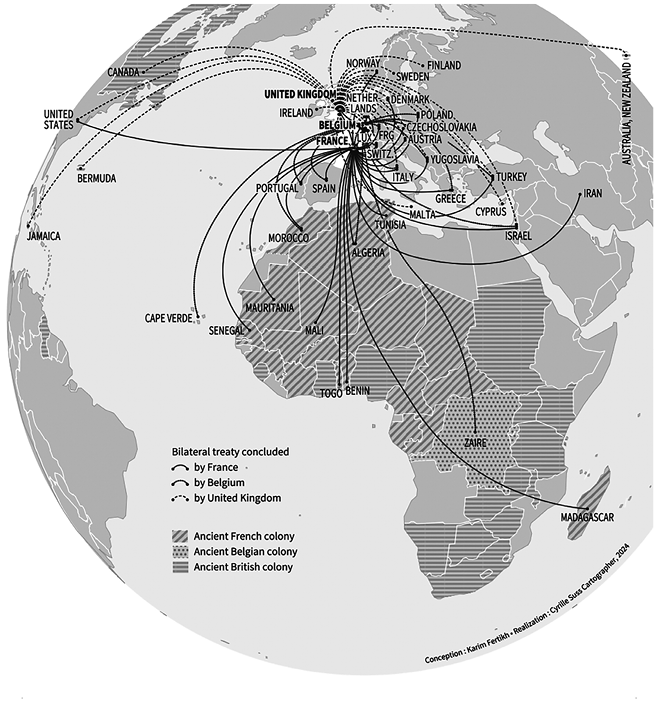
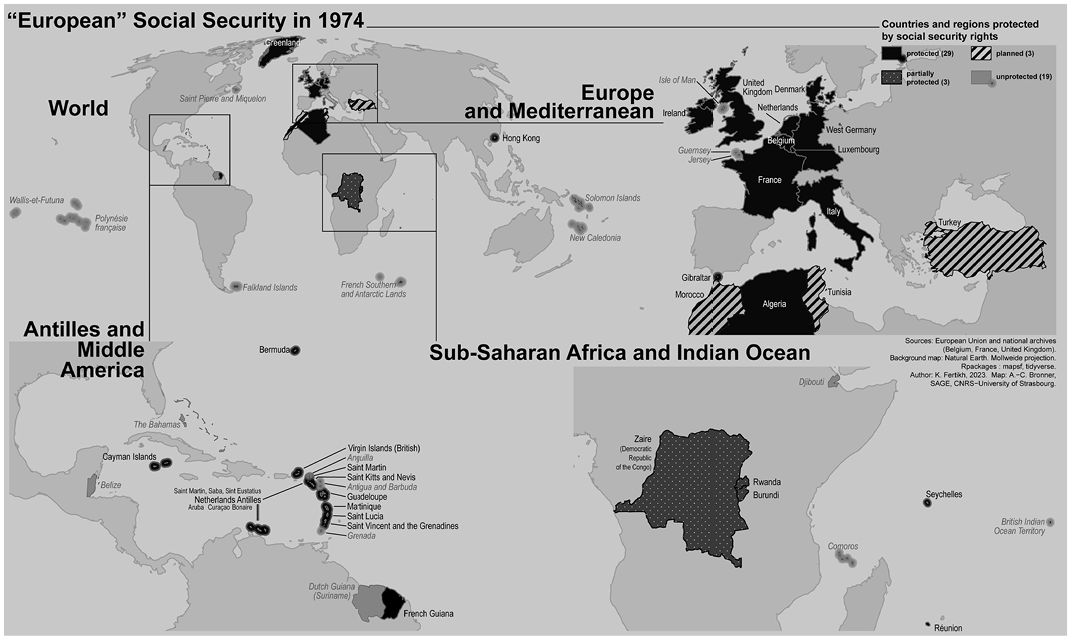

 Open access