


Despite over a century of research showing an association between low socio-economic status (SES) and mental disorders (from Reference JarvisJarvis, 1855, to Reference Johnson, Cohen and DohrenwendJohnson et al, 1999), controversy continues about the nature of the relationship: social causation posits that adversity associated with low SES causes disorder (Reference Hollingshead and RedlichHollingshead & Redlich, 1958); social selection refers to downward social mobility (‘downward drift’ or ‘failure to rise’) among people with psychopathology (Reference DunhamDunham, 1965). These theories are not mutually exclusive (Reference Shrout, Link and DohrenwendShrout & Link, 1998), and their relative importance varies by diagnosis (Reference Dohrenwend, Levav, Shrout and DohrenwendDohrenwend et al, 1998). For depression, studies of both theories have supported causation but not selection (Reference Dohrenwend, Levav and ShroutDohrenwend et al, 1992; Reference Moos, Cronkite and MoosMoos et al, 1998; Reference Johnson, Cohen and DohrenwendJohnson et al, 1999; Reference Miech, Caspi and MoffittMiech et al, 1999), consistent with studies of social causation processes alone (Reference Brown and HarrisBrown & Harris, 1978; Reference Bebbington, Hurry and TennantBebbington et al, 1986; Reference Stueve, Dohrenwend, Skodol and DohrenwendStueve et al, 1998). Inter-generational tests of causation should control for parental depression (Reference Dohrenwend and DohrenwendDohrenwend & Dohrenwend, 1969), but the study described here is apparently the first to do so.
AIMS
Inter-generational, longitudinal data are used to examine both social causation and social selection processes in the relationship between SES and major depressive disorder (MDD).
METHOD
Study design
Data were collected in a retrospective cohort study with multiple follow-up periods, described in detail elsewhere (e.g. Weissman et al, Reference Weissman, Kidd and Prusoff1982, Reference Weissman, Fendrich and Warner1992, Reference Weissman, Warner and Wickramaratne1997; Reference Warner, Weissman and MufsonWarner et al, 1999). Using a high-risk design, cohorts were defined by offspring exposure to parental depression. Probands with and without MDD, along with their spouses and offspring, were assessed several times over 17 years in order to track the development of MDD in initially unaffected offspring.
The study design has the strength of providing a clear distinction between MDD and non-MDD proband groups who were otherwise similar (Reference Weissman, Warner and WickramaratneWeissman et al, 1997). These groups were followed both over time and across generations, using consistent methodology. Having comparable sets of data from grandparents, parents and offspring allows for more stringent control of relevant variables in tests of alternative hypotheses than is usually the case. No previous causation-selection study has controlled for parental depression, although this approach has been urged for over 30 years (Reference Dohrenwend and DohrenwendDohrenwend & Dohrenwend, 1969).
Sample
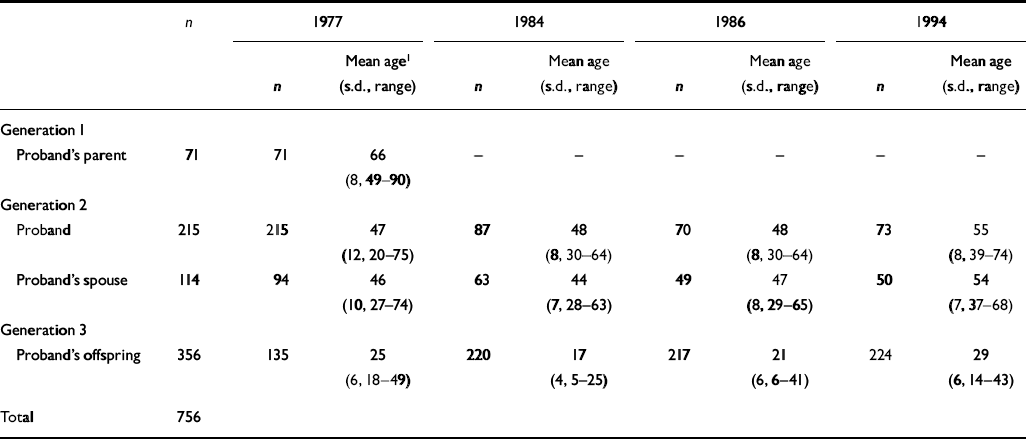
Probands, their spouses and their offspring were assessed up to four times over a 17-year period. Probands' parents were also assessed once, totalling 756 participants (Table 1). Probands with MDD were recruited from a treatment centre and probands without MDD were recruited at the same time from a randomly selected sample from the same community (Reference Weissman, Warner and WickramaratneWeissman et al, 1997). The MDD and non-MDD samples were group-matched by age and gender.
Participants interviewed at each wave and mean age, by relationship to proband
| n | 1977 | 1984 | 1986 | 1994 | |||||
|---|---|---|---|---|---|---|---|---|---|
| n | Mean age1 (s.d., range) | n | Mean age (s.d., range) | n | Mean age (s.d., range) | n | Mean age (s.d., range) | ||
| Generation 1 | |||||||||
| Proband's parent | 71 | 71 | 66 | - | - | - | - | - | - |
| (8, 49-90) | |||||||||
| Generation 2 | |||||||||
| Proband | 215 | 215 | 47 | 87 | 48 | 70 | 48 | 73 | 55 |
| (12, 20-75) | (8, 30-64) | (8, 30-64) | (8, 39-74) | ||||||
| Proband's spouse | 114 | 94 | 46 | 63 | 44 | 49 | 47 | 50 | 54 |
| (10, 27-74) | (7, 28-63) | (8, 29-65) | (7, 37-68) | ||||||
| Generation 3 | |||||||||
| Proband's offspring | 356 | 135 | 25 | 220 | 17 | 217 | 21 | 224 | 29 |
| (6, 18-49) | (4, 5-25) | (6, 6-41) | (6, 14-43) | ||||||
| Total | 756 | ||||||||
Response rates were 80% or higher at each wave of data collection. Non-response rates did not vary by whether the proband had MDD or by SES level. Migration was minimal. Extensive efforts were made to locate and interview all members of the sample, including those who had moved out of the region. Deaths were few and did not vary by the diagnostic status of the proband.
Assessment
Diagnosis
‘Best-estimate’ diagnoses were formulated for all participants (Reference Weissman, Warner and WickramaratneWeissman et al, 1997). Clinical interviewers conducted diagnostic interviews using the Schedule for Affective Disorders and Schizophrenia (SADS). Interviewers had graduate-level clinical training (all had an MA or PhD in clinical psychology, a Master of Social Work, or were psychiatry residents) and received extensive training especially for the study. Interviewees were not told the diagnoses of their relatives. Teams of clinicians pooled all available sources of information (blind to family history of psychopathology) to formulate Research Diagnostic Criteria (RDC), DSM-III or DSM-III-R diagnoses (Reference Spitzer, Endicott and RobinsSpitzer et al, 1978; American Psychiatric Association, 1980, 1987). The team members included psychologists, psychiatrists and psychiatric residents, most with extensive experience, and each team was under the supervision of a senior psychiatrist. For the purposes of this study, depression was defined as a life-time history of at least one episode of MDD.
The group with MDD exhibited the full range of severity, from one episode only to chronic psychotic unipolar depression. (Probands with bipolar disorders were excluded from the study.) All had significant role impairment while depressed. At the first interview, most probands (64%) had recurrent depression and most (65%) reported suicidal ideation or attempts (Reference Weissman, Merikangas and WickramaratneWeissman et al, 1986). A third (33%) had a history of hospitalisation for depression (Reference Weissman, Merikangas and WickramaratneWeissman et al, 1986). All depressed probands had received out-patient treatment for depression.
Socio-economic status
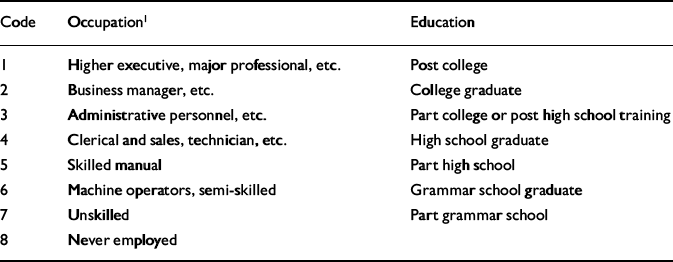
Socio-economic status was measured by two indicators (education and occupation) in the demographic section of the SADS (Reference Mannuzza, Fyer and KleinMannuzza et al, 1986). Level of education and occupational status are coded from 1 to 7 and 1 to 8 respectively (highest to lowest, see Table 2), in accordance with the manual for the Hollingshead Two-Factor Index of Social Position (Reference Myers and BeanMyers & Bean, 1968). The Index of Social Position itself was not used because it is a composite of the education and occupation variables, and we chose to examine their separate and joint effects in a more flexible way by including them as separate terms in regression models. This way of coding occupation is very close to that in the Dictionary of Occupational Titles, which is used by the United States Census (Reference Myers and BeanMyers & Bean, 1968). For the 1994 interview only, the variable denoting the respondent's own level of education had been split into two variables: the last type of school attended and the last type of diploma received. These two variables were re-coded to re-create the Hollingshead variable (Table 2) used in the other three waves.
Hollingshead occupation and education codes
| Code | Occupation1 | Education |
|---|---|---|
| 1 | Higher executive, major professional, etc. | Post college |
| 2 | Business manager, etc. | College graduate |
| 3 | Administrative personnel, etc. | Part college or post high school training |
| 4 | Clerical and sales, technician, etc. | High school graduate |
| 5 | Skilled manual | Part high school |
| 6 | Machine operators, semi-skilled | Grammar school graduate |
| 7 | Unskilled | Part grammar school |
| 8 | Never employed |
Unemployment
The Social Adjustment Scale is a self-report questionnaire about occupational and role functioning (Reference Weissman and BothwellWeissman & Bothwell, 1976). One item from this scale identified participants who were unemployed, housewives, students or retired.
Income
Data were available in the 1994 wave of data collection only, from an item in the SADS measuring income in $10 000 increments, coded from 1 to 9.
Analytic strategy
Social causation
For tests of social causation, logistic regression was used to model the effect of low parental SES on first-onset major depressive disorder in offspring. Socio-economic status was defined in two ways: as education and occupation, both Hollingshead ratings, treated as continuous or dichotomised. Only offspring who had never had MDD as of 1977 (and their parents and grandparents) were included in the analyses. The SUDAAN software package was used to control for the non-independence of observations due to some probands having more than one offspring (Reference Shah, Barnwell and BielerShah et al, 1996).
Given the design of the study, no models were tested predicting the depression status of the proband cases and controls from their parents' SES. This is because the sample was selected on the basis of the probands' depression status. It was also not possible to test the effect of offspring SES on offspring depression, because only four of the 80 offspring who were adults with no MDD history at the beginning of the study later developed MDD during the study period.
Interactions were tested in two ways. Using the conventional method, product terms were added to logistic regression models, to assess interaction on the multiplicative scale. However, we had no reason to postulate that any interactions between risk factors in the present study should be necessarily multiplicative rather than additive. Therefore we also assessed interaction simultaneously on the additive and multiplicative scales using sets of dummy variables in logistic regression. For example, if the sum of the effects of each risk factor in the absence of the other is smaller than the effect of both risk factors together, but the product of the two separate effects is larger than the effect of both risk factors, then there is evidence for positive interaction on the additive scale but not on the multiplicative scale. We used this approach in order to describe more precisely the nature of any interactions discovered.
Social selection
For tests of social selection, mixed-model linear regression was used to model the effect of MDD on SES. Most formulations of social selection theory focus on the effect of mental disorder on the individual's own social mobility. However, to provide a simpler comparison with our social causation analyses (which were all inter-generational), we first report tests of the effect of parental MDD on offspring SES, followed by tests of the effect of offspring's own MDD. For the social selection analyses, MDD and SES were defined as before, with the addition of an income variable that was available at the 1994 wave only. The sample was constrained to offspring who were adults over age 20 years in 1994 when their SES was measured. Analyses predicted low 1994 SES in offspring from positive MDD history by 1984 (in parents or offspring), controlling for prior parental SES. Family membership (i.e. the effect of multiple offspring per proband) was controlled by specifying the term as a random effect in each mixed model.
Hypotheses
Social causation
Low parental SES (defined as low occupation and low education) increases the risk of first-onset MDD in offspring, controlling for offspring gender, age, parental MDD and grandparental MDD.
Social selection
Major depressive disorder (in parent or offspring, tested separately) increases the risk of subsequent low SES (defined as occupation, education and income) among offspring, controlling for gender, age, parental SES and grandparental SES.
RESULTS
Social causation
Effects of education on onset of depression
Analyses revealed a strong and consistent effect of low parental education (highest of either parent) in 1977 on the subsequent onset of MDD in their offspring, both as bivariate associations and after adjusting for parental MDD and offspring gender age and number of interviews (Table 3). The sample (n=306) was defined as those offspring having no personal history of MDD in 1977.
Social causation: parental socio-economic status in 1977 predicting later onset of major depressive disorder (MDD) in offspring

| Risk factor | n | MDD offspring with risk factor | Non-MDD offspring with risk factor | Unadjusted odds ratio (95% CI) | Adjusted odds ratio1 (95% CI) |
|---|---|---|---|---|---|
| Neither parent educated beyond high school v. at least one was | 306 | 67% of 99 | 56% of 207 | 2.50 (1.46-4.28) | 3.32 (1.82-6.03) |
| Neither parent has occupational status higher than skilled manual labour v. at least one has | 306 | 38% of 99 | 23% of 207 | 2.06(1.12-3.81) | 2.39(1.22-4.69) |
Bivariate models
Treating parental education as a continuous variable, the mean education level of parents with depressed offspring was 3.66, versus 3.24 for parents of non-depressed offspring (lower score reflects better education, see Table 2). This difference is statistically significant (t= ‒2.48, d.f.=304, P <0.05; odds ratio 1.25 for each increment in education, 95% confidence interval 1.01 to 1.53, n=306). When parental education was treated as a dichotomous variable, low parental education doubled the offspring's risk of MDD (Table 3). Low parental education was defined as neither parent being educated beyond high school, but the effect is also seen at other dichotomisation points (e.g. failure to complete high school).
Adjusted models
Table 3 shows a stronger effect for low education (OR 3.32) after offspring gender, age, number of interviews and parental MDD were controlled. Offspring age and the number of times that the offspring was interviewed were added to the model to account for differences between individuals in time at risk and observational opportunities. Although only one of these two terms (number of interviews) was a significant predictor, they were both retained in the model for conceptual clarity and because they had been identified as potential confounds a priori. Both parental MDD and offspring gender were significant predictors in the full model.
To test whether the effect of low parental education was stronger in families with or without depression, the analyses were repeated separately for each group of families. The effect of low parental education was stronger for offspring of parents without depression (OR 7.35, 95% CI 2.06-26.21, n=126) than for offspring with one or more parent with depression (OR 2.16, 95% CI 1.08-4.30, n=180). Using the traditional method of assessing interaction, the product term for parental education and parental MDD was not statistically significant (OR 0.32, 95% CI 0.08-1.23, n=306) on the multiplicative scale. Using the dummy variable method, we found evidence of negative interaction on both the additive and multiplicative scales. In other words, offspring with both low parental education and parental depression were less likely to be depressed than would be predicted by adding or multiplying together the risk associated with each risk factor in the absence of the other. This is consistent with the stratified analyses above, which show that low parental education has a much stronger effect among offspring of parents without depression (who are normally at decreased risk for depression compared with offspring of parents with depression).
In order to test whether the effect varied by gender, the analyses were repeated for male and female offspring separately. The effect of parental education was stronger for male (OR 4.17, 95% CI 1.83-9.47, n=152) versus female (OR 2.80, 95% CI 1.18-6.62, n=154) offspring. The product term for parental education and offspring gender was not statistically significant (OR 0.65, 95% CI 0.21-2.03, n=306), indicating no significant interaction on a multiplicative scale. Using the dummy variable method, we found no evidence for interaction on the additive scale but we did find evidence for negative interaction on the multiplicative scale (the effect of having both low education and female gender being weaker than would be predicted by the product of the effects of each in the absence of the other).
In the preceding analyses, parental MDD was defined as at least one parent having MDD, among those parents who were interviewed. If a spouse was not interviewed, the family was still included. When the parental data were made more homogeneous by using data from probands only, or by using only families in which both parents were interviewed, the pattern of results remained the same (results not shown).
Controlling for parental MDD accounts for only part of the familial transmission of depression. Therefore, it was desirable to tighten the control of familial MDD by adding grandparental MDD. Unfortunately, this reduced the number of participants from 306 to 95 because of missing grandparent data. Families with grandparents included versus not included in the study had somewhat younger and better-educated probands but did not differ on MDD or occupation. Grandparental MDD was not a significant predictor of depression in grandchildren (i.e. in offspring of the probands) in either bivariate or adjusted models. When grandparental MDD was included in the model, parental education had a similar point estimate (OR 2.02) as it had in the full sample (Table 3) but failed to reach statistical significance (95% CI 0.74-5.48).
Effect of parental occupation on onset of depression
The results for occupation were similar to those for education, but weaker.
Bivariate models
Bivariate models showed an effect for parental occupation as a continuous variable (t= ‒2.47, P <0.05, OR 1.21 for each increment in occupational level, 95% CI 1.01-1.45, n=306). The mean occupational level of parents of offspring with depression was 3.99, versus 3.52 for parents of offspring without (3 is the code for administrative personnel and 4 is the code for clerical and sales staff). Treating occupation as a dichotomous variable, offspring risk of MDD was doubled if neither parent was a skilled worker or professional (Table 3).
Adjusted models
The occupation effect remained significant after adjusting for parental MDD and offspring gender, age and number of interviews (Table 3). These results held whether parental data were from probands only, from both parents only, or from at least one parent. This effect was stronger for male offspring (OR 3.68, 95% CI 1.41-9.61, n=152) than for female offspring (OR 1.75, 95% CI 0.67-4.56, n=154). However, the product term for parental occupation and offspring gender was not statistically significant (OR 0.45, 95% CI 0.13-1.57, n=306) on the multiplicative scale. There was evidence of negative interaction on both the additive and multiplicative scales.
Stratifying by parental MDD status, the effect of parental occupation was stronger for offspring of non-MDD parents (OR 7.45, 95% CI 2.54-21.88, n=126) than for offspring with one or more parent with MDD (OR 1.40, 95% CI 0.60-3.24, n=180). The product term for parental occupation and parental MDD was statistically significant in the negative direction (OR 0.21, 95% CI 0.05-0.81, n=306). There was strong evidence of negative interaction on both the multiplicative and additive scales.
When grandparental MDD was added to the model, the sample size dropped to 92 and the effect of occupation was no longer statistically significant.
Restricted sample
The sample of 306 offspring in the above analyses was defined as those offspring who had no history of MDD in 1977. The sample of 205 offspring used in the social selection analyses below was defined as those offspring over age 20 years in 1994. To aid comparison, we repeated the preceding analyses on the set of 176 offspring meeting both of these criteria. The previously observed effects of parental education and occupation on offspring depression remained statistically significant, both in bivariate and adjusted models (Table 4).
Social causation analyses using the restricted sample (176 offspring meeting inclusion criteria for both causation and selection analyses)

| Risk factor | n | Unadjusted odds ratio (95% CI) | Adjusted odds ratio1(95% CI) |
|---|---|---|---|
| Neither parent educated beyond high school, v. at least one was | 176 | 3.26(1.70-6.26) | 4.32(2.14-8.73) |
| Neither parent has occupational status exceeding skilled manual labour, v. at least one has | 176 | 2.46(1.24-4.88) | 2.49(1.17-5.31) |
Social causation models including both education and occupation
Although both parental education and parental occupation predicted offspring depression, the effect of occupation became non-significant (OR 1.47, 95% CI 0.76-2.87, n=306) when education was introduced into the model, while the effect of education remained significant (OR 2.83, 95% 1.49-5.35, n=306), both adjusted for offspring gender, age, number of interviews and parental MDD. The same pattern was seen if the model was unadjusted or if it was stratified by gender. Clearly, the effect of occupation on depression was substantially dependent on its relationship to education.
However, if the full model is stratified by parental MDD, the effect of occupation does remain significant among families without parental MDD (OR for occupation 4.68, 95% CI 1.54-14.22; OR for education 5.35, 95% CI 1.44-19.82, n=126).
Recoding occupation
Following the Hollingshead classification system, unemployed and retired persons had been coded at the level of their ‘usual’ profession. We hypothesised that any effect of occupation on MDD might be diluted by this system, if unemployment was very depressogenic and if there were many unemployed people coded as having the higher-status jobs, which are thought to be the least depressogenic in this model. To remove the potentially confounding influence of individuals who were not in paid employment (possibly owing to depression), we extracted data from the Social Adjustment Scale to create a dichotomous variable indicating whether each parent was ‘working’ or ‘non-working’ (unemployed, a student, retired or a housewife).
Reanalysis of the effect of parental occupation on offspring MDD controlling for parental employment status continued to show a significant effect (OR for occupation 3.27, 95% CI 1.49-7.20, n=221, in the full model adjusted for parent MDD, offspring age, gender and number of interviews). The sample size was reduced owing to missing data from the Social Adjustment Scale. Again, this occupation effect became non-significant when parental education was added to the model (OR for occupation 1.60, 95% CI 0.67-3.82). Therefore, the substantial dependence of the occupation effect is not likely to be attributable to the way that non-working people were coded using the Hollingshead system.
Social selection
Now we turn to the alternative model for the MDD-SES relationship, that of social selection. The social selection hypothesis posits that people who are depressed will become so impaired that they will drift down the occupational and social hierarchy, or fail to rise out of low SES (Reference DunhamDunham, 1965; Reference Gruenberg, Gruenberg and HuxleyGruenberg, 1961).
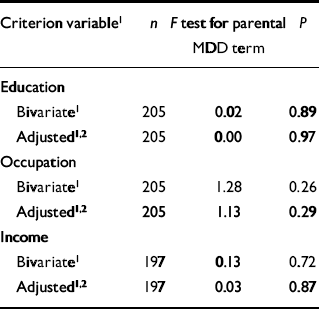
There was no support for social selection models predicting offspring educational, occupational or income level in 1994 from parental (proband and spouse) MDD history as of 1984. As stated above, the sample of 205 offspring used in the social selection analyses below was defined as those offspring over age 20 years in 1994. Mixed linear regression models were tested predicting offspring SES in 1994 from parental MDD by 1984, adjusting for the random effect of family membership (i.e. multiple offspring of some probands). All models failed to show a statistically significant effect of parental MDD, whether SES was defined as the offspring's education, occupation or income, and whether or not the models controlled for offspring age, gender, number of interviews, parental prior SES or combinations of these variables (Table 5). Results (not shown) were the same for the restricted sample: n=176, offspring with no history of MDD in 1977 and over age 20 years in 1994. Given the lack of significant findings for parents and offspring, grandparental effects were not modelled.
Linear regression: predicting offspring socio-economic status from parental depression
| Criterion variable | n | F test for parental MDD term | P |
|---|---|---|---|
| Education | |||
| Bivariate1 | 205 | 0.02 | 0.89 |
| Adjusted1 , 2 | 205 | 0.00 | 0.97 |
| Occupation | |||
| Bivariate1 | 205 | 1.28 | 0.26 |
| Adjusted1 , 2 | 205 | 1.13 | 0.29 |
| Income | |||
| Bivariate1 | 197 | 0.13 | 0.72 |
| Adjusted1 , 2 | 197 | 0.03 | 0.87 |
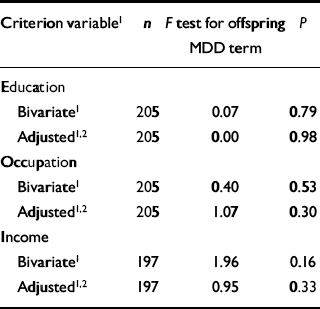
Because the social selection model is typically tested as a within-generation effect rather than as an effect transmitted from parents to children, we substituted offspring MDD for parental MDD in the preceding analyses, and again found no significant effects (Table 6).
Linear regression: predicting offspring socio-economic status from offspring depression
| Criterion variable1 | n | F test for offspring MDD term | P |
|---|---|---|---|
| Education | |||
| Bivariate1 | 205 | 0.07 | 0.79 |
| Adjusted1 , 2 | 205 | 0.00 | 0.98 |
| Occupation | |||
| Bivariate1 | 205 | 0.40 | 0.53 |
| Adjusted1 , 2 | 205 | 1.07 | 0.30 |
| Income | |||
| Bivariate1 | 197 | 1.96 | 0.16 |
| Adjusted1 , 2 | 197 | 0.95 | 0.33 |
Summary of findings
Social causation
There was a robust relationship between parental SES and later onset of depression in offspring, after controlling for parental depression. If neither parent had any education beyond high school, their offspring were over three times as likely to develop MDD, controlling for parental MDD history and offspring gender, age and number of interviews. The education effect was especially strong among offspring of non-MDD parents and among male offspring. If neither parent had an occupational status that was higher than skilled manual labour, offspring were twice as likely to develop MDD, controlling for the same variables. However, the effect of parental occupation on offspring MDD was in large part dependent on the relationship of parental occupation to education.
Social selection
Neither parental depression nor offspring's own depression predicted downward drift or failure to rise in educational attainment, occupational status or income, either in bivariate or adjusted models.
DISCUSSION
This study is the first investigation of the causation-selection issue that both controls for parental depression and follows offspring from childhood into adulthood. It is well known that a family history of MDD is associated with increased risk of MDD in offspring, and it is likely that some of that effect is genetic (Reference Weissman, Warner and WickramaratneWeissman et al, 1997). We used data from a study originally designed to enhance detection of familial effects (a high-risk study) and controlled for these same effects. Despite this stringent test, we found that after controlling for the familial effect, low parental SES is still associated with a more than tripled risk of MDD among offspring. This implies that environment plays a key role in the development of MDD, whether or not genetic vulnerability is present. The effects of low parental education and occupation on offspring MDD are especially powerful when parental MDD is absent (each having about a five-fold effect).
Our results confirm and extend those of other studies. Johnson et al (Reference Johnson, Cohen and Dohrenwend1999) similarly found that low parental SES increased risk for depression among adolescent offspring after offspring IQ and parental psychopathology were accounted for, and that offspring MDD did not predict low educational attainment. Our results are also consistent with the findings of studies conducted using other types of design showing that environmental adversity increases the risk of depression (Reference Brown and HarrisBrown & Harris, 1978; Reference Bebbington, Hurry and TennantBebbington et al, 1986; Reference Holzer, Brent and SwansonHolzer et al, 1986; Reference TimmsTimms, 1996; Reference Dohrenwend, Levav, Shrout and DohrenwendDohrenwend et al, 1998; Reference Moos, Cronkite and MoosMoos et al, 1998; Reference Weich and LewisWeich & Lewis, 1998; Reference Miech, Caspi and MoffittMiech et al, 1999). A recent twin study found that while there was evidence for genetic influences as well, the non-shared environment “played the strongest role in the development of MDD” (Reference Bierut, Heath and BucholzBierut et al, 1999, p. 562).
While our results show a strong relationship between parental SES and the development of depression in offspring, they tell us nothing about the specific processes involved. For example, the educational and occupational levels of parents may induce vulnerabilities by adversely influencing developmental processes during childhood or adolescence. Alternatively, they may exert their impact by linking stresses contributing to the low SES of the offspring and the stresses and strains of low-SES environments for young adults. It will be especially important to isolate similarities and differences in these processes for males and females because MDD and SES both tend to vary by gender.
Clinical implications
Low parental education is an especially powerful risk factor for offspring depression when the offspring is male or when neither parent has a history of depression. Because females are at higher risk for depression, this negative interaction implies that females are already, as a group, so vulnerable that the added vulnerability of low parental education does not produce the full increment of risk for depression that it would among males. Similarly, people whose vulnerability is already high by virtue of having a parent with depression do not tend to experience the full magnitude of increase in risk when the additional burden of low parental education is present. Nevertheless, their already high risk is indeed increased somewhat further by low parental education. In other words, low parental SES does have an independent impact on offspring depression but the strength of this impact varies across groups.
Men and women may have somewhat different (if overlapping) sets of risk factors for depression. The findings of this study suggest that growing up in a low-SES household might play a more important part in the development of depression among men than among women. This might be a particularly important issue to address in psychotherapy for depression in men.
Although the precise causal mechanism is not known, our data suggest that something related to higher parental education may protect offspring against the development of depression. Perhaps the achievement of higher education is a reflection of greater resilience or greater resources (social, emotional, instrumental, etc.), some of which may be transmitted to the offspring and serve to protect them from depression. This study indicates that, for whatever reasons, one of the benefits of seeking a higher education is that one's children will be less likely to suffer from depression. In addition, depressed parents may be reassured to learn that there is no evidence that their children are at increased risk of ‘downward drift’ or ‘failure to rise’ in SES as a result of the parent's depression.
Limitations
The main limitation of this study is that we were unable to extend and complement our analyses of inter-generational social causation effects to intra-generational models. This is because there were insufficient sample sizes meeting the age criteria at each time point. Another wave of data collection is in progress and should ease this problem considerably.
It was beyond the scope of this study to model depression in a more complex manner than the dichotomous operationalisation presented. Finer aspects of symptom patterns, severity and course could not be examined productively because the samples were often too small to subdivide in this way, and data were collected at only a few time points at irregular intervals. Our finding that the impact of low SES is stronger in non-MDD families suggests that SES may have a gradient of differential impact across levels of parental depression. Moreover, although we did not find a social selection effect, any impact of depression on SES may only be visible among severe or chronic cases of depression. When further follow-up data become available on the younger offspring (who did not meet the inclusion criteria for most of our analyses in this study), it should be possible to address these issues.
It must also be emphasised that the probands were drawn from a ‘high-risk’ study. They are not, therefore, a representative sample from the general population, although they do represent a wide range of severity of MDD among out-patients. Furthermore, the local population from which they were selected (New Haven, CT, USA) experienced an economic recession during the study period and may be dissimilar to other populations which did not undergo such difficulties. Replication of our findings in another population would naturally provide strong evidence of generalisability. Within our sample, possible cohort effects relating to the economic recession may be further investigated when more data become available from the grandchildren of the probands, who were too young to include in the present study.
CONCLUSION
The investigation found no evidence for social selection processes in the relationship of SES to MDD, but robust support for social causation models. These results are consistent with other studies but make a distinct contribution. This contribution stems from our ability to control the familial effect of parental depression in the longitudinal assessment of the relation of parental SES to offspring depression and offspring SES. For over a century, psychiatric epidemiologists have wrestled with the question of whether social adversity is causally related to mental disorders independently or rather is confounded with genetic effects. The present findings indicate that, first, the SES-depression association does not disappear after family history of depression is taken into account, and second, it is social causation rather than social selection that mainly accounts for the SES-depression association. Our findings suggest that in the USA, parental education (and, to a lesser extent, occupation) has important implications for the mental health of offspring, especially among non-MDD parents and parents of males. It will be important for future research to replicate these findings with representative samples from the general population and with provisions for investigating the specific processes and mechanisms involved.
ACKNOWLEDGEMENTS
The authors wish to thank Dr Bruce Link, Dr Sharon Schwartz and Dr Myrna Weissman for their helpful comments on prior drafts. J.E.B.R.'s work was supported by a postdoctoral training fellowship from the National Institute of Mental Health (MH-13043). The study was supported by NIMH grant MH-36197 (Dr Myrna Weissman, principal investigator).




eLetters
No eLetters have been published for this article.