


1. Introduction
1.1. Motivation
Small and medium-sized enterprises (SMEs) are vital drivers of global innovation and employment, yet they face a significant structural mismatch in product development. (Reference Garcia-Martinez, Kraus, Breier and KallmuenzerGarcia-Martinez et al., 2023) SMEs that develop physical products must navigate resource constraints and less formalised process infrastructures, factors that differentiate their product-development dynamics from those of larger corporations (Reference Iqbal and SuziantiIqbal & Suzianti, 2021). Most established product development process (PDP) literature focuses on larger corporations, offering extensive, formal frameworks that do not suit the resource-constrained and less formalized environments of SMEs. While SMEs rely on flexible, experience-based approaches, the increasing pressure of digitalization introduces a contemporary challenge; SMEs frequently lack the digital maturity and integrated process documentation necessary to compete with the technology-management capabilities of larger firms. ( The Digital Transformation of SMEs, 2021) This study aims to bridge this gap by characterizing SME-specific PDP challenges and identifying why current frameworks fail to address the unique intersection of limited resources and digital transformation.
1.2. Small and medium-sized enterprises
This study adopts the European Union definition of SMEs as enterprises with fewer than 250 employees. (European Commission, 2003). Externally, these firms operate under intensified market competition, regulatory complexity, and uncertain institutional environments that necessitate a departure from traditional, capital-intensive frameworks. These external pressures exacerbate the internal ‘resource-constrained’ paradigm, characterized by limited financial capital and a scarcity of skilled labor. Furthermore, SMEs face significant technological and digitalization barriers that undermine their ability to invest in formal process infrastructures, ultimately curtailing their competitiveness compared to larger firms (Reference Blais and St-PierreBlais & St-Pierre, 2025; Reference Brink, Packmohr, Jallouli, Bach Tobji, Belkhir, Soares and CasaisBrink & Packmohr, 2023; Reference Mattos, Pellegrini, Hagelaar and DolfsmaMattos et al., 2024; Reference Prasanna, Jayasundara, Naradda Gamage, Ekanayake, Rajapakshe and AbeyrathnePrasanna et al., 2019; Reference Yahaya and NadarajahYahaya & Nadarajah, 2023; Reference Žužek, Gosar, Kušar and BerlecŽužek et al., 2021).
1.3. Product development process in the SME-context
The product development process (PDP) encompasses the sequence of activities through which firms transform an idea into a market-ready product and ultimately commercialise it. Successful product development requires balancing two critical objectives, aligning the offering with customer needs while minimising time-to-market (Reference Iqbal and SuziantiIqbal & Suzianti, 2021). The PDP typically progresses through stages such as idea generation, concept development, design, testing, and launch. However, this process is fraught with challenges, firms frequently face resource limitations, poor cross-functional coordination, and inflexible sequential models that impede responsiveness. (Reference Falahat, Chong and LiewFalahat et al., 2024) Empirical research identified more than 30 distinct challenges in SME product development, ranging from iterative decision-making to stakeholder involvement and unclear process responsibilities, emphasising that complexity arises not only from limited resources but also from organisational and collaboration structures. (Reference Heck and MeboldtHECK & MEBOLDT, 2016) While SMEs operate with smaller financial and human resource pools, their integration of different PDPs is as much a response to high environmental uncertainty and a lack of specialized planning personnel as it is a direct result of resource constraints. Formalized, sequential models often prove too rigid for the responsive operational structures of smaller firms; thus, they favor flexible, informal approaches that allow for situational adaptation. Consequently, the SME PDP is a multidimensional, coordination-dependent endeavor where the choice of approach is a strategic alignment with their specific innovation and organizational context. (Reference Brink, Packmohr, Jallouli, Bach Tobji, Belkhir, Soares and CasaisBrink & Packmohr, 2023; Reference Iqbal and SuziantiIqbal & Suzianti, 2021; Reference Karlsson and OlssonKarlsson & Olsson, 1998; Reference Nicholas, Ledwith and PerksNicholas et al., 2011; Reference Prasanna, Jayasundara, Naradda Gamage, Ekanayake, Rajapakshe and AbeyrathnePrasanna et al., 2019; Reference Salgado, Salomon, Mello and Da SilvaSalgado et al., 2018; Reference Žužek, Gosar, Kušar and BerlecŽužek et al., 2021) Collectively, these studies underscore that the PDP is a multidimensional, resource-intensive, and coordination-dependent endeavour, particularly challenging for SMEs that must innovate under structural and financial limitations.
1.4. Research questions
This study aims to address four central research questions that collectively aim to deepen the scientific understanding of PDPs in hardware-oriented SMEs. These questions are:
RQ1: What factors are relevant in the setup of PDPs for hardware-developing SMEs?
RQ2: How can PDPs within SMEs be characterised?
RQ3: What challenges are characteristic of SME PDPs?
RQ4: Do current development frameworks properly address the specificities of the SME PDP?
Together, these research questions establish a foundation for identifying the current state of SME PDPs, the most important influencing factors and the frameworks available to improve them.
2. Methods
2.1. Systematic literature review
To systematically identify and evaluate relevant scientific contributions, this study employs a structured literature analysis based on the Preferred Reporting Items for Systematic Reviews and Meta-Analyses (PRISMA) framework. (Reference Moher, Liberati, Tetzlaff and AltmanMoher et al., 2009) The next section details the search string:
TITLE-ABS-KEY((“product development process*” OR “product development model*” OR “product development framework*” OR “product development method*” OR “new product development method*” OR “engineering design process*” OR “engineering process*” OR “design process*” OR “development process*”)) AND (“small and medium enterprise*” OR “small & medium enterprise*” OR “small-medium enterprise*” OR “small and medium-sized enterprise*” OR “small & medium-sized enterprise*” OR “small-medium-sized enterprise*” OR “small and medium business*” OR “small & medium business*” OR “small-medium business*” OR “SME” OR “SMEs”)) AND PUBYEAR > 2014 AND PUBYEAR < 2026 AND (LIMIT-TO (DOCTYPE, “cp”) OR LIMIT-TO (DOCTYPE, “ar”)) AND (LIMIT-TO (LANGUAGE, “English”))
The 2015–2025 timeframe was selected to capture the critical research shift toward Industry 4.0 integration and Agile-Stage-Gate hybrids. While physical fundamentals remain stable, this window provides the most relevant data on how SMEs navigate the modern intersection of resource constraints and digital transformation. Selection followed the PRISMA protocol (Fig. 1) with explicit criteria: Inclusion required peer-reviewed empirical data on hardware PDPs in SMEs, while exclusion applied to purely software/service-based works, non-English studies, or those lacking a specific SME-context focus. The literature search employed a structured query capturing publications at the intersection of product development and SMEs. Synonyms of ‘product development process,’ ‘model,’ ‘framework,’ and ‘method’ were combined with SME-related terms and applied to the Scopus and Design Procedia databases. Following the PRISMA procedure, 633 records were identified (509 from Scopus, 124 from Design Procedia).
PRISMA-process of the literature identification

2.2. Analysis of relevant case studies
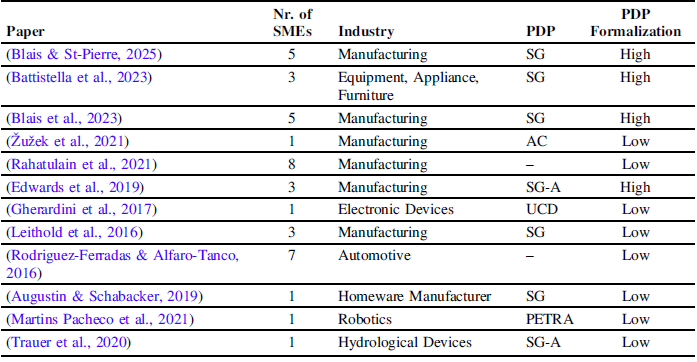
The analysed 12 case studies encompass a heterogeneous sample of 33 SMEs across diverse industrial sectors, as shown in Table 1, predominantly within manufacturing-oriented contexts such as general manufacturing, equipment production, and automotive supply. The majority of studies report the application of a Stage-Gate (SG)–based PDP based on the work of Cooper et al. or its augmented variants such as Stage-Gate with Agile (SG-A), indicating a conceptual alignment with structured development models while allowing for contextual tailoring (Reference CooperCooper, 1990). A smaller subset employs alternative frameworks such as Agile-Concurrent (AC) or User-Centred Design (UCD), illustrating methodological diversity and adaptation to specific product or domain requirements. Only five case studies explicitly describe formalized PDPs, whereas the majority exhibit low process formalization.
Identified case studies

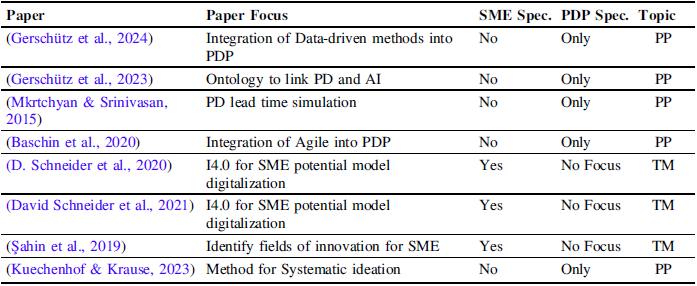
2.3. Analysis of relevant development frameworks
The reviewed literature on PDP development frameworks, shown in Table 2, reveals a concentration on process- and technology-oriented frameworks, while the focus from the process planning (PP) studies is on the PDP and not specifically on SMEs, the technology-management (TM) frameworks are tailored for SMEs without clear PDP focus. The set indicates a methodological imbalance, while PDP-oriented research tends to generalize across firm types, SME-focused contributions largely remain on the side of TM. While TM frameworks are SME focused, they are not PDP focused. An SME specific method for PP or a general integrating framework between PP and TM has not been found during research.
Identified development frameworks

3. Results
3.1. Factors influencing the configuration of the PDP in SMEs
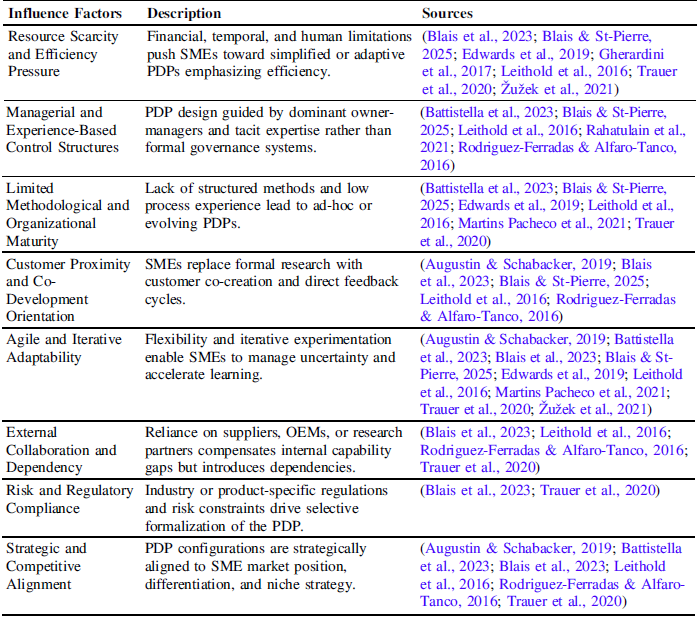
The influencing factors listed in Table 3 have been derived from the literature by clustering relevant information from the sources into eight overarching thematic categories. Specifically, we inductively coded influence-related statements and iteratively merged similar codes until we obtained the smallest set of distinct themes that collectively covered the evidence across the reviewed studies. Industry and firm size also affect the PDP indirectly. Large firms typically use more structured PDPs and extensive KPI systems, whereas in smaller firms these processes are driven mainly by resource availability, managerial expertise, and customer proximity rather than headcount or turnover. (Reference Blais, St-Pierre and BergeronBlais et al., 2023; Reference Blais and St-PierreBlais & St-Pierre, 2025) Smaller SMEs often rely on experience-based and informal coordination mechanisms, where owner-managers design processes according to situational needs and resource constraints rather than standardized frameworks (Reference Battistella, Fornasier and PessotBattistella et al., 2023). Moreover, industry-specific requirements, such as manufacturing quality norms, regulatory demands, or technological uncertainty, exert a contextual pull that influences the degree of process formalization. (Reference Leithold, Woschke, Haase and KratzerLeithold et al., 2016; Reference Trauer, Schweigert-Recksiek, Gövert, Mörtl and LindemannTrauer et al., 2020) Manufacturing-oriented SMEs, for example, selectively integrate Agile or Lean-based methods to maintain flexibility while meeting performance and compliance expectations (Reference Augustin and SchabackerAugustin & Schabacker, 2019; Reference Edwards, Cooper, Vedsmand and NardelliEdwards et al., 2019). Firm size and sector indirectly enable or constrain SME PDPs via the factors in Table 3. In Table 3 and subsequent tables, citations identify the source studies for each factor, challenge, or activity.
Factors influencing the configuration of the PDP in SMEs

3.2. Characterization of the PDPs in studied SMEs
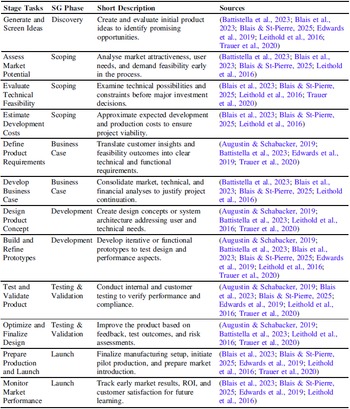
Table 4 summarizes the SME PDP stages based on Cooper et al., while providing a clustering of the main activities conducted by these companies during these stages (Reference CooperCooper, 1990). Synchronized with use-case-based literature for structural consistency, Table 4 presents a composite synthesis where individual stages are selectively bypassed or omitted across specific case studies depending on situational requirements. SMEs execute tasks iteratively and resource-dependently, often hybridizing traditional PDPs with Agile elements to improve flexibility, communication, and responsiveness. Edwards et al. report that manufacturing firms successfully combined Agile practices with stage-gate models to improve coordination and adaptability (Reference Edwards, Cooper, Vedsmand and NardelliEdwards et al., 2019). Battistella et al. similarly identify the use of short design sprints and incremental milestones in SMEs as a means to manage uncertainty and strengthen customer alignment (Reference Battistella, Fornasier and PessotBattistella et al., 2023). Blais et al. emphasize that resource limitations lead SMEs to simplify and selectively formalize their PDPs, streamlining gate reviews and relying on managerial judgment (Reference Blais, St-Pierre and BergeronBlais et al., 2023; Reference Blais and St-PierreBlais & St-Pierre, 2025). Augustin and Schabacker highlight the introduction of systematic ideation and modularized front-end methods, enabling structured creativity within lean development setups (Reference Augustin and SchabackerAugustin & Schabacker, 2019). Together, these studies demonstrate that SMEs rarely apply Agile or stage-gate methods in their standard form, instead, they develop hybrid, context-specific models that balance flexibility, learning, and process control to sustain innovation under constrained conditions.
Generalized PDP of the SMEs

3.3. Overview of challenges within the PDP of SMEs
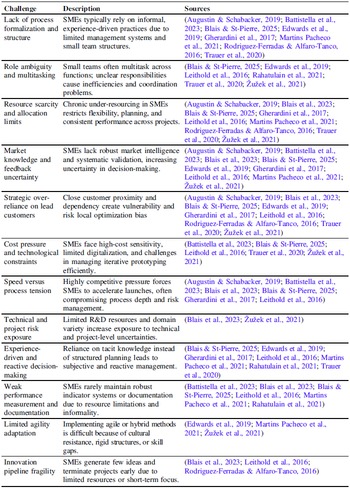
Table 5 synthesizes SME PDP challenge clusters, defined by limited structure, multitasking, and resource scarcity, reflecting systemic tensions in configuration and execution. While customer proximity aids agility, it risks short-termism and dependency. Coupled with cost pressure and low digitalization, this yields a fragile environment where flexibility overrides formalization, sacrificing long-term consistency and capability building. Collaborative networks with suppliers and research partners are frequently used to compensate for limited internal capabilities and accelerate learning (Reference Blais, St-Pierre and BergeronBlais et al., 2023). Close customer proximity serves as a means to reduce market uncertainty and enable rapid feedback cycles (Reference Blais, St-Pierre and BergeronBlais et al., 2023; Reference Leithold, Woschke, Haase and KratzerLeithold et al., 2016). Process adaptability is enhanced through the integration of hybrid development models, combining agile principles with concurrent or stage-gate frameworks to improve communication, flexibility, and responsiveness (Reference Edwards, Cooper, Vedsmand and NardelliEdwards et al., 2019; Reference Žužek, Gosar, Kušar and BerlecŽužek et al., 2021). Furthermore, SMEs employ internal and customer testing, performance indicators, and iterative prototyping to control risk and ensure product–market fit (Reference Blais and St-PierreBlais & St-Pierre, 2025; Reference Leithold, Woschke, Haase and KratzerLeithold et al., 2016). Collectively, these coping mechanisms reflect a pragmatic balance between structure and flexibility, allowing SMEs to sustain innovation under constrained conditions.
PDP challenges in SMEs

Table 5 Long description
A table with five columns and twelve rows. The columns are labeled Challenge, Description, Sources. The rows are as follows: Row 1: Challenge, Lack of process formalization and structure; Description, SMEs typically rely on informal, experience-driven practices due to limited management systems and small team structures; Sources, (Augustin & Schabacker, 2019; Battistella et al., 2023; Blais & St-Pierre, 2025; Edwards et al., 2019; Gherardini et al., 2017; Martins Pacheco et al., 2021; Rodriguez-Ferradas & Alfaro-Tanco, 2016; Trauer et al., 2020). Row 2: Challenge, Role ambiguity and multitasking; Description, Small teams often multitask across functions; unclear responsibilities cause inefficiencies and coordination problems; Sources, (Blais & St-Pierre, 2025; Edwards et al., 2019; Leithold et al., 2016; Rahatulan et al., 2021; Trauer et al., 2020; uek et al., 2021). Row 3: Challenge, Resource scarcity and allocation limits; Description, Chronic under-resourcing in SMEs restricts flexibility, planning, and consistent performance across projects; Sources, (Augustin & Schabacker, 2019; Blais et al., 2023; Blais & St-Pierre, 2025; Gherardini et al., 2017; Leithold et al., 2016; Martins Pacheco et al., 2021; Rodriguez-Ferradas & Alfaro-Tanco, 2016; Trauer et al., 2020; uek et al., 2021). Row 4: Challenge, Market knowledge and feedback uncertainty; Description, SMEs lack robust market intelligence and systematic validation, increasing uncertainty in decision-making; Sources, (Augustin & Schabacker, 2019; Battistella et al., 2023; Blais et al., 2023; Blais & St-Pierre, 2025; Edwards et al., 2019; Gherardini et al., 2017; Leithold et al., 2016; Martins Pacheco et al., 2021; uek et al., 2021). Row 5: Challenge, Strategic over-reliance on lead customers; Description, Close customer proximity and dependency create vulnerability and risk local optimization bias; Sources, (Augustin & Schabacker, 2019; Blais et al., 2023; Blais & St-Pierre, 2025; Edwards et al., 2019; Gherardini et al., 2017; Leithold et al., 2016; Rodriguez-Ferradas & Alfaro-Tanco, 2016; Trauer et al., 2020; uek et al., 2021). Row 6: Challenge, Cost pressure and technological constraints; Description, SMEs face high-cost sensitivity, limited digitalization, and challenges in managing iterative prototyping efficiently; Sources, (Battistella et al., 2023; Blais & St-Pierre, 2025; Leithold et al., 2016; Trauer et al., 2020; uek et al., 2021). Row 7: Challenge, Speed versus process tension; Description, Highly competitive pressure forces SMEs to accelerate launches, often compromising process depth and risk management; Sources, (Augustin & Schabacker, 2019; Battistella et al., 2023; Blais et al., 2023; Blais & St-Pierre, 2025; Gherardini et al., 2017; Leithold et al., 2016). Row 8: Challenge, Technical and project risk exposure; Description, Limited R&D resources and domain variety increase exposure to technical and project-level uncertainties; Sources, (Blais et al., 2023; uek et al., 2021). Row 9: Challenge, Experience-driven and reactive decision-making; Description, Reliance on tacit knowledge instead of structured planning leads to subjective planning and reactive management; Sources, (Blais & St-Pierre, 2025; Edwards et al., 2019; Gherardini et al., 2017; Leithold et al., 2016; Martins Pacheco et al., 2021; Rahatulan et al., 2021; Trauer et al., 2020). Row 10: Challenge, Weak performance measurement and documentation; Description, SMEs rarely maintain robust indicator systems or documentation due to resource limitations and informality; Sources, (Battistella et al., 2023; Blais et al., 2023; Blais & St-Pierre, 2025; Leithold et al., 2016; Martins Pacheco et al., 2021; Rahatulan et al., 2021). Row 11: Challenge, Limited agility adaptation; Description, Implementing agile or hybrid methods is difficult because of cultural resistance, rigid structures, or skill gaps; Sources, (Edwards et al., 2019; Martins Pacheco et al., 2021; uek et al., 2021). Row 12: Challenge, Innovation pipeline fragility; Description, SMEs generate few ideas and terminate projects early due to limited resources or short-term focus; Sources, (Blais et al., 2023; Leithold et al., 2016; Rodriguez-Ferradas & Alfaro-Tanco, 2016).
3.4. Analysis of PDP development frameworks
The analysis of existing development frameworks, as shown in Table 2, reveals two major research and application gaps concerning SMEs. First, there is a lack of PDP development frameworks explicitly designed for SMEs, which support and formalize their inherently ad-hoc, experience-driven processes without imposing the rigidity of large-enterprise models. This lack of adaptable structure is particularly critical regarding digitalization; without formalized PDPs, SMEs struggle to systematically identify and integrate Industry 4.0 technologies, which are often designed for the more mature process infrastructures of larger firms. Existing approaches predominantly target generalized PDPs, largely suited for larger, more formalized enterprises, leaving SMEs without adaptable methods that reflect their resource constraints and informal coordination structures. The second, and more significant, gap concerns the absence of integrative frameworks that connect technology management with SME-specific PDP characteristics. Current models addressing technological capability development or digital transformation largely overlook the procedural and organizational realities of smaller firms. As a result, SMEs lack systematic tools to identify, assess, and integrate new technologies in alignment with their less formalized PDPs. This disconnection limits their ability to access and exploit competitive technologies available to larger enterprises. A dedicated framework that bridges technology management and SME process behaviour, remains critically missing and represents a key opportunity for advancing SME competitiveness.
4. Discussion
Research on SME PDPs remains limited and subject to selection bias. SME heterogeneity and low process formalization impede comparability and framework design. This study consolidates case studies and development frameworks, clarifying SME practices and research gaps. Future work will focus on developing digital knowledge bases and adaptive toolboxes to bridge this gap. By aligning technology management with the informal procedural realities of SMEs, these tools aim to reduce the digital maturity lag and empower smaller firms to exploit competitive technologies that currently remain inaccessible due to process fragmentation. All four research questions originally planned have been answered. RQ1 identifies key factors influencing SME PDP selection, notably limited resources, customer dependence, and informal structures. RQ2 characterizes SME PDPs as flexible but largely ad hoc and experience-driven. RQ3 consolidates core challenges, including resource scarcity, low formalization, decision uncertainty, and digitalization barriers. RQ4 exposes a major gap, existing frameworks optimize general PDPs but fail to accommodate SME-specific conditions or support systematic technology need identification. Overall, the findings clarify SME PDP characteristics and challenges, emphasizing the need for tailored frameworks. Future work will validate results through SME stakeholder interviews, forming the foundation of a dissertation on improving SME product development.
Acknowledgement
This work was conducted in the context of the project “ReTraSON” (Regionales Transformationsnetzwerk Südostniedersachsen), which is funded by the “Bundesministerium für Wirtschaft und Klimaschutz” (Federal Ministry for Economic Affairs and Climate Action).


 Open access

