

After completing his undergraduate training at the University of Buffalo in three years, Peter started at Harvard Medical School in 1953, four and a half years after arriving in the United States through Ellis Island. For the first time, Peter was really on his own. As a first-year student Peter moved into Vanderbilt Hall, a dormitory for male Harvard medical students. In the 1950s, the Harvard medical class was largely composed of elite highly educated men, many of whom had attended Harvard College or other Ivy League institutions. By living in Vanderbilt, Peter became fully immersed in an entirely new culture of the American elite.
How did a young German man come to be accepted into Harvard in the early 1950s? As previously noted, Peter credited his acceptance in part to the connection between his philosophy professor at the University of Buffalo, Marvin Farber, and Marvin’s brother Sidney Farber, a medical school professor at Harvard and namesake for the future Farber Cancer Institute. But Peter was also a star student and a favorite of Marvin Farber, who shared his interests in human motivation. By the time Peter started medical school his English was fluent, but he continued to speak with a thick German accent throughout his life. In these early years in the United States, Peter was sometimes taunted and called a “Nazi.” In subsequent years, when asked where he was from, he would often say “Buffalo, NY.” When people looked at him askew, he smiled. It was not always popular to be German in the United States in the 1950s.
During medical school Peter worked particularly hard. He wanted to make up for the gaps in his own education, and he was also interested in what he was learning. The first-year students spent hours in the basement of one of the large marble-faced buildings on the medical school quadrangle at Harvard, learning anatomy. Working in teams of four students, they spent grueling hours dissecting a human cadaver in a room effused with the smell of formaldehyde. For the first time, Peter had an intimate glimpse into the workings of the human body and the nervous system. Hours were spent dissecting the many interconnected nerves and muscles of the human body and memorizing the anatomical names in Latin. His Latin class with the one-armed teacher in the bombed-out basement of his high school in Lahnstein served him well.
A rite of passage for Harvard medical students was attending lectures in the iconic Ether Dome in Massachusetts General Hospital. Medical students and physicians in training listened to lectures in this amphitheatre with an operating stage below in the center of the dome. The Ether Dome was first built as an operating amphitheatre in 1821, and students and trainees would watch “brutal” surgeries performed on conscious patients since there was no effective anesthesia. On “Ether Day,” October 16, 1846, the first public demonstration of the use of inhaled ether as a surgical anesthetic took place in the Ether Dome, launching modern-day anesthesiology. The first patient to receive ether, Gilbert Abbott, awoke from neck surgery with no pain or memory of the surgery, and said it felt like a “scratch” on his neck.
In addition to his classroom studies, Peter delved into fundamental research in the first year of medical school under the guidance of the German pharmacologist Otto Krayer. Peter had met Krayer during his medical-school interview, and Krayer took an immediate interest in Peter and his history. Dr. Krayer had a history that was similar to Peter’s mother Else and this led to an immediate understanding and connection. Krayer had risked speaking up because, according to Avram Goldstein’s biographical memoir published in 1987, he “believed, very simply, that a person had to do what their conscience said was right, that in such matters it was not a question of weighing consequences” [Reference Goldstein1]. Krayer was a talented young scientist in Germany in 1932 when he was offered a chair position at a University in Dusseldorf. When he learned that the university offered this position because they had relieved a Jewish professor of the position, Krayer refused to accept the appointment. He wrote to the officials, “the primary reason for my reluctance is that I feel the exclusion of Jewish scientists to be an injustice, the necessity of which I cannot understand, since it has been justified by reasons that lie outside the domain of science. This feeling of injustice is an ethical phenomenon. It is innate to the structure of my personality, and not something imposed from the outside.” In response to being told he had to accept the position, he refused. The following was the official response from the Prussian Minister for Science, Art and National Education [Reference Goldstein1, p. 151]:
In your letter of 15 June, you state that you feel the barring of Jewish scientists is an injustice, and that your feelings about this injustice prevent you from accepting a position offered to you. You are of course personally free to feel any way you like about the way the government acts. It is not acceptable, however, for you to make the practice of your teaching profession dependent upon those feelings. You would in that case not be able in the future to hold any chair in a German university. Pending final decision on the basis of section four of the Law on the Restoration of the Professional Civil Service, I herewith forbid you, effective immediately, from entering any government academic institution, and from using any State libraries or scientific facilities.
Having followed his conscience, Dr. Krayer, like Else, had placed himself and his family at risk, and had to leave Germany.
Peter’s research with Dr. Krayer was formative and Janellen recalled that Peter was a kind of “wunderkind” with science. He had never done research before medical school but delved into fundamental science and received a student award for research during medical school.
During this time Peter became interested in neuroscience. What is consciousness and pain? What is the brain’s electrical activity during sleep or lack of consciousness? It was during these years that Peter also developed an interest in child neurology, a new field, focused on the care of children with neurological diseases. In this he was heavily influenced by another of his Harvard professors, Phil Dodge. Dodge was one of the first pediatric neurologists in the nation and started the first training program in child neurology at Harvard. Peter committed to training in child neurology at both Massachusetts General Hospital and Boston Children’s Hospital.
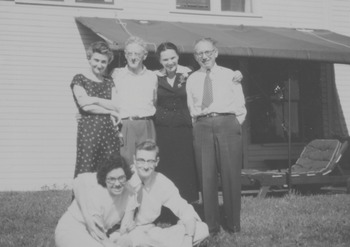
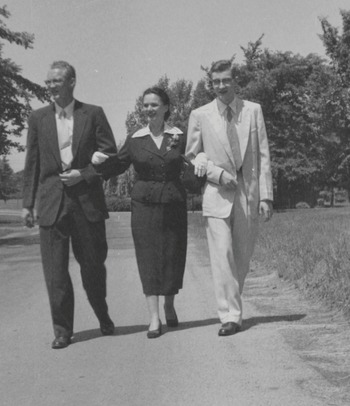
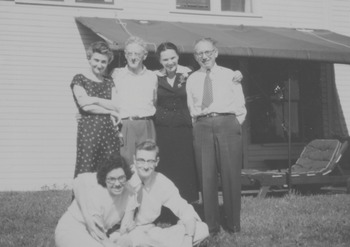
A year after Peter started medical school, he and Janellen were married. When asked to describe the Peter of those early years, Janellen recalled, “He was tall and handsome. I soon learned he was this incredibly kind, fair fellow, the kindest man on the planet.” Peter and Janellen were married in June 1954 in a small outdoor ceremony at Max and Else’s summer home in East Eden, NY, among the rolling farm fields and woodlands of western New York State (Figure 8.1). Else relished the opportunity to celebrate with her two sons (Figure 8.2).
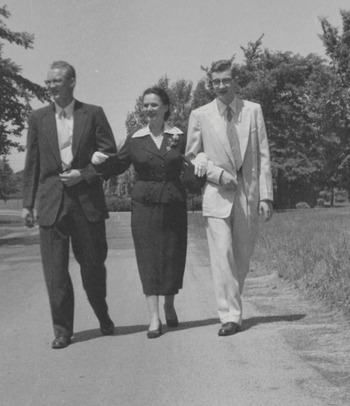
While Peter pursued his medical studies, Janellen pursued a PhD in psychology at Radcliffe College. At that time, Harvard College was all male. Although the Radcliffe women had access to the same Harvard course work and professors as did male students, Radcliffe College conferred degrees on women. It was not until 1999 that Harvard and Radcliffe had fully merged and all prior Radcliffe degrees were subsequently considered equivalent to a Harvard University degree.
With limited financial resources, Peter and Janellen rented a run-down apartment in Cambridge, MA, near the Harvard campus. These were formative years for both Peter and Janellen as they delved into understanding the development of the human brain. They approached their questions from different perspectives, Janellen as a psychologist who was interested in cognitive development and Peter as a pediatric neurologist focused on the development and childhood diseases of the human brain. Janellen recalled: “We both enjoyed our work. How the brain works interested both of us.”