




Introduction
Resource availability is a major contributor to individual variation in performance in wild populations (van Noordwijk and de Jong Reference van Noordwijk and de Jong1986). Life history traits appear to be especially plastic, as evidenced by their low heritability (i.e., high proportion of phenotypic variance due to the environment), compared to other types of traits (Price and Schluter Reference Price and Schluter1991). In particular, early life environmental quality or nutrition can affect life history traits, including longevity and senescence, long into adulthood (Lindström Reference Lindström1999; Nussey et al. Reference Nussey, Kruuk, Morris and Clutton-Brock2007). When a high-quality early life environment leads to long-lasting improvement in individual performance, this phenomenon is known as the “silver spoon effect” (Grafen Reference Grafen and Clutton-Brock1988). The role of diet may be especially important, with recent research implicating the regulation of metabolism as a key component of the senescence process (Monaghan et al. Reference Monaghan, Metcalfe and Torres2009; Lind et al. Reference Lind, Ravindran, Sekajova, Carlsson, Hinas and Maklakov2019; Maklakov and Chapman Reference Maklakov and Chapman2019; Carlsson et al. Reference Carlsson, Ivimey-Cook, Duxbury, Edden, Sales and Maklakov2021). A high-quality environment, with abundant available nutrition, can relax trade-offs between costly traits, although sometimes high-condition individuals may invest highly in traits that increase mating success at the cost of survival (Hunt et al. Reference Hunt, Brooks, Jennions, Smith, Bentson and Bussiere2004; Adler et al. Reference Adler, Telford and Bonduriansky2016; Hooper et al. Reference Hooper, Spagopoulou, Wylde, Maklakov and Bonduriansky2017; Spagopoulou et al. Reference Spagopoulou, Teplitsky, Lind, Chantepie, Gustafsson and Maklakov2020).
Many studies have investigated the effects of diet quality on juvenile and adult insects in the laboratory (e.g., Zajitschek et al. Reference Zajitschek, Brassil, Bonduriansky and Brooks2009; Lewis et al. Reference Lewis, Tigreros, Fedina and Ming2012; Tigreros Reference Tigreros2013; Duxbury and Chapman Reference Duxbury and Chapman2020). However, laboratory diet manipulations may differ from natural variation in diet. For instance, it is common to alter total calories (e.g., Hooper et al. Reference Hooper, Spagopoulou, Wylde, Maklakov and Bonduriansky2017) or individual components of diet such as protein (e.g., Tigreros Reference Tigreros2013). Furthermore, laboratory conditions are generally much more benign than those in nature, providing stable ambient temperature and humidity and excluding predators, parasites, or nonconspecific competitors, unless those are the focus of the study in question. For these reasons, survival and performance of organisms in the lab frequently differ from those of natural populations (Reichert Reference Reichert2016; Zajitschek et al. Reference Zajitschek, Zajitschek and Bonduriansky2020; Turko et al. Reference Turko, Firth, Craig, Eliason, Raby and Borowiec2023). For example, captive animals often live longer on average (Kawasaki et al. Reference Kawasaki, Brassil, Brooks and Bonduriansky2008; Hämäläinen et al. Reference Hämäläinen, Dammhahn, Aujard, Eberle, Hardy and Kappeler2014; Mautz et al. Reference Mautz, Rode, Bonduriansky and Rundle2019), may grow larger (Araújo et al. Reference Araújo, Arruda, Alencar, Albuquerque, Nascimento and Yamamoto2000; Ritz et al. Reference Ritz, Hammer and Clauss2010), and may mate more frequently (Mautz et al. Reference Mautz, Rode, Bonduriansky and Rundle2019) than their wild counterparts do, but captive animals can also display a range of physiological costs, such as reduced flight performance (Kou et al. Reference Kou, Wang, Dudley, Wu and Li2022), reduced bone density (Chirchir et al. Reference Chirchir, Ruff, Helgen and Potts2022), and more rapid senescence (Hämäläinen et al. Reference Hämäläinen, Dammhahn, Aujard, Eberle, Hardy and Kappeler2014; Mautz et al. Reference Mautz, Rode, Bonduriansky and Rundle2019).
Studies of how resource availability affects wild populations have primarily focused on vertebrates (e.g., Nussey et al. Reference Nussey, Kruuk, Morris and Clutton-Brock2007; Campbell et al. Reference Campbell, Rosell, Newman and Macdonald2017; Spagopoulou et al. Reference Spagopoulou, Teplitsky, Lind, Chantepie, Gustafsson and Maklakov2020). In comparison, field studies investigating the effect of the early life environment on adult traits are rare in invertebrates. Recently, Angell et al. (Reference Angell, Oudin, Rode, Mautz, Bonduriansky and Rundle2020) looked at the effect of artificial larval diets that differ in nutrient concentration on performance of adult antler flies, Protopiophila litigata Bonduriansky (Diptera: Piophilidae), in the field. This species is well suited for longitudinal field studies because of the high site fidelity of adult males, which allows marked individuals to be tracked over their lifetime.
In nature, P. litigata larvae feed within the bone matrix of shed moose and deer antlers (Bonduriansky Reference Bonduriansky1995), where they presumably eat bone marrow and associated bacteria and fungi. Then, from late May through July or August, they leave the antler to pupate in the soil during and after rain (Bonduriansky Reference Bonduriansky2002; Angell and Cook Reference Angell and Cook2019). A given antler will support multiple generations of developing flies over about four or five years. Antlers attract decreasing numbers of adults over that time, presumably because their food resources gradually become depleted (Bonduriansky Reference Bonduriansky1996). Previous work in P. litigata has demonstrated that larval diet quality can influence adult morphology and performance (Oudin et al. Reference Oudin, Bonduriansky and Rundle2015; Angell et al. Reference Angell, Oudin, Rode, Mautz, Bonduriansky and Rundle2020). However, these studies used an artificial diet consisting of ground beef mixed with varying amounts of fibre to alter the nutrient concentration, which represents only one possible axis of variation in larval diet quality.
The nutritional composition of the natural larval diet of P. litigata is not characterised, and so it is unclear how well artificial diets reflect biologically relevant variation in diet quality. In addition to declines in nutrient concentrations in antlers, their nutrient composition may change through time as the nutrients become depleted. Macronutrient composition and concentration interact to influence the expression of plastic life history traits in many species (e.g., Maklakov et al. Reference Maklakov, Simpson, Zajitschek, Hall, Dessmann and Clissold2008; Gray et al. Reference Gray, Simpson and Polak2018). Finally, other factors may contribute to larval environmental quality within the antler, such as antler size, water content, micronutrient content, population density, and toxins produced by microbes.
In this study, we leveraged the specialised biology of P. litigata to investigate how natural variation in larval environmental quality contributes to adult performance and fitness in a wild population of this small, nonmodel insect. Because this species develops in shed antlers, we were able to include a range of discrete, natural larval environments in our study by collecting larvae that developed in nine different antlers under natural conditions (i.e., in the wild). We collected mature larvae as they left the antlers to pupate and reared these individuals through pupation to adulthood. Then, using the high site fidelity of male P. litigata, we tracked the survival and mating success of marked males in the wild, where they experienced natural levels of competition, predation, and environmental stress. We expected fresher antlers, and those that were more attractive to adult P. litigata (i.e., putatively high-quality larval environments), to produce a greater number of larvae, and we expected adult males reared from high-quality antlers to have a greater body size, mating success, and longevity than those that developed in lower-quality antlers.
Methods
Experimental procedure
Collection and characterisation of antlers
Shed antlers from moose, Alces alces (Linnaeus) (Artiodactyla: Cervidae), were collected in the spring and summer of 2017–2019 in Algonquin Provincial Park, Ontario, Canada, and were relocated to the Algonquin Wildlife Research Station (45.59°, –78.52°) within the park. In 2019, four of these shed antlers were chosen as “observational” antlers, onto which marked males would be released (described in detail below); these antlers were designated as “O1”–“O4”. Twelve remaining antlers were “source” antlers, from which larval P. litigata would be collected, and were designated as “S1”–“S12”. After 10 days of observation, it became apparent that male P. litigata would not defend territories on antler O3, presumably because it was too old and resource depleted, so it was discarded and replaced with antler S5, which was subsequently designated as “O5”.
Each antler was characterised in a number of ways (Table 1). The surface area of the antlers was measured by wrapping each antler in aluminium foil and then comparing the mass of the foil to a sheet of known surface area (100 cm2). The percent of the surface area damaged by mammal chewing, which generally increases exponentially with antler age (Michael Reference Michael1965; Bonduriansky Reference Bonduriansky2002; Angell and Cook Reference Angell and Cook2019), was measured in the same way. The attractiveness of antlers to adult P. litigata was quantified by the average daily density of adult males (flies/100 cm2) on each antler during a check between 13:00 and 14:30 hours, local time, from 18 July to 25 July 2019, excluding 19 July, which was skipped.
Characteristics of 16 shed moose antlers used in the present study

* Values in parentheses denote antlers that were not collected in their first year (i.e., when their age can be unambiguously assigned), so values are estimates based on comparisons to antlers of known age.
Finally, freshly dropped antlers (i.e., those which were shed the previous winter) can be identified through a combination of factors: they have a strong smell, they are highly attractive to P. litigata, and they yield no mature, pupating larvae until the middle of the summer. In contrast, older antlers are less attractive to adult flies, and they harbour overwintering larvae or eggs that begin leaving the antlers to pupate as early as May (Bonduriansky Reference Bonduriansky1995). In this way, we knew the precise age of six antlers collected over the years, and we estimated the approximate age of the remaining antlers by comparing them visually to the antlers of known age. The field work for this study lasted three summers, so we did not have any antlers with known ages of four or more years that we could use as a basis to estimate the age of older antlers: these were grouped into a single category (“3+”).
Rearing and observation of Protopiophila litigata
Carrion-feeding piophilid flies such as P. litigata leave their larval environment when it rains or shortly thereafter to pupate in the soil (Bonduriansky Reference Bonduriansky2002). We collected larvae by hand between 29 May and 13 July 2019, using soft forceps during or after rain, or after simulating rain by spraying the antlers with water and drumming on them with sticks and pens (Angell and Cook Reference Angell and Cook2019). In addition to the source antlers, we occasionally collected larvae from the observational antlers O4 and O5 after rain, but we never sprayed them so as not to interfere with marked males’ behaviour or performance. Larvae were placed in plastic vials containing 3–5 cm of moistened cocopeat as a pupation substrate and plugged with a foam cap, in groups of up to five individuals from the same antler. We never collected more than 30 larvae from a given antler in one day to reduce over-representation of flies from the most larva-dense antlers, but we counted all additional larvae visible at the time of collection to estimate total larval density. Pupation vials were stored in a portable incubator (Exo Terra Reptile Incubator, Rolf C. Hagen, Inc., Baie-d’Urfé, Quebec, Canada) at 22 °C to reduce environmentally induced variation in development time.
Upon eclosion, adults were separated by sex, based on their terminalia, and males were placed in individual vials with moistened cocopeat until their cuticle was fully sclerotised (at least 6 hours or overnight). Then, males were photographed under a microscope and marked on the thorax with an individual symbol in enamel paint (The Testor Corporation, Rockford, Illinois, United States of America) using a trimmed paintbrush and without anaesthesia, following Bonduriansky and Brooks (Reference Bonduriansky and Brooks1997). Wing length – a proxy for body size (Angell et al. Reference Angell, Oudin, Rode, Mautz, Bonduriansky and Rundle2020) – was measured in ImageJ, version 1.52a (Schneider et al. Reference Schneider, Rasband and Eliceiri2012). In total, 214 individuals were marked and released in this study. Males were released within 1 m of one of the four observational antlers. Observational antlers were placed on 0.8-m-high wooden stands (to facilitate monitoring of both the upper and lower surfaces of the antler) in a natural forest environment at the Algonquin Wildlife Research Station. Each antler was located at least 40 m apart from every other observational antler, and the source antlers were placed together in a separate location, 150 m from the observational antlers. Only one marked fly was observed to migrate from an observational antler to a source antler.
We monitored all observational antlers every two hours from 9:00 to 19:00 each day from 11 June to 31 July 2019. During observations, we recorded the presence and mating status (single versus copulating or mate-guarding) of each marked male, as well as the total number of female and male P. litigata on the antler at that time.
We treated the day following the final sighting of a male as the date of mortality because dead individuals are rarely directly observed. Although an individual’s absence can also be caused by emmigration or nondetection, we consider absence of a male for a full day or more to be a reasonable approximation of the date of death, given male P. litigata’s site fidelity and the lack of unmonitored antlers nearby. Nevertheless, our estimates of adult life span may be somewhat lower than the true values.
Lifetime mating success was quantified as the total number of matings observed over a male’s life. Copulation and mate guarding last about 2.3 hours in P. litigata (Bonduriansky and Brooks Reference Bonduriansky and Brooks1998), and we observed each antler every 2 hours, so we are confident that we observed nearly all matings by marked males. When a given male was observed mating or mate guarding at two consecutive observations, the second record was ignored to avoid double-counting.
Statistical analysis
We first validated the attractiveness of antlers (to adult males) as an indicator of antler quality by analysing its correlation with chewing damage (a metric of antler age) and the number of larvae counted emerging from an antler. We then analysed the effect of antler quality on adult male performance (mortality and mating) in the wild. Finally, because development time and body size are known to influence adult survival and mating success in P. litigata (Bonduriansky and Brassil Reference Bonduriansky and Brassil2005; Angell et al. Reference Angell, Oudin, Rode, Mautz, Bonduriansky and Rundle2020), we investigated whether these traits mediated any effects of antler quality on adult performance. To do so, we quantified the effects of antler quality on body size and pupal development time, and then we tested whether either of these traits predicted adult performance and whether accounting for their effects altered that of antler quality.
All statistical analyses were performed in R, version 3.6.3 (R Core Team 2020). Partial residual plots were produced in the R package, visreg (Breheny and Burchett Reference Breheny and Burchett2017), and Kaplan–Meier plots were produced with the R package, survminer (Kassambara et al. Reference Kassambara, Kosinski and Biecek2021).
Antler attractiveness
Differences in antler attractiveness presumably reflect the adaptive ability of P. litigata to distinguish higher-quality, and hence desirable, antlers from low-quality, less undesirable ones, potentially by scent. We expected quality, and therefore attractiveness, to decrease with antler age. The extent of mammal chewing damage is a proxy for antler age (i.e., time since shedding); Bonduriansky (Reference Bonduriansky1996) reported a strong negative correlation between chewing damage and antler attractiveness on a log10–log10 scale (R = –0.97). We also expected the total number of larvae produced by an antler to be higher in more attractive antlers. Chewing damage, antler attractiveness, and the number of larvae were all highly skewed, so we used Spearman rank correlation tests to quantify their relationships. For the correlation between antler attractiveness and number of larvae, we excluded antlers O1 and O2. These two antlers produced no larvae during the larval collection period because they were freshly shed, not because they were of low quality. In Algonquin Provincial Park, adult P. litigata begin to colonise new antlers in early June, and their offspring typically leave the antlers to pupate starting in mid-July (C.S. Angell, unpublished data).
Adult mortality and mating success
We tested the effect of antler quality on two components of adult male performance in the wild: mortality and lifetime mating success. Males that did not survive at least one day after release were excluded to minimise potential effects of handling-related mortality. This left 74 marked males, originating from seven larval antlers, that were observed at least one day following their release (Table 1). Continuous variables were standardised to a mean of zero and a standard deviation of one (Schielzeth Reference Schielzeth2010).
To test for effects on mortality and lifespan, we used a mixed-effects Cox proportional hazards regression, implemented in the R package, coxme (Therneau Reference Therneau2020). A semiparametric Cox regression quantifies the effects of variables on the overall hazard (mortality) rate, irrespective of the shape of the underlying hazard function. Our model contained continuous fixed effects of log10-transformed larval antler attractiveness, mean adult density (both males and females) on the observational antler during the observations when the focal male was present, and mean adult sex ratio (proportion male) on the observational antler during the observations when the focal male was present. It also included a random effect of larval antler identity. Five males still alive at the end of the study were right censored. Significance testing was performed using type-II likelihood ratio tests using the R package, car (Fox and Weisberg Reference Fox and Weisberg2011), because the design is not balanced, and contrasts cannot be properly set for type-III tests in the coxme package.
To test for effects on lifetime mating success, we used a negative-binomial generalised linear mixed-effects model implemented in lme4 (Bates et al. Reference Bates, Mächler, Bolker and Walker2015). The generalised linear mixed-effects model included the same variables as the Cox regression above. Significance testing was performed using type-III likelihood ratio tests in car.
Effects mediated by pupal development time and body size
We quantified the contribution of antler quality to individual variation in pupal development time and wing length (a proxy for body size) using linear mixed-effects models implemented in the R package, lme4 (Bates et al. Reference Bates, Mächler, Bolker and Walker2015). To retain antlers with zero attractiveness, we added an amount equal to the lowest non-zero male density divided by 10 to all values before transformation. The model for pupal development time included a fixed effect of log10 antler attractiveness and a random effect of larval antler. The model for wing length included fixed effects of pupal development time, log10 antler attractiveness, and their interaction, and a random effect of larval antler. We tested significance using type-III F-tests in car.
We then tested whether pupal development time and body size predicted adult performance and whether accounting for their effects altered that of antler quality. For mortality, we used a mixed-effects Cox regression containing fixed effects of wing length, pupal development time, log10-transformed larval antler attractiveness, mean adult P. litigata density on the observational antler during the observations where the male was present, and mean adult sex ratio (proportion male) on the observational antler during the observations where the male was present. For lifetime mating success, we used a negative-binomial generalised linear mixed-effects model containing the same variables. Significance testing was performed with likelihood ratio tests in car, as above.
Results
Antler attractiveness
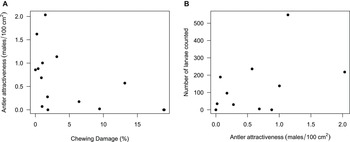
Antlers that were more extensively damaged by mammal chewing tended to attract fewer males (ρ = –0.603, P = 0.015; Fig. 1A), and more attractive antlers (i.e., those with higher adult male density) tended to produce more mature larvae (ρ = 0.616, P = 0.025; Fig. 1B).
Attractiveness to adult male Protopiophila litigata as a metric of antler quality: A, antler attractiveness versus extent of chewing damage (an index of antler age) (ρ = –0.603) and B, number of larvae versus antler attractiveness (ρ = 0.616).

Adult mortality and mating success
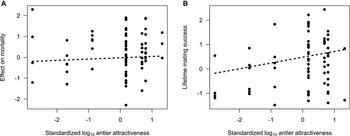
In the present study, the median adult lifespan for male Protopiophila litigata was 7 days, and the maximum adult male lifespan was 22 days (Supplementary material, Figs. S1 and S2). Adult mortality did not vary significantly with larval antler attractiveness (likelihood ratio test: χ 21 = 0.223, π = 0.637; Fig. 2A, Supplementary material, Fig. S3). Mortality was higher among males that experienced a more male-biased sex ratio on the observational antlers (likelihood ratio test: χ 21 = 8.29, P = 0.004), but it did not vary with adult density on the observational antlers (likelihood ratio test: χ 21 = 0.411, P = 0.522).
Partial residual plots showing the effect of antler attractiveness on adult performance of wild male Protopiophila litigata: A, partial effect of antler attractiveness on adult mortality based on the mixed-effects Cox proportional hazards regression not including wing length or development time (see Methods section). Values represent log-transformed hazard ratio, such that positive values represent a proportionally higher mortality and negative values represent proportionally lower mortality relative to the intercept (mean antler attractiveness); and B, partial effect of antler attractiveness on lifetime mating success in wild male antler flies, based on the negative binomial generalised linear mixed-effects model not including wing length or development time. Dotted lines represent nonsignificant estimates.

Lifetime mating success tended to be higher for males from more attractive antlers, but the trend was not significant (likelihood ratio test: χ 21 = 1.80, P = 0.179; Fig. 2B). Lifetime mating success was significantly lower for males that experienced a more male-biased sex ratio on the observational antlers (likelihood ratio test: χ 21 = 7.21, P = 0.007), but it did not change with adult density on the observational antlers (likelihood ratio test: χ 21 = 1.13, P = 0.287).
Effects mediated by pupal development time and body size
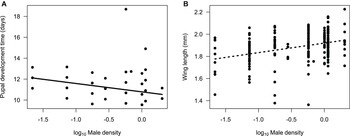
Pupal development time was significantly shorter for flies from more attractive antlers (F 1,6.69 = 8.6, P = 0.023; Fig. 3A). There was also a trend for wing length to increase with larval antler attractiveness (Fig. 3B), but it was nonsignificant (F 1,201.6 = 3.03, P = 0.083). Wing length did not vary with pupal development time (F 1,230.2 = 0.045, P = 0.833), nor was there an interaction between attractiveness and pupal development time (F 1,230.0 = 2.23, P = 0.137).
Effect of antler attractiveness on growth and development of Protopiophila litigata. Partial residual plots showing the partial effect of: A, larval antler attractiveness (adult male density) on pupal development time; and B, larval antler attractiveness on wing length of antler flies. Dotted lines represent nonsignificant estimates.

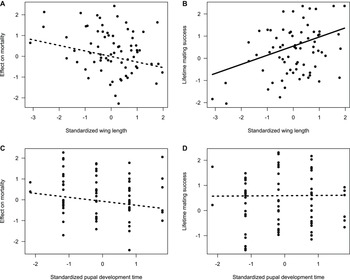
In the Cox model including pupal development time and wing length, mortality tended to decrease with increasing body size, although the effect was nonsignificant (likelihood ratio test: χ 21 = 3.71, P = 0.054; Fig. 4A, Supplementary material, Fig. S4). However, no effect of pupal development time on morality was observed (likelihood ratio test: χ 21 = 1.31, P = 0.253; Fig. 4C). The effect of larval antler attractiveness remained nonsignificant (likelihood ratio test: χ 21 = 0.216, P = 0.642). As in the previous model, mortality was significantly higher among males that experienced a more male-biased sex ratio on the observational antlers as adults (likelihood ratio test: χ 21 = 9.48, P = 0.002), but it did not vary with average adult density on the observational antlers (likelihood ratio test: χ 21 = 1.00, P = 0.316).
Partial residual plots showing the effects of pupal development time and wing length on performance of adult male Protopiophila litigata in the wild. Estimates and residuals are based on the Cox regression and generalised linear mixed-effects model including antler attractiveness, pupal development time, and wing length: A, partial effect of wing length on mortality. Values represent log-transformed hazard ratio, such that positive values represent a proportionally higher mortality and negative values represent proportionally lower mortality relative to the intercept (mean wing length); B, partial effect of wing length on lifetime mating success; C, partial effect of pupal development time on mortality (values represent log-transformed hazard ratios relative to the intercept (mean pupal development time)); and D, partial effect of pupal development time on lifetime mating success. Dotted lines represent nonsignificant estimates.

In the generalised linear mixed-effects model including pupal development time and wing length, lifetime mating success increased significantly with wing length (likelihood ratio test: χ 21 = 11.5, P < 0.001; Fig. 4B) but did not vary with pupal development time (likelihood ratio test: χ 21 = 0.004, P = 0.947; Fig. 4D). As in the previous analysis, lifetime mating success was nonsignificantly higher in males from more attractive antlers (likelihood ratio test: χ 21 = 1.96, P = 0.161). Lifetime mating success decreased significantly for males that experienced a more male-biased sex ratio on the observational antlers as adults (likelihood ratio test: χ 21 = 6.16, P < 0.013) but did not vary with average adult density on the observational antlers (likelihood ratio test: χ 21 = 0.605, P = 0.437).
Discussion
In the present study, we monitored wild male P. litigata that developed in seven shed moose antlers in order to quantify how natural variation in larval environmental quality affects adult performance. This is the first such data reported for this species. We found that more attractive, and therefore presumably higher-quality, antlers yielded flies that developed significantly faster. Flies from more attractive antlers tended to be larger, although the relationship was not significant. Despite this, more attractive antlers were not associated with increased adult male longevity nor increased mating success, although larger males and those that experienced less male-biased sex ratios tended to live longer and have greater mating success.
Unlike in Angell et al. (Reference Angell, Oudin, Rode, Mautz, Bonduriansky and Rundle2020), the early life environment (i.e., larval antler) did not appear to have a strong influence on adult life history in wild male P. litigata. There are at least three possible, nonexclusive explanations for this result. First, the range of environmental quality present in natural antlers may not be great enough to affect the life history of P. litigata to the degree observed previously in Angell et al. (Reference Angell, Oudin, Rode, Mautz, Bonduriansky and Rundle2020). This could occur, for instance, if the nutrient concentration of undiluted ground beef used in the lab is far greater than that of natural antlers.
In a previous study of wild P. litigata, Angell and Cook (Reference Angell and Cook2019) found that body size, pupal development time, and sex ratio differed among three larval antlers. Interestingly, in that study, the correlation of body size and development time differed in direction among antlers. The correlation was positive in Angell and Cook Reference Angell and Cook(2019) putatively freshest antler (the one that attracted the most adult males), suggesting a trade-off between fast development and large size (Angell and Cook Reference Angell and Cook2019), but this correlation was negative in their two other, older antlers, consistent with the findings of lab studies of P. litigata (Angell et al. Reference Angell, Oudin, Rode, Mautz, Bonduriansky and Rundle2020). Unfortunately, Angell and Cook (Reference Angell and Cook2019) lacked sufficient replication (i.e., antlers) to differentiate among many correlated factors. Nevertheless, their results suggest that high resource availability may relax allocation trade-offs between life history traits in P. litigata (van Noordwijk and de Jong Reference van Noordwijk and de Jong1986; Reznick et al. Reference Reznick, Nunney and Tessier2000).
Second, low-quality antlers likely attract fewer ovipositing females, and thus their reduced nutrient concentration may be somewhat balanced by less-intense intraspecific resource competition among larvae. In previous studies, in which P. litigata larvae were reared in the lab (Angell et al. Reference Angell, Oudin, Rode, Mautz, Bonduriansky and Rundle2020, Reference Angell, Janacek and Rundle2022), females were not permitted to adjust their egg-laying behaviour based on their perceptions of environmental quality. This explanation is consistent with the observations of Angell and Cook (Reference Angell and Cook2019). In that study, antler flies that grew in an unattractive antler containing few larvae were similar in size and development time as those that grew in a more attractive antler, but flies from an unattractive antler containing many larvae were smaller and took longer to develop than either other antler (Angell and Cook Reference Angell and Cook2019).
Third, male antler fly density may not be a reliable proxy for antler quality. Although antler attractiveness was significantly correlated with both chewing damage and the number of larvae yielded by an antler, the relationships were not as strong as previously reported by Bonduriansky (Reference Bonduriansky1996). Some nonquality-related variables, such as the precise location of the antlers, may have influenced male density, and some aspects of antler quality, such as larval density or presence of pathogens, may not be detectable to adult flies. Therefore, if variation in survival and mating success do depend on antler quality, those relationships may have been obscured by noise in the attractiveness data.
Our results showed that larger body size significantly increased male lifetime mating success (Fig. 4B) and nearly significantly decreased mortality rate (Fig. 4A). These results are consistent with previous studies in antler flies that demonstrated that large males live longer (Bonduriansky and Brassil Reference Bonduriansky and Brassil2005; Angell et al. Reference Angell, Oudin, Rode, Mautz, Bonduriansky and Rundle2020) and have greater mating success (Bonduriansky and Brassil Reference Bonduriansky and Brassil2005; but see Angell et al. Reference Angell, Oudin, Rode, Mautz, Bonduriansky and Rundle2020). We note that, because our mortality analyses are based on presence–absence data, an elevated estimate of mortality rate in smaller flies could also reflect an increased propensity for dispersal in low-condition individuals. Such dynamics are sometimes reported in other animals (e.g., milkweed beetle, Tetraopes tetrophthalmus (Forster) (Coleoptera: Cerambycidae) (Lawrence Reference Lawrence1987), and Eurasian shrew, Sorex araneus Linnaeus (Eulipotyphla: Soricidae) (Hanski et al. Reference Hanski, Peltonen and Kaski1991)). However, Mautz et al. (Reference Mautz, Rode, Bonduriansky and Rundle2019) observed size-biased mortality in a previous study of captive P. litigata, where true dates of death were known.
Although the trend was nonsignificant, our data suggested that males that developed in more attractive antlers may be larger, so antler quality may improve male fitness through its effect on body size. Interestingly, large male P. litigata experience more rapid senescence in mating rate (Bonduriansky and Brassil Reference Bonduriansky and Brassil2005). Furthermore, rapid development, seen in the present study in males from attractive antlers (Fig. 3A), is associated with faster actuarial senescence (Angell et al. Reference Angell, Oudin, Rode, Mautz, Bonduriansky and Rundle2020). Therefore, it seems likely that flies from high-quality antlers senesce faster than flies from low-quality antlers. Similar accelerated senescence in “high-quality” individuals has been observed in other species, including the fly, Telostylinus angusticollis (Enderlein) (Diptera: Neriidae) (Adler et al. Reference Adler, Telford and Bonduriansky2016; Hooper et al. Reference Hooper, Spagopoulou, Wylde, Maklakov and Bonduriansky2017), and the pied flycatcher, Ficedula albicollis (Temminck) (Passeriformes: Muscicapidae) (Spagopoulou et al. Reference Spagopoulou, Teplitsky, Lind, Chantepie, Gustafsson and Maklakov2020). This may reflect an adaptive prioritisation of reproduction over somatic maintenance by high-condition individuals (Hooper et al. Reference Hooper, Lehtonen, Schwanz and Bonduriansky2018).
Similar to Angell et al.’s (Reference Angell, Oudin, Rode, Mautz, Bonduriansky and Rundle2020) findings, larval antler quality influenced development time but not body size. Flies that grew in a high-quality environment were able to undergo metamorphosis more rapidly (Fig. 4A), suggesting that development rate may be energetically costly in P. litigata (see Dmitriew Reference Dmitriew2011). Notably, unlike Angell et al. (Reference Angell, Oudin, Rode, Mautz, Bonduriansky and Rundle2020), we measured pupal development time rather than egg-to-adult development time. Pupation of P. litigata occurs outside the antler, with no further intake of food, so antler-related variation in the rate of metamorphosis must have been “set” by larval conditions, such as through differences in energy storage or metabolic rate. Although we did not find an effect of development time on survival or mating success, it is likely that early eclosion is beneficial to fitness. If the resources within antlers gradually deplete over the course of a season, flies that reproduce earlier will be able to provide their offspring with a better developmental environment, especially if they can colonise a freshly shed antler with low larval competition. This phenomenon was demonstrated by Houle and Rowe (Reference Houle and Rowe2003) in a lab population of Drosophila melanogaster Meigen (Diptera: Drosophilidae): when eggs were inoculated into a culture bottle in successive waves, flies with as little as 24 hours of priority tended to mature earlier, reach larger sizes, and have higher fecundity than those inoculated later.
In the present study, male flies from more attractive antlers tended to be larger (i.e., have longer wings; Fig. 4B), although the difference was marginally nonsignificant. If real, this relationship is intuitive and would be consistent with studies of early-life environmental quality in other species (e.g., Lindström Reference Lindström1999; Tigreros Reference Tigreros2013; Hooper et al. Reference Hooper, Spagopoulou, Wylde, Maklakov and Bonduriansky2017; McConnell and Judge Reference McConnell and Judge2018), although P. litigata reared on artificial diets have not shown this effect (Oudin et al. Reference Oudin, Bonduriansky and Rundle2015; Angell et al. Reference Angell, Oudin, Rode, Mautz, Bonduriansky and Rundle2020). However, although Angell et al. (Reference Angell, Oudin, Rode, Mautz, Bonduriansky and Rundle2020) reported that fast egg-to-adult development was associated with large adult size, we found no significant relationship between pupal development time and size in the present study. This could be because the strength and direction of this relationship differ among antlers (Angell and Cook Reference Angell and Cook2019), although the interaction between pupal development time and antler attractiveness was also not significant.
In conclusion, antlers differed in their age, chewing damage, and attractiveness to adult flies, and some evidence suggested that antler quality (as measured by attractiveness) influenced pupal development time and adult body size of wild P. litigata. However, larval antler attractiveness did not significantly affect adult performance, even though large-bodied males were more successful on average. It is possible that larval density is a key component of environmental quality that covaries with antler attractiveness and resource availability. A combination of the nutritional geometry framework (Raubenheimer and Simpson Reference Raubenheimer and Simpson1997; Lee et al. Reference Lee, Simpson, Clissold, Brooks, Ballard and Taylor2008) with manipulations of larval density could elucidate the ways resource amount and composition interact with intraspecific competition to influence individual traits. Many factors can contribute to interindividual life history variation in wild populations, and much work remains to be done to characterise them in nonmodel invertebrates.
Supplementary material
The supplementary material for this article can be found at https://doi.org/10.4039/tce.2025.3.
Acknowledgements
The authors thank Tracey Yu and Tia Chen for their assistance with data collection and are grateful to the antler flies, the moose, and the many people who helped collect shed antlers for this project between 2017 and 2019. The authors also thank the staff and community of the Algonquin Wildlife Research Station. Two anonymous reviewers provided helpful comments on the manuscript. This research was supported by a grant from the Natural Sciences and Engineering Research Council of Canada to H.D.R.
Competing interests
The authors declare they have no competing interests.



 Open access

