

People with schizophrenia usually suffer from their psychotic symptoms and impaired social functioning (American Psychiatric Association, 2013). Therefore, their health outcomes are generally lower than that of the general population (Hegarty, Baldessarini, Tohen, Waternaus, & Oepen, Reference Hegarty, Baldessarini, Tohen, Waternaus and Oepen1994; Su, Ng, Yang, & Lin, Reference Su, Ng, Yang and Lin2014). The subjective quality of life (SQoL) is one of the most important outcomes among the impaired health-related outcomes for people with schizophrenia, with growing interest for healthcare providers (Lin et al., Reference Lin, Luh, Yang, Su, Wang and Ma2012). Many studies (Carpenter & Buchanan, Reference Carpenter and Buchanan1994; Hegarty et al., Reference Hegarty, Baldessarini, Tohen, Waternaus and Oepen1994; Hooley, Reference Hooley2010; Yen et al., Reference Yen, Cheng, Huang, Yen, Ko and Chen2008) have shown that an individual's SQoL, including physical and psychological aspects, is impaired in people with a mental illness such as schizophrenia. Mental health professionals could improve the health and wellbeing of people with schizophrenia by finding ways to improve their SQoL.
An individual's SQoL is frequently appraised to assess his or her health and wellbeing (The WHOQOL Group, 1993). The World Health Organization (WHO) defines SQoL as a broad-ranging concept containing dimensions of physical health, psychological health, social relationships, and salient features in the individual's environment (The WHOQOL Group, 1993, 1998). Therefore, SQoL could be used as an indicator of health outcomes for people with mental illness. However, to address the SQoL of people with schizophrenia, mental health professionals need to know what factors determine the SQoL in such individuals.
A person who belongs to a stigmatised group may suffer from self-stigma due to the awareness of the publicly held stigma regarding the group (Corrigan & Watson, Reference Corrigan and Watson2002). Self-stigma is one of the most important factors in an individual's SQoL (Lin, Chang, Wu, & Wang, Reference Lin, Chang, Wu and Wang2016). Although several theories have been proposed to conceptualise self-stigma (Chang, Lin, Gronholm, & Wu, Reference Chang, Lin, Gronholm and Wu2016; Corrigan, Watson, & Barr, Reference Corrigan, Watson and Barr2006; Livingston & Boyd, Reference Livingston and Boyd2010), there is a consensus of opinion that people with self-stigma have internalised a perceived stigma. In a patient with mental illness, self-stigma tends to reduce his/her motivation to accept treatment (Fung, Tsang, & Corrigan, Reference Fung, Tsang and Corrigan2008; Tsang, Fung, & Chung, Reference Tsang, Fung and Chung2010). Studies have demonstrated a causal relationship between an individual's self-stigma and SQoL (Chan & Mak, Reference Chan and Mak2014; Mashiach-Eizenberg, Hasson-Ohayon, Yanos, Lysaker, & Roe, Reference Mashiach-Eizenberg, Hasson-Ohayon, Yanos, Lysaker and Roe2013; Lin et al., Reference Lin, Chang, Wu and Wang2016); others have shown that self-stigma negatively affects the self-esteem of a person with a mental illness (Corrigan & Watson, Reference Corrigan and Watson2002; Corrigan et al., Reference Corrigan, Watson and Barr2006; Lysaker, Roe, Ringer, Gilmore, & Yanos, Reference Lysaker, Roe, Ringer, Gilmore and Yanos2012). As self-esteem has been found to mediate between self-stigma and many health-related outcomes such as depression and impaired social functioning (Yanos, Roe, & Lysaker, Reference Yanos, Roe and Lysaker2010; Yanos, Roe, Markus, & Lysaker, Reference Yanos, Roe, Markus and Lysaker2008), it is not surprising that researchers have proposed an evidence-based model of self-esteem as a mediating factor between self-stigma and an individual's SQoL (Mashiach-Eizenberg et al., Reference Mashiach-Eizenberg, Hasson-Ohayon, Yanos, Lysaker and Roe2013).
For several reasons we identified the need to re-examine the mediating role of self-esteem between the self-stigma in an individual and the individual's SQoL. First, to the best of our knowledge, the proposed evidence-based model has been tested only with a cross-sectional sample; that is, the casual relationships cannot be confirmed. Although we believe that the model can be supported using a longitudinal dataset, there is currently no such evidence. Second, most individuals with schizophrenia receive treatment, including medication, psychotherapy, and occupational therapy, and the treatments might have an impact on the proposed model. For example, one study found that relationships between self-stigma and SQoL were different between groups that engaged and groups that did not engage in community service programs (Huang & Lin, Reference Huang and Lin2015). However, we cannot tackle the treatment issue due to the nature of the cross-sectional design in the previous study (Mashiach-Eizenberg et al., Reference Mashiach-Eizenberg, Hasson-Ohayon, Yanos, Lysaker and Roe2013). Specifically, the treatment is dynamic, and its effects cannot be measured in a short period of time. Third, an individual's SQoL has physical, psychological, social, and environment domains (The WHOQOL Group, 1998), and the evidence-based model (Mashiach-Eizenberg et al., Reference Mashiach-Eizenberg, Hasson-Ohayon, Yanos, Lysaker and Roe2013) treats SQoL holistically rather than as an entity with different dimensions. The SQoL concept employed as a whole can provide mental health professionals with a full picture of an individual's health; however, a consideration of SQoL domains can help to illuminate specific health issues.
The purpose of this study was to examine the mediating role of self-esteem between self-stigma and SQoL using a cohort of individuals with schizophrenia. Instead of treating SQoL as a whole, we separately examined physical, psychological, social, and environment dimensions of SQoL.
Methods
Subjects and Procedure
A retrospective cohort study was conducted. Ethics approval was obtained from the Institutional Review Board of the Jianan Psychiatric Center (IRB #15-011), and all subjects have provided oral consents in the study.
The inclusion criteria for eligible subjects included: (1) a diagnosis of schizophrenia based on medical records; (2) regular receipt of occupational therapy between March 2014 and December 2015 at the Jianan Psychiatric Center; (3) admission to the day-care centre of the Jianan Psychiatric Center, which indicates that the patient had no or little active psychotic symptoms; and (4) 20 to 75 years of age. Subjects were excluded if they had been admitted to any psychiatric hospital as an inpatient during March 2014 to December 2015. An occupational therapist at the Jianan Psychiatric Center first reviewed the medical records to identify eligible subjects; a research assistant then collected the data from the medical records of eligible subjects.
Measures
All measures were repeatedly evaluated every three to five months between June 2014 and December 2015. Self-stigma was measured at the following five time points: June, September and December 2014, and March and July 2015; self-esteem was measured five times: July and December 2014, and March, July and December 2015; SQoL was measured five times: September and December 2014, and March, July and December 2015. Since January 2014, the Department of Occupational Therapy, Jianan Psychiatric Center, routinely measured the self-stigma, self-esteem, and SQoL for day-care patients who participated in the program of occupational therapy. All the measures were self-reported with the assistance of an occupational therapist.
The Self-Stigma Scale — Short (SSS-S)
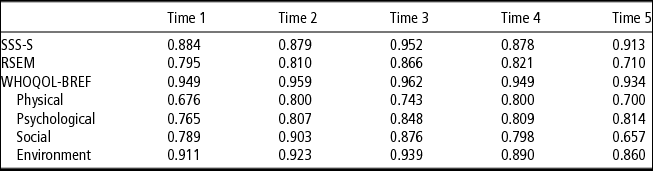
The SSS-S, a self-rated questionnaire for measuring self-stigma of minority groups or people with mental illness, consists of nine items rated on a 4-point Likert scale, with a higher score indicating a higher level of self-stigma. The original SSS-S (Mak & Cheung, Reference Mak and Cheung2010) was developed in Hong Kong, with promising internal consistency according to Cronbach's alpha (α = .81 to .84) and satisfactory construct validity (comparative fit index [CFI] = .97). The SSS-S was adapted to a Taiwanese sample (Wu, Chang, Chen, Wang, & Lin, Reference Wu, Chang, Chen, Wang and Lin2015) with acceptable psychometric properties (α = .80 to .91; CFI = .99). The Cronbach's alpha of the SSS-S in the current study ranged from .878 to .952 in five repeated measures.
The WHO Questionnaire on the Quality of Life — Short Form (WHOQOL-BREF)
The original WHOQOL-BREF (The WHOQOL Group, 1998), a self-rated questionnaire for measuring SQoL across different populations (including healthy population and individuals with illness or disability), consists of 26 items with 2 general items and 24 items spread within four domains: physical, psychological, social, and environment. All items were rated on a 5-point Likert scale with a higher score indicating a higher level of SQoL. The WHOQOL-BREF was adapted to a Taiwanese population (Yao, Chung, Yu, & Wang, Reference Yao, Chung, Yu and Wang2002) with promising internal consistency (α = .70 to .91) and test–retest reliability (r = .76 to .80). In addition, the Taiwan version of WHOQOL-BREF was found to have adequate internal consistency (α = .68 to .76) and test–retest reliability (ICC = .81 to .86) in a Taiwanese sample with schizophrenia (Su et al., Reference Su, Ng, Yang and Lin2014). The Cronbach's alpha of the WHOQOL-BREF in the current study ranged from .934 to .962 in five repeated measures.
Rosenberg Self-Esteem Scale (RSES)
The RSES, a self-rated questionnaire, consists of 10 items within one domain of self-esteem. All items are rated on a 4-point Likert scale. After scores of negatively worded items were reverse coded, a higher score suggested a higher level of self-esteem. The original RSES shows adequate internal consistency (α = .77) and test–retest reliability (r = .63 to .85; Byrne, Reference Byrne1983; Rosenberg, Reference Rosenberg1965; Silber & Tippett, Reference Silber and Tippett1965), and the Taiwan version of the RSES was validated (Wu, Lai, & Shih, Reference Wu, Lai and Shih2013). The Cronbach's alpha of the RSES in the current study ranged from .710 to .866 in five repeated measures.
Data Analysis
Several linear mixed-effect models adjusted for characteristics of subjects (age, sex, education, marital status, and receiving work training or not) were constructed to examine the direct effects of self-stigma and the mediating effects of self-esteem on the SQoL in individuals with schizophrenia receiving occupational therapy in a day-care centre. We constructed the linear mixed-effects model using all data with repeated measures. We applied a stationary model with the restricted maximum likelihood estimation in the linear mixed-effects model. In addition, the methods of AR(1) (i.e., autoregressive (1)) was used to tackle the variance-covariance matrix across the five repeated measures. We have ordered the five measures of each assessment in their temporal sequence. For example, self-stigma measured in June 2014 was assigned as the first measure, September 2014 as the second, December 2014 as the third, March 2015 as the fourth, and July 2015 as the fifth. The mixed-effects model informed us about the association between change in one variable and change in another variable. Therefore, using our longitudinal design, we could determine whether the change in self-stigma was associated with the change in self-esteem or the change in SQoL.
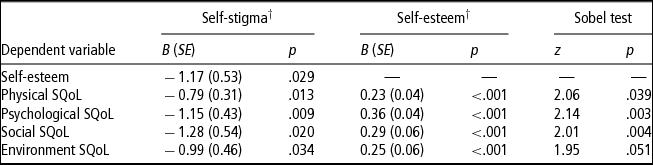
The mediation models were examined using the following steps suggested by Baron and Kenny (Reference Baron and Kenny1986) and Judd, Kenny, and McClelland (Reference Judd, Kenny and McClelland2001): (1) the effects of self-stigma on SQoL; (2) the effects of self-stigma on self-esteem; (3) the effects of self-esteem on SQoL. If steps 2 and 3 showed that self-stigma significantly affected self-esteem and self-esteem significantly affected SQoL, Sobel tests (Sobel, Reference Sobel and Leinhardt1982) were used to further test the statistical significance of the mediation. In addition, we controlled for age, sex, education, marital status, and work training in the linear mixed-effects models.
All the statistical analyses were performed using SPSS 23.0 (IBM Corp., Armonk, NY).
Results
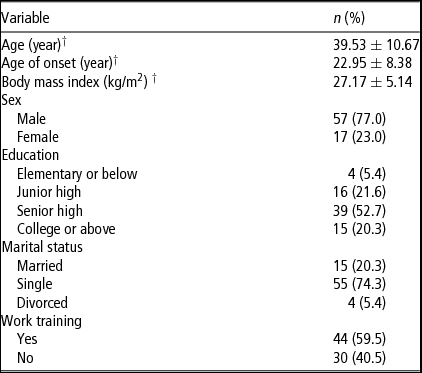
After identifying eligible subjects, the data from 74 patients with schizophrenia and a median age of 39.53 years (SD = 10.67) were used for analyses. The mean age of onset was 22.95 (SD = 8.38). Seventy-seven percent of the participants were male (n = 57); 73% had graduated from senior high or above (n = 54); 74% were single (n = 55). In addition to receiving occupational therapy services, 59.5% of the participants (n = 44) were enrolled in a sheltered employment program (Table 1). Moreover, the internal consistency of each instrument used in the study across five assessment points is reported in Table 2.
Participant Characteristics
Note: †presented as mean ± SD.
Internal Consistency (Crobach's α) of the Three Instruments in this Study
Note: SSS-S = Self-Stigma Scale — Short; RSES = Rosenberg Self-Esteem Scale; WHOQOL-BREF = WHO Questionnaire on the Quality of Life — Short Form.
The impacts of self-stigma on subjects’ SQoL were negative and significant throughout the four domains: physical (B = −0.79, SE = 0.31; standardised B = −0.22; p = .013), psychological (B = 1.15, SE = 0.43; standardised B = −0.28; p = .009), social (B = −1.28, SE = 0.54; standardised B = −0.28; p = .020), and environment (B = −0.99, SE = 0.46; standardised B = −0.22; p = .034). Also, self-stigma had a negative and significant effect on self-esteem (B = −1.17, SE = 0.53; standardised B = −0.17; p = .029). The impacts of self-esteem on subjects’ SQoL were positive and significant throughout the four domains: physical (B = 0.23, SE = 0.04; standardised B = 0.43; p < .001), psychological (B = 0.36, SE = 0.04; standardised B = 0.60; p < .001), social (B = 0.29, SE = 0.06; standardised B = 0.43; p < .001), and environment (B = 0.25, SE = 0.06; standardised B = 0.38; p < .001). The mediated effects of self-esteem were shown in the relationships between self-stigma and all but the environment domain of SQoL. However, the mediated effect of self-esteem in the relationship between self-stigma and environment domains of SQoL was very close to significant (p = .051). This mediated effect was supported by the Baron and Kenny's (Reference Baron and Kenny1986) methods: effect of self-stigma on self-esteem (p = .029) and that of self-esteem on environment SQoL (p < .001) were both supported (Table 3).
Linear Mixed-Effects Models in Which Self-Stigma and Self-Esteem Were Constructed to Explain Subjective Quality of Life (SQoL)
Note: B = coefficient; SE = standard error.
† Adjusted for age, sex, education, marital status, and work training.
Discussion
Using a retrospective longitudinal design, our results support the mediation model in which the SQoL is impacted by self-stigma through self-esteem for individuals with schizophrenia who regularly receive occupational therapy; specifically, self-esteem mediated SQoL in all domains, except for environment domain.
Our results agree with previous findings that self-stigma reduces the self-esteem of an individual with mental illness (Corrigan & Watson, Reference Corrigan and Watson2002; Corrigan et al., Reference Corrigan, Watson and Barr2006; Lysaker et al., Reference Lysaker, Roe, Ringer, Gilmore and Yanos2012). Also, our findings were aligned with studies that found negative impacts of self-stigma on an individual's SQoL (Chan & Mak, Reference Chan and Mak2014; Mashiach-Eizenberg et al., Reference Mashiach-Eizenberg, Hasson-Ohayon, Yanos, Lysaker and Roe2013; Lin et al., Reference Lin, Chang, Wu and Wang2016). In addition, our results agree with the mediation model proposed by Mashiach-Eizenberg et al. (Reference Mashiach-Eizenberg, Hasson-Ohayon, Yanos, Lysaker and Roe2013) that self-esteem is a mediating factor between an individual's self-stigma and his or her SQoL. However, the mediated effect of self-esteem in the relationship between self-stigma and environment SQoL was not fully supported by the Sobel test. A possible explanation is the role of self-esteem under different cultures (Brown, Cai, Oakes, & Deng, Reference Brown, Cai, Oakes and Deng2009; Heine, Lehman, Markus, & Kitayama, Reference Heine, Lehman, Markus and Kitayama1999). A controversy is that different cultures may not value self-esteem similarly. It seems that East Asians had lower self-esteem as compared with North Americans (Heine et al., Reference Heine, Lehman, Markus and Kitayama1999). However, Brown et al. (Reference Brown, Cai, Oakes and Deng2009) suggested that self-esteem is universally important across the two countries of America and Taiwan. Based on our findings, we agree with Brown et al. (Reference Brown, Cai, Oakes and Deng2009) that self-esteem does play an important role in psychological outcomes; however, the effect of self-esteem varies in different psychological outcomes. Specifically, the environment SQoL, which assesses the primary living conditions of an individual, may have diminished association with self-esteem when there is another stronger predictor (i.e., self-stigma). That is, self-stigma may contribute more than self-esteem does to the environment SQoL due to unfriendly treatment perceived in the environment.
Our results indicated two issues in the mediation models that have never been elaborated. In our study, mediation models were supported for the physical, psychological, and social domains but not for the environment domain of an individual's SQoL. Some studies (Chan & Mak, Reference Chan and Mak2014; Mashiach-Eizenberg, Reference Mashiach-Eizenberg, Hasson-Ohayon, Yanos, Lysaker and Roe2013) treated the SQoL as a unidimensional concept, which is beneficial when mental health professionals want to evaluate an individual's overall health and wellbeing. However, we suggest that using different dimensions of SQoL can help mental health professionals design interventions to address specific needs of people with schizophrenia. Using our results as examples, a healthcare provider might provide a self-stigma reduction program that would work more effectively than a self-esteem improvement program to improve the environment domain of an individual's SQoL, because we found that self-esteem had less impact on the environment SQoL for individuals with schizophrenia.
Our findings have two major implications. First, self-stigma reduction programs, such as Narrative Enhancement and Cognitive Therapy (Yanos, Roe, & Lysaker, Reference Yanos, Roe and Lysaker2011; Yanos et al., Reference Yanos, Roe, Lysaker, West and Smith2012), could be beneficial for people with schizophrenia. A self-stigma reduction program may prevent them from the worst health outcomes. Second, self-esteem improvement programs empowering people with schizophrenia (Lecomte et al., Reference Lecomte, Cyr, Lesage, Wilde, Leclerc and Ricard1999) may work together with the self-stigma reduction program to maximise the improvement of health-related outcomes. Moreover, metacognitive oriented treatments may be a promising intervention to tackle self-esteem and self-stigma because such treatments could assist meaning making and guide alternative ways of thinking about the self and life challenges. However, it should be appreciated that either interventions on self-stigma or self-esteem should be viewed as a whole. Interventions must consider individuals’ health and wellbeing from social perspectives of disability rather than the medical model of disability emphasising symptoms and medications.
There were some limitations in our study. First, in addition to occupational therapy, patients received other interventions and therapies at the day-care centre. We were unable to control for such diverse interventions in the study due to the relatively small sample size. To corroborate our study findings, future studies could use a larger sample size to control therapeutic interventions. Second, not all the subjects in our study were inpatients and the generalisability of our results may thus be limited. Specifically, outpatients have more contact with the communities more do inpatients, and the SQoL and stigma may differ between inpatients and outpatients. Third, as we only recruited participants who were not in an early phase of mental illness in Taiwan, the generalisability of our study results might be restricted. Specifically, we cannot ensure that similar findings will be found in other cultures, especially the Western culture with its focus on individualism and strong self-esteem (Ali, Lee, Hsieh, & Krishnan, Reference Ali, Lee, Hsieh and Krishnan2005; Heine et al., Reference Heine, Lehman, Markus and Kitayama1999), or in other types of mental illness. Future studies are thus warranted to corroborate our findings. Fourth, although we have ordered our assessment time points to align with hypothesised temporal associations (i.e., the assessment on self-stigma was first, followed by self-esteem and SQoL), self-esteem and SQoL were assessed at the same time for the last four assessments. Therefore, the temporal associations between self-stigma and the other two measures (self-esteem and SQoL) were strong, and the temporal association between self-esteem and SQoL was weak. Lastly, and importantly, the measurement invariance across time (i.e., the five assessment time points) was not examined in our study because of the small sample size. As an important assumption in the linear mixed-effects model is time invariance for all the measures (i.e., we used the stationary-based model), our findings might be somewhat biased if such an assumption is not fulfilled.
In conclusion, self-esteem mediated the causal relationship between self-stigma and the physical and psychological domains of the SQoL in people with schizophrenia. Mental health professionals could tailor programs to patients with schizophrenia by providing self-stigma reduction and self-esteem improvement programs.
Conflict of Interest
None.


 Open access

