


On August 4, 2020, a massive explosion took place in Beirut, the capital of Lebanon. This explosion was defined as the largest non-nuclear blast in history since Hiroshima and Nagasaki. 1 The blast resulted in 30 000 people displaced, 8643 injured presenting to emergency departments (EDs), 1056 admissions,156 intensive care unit admissions, 534 operations, and 93 deaths in various hospitals. Reference Mansour, Bitar and Fares2 A month after the blast, more than 200 deaths were reported. Major hospitals in Beirut were partially or completely destroyed, and some of them became nonfunctional. Reference Helou, El-Hussein and Aciksari3 The Lebanese American University Medical Center-Rizk Hospital (LAUMC-RH) is a private teaching university hospital in Beirut, situated 2.8 km from the blast. On the day of August 4, 2020, despite an emergency preparedness plan (EPP) at LAUMC-RH that was revised and approved, the hospital suffered major challenges. Our report shows the challenges a hospital can face during a disaster.
LAUMC-RH Disaster Plan
The LAUMC-RH has a capacity of 120 beds. In 2020, The hospital departments were under renovation 1 following the next. The ED was moved to a temporary location, while the new ED was being built. The temporary ED had a capacity of 13 beds in total: 7 beds inside the ED and 5 beds outside as isolation rooms, added recently in response to the coronavirus disease (COVID-19) pandemic.
Like other committees at the hospital, a Disaster Committee (DC) was created headed by the Chief Medical Officer (CMO). The DC was meeting regularly with concerned departments, a risk assessment study was conducted, and an EPP was conceived. This plan was updated on a regular basis, with the last update in 2018, and a drill was being prepared. The plan should encompass all risks but should mainly focus on the most potential mass casualty incidents that are likely to happen in a specific geographical area based on the risk assessment. Reference Randolph4
Patient identification in the ED is usually done by the new electronic system, which is effective and fast and can save patient data in a simple form. When a disaster strikes, the EPP will ensure that every patient presenting shall be identified by name and a unique number. The triage team records manually the triple name on pre-printed numbered labels.
The EPP assigns the triage to the emergency physician on call, using the simple triage and rapid treatment (START) triage tool with 4 color zones.
Response to Disaster
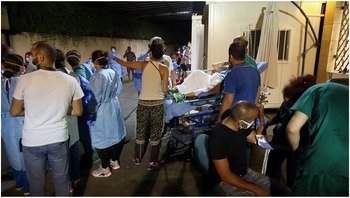
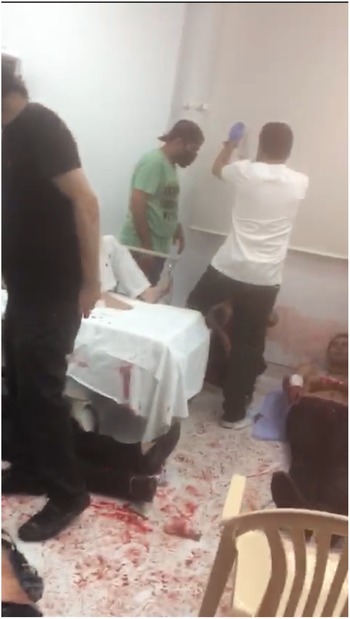
On the night of August 4, 2020, at 6:07 Beirut time, a massive explosion was heard in the hospital. The noise was so loud that the staff thought the explosion happened in one of the hospital buildings. Windows were shattered, lights shut off, the ceiling broke, and dust filled the entire hospital. In the temporary ED, the ceiling fell, the main ED door was unworkable because it was jammed shut, and pieces of glass were seen on the floor. It was late in the afternoon, and most of the hospital staff had already left. Physicians were already home. All clinics were already closed. The operation room was empty and there were no more visitors at the hospital. In the ED, there was 1 emergency physician on duty, 1 resident, and 1 medical student, along with 4 registered nurses, 2 practical nurses, 1 transporter, and 1 admission officer. Two physicians happened to be on the hospital premises, and 2 others who lived within a walking distance to the hospital arrived within a minute. After the staff realized that the explosion originated somewhere outside the hospital and the influx of casualties started, the disaster code was activated from the operator. A message via the mobile instant messaging platform WhatsApp Messenger (https://www.whatsapp.com/) was sent by the CMO to all physicians to come to help at the hospital. Less than 30 minutes later, the ED was filled with casualties lying on beds, on the floor, in the corridor, outside the ED, and near the elevator; later, in the parking area, the ground was a bloody scene (Figures 1 and 2).
The parking area of the emergency department.

The emergency department, overcrowded with patients.

At first, people affected arrived with minor lacerations and injuries; they arrived as walk-ins or in their own cars. These people were present in the surrounding area of the blast but not so close. Later, those who were severely injured were coming by cars or by the Lebanese Red Cross. They were closer to the area of the blast. This gave us time to gather the medical staff in the ED area to help with the triage and management of those severely injured.
Triage started at the back door of the ED by the emergency physician on call. Later, triage was moved to the outside area of the ED. Management was initiated by residents and medical students, until help arrived. Most of the injuries were lacerations from glass of broken windows. Consequently, most of the interventions needed involved suturing. The earlier injured patients were sutured with an adequate technique, but minutes after, sutures were done exclusively by stapling without proper sterilization or anesthesia. Luckily, we had no issues with the equipment, and the supply inventory was enough to serve all casualties.
At LAUMC-RH, a total of 408 cases presented to the ED, of which 331 were treated in the ED; 72 casualties were admitted to the hospital, 9 were admitted to the Intensive Care Unit, and 5 were deceased. Fifty-eight cases underwent surgery (Figure 3).
Diagram for the distribution of the casualties at the LAUMC-RH on August 4.

Major challenges and flaws in the EPP were encountered.
Triage
Although the EPP is designed for a high influx of patients, on August 4, the number of casualties exceeded all expectations, and no plan would have been able to accommodate this surge. Assessing vitals of patients for an adequate triage, as the START triage, was practically impossible. Patients were triaged as walking and stable, not walking and ill-looking, and dead. There was not enough space for these patients. The walking and less injured patients were transferred to the wound care unit and the chemotherapy unit as a temporary location for a day’s use for suturing and management. The more injured patients were handled inside the ED and sent to the Operation Room if needed. This experience made us aware of the limited use of the hospital’s resources and the need to include other floors and areas in the hospital in the EPP, instead of dividing the ED into small zones.
Identification of Patients
When 1 admission officer is available on duty, and 1 emergency physician is doing triage, and hundreds of patients are arriving at the same time, there is no way to be able to get proper patient identification. The electronic system is a failure in a disaster setting. Even the pre-printed numbered labels were not enough and not practical to be used in this setting. Many cases were presented and patients were treated and they left without being documented. They came back later for follow-ups, and that’s how we got their information. Sometimes we had to write on the patient’s chest and arms the imaging needed, and results were communicated in the same way. This prompts us to find a more practical way to collect patient data in a more efficient manner.
Hospital Network System
As the ED was saturated, casualties were sent to other sections of the hospital. There was no way to stop receiving casualties. Our EPP mentions the possibility of a transfer to nearby hospitals when needed. Unfortunately, on that day, nearby hospitals were damaged and 2 hospitals became nonfunctional. This raised the question of creating a hospital network system where hospitals can connect with each other in a mass casualty incident to facilitate a transfer from an overwhelmed hospital to other hospitals outside the area of the disaster.
Chaos
By the time the medical staff arrived at the ED, it was chaotic. Reaching the different team members was impossible. Communication among the personnel was challenging. Identifying each person’s assignments and their allocated zones was hardly possible.
Families and visitors were outside the ED gate screaming and shouting for help and any information we might have. Security guards were unable to control the crowd.
We had to wait until late at night to be able to communicate with families.
A possible solution for this would be to create colored jackets determining each person’s role in the case of disaster.
Conclusion
The ED at LAUMC-RH faced major challenges on that night. The Beirut explosion disaster was a teaching experience for each of us and made us aware of the lack of emergency preparedness and response at LAUMC-RH. Hospitals should review their emergency preparedness plan in preparation for a disaster event in the future. Drills should be conducted, and a network system between Lebanon hospitals should be implemented.


 Open access

