



1. Introduction
1.1. Negative dependence
There is a long history of dependence modeling among multiple sources of randomness in probability, statistics, economics, finance, and operations research. Various notions of positive and negative dependence were introduced in the literature. The notions of negative dependence (except in the bivariate case) are not the mirror image of those of positive dependence. The structures of negative dependence can be more complicated. Popular notions of negative dependence include negative orthant dependence (NOD), negative association (NA [Reference Alam and Saxena2]), weak negative association (WNA [Reference Chen, Embrechts and Wang7]), negatively supermodular dependence (NSMD [Reference Hu11]), negative regression dependence [Reference Dubhashi and Ranjan10, Reference Hu and Xie13], strongly multivariate reverse regular of order 2 [Reference Karlin and Rinott16], pairwise counter-monotonicity [Reference Cheung and Lo8, Reference Lauzier, Lin and Wang17], joint mixability [Reference Puccetti and Wang21, Reference Wang and Wang24], and others.
Recall that a random vector ${\boldsymbol{X}}=(X_1, \ldots, X_n)$
is said to be smaller than another random vector
${\boldsymbol{X}}=(X_1, \ldots, X_n)$
is said to be smaller than another random vector ${\boldsymbol{Y}}=(Y_1, \ldots, Y_n)$
in the usual stochastic order, denoted by
${\boldsymbol{Y}}=(Y_1, \ldots, Y_n)$
in the usual stochastic order, denoted by ${\boldsymbol{X}}\le_\textrm{st} {\boldsymbol{Y}}$
, if
${\boldsymbol{X}}\le_\textrm{st} {\boldsymbol{Y}}$
, if $\mathbb{E} [\varphi ({\boldsymbol{X}})]\le \mathbb{E} [\varphi({\boldsymbol{Y}})]$
holds for all increasing functions
$\mathbb{E} [\varphi ({\boldsymbol{X}})]\le \mathbb{E} [\varphi({\boldsymbol{Y}})]$
holds for all increasing functions $\varphi$
for which the expectations exist [Reference Shaked and Shanthikumar23, Section 4B]. Also, we denote by
$\varphi$
for which the expectations exist [Reference Shaked and Shanthikumar23, Section 4B]. Also, we denote by $[{\boldsymbol{X}}|A]$
any random vector/variable whose distribution is the conditional distribution of
$[{\boldsymbol{X}}|A]$
any random vector/variable whose distribution is the conditional distribution of ${\boldsymbol{X}}$
given event A. For any
${\boldsymbol{X}}$
given event A. For any ${\boldsymbol{x}}\in \mathbb{R}^n$
and
${\boldsymbol{x}}\in \mathbb{R}^n$
and $J\subset [n] := \{1, 2, \ldots, n\}$
, let
$J\subset [n] := \{1, 2, \ldots, n\}$
, let $\{X_j, j\in J\}$
,
$\{X_j, j\in J\}$
, $\{X_j\le x_j, j\in J\}$
, and
$\{X_j\le x_j, j\in J\}$
, and $\{X_j>x_j, j\in J\}$
be abbreviated by
$\{X_j>x_j, j\in J\}$
be abbreviated by ${\boldsymbol{X}}_J$
,
${\boldsymbol{X}}_J$
, ${\boldsymbol{X}}_J\le {\boldsymbol{x}}_J$
, and
${\boldsymbol{X}}_J\le {\boldsymbol{x}}_J$
, and ${\boldsymbol{X}}_J> {\boldsymbol{x}}_J$
, respectively. Throughout, ‘increasing’ and ‘decreasing’ are used in the weak sense, and
${\boldsymbol{X}}_J> {\boldsymbol{x}}_J$
, respectively. Throughout, ‘increasing’ and ‘decreasing’ are used in the weak sense, and $\stackrel {d}{=}$
means equality in distribution.
$\stackrel {d}{=}$
means equality in distribution.
Definition 1. ([Reference Alam and Saxena2, Reference Joag-dev and Proschan15].) A random vector ${\boldsymbol{X}}$
is said to be NA if, for every pair of disjoint subsets
${\boldsymbol{X}}$
is said to be NA if, for every pair of disjoint subsets $A_1, A_2\subset [n]$
,
$A_1, A_2\subset [n]$
,
 \[\textrm{Cov} (\psi_1({\boldsymbol{X}}_{A_1}), \psi_2({\boldsymbol{X}}_{A_2})) \le 0\]
whenever $\psi_1$
and
$\psi_1$
and $\psi_2$
are coordinatewise increasing such that the covariance exists.
$\psi_2$
are coordinatewise increasing such that the covariance exists.
Definition 2. ([Reference Hu11].) A random vector ${\boldsymbol{X}}$
is said to be NSMD if
${\boldsymbol{X}}$
is said to be NSMD if
 \[\mathbb{E} [\psi({\boldsymbol{X}})] \le \mathbb{E} [\psi({\boldsymbol{X}}^\perp)],\]
where ${\boldsymbol{X}}^\perp =(X_1^\perp, \ldots, X_n^\perp)$
is a random vector of independent random variables with
${\boldsymbol{X}}^\perp =(X_1^\perp, \ldots, X_n^\perp)$
is a random vector of independent random variables with $X_i^\perp \stackrel {d}{=} X_i$
for each
$X_i^\perp \stackrel {d}{=} X_i$
for each $i\in [n]$
, and
$i\in [n]$
, and $\psi$
is any supermodular function such that the expectations exist. A function
$\psi$
is any supermodular function such that the expectations exist. A function $\psi\colon \mathbb{R}^n\to \mathbb{R}$
is said to be supermodular if
$\psi\colon \mathbb{R}^n\to \mathbb{R}$
is said to be supermodular if $\psi({\boldsymbol{x}}\vee {\boldsymbol{y}}) +\psi({\boldsymbol{x}}\wedge {\boldsymbol{y}}) \ge \psi ({\boldsymbol{x}}) + \psi({\boldsymbol{y}})$
for all
$\psi({\boldsymbol{x}}\vee {\boldsymbol{y}}) +\psi({\boldsymbol{x}}\wedge {\boldsymbol{y}}) \ge \psi ({\boldsymbol{x}}) + \psi({\boldsymbol{y}})$
for all ${\boldsymbol{x}}, {\boldsymbol{y}}\in\mathbb{R}^n$
, where
${\boldsymbol{x}}, {\boldsymbol{y}}\in\mathbb{R}^n$
, where $\vee$
denotes the componentwise maximum and
$\vee$
denotes the componentwise maximum and $\wedge$
denotes the componentwise minimum, that is,
$\wedge$
denotes the componentwise minimum, that is,
 \[{\boldsymbol{x}}\vee {\boldsymbol{y}}=(x_1\vee y_1, x_2\vee y_2, \ldots, x_n\vee y_n),\quad{\boldsymbol{x}} \wedge {\boldsymbol{y}} =(x_1\wedge y_1, x_2\wedge y_2, \ldots, x_n\wedge y_n).\]
Definition 3. ([Reference Dubhashi and Ranjan10].) Let ${{\boldsymbol{X}}}=(X_1, \ldots, X_n)$
be a random vector.
${{\boldsymbol{X}}}=(X_1, \ldots, X_n)$
be a random vector. ${\boldsymbol{X}}$
is said to be
${\boldsymbol{X}}$
is said to be
-
(1) negatively regression dependent (NRD) if
(1)where \begin{equation} [{\boldsymbol{X}}_I\mid {\boldsymbol{X}}_J={\boldsymbol{x}}_J ]\ge_\textrm{st} [{\boldsymbol{X}}_I\mid {\boldsymbol{X}}_J ={\boldsymbol{x}}_J^\ast ],\end{equation}
${\boldsymbol{x}}_J\le {\boldsymbol{x}}_J^\ast$
, and I and J are any disjoint subsets of [n];
\begin{equation} [{\boldsymbol{X}}_I\mid {\boldsymbol{X}}_J={\boldsymbol{x}}_J ]\ge_\textrm{st} [{\boldsymbol{X}}_I\mid {\boldsymbol{X}}_J ={\boldsymbol{x}}_J^\ast ],\end{equation}
${\boldsymbol{x}}_J\le {\boldsymbol{x}}_J^\ast$
, and I and J are any disjoint subsets of [n];
-
(2) negatively left-tail dependent (NLTD) if (1) is replaced by
(2)
\begin{equation} [{\boldsymbol{X}}_I\mid {\boldsymbol{X}}_J\le{\boldsymbol{x}}_J ]\ge_\textrm{st} [{\boldsymbol{X}}_I\mid {\boldsymbol{X}}_J\le{\boldsymbol{x}}_J^\ast ];\end{equation}
-
(3) negatively right-tail dependent (NRTD) if (1) is replaced by
(3)
\begin{equation} [{\boldsymbol{X}}_I\mid {\boldsymbol{X}}_J>{\boldsymbol{x}}_J ]\ge_\textrm{st}[{\boldsymbol{X}}_I\mid {\boldsymbol{X}}_J >{\boldsymbol{x}}_J^\ast ].\end{equation}


It should be pointed out that, by a limiting argument, the symbols ‘ $\le$
’ and ‘
$\le$
’ and ‘ $>$
’ in (2) and (3) can be replaced by ‘
$>$
’ in (2) and (3) can be replaced by ‘ $<$
’ and ‘
$<$
’ and ‘ $\ge$
’, respectively.
$\ge$
’, respectively.
Definition 4. ([Reference Joag-dev and Proschan15].) A random vector ${\boldsymbol{X}}$
is said to be negatively lower-orthant dependent (NLOD) if
${\boldsymbol{X}}$
is said to be negatively lower-orthant dependent (NLOD) if $\mathbb{P}({\boldsymbol{X}}\le {\boldsymbol{x}}) \le \prod^n_{i=1}\mathbb{P}(X_i\le x_i)$
for all
$\mathbb{P}({\boldsymbol{X}}\le {\boldsymbol{x}}) \le \prod^n_{i=1}\mathbb{P}(X_i\le x_i)$
for all ${\boldsymbol{x}}\in\mathbb{R}^n$
, and negatively upper-orthant dependent (NUOD) if
${\boldsymbol{x}}\in\mathbb{R}^n$
, and negatively upper-orthant dependent (NUOD) if $\mathbb{P}({\boldsymbol{X}}> {\boldsymbol{x}}) \le \prod^n_{i=1}\mathbb{P}(X_i> x_i)$
for all
$\mathbb{P}({\boldsymbol{X}}> {\boldsymbol{x}}) \le \prod^n_{i=1}\mathbb{P}(X_i> x_i)$
for all ${\boldsymbol{x}}\in\mathbb{R}^n$
.
${\boldsymbol{x}}\in\mathbb{R}^n$
. ${\boldsymbol{X}}$
is said to be negatively orthant dependent (NOD) if
${\boldsymbol{X}}$
is said to be negatively orthant dependent (NOD) if ${\boldsymbol{X}}$
is both NLOD and NUOD.
${\boldsymbol{X}}$
is both NLOD and NUOD.
From Definition 3, it is known that ${\boldsymbol{X}}$
is NRD if and only if
${\boldsymbol{X}}$
is NRD if and only if $-{\boldsymbol{X}}$
is NRD, and that
$-{\boldsymbol{X}}$
is NRD, and that ${\boldsymbol{X}}$
is NLTD if and only if
${\boldsymbol{X}}$
is NLTD if and only if $-{\boldsymbol{X}}$
is NRTD. In Definition 3, if
$-{\boldsymbol{X}}$
is NRTD. In Definition 3, if $|J| =1$
, the corresponding NRD, NLTD, and NRTD are denoted by
$|J| =1$
, the corresponding NRD, NLTD, and NRTD are denoted by $\textrm{NRD}_1$
,
$\textrm{NRD}_1$
, $\textrm{NLTD}_1$
, and
$\textrm{NLTD}_1$
, and $\textrm{NRTD}_1$
[Reference Hu and Yang14].
$\textrm{NRTD}_1$
[Reference Hu and Yang14]. $\textrm{NRD}_1$
is also called negative dependence through stochastic ordering in Block et al. [Reference Block, Savits and Shaked5]. The implications among the above notions of negative dependence are as follows.
$\textrm{NRD}_1$
is also called negative dependence through stochastic ordering in Block et al. [Reference Block, Savits and Shaked5]. The implications among the above notions of negative dependence are as follows.
-
(1)
$\textrm{NRD}_1$
implies both
$\textrm{NLTD}_1$
and
$\textrm{NRTD}_1$
[Reference Barlow and Proschan3, Chapter 5], each of which in turn implies WNA [Reference Chen, Embrechts and Wang7]. -
(2)
$\textrm{NRD}_1$
does not imply NA [Reference Joag-dev and Proschan15, Remark 2.5]. -
(3) NA implies NSMD [Reference Christofides and Vaggelatou9].
-
(4) NA does not imply NRD, NLTD, or NRTD (Example 1).
-
(5) NRTD does not imply NRD or NLTD (Example 4).
-
(6) Each of NA, WNA, NSMD, NRD, NLTD, and NRTD implies that the NOD property holds.


As a corollary of their Proposition 24, Dubhashi and Ranjan [Reference Dubhashi and Ranjan10] claimed that NRD implies both NLTD and NRTD. The proof of Proposition 24 contains a critical gap; the following implication was used without proof:
 \begin{equation}{\boldsymbol{X}}\ \hbox{is NRD}\ \Longrightarrow\ [{\boldsymbol{X}}_I\mid {\boldsymbol{X}}_J={\boldsymbol{x}}_J, X_k>x_k ] \ge_\textrm{st} [{\boldsymbol{X}}_I\mid {\boldsymbol{X}}_J={\boldsymbol{x}}^\ast_J, X_k>x_k ]\end{equation}
whenever ${\boldsymbol{x}}_J \le {\boldsymbol{x}}_J^\ast$
,
${\boldsymbol{x}}_J \le {\boldsymbol{x}}_J^\ast$
, $x_k\in\mathbb{R}$
, and I and J are any disjoint and proper subsets of
$x_k\in\mathbb{R}$
, and I and J are any disjoint and proper subsets of $[n]\backslash \{k\}$
. However, the foundational implication (4) is still unknown. Whether NRD implies both NLTD and NRTD remains unresolved. Another unresolved question is whether NRD implies NA.
$[n]\backslash \{k\}$
. However, the foundational implication (4) is still unknown. Whether NRD implies both NLTD and NRTD remains unresolved. Another unresolved question is whether NRD implies NA.
1.2. Tournaments
A tournament consists of competitions among several players, in which each match involves two players. The following two types of tournaments are considered in this paper.
General constant-sum round-robin tournaments [
Reference Bruss and Ferguson6, Reference Moon20
]. Assume that each of n players competes against each of the other $n-1$
players. When player i plays against player j, player i gets a random score
$n-1$
players. When player i plays against player j, player i gets a random score $X_{ij}$
having a distribution function
$X_{ij}$
having a distribution function $F_{ij}$
with support on
$F_{ij}$
with support on $[0, r_{ij}]$
,
$[0, r_{ij}]$
, $r_{ij}>0$
, and
$r_{ij}>0$
, and $X_{ji}=r_{ij} -X_{ij}$
for
$X_{ji}=r_{ij} -X_{ij}$
for $i < j$
. We assume that all
$i < j$
. We assume that all $\left(\begin{smallmatrix}n\\ 2\end{smallmatrix}\right)$
pairs of random scores
$\left(\begin{smallmatrix}n\\ 2\end{smallmatrix}\right)$
pairs of random scores $(X_{12}, X_{21}), \ldots, (X_{1n}, X_{n1}), \ldots, (X_{n-1,n}, X_{n,n-1})$
are independent. The total score for player i is defined by
$(X_{12}, X_{21}), \ldots, (X_{1n}, X_{n1}), \ldots, (X_{n-1,n}, X_{n,n-1})$
are independent. The total score for player i is defined by $S_i=\sum_{j=1, j\ne i}^n X_{ij}$
for
$S_i=\sum_{j=1, j\ne i}^n X_{ij}$
for $i\in [n]$
, and the sum
$i\in [n]$
, and the sum $\sum_{i=1}^{n} S_{i} = \sum_{i < j} r_{ij}$
of the total scores is constant. A simple round-robin tournament is a special case with
$\sum_{i=1}^{n} S_{i} = \sum_{i < j} r_{ij}$
of the total scores is constant. A simple round-robin tournament is a special case with $r_{ij}=1$
and
$r_{ij}=1$
and $X_{ij}\in \{0,1\}$
for all
$X_{ij}\in \{0,1\}$
for all $i < j$
. Ross [Reference Ross22] considered a special case with
$i < j$
. Ross [Reference Ross22] considered a special case with $r_{ij}$
being an integer and
$r_{ij}$
being an integer and $X_{ij}\sim B(r_{ij}, p_{ij})$
, which means that players i and j play
$X_{ij}\sim B(r_{ij}, p_{ij})$
, which means that players i and j play $r_{ij}$
independent games, and player i wins with probability
$r_{ij}$
independent games, and player i wins with probability $p_{ij}$
.
$p_{ij}$
.
Knockout tournaments [
Reference Adler, Cao, Karp, Peköz and Ross1, Reference Malinovsky and Rinott19
]. Consider a knockout tournament with $n =2^\ell$
players, in which player i defeats player j independently of all other duels with probability
$n =2^\ell$
players, in which player i defeats player j independently of all other duels with probability $p_{ij}$
for all
$p_{ij}$
for all $1\le i\ne j\le n$
. The winners of one round move to the next round, and the defeated players are eliminated from the tournament. The tournament continues until all but one player is eliminated, with that player being declared the winner of the tournament. Let
$1\le i\ne j\le n$
. The winners of one round move to the next round, and the defeated players are eliminated from the tournament. The tournament continues until all but one player is eliminated, with that player being declared the winner of the tournament. Let $S_i$
denote the number of games won by player
$S_i$
denote the number of games won by player $i\in [n]$
.
$i\in [n]$
.
1.3. Motivation
Negative dependence in tournaments has received attention in the literature. The property of negative orthant dependence (NOD) was proved for different tournament models, with a special proof for each model; see e.g. Malinovsky and Moon [Reference Malinovsky and Moon18]. For general round-robin tournaments and knockout tournaments with random draws, Malinovsky and Rinott [Reference Malinovsky and Rinott19] unified and simplified many existing results in the literature by proving a stronger property, NA, a generalization leading to a simple proof. For a knockout tournament with a non-random draw, they presented an example to illustrate that ${\boldsymbol{S}}$
is NOD but not NA. However, their proof is not correct. For more details, see the paragraph after Example 4.
${\boldsymbol{S}}$
is NOD but not NA. However, their proof is not correct. For more details, see the paragraph after Example 4.
The purpose of this note is to investigate negative regression dependence for two types of tournaments described in Section 1.2. More precisely, a counterexample is given in Section 2 to show that, for a general constant-sum round-robin tournament, ${\boldsymbol{S}}$
does not possess the property of NRD, NRTD, and NLTD. In Section 3 we establish the properties of NRD, NLTD, and NRTD for a knockout tournament with a random draw and with players being of equal strength (Theorem 1) by proving that such properties are possessed by a random permutation (in fact, the random score vector
${\boldsymbol{S}}$
does not possess the property of NRD, NRTD, and NLTD. In Section 3 we establish the properties of NRD, NLTD, and NRTD for a knockout tournament with a random draw and with players being of equal strength (Theorem 1) by proving that such properties are possessed by a random permutation (in fact, the random score vector ${\boldsymbol{S}}$
has a permutation distribution). For a knockout tournament with a non-random draw and with equal strength, we prove that
${\boldsymbol{S}}$
has a permutation distribution). For a knockout tournament with a non-random draw and with equal strength, we prove that ${\boldsymbol{S}}$
is NA (and hence NSMD) and NRTD (Theorems 2 and 3), while
${\boldsymbol{S}}$
is NA (and hence NSMD) and NRTD (Theorems 2 and 3), while ${\boldsymbol{S}}$
is, in general, not NRD or NLTD (Example 4). This is an interesting finding.
${\boldsymbol{S}}$
is, in general, not NRD or NLTD (Example 4). This is an interesting finding.
This paper is organized as follows. The models of round-robin and knockout tournaments are considered in Sections 2 and 3, respectively.
2. Constant-sum round-robin tournaments
For a general constant-sum round-robin tournament described in Section 1.2, Malinovsky and Rinott [Reference Malinovsky and Rinott19] proved that ${\boldsymbol{S}}=(S_1, S_2, \ldots, S_n)$
is NA. The next counterexample shows that
${\boldsymbol{S}}=(S_1, S_2, \ldots, S_n)$
is NA. The next counterexample shows that ${\boldsymbol{S}}$
is not NRD, NLTD, or NRTD.
${\boldsymbol{S}}$
is not NRD, NLTD, or NRTD.
Example 1. Consider the case of three players $(n=3$
), and let
$(n=3$
), and let $X_{12}=1-X_{21}\sim B(1, 1/2)$
,
$X_{12}=1-X_{21}\sim B(1, 1/2)$
, $X_{13}=5-X_{31}\sim U(\{0, 2, 5\})$
, and
$X_{13}=5-X_{31}\sim U(\{0, 2, 5\})$
, and $X_{23}=5-X_{32}\sim U(\{0,2, 5\})$
, where
$X_{23}=5-X_{32}\sim U(\{0,2, 5\})$
, where $X_{12}$
,
$X_{12}$
, $X_{13}$
, and
$X_{13}$
, and $X_{23}$
are independent, and
$X_{23}$
are independent, and $U(\{0,2,5\})$
is the discrete uniform distribution on
$U(\{0,2,5\})$
is the discrete uniform distribution on $\{0, 2, 5\}$
. Then
$\{0, 2, 5\}$
. Then $S_1=X_{12}+X_{13}$
,
$S_1=X_{12}+X_{13}$
, $S_2=X_{21}+X_{23}$
, and
$S_2=X_{21}+X_{23}$
, and $S_3= X_{31}+ X_{32}$
. Obviously, we have
$S_3= X_{31}+ X_{32}$
. Obviously, we have
 \begin{align*}\mathbb{P}(S_3=0) & =\mathbb{P}(S_3=6) = \mathbb{P}(S_3=10) =\dfrac {1}{9},\\\mathbb{P}(S_3=3) & = \mathbb{P}(S_3=5) = \mathbb{P}(S_3=8) =\dfrac {2}{9}.\end{align*}
Let $f\colon \mathbb{N}^2\to\mathbb{R}$
be an increasing and symmetric function satisfying
$f\colon \mathbb{N}^2\to\mathbb{R}$
be an increasing and symmetric function satisfying
 \begin{align*}f(0,1) & =f(0,6)=f(1,2)=f(1,5)=1,\quad f(2,3) =f(5,6)=2.\end{align*}
Then
 \begin{align*}\mathbb{E} [\,f(S_1,S_2)\mid S_3=0] & =\mathbb{E}[\,f(5+X_{12}, 5+X_{21})\mid X_{13}=X_{23}=5]\\ & = \dfrac {1}{2} [\,f(5,6)+ f(6,5)] \\ &=2,\\ \mathbb{E} [\,f(S_1,S_2)\mid S_3=3] & =\mathbb{E} [\,f(X_{13}+X_{12}, X_{23}+X_{21})\mid (X_{13}, X_{23})\in \{(5,2), (2,5)\}]\\ & = \dfrac {1}{4} [\,f(3,5)+ f(5,3)+ f(2,6)+f(6,2)] \\ &=2,\\ \nonumber\\[-2pt] \mathbb{E} [\,f(S_1,S_2)\mid S_3=5] & =\mathbb{E} [\,f(X_{13}+X_{12}, X_{23}+X_{21})\mid (X_{13}, X_{23})\in \{(5,0), (0,5)\}]\\ & = \dfrac {1}{4} [\,f(1,5)+ f(5,1)+ f(0,6)+f(6,0)] \\ &=1,\\ \mathbb{E} [\,f(S_1,S_2)\mid S_3=6] & =\mathbb{E} [\,f(2+X_{12}, 2+X_{21})\mid X_{13}=2, X_{23}=2]\\ & = \dfrac {1}{2} [\,f(2,3)+ f(3,2)] \\ &=2,\\ \mathbb{E} [\,f(S_1,S_2)\mid S_3=8] & =\mathbb{E} [\,f(X_{13}+X_{12}, X_{23}+X_{21})\mid (X_{13}, X_{23})\in \{(2,0), (0,2)\}]\\ & = \dfrac {1}{4} [\,f(1,2)+ f(2,1)+ f(0,3)+f(3,0)]\\ & =1,\\ \mathbb{E} [\,f(S_1,S_2)\mid S_3=10] & =\mathbb{E}[\,f(X_{12}, X_{21})\mid X_{13}=X_{23}=0]\\ & = \dfrac {1}{2} [\,f(0,1)+ f(1,0)]\\ & =1.\end{align*}
Hence
 \begin{align*}\mathbb{E} [\,f(S_1,S_2)\mid S_3=5] =1 & < 2=\mathbb{E} [\,f(S_1,S_2)\mid S_3=6],\\\mathbb{E} [\,f(S_1,S_2)\mid S_3 \le 5] = \dfrac {8}{5} & < \dfrac {5}{3} =\mathbb{E} [\,f(S_1,S_2)\mid S_3 \le 6],\\\mathbb{E} [\,f(S_1,S_2)\mid S_3 \ge 5] = \dfrac {7}{6} & < \dfrac {5}{4} = \mathbb{E} [\,f(S_1,S_2)\mid S_3\ge 6].\end{align*}
This means that $(S_1, S_2, S_3)$
is not NRD, NLTD, or NRTD.
$(S_1, S_2, S_3)$
is not NRD, NLTD, or NRTD.
Ross [Reference Ross22] proved that ${\boldsymbol{S}}$
is
${\boldsymbol{S}}$
is $\textrm{NRD}_1$
and hence
$\textrm{NRD}_1$
and hence $\textrm{NLTD}_1$
and
$\textrm{NLTD}_1$
and $\textrm{NRTD}_1$
when all
$\textrm{NRTD}_1$
when all $X_{ij}$
are log-concave, that is,
$X_{ij}$
are log-concave, that is, $X_{ij}$
has a log-concave probability density function on
$X_{ij}$
has a log-concave probability density function on $\mathbb{R}$
or a log-concave probability mass function on
$\mathbb{R}$
or a log-concave probability mass function on $\mathbb{Z}$
. It is still an open problem to investigate conditions on
$\mathbb{Z}$
. It is still an open problem to investigate conditions on $F_{ij}$
under which
$F_{ij}$
under which ${\boldsymbol{S}}$
is NRD, NRTD, or NLTD.
${\boldsymbol{S}}$
is NRD, NRTD, or NLTD.
3. Knockout tournaments
3.1. Knockout tournaments with a random draw
For a knockout tournament with $n=2^\ell$
players, a random draw means that in the first round, all
$n=2^\ell$
players, a random draw means that in the first round, all $2^\ell$
players are randomly arranged into
$2^\ell$
players are randomly arranged into $2^{\ell-1}$
match pairs. The winners of these
$2^{\ell-1}$
match pairs. The winners of these $2^{\ell-1}$
matches move to the second round, and they are randomly arranged into
$2^{\ell-1}$
matches move to the second round, and they are randomly arranged into $2^{\ell-2}$
match pairs, and so on. Let
$2^{\ell-2}$
match pairs, and so on. Let $S_i$
denote the number of games won by player
$S_i$
denote the number of games won by player $i\in [n]$
.
$i\in [n]$
.
For a knockout tournament with a random draw, Malinovsky and Rinott [Reference Malinovsky and Rinott19] proved that ${\boldsymbol{S}}=(S_1, \ldots, S_n)$
is NA (and hence NSMD) when the players are of equal strength, that is,
${\boldsymbol{S}}=(S_1, \ldots, S_n)$
is NA (and hence NSMD) when the players are of equal strength, that is, $p_{ij}=1/2$
for all
$p_{ij}=1/2$
for all $i\ne j$
, and gave a counterexample to show that
$i\ne j$
, and gave a counterexample to show that ${\boldsymbol{S}}$
is not NA without equal strength. This counterexample can also be used to illustrate that
${\boldsymbol{S}}$
is not NA without equal strength. This counterexample can also be used to illustrate that ${\boldsymbol{S}}$
is not NRD, NLTD, or NRTD in a knockout tournament with a random draw and without equal strength.
${\boldsymbol{S}}$
is not NRD, NLTD, or NRTD in a knockout tournament with a random draw and without equal strength.
Example 2. Consider a knockout tournament with four players. Player 1 beats player 2 with probability 1, and loses to players 3 and 4 with probability 1. Player 2 beats players 3 and 4 with probability 1, and player 3 beats player 4 with probability 1. With a random draw, according to which of the different players that player 1 meets in the first round, we have
 \[{\boldsymbol{S}}=\begin{cases} (1, 0, 2, 0), & \hbox{with prob.}\ 1/3, \\(0, 2, 1, 0), & \hbox{with prob.}\ 1/3, \\(0, 2, 0, 1), & \hbox{with prob.}\ 1/3. \end{cases}\]
Then
 \begin{align*}\mathbb{P}(S_3=2 \mid S_1=1) & =1,\quad \mathbb{P}(S_3=0 \mid S_1=0) = \mathbb{P}(S_3=1 \mid S_1=0) =\dfrac {1}{2},\end{align*}
which implies that
 \begin{align*}\mathbb{E} [S_3\mid S_1=0] =\dfrac {1}{2} & < 2=\mathbb{E} [S_3 \mid S_1=1],\\\mathbb{E} [S_3\mid S_1\le 0] =\dfrac {1}{2} & < 1=\mathbb{E} [S_3]=\mathbb{E} [S_3\mid S_1\le 1],\\\mathbb{E} [S_3\mid S_1\ge 0] =1 & < 2=\mathbb{E} [S_3\mid S_1\ge 1].\end{align*}
This means that ${\boldsymbol{S}}$
is not NRD, NLTD, or NRTD. If the probability of 1 is replaced by
${\boldsymbol{S}}$
is not NRD, NLTD, or NRTD. If the probability of 1 is replaced by $1-\epsilon$
for small
$1-\epsilon$
for small $\epsilon>0$
, then the same result holds by a continuity argument.
$\epsilon>0$
, then the same result holds by a continuity argument.
Under the assumption that players have equal probabilities in each duel, the NRD, NLTD, and NRTD properties hold for ${\boldsymbol{X}}$
, as stated in the next theorem.
${\boldsymbol{X}}$
, as stated in the next theorem.
Theorem 1. Consider a knockout tournament with $n=2^\ell$
players of equal strength. If the schedule of matches is random, then
$n=2^\ell$
players of equal strength. If the schedule of matches is random, then ${\boldsymbol{S}}$
is NRD, NLTD, and NRTD.
${\boldsymbol{S}}$
is NRD, NLTD, and NRTD.
Proof. As pointed out by Malinovsky and Rinott [Reference Malinovsky and Rinott19] in the proof of their Proposition 2, the vector ${\boldsymbol{S}}$
is a random permutation of the following vector:
${\boldsymbol{S}}$
is a random permutation of the following vector:
 \[\biggl(\underbrace{0, \ldots, 0}_{2^{\ell-1}}, \underbrace{1, \ldots, 1}_{2^{\ell-2}},\ldots, \underbrace{k,\ldots, k}_{2^{\ell-k-1}}, \ldots, \underbrace{\ell-1}_{1}, \ell \biggr),\]
in which the component k ( $k\in \{0, 1, \ldots, \ell-1$
) appears
$k\in \{0, 1, \ldots, \ell-1$
) appears $2^{\ell-k-1}$
times, and the component
$2^{\ell-k-1}$
times, and the component $\ell$
appears once. The desired result now follows from Lemma 1 below.
$\ell$
appears once. The desired result now follows from Lemma 1 below.
A vector ${\boldsymbol{X}}=(X_1, \ldots, X_n)$
is a random permutation of
${\boldsymbol{X}}=(X_1, \ldots, X_n)$
is a random permutation of ${\boldsymbol{x}}=(x_1, \ldots, x_n)$
if
${\boldsymbol{x}}=(x_1, \ldots, x_n)$
if ${\boldsymbol{X}}$
takes as values of all
${\boldsymbol{X}}$
takes as values of all $n!$
permutations of
$n!$
permutations of ${\boldsymbol{x}}$
with probability
${\boldsymbol{x}}$
with probability $1/n!$
, where
$1/n!$
, where $x_1, \ldots, x_n$
are any real numbers. Throughout, when we write
$x_1, \ldots, x_n$
are any real numbers. Throughout, when we write $[{\boldsymbol{W}}\mid {\boldsymbol{W}}\in A]$
for a random vector (variable) and a suitable chosen set A, it is always assumed that
$[{\boldsymbol{W}}\mid {\boldsymbol{W}}\in A]$
for a random vector (variable) and a suitable chosen set A, it is always assumed that $\mathbb{P}({\boldsymbol{W}}\in A)>0$
.
$\mathbb{P}({\boldsymbol{W}}\in A)>0$
.
Lemma 1. A random permutation is NRD, NLTD, and NRTD.
Proof. Let ${\boldsymbol{X}}$
be a random vector with permutation distribution on
${\boldsymbol{X}}$
be a random vector with permutation distribution on $\Lambda=\{x_1, x_2, \ldots, x_n\}$
. First consider the special case when the
$\Lambda=\{x_1, x_2, \ldots, x_n\}$
. First consider the special case when the $x_i$
are distinct. Hence, without loss of generality, assume that
$x_i$
are distinct. Hence, without loss of generality, assume that $\Lambda=[n]$
.
$\Lambda=[n]$
.
(1) To prove the NRD property of ${\boldsymbol{X}}$
, it suffices to prove that, for any increasing function
${\boldsymbol{X}}$
, it suffices to prove that, for any increasing function $\psi\colon \mathbb{R}^{n-k}\to \mathbb{R}$
,
$\psi\colon \mathbb{R}^{n-k}\to \mathbb{R}$
, $\mathbb{E} [\psi({\boldsymbol{X}}_{[n]\backslash [k]}) \mid {\boldsymbol{X}}_{[k]}={\boldsymbol{r}}_{[k]}]$
is decreasing in
$\mathbb{E} [\psi({\boldsymbol{X}}_{[n]\backslash [k]}) \mid {\boldsymbol{X}}_{[k]}={\boldsymbol{r}}_{[k]}]$
is decreasing in ${\boldsymbol{r}}_{[k]}$
, where
${\boldsymbol{r}}_{[k]}$
, where $k\in [n-1]$
. Without loss of generality, assume that
$k\in [n-1]$
. Without loss of generality, assume that $\psi$
is symmetric since the distribution of
$\psi$
is symmetric since the distribution of ${\boldsymbol{X}}$
is symmetric. For suitably chosen
${\boldsymbol{X}}$
is symmetric. For suitably chosen ${\boldsymbol{r}}_{[k]}$
and
${\boldsymbol{r}}_{[k]}$
and ${\boldsymbol{r}}_{[k]}'$
such that
${\boldsymbol{r}}_{[k]}'$
such that ${\boldsymbol{r}}_{[k]}\le {\boldsymbol{r}}_{[k]}'$
, denote
${\boldsymbol{r}}_{[k]}\le {\boldsymbol{r}}_{[k]}'$
, denote $\{s_j, j\in [n-k]\}=[n]\backslash \{r_i, i\in [k]\}$
and
$\{s_j, j\in [n-k]\}=[n]\backslash \{r_i, i\in [k]\}$
and $\{s_j', j\in [n-k]\}= [n]\backslash \{r_i', i\in [k]\}$
. Then
$\{s_j', j\in [n-k]\}= [n]\backslash \{r_i', i\in [k]\}$
. Then $s_{(j)}\ge s'_{(j)}$
for
$s_{(j)}\ge s'_{(j)}$
for $j\in [n-k]$
, where
$j\in [n-k]$
, where $s_{(1)}\le s_{(2)}\le \cdots\le s_{(n-k)}$
denotes the ordered values of
$s_{(1)}\le s_{(2)}\le \cdots\le s_{(n-k)}$
denotes the ordered values of $\{s_j, j\in [n-k]\}$
. Therefore
$\{s_j, j\in [n-k]\}$
. Therefore
 \begin{align*}\mathbb{E}\bigl[\psi({\boldsymbol{X}}_{[n]\backslash [k]})\mid {\boldsymbol{X}}_{[k]}={\boldsymbol{r}}_{[k]}\bigr] & =\psi({\boldsymbol{s}}_{[n-k]})=\psi(s_{(1)},\ldots, s_{(n-k)}) \\& \ge \psi\bigl(s'_{(1)}, \ldots, s'_{(n-k)}\bigr) \\&=\mathbb{E}\bigl[\psi({\boldsymbol{X}}_{[n]\backslash [k]})\mid {\boldsymbol{X}}_{[k]}={\boldsymbol{r}}'_{[k]}\bigr],\end{align*}
which implies X is NRD.
(2) To prove the NRTD property of ${\boldsymbol{X}}$
, it suffices to prove that, for any increasing and symmetric function
${\boldsymbol{X}}$
, it suffices to prove that, for any increasing and symmetric function $\psi\colon \mathbb{R}^{n-k}\to \mathbb{R}$
, the function
$\psi\colon \mathbb{R}^{n-k}\to \mathbb{R}$
, the function $\mathbb{E} \bigl[\psi({\boldsymbol{X}}_{[n]\backslash [k]}) \mid {\boldsymbol{X}}_{[k]}\ge {\boldsymbol{r}}_{[k]}\bigr]$
is decreasing in
$\mathbb{E} \bigl[\psi({\boldsymbol{X}}_{[n]\backslash [k]}) \mid {\boldsymbol{X}}_{[k]}\ge {\boldsymbol{r}}_{[k]}\bigr]$
is decreasing in ${\boldsymbol{r}}_{[k]}$
, where
${\boldsymbol{r}}_{[k]}$
, where $1\le k < n$
. By symmetry of the distribution of
$1\le k < n$
. By symmetry of the distribution of ${\boldsymbol{X}}$
, this is also equivalent to verifying that
${\boldsymbol{X}}$
, this is also equivalent to verifying that
 \begin{align}&\mathbb{E}\bigl[\psi({\boldsymbol{X}}_{[n]\backslash [k]})\mid X_1\ge r_1, {\boldsymbol{X}}_{[k]\backslash \{1\}}\ge {\boldsymbol{r}}_{[k]\backslash \{1\}}\bigr] \notag \\&\quad \ge\mathbb{E}\bigl[\psi({\boldsymbol{X}}_{[n]\backslash [k]})\mid X_1\ge r_1^\ast, {\boldsymbol{X}}_{[k]\backslash \{1\}}\ge {\boldsymbol{r}}_{[k]\backslash \{1\}}\bigr]\end{align}
whenever $r_1 < r_1^\ast$
. To prove (5), by a similar argument to that in the proof of Theorem 5.4.2 in [Reference Barlow and Proschan3], it is required to show that
$r_1 < r_1^\ast$
. To prove (5), by a similar argument to that in the proof of Theorem 5.4.2 in [Reference Barlow and Proschan3], it is required to show that
 \begin{align}&\mathbb{E}\bigl[\psi({\boldsymbol{X}}_{[n]\backslash [k]})\mid X_1= r_1, {\boldsymbol{X}}_{[k]\backslash \{1\}}\ge {\boldsymbol{r}}_{[k]\backslash \{1\}}\bigr] \notag \\&\quad \ge\mathbb{E}\bigl[\psi({\boldsymbol{X}}_{[n]\backslash [k]})\mid X_1= r_1^\ast, {\boldsymbol{X}}_{[k]\backslash \{1\}}\ge {\boldsymbol{r}}_{[k]\backslash \{1\}}\bigr],\end{align}
where $r_1\in [n]$
,
$r_1\in [n]$
, $r_1^\ast\in [n]$
such that
$r_1^\ast\in [n]$
such that $r_1 < r_1^\ast$
. For
$r_1 < r_1^\ast$
. For $k=0$
, both sides in (6) reduce to
$k=0$
, both sides in (6) reduce to $\mathbb{E} [\psi({\boldsymbol{X}}_{[n]})]$
, an unconditional expectation. We consider this special case
$\mathbb{E} [\psi({\boldsymbol{X}}_{[n]})]$
, an unconditional expectation. We consider this special case $k=0$
for convenience of the following proof by induction.
$k=0$
for convenience of the following proof by induction.
Let ${\boldsymbol{b}}=(b_1, \ldots, b_n)$
and
${\boldsymbol{b}}=(b_1, \ldots, b_n)$
and ${\boldsymbol{c}}=(c_1, \ldots, c_n)$
be any two real vectors satisfying
${\boldsymbol{c}}=(c_1, \ldots, c_n)$
be any two real vectors satisfying $b_1>c_1$
and
$b_1>c_1$
and $b_i=c_i$
for
$b_i=c_i$
for $i\in [n]\backslash \{1\}$
, and let
$i\in [n]\backslash \{1\}$
, and let ${\boldsymbol{Y}}$
and
${\boldsymbol{Y}}$
and ${\boldsymbol{Z}}$
be two random vectors having respective permutation distributions on
${\boldsymbol{Z}}$
be two random vectors having respective permutation distributions on ${\boldsymbol{b}}$
and
${\boldsymbol{b}}$
and ${\boldsymbol{c}}$
. We claim that
${\boldsymbol{c}}$
. We claim that
 \begin{equation}\mathbb{E}\bigl[\psi({\boldsymbol{Y}}_{[n]\backslash [k]})\mid {\boldsymbol{Y}}_{[k]}\ge {\boldsymbol{x}}_{[k]}\bigr] \ge\mathbb{E}\bigl[\psi({\boldsymbol{Z}}_{[n]\backslash [k]})\mid {\boldsymbol{Z}}_{[k]}\ge {\boldsymbol{x}}_{[k]}\bigr]\end{equation}
for $k\in [n-1]$
and any
$k\in [n-1]$
and any ${\boldsymbol{x}}_{[k]}$
. Now, we prove (6) and (7) synchronously by induction on k. For
${\boldsymbol{x}}_{[k]}$
. Now, we prove (6) and (7) synchronously by induction on k. For $k=0$
, (6) is trivial, and
$k=0$
, (6) is trivial, and
 \begin{align*}\mathbb{E}\bigl[\psi({\boldsymbol{Y}}_{[n]\backslash [k]})\mid {\boldsymbol{Y}}_{[k]}\ge {\boldsymbol{r}}_{[k]}\bigr] =\psi({\boldsymbol{b}})\ge \psi({\boldsymbol{c}})=\mathbb{E}\bigl[\psi({\boldsymbol{Z}}_{[n]\backslash [k]})\mid {\boldsymbol{Z}}_{[k]}\ge {\boldsymbol{r}}_{[k]}\bigr],\end{align*}
implying (7). That is, (6) and (7) hold for $k=0$
. Assume that (7) holds for
$k=0$
. Assume that (7) holds for $k=m-1$
. For
$k=m-1$
. For $k=m$
, it is easy to see that
$k=m$
, it is easy to see that
 \begin{align} \bigl[{\boldsymbol{X}}_{[n]\backslash [m]}\mid X_1=r_1,{\boldsymbol{X}}_{[m]\backslash \{1\}}\ge{\boldsymbol{r}}_{[m]\backslash \{1\}}\bigr]& \stackrel {d}{=}\bigl[\widetilde{{\boldsymbol{Y}}}_{[n-1]\backslash [m-1]}\mid \widetilde {{\boldsymbol{Y}}}_{[m-1]}\ge{\boldsymbol{r}}_{[m]\backslash \{1\}}\bigr], \end{align}
 \begin{align} \bigl[{\boldsymbol{X}}_{[n]\backslash [m]}\mid X_1=r_1^\ast,{\boldsymbol{X}}_{[m]\backslash \{1\}} \ge {\boldsymbol{r}}_{[m]\backslash \{1\}}\bigr] & \stackrel {d}{=}\bigl[\widetilde{{\boldsymbol{Z}}}_{[n-1]\backslash [m-1]}\mid \widetilde{{\boldsymbol{Z}}}_{[m-1]}\ge{\boldsymbol{r}}_{[m]\backslash \{1\}}\bigr], \end{align}
where $\widetilde{{\boldsymbol{Y}}}$
has a permutation distribution on
$\widetilde{{\boldsymbol{Y}}}$
has a permutation distribution on $[n]\backslash\{r_1\}$
, and
$[n]\backslash\{r_1\}$
, and $\widetilde{{\boldsymbol{Z}}}$
has a permutation distribution on
$\widetilde{{\boldsymbol{Z}}}$
has a permutation distribution on $[n]\backslash\{r_1^\ast\}$
. Thus (6) holds for
$[n]\backslash\{r_1^\ast\}$
. Thus (6) holds for $k=m$
by applying the induction assumption (7) with
$k=m$
by applying the induction assumption (7) with $k=m-1$
to (8) and (9). Therefore, by the symmetry of the distribution of
$k=m-1$
to (8) and (9). Therefore, by the symmetry of the distribution of ${\boldsymbol{Z}}$
, we conclude from (6) with
${\boldsymbol{Z}}$
, we conclude from (6) with $k=m$
that
$k=m$
that
 \begin{align*}&\mathbb{E}\bigl[\psi({\boldsymbol{Z}}_{[n]\backslash [m]})\mid Z_i= c_1, {\boldsymbol{Z}}_{[m]\backslash \{i\}} \ge {\boldsymbol{x}}_{[m]\backslash \{i\}}\bigr]\\&\quad \ge \mathbb{E}\bigl[\psi({\boldsymbol{Z}}_{[n]\backslash [m]})\mid Z_i=c_1^\ast, {\boldsymbol{Z}}_{[m]\backslash \{i\}}\ge {\boldsymbol{x}}_{[m]\backslash \{i\}}\bigr]\end{align*}
when $c_1< c_1^\ast$
and
$c_1< c_1^\ast$
and $i\in [m]$
. Consequently, we have
$i\in [m]$
. Consequently, we have
 \begin{equation}\mathbb{E}\bigl[\psi({\boldsymbol{Z}}_{[n]\backslash [m]})\mid Z_i= c_1, {\boldsymbol{Z}}_{[m]\backslash \{i\}}\ge {\boldsymbol{x}}_{[m]\backslash \{i\}}\bigr] \ge \mathbb{E}\bigl[\psi({\boldsymbol{Z}}_{[n]\backslash [m]})\mid {\boldsymbol{Z}}_{[m]}\ge {\boldsymbol{x}}_{[m]}\bigr]\end{equation}
when $c_1<x_i$
for
$c_1<x_i$
for $i\in [m]$
. Next, we show (7) for
$i\in [m]$
. Next, we show (7) for $k=m$
. To this end, denote by
$k=m$
. To this end, denote by $\mathscr{O}_n$
the set of all permutations on [n]. For each
$\mathscr{O}_n$
the set of all permutations on [n]. For each $\pi=(\pi(1), \ldots, \pi(n))\in\mathscr{O}_n$
and
$\pi=(\pi(1), \ldots, \pi(n))\in\mathscr{O}_n$
and ${\boldsymbol{x}}=(x_1,\ldots, x_n)\in\mathbb{R}^n$
, denote
${\boldsymbol{x}}=(x_1,\ldots, x_n)\in\mathbb{R}^n$
, denote ${\boldsymbol{x}}^\pi=(x_{\pi(1)}, \ldots, x_{\pi(n)})$
. Define the following sets of permutations on [n] as follows:
${\boldsymbol{x}}^\pi=(x_{\pi(1)}, \ldots, x_{\pi(n)})$
. Define the following sets of permutations on [n] as follows:
 \begin{align*}\Pi_0 & = \bigl\{\pi\in\mathscr{O}_n\colon {\boldsymbol{c}}^\pi_{[m]}\ge {\boldsymbol{x}}_{[m]} \bigr\},\\\Pi_i & =\bigl\{\pi\in\mathscr{O}_n\colon \pi(i)=1, {\boldsymbol{b}}^\pi_{[m]} \ge {\boldsymbol{x}}_{[m]}, c_1< x_i\bigr\},\quad i\in [m].\end{align*}
Then
 \begin{align*}\bigl\{{\boldsymbol{Y}}_{[m]} \ge {\boldsymbol{x}}_{[m]}\bigr\} &= \bigcup^m_{i=0} \bigcup_{\pi\in\Pi_i} \{{\boldsymbol{Y}}={\boldsymbol{b}}^\pi\},\quad \bigl\{{\boldsymbol{Z}}_{[m]} \ge {\boldsymbol{x}}_{[m]}\bigr\} =\bigcup_{\pi\in\Pi_0} \{{\boldsymbol{Z}}={\boldsymbol{c}}^\pi\}.\end{align*}
Thus we have
 \begin{equation}\mathbb{E} \bigl[\psi\bigl({\boldsymbol{Y}}_{[n]\backslash [m]}\bigr) \mid {\boldsymbol{Y}}_{[m]}\ge {\boldsymbol{x}}_{[m]}\bigr] = \dfrac {\sum^m_{i=0} \sum_{\pi\in \Pi_i} \mathbb{P}({\boldsymbol{Y}}={\boldsymbol{b}}^\pi)\, \psi \bigl({\boldsymbol{b}}^\pi_{[n]\backslash [m]}\bigr)} {\sum^m_{i=0} \sum_{\pi\in \Pi_i} \mathbb{P}({\boldsymbol{Y}}={\boldsymbol{b}}^\pi)}.\end{equation}
Since ${\boldsymbol{b}}\ge {\boldsymbol{c}}$
and
${\boldsymbol{b}}\ge {\boldsymbol{c}}$
and $\psi$
is increasing, it follows that
$\psi$
is increasing, it follows that
 \begin{align}\dfrac {\sum_{\pi\in \Pi_0} \mathbb{P}({\boldsymbol{Y}}={\boldsymbol{b}}^\pi)\, \psi ({\boldsymbol{b}}^\pi_{[n]\backslash [m]} )} {\sum_{\pi\in \Pi_0} \mathbb{P}({\boldsymbol{Y}}={\boldsymbol{b}}^\pi)}& \ge \dfrac {\sum_{\pi\in \Pi_0} \mathbb{P}({\boldsymbol{Y}}={\boldsymbol{c}}^\pi)\, \psi \big({\boldsymbol{c}}^\pi_{[n]\backslash [m]}\big )} {\sum_{\pi\in \Pi_0} \mathbb{P}({\boldsymbol{Y}}={\boldsymbol{c}}^\pi)} \nonumber \\& = \dfrac {\sum_{\pi\in \Pi_0} \mathbb{P}({\boldsymbol{Z}}={\boldsymbol{c}}^\pi)\, \psi \big ({\boldsymbol{c}}^\pi_{[n]\backslash [m]}\big )} {\sum_{\pi\in \Pi_0} \mathbb{P}({\boldsymbol{Z}}={\boldsymbol{c}}^\pi)} \nonumber \\& = \mathbb{E} \bigl[\psi\bigl({\boldsymbol{Z}}_{[n]\backslash [m]}\bigr) \mid {\boldsymbol{Z}}_{[m]} \ge {\boldsymbol{x}}_{[m]}\bigr]. \end{align}
Noting that $\pi(i)=1$
for each
$\pi(i)=1$
for each $i\in [m]$
such that
$i\in [m]$
such that $\Pi_i \ne \emptyset$
, and that
$\Pi_i \ne \emptyset$
, and that ${\boldsymbol{b}}^{\pi}_{[n]\backslash [m]} = c^{\pi}_{[n]\backslash [m]}$
, we have
${\boldsymbol{b}}^{\pi}_{[n]\backslash [m]} = c^{\pi}_{[n]\backslash [m]}$
, we have
 \begin{align}\dfrac {\sum_{\pi\in \Pi_i} \mathbb{P}({\boldsymbol{Y}}={\boldsymbol{b}}^\pi)\, \psi \big ({\boldsymbol{b}}^\pi_{[n]\backslash [m]}\big )} {\sum_{\pi\in \Pi_i} \mathbb{P}({\boldsymbol{Y}}={\boldsymbol{b}}^\pi)}& = \dfrac {\sum_{\pi\in \Pi_i} \mathbb{P}({\boldsymbol{Z}}={\boldsymbol{c}}^\pi)\,\psi\big ({\boldsymbol{c}}^\pi_{[n]\backslash [m]}\big )} {\sum_{\pi\in \Pi_i} \mathbb{P}({\boldsymbol{Z}}={\boldsymbol{c}}^\pi)} \nonumber \\& = \mathbb{E} \bigl[\psi\bigl({\boldsymbol{Z}}_{[n]\backslash [m]}\bigr) \mid Z_i=c_1, {\boldsymbol{Z}}_{[m]\backslash\{i\}} \ge {\boldsymbol{x}}_{[m]\backslash\{i\}}\bigr]\nonumber \\& \ge \mathbb{E}\bigl[\psi\bigl({\boldsymbol{Z}}_{[n]\backslash [m]}\bigr)\mid {\boldsymbol{Z}}_{[m]}\ge {\boldsymbol{x}}_{[m]}\bigr], \end{align}
where the last inequality follows from (10). In view of (12) and (13), it follows from (11) that
 \[\mathbb{E} \bigl[\psi\bigl({\boldsymbol{Y}}_{[n]\backslash [m]}\bigr)\mid {\boldsymbol{Y}}_{[m]}\ge {\boldsymbol{x}}_{[m]}\bigr] \ge \mathbb{E}\bigl[\psi\bigl({\boldsymbol{Z}}_{[n]\backslash [m]}\bigr)\mid {\boldsymbol{Z}}_{[m]}\ge {\boldsymbol{x}}_{[m]}\bigr],\]
which implies that (7) holds for $k=m$
. Therefore the desired results (6) and (7) hold by induction. This proves that
$k=m$
. Therefore the desired results (6) and (7) hold by induction. This proves that ${\boldsymbol{X}}$
is NRTD.
${\boldsymbol{X}}$
is NRTD.
(3) The NLTD property of ${\boldsymbol{X}}$
follows from the facts that
${\boldsymbol{X}}$
follows from the facts that $-{\boldsymbol{X}}$
also has a permutation distribution, and that
$-{\boldsymbol{X}}$
also has a permutation distribution, and that ${\boldsymbol{X}}$
is NLTD if and only if
${\boldsymbol{X}}$
is NLTD if and only if $-{\boldsymbol{X}}$
is NRTD.
$-{\boldsymbol{X}}$
is NRTD.
Finally, consider the general case $\Lambda=\{x_1, \ldots, x_n\}$
with
$\Lambda=\{x_1, \ldots, x_n\}$
with $x_i=x_j$
for at least one pair
$x_i=x_j$
for at least one pair $i\ne j$
. A careful check shows that the above proof for the special case is still valid for the general case. This proves the desired result.
$i\ne j$
. A careful check shows that the above proof for the special case is still valid for the general case. This proves the desired result.
From the proof of Lemma 1, we conclude that if ${\boldsymbol{Y}}$
and
${\boldsymbol{Y}}$
and ${\boldsymbol{Z}}$
have respective permutation distributions on
${\boldsymbol{Z}}$
have respective permutation distributions on ${\boldsymbol{b}}$
and
${\boldsymbol{b}}$
and ${\boldsymbol{c}}$
with
${\boldsymbol{c}}$
with ${\boldsymbol{b}}, {\boldsymbol{c}} \in \mathbb{R}^n$
such that
${\boldsymbol{b}}, {\boldsymbol{c}} \in \mathbb{R}^n$
such that ${\boldsymbol{b}}\ge {\boldsymbol{c}}$
, then
${\boldsymbol{b}}\ge {\boldsymbol{c}}$
, then
 \begin{align*}[{\boldsymbol{Z}}_L \mid {\boldsymbol{Z}}_I \ge {\boldsymbol{x}}_I] & \le_\textrm{st} [{\boldsymbol{Y}}_L \mid {\boldsymbol{Y}}_I \ge {\boldsymbol{x}}_I], \\ [{\boldsymbol{Z}}_L \mid {\boldsymbol{Z}}_I \le {\boldsymbol{x}}_I] & \le_\textrm{st} [{\boldsymbol{Y}}_L \mid {\boldsymbol{Y}}_I \le {\boldsymbol{x}}_I],\end{align*}
for ${\boldsymbol{x}}\in\mathbb{R}^n$
, where I and L are two disjoint proper subsets of [n]. In fact, we have the following conjecture.
${\boldsymbol{x}}\in\mathbb{R}^n$
, where I and L are two disjoint proper subsets of [n]. In fact, we have the following conjecture.
Conjecture 1. Let I, J, K, and L be four disjoint subsects of $[n]$
, where one or two of I, J, and K may be an empty set. If
$[n]$
, where one or two of I, J, and K may be an empty set. If ${\boldsymbol{X}}$
is a random vector with permutation distribution on
${\boldsymbol{X}}$
is a random vector with permutation distribution on $\{a_1, \ldots, a_n\}$
, then, for any increasing function
$\{a_1, \ldots, a_n\}$
, then, for any increasing function $\psi\colon \mathbb{R}^{|L|}\to \mathbb{R}$
and any suitable chosen
$\psi\colon \mathbb{R}^{|L|}\to \mathbb{R}$
and any suitable chosen ${\boldsymbol{x}}_I$
,
${\boldsymbol{x}}_I$
, ${\boldsymbol{x}}_J$
, and
${\boldsymbol{x}}_J$
, and ${\boldsymbol{x}}_K$
,
${\boldsymbol{x}}_K$
,
 \[\mathbb{E} [\psi({\boldsymbol{X}}_L)\mid {\boldsymbol{X}}_I\ge {\boldsymbol{x}}_I, {\boldsymbol{X}}_J\le {\boldsymbol{x}}_J, {\boldsymbol{X}}_K= {\boldsymbol{x}}_K]\]
is decreasing in ${\boldsymbol{x}}_I$
,
${\boldsymbol{x}}_I$
, ${\boldsymbol{x}}_J$
, and
${\boldsymbol{x}}_J$
, and ${\boldsymbol{x}}_K$
.
${\boldsymbol{x}}_K$
.
3.2. Knockout tournaments with a non-random draw
The next counterexample shows that ${\boldsymbol{S}}$
is not NRD, NLTD, or NRTD in a knockout tournament with a deterministic draw and without equal strength.
${\boldsymbol{S}}$
is not NRD, NLTD, or NRTD in a knockout tournament with a deterministic draw and without equal strength.
Example 3. Consider a knockout tournament with four players. Player 1 beats player 2 with probability $1/2$
, and loses to players 3 and 4 with probability 1. Player 2 beats players 3 and 4 with probability 1, and player 3 beats player 4 with probability
$1/2$
, and loses to players 3 and 4 with probability 1. Player 2 beats players 3 and 4 with probability 1, and player 3 beats player 4 with probability $1/2$
. In the first round, players 1 and 2 are in one duel, and players 3 and 4 are in another duel. Then
$1/2$
. In the first round, players 1 and 2 are in one duel, and players 3 and 4 are in another duel. Then
 \[{\boldsymbol{S}}=\begin{cases} (1, 0, 2, 0), & \hbox{with prob.}\ 1/4, \\(0, 2, 1, 0), & \hbox{with prob.}\ 1/4,\\(1, 0, 0, 2), & \hbox{with prob.}\ 1/4, \\(0, 2, 0, 1), & \hbox{with prob.}\ 1/4, \end{cases}\]
and hence
 \begin{align*}\mathbb{P}(S_3=0 \mid S_1=1) & =\mathbb{P}(S_3=2\mid S_1=1)=\dfrac {1}{2},\\\mathbb{P}(S_3=0 \mid S_1=0) & = \mathbb{P}(S_3=1 \mid S_1=0) =\dfrac {1}{2}.\end{align*}
It is easy to see that
 \begin{align*}\mathbb{E} [S_3\mid S_1=0] & =\dfrac {1}{2}<1=\mathbb{E} [S_3\mid S_1=1],\\\mathbb{E} [S_3\mid S_1\le 0] & =\dfrac {1}{2} <\dfrac {3}{4}=\mathbb{E} [S_3\mid S_1\le 1],\\\mathbb{E} [S_3\mid S_1\ge 0] & =\dfrac {3}{4} <1=\mathbb{E} [S_3\mid S_1\ge 1],\end{align*}
which implies that ${\boldsymbol{S}}$
is not NRD, NLTD, or NRTD.
${\boldsymbol{S}}$
is not NRD, NLTD, or NRTD.
Example 4 shows that ${\boldsymbol{S}}$
is not NRD or NLTD in a knockout tournament with a deterministic draw and with equal strength.
${\boldsymbol{S}}$
is not NRD or NLTD in a knockout tournament with a deterministic draw and with equal strength.
Probability mass function of ${\boldsymbol{S}}$
.
${\boldsymbol{S}}$
.

Example 4. Consider a knockout tournament with four players of equal strength. In the first round, player 1 plays against player 2, and player 3 against player 4. Then ${\boldsymbol{S}}$
has eight outcomes, the permutations of (0, 0, 1,2) with only one of the first two coordinates must be positive. See Table 1. To see that
${\boldsymbol{S}}$
has eight outcomes, the permutations of (0, 0, 1,2) with only one of the first two coordinates must be positive. See Table 1. To see that ${\boldsymbol{S}}$
is not NRD or NLTD, note that
${\boldsymbol{S}}$
is not NRD or NLTD, note that
 \begin{align*}\mathbb{P}(S_3=0\mid S_1=0) &=\dfrac {1}{2},\quad \mathbb{P}(S_3=1\mid S_1=0)=\mathbb{P}(S_3=2\mid S_1=0)=\dfrac {1}{4}, \\\mathbb{P}(S_3=0\mid S_1=1) &= \mathbb{P}(S_3=2 \mid S_1=1) =\dfrac {1}{2},\\\mathbb{P}(S_3=0\mid S_1=2) &= \mathbb{P}(S_3=1 \mid S_1=2) =\dfrac {1}{2}.\end{align*}
Then
 \begin{align*}\mathbb{E} [S_3\mid S_1=0] & =\dfrac {3}{4}<1=\mathbb{E} [S_3\mid S_1=1],\\\mathbb{E} [S_3\mid S_1\le 0] & =\dfrac {3}{4} <\dfrac {5}{6}=\mathbb{E} [S_3\mid S_1\le 1],\end{align*}
which implies that ${\boldsymbol{S}}$
is not NRD or NLTD. However, in this example with four players,
${\boldsymbol{S}}$
is not NRD or NLTD. However, in this example with four players, ${\boldsymbol{S}}$
is NRTD, as can be seen by observing that
${\boldsymbol{S}}$
is NRTD, as can be seen by observing that
 \begin{align*}[(S_2, S_3, S_4)\mid S_1\ge 0] & \ge_\textrm{st} [(S_2, S_3, S_4)\mid S_1\ge 1] \ge_\textrm{st} [(S_2, S_3, S_4)\mid S_1\ge 2],\\ [(S_3, S_4)\mid S_1\ge 0, S_2\ge 0] & \ge_\textrm{st} [(S_3, S_4)\mid S_1\ge 1, S_2\ge 0],\\ [(S_2, S_4)\mid S_1\ge 0, S_3\ge 0] & \ge_\textrm{st} [(S_2, S_4)\mid S_1\ge 1, S_3\ge 0]\ge_\textrm{st} [(S_2, S_4)\mid S_1\ge 1, S_3\ge 1],\\ [(S_2, S_4)\mid S_1\ge 1, S_3\ge 0] & \ge_\textrm{st} [(S_2, S_4)\mid S_1\ge 2, S_3\ge 0]\ge_\textrm{st} [(S_2, S_4)\mid S_1\ge 2, S_3\ge 1].\end{align*}
Malinovsky and Rinott [Reference Malinovsky and Rinott19] used Example 4 to show that ${\boldsymbol{S}}$
is not NA. However, their proof is not correct. They claimed that
${\boldsymbol{S}}$
is not NA. However, their proof is not correct. They claimed that $\mathbb{E} [\,f_1(S_1, S_3)f_2(S_2, S_4)]=1/8$
,
$\mathbb{E} [\,f_1(S_1, S_3)f_2(S_2, S_4)]=1/8$
, $\mathbb{E} [\,f_1(S_1, S_3)]=1/4$
,
$\mathbb{E} [\,f_1(S_1, S_3)]=1/4$
, $\mathbb{E} [\,f_2(S_2, S_4)]=1/8$
, and thus
$\mathbb{E} [\,f_2(S_2, S_4)]=1/8$
, and thus
 \begin{equation}\textrm{Cov} (f_1(S_1, S_3), f_2(S_2, S_4))>0\end{equation}
for two increasing functions $f_1(x_1, x_3)$
and
$f_1(x_1, x_3)$
and $f_2(x_2, x_4)$
, where
$f_2(x_2, x_4)$
, where $f_1$
takes the value 0 everywhere apart from
$f_1$
takes the value 0 everywhere apart from $f_1(0,1)=f_1(0,2)=1$
, and
$f_1(0,1)=f_1(0,2)=1$
, and $f_2$
takes the value 0 everywhere apart from
$f_2$
takes the value 0 everywhere apart from $f_2(2, 0)=1$
. Such functions
$f_2(2, 0)=1$
. Such functions $f_1$
and
$f_1$
and $f_2$
do not exist since the monotonicity of
$f_2$
do not exist since the monotonicity of $f_1$
and
$f_1$
and $f_2$
implies that
$f_2$
implies that $f_1(k, 2)\ge f_1(k,1)\ge 1$
and
$f_1(k, 2)\ge f_1(k,1)\ge 1$
and $f_2(2, k)\ge 1$
for
$f_2(2, k)\ge 1$
for $k=1, 2$
. Thus the functions
$k=1, 2$
. Thus the functions $f_1$
and
$f_1$
and $f_2$
are not increasing. Therefore (14) does not hold. We will show
$f_2$
are not increasing. Therefore (14) does not hold. We will show ${\boldsymbol{S}}$
is NA in Theorem 2 for a knockout tournament with a deterministic draw and with equal strength.
${\boldsymbol{S}}$
is NA in Theorem 2 for a knockout tournament with a deterministic draw and with equal strength.
To establish the NA and NSMD properties of ${\boldsymbol{S}}$
, we need two useful lemmas.
${\boldsymbol{S}}$
, we need two useful lemmas.
Lemma 2. ([Reference Bäuerle4, Reference Hu and Pan12].) Let $\{X_\lambda, \lambda\in \Lambda\}$
be a family of random variables, where
$\{X_\lambda, \lambda\in \Lambda\}$
be a family of random variables, where $\Lambda$
is a subset of
$\Lambda$
is a subset of $\mathbb{R}$
. Let
$\mathbb{R}$
. Let $\{X_{i,\lambda}, \lambda\in\Lambda\}$
,
$\{X_{i,\lambda}, \lambda\in\Lambda\}$
, $i\in [n]$
, be independent copies of
$i\in [n]$
, be independent copies of $\{X_\lambda, \lambda\in\Lambda\}$
. For every function
$\{X_\lambda, \lambda\in\Lambda\}$
. For every function $\psi\colon \mathbb{R}^n\to\mathbb{R}$
, define
$\psi\colon \mathbb{R}^n\to\mathbb{R}$
, define
 \begin{align*}g(\lambda_1, \lambda_2, \ldots, \lambda_n) & =\mathbb{E}[\psi (X_{1, \lambda_1}, X_{2, \lambda_2}, \ldots, X_{n,\lambda_n})]\end{align*}
where the expectation is assumed to exist. If $\psi$
is supermodular, and
$\psi$
is supermodular, and $X_\lambda$
is stochastically increasing in
$X_\lambda$
is stochastically increasing in $\lambda$
, then g is a supermodular function defined on
$\lambda$
, then g is a supermodular function defined on $\Lambda^n$
.
$\Lambda^n$
.
In the following lemma, when we consider the NSMD property, we always assume that the underlying probability space $(\Omega, \mathscr{F}, \mathbb{P})$
is atomless. Below, we say that for two random vectors (variables)
$(\Omega, \mathscr{F}, \mathbb{P})$
is atomless. Below, we say that for two random vectors (variables) ${\boldsymbol{X}}$
and
${\boldsymbol{X}}$
and $\boldsymbol{\Theta}$
,
$\boldsymbol{\Theta}$
, ${\boldsymbol{X}}$
is said to be stochastically increasing in
${\boldsymbol{X}}$
is said to be stochastically increasing in $\boldsymbol{\Theta}$
if
$\boldsymbol{\Theta}$
if $[{\boldsymbol{X}} \mid \boldsymbol{\Theta} = \boldsymbol{\theta}] \leq_\textrm{st} [{\boldsymbol{X}} \mid \boldsymbol{\Theta} = \boldsymbol{\theta}']$
holds whenever
$[{\boldsymbol{X}} \mid \boldsymbol{\Theta} = \boldsymbol{\theta}] \leq_\textrm{st} [{\boldsymbol{X}} \mid \boldsymbol{\Theta} = \boldsymbol{\theta}']$
holds whenever $\boldsymbol{\theta} \leq \boldsymbol{\theta}'$
.
$\boldsymbol{\theta} \leq \boldsymbol{\theta}'$
.
Lemma 3. Let ${\boldsymbol{X}}^{(k)}= \bigl(X_1^{(k)}, \ldots, X_n^{(k)}\bigr)$
,
${\boldsymbol{X}}^{(k)}= \bigl(X_1^{(k)}, \ldots, X_n^{(k)}\bigr)$
, $k\in [m]$
, and denote
$k\in [m]$
, and denote ${\boldsymbol{S}}^{(k)}= \bigl(S_1^{(k)}, \ldots, S^{(k)}_n\bigr)$
with
${\boldsymbol{S}}^{(k)}= \bigl(S_1^{(k)}, \ldots, S^{(k)}_n\bigr)$
with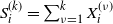 $S^{(k)}_i=\sum^k_{\nu=1} X_i^{(\nu)}$
and
$S^{(k)}_i=\sum^k_{\nu=1} X_i^{(\nu)}$
and $S^{(0)}_i=0$
,
$S^{(0)}_i=0$
, $i\in [n]$
. Assume that
$i\in [n]$
. Assume that
-
(i) for all
$k\in [m]$
,
$\bigl[{\boldsymbol{X}}^{(k)} \mid {\boldsymbol{S}}^{(k-1)}\bigr]$
is NA (respectively, NSMD); -
(ii) for all
$k\in [m]$
and
$I\subset [n]$
,
$\bigl[{\boldsymbol{X}}_I^{(k)}\mid {\boldsymbol{S}}^{(k-1)}\bigr] \stackrel{d}{=} \bigl[{\boldsymbol{X}}_I^{(k)}\mid {\boldsymbol{S}}^{(k-1)}_I\bigr]$
; -
(iii) for all
$k\in [m]$
and
$I\subset [n]$
,
${\boldsymbol{X}}_I^{(k)}$
is stochastically increasing in
${\boldsymbol{S}}^{(k-1)}_I$
.





Then ${\boldsymbol{S}}^{(k)}$
is NA (respectively, NSMD) for
${\boldsymbol{S}}^{(k)}$
is NA (respectively, NSMD) for $k\in [m]$
.
$k\in [m]$
.
Proof. First, we prove the NA property of ${\boldsymbol{S}}^{(k)}$
by induction on
${\boldsymbol{S}}^{(k)}$
by induction on $k\in [m]$
. For
$k\in [m]$
. For $k=1$
,
$k=1$
, ${\boldsymbol{S}}^{(1)}={\boldsymbol{X}}^{(1)}$
is NA by assumption (i). Assume
${\boldsymbol{S}}^{(1)}={\boldsymbol{X}}^{(1)}$
is NA by assumption (i). Assume ${\boldsymbol{S}}^{(k)}$
is NA for
${\boldsymbol{S}}^{(k)}$
is NA for $k\in [m]$
. Let
$k\in [m]$
. Let $I_1$
and
$I_1$
and $I_2$
be two disjoint proper subsets of [n], and let
$I_2$
be two disjoint proper subsets of [n], and let $\psi_j\colon \mathbb{R}^{|I_j|}\to\mathbb{R}$
be an increasing function for
$\psi_j\colon \mathbb{R}^{|I_j|}\to\mathbb{R}$
be an increasing function for $j=1, 2$
. Then
$j=1, 2$
. Then
 \begin{align*}& \textrm{Cov} \bigl(\psi_1\bigl({\boldsymbol{S}}^{(k+1)}_{I_1}\bigr), \psi_2\bigl({\boldsymbol{S}}^{(k+1)}_{I_2}\bigr)\bigr) \\& \quad = \textrm{Cov} \bigl(\mathbb{E} \bigl[\psi_1\bigl({\boldsymbol{X}}_{I_1}^{(k+1)}+{\boldsymbol{S}}^{(k)}_{I_1}\bigr) \mid {\boldsymbol{S}}^{(k)}\bigr], \mathbb{E}\bigl[\psi_2\bigl({\boldsymbol{X}}_{I_2}^{(k+1)}+ {\boldsymbol{S}}^{(k)}_{I_2}\bigr) \mid {\boldsymbol{S}}^{(k)}\bigr]\bigr) \\&\quad \quad + \mathbb{E} \bigl[\textrm{Cov} \bigl(\psi_1\bigl({\boldsymbol{X}}_{I_1}^{(k+1)}+{\boldsymbol{S}}^{(k)}_{I_1}\bigr), \psi_2\bigl({\boldsymbol{X}}_{I_2}^{(k+1)}+{\boldsymbol{S}}^{(k)}_{I_2}\bigr)\mid {\boldsymbol{S}}^{(k)} \bigr)\bigr] \\& \quad \le \textrm{Cov} \bigl(\mathbb{E} \bigl[\psi_1\bigl({\boldsymbol{X}}_{I_1}^{(k+1)}+{\boldsymbol{S}}^{(k)}_{I_1}\bigr) \mid {\boldsymbol{S}}^{(k)}\bigr], \mathbb{E}\bigl[\psi_2\bigl({\boldsymbol{X}}_{I_2}^{(k+1)}+ {\boldsymbol{S}}^{(k)}_{I_2}\bigr) \mid {\boldsymbol{S}}^{(k)}\bigr]\bigr)\\& \quad = \textrm{Cov} \bigl(\varphi_1\big ({\boldsymbol{S}}^{(k)}\big ), \varphi_2\big ({\boldsymbol{S}}^{(k)}\big )\bigr),\end{align*}
where the first inequality follows from assumption (i), and
 \[\varphi_j\big ({\boldsymbol{S}}^{(k)}\big )=\mathbb{E}\bigl[\psi_j\bigl({\boldsymbol{X}}_{I_j}^{(k+1)}+{\boldsymbol{S}}^{(k)}_{I_j}\bigr)\mid {\boldsymbol{S}}^{(k)}\bigr], \quad j=1, 2.\]
By assumption (ii), it follows that $\varphi_j\big ({\boldsymbol{S}}^{(k)}\big )$
depends on
$\varphi_j\big ({\boldsymbol{S}}^{(k)}\big )$
depends on ${\boldsymbol{S}}_{I_j}^{(k)}$
only, that is,
${\boldsymbol{S}}_{I_j}^{(k)}$
only, that is,
 \[\varphi_j\big ({\boldsymbol{S}}^{(k)}\big )=\mathbb{E}\bigl[\psi_j\bigl({\boldsymbol{X}}_{I_j}^{(k+1)}+{\boldsymbol{S}}^{(k)}_{I_j}\bigr)\mid {\boldsymbol{S}}_{I_j}^{(k)}\bigr] \stackrel{\textrm{def}}{=} \varphi_j^\ast\big ({\boldsymbol{S}}_{I_j}^{(k)}\big ), \quad j=1, 2.\]
By assumption (iii), $\varphi_j^\ast\big ({\boldsymbol{s}}_{I_j}\big )$
is increasing in
$\varphi_j^\ast\big ({\boldsymbol{s}}_{I_j}\big )$
is increasing in ${\boldsymbol{s}}_{I_j}$
. So we have
${\boldsymbol{s}}_{I_j}$
. So we have
 \[\textrm{Cov} \bigl(\psi_1\bigl({\boldsymbol{S}}^{(k+1)}_{I_1}\bigr), \psi_2\bigl({\boldsymbol{S}}^{(k+1)}_{I_2}\bigr)\bigr)=\textrm{Cov} \bigl(\varphi_1^\ast\big ({\boldsymbol{S}}_{I_1}^{(k)}\big ), \varphi_2^\ast\big ({\boldsymbol{S}}_{I_2}^{(k)}\big )\bigr)\le 0 ,\]
by the induction assumption that ${\boldsymbol{S}}^{(k)}$
is NA. This means that
${\boldsymbol{S}}^{(k)}$
is NA. This means that ${\boldsymbol{S}}^{(k+1)}$
is NA. Therefore we prove the NA property of
${\boldsymbol{S}}^{(k+1)}$
is NA. Therefore we prove the NA property of ${\boldsymbol{S}}^{(k)}$
by induction.
${\boldsymbol{S}}^{(k)}$
by induction.
Next, we prove the NSMD property of ${\boldsymbol{S}}^{(k)}$
by induction on
${\boldsymbol{S}}^{(k)}$
by induction on $k\in [m]$
. For
$k\in [m]$
. For $k=1$
,
$k=1$
, ${\boldsymbol{S}}^{(1)}={\boldsymbol{X}}^{(1)}$
is NSMD by assumption (i). Assume
${\boldsymbol{S}}^{(1)}={\boldsymbol{X}}^{(1)}$
is NSMD by assumption (i). Assume ${\boldsymbol{S}}^{(k)}$
is NSMD for
${\boldsymbol{S}}^{(k)}$
is NSMD for $k\in [m]$
. Let
$k\in [m]$
. Let $\psi\colon \mathbb{R}^n\to\mathbb{R}$
be a supmodular function. Since the underlying probability space is atomless, by assumptions (i) and (ii), we have
$\psi\colon \mathbb{R}^n\to\mathbb{R}$
be a supmodular function. Since the underlying probability space is atomless, by assumptions (i) and (ii), we have
 \begin{align*}\mathbb{E} \bigl[\psi\bigl({\boldsymbol{S}}^{(k+1)}\bigr)\bigr] & = \mathbb{E}\bigl\{\mathbb{E} \bigl[\psi\bigl({\boldsymbol{X}}^{(k+1)}+{\boldsymbol{S}}^{(k)}\bigr) \mid {\boldsymbol{S}}^{(k)}\bigr] \bigr\} \\& \le \mathbb{E}\bigl\{\mathbb{E} \bigl[\psi\bigl({{\boldsymbol{Y}}}({\boldsymbol{S}}^{(k)} ) +{\boldsymbol{S}}^{(k)}\bigr) \mid {\boldsymbol{S}}^{(k)}\bigr] \bigr\}\\&= \mathbb{E} \bigl[\varphi\bigl({\boldsymbol{S}}^{(k)}\bigr) \bigr],\end{align*}
where $\varphi({\boldsymbol{s}})= \mathbb{E} \bigl[\psi\bigl({{\boldsymbol{Y}}}({\boldsymbol{s}}) +{\boldsymbol{s}}\bigr)\bigr]$
for
$\varphi({\boldsymbol{s}})= \mathbb{E} \bigl[\psi\bigl({{\boldsymbol{Y}}}({\boldsymbol{s}}) +{\boldsymbol{s}}\bigr)\bigr]$
for ${\boldsymbol{s}}\in \mathbb{R}^n$
, and
${\boldsymbol{s}}\in \mathbb{R}^n$
, and ${\boldsymbol{Y}}({\boldsymbol{s}})=(Y_1(s_1), \ldots, Y_n(s_n))$
is a vector of independent random variables, independent of all other random variables, such that
${\boldsymbol{Y}}({\boldsymbol{s}})=(Y_1(s_1), \ldots, Y_n(s_n))$
is a vector of independent random variables, independent of all other random variables, such that
 \[Y_i(x) \stackrel {d}{=} \bigl[X_i^{(k+1)}\mid S^{(k)}_i=x\bigr]\quad\text{for $i\in [n]$ and $x\in\mathbb{R}$.}\]
By assumption (iii) and Lemma 2, we have
 \[\varphi({\boldsymbol{s}})= \mathbb{E} [\psi(Y_1(s_1) +s_1, \ldots, Y_n(s_n)+s_n)]\]
is also supermodular in ${\boldsymbol{s}}\in\mathbb{R}^n$
. By the induction assumption that
${\boldsymbol{s}}\in\mathbb{R}^n$
. By the induction assumption that ${\boldsymbol{S}}^{(k)}$
is NSMD, there exists
${\boldsymbol{S}}^{(k)}$
is NSMD, there exists ${\boldsymbol{S}}^{(k)*}=\bigl(S^{(k)*}_1, \ldots, S^{(k)*}_n\bigr)$
of independent random variables such that
${\boldsymbol{S}}^{(k)*}=\bigl(S^{(k)*}_1, \ldots, S^{(k)*}_n\bigr)$
of independent random variables such that $S^{(k)*}_i \stackrel {d}{=} S^{(k)}_i$
for
$S^{(k)*}_i \stackrel {d}{=} S^{(k)}_i$
for $i\in [n]$
and
$i\in [n]$
and
 \[\mathbb{E} \bigl[\varphi\bigl({\boldsymbol{S}}^{(k)}\bigr) \bigr] \le \mathbb{E} \bigl[\varphi\bigl({\boldsymbol{S}}^{(k)*}\bigr) \bigr].\]
Define ${\boldsymbol{S}}^{(k+1)*} ={\boldsymbol{Y}}\bigl({\boldsymbol{S}}^{(k)*}\bigr)+ {\boldsymbol{S}}^{(k)*}$
. Then the components of
${\boldsymbol{S}}^{(k+1)*} ={\boldsymbol{Y}}\bigl({\boldsymbol{S}}^{(k)*}\bigr)+ {\boldsymbol{S}}^{(k)*}$
. Then the components of ${\boldsymbol{S}}^{(k+1)*}$
are independent,
${\boldsymbol{S}}^{(k+1)*}$
are independent, $S_i^{(k+1)*} \stackrel {d}{=} S_i^{(k+1)}$
for
$S_i^{(k+1)*} \stackrel {d}{=} S_i^{(k+1)}$
for $i\in [m]$
, and
$i\in [m]$
, and
 \[\mathbb{E} \bigl[\psi\bigl({\boldsymbol{S}}^{(k+1)}\bigr)\bigr] \le \mathbb{E} \bigl[\varphi\bigl({\boldsymbol{S}}^{(k)*}\bigr) \bigr]= \mathbb{E} \bigl[\psi\bigl({{\boldsymbol{Y}}}\bigl({\boldsymbol{S}}^{(k)*} \bigr) +{\boldsymbol{S}}^{(k)*}\bigr)\bigr] =\mathbb{E} \bigl[\psi\bigl({\boldsymbol{S}}^{(k+1)*}\bigr)\bigr],\]
implying that ${\boldsymbol{S}}^{(k+1)}$
is NSMD. Therefore the desired result follows by induction.
${\boldsymbol{S}}^{(k+1)}$
is NSMD. Therefore the desired result follows by induction.
Theorem 2. Consider a knockout tournament with $n=2^\ell$
players of equal strength, where
$n=2^\ell$
players of equal strength, where $\ell\ge 2$
. If the schedule of matches is deterministic, then
$\ell\ge 2$
. If the schedule of matches is deterministic, then ${\boldsymbol{S}}$
is NA and hence NSMD.
${\boldsymbol{S}}$
is NA and hence NSMD.
Proof. It suffices to prove ${\boldsymbol{S}}$
is NA since NA implies NSMD. By a similar argument to that in the proof of Proposition 3 in [Reference Malinovsky and Rinott19], without loss of generality, assume that in the first round player
${\boldsymbol{S}}$
is NA since NA implies NSMD. By a similar argument to that in the proof of Proposition 3 in [Reference Malinovsky and Rinott19], without loss of generality, assume that in the first round player $2i-1$
plays against player 2i for
$2i-1$
plays against player 2i for $i\in [n/2]$
. For
$i\in [n/2]$
. For $i\in [n]$
, denote
$i\in [n]$
, denote
 \[X_i^{(1)}=\begin{cases} 1, & \hbox{if player ${i}$ wins the first round}, \\0, & \hbox{if player ${i}$ loses the first round}. \end{cases}\]
Then the pairs $\big (X_{2i-1}^{(1)}, X^{(1)}_{2i}\big )$
,
$\big (X_{2i-1}^{(1)}, X^{(1)}_{2i}\big )$
, $i\in [n/2]$
, are independent and NA. By Property
$i\in [n/2]$
, are independent and NA. By Property $\textrm{ P}_7$
in [Reference Joag-dev and Proschan15], it follows that
$\textrm{ P}_7$
in [Reference Joag-dev and Proschan15], it follows that ${\boldsymbol{X}}^{(1)}=\big (X_1^{(1)}, \ldots, X^{(1)}_n\big )$
is NA. For
${\boldsymbol{X}}^{(1)}=\big (X_1^{(1)}, \ldots, X^{(1)}_n\big )$
is NA. For $k\ge 2$
, define
$k\ge 2$
, define
 \[X_i^{(k)}=\begin{cases}1, & \hbox{if player ${i}$ wins the ${k}$th round}, \\0, & \hbox{otherwise}, \end{cases}\]
and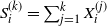 $S^{(k)}_i=\sum^k_{j=1} X_i^{(j)}$
for
$S^{(k)}_i=\sum^k_{j=1} X_i^{(j)}$
for $i\in [n]$
. Note that if
$i\in [n]$
. Note that if $X_i^{(k-1)}=0$
then
$X_i^{(k-1)}=0$
then $X^{(k)}_i=0$
. Obviously, assumptions (i) and (iii) of Lemma 3 are seen to hold. Given
$X^{(k)}_i=0$
. Obviously, assumptions (i) and (iii) of Lemma 3 are seen to hold. Given ${\boldsymbol{S}}^{(k-1)}$
, among all players
${\boldsymbol{S}}^{(k-1)}$
, among all players $I\subset [n]$
, only players
$I\subset [n]$
, only players
 \[\bigl\{i\in I\colon S^{(k-1)}_i=k-1\bigr\}\]
move to the kth round, and their scores are not affected by ${\boldsymbol{S}}^{(k-1)}_{[n]\backslash I}$
since the schedule of matches is deterministic. Thus assumption (ii) of Lemma 3 is satisfied. Therefore the NA property of
${\boldsymbol{S}}^{(k-1)}_{[n]\backslash I}$
since the schedule of matches is deterministic. Thus assumption (ii) of Lemma 3 is satisfied. Therefore the NA property of ${\boldsymbol{S}}$
follows from Lemma 3.
${\boldsymbol{S}}$
follows from Lemma 3.
Motivated by Example 4, we have the next theorem concerning the NRTD property of ${\boldsymbol{S}}$
in a knockout tournament with a deterministic draw and players having equal strength.
${\boldsymbol{S}}$
in a knockout tournament with a deterministic draw and players having equal strength.
Theorem 3. Consider a knockout tournament with $n=2^\ell$
players of equal strength, where
$n=2^\ell$
players of equal strength, where $\ell\ge 2$
. If the schedule of matches is deterministic, then
$\ell\ge 2$
. If the schedule of matches is deterministic, then ${\boldsymbol{S}}$
is NRTD.
${\boldsymbol{S}}$
is NRTD.
Proof. Since the schedule of matches is deterministic, without loss of generality, assume that in the first round, player $2^k-1$
plays against player
$2^k-1$
plays against player $2^k$
for each
$2^k$
for each $k\in [\ell]$
; in the second round, the winner between player 1 and 2 plays against the winner between player 3 and 4, the winner between player 5 and 6 plays against the winner between player 7 and 8, and so on. In the next rounds, all matches are arranged in a similar way. To prove that
$k\in [\ell]$
; in the second round, the winner between player 1 and 2 plays against the winner between player 3 and 4, the winner between player 5 and 6 plays against the winner between player 7 and 8, and so on. In the next rounds, all matches are arranged in a similar way. To prove that ${\boldsymbol{S}}$
is NRTD, it suffices to prove that, for any non-empty set
${\boldsymbol{S}}$
is NRTD, it suffices to prove that, for any non-empty set $I\varsubsetneq [n]$
and an increasing function
$I\varsubsetneq [n]$
and an increasing function $\psi\colon \mathbb{R}^{n-|I|}\to \mathbb{R}$
,
$\psi\colon \mathbb{R}^{n-|I|}\to \mathbb{R}$
,
 \begin{equation}\mathbb{E}\bigl[\psi\bigl({\boldsymbol{S}}_{[n]\backslash I}\bigr) \mid S_{i_0}\ge h-1, {\boldsymbol{S}}_{I\backslash\{i_0\}} \ge {\boldsymbol{s}}_{I\backslash\{i_0\}}\bigr] \ge \mathbb{E}\bigl[\psi\bigl({\boldsymbol{S}}_{[n]\backslash I}\bigr)\mid S_{i_0}\ge h, {\boldsymbol{S}}_{I\backslash\{i_0\}} \ge {\boldsymbol{s}}_{I\backslash\{i_0\}}\bigr]\end{equation}
for each $i_0\in I$
, where
$i_0\in I$
, where $h\in [\ell]$
and
$h\in [\ell]$
and ${\boldsymbol{s}}_{I\backslash\{i_0\}}$
satisfy
${\boldsymbol{s}}_{I\backslash\{i_0\}}$
satisfy
 \begin{equation*} \mathbb{P}\bigl(S_{i_0}\ge h-1, {\boldsymbol{S}}_{I\backslash\{i_0\}} \ge {\boldsymbol{s}}_{I\backslash\{i_0\}}\bigr)\ge \mathbb{P}\bigl(S_{i_0}\ge h, {\boldsymbol{S}}_{I\backslash\{i_0\}} \ge {\boldsymbol{s}}_{I\backslash\{i_0\}}\bigr)>0.\end{equation*}
Without loss of generality, assume $i_0=1$
. From the second strict inequality, we know that
$i_0=1$
. From the second strict inequality, we know that $s_i\le h-1$
for all
$s_i\le h-1$
for all $i\in [2^h]\cap (I\backslash \{1\})$
.
$i\in [2^h]\cap (I\backslash \{1\})$
.
Define $K=[2^h]\cap ([n]\backslash I)$
and
$K=[2^h]\cap ([n]\backslash I)$
and $J=([n]\backslash [2^h])\cap ([n]\backslash I)= [n]\backslash (I\cup K)$
, and denote
$J=([n]\backslash [2^h])\cap ([n]\backslash I)= [n]\backslash (I\cup K)$
, and denote
 \begin{align*}E_0 & =\bigl\{S_1= h-1, {\boldsymbol{S}}_{I\backslash\{1\}} \ge {\boldsymbol{s}}_{I\backslash\{1\}}\bigr\},\\E_1 & =\bigl\{S_1\ge h-1, {\boldsymbol{S}}_{I\backslash\{1\}} \ge {\boldsymbol{s}}_{I\backslash\{1\}}\bigr\},\\E_2 & =\bigl\{S_1\ge h, {\boldsymbol{S}}_{I\backslash\{1\}} \ge {\boldsymbol{s}}_{I\backslash\{1\}}\bigr\}.\end{align*}
Obviously, $E_1=E_0\cup E_2$
and
$E_1=E_0\cup E_2$
and $E_0 \cap E_2=\emptyset$
. From the specified schedule of matches, it is known that the outcomes in the first h rounds for players in
$E_0 \cap E_2=\emptyset$
. From the specified schedule of matches, it is known that the outcomes in the first h rounds for players in $[2^h]$
do not change the distribution of
$[2^h]$
do not change the distribution of ${\boldsymbol{S}}_{[n]\backslash [2^h]}$
because only one winner among the first
${\boldsymbol{S}}_{[n]\backslash [2^h]}$
because only one winner among the first $2^h$
players will play against one player
$2^h$
players will play against one player $k\in [n]\backslash [2^h]$
. Then
$k\in [n]\backslash [2^h]$
. Then
 \begin{equation}[{\boldsymbol{S}}_J \mid E_0] \stackrel {d}{=} [{\boldsymbol{S}}_J \mid E_2].\end{equation}
Next, we prove that
 \begin{equation}[{\boldsymbol{S}}_K \mid E_2, {\boldsymbol{S}}_J={\boldsymbol{s}}_J] \le_\textrm{st} [{\boldsymbol{S}}_K \mid E_0, {\boldsymbol{S}}_J={\boldsymbol{s}}_J]\end{equation}
for all possible choices of ${\boldsymbol{s}}_J$
. To simplify notations, define
${\boldsymbol{s}}_J$
. To simplify notations, define
 \begin{align*}{\boldsymbol{Y}}_K & =[{\boldsymbol{S}}_K \mid E_0, {\boldsymbol{S}}_J={\boldsymbol{s}}_J], \quad{\boldsymbol{Z}}_K =[{\boldsymbol{S}}_K \mid E_2, {\boldsymbol{S}}_J={\boldsymbol{s}}_J].\end{align*}
Since the event $\{S_1\ge h\}$
means that player 1 beats all players
$\{S_1\ge h\}$
means that player 1 beats all players $i\in [2^h]$
, it follows that
$i\in [2^h]$
, it follows that $Z_k \le h-1$
for each
$Z_k \le h-1$
for each $k\in K$
. To prove (17), let
$k\in K$
. To prove (17), let $\phi\colon \mathbb{R}^{|K|}\to\mathbb{R}$
be an increasing function. First, note that
$\phi\colon \mathbb{R}^{|K|}\to\mathbb{R}$
be an increasing function. First, note that
 \begin{equation}\mathbb{P}({\boldsymbol{Z}}_K ={\boldsymbol{s}}_K) = \mathbb{P} ({\boldsymbol{Y}}_K={\boldsymbol{s}}_K)\end{equation}
whenever $s_k<h-1$
for all
$s_k<h-1$
for all $k\in K$
because players
$k\in K$
because players $k\in K$
were knocked out in the first
$k\in K$
were knocked out in the first $h-1$
round. In view of (18), we have
$h-1$
round. In view of (18), we have
 \begin{align*}\mathbb{E} [\phi({\boldsymbol{Y}}_K)] & =\mathbb{E} [\phi ({\boldsymbol{Y}}_K)\cdot 1_{\{Y_k < h-1, k\in K\}} ] + \sum_{k\in K} \mathbb{E} [\phi ({\boldsymbol{Y}}_K)\cdot 1_{\{Y_j < h-1, j\in K\backslash\{k\}\}} \cdot 1_{\{Y_k\ge h-1\}}]\\ & \ge \mathbb{E} [\phi ({\boldsymbol{Z}}_K)\cdot 1_{\{Z_k < h-1, k\in K\}} ] + \sum_{k\in K} \mathbb{E} [\phi (h-1, {\boldsymbol{Y}}_{K\backslash \{k\}}) \cdot 1_{\{Y_j < h-1, j\in K\backslash\{k\}\}} ]\\& = \mathbb{E} [\phi ({\boldsymbol{Z}}_K)\cdot 1_{\{Z_k < h-1, k\in K\}} ] + \sum_{k\in K} \mathbb{E} [\phi (h-1, {\boldsymbol{Z}}_{K\backslash \{k\}}) \cdot 1_{\{Z_j < h-1, j\in K\backslash\{k\}\}} ]\\& = \mathbb{E} [\phi ({\boldsymbol{Z}}_K)\cdot 1_{\{Z_k < h-1, k\in K\}} ] + \sum_{k\in K} \mathbb{E} [\phi ({\boldsymbol{Z}}_K) \cdot 1_{\{Z_j < h-1, j\in K\backslash\{k\}\}} \cdot 1_{\{Z_k= h-1\}}]\\& = \mathbb{E} [\phi({\boldsymbol{Z}}_K)],\end{align*}
which implies ${\boldsymbol{Z}}_K\le_\textrm{st} {\boldsymbol{Y}}_K$
, that is, (17).
${\boldsymbol{Z}}_K\le_\textrm{st} {\boldsymbol{Y}}_K$
, that is, (17).
Next, we turn to proving (15). Note that
 \begin{align*}\mathbb{E}\bigl[\psi\bigl({\boldsymbol{S}}_{[n]\backslash I}\bigr) \mid E_1\bigr]& =\dfrac { \mathbb{E}[\psi({\boldsymbol{S}}_J, {\boldsymbol{S}}_K)\cdot 1_{E_1}] }{\mathbb{P}(E_1)}\stackrel{\textrm{def}}{=} \dfrac {\eta_3 +\eta_4}{\eta_1+\eta_2},\end{align*}
where $\eta_1= \mathbb{P}(E_0)$
,
$\eta_1= \mathbb{P}(E_0)$
, $\eta_2 =\mathbb{P}(E_2)$
, and
$\eta_2 =\mathbb{P}(E_2)$
, and
 \begin{align*}\eta_3 &=\mathbb{E}[\psi({\boldsymbol{S}}_J,{\boldsymbol{S}}_K)\cdot 1_{E_0}],\quad \eta_4 =\mathbb{E}[\psi({\boldsymbol{S}}_J,{\boldsymbol{S}}_K)\cdot 1_{E_2}].\end{align*}
On the other hand, given $S_1\ge h-1$
and
$S_1\ge h-1$
and ${\boldsymbol{S}}_{I\backslash\{1\}} \ge {\boldsymbol{s}}_{I\backslash\{1\}}$
, player 1 will play a match with another player from
${\boldsymbol{S}}_{I\backslash\{1\}} \ge {\boldsymbol{s}}_{I\backslash\{1\}}$
, player 1 will play a match with another player from $[2^h]$
in the hth round, and thus the events
$[2^h]$
in the hth round, and thus the events $\{S_1=h-1\}$
and
$\{S_1=h-1\}$
and $\{S_1\ge h\}$
occur respectively with probabilities
$\{S_1\ge h\}$
occur respectively with probabilities $1/2$
since he wins and loses in this round with probability
$1/2$
since he wins and loses in this round with probability $1/2$
. So we have
$1/2$
. So we have
 \[\eta_1=\mathbb{P}(S_1=h-1 \mid E_1) \cdot \mathbb{P}(E_1) =\mathbb{P}(S_1\ge h \mid E_1) \cdot \mathbb{P}(E_1) = \mathbb{P}(E_2)= \eta_2.\]
Also, by (16) and (17), we have
 \begin{align*}\eta_3 &=\sum_{{\boldsymbol{s}}_J}\mathbb{E}\bigl[\psi({\boldsymbol{S}}_J, {\boldsymbol{S}}_K)\cdot 1_{\{{\boldsymbol{S}}_J={\boldsymbol{s}}_J, E_0\}}\bigr]\\&= \eta_1 \sum_{{\boldsymbol{s}}_J} \mathbb{E}[\psi({\boldsymbol{s}}_J, {\boldsymbol{S}}_K) \mid {\boldsymbol{S}}_J={\boldsymbol{s}}_J, E_0 ]\cdot \mathbb{P}({\boldsymbol{S}}_J={\boldsymbol{s}}_J \mid E_0 )\\& \ge \eta_2 \sum_{{\boldsymbol{s}}_J} \mathbb{E}[\psi({\boldsymbol{s}}_J, {\boldsymbol{S}}_K) \mid {\boldsymbol{S}}_J={\boldsymbol{s}}_J, E_2 ]\cdot \mathbb{P}({\boldsymbol{S}}_J={\boldsymbol{s}}_J \mid E_2 )\\&= \sum_{{\boldsymbol{s}}_J} \mathbb{E}\bigl[\psi({\boldsymbol{S}}_J, {\boldsymbol{S}}_K)\cdot 1_{\{{\boldsymbol{S}}_J={\boldsymbol{s}}_J, E_2\}}\bigr] \\&= \eta_4.\end{align*}
Therefore
 \[\mathbb{E}\bigl[\psi\bigl({\boldsymbol{S}}_{[n]\backslash I}\bigr) \mid E_1\bigr] =\dfrac {\eta_3+\eta_4}{\eta_1+\eta_2}\ge \dfrac {\eta_4}{\eta_2} \ge \mathbb{E}\bigl[\psi\bigl({\boldsymbol{S}}_{[n]\backslash I}\bigr) \mid E_2\bigr].\]
This proves (15).
Remark 1. We give an intuitive interpretation of the NRTD result in Theorem 3, which can be regarded as a less rigorous proof. Observe that, given $S_k\ge h$
for some
$S_k\ge h$
for some $k\in [n]$
, it means that player k won in the first h rounds, and no other deterministic information about his score in the next
$k\in [n]$
, it means that player k won in the first h rounds, and no other deterministic information about his score in the next $\ell-h$
rounds can be inferred. In the proof of Theorem 3, define
$\ell-h$
rounds can be inferred. In the proof of Theorem 3, define
 \begin{align*}{\boldsymbol{U}}_{[n]\backslash I} & =\bigl[{\boldsymbol{S}}_{[n]\backslash I}\mid E_1\bigr]=\bigl[{\boldsymbol{S}}_{[n]\backslash I}\mid E_0\cup E_2\bigr],\quad {\boldsymbol{V}}_{[n]\backslash I} = \bigl[{\boldsymbol{S}}_{[n]\backslash I}\mid E_2\bigr].\end{align*}
We compare $E_1$
and
$E_1$
and $E_2$
. The difference between
$E_2$
. The difference between $E_1$
and
$E_1$
and $E_2$
is that player
$E_2$
is that player $i_0$
won the first h rounds for
$i_0$
won the first h rounds for $E_2$
while player
$E_2$
while player $i_0$
just won the first
$i_0$
just won the first $h-1$
rounds for
$h-1$
rounds for $E_1$
. Intuitively,
$E_1$
. Intuitively, ${\boldsymbol{S}}_{[n]\backslash I}$
given
${\boldsymbol{S}}_{[n]\backslash I}$
given $E_0$
tends to take larger values than given
$E_0$
tends to take larger values than given $E_2$
. Thus
$E_2$
. Thus ${\boldsymbol{U}}_{[n]\backslash I}$
is stochastically larger than
${\boldsymbol{U}}_{[n]\backslash I}$
is stochastically larger than ${\boldsymbol{V}}_{[n]\backslash I}$
.
${\boldsymbol{V}}_{[n]\backslash I}$
.
Acknowledgements
The authors are grateful to the Associate Editor and four anonymous referees for their comprehensive reviews of an earlier version of this paper.
Funding information
Z. Zou is supported by the National Natural Science Foundation of China (no. 12401625), the China Postdoctoral Science Foundation (no. 2024M753074), the Postdoctoral Fellowship Program of CPSF (GZC20232556), and the Fundamental Research Funds for the Central Universities (no. WK2040000108). T. Hu would like to acknowledge financial support from the National Natural Science Foundation of China (nos. 72332007, 12371476).
Competing interests
There were no competing interests to declare which arose during the preparation or publication process of this article.
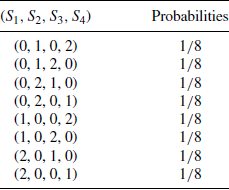
 S
S

