

Archaeologists have long grappled with understanding the nature of transformations in human societies. Some of these transformations are seen as “revolutionary,” including the development of tools, the creation of imagery, the domestication of plants and animals, and the rise of urban and state-level societies. While the complexity and diversity of these reconfigurations has become more apparent with every new study, social group restructuring is crucial to each. Cultural transformations may share characteristics, but the organization and workings of social groups appear specific to each threshold of change. From this perspective, we argue that fundamental societal transformations are more intimately entangled with innovations in group formation – new modes of kin definition, religious groupings, political organizations and manipulation of ancient social media – than driven by technological innovation.
One of the most dynamic periods of ancient economic, political and technological transformation is the Iron Age of the Middle East (~1150–550 BCE). Paradoxically, this period emerged out of Late Bronze Age palace economies arguably co-dependently linked through a fragile “world system” and consequently leading to a region-wide collapse (Frank Reference Frank1993). A general defining feature of the Iron Age is the rapid and widespread adoption of new, more socially integrative and robust economies and technologies. After an initial, short “Dark Age,” Iron Age innovations radically departed from prior cultural trajectories with ultimately longer lasting impacts (e.g. invention of money, political and military reorganization and expansion, monotheism). The Iron Age metamorphosed from many local competing polities into newly formed and competing empires. However, the emergence of new types of Iron Age groups and mechanisms for group formation, as well as new types of power structures, remain relatively poorly understood.
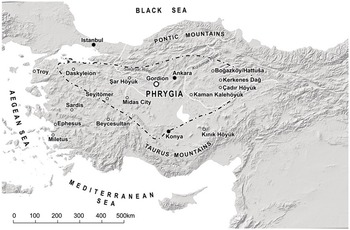
This book is an exploration of Iron Age group formation at the central Anatolian settlement of Gordion, over 1,000 years from the late second millennium into the first millennium BCE. While occupation of this site extends back at least to the Early Bronze Age (EBA), it is during the Iron Age (ca. 1150–540 BCE) that it achieves its greatest prominence as an urban center and as capital of the Phrygians, a major political force in central Anatolia in the Middle Iron Age (MIA; Fig. 1.1). With a long history of excavations that are ongoing, and against the background of an extraordinarily dynamic period of cultural transformation in the ancient Middle East, Gordion provides one of our best archaeological windows on the development and negotiation of Iron Age group identities.
Map of Turkey with key sites and hypothesized boundaries of Phrygia.

Group creation is an active and culturally innovative phenomenon consisting of new forms of social practices, material culture and the synergistic interplay between the two. Here we focus on ceramics as a proxy for both the practices and material culture of identity formation. Unlike many other artifact classes, ceramics span elite and quotidian use as an important medium for both domestic and public activities throughout the first millennium BCE. They provide the material evidence of practices needed to study the process of group formation and maintenance over time. They also embed the social relations of production, and as plastic, disposable media, their distribution reveals the actions that constitute group definition (e.g. domestic activities, feasting, socializing).
Groups and Identity in Archaeology
How groups are formed, how they practice and what happens to them over time have been abiding research themes for both anthropology and archaeology (e.g. Binford Reference Binford1967; Lewis Reference Lewis1963; Redfield Reference Redfield1947, Reference Redfield1953, Reference Redfield1955). Groups are created as people share activities, materials and language, to name a few (Appadurai Reference Appadurai1988). The strength and longevity of a group can be linked to the extent and type of things shared: kinship and proximity can lead to lasting group bonds – or enmities (Barth Reference Barth1956). A critical element for group cohesion is ongoing, regular “practice,” constituting the group through interaction and negotiation.
The formation and development of groups is particularly critical in constituting complex societies. Groups exist at every scale, from playground gangs to national political parties. They also have highly variable “lives” – from short-term political action groups to institutions that span decades or centuries, such as the Catholic Church. However, archaeologists have tended to focus on a subset of groups related to particular activities or practices: political (ruling elites, factions, etc.), domestic (households, families) and economic (trade and exchange, production and consumption). Given that a rich panoply of groups exists outside this comparatively narrow range of often formalized activities, and can also play a critical role in the development of social networks and political and/or economic practices, we seek to extend our analysis beyond the range of groups conventionally considered by archaeologists.
Since the 1980s, through the works of Bourdieu (Reference Bourdieu1973, Reference Bourdieu1977, Reference Bourdieu1990), Foucault (Reference Foucault1977, Reference Foucault1982) and Giddens (Reference Giddens1984), archaeologists have become interested in the role of individuals, agency, practice and the dialectics of structure and process. “Identity” was a critical focus, in particular how gender, age, ethnicity, religion and status are defined, entangled, contested and malleable (Garcia et al. Reference Garcia, Lucy, Babic and Edwards2005; Insoll Reference Insoll2007; Meskell Reference Meskell and Insoll2007; Shennan Reference Shennan2003; Thomas Reference Thomas1991). At the same time, attempts to redress the overly prescriptive and formalized character of conventional hierarchical typologies of groups (band, tribe, chiefdom, state; e.g. Pauketat Reference Pauketat2007), sought more meaningful groups through daily practice in “communities” (Yaeger and Canuto Reference Yaeger, Canuto, Canuto and Yaeger2000), however volatile (Isbell Reference Isbell, Canuto and Yaeger2000).
Archaeologists have further elaborated the idea of “communities” as a productive approach for understanding group formation and dynamics. Mac Sweeney (Reference Mac Sweeney2011:21) defined communities as a “conscious mental construct, built both on and through social practice and lived experience, which is itself facilitated by residential proximity and regular direct interaction.” Isbell (Reference Isbell, Canuto and Yaeger2000:249), noting some of the tensions between geographic and social communities, elaborated the idea of an imagined community: “recogniz[ing] that correspondence between a socially interacting group, a bounded territory, economy, politics, reproductive pool, intergenerational education, desires and sentiments, can exist only in an ideal model, not in the real world [emphasis added].”
Arguably, most behaviors have either direct or indirect material manifestations. For archaeology, Isbell (Reference Isbell, Canuto and Yaeger2000:249), building on (Soja Reference Soja1989), suggested that materials or goods must also be understood as “the means, medium, and outcome of social reproduction.” From this perspective, the creation and use of materials constructs social relationships – with groups produced through shared processes that promote group identification (whether through similarity or difference; Preucel Reference Preucel, Canuto and Yaeger2000). Material culture, therefore, is not simply a passive proxy for behavior, but plays an active role in the creation of identities at all scales, for individuals, groups and communities.
Ceramics, in both production and use, represent one means by which groups in the past were constituted. While solitary individuals can produce ceramics – gathering clay, fuel and water, constructing pots, drying and firing them – most production includes at least the cooperation of a family unit. Ceramic use, likewise, involves shared cooking, meals, goods and infrastructure/investment. More broadly, ceramic use establishes larger groups not only through shared forms and styles, but also through patterns of usage and disposal as a reflection of culinary practices (e.g. shared actions/solidarity of meal production, etiquette/table manners of food consumption, types of food and drink consumed). This is particularly evident for group events. During the Bronze and Iron Ages in Anatolia, feasting and religious ritual, as well as payments of allotted goods (beer, grain, etc.) were practiced using ceramics. Ceramic styles and forms were often emblematic of particular groups across a range of scales. As a plastic, additive technology that enables a wide range of decorative and formal choice, ceramics can also provide relatively fine-grained differentiation of social identities and relationships.
Finally, because most ceramics are relatively fragile they also have a relatively short life span, a characteristic that is particularly useful for tracking quite dynamic changes in group identity and formation over archaeologically short periods (years as opposed to decades).
The Site of Gordion and Its History
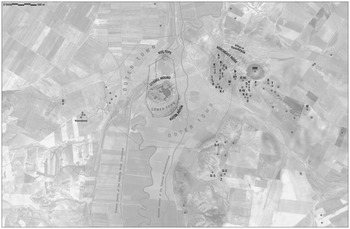
Excavated remains from the site of Gordion (modern Yassıhöyük) are the focus of this book (Fig. 1.2). Gordion is identified as the capital of Phrygia, an Iron Age polity of central Anatolia, best known through Greek records and legends referring to King Midas (e.g. Herodotus). The site was first proposed as the Phrygian capital in the 1890s by the Körte brothers on the basis of historical texts that located Gordion on the banks of the Sangarios (Sakarya) River (Sams Reference Sams and Sasson1995). The brothers excavated burial tumuli surrounding the site as well test trenches on the site itself (G. Körte and A. Körte Reference Körte and Körte1904). Investigations resumed in 1950, under the direction of Rodney Young from the University of Pennsylvania Museum, who also excavated both nearby tumuli and areas of the Citadel Mound. Following his accidental death in 1974, fieldwork at Gordion halted, and the focus then shifted to analysis under Project Director Keith DeVries. With publication of Young’s work underway, fieldwork resumed in 1988 under Mary Voigt’s direction. Her aims were to establish a clear stratigraphic sequence, gain an understanding of nonelite activities and identify settlement areas beyond the Citadel Mound (Voigt Reference Voigt1997, Reference Voigt, Manning and Bruce2009, Reference Voigt, Steadman and McMahon2011, Reference Voigt, Redford and Ergin2013). Since then, excavation and site conservation have continued under the direction of Brian Rose, and a Gordion regional survey was completed by Kealhofer (Kealhofer Reference Kealhofer2005a; Kealhofer and Marsh Reference Kealhofer and Marsh2019; Marsh and Kealhofer Reference Marsh and Kealhofer2014; Rose Reference Rose2012a, Reference Rose2017; Rose and Darbyshire Reference Rose and Darbyshire2011).
Map of Gordion showing the location of Citadel Mound, Lower and Outer Towns, some tumuli, and Sakarya River (ancient and modern courses).
Excavated tumuli are labelled, and unexcavated tumuli are indicated by black dots (see also Fig. 3.6).

Our understanding of the scale of Phrygian power and influence derives from both historical and archaeological data. DeVries (Reference DeVries, Rose and Darbyshire2011b), Roller (Reference Roller, Steadman and McMahon2011) and Sams (Reference Sams, Steadman and McMahon2011a) summarize the historical record, including Assyrian and Greek sources that mention the Phrygians or King Midas. Most of the documents date to the eighth or seventh century BCE, when Phrygia seems to have been at the height of its power and influence. At that time, Phrygia was “in league” with the kings of Tabal, a region somewhere near the modern capital of Konya, contesting Assyrian intrusions into Anatolia. Sams (Reference Sams, Voigt, Rose and Darbyshire2011a) suggests that the Phrygians eventually paid tribute to the Assyrians, garnering support against raiders (the Kimmerians) who ranged throughout Anatolia and into Assyrian territory in the seventh century BCE. In the west, Greek references to Midas or Phrygians include marriages between ruling families (Roller Reference Roller, Steadman and McMahon2011), reinforcing the prominence of the Phrygians in central Anatolian affairs during the first half of the first millennium BCE.
Archaeological data on the scale of Phrygian power are somewhat more challenging. There is little evidence for boundaries or borders of a Phrygian polity (Roller Reference Roller, Steadman and McMahon2011; van Dongen Reference Van Dongen, Gaspa, Grico and Bonacossi2014). Based on the distribution of Phrygian inscriptions, DeVries (Reference DeVries2000) mapped a territory for the Phrygians that encompassed most of inland western Anatolia south to the Lake District, west of Konya (Fig. 1.1). The distribution of a distinctive type of stepped altar has also been used as a proxy for the extent of Phrygian political control (Roller Reference Roller, Steadman and McMahon2011). From the distribution of grey ware ceramics found during Todd’s survey of Nigde, near Kırşehir, Summers (Reference Summers, Çilingiroğlu and French1994) further suggested that Phrygian influence extended into the east – an inference confirmed by excavation at the site of Kerkenes, which is clearly a Phrygian settlement within the Halys River [Kızılırmak] bend (Summers Reference Summers2018).
While both archaeological and historical data document Phrygia, the dynamic processes through which groups crafted a new Phrygian identity and community evident for Iron Age Gordion have yet to be explored.
The Gordion Sequence
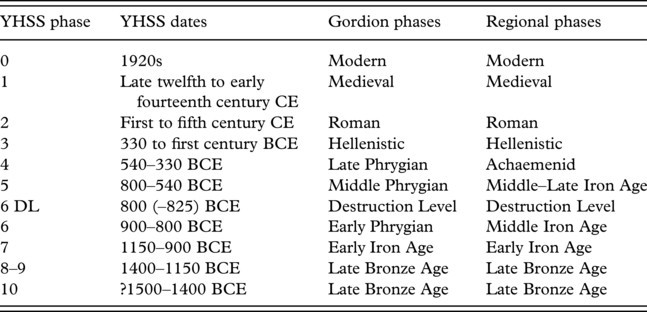
Occupation at Gordion extends back into the Early Bronze Age, but our focus here is on the better documented Iron Age sequence, dating from the end of the Bronze Age through to the Early Hellenistic Period (1150–330 BCE; Table 1.1). We begin with the Late Bronze Age (LBA), 1500–1150 BCE, to set the stage for the sequence of cultural transformations during the Iron Age. Late Bronze Age Gordion was a small town likely subject to Hittite rule (based on both ceramics and epigraphic data; Gunter Reference Gunter1991, Reference Gunter2006). Following the collapse of the Hittite Empire in the twelfth century BCE, archaeologists have identified a relatively short period in the Early Iron Age (EIA) during which material culture and domestic life at Gordion changed substantially. By 900 BCE an entirely new polity emerged with Gordion as its capital. This Early Phrygian period of political and community development continued with a monumental rebuild and urban expansion during the early Middle Phrygian period (mostly after 800 BCE), and a political and cultural transformation with Lydian (late Middle Phrygian) and subsequently Persian control during the Late Phrygian period. Early Hellenistic Gordion continued as a thriving center. Subsequent Galatian and Roman occupations appear to have been less substantial in population and scale.
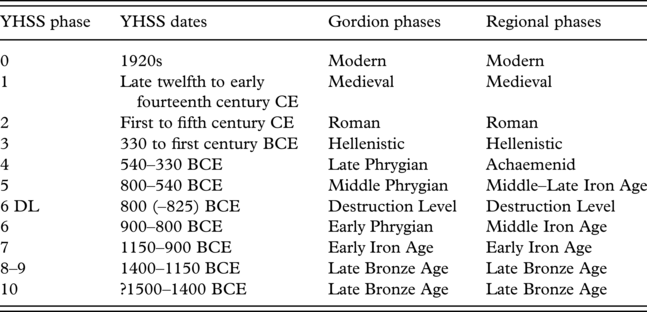
Note that YHSS phases are only assigned for levels excavated under Voigt’s direction.
Gordion’s Late Bronze–Iron Age archaeological sequence extends over approximately 1,000 years and provides an unparalleled perspective on political (group) formation and transformation for central Anatolia. In addition to the emergence of Phrygian identity, new neighboring groups increasingly engaged with the Phrygians from the eighth century BCE. In every phase, groups at Gordion drew upon both local and exotic practices to create new types of organization as well as styles. Even after the Lydian and Persian conquests, Phrygian identity continued to be recrafted, using novel combinations of traditional elements such as tumuli and ceramics, while at the same time expanding engagement with the eastern Mediterranean world. Here we explore the ongoing creation of cultural identity and community at Gordion over a highly dynamic period of political, social and economic transformations using the lens of elite and utilitarian ceramic production, consumption and distribution.
The Ceramic Assemblage
Archaeological explorations of Gordion provide two parallel excavation sequences for evaluating how ceramics expressed group formation. One sequence is derived from Rodney Young’s excavations in the core elite areas of the Citadel Mound; the other was produced by Mary Voigt’s later excavations, which included both elite and non-elite areas of the settlement (Voigt Reference Voigt1997, Reference Voigt, Redford and Ergin2013). While comparing assemblages excavated by different strategies and with different goals presents methodological challenges, the potential for evaluating the development of group identities within both elite and non-elite contexts over the course of the first millennium BCE provides a unique opportunity.
The quantity of ceramics uncovered by ongoing archaeological activity in the Middle East represents a vast and diverse resource. Earlier excavation projects, faced with storage limitations, commonly employed highly selective sampling largely focused on decorated or elite wares, and disposed of the majority of the remaining assemblage. Much of what was discarded was assumed to be either non-diagnostic or redundant. More recently, however, a shift in strategies to more expansive sampling includes capturing a representative range of both stylistic and technological types, as archaeologists realized the negative impacts of small or selective sampling on the robustness of interpretations and conclusions. The archaeological ceramic samples at Gordion follow this trajectory. Ceramics retained from Young’s excavations (1950–1973) are a relatively small selection of decorated or unusual wares curated as a study collection and held in a small depot attached to the Gordion Museum in the village of Yassıhöyük. The ceramic assemblage from Voigt’s excavations includes a much more complete and representative sample from every excavation context (see Henrickson references in the next paragraph), with a selection stored in the museum and the majority held in a recently constructed purpose-built depot in the Gordion excavation compound.
The ceramics used in the present study comprise just under 1,600 samples. They include about 680 samples from the collection of study ceramics from Young’s excavations, spanning the Early Iron Age to the Hellenistic period and housed at the Gordion Museum, as well as about 900 samples from the Voigt excavations. Robert Henrickson studied the ceramics from the Voigt excavations (Henrickson Reference Henrickson and Kingery1993, Reference Henrickson, French and Çilingiroğlu1994, Reference Henrickson, Vandiver, Druzik and Galvain1995, Reference Henrickson, Hopkins and Lapp2002; Henrickson and Blackman Reference Henrickson and James Blackman1996; Henrickson and Voigt Reference Henrickson, Voigt, Tuna, Akture and Lynch1998; Henrickson et al. Reference Henrickson, Hopkins and Lapp2002) and selected a relatively large and representative sequence of samples from well dated contexts for geochemical characterization (identified by the abbreviation YHP – “Yassıhöyük Pottery”). Ceramics dating from the Late Bronze Age to the Late Phrygian period from his collection (n = 705) are included here (the Hellenistic and Roman component is beyond the scope of the present study). In addition, our own work included an additional sample (n = 180) from the later phases of Voigt’s excavations.
Both the Young and Voigt sets of samples have been studied formally and to some extent stylistically, and all have also been compositionally analyzed with Neutron Activation Analysis (NAA) at two different facilities: Becquerel Canada for the Anatolian Iron Age Project (AIA) samples and the National Institute of Standards and Technology (NIST) for the Henrickson YHP samples. The combination of stylistic, contextual and compositional analyses allow us to assess group formation from several complementary but independent perspectives and compare these perspectives over time. Studies of ceramic technology done by Henrickson define the scale of groups producing the ceramics and the types of technological styles in use. Identification of forms and changes in style, in relation to find and/or use contexts, define the changing patterns of consumption contexts in both elite and non-elite contexts. And finally, the compositional data from each period allows us to empirically evaluate the scale and diversity of local (clay) resource use, exchange of ceramics, and the relationship between exchange and emulation over time, all of which play into group interaction and the processes of group formation.
Issues in Anatolian Ceramics
Ceramics play a prominent role in the archaeology of the larger region to establish and correlate chronological frameworks both locally and regionally. Ceramic forms are also used to identify cultural practices: food consumption, exchange (as containers and as valuables), provisioning (food and other good storage), household patterns (through differences in consumption, production and disposal) and interaction (through visible signaling with styles, and through intergenerational transmission of learning).
In Anatolia, ceramic studies have focused on three main areas: establishing cultural and chronological frameworks for sites and regions (e.g. Hnila Reference Hnila2012; Mellaart Reference Mellaart1955; Mellaart and Murray Reference Mellaart and Murray1995; Schoop Reference Schoop, Daddi, Torri and Corti2009, Reference Schoop, Genz and Mielke2011; Summers Reference Summers, Çilingiroğlu and French1994), understanding production technologies (e.g. Henrickson Reference Henrickson, French and Çilingiroğlu1994, Reference Henrickson, Hopkins and Lapp2002, Reference Henrickson and Kealhofer2005) and distribution (e.g. Braekmans et al. Reference Braekmans, Degryse and Poblome2011; Kibaroğlu et al. Reference Kibaroğlu, Sagona and Satir2011; Neyt et al. Reference Neyt, Braekmans and Poblome2012). Unlike work in ceramic-producing regions elsewhere (e.g. D. E. Arnold Reference Arnold1985; P. J. Arnold et al. Reference Arnold, Pool, Kneebone and Santley1993; Longacre et al. Reference Longacre, Kvamme and Kobayashi1988; Rice Reference Rice2015; Stark Reference Stark2003; Van der Leeuw Reference Van der Leeuw, Beek, Brant and Gruenman van Watteringe1977), relatively few studies in this region have explored the social and behavioral facets of ceramic production, exchange and use (however, see Grave et al. Reference Tsetskhladze2016; Knappett Reference Knappett2011).
Within the broad scope of ceramic analyses in the region, a series of critical issues can be identified for ceramics during the millennium under consideration. For example, what is the cultural significance of the rapid diversification of styles and forms of ceramics in this period, and the frequent inclusion of stylistic or formal elements from distant regions or times? Genz (Reference Genz2000) notes a strong similarity between Early Iron Age and Early Bronze Age decorative styles in central Anatolia (cf. Summers Reference Summers2013). The integration of local with exotic and chronologically distant elements appears to expand significantly during the seventh and sixth century BCE. At sites across the region, provincial versions of high styles (“Lydianizing,” “Atticizing”) make their first appearance (Berlin and Lynch Reference Berlin and Lynch2002; Gürtekin-Demir Reference Gürtekin-Demir2002, Reference Gürtekin-Demir2007). These patterns raise questions about the pattern of exchange and emulation of ceramic styles over space and time, and particularly questions about the significance of stylistic and formal emulation. Emulation clearly reflects the transmission of ideas between groups. However, this transmission is not a passive diffusion of elements over space, but an active acquisition by individuals and groups of specific ideas and technologies in the form of styles and goods, a key component of group formation.
Structure of the Book
Chapter 2 introduces the ideas that underwrite this study, particularly in relation to group formation and ceramic studies. In the subsequent chapter we describe the nature of the archaeology and the ceramic datasets that are the basis for exploring group formation. The character of the long-term excavations at Gordion, as well as the nature of the sample of excavated areas, play an important role in shaping our understanding of those who lived at Gordion over the first millennium BCE. Chapter 4 explains the methods we use. The next chapters look at the evidence for group formation and group dynamics, beginning in the Late Bronze Age and ending after the Late Phrygian period (ca. 330 BCE), making use of production, distribution and consumption data. We conclude with a discussion relating the ceramic evidence for group formation over time to what we know about the political history of Gordion and Phrygia. The daily practices of groups, both elite and non-elite, as seen from ceramic data, provide a counternarrative to top-down perspectives for understanding how political regimes were created and experienced during this transformative period.