

Introduction
In contexts of widespread poverty and inequality, social policy becomes a critical instrument for balancing immediate needs with long-term development goals. These policies vary in their temporal focus: some prioritize short-term economic relief and immediate returns to beneficiaries—such as cash transfers—while others seek to expand individuals’ productive capacity over the long term, mitigate future risks, and promote social inclusion—such as education or labor programs (Esping-Andersen Reference Esping-Andersen1999; Morel and Palier Reference Morel and Palier2011; Beramendi et al. Reference Beramendi, Häusermann, Kitschelt and Kriesi2015; Hemerijck and Hemerijck Reference Hemerijck2017). While the former tend to yield clear electoral rewards for governments in the short term (de la O Reference de la O2013; Diaz- Cayeros et al. Reference Díaz-Cayeros, Estévez and Magaloni2016; Garay Reference Garay2016), the latter are more expensive, institutionally demanding, and offer fewer immediate political gains (Pierson Reference Pierson2001a; Holland and Schneider Reference Holland and Ross Schneider2017). This tension raises a critical question: What strategies do governments use to construct public support for long-term oriented policies?
The way in which governments communicate with citizens is essential for maintaining and strengthening public support and legitimacy for their actions (Druckman and Lupia Reference Druckman and Lupia2012; Grimmer and Stewart Reference Grimmer and Stewart2013; Grimmer et al. Reference Grimmer, Roberts and Stewart2022). Government communication often involves presenting the same issue or policy alternative from different perspectives, drawing on distinct framing strategies (Chong and Druckman Reference Chong and Druckman2007). Such framing has been shown to shape citizens’ opinions and attitudes (Chong and Druckman Reference Chong and Druckman2007; Price and Tewksbury Reference Price and Tewksbury1997; Slothüs Reference Slothüs2008; Busby et al. Reference Busby, Gubler and Hawkins2019; Cacciatore et al. Reference Cacciatore, Scheufele and Iyengar2016). I argue that incumbents strategically use a framing aligned with their ideological orientation to communicate long-term oriented policies to citizens.
In this study, I focus on social investment policies (SIPs). Within the spectrum of long-term oriented policies, SIPs are designed to contribute to human capital in the long run and have the particularity that they can be naturally framed in two distinct ways. On the one hand, by providing job training, education, and housing, they can be presented as inclusive policies that prioritize low-income citizens. On the other hand, they can also be portrayed as measures to reshape labor markets, emphasizing potential economic growth through the recommodification of workers (Gingrich and Ansell Reference Gingrich, Ansell, Beramendi, Häusermann, Kitschelt and Kriesi2015). This latter framing carries particular electoral appeal in contexts characterized by high informality, persistent unemployment, and in-work poverty (Hemerijck and Hemerijck Reference Hemerijck2017). Given this dual framing and the fact that both right- and left-wing governments implement SIPs, these policies provide an ideal case for examining whether governments highlight different aspects depending on their ideological orientation. Specifically, this study asks: How do governments across the ideological spectrum appeal to their constituents when discussing topics related to SIPs?
I argue that ideology plays a central role in shaping how governments frame SIPs, both to reinforce their connection with core constituencies and to strategically pursue electoral goals. Specifically, I suggest that left-leaning governments are more likely to frame SIPs by emphasizing inclusion and targeting low-income citizens, highlighting the policies’ redistributive dimensions. While these policies may also contribute to productivity in the long term, this outcome is typically not foregrounded. In contrast, right-leaning governments tend to frame SIPs in terms of their potential to enhance economic productivity and foster growth. Whereas right-leaning incumbents may justify these policies by underscoring their contribution to national development, left-leaning ones are more inclined to emphasize their inclusive and egalitarian features.
I illustrate how left- and right-wing parties in Latin America strategically frame and communicate topics related to SIPs—mostly oriented toward long-term goals—to their supporters. This region, marked by deficient public services, limited upward mobility, and unequal access to opportunities, provides a critical context for analyzing these ideological distinctions (Huber and Stephens Reference Huber and Stephens2012; Arza and Martínez Franzoni Reference Arza and Martínez Franzoni2018; Arza et al. Reference Arza, Castiglioni, Franzoni, Niedzwiecki, Pribble and Sánchez-Ancochea2022). These challenges place significant pressure on parties from both the left and the right to invest in SIPs. The left is widely credited with advancing social policies, and left-wing voters are often seen as prioritizing these policies more than their right-wing counterparts. Studies indicate that left-leaning administrations tend to implement and expand social policies more aggressively than right-leaning ones (Huber and Stephens Reference Huber and Stephens2012; Pribble Reference Pribble2013; de la O Reference de la O2015; Leibfried et al. Reference Leibfried, Huber, Lange, Levy and Stephens2015; Hunter Reference Hunter, Kapiszewski, Levitsky and Yashar2021; Arza et al. Reference Arza, Castiglioni, Franzoni, Niedzwiecki, Pribble and Sánchez-Ancochea2022; Feierherd et al. Reference Feierherd, Larroulet, Long and Lustig2023). However, scholars have shown that parties across the ideological spectrum have played crucial roles in the expansion of social policies (de la O Reference de la O2015; Fairfield and Garay Reference Fairfield and Garay2017; Niedzwiecki and Pribble Reference Niedzwiecki and Pribble2017; Castiglioni, Reference Castiglioni2020).
In this study, I focus on countries with different levels of political polarization at the mass level—defined as “the extent to which differences in opinions on major political issues result in major clashes of views and polarization in society” (McCoy Reference McCoy2024). This variation is relevant for assessing the extent to which my argument holds across different contexts: in more polarized societies, governments may need to communicate more clearly to secure support and distinguish themselves from their opponents. Specifically, I examine Argentina (2003–23), Uruguay (2011–24), and Chile (2014–24), three countries in which parties are—at least to a certain extent—programmatic (Kitschelt et al. Reference Kitschelt, Hawkins, Luna, Rosas and Zechmeister2010; Pribble Reference Pribble2011; Niedzwiecki and Pribble Reference Niedzwiecki and Pribble2023; Belmar et al.), yet differ markedly in their levels of political polarization. Uruguay exhibits lower polarization than Argentina, and while polarization remained relatively stable in both countries over the study period, Chile provides a contrasting case, with polarization rising substantially by 2019. In sum, if my expectations are correct, at least in countries in which political parties are generally organized along ideological lines, government communication becomes more consequential as political polarization intensifies, as politicians may be compelled to emphasize more distinct dimensions of issues related to SIPs.
Regarding methods, I employ Keyword-Assisted Topic Models (keyATM) to assess the extent to which politicians discuss these policies, and an à la Carte on Text (conText) embedding regression model (ALC embedding) to evaluate whether governments with different ideological orientations adopt distinct framings when addressing issues related to education, labor, and housing policies (Eshima et al. Reference Eshima, Imai and Sasaki2024; Khodak et al. Reference Khodak, Saunshi, Liang, Ma, Stewart and Arora2018; Rodriguez et al. Reference Rodríguez, Spirling and Stewart2023). To do so, I analyze presidential speeches and official government communications on social policies in the three countries during comparable time periods. I complement this analysis with qualitative evidence derived from a direct examination of these sources. It is worth noting that presidential speeches are often amplified by mass media outlets, which increases their visibility. Existing evidence suggests that such speeches can influence public opinion to some extent (Andrews-Lee and Liu Reference Andrews-Lee and Liu2021).
This article reveals key distinctions in how governments with different ideological predispositions communicate long-term oriented policies. The results show that governmental communications from the left and right differ in the frames they use to justify SIPs. Recognizing these patterns can help voters assess which proposed policies align more closely with their preferences and evaluate governments accordingly. Voters can expect left-wing parties to propose more inclusive SIPs, whereas right-wing parties are more likely to design pro-market policies. This is particularly relevant because the way governments communicate their actions—including the policies they pursue and implement—not only conveys their preferences but can also shape citizens’ interests, influencing their demands and electoral choices (Erikson et al. Reference Erikson, MacKuen and Stimson2002; Druckman Reference Druckman2011; Chong and Druckman Reference Chong and Druckman2007). In this sense, communication serves a strategic purpose: it signals to constituents that policies—even those that do not directly benefit them—are aligned with the government’s and voters’ core values. This approach helps secure legitimacy for investment initiatives across income groups and strengthens overall political support.
By examining how presidents from different ideological positions communicate topics related to SIPs to citizens, this article seeks to deepen our understanding of the complex interplay between political ideology, governance, and social welfare in Latin America. First, while there is a well-established body of research on the types of welfare states developed by right- and left-wing governments (see, for instance, Esping-Andersen Reference Esping-Andersen1990), there are few, if any, studies that focus on how governments from different ideological positions communicate these policies to their constituencies. Addressing this gap, the article contributes to the literature on welfare states—particularly on how governments from varying ideological backgrounds promote and justify these policies (Huber and Stephens Reference Huber and Stephens2012; Pribble Reference Pribble2013; de la O Reference de la O2015; Fairfield and Garay Reference Fairfield and Garay2017; Niedzwiecki and Pribble Reference Niedzwiecki and Pribble2017; Castiglioni Reference Castiglioni2020; Niedzwiecki and Pribble Reference Niedzwiecki and Pribble2023). Second, this study contributes to the ongoing debate over the role of ideology in the implementation of social policies (Diaz-Cayeros et al. Reference Díaz-Cayeros, Estévez and Magaloni2016; Feierherd et al. Reference Feierherd, Larroulet, Long and Lustig2023). It offers a bridge between opposing perspectives by suggesting that, while both the left and the right advance social policies to a certain extent, they frame these policies in markedly different ways. This strategic use of framing by parties with distinct ideological orientations remains an underexplored dimension in the existing literature. Moreover, it engages with the literature on political framing—not so much by analyzing how framing affects public opinion, but by focusing on the types of frames elites actually employ, not only to persuade but also to counter opposition narratives (Walgrave et al. Reference Walgrave, Sevenans, Camp and Loewen2018). In doing so, the analysis sheds light on the context and meanings that left- and right-wing governments assign to these policies. Finally, the article makes a methodological contribution by applying a novel technique to measure framing (Rodriguez et al., Reference Rodríguez, Spirling and Stewart2023). Thus, this study contributes to the literature on political framing, ideological differences in social policy, and methodological innovation.
This article is structured as follows. I begin by conceptualizing SIPs and delineating the specific policy areas examined in Latin America. I then present the central argument of the article, followed by a discussion of case selection and methodological approach. The subsequent section presents the empirical evidence, and the article concludes with a discussion of the findings and their broader implications.
Long-Term Policies: The Case of Social Investment
In democracies, governments face a choice: they can implement policies that meet immediate needs and provide short-term returns, or they can prioritize policies with gains in the long horizon. This trade-off is also true when addressing challenges related to poverty and inequality: they can implement social policies that meet immediate needs and provide short-term economic returns, or they can prioritize social policies primarily designed to build long-term capacities, while potentially offering some immediate benefits: SIPs.
These policies have been demonstrated to be associated with lower market and disposable income inequality as they aim to enhance beneficiaries’ capabilities, reduce risks, and promote social inclusion in advanced post-industrial democracies (Esping-Andersen Reference Esping-Andersen1999; Morel and Palier Reference Morel and Palier2011; Beramendi et al. Reference Beramendi, Häusermann, Kitschelt and Kriesi2015; Hemerijck and Hemerijck Reference Hemerijck2017; Huber and Stephens Reference Huber and Stephens2024). By fostering human skills and capabilities, SIPs are recognized as effective tools to mitigate emerging social risks (Busemeyer and Garritzmann Reference Busemeyer and Garritzmann2017).
SIPs have additional features that make them particularly suitable for testing our argument. Rather than exclusively benefiting individuals below a certain income threshold, they can also reach middle- and upper-income populations, making them electorally appealing to right-leaning parties. These policies can vary in their degree of egalitarianism and fiscal progressiveness, producing both individual and collective effects. By incorporating job training, childcare, and various forms of education, SIPs can be framed as inclusive initiatives that particularly benefit low-income citizens. Alternatively, they can be presented as initiatives aimed at reshaping the labor market, emphasizing the potential economic growth associated with re-commodifying workers (Gingrich and Ansell Reference Gingrich, Ansell, Beramendi, Häusermann, Kitschelt and Kriesi2015). This framing is electorally advantageous, particularly in contexts of high informality, long-term unemployment, and in-work poverty (Hemerijck and Hemerijck Reference Hemerijck2017). Consequently, while governments across the ideological spectrum can implement these policies, there are strong reasons to expect differences in how they communicate them.
Social Investment Policies in Latin America
In developing countries where poverty remains a pressing concern, SIPs are especially important—particularly in truncated welfare states, such as those found in most Latin American countries, where labor market dualization leaves many workers without access to non-contributory benefits or with benefits that are inferior to those provided through contributory schemes (Palier Reference Palier2010; Thelen Reference Thelen2014; Ha¨usermann et al. 2017; Holland Reference Holland2018). SIPs invest in human capital across the life cycle by providing social services that enable individuals to remain productively employed throughout their working age (Huber and Stephens Reference Huber and Stephens2024). There are three areas that are central to this agenda and that constitute the focus of this study: education, labor, and housing.
Education policies are the clearest example of SIPs because they aim to expand individuals’ skills and capabilities over the life course, thereby enhancing long-term employability and productivity rather than producing immediate consumption benefits. As Hemerijck (Reference Hemerijck2023) notes, investments in education influence people’s skill development, educational trajectories, and transitions to the labor market, shaping opportunities not only for current but also for future generations. Typical examples include early childhood education and care programs, curricular reforms that emphasize cognitive and socio-emotional skills, and lifelong learning initiatives that allow citizens to adapt to changing labor market demands. For instance, Uruguay’s “Plan Ceibal”—which provides laptops, internet access, and digital resources to all state school students—has long-term objectives: it seeks to reduce educational inequality, foster digital inclusion, and equip new generations with the technological skills required in the modern economy. Thus, in general, these policies are structural, preventive, and future-oriented, seeking to modify opportunity structures rather than redistribute income immediately. Labor policies within the social investment paradigm are those that mobilize human capital and promote durable attachment to the labor market by providing opportunities for retraining when skills become obsolete, offering assistance in finding employment, and expanding labor protections (Garritzmann et al., Reference Garritzmann, Busemeyer and Neimanns2018). They are not primarily concerned with short-term income gains but rather with creating the institutional and skill-building conditions that sustain employment and productivity over time. For example, the Modernizacio´n del Sistema de Relaciones Laborales, implemented under Michelle Bachelet’s administration in Chile in 2016, aimed to strengthen collective bargaining, promote gender equality in the workplace, and enhance the institutional framework for labor relations. By focusing on building negotiation capacity, improving workers’ representation, and modernizing labor institutions, this reform sought to transform the employability and adaptability of the workforce, embodying a long-term orientation that goes beyond immediate redistributive effects. Housing can also be understood as a social investment policy when it enhances individuals’ long-term stability, health, and capacity to participate in education and employment (Rains et al. Reference Rains, Krishna and Wibbels2019; Xu Reference Xu2023). While building houses can generate visible, short-term political returns, social investment housing policies also contribute to focus on improving human capital formation and intergenerational well-being. For instance, Argentina’s ProCreAr (Programa de Crédito Argentino) provides affordable credit and promotes access to home ownership while simultaneously fostering local employment in the construction sector and supporting family stability. Stable housing has been shown to encourage better health outcomes, higher educational attainment, and stronger labor market participation—all long-term effects documented in the social investment literature. Thus, housing becomes a social investment when it functions as a platform for human development and social mobility, rather than as a short-term infrastructure or distributive policy.
Ideological Patterns in Social Policy in Latin America
It is well-documented that in Latin America—as in many other regions—left-leaning governments have been the primary drivers of social policy expansion (Rueda Reference Rueda2007; Weyland et al. Reference Weyland, Madrid and Hunter2010; Levitsky and Roberts Reference Levitsky and Roberts2011; Huber and Stephens Reference Huber and Stephens2012; Birdsall et al. Reference Birdsall, Lustig and Meyer2014; Morgan Reference Morgan2013; Pribble Reference Pribble2013; Leibfried et al. Reference Leibfried, Huber, Lange, Levy and Stephens2015; Franko Reference Franko2017; Feierherd et al. Reference Feierherd, Larroulet, Long and Lustig2023). Right-leaning incumbents, in turn, tend to preserve these policies, largely due to institutional stickiness and the high electoral costs associated with retrenchment (Pierson Reference Pierson1994; Pierson, Reference Pierson2001a). In some cases—often in response to political pressures—conservative governments have also introduced new welfare programs or expanded existing ones (de la O Reference de la O2015; Fairfield and Garay Reference Fairfield and Garay2017; Niedzwiecki and Pribble Reference Niedzwiecki and Pribble2017; Castiglioni Reference Castiglioni2020).Footnote 1
Although governments across the ideological spectrum implement social policies, these policies can differ in important ways. Such differences are often related to the generosity of benefits: left-wing administrations tend to provide more generous benefits, contributing to significant reductions in inequality (Birdsall et al. Reference Birdsall, Lustig and Meyer2014; Huber and Stephens Reference Huber and Stephens2012; Morgan Reference Morgan2013; Pribble Reference Pribble2013; Garay Reference Garay, Kapiszewski, Levitsky and Deborah2021; Feierherd et al. Reference Feierherd, Larroulet, Long and Lustig2023). For instance, cash transfer programs enacted by leftist governments typically feature broader coverage, more flexible conditionalities, and more uniform benefit structures than those introduced by right-leaning counterparts (Borges Reference Borges2022; Arza et al. Reference Arza, Castiglioni, Franzoni, Niedzwiecki, Pribble and Sánchez-Ancochea2022; Diaz-Cayeros et al. Reference Díaz-Cayeros, Estévez and Magaloni2016; Holland & Ross Schneider, Reference Holland and Ross Schneider2017; de la O Reference de la O2015).
Moreover, ideological orientations can also shape the design of social programs, often in interaction with the degree of linkage to organized labor. For example, early childcare programs launched under a right-wing administration in Mexico emphasized custodial care during mothers’ working hours, with early education considered secondary. In contrast, similar programs introduced by a left-leaning government in Chile emphasized children’s cognitive and socio-emotional development, highlighting their long-term human potential while also facilitating maternal labor market participation (Altamirano and Za´rate-Tenorio Reference Altamirano, Zárate-Tenorio, Garritzmann, Häusermann and Palier2022). Labor unions also played divergent roles in the post-reform periods: in Chile, they acted as consenters, whereas in Mexico they were largely absent, reflecting the country’s high levels of labor market dualization.
Yet despite these important design differences, citizens are often only vaguely aware of how programs are structured—particularly when they are not direct beneficiaries. This limited awareness can weaken the connection between policy features, program performance, and public support. In general, citizens aligned with the political left express stronger support for social spending, but both left- and right-wing governments tend to implement—or at least sustain—social policies, particularly SIPs. Given that citizens may not always fully recognize these distinctions, the way governments communicate their policies becomes crucial: framing can signal the goals, benefits, and legitimacy of programs, helping build broader support. Understanding how governments can cultivate public backing for policies that balance short-term relief with long-term investment is therefore key to addressing economic vulnerability while fostering sustainable development. In this context, the way governments communicate such policies may be central to shaping public opinion (Druckman and Lupia Reference Druckman and Lupia2012; Grimmer and Stewart Reference Grimmer and Stewart2013; Grimmer et al. Reference Grimmer, Roberts and Stewart2022). How do ideological differences shape the way governments frame SIPs? In the next section, I develop a theoretical argument to address this question.
Theoretical Framework
I argue that the frames used by left-leaning and right-leaning governments differ. While candidates across the ideological spectrum may endorse these policies, their public communication diverges in important ways. Specifically, I contend that governments emphasize different dimensions of SIPs when announcing and discussing them, drawing on distinct interpretive frames that resonate with their ideological orientation (Chong and Druckman Reference Chong and Druckman2007). Incumbents strategically tailor the presentation of these policies to align with their political orientation, aiming to shape public perception through ideologically consistent narratives (Chong and Druckman Reference Chong and Druckman2007; Price and Tewksbury Reference Price and Tewksbury1997; Slothuus Reference Slothüs2008; Cacciatore et al. Reference Cacciatore, Scheufele and Iyengar2016; Busby et al. Reference Busby, Gubler and Hawkins2019).
According to Bobbio (Reference Bobbio1996), the main difference between the left and the right lies in their attitudes toward inequality. While the right views inequality as part of a natural social order, the left considers it an artificial problem that requires government intervention. As a result, left-leaning parties advocate an active state role in fostering equality, whereas right-leaning parties tend not to regard inequality as a pressing issue (Levitsky and Roberts Reference Levitsky and Roberts2011). Another distinction concerns the state–market dimension (Martínez-Gallardo et al. Reference Martínez-Gallardo, de la Cerda, Hartlyn, Hooghe, Marks and Bakker2022; Wiesehomeier and Doyle Reference Wiesehomeier and Doyle2012; Kitschelt et al. Reference Kitschelt, Hawkins, Luna, Rosas and Zechmeister2010; Alcántara Sáez, Reference Alcántara Sáez2008). From this perspective, right-leaning politicians view the market as the primary source of growth, while their left-leaning counterparts highlight frequent market failures and emphasize the state’s role in promoting both equality and growth. Hence, the right tends to stress ideas linked to productivity, whereas the left underscores inclusive growth rather than trickle-down dynamics.
As mentioned above, one distinctive feature of SIPs is their dual framing potential: they can be presented as inclusive initiatives that primarily benefit low-income citizens, or as labor market reforms that promote economic growth by re-commodifying workers (Gingrich and Ansell Reference Gingrich, Ansell, Beramendi, Häusermann, Kitschelt and Kriesi2015). Unlike targeted cash transfers, which generally benefit only those below a certain threshold, SIPs can also reach middle- and upper-income groups, making them more attractive to right-leaning parties. These policies vary in their degree of egalitarianism and fiscal progressiveness, producing both individual and collective effects (Busemeyer and Garritzmann Reference Busemeyer and Garritzmann2017). Such versatility is electorally advantageous, particularly in contexts of high informality, long-term unemployment, and in-work poverty (Hemerijck and Hemerijck Reference Hemerijck2017).
Thus, left- and right-leaning governments can differ in how they frame topics related to social investment. While leftist politicians often highlight their role in reducing inequality and fostering social inclusion, their right-leaning counterparts tend to emphasize contributions to economic growth, which is central to their ideological agenda (Luna & Rovira Kaltwasser, Reference Luna and Rovira Kaltwasser2014). I therefore expect left-leaning governments to stress the benefits of SIPs for low-income citizens, whereas right-leaning governments will focus more on their productivity-enhancing potential. This does not imply that inclusion and productivity are mutually exclusive; rather, each ideological orientation prioritizes one dimension over the other when communicating and announcing these policies.
H1: Left-leaning politicians are more likely than right-leaning politicians to emphasize the social-inclusion aspects of SIPs when discussing and announcing topics related to these policies.
H2: Right-leaning politicians are more likely than left-leaning politicians to emphasize the labor and productivity aspects of SIPs when discussing and announcing topics related to these policies.
To assess the extent to which my argument is more salient in political contexts where governments have clear incentives to use communication strategically to build and maintain support, I focus on one specific dimension that is particularly relevant at the presidential level: ideological polarization among the mass public. The theory is expected to hold more strongly where polarization is higher. Based on previous studies and available measurements in the region, I consider this as “the extent to which differences in opinions on major political issues result in major clashes of views and polarization in society” (McCoy Reference McCoy2024). Thus, where societal divisions between ideological camps are sharper, governments face a greater need to craft distinct communicative strategies to differentiate themselves from opponents and mobilize their base. This applies not only to the overall level of ideological polarization in a country but also to the specific political dynamics surrounding individual policy areas. Even in less polarized countries, certain policy domains may be more politically sensitive and provoke sharper ideological divides. In such cases, governments may still need to frame their policies in ways that resonate with their constituencies and distinguish them from their opponents.
The way governments frame SIPs reflects their connection to their electoral constituencies and the audiences they aim to appeal to. Because SIPs typically involve significant fiscal costs—whether through increased taxation or reallocation of public spending—governments must ensure that their core supporters do not bear the perceived burden of these costs, which could trigger electoral backlash (Häusermann et al. Reference Häusermann, Garritzmann and Palier2022; Garritzmann et al. Reference Garritzmann, Neimanns and Busemeyer2023). Assuming that right-leaning voters tend to be wealthier and more likely to be net contributors to the tax system, right-leaning governments may frame SIPs in terms of their long-term economic benefits and the opportunity costs of inaction, thereby justifying their implementation to skeptical constituencies (Fairfield and Garay Reference Fairfield and Garay2017; Tobin et al. Reference Tobin, Schneider and Leblang2022). In contrast, left-leaning governments, whose supporters are more often the beneficiaries of social programs, may emphasize the inclusive nature of SIPs and their immediate and future gains for lower-income groups. Accordingly, I expect left-leaning governments to frame these policies around social inclusion and redistribution, while right-leaning governments are more likely to highlight economic productivity and efficiency.
Case Selection
In this study, I focus on the announcement of SIPs in Argentina, Chile, and Uruguay, specifically in the areas of education, labor, and housing. In Argentina and Chile, the data consist primarily of transcripts of government speeches delivered by presidents and, in some cases, ministers. In Uruguay, official communications are primarily published as articles that include quotes from presidential and ministerial speeches. The time period covered varies by country, depending on the availability of communications on official websites.Footnote 2 The selection of Argentina, Chile, and Uruguay is guided by four characteristics particularly relevant for testing my argument: they are among the most developed welfare states in the region; the party system structure is mostly programmatic; they exhibit variation in the ideology of governments in power over the period under study, and they differ in levels of mass-level ideological polarization, enabling an examination of how governments facing greater societal divisions adapt their communication strategies to build support and distinguish themselves from rivals.
First, Argentina, Chile, and Uruguay are among the most developed welfare states in the region with high levels of social policy generosity (Huber and Stephens Reference Huber and Stephens2012). Since the 2000s, public spending on these policies has increased in all three countries. Overall, left-leaning governments are associated with higher levels of public spending than right-leaning ones, particularly in education and housing policies in Argentina, Uruguay, and, to a lesser extent, Chile (see Figures B.1–B.3 in the Supplementary Material). This is important for testing my argument, as it ensures that governments are investing in these policy areas.
Second, party competition in all three countries is relatively highly programmatic. Chile and Uruguay represent cases where parties were programmatic for at least the first two decades of the 2000s (Kitschelt et al. Reference Kitschelt, Hawkins, Luna, Rosas and Zechmeister2010; Pribble Reference Pribble2011). In Chile, after 2019, party programmatic considerations still mattered, but the party system changed, incorporating new actors, and a lack of party identification among citizens became more salient (Belmar et al. Reference Belmar, Morales and Villarroel2023; Niedzwiecki and Pribble Reference Niedzwiecki and Pribble2023). Although Argentina stands out for having the least programmatic party system among the three, it is clear that Peronists favor more policies that benefit the working and lower classes and the other parties are more favorable to business and upper-income earners. Because my argument expects ideological framing to be clearer where programmatic structures facilitate consistent partisan messaging, the analysis is intentionally limited to countries whose party systems are at least moderately programmatic. Given this, Argentina, Chile, and Uruguay mirror this scope condition, and constitute appropriate cases for testing the theory.
Moreover, these countries present variation in terms of the ideology of the government in power during the period under analysis. In Argentina, the data covers 2003 to 2023, a period that includes both center-left and center-right administrations. From 2003 to 2015, the Kirchner administrations (Ne´stor Kirchner followed by Cristina Ferna´ndez de Kirchner) led a center-left government. This was followed by the center-right administration of Mauricio Macri (2015–19, Republican Proposal, PRO), after which the center-left returned under Alberto Ferna´ndez (2019–23). In Uruguay, the data extends from 2011, covering the end of José Mujica’s government (2009–15) and the presidency of Tabaré Va´zquez (2015–20), both from the center-left Broad Front (Frente Amplio). From 2020 to 2025, the center-right National Party, under Luis Lacalle Pou, held office. In Chile, the data begins in 2014, including Michelle Bachelet’s second term (2014–18, center-left, Socialist Party), followed by Sebastia´n Pin˜era (2018–22, center-right, Chile Vamos coalition), and the current left-wing government of Gabriel Boric (2022–26, Social Convergence and Apruebo Dignidad coalition). This variation in government ideology across the three countries allows us to analyze how political orientation interacts with policy communication.
Finally, these cases exhibit different levels of ideological polarization at the mass level. This variation allows me to evaluate whether governments facing higher polarization adapt their communication strategies to more explicitly build support and differentiate themselves from their rivals. Country-level data indicate that the distance between parties has generally increased in Latin America as part of the region’s leftward shift, with most countries experiencing greater polarization today than at the onset of that shift (Moncagatta and Silva Reference Moncagatta and Silva2024). Only a few countries, such as Uruguay, have managed to maintain low to moderate levels of political polarization over time (McCoy Reference McCoy2024). However, even in Uruguay, certain policy areas—such as education—remain highly politicized and marked by sharper ideological divisions. In contrast, Argentina experienced a rise in political polarization in the early 2000s, while Chile saw a similar trend beginning around 2019.
Drawing on the V-Dem indicator on societal polarization (v2smpolsoc), which measures “the extent to which differences in opinions on major political issues result in major clashes of views and polarization, or alternatively, whether there is general agreement on the direction society should take,” these countries present meaningful variation. Argentina exhibits consistently high polarization, with deep divisions across major political issues. Uruguay, in contrast, shows low levels of polarization that remain relatively stable over time. Chile provides an intermediate case: polarization was moderate for most of the study period but increased sharply around 2019. This variation allows the study to assess the extent to which the ideological framing of SIPs by left- and right-leaning governments becomes more consequential in societies with sharper societal divisions—both across countries and over time (see data in Supplementary Material Section C).
Thus, considering the specific dynamics of each case, I expect my argument to be more relevant in more polarized contexts, where the left and right actively seek to distinguish themselves from one another. This differentiation is also likely to manifest around particularly divisive issues, even in less polarized countries—for example, education policy in Uruguay.
Social Policies in Government Speeches
After presenting the criteria for case selection, this section introduces the SIPs discussed and announced by the selected governments, showing that administrations from different ideological orientations implement SIPs. In addition to demonstrating this ideological variation, the section also clarifies the types of policies included in the analysis—specifically, those related to education (such as the expansion of access to tertiary education and scholarship programs), labor (for example, employment training and job placement initiatives), and housing (including subsidies and programs aimed at facilitating home ownership). This overview provides context for understanding how different governments frame and communicate issues related to social investment in the long run.
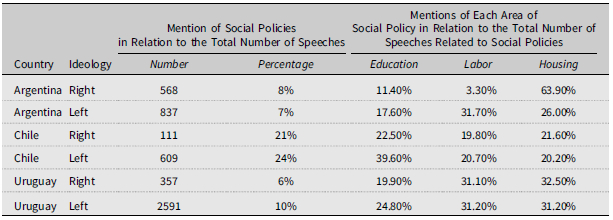
In all cases, I initially included all available communications published on the official websites of each country, whether delivered by presidents or ministers. I then manually selected those related to social policies—both short-term programs, such as cash transfers, and long-term initiatives, which are the main focus of this study. This process resulted in a sample of 5,073 communications related to social policies (Argentina: n = 1,405; Chile: n = 720; Uruguay: n = 2,948). As shown in Table 1, social policies account for approximately 22% of all speeches in Chile, 8% in Uruguay, and 7% in Argentina. The proportion of speeches and communications related to social policies is slightly higher among left-leaning governments in Chile and Uruguay, while in Argentina, the share is relatively similar across ideological orientations, though marginally higher for right-leaning administrations.
Classification of Social Policies by Governmental Administration

Next, to classify the types of social policies that left- and right-leaning governments emphasize in their speeches, I employ Keyword-Assisted Topic Models (keyATM) (Eshima et al. Reference Eshima, Imai and Sasaki2024). This method is applied to presidential speeches and press conferences (including those delivered by presidents and ministers) related to social policies, all of which are available on each country’s official website. Given that these countries are also known for implementing conditional cash transfers, I include these programs in the dataset as part of the broader universe of social programs discussed by governments—that is, they are counted among the total number of observations. However, these programs are not the main focus of this study and are excluded from the framing analysis, as conditionalities are not always strictly enforced and existing institutional infrastructures often cause these policies to function more as short-term benefits than as long-term investments (Huber et al., Reference Huber, Dunn and Stephens2022).Footnote 3
keyATM is a semi-supervised topic modeling approach that allows researchers to label topics using predefined keywords before fitting the model. Unlike fully unsupervised topic modeling strategies widely used in text analysis, which excel at discovering latent themes within text, keyATM enables researchers to specify the number of unlabeled topics (i.e., topics without predefined keywords), allowing the model to capture additional themes that emerge from the data (Roberts, Reference Roberts2014). This approach allows me to incorporate contextual knowledge by specifying words related to each issue area, which the model then uses to guide topic identification. Based on qualitative insights and an unsupervised keyword list estimated from 30% of the sample, I define three social policy domains using a small set of specific keywords for each topic. All analyses are conducted in Spanish (see Supplementary Material Section D for the list of keywords used in each country and policy domain).
Thus, the model is well-suited to measure the prevalence of the three identified policy areas, as it estimates the proportion of text devoted to each defined (and undefined) topic. In essence, the model generates a variable that captures how closely each speech aligns with each policy domain. Table 1 presents the classification of social policies emphasized by governments of different ideological orientations in each country. In Argentina, right-leaning governments focus more on housing policies, whereas left-leaning ones emphasize labor policies—an area that is not even salient for the right. In Chile, the left prioritizes education policies over other domains. Finally, in Uruguay, both right- and left-leaning governments place similar emphasis on labor and housing policies relative to other areas.
Although mentions may not necessarily imply a policy commitment to improving these areas and may even include criticisms of such policies, a qualitative analysis of the speeches suggests that the governments did not frame these policies in a negative light. When there is a critical element in their discourse, it is typically directed at actions taken by the opposition during the previous term, especially in the cases of Argentina and Chile. For example, in Argentina Mauricio Macri expressed the following while announcing a new housing program:
Unfortunately, in Argentina, there is a need for a little more than a million homes, and significant repairs are needed for more than two million homes (…) The worst part is that things have gotten worse over the last 15 years. We arrived with the team and found many homes—like these ones—either at the beginning, halfway through, or with a lot of work halted all over the country (…) So today we are very pleased to have launched a Housing Plan.Footnote 4
To further clarify these policies, I provide some concrete examples that were discussed in each country. In Uruguay, for instance, educational communications highlight programs like Plan Ceibal (Plan Ceibal), which provides laptops to students, and English Without Limits (Inglés sin Límites), a platform for acquiring a good level of English during formal education, both in urban and rural areas. Labor announcements often focus on initiatives such as the Labor Opportunity Program (Programa Oportunidad Laboral), aimed at creating jobs for young people. In the housing sector, announcements emphasize programs like New Home Purchase Program (Compra Vivienda Nueva), which offers support to purchase new homes, and the Housing Subsidy Program (Programa de Subsidios Habitacionales). In Argentina, governments publicize Progresar Scholarships (Becas Progresar) and Connect Equality Plan (Plan Conectar Igualdad), which provided laptops and digital resources to students and teachers to promote educational inclusion and reduce the digital divide. Labor communications refer to policies like the First Employment Law (Proyecto de Ley de Primer Empleo) or More and Better Work Plan (Plan Ma´s y Mejor Trabajo), which encourage youth employment and skills development. Housing announcements often focus on ProCrear (Plan ProCrear), a program providing loans and subsidies for housing. In Chile, educational messaging highlights I Connect to Learn (Me Conecto para Aprender) and the Higher Education Tuition-Free Law (Ley de Gratuidad), labor announcements include the Modernization of Labor Relations (Modernizacio´n del Sistema de Relaciones Laborales) or Employment Protection Law (Ley de Proteccio´n del Empleo), and housing communications emphasize programs related to investments in social housing.
To empirically assess the extent to which governments of different ideological orientations emphasized each policy area, I estimate three ordinary least squares (OLS) models—one for each social policy category—using each speech as the unit of analysis. The key independent variable is the government’s ideology score, and the dependent variable is the keyATM-derived measure capturing how closely each communication aligns with each policy area. The models control for GDP per capita, poverty rate, election year, and the years affected by the COVID-19 pandemic. Additionally, I include country fixed effects.
The regression analysis results are illustrated in Figure 1 (see Tables D2–D4 in Supplementary Material for more details). Ideology plays a significant role in explaining the proportion of speeches related to investment policies. Left-leaning governments are more inclined to include education policies in their speeches, with an association of 0.15 in Chile, 0.07 in Uruguay, and 0.04 in Argentina. The association between left-leaning governments and labor policies is positive in Chile (0.05) and in Argentina (0.21) while negative in Urugua, right-leaning governments being more associated to these policies (0.13). Finally, while right-leaning governments are more inclined to discuss housing policies in Argentina (0.32), these policies are more closely to the left in Uruguay (0.11) with no statistically significant difference in Chile.
Ideological Differences in Social Policies Across Countries.

Among the covariates, the proportion of speeches addressing educational policies increases – with the exception of Chile- during the years affected by the COVID pandemic (2020 and 2021). This is because governments were forced to implement educational measures due to the closure of schools during the most critical moments of the pandemic, and later to implement measures for a safe return to the classroom. In contrast, labor and housing policies were mentioned less frequently during these years (except in Argentina regarding housing). GDP, poverty rates, and electoral years are not significant variables in explaining the presence of these topics in official communications.
To sum up, left- and right-leaning governments differ in the emphasis they place on SIPs in their speeches and communications. Overall, the two ideological positions vary in their attention to education policies across all three countries, labor policies—particularly in Argentina and Chile—and housing policies in Argentina and Uruguay. Nevertheless, all governments address long-term-oriented policies in their communications. In the next section, I examine the framing strategies used by governments of different ideological orientations when discussing topics related to these policies.
How Do Governments Frame Social Policies?
Measurement
To assess whether governments from different ideological positions adopt different frames while discussing topics related to SIPs, I use the ‘à la Carte on Text’ (conText) embedding regression model (ALC embedding) (Khodak et al. Reference Khodak, Saunshi, Liang, Ma, Stewart and Arora2018; Rodriguez et al. Reference Rodríguez, Spirling and Stewart2023). This model is helpful for shedding light on whether the way governments communicate social policies differs based on their ideology and whether the framing they adopt is closer to inclusion or productivity (H1 and H2). It allows us to make statements about how the meaning of a set of terms (Y—in this case, each policy area) changes as covariates (X—in this case, ideology) vary. For this purpose, ALC embedding uses regression to test hypotheses about whether the groups differ systematically. In doing so, I test whether right-leaning governments choose a frame closer to productivity, while left-leaning governments lean closer to inclusion when discussing topics related to education, housing, and labor. In the conText framework, word embeddings capture the semantic meaning of words associated with inclusion and productivity in a specific context, rather than a single global meaning (Table 2 presents the words considered for the embedding of each framework). These embeddings are derived from patterns of co-occurrence in the text, allowing me to measure how these words are used differently depending on ideology.
Words Considered for the Embedding Regression Analysis

To compare how ideology shapes the understanding of SIPs along the “inclusion” vs. “productivity” dimension, I calculate the cosine similarity between the right and the left for a set of words representing each framework. A score close to 1 indicates that two words or sets of words are used in very similar contexts; a score near 0 indicates little contextual similarity; and a score near −1 suggests very different or opposing usage. By examining cosine similarity between embeddings for right- and left-leaning governments, I can assess how the framing of social policies shifts along the inclusion–productivity dimension and test whether ideological differences in communication are systematic.
Results
The evidence above indicates that governments across the ideological spectrum implement and discuss investment policies in education, labor, and housing, albeit with varying emphasis. The ALC embedding analysis reveals whether the framing used to describe topics related to these policies differs, and to what extent it aligns with productivity or inclusion. Overall, left-leaning governments adopt a social-inclusion framework, situating these policies in a context associated with equality, poverty, and inclusion, whereas right-leaning governments employ a productivity-oriented framing, emphasizing innovation, growth, development, and efficiency.
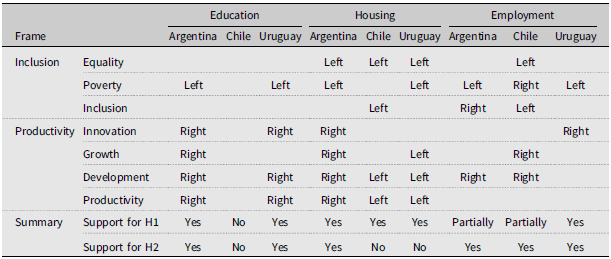
Figure 2 reveals several interesting patterns regarding the framing adopted by governments with different ideological alignments when discussing topics related to education, labor, and housing policies. Among left-leaning governments, education policies are consistently framed with an inclusion-oriented vocabulary in Argentina and Uruguay, emphasizing terms associated with poverty. However, this is not the case in Chile, where no statistically significant differences are observed in the framing employed by different administrations with respect to productivity and inclusion. Housing policies follow a similar trend, with left-leaning governments in Chile, Argentina, and Uruguay discussing these policies within an inclusion-oriented context. For employment policies, the pattern is somewhat less consistent: while an inclusion framing is more prevalent among left-leaning governments in Uruguay, in Argentina and Chile, right-leaning governments also discuss employment in the context of inclusion and poverty, respectively.
Results: Distance in Framing Used by Left- and Right-Leaning Governments in Their Speeches (ConText).

In a similar vein, among right-leaning governments, communications related to education are framed in terms of productivity in Argentina and Uruguay, but not in Chile. When right-leaning governments in these two countries discuss education, they do so in a context where innovation, growth, development, and productivity are salient. Regarding housing policies, only in Argentina are these policies systematically discussed by the right within a productivity-oriented framing, whereas in Chile and Uruguay, this framing is employed more prominently by the left. Finally, for labor policies, the productivity framing is more strongly associated with the right than with the left across all three countries: in Argentina, labor issues are discussed within a context of development; in Chile, within growth and development; and in Uruguay, within innovation. These results indicate that while ideological alignment is broadly associated with distinct framings, there are notable country- and policy-specific deviations (see more details in Supplementary Material Section E).
Table 3 summarizes these results. As expected by H1, left-leaning politicians are more likely to emphasize the social-inclusion aspects of SIPs than right-leaning politicians when discussing and announcing policies on education in Argentina and Uruguay, housing across all three countries, and labor in Uruguay (and partially in Argentina and Chile). Moreover, as predicted by H2, right-leaning politicians are more likely to emphasize the productivity aspects of SIPs than left-leaning politicians when discussing and announcing education policies in Argentina and Uruguay, housing in Argentina, and labor policies across all three countries under analysis.
Summary of Embedding Regression Analysis

Note: Labels indicate whether the left-leaning (Left) or right-leaning (Right) government has a higher cosine similarity for each target word and whether this difference is statistically significant. Cells left blank indicate that the difference is not statistically significant, corresponding to partial or no support for H1 and H2.
With respect to the role of ideological polarization, the evidence only partially conforms to the original expectations. In Argentina—the most polarized society among the three—the left and the right systematically rely on inclusion and productivity framings, respectively. By contrast, this pattern is less consistent in Chile and Uruguay. In Chile, it emerges only partially in labor policies, whereas in Uruguay it applies to education—a highly polarized topic in this country—and to labor policies.Footnote 5
As a result, while Argentina exhibits the strongest and most consistent alignment between ideology and framing, Chile does not perform as an intermediate case between Argentina and Uruguay, as initially anticipated. Instead, ideological patterns are weaker and more fragmented in Chile than in Uruguay, despite Chile’s increasing levels of mass polarization. One plausible explanation is that Chile’s recent transition from low to higher polarization has produced a fluid and unsettled party landscape, in which ideological cues are less consolidated in governmental discourse. Taken together, these findings refine the scope conditions of the argument by suggesting that polarization must be not only present but also institutionally consolidated to systematically shape how governments frame social investment policies.
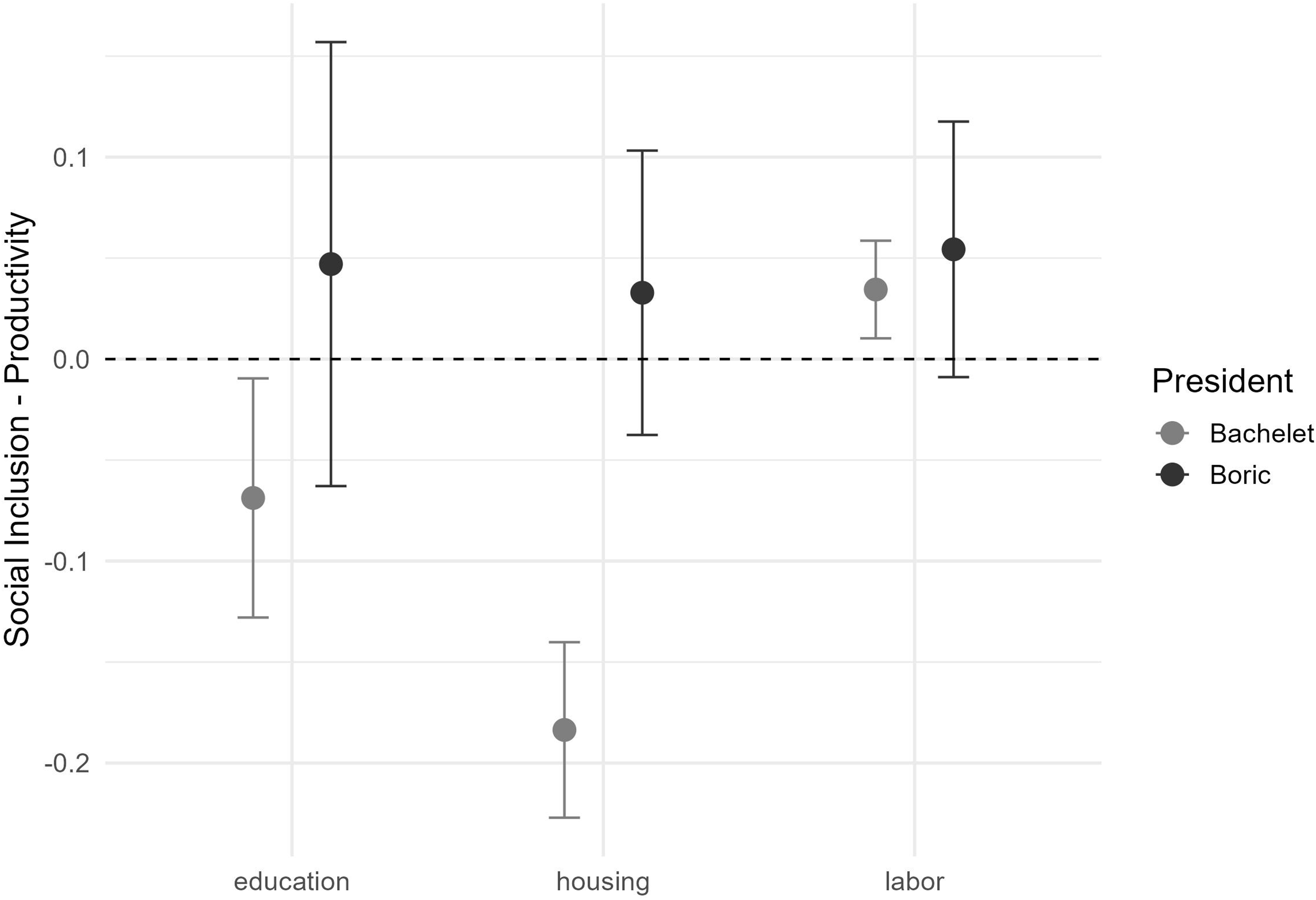
To further examine whether the ideological distance between governments of similar political orientations varies with changes in the level of polarization, I compare the cases of Bachelet and Boric. Considering that ideological polarization at the mass level has increased in Chile since 2019, I expect the latter to employ a framing more strongly centered on social inclusion than Bachelet. As figure shows, the comparison of Boric’s and Bachelet’s speeches reveals that Boric relies more often on a social-inclusion framing than on a productivity framing when addressing these policies—though the difference is not statistically significant. Bachelet, by contrast, exhibits a less sharply defined ideo- logical profile in her discourse, combining social-inclusion appeals with a comparatively stronger reliance on productivity-oriented framings, particularly in education and housing. This pattern helps explain why Bachelet’s discourse does not fully align with the article’s ideological expectations.
One plausible explanation for this difference lies in the interaction between increasing ideological polarization and shifts in the ideological positioning of left governments. Boric represents a more left-leaning political project than Bachelet, which may itself reflect broader changes in a more polarized society. Moreover, Boric’s administration emerged in the context of heightened social mobilization and ideological contestation, allowing for a greater—albeit still incomplete—shift toward social-inclusion framing.
This comparison suggests that while both administrations adopted a social-inclusion framework, Bachelet relied more heavily on productivity-oriented framings than Boric, resulting in a less sharply defined ideological profile in her discourse.Footnote 6 As polarization intensified, Boric’s administration appears to have adopted a more clearly left-leaning communicative strategy, relying more strongly on social-inclusion framings to differentiate itself from previous center-left governments. Taken together, these findings provide evidence that, in contexts of increasing polarization, the argument proposed in this article becomes more salient—namely, that parties reinforce their identities through communication by employing framings that align more closely with their ideology and by further distancing themselves from opposing positions (Figure 3).
Difference in Framing by President with 90% CI.
Note: Positive values indicate that social inclusion dominates productivity. Error bars represent 90% confidence intervals.

Closer Analysis: Policy Framing Across Areas
To complement these findings with qualitative evidence from government speeches, I select government communications related to policies that remain similar in design across administrations with different ideological orientations. This approach allows me to show that policies with very similar designs are communicated differently by left- and right-leaning governments. To do so, I focus on areas and countries in which statistically significant differences were identified in the quantitative analysis regarding the framing used by left- and right-leaning governments—that is, cases providing support for H1 and H2. Accordingly, I focus on Uruguay for education, Argentina for housing, and Chile for labor.
Education: The Case of Plan Ceibal in Uruguay
In the case of Uruguay, Plan Ceibal is one of the most salient long-term social investments in the education sector. It was launched in 2007 under the administration of President Tabaré Va´zquez to broaden educational opportunities for students across the country by providing each child with a laptop and internet access, alongside teacher training and digital resources. The program aims to reduce the digital divide, enhance learning outcomes, and foster skills relevant for the modern labor market. Initially, it targeted students in public primary schools, eventually expanding to secondary education, special education, and adult education programs. Eligible participants gained not only access to technology but also support for integrating these tools into classroom learning, creating opportunities for lifelong learning and digital inclusion. On October 18, 2013, the official communications site of the Presidency of Uruguay published an excerpt from a report issued in the context of the ExpoAprende fair organized by Plan Ceibal. The piece highlights phrases such as: “the challenge is to unify technology and pedagogy to achieve greater inclusion,” “this plan emerged as a project of inclusion and equity, and now the greatest challenge is the integration of pedagogy and technology to generate greater inclusion,” and “so that children with fewer resources and from more disadvantaged contexts can have access (…) In 2013, 83% of individuals in the richest quintile of the population had computers, while 73% of those in the poorest quintile also had computers. In 2006, this difference was elevenfold between one quintile and another.”Footnote 7 Thus, the relevance of inclusion is salient in these communications.
In the case of the center-right administration, while also referring to inclusion and poverty, they highlight the benefits of educational investment for the development of the country. For instance, on May 31, 2022, an article from the official website states that “work is being done in education to raise awareness that Uruguay is a productive country (…)”.Footnote 8 Similarly, on July 7, 2023, in the context of the presentation of accessible material for first-grade students, officials from the Ministry of Education emphasized that “there is a process of strengthening education as a tool for the country’s development, in which the role of the teacher is central in ensuring that the material is used by all children. …”Footnote 9
Housing: The Case of ProCrear in Argentina
The ProCrear program was launched in 2012 during the presidency of Cristina Ferna´ndez de Kirchner as an initiative to facilitate access to homeownership through subsidized mortgage loans, primarily targeting low- and middle-income households. In its early years, the program promoted both the construction and acquisition of homes, with a strong focus on social inclusion and the reduction of housing inequalities. Under the presidency of Mauricio Macri, ProCrear was reoriented toward credit lines more focused on private investment and land acquisition, with reduced direct subsidies and an emphasis on middle- and moderate-income households; although some programs for home refurbishment and improvement were maintained, the program’s overall reach was more limited than in its initial phase.
In her speech announcing the creation of the Bicentennial Argentine Housing Credit Program (PRO.CRE.AR Bicentenario), President Cristina Ferna´ndez emphasized the government’s commitment to social inclusion, equality, and addressing poverty. She highlighted that the program “fundamentally … aims to double the State’s commitment to a model of growth and social inclusion” and stressed that the initiative prioritizes families and first-time homeowners, ensuring access based on need rather than privilege. As she stated, “We are focused on a macroeconomic policy on one hand, but on a policy of social inclusion on the other,” underscoring the dual approach of combining economic development with efforts to reduce inequalities. The president also noted that “just as work is the great social organizer, the home is the great family organizer,” and emphasized that “there is no freedom without equality, and there is no equality without freedom.” By linking housing policies to broader social goals, Ferna´ndez framed the program as a tool for enhancing equality, expanding opportunities, and alleviating poverty.Footnote 10
In his address announcing measures to reinforce the National Housing Plan (October 12, 2018), President Mauricio Macri emphasized the link between housing policies, economic growth, and social development. He highlighted that “these advances also aim to boost the construction sector, which is one of Argentina’s main engines, providing employment to many people,” illustrating the program’s role in promoting productivity and job creation. Macri further noted that the policy measures were the result of collaborative “productivity tables” across sectors, demonstrating a focus on innovation and coordinated problem-solving. He also stressed the long-term impact of these initiatives: “this is how the future is built, with thousands of lives transformed one by one, with families accessing new opportunities that allow them to grow,” while ensuring sustainability in social housing projects. By linking housing investment to both social inclusion and broader economic development, the speech reflects a strategic vision where growth, productivity, and innovation reinforce each other.Footnote 11
Labor in Chile
In Chile, there is no single labor program that has persisted across successive governments. Therefore, to illustrate the framing used by different administrations when referring to labor policies, it is instructive to analyze speeches delivered on Labor Day. Under the center-right government of Sebastia´n Pin˜era, the discourse emphasized economic growth and productivity as the primary drivers of employment. For example, in 2018, Pin˜era stated: “It is important to create jobs, and to create jobs the economy must grow. When the economy stagnates, jobs are not created; when investment falls, when productivity falls, when the economy does not grow, what happens? Jobs are not created, or only very precarious jobs are created, under unfavorable conditions, without contracts, with low wages, and without security.”Footnote 12 This framing highlights the centrality of economic performance and productivity in ensuring employment, with workers’ well-being framed largely as a consequence of a growing economy. By contrast, the center-left government of Gabriel Boric frames labor policies more in terms of inclusion and social cohesion. In 2022, Boric stated: “As a government, we will continue working so that all workers in Chile can enjoy a dignified life and so that, as a society, we are much more cohesive and can live better.”Footnote 13 Here, the emphasis is less on economic productivity and more on ensuring that all workers, regardless of their circumstances, have the opportunity to live with dignity.
Discussion and Final Remarks
This article focuses on education, housing, and labor policies implemented by governments with different ideological positions in various Latin American countries. The evidence presented here shows that while both left- and right-leaning governments implement long-term policies, left-leaning governments place a greater emphasis on education policies in the three countries under analysis, labor in Argentina and Chile and housing in Uruguay.
Moreover, the study’s findings provide insights into how governments communicate SIPs in relatively developed welfare states with varying levels of ideological polarization at the mass level. The evidence suggests that societal polarization is a key factor shaping this dynamic: in more ideologically divided societies, such as Argentina, left- and right-leaning governments tend to adhere more closely to social inclusion or productivity framings, respectively. In particular, the evidence presented in this article shows that governments from different ideological positions adopt different framings when discussing topics related to education in Argentina and Uruguay, housing in Argentina, and labor in all three countries. Left-leaning governments emphasize social inclusion, highlighting the importance of integrating disadvantaged populations into society, whereas right-leaning governments focus on externalities related to economic productivity for the broader population.
Overall, this study underscores the critical role of political discourse in governments’ efforts to build public support for their policies. Nevertheless, there are at least two limitations that open multiple avenues for future research. First, this article provides evidence that polarization affects the way governments communicate not only when overall ideological polarization within society is high, but also when polarization is high in a specific policy area. Since there is currently no policy-area-specific polarization, it would be valuable to develop such a measure and complement it with qualitative evidence from government communications to assess whether their strategies align with this argument.
Second, this study focuses on the region’s most developed welfare states, so caution is warranted when extrapolating these findings to countries with weaker institutions, more clientelistic rather than programmatic political parties, lower fiscal capacity, or distinct social policy trajectories. In this same vein, this study focuses on specific policy areas, and further research is needed to assess how generalizable these findings are to other domains. While the cases analyzed here illustrate key dynamics of policy framing that may be informative for broader comparative analysis, it is important to remember that SIPs are particularly well-suited for testing this argument, as their design allows governments to frame them in multiple ways. The patterns identified in this study provide a framework for understanding how governments cultivate public support for policies with long-term impacts and suggest promising avenues for exploring similar framing strategies in other policy domains where future-oriented benefits are central, such as health, infrastructure, and security. Extending this research to these areas and to different contexts is therefore warranted.
This study highlights how governments strategically frame their communications regarding SIPs. In doing so, it advances our understanding of how Latin American political actors respond to their countries’ political landscapes, aligning their strategies with broader ideological orientations, whether conservative or liberal (Saiegh, Reference Saiegh2009; Power and Zucco Reference Power and Zucco2009; Wiesehomeier and Doyle Reference Wiesehomeier and Doyle2012). At the same time, it shows how the way they communicate reinforces, in certain ways, their linkages to their constituencies, especially in more polarized contexts. Future research should investigate whether citizens are sensitive to these differing framings and how such communication shapes public support for distributive policies, ultimately influencing policy preferences and the trajectory of social policy in the region.
Supplementary material
To view supplementary material for this article, please visit https://doi.org/10.1017/lap.2026.10048
Data availability statement
Data files can be accessed at https://dataverse.harvard.edu/dataset.xhtml?persistentId=doi:10.7910/DVN/IBHMKO.
Acknowledgements
I thank Evelyne Huber, Jonathan Hartlyn, Caitlin Andrews-Lee, Lucy Martin, Sara Niedzwiecki, Matías Tarillo, and Rafael Piñeiro for helpful comments on earlier drafts. I am also grateful to Bryce Hecht, Cecilia Martínez-Gallardo, Santiago Olivella, Cecilia Rossel, and participants at the 2025 Latin American Studies Association (LASA) Congress for their feedback and suggestions.
Declaration of Competing Interests
The author declared no potential conflicts of interest with respect to the research, authorship, and/or publication of this article.
Consent to Participate
There are no human participants in this article and informed consent is not required.
Funding statement
The author received no financial support in the preparation of this manuscript.





 Open access

