




Introduction
There are certain milestones in language acquisition that all children with typical development reach at certain ages with only small variation between individuals – for example, canonical babbling or production of the first word. In contrast to such milestones, children can vary a great deal from one another in their developmental trajectories for phonology, the lexicon and morphosyntax. Such variance is referred to as individual differences. Importantly, individual differences in development are not random; on the contrary, and as we will explore in this article, there are multiple factors inherent to a child and in a child’s surrounding environment that can account for why one child would acquire language faster, and with different outcomes, than another child. Individual difference (ID) factors in oral language development have been explored for a long time in the field of child language acquisition, with the research highly concentrated on input and interaction in the preschool years for monolinguals (Fernald & Weisleder, Reference Fernald, Weisleder, Neuman and Dickinson2011; Rowe & Snow, Reference Rowe and Snow2020)
Bilingual children are a more heterogenous group than their monolingual counterparts with respect to the sources of variation in their language learning environment and in some of the internal capacities they bring to the task of dual language learning. Bilingual children are learning two languages and so their linguistic input space is divided and can change daily or weekly with respect to the quantity and quality of input and interaction in each language. Bilingual children can experience staggered age of acquisition onset: some children are simultaneous bilinguals who are exposed to both their languages from birth or during the toddler years while others are sequential bilinguals who learn a second language (L2) after their first language (L1) has been established, and thus they are learning their L2 with greater cognitive and linguistic maturity than younger monolingual learners. Bilinguals’ languages can have different sociolinguistic status – for example, an Arabic–English bilingual child in Canada speaks one language that is the majority language (ML) of the community and the official language of schools and other government institutions, while their other language is a minority language with fewer speakers and less prestige. Furthermore, the association between certain ID factors and language development that has been well-established for monolingual children could work differently in a bilingual context. For example, family socio-economic status (SES) has been shown to have an impact on the quality and quantity of input to children, which, in turn, impacts language development in monolinguals (Rowe, Reference Rowe2018; Rowe & Snow, Reference Rowe and Snow2020). However, in a bilingual environment, does input to children in L1, L2 or both show the same associations with SES? Does it matter which language the parents are using, and their proficiency level in each of them, when assessing the impact of SES on language development? We return to these questions below, but such questions illustrate the greater complexities surrounding some ID factors for bilingual children.
Bilingual children not only have many more potential sources of individual differences in development, but also they display wide individual variation in their language abilities. In Paradis (Reference Paradis2011), 5- to 7-year-old bilingual children acquiring English as their L2 with diverse L1 backgrounds were given a receptive vocabulary test that has a standard mean of 100 and a 1 standard deviation range of 85-115. The bilingual children’s mean standard score was 88, but their scores ranged from 40-125. So, some bilingual children’s vocabulary abilities were similar or above average when benchmarked to their monolingual peers, while others were more than 2 standard deviations below the normal range for monolinguals. Soto-Corominas, Paradis, Rusk, Marinova-Todd, and Zhang (Reference Soto-Corominas, Paradis, Rusk, Marinova-Todd and Zhang2020a) found much wider within-group variation in performance on English language tasks for bilingual versus monolingual middle school students, even for bilinguals who had received all of their education in the L2 (more than 7 years). As early as the toddler years, simultaneous bilinguals show more within-group variation in lexical and grammatical development than their monolingual peers on the same language measures (Hoff, Core, Place, Rumiche, Señor & Parra, Reference Hoff, Core, Place, Rumiche, Señor and Parra2012). Therefore, heterogeneity in both ID factors and language abilities argue for the importance of an ID approach to research on bilingual development (defined below).
Much of the recent research on ID factors in bilingual development has been conducted with heritage language (HL) children, who are either simultaneous or sequential bilinguals and speak a majority language (ML) and a minority HL (Montrul, Reference Montrul2016; Paradis, Genesee & Crago, Reference Paradis, Genesee and Crago2021a). The HL is children’s L1/2L1 and the ML is their L2/2L1. Because the L2 is the dominant language of the community, heritage bilinguals are not foreign-L2 learners, but instead community-L2 learners. What constitutes a HL and a HL speaker is debated (Kupisch & Rothman, Reference Kupisch and Rothman2018; Montrul, Reference Montrul2016). A narrow definition of a HL specifies that it is a minority language for which there is a recent migration background for speakers, e.g., first-, second- or third-generation immigrants. In contrast, a broad definition of HL includes other kinds of minority languages, such as those in regional bilingual contexts like Catalunya in Spain or Wales in the UK. The narrow definition of HL was adopted when determining the scope of research discussed in this article. Henceforth, for the sake of simplification, the terms ML and L2 are used interchangeably, as will be HL and L1. Specific terminology is used when a distinction between simultaneous and sequential bilinguals is relevant.
Heritage bilingual children often show differential acquisition patterns and outcomes in the HL compared to their counterparts acquiring this language in the home country; whereas their abilities in their L2 tend to converge, or nearly converge, with those of their monolingual peers in the host country after several years of schooling the L2 (Montrul, Reference Montrul2016; Kupisch & Rothman, Reference Kupisch and Rothman2018; Paradis et al., Reference Paradis, Genesee and Crago2021a; Soto-Corominas et al., Reference Soto-Corominas, Paradis, Rusk, Marinova-Todd and Zhang2020a). Behind these broad characterizations of L1 and L2 development in heritage bilinguals lies much individual variation that can be explained by multiple ID factors. In other words, some individual child heritage bilinguals grow up to be highly competent speakers of the HL, and some individual child heritage bilinguals lag behind their monolingual peers in the L2 as adolescents; ID approaches to bilingual development can offer insights into why such variable outcomes occur.
Research on ID factors in child heritage bilinguals that is focused on oral language development – rather than academic language and literacy skills – has been growing sharply since about 2011 (see the 2011 Linguistic Approaches to Bilingualism volume 1, issue 3 on this topic). This recent research on ID factors has had a greater focus on child L2 acquisition, but there has been a recent uptick in focus on ID factors in HL acquisition, and many studies include an examination of both languages. Studies discussed in this article are mainly drawn from the body of research since 2011 and are intended to be a representative sample and not an exhaustive one due to space limitations. The organization of this article is as follows. In the first section, specifics of what an ID approach to bilingual development consists of and its theoretical and applied relevance are discussed. In the next two sections, research on child-internal and child-external ID factors in bilingual development are reviewed. In the fourth section, emergent research on ID factors in bilinguals with developmental language disorder (DLD) is reviewed. General conclusions and implications are given in the final section.
Individual difference approaches to bilingual development
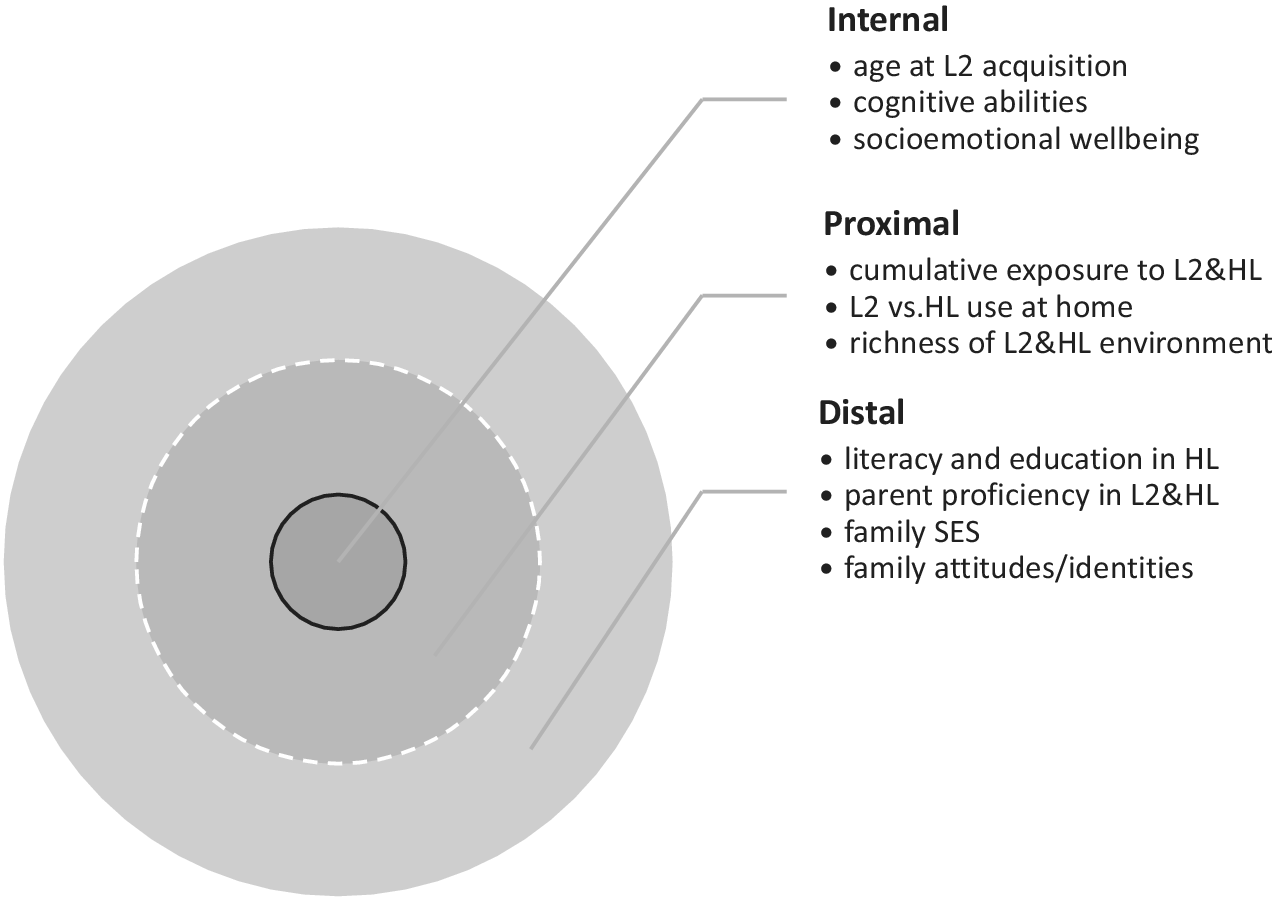
What is an ID approach to bilingual development? It consists of examining sources of individual differences in performance on linguistic and psycholinguistic measures among bilingual participants, in addition to, or instead of, examining group averages. Factors that account for individual variation in bilingual development can be roughly categorized as internal or external to the child. Variation in these internal and external factors can be associated with individual variation in children’s language development. Child-internal factors are those like age at onset of L2 acquisition (AOA) or cognitive abilities that are relevant for language learning, such as verbal short-term memory. Child-external factors include environmental factors that encompass the quantity and quality of linguistic input in each language. External factors can further be sub-categorized as proximal and distal; the former refers to more direct input, output and interaction factors while the latter refers to broader environmental characteristics that can shape proximal factors – for example, SES background. The diagram in Figure 1 lists the ID factors that have been examined in recent research on bilingual development as organized according to the internal-proximal-distal categories.
Diagram illustrating the relationships among individual difference factors in bilingual development, with the child at the centre. Dashed lines indicate that the boundaries between proximal and distal factors are not absolute and that relationships between them are expected. This model of individual difference factors and bilingual development overlaps conceptually with Bronfenbrenner’s ecological model of child development (Bronfenbrenner, Reference Bronfenbrenner1977).
Theoretical contribution of ID approaches to bilingual development
In the context of one study, researchers might examine how ID factors such as verbal memory and input quantity modulate performance on a language task. Weaker verbal memory skills might decrease performance while greater exposure to input in the target language could increase performance. Such results tell us not only about specific participants’ performance on one task, but they can also indicate something about the determinants of language development, i.e., what factors contribute to developmental rates and outcomes. For example, bilingual children with first-generation immigrant parents might be exposed to more non-native L2 speech than others, and in that L2 speech, some grammatical rules might be applied intermittently. Such differential input quality could, in turn, result in differential access to input needed to acquire target-like structures in the L2 – hence, differential acquisition timetables and outcomes. In another example, if bilingual children are experiencing socioemotional difficulties, this could disrupt cognitive mechanisms like memory and attention systems that are implicated in learning. Such socioemotional difficulties could thus result in decreased uptake of linguistic input, and in turn, slow down the acquisition process compared to bilingual children who are not experiencing these difficulties. Therefore, ID factors, from input experiences to cognition, modulate access to – and uptake of – phonological, lexical and grammatical properties of the target language. Viewed this way, ID factors index resources and/or mechanisms for language learning, and thus are theoretically important in bilingual acquisition research. However, this is not to say that ID factors are the only indices of the resources and mechanisms for language learning. Cognitive abilities and quantity and quality of input could interface with domain-specific, innate linguistic knowledge in the acquisition process. In this sense, ID approaches are relevant to research with or without nativist assumptions about language acquisition (cf. Kupisch & Rothman, Reference Kupisch and Rothman2018; Rankin & Unsworth, Reference Rankin and Unsworth2016). That being said, ID approaches are more integral to non-nativist, constructivist theories of language acquisition (e.g., Behrens, Reference Behrens2021).
Some associations between ID factors and language abilities are inherently unidirectional, suggesting causality. For example, it is plausible that family SES could influence a child’s L2 abilities, but it is not plausible – or logical – that a child’s L2 abilities would influence family SES. Thus a statistically significant relationship between family SES and children’s performance on a language task could confidently be interpreted as meaning higher or lower SES predicts higher or lower performance on the task, respectively. However, some ID factors might have bi- or multi-directional relations with language abilities. For example, an association between HL use among siblings and HL proficiency might mean use determines proficiency, or it could equally mean proficiency determines use. Therefore, researchers taking ID approaches need to be cautious in interpreting directionality/causality in concurrent associations between ID factors and language abilities.
In sum, examining individual differences goes beyond merely accounting for variation in participant performance in a specific study, or controlling for nuisance variables statistically. Instead, ID approaches can reveal the factors that contribute to/are associated with acquisition rates and outcomes in bilingual children more generally.
Applied contribution of individual differences approaches to language development
Understanding the extent of individual variation in language abilities among bilingual children is important for clinicians and educators who need to evaluate their levels of language development, plan programming to support that development, and offer guidance to parents. It is especially important for clinicians and educators to understand the sources of variation that are malleable, meaning that they can be influenced or changed through intervention.
Over-identification of language and learning disabilities in bilingual children is an acknowledged risk factor in assessment (Paradis et al., Reference Paradis, Genesee and Crago2021a). While uncritical use of monolingual norm-referencing with bilingual children is a key contributor to this problem, lack of understanding about how heterogenous young bilingual children’s language abilities can be also a contributor to the problem. Research on bilingual development using an ID approach can yield information on the range of bilingual performance on a language test, as well as factors that are associated with stronger or weaker performance, e.g., amount of input in the L2. In so doing, such research results can have practical value. Beyond diagnostic concerns, research documenting the extent of variation and the factors that explain it can assist clinicians and educators in setting appropriate expectations for bilingual children’s progress in the L2 (and HL). Furthermore, if educators know that a rich home language environment can boost L2 language and literacy, they might proactively bolster language and literacy activities in the classroom for those bilingual children with relatively impoverished home language environments. Parallel findings on ID factors in children’s HL development could equally be of value to educators in formal dual language programs (HL and L2), or at informal, weekend HL schools. Finally, recommendations for parents about how best to support their children’s bilingual development can emerge directly from research taking an ID approach. If reading to a child in the HL at home is associated with strengthening both their HL and their L2, this could translate into a useful recommendation for parents who might have low proficiency in the L2, but nevertheless are keen to support their child’s literacy development in the language of schooling.
ID approaches that focus on malleable factors are more likely to have a larger impact on clinicians, educators and parents. For instance, if a study shows that children with superior verbal memory skills have larger vocabularies in the L2 than children with weaker verbal memory skills, communicating this finding to educators is unlikely to directly change their practice or advice to parents. By contrast, imagine a study showing that children whose parents speak primarily the HL at home perform similarly in the L2 as children whose parents speak a mix of the HL and L2 at home, and perform better than the mixed home language children in the HL. Communicating this finding to educators could encourage them to promote use of the minority HL at home among bilingual families, rather than advising them to use the majority L2 at home to “help” their children acquire the L2 faster.
In sum, the implications of ID approaches to bilingual development for applied concerns are multifold, and in my view, equally important as the theoretical implications. Needless to say, purposeful knowledge mobilization practices with clinicians, educators and parents are a necessary step to making research accessible and meaningful to members of the non-academic community.
Child-internal factors and bilingual development
Age at L2 acquisition
Age effects in L2 acquisition are most often associated with long-term effects, e.g., ultimate attainment in late bilinguals learning the L2 in adulthood (De Keyser, Reference De Keyser, Gass and Mackey2012). In contrast, age at L2 acquisition (AOA) as an ID factor in child L2 learners is typically associated with short-term effects; in other words, whether there are individual differences in children’s developmental rates due to variations in age of L2 onset when onset occurs before adolescence. Older AOA among child bilinguals typically results in faster initial gains in L2 vocabulary and morphosyntax than in their younger AOA counterparts, when amount of L2 exposure is controlled for (Golberg, Paradis & Crago, Reference Golberg, Paradis and Crago2008; G. Jia & Fuse, Reference Jia and Fuse2007; Chondrogianni & Marinis, Reference Chondrogianni and Marinis2011; Paradis, Reference Paradis2011; but see Roesch & Chondrogianni, Reference Roesch and Chondrogianni2016, for a younger AOA advantage). However, longitudinal studies indicate that the older AOA advantage among young L2 learners might not last (G. Jia & Fuse, Reference Jia and Fuse2007; Paradis, Soto-Corominas, Daskalaki, Al Janaideh, Chen & Gottardo, Reference Paradis, Soto-Corominas, Daskalaki, Chen and Gottardo2021b). For example, Paradis et al. (Reference Paradis, Soto-Corominas, Daskalaki, Chen and Gottardo2021b) found that Arabic L1–English L2 bilinguals with an older AOA had stronger L2 morphosyntax at 20 months of L2 exposure, but AOA no longer predicted morphosyntax abilities one year later. Regardless of how long the older AOA advantage persists, the underlying reason for it is not well understood. Most researchers hypothesize that it is due to the greater linguistic and cognitive maturity of older children when L2 learning begins, but additional research is needed to know if this explanation is on the right track.
The implications of AOA are different for a bilingual child’s HL, due to the differences in the sociolinguistic characteristics between the ML and the HL. In the case of heritage bilinguals, AOA indexes the length of time the child has been functionally monolingual. Heritage bilinguals with a younger AOA have had a shorter period of being monolingual, and this is associated with variable HL proficiency and long-term outcomes in adult heritage speakers (G. Jia, Reference Jia, He and Xiao2008; Montrul, Reference Montrul2016). Even in childhood, HL proficiency for vocabulary, morphology, syntax and narrative skills can be negatively associated with younger AOAs in mixed AOA samples (Albirini, Reference Albirini2018; Hammer, Komaroff, Rodriguez, Lopez, Scarpino & Goldstein, Reference Hammer, Komaroff, Rodriguez, Lopez, Scarpino and Goldstein2012; R. Jia & Paradis, Reference Jia and Paradis2015; Meir, Walters & Armon-Lotem, Reference Meir, Walters and Armon-Lotem2017; Paradis, Soto-Corominas, Chen & Gottardo, Reference Paradis, Soto-Corominas, Chen and Gottardo2020; Soto-Corominas, Daskalaki, Paradis, Winters-Difani & Al Janaideh, Reference Soto-Corominas, Daskalaki, Paradis, Winters-Difani and Al Janaideh2022). In Paradis et al. (Reference Paradis, Soto-Corominas, Chen and Gottardo2020) and Soto-Corominas et al. (Reference Soto-Corominas, Daskalaki, Paradis, Winters-Difani and Al Janaideh2022), the relationship between AOA and HL proficiency emerged when amount of L2 exposure was controlled for, indicating that age and input effects made independent contributions. The contrast between the roles of AOA for the L2 and HL in bilingual development is demonstrated in Paradis and colleagues’ longitudinal studies of Arabic–English bilinguals (Paradis et al., Reference Paradis, Soto-Corominas, Daskalaki, Chen and Gottardo2021b; Paradis, Soto-Corominas, Daskalaki, Al Janaideh, Chen & Gottardo, Reference Paradis, Soto-Corominas, Daskalaki, Al Janaideh, Chen and Gottardo2022a). In these studies, the effects of AOA within the same children are quite distinct for their L2 and HL morphosyntactic development. For the L2, as noted above, the older AOA advantage faded quickly; whereas, for the HL, the older AOA advantage was stable across 5 years post resettlement in Canada.
Cognitive abilities
Studies with adult L2 learners and older children and youth in immersion programs have consistently found language aptitude to be a robust predictor of language learning outcomes (Harley & Hart, Reference Harley and Hart1997; Skehan, Reference Skehan, Gass and Mackey2012). Language aptitude is a combination of cognitive abilities that vary among individuals and that are pertinent for language learning such as: verbal short-term memory, working memory and analytic reasoning (Paradis, Reference Paradis2011). In research with young children, cognitive abilities that comprise language aptitude are often measured through tasks like non-word repetition (verbal short-term memory), backwards digit span (working memory) or nonverbal IQ tests including pattern matching/detection in geometric sequences (analytic reasoning). Among bilingual preschoolers, nonverbal working memory and analytic reasoning are sources of variance in ML vocabulary and morphosyntax (Lauro, Core & Hoff, Reference Lauro, Core and Hoff2020; Unsworth, Brouwer, de Bree & Verhagen, Reference Unsworth, Brouwer, de Bree and Verhagen2019). In bilinguals aged 4 to 8 years old, verbal short-term memory and visual analytic reasoning were found to predict variation in L2 lexical, morphological, syntactic and narrative abilities (Paradis, Reference Paradis2011; Paradis, Rusk, Sorenson Duncan & Govindarajan, Reference Paradis, Rusk, Sorenson Duncan and Govindarajan2017a; Pham & Tipton, Reference Pham and Tipton2018; Sorenson Duncan & Paradis, Reference Sorenson Duncan and Paradis2020a; Sun, Yin, Amsah & O’Brien, Reference Sun, Yin, Amsah and O’Brien2018). Importantly, in these studies, the cognitive variables specified variance in children’s L2 proficiency separate from the variance specified by input factors. Furthermore, cognitive abilities continue to be a pertinent ID factor in the lexical and morphological outcomes of English L2 children and adolescents in senior elementary and middle school, even when they have had 6 years or more L2 exposure at school and in the community (Farnia & Geva, Reference Farnia and Geva2011; Paradis, Tulpar & Arppe, Reference Paradis, Tulpar and Arppe2016; Soto-Corominas et al., Reference Soto-Corominas, Paradis, Rusk, Marinova-Todd and Zhang2020a). Finally, studies with first-generation refugee children, many of whom arrived in the host country during the school years, have also found that verbal memory and analytic reasoning were significant ID factors in their L2 acquisition of vocabulary, inflectional morphology and morphosyntax (Hamann, Chilla, Abed Ibrahim & Fekete, Reference Hamann, Chilla, Abed Ibrahim and Fekete2020; Paradis et al., Reference Paradis, Soto-Corominas, Chen and Gottardo2020; Soto-Corominas et al., Reference Soto-Corominas, Daskalaki, Paradis, Winters-Difani and Al Janaideh2022; Paradis et al., Reference Paradis, Soto-Corominas, Daskalaki, Chen and Gottardo2021b).
Turning to studies on HL development, superior verbal short-term memory and non-verbal analytic reasoning abilities skills were found to be associated with larger vocabularies in the Vietnamese HL and Arabic HL of bilingual children and youth, beyond the influence of other ID factors (Paradis et al., Reference Paradis, Soto-Corominas, Chen and Gottardo2020; Pham & Tipton, Reference Pham and Tipton2018). Furthermore, Soto-Corominas et al. (Reference Soto-Corominas, Daskalaki, Paradis, Winters-Difani and Al Janaideh2022) and Paradis et al. (Reference Paradis, Soto-Corominas, Daskalaki, Chen and Gottardo2021b) found that both non-verbal analytic reasoning and verbal memory were consistent predictors of individual differences in Arabic HL morphosyntactic abilities across time. R. Jia and Paradis (Reference Jia and Paradis2020) found that individual differences in verbal memory accounted for differences in bilingual children’s syntactic abilities in their Mandarin HL.
In sum, cognitive factors have been associated with individual variation in performance on a variety of expressive and receptive language tasks, both experimental and naturalistic, in the L2 and HL. Compared to input factors, cognitive factors are rather understudied in ID research with child heritage bilinguals; however, existing research suggests that they merit more attention.
Socioemotional wellbeing
Socioemotional development is a broad construct comprising many dimensions such as: self-regulation, social competence, social cognition, and problem or prosocial behaviours (Halle, Whittaker, Zepeda, Rothenberg, Anderson, Daneri & Buysse, Reference Halle, Whittaker, Zepeda, Rothenberg, Anderson, Daneri and Buysse2014). Relations between problem or prosocial behaviours, social adjustment factors and language proficiency are those most commonly investigated in research with bilinguals, and socioemotional wellbeing is used as an umbrella term for them here. Prosocial behaviours indicate good socioemotional wellbeing and social adjustment; whereas, problematic behaviours (internalizing and externalizing) indicate difficulties with socioemotional wellbeing, and, in high density, could signal concern and referral for intervention (Goodman & Goodman, Reference Goodman and Goodman2009). Among older children and adolescents from immigrant families, socioemotional wellbeing also includes ethnocultural identity because identity and self-concept are indicators of social adjustment (Oh & Fuligni, Reference Oh and Fuligni2010).
A number of studies have shown an association between level of dual language proficiency and indices of socioemotional wellbeing in children (Dawson & Williams, Reference Dawson and Williams2008; Han, Reference Han2010; McNally, Darmody & Quigley, Reference McNally, Darmody and Quigley2019; Sun, Yussof, Mohamed, Rahim, Bull, Cheung & Cheong, Reference Sun, Yussof, Mohamed, Rahim, Bull, Cheung and Cheong2021; Whiteside, Gooch & Norbury, Reference Whiteside, Gooch and Norbury2017; Winsler, Kim & Richard, Reference Winsler, Kim and Richard2014). Dawson and Williams (Reference Dawson and Williams2008) and McNally et al. (Reference McNally, Darmody and Quigley2019) found that lack of proficiency in children’s English L2 was associated with an increase in problematic behaviours. In Han (Reference Han2010)’s study with Spanish–English bilingual children, children who were fluently bilingual and not dominant in English showed more positive socioemotional wellbeing than their peers who had become English-dominant, thus suggesting a positive impact of HL maintenance. Sun et al. (Reference Sun, Yussof, Mohamed, Rahim, Bull, Cheung and Cheong2021) conducted a large-scale study with children aged 4-8 in the highly multilingual context of Singapore (where our narrow definition of HL might not strictly apply). Sun and colleagues found positive associations between children having larger receptive vocabularies in their English L2, actively using two languages for a longer time, and prosocial behaviours. They also found that having larger receptive vocabularies in both L1 and L2 was associated with fewer problem behaviours.
Regarding child wellbeing within the family, several studies have shown HL maintenance to be associated with more harmonious relationships (more closeness, less conflict) between children, adolescents and their parents (Birman, Reference Birman2006; Block, Reference Block2012; Oh & Fuligni, Reference Oh and Fuligni2010; Portes & Hao, Reference Portes and Hao2002; Tseng & Fuligni, Reference Tseng and Fuligni2000). For example, greater use of the HL at home and greater adolescent proficiency in the HL tended to go along with more harmonious relationships in families from diverse cultural and linguistic backgrounds (Oh & Fuligni, Reference Oh and Fuligni2010; Tseng & Fuligni, Reference Tseng and Fuligni2000). Turning to ethnocultural identity in particular, Armon-Lotem, Joffe, Abutbul-Oz, Altman and Walters (Reference Armon-Lotem, Joffe, Abutbul-Oz, Altman, Walters, Grüter and Paradis2014) examined the role of ethnolinguistic attitudes and identity in the Hebrew L2 of Russian HL children. They found that positive attitudes towards an Israeli identity were correlated with stronger L2 proficiency; however, age and exposure factors accounted for more individual variance in the L2. In studies with older heritage bilinguals, Oh and Fuligni (Reference Oh and Fuligni2010) and Extra and Yagmur (Reference Extra and Yagmur2010) found relationships between positive ethnocultural and ethnolinguistic identity among adolescents and greater HL proficiency. In G. Jia (Reference Jia, He and Xiao2008), having a stronger Chinese identity was associated with stronger self-rated proficiency in Chinese in young adults in the United States.
Refugee children fleeing conflict zones with their families face many risks to their socioemotional wellbeing – for example, interrupted education, frequent transitions, exposure to violence, separation from family, extended stays in refugee camps, and poverty/deprivation. Soto-Corominas, Paradis, Al Janaideh, Vitoroulis, Chen, Georgiades, Jenkins, and Gottardo (Reference Soto-Corominas, Paradis, Al Janaideh, Vitoroulis, Chen, Georgiades, Jenkins, Gottardo, Brown and Kohut2020b) and Paradis, Soto-Corominas, Vitroulis, Al Janaideh, Chen, Gottardo, Jenkins, and Georgiades (Reference Paradis, Soto-Corominas, Vitroulis, Al Janaideh, Chen, Gottardo, Jenkins and Georgiades2022b) examined problematic behaviours, age and input factors, and language abilities in Syrian refugee children and adolescents recently resettled in Canada. After 2 years of residency, higher density of problematic behaviours was associated with lower morphological and word reading abilities in the HL and L2, beyond the variation specified by AOA, quality and quantity of input, and SES (Soto-Corominas et al., Reference Soto-Corominas, Paradis, Al Janaideh, Vitoroulis, Chen, Georgiades, Jenkins, Gottardo, Brown and Kohut2020b). Paradis et al. (Reference Paradis, Soto-Corominas, Vitroulis, Al Janaideh, Chen, Gottardo, Jenkins and Georgiades2022b) focused on contributions of wellbeing and pre-migration adversity factors on individual differences in English L2 vocabulary, morphosyntax, listening comprehension and narrative skills in the same children after 3 years of residency. Density of problem behaviors and time spent in refugee camps contributed to participants’ L2 outcomes in the predicted direction, beyond the contribution of AOA and length of L2 exposure.
It is important to note that, possibly more than any of the other ID factors being discussed in this article, associations between bilingual proficiency and socioemotional wellbeing are very likely bi- or multi-directional (Oh & Fuligni, Reference Oh and Fuligni2010). HL proficiency could promote positive ethnocultural identity or vice versa. On one hand, wellbeing difficulties are often linked with cognitive functioning difficulties and, therefore, can be expected to impact learning in general and L2 learning more specifically. On the other hand, density of problem behaviours could disrupt social interaction with peers and classroom functioning, and in so doing, diminish opportunities for L2 learning. Therefore, interpretations of associations between wellbeing and bilingual development need to be especially cautious in assumptions about directionality.
Child-external factors and bilingual development
Quantity of input in the L2 and HL
The relationship between quantity of input and language proficiency has been extensively explored in simultaneous and sequential bilinguals. For simultaneous bilinguals, relative exposure to each of their languages is rarely equal, and so most experience a 60-40%, 70-30% or 80-20% division in their input space between the two languages. Many studies have shown that bilingual preschoolers, even toddlers, tend to show more advanced development in the language they receive more input in, as measured by parent report (Hoff, Reference Hoff2018; Hoff et al., Reference Hoff, Core, Place, Rumiche, Señor and Parra2012; Hurtado, Grüter, Marchman & Fernald, Reference Hurtado, Grüter, Marchman and Fernald2014; Kehoe & Havy, Reference Kehoe and Havy2019; Unsworth, Reference Unsworth2013; Unsworth et al., Reference Unsworth, Brouwer, de Bree and Verhagen2019). How much expressive language children produce, i.e., output, in each language is also associated with more advanced skills, again measured by parent report (Bohman, Bedore, Peña, Mendez-Perez & Gillam, Reference Bohman, Bedore, Peña, Mendez-Perez and Gillam2010; Hammer, Komaroff, Rodriguez, Lopez, Scarpino & Goldstein, Reference Hammer, Komaroff, Rodriguez, Lopez, Scarpino and Goldstein2012; Ribot, Hoff & Burridge, Reference Ribot, Hoff and Burridge2018). Importantly, these studies have found effects of the quantity of input received and output produced on individual differences in young bilinguals across a variety of linguistic subdomains: lexical processing, phonological accuracy, expressive and receptive vocabulary, morphosyntax and narrative recall. Likewise, for school-age sequential bilinguals, more cumulative input in the L2 is related to greater L2 proficiency across linguistic subdomains (Chondrogianni & Marinis, Reference Chondrogianni and Marinis2011; Hamann et al., Reference Hamann, Chilla, Abed Ibrahim and Fekete2020; Hammer et al., Reference Hammer, Komaroff, Rodriguez, Lopez, Scarpino and Goldstein2012; Paradis, Reference Paradis2011; Paradis et al., Reference Paradis, Rusk, Sorenson Duncan and Govindarajan2017a; Reference Paradis, Soto-Corominas, Chen and Gottardo2020; Reference Paradis, Soto-Corominas, Daskalaki, Chen and Gottardo2021b; Reference Paradis, Soto-Corominas, Vitroulis, Al Janaideh, Chen, Gottardo, Jenkins and Georgiades2022b; Pham & Tipton, Reference Pham and Tipton2018; Prevoo, Malda, Mesman, Emmen, Yeniad, van Ijzendoorn & Linting, Reference Prevoo, Malda, Mesman, Emmen, Yeniad, van Ijzendoorn and Linting2014; Roesch & Chondrogianni, Reference Roesch and Chondrogianni2016; Sorenson Duncan & Paradis, Reference Sorenson Duncan and Paradis2020b). Quantity of input (and output) can be measured cumulatively/longitudinally, e.g., total L2 exposure over time from all sources, or it can be measured (con)currently, e.g., relative quantity of input in the L2 vs. the L1 from all sources at time of testing. Unsworth (Reference Unsworth2013) found that cumulative and current input quantity in Dutch accounted for separate variance in simultaneous bilinguals’ performance in Dutch ML morphosyntax. Unsworth’s study shows that the heterogeneity and changeability of children’s dual language input has an impact on their language outcomes. Finally, quantity of input and quantity of output can be measured independently, and their associations with language outcomes have been found to be independent in some studies as noted above; however, reciprocal relationships between input and output are very likely (e.g., Song, Spier & Tamis-Lemonda, Reference Song, Spier and Tamis-Lemonda2014), and terms like “input and interaction” and “language experiences’ are used in the subsequent sections to capture this.
The relationship between quantity of input and individual variation in language abilities is compelling at this point in the existing research (but see De Houwer, Reference De Houwer, Miller, Bayram, Rothman and Serratrice2018 for alternative views). Consequently, we turn to discussing research addressing additional dimensions of proximal L1 and L2 exposure – for example, the differential impact of the sources of input and interaction, as well as the qualitative aspects of input and interaction.
L2 vs. HL use at home
The question, “who speaks what to whom at home?”, encapsulates the focus of research on home language use and its impact on bilingual development in heritage speakers. Two key themes have emerged from the research about the relative use of each language at home: there is a differential impact on children’s HL compared to their L2 in general, and there is a differential impact based on the interlocutor, or source of the input and interaction, for the L2 in particular.
Heritage bilingual children have access to the majority L2 in the community and at school, but have more restricted access to the L1 outside the home. Accordingly, a positive relationship between more L1 input and interaction at home, and stronger abilities in the L1 for bilingual children is a robust finding across studies (Bohman et al., Reference Bohman, Bedore, Peña, Mendez-Perez and Gillam2010; Daskalaki, Chonrdrogianni & Blom, Reference Daskalaki, Chonrdrogianni and Blom2022; Flores, Santos, Jesus & Marques, Reference Flores, Santos, Jesus and Marques2017; G. Jia, Chen, Kim, Chan & Jeung, Reference Jia, Chen, Kim, Chan and Jeung2014; R. Jia & Paradis, Reference Jia and Paradis2020; Place & Hoff, Reference Place and Hoff2016; Hammer et al., Reference Hammer, Komaroff, Rodriguez, Lopez, Scarpino and Goldstein2012; Prevoo et al., Reference Prevoo, Malda, Mesman, Emmen, Yeniad, van Ijzendoorn and Linting2014; Pham & Tipton, Reference Pham and Tipton2018; Rojas, Iglesias, Bunta, Goldstein, Goldenberg & Reese, Reference Rojas, Iglesias, Bunta, Goldstein, Goldenberg and Reese2016; Sorenson Duncan & Paradis, Reference Sorenson Duncan and Paradis2020b). Nevertheless, interlocutor can make a difference in the impact of language use at home. Hammer et al. (Reference Hammer, Komaroff, Rodriguez, Lopez, Scarpino and Goldstein2012) found father’s and mother’s English-L2 use to make separate contributions to the variance in children’s vocabularies and story recall in their Spanish HL. Rojas et al. (Reference Rojas, Iglesias, Bunta, Goldstein, Goldenberg and Reese2016) found that more interaction with older siblings (and peers) in kindergartners’ English L2 had negative effects on their expressive abilities in their Spanish HL, but language of parent interaction was not associated with variation in children’s Spanish. In a cross-sectional study, G. Jia et al. (Reference Jia, Chen, Kim, Chan and Jeung2014) examined relative use of the L1 and L2 at home and lexical skills in Korean, Cantonese and Mandarin HL children and adolescents. They found that more use of the English L2 with parents was correlated with decreased lexical skills in the HL for adolescents, but more use of English L2 with siblings was correlated with increased English abilities in younger children. Similarly, in a longitudinal study with Arabic–English bilinguals, Paradis et al. (Reference Paradis, Soto-Corominas, Daskalaki, Chen and Gottardo2021b) found that more sibling interaction in the L2 had neutral effects on the HL early on, but showed a negative impact on HL morphosyntax after 3 years post resettlement. Flores et al. (Reference Flores, Santos, Jesus and Marques2017) reported that, among Portuguese–German bilingual children and adolescents, first-borns had stronger Portuguese skills than later-borns; this pattern was likely due to long-term residency in Germany where older siblings brought the L2 into the home. Regarding HL maintenance in the longer term, adolescents and young adults exhibit superior HL proficiency when they use their HL with a greater number of interlocutors, especially family (Albirini, Reference Albirini2014; G. Jia et al., Reference Jia, Chen, Kim, Chan and Jeung2014).
Regarding use of the L2 at home, conflicting findings exist with respect to whether L2 use at home, as measured aggregately across family members, is supportive of L2 acquisition (Paradis et al., Reference Paradis, Genesee and Crago2021a). In contrast, much recent research has found that input and interaction with siblings in the L2 is supportive of L2 acquisition (Bridges & Hoff, Reference Bridges and Hoff2014; G. Jia et al., Reference Jia, Chen, Kim, Chan and Jeung2014; Sorenson Duncan & Paradis, Reference Sorenson Duncan and Paradis2020a; Paradis et al., Reference Paradis, Soto-Corominas, Chen and Gottardo2020, Reference Paradis, Soto-Corominas, Daskalaki, Chen and Gottardo2021b; Rojas et al., Reference Rojas, Iglesias, Bunta, Goldstein, Goldenberg and Reese2016; Tsinivits & Unsworth, Reference Tsinivits and Unsworth2021). In sequential bilingual children aged 5 to 7 years, Sorenson Duncan and Paradis (Reference Sorenson Duncan and Paradis2020a) found that relatively more input from older siblings positively predicted stronger L2 lexical, morphological and narrative abilities, while relatively more L2 input from mothers showed limited relation to children’s L2 abilities. Similarly, Tsinivits and Unsworth (Reference Tsinivits and Unsworth2021) found that Greek HL – Dutch ML bilingual toddlers with older siblings had greater input and output in Dutch at home, and showed more advanced Dutch vocabulary and morphosyntactic abilities, than their first-born peers (see also Bridges & Hoff, Reference Bridges and Hoff2014). In studies examining both languages, L2 use among siblings had positive associations with children’s L2 abilities but parallel negative associations with HL abilities (Paradis et al., Reference Paradis, Soto-Corominas, Chen and Gottardo2020; Paradis et al., Reference Paradis, Soto-Corominas, Daskalaki, Chen and Gottardo2021b; Rojas et al., Reference Rojas, Iglesias, Bunta, Goldstein, Goldenberg and Reese2016). In Paradis et al. (Reference Paradis, Soto-Corominas, Chen and Gottardo2020) and Paradis et al. (Reference Paradis, Soto-Corominas, Daskalaki, Chen and Gottardo2021b), no differences were found in the impact of input and interaction with younger versus older siblings, in contrast to Sorenson Duncan and Paradis (Reference Sorenson Duncan and Paradis2020a) and Tsinivits and Unsworth (Reference Tsinivits and Unsworth2021). One reason for this discrepancy could be that the participants and their siblings in the studies by Paradis and colleagues all migrated to Canada at the same time; therefore, older children would not have had longer exposure to the ML than younger children, which is the common pattern among second-generation heritage bilinguals.
Richness of the L2 and HL environment
In addition to cumulative and current input quantity in the L2 and HL, the quality of children’s language environments is a source of individual differences. Richness of the language environment refers to the diverse and complex language children experience through certain activities and interactions; therefore, the concept centres on the qualitative properties of language experiences that support development. Nevertheless, quantitative properties, or frequency, cannot be entirely disentangled from richness. This is because, if rich language experiences happen only rarely, then they are unlikely to influence children’s language abilities. In contrast to relative language use at home, measures of the richness of the L2 and HL environment are usually measured independently of each other; children can have a high density of rich experiences in both their languages. Similar to relative use of the L2 and HL at home, richness is usually measured concurrently. Finally, studies can include aggregate measures of richness (all sources combined, i.e., overall richness) or specific sources of richness, e.g., diversity of interlocutors or media engagement in an average week.
Home literacy practices, e.g., interactive book sharing, language games and maternal responsiveness during such activities, contribute positively to the bilingual and emergent literacy development of preschoolers (Prevoo et al., Reference Prevoo, Malda, Mesman, Emmen, Yeniad, van Ijzendoorn and Linting2014; Tamis-LeMonda, Song, Kuchirko & Luo, Reference Tamis-LeMonda, Song, Kuchirko and Luo2014; Unsworth et al., Reference Unsworth, Brouwer, de Bree and Verhagen2019). For L2 development in school-age children, richness includes both home and community factors, e.g., engagement with media (audiovisual and print) and social media, participation in extra-curricular activities and cultural events, and language use with friends. Studies have shown that richer L2 environments outside school promote stronger English L2 vocabulary, morphology, syntax, and narrative skills within children’s first 2-3 years of L2 exposure (G. Jia & Aaronson, Reference Jia and Aaronson2003; G. Jia & Fuse, Reference Jia and Fuse2007; Paradis, Reference Paradis2011; Paradis et al., Reference Paradis, Rusk, Sorenson Duncan and Govindarajan2017a; Reference Paradis, Soto-Corominas, Chen and Gottardo2020; Reference Paradis, Soto-Corominas, Daskalaki, Chen and Gottardo2021b; Govindarajan & Paradis, Reference Govindarajan and Paradis2019; Unsworth et al., Reference Unsworth, Brouwer, de Bree and Verhagen2019). Importantly, current richness in the L2 environment, as measured aggregately, can account for variance in L2 abilities beyond that explained by cumulative L2 exposure (Paradis, Reference Paradis2011; Paradis et al., Reference Paradis, Rusk, Sorenson Duncan and Govindarajan2017a; Paradis & R. Jia, Reference Paradis and Jia2017). Concerning bilinguals with longer exposure to the L2 in school, overall richness of the L2 environment (Paradis & R. Jia, Reference Paradis and Jia2017), L2 use when socializing with friends (G. Jia et al., Reference Jia, Chen, Kim, Chan and Jeung2014; Soto-Corominas et al., Reference Soto-Corominas, Paradis, Rusk, Marinova-Todd and Zhang2020a) and home literacy practices in the L2 (G. Jia et al., Reference Jia, Chen, Kim, Chan and Jeung2014; Kaltsa, Prentza & Tsimpli, Reference Kaltsa, Prentza and Tsimpli2019) contribute positively to stronger individual L2 abilities across linguistic subdomains.
Like language use at home, richness of the HL environment is possibly more vital to the acquisition of the HL than the L2 because the HL is a minority language. In bilingual toddlers, Place and Hoff (Reference Place and Hoff2011, Reference Place and Hoff2016) found that diversity of interlocutors was a predictor of individual differences in children’s Spanish HL; these researchers suggested that diversity of speakers is a measure of input quality particularly important for acquiring a minority language. R. Jia, and Paradis (Reference Jia and Paradis2015) found that more media engagement, extra-curricular and cultural activities, and socializing in Mandarin was associated with stronger Mandarin narrative abilities in bilingual school age children. Pham and Tipton (Reference Pham and Tipton2018) found parallel associations between overall richness and vocabulary in the HL for Vietnamese–English bilinguals. Similarly, Sun, Ng, O’Brien and Fritzche (Reference Sun, Ng, O’Brien and Fritzche2020) found that more media input and more books in the home predicted larger HL vocabularies in the Singapore context. Studies with Arabic–English refugee children and adolescents have shown a contrast between the impact of overall richness in the Arabic HL vs. the English L2 environment on bilingual development (Paradis et al., Reference Paradis, Soto-Corominas, Chen and Gottardo2020, Reference Paradis, Soto-Corominas, Daskalaki, Chen and Gottardo2021b; Soto-Corominas et al., Reference Soto-Corominas, Daskalaki, Paradis, Winters-Difani and Al Janaideh2022). While overall richness of the English environment predicted stronger abilities in this language consistently across linguistic subdomains and time, overall richness of the HL environment was not associated with individual differences in Arabic abilities. Paradis et al. (Reference Paradis, Soto-Corominas, Daskalaki, Al Janaideh, Chen and Gottardo2022a) examined concurrent overall richness prospectively and observed a decline in the richness of the HL environment for Arabic–English bilinguals across 5 years post resettlement, especially with respect to literacy activities and socializing with friends in the HL (see also G. Jia et al., Reference Jia, Chen, Kim, Chan and Jeung2014 for second-generation HL bilinguals). Nevertheless, Paradis et al. (Reference Paradis, Soto-Corominas, Daskalaki, Al Janaideh, Chen and Gottardo2022a) found positive associations between individual variation in Arabic proficiency after 5 years of L2 exposure and HL use in friendship circles; more HL use with friends meant better HL maintenance.
Literacy and education in the HL
For heritage bilinguals, by definition, literacy and education in the L2 is taken for granted, but this is not the case for the HL. Literacy skills and access to education in the HL could have particular importance for HL development and maintenance beyond the other qualitative factors we have just discussed. This is because engagement with written texts offers exposure to more complex grammar and richer vocabulary than everyday conversation, as well as fostering connections with culture and community. Research with child heritage bilinguals indicates that schooling in the HL can contribute positively to HL proficiency, and thus is a source of individual differences (Andreou, Dosi, Papadopoulou & Tsimpli, Reference Andreou, Dosi, Papadopoulou, Tsimpli, Brehmer and Treffers-Daller2020; Bayram, Rothman, Iverson, Kupisch, Miller, Puig-Mayenco & Westergaard, Reference Bayram, Rothman, Iverson, Kupisch, Miller, Puig-Mayenco and Westergaard2019; Paradis et al., Reference Paradis, Soto-Corominas, Chen and Gottardo2020; Soto-Corominas et al., Reference Soto-Corominas, Daskalaki, Paradis, Winters-Difani and Al Janaideh2022). Bayram et al. (Reference Bayram, Rothman, Iverson, Kupisch, Miller, Puig-Mayenco and Westergaard2019) found that being literate in Turkish predicted stronger HL syntactic abilities in Turkish–German bilingual adolescents in Germany while other ID factors did not. Similarly, Andreou et al. (Reference Andreou, Dosi, Papadopoulou, Tsimpli, Brehmer and Treffers-Daller2020) showed that biliteracy was positively associated with stronger Greek L2 morphosyntax in Albanian–Greek bilingual children. In R. Jia and Paradis (Reference Jia and Paradis2015), half of the Mandarin–English children attended Mandarin bilingual education programs. These researchers found that richness of the HL environment was only associated with individual differences in the HL for those children who attended English-only programs. This result could mean that the stronger influence of schooling in Mandarin washed out the influence of HL environment richness on children’s HL proficiency.
As mentioned in the Socioemotional Wellbeing section, interrupted schooling is a common adversity factor experienced by refugee children. In Paradis and colleagues’ sample of Arabic–English refugee children and adolescents, 27% did not have age-appropriate years of schooling before resettlement, and, on average, participants had just 14 months of schooling in Arabic pre-migration (Paradis et al., Reference Paradis, Soto-Corominas, Chen and Gottardo2020, Reference Paradis, Soto-Corominas, Vitroulis, Al Janaideh, Chen, Gottardo, Jenkins and Georgiades2022b). Nevertheless, children who had more schooling in Arabic had superior morphosyntactic skills in Arabic 2 years post-resettlement (Soto-Corominas et al., Reference Soto-Corominas, Daskalaki, Paradis, Winters-Difani and Al Janaideh2022), and this factor continued to predict variance in HL abilities 5 years post-resettlement (Paradis et al., Reference Paradis, Soto-Corominas, Daskalaki, Al Janaideh, Chen and Gottardo2022a). However, amount of schooling in Arabic was not as robust a predictor of Arabic proficiency as some other factors we have discussed.
Parent proficiency in the L2 and HL
Varying levels of language proficiency are characteristic of bilingual speakers and bilingual communities and can be related to AOA, immigration depth and contact with heritage varieties of a language (Kupisch & Rothman, Reference Kupisch and Rothman2018; Montrul, Reference Montrul2016; Unsworth et al., Reference Unsworth, Brouwer, de Bree and Verhagen2019). Accordingly, researchers have asked whether parent proficiency – or degree of nativeness – in the language they are using with their children is a source of individual differences in bilingual development.
Regarding the ML, input in this language from parents who are less proficient/less nativelike does not support ML development as much as input from more proficient/more native-like parents, in both preschool- and school-age children (Chondrogianni & Marinis, Reference Chondrogianni and Marinis2011; Hoff & Ribot, Reference Hoff and Ribot2017; Hoff, Core & Shanks, Reference Hoff, Core and Shanks2020; Hammer et al., Reference Hammer, Komaroff, Rodriguez, Lopez, Scarpino and Goldstein2012; Place & Hoff, Reference Place and Hoff2011, Reference Place and Hoff2016; Paradis & R. Jia, Reference Paradis and Jia2017; Sorenson Duncan & Paradis, Reference Sorenson Duncan and Paradis2020a; Unsworth et al., Reference Unsworth, Brouwer, de Bree and Verhagen2019). Effects of parent L2 proficiency on children’s abilities extend across ages and lengths of L2 exposure. Unsworth et al. (Reference Unsworth, Brouwer, de Bree and Verhagen2019) found that degree of non-nativeness in parent input was a significant source of individual variation in 3-year-old children’s Dutch ML lexical and morphosyntactic abilities, beyond the influence of other input and non-input factors. Paradis and R. Jia (Reference Paradis and Jia2017) found that lower maternal L2 proficiency predicted lower scores on a listening comprehension task in 8- to 10-year-old children, with length of L2 exposure and maternal education controlled for. In Hoff et al. (Reference Hoff, Core and Shanks2020), qualitive properties of maternal child-directed speech to toddlers were examined directly. These researchers found that Spanish native-speaker mothers who were less proficient in English had shorter MLUws and fewer diverse word types than a comparison group of English native-speaker mothers; whereas, overall volubility between groups of mothers was similar. This study underscores how quality can differ from quantity in the child-directed speech of non-native speakers.
The influence of parent HL proficiency has not received the same attention as parent L2 proficiency in the research on child heritage bilinguals. This is likely because of the assumption that parents would be similar to monolingual speakers of the HL. However, parents who are second-generation immigrants can have distinct features and levels of proficiency in their HL (Kupisch & Rothman, Reference Kupisch and Rothman2018; Montrul, Reference Montrul2016), and even first-generation immigrants can undergo L1 attrition (Yılmaz & Schmid, Reference Yılmaz, Schmid, Miller, Bayram, Rothman and Serratrice2018). In other words, child heritage bilinguals are often exposed to a heritage variety rather than a standard variety of their L1, or a mix of both. Studies comparing monolinguals, child heritage speakers, and adult heritage speakers have demonstrated that there are differences in morphosyntax among speakers related to age, minority/majority context and immigration depth (Daskalaki & Pappas, Reference Daskalaki and Pappas2022; Montrul & Sánchez-Walker, Reference Montrul and Sánchez-Walker2013). However, such studies do not inform us directly about the influence of the qualitative properties of parent input to their own children. Daskalaki et al. (Reference Daskalaki, Chonrdrogianni and Blom2022) and Flores et al. (Reference Flores, Santos, Jesus and Marques2017) found that shallower immigration depth of HL children, e.g., second vs. third generation, predicted greater accuracy with HL morphosyntax. These results suggests that HL input from first-generation parents (second-generation children) is less likely to contain non-standard morphosyntactic features. Turning to studies examining parent input quality directly, Paradis and Navarro (Reference Paradis and Navarro2003) found that a Spanish–English simultaneous bilingual child living in the United Kingdom used more redundant overt subjects in her Spanish than her monolingual counterparts in Spain. While crosslinguistic influence from English to Spanish could explain this finding, examination of this child’s input revealed that she heard more overt subjects from her bilingual parents than her monolingual counterparts; thus exposure to non-standard input could also have influenced her Spanish. In an investigation of parent input quality in HL acquisition, Daskalaki, Chondrogianni, Blom, and Paradis (Reference Daskalaki, Chondrogianni, Blom and Paradis2020) included Greek–English bilingual parents with varying immigration depths residing in Canada. Daskalaki et al. (Reference Daskalaki, Chondrogianni, Blom and Paradis2020) found that both the quantity and quality of parent HL input to children was associated with individual differences in children’s grasp of subject use in Greek. Parent immigration depth was also associated with the density of non-standard features in their Greek subject use, as well as with the overall quantity of Greek input to their children. While more studies directly examining parent input quality in the HL and its effect on bilingual child outcomes are needed, this study suggests that variable outcomes in the HL could be based, in part, on exposure to non-standard input.
Family SES
SES is a broad construct encompassing social, economic and cultural capital in a family, and more specifically, it is an influential home language environment factor (De Cat, Reference De Cat2021; Prevoo et al., Reference Prevoo, Malda, Mesman, Emmen, Yeniad, van Ijzendoorn and Linting2014; Rowe, Reference Rowe2018; Rowe & Snow, Reference Rowe and Snow2020). While maternal education is commonly used in studies as a proxy for family SES, SES is actually a complex composite of many family characteristics that can influence children’s development. Parent occupation, family income and deprivation factors (precarious and crowded housing, unemployment, food insecurity and other material hardships), as well as increased stress and mental health issues due to the deprivation factors that reduce interactions with children, are all components of the SES composite (De Cat, Reference De Cat2021; Halle et al., Reference Halle, Whittaker, Zepeda, Rothenberg, Anderson, Daneri and Buysse2014; Rowe, Reference Rowe2018). Nevertheless, De Cat (Reference De Cat2021) found that maternal education makes a substantial contribution to the overall impact of SES on children’s language development.
Studies with preschool and school-age heritage bilinguals have found that lower family SES is associated with weaker phonological, lexical, morphosyntactic, listening comprehension and narrative abilities in the ML (Chondrogianni & Marinis, Reference Chondrogianni and Marinis2011; De Cat, Reference De Cat2021; Hamann et al., Reference Hamann, Chilla, Abed Ibrahim and Fekete2020; Hammer et al., Reference Hammer, Komaroff, Rodriguez, Lopez, Scarpino and Goldstein2012; Kehoe & Havy, Reference Kehoe and Havy2019; Meir & Armon-Lotem, Reference Meir and Armon-Lotem2017; Paradis & R. Jia, Reference Paradis and Jia2017; Paradis et al., Reference Paradis, Soto-Corominas, Chen and Gottardo2020, Reference Paradis, Soto-Corominas, Daskalaki, Chen and Gottardo2021b, 2022; Rojas et al., Reference Rojas, Iglesias, Bunta, Goldstein, Goldenberg and Reese2016; Unsworth et al., Reference Unsworth, Brouwer, de Bree and Verhagen2019). Furthermore, De Cat (Reference De Cat2021) found that parent education and occupation were the most predictive SES components for L2 abilities, and that the influence of SES became stronger with longer exposure to the L2. As mentioned in the Introduction, the cascading effects of family SES on proximal input factors are not as straightforward for bilingual as they are for monolingual children. Furthermore, school-age sequential bilingual children who are beginner L2 learners are beyond the early learning years when the relationship between SES and language abilities in monolinguals has been studied intensely, and their proximal language experiences are more diverse and complex than those of toddlers. In Paradis et al. (Reference Paradis, Soto-Corominas, Vitroulis, Al Janaideh, Chen, Gottardo, Jenkins and Georgiades2022b), maternal education and maternal employment were significant ID factors in the Arabic HL participants’ English L2 abilities; however, mothers and children interacted almost exclusively in Arabic at home, and mothers were also almost exclusively educated in Arabic (see also Golberg et al., Reference Golberg, Paradis and Crago2008; Rojas et al., Reference Rojas, Iglesias, Bunta, Goldstein, Goldenberg and Reese2016). Paradis et al. (Reference Paradis, Soto-Corominas, Vitroulis, Al Janaideh, Chen, Gottardo, Jenkins and Georgiades2022b) suggested that, since the SES influence could not be attributed to proximal L2 input and interaction, it could be due to the more distal effects of higher education on parenting and family social cultural capital, and/or indirectly to the L2 via influence on the L1 through interdependence (cf. Soto-Corominas et al., Reference Soto-Corominas, Daskalaki, Paradis, Winters-Difani and Al Janaideh2022).
With respect to HL development, some studies have found SES to be a source of individual differences in children’s abilities (Armon-Lotem et al., Reference Altman, Burstein-Feldman, Yitzhaki, Armon-Lotem and Walters2014; Hammer et al., Reference Hammer, Komaroff, Rodriguez, Lopez, Scarpino and Goldstein2012; Paradis et al., Reference Paradis, Soto-Corominas, Chen and Gottardo2020) and yet other studies that have examined SES effects on both languages have found that SES can differentially impact the HL and the ML for the same children (Hamann et al., Reference Hamann, Chilla, Abed Ibrahim and Fekete2020; Paradis et al., Reference Paradis, Soto-Corominas, Daskalaki, Chen and Gottardo2021b; Place & Hoff, Reference Place and Hoff2016; Prevoo et al., Reference Prevoo, Malda, Mesman, Emmen, Yeniad, van Ijzendoorn and Linting2014; Rojas et al., Reference Rojas, Iglesias, Bunta, Goldstein, Goldenberg and Reese2016; Winsler et al., Reference Winsler, Kim and Richard2014). Research on the mediating factors between SES and children’s language outcomes could shed light on the asymmetry between SES effects on the ML versus the HL (Hoff, Burridge, Ribot & Guigere, Reference Hoff, Burridge, Ribot and Guigere2018; Prevoo et al., Reference Prevoo, Malda, Mesman, Emmen, Yeniad, van Ijzendoorn and Linting2014; Sorenson Duncan & Paradis, Reference Sorenson Duncan and Paradis2020b). Prevoo et al. (Reference Prevoo, Malda, Mesman, Emmen, Yeniad, van Ijzendoorn and Linting2014) found relationships among proximal and distal external factors, e.g., SES, maternal language use and parental reading input in Dutch. They also found relationships among proximal external factors and children’s language outcomes, e.g., language use, reading input and children’s Dutch vocabulary. Therefore, they found a mediated, rather than a direct, relationship between SES and children’s vocabulary. No relation, direct or mediated, between SES and children’s Turkish HL vocabulary was found. This discrepancy might be because all the mothers in the study received most or all of their education in Dutch, suggesting they were more proficient in and had stronger literacy skills in Dutch. Hoff et al. (Reference Hoff, Burridge, Ribot and Guigere2018) examined relations between children’s language abilities and the language of mother’s highest level of education. They found that maternal level of education in Spanish was predictive of children’s Spanish abilities and maternal level of education in English was predictive of English abilities, but no crossover effects were observed. Their findings beg the question of whether language of education is a proxy for language proficiency. In Sorenson Duncan and Paradis (Reference Sorenson Duncan and Paradis2020b), language of education was associated with maternal language choice (L1 vs. L2) with children, but maternal L2 proficiency, which was related to level and not language of education, was predictive of children’s L2 syntactic development (see also De Cat, Reference De Cat2021). These studies on mediating factors are an important starting point for unravelling the complex relationships between SES, proximal input factors and bilingual development.
Family attitudes/identities
Attitudes toward HL maintenance and ethnocultural/ethnolinguistic identities on the part of parents, could, in principle, be a distal environment factor associated with individual variation in children’s bilingual development, but this remains a relatively understudied area with respect to ID approaches to child bilingualism. Pérez-Leroux, Cuza, and Thomas (Reference Pérez-Leroux, Cuza, Thomas and Potowski2011) examined attitudes toward the HL and bilingualism among Spanish–English families in Canada. Attitudes ranged from neutral to positive, and more positive attitudes were related to parents initiating more conversations in Spanish with their children and providing a richer Spanish environment for their children outside the home. Children were more likely to be Spanish dominant if their parents had positive as opposed to neutral attitudes. Altman, Burstein-Feldman, Yitzhaki, Armon-Lotem and Walters (Reference Altman, Burstein-Feldman, Yitzhaki, Armon-Lotem and Walters2014) found that pro-Russian family language policies led to superior Russian proficiency in Russian–Hebrew children in Israel; however, regardless of family language policy, parents and children spoke more Russian with each other, and siblings spoke more Hebrew with each other. By contrast, other studies indicate that positive attitudes towards HL maintenance and ethnolinguistic/enthocultural identity on the part of parents do not have straightforward relationships with the quantity and quality of children’s HL experiences (e.g., Daskalaki & Pappas, Reference Daskalaki and Pappas2022; Nagpal & Nicoladis, Reference Nagpal and Nicoladis2010). Furthermore, Altman, Burstein-Feldman, Fichman, Armon-Lotem, Joffe and Walters (Reference Altman, Burstein-Feldman, Fichman, Armon-Lotem, Joffe and Walters2021) found that perceptions of HL and L2 abilities and heritage vs. societal identities were not aligned between parents and children in immigrant families in Israel from Russian L1 and English L1 backgrounds. Clearly, additional research is needed that is focused on mediating variables and bidirectionality among distal environment factors like attitudes and identity, proximal input factors, and children’s bilingual development.
ID factors and bilingual children with developmental language disorder
The research on ID factors and heritage bilinguals discussed thus far has included children with typical development (TD) as participants. To date, there is limited research on individual differences in bilinguals with atypical development, but existing research suggests that ID factors might have differential influence on the bilingual development of children with TD and those with DLD. DLD is characterized by early delay in onset of language development, followed by mild-to-moderate difficulties in language development throughout childhood, with morphosyntax being particularly affected (Leonard, Reference Leonard2014). Children with DLD exhibit deficits in cognitive systems – such as verbal memory, processing speed and executive functions – which likely contribute to their language learning difficulties (Leonard, Reference Leonard2014). As evidenced by their protracted and variable language development, children with DLD have difficulties in uptake from their language environments; consequently, researchers, clinicians and parents have an interest in how children with DLD manage a dual language environment (Armon-Lotem & Meir, Reference Armon-Lotem and Meir2022; Paradis et al., Reference Paradis, Genesee and Crago2021a).
Blom and Paradis (Reference Blom and Paradis2015) examined ID factors in the English L2 morphological abilities of bilingual children with and without DLD, matched groupwise for age and cumulative L2 exposure. Using mixed modeling and random forest analyses, they found differential results for the role of ID factors between the groups. For the TD bilinguals, morphological accuracy was predicted foremost by longer L2 exposure, with some modulation based on L1 (inflecting vs. isolating L1). For bilinguals with DLD, morphological accuracy was predicted foremost by older AOA, with some modulation based on longer L2 exposure for children with the oldest AOA. Similar findings were reported by Govindarajan and Paradis (Reference Govindarajan and Paradis2019) for English L2 narrative macro- and microstructure abilities: cumulative L2 exposure and richness of the L2 environment predicted individual variation for TD bilinguals, but chronological age emerged as the only significant predictor for the bilinguals with DLD. In a study with Spanish L1–English L2 children with TD and DLD (matched for age and L2 exposure), Ebert and Reilly (Reference Ebert and Reilly2022) examined individual differences in children’s performance on the grammatical subtests of a standardized test in both languages, and also found differential patterns for the TD and DLD groups. For Spanish, less English at home and stronger analytical reasoning predicted better performance for the DLD group; whereas less English at home, less cumulative exposure to English and use of Spanish with more interlocutors at home predicted better performance for the TD group. For English, longer L2 exposure and stronger analytical reasoning predicted better performance for DLD, while more English use at home predicted better performance for the TD group.
Smolander, Laasonen, Arkkila, Lahti-Nuutila and Kunnari (Reference Smolander, Laasonen, Arkkila, Lahti-Nuutila and Kunnari2021) examined the role of AOA and input factors on receptive and expressive Finnish L2 vocabulary in bilingual children with and without DLD from diverse L1 backgrounds. Unlike the studies just discussed, the TD and DLD groups differed in their amount of cumulative L2 exposure, which complicates analyses for AOA effects since younger AOA was correlated with longer L2 exposure. Smolander and colleagues found that cumulative L2 exposure was a significant ID factor for both groups, but that it was associated with steeper L2 vocabulary growth in the TD group than the DLD group, pointing to reduced uptake for the DLD group. Armon-Lotem and Meir (Reference Armon-Lotem and Meir2022) report results of a comparison of AOA and current L2 exposure effects on L1 and L2 morphosyntax in a three-group sample of 6-7 year-old Russian–Hebrew bilinguals (TD, DLD, ASD – autism spectrum disorder). Groups were matched for current Hebrew-L2 input quantity, but not AOA; the DLD group had less cumulative L2 exposure than the TD group, as indexed by age at onset of bilingualism. The morphosyntax measure used was a sentence repetition task, and, as expected, the DLD group scored lower than their TD and ASD peers in both languages. Regression analyses revealed that older AOAs were associated with stronger HL morphosyntax for TD, DLD and ASD. In addition, a steeper increase in task scores in the HL along with an older AOA was evident for the children with DLD when compared to the other groups, suggesting that older AOA was particularly advantageous for them. In addition, while variation in the amount of current L2 exposure made little difference to TD children’s task scores, scores for children with DLD rose steeply along with more current L2 exposure, suggesting a need for more input to achieve better uptake.
Taken together, these five studies appear to indicate that internal factors (AOA, analytic reasoning) are particularly important sources of individual differences in bilinguals with DLD. Paradis and colleagues hypothesized that the effect of AOA/age in the L2 acquisition of children with DLD could indicate that the cognitive mechanisms needed for uptake of available linguistic input are slower to develop in affected children – thus older AOA might be better for L2 acquisition in children with DLD (Blom & Paradis, Reference Blom and Paradis2015; Govindarajan & Paradis, Reference Govindarajan and Paradis2019). The particular role of analytic reasoning in Ebert and Reilly (Reference Ebert and Reilly2022) could be explained by (1) the tendency for children with DLD to have depressed nonverbal IQs compared with their TD peers, and (2) the findings that analytic reasoning skills are predictive of faster rates of L2 acquisition discussed earlier. Most of these studies also appear to indicate some differential effects of input factors for bilinguals with TD vs. DLD: TD bilinguals have more consistent sensitivity to variations in amount of input than bilinguals with DLD. This finding could be related to the limitations in uptake evidenced by children with DLD. These observations about AOA/age and input are merely tentative, however, given the small number of studies examining ID factors in bilinguals with DLD.
More research on ID factors in bilingual children with neurodevelopmental disorders is needed not only for empirical but also theoretical reasons. In monolingual children with DLD and ASD, age (cognitive maturity) cannot be separated from cumulative linguistic input; therefore, it is difficult to know if language delays and difficulties are due to children just needing more exposure to increase their uptake, or whether they are due to slower development of the cognitive and social-interaction mechanisms needed to support uptake. By contrast, in sequential bilinguals, age and input can be separated; therefore, the relative contribution of internal vs. external factors in the language development of children with neurodevelopmental disorders might be examined more easily in bilingual children (Paradis, Jia & Arppe, Reference Paradis, Jia and Arppe2017b).
Conclusions and Implications
Existing research shows that a wide range of ID factors impact many linguistic subdomains in bilingual development, and they can differentially impact the L2 and HL.
First, ID factors that are relevant to bilingual development go beyond input quantity; child-internal factors like socioemotional wellbeing and more qualitatively oriented external factors like parent proficiency make robust contributions to individual differences. In some studies, internal factors combined explained more variance in language abilities than external factors (e.g., Paradis, Reference Paradis2011; Sun et al., Reference Sun, Yin, Amsah and O’Brien2018). And yet, internal factors tend to be understudied compared with external factors in the research on individual differences in the oral language development of heritage bilinguals. Second, variations in input and experience not only impact accumulation of vocabulary but also more “rule-based” systems such as morphosyntax and phonology as well as skills dependent on the coordination of multiple linguistic subdomains and cognitive interfaces such as: story generation and story recall. Third, factors like AOA and SES can have different influences on L2 and HL development. For example, older AOA can have short-term advantages for the L2 but long-term advantages for the HL. In sum, future research on ID factors and bilingual development needs to go beyond the usual suspects, e.g., quantity of L2 input predicting L2 vocabulary size, in order to achieve a comprehensive understanding of the mechanisms and resources that determine the acquisition of two languages.
Another area that demands attention in future research are the paths of mediation relating distal environment factors, like SES and family attitudes/identity, with proximal input factors. Existing research is often based on regression modelling including a set of internal and/or external factors directly predicting children’s language outcomes. Such analysis designs can only offer limited understanding of the relationships among distal and proximal external factors, as well as the potential interactions with internal factors. In particular, existing research on attitudes/identity and bilingual abilities is sparse and findings are not robust. The relations among attitudes/identity, input and interaction, and perhaps social adjustment and wellbeing, are likely to be complex; therefore, more complex analytic techniques are needed to understand the path(s) between family attitudes about the HL on one hand, and children’s HL outcomes on the other.
Turning to broader implications, ID approaches permit using within-child, within-group study designs with bilingual children, and thus constitute an alternative to the monolingual-bilingual between-group comparisons that are so common in this field and that so often find bilinguals to be lacking with respect to their monolingual peers, i.e., smaller L2 vocabularies, morphosyntactic errors in their HL morphosyntax. In other words, ID approaches to bilingual development can permit us to pivot from simplistic questions like “does dual language learning cause delay?” to more nuanced questions like “what factors account for stronger or weaker dual language outcomes in children?”. Doing so could shift us from a bilingual deficit to a bilingual difference ideology. In my view, heterogeneity in bilingual children’s linguistic abilities should be expected given the greater complexities of their individual language experiences, the staggered ages at which they begin learning additional languages, and the broader sociolinguistic and education contexts surrounding them, as research on individual differences has shown us. In particular, the bilingual deficit ideology regarding bilingual children’s HL abilities is notable (cf. Bayram et al., Reference Bayram, Rothman, Iverson, Kupisch, Miller, Puig-Mayenco and Westergaard2019; Kupisch & Rothman, Reference Kupisch and Rothman2018). Research on individual differences in heritage bilinguals shows quite clearly that the resources children have access to for acquiring an HL are different from those for acquiring an ML. Upon reflection, this research makes expectations that children’s HL abilities would be similar to those of monolinguals in the home country – just because the HL is their L1 – appear to be naïve. Importantly, the concept of bilingual difference is not a euphemism for bilingual deficit. After all, some individual bilingual children surpass monolingual age-based expectations in their L2 abilities (e.g., Paradis, Reference Paradis2011; Soto-Corominas et al., Reference Soto-Corominas, Paradis, Rusk, Marinova-Todd and Zhang2020a) and bilingual children show both resilience and vulnerability in their HL abilities and heterogeneity in individual HL outcomes (e.g., Albirini, Reference Albirini2018; R. Jia & Paradis, Reference Jia and Paradis2015). At its essence, embracing a bilingual difference ideology consists of recognizing that bilinguals are not two monolinguals in one – with respect to their acquisition paths and the factors that shape them (cf. Grosjean, Reference Grosjean1989).
Regarding applied implications, interpretation of monolingual-bilingual between-group studies can yield misleading information for clinicians such as speech-language pathologists and pediatricians. Take, for example, Hoff and colleagues’ study showing Spanish–English bilingual toddlers to lag behind their monolingual peers, as a group, in English on MacArthur CDI measures (Hoff et al., Reference Hoff, Core, Place, Rumiche, Señor and Parra2012). In these group data, children with predominantly Spanish exposure would lower the group mean in English, and children with predominantly English exposure would lower the group mean in Spanish. When Hoff and colleagues re-analysed their data taking individual exposure into account, they found that children with predominantly English exposure could keep pace with their monolingual peers. This difference in the analyses has relevance for application to clinical practice. The group-based data suggests that bilingual toddlers should be expected to show delays in both their languages as the norm. By contrast, the data taking individual exposure into account indicates that the norm is for bilinguals to be within the range of monolingual expectations in at least one of their languages. If clinicians mistakenly expect delay in both languages to be the norm, then a bilingual child who is delayed in both languages, and is at risk for DLD, might be overlooked, and thus not have access to needed early intervention. This example shows how taking an ID approach can make a difference in the quality of information about bilingual development available to clinicians.
Going further with applied implications, existing research on input and environment factors provides many recommendations for parents and educators, especially with respect to richness of the language environment. Research also reveals some tensions – for example, if use of the L2 between siblings strengthens L2 development, should this be encouraged? In my view, it should not be encouraged because the potential negative impact on HL abilities over time contraindicates the benefit for the L2, and community-L2 learners have more opportunities for input and interaction in their L2 than in their minority HL outside the home. An additional consideration about recommendations pertains to parent capacity to provide a language rich environment. Differential literacy levels, SES-related issues such as low income or juggling multiple jobs, and cultural beliefs and practices, can influence how much parents engage their children in language rich activities (Paradis et al., Reference Paradis, Genesee and Crago2021a). For parents of refugee children, stress and mental health issues due to pre-migration adversity could play a role as well (Paradis et al., Reference Paradis, Genesee and Crago2021a, Reference Paradis, Soto-Corominas, Vitroulis, Al Janaideh, Chen, Gottardo, Jenkins and Georgiades2022b). Therefore, when considering applied implications of the research on richness of the language environment, it is important to bear in mind that, while this is a malleable factor in principle, it is not the case that all parents have the ability to change the richness of the home language environment. School- and community-based programming should be considered as sources of rich language experiences for some bilingual children in order to not expect more of parents than they can provide at home.
In conclusion, research taking an ID approach to the dual language development of child heritage bilinguals has come a long way since the 2011 special issue in Linguistic Approaches to Bilingualism. Research to date has yielded rich insights into the mechanisms and resources underlying dual language learning, as well as informing evidence-based practices and policies of educators and clinicians who work with child heritage bilinguals.
Acknowledgments
I would like to first thank the graduate students, post-doctoral fellows, former mentors and current colleagues who I have collaborated with and who are co-authors on many papers cited in this article. These collaborations have been at the centre of my development as a scholar, and I am grateful for each one. In particular, special appreciation goes to Fred Genesee, Martha Crago, Elma Blom, Tamara Sorenson Duncan, Adriana Soto-Corominas and Evangelia Daskalaki. I would also like to express my appreciation for the research funding I have received over the past 20 years from the Social Sciences and Humanities Research Council of Canada.


 Open access

