




For several centuries after the Spanish invasion of the Nahua people and their polities, including the so-called Aztec Empire, Tlaxcala, Huexotzinco, and other independent altepetl (or states), Europeans were convinced they had grasped the Nahua beliefs regarding the afterlife. The first seventeenth- and eighteenth-century authors, as well as later modern scholars, tended to base their views on the Florentine Codex (hereafter, FC), a monumental work inspired and directed by Fray Bernardino de Sahagún in the late sixteenth century. Drawing mainly from the Appendix to its Book Three and its Book Six (Sahagún 1950–Reference Sahagún, Anderson and Dibble1982:bk. 3, Appendix, ch. 1–3, pp. 39–48; bk. 6), though aided by other early colonial sources, such as folios 1v–3v of Codex Vaticanus A (hereafter, CVA), Historia de los mexicanos por sus pinturas (hereafter, HMP [Reference Tena2002:80–83]), or the Sahaguntine Códices matritenses (Sahagún Reference Sahagún, Sullivan, Nicholson, Anderson and Dibble1997:177–178), scholars arrived at various realizations of what Roberto Martínez and Julia Madajczak (Reference Martínez, Madajczak, González, Lara and Álvarez2026) have called the “Sahaguntine paradigm.” The basic scholarly consensus was the following:
The pre-contact Nahua believed that the dead went to one of several afterlife regions. Four were the most common: Mictlan—for those who died an “ordinary” death; Tlalocan—for those who died an “aquatic” death brought by Tlaloc, the god of rain; Tonatiuh Ichan—the Home of the Sun, for those who died a glorious death in war, labor, or sacrifice; and the Place of the Nursing Tree, called Tonacacuauhtitlan, Xochatlapan, or Chichihualcuauhco—for deceased infants. These afterworlds were arranged vertically, with Mictlan underground, Tlalocan on the surface of the Earth, and Tonatiuh Ichan in the sky. Additionally, Mictlan and the skies comprised several levels, typically nine and 13, respectively. The underworld, Mictlan, was an unpleasant place where the dead descended level after level, facing different perils and torments. After four years of traveling, they would cross a river (or nine rivers) and arrive in a dark and secluded place before the voracious, terrifying Lord of the Dead. In contrast, Tonatiuh Ichan offered the prestigious company of the Sun God, while Tlalocan assured solace in paradisiacal gardens. Since the eternal destination of every human depended on how they died, people strived to deserve a death that would grant them access to one of the coveted afterworlds. The Home of the Sun was particularly prestigious. There, the male sacrificial victims and warriors killed on the battlefield accompanied the Sun from sunrise to zenith, when they passed it to female sacrificial victims and women who had died in their first labor. They carried the Sun until dusk and, on the West, handed it over to the inhabitants of the underworld (Krickeberg Reference Krickeberg, Garst and Reuter1985; León-Portilla Reference León-Portilla1983; López Austin 1984 [1980]; Ragot Reference Ragot2000; for a comprehensive bibliography on Nahua afterworlds, see Martínez Reference Martínez and González2021:17–48 and Martínez and Madajczak Reference Martínez, Madajczak, González, Lara and Álvarez2026).
The “Sahaguntine paradigm” focused on just four postmortem destinations, leaving a score of Nahuatl names of after- or otherworlds, such as Ximohuayan, Quenamican, Chiucnauhnepaniuhcan, Tlillan Tlapallan, and many more, unexplained. These paradigmatic destinations would not only be places of precise location (underground, earth, or sky) and defined limits, but each would also suit a particular kind of death. They (especially Tlalocan; see Contel Reference Contel, Pérez and Marinas2000) were very like the Christian afterworlds, and indeed, in his Spanish text of FC, Sahagún (Reference Sahagún and Temprano2001:vol. 1, bk. 3, Appendix, ch. 1–3, pp. 295–300) rendered mictlan as “hell,” tlalocan as “earthly paradise,” and tonatiuh ichan as “heaven.” His Spanish translations highlight what is already evident in the Nahuatl text of FC, which was created by Indigenous Christians. While the Nahua collaborators of Sahagún gathered genuine details concerning their people’s beliefs about the afterlife, this information was then filtered through their own beliefs and forced into a mold shaped by Sahagún’s questionnaire. An often too straightforward reading of both Nahuatl and Spanish texts of FC by modern authors has further masked the complexity and uniqueness of the Nahua otherworlds.
Fortunately, in recent decades, scholars have identified numerous discrepancies between the traditional model of Nahua afterworlds and data scattered throughout the corpus of Mesoamerican alphabetic, graphic, and archaeological sources. The gradual and multifaceted deconstruction of the “Sahaguntine paradigm” began in the 1980s and has gained momentum over the last decade. However, although this subject is crucial for our understanding of the pre-Hispanic Nahua (and other Mesoamerican) beliefs, worldview, and overall culture, the groundbreaking findings of now three generations of scholars have received little attention. The traditional model remains prevalent in both the current academic literature and popular science literature, as well as in museum exhibitions.
As Martínez and Madajczak (Reference Martínez, Madajczak, González, Lara and Álvarez2026) observe, there are three central angles from which one can approach the “Sahaguntine paradigm”: the funerary rituals, the postmortem existence (both discussed in Martínez and Madajczak Reference Martínez, Madajczak, González, Lara and Álvarez2026), and the afterlife destinations. This article focuses on the latter. Using the findings of previous scholars complemented by new readings of Nahuatl texts and codices from the central part of Mesoamerica, it reviews and reassesses the already known data, providing a new framework for thinking about the Nahua after- and otherworlds. Our main argument is that instead of focusing on their spatial aspect (“regions” or “places”), we should consider these otherworlds as conceptual domains that involve multiple phenomena, such as space, time, or potential actions, and agents. Through analyzing a sample of narratives about journeys to the world beyond, recorded in colonial and pre-Hispanic Mesoamerican sources, we will argue that the Nahua divided their supernatural realm into two main parts, each with distinct functions: one allowed for contact between humans and nonhumans, and the other prompted a destruction of one’s identity and transformation into a new being. The numerical classifiers eight and nine (symbolizing contact and transformation, respectively) guided the attention of listeners or readers to the key function of the term they marked.
While Mictlan, Tlalocan, and Tonatiuh Ichan appear throughout our discussion of the otherworldly journeys and the two realms, we chose not to analyze them in detail in this article. Since we aim to divert from the “Sahaguntine paradigm” and direct the attention of scholars to the existence of a plethora of Nahua otherworlds, we conclude this work by discussing four understudied conceptual domains: Tlillan Tlapallan, Tlahuizcalli, Itzmictlan, and Chiucnauhnepaniuhcan. They all play a role in the myth of Topiltzin Quetzalcoatl and, consequently, form a concise set of concepts, which allows us to observe the relations between otherworlds and thus better grasp their unique nature.
The deconstruction of the “Sahaguntine paradigm”
The deconstruction of the “Sahaguntine paradigm” began with Michel Graulich. In his works concerning Mesoamerican myths, rituals, and worldview, published in the late twentieth century, Graulich (Reference Graulich1980, Reference Graulich, Ortiz de Montellano and de Montellanode Montellano1997:249–258, 265) outlined a model that he called “cyclical otherworlds.” He proposed that along with their traditional identification as regions, the three afterworlds mentioned in the Appendix to Book Three of FC were also times of the day: the Home of the Sun was the morning when the dead warriors accompanied the young Sun in battle; Tlalocan was the afternoon when women who had passed away in childbirth carried the aging Sun or its reflection on a litter; and Mictlan was the night. Along with highlighting the equivalence of time and space, characteristic of Mesoamerican cultures, Graulich’s theory understood the three Nahua afterworlds as a continuum rather than separate locations/times. The dead accompanied the Sun along its entire route, metamorphosing with each passage to the next time-space. Thus, the male warriors and sacrificial victims who accompanied the Sun in the morning would, at noon, transform into the inhabitants of the lush garden of Tlalocan: the nectar-sucking hummingbirds and butterflies (Sahagún 1950–Reference Sahagún, Anderson and Dibble1982:bk. 6, ch. 29, p. 163). The brave dead women—cihuateteo—who carried the Sun from the zenith till dusk were identified with another element of Tlalocan, the clouds (Serna Reference Serna, del Paso and Ediciones2006:284). Then, with the coming of the Mictlan-night, the men-hummingbirds and the women-clouds metamorphosed into beings fit for the world of night and decay: stars and the skeletal creatures called tzitzimime.
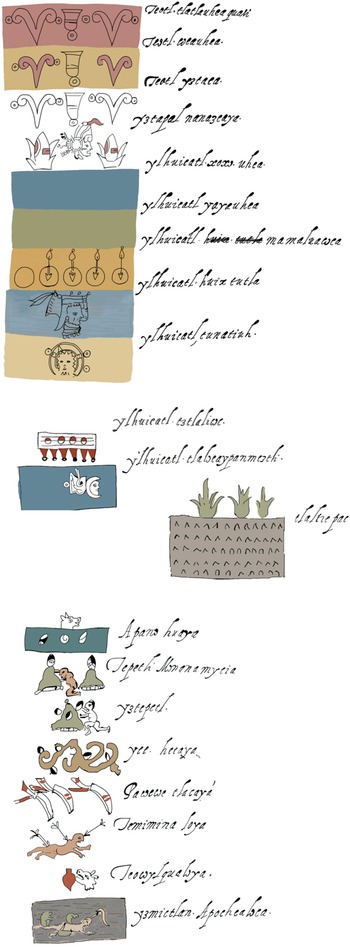
It took scholars two decades to question another firm conviction regarding the Nahua supernatural realm: the supposed division of the cosmos into numerous tiers. Based on the representation of the underworld and the skies in CVA (f. 1v–2v; Figure 1) and some complementary descriptions in alphabetic sources (e.g., HM Reference Tena2002:142–145; HMP Reference Tena2002:80), the traditional consensus was that the Nahua dead reached the god Mictlanteuctli after descending nine underground levels. Relatively recently, however, Jesper Nielsen and Toke Sellner (Reference Nielsen and Sellner2009, Reference Nielsen, Sellner and Díaz2015) suggested that instead of the multiple Dantean levels of the universe, the pre-Hispanic Mesoamerican cosmos had consisted of only three tiers—underworld, earth, and sky—and the division of each of these tiers had been horizontal, going from the center toward the cardinal directions. At the same time, Ana Díaz (Reference Díaz2009) proposed that the European medieval model of the universe brought to New Spain by religious orders strongly influenced the supposed Nahua division of the underworld and the sky into nine levels each (or nine and thirteen levels, respectively). Popular among Renaissance intellectual circles, the model was a version of the Aristotelian and Ptolemaic tiered-spheric model of the universe adapted to Christian ideology by Saint Thomas Aquinas. Consequently, the famous CVA’s representation of the cosmos (Figure 1) was a cultural and ontological hybrid elaborated by Nahua intellectuals educated in Franciscan schools such as the Colegio de Santa Cruz de Tlatelolco (Díaz Reference Díaz2009; Nielsen and Sellner Reference Nielsen and Sellner2009). In the pre-contact Nahua worldview, the dead who headed toward Mictlanteuctli did not descend level by level but rather moved on a “horizontal plane” (Nielsen and Sellner Reference Nielsen and Sellner2009:402–405).
Model of tiered Nahua cosmos as presented in CVA (f. 1v–2v; without the layer of Hometeule). Drawing by Katarzyna Mikulska.

Figure 1 Long description
The illustration presents a model of the tiered Nahua cosmos, divided into multiple sections. Each section is labeled with text describing different realms or elements. The top section features decorative patterns and is labeled with text. Below it, various sections depict plants, symbols and figures, each accompanied by descriptive text. The middle sections show abstract designs and symbols, while the lower sections include depictions of animals and human figures. The text alongside each section provides specific names or descriptions related to the Nahua cosmology.
But was this “horizontal plane” necessarily below the earth? Following Graulich’s “cyclical otherworlds” hypothesis, as well as observations of Richard Haly (Reference Haly1992:288–289), Katarzyna Mikulska (Reference Mikulska2008a) questioned the exclusive location of Mictlan in the underworld. She demonstrated a similarity between Mictlan and the night sky, which could have extended either above or below the earth. In her follow-up work, she suggested that Mictlan was a dynamic, maybe even all-encompassing space (Mikulska Reference Mikulska and Díaz2015a:123). Similarly, Tlalocan was associated with multiple locations, including the East, the underground, caves, or mountaintops (Contel Reference Contel1999:92–158; Martínez and Mikulska Reference Mikulska, Barrio and Rosado2016:12–13).
Together, the studies discussed earlier challenge the “Sahaguntine paradigm.” They suggest that the Nahua afterworlds were not precisely positioned (top, middle, bottom) regions, each serving as the final abode of a specific category of the dead. They were not even regions per se, but rather time-spaces, as at least some of them had a temporal aspect (which is logical from the perspective of the Nahuatl language, in which the locative suffixes -can and -yan can also designate time) and occupied multiple locations. Moreover, the boundaries between the afterworlds were flexible, allowing the dead to travel from one afterworld to another while changing their form to fit the new setting. This summarized view serves as our starting point for further reflection on the Nahua supernatural realm. It is important to understand what the Nahua after- or otherworlds were not, but the next step is to explore what they were. To do this, we will first review several Nahua and other Mesoamerican accounts of supernatural journeys that shed light on the structure of the world beyond.
Journeys through the world beyond
Before our review can begin, one terminological question needs to be addressed. Both the alphabetic sources and the academic literature use the term mictlan to refer to two distinct concepts. The first is the afterworld through which the deceased would travel for four years after their death, where they would encounter obsidian winds, clashing mountains, and other “obstacles” (Sahagún 1950–Reference Sahagún, Anderson and Dibble1982: bk. 3, Appendix, ch. 1, p. 41). The second is the dark realm of Mictlanteuctli—the ultimate destination of the dead, which they would reach after crossing a body of water. Our discussion requires distinguishing between these two afterworlds. For this reason, we will use the capitalized Mictlan when referring to the domain of Mictlanteuctli and the noncapitalized “mictlan” in quotation marks when referring to the transient time-space.
The first journey to be analyzed has been recorded in the Sahaguntine Códices matritenses (Sahagún Reference Sahagún, Sullivan, Nicholson, Anderson and Dibble1997:179–183). Its protagonist is Quetzalpetlatl, a Tlatelolcan woman who died, was buried, and, for four days, wandered through otherworlds. She started at “the great plains” and “the houseless grasslands,” which Mikulska (Reference Mikulska and Díaz2015a:140–141) identified with the northern landscape characteristic of the transient “mictlan.” Continuing her journey, Quetzalpetlatl passed between rows of lizards and weaving women and entered the eternal spring of Tlalocan—all without, as Nielsen and Sellner (Reference Nielsen, Sellner and Díaz2015:38) observed, ascending or descending. In Tlalocan were those who died from being struck by lightning or drowned in the water, and a place reminiscent of the Nursing Tree, dedicated to deceased infants. Quetzalpetlatl met with the god of rain, Tlaloc, and received gifts from him (Sahagún Reference Sahagún, Sullivan, Nicholson, Anderson and Dibble1997:179–183). Judging by the Spanish heading for the story, “This miraculous story or prophecy…” (Esta historia milagrosa o p[ro]fecia…; Sahagún Reference Sahagún, Sullivan, Nicholson, Anderson and Dibble1997:179), we may suppose that Tlaloc also gave Quetzalpetlatl a prophecy. She then continued her otherworld wandering, proceeding again onto the windswept grassy plains, where she met some deceased rulers. Here, the story is cut short by a missing folio, but a similar tale from Book Eight of FC concludes with the woman returning to life, uttering her prophecy, and continuing to live for the next 21 years (Anderson Reference Anderson, Josserand and Dakin1988; Sahagún 1950–Reference Sahagún, Anderson and Dibble1982:bk. 8, ch. 1, p. 3).
There are numerous other Nahua accounts about people who traveled to an otherworld and came back with a prophecy or a mission to accomplish. The young Nezahualcoyotl, fleeing from his father’s assassins, fell into the water, and the tlatlacatecolo (men-owls) took him to the Mountain Poyauhtecatl, that is, Tlalocan. There, he was anointed as the one who would crush the hegemony of the Tepanecs (AC 1998 [Reference Bierhorst1992]:86, 2011 [Reference Bierhorst1992]:48; Contel Reference Contel1999:262–263). Another source recounts the story of a hunchbacked servant to a Chalcan ruler. The servant was locked in a cave on the volcano Popocatepetl, where, in a dream, he saw the palace of Tlaloc. When the ruler’s men eventually came to fetch him, he carried the prophecy of the Chalca’s upcoming defeat by the Mexica (HMP Reference Tena2002:28–31). In yet another story, the Mexica leader Huitzilin, shortly before his death, transformed into an eagle and flew to the top of Mountain Huey Colhua to attend an assembly of gods. Huitzilin received divine instructions regarding the proceedings after his death, which he passed on to his people upon returning to earth (Castillo 2000:120–121). This last example shows that it is not always easy to identify the destination of the supernatural traveler. Huitzilin traveled to a mountain, which, by the usual association, would point to Tlalocan. Nevertheless, in the dynamic landscape of Nahua otherworlds, the mountains could also point to the Home of the Sun, as suggested by FC’s mention that the bodies of the merchants who had died of illness, were placed on the tops of mountains, from where the deceased went to the sky to follow the Sun (Sahagún 1950–Reference Sahagún, Anderson and Dibble1982:bk. 9, ch. 5, p. 25).
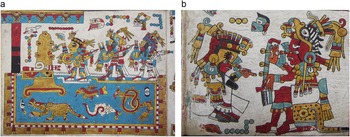
Non-Nahua Mesoamerican narratives provide more explicit accounts of traveling to the solar realm and back. The Purépecha had a story about a woman taken by an eagle “who they said was the god Curícaberi,” the solar deity (see Olivier and Martínez Reference Olivier and Martínez2015), to the top of a hill, Xanoata hucacio, to talk to the gods and receive a message from them (Relación de Michoacán 2008:f. 36v). A Popoloca “sorcerer” involved in the conflict with an Otomí flew to the sky to ask the Sun to stop its movement, as a proof of the power of the Popoloca. The Sun refused to do it, but instead, he gave the “sorcerer” his solar beard, which impressed the Otomí so much that they never again caused problems to the Popoloca (HM Reference Tena2002:130–131). Still, probably the most famous story about a journey to the Home of the Sun is that of the Mixtec cultural hero, 8-Deer Jaguar’s Claw, included, among others, in the pre-Hispanic Codex Nuttall. The codex shows 8-Deer and his two companions crossing a body of water (Codex Colombinus, plates 22–23; Codex Nuttall, plate 80; [because nowadays the photographs of the original Codex Nuttall are, by courtesy of the British Museum, accessible for everyone: https://www.britishmuseum.org/collection/object/E_Am1902-0308-1, we use here the pagination written in pencil directly on the manuscript, as this pagination corresponds to the real pages of the codex]. Dupey Reference Dupey2018:169–170; Hermann Reference Hermann Lejarazu2008:82, Reference Hermann Lejarazu2011:142), at the end of which they face a big black and red column supporting the sky (Figure 2a; see further discussion below). Further away, they arrive at the House of the Sun, where, in line with other stories about people going to the otherworldly realms and back, 8 Deer settles an “earthly matter.” In his case, it was the legitimation of power: he received insignia from the Sun God—a turquoise necklace with gold bell rattles (Figure 2b)—and ignited the new fire, a symbol of new rulership. All of these narratives, produced by the people who shared the core Mesoamerican worldview with the Nahua, suggest that the Nahua may have had more stories about traveling to the Home of the Sun, which have now been lost.
The journey of 8-Deer Jaguar’s Claw to the House of the Sun in Codex Nuttall. (a) 8-Deer and his companions arrive at the black and red column behind a huge body of water. Codex Nuttall, plate 80, (b) 8-Deer receives insignia of power from the Sun. Codex Nuttall, plate 85. Photographs by Katarzyna Mikulska © Trustees and courtesy of the British Museum.
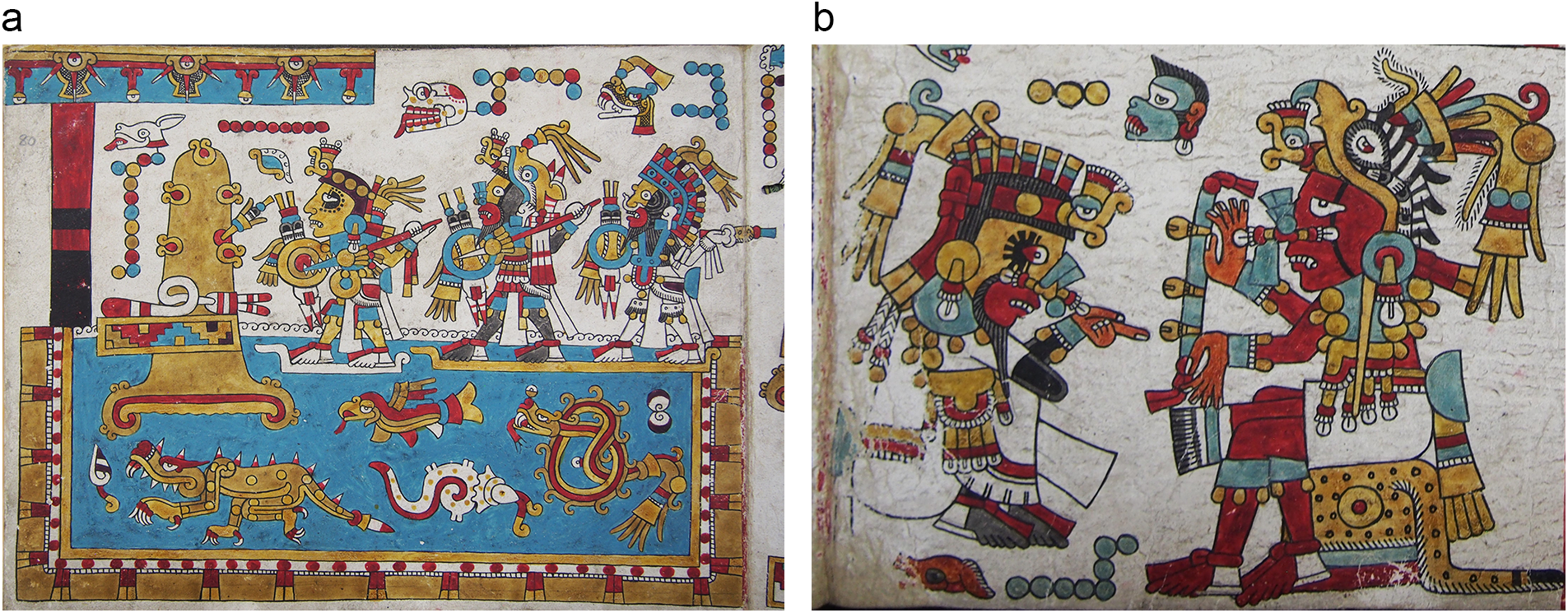
Figure 2 Long description
Image A shows a scene from Codex Nuttall with 8-Deer Jaguar’s Claw and his companions standing near a large column behind a body of water. The column is black and red and the water is depicted with various creatures. The figures are adorned with intricate clothing and accessories and the setting includes decorative elements. Image B depicts 8-Deer Jaguar’s Claw receiving insignia of power from the Sun. The figures are richly dressed, with elaborate headdresses and garments. The scene is detailed with symbolic items and gestures, emphasizing the significance of the event.
The stories recapitulated so far suggest that some otherworlds allowed the visitors to settle their matters with the gods and then return to earth. However, the Nahua also knew of otherworlds that did not facilitate communication with gods and the dead. “Indeed,” sang the Nahua, referring to the ultimate destiny of the dead, “is it possible for our elder brothers to visit us? They have already gone to reside in Quenonamican [with] the lord Axayacatzin” (ye nelli yahue y mach oc techalmati tachcahua ye omotecato quenonamicani yn axayacatzi ȳ teuctli [Cantares mexicanos Reference Bierhorst1985:282]; translation by Julia Madajczak).
The Song of Tlaloc, recorded in Códices matritenses (f. 274v–275r), describes the route to Quenonamican. The song first encourages the victim, compared to the daughter of Tozcuecuex, an archetypal female victim sacrificed to Tlaloc, to succumb to her destiny: “Go! Stretch yourself [on the sacrificial stone] in Poyauhtlan [i.e., Tlaloc’s temple]!” (Ahvia xiyanovia, nahuia xiyamoteca ya ay poyauhtla; transcription and translation of Códices matritenses songs by Julia Madajczak). Once sacrificed, the victim “is taken by the water to Tlalocan” (ay avicalo tlallocan aya) but begs the god to send her further to Quenamican (another version of the name Quenonamican). Thus, she departs. The song recounts how “for four years she suffered from storm [at sea] above us” (Ahuia nauhxiuhtica ya i topan ecaviloc; see Molina 1977 [Reference Molina1571]:vol. II, f. 28r for eecahuilo), alluding to the Nahua belief that the sky was the ocean extended upwards (Sahagún 1950–Reference Sahagún, Anderson and Dibble1982:bk. 11, ch. 12, p. 247). After that, the victim becomes “property of the Nourisher (teizcaltiquetl) in Ximohuayan. She is now in the place of the quetzal houses, in the place of crossing (nepanavia)” (ximovaya ye quetzalcalla nepanavia ay yaxcan a teizcaltiquetl). The Nahua annotators of the song explain that, with the victim’s arrival, the god Teizcaltiquetl will be able to nourish people. Thus, the sacrificed woman experiences a variant of the four-year journey of the dead outlined in the Appendix to Book Three of FC. She suffers, she crosses a large body of water, and finally, she arrives before a god residing in Que(no)namican Ximohuayan, where, as Sahagún’s Nahua collaborators claimed, “everything ended” (ca oic cen onquiz, ca otonmovicac in quenamican, ximooaian; cf. Sahagún 1950–Reference Sahagún, Anderson and Dibble1982:bk. 3, Appendix, ch. 1, p. 39). Turned to bones, the dead eventually transformed into nourishment for the living.
Another exceptional story is registered among the cosmogonic narratives in the central part of the pre-Hispanic Codex Borgia. Although separated from Códices matritenses by at least half a century and some geographical distance (while Sahagún worked in the central Valley of Mexico, CB more probably comes from the eastern Nahuatl-speaking region of Puebla-Tlaxcala or Cholula; cf. Domenici et al. 2012:140; Grazia et al. Reference Grazia, Buti, Amat, Rosi, Romani, Domenici, Sgamellotti and Miliani2020:11), CB provides a graphic parallel to the Song of Tlaloc. The codex’s narrative begins with a large sacrificial bundle, bound with sacrificial paper and adorned with balls of down, which burns in the Temple of Night (CB, plate 35), from where two gods take it. Both gods have graphic elements that identify them as Night Sun and Wind (in yohualli in ehecatl): the wind pectoral, shell necklace, the night sun adornment, and black body with black sacrificial papers. Additionally, the god who carries the bundle, named “Black Quetzalcoatl” by Elizabeth Boone (Reference Boone2007:190), is a sacrificial victim, provided with a maguey spike and a copal bag. On the next page (CB, plate 36), the bundle opens in the middle of the night, and while his companion stays behind, “Black Quetzalcoatl” starts to metamorphose. First, he appears as Xolotl, the canine god renowned as a traveler to the World of the Dead/night and an aspect of Ehecatl, the Wind. In his next appearance, his closed eyes indicate that he is now dead. The stream of darkness bursting out of the mortuary bundle carries him through the World of Night/Darkness/Death. During this long trip, he is accompanied by various musical instruments which, according to the role of music in Mesoamerica, may symbolize the opening of the passage between worlds (CB, plates 36–38).
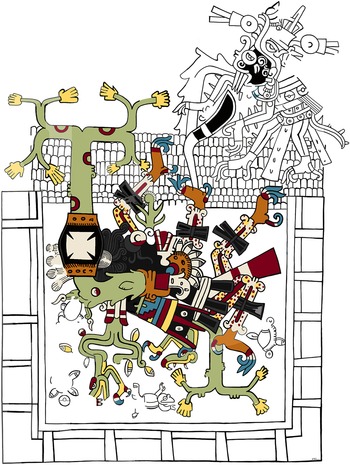
In the final scene, the stream becomes wind—a vehicle for traveling across human and nonhuman realms par excellence (CB, plates 36–38; Mikulska Reference Mikulska, Botta and Olivier2026b)—and the “traveler” reemerges from it in CB, plate 38 (Figure 3b). Still dead, he reappears in the next scene within a body of water, now in a skeletal form but recognizable thanks to his night-sun sign, shell necklace, and the “smoking eye” that he had at the beginning of the story. Here, he undergoes the final transformation, converting himself into hydrophytic plants, the most notable being an ahuehuetl (Taxodium mucronatum), a riparian tree that grows along riverbanks. A Tlaloc-like being seems to be assisting in the transformation, pouring blood into the body of water (Figure 3). Thus, as in the Song of Tlaloc, a long journey through the supernatural realm ultimately brings the sacrificed entity to transformation and the creation of a new life.
“Black Quetzalcoatl” transforms into plants at the end of his supernatural journey, CB, plate 38. Drawing by Katarzyna Mikulska.
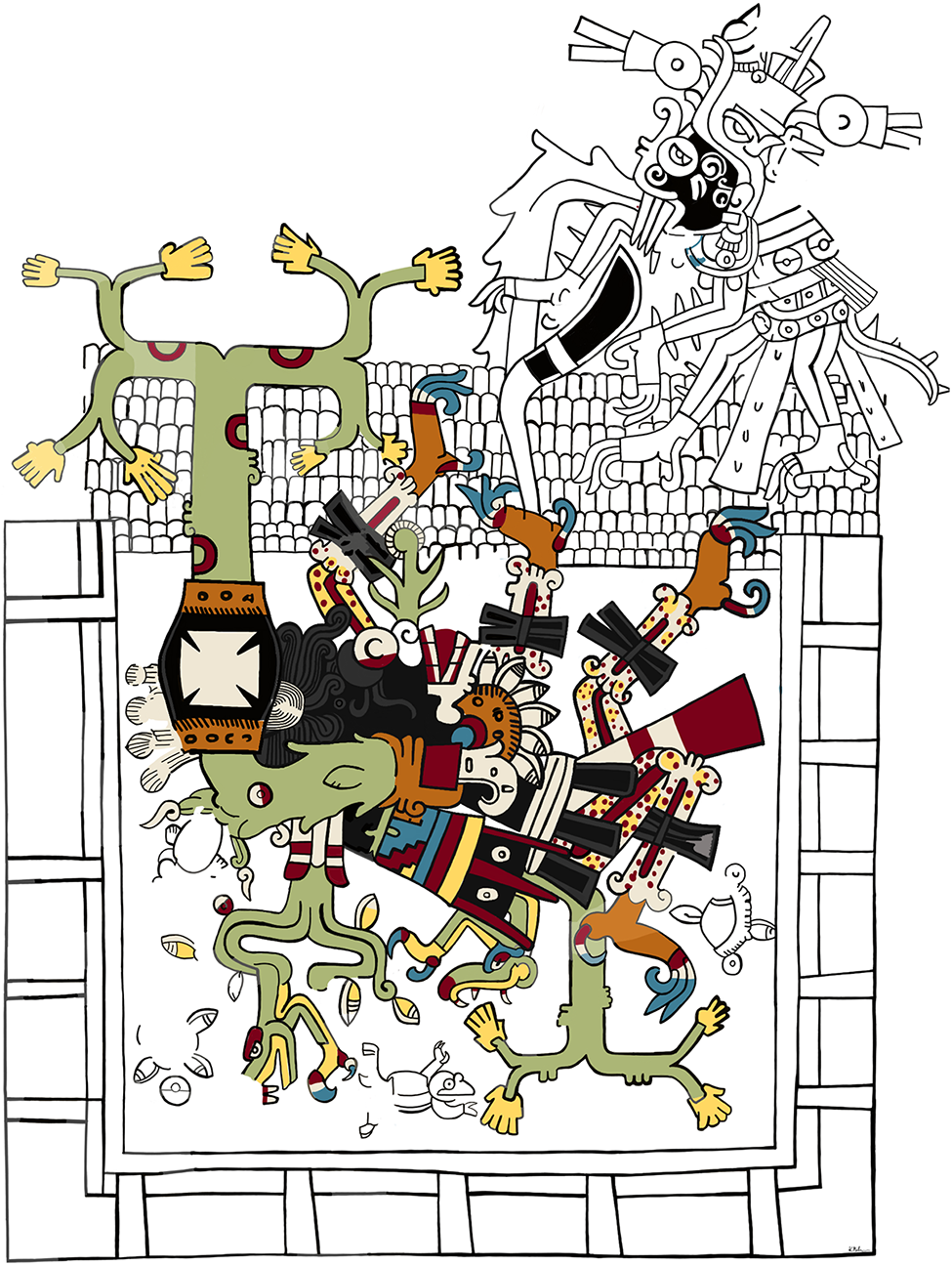
Figure 3 Long description
The illustration depicts Black Quetzalcoatl undergoing a transformation into plants. He is shown in a skeletal form, adorned with a night-sun sign and a shell necklace. A Tlaloc-like figure is positioned above, pouring liquid into the scene, which appears to assist in the transformation. The setting includes a tiled background and various plant elements emerging from Quetzalcoatl's form, notably resembling an ahuehuetl tree. The composition is detailed with intricate patterns and symbolic elements.
Realms of contact and creation
The accounts of journeys to the world beyond suggest that, at the most general level, the Nahua organized their supernatural space into two parts, both inhabited by gods and the dead. Conceptually, the first part lay close enough to tlalticpac, the populated earth, that people could risk venturing there to settle their human affairs. It was an otherworld of communication. The names and landscapes usually associated with it are those of Tlalocan and Tonatiuh Ichan, classified by Graulich (Reference Graulich1980), together with “mictlan,” as time-spaces of a transient nature. Indeed, the Song of Tlaloc mentions Tlalocan as a mere stop on the victim’s way, followed by a four-year passage parallel to that through “mictlan,” before she can reach Ximohuayan Quenamican. Moreover, the association of “mictlan” with travel is visible in some of its features which (as we will see below), rather than being mere “obstacles,” have also symbolic values: the narrow passage between two mountains (Tepetl Imonamiquiyan) and the road guarded by a snake invoke the notions of transit (CVA:f. 2r; Sahagún 1950–Reference Sahagún, Anderson and Dibble1982:bk. 3, Appendix, ch. 1, p. 41; Reference Sahagún, Sullivan, Nicholson, Anderson and Dibble1997:178). Finally, it should be stressed that although Tlalocan and Tonatiuh Ichan usually appear within the closer-to-earth realm of contact with the gods, this is not a fixed classification. Depending on the narrative, both could also belong to the more distant realm of origin and transformation. For example, in CB, a Tlaloc-like being awaits “Black Quetzalcoatl” in the watery world of transformation (Figure 3), and in the myth about the origin of music, the origin time-space is the Home of the Sun, located across the ocean (HM Reference Tena2002:156–157).
The second part—Mictlan, Ximohuayan, or Quenamican—was the most distant afterworld, associated with destruction, creation, and transformation. Here, as the etymology of the word Ximohuayan suggests, people “were shaved free of flesh” (Karttunen 1992 [Reference Karttunen1983]:325), reduced to a seed from which new life could sprout (López Austin 2000 [Reference López Austin1994]:222); the name Quenamican (Place/Time of How) hinted at giving this pure potential a (new) form or shape (Molina 1977 [Reference Molina1571]:vol. II, f. 88v). Multiple sources tell us about this kind of postmortem transformation, resulting in the generation of a new existence. Gods and other supernatural beings of the divine time-space often transformed into essential or sacred plants, such as the ahuehuetl, which grew from the remains of the sacrificed god in CB. The goddess Mayahuel transformed into maguey after the tzitzimime devoured her flesh, and her bones were buried (HM Reference Tena2002:150–151). From the heart of the sacrificed Copil, thrown among the reeds, grew a cactus that marked the spot of the future city of Tenochtitlan, while from his unburied body emanated hot springs (Durán 2006 [Reference Durán and Kintana1967]:vol. II, ch. IV, p. 38). According to Histoire du Méchique, the transformation of Topiltzin into Venus was a consequence of the cremation of his corpse—the star was made from the smoke of the funeral pyre (HM Reference Tena2002:162–165).
In the Nahua worldview, therefore, there was no such thing as complete annihilation, but rather a kind of new and productive postmortem existence, assured by Mictlanteuctli, who represented both death and life that issued from death (Haly Reference Haly1992:286). Mictlanteuctli was the keeper of bones and ashes that, ground up and mixed with sacrificial blood of the gods, produced humanity in the present era (AC 2011 [Reference Bierhorst1992]:5; HM Reference Tena2002:148–149; LS 2011 [Reference Bierhorst1992]:89; Torquemada 1975–83 [Reference Torquemada and León-Portilla1615]:vol. III, bk. 6, ch. XLII, p. 121); as Teizcaltiquetl, “Nourisher,” he then kept converting the skeletal remains of the dead into the sustenance for the living. The heart of a deceased person also seems to have been able to give rise to new lives; at least, this is what we can infer from a song that speaks of the fate of a young man from Huexotzinco who was killed in war in Tenochtitlan. The warrior’s heart is treated as a kind of valuable possession to be handed over after death: “You give [to god] your heart polished like a fine turquoise, it comes shining and giving off tonalli (solar heat, but also vital strength/soul). You are yet to sprout; you will bloom again on earth” (Çan teuxiuhtlamatiloltic moiollo toconmacan tonativitzin, oc titzmolinjz y: oc ceppa tixotlaz tlalticpac [Sahagún 1950–Reference Sahagún, Anderson and Dibble1982:bk. 6, ch. 21, p. 115]; translation by Julia Madajczak). Death seems to have provided the raw material for generating new life in many forms that benefit humanity, such as water or plants. What is important from the point of view of our discussion is that the regeneration always seemed to require the conclusion of the mortuary process: the bones must have been bare or the corpse burned. In other words, the ultimate, irreversible transformation of the deceased humans into resources for the living occurred in their ultimate postmortem destination: the distant afterworld of destruction, Mictlan, the second part of the world beyond.
What supports our idea that the Nahua otherworld had two conceptual parts with different functions and natures is that the sources tend to qualify them with two distinct numbers: eight and nine. As is widely known, a passion for numerical thinking was omnipresent in Mesoamerican cultures, with the Nahua being no exception; numbers had not only numerical value but also symbolic and semantic significance (Dehouve Reference Dehouve2011; Mikulska Reference Mikulska and Díaz2015a:131). The number nine has already attracted scholarly attention. Danièle Dehouve (Reference Dehouve2011:169) and, subsequently, Mikulska (Reference Mikulska and Díaz2015a:125–138, 161) observed that sources often associated the number nine with Nahua regions of the dead, or, more broadly, with spaces outside the human world. For example, the medical incantations gathered in the seventeenth century by Hernando Ruiz de Alarcón (Reference Ruiz de Alarcón, Andrews and Hassig1984:166, 190) speak of Nine Mictlan and Nine Nepaniuhcan (“Place/Time of Juncture”). Both are places physicians must reach through magic incantations and healing rituals to restore their patients’ health—the integrity of their fractured bones and the restoration of their lost tonalli, respectively. In the Sahaguntine texts, Nine Mictlan is the ultimate destiny of the deceased, where they arrive after crossing Nine Apan (“Water”) with the help of Nine Itzcuintli (“Dog”) (Sahagún 1950–Reference Sahagún, Anderson and Dibble1982:bk. 3, Appendix, ch. 1, pp. 41–42, Reference Sahagún, Sullivan, Nicholson, Anderson and Dibble1997:178). Finally, the sixteenth-century Anales de Cuauhtitlan describes the place of origin of the 400 Mimixcoa gods as Nine Tiliuhcan (“Hill”) and Nine Ixtlahuatl (“Desert”) (AC 2011 [Reference Bierhorst1992]:3). From the “topographic” point of view, all these locations and features are not merely outside of the human world, but at the farthest extremes of the otherworld. The names that include the number nine refer to the realm of destruction, creation, and transformation—a deposit of bones and tonalli or a place where gods are born.
Curiously, among the features of “mictlan” that the dead crossed before arriving at the shore of Nine Water, Sahagún’s collaborators list Eight Tiliuhcan (“Hill”) and Eight Ixtlahuatl (“Desert”) (Sahagún 1950–Reference Sahagún, Anderson and Dibble1982:bk. 3, Appendix, ch. 1, p. 41). They are the same features that, on the other side of the watery barrier, at the place of origin, receive the qualification of “nine.” The Song of Ixcozauhqui of Códices matritenses (f. 276r–276v) confirms that the use of different numbers to refer to different supernatural realms is intentional. The song mentions a place called Chicueyocan—“Place/Time of the Quality of Eight”—which, as Ángel María Garibay (Reference Garibay1958:89) surmised, was related to the Eight Hill and Eight Desert of the transient “mictlan.” Garibay proposed that “Place/Time of Eight” was a more general designation than “Place/Time of Nine,” thus comprising both “mictlan” and Tlalocan. However, rather than the degree of generality, the semantic value of the numbers seems to refer to the positioning of these regions in relation to each other. The number eight goes before nine; it is the “announcement” or “vestibule” of nine. Similarly, the Place/Time of Eight is the vestibule one must pass to get to the Place/Time of Nine.
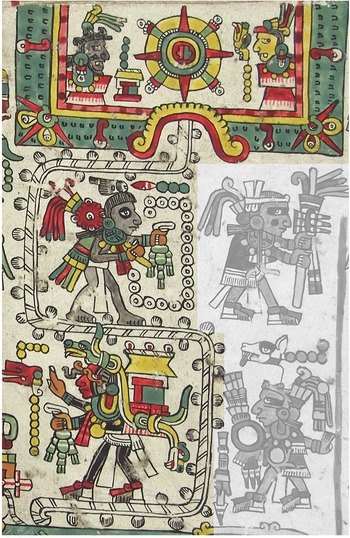
The Song of Ixcozauhqui alludes to the “transient” character of the Place/Time of Eight through two concepts: ropes and the nahualli. The song says: “You are in the place of ropes, my masters. It is a place full of palm fibers, the Place/Time of Eight, the house of a nahualli, the nahualli who descends” (A uncã mecatla notecvã ycçotl mimilcatoc chicueyocã navalcalli navali temoquetl aya; translation by Julia Madajczak). Additionally, the first verse refers to the temple of Tzonmolco, which is soon to become a stage for human sacrifice, as “a place of constant descending” (tetemocã). Among the Nahua and, more broadly, in Mesoamerica, supernatural beings tended to descend to earth from the sky (see, for example, CVA:f. 6v–7r; HM Reference Tena2002:150; Sahagún 1950–Reference Sahagún, Anderson and Dibble1982:bk. 4, ch. 33, p. 107), and they often did it on threads or ropes (Codex Nuttall, plates 18, 19; Codex Vindobonensis, plate 48; Klein Reference Klein, Aveni and Urton1982:15–17; Figure 4). The dead could also use ropes to leave the earth. In 1572, the colonial officials caught a Nahua man preparing burial offerings for his deceased children. Among the items he had laid out were pieces of straw tied with paper knots, which represented “a ladder for descending into hell” (Tavárez Reference Tavárez2011:69). “The place of constant descending” and “the place of ropes” are, therefore, points of contact between the world of humans and that of gods.
Two individuals (named Three Flint and 12 Wind) descending from the sky on a rope. Codex Nuttall, plate 18. Photograph by Katarzyna Mikulska © Trustees and courtesy of the British Museum.
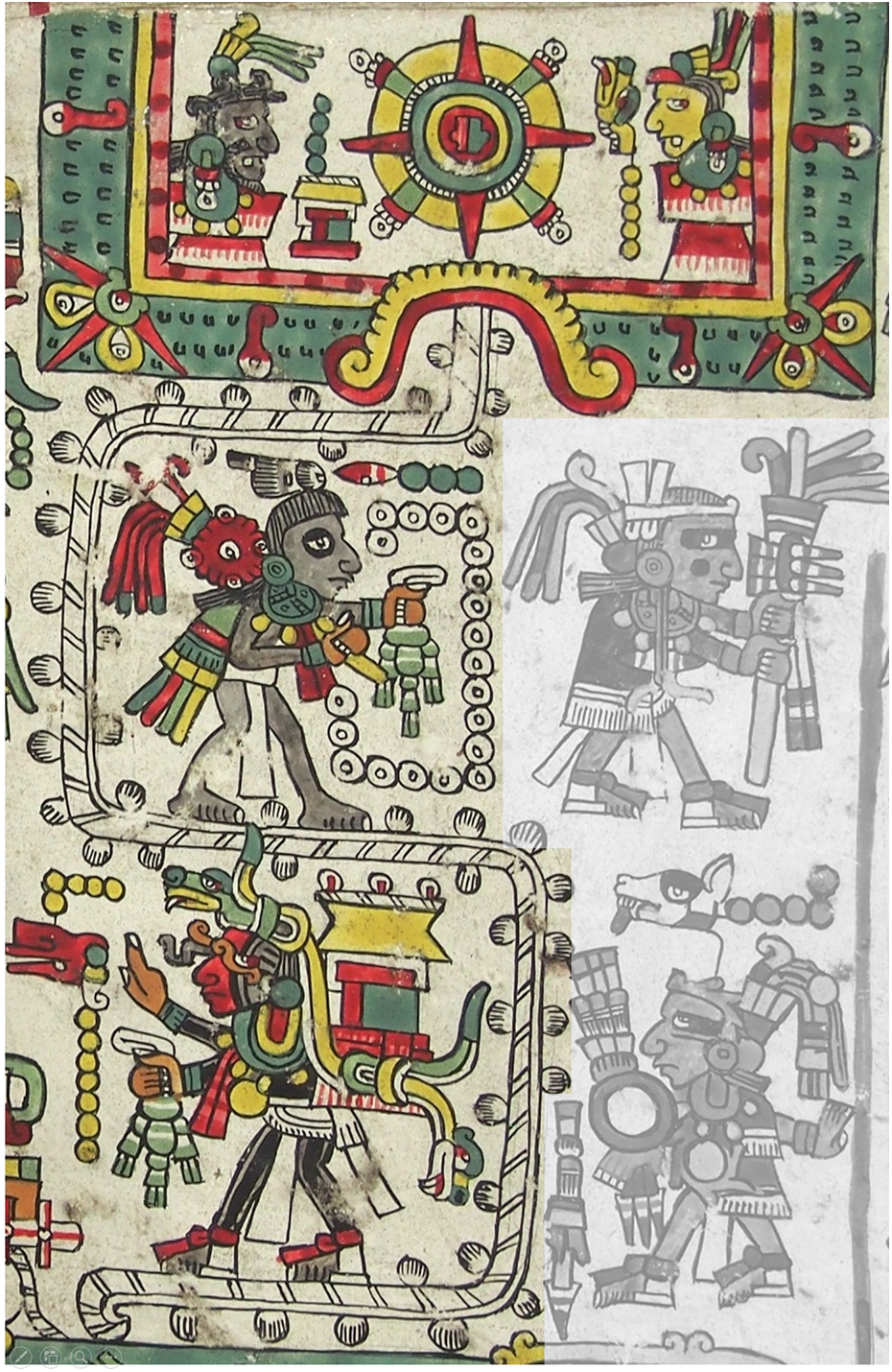
Figure 4 Long description
The illustration from Codex Nuttall features two figures adorned with intricate attire and accessories. The top section displays a circular motif with geometric patterns, flanked by two figures. The central motif includes a circle with a smaller circle inside, surrounded by decorative elements. The figures are dressed in elaborate clothing, holding objects in their hands. The lower section shows another figure with similar attire, holding items and surrounded by symbolic designs. The right side includes a grayscale version of the figure, highlighting the detailed patterns and attire.
Along with being a “place of ropes,” the Place/Time of Eight is also “the house of a nahualli who descends.” Nanahualtin (plural of nahualli) were avatars of the people endowed with special powers (the Spaniards liked to call them “sorcerers”). These religious specialists typically assumed animal or other nonhuman forms during the night, while they slept; in this way, they were able to travel to the world beyond (Martínez Reference Martínez2011:138–168; Martínez and Mikulska Reference Mikulska, Barrio and Rosado2016:37–38). Similar to ropes that joined the worlds, the nanahualtin allowed for the contact between the earth and the supernatural dimension. The state of sleep in which they operated added to their liminal nature. In Mesoamerica, sleep was often interpreted as a form of temporal death, and in Nahuatl, specifically, the verb “to dream,” temiqui, shared a root with miqui, “to die” (Martínez and Mikulska Reference Mikulska, Barrio and Rosado2016:34–35). Sleep was “almost death,” just like eight was almost nine, but it was the kind of death from which one could still return to the world of the living. By describing the Place/Time of Eight as “the place of ropes” and “the house of a nahualli,” the Song of Ixcozauhqui emphasized its features of transit and contact. In the song, the Place/Time of Eight is where humans enter a death-like state that enables them to communicate with gods and mediate between the earth and the supernatural.
The last point about the Place/Time of Eight that needs to be discussed is the watery barrier that, in the sources, often separates it from both the earth and the Place/Time of Nine. This feature is particularly pronounced in the descriptions of the journeys of the dead. The deceased, departing from the earth, entered the transient “mictlan” (qualified by the number eight; see its Eight Hill and Eight Desert earlier) after passing over water in Apanoayan (CVA:f. 2r). They left “mictlan” by crossing Nine Water (Sahagún 1950–Reference Sahagún, Anderson and Dibble1982:bk. 3, Appendix, ch. 1, p. 41), that is, perhaps, the ocean (as suggested by Sahagún 1950–Reference Sahagún, Anderson and Dibble1982:bk. 3, ch. 14, p. 36 and the Song of Tlaloc analyzed earlier). On the other side of this second body of water was the part of the otherworld qualified by the number nine—the realm of Mictlanteuctli. Thus, the water highlighted the boundaries between the earthly and supernatural worlds, but its crossing also carried symbolic meaning. It may have symbolized a change in ontological status that the traveler underwent with each leg of the journey: from a living human to a dead person with whom relatives could still communicate through offerings (Sahagún 1950–Reference Sahagún, Anderson and Dibble1982:bk. 3, Appendix, ch. 1, p. 42), to part of Mictlanteuctli’s domain of annihilation and transformation.
Summing up, all the discussed narratives conceptualize the supernatural dimension as separated from the human world and divided into two: one part, classified by the number eight, was the realm of transit and communication with the gods, and the other, classified by the number nine, was the realm of destruction, creation, and transformation. Actions required to pass from one world to another—such as overcoming a watery barrier, descending on a rope, or undergoing a metamorphosis—emphasized their separate and distinct natures. Alongside this model, the Nahua had a score of time-spaces, such as Tlalocan, Tonatiuh Ichan, Ximohuayan, or Tlillan Tlapallan. Some of them were unequivocally classified in either the realm of contact (“eight”) or the realm of destruction/creation (“nine”). For example, Ximohuayan, whose name indicated decay, fits only in the latter. However, many time-spaces, among them Tlalocan and Tonatiuh Ichan discussed earlier, and Chiucnauhnepaniuhcan discussed below, comprised features of both realms. In such cases, their numerical qualification depended on which of the two functions (communication/transit or destruction/origin/transformation) was considered essential in the entire system of beliefs or even in a single story.
To complete our discussion of the Nahua otherworlds, we will now analyze four of them: Tlillan Tlapallan, Tlahuizcalli, Itzmictlan, and Chiucnauhnepaniuhcan. Sources connect them to the transformations of Topiltzin Quetzalcoatl, and the route of the transforming god will help us navigate through these complex concepts.
“Otherworld” as a collection of domains
Tlillan Tlapallan
Topiltzin Quetzalcoatl was a divinized ruler of Tollan who abandoned his city after a confrontation with Tezcatlipoca and left toward the seacoast (AC 1998 [Reference Bierhorst1992]:36, 155; HM Reference Tena2002:163–164; Sahagún 1950–Reference Sahagún, Anderson and Dibble1982:bk. 3, ch. 14, p. 36). Graulich (Reference Graulich, Ortiz de Montellano and de Montellanode Montellano1997:187–206) has demonstrated that Topiltzin’s life and death represented the route of the Sun from its rising to its setting. At death, Quetzalcoatl-Sun completed the cycle, transforming into Tlahuizcalpanteuctli, the Morning Star that precedes the rising of the “new” Sun. According to the Anales de Cuauhtitlan (1998 [Reference Bierhorst1992]:36), this transformation began in Tlillan Tlapallan, “Place of Black, Place of Red,” on the ocean shore. There, Quetzalcoatl cremated himself, and with the smoke of the funeral pyre, he reached Mictlan-sky, where he remained for eight days, crafting arrows used by Tlahuizcalpanteuctli.
Other sources give different details. Some of them locate Topiltzin’s destination on the other side of the ocean, and the vast majority use only the name “Tlapallan” (CVA:f. 9v; HMP Reference Tena2002:43; LS 1998 [Reference Bierhorst1992]:155; Sahagún 1950–Reference Sahagún, Anderson and Dibble1982:bk. 3, ch. 13–14, pp. 33, 35–36; more in Dupey Reference Dupey2018:162–165 and Nicholson Reference Nicholson2001:3–135). Anales de Cuauhtitlan (1998 [Reference Bierhorst1992]:36) additionally calls it “Tlatlayan,” “Place/Time of Burning,” which refers to Topiltzin Quetzalcoatl’s cremation (Muñoz Camargo Reference Muñoz Camargo and Acuña2000:133), and other texts have “Poctlan Tlapallan” (Cantares mexicanos Reference Bierhorst1985:324; Chimalpahin Cuauhtlehuanitzin Reference Cuauhtlehuanitzin and Tena1998:vol. I, p. 152–153; Szoblik Reference Szoblik2025). “Poctlan” is the “Place of Smoke,” a name that recalls some terms associated with the distant Mictlan of Mictlanteuctli, such as ayauhtlan or “Place of Fog” (Sahagún 1950–Reference Sahagún, Anderson and Dibble1982:bk. 6, ch. 27, pp. 153–154) and apochquiahuayocan or “Place Without a Smoke Opening” (Sahagún 1950–Reference Sahagún, Anderson and Dibble1982:bk. 6, ch. 27, p. 152). They indicate a dark place filled with trapped smoke or fog, making it difficult to see. All of these terms—“Tlillan,” “Tlapallan,” “Tlatlayan,” and “Poctlan”—form a metonymic series, that is, a compound designation that through the “enumeration of its parts” (Dehouve Reference Dehouve, Mikulska and Offner2019:96–98) defines the place where Topiltzin disappeared.
Recently, Élodie Dupey proposed that “Tlapallan”—the most frequent term for the destination of Topiltzin—is a name of the Home of the Sun that conveys its colorful nature. Indeed, other than “red,” tlapalli also means “color for painting or a dyed thing” (Molina 1977 [Reference Molina1571]:vol. II, f. 130r; cf. Dupey Reference Dupey2018:161). Considering that the Sun’s shire merges with ocean water extending to the sky, another argument of Dupey is the multicolored representation of the sea that 8-Deer sailed through during his journey (Codex Colombinus, plates 22–23; Dupey Reference Dupey2018:169–170; Hermann Reference Hermann Lejarazu2011:142). While we are not dismissing the idea of a multicolored space in the afterlife (cf. Mikulska Reference Mikulska, Botta and Olivier2026b), the lens of the metonymic series requires us to consider Tlapallan together with Tlillan or Poctlan, that is, as a combination of red and black (or dark). We will do this by analyzing graphic representations of this combination in pre-Hispanic Nahua and Mixtec codices. Although the Nahua and the Mixtec spoke different languages, their cultures were closely related due to their immediate proximity and permanent contact. The Nahua Tlaloc and Mixtec Dzavui were the same god of rain, while the Nahua Ehecatl and the Mixtec 9-Wind were the same creator god, protagonist of the cosmogonic narratives registered in pre-Hispanic codices Borgia and Vindobonensis (Mikulska and Hermann Reference Mikulska and Hermann Lejarazu2021:110–116). Despite some stylistic differences in Mixtec and Nahua codices, the similar worldviews of these cultures allow us to use the Mixtec material to elucidate the meaning of a Nahuatl term (Tlillan Tlapallan).
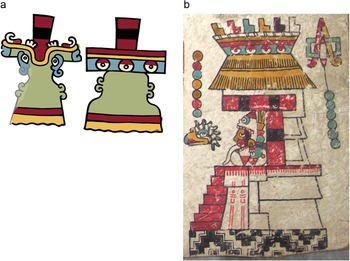
In Mixtec codices, the combination of red and black often appears in connection with either the confines of the world or the creative potential or force. In the already mentioned story of 8-Deer, an enormous black and red column supports the sky at the end of the sea that 8-Deer and his companions cross (Codex Nuttall, plate 80; cf. Hermann Reference Hermann Lejarazu2008:82; Figure 2a). The Mixtec Codex Vindobonensis (plates 45, 9; Figure 5a) also depicts such columns supporting the sky and the earth, entering inside the earth, or supporting the sky below; the columns appear in the context of the creation of the world and graphically render the names of sacred places. A black and red column and beam are part of the Temple of the Sky in Mixtec Tilantongo, where a sacred bundle—a “vessel” of condensed creative potential—is kept (Codex Bodley, plate 10; Codex Colombinus, plate 2; Codex Nuttall, plate 47; Figure 5b).
Black and red columns. (a) Supporting the sky and the earth in topograms of sacred places. Codex Vindobonensis, plate 45. Drawing by Katarzyna Mikulska, (b) As part of the Temple of the Sky. Codex Nuttall, plate 47. Photograph by Katarzyna Mikulska © Trustees and courtesy of the British Museum.
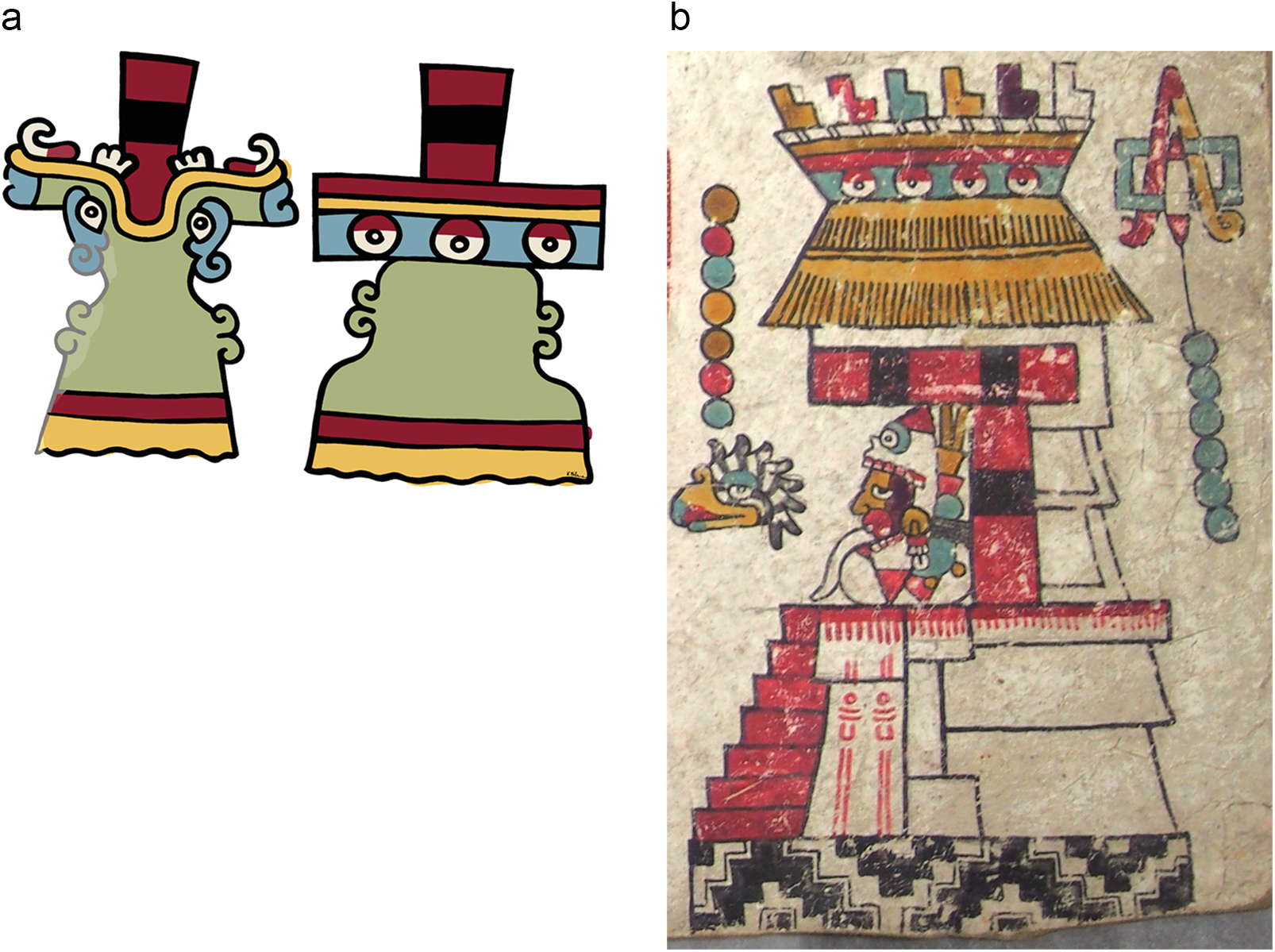
Figure 5 Long description
The image A shows two stylized columns with decorative elements. Each column has a wide base and a narrow top, adorned with intricate patterns and eye-like designs. The columns have curved extensions resembling horns or wings. The image B depicts a Mixtec temple with intricate designs. The temple features multiple tiers with geometric patterns and a figure seated on the steps. The structure includes decorative elements such as circles and a vertical arrangement of shapes. The figure appears to be holding an object and the temple is surrounded by various symbolic designs.
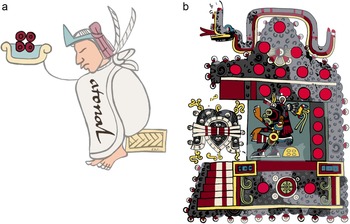
Particularly illuminating is the presence of the black-and-red code in the cosmogonic part of Codex Borgia. The first scenes (Episode 1 sg. Boone Reference Boone2007:179–183) take place inside celestial/terrestrial bodies (Díaz Reference Díaz and Díaz2015:77–85, 91–94; Mikulska Reference Mikulska2008b:151–154) filled with the color red and the black “darkness” design (CB, plates 29–31; cf. Boone Reference Boone2007:179; Díaz Reference Díaz and Díaz2015:77–85; Mikulska Reference Mikulska2015b:417–419, 465–469). All these scenes represent the most primordial acts of creation, that is, the creation of the winds (Baena Reference Baena2014:204–208; Mikulska and Hermann Reference Mikulska and Hermann Lejarazu2021:110–117), the calendar, and “essences, personifications, or anonymous agents of action” that would act in subsequent stages of this process (Boone Reference Boone2007:179). Furthermore, at the center of the calendar creation scene (Boone Reference Boone2007:181–183; CB, plate 30; Mikulska and Hermann Reference Mikulska and Hermann Lejarazu2021:117–124) is a large red solar circle that is covering a dark-colored “ball” or night Sun (Anders et al. Reference Anders, Jansen and García1993:194; Mikulska and Hermann Reference Mikulska and Hermann Lejarazu2021:117). Such red circles are conventionalized signs that encode the value of tonalli, among whose meanings are that of “day/destiny” (see examples in Codex Mendoza:f. 7v, 12r; Figure 6a) and “sun heat” (Molina 1977 [Reference Molina1571]:vol. II, f. 149r). These red circles appear frequently on the background of the night—like in Temples of the Night in the following creation episodes (CB, plates 35, 37; Figure 6b)—thus encoding the creative potential of “sun heat” temporarily “sedated” during the night, but able to burst out when a new day starts (Mikulska Reference Mikulska, Botta and Olivier2026b).
Tonalli signs as red circles. (a) As a logogram in the name of Mexica tlatoani Atonal (Codex Mendoza:f. 12r), drawing by Katarzyna Mikulska. (b) In the Temple of the Night (CB plate 35; with the tonalli signs highlighted). Drawing and reconstruction by Katarzyna Mikulska.

Figure 6 Long description
The image A shows a logogram in the name of Mexica tlatoani Atonal. The figure is holding a tray with circular symbols. The clothing has text written on it. The image B depicts the Temple of the Night, featuring intricate designs and numerous circular symbols. The central area includes a detailed figure surrounded by decorative elements and patterns. Both illustrations are drawn by Katarzyna Mikulska.
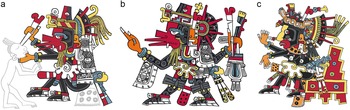
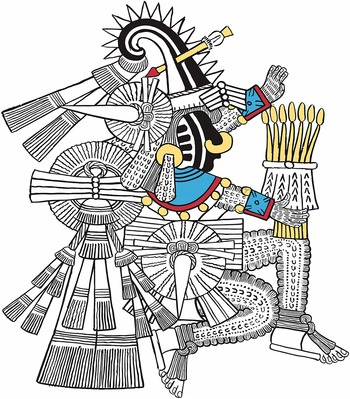
As we can judge from the black and red code in body painting and garments, several Nahua gods pertained to the domain of Tlillan Tlapallan: Tlazolteotl, Patecatl, and Ehecatl Quetzalcoatl (CB, plates 12, 16, 19, 23, 55, 56, 58, 60, 68, 70, 72; Codex Tudela:f. 35r–39r, 44r; Codex Vindobonensis, plates 59, 61; Figure 7a–c). Like Topiltzin Quetzalcoatl, they were all connected with the ocean coast and, specifically, with the region called La Huasteca (Dupey Reference Dupey2020:19; Mikulska Reference Mikulska2008b:125–137; Ochoa and Gutiérrez 1996–Reference Ochoa and Gutierrez1999; Sullivan Reference Sullivan and Benson1982:8). The Nahua perceived this coastal region as a place of fertility, lust, and drunkenness, and thus a place of chaos and origin (Johansson Reference Johansson2012:90–94; Mikulska Reference Mikulska2008b:129–136; Sahagún 1950–Reference Sahagún, Anderson and Dibble1982:bk. 10, ch. 29, p. 193; among others). Additionally, the graphic representations of Ehecatl Quetzalcoatl (Wind) allude to the concept of solar force that is “sedated” at night (Mikulska Reference Mikulska, Botta and Olivier2026b). In the codices, he usually wears attire made of cloth used for mortuary or sacred bundles (or bears the glyph of such a bundle; Mikulska Reference Mikulska, Botta and Olivier2026b; Figure 7a–b), together with sacrificial instruments (a bone perforator and a maguey thorn), which suggests his status as a sacrificial or sacrificed being. Simultaneously, the glyph of the night Sun (or its facial painting variant; Mikulska Reference Mikulska and Mikulska2020:549) situates him in the nocturnal domain of Mictlan. Most interesting in this regard is Ehecatl Quetzalcoatl’s facial background painting: yellow on his forehead and nose, red around his mouth, and black on the whole “backside” of his face (CB, plates 62, 51; Figure 7c). These are the colors of the sky during twilight, when the red light brimmed with yellow still lingers, signaling where the Sun has set, while the rest of the sky is already black (Mikulska Reference Mikulska, Botta and Olivier2026b). Ehecatl Quetzalcoatl, the Wind, is a dead (sacrificed) god moving at the world’s edge between day and night.
Ehecatl Quetzalcoatl with red and black colors, with signs of mortuary/sacred bundles, as a glyph on his neck (a) or clothes (a, b), sacrificial instruments (b, c), and yellow-red-black facial painting (c); (a) CB plate 16 (b) CB plate 19 (c) CB plate 62. Drawings by Nicolas Latsanopoulos, reproduced with permission.

Figure 7 Long description
The image contains three illustrations labeled a, b and c, depicting Ehecatl Quetzalcoatl. In illustration a, Ehecatl Quetzalcoatl is shown in profile, adorned with elaborate headdresses and garments, standing next to a human figure. Illustration b presents Ehecatl Quetzalcoatl with a different set of attire, including a prominent headdress and various accessories, holding a staff-like object. Illustration c features Ehecatl Quetzalcoatl in a dynamic pose, with intricate clothing and accessories, including a large headdress and decorative elements. Each illustration highlights unique aspects of attire and symbolism associated with Ehecatl Quetzalcoatl.
As the earlier analysis shows, the combination of red and black encodes liminality associated with the transition from light to darkness. Whether it appears in the columns between the human world and the interior of the earth, in the night sky, or on terrestrial/celestial bodies, the tlilli tlapalli (“black-red”) series marks the border between day and night. Additionally, it can connote a temporal “sedation” of the luminous, hot, “day-making” forces that, surrounded by the darkness, await the restoration of their creative power. It is, then, evident that Tlillan Tlapallan cannot be merely a place. It is as much a time of the day—sunset—when the solar Topiltzin Quetzalcoatl enters Mictlan-night, to proceed with his transformation into the Morning Star. Better said even, Tlillan Tlapallan is a conceptual domain that encompasses such elements as the location on either side of the ocean, the time of sunset, liminality, creative potential, the combination of red and black colors, and several gods, including Ehecatl Quetzalcoatl—the Wind that blows across different parts of the world—and Topiltzin Quetzalcoatl—the setting Sun, ready to transform.
Tlahuizcalli and Itzmictlan
After passing through the red and black border of Tlillan Tlapallan, Topiltzin Quetzalcoatl ascended to the night sky, or Mictlan, where he spent eight days (AC 1998 [Reference Bierhorst1992]:36, 2011 [Reference Bierhorst1992]:12). In other words, the Sun had set, and the night fell. However, in Mictlan—the realm of transformation—Topiltzin worked to acquire a new identity. Eight days completed, he appeared in the eastern sky in the domain of Tlahuizcalli, whose name means both the “light of dawn” and the “house of battle insignia” (Molina 1977 [Reference Molina1571]:vol. II, f. 145r). Topiltzin transformed into Tlahuizcalli’s lord, Tlahuizcalpanteuctli, or the Morning Star. His darts, fashioned in Mictlan, were—as the name of Tlahuizcalli indicated—both weapons and rays of light.
Leyenda de los Soles, written down in the mid-sixteenth century, probably by the Nahua intellectuals from the Sahaguntine circle, tells the next part of this story in the myth about the creation of the Sun. According to this text, on the first day of the Sun’s existence, Tlahuizcalpanteuctli, angry that the new god did not move, shot him with his ray arrows, but the Sun’s rays shot in response were much more powerful, and the assailant lost. Leyenda then explains that Tlahuizcalpanteuctli was not only the Morning Star but also frost or ice (cetl) (LS 1998 [Reference Bierhorst1992]:149, 2011 [Reference Bierhorst1992]:91), whose name, in its divine emanation, was Itztlacoliuhqui. Decades ago, Eric J. Thompson (Reference Thompson1971:220) observed that the close association between Tlahuizcalpanteuctli and Itztlacoliuhqui stemmed from their representing two characteristic features of early morning: the soft light of the Morning Star and the coldness of dawn. Each morning, the bright light of the young, bellicose Sun eclipses the glow of Venus, and its warmth overcomes the cold—this is what the battle of the Leyenda represents.
The list of deities known as the “Nine Lords of the Night,” recorded in several graphic and alphabetic sources (Mikulska Reference Mikulska and Mikulska2020:526), offers a variant of the Tlahuizcalpanteuctli-Itztlacoliuhqui pair. In sources from the same time and region as the Leyenda, the second god on the list in the Codex Tudela (f. 98v) is Tlahuizcalpanteuctli; however, in the Codex Telleriano-Remensis (f. 8r), his equivalent is Itztli, the personification of a knife. In Nahuatl, itztli means both “knife” and “obsidian” (Mikulska Reference Mikulska2022:451), and each of these connotations matches the nature of Itztlacoliuhqui, “One That Curves Like Itztli.” Obsidian evokes the cold, as in the Sahaguntine descriptions of freezing obsidian winds of the northern deserts blowing through the transient “mictlan”: “Obsidian knives are carried by the wind, sand is carried by the wind, sticks are carried by the wind. There are tzihuactli cacti. Flint knives are carried by the wind. There are necuametl cacti and poisonous thornbush. It is very cold. There are barrel cacti” (itztli ecatoco. xalli ecatoco. quavitl ecatoco. tzivactli. tecpatl ecatoco. nequametl. netzolli. çenca çeva. teucomitl [Sahagún Reference Sahagún, Sullivan, Nicholson, Anderson and Dibble1997:177–178]; translation by Julia Madajczak, emphasis added; see also: Sahagún 1950–Reference Sahagún, Anderson and Dibble1982:bk. 3, Appendix, ch. 1, p. 41). The knife, on the other hand, evokes human sacrifice for which it was a primary tool. Indeed, the attire of Itztlacoliuhqui in the pre-Hispanic codices suggests that the Sun not only defeated but also sacrificed him: Itztlacoliuhqui’s entire body or, sometimes, just face, is typically represented as wrapped in a (mortuary?) bundle and adorned with folded paper ties that often mark offerings to the gods (Figure 8). The most characteristic feature of his appearance, the obsidian knife cap, encodes his name and alludes to his properties of coldness and sacrifice (Mikulska Reference Mikulska2026a).
God Itztlacoliuhqui covered with sacrificial papers. Codex Borbonicus plate 12. Drawing by Nicolas Latsanopoulos, reproduced with permission.

Figure 8 Long description
The illustration depicts God Itztlacoliuhqui, covered with sacrificial papers. The figure is adorned with intricate patterns and designs, including a headdress with a prominent spiral element. The attire features various geometric shapes and textures, with elements resembling feathers and arrows. The figure is positioned in a dynamic pose, with one knee bent and arms extended. The design includes detailed ornamentation, highlighting the cultural and symbolic significance of the deity.
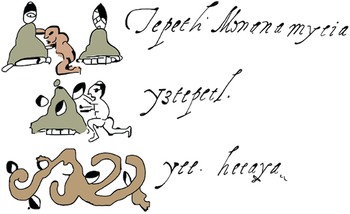
Interestingly, folio 2r of the previously mentioned CVA, which depicts the route through “mictlan,” suggests that, in this context as well, the graphic symbol of itztli —the knife—evoked, alongside the freezing temperatures, human sacrifice. In this source, knives mark graphically several “stations” of “mictlan”: Itzehecayan (“Place/Time of Obsidian Winds”), Itztepetl (“Obsidian Mountain”), and even Tepetl Imonamiquiyan (“Narrow Passage Between Mountains”), whose name does not include the morpheme itz (Figure 9). Other “stations,” not marked by knives, allude to sacrifice in different ways. Pancuecuetlacayan, “Place/Time of Rustling Flags,” refers to paper flags commonly carried by Nahua sacrificial victims (Mikulska Reference Mikulska, Barrio and Rosado2016). Temiminaloyan, “Where/When People Are Shot,” makes one think of both a sacrifice carried out by arrows (tlacacaliztli) and hunting as a metaphor for human sacrifice. Finally, Teyollocualoyan, “Where/When People’s Hearts are Eaten” hints at the sacrifice by cardiectomy, which resulted in the Sun God consuming the vital energy of the victim, presented to him by the priest holding up the freshly extracted heart (Durán 2006 [Reference Durán and Kintana1967]:vol. I, ch. IV, p. 44; HMP Reference Tena2002:40–41). Thus, what has traditionally been understood as “obstacles” or “stations” encountered by the dead on their way to the realm of Mictlanteuctli, in CVA, is also an accumulation of symbols associated with human sacrifice. In terms proposed by Dehouve (Reference Dehouve, Mikulska and Offner2019), it is a series that defines sacrifice by extension, referring to its different forms and symbols. The final “station” provides a term that seems to integrate all the previous names and representations: “Itzmictlan,” “Obsidian Mictlan.”
Top to bottom: Tepetl Imonamiquiyan, Itztepetl, and Itzehecayan marked with sacrificial knives. CVA:f. 2r. Drawing by Katarzyna Mikulska.

Figure 9 Long description
The illustration depicts three distinct scenes. At the top, two figures are seated beside a smaller figure, labeled 'Tepetl Imonamiquiyan.' In the middle, a figure is positioned next to a mountain-like shape, labeled 'Itztepetl.' At the bottom, a serpentine form is labeled 'Itzehecayan.' Each scene includes sacrificial knives, emphasizing the theme of sacrifice.
Again, Nahua otherworlds prove not to be specific places or “lands of the dead” but sets of logically connected symbols that allow one to produce associations and create narratives. The metamorphoses of Topiltzin Quetzalcoatl led him through Tlillan Tlapallan and the transformative Mictlan first to Tlahuizcalli and then to a domain that recalled the CVA’s Itzmictlan. Each of the latter two domains fits the god’s changing identity and status: first, glowing and bellicose; then, cold and defeated. Tlahuizcalli is the conceptual domain of early morning, eastern sky, light, action, and war; its symbol is darts, and its two principal agents are the young, powerful Sun and the bellicose Tlahuizcalpanteuctli-Venus. This set of associations contrasts with the domain of Venus’s demise. Its symbolism is that of Itzmictlan, or the transient “obsidian mictlan,” in which the obsidian knife symbolizes cold and sacrifice—the latter understood as a means of transformation and passage to the next stage. Like Tlahuizcalli, Itzmictlan encompasses the eastern, still cold sky, but also passivity, sacrifice, death, and transition. Its agents are the sacrificed Itztlacoliuhqui and the divine personification of the knife—Itztli.
Chiucnauhnepaniuhcan
The Leyenda de los Soles mysteriously claims that when the Sun’s dart hit Tlahuizcalpanteuctli-Frost, the latter’s face was veiled with nine nepaniuhqui (auh niman ic quihuallixtlapacho in chiucnauhnepaniuhqui; LS 2011 [Reference Bierhorst1992]:91). The Nahuatl text uses here the same verb (ixtlapachoa) that, in Book Eight of FC, describes a ritual performed on a candidate for the Mexica ruler. At one point in the installation ceremony, the priests stripped the candidate naked and veiled his face (conjxtlapachoa) with a green cape designed with bones (Sahagún 1950–Reference Sahagún, Anderson and Dibble1982:bk. 8, ch. 18, p. 62). This act was one of several aimed at inducing the candidate in the state of ritual death from which he would emerge reborn as a ruler (Madajczak Reference Madajczak2024:394–395; Olivier Reference Olivier and Sule2004:148–154, Reference Olivier and Olivier2008:265–267). We can presume that the nine nepaniuhqui veil had a similar effect on Frost (Itztlacoliuhqui). The Sun’s dart did not annihilate him; instead, it disabled him for some time, presumably until the following day, when the duel would repeat. The veil that put Itztlacoliuhqui in a death-like state is one of the diagnostic features of this god in the pre-Hispanic codices, where it covers his face (Mikulska Reference Mikulska2026a).
Nine nepaniuhqui was a veil that brought on one temporal death or a deep, death-like sleep. The word nepaniuhqui is an agentive form of the verb nepanihui, “to be joined,” meaning “that which is joined” (Gran Diccionario Náhuatl 2012; Mikulska Reference Mikulska and Díaz2015a:127). The domain of nine nepaniuhqui was called Nine Nepaniuhcan (chiucnauhnepaniuhcan), which we translate as the “Nine Place/Time of That Which is Joined,” or the “Nine Place/Time of Juncture.” This term was once considered an argument in favor of the vertical model of the Nahua cosmos (e.g., Andrews and Hassig Reference Andrews, Hassig and de Alarcón1984:21; López Austin 1984 [1980]:226–228, Reference López Austin2000:90–91). López Austin translated it as “the place of nine levels,” but considering recent research casting doubt on the pre-contact origin of a multitiered model, such an interpretation cannot be upheld. Díaz (Reference Díaz2009:20) observed that in the colonial Nahuatl term for a crossing—the central part of a cruciform church—huitoliuhcanepaniuhqui, the noun nepaniuhqui refers to a union of horizontally collocated elements. Independently, Nielsen and Sellner (Reference Nielsen and Sellner2009:404) scrutinized the term chicnauhtlanepaniuhcan from the incantations gathered by Ruiz de Alarcón (Reference Ruiz de Alarcón, Andrews and Hassig1984:166) and concluded that it referred to “a place where nine entities are united or fitted together” rather than placed on top of each other. Earlier authors (e.g., García Quintana Reference García Quintana1969:201–203) also sometimes translated chiucnauhnepaniuhcan as “lugar de las nueve confluencias” or “the place of nine connections.” However, we must make one more adjustment in the reading of Nine Nepaniuhcan. As evident from previously cited research by Dehouve (Reference Dehouve2011:169) and Mikulska (Reference Mikulska and Díaz2015a:125–138, 161), the number nine serves not as a count of nine entities, but rather as a “semantic qualifier” or a carrier of particular meaning. Arguably, it allows one to assign nepaniuhcan (Place/Time of Juncture) to the realm of nine: the distant otherworld of origin, creation, destruction, and transformation.
While the majority of our data on Nine Nepaniuhcan derive from sources produced by Sahagún’s collaborators, such as Leyenda or FC, a seventeenth-century medical incantation recorded in a Nahuatl-speaking community in today’s Guerrero provides an important complement to the older material. In this text, the term chicnauhtlanepaniuhcan refers to where the tonalli, or life force, of a sick child goes (Ruiz de Alarcón Reference Ruiz de Alarcón, Andrews and Hassig1984:166). Two reasons may have led the chanting physician to choose this concept. First, the departure of tonalli caused a person to become passive and drowsy, gradually losing energy until the patient died if the tonalli was not restored in time (López Austin 1984 [1980]:248–249). The sick child in Ruiz de Alarcón’s incantations was thus like the semi-dead, passive Itztlacoliuhqui, with his face covered by nine nepaniuhqui. This feature of deep sleep or temporal death characteristic of the nahualli from the Place/Time of Eight discussed earlier could associate nepaniuhcan with the realm of contact and transit. Nevertheless, the qualifier “nine” directs the focus to its association with the realm of origin and transformation and provides the second reason for the physician’s choice: it suggests that the child’s tonalli returned to its point of origin. Sixteenth-century Nahuatl texts frequently juxtapose Nine Nepaniuhcan with Omeyocan, the residence of creator gods and the source of human lives (AC 2011 [Reference Bierhorst1992]:8; CVA:f. 1v; Mikulska Reference Mikulska2008a:154–155, Reference Mikulska2008b:231, 2015:125–127; Sahagún 1950–Reference Sahagún, Anderson and Dibble1982 bk. 6, ch. 32, pp. 175–176), which later sources further corroborate. In another medical case described by Ruiz de Alarcón (Reference Ruiz de Alarcón, Andrews and Hassig1984:190), a physician again heads to the realm of nine—this time to Nine Mictlan, a deposit of life-generating bones—to repair a fractured bone. The fact that the patients themselves could not make this trip but had to rely on a specialist equipped with supernatural powers is also telling. Communication and proximity were not the most stressed features of Nine Nepaniuhcan. The qualifier “nine” placed it in the most dangerous and distant part of the otherworld, governed by gods like Ometeuctli and Mictlanteuctli.
Like Tlillan Tlapallan, Tlahuizcalli, or Itzmictlan, Nine Nepaniuhcan was not (just) a “place” or even “place/time,” although it was associated with the eastern sky and the early morning. It was a conceptual domain and, as such, it encompassed many more elements: its name activated associations with the realm of origin, loss of consciousness or vital powers, the thin line between life and death, and the juncture between night and day. The Nine Nepaniuhcan’s agents were the deactivated Itztlacoliuhqui-Frost, the creator gods, such as Ometeuctli, and the religious specialists who could access this domain.
The sacred story about the first dawn offers us a deeper understanding of the Nahua otherworlds than the Sahaguntine descriptions of Mictlan, Tlalocan, and Tonatiuh Ichan, which are molded into encyclopedic entries. The story demonstrates how oral and written traditions integrated these concepts. Most strikingly, it is “staged” in more than one domain, which would not have been possible if domains had only had a spatial dimension. Since otherworlds are not mere “regions,” they can partially overlap while, at the same time, emphasizing different points: Tlahuizcalli focuses on light and war, Itzmictlan on cold and sacrifice, and Chiucnauhnepaniuhcan on temporal deactivation. The signs (in Peircean terms) of darts, obsidian knives, and the nine nepaniuhqui blindfold allow for the concentration of complex meanings in a sacred story through a few names or graphic representations.
Conclusions
Before questioning the “Sahaguntine paradigm,” authors traditionally referred to concepts like “Tlalocan,” “Tonatiuh Ichan,” “Mictlan,” or “Tlillan Tlapallan” as “regions,” “spaces,” or “places.” This perspective was very “topographic” and easily grasped by a Westerner. It was also not contradictory to Nahua and other Mesoamerican accounts (some of which we have discussed in this article), which indeed phrase or represent the journeys to the otherworld as movement through various places. Some of the otherworldly landscapes, such as the deserts of the north, the ocean, and the mountains, could even be precisely located on a map of Mexico, suggesting they had real-life models. However, the hypotheses of our predecessors regarding the cyclical and dynamic nature of the Nahua otherworlds have paved the way for a more nuanced understanding of what were previously considered supernatural “regions.”
As we have seen, accounts of journeys to the world beyond suggest that this world was organized by two qualities, symbolized by the numbers eight and nine. The number nine described the part of the cosmos associated with the annihilation of individuals and their transformation into resources that the gods would then return to earth. In spatial terms, this realm of origin and destruction was located at the farthest extremes of the known world, on the other side of the ocean, and encompassed such domains as Nine Mictlan, Nine Nepaniuhcan, Ximohuayan, or Quenamican. Only gods could have freely moved between this realm and the earth, and if tonalli of regular people wandered there due to their sickness, it had to be retrieved relatively quickly by a religious specialist. The number eight, in turn, qualified the part of the cosmos that allowed for communication with gods through sacrifice, supernatural travels, or activities performed while asleep. Additionally, this realm, to which sources often ascribe “mictlan,” Tlalocan, and Tonatiuh Ichan, was a transitional one, which meant that the dead could pass through it on their way to the “nine” realm. However, as our necessity to distinguish the transient “mictlan” from the Mictlan of Mictlanteuctli exemplifies, the same term could have been used to describe domains in both parts of the world beyond. In other words, the three canonical afterworlds could qualify as either “eight” or “nine,” depending on the goals of the narrator. It was a flexible, living classification.
Our preference to refer to Nahua after- and otherworlds with the term “domains” results from our discussion of Tlillan Tlapallan, Tlahuizcalli, Itzmictlan, and Chiucnauhnepaniuhcan. The evidence demonstrates that, rather than spaces or even time-spaces, they were conceptual domains encompassing different locations, times, gods, and other nonhuman beings, as well as attributes, symbols, potential actions, and ontological states. These domains sometimes partially overlapped. For example, Tlillan Tlapallan, Tlahuizcalli, Itzmictlan, and Chiucnauhnepaniuhcan all referred to a frontier between light and darkness—or darkness and light. However, this does not mean they were synonyms or that one was “located” within the other. Although they might have shared some features, each emphasized slightly different phenomena, which made them all necessary in describing the transformations of Topiltzin Quetzalcoatl. Tlillan Tlapallan would manifest at sunset and encompassed elements that allowed the narrator to represent Sun’s death; Tlahuizcalli was a domain of active fighting and the temporary triumph of the morning Venus or Tlahuizcalpanteuctli, who was Tlahuizcalli’s lord; Itzmictlan was a domain of sacrifice, witnessing the defeat of Tlahuizcalpanteuctli-Itztlacoliuhqui; and Chiucnauhnepaniuhcan was a domain of temporal deactivation that carried a potential of repeating the fight the next day. Tlahuizcalpanteuctli could not have been born or defeated in Tlillan Tlapallan. Each domain had its specific role in the day cycle.
In this article, we chose not to discuss Tlalocan and Tonatiuh Ichan. Still, we believe that their names, as well as those of Chichihualcuauhco, Ximohuayan, Quenamican, Atlecalocan, Tamoanchan, etc., were used according to the same rules as those of the four domains discussed earlier. By using these names or their corresponding graphic representations, a Nahua author activated a spectrum of associations that immediately ran through his audience’s minds, constructing a rich world from the condensed symbols. Understanding the Nahua afterworlds as conceptual domains rather than the postmortem destinations of the fixed categories of the dead sheds new light on a European question: “Where would the Nahua dead go?” The answer to that would depend on which associations the storyteller wanted to emphasize and on their current focus. This is why warriors and sacrificial victims could travel to the Home of the Sun or Tlalocan—both of which were usually of a transient nature—as well as to the distant Ximohuayan or Quenamican, associated with decay and transformation. The same “category” of the dead could have been imagined in different “destinations,” each signaling a different status or role for these people. Simultaneously, the “afterworlds” were never just domains of the dead; they also housed an array of gods and other supernatural beings, serving purposes unrelated to the afterlife, such as storing prophecies, artifacts from past eras, and cultural inventions.
Acknowledgements
We would like to thank the CEM+ research group at the University of Warsaw, Faculty of Modern Languages (Agnieszka Brylak, Justyna Kowalczyk-Kądziela, Tonne de Andrade Nardi, Gabriela Piszczatowska, Katarzyna Szoblik, Katarzyna Wągrodzka) for discussing this research with us over several meetings. The detailed comments of Katarzyna Szoblik, Agnieszka Brylak, and the anonymous reviewers helped us immensely in refining our argument, for which we are very grateful.
Competing interests
The authors declare none.
Data availability statement
The data that support the findings of this study derive from published and unpublished historical documents, available at libraries and archives worldwide.
Funding statement
This research was funded by the National Science Center of Poland, project No. 2019/33/B/HS3/00528.

 Open access

