


Highlights
What is already known?
In random-effects meta-analysis, the between-study heterogeneity variance,
$\tau ^2$
 , is often reported but is not easy to interpret. For meta-analyses of differences, the standard deviation (SD),
$\tau $
, is often reported but is not easy to interpret. For meta-analyses of differences, the standard deviation (SD),
$\tau $
 , is helpful to understand the extent to which studies’ true differences vary about their average.
What is new?
For meta-analyses of ratios (such as odds ratios, risk ratios, etc.), the geometric SD,
$\exp (\tau )$
 , is helpful to understand the extent to which studies’ true ratios vary multiplicatively about their average.
Potential impact for RSM readers
We recommend that authors and software developers report
$\tau $
 for differences and
$\exp (\tau )$
for differences and
$\exp (\tau )$
 for ratios, rather than
$\tau ^2$
for ratios, rather than
$\tau ^2$
 . This will facilitate the interpretation of the magnitude of heterogeneity values, for example, the interpretation of heterogeneity estimates and confidence intervals beyond simple binary statements about the presence or absence of heterogeneity.
1 Introduction
In random-effects meta-analysis, the distribution of underlying true effect sizes is modeled. The extent of heterogeneity (i.e., how studies’ true effects vary about their average) is very important. For example, an estimate of heterogeneity can substantially influence the calculation of i) a confidence interval (CI) of the average effectReference Viechtbauer1 and ii) a prediction interval for the true effect of the next study.Reference Higgins, Thompson and Spiegelhalter2
Although heterogeneity values appear in various graphs, tables, and text,Reference Viechtbauer1–
Reference Röver, Rindskopf and Friede4 they are often expressed in a way that does not facilitate understanding. For example, the heterogeneity variance (
$\tau ^2$
 ) is reported more frequently than the standard deviation (SD,
$\tau $
) is reported more frequently than the standard deviation (SD,
$\tau $
 ).Reference Borenstein5 For meta-analyses of differences (such as mean differences, standardized mean differences [SMDs], or risk differences),
$\tau $
).Reference Borenstein5 For meta-analyses of differences (such as mean differences, standardized mean differences [SMDs], or risk differences),
$\tau $
 is on the same scale and is easier to interpret.Reference Borenstein5 For meta-analyses of ratios (such as odds ratios, risk ratios [RRs], hazard ratios, incidence rate ratios, and ratios of means or response ratios),
$\tau $
is on the same scale and is easier to interpret.Reference Borenstein5 For meta-analyses of ratios (such as odds ratios, risk ratios [RRs], hazard ratios, incidence rate ratios, and ratios of means or response ratios),
$\tau $
 (the SD of log-transformed ratios) is on the logarithmic scaleReference Röver, Bender and Dias6 and is less obviously interpretable.
In this article, we explain how
$\tau $
 is helpful to understand the heterogeneity of differences and how
$\exp (\tau )$
is helpful to understand the heterogeneity of differences and how
$\exp (\tau )$
 is helpful to understand the heterogeneity of ratios. We also explain how some values of
$\tau $
is helpful to understand the heterogeneity of ratios. We also explain how some values of
$\tau $
 itself can be meaningfully interpreted for ratios in an Appendix of the Supplementary Material. We recommend that authors and software developers replace the reporting of
$\tau ^2$
itself can be meaningfully interpreted for ratios in an Appendix of the Supplementary Material. We recommend that authors and software developers replace the reporting of
$\tau ^2$
 with more accessible formulations of heterogeneity. This will facilitate the interpretation of the magnitude of heterogeneity values, for example, the interpretation of heterogeneity estimates and CIs beyond simple binary statements about the presence or absence of heterogeneity.
2 Random-effects models
2.1 Differences
We consider a meta-analysis model of difference measures of effect, with a focus on SMDs. Let
$\theta _i$
 denote the true SMD for study
$i \ (i = 1, \ldots , k)$
denote the true SMD for study
$i \ (i = 1, \ldots , k)$
 . A random-effects model for SMDs can be described in terms of the true SMD
$\theta _i$
. A random-effects model for SMDs can be described in terms of the true SMD
$\theta _i$
 , the observed SMD
$\widehat {\theta }_i$
, the observed SMD
$\widehat {\theta }_i$
 , and its standard error
$\sigma _i$
, and its standard error
$\sigma _i$
 . A popular modelReference Röver, Bender and Dias6 is
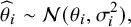
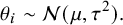
The modeled distribution of true SMDs is a normal distribution with mean
$\mu $
 and SD
$\tau $
and SD
$\tau $
 . Therefore, the interval
$[\mu - \tau , \mu + \tau ]$
. Therefore, the interval
$[\mu - \tau , \mu + \tau ]$
 covers approximately 68% (or 2/3) of the distribution and the interval
$[\mu - 2\tau , \mu + 2\tau ]$
covers approximately 68% (or 2/3) of the distribution and the interval
$[\mu - 2\tau , \mu + 2\tau ]$
 covers approximately 95% (or 19/20) of the distribution (as does the interval
$[\mu - 1.96\tau , \mu + 1.96\tau ]$
covers approximately 95% (or 19/20) of the distribution (as does the interval
$[\mu - 1.96\tau , \mu + 1.96\tau ]$
 ). We will refer to such intervals as 68% and 95% ranges.
2.2 Ratios
We now consider a meta-analysis model of ratio measures of effect, with a focus on RRs. Throughout, log denotes the natural logarithm.
Let
$\alpha _i$
 denote the true RR for study
$i \ (i = 1, \ldots , k)$
denote the true RR for study
$i \ (i = 1, \ldots , k)$
 . A random-effects model for RRs is typically described in terms of the true log RR (
$\theta _i = \log \alpha _i$
. A random-effects model for RRs is typically described in terms of the true log RR (
$\theta _i = \log \alpha _i$
 ), the observed log RR (
$\widehat {\theta }_i$
), the observed log RR (
$\widehat {\theta }_i$
 ), and its standard error (
$\sigma _i$
), and its standard error (
$\sigma _i$
 ) using (1) and (2).
We now focus on describing the modeled distribution of true RRs,
$\alpha _i = \exp (\theta _i)$
 . A lognormal distribution is implied, and the geometric mean (GM) and median of the distribution are
$\exp (\mu )$
. A lognormal distribution is implied, and the geometric mean (GM) and median of the distribution are
$\exp (\mu )$
 . A pooled or overall RR from a meta-analysis is an estimate of the
$\mathrm {{GM}}$
. A pooled or overall RR from a meta-analysis is an estimate of the
$\mathrm {{GM}}$
 . There are several ways to describe variation about the
$\mathrm {{GM}}$
. There are several ways to describe variation about the
$\mathrm {{GM}}$
 .Reference Kirkwood7,
Reference Chatfield, Marquart-Wilson, Dobson and Farewell8 We explain the simplest way by using
$\exp (\tau )$
.Reference Kirkwood7,
Reference Chatfield, Marquart-Wilson, Dobson and Farewell8 We explain the simplest way by using
$\exp (\tau )$
 below, and an alternative way using
$\tau $
below, and an alternative way using
$\tau $
 directly in the Appendix of the Supplementary Material.
The geometric SD of the modeled distribution of true RRs is
$\exp (\tau )$
 . It quantifies variation about the
$\mathrm {{GM}}$
. It quantifies variation about the
$\mathrm {{GM}}$
 in a multiplicative manner.Reference Kirkwood7 Approximately 68% of the distribution lies in the interval
$[\mathrm {LB}1, \mathrm {UB}1]$
in a multiplicative manner.Reference Kirkwood7 Approximately 68% of the distribution lies in the interval
$[\mathrm {LB}1, \mathrm {UB}1]$
 , where

Approximately 95% of the distribution lies in the interval
$[{\mathrm {{LB}}}2, {\mathrm {{UB}}}2]$
 , where

2.3 Prediction intervals
Reporting a prediction interval for the true effect of the next studyReference Higgins, Thompson and Spiegelhalter2, Reference Mátrai, Kói, Sipos and Farkas9 is recommended by many.Reference Borenstein5, Reference Higgins, Thomas and Chandler10, Reference IntHout, Ioannidis, Rovers and Goeman11 Most software packages will calculate and display a prediction interval on a forest plot.
Assuming that



Higgins et al.Reference Higgins, Thompson and Spiegelhalter2 proposed an approximate 95% prediction interval for
$\theta _{k+1}$
 is
is
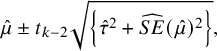
where
$t_{k-2}$
 is the 0.975 quantile of the t-distribution with
$k-2$
is the 0.975 quantile of the t-distribution with
$k-2$
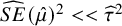
 degrees of freedom. A 95% prediction interval calculated this way will be similar to the 95% range when
$\hat {\mu } \approx \mu $
degrees of freedom. A 95% prediction interval calculated this way will be similar to the 95% range when
$\hat {\mu } \approx \mu $
 ,
$\hat {\tau } \approx \tau $
,
$\hat {\tau } \approx \tau $
 , the number of studies in a meta-analysis is not small, and
$\widehat {SE}(\hat {\mu })^2 << \widehat {\tau }^2$
, the number of studies in a meta-analysis is not small, and
$\widehat {SE}(\hat {\mu })^2 << \widehat {\tau }^2$
 .
.
However, a prediction interval will not convey the (often considerable) uncertainty in the estimate of
$\tau $
 . Therefore, a 95% CI for
$\tau $
. Therefore, a 95% CI for
$\tau $
 provides valuable information in addition to a prediction interval.Reference Higgins, Thompson and Spiegelhalter2
3 Examples
3.1 Differences
Roberts et al.Reference Higgins, Thompson and Spiegelhalter2,
Reference Roberts, Tchanturia, Stahl, Southgate and Treasure12 performed meta-analysis on 14 studies comparing the time to complete a trail making task between people with eating disorders and healthy controls. They calculated SMDs (Cohen’s d) and considered these effect sizes negligible if
$\geq -0.15$
 and
$<0.15$
and
$<0.15$
 , small if
$\geq 0.15$
, small if
$\geq 0.15$
 and
$<0.40$
and
$<0.40$
 , medium if
$\geq 0.40$
, medium if
$\geq 0.40$
 and
$<0.75$
and
$<0.75$
 , large if
$\geq 0.75$
, large if
$\geq 0.75$
 and
$<1.10$
and
$<1.10$
 , very large if
$\geq 1.10$
, very large if
$\geq 1.10$
 and
$<1.45,$
and
$<1.45,$
 and huge if
$\geq 1.45$
and huge if
$\geq 1.45$
 . We performed a random-effects meta-analysis on the data and produced a forest plot showing an estimate and 95% CI for
$\tau $
. We performed a random-effects meta-analysis on the data and produced a forest plot showing an estimate and 95% CI for
$\tau $
 (Figure 1).
Random-effects meta-analysis comparing the time to complete a trail making task in people with eating disorders and healthy controls.Reference Higgins, Thompson and Spiegelhalter2,
Reference Roberts, Tchanturia, Stahl, Southgate and Treasure12 DerSimonian and Laird estimator of
$\tau $
 used. Figure produced using the R package meta.
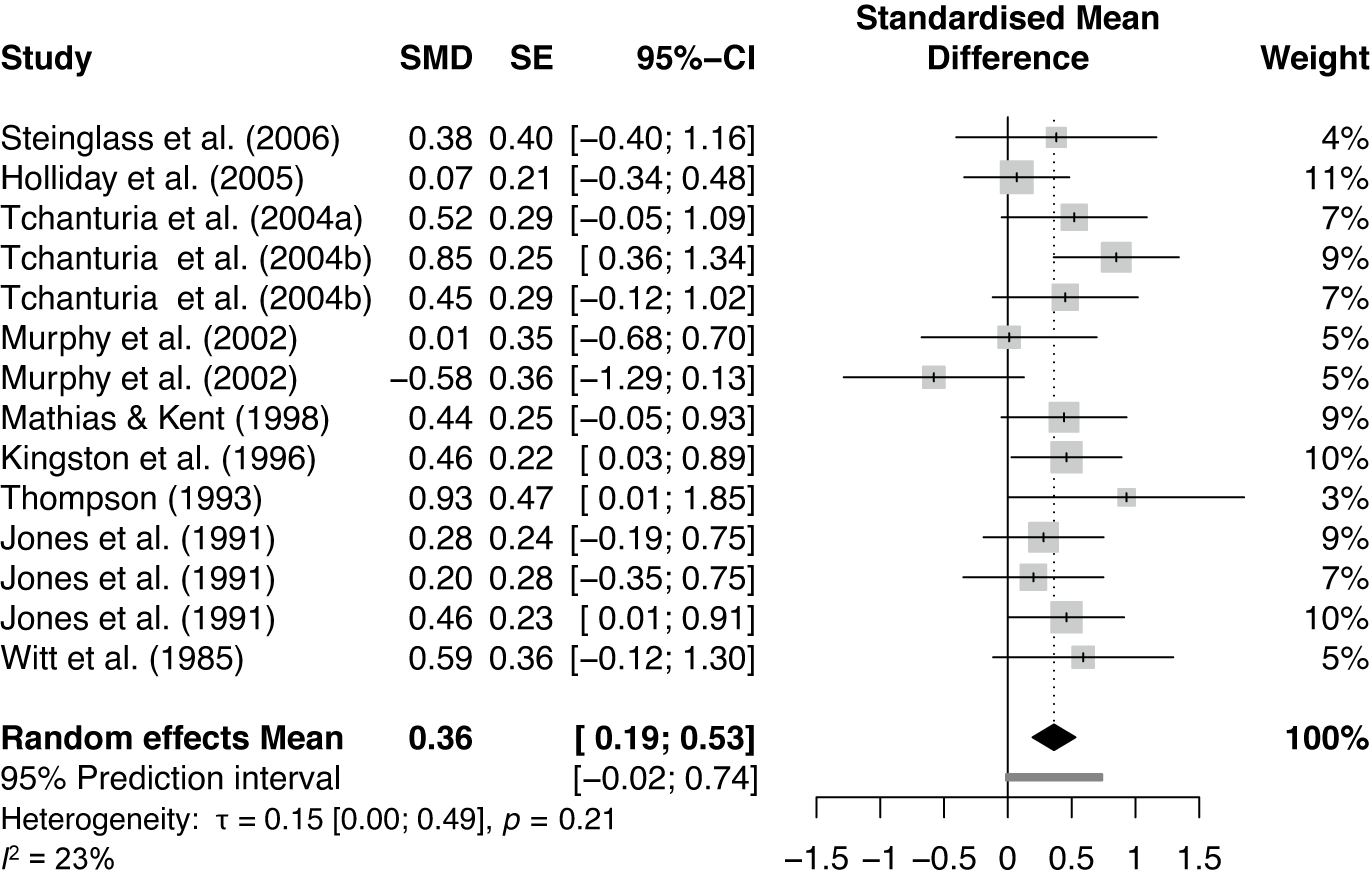
Figure 1 Long description
The forest plot contains columns for Study, S M D (Standardised Mean Difference), S E (Standard Error), 95 percent C I (Confidence Interval), a visual plot of the S M D, and Weight.
Individual study data from top to bottom:
* Steinglass et al. 2006: S M D 0.38, S E 0.40, C I -0.40 to 1.16, Weight 4 percent.
* Holliday et al. 2005: S M D 0.07, S E 0.21, C I -0.34 to 0.48, Weight 11 percent.
* Tchanturia et al. 2004a: S M D 0.52, S E 0.29, C I -0.05 to 1.09, Weight 7 percent.
* Tchanturia et al. 2004b: S M D 0.85, S E 0.25, C I 0.36 to 1.34, Weight 9 percent.
* Tchanturia et al. 2004b (second entry): S M D 0.45, S E 0.29, C I -0.12 to 1.02, Weight 7 percent.
* Murphy et al. 2002: S M D 0.01, S E 0.35, C I -0.68 to 0.70, Weight 5 percent.
* Murphy et al. 2002 (second entry): S M D -0.58, S E 0.36, C I -1.29 to 0.13, Weight 5 percent.
* Mathias and Kent 1998: S M D 0.44, S E 0.25, C I -0.05 to 0.93, Weight 9 percent.
* Kingston et al. 1996: S M D 0.46, S E 0.22, C I 0.03 to 0.89, Weight 10 percent.
* Thompson 1993: S M D 0.93, S E 0.47, C I 0.01 to 1.85, Weight 3 percent.
* Jones et al. 1991: S M D 0.28, S E 0.24, C I -0.19 to 0.75, Weight 9 percent.
* Jones et al. 1991 (second entry): S M D 0.20, S E 0.28, C I -0.35 to 0.75, Weight 7 percent.
* Jones et al. 1991 (third entry): S M D 0.46, S E 0.23, C I 0.01 to 0.91, Weight 10 percent.
* Witt et al. 1985: S M D 0.59, S E 0.36, C I -0.12 to 1.30, Weight 5 percent.
Summary Statistics at the bottom:
* Random effects Mean: S M D 0.36, 95 percent C I 0.19 to 0.53, represented by a black diamond on the plot centered at 0.36.
* 95 percent Prediction interval: -0.02 to 0.74, shown as a grey horizontal bar.
* Heterogeneity: tau = 0.15, p = 0.21, I super 2 = 23 percent.
* Total Weight: 100 percent.
The X-axis for the Standardised Mean Difference ranges from -1.5 to 1.5 with a vertical line of no effect at 0. Most studies show a positive S M D, indicating longer completion times for the eating disorder group.
In this example, the mean [95% CI] of the modeled distribution of true SMDs was estimated to be
$\widehat {\mu }=0.36 \ [0.19, 0.53]$
 . The estimated SD of that distribution was
$\widehat {\tau }=0.15$
. The estimated SD of that distribution was
$\widehat {\tau }=0.15$
 , which corresponds to a 68% range of
$[\mu - 0.15, \mu + 0.15]$
, which corresponds to a 68% range of
$[\mu - 0.15, \mu + 0.15]$
 and a 95% range of
$[\mu - 0.30, \mu + 0.30]$
and a 95% range of
$[\mu - 0.30, \mu + 0.30]$
 when a normal distribution is assumed. For example, if
$\mu $
when a normal distribution is assumed. For example, if
$\mu $
 was 0.35, then the 68% range would be
$[0.2,0.5]$
was 0.35, then the 68% range would be
$[0.2,0.5]$
 and the 95% range would be
$[0.05,0.65]$
and the 95% range would be
$[0.05,0.65]$
 . We view this as a substantial amount of heterogeneity in this context. The 95% CIReference Viechtbauer1 for
$\tau $
. We view this as a substantial amount of heterogeneity in this context. The 95% CIReference Viechtbauer1 for
$\tau $
 was [0, 0.49], indicating that a degenerate distribution (homogeneity) is possible, as is a distribution with a huge SD (if
$\tau =0.49,$
was [0, 0.49], indicating that a degenerate distribution (homogeneity) is possible, as is a distribution with a huge SD (if
$\tau =0.49,$
 then the 95% range is
$[\mu - 0.98, \mu + 0.98]$
then the 95% range is
$[\mu - 0.98, \mu + 0.98]$
 ). It is clear that there is considerable uncertainty in the SD of this distribution. These interpretations are readily apparent because an estimate and CI for
$\tau $
). It is clear that there is considerable uncertainty in the SD of this distribution. These interpretations are readily apparent because an estimate and CI for
$\tau $
 were reported. This provides a more informative and nuanced understanding than a binary statement, such as “heterogeneity was present (
$\widehat {\tau }>0$
were reported. This provides a more informative and nuanced understanding than a binary statement, such as “heterogeneity was present (
$\widehat {\tau }>0$
 )” or “no evidence of heterogeneity was found (
$p=0.21$
)” or “no evidence of heterogeneity was found (
$p=0.21$
 ).”
).”
3.2 Ratios
The bacille Calmette–Guérin (BCG) vaccine is used to prevent tuberculosis. Colditz et al.Reference Colditz, Brewer and Berkey13 performed a meta-analysis on the efficacy of the vaccine using RRs from 13 randomized trials. We performed a random-effects meta-analysis on the data and produced a forest plot showing an estimate and 95% CI for
$\exp (\tau )$
 (Figure 2).
Random-effects meta-analysis comparing the risk of tuberculosis (TB) between vaccine and control groups.Reference Colditz, Brewer and Berkey13 REML estimator of
$\tau $
 used. Figure produced using the R package meta with some manual editing.
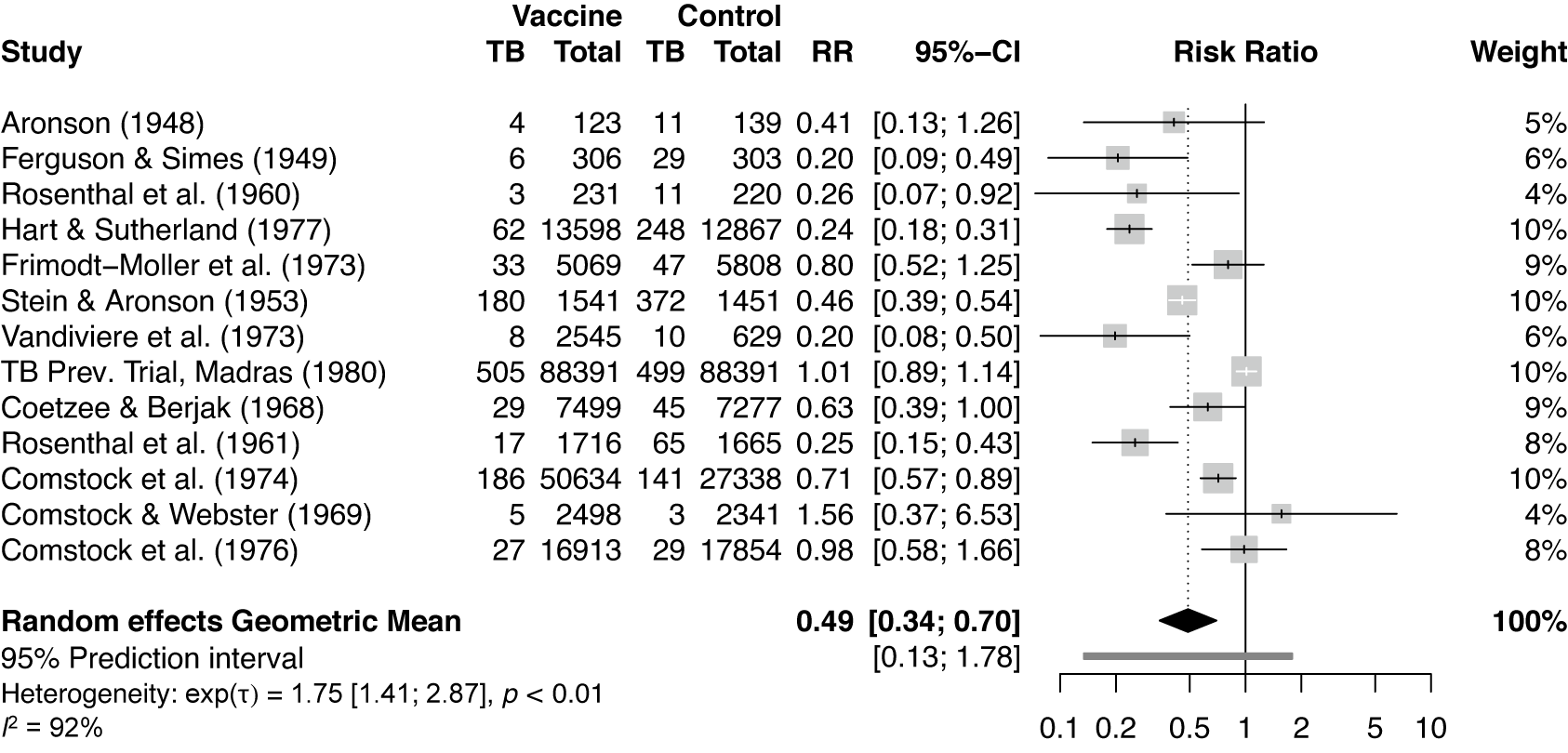
Figure 2 Long description
The table contains columns for Study, Vaccine T B and Total, Control T B and Total, R R, 95% C I, Risk Ratio plot, and Weight.
Individual study data includes
* Aronson 1948. R R 0.41, 5% weight.
* Ferguson and Simes 1949. R R 0.20, 6% weight.
* Rosenthal et al. 1960. R R 0.26, 4% weight.
* Hart and Sutherland 1977. R R 0.24, 10% weight.
* Frimodt-Moller et al. 1973. R R 0.80, 9% weight.
* Stein and Aronson 1953. R R 0.46, 10% weight.
* Vandiviere et al. 1973. R R 0.20, 6% weight.
* T B Prev. Trial, Madras 1980. R R 1.01, 10% weight.
* Coetzee and Berjak 1968. R R 0.63, 9% weight.
* Rosenthal et al. 1961. R R 0.25, 8% weight.
* Comstock et al. 1974. R R 0.71, 10% weight.
* Comstock and Webster 1969. R R 1.56, 4% weight.
* Comstock et al. 1976. R R 0.98, 8% weight.
The Risk Ratio plot uses a logarithmic x-axis ranging from 0.1 to 10. A vertical dashed line marks the null effect at 1. Most studies show a risk reduction with squares positioned to the left of the null line.
Summary statistics at the bottom
* Random effects Geometric Mean. 0.49 with 95% C I of 0.34 to 0.70, represented by a black diamond centered at 0.49.
* 95% Prediction interval. 0.13 to 1.78, shown as a horizontal grey bar.
* Heterogeneity. exp tau equals 1.75, p less than 0.01, I-squared equals 92%.
The GM [95% CI] of the modeled distribution of true RRs was estimated to be
$\widehat {{\mathrm {{GM}}}} = 0.49 \ [0.34, 0.70]$
 . The estimated geometric SD was
$\exp (\widehat {\tau })=1.75$
. The estimated geometric SD was
$\exp (\widehat {\tau })=1.75$
 , which corresponds to a 68% range of
$[{\mathrm {{GM}}} / 1.75, {\mathrm {{GM}}} \times 1.75]$
, which corresponds to a 68% range of
$[{\mathrm {{GM}}} / 1.75, {\mathrm {{GM}}} \times 1.75]$
 and a 95% range of
$[{\mathrm {{GM}}} / 1.75^2, {\mathrm {{GM}}} \times 1.75^2] = [{\mathrm {{GM}}} / 3.06, {\mathrm {{GM}}} \times 3.06]$
and a 95% range of
$[{\mathrm {{GM}}} / 1.75^2, {\mathrm {{GM}}} \times 1.75^2] = [{\mathrm {{GM}}} / 3.06, {\mathrm {{GM}}} \times 3.06]$
 when a lognormal distribution is assumed. For example, if the
$\mathrm {{GM}}$
when a lognormal distribution is assumed. For example, if the
$\mathrm {{GM}}$
 was 0.5, then the 68% range would be
$[0.29,0.88]$
was 0.5, then the 68% range would be
$[0.29,0.88]$
 and the 95% range would be
$[0.16,1.53]$
and the 95% range would be
$[0.16,1.53]$
 . We interpret this as considerable heterogeneity in the true RRs between trials. Repeating the process with the lower bound of the 95% CIReference Viechtbauer1 for
$\exp (\tau )$
. We interpret this as considerable heterogeneity in the true RRs between trials. Repeating the process with the lower bound of the 95% CIReference Viechtbauer1 for
$\exp (\tau )$
 (i.e., 1.41), if the
$\mathrm {{GM}}$
(i.e., 1.41), if the
$\mathrm {{GM}}$
 was 0.5, then the 68% range would be
$[0.35,0.71]$
was 0.5, then the 68% range would be
$[0.35,0.71]$
 and the 95% range would be
$[0.25,0.99]$
and the 95% range would be
$[0.25,0.99]$
 . These calculations are straightforward because an estimate and CI of
$\exp (\tau )$
. These calculations are straightforward because an estimate and CI of
$\exp (\tau )$
 were reported. Clearly, there is much heterogeneity here. This is more informative than a binary statement, such as “heterogeneity was present (
$\widehat {\tau }>0$
were reported. Clearly, there is much heterogeneity here. This is more informative than a binary statement, such as “heterogeneity was present (
$\widehat {\tau }>0$
 )” or “evidence of heterogeneity was found (
$p<0.01$
)” or “evidence of heterogeneity was found (
$p<0.01$
 ).”
).”
4 Conclusion
For meta-analyses of differences, we recommend reporting
$\tau $
 rather than
$\tau ^2$
rather than
$\tau ^2$
 . For meta-analyses of ratios, we recommend reporting
$\exp (\tau )$
. For meta-analyses of ratios, we recommend reporting
$\exp (\tau )$
 rather than
$\tau ^2$
rather than
$\tau ^2$
 . This will facilitate the interpretation of the magnitude of heterogeneity estimates. Similarly, reporting CIs or credible intervals for
$\tau $
. This will facilitate the interpretation of the magnitude of heterogeneity estimates. Similarly, reporting CIs or credible intervals for
$\tau $
 or
$\exp (\tau )$
or
$\exp (\tau )$
 will be more helpful than following the current recommendation to report intervals for
$\tau ^2$
will be more helpful than following the current recommendation to report intervals for
$\tau ^2$
 .Reference Viechtbauer1–
Reference Veroniki, Jackson and Viechtbauer3
.Reference Viechtbauer1–
Reference Veroniki, Jackson and Viechtbauer3
Author contributions
Conceptualization: M.D.C.; Formal analysis: M.D.C.; Supervision: L.M.-W., A.D., and D.F.; Writing—original draft: M.D.C.; Writing—review and editing: M.D.C., L.M.-W., A.D., and D.F.
Competing interest statement
The authors declare that no competing interests exist.
Data availability statement
Previously published summary data are provided in the figures and in an Excel file.
Funding statement
The authors declare that no specific funding has been received for this article.
Supplementary material
The supplementary material for this article can be found at https://doi.org/10.1017/rsm.2026.10075.



 Open access

