

Introduction
In an era of increasing multilevel government, public attitudes toward subnational government have become more important. There is a clear trend of increasing authority exercised by local and regional governments, and subnational authorities take decisions and have competence over policies that citizens care about (Hooghe et al. Reference Hooghe, Marks, Schakel, Niedzwiecki, Osterkatz and Shair-Rosenfield2016; Ladner et al. Reference Ladner, Keuffer, Baldersheim, Hlepas, Swianiewicz, Steyvers and Navarro2019). Public support for government at various territorial scales is crucial for the legitimacy of any multilevel governance system. Despite the important role that subnational governments play in current day democracies, there is surprisingly little research that focuses on public support for decisions taken by different government levels.
Studies that focus on acquiescence have pointed out that support for a decision depends on whom takes a decision and how the decision-making processes was conducted (Gibson, Caldeira and Spence Reference Gibson, Caldeira and Spence2005; Levi, Sacks and Tyler Reference Levi, Sacks and Tyler2009). This literature has not systematically explored whether public support varies depending on which level of government takes a decision and which government tiers are involved in the decision-making process. There are strong arguments to expect an impact of multilevel government on acquiescence. Decentralization boosts acceptance of governmental decisions because it increases congruence between citizens and their representatives (Arnesen and Peters Reference Arnesen and Peters2018) and between citizen’s policy preferences and adopted policies (Treisman Reference Treisman2007).
This paper theoretically and empirically explores whether and how acceptance of decisions depends on which government tiers are involved in taking the decisions. Our main argument is that acceptance of governmental decisions depends on citizens’ preferences for subnational authority. We hypothesize that citizens who prefer subnational authority are more supportive when subnational governments take decisions, and their support increases when a subnational government is involved in the decision-making process of another government.
The empirical focus is on Norway which serves as a least likely case to find differences in public support for decisions taken by different decision-takers and across different decision-making processes because Norwegians display high trust in both subnational and national governments and politicians (Denters Reference Denters2002; Stein et al. Reference Stein, Broderstad and Bjørnå2022). Norway is also a useful case to explore whether acquiescence differs across different subnational tiers because institutional legitimacy may be expected to be (much) higher for municipalities than for countries. Norway has a long-standing tradition of strong local democracy, but county government is often perceived by citizens to be less important than municipal government (Ervik Reference Ervik2012; Rose and Hansen Reference Rose, Hansen, Dandoy and Schakel2013; Stein et al. Reference Stein, Folkestad, Aars and Christensen2021).
We fielded a survey in November 2020 that asked 1,855 respondents to indicate their willingness to accept a decision taken by their municipality, their county, or the national government to close down an educational institution in their municipality (respectively a kindergarten, a secondary school, and a department of a university college). Respondents subsequently received a random treatment which informed them that a decision was supported by their municipality, their county, the national government, or a combination of two governments. We then asked respondents again for their willingness to accept the decision.
We find substantial empirical evidence for our hypotheses: a preference for subnational authority boosts the willingness to accept decisions taken by subnational governments and the involvement of a subnational government in the decision-making process increases the willingness to accept among respondents with strong preferences for subnational authority. Our findings have important implications because they reveal that it is vital to differentiate between different government levels when studying public support for governmental decisions. In addition, multilevel government is increasing across the globe, many countries have created new tiers of governance, and most countries have empowered their subnational governments (Hooghe et al. Reference Hooghe, Marks, Schakel, Niedzwiecki, Osterkatz and Shair-Rosenfield2016; Ladner et al. Reference Ladner, Keuffer, Baldersheim, Hlepas, Swianiewicz, Steyvers and Navarro2019). Our results point out that the extent to which decentralization increases the legitimacy of multilevel government depends on citizens’ preferences for subnational authority. Furthermore, our findings are important for the debate on the “virtues and vices” of multilevel government. Decentralization may improve congruence between citizens’ preferences and government policy and our results add another virtue: decisions which involve multiple levels of government enjoy higher levels of public support. These benefits need to be weighed against the possible drawbacks of multilevel government such as blurring of attribution of responsibility (León Reference León2011) and hampering political responsiveness (Däubler et al. Reference Däubler, Müller and Stecker2018).
The next section presents a discussion of the literatures that focus on acquiescence to governmental decisions and public support for subnational government. In the third section we develop our hypotheses and in the fourth section we present our survey question design to assess the willingness to accept decisions taken by different levels of government. Data and methods are discussed in the fourth section and the results are presented in the fifth section. The final section discusses the implications of the results and considers avenues for further research.
Public support for subnational government and legitimacy of government decisions
Previous research on the legitimacy of governmental decisions have mainly focused on impact of the type of decision-maker and characteristics of the decision-making process (Levi et al. Reference Levi, Sacks and Tyler2009; Magalhães and Aguiar-Conraria Reference Magalhães and Aguiar-Conraria2019). For example, Esaiassion et al. (Reference Esaiasson, Persson, Gilljam and Lindholm2019: 295) differentiate between elected representatives, expert administrators, judges, and citizens in referendums because each have different characteristics that impact citizens’ perceptions of the legitimacy of decisions. The characteristics of the decision-making procedure are also important. For instance, Porumbescu and Grimmelikhuijsen (Reference Porumbescu and Grimmelikhuijsen2018) find that citizens are less willing to voice opposition to government decisions when a decision-making process is perceived to be fair and transparent but, when the decision-making process is deemed to be unfair, greater transparency does not increase the willingness to voice opposition (see also Arnesen Reference Arnesen2017).
Research on support for governmental decisions has not systematically explored whether acquiescence varies depending on which level of government takes a decision. Most often, national actors feature in experimental survey designs and when subnational actors are included, they are compared to non-governmental actors (Gibson Reference Gibson1989; Gibson et al. Reference Gibson, Caldeira and Spence2005). There are some strong arguments to expect public support to vary between decisions taken by subnational and national governments. Decentralization brings “government closer to people” and is often thought to increase congruence between citizen’s policy preferences and adopted policies (Treisman Reference Treisman2007). Satisfaction with policy contributes to diffuse support for the government, especially in the longer term (Easton Reference Easton1975; Norris Reference Norris1999). In addition, there may be large differences in levels of descriptive representation between subnational and national representative bodies, especially in jurisdictions where local and regional parties are electorally strong. This can be important because citizens are more willing to accept a decision when it is made by a group of people like them (Arnesen and Peters Reference Arnesen and Peters2018).
Despite these expectations, legitimacy of subnational government and output legitimacy of their decisions have rarely been subject to survey research. Gibson, Caldeira, and Spence (Reference Gibson, Caldeira and Spence2005: 188) argue that a useful way to conceptualize diffuse support for institutions is “to think of it as institutional loyalty – support not contingent upon satisfaction with the immediate output of the institution.” Distinguishing between “diffuse support for governments” and “specific support for their decisions” is key because citizen dissatisfaction with policy in the short term does not necessarily undermine the basic commitment to support a government when it can count on a high level of institutional legitimacy (Hobolt and De Vries Reference Hobolt and De Vries2016). Diffuse support consists of “a reservoir of favorable attitudes or good will that helps members to accept or tolerate outputs to which they are opposed or the effects of which they see as damaging to their wants” (Easton Reference Easton1965: 273). A dominant hypothesis in the literature, therefore, is that institutional legitimacy generates acquiescence, also when citizens do not agree with the policy (Gibson Reference Gibson1989; Gibson et al. Reference Gibson, Caldeira and Spence2005).
Public support for multilevel government is rarely studied, especially in relation to subnational government, and most public opinion research involving subnational government does not clearly separate whether acceptance arises out of diffuse or specific support. Survey questions typically gauge which levels of government provide most value for money, the perceived effectiveness of government levels, the popularity of the taxes raised by different tiers of government, the desirability of intergovernmental fiscal transfers, and the perceived federal government interference with regional decision-making (Brown and Deem Reference Brown and Deem2016; Cole and Kincaid Reference Cole and Kincaid2006; Cole et al. Reference Cole, Kincaid and Parkin2002; Jedwab Reference Jedwab, Jedwab and Kincaid2018; Kincaid and Cole Reference Kincaid and Cole2011, Reference Kincaid and Cole2016). These questions mostly tap specific support for particular policies decided and implemented by subnational governments which may heavily depend on a desire of having subnational governments in the first place (Brown and Deem Reference Brown, Deem, Jedwab and Kincaid2018: 231; McGrane and Berdahl Reference McGrane and Berdahl2020: 3–4). Institutional legitimacy may spill-over into specific support and policy generated by institutions which enjoy high levels of diffuse support generate a higher willingness to accept decisions among citizens (Gibson Reference Gibson1989; Gibson et al. Reference Gibson, Caldeira and Spence2005).
Typical survey questions that come closest to tap institutional legitimacy for subnational government are questions that ask respondents whether they prefer their local and regional governments to have more or less authority, or whether they trust subnational or national governments and politicians (Henderson et al. Reference Henderson, Jeffery, Wincott and Jones2013; Jedwab and Kincaid Reference Jedwab and Kincaid2018). One caveat associated with these studies is that they tend to assess institutional legitimacy of one government level in isolation. However, various governmental levels may enjoy high levels of institutional legitimacy at the same time, governmental tiers may enjoy different levels of diffuse support, or high institutional legitimacy of one governmental tier may spill-over into diffuse support for another governmental tier. For example, a major debate in the literature on political trust in multilevel political systems is the extent to which trust in national government spills-over into trust in subnational government, or whether trust in government is level specific (Muñoz Reference Muñoz, Zmerli and van der Meer2017; Proszowska et al. Reference Proszowska, Jansen and Denters2022, Reference Proszowska, Jansen and Denters2023; Stein et al. Reference Stein, Folkestad, Aars and Christensen2021). Furthermore, policy responsibility is often shared and jointly exercised by multiple tiers of government and, to the extent that institutional legitimacy differs across government levels, one may also expect that multilevel government can increase public support but to different degrees depending on which government tiers are involved in the provision of policy.
The recent International Constitutional Value Survey (ICVS) offers questions that tap citizen’s diffuse support for multilevel government in countries where authority is divided and shared between national and subnational governments (Brown et al. Reference Brown, Deem and Kincaid2022). A key finding of the ICVS is that respondents with strong preferences for subnational authority can be found in the federations of Australia, Belgium, Canada, Germany and Switzerland, and the United States as well as in the unitary countries of France and the United Kingdom (Brown et al. Reference Brown, Deem and Kincaid2022; Schakel and Brown Reference Schakel and Brown2022; Schakel and Smith Reference Schakel and Smith2022). We have fielded the ICVS questions in a survey held in Norway in 2020 – discussed in more detail below – which enables us to test our argument that citizens’ preferences for subnational authority are key to explain support for decisions taken by subnational and national governments.
In a nutshell, our argument is that support for subnational government decisions is higher among citizens who prefer subnational authority and their support increases when subnational governments are involved in the decision-making process of another tier of government. To the best of our knowledge, our study provides the first exploration into institutional legitimacy of subnational and national governments and public support for the decisions they take. In the next section we substantiate our argument, and we develop hypotheses for the case of Norway which is the empirical focus of the analysis.
Institutional legitimacy of (sub)national government in Norway
Norway is an excellent case study because it is a least-likely case to expect large differences in support for subnational and national government. Norwegians exhibit high levels of trust in both subnational and national governments, representative bodies, and politicians (Denters Reference Denters2002; Stein et al. Reference Stein, Broderstad and Bjørnå2022). Hence, institutional legitimacy for both subnational and national government can be expected to be high. On the other hand, among the least-likely cases, Norway is a most-likely case to expect institutional legitimacy for subnational and national government to differ. Norway is a unitary and centralized country with a long tradition of local democracy (Baldersheim and Rose Reference Baldersheim, Rose, Loughlin, Hendriks and Lidström2011; Saglie and Segaard Reference Saglie, Segaard, Gendźwiłł, Kjaer and Steyvers2022). There are strong center–periphery and urban–rural cleavages which may reduce the institutional legitimacy of the central government but might increase diffuse support for subnational government especially in peripheral and rural areas (Stein et al. Reference Stein, Folkestad, Aars and Christensen2021).
Most importantly, institutional legitimacy for municipal and county government is likely to differ because county government is perceived to be less important than local and national government (Ervik Reference Ervik2012; Rose and Hansen Reference Rose, Hansen, Dandoy and Schakel2013; Stein et al. Reference Stein, Folkestad, Aars and Christensen2021). Survey findings from the Norwegian Citizen Panel data reveals that Norwegians provide less support for county than for local government: 29.4% indicate that municipalities should have more tasks, 60.2% prefer that municipalities keep the tasks they have, and 10.4% would like municipalities to have fewer tasks. The corresponding percentages for county government are 15.1%, 41.1%, and 19.9% and no less than 23.9% prefer counties to be closed down (Ivarsflaten et al. Reference Ivarsflaten, Øivind Skjervheim, Olav, Amund, Asle, Stefan, Erla, Sveinung, Susanne, Endre, Nina, Lise, Erik, Thea, Gisela, Arjan, Anne Lise and Kristine2024a).Footnote 1 In addition, the Norwegian Citizen Panel reveals that Norwegian citizens perceive county decisions to be the least important. To the question how important a decision made by a government was for a respondent personally, 84.1% and 81.9% answered important or very important for the municipal council and the national parliament whereas this was 58.3% for the county council (Ivarsflaten et al. Reference Ivarsflaten, Øivind, Olav, Amund, Joachim, Asle, Stefan, Erla, Hege, Lise, Gisela, Dag, Thea, Anne Lise, Arjan, Åsta Dyrnes, Yvette, Bjørn and Rouven2024b).Footnote 2 Finally, the 2019 Norwegian Local Elections Survey demonstrate that trust in subnational government is higher than trust in national government but among the subnational tiers, Norwegians place much more trust in their municipalities than in their counties (Statistics Norway, 2024).Footnote 3 Indeed, 18.4% of respondents selected one of the three highest levels (i.e. ticked scores 8–10) of trust for their local governments, whereas this number is only 13.1% for trust in the counties (Statistics Norway, 2024).
When we apply a general institutional legitimacy hypothesis (Gibson Reference Gibson1989; Gibson, Caldeira and Spence Reference Gibson, Caldeira and Spence2005) to the case of Norway, we may expect support to be lower for county decisions than for decisions taken by municipal and national governments (Table 1, hypothesis 1).
Hypotheses on the impact of institutional legitimacy and preferences for subnational authority on support for government decisions
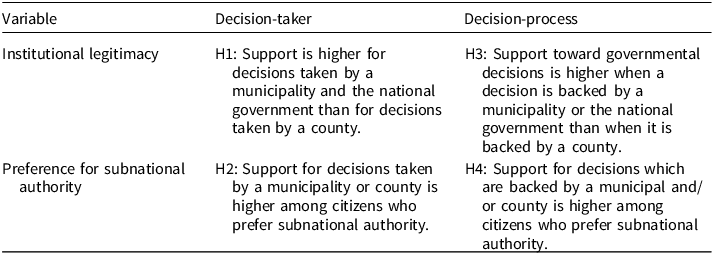
Our main contribution is to develop and test theory that explains various levels of support for governmental decisions across citizens depending on their diffuse support for subnational and national governments (Table 1). Key for understanding individual level variation in perceived legitimacy of multilevel government are citizens’ preferences for subnational authority. We develop two specific theoretical arguments regarding the decision-taker to explain individual variation in public support for governmental decisions. First, citizens who value decentralization are more likely to accept decisions taken by municipal and county governments (hypothesis 2). These citizens privilege subnational authority and they would like their local and county governments to have their own sphere of autonomy where they can take decisions according to the policy preferences of citizens within the jurisdiction.
The literature review above reveals that, in addition to the decision-taker, the characteristics of the decision-making process is also an important determinant for acquiescence. For example, citizens who perceive the decision-making process to be fair are more inclined to comply to policy they do not agree with (Levi, Sacks and Tyler Reference Levi, Sacks and Tyler2009; Porumbescu and Grimmelikhuijsen Reference Porumbescu and Grimmelikhuijsen2018). We argue that collaboration between different government tiers during the decision-making process can also increase acquiescence (Table 1). Institutional legitimacy will be pooled when levels of government collaborate, and their collective legitimacy may spill-over into specific support for the decisions that result from the cooperation. In Norway, we may expect higher levels of institutional legitimacy for national and local than for county government (hypothesis 1). Consequently, involvement of municipal and national government during the decision-making process may have a larger impact on public support in comparison to the involvement of county government (hypothesis 3). In addition, we may expect higher support among citizens with a preference for subnational authority when a municipality and/or county backs a decision. These citizens value the participation of their municipality and/or county in the decision-making process when another tier of government takes a decision (hypothesis 4).
Data and methods
Survey data is obtained from wave 19 of the Norwegian Citizen Panel (Ivarsflaten et al. Reference Ivarsflaten, Øivind, Olav, Amund, Joachim, Asle, Stefan, Erla, Hege, Lise, Gisela, Dag, Thea, Anne Lise, Arjan, Åsta Dyrnes, Yvette, Bjørn and Rouven2024b). The Norwegian Citizen Panel is a web-based panel survey with a random sample of respondents drawn from the Norwegian population registry. Wave 19 was fielded online in November 2020 and the general response rate among 16,212 respondents was 76.8%. The survey questions used in this paper were fielded to a sub-sample, and 1,855 respondents are retained when observations with missing values on either the dependent or independent variables are excluded. More information on the NCP wave 19 and full survey question wording in Norwegian and English are provided in Appendices A and B.
Dependent variable: willingness to accept a decision
We fielded six survey questions that asked citizens their willingness to accept a decision taken by a tier of government (Figure 1). The questions were preceded by a short introduction that read: We would like to ask you a couple of questions on your willingness to accept decisions taken by either your municipality, your county, or the national government.Footnote 4 Questions 1, 3 and 5 started with a similar hypothetical situation and question: Imagine that your [government] must cut down spending and decides to close down a [educational institution] in your municipality. This will be done to preserve other public positions that otherwise would not have been retained. Generally speaking, to what extent do you think this decision is acceptable? Respondents could indicate their willingness to accept the decision on a five-point Likert scale ranging from “not at all” to “a very large extent.” Follow-up questions 2, 4, and 6 asked respondents the extent to which they were willing to accept the decision once a respondent received information that the decision is supported by one or two other tiers of government (Figure 1). Respondents could again indicate their willingness to accept this decision on a five-point Likert scale.
Design of the survey questions tapping specific support for multilevel government.
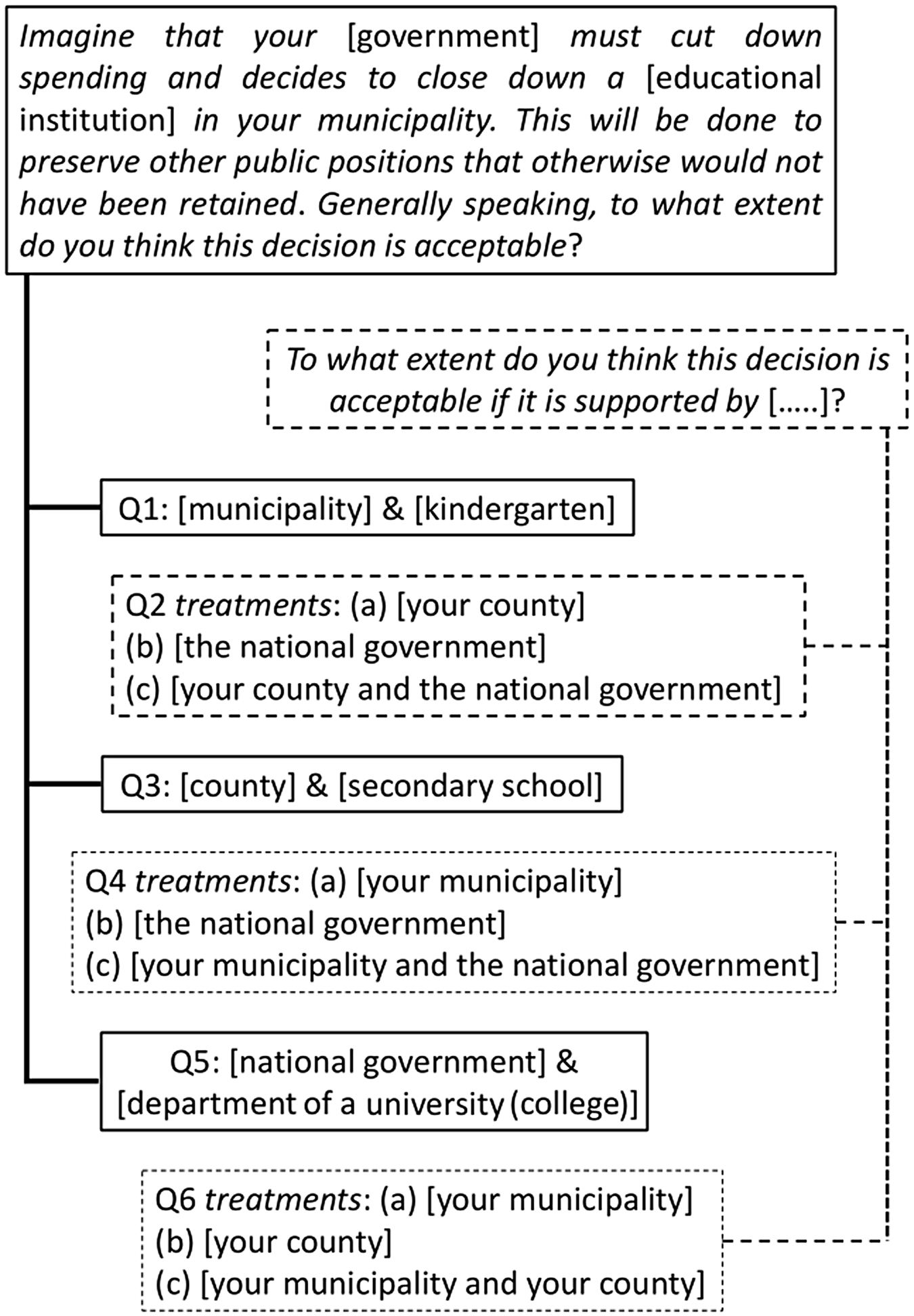
Each respondent received three sets of two questions. In the first set (questions 1 and 2), a respondents’ municipality closes a kindergarten, and this decision is either supported by a respondents’ county, the national government, or both. In the second set (questions 3 and 4), a respondents’ county closes a secondary school and this decision is supported by either a respondents’ municipality, the national government, or both. In the final set (questions 5 and 6), the national government closes a department of a university college, and this decision is either supported a respondents’ municipality, county, or both. All six questions were presented to all respondents, but they randomly received different treatments in questions 2, 4, and 6 – that is, which other tier(s) of government supports the decision varied.
We opted for the closing of educational institutions because education is a valence issue, that is, most citizens care about education and they expect their governments to provide for education. In addition, to increase the probability that a respondent concerns about the decision being taken, we specified that a decision concerns the closing of an educational institution in a respondent’s municipality. In addition, each decision lies within the competence of a government tier as to make sure that the hypothetical decisions may occur in practice.Footnote 5 Although, the educational institution that is closed covaries with the tier of government, comparability is enhanced by specifying that the educational institution in a respondent’s municipality will be closed. The questions do not specify which actor within the government takes the decision because in-depth knowledge about the authorities is not a requirement for the expression of support: “… it is enough that the members have knowledge of the authorities as a class or undifferentiated group even if they cannot name names or describe functions” (Easton Reference Easton1975: 437).
In Norway, it is common practice that national and subnational politicians and governments publicly express their opinion about a decision or policy adopted by another tier of government. There are several (in)formal ways in which they (can) do that. For example, the minutes of subnational councils often include “statements” (uttalelser) in which they express their (often unsolicited) opinions about policies decided by other governments. Subnational governments can and do submit responses to public hearings in addition to citizens, organizations, and businesses.Footnote 6 Local politicians also often express their views on both local and national issues through the local media (Ervik Reference Ervik and Saglie2009, Reference Ervik2012). These views are likely to be picked up by citizens because, in Norway, there is a high number of newspapers (about 215) which mostly consists of local and regional daily newspapers (75%), and newspaper readership in Norway is among the highest in the world (Bruns and Himmler Reference Bruns and Himmler2011; Høst Reference Høst1999; Østbye Reference Østbye and Terzis2007: 157–160).
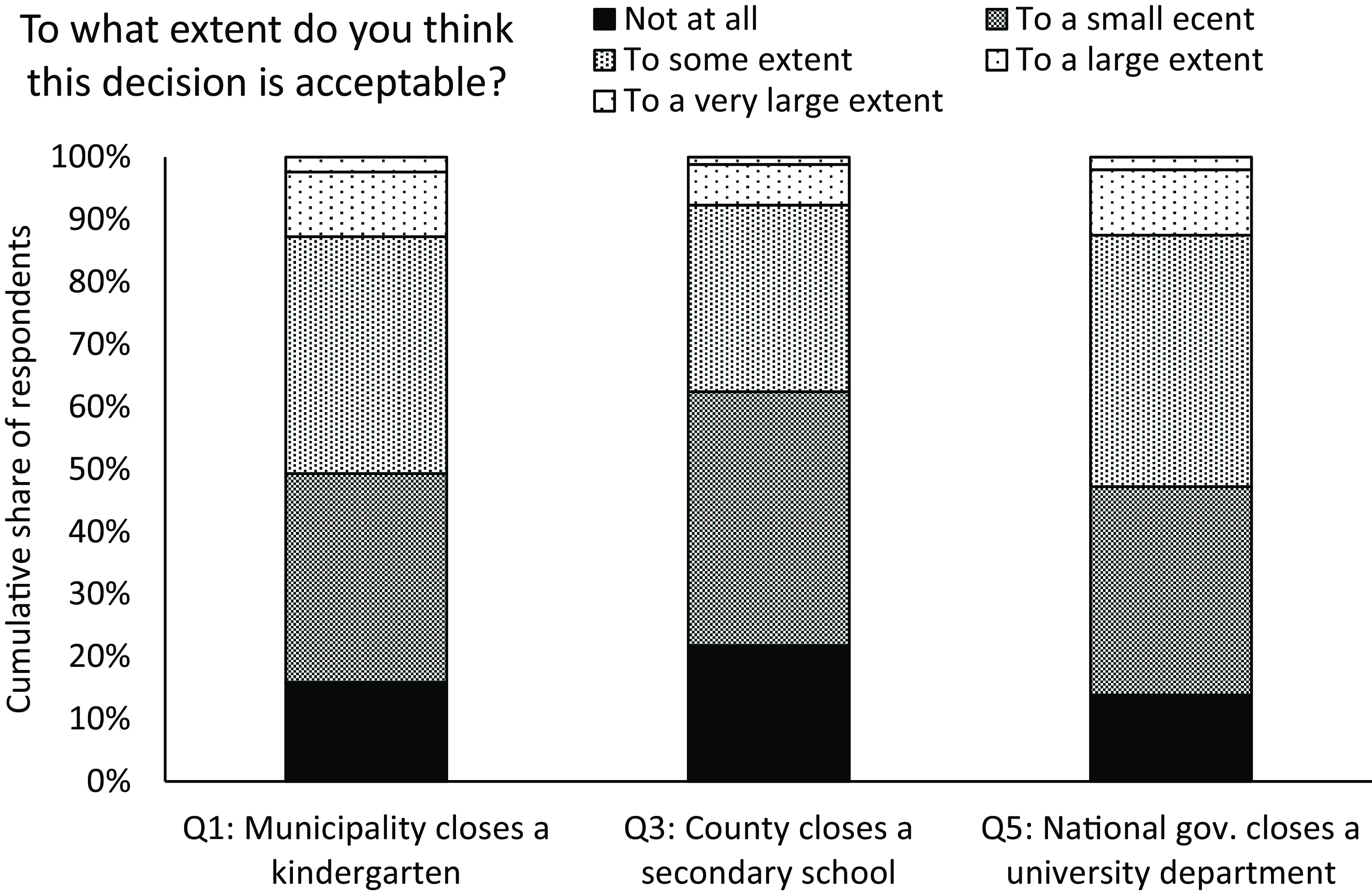
The dependent variable is the willingness to accept a decision by a municipality, county, or the national government (Figure 1) and respondents could choose one out of five answer categories: not at all (= 1), to a small extent (= 2), to some extent (= 3), to a large extent (= 4), or to a very large extent (= 5). We merge answer categories “to a large extent” (= 4) and “to a very large extent” (= 5) because of the low share of respondents in the latter category (Figure 2). In Appendix D we present the results for the unmerged answer categories.
Share of respondents who are (not) willing to accept a decision.
Notes: Shown are the share of respondents (N = 1,855) who are willing to accept a decision by a municipal, county or national government to close down an educational institution. Question wording is provided in Figure 1.
Main independent variable: Preference for subnational authority
The NCP wave 19 replicated a question from the International Constitutional Value Survey (ICVS) that taps preferences for subnational authority. Respondents were asked whether they found six features of multilevel government (very) desirable or (very) undesirable (Brown, Deem and Kincaid Reference Brown, Deem and Kincaid2022; Table 2). The question reads: “Norway has a system of governance comprising of three levels – the national, the regional (counties) and the municipal (municipality) level of governance. Please state if you think each of these is a desirable feature, or an undesirable feature of having different levels of government.” Preferences for subnational authority are derived by taking an average across the six items, and we rescale the variable so that scores vary from 0 – very undesirable across all six items – to 1 – very desirable across all six items.
Survey items used to tap preferences for subnational authority
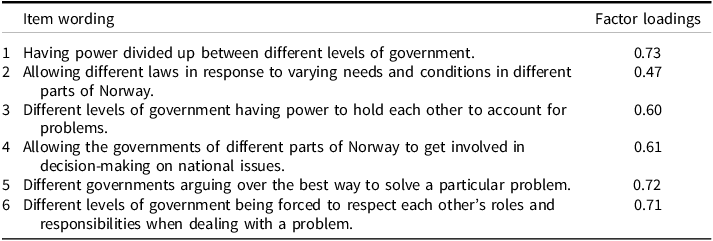
Notes: Respondents could indicate whether these six features of multilevel government were (very) desirable or (very) undesirable. The order of the statements was randomized. Shown are the factor loadings which are retrieved from a principal component analysis on the responses of 1,855 respondents: Eigenvalue = 2.51; Explained variance = 42%; Cronbach’s alpha = 0.70.
A principal component analysis on the responses of 1,855 respondents retains one dimension with an eigenvalue above 1 (eigenvalue of 2.51) and all items, except for item 2, have a factor loading of 0.6 or higher. The explained variance of the principal component is 42% and the Cronbach’s alpha is 0.70. The principal component analysis provides sufficient but not overwhelming support for the assumption that the six items tap into one underlying dimension, that is, preferences for subnational authority. Subnational authority can be understood to consist of self-rule and shared rule (Elazar Reference Elazar1997; Hooghe et al. Reference Hooghe, Marks, Schakel, Niedzwiecki, Osterkatz and Shair-Rosenfield2016). Self-rule refers to the authority exercised by a subnational government over citizens who live within its jurisdiction. Shared rule refers to the authority co-exercised by subnational and national governments in the country as a whole. Items 1, 2, and 3 in Table 2 concern having divided powers, legal diversity, and governmental accountability and thereby tap preferences for self-rule. Items 4, 5, and 6 measure preferences for different levels of government arguing, being involved, and being forced to respect each other’s roles and responsibilities and thereby tap preferences for shared rule. In Appendix B we present principal component analyses that explore the dimensionality underlying the six ICVS-items, and we compare the dimensionality of the six ICVS-items among respondents in Norway to the respondents in the eight countries that were surveyed by the ICVS. In Appendix E, we provide a robustness test for our results by rerunning our models with preferences for self-rule, preferences for shared rule, and for each of the six items separately.
Models
We explore the willingness to accept a decision (WtA) taken by a municipality, county, or the national government with two regression models whereby the willingness to accept a decision by respondent (i) is clustered by three tiers (j), that is, a respondent’s municipality, a respondent’s county, or the national government. The models include fixed effects for respondents ( ${\zeta _i}$
), a constant (c), and an error term that varies by respondent and tier (
${\zeta _i}$
), a constant (c), and an error term that varies by respondent and tier ( ${\varepsilon _{ij}}$
). Model 1 is run for the first question in each set of questions (Q1, Q3, and Q5 in Figure 1) and thereby enables us to explore whether the willingness to accept a decision depends on the tier taking the decision (
${\varepsilon _{ij}}$
). Model 1 is run for the first question in each set of questions (Q1, Q3, and Q5 in Figure 1) and thereby enables us to explore whether the willingness to accept a decision depends on the tier taking the decision ( ${\beta _1}$
) as well as in how far respondents with a strong preference for subnational authority (PSA
i
) have a higher willingness to accept decisions taken by their municipality and/or county (
${\beta _1}$
) as well as in how far respondents with a strong preference for subnational authority (PSA
i
) have a higher willingness to accept decisions taken by their municipality and/or county ( ${\beta _2}$
):
${\beta _2}$
):
 $${\rm Model\ 1}: Wt{A_{ij}} = {\beta _1}Tie{r_j} + {\beta _2}Tie{r_j}{\rm{*}}PS{A_i} + {\zeta _i} + c + {\varepsilon _{ij}}$$
A second model is run for the second question in each set of questions (Q2, Q4, and Q6 in Figure 1) which explores the impact of preferences for subnational authority on the willingness to accept a decision after learning that the decision is supported by another tier of government. A respondent randomly received one out of six possible support treatments (ST): a decision is supported by a respondent’s municipality (M), a respondent’s county (C), the national government (N), the municipality and county (M+C), the municipality and the national government (M+N), or the county and the national government (C+N).
 $${\rm Model\ 2}: Wt{A_{ij}} = {\beta _1}Tie{r_j} + {\beta _2}S{T_{ij}} + {\beta _3}A1st{Q_{ij}}$$
 $$ + \;{\beta _4}A1st{Q_{ij}}*S{T_{ij}} + {\beta _5}A1st{Q_{ij}}*PS{A_i} + {\beta _6}S{T_{ij}}*PS{A_i}$$
 $$ + \;{\beta _7}A1st{Q_{ij}}*S{T_{ij}}*PS{A_i} + {\zeta _i} + c + {\varepsilon _{ij}}$$
Outcome favorability – that is, support depends on the degree to which a decision coincides with an individual’s preference (Arnesen Reference Arnesen2017; Esaiasson et al. Reference Esaiasson, Persson, Gilljam and Lindholm2019) – implies that a respondents’ willingness to accept a policy decision can hardly be affected by the procedure of the decision-making process when a respondent (dis)agrees with and feels strongly about the decision outcome. Therefore, model 2 includes the answer to the first question (A1stQ) for each of the three sets of questions (Q1, Q3, and Q5 in Figure 1). Model 2 enables us to assess the direct impact of the support treatment on the willingness to accept a decision ( ${\beta _2}$
) and to observe whether respondents with a strong preference for subnational authority react differently to a support treatment (
${\beta _2}$
) and to observe whether respondents with a strong preference for subnational authority react differently to a support treatment ( ${\beta _6}$
) while controlling for their responses to the first questions (
${\beta _6}$
) while controlling for their responses to the first questions ( ${\beta _3}$
,
${\beta _3}$
, ${\beta _4}$
,
${\beta _4}$
, ${\beta _5}$
, and
${\beta _5}$
, and ${\beta _7}$
) and the tier that is taking the decision (
${\beta _7}$
) and the tier that is taking the decision ( ${\beta _1}$
). The survey design does not enable us to test whether the willingness to accept a decision changes if no support is given by another government, that is, a proper “control group” is missing. However, we can observe the extent to which a respondent’s willingness to accept a decision changes in response to whether their municipality, county, the national government, or any combination of two governments support a decision. In other words, the answer to the first question serves as a “control” or “benchmark” to test for whom the “treatment” has an impact.
${\beta _1}$
). The survey design does not enable us to test whether the willingness to accept a decision changes if no support is given by another government, that is, a proper “control group” is missing. However, we can observe the extent to which a respondent’s willingness to accept a decision changes in response to whether their municipality, county, the national government, or any combination of two governments support a decision. In other words, the answer to the first question serves as a “control” or “benchmark” to test for whom the “treatment” has an impact.
A respondents’ answer to the first question (A1stQ) and its interactions with support treatment (ST) and a respondent’s preference for subnational authority (PSA) are entered into the model to control for likely associations between the responses to first and second questions in each of the three sets of questions (Figure 1). Changes in the willingness to accept a decision are less likely with low or high responses to the first question because of outcome favorability. That is, respondents who are not at all (= 1) or to a very large extent (= 5) willing to accept a decision are also more probable to feel quite strongly about their (dis)agreement with the decision outcome. Thus, these respondents are less likely to change their willingness to accept a decision after learning that a decision is supported by another tier of government. In addition, the likelihood that the willingness to accept a decision increases or decreases in the second response is more likely for, respectively, lower and higher responses to the first questions. A respondent who is to a very large extent willing to accept a decision cannot further increase her willingness to accept, whereas a respondent who is not at all willing to accept a decision cannot further decrease her willingness to accept. To control for these complex associations between first and second responses we enter the answer to the first question (A1stQ) as a categorical variable which allow for changes in the sign of the beta coefficients across the responses to the first question.
Both models 1 and 2 include fixed effects for respondents which has the advantage that it precludes the possibility of omitted variable bias of factors that covary at the individual level (e.g. age, education, local and regional identities, having children that attend school, etc.) or at the municipal level (e.g. whether a respondent’s municipality has a kindergarten, an upper secondary school, or a university (college) department). One major drawback is that the models cannot assess the direct impact of preferences for subnational authority because these covary with the respondent fixed effects. Thereby, the impact of preferences for subnational authority on the willingness to accept a decision may be underestimated. In Appendix F we test for the robustness of the results by employing regression models that include a battery of individual-level control variables and whereby respondents are clustered by municipality.
Results
The first question in each set – that is, questions 1, 3, and 5 in Figure 1 – enables us to empirically assess whether institutional legitimacy is higher for national and local than for county government (hypothesis 1), and whether support for municipal and county decisions is higher among respondents who prefer subnational authority (hypothesis 2). Figure 2 presents the shares of respondents who are (not) willing to accept a decision taken by their municipality (Q1), their county (Q3), or the national government (Q5) for 1,855 respondents. The shares of respondents are shown for each answer category – that is, not willing to accept at all, to a small extent, to some extent, to a large extent, and to a very large extent. Figure 2 provides strong evidence for our institutional legitimacy hypothesis (Table 1, hypothesis 1). The willingness to accept a decision taken by the county is about ten percentage points lower than for the decisions taken by the municipal and national governments. 38 percent of the respondents is willing to accept, to some extent or to a (very) large extent, a decision taken by their county (Q3). In stark contrast, 51 and 53 percent of the respondents are willing to accept a decision taken by, respectively, their municipality (Q1) and the national government (Q5; Figure 2). This is not a surprising finding considering that Norway is a country with a long-standing tradition of strong local democracy where citizens consider municipal to be (much) more important than county government.
Figure 3A and 3B display the marginal effects from model 1 that analyses preferences for subnational authority on the willingness to accept a decision taken by a municipality, a county, or the national government. Full model results are provided in Appendix C. Figure 3A displays predicted willingness-to-accept-scores and their 84% (thick lines) and 95% (thin lines) confidence intervals for respondents who have the lowest (= 0) and highest (= 1) preferences for subnational authority. Figure 3B displays the estimated scores on the willingness to accept a decision and their 84% confidence intervals when a preference for subnational authority goes from its minimum (= 0) to its maximum (= 1). 84% confidence intervals can be used to determine whether point estimates are statistically significantly different from each other whereas 95% confidence intervals should be used to ascertain whether a point estimate is different from a constant, that is, the estimate for the base respondent (Greenland et al. Reference Greenland, Senn, Rothmann, Carlin, Poole, Goodman and Altman2016; Julious Reference Julious2004; Macgregor-Firs and Payton 2013). Model 1 includes fixed effects for the government tier that takes a decision which necessitates choosing a base category when calculating marginal effects. Figure 3A and 3B present the results when the national government is taken as a base category. In appendix C we present marginal effects when the municipality or the county are taken as the base category.
The impact of preferences for subnational authority on the willingness to accept a decision taken by a municipality, county, or the national government.
Notes: Shown are the marginal effects for preferences for subnational authority based on model 1. The horizontal line in the graph represents the point estimate for the base category, that is, a decision taken by the national government. The confidence intervals in plot 3A are indicated by thick (84%) and thin (95%) vertical lines. The shaded areas in plot 3B reflect the 84% confidence intervals. Full model results are provided in Appendix C.
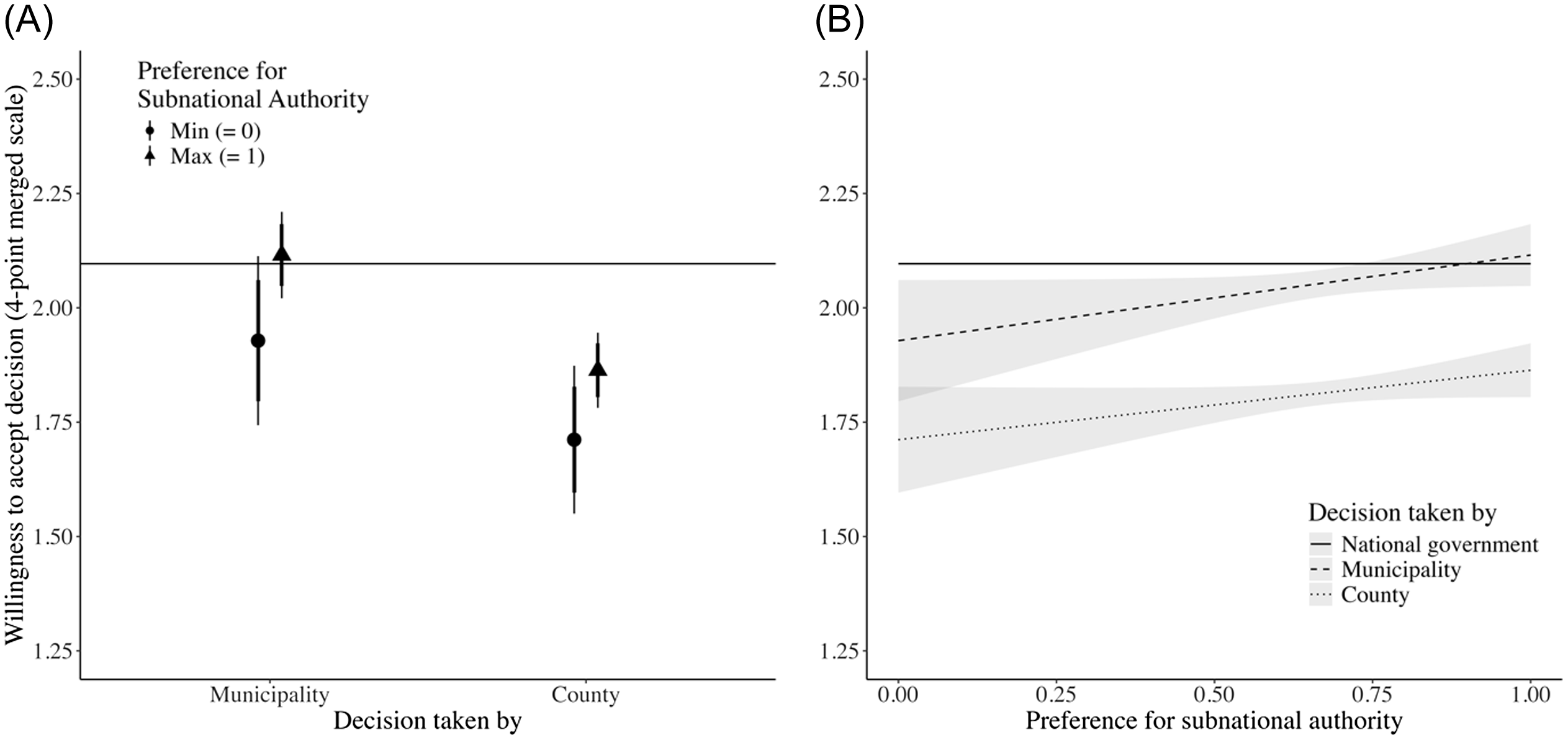
Figure 3A and 3B provide strong evidence for hypothesis 1 and the willingness to accept a decision taken by a county (1.71–1.86) is significantly lower than the willingness to accept a decision taken by a municipality (1.93–2.12) or the national government (2.1). The survey question design does not allow us to differentiate between the impact of the decision-maker from the type of educational institution (Figure 1). Hence, the lower support for the county decision might arise because the county enjoys less institutional legitimacy or because citizens care more about secondary schools than primary schools and departments of university colleges. We think that the former explanation is more likely than the latter because research on subnational government in Norway has revealed that institutional legitimacy is lower for counties (see section “Institutional legitimacy of (sub)national government in Norway”) whereas, to the best of our knowledge, there is no empirical evidence that points out that (Norwegian) citizens care less about secondary education than about primary or higher education.
Figure 3 provides limited evidence for hypothesis 2 that a preference for subnational authority may increase the support for municipal and county decisions. Respondents who have a strong preference for subnational authority have a 0.19 and 0.15 points higher willingness to accept a decision taken by, respectively, a municipality (from 1.93 to 2.12) or a county (from 1.71 to 1.86). Although these estimates are not statistically significantly different from each other in Figure 3A and 3B, they are in three robustness analyses: (1) when the answer category “very likely to accept” is demerged from the answer category “likely to accept” (appendix D); (2) in a random effects specification of the model (appendix F); and (3) when a preference for self-rule instead for subnational authority is included in the model (appendix E).Footnote 7 These three robustness analyses provide empirical evidence for hypothesis 2 and public support for decisions taken by a municipality or county tends to be higher among citizens who prefer subnational authority.
The institutional legitimacy of one tier may spill-over into support for decisions taken by another tier when the decision-making process involves more than one tier. The second question in each set – that is, questions 2, 4, and 6 in Figure 1 – enable us to explore whether the willingness to accept a decision changes when another tier of government supports a decision. Figure 4 presents the share of respondents who increase or decrease their willingness to accept a decision after they learn that another government supports a decision. Figure 4 reveals that between 73% and 76% of the respondents do not change their willingness to accept a decision after learning that one or two other tiers of government support a decision. The percentages of respondents that decrease/increase their willingness to accept a decision after learning that the decision is supported by another tier of government are 12%/14%, 5%/21%, and 6%/18% for a decision taken by, respectively, a municipality, county, or the national government.
Share of respondents who change their willingness to accept a decision after they learn that another government supports a decision.
Notes: Shown are the share of respondents (N = 1,855) who change their willingness to accept a decision by a municipal, county or national government to close an educational institution after they learn that a municipality, county, the national government or a combination of two governments support a decision. Question wording is provided in Figure 1.
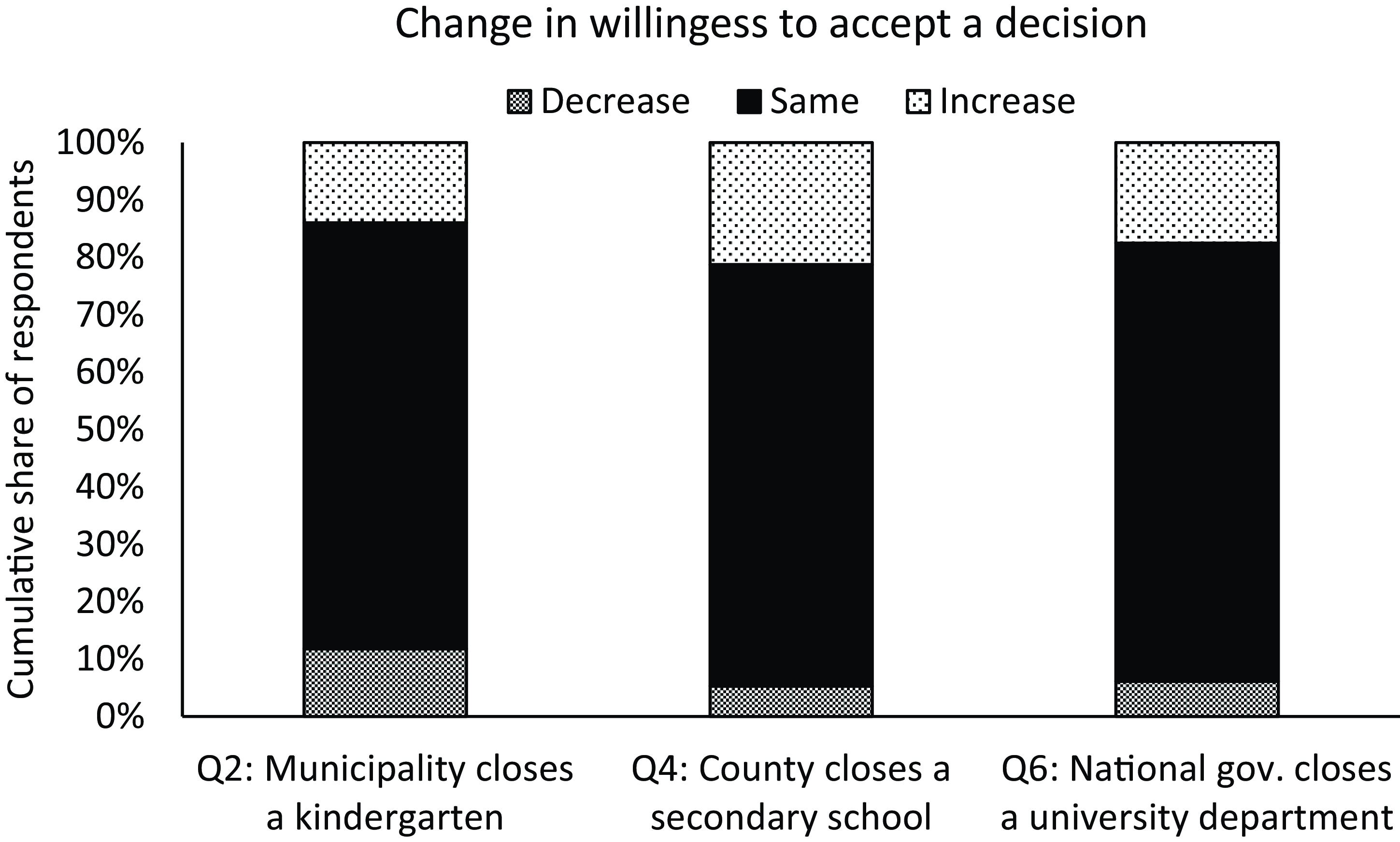
Outcome favorability may explain the large share of respondents that stick to the similar level of willingness to accept a decision before and after learning that a decision is supported by another tier of government. Recent research reveals that the degree to which a decision coincides with an individual’s preference is the dominant determinant of support for a decision (Arnesen Reference Arnesen2017; Esaiasson et al. Reference Esaiasson, Persson, Gilljam and Lindholm2019; Magalhães and Aguiar-Conraria Reference Magalhães and Aguiar-Conraria2019). If one agrees with a decision, one is very likely to be acquiescent, but if one does not agree with a decision, one is very unlikely to support it. Hence, a respondents’ willingness to accept a decision can hardly be affected by the procedure of the decision-making process when a respondent (dis)agrees with and feels strongly about the decision outcome. Despite the likely presence of outcome favorability, around a one-quarter of the respondents do change their willingness to accept a decision after learning that another tier of government supports a decision. This is an important observation because it indicates that the support for a government decision can be affected by the involvement of another government in the decision-making process.
Figure 5 presents the results of model 2 by displaying the estimated levels of support after a respondent learns that a decision by a municipality (Figure 5A–C), county (Figure 5D–F), or the national government (Figure 5G–I) is supported by one or two other tiers of government (Q2, Q4, and Q6 in Figure 1). There are nine plots in Figure 5, three plots each for questions 2, 4, and 6 because there are three “treatments,” that is, support provided by a municipality, by a county, by the national government, or by a combination of two governments (Figure 1). Within each plot we compare a respondent with a strong preference for subnational authority (mean plus one standard deviation: 0.88) to a respondent with a weak preference for subnational authority (mean minus one standard deviation: 0.44). Estimates are shown for four different levels of willingness to accept the initial decision (x-axis; Q1, Q3, and Q5 in Figure 1): not at all (= 1), to a small extent (= 2), to some extent (= 3), and to a large extent or to a very large extent (= 4). We compare respondents with weak and strong preferences for subnational authority across four answer categories because the likelihood that the willingness to accept a decision increases or decreases is more likely for, respectively, lower and higher initial support whereas outcome favorability decreases the overall probability of any change in the willingness to accept a decision when initial support is either low or high.
The impact of support provided by another tier of government on the willingness to accept a decision.
Notes: * p < 0.05; **p < 0.01 (based on the 84% confidence intervals). Shown are the estimated levels of support after a respondent learns that a decision by a municipal (top row), county (middle row), or the national government (bottom row) is supported by one or two other tiers of government. The estimates are shown for four different levels of initial support provided for a decision (x-axis; Q1, Q3, and Q5 in Figure 1) and for respondents with low (0.44; mean minus one standard deviation) and high (0.88; mean plus one standard deviation) preferences for subnational authority. Confidence intervals are indicated by thick (84%) and thin (95%) vertical lines. The estimations are based on model 2 and full model results are provided in Appendix C.

Figure 5 clearly reveals that legitimacy of decisions taken by municipal, county, and national government does not depend on which other tier(s) of government support a decision. The “willingness-to-accept-scores” are not statistically significantly different from each other across the support-treatments (i.e. which government provides support a decision) and within answer categories. For example, respondents who initially accepted a municipal decision to a small extent (answer category 2) increase their support with similar magnitudes when the municipal decision is supported by their county (Figure 5A), the national government (Figure 5B), or both (Figure 5C). We can therefore reject hypothesis 3 with confidence and support for governmental decisions is not higher when a decision is supported by the national or municipal government compared to support provided by a county.
Figure 5 provides strong empirical evidence for hypothesis 4 and support for decisions which are backed by a municipal and/or county is higher among citizens who prefer subnational authority. Support for a municipal and for a county decision increases among respondents with a strong preference for subnational authority once they learn that this decision is supported by, respectively, their county (5A: an increase from 2.55 to 3.05 points) or their municipality (5D: an increase from 2.74 to 3.23 points). In stark contrast, these respondents do not increase their willingness to accept when a decision is supported by the national government (5B–C; 5E–F). It is important to note that the increases in willingness to accept shown in plots 5A and 5D are largest for answer categories 2 and 3 and statistically significant for answer category 3, whereas the changes in support for a decision are minimal for answer categories 1 and 4. This result can be explained by “outcome favorability” among respondents who are fiercely against or in favor of a decision which makes it relatively difficult to persuaded them to change their opinion.
The impacts of municipal and county support are most noticeable for the national decision. The willingness to accept a national government decision to close a department of a university (college) among respondents who prefer subnational authority is up to 0.83 points higher when either the municipal or county or both support the decision (Figure 5G–I). These higher levels of support for the national decision are statistically significant (p<0.05) for all initial levels of acceptance provided for the national decision. There is only one exception: respondents who do not accept the national decision at all and who subsequently learn that their municipality supports this decision (Figure 5G). The upshot is that municipal and county support can significantly increase support for national decisions, especially among respondents who prefer subnational authority.
Discussion
In Norway, municipal and national government enjoy higher levels of institutional legitimacy than county government and, as a result, the willingness to accept a decision is higher for municipal and national government than for county government. Our main contribution is to show that the willingness to accept governmental decision increases among citizens who prefer subnational authority when a decision is supported by their municipal or their county. This impact is found to be strongest for a national decision which strongly suggests that the extent to which institutional legitimacy may spill-over is conditional on which tiers of governments collaborate.
These findings are important because they reveal that it is vital to differentiate between different governmental decision-makers. Hence, studies that compare acquiescence to decisions taken by different decision-makers, such as a court or citizens through a referendum (e.g. Gibson Reference Gibson1989; Gibson, Caldeira and Spence Reference Gibson, Caldeira and Spence2005), or across different procedures (e.g. Esaiasson et al. Reference Esaiasson, Persson, Gilljam and Lindholm2019; Magalhães and Aguiar-Conraria Reference Magalhães and Aguiar-Conraria2019; Porumbescu and Grimmelikhuijsen Reference Porumbescu and Grimmelikhuijsen2018), are well advised to also explore support for decisions taken by or involving local governments and to differentiate between municipal and county government.
Finding an impact in the least likely case of Norway – where all government tiers enjoy a (relatively) high institutional legitimacy and where electorally strong regional(ist) parties mobilizing citizens for decentralization are absent – is an important result. It strongly implies that preferences for subnational authority is likely to affect the institutional legitimacy of subnational and national governments in most European countries where trust in local government is (much) higher than trust in national government (Fitzgerald and Wolak Reference Fitzgerald and Wolak2016). However, Norway stands out with respect to a high number of local and regional daily newspapers and a high degree newspaper readership (Bruns and Himmler Reference Bruns and Himmler2011; Høst Reference Høst1999; Østbye Reference Østbye and Terzis2007: 157–160) which may make local and regional government more salient among citizens (Ervik Reference Ervik2012). Hence, future research should also focus on exploring the causal drivers of a preference for subnational authority.
Our findings are also vital for understanding the legitimacy of multilevel government. Each country, no matter its population size, has at least one subnational government that exercises authority over a country’s population (Schakel Reference Schakel and Lago2021). In addition, multilevel government is increasing across the globe, many countries have created new tiers of governance, and most countries have empowered subnational governments (Hooghe et al. Reference Hooghe, Marks, Schakel, Niedzwiecki, Osterkatz and Shair-Rosenfield2016; Ladner et al. Reference Ladner, Keuffer, Baldersheim, Hlepas, Swianiewicz, Steyvers and Navarro2019). Our results point out that, in general, decentralization is welcomed by citizens, but to different degrees, and support for governmental decisions depends on citizens’ preferences for subnational authority. Further research should focus on what drives citizens to have different preferences for local and regional authority. In Norway, institutional legitimacy is (much) higher for municipal than for county government and Norwegian citizens with strong preferences for subnational authority may desire authority particularly for their municipalities. In federal and regionalized countries, one may expect preferences for subnational authority to be targeted toward regional government (Schakel and Smith Reference Schakel and Smith2022).
A trend of decentralization across the globe entails increasing multilevel governance, and collaboration between local, regional, and national governments has significantly increased (Eaton and Schakel Reference Eaton and Schakel2022; Hooghe and Marks Reference Hooghe and Marks2001; Schakel and Tatham Reference Schakel, Tatham, Sperling and Lucarelli2023). The results presented in this paper reveal that the involvement of multiple tiers of government in decision-making is generally appreciated by citizens, but more so by citizens who prefer subnational authority. In addition, we find that the impact of a preference for subnational authority depends on which government level takes a decision and on which governmental tier provides support. Thereby, our results add another virtue associated with multilevel government: decisions which involve multiple levels of government enjoy higher levels of public support. This is important because the desirability of decentralization depends on how the benefits are weighed against the possible drawbacks of multilevel government such as blurring of attribution of responsibility (León Reference León2011) and hampering political responsiveness (Däubler, Müller, and Stecker Reference Däubler, Müller and Stecker2018).
Further research should further explore when and why the involvement of different government tiers during a decision-making process increases public support. For example, this impact may depend on the extent of institutional legitimacy a government level enjoys, and shared rule may particularly increase acceptance of decisions when it involves government tiers which can rely on a large reservoir of diffuse support. In addition, the extent to which multilevel government increases support for governmental decisions may depend on whether a citizen’s preferred party controls the subnational and/or national government (see e.g. Proszowska, Jansen and Denters Reference Proszowska, Jansen and Denters2022; VanDusky-Allen and Utych Reference VanDusky-Allen and Utych2021).
Supplementary material
To view supplementary material for this article, please visit https://doi.org/10.1017/S0143814X25000066
Data Availability Statement
Replication materials are available in the Journal of Public Policy Dataverse at https://doi.org/10.7910/DVN/ZFVVKY
Acknowledgments
The authors would like to thank Reto Wüest, Martin Gross, Øystein Solvang, and Jonas Stein for their feedback on earlier drafts of this paper.
Funding statement
This research is supported by the Trond Mohn Foundation under grant number TMS2019REK01 and the University of Bergen under grant number 812468.
Competing interests
The authors declare none.


 Open access

