




1. Introduction
The underlying tension in this essay interweaves historical, political, creative and media dimensions, analysing the intellectual landscape while moving toward a singular, focused reality. Our analysis started with Boris Kossoy’s (Reference Kossoy2009) insights, a photographer, researcher and university professor, who argues in Realidades e Ficções na Trama Fotográfica that photographic production in Brazil and Latin America followed European models, particularly in the depiction of elites and national landscapes. This historical basis is vividly illustrated in the portraits of Emperor Dom Pedro II and Empress Teresa Cristina by Joaquim Insley Pacheco (1883). The lush vegetation symbolically underlines Dom Pedro II’s ideological striving for a civilised presence in the tropics through the conventions of 19th-century photography.
As Grandin (Reference Grandin2019) notes, technological advances do not merely mark physical borders but also enforce ideological boundaries. Media do not simply transmit narratives or misconceptions about a region; they actively shape our collective understanding, often converging on a dominant interpretation that marginalises alternative cosmovisions and narratives. This deliberate suppression of diversity reinforces a hegemonic, monolithic view of territory as uniquely definitive.
This essay explored how Latin American societies contended with the lasting impact of European artistic traditions until the 20th century. Initially, some communities strove to mirror the idealised European model, while others adopted critical methods to reinterpret and contest established paradigms, making unique creative identities. In Brazil, despite the declaration of independence from Portugal in 1822, a truly distinct cultural identity only developed in the late 19th and 20th centuries. Gradually, Latin American creators assimilated and reimagined European techniques, moulding them into inventive local expressions that evolved into vital cultural assets and internationally acclaimed art forms.
From the avant-garde movements of modernism to contemporary art and media, Latin America has recognised that mixing foreign influences is the key to fostering an independent cultural sensibility (García Canclini, Reference García Canclini1995; Andrade, Reference Andrade2012; Gilman, Reference Gilman2012). Experimental creators have developed different narratives about their regions, making this analysis essential for connecting historical influences with contemporary debates.
Further analysis on the evolution of Latin American artistic movements focused on sound art, a medium playing an equally key role in shaping cultural and political narratives, despite often being overshadowed by visual forms. Sound art offers a distinct perspective by foregrounding the act of listening, an experience deeply intertwined with environmental context and power dynamics. Unlike traditional art forms that primarily involve the visual sense, sound art challenges us to consider how auditory expressions convey meaning, resist dominant narratives and foster alternative cultural identities. This change is particularly significant in Latin America, where artists have progressively integrated auditory elements into their work to address complex socio-political issues. Thus, this essay proposed to 1) explore the creative processes and personal discourses of four selected artists through their contemporary works; 2) examine how their artistic approaches engage with broader political discussions by anchoring themselves in ecological discourses and other Latin American worldviews; and 3) analyse how these practices challenge ethnocentric hegemony in the interpretation of visual and sonic landscapes across the region.
2. Artistic practices grounded in nature
At every step I encountered the marvelous in the real. But I also thought that the presence and prevalence of this marvelous reality was not a privilege unique to Haiti, but the patrimony of the whole of America, where there has yet to be drawn up, for example, a complete list of cosmogonies. (Carpentier Reference Carpentier1949: 140)
The selection criteria were arbitrary and not random, but they required some considerations. Since we have focused on contemporary Latin American sound art, we have selected artists currently active (2025) and whose work is rooted in the region. They also enjoy international recognition. We have deliberately avoided selecting two names from the same country. We considered those who have released at least one album on digital platforms, either independently or through a label. Interestingly, two of them appear in the Argentinian label catalogue ‘CALATHEA experimenta’, known for releasing Latin American works in the fields of ambient, noise, radio art, and experimental subgenres.
One can observe that these artists intertwine with multiple media and integrate questions and concepts from diverse research fields, revealing a layered reality beneath their works. In line with Nicolescu (Reference Nicolescu2002, Reference Nicolescu2014), we adopted the term ‘transdisciplinary/transmedia practice’ because it emphasises the semiotic dimensions inherent in the interplay among various disciplines. This provides us with an onto-epistemological framework to address intricate research challenges. This perspective integrates diverse methods and media, fostering a comprehensive and interconnected understanding of the phenomena under study. We argue that merging different approaches responds to the imperative of examining environmental sound art in a profoundly multifaceted way, recognising the inherent multidimensionality of the environmental sound.
Since our analysis is based on the environmental sound art research field, the predominance of an ecological/environmentalist discourse, the narrative that emerged in global media in the late 1960s, is a fundamental aspect connecting the artists under study. Although there is extensive debate regarding the most appropriate term (whether ‘ecological’ or ‘environmentalist’), we focused on the concept that environmental sound art can be understood as ‘a collection of artistic practices in which environmental sound constitutes the medium, material and/or subject matter for the work’ (Gilmurray Reference Gilmurray, Bianchi and Manzo2016: xix). In addition,
When we use the term environmental sound, however, we are not referring to a specific kind of sound, nor to a specific kind of environment, but to a specific conception of sound in which it is defined by its environmental context: thus, the tweeting of birds and the rustling of leaves in the wind are part of the environmental sound of a forest; the hum of air conditioning and the tapping of computer keyboards are part of the environmental sound of an office. (Gilmurray Reference Gilmurray, Bianchi and Manzo2016: xix)
We also considered a prevailing tendency among certain Latin American artists to adopt specific practices in environmental sound art as a political stance aimed at defining, perceiving, understanding, studying, and preserving the intricate acoustic complexity of their countries’ landscapes. We believe this approach helps dismantle the singular interpretation of Latin American land/soundscapes imposed by a hegemonic colonial gaze (Ma Reference Ma and Ma2020; Villanueva-Martínez Reference Villanueva-Martínez2024). After all, the first step toward self-identification is understanding how we inhabit, perceive and name our reality based on our own experience (Boillat et al. Reference Boillat, Serrano, Rist and Berkes2013; Ortega-Iturriaga et al. Reference Ortega-Iturriaga, Bocco, Urquijo and Serrano2024). Thus, we argue that Latin American environmental sound artists have been striving to position themselves within this fissure.
Our core arguments resulted from a sustained reflection on the artists’ works. During the writing process, one of the authors conducted brief, informal conversations with the four artists – not formal interviews – to share initial insights and evaluate their response. These exchanges were a methodological triangulation to support our readings of the artworks and strengthen the analysis.
2.1. Mar Alzamora (Panamá)
Mar Alzamora’s creative impulse emerges from the intersection of writing, visual art and musical performance, fostering an interdisciplinary practice centred on active, reflective listening. This practice embodies presence and heightens sensitivity to the world. For Alzamora, sound transcends being a mere raw material; it becomes a profound medium to explore the dynamic interplay of body, space, and time.
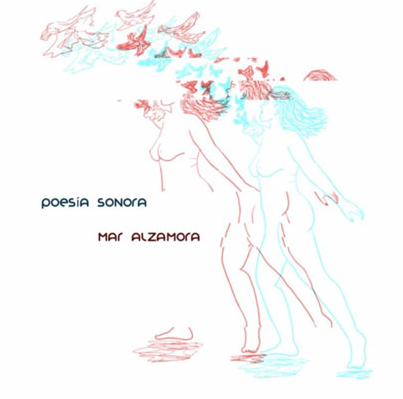
A strong ecological consciousness permeates her work. Alzamora’s process, employing field recordings and soundwalk techniques, reconnects the body with its sonic environment. Alzamora strives to capture and convey the essence of ‘being there’ through deliberate listening and immersive engagement. For instance, in Antipajareo, clearly influenced by Pauline Oliveros and Alicia Coltrane, Alzamora embarks on an odyssey to reveal a hidden reality among birds through the spoken word (Figure 1).
ANTIPAJAREO
Desde anoche empecé a creer que los pájaros se llevan las cosquillas de las fotos
felices, los sombreros de fiesta, las sonrisas temporales y después se sientan en los
postes de luz a cagar en el viento los recuerdos.
He decidido dejar de echarle la culpa a las fotos y los diarios: bien puedo matar a los
pájaros o aguantarme la desazón de la melancolía.
Hoy me regalé un vestido de espantapájaros. (Alzamora Reference Alzamora2022)
Front cover of Mar Alzamora’s album, Poesia Sonora, 2022.

The soundwalks in ‘Antipajareo’ evoke a subtle magic hidden beneath the surface of nature while simultaneously reflecting on freedom. The poem’s imagery flirts with magical realism, a key artistic movement in Latin America after World War II (Carpentier Reference Carpentier1949; Rave Reference Rave2003). As Alejo Carpentier famously remarked, ‘I speak of the marvellous real when I refer to certain things that have happened in America, certain features of its landscape’ (1949: 102). The interplay between the recorded soundscapes, her voice and the sitar evokes a reality that bridges the remnants of magical realism with the natural world. Alzamora restores the world’s own enchantment.
Alzamora engages with Latin American territory by recognising its inherent complexity, challenging hegemonic narratives that obscure its richness and distinctiveness. The idea of a Latin American identity supports Alzamora’s artistic practice, guiding her nuanced and inclusive exploration of regional landscapes, opposed to reductionist or normative frameworks. For Alzamora, engaging with these landscapes requires transcending sensory and conceptual barriers, delving into subtle and profound dimensions of their sonic character. Alzamora’s approach promotes a holistic, embodied listening experience that transcends mere auditory perception to engage with the entire body.
Water plays a crucial role in Alzamora’s ecological inquiries, inspiring projects that redefine our auditory engagement with this essential element. For instance, her sonification of environmental data from Panamanian rivers (specific work citation) is a project that renders hydrological dynamics audible while fostering critical reflection on humanity’s relationship with ecosystems and natural resources.
By merging ecological, cultural and sensory perspectives, Alzamora offers a transformative approach to listening. Alzamora’s work challenges prevailing discursive structures surrounding Panamanian territory, presenting alternative modes of understanding and experiencing the world, modes critically resonant and deeply connective.
2.2. Pablo Bas (Argentina)
Pablo Bas’s (Figure 2) creative impulse emerges from the intersection of music, sound art and questions of belonging. For Bas, music transcends the realm of imagination; it is a powerful tool for constructing discourses that probe the complexities of identity and the relationships between individuals and territories. Sound is a means of connection, articulating profound narratives and redefining sonic cartographies that shape our environment.
The core of Bas’s work is the interplay between space, narrative and perception, guided by a broad ecological perspective. Bas considers space not as a neutral backdrop but a contested territory imbued with histories, meanings and cultural layers. Bas seeks to unravel the inseparability of landscape and perception through his artistic practice, deconstructing how environments are experienced and understood. Listening becomes a form of cartography, a method for mapping and reinterpreting the intricate relationships between territory, listener and auditory phenomena.
Pablo Bas during a field recording in Argentina, 2016-18, artist’s archive.
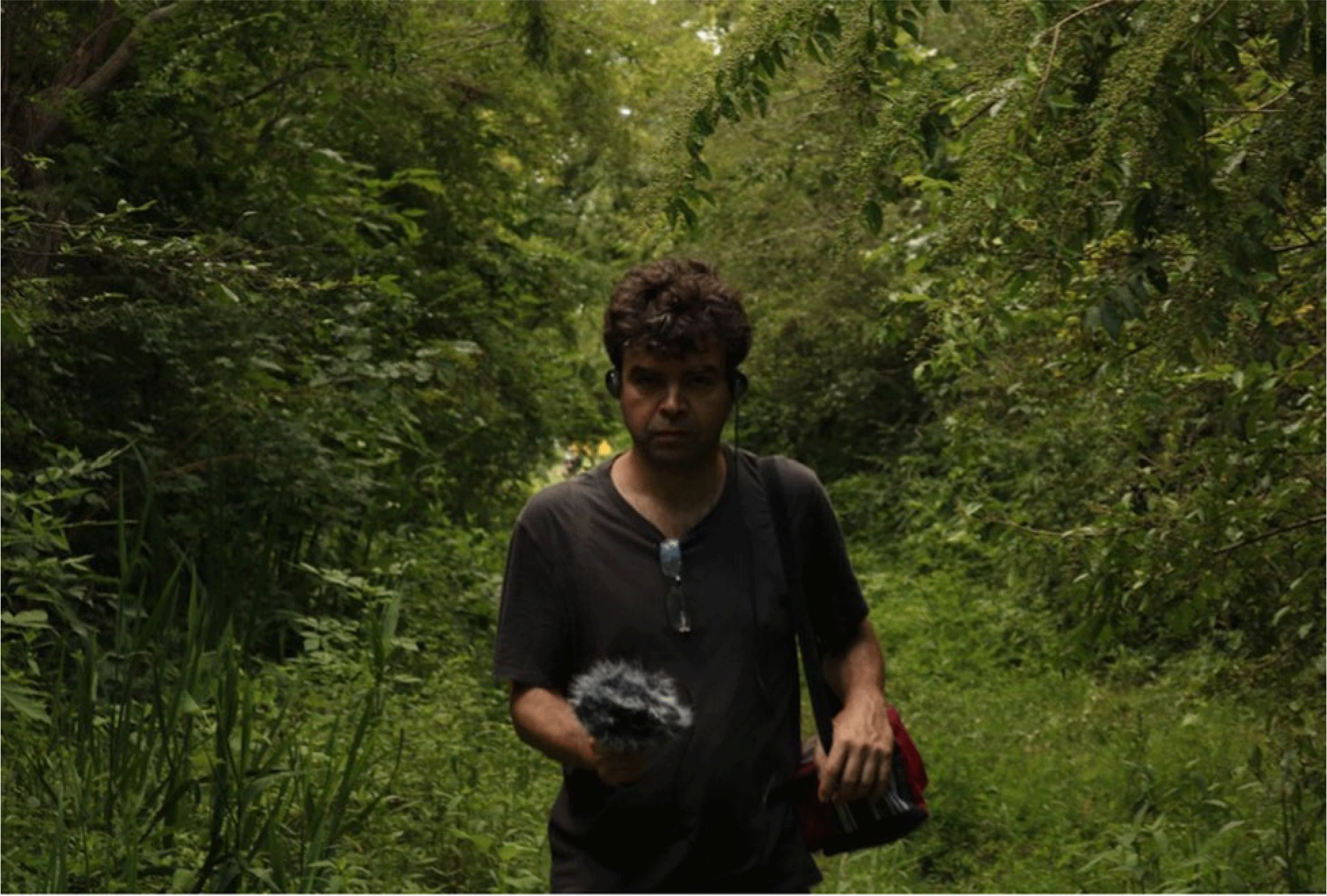
Since 2016, Bas has been investigating territory through the auditory dynamics that define its soundscape. Bas’s commitment to creating sound maps covers Argentina, Bolivia, Brazil, Chile, Mexico and Uruguay. It explores, records, listens, edits and collectively maps the environments we inhabit and traverse. This circular and interdisciplinary process emerges from a shared axis that unites diverse experiences, fostering new ways of perceiving and understanding landscapes (Bas Reference Bas2023).
Bas (Reference Bas2018) affirms that ‘sound cartographies are based, at least initially, on a simple and direct relationship between territory and sound’. These sound cartographies presuppose direct engagement with people and environments where recordings occur, establishing a deep connection between listening and existence. For Bas, listening is more than a perceptual act; it is a way of inhabiting the world.
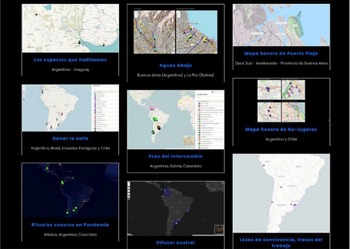
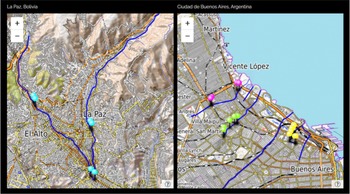
Bas’s project Aguas Abajo (Figures 3 and 4) exemplifies this search for sound cartography by exploring canalised rivers that continue to emerge and shape urban landscapes, despite their ‘invisibility’. For Bas, rivers are living entities, dynamic forces in cities. Why should they not also shape the acoustic fabric of places like La Paz, Bolivia and Buenos Aires, Argentina? Through sound, Bas uncovers the traces of rivers where others see nothing, revealing their presence even when they remain visually obscured.
Nos preguntamos por el agua en la ciudad. Ríos y arroyos como ecología invisible. Porque ya no se ven.¿Pero se escuchan?
En un ejercicio de imaginación sonora, salimos con nuestros grabadores profesionales y hasta con celulares. Orientamos la exploración y la investigación de escucha y registro en los cruces entre los cursos de agua y el modo de habitar de las personas en los espacios donde se surcan. El recorrido inspiró preguntas, disparó certidumbres, nos permitió acceder a ese borde que está latiendo, viviendo cerca -abajo- nuestro. ÁAguas abajo, Mapa Sonoro de Arroyos Urbanos censa el reflejo del ambiente acústico en nuestras ciudades hiperurbanizadas, censa el perfume y el rugido del ecosistema conquistado. Documenta las cuencas hídricas invisibles de la ciudad. Habla de posnaturaleza. (Bas Reference Bas2023)
Print screen of Pablo Bas’ website.

‘Aguas abajo’, sound map of urban streams: an artistic ethnography conducted in the Maldonado, Ugarteche, Vega, Medrano and Cildáñez streams (Buenos Aires, Argentina) and Choqueyapu and Orkojahuira streams (La Paz, Bolivia), 2023.

This reimagining of Latin American landscapes beyond hegemonic frameworks is a key aspect of Bas’s artistic inquiry. Bas challenges reductionist and colonialist perspectives by examining the intricate connections between territory, listener and listening context. For Bas, listening is a profoundly political act, an instrument to challenge power structures and foster new possibilities for understanding and belonging. Bas transforms sounds into living cartographies, proposing a deeply reflective listening practice that reveals hidden layers of Latin American soundscapes.
Bas’s creative process is defined by practices that prioritise experimentation, improvisation and collaborative engagement. Field recordings are raw material for his compositions, capturing the distinctive sounds of specific spaces and contexts. Bas’s performances, deeply influenced by free improvisation, result in unique, unrepeatable works that highlight the transience and singularity of each sonic moment. The core of Bas’s practice is a commitment to experimentation, fostering auditory experiences that challenge and transcend traditional artistic and cultural boundaries.
2.3. Ana Rodríguez (Uruguay)
Ana Rodríguez’s creative impulse is profoundly shaped by a narrative drive to uncover the stories embedded within spaces. Rodríguez investigates how imagination and memory influence places and experiences, creating foundational narratives that bring deeper meaning to the territories explored. For Rodríguez, every space holds layers of stories waiting to be uncovered and reimagined, intertwining memory and imagination in a dynamic and continuous creation process.
Rodríguez’s distinctive methodologies further enhanced this deep engagement with space. Practices such as walking, field recordings and interviews allow her to identify key elements that bring significance to her work and serve as immersive acts that intimately connect with the landscapes and the histories they hold. Venturing into unfamiliar terrains, Rodríguez transforms these journeys into intuitive explorations that reveal new perspectives and hidden narratives.
The ‘Línea negra’ exemplifies Rodríguez’s approach, the sixth composition of Radioballo, created in collaboration with Robert da Silva. This piece interweaves recorded soundscapes (Figure 5), reminiscence dialogues and resonant melody that echoes through the environment and its inhabitants’ memories. The title ‘Línea negra’ alludes to the scar on a horse’s skin, a powerful symbol drawn from Rodríguez’s recollection of an intimate episode involving her, her father and one of her family’s racehorses. Through this composition, Rodríguez captures the intricate dialogue between memory, narrative and lived landscape, demonstrating how personal histories and sensory experiences can redefine our understanding of place.
Después el sanó. Curarlo era un sacrificio. Y yo sentía que él ya no confiaba en mí, porque yo me iba a acercar y él ya no era el mismo de antes. Y para curarlo era…no se dejaba curar. Pero aún así encontramos la manera, le hicimos tipo un tubo en casa y lo fuimos curando curando hasta que sanó. Obviamente le quedó este, le quedó medio hundido ahí porque el hueso quebró, pero le quedó una línea negra y aún así después de que él sanó, papá lo volvió a subir, anduvo lo más bien y se lo llevó. (Transcription from ‘Línea Negra’, composition by Ana Rodríguez and Robert da Silva)
Ana Rodríguez recording a testimony for ‘Línea negra’ in Santa Bárbara, Curtina, Uruguay (March 2021).

Rodríguez expresses an intimate connection with memory by sharing a space of recollection with those close to her. However, her process transcends simply recounting past events for a recorder; it unfolds into a complex interplay between personal remembrance and sensory perception. Rodriguez’s surrounding ambient sounds define the physical boundaries of the space and shape her interpretation of the moment. By evoking recollection and environmental cues, Rodríguez invites her listeners to engage deeply with the narrative rather than merely imagining a place. This narrative is a profound tribute to a significant being, a horse, and its inherent fragility. Through this evocative act, Rodríguez reclaims personal and collective memory using the metaphor of the ‘black scar’, suggesting that every surface, from skin to landscape, brings the marks of past traumas and validates histories marginalised or erased for years.
This exploration of memory naturally extends into a broader reflection on landscapes as more than mere physical spaces. Landscapes are vibrant repositories of cultural and memorial layers. Rodríguez’s composition delves into these often-overlooked strata of memory by recognising that landscapes bring the indelible marks of human intervention, similar to scars left by trauma. Rodríguez’s endeavour to capture a poignant episode from her past, imbued with a range of emotions, offers profound insights into humanity’s relationship with its environment. This approach raises the voices and experiences of those subjugated by dominant colonial narratives, highlighting that personal narratives and emotional depth are essential for understanding the deep connections between the people and the places they inhabit.
Rodríguez’s environmental concerns complement this focus on memory and narrative, bringing dimension to her work. Rodríguez’s attention to memories linked with animals, rivers and water highlights the value of collective and shared ecological memories. By exploring how human relationships with the environment reflect broader cultural, historical and affective dynamics, Rodríguez seeks to recover forgotten memories and cultivates a critical awareness of the intricate interplay between communities and their natural surroundings. These interconnected layers (intimacy, cultural memory and ecological sensitivity) form a compelling framework for understanding individual and collective engagements with the world.
2.4. Eufrasio Prates (Brazil)
Eufrasio Prates is a founding member of BsBLork, the Brasília Laptop Orchestra. Prates’s work, characterised by his performative installations and collaborations with BsBLork, rigorously explores the musical chance, the unpredictability of sonic events and the dynamic interplay between his computational systems and the audience. This system converts movement into sound and establishes an interactive framework to reshape continuously the performative experience (Prates Reference Prates2011).
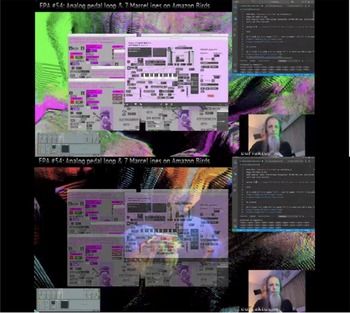
Prates’s performances (Figure 6) are shaped by the variability of sound compositions that emerge from the interface between the musician and the computer, the primary instrument in most of his presentations. Based on fractal principles and their inherent unpredictability, Prates enables interactors to influence the system without fully controlling it. This deliberate partial surrender of control fosters a more playful and intuitive creative experience rather than a rigidly rational one. By embracing chance and unpredictability, Prates cultivates a dynamic aesthetic process in which spontaneity and improvisation are essential to artistic expression.
Among the first open computing platforms developed for interactive musical systems was the Max environment, which I used to develop the Holofractal System for Music and Image Transduction. This program, which I developed during my doctoral research, was designed to meet the challenge of placing performers, musicians, actors, dancers and even the audience at the center of the creative process in real time. (Prates Reference Prates2011: 41)
Screenshots from one of the prates’s live performances in 2025.

Prates seeks to broaden the boundaries of hybrid or cybrid creations, simultaneously acoustic, visual, algorithmic, immersive and interactive. Prates’s creative approach integrates disparate elements using a coherent methodology that focuses on unpredictability and interaction as fundamental compositional tools. This experimental ethos aligns with the fractal principles and stochastic processes that have characterised Prates’s artistic output from the outset.
Earlier in his career, Prates spent 15 years developing interactive acoustic and visual systems that respond in real time to unpredictable, stochastic, and fractal patterns, enabling machines to simulate or emulate non-deterministic agents. Prates’s compositional process manipulates raw, unaltered samples from various sources. These recordings are converted into binary formats that drive his interactive ‘arteficient’ algorithms – a term Prates coined to avoid sterile debates about intelligence in inorganic substrates. Prates creates immersive environments using these algorithms that are unpredictable, surprising, chaotic, dynamic, “breathing” and mutative. Prates’s systems generate compositional structures that perfectly integrate sound and image for live interaction. In 2021, in Cerrado Sentionics Improvisation #1, Prates analysed eco-acoustic data from the Brazilian Cerrado to map the behavioural patterns of its sentient fauna under climate stress and anthropogenic noise. The piece is based on Pereira Júnior and Garcia (Reference Pereira Júnior and Garcia2020) studies on sentience and Bernie Krause’s (Reference Krause2013) acoustic-niche hypothesis.
Cerrado field recordings are converted into MIDI events that drive a live improvisation between Prates and his Artificial Intelligence (AI) algorithm, Marceline. Markov. Two biophonic samples are time-stretched, and the session tempo in Ableton Live is set to 20 BPM, exposing subtle textures and micro-temporal variations in the vocalisations. Then, Marceline. Markov generates patterns from the samples’ rhythmic contours, creating a dialogue between human and algorithmic listening. Prates’s ongoing investigations with AI reflect a sustained commitment to technological experimentation. Prates deploys stochastic agents based on hidden Markov chains trained on transductions of natural sounds, particularly those originating from endangered biomes, such as the Cerrado, the Atlantic Forest, and the Amazon. This technique underscores Prates’s dedication to preserving and reimagining the sonic landscapes of threatened environments.
Based on an ecosophical, anti-colonial ethic, Prates’s work opposes the relentless exploitation of oikós – the more-than-human world – and human communities. Krenak’s (Reference Krenak2024) claim that any viable future must be ‘inhabited by the ancestors’, Cerrado Sentionics Improvisation #1 extends a critical arc that started with the artist’s debut album Música Quântica (Prates Reference Prates1997), a direct rebuttal of technocentric attempts to subordinate nature. In the 2000s, Prates’s holofractal research embraced unpredictable algorithmic procedures, a search intersecting with AI systems. Adopting fractal principles in his aesthetic (microtonality) and stochastic processes (Prates Reference Prates2011), Prates rejects fixed, deterministic models in favour of open, adaptive structures that respond to interaction – an inherently decolonial stance that dissolves hierarchies and invites a plurality of voices into the creative act.
Prates affirms that any creative work challenging the unequal distribution of global power is inherently decolonial if it emerges from nations that have suffered territorial or ideological invasion. In addition, Prates extends this argument to all forms of colonialism, including those rooted in technological, cultural, and economic hegemony. Prates’s assertion reflects a broader notion of decoloniality that transcends geopolitical borders and embraces creative autonomy as an act of resistance.
Prates’s work transcends the limitations imposed by hegemonic frameworks, particularly those that reduce, exoticise or rationalise representations of the landscapes of his country. Prates still seeks to overcome these limitations even in projects not explicitly based on natural soundscapes. Prates’s practice embodies a search to reclaim creative autonomy through methodologies that embrace unpredictability, complexity and participation as essential elements of artistic creation and social transformation.
3. Convergent boundary
Other works have examined the origins of sound art (Licht Reference Licht2009), its diverse styles (Truax Reference Truax2002) and their intricate interconnections (Westerkramp Reference Westerkamp2002). Since experimental and electroacoustic music disrupt traditional boundaries, their evolving definitions have acquired profound cultural significance. In this dynamic context, our essay focused on the artistic strategies of contemporary environmental sound art in Latin America.
Although environmental music is a global phenomenon, our analysis extended beyond celebrating innovation. We argued that artists such as Mar Alzamora, Pablo Bas, Ana Rodríguez, and Eufrasio Prates incorporate political, ecological, cultural, aesthetic, and poetic elements to advance a non-hegemonic exploration of Latin American soundscapes. This method reflects a wider movement among formerly colonised nations, which, having endured violent formative processes that suppressed their voices and imposed outdated identities, are now actively reclaiming self-definition through creative expression.
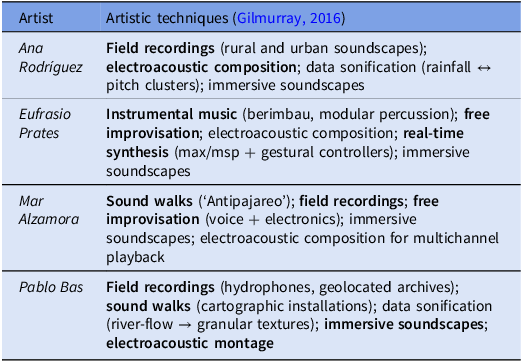
Our analysis considered Gilmurray’s (Reference Gilmurray, Bianchi and Manzo2016) definition of Environmental Sound Artists, encompassing sound walks, field recordings, electroacoustic composition, instrumental music, data sonification, free improvisation, real-time synthesis and immersive soundscapes. We mapped the techniques of each of the four artists employed, considering liner notes, programme materials and other publicly available documentation. Table 1 shows how each artist occupies a distinct cluster of techniques within the broader ecology of environmental sound art, following Gilmurray’s (Reference Gilmurray, Bianchi and Manzo2016) definition. Methods corresponding to the core of an artist’s practice – rather than playing a peripheral role – are marked in bold.
Characterisation of each artist analysed, following Gilmurray’s (Reference Gilmurray, Bianchi and Manzo2016) definition and showing a distinct cluster of techniques within the broader ecology of environmental sound art

By employing these varied methods, the four artists reveal the rich sonic textures of natural environments, capturing and reinterpreting environmental sounds to produce new, contextually grounded understandings. The study of local soundscapes, enhanced by sound art, becomes a conscious effort to mobilise diverse epistemological, scientific, philosophical, political and cultural resources. This approach fosters a knowledge system to empower self-definition and enhance cultural understanding. By embracing multiple perspectives, artists can better capture the complexities of their environments and convey their nuanced realities. We followed Aristotle’s (2008) foundational idea that art is a legitimate means of producing knowledge. However, we also aligned with Deleuze’s (Reference Deleuze2003) (Deleuze and Guattari Reference Deleuze and Guattari1996) perspective, which reshapes this knowledge not as a representation or rational explanation, but as a creative, transformative process that generates new ways of experiencing and understanding the world.
In Latin America, sound artists are increasingly developing strategies combining artistic techniques with a non-hegemonic cosmovision (Rivera-Santana Reference Rivera-Santana2023), for example Afro-indigenous worldviews guide the search for territory in the four artists. These practices are a political stance to define and preserve the sonic complexity of their landscapes and challenge the dominant cultural narratives that reduce nature and territory to mere commodities – a legacy of colonial imposition.
These artists open alternative ways of perceiving time and space by challenging paradigms that commodify nature and territory within a capitalist framework. Their creative practices prompt critical questions: Can the fusion of artistic techniques with philosophical, socio-political, and historical contexts define a distinct aesthetic in contemporary Latin American sound art? Can universal criteria for classifying art be meaningfully applied to such diverse forms of contemporary expression? Although these questions are difficult to answer, the point is not to establish rigid aesthetic principles or a one-size-fits-all framework. Instead, the convergence of history, politics, aesthetics, poetics and technology suggests that interpretive possibilities continually evolve. This ongoing dialogue, marked by unity and tension, underscores the inadequacy of fixed guidelines, making them inherently anachronistic.
By treating environmental sounds as essential components of the soundscape, these artists articulate meanings that resonate with the identities and dynamics of their territories. Fully appreciating these endeavours requires engaging with the complex, multi-layered concept of landscape itself, which demands a pluralistic, interdisciplinary framework to shape our understanding and appreciation of their work.
The term, which appears in variations such as ‘landschaft’ and ‘landscape’, carries an inherent spatial connotation. Historically, an aesthetic-phenomenological perspective characterizes landscape as an appearance or representation – a configuration of visible objects filtered through the subject’s own perceptual lens. (Britto and Ferreira Reference Britto and Ferreira2011: 2)
The interplay of physical, biological, climatic, cultural and human elements constantly reshapes our landscape perception. These dynamic interactions reveal processes that unfold within and beyond our sensory experiences and require a deep awareness rooted in our strong presence in these spaces. As Bertrand (Reference Bertrand2004: 141) notes, landscape is not simply the sum of different geographical features but emerges from a constantly evolving, unstable interplay of physical, biological and human factors in constant dialectical tension.
Therefore, understanding a landscape requires recognising the human and cultural forces that imbue it with meaning. Cultural phenomena shape our perceptions of the environment and influence the criteria by which landscapes – and their constituent elements – are classified and evaluated. Based on insights from critical geography, non-hegemonic perspectives and artistic practices, we discussed how landscapes are constructed amid material contradictions and dominant, often violent, narratives about land. As Friess and Jazeel (Reference Friess and Jazeel2016: 15) observe, these narratives tend to marginalise or obscure alternative geographies, perspectives and spatial experiences, reinforcing a colonial logic of representation that shapes how territories are perceived, understood and experienced. These four artists demonstrate a keen awareness of these dynamics and channel their creative practices to dismantle this singular mode of territorial perception.
In Brazil, for instance, a colonial logic prevails in which agribusiness is considered the engine of economic progress while conflicting with conservation efforts and traditional ecologies of Indigenous peoples, quilombolas and other worldviews. Although art cannot directly resolve these deep-rooted conflicts, it highlights the ecological interdependencies and conveys the intricate complexities of environmental systems. By embracing non-hegemonic approaches, art disrupts the colonial legacies that permeate scientific inquiry and everyday knowledge production, fundamentally reshaping how peoples, places, and ecologies are categorised and valued (de Leeuw and Hunt Reference de Leeuw and Hunt2018; Mbembe Reference Mbembe2015; Sundberg Reference Sundberg2014; Bluwstein Reference Bluwstein2021).
Krenak’s (Reference Krenak2020, Reference Krenak2023) insights remind us that land is more than a commodity to be exploited; it is a living entity endowed with knowledge and voice. By challenging the conventional dichotomy between humans and nature, Krenak’s reflections invite us to use art to establish a reciprocal dialogue with the environment. In the vibrant Latin American context, where Indigenous and Afro-Latin Americans’ knowledge converges with contemporary artistic practices, this perspective provides a powerful framework for contesting and reconfiguring dominant narratives of exploitation and control. By embracing these alternative discourses, contemporary artists are uniquely positioned to critique and transform the enduring power structures that have historically defined the relationship between the culture and natural world.
This integrated vision emerges in the work of Latin American sound artists to challenge established narratives and foster a multi-layered understanding of space. Their creative techniques question entrenched representations of the environment and enable a richer, more inclusive discourse on art, culture and politics in Latin America. These perspectives underscore the transformative potential of art in reconceptualising our relationship with the land and establishing pathways toward more equitable and sustainable futures.
5. Conclusion
Mar Alzamora, Pablo Bas, Ana Rodriguez and Eufrasio Prates emphasise a practical, community-oriented approach to ecological responsibility with balance, reciprocity, existential approaches and tangible actions over abstract theoretical constructs. Their work, deeply rooted in lived experiences and local autonomy, challenges hegemonic perspectives by engaging directly with Latin American landscapes and their inhabitants. They approach the relevance of decoloniality critically, advocating for frameworks that emerge from real-world contexts rather than imposed theoretical labels. For them, meaningful change arises from creating new ways of being and existing, rooted in the immediate realities of the communities and territories they engage with. They reconsider listening to themselves as a vital, embodied act, fundamental as seeing or perceiving, profoundly shaped by specific environments and viewpoints. This reassessment of listening becomes a political and poetic act, expanding our understanding of Latin American soundscapes by incorporating diverse voices, histories and perspectives. Their work reimagines listening as a tool for challenging dominant narratives, fostering deeper connections with territories, and promoting actionable, community-driven change.
Acknowledgements
The authors thank the National Council for Scientific and Technological Development (CNPq) for funding and supporting this research. We also thank the Federal Institute of Education, Science and Technology of São Paulo (IFSP), the Centre for Interdisciplinary Research in Music Media and Technology (CIRMMT) and the Interdisciplinary Nucleus for Sound Communication (NICS, Unicamp) for their institutional support. We are deeply grateful to the artists who generously contributed texts and images and to Aline Parreiras (UFRGS/McGill), Ricardo Dal Farra (Concordia University), Kasey Pocius (Concordia University) and André Gonçalves (Unicamp) for their insightful feedback and discussions.


 Open access

