


Introduction
Rock art is one of the principal means through which prehistoric peoples expressed social and territorial identities (e.g. David & Wilson Reference David and Wilson2002), and as such has been viewed as a key indicator of cultural ‘efflorescence’ at times of heightened social pressures (David & Lourandos Reference David and Lourandos1998). At the site of Lene Hara on the eastern tip of the island of Timor, engraved face motifs have been reported dating from the Pleistocene–Holocene transition. In this paper we describe further examples of these speleothem faces, suggesting they constitute part of a wider tradition. We explore how this relates to a range of other changes that are apparent in the terminal Pleistocene and early Holocene of the region, including bead and burial traditions.
Engraving sites are rare in mainland and Island Southeast Asia (ISEA) (see Tan Reference Tan2014 for an overview), but common to the east in Near and Remote Oceania, while painted art is more common in mainland New Guinea and islands to the west. This observation on the bipartite distribution of engraved versus painted rock art was one of the major outcomes of Specht's (Reference Specht and Mead1979, 63) early analysis of the rock art of the western Pacific. Specht (Reference Specht and Mead1979, 74) also argued that the execution of engravings was focused in areas of igneous geology, in open locations on boulders or rock walls near water, and ‘never in caves or shelters’. He reasoned that although Near Oceania has a prehistory stretching back into the Pleistocene, engravings sites showed a high co-occurrence with areas where Austronesian languages were spoken, and thus that this artistic tradition was probably introduced by incoming Austronesian settlers after 3500 bp. These features, coupled with the fact that the engravings had a stylistic coherence, being characterized by motifs which were ‘generally curvilinear geometric forms such as spirals, concentric circles, face-like forms’ led Specht (Reference Specht and Mead1979, 74) to define ‘the Austronesian engraving style’ (AES).
Wilson and Ballard's (Reference Wilson, Ballard, David and McNiven2018; see also Wilson Reference Wilson2004) recent synthesis of the rock art of Oceania is geographically the broadest yet undertaken and included both engraved and painted art. They define Oceania as encompassing the area from ISEA in the west, to Micronesia and Hawai'i in the north, Australia and Aotearoa (New Zealand) to the south and Rapa Nui (Easter Island) to the east. Near Oceania spans from New Guinea in the east to, and including, the main Solomon Islands group in the west. Their analysis found that there was more overlap in motif type between engraving and painting traditions in the western Pacific than had previously been thought, but they still recognized an east–west division which they suggested might be ‘governed by the geological availability of rock surface types’. Painted galleries occur in areas where limestone cliff faces are present, from eastern Indonesia to Fiji, while engravings predominate in areas of volcanic geology where boulder fields, volcanic flows and beach platforms are available, as in much of Polynesia (Wilson & Ballard Reference Wilson, Ballard, David and McNiven2018).
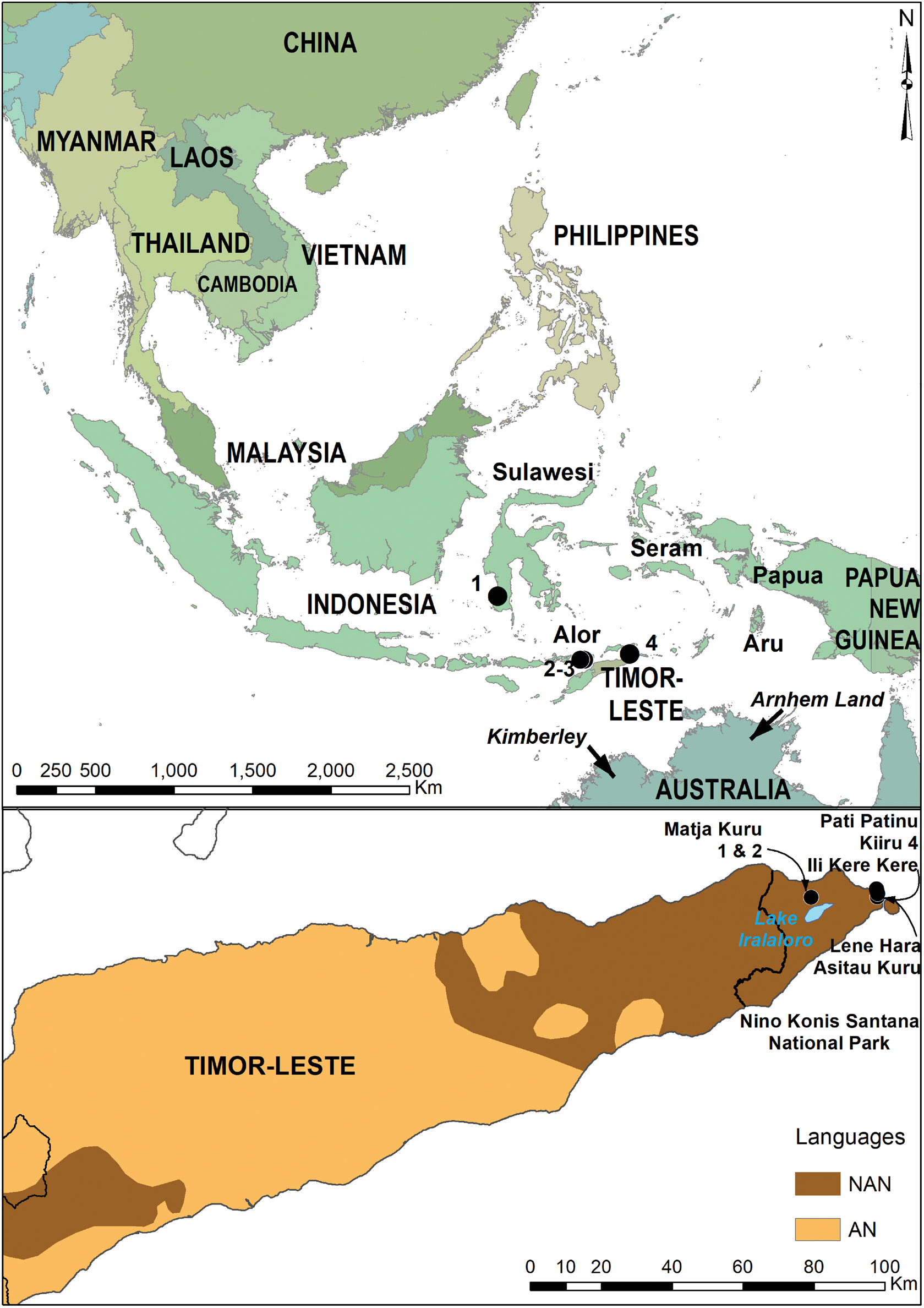
Recent rock-art surveys in eastern Indonesia and Timor-Leste have discovered a number of engraving sites which are changing this perspective. The engravings occur in caves or rock-shelters which are not in close proximity to water (O'Connor et al. Reference O'Connor, Aplin, St Pierre and Feng2010a; Reference O'Connor, Mahirta, Louys, Kealy and Brockwell2018a) and, at least in the case of the Timor-Leste engravings, do not occur in Austronesian language areas (Fig. 1). While it is still true to say that painted rock art dominates prehistoric artistic expression in ISEA, the lack of engraving sites may partly be an outcome of the limited amount of field survey undertaken and the comparatively low visibility of engravings compared with pigment art.
Map of Southeast Asia (top) and Timor-Leste inset (bottom) showing location of various engraved and painted rock art and archaeological sites. Top: Site numbers correspond to the following; (1) Leang Bulu'Sipong 4; (2) Makpan; (3) Tron Bon Lei; (4) Here Sorot Entapa. Bottom: Sites are labelled accordingly. The distribution of Non-Austronesian and Austronesian languages in Timor-Leste is also shown in addition to the boundary of the Nino Konis Santana National Park.
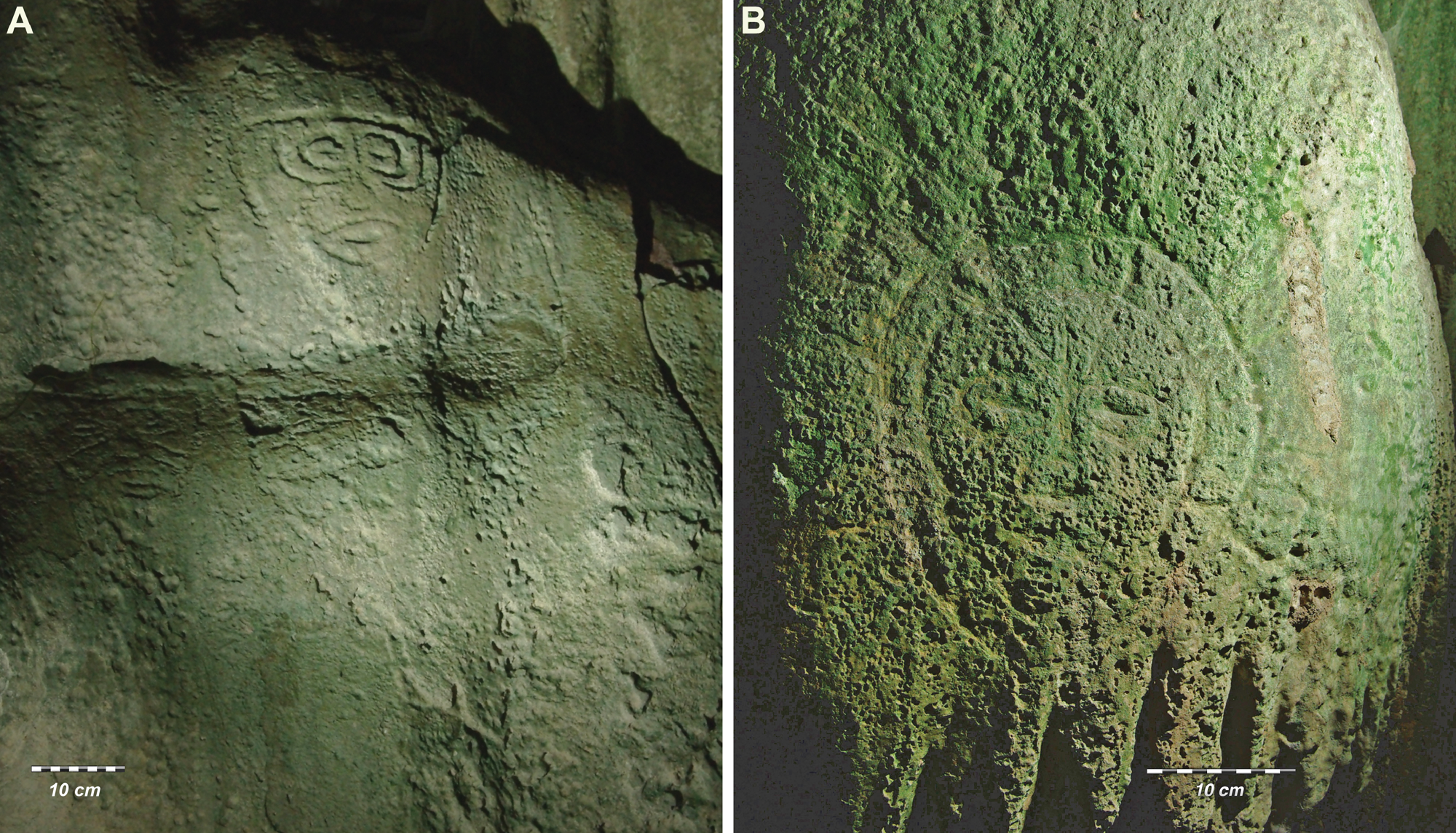
In 2007, two engraved face motifs were discovered in Lene Hara Cave in the Nino Konis Santana National Park at the far eastern end of Timor-Leste (Fig. 1; O'Connor et al. Reference O'Connor, Aplin, St Pierre and Feng2010a). These extraordinary images were pecked into massive speleothem columns located in two different areas of the cave (Fig. 2). Although Lene Hara Cave has a long and extensive history of archaeological prospection and excavation (Almeida & Zybszweski Reference Almeida, Zbyszewski and Solheim1967; Glover Reference Glover1972; O'Connor et al. Reference O'Connor, Spriggs and Veth2002; Reference O'Connor, Barham, Spriggs, Veth, Aplin and St Pierre2010b), and painted rock art has previously been recorded on the cave walls (Almeida Reference Almeida and Solheim1967; Cinatti Reference Cinatti1963; O'Connor Reference O'Connor2003; Standish et al. Reference Standish, García-Diez, O'Connor and Oliveira2020), the engraved motifs had escaped detection. This is probably the result of a combination of factors, including their position above eye height on columns which are located in dimly lit parts of the cave, the presence of more recent calcite growth which partially obscures the engravings and grey-green algal growths that coat the surface of the speleothems. The engravings are thus not obvious unless the speleothems are closely inspected with good lighting. They were found while undertaking a survey of the speleothems for possible owl roost deposits using high-luminosity caving torches. One of the faces (Fig. 2A) in Lene Hara Cave has been dated using the Uranium–Thorium method to between 12,500 and 10,200 years ago (O'Connor et al. Reference O'Connor, Aplin, St Pierre and Feng2010a).
Engraved faces at Lene Hara. (Modified from O'Connor et al. Reference O'Connor, Aplin, St Pierre and Feng2010a, figs 4 & 6).
Here we describe further engravings from another two shelter sites, Pati Patinu and Kiiru 4, which, like Lene Hara, had been previously surveyed for painted art, but in which the engravings were discovered only in 2017. Most of the new Timor-Leste engravings are humanoid in form like the Lene Hara faces, raising the possibility that a discrete artistic tradition arose in this region in the terminal Pleistocene. We explore this idea and the factors that may have led to an efflorescence of symbolic expression at this time.
Engravings at Pati Patinu and Kiiru 4
In 2017, a survey of the painted rock-art sites in the Nino Konis Santana National Park was undertaken to assess the potential of the rock art for Uranium–Thorium dating. During this survey engravings were recognized in two of the limestone shelters in which paintings had previously been recorded; Pati Patinu and Kiiru 4 (Fig. 1). The fact that both sites had previously been surveyed for painted art and occupation deposit is telling in terms of the difficulty of seeing the engravings on the speleothems.
Pati Patinu is a large limestone overhang or shelter in a north–south-running coralline limestone terrace, southeast of the well-known rock-art gallery, Ili Kere Kere (Almeida Reference Almeida and Solheim1967; O'Connor Reference O'Connor2003). The entrance of the overhang faces east. The site was originally recorded in 2004 as potentially having painted rock art and a floor deposit with surface evidence of occupation and excavation potential. The painted art comprised a few areas of red pigment including a star-shaped geometric motif and a small red anthropomorph, but no further motifs could be distinguished. The paintings are spatially separated from the engravings.
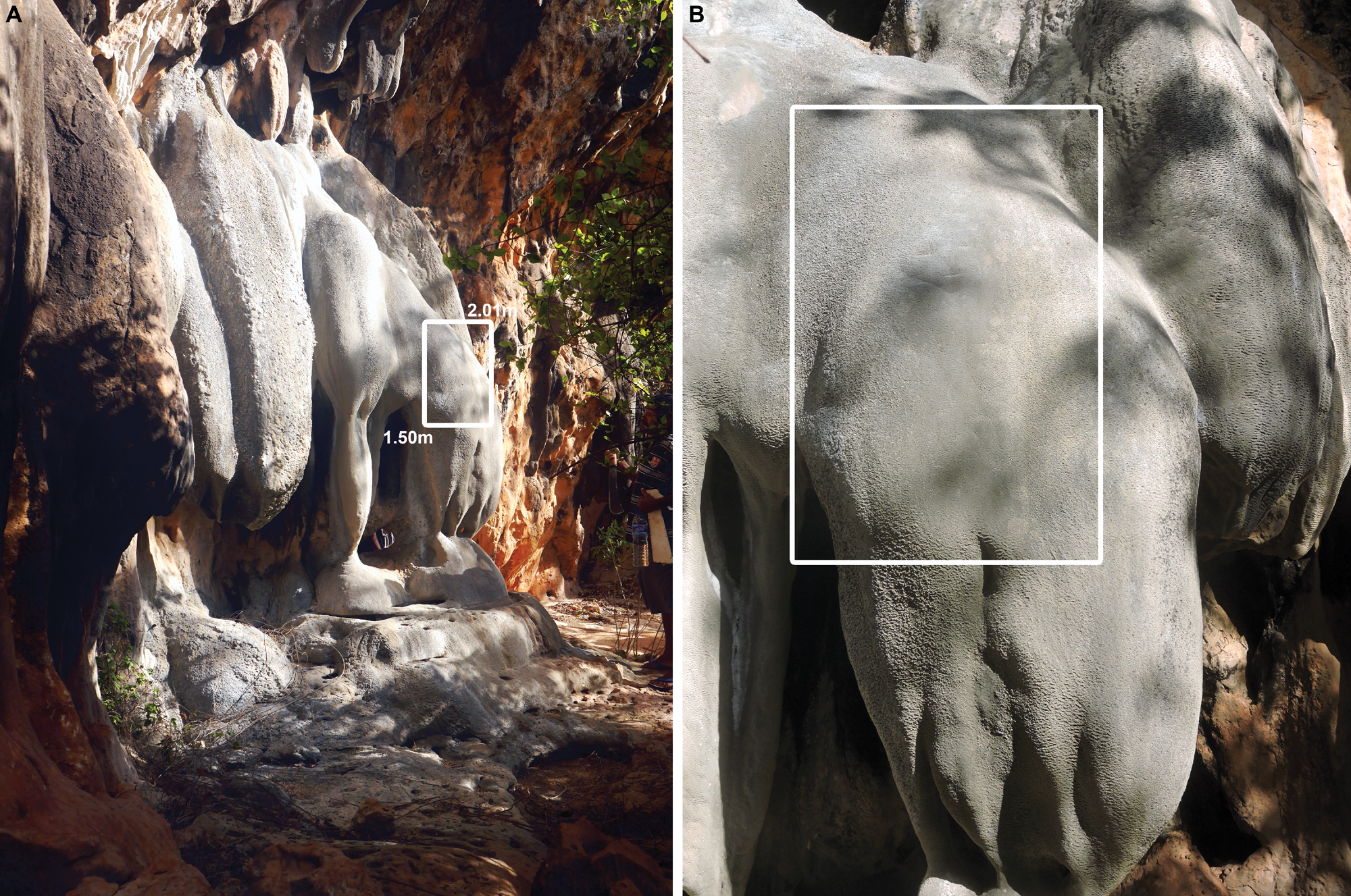
The Pati Patinu face engravings are on an extensive area of speleothem flow on the back wall of the overhang (Fig. 3). The form of the original features of the engravings is almost entirely obscured by subsequent deposition of carbonate (Figs. 4A & B). Only the upper engraving at c. 2 m above the floor of the deposit is clearly a face (Fig. 5). All that remains is the outline, eyes and a mouth, which appear as horizonal ellipses veiled in carbonate. The face is broader at the top, descending to a pointed chin, and encircled in an oblong. Below the Pati Patinu face are two smaller semi-triangular engraved shapes which may also have been faces, but if so no internal features remain visible. The base of the lowest engraved shape is at c. 1.5 m above the adjacent shelter floor. On a separate carbonate flow at Pati Patinu at c. 1.4 m and 1.8 m above the shelter floor is a cross-hatched geometric motif (Fig. 6).
Pati Patinu overhang indicating location of engravings and their heights above the shelter floor.
Pati Patinu engraving almost completely obscured by carbonate flow with a single face observable (A & C) surrounded by other faint depressions which are interpreted as remnants of other engravings (shown in B & D).
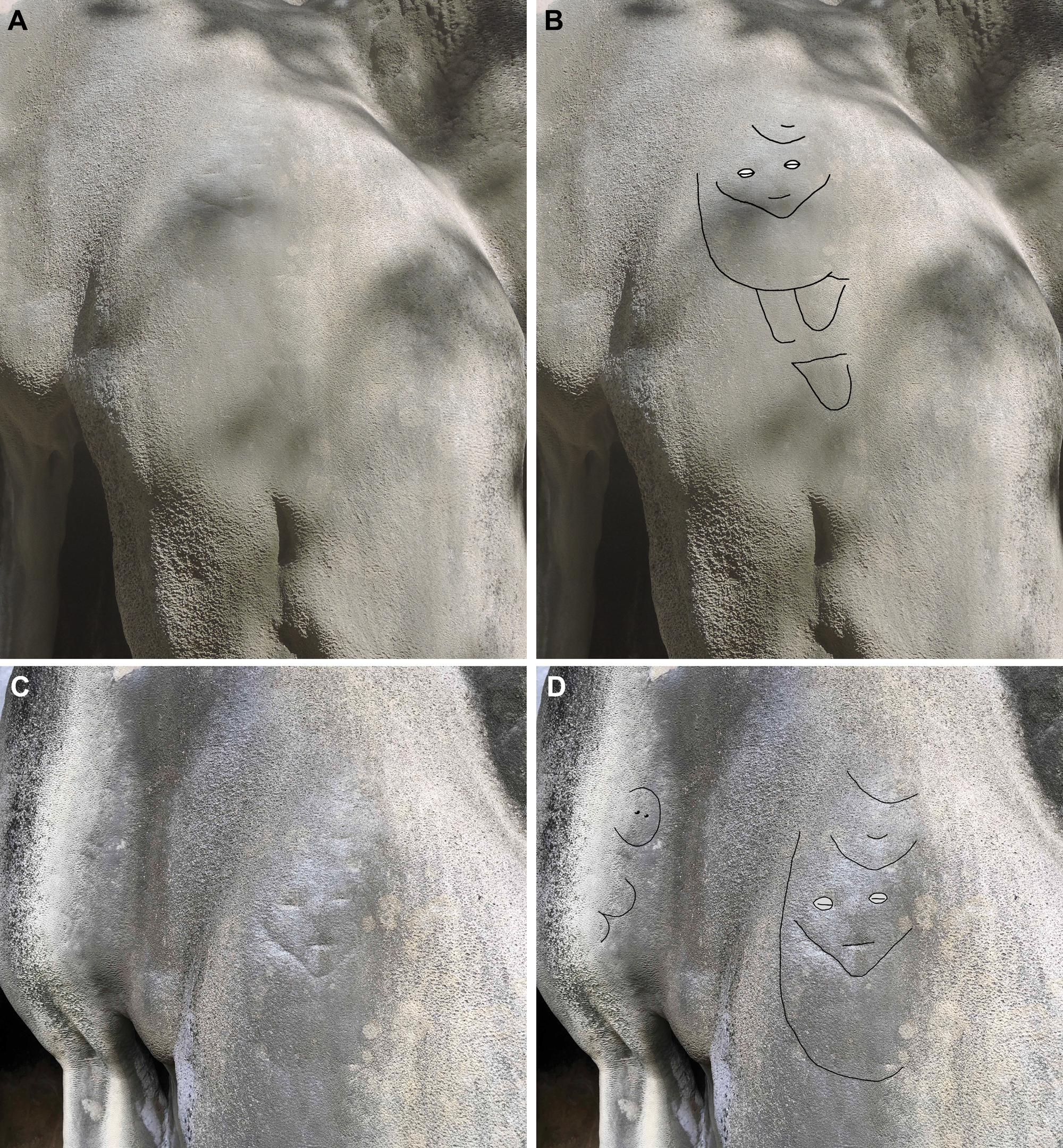
Close up of Pati Patinu face.
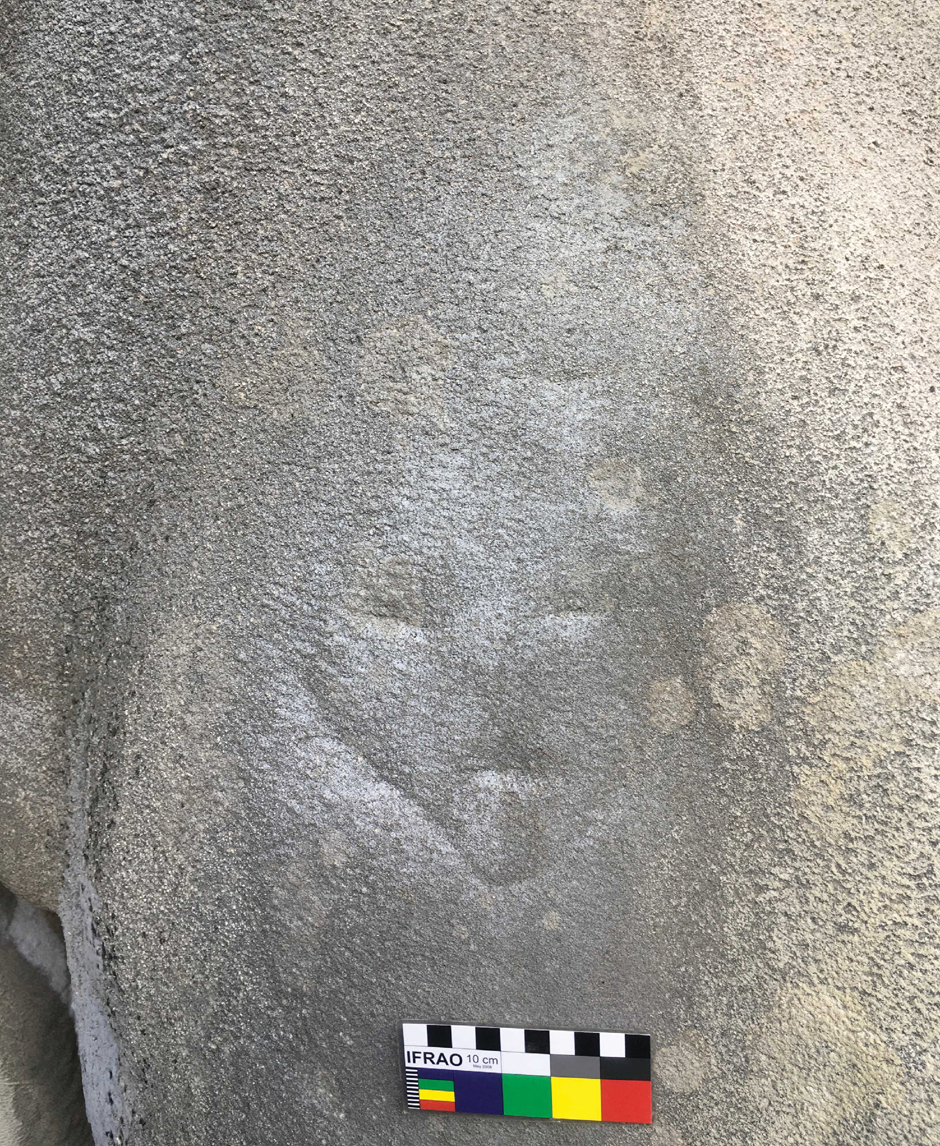
Pati Patinu cross-hatched engraving.
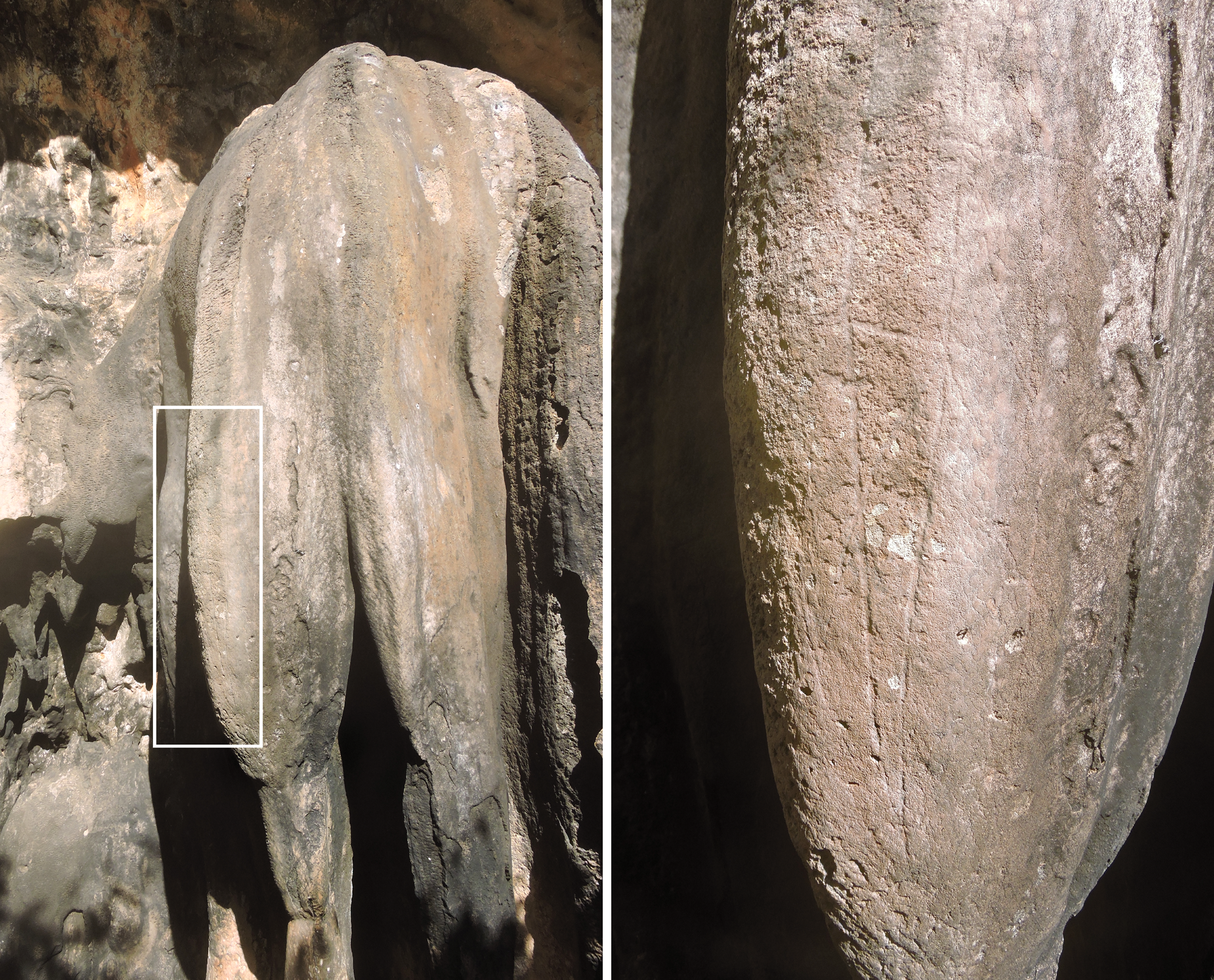
Kiiru 4 is one of a series of deep shelters, also in an uplifted coralline limestone terrace that runs north–south. Of the five recorded Kiiru shelters, two contained painted rock art: Kiiru 2 and 4. The painted rock art included a number of poorly preserved small red anthropomorphs and geometric motifs in the style typical of those recorded elsewhere in Timor-Leste and the neighbouring islands of Indonesia (e.g. O'Connor Reference O'Connor2003; O'Connor et al. Reference O'Connor, Tanudirjo, Ririmasse, Husni, Kealy and Hawkins2018b; Reference O'Connor, Kealy and Blackin press; Yuwono et al. Reference Yuwono, Mahirta, Kealy, Black and Hawkins2020). Engraved motifs were discovered in Kiiru 4 on speleothem growths which are well developed in several areas of the overhang (Fig. 7A).
Kiiru 4 rock-shelter showing the location of the engravings in the shelter and (B) Mr Pedro Morais (left) and Mr Custódio Guimarães (right) from Tutuala showing the height of the humanoid figures above the shelter floor.
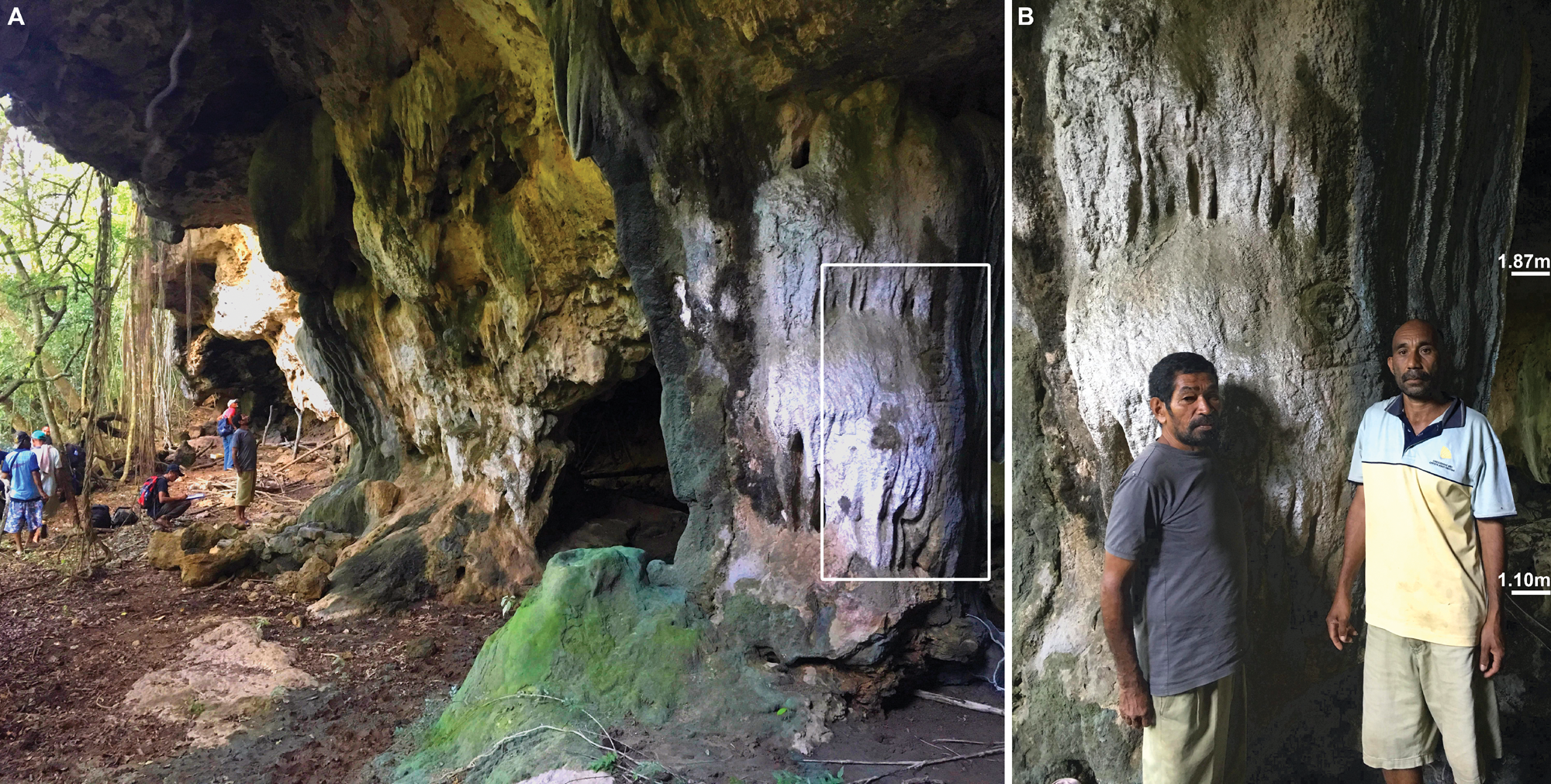
The Kiiru engravings include two full-bodied humanoid figures carved into the same large speleothem column which extends from the roof to the floor of the deposit. They are on the north side of the column with the top of the heads at c. 1.87 m above the adjacent cave floor and they extend c. 0.77 m in total length (Fig. 7B). The lowest engraving continues almost to the base of the speleothem flow about 1.10 m above the floor of the deposit. The combined width of the two figures is c. 0.45 m.
The better preserved figure on the viewer's right, Figure 8B, has a deeply carved circular face and the eyes and mouth are represented simply by deeply gouged holes. The neck is shown using two parallel lines extending from the base of the head to the upper body. The body is triangular with the broad flat area of the triangle forming the upper body and shoulders. Two gently incurving lines are used to define the shape of the belly within the body. To the side of the body, two wavy lines may represent long hair as they appear to connect to the head. The arms lie at the sides of the body following its outline, with the inner line of the arm formed by the outline of the body. At the base of the body is another large deeply gouged hole; larger than the mouth, it may represent a vulva. Only the leg to the viewer's left can be made out and it extends into a wide thigh running up to the body. The left leg has only a single line remaining. The Kiiru figure uses a combination of techniques, pecking alone, pecking followed by abrasion, and incision, with some lines such as the one creating the circular face being c. 10 mm deep. It is not always clear which technique is used as parts of the engraving are very weathered.
Kiiru egravings showing original and contrasted photos. The panel has two figures, one poorly preserved on the viewer's left (A) and a better preserved figure to the right (B).

A second figure, which is located on the viewer's left in Figure 8A, is poorly preserved and difficult to delineate. The shape of a face and the outline of the narrow shoulders and upper body can be made out. The body is shown beginning immediately below the head but no further carved features are evident, although it is possible that the artist has used the carbonate flows within and below the body to represent arms and legs. On this figure the eyes are represented by two circles with the one on the viewer's left best preserved. A nose can be vaguely made out, although its original shape is uncertain and the mouth is represented by a hole, as in the better preserved figure (Fig. 8B). The fresh appearance of another hole in the chin area suggests it is the result of recent damage or natural weathering.
The Timor-Leste humanoids are all distinctly different from each other, in terms of face shape and features. Some, such as Lene Hara Petroglyph group A, are formed from inverted triangles, wide and flat at the top and pointed at the chin (Fig. 2A; O'Connor et al. Reference O'Connor, Aplin, St Pierre and Feng2010a). The eyes are shown using two pecked concentric circles. The mouth is oval with a deep linear groove pecked centrally as if to show lips parted around an open mouth. At Pati Patinu the face lacks a nose, and the eyes and mouth are elliptical rather than round. Lene Hara Petroglyph B has an elaborate oval head dress haloing the full face. The Kiiru humanoids show bodies, and the natural form of the carbonate flows appear to have been used to suggest body features, with the figures showing differences between them in the representation of various features. Sex is not indicated for the majority of the Timor-Leste humanoids, but we suggest that Kiiru B is likely to represent a female.
Discussion
While they contain ‘face-like forms’, the Timor-Leste engravings do not meet the defining criteria for the AES. None of the engravings are in areas of igneous bedrock, nor in open locations. Instead, they all occur in limestone outcrops and in caves or overhangs. Nor do they map onto an Austronesian language area, with the Fataluku language spoken in the region being a non-Austronesian language thought to belong to the Papuan family (Fig. 1) (see papers in Schapper Reference Schapper2014). The dating of the Lene Hara engraved face demonstrates that at least one was carved many thousands of years before Austronesians entered ISEA (O'Connor et al. Reference O'Connor, Aplin, St Pierre and Feng2010a). The extensive speleothem deposition on top of the Pati Patinu faces also hints at their great antiquity. While the Timor-Leste faces are frontal and geometric, they are more idiosyncratic than the stylized face motifs with simple features found in Near and Remote Oceania. The Timor-Leste engravings also lack the accompanying cupules and curvilinear or spiral-based motifs widely found in combination with face motifs in the AES. The Timor-Leste faces are distinct both from the geometric and figurative petroglyphs from neighbouring Alor island (O'Connor et al. Reference O'Connor, Mahirta, Louys, Kealy and Brockwell2018a), as well as the local painted rock tradition that is thought to post-date the Neolithic transition, in which humanoids are depicted as small whole body figures without facial features (O'Connor et al. Reference O'Connor, Tanudirjo, Ririmasse, Husni, Kealy and Hawkins2018b; Reference O'Connor, Kealy and Blackin press).
A brief review of the art to the west of Timor shows that engravings of faces and anthropomorphic forms occur at some sites in Fujian in southeast China and in Taiwan, where they are undated but on stylistic grounds are thought to be Neolithic or Bronze Age (Meacham Reference Meacham2009; O'Connor et al. Reference O'Connor, Mahirta, Louys, Kealy and Brockwell2018a, table 1). Most are on boulders in open locations near the coast. Engraving sites featuring anthropomorphs and faces are known from Vietnam but are also executed on boulders in open locations (Tan Reference Tan2014, 84). An isolated example of an engraved face was recorded in Dong Noi Cave, a limestone cave in Hoa Binh Province, Vietnam, but unfortunately it has since been destroyed (Tan Reference Tan2014). A latex mask of the Dong Noi face can be found in the Hanoi Museum, but from observation it is unclear if it was carved into the limestone wall or a speleothem and the method of engraving is also uncertain. While a detailed comparison of engravings across the broader Asia-Pacific rim is merited, on current evidence the Timor-Leste engraved humanoid tradition appears to be unique, both stylistically and in terms of its focus on speleothems, and therefore is likely to have arisen independently of external influence.
With one exception, the Timor-Leste engravings are all humanoid in form. Elsewhere in the world humanoids were some of the earliest forms to be imagined and created, but are rare. European Pleistocene art is dominated by pictures of large naturalistic animals such as bison and horses, with humanoids and therianthropes occasionally depicted (Comba Reference Comba and Clottes2012). Engravings of human forms become more common in the terminal Pleistocene and display regional variations (Fuentes Reference Fuentes2013). Closer to Timor, the painted rock art of the islands of Sulawesi and Borneo is dated as early as c. 44,000 years ago and also features large animals native to these islands (Aubert et al. Reference Aubert, Brumm and Ramli2014; Reference Aubert, Setiawan and Oktaviana2018; Reference Aubert, Lebe and Oktaviana2019). Like the European cave art, the emphasis is on musculature, body features and naturalistic poses that allow identification of the animal, but a newly discovered panel in Leang Bulu’ Sipong 4 in Sulawesi has been interpreted as a complex hunting scene, showing human-like figures were part of the early artistic repertoire in ISEA, but are rare (Aubert et al. Reference Aubert, Lebe and Oktaviana2019).
All of the Timor-Leste engravings are into speleothems, rather than into the limestone walls of the caves and shelters. Engraved speleothems are uncommon globally. Examples are found throughout the ancient Maya range, including areas of Guatemala, Honduras, Belize, and Mexico (Brady Reference Brady and Gubler1999), but are very different to the Timor-Leste engravings in that they are made by chipping, trimming, shaving or enlarging naturally occurring holes and shapes in the mineral deposits to create a resemblance to simple, often grotesque or monstrous faces, and for this reason they have been referred to as ‘modified speleothem sculptures’ rather than engravings (Griffith & Jack Reference Griffith, Jack, Huang and Culley2005, 2). In the Timor-Leste engravings, the facial features and body outlines of the humanoids are created by pecking, abrading, incising or gouging lines into the carbonate.
Occasionally the Timor-Leste engravers utilized the natural shape of the mineral deposits to suggest features of the body, such as can be seen in Figure 8B where the vertical carbonate flows below the body suggest legs, lending the figure a more three-dimensional quality. This technique, referred to by Conkey (Reference Conkey1981, 27) as ‘iconic congruence’, has been documented elsewhere, including in Ice Age Cantabrian cave art, an example being the red ibex in Cougnac Cave. The use of the curved surfaces of speleothem columns gives the engravings more of an in-the-round statuesque quality than they would have if they were carved into a flat wall. The use of columns also provides them with gravitas as they stare out from these prominent features set apart from and standing proud of the cave walls. In a more pragmatic vein, speleothems would have offered a smoother surface for engraving than the limestone geology of the cave walls which sometimes incorporates coral and other clasts. When active, the speleothems are subject to continuous carbonate deposition which would also have made them less brittle and easier to work than the limestone walls of the caves.
There are many reasons for the creation of rock art, but perhaps a pertinent one is marking territories (David & Wilson Reference David and Wilson2002). In northern Australia, analyses of superimpositions coupled with a major programme of direct dating of art styles are beginning to produce an understanding of the stylistic and chronological sequence of rock art. As in Europe, Sunda (Borneo), and Wallacea (Sulawesi), the earliest northern Australian figurative art is characterized by animals painted in a naturalistic style, known in the Kimberley as Irregular Infill Animal style, and in Arnhem Land as Large Naturalistic Style. Humanoids occur in this phase but are rare (Taçon & Brockwell Reference Taçon and Brockwell1995, 684; Veth et al. Reference Veth, Myers, Heaney and Ouzman2016). This early figurative phase featuring animals has not yet been directly dated but in the Kimberley has been suggested to date from c. 35,000 until at least the last glacial maximum about 18,000 years ago (Veth et al. Reference Veth, Myers, Heaney and Ouzman2016), and in Arnhem Land from before the Pleistocene–Holocene transition (Chippindale & Taçon Reference Chippindale, Taçon, Chippindale and Taçon1998). In the terminal Pleistocene in both these regions of northern Australia, there is a radical change in painted art with the appearance of a new style which is overwhelmingly dominated by human figures. Known in Arnhem Land as the Dynamic figure phase and in the Kimberley as the Gwion figure phase (previously called Bradshaw phase), the human figures feature personal accoutrements such as dilly bags and weapons, as well as elaborate body and hair decorations. Motifs from this stylistic phase have recently been dated to between 13,000 and 12,000 years ago in the Kimberley (Finch et al. Reference Finch, Gleadow and Hergt2020, 5). In western Arnhem Land the Dynamic figure phase is also thought to date to the terminal Pleistocene and early Holocene (Chippindale & Taçon Reference Chippindale, Taçon, Chippindale and Taçon1998), based on a minimum age of 9400 cal. bp for a Northern Running Figure, a late variant of the Dynamic figure phase (Jones Reference Jones2017, 167–8). This radical change in motif subject and the scenes shown has been suggested to be associated with increased territoriality following sea-level rise that submerged huge areas of northern Australia; sometimes rapidly (e.g. Meltwater Phase 1a), resulting in perceptible land loss in individual lifetimes. This is likely to have ‘caused significant social disruption both for coastal groups relocating from inundated areas and to those resident groups who occupied the territory besieged by new arrivals’ (Jones Reference Jones2017, 168). The focus on humans engaged in collective behaviour and displays, including an emphasis on decorative items such as headdresses, weapons and body adornment has been suggested to be a response to the loss of territory, incursion of new populations and the need to demarcate or affirm social and territorial boundaries and relationships (Jones Reference Jones2017).
The terminal Pleistocene, when the Lene Hara face was carved, was also a time of significant environmental, demographic and social change in Timor and more broadly in the southern Wallacean islands. The early Holocene of the nearby rock-shelter of Asitau Kuru sees the appearance of obsidian artefacts from an exotic source, shell adze and shell fishhook technology, a proliferation of personal ornaments made of shell and an overall increase in occupation intensity (Shipton et al. Reference Shipton, O'Connor, Reepmeyer, Kealy and Jankowski2019). To the northwest on Alor island, Makpan cave sees more intensive occupation in the terminal Pleistocene and early Holocene, and the introduction of fishhook production, following an initial Late Pleistocene occupation phase in which these artefacts were absent (Kealy et al. Reference Kealy, O'Connor and Mahirtain press). These changes occur at a time of rapidly rising sea levels, the ecological conditions formed by which are likely to have promoted more intensive coastal exploitation and voyaging between previously connected islands, and thus favoured the use and development of water-craft technology (Shipton et al. Reference Shipton, O'Connor, Reepmeyer, Kealy and Jankowski2019). Rising seas are known to have divided many of the larger Wallacean islands formed during the LGM low stand, physically separating communities whose only recourse for continued social engagement would have been sea voyaging. Exotic obsidian from the same source as that at Asitau Kuru is also documented from the terminal Pleistocene and Holocene at Here Sorot Entapa on Kisar island, as well as Tron Bon Lei on Alor (Reepmeyer et al. Reference Reepmeyer, O'Connor, Mahirta, Maloney and Kealy2016; Reference Reepmeyer, O'Connor, Mahirta, Kealy and Maloney2019).
As sea level stabilized in the early Holocene, inshore reefs would have created stable and productive coastal ecosystems. This is reflected in increases in fish bone, shell and stone artefact numbers in the early Holocene at Asitau Kuru (Shipton et al. Reference Shipton, O'Connor, Reepmeyer, Kealy and Jankowski2019), Makpan (Kealy et al. Reference Kealy, O'Connor and Mahirtain press) and Tron Bon Lei (Maloney et al. Reference Maloney, O'Connor and Reepmeyer2018; Samper Carro et al. Reference Samper Carro, Louys and O'Connor2017) and Here Sorot Entapa (O'Connor et al. Reference O'Connor, Mahirta and Kealy2019). Such increases in occupation intensity suggest increased population density which has been linked to an efflorescence of cultural innovations and complexity elsewhere in the world (David & Lourandos Reference David and Lourandos1998; Powell et al. Reference Powell, Shennan and Thomas2009; Shennan Reference Shennan2000; Reference Shennan2001).
Innovative material culture in Timor-Leste includes beads, which are commonly used as markers of social identity in hunter-gatherer societies (Vanhaeran & d’Errico Reference Vanhaeren and d'Errico2006; Wiessner Reference Wiessner1984), including in mediating interactions between inter-connected groups (Hitchcock Reference Hitchcock2012; Stiner Reference Stiner2014). Asitau Kuru sees a dramatic increase in the frequency of beads as well as the appearance of new types in the early Holocene (Shipton Reference Shipton, O'Connor, Reepmeyer, Kealy and Jankowski2019). Likewise, Lene Hara and the sites of Matja Kuru 1 and 2 in eastern Timor also see a proliferation of beads in the terminal Pleistocene to mid Holocene (Langley & O'Connor Reference Langley and O'Connor2016). A distinctive double-holed Nautilus shell bead type occurs at sites several hundred kilometres apart on Kisar and Alor islands in the terminal Pleistocene and early Holocene (Kealy et al. Reference Kealy, O'Connor and Mahirtain press; O'Connor et al. Reference O'Connor, Mahirta and Kealy2019), further implicating such artefacts in inter-group connections.
Social and territorial identity can also be asserted through human burials (e.g. Pardoe Reference Pardoe1988). On Alor island at Tron Bon Lei, burials occur from the Pleistocene–Holocene transition (O'Connor et al. Reference O'Connor, Samper Carro, Hawkins, Kealy, Louys and Wood2017), while in Makpan there is a burial in the early Holocene (Samper Carro et al. Reference Samper Carro, Stewart, Mahirta and O'Connorin press). These burials share similaritites in interment practice such as the selective removal of skeletal elements prior to interment and the use of cobbles to cover the body (Samper Carro et al. Reference Samper Carro, Gilbert and Bulbeck2019; Reference Samper Carro, Stewart, Mahirta and O'Connorin press). Unlike Makpan, the only fishhooks known from Tron Bon Lei were interred as grave goods with a single burial (O'Connor et al. Reference O'Connor, Samper Carro, Hawkins, Kealy, Louys and Wood2017). This supports the evidence of distinctive bead types at different sites, which suggests that in spite of long-distance connections, separate group traditions were maintained even on the same islands.
A third archaeologically visible form of marking identity is through rock art (e.g. David & Wilson Reference David and Wilson2002; Demattè Reference Demattè2004; Eisenberg-Degen et al. Reference Eisenberg-Degen, Schmidt and Nash2018; Gunn Reference Gunn2011; Ross Reference Ross2013; Taçon et al. Reference Taçon, Kelleher, King, Brennan, Sanz, Fiore and May2008). We suggest that the humanoid petroglyphs from eastern Timor are a local response to the broader regional phenomenon of increased inter-group interaction and population density in the terminal Pleistocene and early Holocene, and the resultant need for the expression and marking of social and territorial identity. Given that the engravings are in quite hidden locations, it is unlikely that they were intended for display to people from other groups. Instead the act of their creation may have been a ritual way of marking territorial identity. The variability of forms in the engravings also suggests that it was their creation rather than their final appearance that was most significant.
Conclusion
The two new engraving sites in Timor-Leste described here add to a growing body of engravings in ISEA which are changing conventional views on the distribution, locational characteristics and form of engravings in Oceania. Engravings have been thought to be rare in ISEA, especially in areas of limestone geology (Specht Reference Specht and Mead1979). Specht (Reference Specht and Mead1979) also believed that engravings occurred predominantly in areas where Austronesian languages were spoken and were culturally associated with these late Holocene immigrants to Oceania, and thus coined the ‘Austronesian engraving style’ to describe them. The Timor-Leste engravings meet none of these criteria. They are executed on speleothems in limestone caves and shelters and are predominantly humanoid in form. Aside from this, they are all quite different from each other. To date there are no obvious antecedents for the Timor engraved humanoids among the repertoire of engraved motifs from areas to the west or east, and we suggest that they probably arose as an independent symbolic response to environmental, demographic and social changes which were occurring in the terminal Pleistocene and early Holocene in southeastern Wallacea. Other changes in the archaeological record at this time signal greater inter-island connectivity and enlarged social networks, involving raw material exchange linking at least four islands (Reepmeyer et al. Reference Reepmeyer, O'Connor, Mahirta, Kealy and Maloney2019; Shipton et al. Reference Shipton, O'Connor, Reepmeyer, Kealy and Jankowski2019). Like burials and beads, rock art is a means for human groups to signal identity and territoriality, as much through its creation as its viewing. We suggest that the eastern Timor engraving tradition in part served this function at a time of increased inter-group contact.
It is possible that many more such engraved sites exist but have been overlooked by researchers as they are usually in dimly lit areas of caves and have been altered by erosional and/or accretionary processes, such as carbonate deposition, making them difficult to see. Speleothems are abundant in these limestone caves and overhangs, and few have ever been closely examined using suitable lighting, so we hope that future surveys will inspect these closely, and perhaps add to the corpus of rock art in previously studied regions.
Acknowledgements
This research was supported by Ms Cecília Assis, Secretaria do Estado da Arte e Cultura, and the staff of the Direção Nacional do Património Cultural, Timor-Leste. The people of Tutuala are thanked for their help and support. The field research was financially supported by grants to NVO from the Gerda Henkel Foundation and the National Geographic Society (Grant 6816). SO's fieldwork was funded by the Australian Research Council (ARC) Centre of Excellence for Australian Biodiversity and Heritage (CE170100015). We would like to thank Bruno David for sharing his extensive knowledge of world rock art.


 Open access

