


1. Introduction
The transition from linear to circular economy (CE) models has become a central topic in sustainability discourse. CE can be defined as an economic system that seeks to decouple economic growth from the consumption of finite resources by designing out waste, keeping products and materials in use as long as possible, and regenerating natural systems (Reference Kirchherr, Reike and HekkertKirchherr et al., 2017). It enables companies to extend product life cycles and to use resources more efficiently (Reference Geissdoerfer, Santa-Maria, Kirchherr and PelzeterGeissdoerfer et al., 2023). Reference Potting, Hekkert, Worrell and HanemaaijerPotting et al. (Reference Potting, Hekkert, Worrell and Hanemaaijer2017) identified a hierarchical set of ten R-strategies to enhance circularity in product life cycles, categorized into narrowing, slowing, or closing the loop (Reference Potting, Hekkert, Worrell and HanemaaijerPotting et al., 2017; Reference Kirchherr, Reike and HekkertKirchherr et al., 2017). Narrow-the-loop strategies includes refuse (R0), rethink (R1) as well as reduce (R2) and focus on reducing resource consumption at the design as well as production stages. This study emphasizes some of the slow-the-loop strategies which are reuse (R3), repair (R4), refurbish (R5), remanufacture (R6) and repurpose (R7). These strategies are essential for extending product lifespans and minimizing resource input during the use phase. Close-the-loop strategies, including recycling (R8) and recovery (R9), address the end-of-life phase by facilitating material recirculation and energy recovery.
The efficiency of slow-the-loop strategies in minimizing resource input and environmental impact is well recognized, however, the interplay between human behaviour and industry-specific conditions in the successful implementation of CE approaches remains underexplored (Reference Kirchherr, Yang, Schulze-Spüntrup, Heerink and HartleyKirchherr et al., 2023). More precisely, consumer behaviour strongly influences the effectiveness of all these strategies, particularly regarding the duration of product use, willingness to repair rather than replace, and participation in end-of-life return systems (Reference Potting, Hekkert, Worrell and HanemaaijerPotting et al., 2017; Reference Wastling, Charnley and MorenoWastling et al., 2018).
The bicycle industry exemplifies the opportunities and challenges at the intersection of circular economy, consumer behaviour and industry-specific conditions. In this paper, the bicycle industry is associated with all economic activities involved in the design, manufacturing, distribution, marketing, sales, and servicing of bicycles, bicycle components and bicycle-related products. The absence of universal standards for component compatibility, a proliferation of proprietary designs, and rapid cycles of technological innovation often inhibit repair, refurbishment, and the reuse of components. Globalised manufacturing, strict safety requirements, and incentive structures that favour product replacement further complicate efforts to embed circularity into bicycles’ product life cycles (Reference Szto and WilsonSzto & Wilson, 2023). These structural barriers underscore the critical need for strategies that intentionally address systemic lock-ins and enable circular practices such as modular, dismountable, repair-friendly, and upgradable products which implies standardisation of components, thus empowering both consumers and manufacturers to participate in more circular flows. Despite these obstacles, there are early efforts to integrate remanufacturing and additive manufacturing into business models in the bicycle industry (Reference McEwen, Cooper, Warnett, Kourra, Williams and GibbonsMcEwen et al., 2018). Yet less is known about the specific incentives that might motivate end-users to engage in reuse, repair, remanufacture, or refurbishment, particularly in contexts where ownership remains with the consumer until end of life (Reference Kirchherr, Reike and HekkertKirchherr et al., 2017).
This study examines slow-the-loop strategies in the bicycle industry with the dual goal of minimizing waste and enabling the behavioural and systemic changes needed for a transition to a circular economy, recognising that circularity must be considered at the level of each product and component. Specifically, it explores how consumer perceptions, industry challenges, and incentive mechanisms influence the adoption of slow-the-loop approaches, addressing the current lack of empirical research on consumer behaviour in this context. Using a large-scale survey of cyclists in Germany, the study aims to give a high-level overview and records actual usage, return, and purchasing intentions to better understand consumer acceptance and willingness to engage with CE strategies. It seeks to answer the following research questions:
(1) How do consumers perceive and evaluate slow-the-loop strategies within the bicycle industry?
(2) To what extent are consumers willing to return bicycles at end-of-life?
(3) What influencing factors and incentive mechanisms can facilitate consumer engagement in repair, remanufacture and refurbishment strategies?
The paper unfolds as follows. Next, the current state of research on slow-the-loop strategies regarding consumer behaviour in the bicycle industry is discussed. Thereafter, the research design is elaborated followed by the presentation of the results. The paper closes with a discussion and conclusion highlighting recommendations for manufacturers in the bicycle industry and future research directions.
2. Theoretical background on slow-the-loop strategies and consumer behaviour in the bicycle industry
The following section presents the theoretical background related to the three research questions, starting with consumer behaviour and engagement in context of circular economy approaches, including consideration of the attitude-behaviour gap. Afterwards, the current state of research on slow-the-loop strategies in the bicycle industry in this regard is outlined.
Consumer behaviour theories examine the psychological and sociocultural mechanisms underlying individuals’ or groups’ selection, acquisition, use, and disposal of products, services, concepts, or experiences to fulfil their needs and preferences (Reference Vidal-Ayuso, Akhmedova and JacaVidal-Ayuso et al., 2023). In this study, consumer attitude is operationalized as the willingness to purchase, repair, or return bicycles, as well as the motivational aspects underpinning these attitudes. A critical concept in this context is the attitude-behaviour gap which implies that consumers’ stated intentions toward responsible purchasing do not always translate into their actual behaviours (Reference Terlau and HirschTerlau & Hirsch, 2015). This phenomenon has been documented by Reference Cheung, Fillare, Gonzalez-Wertz, Nowak, Orrell and PetersonCheung et al. (Reference Cheung, Fillare, Gonzalez-Wertz, Nowak, Orrell and Peterson2022) regarding recycled products; hence, it is reasonable to expect similar discrepancies regarding refurbished bicycle, signalling the potential for behavioural deviations in this domain. In addition to consumer behaviour and attitude, consumer engagement is an essential dimension in the literature. Despite its recognised importance as a determinant of successful circular economy implementation (Reference Kirchherr, Reike and HekkertKirchherr et al., 2017), scholarly attention remains limited. Reference BucurBucur (Reference Bucur2023) defines consumer engagement as the extent to which consumers actively support and participate in circular initiatives, including purchasing circular products and services, supporting circular businesses, and participating in circular economy activities. To enhance consumer engagement, a variety of strategies can be employed, such as awareness campaigns, financial incentives, and the creation of convenient infrastructure to facilitate circular actions (Reference BucurBucur, 2023). Since consumer engagement fundamentally includes decision-making processes, Reference Vidal-Ayuso, Akhmedova and JacaVidal-Ayuso et al. (Reference Vidal-Ayuso, Akhmedova and Jaca2023) conceptualise consumer decision-making along two axes: individual versus collaborative choices, and the level of consumer involvement, from low (passive) to high (active) engagement. This study targets individual decision-making processes across this spectrum of consumer involvement: from low involvement (e.g., purchasing refurbished bicycles) to moderate involvement (e.g., participating in repair activities), and up to high involvement, as exemplified by undertaking the return and disposal of bicycles.
In the following, the research background on slow-the-loop strategies is elaborated in more detail, with a primary focus on the bicycle industry while also drawing on insights from other sectors. While Reference Cudok, Neugebauer and VietorCudok et al. (Reference Cudok, Neugebauer and Vietor2022) provide initial insights into consumer behaviour towards refurbished bicycles by providing measures according to the 4P’s in marketing research such as product (warranties, quality seals, etc.) for increasing acceptance, Reference Koop, Grosse Erdmann, Koller and DöpperKoop et al. (Reference Koop, Grosse Erdmann, Koller and Döpper2021) describe the broader state of CE practices, particularly, the combination of remanufacturing and additive manufacturing for electric bicycles. Existing approaches primarily focus on leasing and sharing models that follow a product-as-a-service logic. These models are mainly found in urban contexts and support circularity through controlled return systems. However, they do not reflect the ownership context central to this study, as many consumers still prefer owning a bicycle over leasing or sharing one (Reference Huang, Qian, Soopramanien and TyfieldHuang et al., 2021).
No study has explicitly examined willingness to adopt slow-the-loop strategies in the bicycle industry. Therefore, we developed the survey by adapting relevant constructs from prior research, as no suitable survey measures were available. Although general product return behaviour has been studied. Reference Martinho, Magalhães and PiresMartinho et al. (Reference Martinho, Magalhães and Pires2017) found that financial incentives, such as vouchers, can positively influence return decisions, while many consumers prefer to pass on used products within their personal network rather than use official collection points. However, this study focused on smartphones. Reference Bovea, Ibanez-Fores, Perez-Belis and JuanBovea et al. (Reference Bovea, Ibanez-Fores, Perez-Belis and Juan2018) identified emotional attachment as a barrier to product return, noting that some users keep unused items as potential sources of spare parts. Similarly, Reference Ratay and MohnenRatay and Mohnen (Reference Ratay and Mohnen2022) emphasized convenience as a key driver of return behaviour highlighting the importance of home pick-up options and accessible return stations. None of these studies, however, address the specific characteristics of the bicycle industry, leaving open whether the same factors apply to bicycles.
Beyond product returns, other studies have investigated factors and incentives influencing the adoption of slow-the-loop strategies, specifically regarding consumers’ use of repair and refurbishment services. Research shows that environmental awareness and the desire to reduce waste by extending product lifespans are major motivators for repair lifespan (Reference Van den Berge, Magnier and Muggevan den Berge et al., 2023; Reference Fachbach, Lechner and ReimannFachbach et al., 2022; Reference Rogers, Deutz and RamosRogers et al., 2021). Financial savings compared to purchasing a new product and a favourable cost-benefit ratio also encourage repair decisions (Reference Bovea, Ibanez-Fores, Perez-Belis and JuanBovea et al., 2018; Reference Laitala, Klepp, Haugrønning, Throne-Holst and StrandbakkenLaitala et al., 2021; Reference TerzioğluTerzioğlu, 2021). For slow-the-loop strategies such as refurbishment, remanufacturing, and repurposing, altruistic and environmental motives, including the wish to curb overconsumption and environmental impact, play a central role (Reference de Morais, Pinto and Cruz-Jesusde Morais et al., 2021; Reference Kannan, Shankar and GholipourKannan et al., 2022). Product design also shapes acceptance: products that are durable, easy to clean and maintain, and aesthetically appealing are more likely to be reused (Reference Selvefors, Rexfelt, Renström and StrömbergSelvefors et al., 2019).
Taken together, existing studies highlight various factors and incentives shaping consumer behaviour in slow-the-loop contexts but do not address the bicycle industry specifically. One of the few studies examining the context of the bicycle industry is conducted by Reference Cudok, Neugebauer and VietorCudok et al. (2022), who found that consumer trust in both the product and the provider can be strengthened through transparency regarding the condition and functionality of refurbished bicycles. A clear price advantage compared to new models further serves as a key purchasing incentive. Consequently, a clear research gap remains, as the research questions outlined in the introduction have not been addressed in the existing literature.
3. Survey development and data collection
Given the exploratory character of this cross-disciplinary research field and the unknown composition of the target population, an online survey provides a pragmatic and efficient way to gather data and formulate hypotheses (Reference Nadler, Petzold and SchönduweNadler et al., 2015). Thus, a large-scale survey was conducted from July 3 to September 2, 2025, targeting adult bicycle users residing in Germany, with a particular focus on city and trekking bikes due to their leading market share (ZIV, 2025). The survey excluded children’s and youth bicycles, concentrating instead on adult participants with experience in purchasing, using, repairing, or disposing of bicycles. The online survey was distributed across multiple online channels including social media, company networks, and the newsletters of industry associations (e.g., ADFC and ZIV) to capture a broad cross-section of user perspectives.
The questionnaire was developed based on a review of existing literature on circular economy consumer practices and adapted to the specific context of the bicycle industry. Survey questions were formulated to capture key constructs such as willingness to purchase refurbished bicycles, repair behaviour, and end-of-use management. The draft questionnaire was pretested with ten potential participants to assess clarity and technical operability; following feedback, minor revisions were made to improve comprehension and item relevance.
The instrument consisted of 32 questions divided into five sections: sociodemographic, bicycle ownership/usage, attitudes toward refurbished bicycles, end-of-use/disposal strategies, and repair/return expectations. Key survey questions that are considered in this paper measured the consumer’s willingness to repair and purchase refurbished bicycles, as well as influencing factors and incentive mechanisms supporting slow-the-loop circular strategies such as repair, reuse and refurbish.
For the sociodemographic questions and those related to usage/ownership behaviour, single-response options were provided, allowing respondents to select one answer per item. The questions addressing general repair willingness, as well as motivators and barriers, were measured using a five-point Likert scale ranging from “strongly disagree” (1) to “strongly agree” (5). The general willingness to purchase a refurbished bicycle was also measured using a five-point Likert scale ranging from “no, definitely not” (1) to “yes, definitely” (5). Motivators and barriers influencing the willingness to return bicycle components were also measured using a five-point Likert scale ranging from “no influence” (1) to “very strong influence” (5). For the questions focusing on repair motivation and expectations towards manufacturers, respondents were asked to rank the given answer options according to their individual importance. Each response option had to be assigned a unique rank. Consequently, percentages refer to the proportion of responses within each rank, which may result in totals exceeding 100%. Most questions were closed-ended, supplemented by hybrid and minimal open formats.
In total, 487 responses were recorded, with 411 fully completed (dropout rate: 15.6%); respondents were 59.9% male, 39.9% female, 0.2% diverse, with age ranges mostly between 25–54 years (69.1%). Participation was voluntary. The study fully complied with applicable data privacy regulations; a formal ethics approval was not required. All data were manually checked for quality before analysis. For this study data management and statistical analysis were performed using SPSS, which enabled systematic data cleaning and provided a broad range of analytical tools. Only descriptive statistics were applied to examine the distribution of responses. Simple frequency analyses were conducted, and the results are reported based on valid percentages to account for missing values.
4. Results of the consumer readiness for slow-the-loop strategies
The results section first presents descriptive statistics relating to respondents’ willingness, as the consumers’ attitude is fundamental for the implementation of slow-the-loop strategies. Following this, we examine key influencing factors and potential incentive systems in greater detail to better understand drivers and barriers relevant to promoting repair and refurbishment practices within the bicycle industry. Prior to these results, findings regarding bicycle usage, time of usage, the most used types and buying behaviour of bicycles are summarised briefly. 44.8% of respondents stated that they use their bicycle daily; 34.3% use their bicycle several times a week and 11.2% several times a month, while only 9.7% use their bicycle less frequently. According to the survey, 24.5% of respondents typically keep their bicycles for 10 years before disposing of them, giving them away or selling them. Further 16.8% of respondents reported a usage period of 15 years, and another 12.1% indicated a usage period of 20 years, reflecting a considerably lengthy life span for bicycles. Most respondents stated that they use trekking bikes (23.1%), followed by city bikes (22.4%). Regarding ownership, 83.9% owned their bicycle, 14.6% used a leasing model, and 1.5% were unsure. Moreover, 73.8% of respondents stated that they bought new bicycles, and only 26.2% of respondents purchased pre-owned bicycles. Indicating a high portion of ownership compared to leasing bicycles in the results of this survey data as illustrated in the literature (Reference Huang, Qian, Soopramanien and TyfieldHuang et al., 2021), therefore, strengthening the focus in this study on slow-the-loop strategies compared to narrow- or close-the-loop strategies.
4.1. Consumer readiness for slow-the-loop strategies in the bicycle industry
The survey findings provide insights into consumer attitudes regarding repair practices and the purchase of refurbished bicycles within the context of circular economy principles. The majority of respondents indicated a strong willingness to repair a bicycle stand themselves under the given conditions rather than purchase a new one. 77.2% stated this was very likely, and 10.9% tended to consider it likely. 3.2% were undecided, while 8.6% regarded self-repair as rather or very unlikely.
Additionally, a substantial proportion of survey participants (82.4%) expressed a positive attitude toward purchasing refurbished bicycles, provided that the products are technically flawless and accompanied by a warranty. Specifically, 63.8% indicated that they would “definitely” consider such a purchase, while a further 18.6% reported that they would “probably” do so. These findings underscore the importance of technical reliability and post-purchase security as critical determinants in consumer adoption of circular economy practices such as refurbishment. Overall, these results suggest that consumers in the bicycle industry demonstrate a strong willingness to repair and buy refurbished bicycles. Willingness to engage in repair, refurbishment, and return activities is illustrated alongside the factors influencing bicycle return behaviour in Section 4.2. The motivators and barriers give insights into targeted interventions to further promote slow-the-loop practices and will be reviewed in Section 4.3 and discussed in Section 5.
4.2. Consumer readiness and willingness for returning bicycles at end-of-life
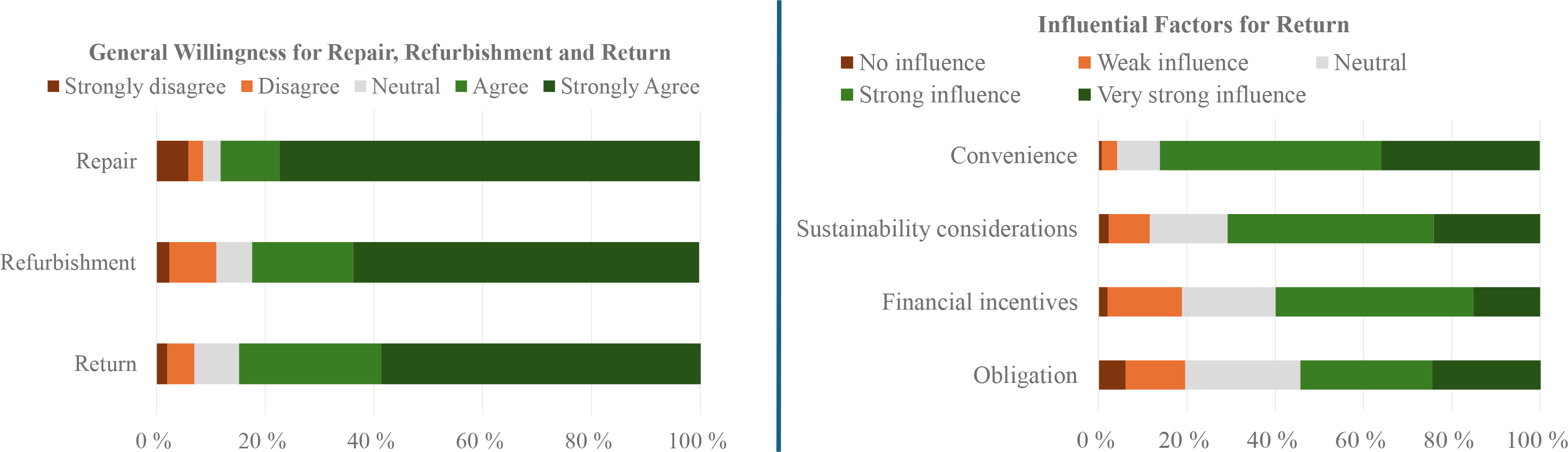
A prerequisite for the implementation of slow-the-loop strategies is the return of products by consumers; therefore, it is essential to assess their willingness to return used products. Most respondents expressed a clear willingness to participate in a collection scheme for used bicycles: 58.8% strongly agreed and 26.1% tended to agree. 8.2% remained neutral, while 5.0% tended to disagree and 2.0% strongly disagreed. In Figure 1, the first stacked bar chart summarises the willingness of the participants to (1) repair bicycles, (2) buy refurbished bicycles and (3) return bicycles at end-of-use. The second stacked bar chart shows influential factors for returning bicycles.
Willingness for repair, refurbishment and return as well as influential factors for return (own presentation)

Figure 1 Long description
The image contains two bar graphs. Panel A: A horizontal bar graph shows general willingness for repair, refurbishment, and return. The x-axis represents the percentage from 0 percent to 100 percent. The y-axis lists three categories: Repair, Refurbishment, and Return. Each bar is divided into segments representing different levels of agreement: Strongly disagree, Disagree, Neutral, Agree, and Strongly Agree. The majority of responses for all three categories fall under Agree and Strongly Agree. Panel B: Another horizontal bar graph illustrates influential factors for return. The x-axis represents the percentage from 0 percent to 100 percent. The y-axis lists four factors: Convenience, Sustainability considerations, Financial incentives, and Obligation. Each bar is divided into segments representing different levels of influence: No influence, Weak influence, Neutral, Strong influence, and Very strong influence. Convenience and Sustainability considerations show a higher percentage of Strong influence and Very strong influence compared to Financial incentives and Obligation.
The results indicate that convenient return options, such as collection points, exert a strong or very strong influence for 85.4% of respondents. Sustainability considerations in terms of intrinsic motivations also play a central role, with 68.7% indicating these aspects strongly influence their willingness to return bicycles. Furthermore, financial incentives such as deposit schemes are cited as a strong or very strong motivator by 59.9% of participants, while mandatory return requirements exert a slightly lower level of influence for 53.3%. These findings highlight that convenient return options, sustainability considerations, and financial incentives are the key factors influencing consumers’ willingness to return products and should therefore be prioritized to successfully implement slow-the-loop strategies.
4.3. Influencing factors and incentive mechanisms for implementing slow-the-loop strategies in the bicycle industry
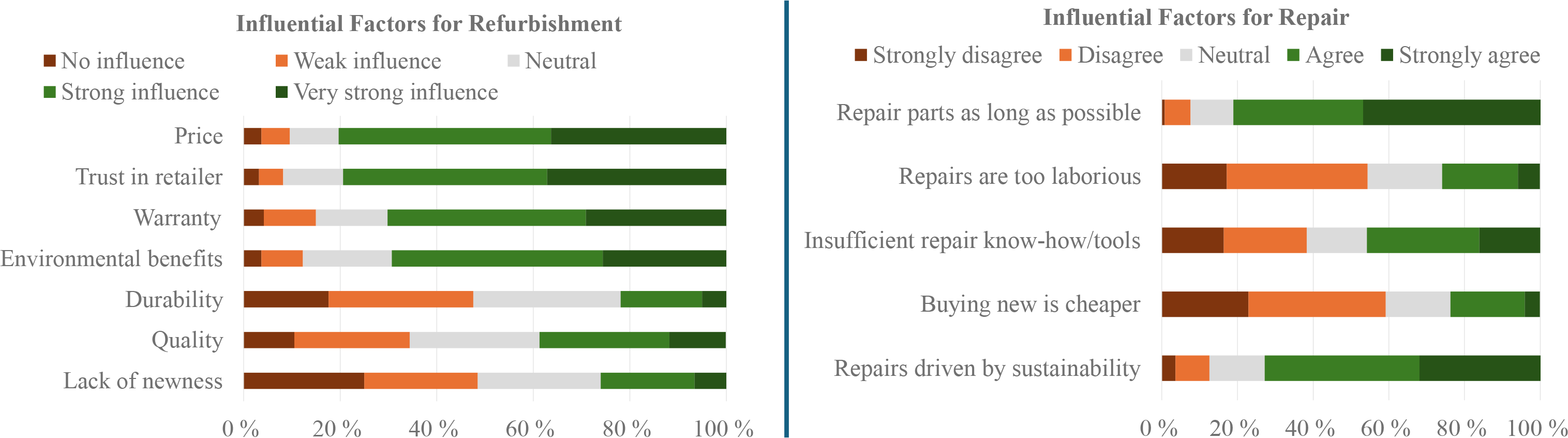
The findings further underscore the strong willingness among respondents to purchase refurbished bicycles, with key influencing factors and barriers. Price emerged as the most significant driver, with 79.8% of respondents indicating that a lower price would have a strong or very strong influence on their willingness to buy a refurbished bicycle. Trust in certified dealers or manufacturers was nearly as important, with 79.3% rating it as a strong or very strong influence. The availability of a warranty (70.0%) and perceived environmental benefits or resource conservation (69.0%) were also frequently evaluated as strong or very strong motivating factors. Regarding barriers, 21.5% identified concerns about durability, 29.1% noted uncertainty regarding quality or origin, and 25.9% expressed a preference for new products as having a strong or very strong negative influence. These results suggest that consumer acceptance of refurbished bicycles can be substantially increased by addressing quality concerns, providing transparent product information, and ensuring reliable sales channels, all of which directly affect the factors most strongly influencing purchasing behaviour. In Figure 2, the first stacked bar chart shows the influential factors for buying refurbishment, and the second stacked bar chart shows influential factors for repairing bicycles.
Influential factors for refurbishment and repair (own presentation)

A strong willingness to engage in repair activities was evident, with 78% of respondents agreeing or somewhat agreeing that they seek to repair damaged bicycle components for as long as possible. Concerning the perceived effort involved, 55% of participants disagreed or somewhat disagreed with the notion that repairing bicycles is excessively laborious. Nevertheless, 47% indicated that they lack the necessary knowledge or tools to undertake repairs themselves. Additionally, 59% disagreed or somewhat disagreed with the statement that purchasing new bicycles or components is cheaper or more convenient than repairing existing ones. Notably, sustainability considerations emerged as a significant motivation for repair decisions, as 69% of respondents reported repairing their bicycles for environmental reasons.
In the survey, respondents identified several primary motivators for engaging in repair activities. Cost savings (33.5%) and environmental or sustainability concerns (32.2%) emerged as the top-ranked drivers. The desire to maximize the useful life of the product was also important, receiving 29.7% of responses in the second rank and 22.7% in the third rank. Enjoyment of do-it-yourself repair was recognized as a motivating factor as well, cited by 20.4% in third rank, 23.4% in fourth rank, and rising to 37.6% in the fifth rank. Additionally, easy access facilitated by tools such as QR codes was mentioned by 23.7% as a fourth rank influencing factor. These findings highlight the multifaceted nature of repair motivation, with economic, environmental, and experiential factors all playing significant roles in encouraging repair behaviour.
Participants were also asked about the barriers that prevent bicycle owners from carrying out repairs themselves. The most frequently mentioned barrier was that repairs were perceived as too time-consuming or too complicated (47.2%). A substantial proportion of respondents also indicated a lack of tools or technical skills (41.1%). Concerns about the stability or durability of self-performed repairs were reported by 12.2%. Furthermore, 21.9% stated that they do not have enough time for repairs, while 7.1% expressed a general lack of interest in repair activities. An additional 17.3% cited reasons beyond the predefined response options, with many indicating that there are no factors impeding them from undertaking the repair.
The findings further reveal which conditions consumers regard as most essential for manufacturers to effectively support and enable repairing their bicycles. The most frequently cited first-rank factor was repair-friendly product design, selected by 40.1% of respondents, followed by the easy availability of spare parts (26.4%). Notably, the ease of finding spare parts remained relevant in the second rank (26.2%). The provision of repair instructions gained significance in lower ranks, with 32.5% of participants ranking it third and 22.0% ranking it fourth or fifth. Free spare parts were considered a motivating factor by 18.9% at the fourth or fifth rank. Other options, such as the availability of repair services and post-repair guarantees, were generally perceived as less important. These findings suggest that product design, access to spare parts, and practical support through repair instructions play a central role in empowering consumers to engage in repair activities, while additional services are of secondary importance.
5. Discussion & conclusion
With respect to the first research question, the findings suggest that consumers generally have a very positive perception of slow-the-loop strategies in the bicycle industry. For the slow-the-loop options presented, most respondents expressed a high willingness to engage, with 88.1% (strongly) agreeing to repair practices. In addition, 82.4% (strongly) agreed to consider buying refurbished bicycles and 84.9% to return bicycles at end-of-use. This high level of acceptance suggests that consumers view such approaches as both desirable and feasible within the context of bicycle ownership and use. However, these results only indicate the attitude and does not include any behaviour, therefore, may be subject to the attitude-behaviour gap. Nonetheless, these results indicate substantial potential for the efficient implementation and scaling of circular business models within the bicycle industry. Supporting and motivating consumers through the development of incentive-based systems may further facilitate this transition, which warrants further investigation.
The results regarding the consumer willingness to return bicycles, which directly address the second research question, both mirror and diverge from prior studies examining consumer return behaviour in other product categories. For instance, the influence of convenience aligns with Reference Ratay and MohnenRatay and Mohnen’s (Reference Ratay and Mohnen2022) findings in the context of product returns, where convenient local collection points enhanced participation rates. The present study reinforces the significance of convenience but extends its application to the bicycle industry which is a context not previously addressed in the literature. Similarly, the role of financial incentives, highlighted by Reference Martinho, Magalhães and PiresMartinho et al. (Reference Martinho, Magalhães and Pires2017) in relation to smartphones, appears equally relevant for bicycles. Although obligatory return schemes would be expected to strongly drive returns, the presented results show a comparatively low influence of mandatory requirements, indicating limited impact on consumers’ motivation to return bicycles in this context. Thus, the persistence of a relatively high willingness to return even under voluntary schemes suggests that, for bicycles, intrinsic motivations such as sustainability play an unusually prominent role. This phenomenon may be attributable to the fact that cyclists, by virtue of utilizing emission-free modes of transportation, are already predisposed to more sustainable behaviours. The practical implications of these findings are clear: successful implementation of slow-the-loop strategies hinges on the development of accessible and user-friendly return infrastructures. Combining such systems with targeted financial incentives and effective communication of sustainability benefits is likely to maximize consumer engagement. Policymakers and industry stakeholders are advised to prioritize investments in convenient return channels and to consider the positive role of deposit schemes.
The results show a strong willingness among respondents to purchase refurbished bicycles and, in response to the third research question, reveal several key factors shaping engagement in circular strategies. Lower price emerged as the leading motivator, with 79.8% citing it as highly influential, followed by trust in certified sellers, warranty availability, and perceived environmental benefits. Main barriers included concerns over durability, product quality, and a preference for new products. These insights largely align with prior studies (Reference Bovea, Ibanez-Fores, Perez-Belis and JuanBovea et al., 2018; Reference Laitala, Klepp, Haugrønning, Throne-Holst and StrandbakkenLaitala et al., 2021; Reference TerzioğluTerzioğlu, 2021), which underscore financial savings and positive cost-benefit perceptions as core incentives for selecting refurbished goods, alongside environmental motivations such as waste reduction and product longevity (Reference Van den Berge, Magnier and Muggevan den Berge et al., 2023; Reference Fachbach, Lechner and ReimannFachbach et al., 2022; Reference Rogers, Deutz and RamosRogers et al., 2021; Reference de Morais, Pinto and Cruz-Jesusde Morais et al., 2021; Reference Kannan, Shankar and GholipourKannan et al., 2022). A distinctive contribution of this study is its emphasis on trust in certified channels, which appears nearly as influential as price and represents a factor often less highlighted than price in earlier research. This prominence likely relates to heightened concerns about safety and quality in refurbished bicycles compared to less complex goods. As Reference Selvefors, Rexfelt, Renström and StrömbergSelvefors et al. (Reference Selvefors, Rexfelt, Renström and Strömberg2019) indicate, product design and perceived durability are essential for consumer acceptance of reclaimed products, with trust in sales channels particularly critical for bicycles, where safety is paramount. Participants’ concerns about product longevity and hesitancy toward used goods reinforce the need for transparent product information and strong after-sales support, echoing findings that lack of information and doubts about product integrity impede circular adoption (Reference Laitala, Klepp, Haugrønning, Throne-Holst and StrandbakkenLaitala et al., 2021). Addressing these barriers through quality certification, clear warranty terms, and consumer education can foster engagement. Industry stakeholders should invest in third-party certified refurbishment and transparent after-sales services, while policies and marketing should emphasize both environmental benefits and the reliability and safety assured by quality standards and warranties. This dual approach addresses key consumer motivators and systematically reduces major barriers.
This study additionally shed light on consumer engagement with repair practices in the bicycle industry, highlighting both motivational factors and barriers relevant to the wider adoption of circular economy principles. Notably, a strong willingness to repair, shown by 78% of respondents intending to maintain and repair bike components, aligns with the circular economy’s aims of product longevity and resource conservation, supporting recent findings that maintenance helps slowing material loops and reducing virgin resource use (Reference Van den Berge, Magnier and Muggevan den Berge et al., 2023; Reference Fachbach, Lechner and ReimannFachbach et al., 2022; Reference Rogers, Deutz and RamosRogers et al., 2021). Convenience and perceived effort are important determinants of repair engagement. The finding that 55% of participants did not view bicycle repair as excessively laborious supports previous evidence that the perceived manageability of repair processes significantly increases the likelihood of consumer action. However, 47% cited lack of technical knowledge or tools as obstacles, echoing Reference Piscicelli, Ludden, Lloyd and BohemiaPiscicelli and Ludden (Reference Piscicelli, Ludden, Lloyd and Bohemia2016) on the role of skills and equipment access as inhibitors. Thus, while the behavioural intention to repair is rather high, practical constraints may impede the realization of these intentions. These findings point to an opportunity for targeted interventions, such as educational initiatives, step-by-step repair guidance, tool-sharing programs, or integrated digital support, to lower barriers and empower more consumers to engage in repairs. Economic considerations also remain a powerful motivator for repair, as indicated by 33.5% of respondents ranking cost savings as their primary driver. However, beyond financial incentives, a substantial majority recognize the environmental benefits of repair, with 69% citing sustainability motivations for their engagement in such activities. This corroborates research by Reference Van den Berge, Magnier and Muggevan den Berge et al. (Reference Van den Berge, Magnier and Mugge2023) and Reference de Morais, Pinto and Cruz-Jesusde Morais et al. (Reference de Morais, Pinto and Cruz-Jesus2021), who observed that ecological awareness and the intention to extend product lifespan are key motivators in circular practices. Enjoyment of do-it-yourself repairs also emerged as a meaningful factor, suggesting that experiential and intrinsic motivations, including personal satisfaction and skill development, should not be underestimated. These insights suggest that industry and policymakers should strengthen repair engagement by addressing knowledge and tool deficits through workshops, online tutorials, repair cafés, and digital guidance tools such as QR codes or apps, further lowering barriers to consumer participation in circular bicycle strategies.
The results show that consumer acceptance is not a major obstacle to the introduction of circular bicycle concepts. Rather, perceived market risk and uncertainties regarding user participation seem to be slowing down investment in circular product designs and business models. Evidence of fundamental consumer willingness reduces these uncertainties and provides a market-based rationale for industrial change. To move beyond general recommendations, the findings can be linked to the established logics of circular business models that are already discussed in the literature (e.g., Reference Lüdeke-Freund, Gold and BpckenLüdeke-Freund et al. 2019). Take-back-based refurbishment and remanufacturing models, deposit schemes and trade-in schemes provide concrete pathways through which the observed consumer willingness can be operationalised. However, these business models require corresponding product design practices, such as modular architectures and standardised components, as well as design for disassembly, to be economically viable. In this sense, the results inform managerial decision-making and point towards specific policy levers that can support implementation, while also implying policy implications given that standardisation is shaped by regulation and industry norms.
Based on these results, several actionable recommendations can be drawn for manufacturers seeking to implement circular economy strategies in the bicycle industry. First, manufacturers should prioritize the development of convenient and accessible return infrastructures, such as local collection points, easy shipping options, or in-store drop-off services. Ensuring a seamless and user-friendly return process directly addresses key consumer concerns, lowering barriers to participation in product take-back schemes. Furthermore, incentive structures play a vital role in motivating consumers. Manufacturers are advised to design transparent and attractive reward systems, such as discounts on future purchases, trade-in bonuses, or contributions to environmental initiatives, to encourage the return of end-of-use bicycles. Equally important is the integration of sustainability principles into the initial product design. By considering modularity and ease of disassembly, manufacturers can facilitate both maintenance and end-of-life processing. The use of durable, recyclable materials, as well as clear communication of product lifecycle and ecological footprint, can foster consumer trust and strengthen alignment with sustainability-oriented values. Finally, manufacturers should enhance transparency regarding the fate and quality of refurbished or remanufactured bicycles with after-sales-services, addressing consumer concerns related to reliability and trust. Incorporating third-party certifications, extended warranties, or clear labelling can further ease acceptance and support the diffusion of circular business models.
Despite these insights, the study has several limitations. Reliance on self-reported willingness and attitudes may not reflect actual behaviour due to the attitude–behaviour gap, cognitive biases, and self-deception. The sample may also be biased toward internet-savvy users (Reference Blasius and BrandtBlasius & Brandt, 2009) and sustainability-oriented individuals, as many participants were frequent cyclists and, in some cases, affiliated with cycling organisations. This limits the generalisability of the findings, particularly to less environmentally engaged groups. In addition, the analysis is restricted to descriptive statistics. Future research should address these limitations through more diverse samples and alternative methods, such as observational studies, vignette-based experiments, and real-world field trials, as well as inferential analyses (e.g., correlation and regression) to examine demographic associations and potential causal relationships. Further research is needed on the role of emotional attachment in return and reuse intentions, the effectiveness of a broader range of R-strategies beyond repair and refurbishment (Reference Vidal-Ayuso, Akhmedova and JacaVidal-Ayuso et al., 2023), and the impact of consumer education on lifecycle extension. Additional avenues include examining engagement dimensions such as value co-creation and co-destruction, analysing the reparability and design of specific components (e.g., pedelec batteries), and testing the transferability of findings across mobility sectors and beyond to identify sector-specific and transferable drivers of engagement with slow-the-loop strategies. Finally, assessing the long-term effectiveness of design interventions and incentive mechanisms remains a promising direction for future research.
In summary, this study demonstrates that consumers are most likely to engage in circular bicycle practices when convenience, incentives, and trust are prioritized. Addressing these factors through thoughtful product design and transparent communication can significantly boost acceptance of return, repair, and refurbish schemes, accelerating sustainability in the bicycle industry and providing a foundation for future consumer-oriented circular initiatives and research.
Acknowledgement
Generative AI tools were employed to support language refinement, enhance readability, and assist in the generation of ideas during the preparation of this paper. The authors carefully both reviewed and edited the content where needed and accept full responsibility for the final version of the publication.

 Open access

