

CLINICIAN’S CAPSULE
What is known about the topic?
Mentorship is perceived to be an important component of residency education; however, evidence on its influence in emergency medicine is lacking.
What did this study ask?
We surveyed emergency physicians in Canada to identify the association between mentorship during residency and professional development and attitudes regarding mentorship.
What did this study find?
While many participants consulted their mentor regarding their first job, fewer contacted their mentor regarding subspecialty training or research.
Why does this study matter to clinicians?
Mentorship during residency may have a greater association with the location of practice than with academic scholarship or subspecialty training.
INTRODUCTION
The classic definition of a mentor is someone of an advanced rank or with experience who guides, teaches, and develops a novice.Reference Zerzan, Hess, Schur, Phillips and Rigotti 1 Across various professional domains, mentorship is viewed as a beneficial endeavour in promoting professional growth.Reference Bhagia and Tinsley 2 In particular, mentorship has demonstrated benefits in medical education. Mentorship has been associated with benefits in career selection, career advancement, research interests, and publication productivity.Reference Ramanan, Taylor, Davis and Phillips 3 , Reference Sambunjak, Straus and Marusić 4 Similarly, individuals who reported never having a mentoring relationship have implicated it as a major factor hindering their career progression.Reference Maddix 5 , Reference Schor 6 Success in this relationship is believed to require engagement from both mentors and mentees. Ideal mentors are often described as those who exhibit admirable personal qualities, act as a career guide, and display commitment to their mentees.Reference Cho, Ramanan and Feldman 7 Similarly, mentees are expected to be active participants, demonstrating initiative and appreciation for their mentor.Reference Zerzan, Hess, Schur, Phillips and Rigotti 1 , Reference Saha, Saint, Christakis, Simon and Fihn 8 In emergency medicine (EM), mentorship is believed to be an important determinant of professional success and development.Reference Yeung, Nuth and Stiell 9
Despite these perceived benefits, there is significant variation in the definition and degree of mentorship.Reference Berk, Berg, Mortimer, Walton-Moss and Yeo 10 Mentorship can be developed spontaneously, based on mutual interests, or set up more formally.Reference Leslie, Lingard and Whyte 11 , Reference Pololi and Knight 12 Formal mentorship programs mandate that residents identify a faculty mentor and meet with that mentor regularly. Such programs are becoming more commonplace in residency training. Because of the lack of a universal structure in this construct, there are no widely shared criteria for the evaluation of effectiveness.Reference Short 13 This is particularly true in EM. Therefore, these varying definitions of mentorship have led to disparate views regarding the true benefit of this relationship.Reference Sambunjak, Straus and Marusić 4 , Reference Kashiwagi, Varkey and Cook 14 Some sources have cited drawbacks to mentorship.Reference Coates 15 In EM, there is even less of an understanding regarding the concept of mentorship. In comparison to other specialties, EM is still relatively new. For this reason, it had been commonplace for EM physicians to seek mentorship outside the specialty.Reference Blumstein and Cone 16 As the specialty grows and the number of EM physicians increases, trainees can expect to find more support within the specialty.Reference Yeung, Nuth and Stiell 9 More recent work shows that EM residents do seem to seek out mentorship, particularly from more senior physicians.Reference Okereke 17 The existing evidence also supports the notion that mentorship during EM training does help in developing skills related to professionalism and research.Reference Larkin, Binder, Houry and Adams 18 , Reference Blanda, Gerson and Dunn 19 However, little is known regarding how mentorship during EM residency training ultimately affects independent practice.Reference Yeung, Nuth and Stiell 9 Therefore, the impact of mentorship on professional development, particularly in EM, remains unclear.
The goal of this study was to investigate the association between mentorship (and the degree of this relationship) during EM residency and the perceived impact on professional development and career decisions. We chose to survey attending EM physicians across Canada regarding their experiences with mentorship during their postgraduate medical training. We hypothesized that mentorship during EM residency training is associated with decisions regarding research in residency, subspecialty training, and ultimate practice location. A survey methodology was selected to explore these questions and to allow data to be collected from this large and distributed population in a generalizable, cost-effective, and standardized fashion.
METHODS
This study received ethics approval from the Ottawa Health Science Network Research Ethics Board. Survey results were reported in accordance with previously outlined best practices.Reference Mello, Merchant and Clark 20
After a thorough review of the literature, a survey was designed by consensus of the five authors. Two of the authors (WJC and JRF) have advanced degrees in medical education, with significant experience specifically in residency education, and two other authors (SBC and LT) have served as program directors of EM residency programs. A pilot version was completed by two faculty EM physicians with experience in medical education and survey development. Their qualitative feedback was used to clarify questions and revise the content. Content domains explored in the survey included subspecialty training, the location of practice, type of practice, and research experience. The survey was hosted by SurveyMonkey. The survey was distributed in English only and is included in Appendix 1.
The survey was administered by the Canadian Association of Emergency Physicians (CAEP). It was distributed three times, in two-week intervals, during May and June of 2017. A survey link was distributed by email from CAEP to all attending physician members (current residents were excluded). Respondents were recruited using a modified Dillman method,Reference Hoddinott and Bass 21 with three separate email blasts distributed by CAEP. All responses were anonymous, and completion of the survey was voluntary. For the purposes of the survey, a “mentor” was explicitly defined as “a person who takes a special interest in the professional development of a junior colleague and provides guidance and support.”Reference Yeung, Nuth and Stiell 9 Questions were followed by a series of potential answers. Some questions (e.g., “Did you complete additional training during/following residency?”) allowed for participants to select multiple answers. Questions related to attitudes regarding the importance of mentorship were answered on a Likert scale (from “strongly agree” to “strongly disagree”). Participants were allowed to skip any questions that they did not want to answer. Entry into a draw for one of five $50 gift cards was used as an incentive for survey participation.
Statistical analysis was performed using IBM SPSS version 21. A chi-squared test was used to calculate p values for categorical variables. A p value of ≤0.05 was considered significant. Data collected from incomplete surveys were included in the analysis.
RESULTS
Participant characteristics
Of the 1,314 CAEP attending physician members, 309 (23.5%) participated in the survey. Of the 309 participants, only three did not complete all survey questions. Further, 209 (67.6%) reported having a mentor during their postgraduate medical training, but 100 (32.4%) did not. The demographics of the participants, with and without a mentor, are presented in Table 1. Participants were predominantly male in both groups (57.3% of those with a mentor; 60.0% of those without a mentor) and worked in academic tertiary care emergency departments (ED; 64.6% of those with a mentor; and 58.0% of those without a mentor). The proportion of participants who had a formal mentorship program during residency training was higher in the mentor group (44.5%) versus the non-mentor group (8.0%, p<0.001). Participants with a mentor during postgraduate training were more likely to be five-year training program (48.8% with a mentor v. 30.0% in the non-mentor group, p<0.001) trained through the Royal College of Physicians and Surgeons of Canada (FRCPC) and within their first 10 years of independent practice (53.6% with a mentor v. 29.3% in the non-mentor group, p<0.001). Of the participants without a mentor during postgraduate training, 88.8% stated that they felt that having a mentor during this time would have been beneficial.
Baseline characteristics of participants with and without a mentor
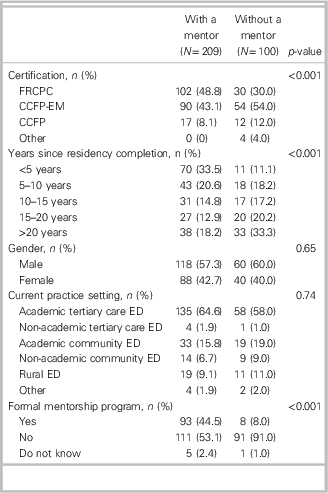
CCFP=College of Family Physicians of Canada; CCFP-EM=College of Family Physicians of Canada with additional competency in Emergency Medicine; ED, Emergency Department; FRCPC=Fellow of the Royal College of Physicians of Canada.
Characteristics of mentors
The responses of the 209 participants in the mentor group are summarized in Table 2. The majority of the respondents (63.6%) reported having more than one mentor during residency. In evaluating the qualities of the individuals identified as primary mentors, they were predominantly self-selected by mentees (74.8%) and of the same gender as the mentee (69.4%). Only 76.8% of the participants reported that their primary mentor was in EM, with 42.4% of primary mentors having the FRCPC designation. The large majority (69.4%) of these primary mentors had been in practice for at least five years before the beginning of the mentorship relationship.
Characteristics of primary mentors during residency, as described by mentees

CCFP=College of Family Physicians of Canada; CCFP-EM=College of Family Physicians of Canada with additional competency in Emergency Medicine; ED=Emergency Department; EM=emergency medicine; FRCPC, Fellow of the Royal College of Physicians of Canada.
Topics and impact of mentorship during residency
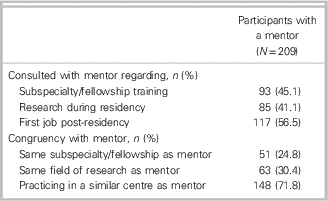
The most common topics of discussion between mentees and mentors are depicted in Supplementary Figure 1. The most common responses provided by the participants were: career planning and goals (82.8%), clinical skills (75.5%), work-life balance (72.5%), and preparation for examinations (61.3%). The least common topics included: conducting research (26.0%), finances (27.9%), and professionalism (32.8%). The impact of postgraduate mentorship on professional development is shown in Table 3. Less than one-half of the participants consulted with their mentor regarding subspecialty training (45.1%) and research during residency (41.1%). Further, 56.5% consulted with their mentor while choosing their first job following residency. As compared with their mentor, the large majority of participants ultimately chose to work in a similar centre (71.8%), but few completed the same subspecialty as their mentor (24.8%) or completed research in the same field as their mentor (30.4%).
Impact of mentorship on professional development
The importance of mentorship
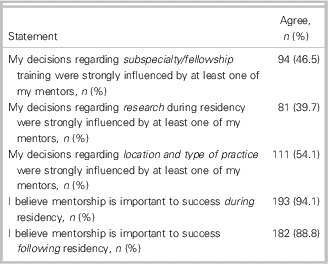
Participant beliefs regarding the importance of mentorship are shown in Table 4. Again, less than one-half of the participants agreed that their decisions regarding subspecialty/fellowship training (46.5%) and research during residency (39.7%) were strongly influenced by at least one of their mentors. Further, 54.1% stated that their decisions regarding the location and type of practice were strongly influenced by their mentor. Overall, 94.1% of the participants agreed that mentorship was important to success during residency, and 88.8% stated that it was important for success following residency. In the subgroup of participants who reported that they did not meet regularly with their mentors, most found mentorship to be important for success during (90%) and after (82.5%) residency. Additionally, 51.7% of the participants reported that they continue to solicit advice from their mentors. Moreover, 53.4% stated that they were currently mentoring a junior colleague, resident, or medical student.
The importance of mentorship during residency
Comparisons between participants who completed EM residency training through the FRCPC training program and those who underwent alternative EM training (most commonly as an added competency through the College of Family Physicians of Canada) are depicted in Table 5. FRCPC participants were more likely to have had a formal mentorship program during residency, as compared with their non-FRCPC colleagues (40.5% v. 27.0%, respectively; p=0.04). FRCPC participants versus their non-FRCPC colleagues also more commonly felt that their decisions regarding subspecialty training (57.7% v. 36.9%, respectively; p<0.01) and research (54.1% v. 26.7%, respectively; p<0.001) were strongly influenced by their mentors. Interestingly, fewer FRCPC participants felt that mentorship was important to success during residency, as compared with their non-FRCPC colleagues (58.7% v. 96.2%, respectively; p<0.001) but rated the importance of mentorship following residency similarly (86.9% v. 90.6%, respectively; p=0.40).
Training certification programs and the impact of mentorship
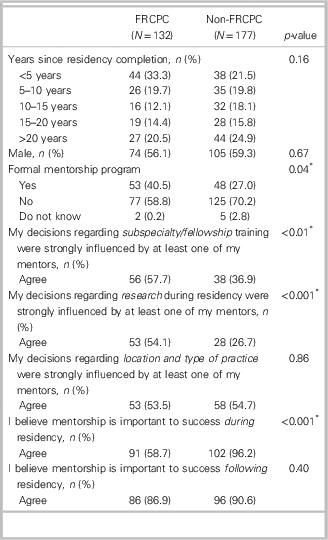
CCFP=College of Family Physicians of Canada; FRCPC=Fellow of the Royal College of Physicians of Canada.
* Significant
DISCUSSION
Professionals with strong mentors are more productive and have greater career satisfaction in both the short and long term.Reference Ramani, Gruppen and Kachur 22 , Reference Paice, Heard and Moss 23 Specifically, in EM, mentorship is thought to be related to career planning, as well as with research interests and productivity, subspecialty training, and professionalism within the discipline.Reference Yeung, Nuth and Stiell 9 , Reference Garmel 24 The results from our study seem to suggest that while research and subspecialty training are topics of conversation between mentors and mentees, the relationship may have had less of an impact on career decisions pertaining to these topics, as compared with others. Only a small proportion of the respondents reported that mentorship had a strong impact on their subspecialty training or their research interests. The notion that mentorship positively impacts research productivity during residency training has been supported by work in some specialties and refuted by work in others.Reference Miller and McCartney 25 , Reference Smeds, Huynh, Thrush, Moursi and Amankwah 26 While we did not compare research productivity between participants, our work does show that research was one of the least popular topics of conversation between mentors and mentees. Not every Canadian EM residency program has the infrastructure to support research during residency significantly, and there is variability in the infrastructure among programs.Reference Calder, Abu-Laban and Artz 27 Thus, research may not be a major focus for most EM residents and not an issue on which they may seek mentorship support.
Residents were far more likely to work in a location similar to that of their mentor but less likely to partake in similar research or subspecialty training. Recent Canadian evidence suggests that EM residents tend to select mentors based on shared interests and personality.Reference Sutherland, Pham and La Riviere 28 Work in other specialties shows that decisions surrounding practice location are often changed by mentorship influence.Reference Klingensmith, Cogbill and Luchette 29 , Reference DeLong, Hughes, Tandon, Choi and Zenn 30 Thus, while mentees may choose mentors based on their preferred choice of practice location (e.g., choosing a rural EM physician as a mentor based on a desire to one day practice in a rural environment), it does appear that this decision can be formed during the mentorship process. EM residents have reported that their choice of specialty was significantly influenced through mentorship by EM physicians during undergraduate medical educationReference Dehon, Cruse, Dawson and Jackson-Williams 31 ; therefore, the decision to practice in the same location may be related to a similar phenomenon.
The most commonly reported topics of conversation were related to clinical expertise and work-life balance. EM is a specialty that is characterized by a fast pace, shift work, and work intensity, as well as serving an acutely ill population, and often associated with a significant degree of burnout.Reference Wears 32 Mentorship has been demonstrated in other specialties to be associated with the prevention and reduction of burnout, by allowing an outlet for discussion and providing a source of information on work-life balance.Reference Gabbe, Webb and Moore 33 The fact that work-life balance appears to be a common topic of conversation between mentors and mentees in EM suggests that this relationship may function as a coping mechanism and play a role in maintaining wellness among residents in the specialty.Reference DeCastro, Sambuco, Ubel, Stewart and Jagsi 34
Finally, it is worth mentioning the impact of formal mentorship programs. The presumed benefits of mentorship are one of the reasons behind the institution of formal mentorship programs in EM residency. While only a minority of EM departments have such a formal program,Reference Welch, Sawtelle and Cheng 35 whether such benefits are found at the resident level are unclear. We found that residents who were trained in programs that employed formal mentorship programs were far more likely to have a mentor. Participants who were involved in formal mentorship programs were more likely to be more junior in their practice and female (Supplemental Table 1). This is probably because such formal programs are a more recent development,Reference Sutherland, Pham and La Riviere 28 , Reference Welch, Sawtelle and Cheng 35 and the proportion of females in EM has steadily increased in the last few decades.Reference Choo, Kass and Westergaard 36 However, individuals who trained at centres with formal mentorship programs did not rate their mentorship experiences higher than those at centres without a formal program. Therefore, the major benefit of a formal mentorship program seems to be its ability to connect residents with faculty mentors, but it does not appear to improve reported mentorship experiences.
FRCPC participants felt that mentorship more strongly influenced their decisions regarding subspecialty training and research training. They also felt less strongly than non-FRCPC participants that mentorship was important to success during residency. This may be because the FRCPC training program provides residents with more infrastructure and years of training to support their academic careers. Non-FRCPC trainees (particularly those in one-year programs) have a much shorter course; therefore, a strong mentoring relationship may help them navigate the challenges of a condensed training program and early career decisions.
LIMITATIONS
There are certain limitations that are inherent to a survey-based study. First, such a design creates the possibility of various types of biases, including non-response and recall bias. Our study was distributed through a standardized channel (the CAEP database) to a well-defined population (attending EM physicians). As mentioned, participants may have had difficulty recounting their experiences with mentorship during residency. The response rate (though not the total number of responses) was slightly below what would be expected for a national survey distributed through this database.Reference Yadav, Gatien, Corrales-Medina and Stiell 37 As there is no existing validated tool for analyzing the impact of mentorship, our survey was derived using author consensus that has the potential to introduce bias. We did not track the location of response, so it is unclear if responses were concentrated within a specific segment of the population. The vast majority of participants were from academic centres, and many were very early (i.e., <5 years after residency completion) into independent practice. Furthermore, while this study was administered across Canada, it was only distributed in English. Therefore, our results are likely most reflective of academic EM physicians with an interest in mentorship during residency and, thus, cannot be generalized to all practising EM physicians in Canada.
It is important to acknowledge that there are multiple confounders that may have contributed to professional development, aside from mentoring. While it is inherently difficult to quantify the impact that mentorship had on professional development, the vast majority of participants perceived that mentorship was beneficial to their career development, and our findings provide some initial evidence supporting this construct in EM.
CONCLUSION
Our study suggests that the majority of participating EM physicians did have at least one mentor over the course of their residency training, and mentorship during EM residency was important to career planning and work-life balance but was less integral to academic scholarship and subspecialty selection. Our findings provide some of the first evidence regarding the impact of mentorship during EM residency training on professional development and concomitant perceptions surrounding this construct. Given the potential benefits espoused from this study, EM residency programs should encourage residents to select mentors who can provide guidance during their training and support their career development.
Acknowledgements: The authors would like to thank Drs. Jolanta Karpinski and Lindy Samson (University of Ottawa) and the Residents as Leaders Course (Postgraduate Medical Education, University of Ottawa) for providing early feedback on the project. The authors also thank Angela Marcantonio (Ottawa Hospital Research Institute) for administrative support. SMF, WJC, SBC, LT, and JRF designed the study. SMF gathered the data. SMF, WJC, SBC, LT, and JRF analyzed the data, wrote the manuscript, and agreed to be responsible for its contents.
Competing interests: None declared.
Supplementary material
To view supplementary material for this article, please visit https://doi.org/10.1017/cem.2018.42



