





Does the representation of ethnic minorities spur radical-right electoral success in Central and Eastern Europe (CEE)? If so, are some types of representation more likely to trigger majority resentment than others? And does it matter which ethnic minority is represented? Consider Slovakia in 1998. That year, a Hungarian ethnic minority party, SMK, joined the government coalition for the first time. SMK received the Ministry of Regional Development, the Ministry of Environment, and a newly formed vice-premiership for minority rights. The party also made it a priority to change the text in the preamble of the Slovak Constitution from ‘We, the Slovak nation’ to ‘We, the citizens of the Slovak Republic’. Ján Slota, then leader of the radical-right Slovak National Party (SNS), criticized these steps and later labeled Slovakia’s Hungarian ethnic minority ‘a cancer in the body of the Slovak nation’ (Orth et al. Reference Orth, Michel and Jensen2008). Twenty-five years later, far-right politicians criticized Slovakia’s first Hungarian Prime Minister – the head of the 2023 caretaker government, Ľudovít Ódor – for his ethnic origins (RTVS 2023).
The Slovak example highlights a wider trend. From Western Europe (Dancygier Reference Dancygier2010; Rydgren Reference Rydgren2008) to the United States (Hooghe and Dassonneville Reference Hooghe and Dassonneville2018; Mutz Reference Mutz2018), the electoral fortunes of the radical right covary with minority representation (Bonikowski Reference Bonikowski2017, S205; Buštíková Reference Buštíková2020; Koev Reference Koev2015; Svraka 2025). Majority groups favor the hierarchical, group-based status quo, which reflects their privileged position (Sidanius and Pratto Reference Sidanius and Pratto2001) – that is, their dominant influence over policymaking and resource distribution. When minority groups mobilize and demand representation, members of the majority may feel threatened (Dixon Reference Dixon2006) and fear status reversal (Mutz Reference Mutz2018, E4331; Petersen Reference Petersen2002, Chapter 3). In turn, these sentiments predict intolerance (Weldon Reference Weldon2006) and political mobilization (Valentino et al. Reference Valentino, Brader, Groenendyk, Gregorowicz and Hutchings2011; Zonszein and Grossman Reference Zonszein and Grossman2024). Thus, when ethnic minorities (appear to) extract concessions from the state, individuals from the majority will mobilize to stop these gains and to restore the prior distribution of power (Buštíková Reference Buštíková2020, 53; Koev Reference Koev2015, 652). One way to do so is to vote for the radical right – parties that offer an ideological bundle rooted in an exclusionary, anti-liberal, anti-pluralist conception of democracy, and the myth of a homogeneous nation-state (Minkenberg Reference Minkenberg2017, 14; Pytlas Reference Pytlas2016, 25). In other words, individuals threatened by minority political ascendancy will support those who promise to return majorities to their dominant positions.
Minority representation, however, varies along multiple dimensions. First, and perhaps most consequentially, the type of representation varies. Descriptive representation does not necessarily beget substantive representation (Foxworth et al. Reference Foxworth, Liu and Sokhey2015; Minta Reference Minta2011; Preuhs Reference Preuhs2005; Reingold Reference Reingold2008). Moreover, descriptive representation is itself not a uniform treatment. While often measured as the number of ethnic minority legislators, such an approach ignores prestige and visibility. For example, ethnic minority legislators can hold parliamentary leadership roles or prestigious committee appointments. Ethnic minorities may also take up functions within the executive – for example, as cabinet ministers. We contend that the visibility, prestige, and policy influence associated with such appointments raise the salience of ethnic minority representation among ethnic majority voters, motivating support for the radical right. To evaluate our claims, we depart from previously used measures of representation – a simple headcount of the number of minorities in the legislature or a binary measure of government coalition participation – and introduce a new measure of minority presence in executive-level cabinets. Importantly, we code not just the number of minority ministers, but also the prestige, visibility, and influence of their portfolios (Barnes and O’Brien Reference Barnes and O’brien2018; Chew and Liu Reference Chew and Liu2025; Krook and O’Brien Reference Krook and O’Brien2012; Liu et al. Reference Liu, Hlatky, Chew, Power, Selsky, Compton and Xu2025).
Second, the actor advocating for representation varies. Minorities are not the only ones championing minority-friendly policies. In some cases, it can be allies from the majority (Celis et al. Reference Celis, Erzeel, Mügge and Damstra2014; Valdini Reference Valdini2019; van de Wardt et al. Reference Van de Wardt, Sobolewska and English2024); in other cases, it can be an international actor (Hlatky Reference Hlatky2021; Vermeersch Reference Vermeersch2012). Without considering non-minority sources of minority representation, we miss alternative pathways that explain why voters favor the radical right.
Finally, who is being represented also varies. All ethnic groups are situated in a social hierarchy and, due to variations in political mobilization capacity (e.g., Koev Reference Koev2022; Svraka 2025), some minorities pose a greater threat to the standing of majorities than others. Thus, without disaggregating ‘ethnic minorities’, we cannot determine whether resentment is driven by minority groups that are politically mobilized or ones that are socially marginalized.
We theoretically unpack and empirically test how these different dimensions of minority representation result in majority resentment and radical-right electoral success. To do so, we rely on three studies. In Study 1, we replicate and extend existing work on the aggregate-level association between ethnic minority party success and radical-right vote shares in CEE (Buštíková Reference Buštíková2014), incorporating our new measure of ethnic minority representation. We find that ethnic minority party coalition participation and executive-level prestige, but not vote shares, positively correlate with radical-right success.
In Study 2, we change the unit of analysis and focus on individual vote choice. Using the European Social Survey (ESS), we partly reaffirm the aggregate-level findings: Neither descriptive representation nor coalition participation is associated with support for the radical right at the individual level. Instead, minority prestige at the executive level is again associated with individual-level support for the radical right.
Finally, in Study 3, we conduct mixed-factorial (between- and within-subject) survey experiments in Romania and Slovakia – countries with sizable Hungarian and Roma ethnic minority populations. Between subjects, we manipulate the ethnic group being represented. Within subjects, we manipulate the type of representation and the subject advocating for representation. The results suggest that minority representation – of all types – leads to resentment among majorities. However, resentment is greatest when the minority group is politically mobilized and when minorities themselves, rather than their allies, are responsible for representation.
Attempts to disrupt group-based hierarchies continue to shape electoral behavior in CEE. The representation of ethnic minorities – particularly that of politically mobilized ethnic minorities in high-ranking, prestigious cabinet portfolios – spurs radical-right electoral success. Resentment is the underlying mechanism. Thus, our results reaffirm previous evidence on the cyclical connection between radical right and ethnic minority electoral success, demonstrating that voter demand for the radical right is spurred by the supply of ethnic minority mobilization (Buštíková Reference Buštíková2020; Koev Reference Koev2015; Svraka 2025). Importantly, our findings also emphasize the importance of disaggregating representation. Majority reactions vary with the extent of influence and prestige granted to ethnic minorities. Resentment is also a function of the minority group’s identity and of whether representation stems from minority mobilization or ally advocacy (Svraka Reference Svraka2024). While we focus on ethnic minorities and CEE, the implications of our findings extend beyond this context. Though the targets of radical-right mobilizations may change across countries and time, the radical right consistently centers the purported threat posed to majorities by minorities. This article contributes a framework for understanding when and why these mobilizations succeed.
The radical right in CEE
Due to CEE’s legacy – of multiethnic empire, imperial collapse, and ethnonationalist state-building (Bunce Reference Bunce2005) – ethnic group hierarchies have historically determined the distribution of power and resources in the region (Buštíková Reference Buštíková2020, 7). Traditionally, ethnic majorities were located at the top and ethnic minorities at the bottom. With the collapse of state socialism in the 1990s, these hierarchies reemerged as objects of political contestation. The renewal of political competition occurred during – and was therefore shaped by – multiple, concomitant societal transformations (Minkenberg Reference Minkenberg2002, 356). Transitions to democracy and market capitalism were accompanied by the collapse of the state’s legitimating ideology, societal dislocation, and questions about future geopolitical trajectories. With these transformations, debates about state building, resource allocation, individual rights, and nationhood became politically contentious.
As such, CEE’s democratization not only structured political competition around a distributive, economic cleavage but also ‘intensified societal and political debate on the shape and direction of national identity’ (Pytlas Reference Pytlas2016, 6). These debates reflected a sociocultural dimension – one that pitted liberal modernizers against conservative traditionalists (Kitschelt Reference Kitschelt1995). The uncertainty of transition and the emerging salience of national identity proved fruitful for radical-right political entrepreneurs, who offered an ideological bundle rooted in ethnonationalism, sociocultural conservatism, and a welfare state (Minkenberg Reference Minkenberg2002, 359; Pirro Reference Pirro2015, 4-6). At the same time, these developments also facilitated the political mobilization of ethnic minority parties and their ‘ethnoliberal’ allies (Buštíková Reference Buštíková2014, 1743) – advocates of political pluralism, individual (minority) rights, and counter-majoritarian institutions (Minkenberg et al. Reference Minkenberg, Florian, Végh and Zobel2021, 653; Rovny Reference Rovny2023, 1413–1414).
With an open political arena, ethnic minorities competed in elections, mobilized for policies, and extracted state resources. Recognition and representation heightened the salience of distributive conflicts and threatened the majority’s stake in the distribution of power and resources. With minority gains, ethnic majorities experience status loss – whether actual or perceived (Gidron and Hall Reference Gidron and Hall2017, S61). Status loss leads to stronger preferences for hierarchical social arrangements, preferential in-group bias, and out-group animosity (Mutz Reference Mutz2018, E4431; Wilkins and Kaiser Reference Wilkins and Kaiser2014). Status loss can also lead to anxiety, frustration, and resentment (Bonikowski Reference Bonikowski2017, S205). These sentiments are more likely to manifest during periods of political and economic transition due to heightened levels of insecurity (Pirro Reference Pirro2015, 37). Thus, in CEE, the radical right not only capitalized on transition-related uncertainty but also mobilized against the recognition and representation of minority groups. To electorates, the radical right offered programmatic appeals rooted in an anti-liberal, anti-pluralist conception of democracy meant to ensure the ethnic majority’s ‘rightful’ position at the top of the group hierarchy (Buštíková Reference Buštíková2020, 45–53).
Nonetheless, cross-national differences in communist legacies, federalist center-periphery arrangements, experiences with territorial loss, and ethnic demography determined the extent to which questions of national identity shaped political competition in CEE (e.g., Buštíková and Kitschelt Reference Buštíková and Kitschelt2009; Minkenberg Reference Minkenberg2017, 40–42; Pirro Reference Pirro2015, 40–44; Rovny Reference Rovny2014). In countries where questions of national identity were less settled – for example, Bulgaria, Slovakia, and Romania – the radical right was generally more successful, and their participation in government often coincided with democratic backsliding (Minkenberg Reference Minkenberg2017, 127). However, even in the region’s democratic success stories, the presence of sizable ethnic minorities shaped the electoral fortunes of the radical right. For example, in Estonia and Latvia, the radical right successfully mobilized against the Russian minority, targeting their language rights (Buštíková Reference Buštíková2020, 74). In ethnically homogeneous countries, such as the Czech Republic or Hungary, the radical right also relied on ethnonationalist appeals, often targeting Roma or Jewish minorities (Minkenberg Reference Minkenberg2017, 70–71).
Majority backlash to minority ascendancy is by no means CEE-specific. Extensive comparative evidence from outside the region supports the connection between minority political gains, majority status loss, and electoral backlash. For example, perceived minority challenges to the dominant position of whites in the American group-based hierarchy led some individuals to vote for Donald Trump in 2016 (Mutz Reference Mutz2018; also see Gest et al. Reference Gest, Reny and Mayer2018; Hooghe and Dassonneville Reference Hooghe and Dassonneville2018). More generally, white Americans increasingly think about their group identity and make political decisions to protect their dominant position in America’s group-based hierarchy (Jardina Reference Jardina2019). Studies from outside CEE also highlight how economic insecurity can strengthen the relationship between group threat and radical-right voting (e.g., Baccini and Weymouth Reference Baccini and Weymouth2021; Bolet Reference Bolet2023; Engler and Weisstanner Reference Engler and Weisstanner2021; Kurer Reference Kurer2020). Across 28 European countries, Bolet finds that relative economic status loss is associated with supporting radical parties, but that the strength of anti-immigration attitudes determines whether voters choose radical-left or radical-right options. In the US, manufacturing job losses raise status concerns among white Americans, who then turn to politicians who promise to protect the privileged positions of whites in the racial hierarchy (Baccini and Weymouth Reference Baccini and Weymouth2021, 553). Similarly, Dancygier (Reference Dancygier2010) suggests that economic scarcity and immigrant political power combine to influence contentious identity politics in Western Europe (see Zonszein and Grossman Reference Zonszein and Grossman2024 for additional evidence). In short, when majorities consider themselves disadvantaged – whether or not they truly are – they look to re-elevate their position. The radical right offers a means to do so.
Thus far, we have focused on how the ‘internal’ supply-side characteristics of radical-right parties – their ideological and programmatic offer to voters (Van der Brug et al. Reference Van der Brug, Fennema and Tillie2005; Werkmann and Gherghina Reference Werkmann and Gherghina2018) – interact with demand-side grievances to fuel support for the radical right. However, ‘external’ supply-side factors – for example, electoral rules and party-system stability – matter as well (Arzheimer and Carter Reference Arzheimer and Carter2006; Golder Reference Golder2016). These factors are not only consequential for explaining radical-right success, but they are also important for explaining representation more generally – including that of ethnic minorities.
Consider electoral rules. While scholars continue to debate whether permissive electoral systems benefit the radical right, permissiveness does increase the upper limit on the number of viable parties (Cox Reference Cox1997; Tavits Reference Tavits2008). Moreover, recent evidence from within-country reforms suggests that changing from majoritarian to proportional rules increases radical-right vote shares (Becher et al. Reference Becher, González and Stegmueller2023). More consequential for our purposes, however, is the evidence that – under the right combination of ethnic demography, geographic concentration, and district magnitude – proportional electoral rules benefit ethnic minority parties (Bochsler Reference Bochsler2010; Kostadinova Reference Kostadinova2007; Lublin Reference Lublin2017; Selway Reference Selway2015). Importantly, permissive electoral rules also affect representation indirectly. When ethnic minority parties succeed electorally, they are often attractive coalition partners (e.g., Gherghina and Jiglău Reference Gherghina and Jiglău2016), and their success can incentivize nonethnic parties to include ethnic minorities on their own lists (e.g., Sobolewska Reference Sobolewska2013). Thus, permissiveness can determine whether minorities achieve visible, prestigious positions in governments.
Party-system dynamics are also consequential for representation. Compared to their Western European counterparts, CEE party systems tend to be more personalized and volatile, with frequent party entry, exit, and ideological repositioning (Gyárfášová and Hlatky Reference Gyárfášová and Hlatky2023; Haughton and Deegan-Krause Reference Haughton and Deegan-Krause2020; Ibenskas and Sikk Reference Ibenskas and Sikk2017). CEE mainstream parties have also adopted the issue positions of their radical competitors to a much greater extent than Western European mainstream parties (Pytlas Reference Pytlas2018). Across the region, radicalized mainstream parties – such as Fidesz, PiS, and Smer – have succeeded not only by governing with the radical right, but also by co-opting their rhetoric and program. Underlying this party-level organizational fluidity, however, is relatively stable ideological divides that largely correspond to the original dimensions of political competition that emerged in the 1990s (Rovny and Polk Reference Rovny and Polk2017). New issues – for example, European integration, migration, LGBTQ+ rights, and the Russo-Ukrainian War – tend to map on to parties’ ideological positions on the sociocultural dimension. The radical right, for example, remains skeptical of international integration, hostile toward ‘new’ minorities, and relatively friendly toward Russia. As such, while the parties may change, the underlying ideological structures of CEE party systems are less volatile. Importantly, ethnic parties have particularly stable electorates, and due to the nature of identity-based representation, their ideological repositioning is less common (Baboš and Malová Reference Baboš and Malová2013).
By centering the threat posed to majorities by the political ascendancy of minorities, scholarship effectively integrates supply- and demand-level factors to explain the rise of the radical right. The proximate causes of radical-right voting are the individual-level grievances that originate when minority groups extract concessions from the state. However, two types of supply spur this demand. First, ethnic minority parties must mobilize and achieve representation, allowing them to demand policy concessions and resources. Second, the radical right must offer an ideological bundle that capitalizes on majority resentment. In sum, individuals resent the elevation of minorities vis-à-vis majorities and turn to the radical right in order to re-elevate their own position.
Disaggregating minority representation
Representation varies along different dimensions. Descriptive representation – the extent to which representatives resemble the represented – varies in prestige and visibility. The traditional measure of descriptive representation – a simple legislative headcount – potentially masks salient variations in how ethnic minorities are afforded influence in government and policymaking. Thus, such a measure cannot fully capture the extent to which the majority perceives disruptions to the group-based status quo. Ethnic minority politicians can take up important positions in the legislature – for example, as committee heads – or they can be ostracized and afforded little influence. A focus on coalition participation remedies some of these shortcomings, capturing the presence of ethnic minorities at the highest level of government. However, even this measure ignores variations in the prestige and visibility afforded to ethnic minorities within government. While coalition participation is synonymous with a presence in the executive, ethnic minority parties tend to be the smaller, junior partners in coalitions, hampering their ability to effectively pursue policy goals (Bolleyer Reference Bolleyer2007). Moreover, ethnic minorities can be elected on the ballots of mainstream parties. Thus, a binary indicator of coalition participation does not capture the visibility and prestige afforded to minorities within government, and it overlooks nonethnic party sources of minority representation. If status loss links minority gains to radical-right backlash, then measuring visibility and prestige – that is, the extent to which minority presence disrupts the status quo – is essential. For this reason, we shift focus away from minority legislative or coalition presence. Instead, we focus on the extent to which minorities are represented at the highest levels of government – in the executive – taking care to account for the visibility and prestige of their positions.
H1: The descriptive representation of ethnic minorities increases majority resentment and is associated with radical-right electoral success.
Moreover, descriptive and substantive representation are not synonymous. The former is about the presence of ethnic minorities in positions of power. The latter is about advocating for, allocating resources to, and pursuing the interests of ethnic minority groups (Pitkin Reference Pitkin1967). While descriptive representation can lead to substantive representation, it is neither necessary nor sufficient for substantive representation (Minta Reference Minta2011; Reingold Reference Reingold2008). For example, focusing on France, Murray shows that ethnic minority women achieve descriptive representation only when they are willing to abandon some of their substantive goals (Murray Reference Murray2016). Partisanship and ideology also influence whether minority representatives advocate for other minorities (e.g., Lončar Reference Lončar2016; Sobolewska et al. Reference Sobolewska, McKee and Campbell2018), and minority candidates suffer an electoral penalty if they campaign on pro-minority policies (Martin and Blinder Reference Martin and Blinder2021). Thus, differentiating between the types of representation is essential.
Descriptive and substantive representation are likely to have different effects on majority resentment. When ethnic minorities are able to extract resources and policy concessions from the state, this substantive representation threatens the group-based hierarchy. Such ‘concessions’ directly alter the distribution of power between groups, raising the salience of distributive conflict. As such, substantive representation should evoke greater resentment than descriptive representation. Importantly, majorities are likely to be most resentful when both types of representation are present – that is, when ethnic minorities are descriptively and substantively represented. The simultaneity of ethnic minorities being visible and (allegedly) extracting concessions from the state poses the largest threat to the group-based hierarchy.
H2a: The substantive representation of ethnic minorities increases majority resentment.
H2b: The substantive representation of ethnic minorities increases majority resentment relative to descriptive representation.
H2c: The simultaneous descriptive and substantive representation of ethnic minorities increases majority resentment relative to singular descriptive or substantive representation.
Next, we consider the subject responsible for representation – who is doing the representing (Dovi Reference Dovi2002). While ethnic minority parties mobilize, advocate, and achieve representation on their own behalf, other actors also advocate for minorities. For example, non-minority parties can incorporate minorities when doing so offers an advantage (e.g., Celis et al. Reference Celis, Erzeel, Mügge and Damstra2014; Valdini Reference Valdini2019; van de Wardt et al. Reference Van de Wardt, Sobolewska and English2024). Ethnic majority allies can also pass policies that are in the interests of minority groups, regardless of whether minorities are in positions of power. Thus, we examine whether the substantive representation of minorities by non-minorities spurs resentment.
Two possible mechanisms lead to opposing predictions. Consider a minority group that has secured a number of legislative seats and has joined a government coalition. This clearly signals an ability to alter – at least to some extent – the existing distribution of power and resources. However, if minorities have to rely on their majority allies to extract concessions from the state, the minority group may not be powerful enough to mobilize and alter the distribution of power on its own. Moreover, the majority still retains control. This may reassure majorities of their dominant position in the group-based hierarchy. Conversely, when majorities ensure the substantive representation of ethnic minorities, this may cause more resentment among majority group members because it is considered a betrayal of group interests (Severs and de Jong Reference Severs and de Jong2018). Put differently, while it may be expected that ethnic minorities mobilize to better their own status (e.g., Chandra Reference Chandra2007), it is surprising when the politically dominant group acts on their behalf.
International actors can also substantively represent minority groups. A prominent example in CEE is the EU. EU Cohesion Policy provides extensive financial support for minority inclusion programs (Hlatky Reference Hlatky2021). Many of the programs that benefit marginalized Roma communities are almost entirely supported by EU funds. Similarly, the Hungarian ethnic minorities in Romania and Slovakia have mobilized to demand EU funds in support of cultural autonomy (e.g., Waterbury Reference Waterbury2017, 235–236). When an international third-party advocates for the representation of ethnic minorities, it may cause minimal resentment. While financial and diplomatic support can be extensive, it is often inefficient (Ram Reference Ram2014) and superficial (Bracic Reference Bracic2020). In addition, independent of the international actor, the political arena is still fundamentally dominated by the ethnic majority. They continue to wield the most influence over resources and policy. Moreover, support by an international actor can mitigate sentiments of zero-sum competition – the majority may not feel as if ‘their’ resources are going to minority communities if the support comes from an international actor.
H3a: Substantive representation of ethnic minorities by the majority leads to different levels of resentment relative to substantive representation by ethnic minorities.
H3b: Substantive representation of ethnic minorities by an international actor decreases resentment relative to substantive representation by ethnic minorities or ethnic majorities.
Finally, we consider the object of representation – who is being represented. Not all minority groups are equal. Some are socially marginalized, while others are politically mobilized. While the descriptive representation of a socially marginalized group can elicit fear, their presence may be tokenized. A few legislators or even one cabinet minister can only do so much when there are formal rules (Haynie Reference Haynie2001), informal channels (Hawkesworth Reference Hawkesworth2003; Murray Reference Murray2016), potential electoral costs (Martin and Blinder Reference Martin and Blinder2021), or strong social norms (Severs and de Jong Reference Severs and de Jong2018) preventing them from doing more. In contrast, the representation of a politically mobilized minority group is a much larger threat: They are the ones who have the ability to organize and extract resources (Buštíková Reference Buštíková2020, 127).
Importantly, representation type and whether a minority is politically mobilized or socially marginalized may not be independent. Politically mobilized minorities have organizational capacities to effectively demand policy and resources. Put differently, they are more likely to achieve representation – whether descriptive or substantive – in a systematic manner. Conversely, socially marginalized minorities are unlikely to have this capacity. However, some socially marginalized groups are, nonetheless, represented. The Roma are an example. Various actors – ranging from governments to the EU to NGOs – advocate for policies that benefit Roma communities. And, despite the lack of Roma ethnic party electoral success, Roma politicians do win seats in national legislatures on the lists of non-Roma parties (e.g., DPS in Bulgaria or OĽaNO in Slovakia).
While both socially marginalized and politically mobilized minority groups can extract resources from the state, the politically mobilized group is doing so from a more privileged position in the group-based hierarchy. By definition, the group already possesses the resources necessary to mobilize. Thus, by demanding more representation or resources from the state, they demand an even larger ‘slice of the pie’. As such, they may pose a greater threat to the status of majorities, likely evoking larger levels of resentment than if a socially marginalized group made similar demands.
H4: The representation – no matter the type – of politically mobilized ethnic minorities increases resentment relative to the representation of socially marginalized ethnic minorities.
Research design overview
Three studies test our hypotheses. In Study 1, we examine the relationship between ethnic minority descriptive representation – and associated variations in visibility and prestige – and radical-right electoral success using aggregate electoral data from 17 CEE states between 1992 and 2020. In Study 2, we use the ESS to determine whether the aggregate-level relationship replicates at the individual level. And, in Study 3, we establish the link between minority representation and resentment using survey experiments conducted in Romania and Slovakia.
Study 1: Minority representation and radical-right electoral success
We start with aggregate-level election data for two reasons. First, it allows us to replicate and extend Buštíková’s (Reference Buštíková2014) analysis using the same unit of analysis: country-election-year. Second, election-level data give us wider temporal and spatial coverage than any source of individual-level data. In other words, we maximize the number of analyzed country-election-years, strengthening external validity. Buštíková’s original dataset included elections from 17 CEE countries between 1992 and 2012 (93 total elections). We update the data through 2020. Depending on the model specification, our data include anywhere from 9 to 11 elections per country for a total N of 110 to 132. Per Buštíková, we use the natural log of radical-right vote share at election t as the dependent variable. If two or more radical-right parties competed in a given election, we sum their vote shares.
We follow Buštíková’s original coding strategy to identify radical-right and ethnic minority parties.Footnote 1 Buštíková defined the radical right following the logic of social control outlined by Douglas and Wildavsky (Reference Douglas and Wildavsky1982), focusing on two ideological dimensions: nationalism and sociocultural conservatism. Parties high on both ideological dimensions are considered radical right (Buštíková Reference Buštíková2020, 71–72). We apply Buštíková’s designations through 2020, validating them with other sources where relevant and making changes only when necessary (e.g., Fidesz’s radicalization prior to 2014, and Jobbik’s moderation after 2018).
We also follow Buštíková’s coding strategy to identify ethnic minority parties. In her original analysis, Buštíková included ‘ethno-liberal’ parties. These parties – for example, ODA (Czech Republic) or SZDSZ (Hungary) – are not parties defined by an ethnic voting base. Rather, they are socially liberal parties that defend minority rights. Given that (1) few objective indicators exist that could extend this designation through 2020, and (2) none of the ethno-liberal parties identified by Buštíková contested elections after 2012, we focus solely on traditional ethnic minority parties, again cross-referencing our list with other studies (e.g., Koev Reference Koev2022; Svraka 2025).
As our first measure of descriptive representation, we use the natural log of ethnic minority party vote share. A large legislative headcount, however, does not necessarily translate to policy influence, prestige, or visibility. Thus, for our second predictor, we use minority party participation in the government coalition. Here, it is not about size, but about control over some portfolio or policy jurisdiction. However, coalition participation cannot capture the salience of representation – that is, how many portfolios, the prestige and policy influence of the positions, and the related visibility of ethnic minorities in high-ranking offices. In addition, a binary measure cannot identify whether radical-right counter-mobilizations result from a threshold effect (whether there are any ethnic minorities in the cabinet) or whether radical-right electoral success increases as the prestige and influence of ethnic minorities increase. These distinctions matter if majority resentment and radical-right backlash are fueled by minority gains vis-à-vis the majority.
Thus, we introduce a new measure to capture the visibility and prestige afforded to ethnic minorities at the highest level of government. We use the Ethnic Power Score (EPS) from Liu et al. (Reference Liu, Hlatky, Chew, Power, Selsky, Compton and Xu2025), which builds on Krook and O’Brien (Reference Krook and O’Brien2012), to consider both the prestige and the ethnic nature of each ministerial portfolio. Portfolios with high visibility, substantial policy influence, and large financial resources (e.g., defense or interior) are high prestige. Portfolios with less influence, but with substantial resources, are medium prestige (e.g., agriculture); and those with minimal resources and visibility are low prestige (e.g., culture or tourism). Liu et al. also characterize each portfolio based on whether it is generally associated with the larger nation (e.g., foreign affairs), minority groups (e.g., minority affairs), or neither (e.g., environment).
Substantively, EPS captures the extent to which ethnic minorities occupy cabinet posts traditionally reserved for the majority. In other words, EPS is a continuous measure of the visibility, prestige, and policy influence ethnic minorities possess at the executive level. Thus, the score assigns higher weights when high-prestige, majority-associated cabinet positions are allocated to ethnic minorities:Footnote 2
 $$\eqalign{ & {\bf{EPS}} = {\rm{ }}[(\% \,High{\rm{ - }}prestige\,\,{\rm{held\,by\,minority}} \times \;3)\, \,+ \cr & (\% \, Medium{\rm{ - }}prestige\,\,{\rm{held\,by\,minority}} \times \;2) \,+ \,(\% \, Low{\rm{ - }}prestige\,\,{\rm{held\,by\,minority}} \times \;1) \,\,+ \cr & (\% \, Majority{\rm{ - }}type\,\,{\rm{held\,by\,minority}} \times \;3) \,+ \,(\% \, Neutral{\rm{ - }}type\,\,{\rm{held\,by\,minority}} \times \;2) \,\,+ \cr & (\% \, Minority{\rm{ - }}type\,\,{\rm{held\,by\,minority}} \times \;1)]\; \times \,\% \, \, {\rm{ Ethnic \,Minority}} \cr}$$
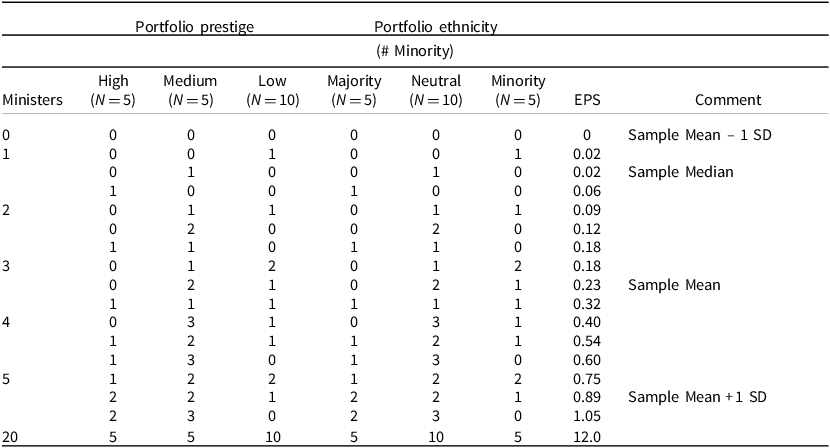
EPS can range from 0 (no ethnic minorities in the cabinet) to 12 (cabinet is entirely composed of ethnic minorities). In our data, EPS ranges from 0 to 5.98, although the distribution is heavily left-skewed, with a mean of 0.23. Given that EPS is contingent not just on the cabinet size and the number of ethnic minorities in the cabinet, but also on the distribution of portfolios across prestige (high, medium, and low) and ethnicity type (majority, neutral, minority), interpretation can be difficult. To make sense of what it means to go from an EPS of 0 (one standard deviation below the mean) to 0.02 (sample median) to 0.23 (sample mean) to 0.89 (one standard deviation above the mean), we calculate the EPS for different compositions of a hypothetical 20-person cabinet. We (randomly) allocate five portfolios to be high prestige, five to be medium prestige, and ten to be low prestige; likewise, we distribute five portfolios as being majority-relevant, ten as neutral, and five as minority-relevant (see Table 1).
Ethnic Power Scores (EPS) in a hypothetical 20-person cabinet

The sample median (0.02) corresponds to one ethnic minority minister in a medium-prestige portfolio associated with ethnic minorities, for example, the Ministry of Regional Development – one of the more commonly demanded portfolios by minority parties. Likewise, the sample mean (0.23) is equivalent to three minority ministers: two in medium-prestige portfolios and one in a low-prestige portfolio, with two of these positions being ethnicity neutral and one being minority-associated. This is similar to what Slovakia’s Hungarian minority party had in 1998 – which led to staunch criticism from the radical right, as described in the opening paragraph. The match between these descriptive statistics and the real-world allocation of cabinet portfolios to ethnic minorities offers some construct validity.
In our models, we include the same controls as Buštíková, making changes where necessary due to data availability. We include economic variables: GDP/capita, economic volatility (changes in GDP/capita in the year prior to the election), and the unemployment rate. We also control for the natural log of majority group size, electoral disproportionality (operationalized as the traditional Gallagher Index), the effective number of parliamentary parties, lagged radical-right coalition participation, lagged (and logged) radical-right vote shares, EU membership, and the number of years since the first post-socialist, democratic election. Relevant variables are lagged either by one year, by one electoral period, or by the number of years since the most recent census (SI, Table A2, presents descriptives).
Study 1: Results
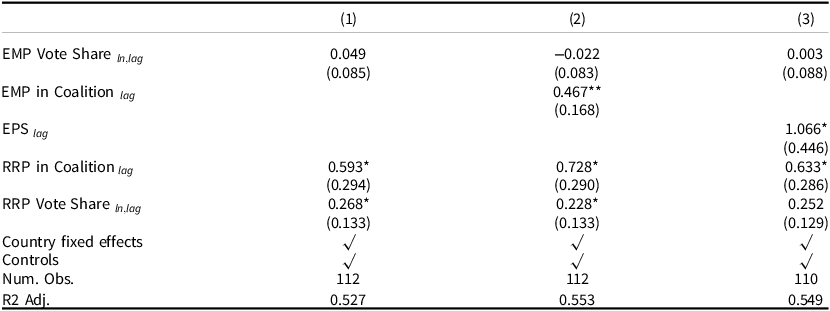
We estimate associations with linear models that include country fixed effects and HC1 robust standard errors. For each predictor – ethnic minority vote share, coalition participation, and EPS – we estimate three models: (1) a baseline model that only includes the predictor of interest, the lagged dependent variable (the log of radical-right vote share), and lagged radical-right coalition participation; (2) a model adding all economic covariates; and (3) a fully specified model that includes all covariates. The statistical significance and substantive magnitude of the primary predictors remain consistent across models. Thus, we present only the third model – with all covariates – for each predictor of interest in Table 2. Full model results are reported in Tables A3–A4 of the SI.
Ethnic minority representation and radical-right electoral success

*p < 0.05, **p < 0.01, ***p < 0.001; HC1 standard errors in parentheses; EMP=Ethnic Minority Party; EPS=Ethnic Power Score; RRP=Radical Right Party.
The results are consistent with H1. Descriptive representation, in the form of ethnic minority vote shares, does not correlate with radical-right electoral success. However, the more meaningful, visible, and prestigious representation of minorities at the executive level has a positive association with the electoral success of the radical right. When it comes to coalition participation, our estimate of 0.467 largely mirrors the association size identified by Buštíková, successfully replicating previous results with an expanded sample. Recall that the dependent variable is logged. As such, in substantive terms, ethnic minority coalition participation is associated with an estimated 59.5% relative increase in radical-right vote shares in the subsequent election. A one-unit increase in EPS has a substantially larger effect – translating to a 190% relative increase in the radical-right vote. However, a one-unit increase in EPS means moving from one ethnic minority minister in a high-prestige, majority-associated position to five ethnic minority ministers, none of whom administer low-prestige or minority-associated portfolios. As such, a more theoretically relevant quantity is a one standard deviation increase in EPS (0.66), which translates to a 102% relative increase in radical-right vote shares.
In sum, we find strong evidence of a positive association between the visible representation of ethnic minorities at the highest levels of government and the electoral performance of the radical right. The radical right succeeds when ethnic minorities are in positions of power and afforded influence over policymaking and resource distribution. The less-visible descriptive representation of ethnic minorities in the legislature is insufficient for evoking radical-right backlash.
Study 2: Minority representation and individual support for the radical right
Having demonstrated the positive association between minority representation and radical-right aggregate electoral success, we consider whether representation motivates individual radical-right vote choice. We rely on Waves 1-10 of the ESS. We use the ESS due to its consistent and expansive spatial and temporal coverage. The geographic coverage corresponds to all but one of the states included in our aggregate analysis (Moldova). ESS Wave 1 was fielded in 2002, and thus ESS data do not cover the 1990s. Given that nationalist counter-mobilizations against ethnic representation were particularly strong in the 1990s, the data range potentially biases against finding evidence for our hypotheses.
The retrospective vote choice question is the dependent variable. We assign respondents who indicated that they voted for a radical-right party in the preceding election a value of 1. Voters of other parties and individuals who indicated that they did not vote were assigned a value of 0. In the pooled sample, 5.4% of respondents indicated they voted for a radical-right party (8.6% when nonvoters are excluded). Our primary predictors remain the natural log of minority party vote share, coalition participation, and EPS.
As individual-level confounding factors, we consider age, gender, education (number of years), unemployment (within the last three months), religious attendance, and perceived household financial situation. We also include attitudinal predictors of radical-right support: immigration attitudes (allow more/fewer immigrants of different races/ethnicities), satisfaction with the national economy, and satisfaction with the government. We include a more limited set of country-level controls: GDP/capita, unemployment, majority size, and EU membership. All relevant country-level variables are appropriately lagged. Finally, we also include lagged radical-right vote share and coalition participation to account for cyclical electoral dynamics.
Study 2: Results
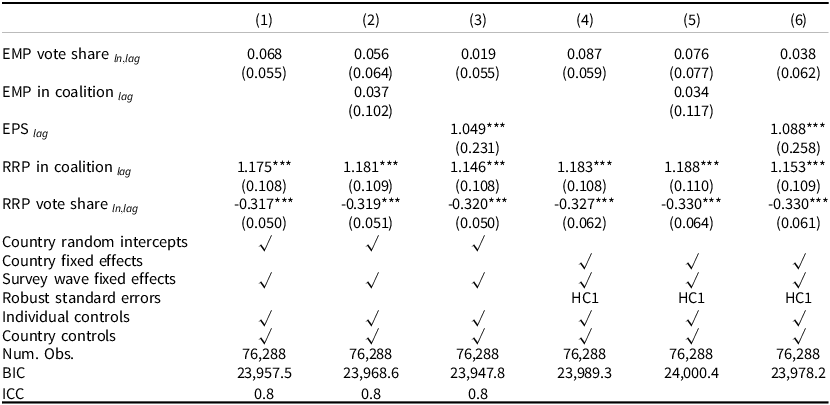
We use two estimation strategies: (1) multilevel mixed-effects logistic regression with random intercepts for countries and fixed effects for ESS survey wave; and (2) logistic regression with fixed effects for both countries and survey wave and HC1 robust standard errors. As before, we build our models sequentially. In the first set, we only include lagged radical-right vote share and coalition participation, the predictor of interest, and, for coalition participation and EPS, lagged ethnic minority vote share. The second set adds all individual-level covariates. The final set adds country-level controls. Given that there are no noteworthy differences between model sets, Table 3 presents the abbreviated results of the third set of models. Full results of all models are presented in the SI, Tables A6–A9.
Ethnic minority representation and radical-right voting

*p < 0.05, **p < 0.01, ***p < 0.001; Logit coefficients; Standard errors in parentheses; EMP=Ethnic Minority Party; EPS=Ethnic Power Score; RRP=Radical Right Party.
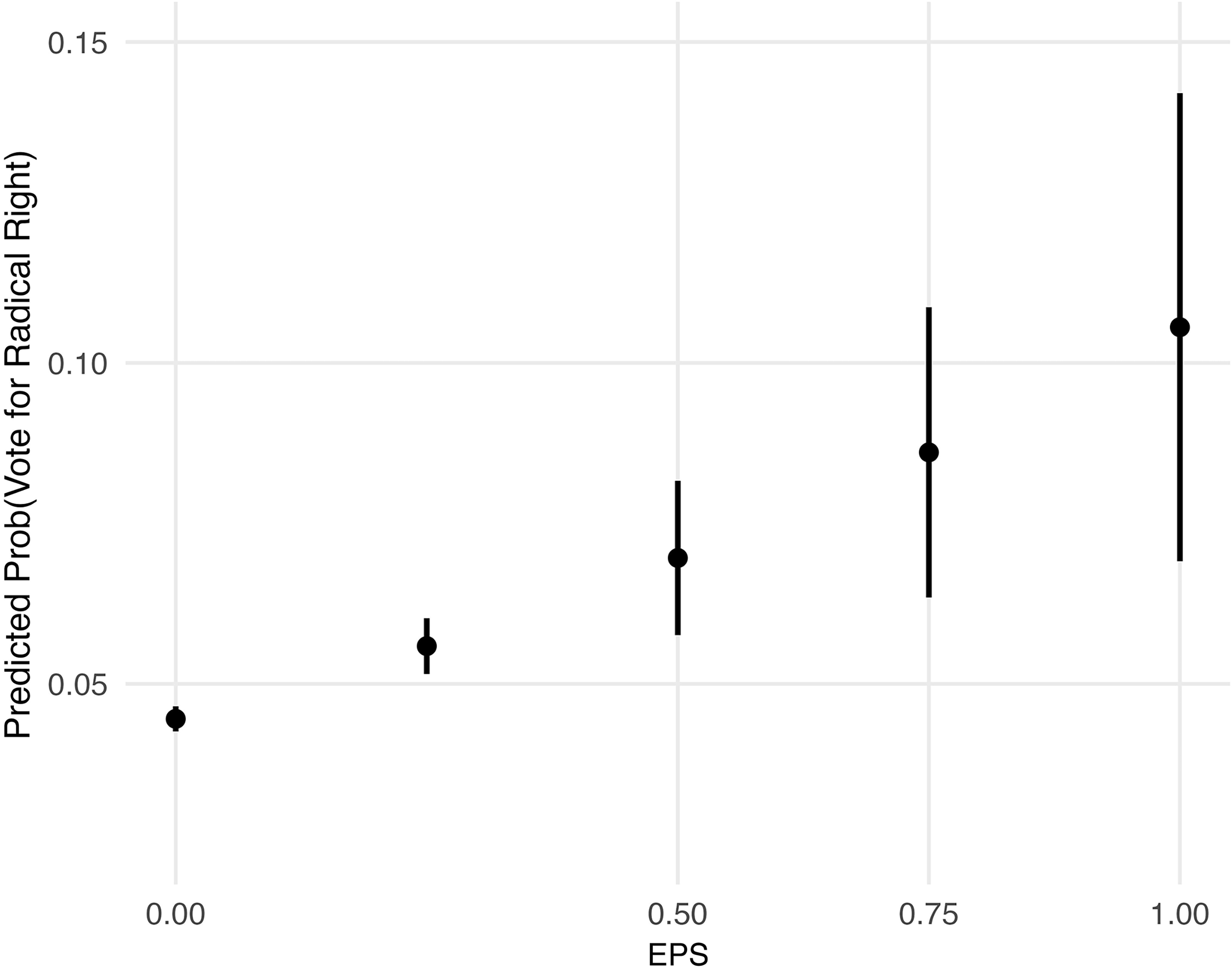
Ethnic minority party vote shares (Models 1 and 4) and coalition participation (Models 2 and 5) have little association with individual support for the radical right. Instead, voting for the radical right is associated with the visible representation of ethnic minorities in the highest levels of government (Models 3 and 6). Given that coefficients are presented on the log-odds scale, we plot the average predicted probabilities derived from Model 6 to assess the substantive size of the association between EPS and radical-right voting (Figure 1). We limit EPS’s range to between 0 and 1, given insufficient support in the data at higher values.
Predicted probability of supporting the radical right across EPS.
Note: Average predicted probabilities presented with 95% confidence intervals; calculated from Table 3, Model 6.

The average predicted probability of supporting the radical right at an EPS of 0 – that is, when there are no ethnic minorities in the cabinet – is approximately 0.045. Near the sample mean of 0.23 (three minority ministers in medium- and low-prestige portfolios), the predicted probability approaches 0.06, and at an EPS of 1 (five minority ministers in high- or medium-prestige posts), the predicted probability exceeds 0.10. This suggests that radical-right support is not necessarily a product of a single ethnic minority in a low-prestige position; rather, the relationship between resentment and radical-right voting strengthens once there are multiple ethnic minorities in prominent portfolios. Overall, the results provide further evidence consistent with our hypotheses: The presence of ethnic minorities in prestigious and visible positions within the executive is positively associated with individual decisions to vote for the radical right.
Study 3: Minority representation and majority resentment
The final empirical test examines the mechanism linking minority representation to radical-right gains by using mixed-factorial survey experiments in Romania and Slovakia. These experiments also allow us to test the remainder of our hypotheses, which we could not test with the observational data. In both countries, the ethnic Hungarians have been able to successfully mobilize. In Romania, the minority is politically represented by the Democratic Alliance of Hungarians in Romania (UDMR). UDMR has achieved parliamentary representation in every election since 1990; moreover, the party, as of 2025, has participated in twelve government coalitions. In Slovakia, Hungarian parties have secured representation in the parliament in all but the two most recent elections (2020 and 2023); they have also helped form the government on five different occasions. Additionally, in both Romania (Csata et al. Reference Csata, Hlatky and Liu2021) and Slovakia (Findor et al. Reference Findor, Hruška, Hlatky, Hrustič and Bošeľová2023), the Roma are marginalized, allowing us to determine whether the representation of a stigmatized group evokes resentment. Finally, in Romania, there is a third ethnic group (German) that is neither politically mobilized nor stigmatized; this allows us to ascertain whether variations in political relevance or discrimination condition the effect of representation on resentment.
Both countries have seen radical-right electoral success, although there are variations in government participation and the number of radical-right parties. In Romania, the nationalist Greater Romania Party (PRM) was successful in the 1990s and early 2000s – winning nearly 20% of the vote in 2000. More recently, the Alliance for the Union of Romanians (AUR) fared well in the 2024 election, winning 18% of the vote. However, the radical right has only helped form a government once (PRM in 1992). In contrast, the Slovak radical right has seen more consistent success. The Slovak National Party (SNS) has contested elections since the 1990s and has participated in government five times. In addition, SNS has co-existed with other electorally successful radical-right parties such as ĽSNS, Republika, and Sme Rodina. The combined vote share of the Slovak radical right exceeded 20% in 2016 and 2020, while falling back to around 13% in the 2023 election (largely due to the radicalization of mainstream parties; Hlatky and Gyárfášová Reference Hlatky and Gyárfášová2025). In sum, Romania and Slovakia offer the variations necessary to test our argument.
We implemented mixed-factorial survey experiments with quota-representative samples of the ethnic majority population (Romania N=1528; Slovakia N=831; quotas on age, education, gender, region, and size of settlement; ethnic minorities excluded from participation). The samples are representative of their respective national populations on all quotas, with the exception of education in Romania, where our sample is slightly more educated (see SI, Tables A10–11, for balance and representativeness). Between subjects, we manipulated the identity of the represented ethnic group to determine whether the representation of politically mobilized (Hungarians), socially marginalized (Roma), or non-politicized (Germans, Romania only) minorities causes variations in resentment. Within subjects, we manipulated representation type – descriptive, substantive, or both – and the actor responsible for representation – the minority, a majority ally, or the EU (Slovakia only). Directly manipulating representation type is a particularly important complement to the large-N observational tests, as it allows us to differentiate majority responses to descriptive versus substantive representation.
In the experiment, descriptive representation takes the form of an ethnic minority holding a single ministerial portfolio: the Ministry of Regional Development. Note that in Romania, UDMR has held the portfolio in six out of the twelve governments it has helped form. In Slovakia, ethnic minority parties have held the portfolio each time they have helped form the government. Substantive representation is the allocation of resources to ethnic minority regions by said minister, whether they are from the ethnic minority (descriptive and substantive condition) or an ethnic majority ally (singular substantive condition).
Outside actors can also advocate for minority representation. Prior to accession, the EU and the Council of Europe pushed for pro-minority reforms in CEE, including linguistic and cultural autonomy (Sasse Reference Sasse2013). Contemporarily, the EU allocates substantial funding to ethnic minority groups – especially Roma communities (Ram Reference Ram2014) – through Cohesion Policy. These funds are often a cause of local, place-based resentment and ethnonationalist mobilization (Hlatky Reference Hlatky2021; Rehák et al. Reference Rehák, Rafaj and Černěnko2021; Vermeersch Reference Vermeersch2012). Likewise, ethnic minority communities – from the Hungarians in Slovakia (Malová and Világi Reference Malová and Világi2006) and Romania (Waterbury Reference Waterbury2017) to the Turks in Bulgaria (Bloom and Petrova Reference Bloom and Petrova2013, 1613) – have mobilized for the attainment of EU Structural Funds. Thus, we add an additional condition to the Slovakia experiment that focuses on EU funds for ethnic minorities.
We embedded the between and within manipulations directly in the questions measuring resentment (the dependent variable). In the first stage of the experiment, respondents were randomly assigned to one of the two (Slovakia) or three (Romania) groups based on a between-subject condition. In the second stage, all respondents – across all groups – answered the same control question:
-
• Control:‘To what extent do you agree or disagree with the following statement: It bothers me when a Romanian/Slovak becomes Minister of Development, Public Works and Administration/Minister of Investments, Regional Development and Informatization’.
The control question asks members of the majority to evaluate how much it bothers them to have a co-ethnic as a minister. Aside from the necessity of having such a question from an experimental design perspective, we also consider it theoretically appropriate. The question captures the usual state of affairs – ministries are almost always filled by members of the ethnic majority, and we expect little resentment to result from this arrangement. Thus, we can effectively measure shifts in resentment when an ethnic minority takes over the portfolio and the status quo changes.
After answering the control question, respondents were exposed to the within-subject manipulations in a randomized order.Footnote 3 We note the between-subject manipulations – the ethnic group being represented – in bold:
-
• Descriptive:‘… It bothers me when a Hungarian/Roma/German becomes Minister …’.
-
• Substantive:‘… It bothers me when a Romanian/Slovak becomes Minister … and allocates substantial funding to the Hungarian/Roma/German ethnic minority’.
-
• Descriptive + Substantive:‘… It bothers me when a Hungarian/Roma/German becomes Minister … and allocates substantial funding to the Hungarian/Roma/German ethnic minority’.
-
• EU:‘… It bothers me when the European Union allocates substantial funding to the Hungarian/Roma ethnic minority’.
We measured responses on a four-point scale ranging from ‘completely disagree’ to ‘completely agree’. After completing the within-randomization stage of the experiment, respondents answered an attention check: identify which ethnic minority group was mentioned in the questions.
Study 3: Results
We estimate within-subject treatment effects separately for each between-subject condition. We do so with a linear mixed model that includes fixed effects for within-subject condition, random intercepts for respondents, and standard errors clustered by respondent. We include attention check failures and present results with failures excluded in the SI (Tables A14–A15; results remain consistent). Figure 2 plots treatment effects and associated 95% confidence intervals.
Effects of minority representation on resentment in Romania and Slovakia.
Note: Estimates presented with 95% confidence intervals; Romania N Obs. = 2550 (Hungarian), 2540 (Roma), 2550 (German); Romania N Respondents = 510 (Hungarian), 508 (Roma), 510 (German); Slovakia N Obs. = 2912 (Hungarian), 2905 (Roma); Slovakia N Respondents = 416 (Hungarian), 415 (Roma); Estimates, clustered standard errors, and p values in SI, Tables A12–A13.

The representation of minorities increased resentment – regardless of representation type, the minority group, or the actor behind the representation. All within-subject treatment effects statistically differed from 0. Substantively, the effects were moderate to large, with Cohen’s d ranging from 0.61 to 1.00. Almost across the board, treatment effects were substantively smaller in Romania than in Slovakia. Moreover, in Romania, resentment did not vary as a function of representation type. Relative to the ethnic majority minister baseline, (1) an ethnic minority minister, (2) a majority minister allocating funding to the ethnic minority group, and (3) a minority minister allocating funding evoked similar levels of resentment. In Slovakia, the combined descriptive and substantive condition – a minority minister allocating funds to the minority community – caused significantly more resentment than the singular substantive or descriptive conditions. Importantly, the singular descriptive representation of Roma evoked less resentment than any other type of Roma representation.
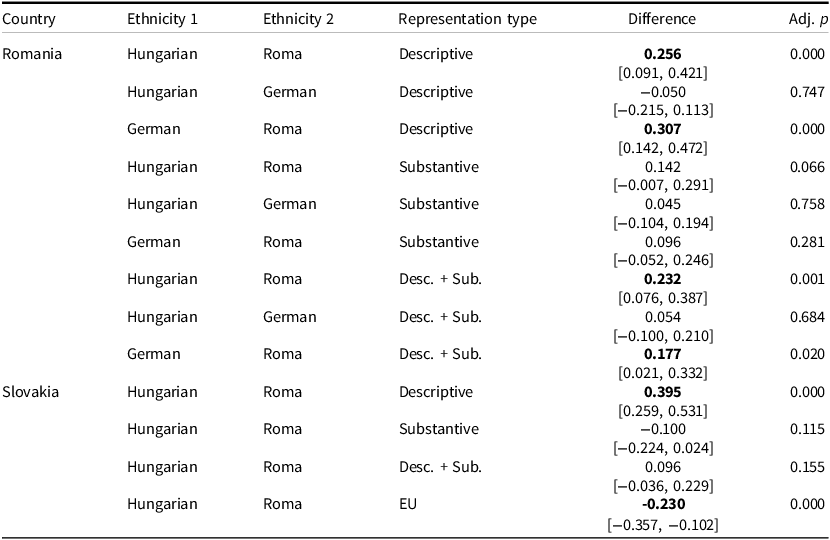
To analyze between-subject effects – differences that manifest due to the ethnic group being represented – we rely on ANOVA and Tukey HSD tests (which adjust for multiple comparisons by controlling the family-wise error rate). Table 4 summarizes these findings. In Romania, the descriptive representation of Roma evoked less resentment than the descriptive representation of Hungarians (p<0.001) and Germans (p<0.001). There was also some weaker evidence that the majority representation of Hungarians caused more resentment than the majority representation of Roma (p=0.066). Finally, there were clear differences in the combined representation condition, where respondents were more resentful of both Hungarians (p=0.001) and Germans (p=0.020) than Roma. Substantively, these between-subject effects were small to moderate, amounting to approximately a quarter of the outcome’s standard deviation. In Slovakia, the descriptive representation of Hungarians evoked more resentment than the descriptive representation of Roma (p<0.001). EU substantive support for Roma evoked more resentment than EU support for Hungarians (p<0.001). There was little statistical evidence of ethnic group differences in either the singular substantive or the combined descriptive and substantive conditions.
Ethnic group identity effects

Note: Bold indicates a significant difference at p < 0.05; p values derived from Tukey HSD test; 95% family-wise confidence intervals in brackets.
Both the Romania and Slovakia results provide strong evidence for H1 and H2a. No matter the type, representation increased majority resentment. In Romania, evidence for H2b and H2c is limited. The descriptive and/or substantive nature of representation did not lead to differences in resentment. In Slovakia, H2b and H2c were confirmed for the Roma minority. Substantive representation evoked more resentment than descriptive representation; additionally, combined descriptive and substantive representation led to more resentment than descriptive or substantive representation singularly. For the Hungarian minority, there was limited evidence in favor of H2b but strong evidence for H2c. Descriptive representation evoked less resentment than combined representation, but singular substantive representation – that is, when resources remained in the hands of the ethnic majority – evoked less resentment than both singular descriptive representation and combined representation. In other words, Slovaks were least resentful of Hungarian representation when a Slovak co-ethnic controlled resources.
These differences also indicate support for H3a in Slovakia. Majority resentment varied based on whether policy influence and resource control remained in the hands of the majority or were under the purview of the ethnic minority. At the same time, resentment in Slovakia also varied based on whether the EU was responsible for substantive representation. For Hungarians, EU support evoked similarly low levels of resentment to when the majority had control over resources, confirming H3b. However, when it comes to the Roma, EU support had just as large an effect on resentment as the combined representation condition, providing evidence against our prediction. The large effects likely stem from the politicization of EU-funded programs for marginalized Roma communities. In Slovakia, these programs are numerous, generally inefficient, and the radical right has few qualms about disputing their value.
Finally, the results provide fairly strong evidence for H4. Resentment of politically mobilized minorities tended to be stronger than the resentment of marginalized minorities. In Romania, the descriptive representation of Hungarians and Germans evoked more resentment than the descriptive representation of the Roma. The same was true of combined representation; again, the descriptive and substantive representation of Hungarians and Germans evoked greater resentment. In Slovakia, the identity of the ethnic group also mattered. The descriptive representation of Hungarians caused more resentment than the descriptive representation of the Roma. However, once we shift to substantive representation – whether singular or simultaneous with descriptive representation – resentment becomes statistically indistinguishable between minority groups. In other words, when the majority is forced to share benefits and resources, it does not matter to whom the benefits are allocated. An exception, however, was EU support – where disbursements to the Roma evoked more resentment than disbursements to Hungarians. Importantly, variations in ethnic group identity can signal characteristics other than political mobilization – for example, group size or prejudice. The German treatment in Romania accounts for some of this information by asking about a minority that is neither discriminated against nor politically mobilized. Given that increases in resentment associated with the German and Hungarian treatments were largely similar, we speculate that the social marginalization of the Roma may render them less threatening to the majority.
Concluding discussion
Analyzing over 100 elections and nearly 20 years of cross-national public opinion surveys, we find that radical-right electoral success in CEE is associated with the visibility and prestige of ethnic minorities in the highest levels of government. Original survey experiments in Romania and Slovakia identify resentment as the underlying mechanism. Across three studies, we disaggregated representation along three dimensions: (1) the type of representation – descriptive or substantive; (2) the subject advocating for representation – minority, majority, or third-party; and (3) the object of representation – a politically mobilized or socially marginalized minority group. Our analyses underscore that these variations are consequential for understanding the relationship between minority representation, majority resentment, and radical-right electoral success.
First, to differentiate simple descriptive representation – whether in the form of legislative vote shares or coalition participation – from more meaningful, visible representation, we coded the ethnic identity of all cabinet ministers in CEE and the prestige of their portfolios from 1990 to 2020. While not a measure of substantive representation (Dovi Reference Dovi2002), EPS clearly moves beyond descriptive representation to capture important variations in visibility, prestige, and policy influence. Given that status loss is the key mechanism linking the political ascension of ethnic minorities to radical-right counter-mobilizations (Buštíková Reference Buštíková2020; Dancygier Reference Dancygier2010; Mutz Reference Mutz2018), we consider the introduction of this measure essential.
The large-N analyses, whether of aggregate electoral results or individual voting, suggest our considerations are warranted. EPS has a positive and statistically significant correlation with radical-right support. Moreover, this association is substantively larger than that of ethnic minority party vote shares or coalition participation. As such, it is not the simple presence of ethnic minorities in the legislature or even in government that fuels majority backlash. Rather, the radical right is mobilized by the visibility of ethnic minorities in prestigious executive positions with substantial policy influence (Buštíková Reference Buštíková2020; Koev Reference Koev2015).
Experiments in Romania and Slovakia offered systematic evidence for the mechanism: across both countries and four treatment arms, majorities consistently resented minority representation. Perhaps most consequentially, the experiments showed that: (1) resentment was least likely to arise when the majority retained control over resources – even if said resources were allocated to the minority; and (2) resentment of politically mobilized minorities tended to be greater than that of socially marginalized minorities. Taken together, these findings offer additional evidence for the key role of status loss. Variations in representation lead to differences in how the minority disrupts the group-based status quo, and some minority groups pose a greater threat to the majority’s dominant position than others. In sum, conceptually and operationally unpacking ‘representation’ is essential for understanding when and why majorities counter-mobilize against minority gains.
This article provides additional comparative evidence of the tensions that can arise as a result of minority representation and mobilization in multiethnic states (e.g., Basta Reference Basta2018; Traunmüller and Helbling Reference Traunmüller and Helbling2022). Importantly, this relationship is not isolated to ethnic minorities. The political ascendancy of immigrants (Grossman and Zonszein Reference Grossman and Zonszein2024), women (Krook Reference Krook2015), and sexual minorities (Abou-Chadi and Finnegan Reference Abou-Chadi and Finnigan2019) also causes backlash. The minorities may change, yet the radical-right strategy remains the same: convince voters that their position in the group-based hierarchy is under threat. Along these lines, three future research directions can prove useful. First, majority backlash is not universal – not all members of the majority are equally threatened (Baccini and Weymouth Reference Baccini and Weymouth2021). As such, understanding individual-level susceptibility to radical-right mobilizations remains essential. Second, identities are not singular – they can crosscut or intersect. Our analysis identifies that the representation of some minorities causes more resentment than the mobilization of others, but future analyses should consider whether intersectional identities matter for resentment (Hughes Reference Hughes2011; Ward Reference Ward2019). Finally, while the representation of ethnic minorities remains a source of majority resentment, ethnic minorities are not currently a target of radical-right mobilizations. Instead, migrants, gender minorities, and sexual minorities are the current preoccupations (Caiani Reference Caiani2022; Guasti and Buštíková Reference Guasti and Buštíková2023). As such, future research should examine which minority groups the radical right chooses to target and why.
Our results also contribute to understanding CEE party competition. Ethnic dynamics continue to structure electoral politics. While the overt ethnonationalist mobilizations of the 1990s may be over, minority-majority relations continue to generate tension. Much of the recent focus has been on how mainstream competitors – whether on the left or the right – respond to radical right challengers. Yet, our work underscores previous findings on the importance of competitive dynamics between spatially non-proximate parties (Buštíková Reference Buštíková2020; Koev Reference Koev2015; Svraka 2025). Put differently, understanding the success of the radical right (and of ethnic minority parties) requires not only analyzing whether mainstream parties legitimize niche competitors but also identifying how group-based representation shapes wider electoral competition. Future research may wish to determine whether mainstream parties radicalize their policy stances in response to ethnic minority success in order to capitalize on majority resentment – and if they do so, at what cost. Conversely, majority allies can also advocate for minority groups – whether because of electoral strategy (Valdini Reference Valdini2019; van de Wardt et al. Reference Van de Wardt, Sobolewska and English2024) or ideological commitments (Celis et al. Reference Celis, Erzeel, Mügge and Damstra2014, 45). Our EPS measure picks up such inclusion at the executive level, and our experimental results suggest that minority representation within the confines of majority-ruled structures evokes less resentment. Yet, further cross-national evidence is necessary to determine the scope conditions of these relationships. Finally, our experiment only tested one type of substantive representation – the direct transfer of financial resources to minority communities. This type of substantive representation may have primed respondents to consider corruption or may have raised the salience of welfare chauvinism. More importantly, substantive representation comes in a variety of forms. Given that many of the debates about minority rights in CEE have focused on language and citizenship, future research could consider whether substantive representation on these issues also evokes majority backlash.
In sum, majority resentment of minority representation remains a concern. Many CEE ethnic minorities, and particularly the Roma, remain disadvantaged (Bracic Reference Bracic2020). Thus, representation remains an important civil society, EU, and (to a lesser extent) national government priority. At the same time, the political mobilization of ethnic minorities may enshrine protections and liberties that prevent democratic decay (Rovny Reference Rovny2023). Yet, as we show, efforts at inclusion can generate backlash. Thus, identifying effective pathways for mitigating the grievances that arise from minority advancement should remain a priority.
Supplementary material
For supplementary material accompanying this paper, visit https://doi.org/10.1017/S1475676525100169.
Data availability statement
Replication data and code for this paper can be found at https://doi.org/10.17605/OSF.IO/8YZBP.
Acknowledgments
We presented previous versions of this paper at the 2023 Texas Comparative Circle (TXCP) conference (Texas Tech University), 2023 Southwestern Social Science Association (SSSA) annual meeting (Fort Worth, TX), 2023 American Political Science Association (APSA) annual meeting (Los Angeles, CA), 2023 Politics of Race, Ethnicity, and Immigration Consortium (PRIEC) conference (University of North Texas), and the 2024 Women in Legislative Studies (WILS) conference (University of Wisconsin). This project would not have been possible without feedback from Lenka Buštíková, Ken Greene, Petra Guasti, Bob Luskin, Rob Moser, Zeynep Somer-Topcu, and George Soroka. We also thank the anonymous reviewers for their incisive comments.



 Open access

