

1. Introduction
Current environmental developments like climate change indicate the importance of transforming industrial value creation processes towards a more sustainable direction (PIK, 2025). To drive this forward, the EU is taking increased regulatory action. Introduced by the Ecodesign for Sustainable Products Regulation (ESPR) for several product groups, environmental impact has to be assessed and reported on product level in terms of a product carbon footprint (ESPR, 2024). Assessing such lifecycle-oriented impact metrices manually is a labour and knowledge intensive process conducted by experts. An established framework is provided through the standard of lifecycle assessment (LCA) (ISO 14040/44). The greatest influence on product lifecycle characteristics (e.g., energy consumption) and correlating impact metrics exists during the design phase of a product (Reference Ramani, Ramanujan, Bernstein, Zhao, Sutherland, Handwerker, Choi, Kim and ThurstonRamani et al., 2010). Therefore, approaches for automated impact assessment conduction based on product data hold great potential for addressing the need for a reliable design decision support in the context of sustainability. Incorporating this lifecycle-oriented perspective into design of products is a fundamental aspect of Lifecycle Design (LCD) (Reference Vezzoli and SciamaVezzoli & Sciama, 2006). The central challenge for a data driven application derives from the capability of reasoning for lifecycle data based on design characteristics in a prospective way. In an industrial environment, it has to be taken into account that product and lifecycle data are highly distributed in a heterogeneous IT environment. This includes a variety of IT systems for Product Lifecycle Management (PLM) like Enterprise Resource Planning (ERP) or Supply Chain Management (SCM) systems. Consequently, there is great potential for developing a cross-domain interface that represents the dependency of product and life cycle data in the context of LCA. Integrating data from various sources and contextualizing it in a machine-readable format is addressed by semantic technologies (Reference Berners-Lee, Hendler and LassilaBerners-Lee et al., 2001). Therefore, this paper explores the potential of semantic technologies for realizing automated lifecycle assessment based on digital product data. The structure of the paper includes a review of the research context (section 2), description of the methodical approach (section 3) and research results in semantic data model development and technological implementation (section 4), which are finally discussed and summarized within the research context (sections 5, 6).
2. Research context
2.1. Digital integration of design and LCA
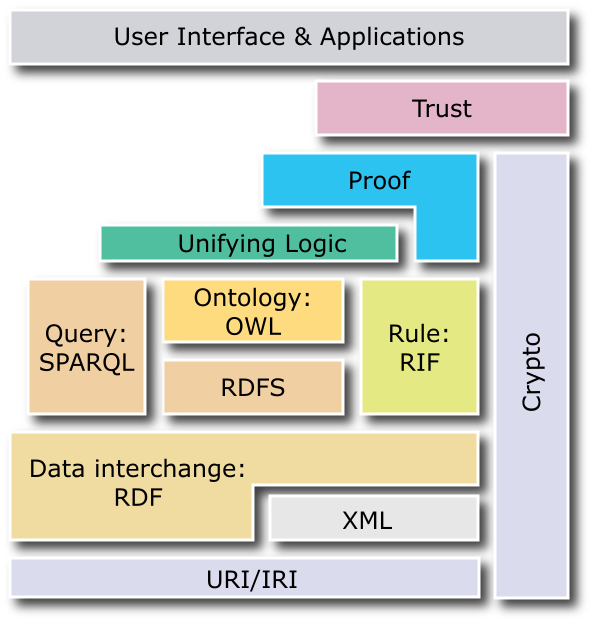
Within literature several approaches address the digital integration of design and LCA data through the application of semantic technologies. In the context of information processing, the term semantic refers to the formal description of the meaning and relation of real-world concepts (Reference StuckenschmidtStuckenschmidt, 2011). A concept implies any physical (e.g., product component) or non-physical (e.g., process) entity. Core semantic technologies are aggregated within the semantic technology stack model (W3C, 2007). Fundamental components for representing and linking cross-domain information entities are standardized and machine-readable languages like Resource Description Framework (RDF) and the Web Ontology Language (OWL) (Reference Cyganiak, Wood and LanthalerCyganiak et al., 2014; Reference McGuinness and HarmelenMcGuinness & v. Harmelen, 2004). These languages introduce a triple structure, which provides powerful capabilities for linking data within an extensible data model. This forms the basis for the implementation of ontologies. Reference GruberGruber (1993) defines an ontology as: “An ontology is an explicit specification of a conceptualization”. The conceptualization is a simplified representation of a knowledge domain and thus forms the basis structure of a knowledge base (Reference GruberGruber, 1993). The core elements of an ontology are taxonomy and inference rules representing domain-specific concepts and relations among them (Reference Aufaure, Le Grand, Soto, Bennacer, Taniar and RahayuAufaure et al., 2006). Further technologies address the need for rule-based data interaction (e.g., consistency checks, classification), which are described in more detail in section 4.3.
The following review focuses on approaches that introduce a semantic representation of design and lifecycle data to implement automated LCA. Reference Ostad-Ahmad-Ghorabi, Rahmani and GerhardOstad-Ahmad-Ghorabi et al. (2013) describe the development of an ontology representing product parameters and LCA indicators. The implementation focuses on a specific product use case rather than overarching conceptualization of design and LCA domains. This results in limited transferability to other applications, as existing standards and reference ontologies are not considered. Another approach presents an information model combining STEP-based product information and LCA concepts (Reference Li and RoyLi & Roy, 2014). Standardization is only taken into account within the representation of the product domain. Furthermore, formalization of concepts regarding the transformation of lifecycle data with respect to design characteristics is not realized. Accordingly, the interface between the product and LCA domain is not described adequately in terms of semantics and expressiveness. A detailed ontology for representing processes in the context of LCA along the product lifecycle is provided by Reference Zhang, Luo, Buis and SutherlandZhang et al. (2015). Comprehensive rulesets are implemented to automatically classify product and process instances. However, the product domain is inadequately represented in the context of design application as no further specification of distinct design characteristics is provided. The approach of Reference Zhou and TaoZhou and Tao (2021) addresses the conceptual integration of information from various IT systems into a so-called lifecycle model. Through the model processual operations are associated with distinct product features. However, this approach also lacks detailed information about the interface between the domains, which limits its use as a productive knowledge base. Furthermore, no LCA standards are taken into account which hinders the direct association of secondary lifecycle data sets provided by external databases.
Digital integration of design and LCA data is also addressed by various industrial applications within the context of automated product carbon footprint calculation (SAP, 2025; Siemens, 2025a). These PLM solutions focus on the automated mapping of product data on LCA data provided by integrated databases. The integration of product data is primarily limited to the type and quantity of materials and associated lifecycle data. A deeper level of detail regarding distinct design characteristics is not supported, which limits the application in the context of design decision support. The same is valid for Computer-Aided Design (CAD) applications with integrated LCA capabilities, where several impact categories are automatically assessed (Dassault Systems, 2025; Siemens, 2023). However, a major advantage is the visualization of sustainability data mapped directly onto the design model and the automated validation of design alternatives. Additionally, such applications also entail vendor-specific dependencies about the connection of data sources. This dependency is addressed by standalone LCA applications that integrate product data from a wide variety of sources (Carbmee GmbH; Makersite, 2024). Supported by AI technology these applications realize an automated mapping of product and LCA data from various sources. Although this enables great flexibility in terms of data set mapping the implemented granularity level of product data remains on the stage of material-related information.
2.2. Research goal
The conducted review of existing approaches illustrates the lack of a comprehensive semantic representation of concepts and relations in the context of discrete design characteristics and lifecycle data. Key aspects that have to be addressed are the integration of existing domain standards and the specification of logics for the quantification of lifecycle data based on design characteristics. In addition, the scientific approaches mostly describe feasibility studies without the implementation of a scalable data base structure. This is achieved in industrial approaches, which are built on existing data bases of PLM systems. However, these are limited to the processing of material-related information in the context of an automated LCA. A vendor-independent interface with a semantic schema for flexible description and integration of data is not provided. This research aims to address these gaps by the development of a lifecycle design application (LCD application) based on semantic technologies. Therefore, the following research questions are derived.
-
1. How can discrete design characteristics be represented semantically to enable an association and quantification of lifecycle data?
-
2. How can the technological implementation of a semantic data layer be realized to support the automated LCA of digital design models?
3. Methodology
This paper builds on the initial development of a generic LCD ontology (LCDO) published by Reference Tschiltschke, Wehking, Riedelsheimer and LindowTschiltschke et al. (2025) and addresses the technological implementation within the framework of automated LCA. The focus is on semantic contextualization and automated reasoning for lifecycle data based on design characteristics. The initial recognition of discrete design characteristics (e.g., automated feature recognition) is not part of this study. This work follows a three-step approach comprising ontology refinement (step 1), implementation of reasoning capabilities (step 2) and technological integration (step 3). The approach is validated within the use case of fuel cell production in a laboratory environment. The considered product system consists of production processes regarding material supply, transportation, milling, stacking and screwing within final assembly associated with the bipolar plates (BPP) of the fuel cell. In the context of the desired LCD application these processes should be automatically derived, quantified, assessed regarding their environmental impact based on a CAD model of the fuel cell. The main capabilities can be clustered as follows:
-
1. Reasoning for lifecycle phases and correlating lifecycle data based on design characteristics
-
2. Quantification of lifecycle data based on design characteristics (e.g., weight)
-
3. Assessment of the environmental impact in impact categories (e.g., global warming potential)
-
4. Tracing back the process-oriented impacts to the initial design characteristics
During step 1 ontology refinement is carried out based on the published Lifecycle Design Ontology (LCDO), which was developed following the first five steps of the framework of Noy and McGuinness (Reference Noy and McGuinnessNoy & McGuinness, 2001). The LCDO consists of three main components representing product data (e.g., assembly, features, and geometry), LCA data (e.g., processes, flows and technical resources) and intermediate operators representing logical transformations of lifecycle data through assigned operator parameters (Reference Tschiltschke, Wehking, Riedelsheimer and LindowTschiltschke et al., 2025). In that way, the LCDO forms the semantic backbone for implementing the capabilities 1 and 4. Established standards are considered to implement representations of discrete design characteristics, lifecycle impact assessment (LCIA) results and references to external data sources. In addition, concept expressions are refined und instantiation is carried out with respect to the provided use case matching the last two steps of the framework of Reference Noy and McGuinnessNoy and McGuinness (2001).
As part of step 2 existing semantic technologies for rule-based reasoning are reviewed. Rule sets are developed in accordance to use case-specific requirements and the structure of the LCDO. The application of the rule sets through an appropriate engine enables the implementation of capability 1 and 2. Finally, rule base implementation is carried out using the selected semantic technology. Within step 3 technological instantiation and validation are carried out for the main modules of the LCD application. These are: PLM for product data provision, LCD knowledge base for graph-based data integration, modules for data extraction, reasoning and processing and LCA module for product system modelling and impact assessment (capability 3).
4. Results
4.1. Semantic design representation and ontology extension
As part of the LCD application formalized knowledge regarding the correlation of generic design characteristics and lifecycle processes has to be established. This forms the basis for rule-based reasoning for product-specific lifecycle data and tracing back environmental impacts to the initial design characteristics. The contextualization of design data regarding correlating lifecycle processes within a semantic information element is accomplished through the introduction of features (VDI, 2003). A distinction can be made between physical features (P-features) and information features (I-features) (Reference Sanfilippo and BorgoSanfilippo & Borgo, 2016). Hereby, P-features represent elements related to a physical entity (e.g., geometrical element like a slot or step). I-features are related to information entities aggregating product properties within the scope of explicit lifecycle process (e.g., production) (Reference Sanfilippo and BorgoSanfilippo & Borgo, 2016). This classification is transferred to the LCD ontology within the class Feature through the subclasses ProductFeature (P-Features) and LifecycleFeature (I-Features) (s. Figure 1).
Part of the LCDO representing the hierarchy of features with exemplary classes

Figure 1 Long description
A diagram representing the hierarchy of features within the LCDO, showing various classes and their relationships. The diagram starts with the core entity at the top, which branches into two main sub-classes: Feature and LifecycleFeature. The Feature class further branches into ProductFeature and LifecycleFeature. The ProductFeature class is subdivided into ArtifactFeature, GeometricFeature, InteractionFeature, and AssemblyFeature. The GeometricFeature class includes Step, Hole, Contour, Pocket, Slot, and Boss. The LifecycleFeature class includes ProductionFeature.
Instances of the class ProductFeature reference design information provided by initial design models (e.g., CAD model). Several subclasses are defined in accordance to the definition of Reference Favi, Campi, Germani and MandoliniFavi et al. (2022) to cover different levels of product design granularity with respect to the component and assembly level. Distinct concepts are component, geometric, interaction and assembly features (Reference Favi, Campi, Germani and MandoliniFavi et al., 2022). The classification of basic shape features (e.g., Hole, Pocket and Step) within the class GeometricFeatures was specified regarding the taxonomy of basic features of Reference Köhler, Song, Bergmann and PetersKöhler et al. (2023) as they provide explicit detection rules and compatibility with the ISO 13030-242 standard. Within the class LifecycleFeature subclasses are incorporated representing the relevant lifecycle phases of the use case within the superclass ProductionFeature. Instances reference one or more product features through the object property hasLCFeature enabling the lifecycle-specific grouping of generic design properties. Through this schema generic design characteristics are grouped within an extensible feature library and are represented in a lifecycle-specific context.
Further extension of the LCDO is realized regarding the representation of impact assessment result data within the LCA domain as this is not covered by the integrated BONSAI ontology (Reference Ghose, Lissandrini, Hansen and WeidemaGhose et al., 2022). This involves classes for representing result values, flow- and process-oriented contributions and distinct impact categories. Furthermore, the concept of product systems is introduced to represent a product-specific sequence of processes and flows in alignment with the ISO 14044 standard. During the step of instantiation, persistence must be ensured by referencing data entities from various domain models (e.g., CAD model or LCA databases). Therefore, the established DCMI ontology is integrated as it provides concepts for describing, identifying and localizing data points (DCMI Usage Board, 2020).
4.2. Quantification of lifecycle data
Fundamental for the assessment of environmental impacts is the quantification of lifecycle data (e.g., electricity or material consumption) associated with certain lifecycle phase. Within the LCDO calculation operations associated with lifecycle data are formally represented through the class of operators (Reference Tschiltschke, Wehking, Riedelsheimer and LindowTschiltschke et al., 2025). An operator represents the process-specific transformation of a product, energy or information by the usage of resources (e.g., machines) (VDI/VDE, 2015). As an extension, the concept of operator parameter is incorporated to represent the correlation logics for the quantification of lifecycle data based on design characteristics. A certain class of operator parameter is specified through the type of referenced input data and the mathematical operation of the correlation logic. In addition to distinct design characteristics possible input data is also provided by technical resource attributes (e.g., reference power consumption) or other operator parameters. An operator parameter is linked to a flow within the LCA knowledge base to formally describe the correlation of quantitative values. An illustrative example with terminological concepts (T-Box) and asserted instances (A-Box) is provided through Figure 2.
Instantiated graph representing the correlation of product features, lifecycle features, operators and lifecycle processes

While the entities of the illustrated T-Box represent generic concepts, use case-specific instances are implemented as part of the A-Box (s. Figure 2). Within the use case of bipolar plate manufacturing, an exemplary correlation sequence originates from the detection of a geometric product feature of the class FreeFormContour. The correlating geometry represents the outer contour of the plate. Based on predefined rule sets the product feature is linked to the lifecycle feature ContouringFeature, which groups relevant feature attributes in the context of a subtractive manufacturing process (e.g., raw volume, finished volume and material properties). The associated ContourMillingOperator is linked to operator parameters representing different logics for quantifying the weight of removed material. The calculation of the removed volume is based on a subtractive calculation represented by the RemovedVolumeOP (x) in formula 1.

This parameter serves as the initial parameter for a subsequent multiplication with the material density and number of parts represented by the RemovedMaterialOP (x) in formula 2.

Finally, the link to the flow of a milling activity within the LCA domain is established. Through this causal chain a seamless link of design characteristics and lifecycle data is provided (s. Figure 2).
4.3. Rule-based reasoning and instantiation
In the context of an automated application comprehensive capabilities regarding the reasoning and integration of instance-specific links within the domains of the formal data model must be implemented. The chosen approach is based on formalized rule sets as this allows for validating the logical structure of the data model within the given use case. Reasoning based on logical rules provides high accuracy and explicit traceability for reasoning results. Further approaches for reasoning outside predefined rule sets are provided by AI-based methods (Reference Tian, Zhou, Wu, Zhou, Zhang and ZhangTian et al., 2022). However, these approaches require an extensive database and specific training processes to generate reliable results. Therefore, exploring the potential of AI-based reasoning approaches will be the subject of future research.
In the context of the LCD application there are two types of rule sets characterized by the addressed concepts of the LCDO. These are the reasoning for (1) lifecycle features based on design characteristics and (2) operators and operator parameters for lifecycle data quantification based on lifecycle features.
Several semantic technologies support the rule-based interaction with graph data to extend the limited capabilities of languages like OWL and RDF regarding the expression of complex inference rules. The standardized Semantic Web Rule Language (SWRL) allows for formulating inference rules in terms of OWL concepts with a structure of an antecedent and a consequent (Reference Horrocks, Patel-Schneider, Boley, Tabet, Grosof and DeanHorrocks et al., 2004). Rule veri-fication and execution is realized through a compatible reasoning engine. In addition, other languages like the Shapes Constraint Language (SHACL) allow for the implementation of conditions for validation and conformance checking of RDF graphs (Reference Knublauch and KontokostasKnublauch & Kontokostas, 2017). Both languages are mainly constructed for the inference and validation based on existing graph data. Within the described approach the dynamic creation of new instances based on inferred information is required. Such advanced interaction methods are provided by the SPARQL Protocol and RDF Query Language (SPARQL). A SPARQL query is constructed through graph patterns, which contain sets of triples matching the RDF structure. Matching triples are returned as a query result and can be formated through various methods (W3C SPARQL Working Group, 2013). Building on that the SPARQL Update Language provides a framework for the specification of update operation related to modifying graph data (e.g., inserting and deleting triples) (Reference Gearon, Passant and PolleresGearon et al., 2013). A high degree of compatibility is ensured as most of the existing graph stores provide a SPARQL endpoint. Due to the high degree of flexibility regarding the specification of conditions through defined graph patterns and the implementation of consequences via updating operations, SPARQL is chosen for the specification of rule sets. A simplified structure of a SPARQL query is provided for the detection and creation of an operator (s. Figure 3).
Exemplary SPARQL query components (blue) for rule-based creation of an operator with highlighted generic components (pink)

Within the WHERE-Clause a matching pattern regarding relevant lifecycle features is followed by the selection of relevant properties and randomized ID creation through the build in method STRUUID(). Inside the INSERT-Clause instances and properties are created for the operator (ContourMillingOperator) and linked operator parameters (VolumeTransformation, MassScaling) (s. Figure 3).
4.4. Tool integration
The three main software systems that have to be integrated within the context of the LCD application are: CAD tool providing machine readable product data, triple store as the central element for storing the LCD knowledge base structured according to the LCDO, which is modelled using the Protégé editor and LCA software for model creation and impact calculation (Stanford University, 2025). Siemens NX was chosen as an appropriate CAD software widely adopted by industry (Siemens, 2025b). The triple store is implemented using ontotext GraphDB and its free server distribution as it provides a suitable SPARQL endpoint through the REST API and comprehensive capabilities for advanced data management (Reference OntotextOntotext AD, 2025). As a last component openLCA is integrated as an open source LCA software with powerful API functionalities for automation and data extraction provided by the integrated IPC server (greenDelta, 2025). Intermediate functionalities regarding data extraction, transfer and integration are realized within the LCD application which consists of several python modules.
Fundamental for the implementation is the processing of product data. Within the presented approach a 3D-model of the fuel cell is created using Siemens NX. Hereafter, the LCA-based validation is focussed on the production of the bipolar plate as a reference part. Therefore, relevant product data like assembly structure, part numbers, materials, product features and attributes are extracted through a python-based extractor accessing the native model via the Siemens NX open API. The recognition of product features is simplified as this is not a primary aspect for validation in the context of the presented approach. Comprehensive approaches and solutions are present within literature (Reference Shi, Zhang, Xia and HarikShi et al., 2020; Reference Verma and RajotiaVerma & Rajotia, 2010). Specific features and attributes are grouped in the construction tree of the CAD part within so-called feature groups. Each group has an assigned flag which matches a respective product feature class within the LCDO (e.g., SlotFeature). For each of the extracted features and attributes correlating instances are created within the knowledge graph with references to the initial data model (identifier and location) as part of the instance mapping. LCA process reasoning is performed by a series of SPARQL update queries that are executed through the reasoning module of the LCD application (s. Figure 4). This involves rule set validation and instantiation of lifecycle features, operators and operator parameters as well as implementation of cross domain relations (s. section 4.3).
Technical architecture of the LCD application and its software interfaces with a visualization of impact results on the level of product features

The rule-based implementation of product-specific relations between operator parameters and LCA processes requires previous instantiation of LCA processes and flows. Since the correlating instances in openLCA are specified via unique UUIDs, these identifiers must also be referenced in the LCD knowledge base matching the DCMI schema. Exemplary LCA processes and connecting flows are specified in the context of the use case and represent operations related to transportation, milling, screwing and robotic stacking of the plates as well as electricity provision and consumption. The final SPARQL query returns product-specific references of associated lifecycle data. Building on this, the sequence of processes (product system) is automatically created and calculated using the IPC interface of openLCA. The impact assessment is conducted using the preselected method “CML v4.8 2016”. Subsequent, the impact results are returned to the LCD knowledge graph by implementing relations to the corresponding flow and process instances. Through the previously implemented associations, the impact results can be traced back to the initial product features in terms of individual contributions. As a result, the LCD application provides contextualized product data with associated lifecycle processes and impact contributions. A mockup of the final communication of results mapped onto features of the initial CAD model is provided as part of the illustrated architecture (s. Figure 4).
The process of LCA model creation is also carried out manually in a benchmark study. A tabular overview of processes and input and output flows serve as the data basis. Modelling involves the creation and quantification of flow entities. These are then assigned to process entities through input and output relationships. Based on these causal relationships, the product system can be created automatically using the auto-link function of openLCA. The manual process of creating the LCA model takes 6:20 minutes. In comparison, automated processing of extracted product data within the LCD application requires 3.5 seconds for LCA model creation. The consecutive calculation and graph-based retracing of individual contributions on product feature level takes 1.7 seconds, which results in an overall processing time of less than six seconds.
5. Discussion
The technical implementation of the presented approach showcases the potential of semantic technologies for realizing seamless traceability of lifecycle impacts and their dependencies to distinct design characteristics. Fundamental formalization and data integration capabilities are provided through the knowledge base structured in accordance with the LCDO schema. This proves the general suitability of the desired conceptualization and structure of the LCDO for representing the context of lifecycle design in application of environmental impact metrics. Compared to existing approaches, the integration and expansion of established data models enables a higher degree of standardization and granularity (Reference Li and RoyLi & Roy, 2014; Reference Zhang, Luo, Buis and SutherlandZhang et al., 2015; Reference Zhou and TaoZhou & Tao, 2021).
The automated tool chain realizes the creation and calculation of LCA models by reducing the required individual knowledge, manual effort and associated costs. This is highlighted by the conducted benchmark study which reveals a time saving of over 99 percent compared to manual LCA modelling. The evaluation must consider the reduced complexity of the use case in the laboratory environment. Performance and scalability regarding more extensive product and LCA models will be validated in future studies. One potential limitation is the performance of SPARQL-based validation of rule sets. In addition to the potentially large number of comprehensive rule sets, the size of the graph is also an important factor. Therefore, it is essential to investigate how query logics can be efficiently implemented and combined with modular graph structures.
In addition to effort savings, an increase in design-related granularity and traceability of LCA results has been achieved compared to the reviewed industrial approaches (s. section 2.1). These are mostly limited to automated impact assessments associated to the level of components and material shares. The integrated mapping of impact contributions back onto distinct design characteristics hold great potential for realizing automated design decision support. Therefore, the LCD application may be used in combination with existing design tools (e.g., CAD). This applies both to the comparison of design variants and new developments within the scope of formalized feature classes. Furthermore, the interoperable semantic data model offers the capability of integrating relationships to upstream design entities such as requirements and logical system models. This would extend comprehensive decision support to earlier design phases. Further user studies are required for the development and validation of suitable visualization and communication along the design process. Hereby, additional user interactions along the causal chain should be also validated regarding the potentials for increasing the flexibility and accuracy of the approach. For example, automated reasoning regarding lifecycle processes could initially provide a selection of potential matches, which can then be selected by the user. Additionally, interfaces for intuitive maintenance and extensions must be developed and validated to ensure the long-term accuracy of the approach. The basis therefore is provided by the expandability of the LCDO.
From a company perspective does the implementation of LCD application require comprehensive initial effort and involvement of domain experts. Firstly, LCA data regarding relevant lifecycle processes and flows matching the product associated activities of the organisation must be collected by LCA practitioners. Building such a database in an appropriate format is a challenging task conducted by knowledge engineers and requires extensive effort regarding creation and maintenance. Secondly, does the rule-based approach require the specification of comprehensive rule sets that mirror the organization-specific context of relevant design characteristics and LCA data. Designers must be involved in this process in order to implement precise formal descriptions of design characteristics in a given product environment. This effort can be reduced by the development of standard libraries that can be configured to match a specific context. AI-based approaches should also be investigated to streamline the process for automated recognition and similarity analysis of concepts within given product and lifecycle specifications (Reference Tian, Zhou, Wu, Zhou, Zhang and ZhangTian et al., 2022). However, actual regulation like the ESPR specifies precise requirements on companies to quantify product-specific lifecycle metrics and make them available to other stakeholders on the market (ESPR, 2024). Therefore, the efficient reuse of LCA knowledge as addressed by the LCD application is playing an increasingly important role from a business perspective. This need is expanded through further economic potentials that could be unlocked through the implementation of the LCD application. Examples therefore are the provision of lifecycle-oriented metrics as a service and cost optimizations that arise from resource efficient product designs.
To validate these potentials the presented laboratory implementation has to be transferred to an industrial environment. Hereby, a fundamental challenge arises from the integration of several data sources as product and lifecycle data is usually distributed through various PLM tools. Therefore, the overarching knowledge base provides a suitable interface that has to be integrated with existing IT systems.
6. Conclusion
Within this paper a technical implementation of the Lifecycle Design Application is introduced. The application realizes automated lifecycle assessment based on digital design data in the context of a design decision support system. Semantic integration of design and lifecycle data is enabled through an ontology that references standardized data models and is embedded into a knowledge base. Rule-based reasoning capabilities are implemented through semantic technologies in order to automatically identify and quantify lifecycle data based on discrete design characteristics. The graph-based representation of this context within the knowledge base allows end to end traceability of correlations between design characteristics and lifecycle impacts. Through the implementation in a laboratory environment the overall feasibility of the application and consistency of the developed ontology are validated.
Future work will address the conduction of user studies to investigate on interaction scenarios and beneficial visualizations for decision support. Additional design domains from conceptual stages like requirement specification and systems design should be considered to expand the support of the application throughout the entire design process. Furthermore, implementation in an industrial environment will be carried out. This involves examining compatibility with multiple IT systems for data integration and validation of scalability and maintainability.


 Open access