




1. Introduction
During the pandemic, Latin American artists faced physical isolation and the closure of cultural venues. They responded with practices that leveraged accessible technologies to create spaces for encounter, sonic experimentation and networked performance. This article focuses on VR concerts, 3D live coding, collective streams, algorithmic performances and Algoraves held on platforms such as Mozilla Hubs, Twitch, Jitsi, YouTube, Habbo Club and OBS. The case of La Fábrica VR – a virtual space managed by TOPLAP México – serves as the core through which to discuss parallel phenomena in TOPLAP nodes and cultural spaces in Peru, Colombia, Argentina and Costa Rica. These environments functioned as mutating stages, improvisation labs and affective networks where the notion of agency was central (Audio-First VR, NIME 2018) and where ideas of technological sovereignty and the reconfiguration of listening in virtual spaces were put to the test. According to Rodríguez Reinoso (Reference Reinoso2021), the forced social distancing measures of the pandemic displaced the place of musical and sound interactions to virtual domains, where the circulation and creation of meaning occurred through digital connectivity.Our analysis draws on participant observation, event documentation and informal interviews with artists and managers of the aforementioned virtual spaces.
2. Historical-technological context
The idea of shared virtual worlds is not new: from early multiplayer video games such as Doom to platforms like Second Life, Minecraft and VRChat, successive generations have explored presence and cohabitation in digital spaces. What stands out in the Latin American pandemic experiences is their tactical, adaptive and experimental nature – repurposing and hacking tools while developing concepts along the way. As media-theory scholar Claudia Kozak argues, these digital cultures are shaped by tecnopoéticas that reconfigure technological infrastructure through collaborative and DIY approaches, often mobilising precarious or low-cost resources to produce situated practices of resistance and creativity (Kozak Reference Kozak2012).
Technologies such as Mozilla Hubs – originally designed for virtual meetings in WebVR – were redefined by artists to create autonomous spaces for digital art and music-technology experimentation. These spaces were built collaboratively by musicians, programmers, designers, architects, 3D artists, curators and performers in countries including Mexico, Peru, Argentina, Costa Rica, Chile, the United States and Colombia, forging bridges with the United Kingdom, Italy, Germany, Thailand and Japan.
In Italy, UXRZone presented its first metaversal programme at the Live Cinema Festival in Rome (October 2020), combining live coding, electronic music and interactive installations. This initiative connected with international communities and later collaborated with La Fábrica VR, showcasing how Latin American and European hubs co-developed metaversal practices during the pandemic, holding events such as Algoraves and some digital reality exhibitions. One of the most relevant events that brought together multiple online and non-live-coding communities was the Cyber Yacht party in 2020. In parallel with Latin American and European initiatives, browser-based WebXR projects developed in the United States placed a strong emphasis on live theater in virtual reality, connecting dispersed communities during the pandemic and offering reflective frameworks on performativity and immersion within networked environments (Bradley Reference Bradley2023).
Before the pandemic, live coding had already consolidated an international alternative scene – communities like TOPLAP, EulerRoom, TidalClub and LURK – using tools such as TidalCycles, Hydra, SuperCollider, Pure Data and FoxDot for algorithmic concerts, both in person and online through YouTube channels. This distributed, open-source infrastructure – comprising software, community networks and collaborative events – enabled local scenes worldwide to continue their activities, share knowledge and even emerge virtually during lockdown.
Latin American artists from countries including Argentina, Mexico, Peru, Colombia and Costa Rica, along with participants from other international TOPLAP nodes, built on this precedent by adapting the same open-source tools and improvisational methodologies to their regional contexts. They responded to the challenges of physical isolation and unequal access to technology, while sustaining creative and collaborative practices. Institutionally, the adoption of Mozilla Hubs for digital artistic practices gained visibility through Ars Electronica 2020–21 (In Kepler’s Gardens), which highlighted and supported such experiments within the festival context. Across Latin America, several initiatives reconfigured the concert as a spatial, affective and collaborative event, using improvised 3D environments as key spaces of resistance and creation.
Beyond technological infrastructure, it is crucial to address the connection between aesthetics and tools. For example, the adoption of TidalCycles and Sonic Pi facilitated the rapid appropriation of algorithmic sound practices (McLean & Wiggins Reference McLean and Wiggins2010), while Hydra enabled ephemeral, code-based visuals – including video manipulation and shaders – that emphasised the aesthetics of instability and improvisation in streaming contexts (Jack Reference Jack2019). Mozilla Hubs and OBS not only provided platforms but also influenced poetics by prioritising collaboration and distributed authorship. This intersection of tools and aesthetics highlights how free access and interconnected communities that offered both technical support and open instruction shaped artistic imagination and sonic materialism during the pandemic period.
3. Live coding as precursor to virtual spaces
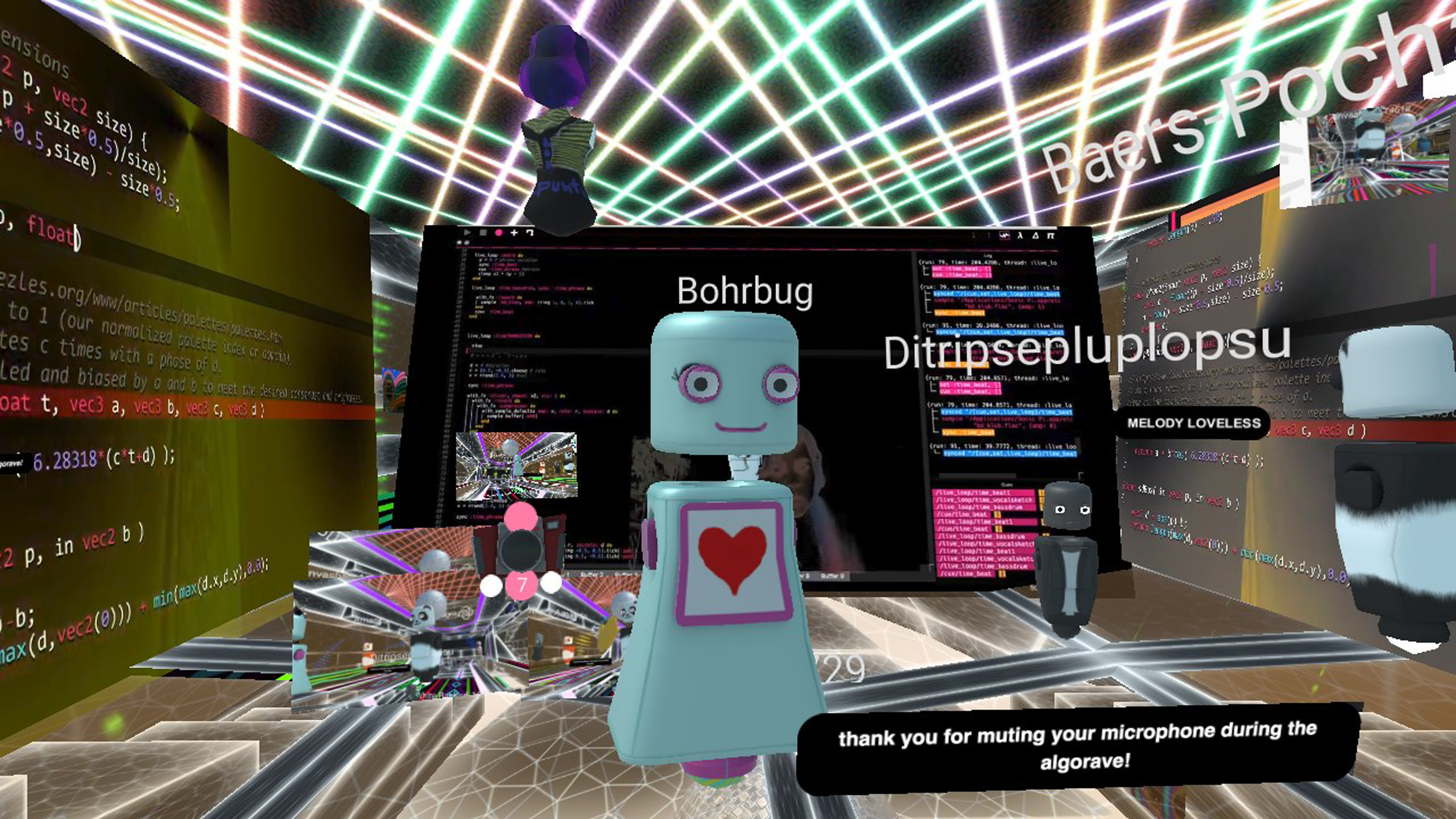
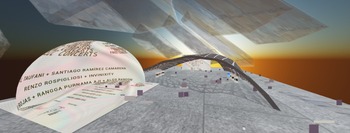
Live coding – the practice of writing code in real time (often featured in ‘Algoraves’, dance events where algorithmically generated music is performed live) – established both the technical and organisational foundations for these metaversal ventures. Since 2004, TOPLAP has promoted openness and radical experimentation; 24-hour marathons such as Equinox and EulerRoom, before, during and after the pandemic, interconnected global nodes (EulerRoom Equinox 2020). During the pandemic, EulerRoom migrated fully to virtual formats, and its horizontal structure inspired immersive spaces such as La Fábrica VR (Mexico) and UXR Zone (Italy) (see Figures 1–2).
Sketch made in Blender of Fábrica VR – TOPLAP MX, for the first open call, Algorave VR 2020.

Screenshot of the WebVR concert Algorave TOPLAP MX – UXR Zone Cyber Yacht, with audience avatars and live-coding stream.
4. Early metaverse experiments in Latin America
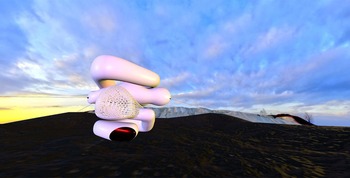
Latin American artists adopted Mozilla Hubs to build digital works that transcended the logic of a ‘virtual meeting’. A foundational project was Layering Corpus (Cortés Reference Cortés García2020), a speculative architectural pavilion and a ‘WebVR sonic walkthrough’, using Cortés’ term, commissioned by the Museo Morelense de Arte Contemporáneo Juan Soriano and curated by Guillermo Santamarina. Using Web Audio panning to activate sound sources according to user proximity, the project included virtual walkthroughs, a workshop and an immersive concert with curator and digital artist Doreen Ríos, where CNDSD performed music while the virtual sky became a projection surface. The sonic experience was defined by spatial manipulation, with audio sources moving and transforming in relation to the avatar’s position, producing acoustic immersion (see Figure 3).
3D WebVR sound pavilion Layering Corpus, Museo de Arte Contemporáneo de Morelos.

This appropriation of Mozilla Hubs as a scalable sonic pavilion catalysed a wave of projects that combined architecture, generative sound, live coding and audiovisual performance. Layering Corpus consolidated a methodology in which spatial design, sound programming and avatar agency operated as an architectural instrument for sonic navigation, laying the groundwork for La Fábrica VR (see Figure 4).
Posters. (1) Algorave VR flyer (April 2020) managed by TOPLAP MX with artists from across Latin America; (2) open call in collaboration with UXR Zone for a worldwide Algorave (European time) – both spaces created in Mozilla Hubs.

5. La Fábrica VR and metaverse algoraves
Launched in April 2020, La Fábrica VR was a virtual environment managed by TOPLAP México, functioning as an incubator for WebXR concerts and exhibitions. The space expanded beyond Algorave, hosting experimental sound and visual communities, GIF/NFT exhibitions, 360-degree projections and student jams. Artists and curators from other Latin American nodes participated as performers and audience, developing creative proposals and new tools to keep their own local communities globally active. Sound experimentation was central; algorithmic synthesis and live programming generated unpredictable soundscapes and rich textures accompanied by visuals. Participants reported a strong sense of acoustic presence and community despite physical distance, facilitated by the social affordances of Mozilla Hubs (group chat, photography, selfies). Parallel channels such as YouTube chat and Discord layered additional interaction, producing what Ang Kia Yee (Ang, Reference Ang2023) calls a ‘metaversal’ experience – multiple intertwined realities (see Figures 5–7). The Fabrica VR project moved its activities to the Spatial.io environment (The VR Factory 2025), where some activities such as concerts and recordings continue.
Space managed by Proyecto Mutar (Santiago Ramírez Camarena) for the Latency concert linking communities in Costa Rica, Latin America and Indonesia (Mozilla Hubs).

(1) WebVR space managed by Sinestesia (Randall Sáenz); cyber-cumbiero meeting. (2) WebVR space managed by Piranha Lab (Ocelotl, Teixido, Sotomayor) during the EDGES Festival, CENART 2020.

Algorave VR with audience avatars experiencing a live-coding audiovisual act.

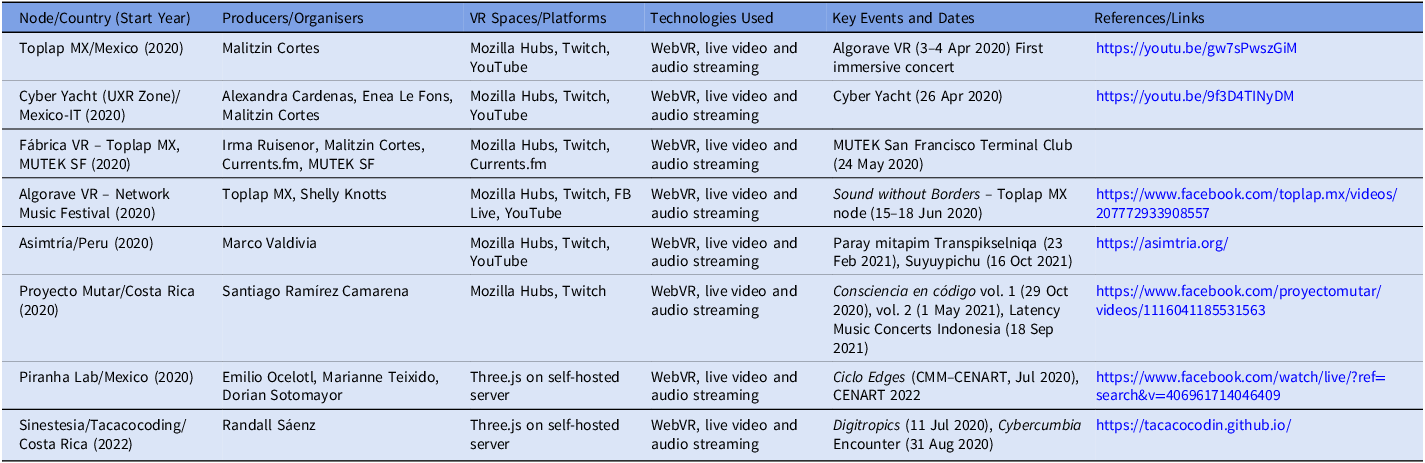
Summary of key metaversal Algoraves and independent WebVR initiatives (2020–22). This table highlights representative events and platforms. A full chronology, including complete details of participants, platforms and links, is available in Supplementary Table 1.1.

From an analytical perspective, attendees’ descriptions of acoustic presence and co-embodiment resonate with classic frameworks of media presence that link sensory immersion with a sense of ‘being present’ (Lombard and Ditton, Reference Lombard and Ditton1997). The interrelationship of audiovisual stimuli and the synchronous interaction of avatars in VR Factory can also be understood through Christoph Cox’s (Reference Casemajor, Fallon and Stern2016) sonic materialist philosophy, where sound is not merely representational but an affective and vibratory force that connects bodies and spaces beyond language. This sonic materialism frames listening as a dynamic act that extends embodied perception into computational and mediated environments through continuous feedback between sensation and action; through stimuli such as the body, architecture, the sense of scale and the presence of others in a space, these loops were reinforced by low-latency audio streams and gaze-directed spatial sound, fostering what participants perceived as a ‘shared corporeality’ despite physical separation.
Briefly, the first immersive Algorave took place on 3–4 April 2020, coordinated by TOPLAP MX. Within weeks, similar events emerged across the region, including Asimtría’s Mozilla Hubs series in Peru (2020), a platform focused on learning, production, transfer and the exchange of collective artistic creation grounded in Free Software Culture and the values of Iskay Yachay and Sumaq Kawsay, led by Marco Valdivia. Proyecto Mutar in Costa Rica (2020–21) followed as an interdisciplinary cultural initiative centred on sound and music, with activities ranging from training and workshops to concerts, research and cultural exchange, led by Santiago Ramírez Camarena.
Other projects, beyond experimenting with Mozilla Hubs, pursued autonomous development through self-hosted three.js servers. This was the case of Piranha Lab in Mexico (2020), a laboratory dedicated to promoting practice, development, research and dissemination of software for audiovisual creation, directed by Emilio Ocelotl, Marianne Teixido and Dorian Sotomayor. Piranha Lab collaborated with the Centro Multimedia at CENART and shared server infrastructure with Sinestesia/Tacacocoding in Costa Rica (2022). Tacacocoding, a Costa Rican live-coding collective, co-founded by Randall Sáenz through Sinestesia – a laboratory for experimentation with new media and interdisciplinary improvisation – played a crucial role in creating, programming and managing immersive environments for their community.
The rapid adoption of WebXR illustrates how Latin American live-coding communities were able to mobilise low-cost infrastructures to sustain artistic exchange during the pandemic lockdown.
6. Documentation and legacy
During the pandemic, numerous online events were recorded, culminating in the 2025 mini-documentary VLR – Resistance of Electronic Music and Digital Art in Latin America in Times of Confinement, which compiled the experiences of various artists and cultural spaces analysed here. The ephemeral nature of these performances, and their dissemination through platforms such as Zoom, raised crucial questions about digital preservation and collective memory. Documentation practices were closely linked to the possibilities of metaverse web platforms. In live-coding and networked performance scenes, multihour broadcasts became the default archive: continuous YouTube/Twitch streams, such as EulerRoom Equinox 2020, established an initial benchmark for how to publish, preserve and subsequently revisit distributed concerts and talks (EulerRoom 2020). Within WebXR rooms, integrated features such as lobby viewing and camera modes, along with external capture pipelines, allowed concerts to be documented as they unfolded, generating an immediately accessible, link-based record for both the public and researchers (Hubs Foundation 2024).
In Latin America, institutional websites and programme notes often served as living records of metaversal events. The Pioneras Electrónicas concert (Casa del Lago UNAM, August 2020), organised with TOPLAP MX and La Fábrica VR, provided public access to a dedicated Mozilla Hubs room and archived programme information online.
The legacy of these practices is inseparable from the platform’s lifecycle. On 31 May 2024, Mozilla ended official support for Hubs; teams were encouraged to export scenes and assets before the shutdown, while codebase management was transferred to the Hubs Foundation. Some projects experimented with alternatives like Spatial.io, while others rebuilt custom environments in three.js, though most pandemic-era venues were abandoned as virtual concerts declined or disappeared. As a result, the post-pandemic archive of metaversal music in the region is hybrid – composed of institutional publications, long-form livestreams, downloadable 3D assets and traces of migrations – and demands preservation strategies that recognise links, venues and repositories as co-equal parts of the record (Mozilla 2024; Hubs Foundation 2024).
Shortly before Mozilla shut down Hubs, the US artist Trash Panda released the mini-documentary ‘HUB ZONING: A Tour of Art and Music Spaces in Web VR’ (Reference Trash Panda2025), which featured a livestream featuring a general audience and some of the creators of the art and sound spaces created on the platform. In the United States, Mozilla Hubs was adopted mainly for artistic and theatrical purposes but did not consolidate a community of live-coding concerts in these environments. However, US artists and live coders participated in Latin American initiatives such as La Fábrica VR’s collaborations with MUTEK SF, Terminal and Currents, underscoring the cross-regional exchanges that shaped the metaversal archive (see Table 1) .
7. Critical discussion: Non-corporate WebXR and future metaverses
Grounded in the pursuit of technological sovereignty amidst persistent infrastructural inequality in Latin America, the practices documented here exemplify a non-corporate use of WebXR and spatial audio that challenged the ‘metaverse’ narrative promoted by Big Tech. Unlike proprietary platforms like Meta Horizon Worlds, which prioritised closed ecosystems, data monetisation models and brand-centric spatial design, these Latin American initiatives embraced open protocols, community governance and artistic experimentation. By self-hosting Mozilla Hubs instances and sharing source code modifications, artists created open-source micrometaverses based on practical research. Mozilla’s subsequent ‘Creators’ programme, which provided experimental access to Hubs code, was fuelled in part by this community innovation and led to collaborations with institutions like the Société des Arts Technologiques de Montréal.
In Mexico, concrete initiatives emerged through the programming of the Casa del Lago cultural centre, under the direction of Cinthya García Leyva, which launched its first virtual experiment with three.js to host concerts and talks. This pilot project led to collaborations with La Fábrica VR, commissioning two Mozilla Hubs projects that expanded diverse artistic practices. Most relevant to the metaversal musical environment were the Pioneras Electrónicas and Femlab 2019 programmes. A special version of Fabrica VR was created, along with a lobby connected to the virtual Casa del Lago on its website. Streaming concerts in this virtual space attracted over 350 participants, prompting the creation of pre-registration-only mirror rooms to accommodate the crowds. In this context, the limitations of Mozilla Hubs became an aesthetic condition: the proliferation of fragmented yet interconnected virtual spaces generated a poetics of multiplicity and distributed encounter, reconfiguring the way communities communicated across distances.
For Latin American communities, Mozilla Hubs developers offered extensive support and communication through their Discord channel, assisting with logistical challenges related to large-scale multiplayer events, textures, audio and 3D environments. In the case of Fábrica VR – TOPLAP MX, this collaborative approach persisted and expanded into other artistic projects, providing free workshops and guidance to cultural organisers interested in adopting Mozilla Hubs, using Blender for 3D modelling and constructing WebVR environments in Spoke, an online software whose workflow closely resembles that of Unity.
Live-coding networks not only created their own three.js environments but also shared servers and technical knowledge across nodes (e.g., Piranha Lab in Mexico; Sinestesia in Costa Rica). An innovative form of collaboration consisted of allowing audiences to ‘jump’ between metaverses via links – for instance, attending an event at Fábrica VR and then instantly moving to one hosted by Proyecto Mutar. These experiments embody a situated techno-aesthetic practice in which creative outcomes were inseparable from material choices and the limitations of the platforms used.
This alignment between form and technology resonates with Magnusson’s (Reference Magnusson2019) argument that musical technologies inscribe aesthetic and epistemic possibilities into the fabrication of sonic systems and environments. Similarly, Born’s (Reference Born2013) work on the interrelation of sound, space and experience supports the observation that digital contexts like these reshape publicness, social interaction and collective presence.
8. Technopolitical implications
Technological sovereignty is not an abstract concept, but a practical condition for sustaining artistic practices in Latin America. Managing Hubs on local servers in Mexico and Costa Rica reduced dependence on corporate infrastructure and allowed communities to configure their own environments. This autonomy, emerging in conditions of infrastructural inequality, positioned metaversal experiments as both creative and political acts.
Feminist and care-oriented protocols were equally central. Moderation roles, room cloning to facilitate accessibility and the collective management of avatars and resources illustrate what Casemajor (Reference Casemajor, Fallon and Stern2022) calls infrastructure as care. Similar dynamics were observed in Chile, where Karmy and Urqueta (Reference Karmy and Urqueta2021) documented how musicians responded to precarious working conditions during lockdown by creating mutual support networks, and in the TRAMUS project (Calderón-López and Villarroya, Reference Calderón-López and Villarroya2023), which highlighted feminist strategies for sustaining artistic communities. These cases demonstrate that care was not peripheral, but integral to the very organisation of metaversal events.
The sharing of 3D models, sound libraries and scripts in Peru, Argentina and Mexico created porous metaverses that anticipated interoperability standards such as the W3C’s Open Metaverse Operating System. Rather than refined virtual worlds controlled by corporations, these environments were provisional, collaborative and resource-conscious. Strub & Margolies, Reference Strub and Margolies2024) describe this improvisational ethos as characteristic of Latin American musical responses to the pandemic, turning technological limitation into a catalyst for collective invention.
Taken together, these technopolitical practices reveal that Latin American metaversal art was never limited to experimentation: it redefined aesthetic infrastructures as spaces of sovereignty, care and reciprocity.
9. Conclusion
Live coding, networked performance and immersive sound have reconfigured collective creation in Latin America. Open platforms and free software – SuperCollider, TidalCycles, Hydra, Pure Data – have fostered a situated technological culture that challenges hegemonic virtuality. Beyond the urgency of the pandemic, these networks of mutual support continue to generate new forms of cultural resistance, whose legacy depends on ethical and affective documentation.
Future research could adopt longitudinal and comparative approaches to trace how these metaversal practices persist, transform or hybridise with in-person performance as post-pandemic conditions evolve. The phenomenon also poses new technological, methodological and theoretical challenges, raising questions for artistic research: How might future performances combine physical and virtual presence? What new forms of authorship and collaboration can develop in immersive environments? How can audiovisual experimentation in metaverses continue to expand our understanding of art, technology and community? And how can archives of metaversal performance be preserved and studied across different platforms?
Ultimately, the practices analysed here affirm that metaversal experimentation in Latin America is not defined by absence but by imagination. They highlight the ongoing potential of these environments to foster innovation and collective creativity.
Supplementary material
To view supplementary material for this article, please visit https://doi.org/10.1017/S1355771825100927





 Open access

