
Introduction
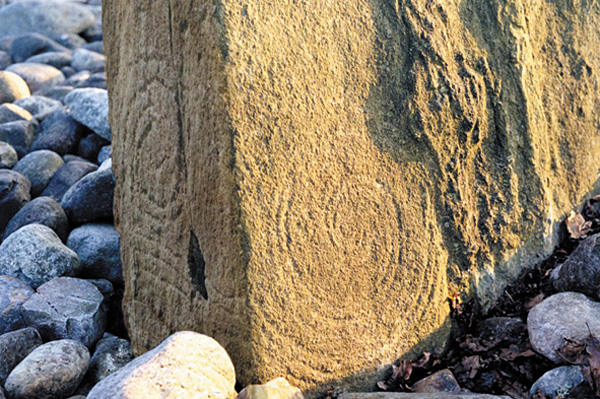
The Temple Wood and Nether Largie complex stands in the Kilmartin Glen, Argyll, Scotland (Grid Ref. NR 82 97; Lat. 56° 7' Long. 5° 29'; Figure 1). The Temple Wood site (Figure 2) consists of two adjacent stone circles thought to have been built in the fourth millennium BC (RCAHMS 1988, 1999; Scott 1989: 53). However, there is some doubt about this date, (Butter 1999). Radiocarbon dates for the southern circle show that it was used for burial from the middle to late Bronze Age (Scott 1989: 115-7; Reference SheridanSheridan 2008). It is thought that the southern circle was erected after the northern circle (Scott 1989) and it is possible that they were built in the early Bronze Age. The line connecting the centre of the circles forms an axis running NE-SW, and coincides with the alignment of the southern circle's three burial cists. Three of the stones of the Temple Wood southern circle have symbols carved on their outer sides: stone 8 is cupmarked and stone 10 has a double spiral (Figure 3), while stone 12 has faint concentric circles.
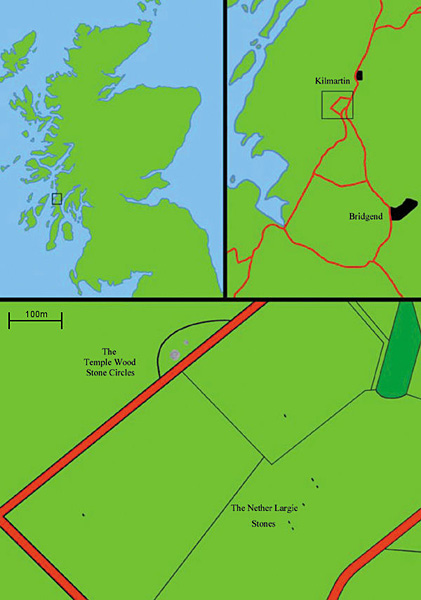
The location of the Temple Wood stone circles and the Nether Largie stones in the Kilmartin Glen on the west coast of Argyll, Scotland.

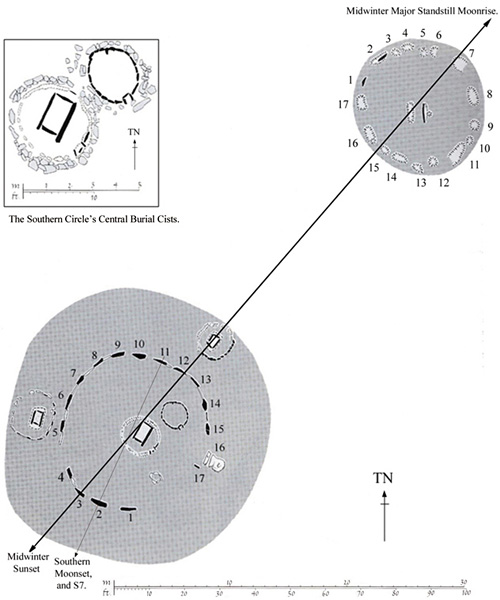
Plan of the Temple Wood stone circles (after RCAHMS 1999, with permission).

The spirals on stone 10.

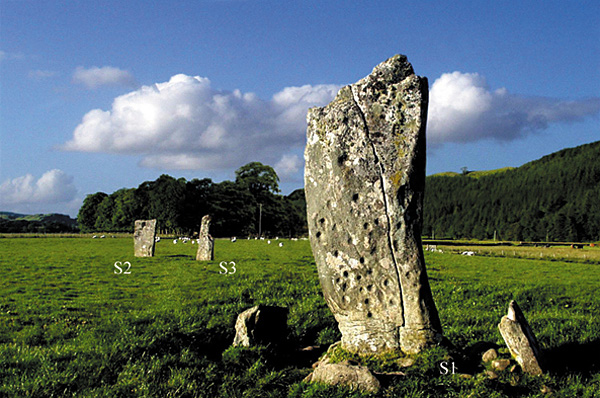
The Nether Largie standing stones are situated some 300m to the south-east of the Temple Wood stone circles and are probably broadly contemporary with them. They stand in a rectangular or X-shaped setting which is formed by two pairs of standing stones, placed about 35m to the north-east and south-west of a central stone. With the exception of S4, and S7, all the Nether Largie stones are cupmarked, and S1, on its south-west side, has a large number of these, some of which are surrounded by rings and are connected to other cupmarks by grooves (Figure 4). S7 no longer exists and its position was located from Reference HawkinsHawkins 1983 and information from Dr Aubrey Burl.
The Nether Largie stones S1, S2 and S3 viewed from the south. The south side of S1 is covered with cup-and ring marks, some of which are joined with grooves to other cupmarks. There are also a number of cupmarks on the southern side of S2, and on the inner western side of S3.

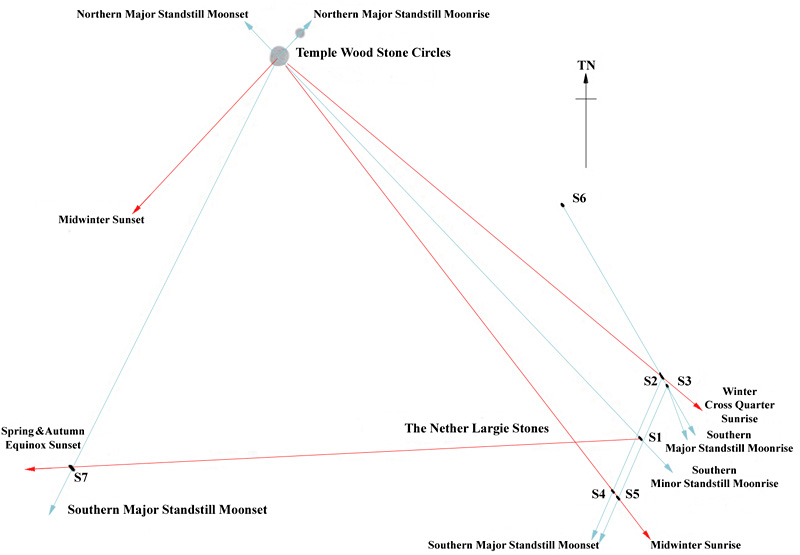
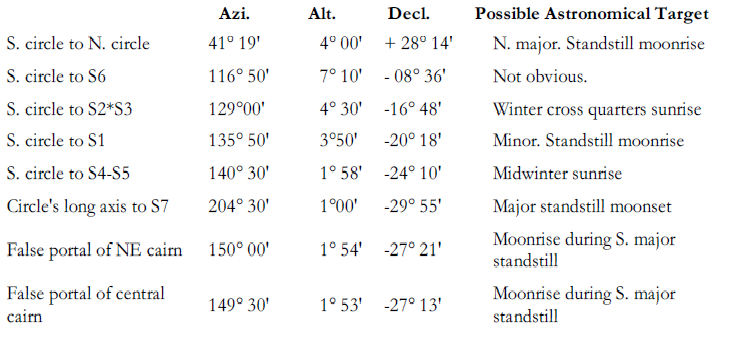
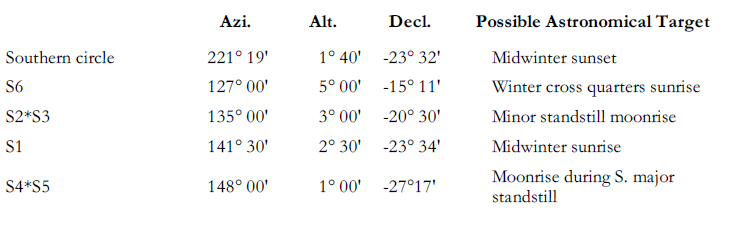
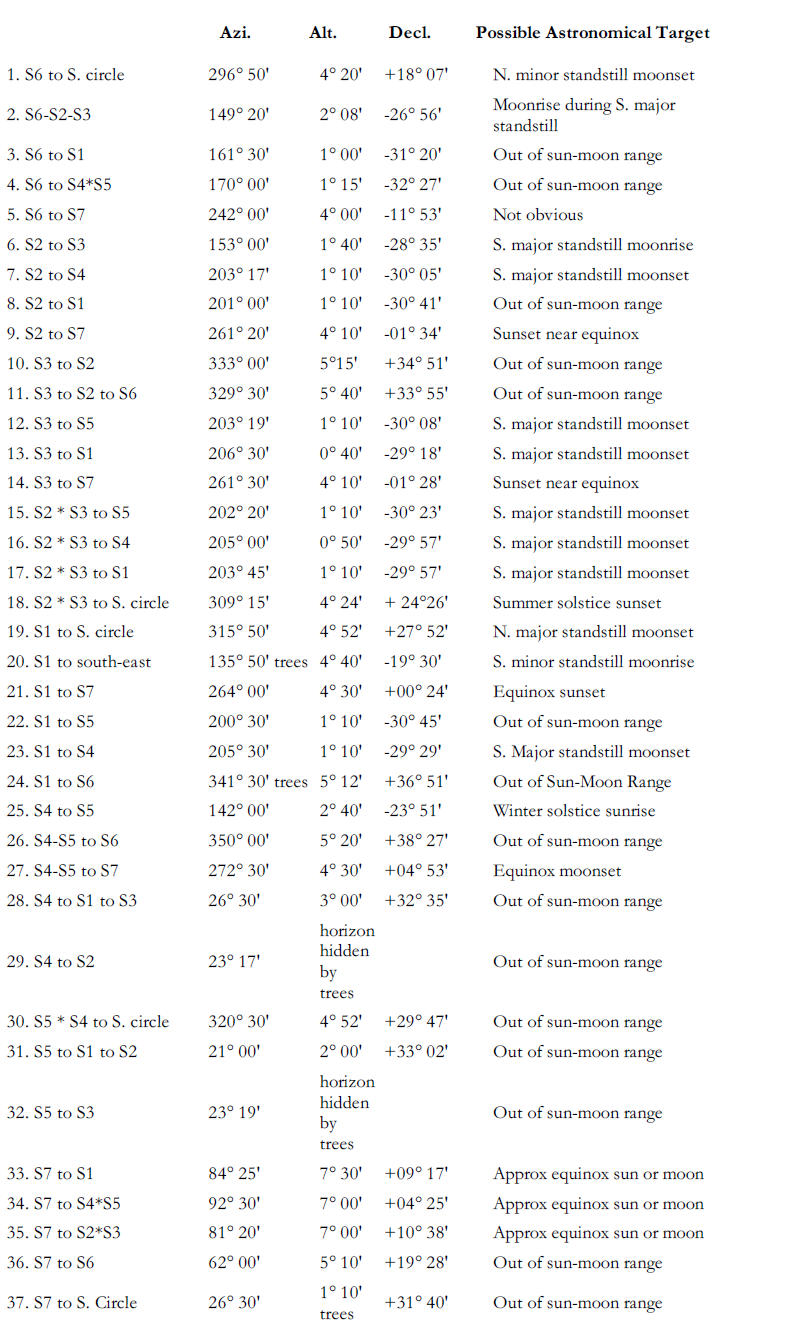
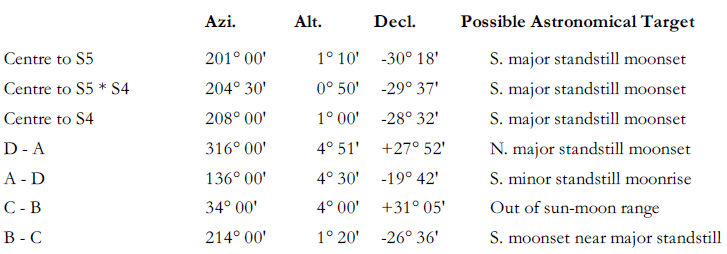
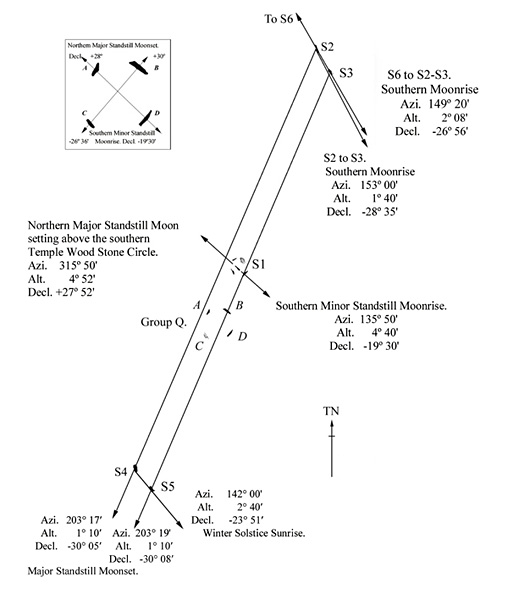
With a view to determining their possible astronomical use some 4000 years ago, the Temple Wood stone circles and the Nether Largie stones have been examined by a number of scholars who have proposed alignments of various significance, mainly deducted from partial surveys (Reference ThomThom 1967, 1971; Reference PatrickPatrick 1979; Thom et al. 1980; Reference HawkinsHawkins 1983; Reference RugglesRuggles 1984; Scott 1989). The author surveyed all the sightlines in 1992 and used direct observations on site during the 2006-2007 major standstill. Summarised here are those solar and lunar events that now appear to be significant (Figure 5, Tables 1-4).
Summary of the solar and lunar sightlines observed between the southern Temple Wood stone circles and the Nether Largie stones. The solar-lunar sightlines are shown in red and blue.


Solar events
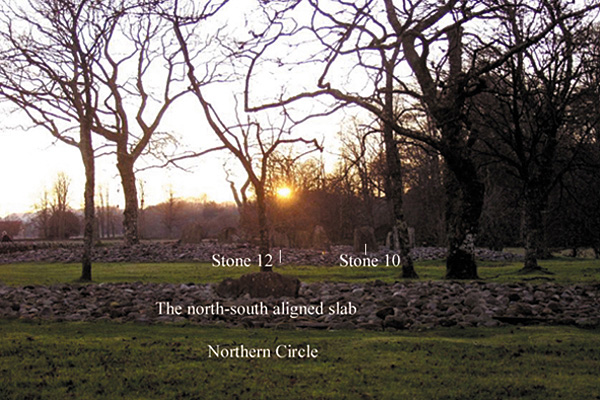
From the northern circle, the midwinter sun would have set in line with the southern circle (Figure 6). The concentric circles on stone 12 and the double spirals on stone 10 could be symbolising this event. From the southern circle, the winter solstice sun would have risen in line with alignment S4-S5, and although the Nether Largie stones are more concerned with lunar events (below), it is possible to see the midwinter sun rise from S4-S5 about 10 minutes after it had risen from the Temple Wood circle (Figure 7). From S1, the sun will set in line with S7 on the days of the spring and autumn equinoxes.
The midwinter sun seen from the northern circle setting above the southern circle on the 17 December 2007. The double spirals on stone 10 could be marking where the sun set about 10 days before midwinter, and perhaps the concentric circles on stone 12 are depicting this event.

The midwinter sun rising in line with S4-S5, about 9:28am on the 17 December 2007, Azi. 141° 38' Alt. 2°47' Decl. -23° 21'. Some 4000 years ago, the winter solstice sun would have risen in line with the lower right sides of the two stones. This has been confirmed by a star trail photograph.

Lunar events
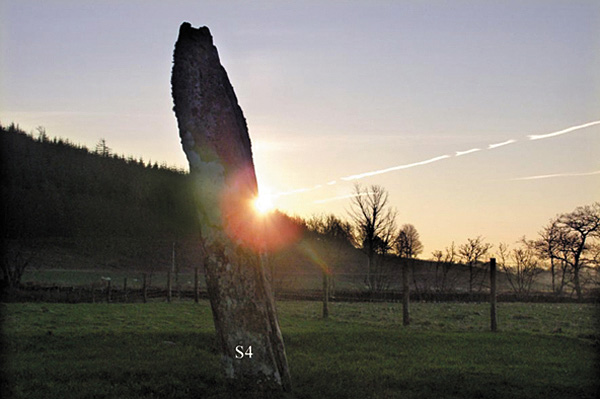
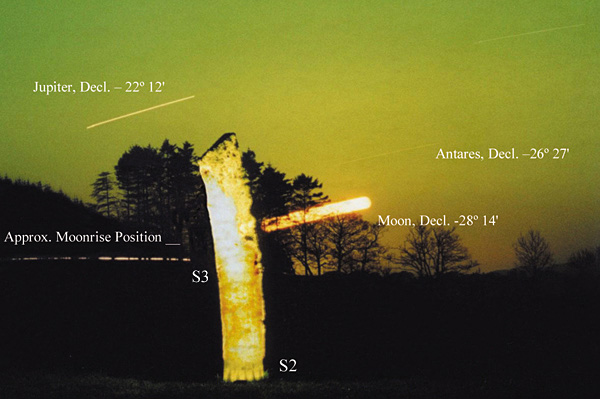
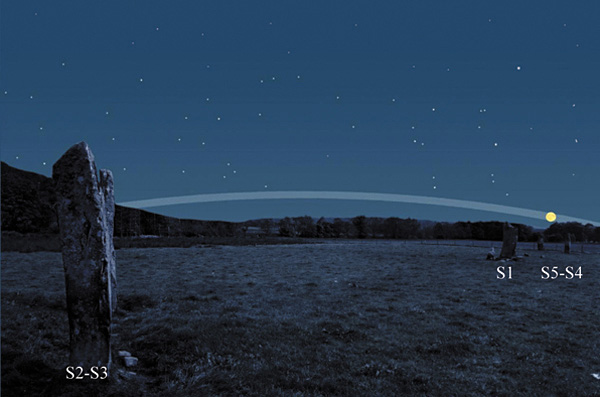
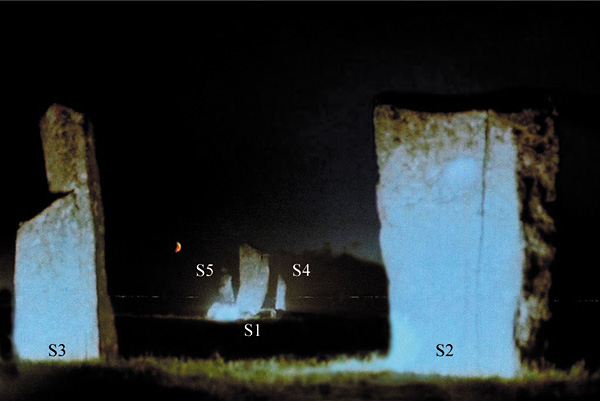
The north-east direction of the Temple Wood circles orientates to the rising major standstill midwinter full moon, while the long axis of the southern circle is towards Nether Largie stone S7 and the setting southern major standstill moon. The false portals of the burial cairns in the southern circle are orientated towards moonrise near the southern major standstill. From the centre point Q of Nether Largie, the southern major standstill moon would have set between S5-S4 (Figure 8). Nether Largie stones S6 to S2-S3 generally indicate where the midsummer moon will rise a few days before it reaches its southern major standstill. After rising in line with S2-S3 (Figure 9), over the next three nights , the moon would have set in line with and between S4-S5 (Figure 10) and this could have been watched from between S2-S3, or from S1 (Figure 11). The parallel sightlines between S2-S4 and S3-S5 indicate where the extreme southern major standstill first quarter moon could have set in September.
The solar and lunar alignments of the Nether Largie stones.

This time-exposed picture of the rising moon, declination -28° 14', was taken from about 12:13am GMT on the 5 of May 2007. As the video camera recording the moonrise was in line with the stones, the above picture was taken slightly to the north of their alignment, about ten minutes after the moon had risen. The dark form of S3 can be seen just to the left of S2.

Digital illustration showing the trajectory of the midsummer moon. From S2 the midsummer moon will generally rise in line with S3 when it has a declination of about -28° 30'. Over the next few nights, the moon's declination would continue to lower and it would rise slightly more to the right of S2-S3, and then set between S5-S4. As there are cupmarks on the southern side of S2, and S3 has some on its lower inner side, these could have been connected in some way with the rising and setting moon.

The setting major standstill moon with a declination of -29° 38' was observed from the northern stones S2-S3 about 8:00 pm GMT, on the 29 September 2006. Even though the moon was completely hidden by the trees before it came in line with the stones, careful examination of its setting angle suggests that it would have set between S5-S4.

Discussion
There are good correlations at Kilmartin between stone alignments and the rising and setting of the midwinter sun and the major standstill moon. Ruggles found a number of alignments, mainly in Mull and Argyll, that indicated to within a degree the rising or setting of the southern major standstill moon (Reference RugglesRuggles 1984: 282, 1999: 183-6, 190, 192). The present author has also identified a large number of solar and lunar events of similar accuracy at other sites (Reference ScottScott 1990, 1991, 2003; cf Reference BradleyBradley 2000: 181). It seems unlikely that these alignments were haphazard or that they commemorated a single chance observation. While it is not known for how long the stones were in use, research using the astronomy program Redshift, has shown that, weather permitting, it would have been possible to see the southern major standstill moon in its different phases rising and setting in line with these stones about 18 times from March to September. The moon would also have risen and set in line with these stones for about a year on either side of a major standstill giving 54 opportunities to see this occur. Over the 1000 years that the Temple Wood stone circles and the Nether Largie stones were possibly in existence together, there would have been 50 major standstills, each tracked by 54 observations, making at least 2700 potential occasions of use.
The complexity revealed by the Kilmartin observations, where solar and lunar events were used in combination, suggests an equally complex context of commemoration or prediction. At Nether Largie, stones were used to mark not only the rising winter solstice sun but also where the southern moon, generally rising in line with the northern stones S6-S2-S3 and S2-S3, could have given warning that it would be setting between S5-S4 in a few days time. As standing stones are sometimes found in association with burials and cremations, so the symbols carved on them and their alignment to the sun or moon could have reflected some connection with ancestors and the spirit world.
From S1, the sun will set in line with S7 at the spring and autumn equinoxes, at which time the major standstill moon is at its furthest south. There is a possibility that the stones could have been used at this time to anticipate lunar eclipses within three weeks of the last and first quarter moon rising in line with S2-S3 or setting between S5- S4. Whether or not such speculations are accorded any validity, the Temple Wood and the Nether Largie stones demonstrate alignments of astronomical significance that are among the most sophisticated of any so far claimed in Scotland.
-
• All the horizon altitudes are shown as surveyed and they have been adjusted for terrestrial refraction.
-
• The central declinations of the summer and winter solstice sun 4000 years ago were +23° 54' and -23° 54'.
-
• The central declinations of the northern and southern moon at the major standstill are -30° and +28° 12', and at the minor standstill -19° 42' +17° 54'. The accepted outer declination limits for the northern and southern sun and moon is 0° 30'.
-
• The asterisks show that surveys were to and from between S2-S3, S4-S5.
Acknowledgements
The author would like to thank Dr Andrew Turnbull, Prof. Martin Carver and Dr Aubrey Burl for their assistance in the compilation of this paper.