

Introduction
On February 24, 2022, Russia escalated its aggression against Ukraine. In addition to a staggering civilian death toll (i.e., ≥ 14,383) (OHCHR 2025), the Russo-Ukrainian War had made approximately 5,752,670 refugees as of October 31, 2025 (UNHCR 2025).
During the early days of the Russo-Ukrainian War, many correspondents compared the turmoil Ukrainians were going through to that of Afghans, Iraqis and Syrians. Illustratively, U.S. CBS News’ Charlie D’Agata declared: “This isn’t a place, with all due respect, like Iraq or Afghanistan, that has seen conflict raging for decades. This is a relatively civilized, relatively European—I have to choose those words carefully, too—city, one where you wouldn’t expect that, or hope that it’s going to happen.” Neither was he sure about the civility of Ukraine nor its Europeanness, but he was sure that its alleged difference from Iraq and Afghanistan made war an odd occurrence. A little bit surer about the Europeanness of Ukraine, U.K. ITV News’ Lucy Watson declared: “Now, the unthinkable has happened to them, and this is not a developing Third World nation, this is Europe!” With nuances of Racial Capitalism and how it dictates who should live and die (see Robinson Reference Robinson1983), French BFM TV’s Philippe Corbé declared: “We’re not talking here about Syrians fleeing the bombing of the Syrian regime backed by Putin. We’re talking about Europeans leaving in cars that look like ours to save their lives” (Bayoumi Reference Bayoumi2022).
Against this background, many scholars wondered how news outlets portrayed the Russo-Ukrainian War’s refugees across the “Occident”. After all, the relationship between the “Occident” and the “Orient” has been historically shaped by power dynamics that contrast the “civilized” European “Us” with the “uncivilized” non-European “Them” (Said Reference Said1978, 07). Initially, scholars concentrated on U.S.-based news outlets (see Sambaraju and Shrikant Reference Sambaraju and Shrikant2023; see also Roman, Young and Perkins Reference Roman, Young and Perkins2020). Soon, however, the spotlight turned to the European Union (EU) (see Sambaraju and Shrikant Reference Sambaraju and Shrikant2023; Zawadzka-Paluektau Reference Zawadzka-Paluektau2023a; Zogata-Kusz, Hobzová and Cekiera Reference Zogata-Kusz, Hobzová and Cekiera2025), where Germany, Poland and the Czech Republic had become the largest destinations, hosting approximately 1,210,515 (≈ 27.7%), 995,925 (≈ 22.8%) and 385,655 (≈ 8.8%) Russo-Ukrainian War’s refugeesFootnote 1 , respectively, as of October 31, 2025 (European Commission 2025c).Footnote 2 Further away, however, Spain appears as the next biggest destination for 244,165 (≈ 5.6%) Russo-Ukrainian War’s refugees (European Commission 2025c) and a sui generis “Circuit of Culture” (Hall Reference Hall, Curran, Gurevitch and Woollacott1977).
Like any other colonizer, Spain has unparalleled experience with dehumanizing the “Other”. Spain honed its colonization of Latin America through a legal system (i.e., the Encomienda) that granted colonizers the right to demand tributes and labor from Indigenous populations. In a supposed reciprocity, the colonizers were tasked with converting Indigenous populations to Christianity. Such a condescending logic subsequently underpinned the arguments advanced at the Controversia de Valladolid (1550–1551), during which Juan Ginés de Sepúlveda defended the natural right of Spaniards to enslave Indigenous populations (Todorov Reference Todorov1982). Even though colonialism may have ended, coloniality outlived it by continuing to dehumanize those who are not “[…] the simultaneously Christian, white, Western and heterosexual men” through “[…] racially hierarchical, dehumanizing and totalitarian enunciative apparatus […],” such as Spanish-language news outlets (Mignolo and Bussmann Reference Mignolo and Santino Bussmann2023, 02; see also Abu-Bakare Reference Abu-Bakare2022).
Demonstrably, Spanish news outlets textually dehumanized Syrian Civil War’s refugees between 2015 and 2016 (Soto-Almela and Alcaraz-Mármol Reference Soto-Almela and Alcaraz-Mármol2019; Alcaraz-Mármol and Soto-Almela Reference Alcaraz-Mármol and Soto-Almela2020; Porto Reference Porto2022; see also Berry, García-Blanco and Moore Reference Berry, García-Blanco and Moore2015; van Dijk Reference van Dijk2015). Incipiently, Prieto-Andrés, Fernández and López-Avilés (Reference Prieto-Andrés, Fernández and López-Avilés2024) comparatively analyzed how four Spanish news outlets—ABC, El Mundo, El País and La Vanguardia—photographically portrayed Russo-Ukrainian War’s refugees between February 24 and April 30, 2022, and Afghan refugees between September and December 2022 (see also Zawadzka-Paluektau Reference Zawadzka-Paluektau2023b; Diab Reference Diab2025). Innovatively, however, we contribute to the scholarly literature on the portrayal of the Russo-Ukrainian War’s refugees by timely asking: How have Spanish news outlets textually and photographically portrayed the Russo-Ukrainian War’s refugees?
We begin by engaging with the current scholarly literature on how news outlets have portrayed the Russo-Ukrainian War’s refugees. Then, we conceptually entwine Off-Whiteness (Baker et al. Reference Baker, Iacob, Imre and Mark2024) with Orientalism (Said Reference Said1978) to explicate how the conventional meanings of Water Metaphors (Porto Reference Porto2022) were disrupted through a re-racialization that generated a distinctive Sentence-Image (Rancière Reference Rancière2007) of the Russo-Ukrainian War’s refugees. Finally, we demonstrate that, even though the two leading Spanish news outlets—El Mundo and El País—have employed Water Metaphors to describe the Russo-Ukrainian War’s refugees, their portrayals crystallized as what we term “Contingent Safe Waters”.
Literature Review
Since February 24, 2022, research on the textual portrayal of the Russo-Ukrainian War’s refugees has progressively concentrated on their three largest destinations across the EU: Germany, Poland and the Czech Republic. Sambaraju and Shrikant (Reference Sambaraju and Shrikant2023, 1728) analyzed one German news outlet—DW News—between February 25 and March 25, 2022.Footnote 3 They concluded that the Russo-Ukrainian War’s refugees were portrayed as “Contingent Refugees” “[…] who are only now forcefully seeking refuge and are otherwise not those refugees who might seek to relocate to other countries.” Consequently, they tended to be seen as vulnerable and their movement as understandable. Zawadzka-Paluektau (Reference Zawadzka-Paluektau2023a) analyzed three Polish news outlets—Fakt, Gazeta Wyborcza and Rzeczpospolita—between March 1 and 7, 2022. They concluded that the Russo-Ukrainian War’s refugees were positively, or at least neutrally, portrayed. Zogata-Kusz, Hobzová and Cekiera (Reference Zogata-Kusz, Hobzová and Cekiera2025) analyzed the tweets of five Czech news outlets—Seznam Zprávy (i.e., @SeznamZpravy), Novinky (i.e., @Novinkycz), Aktuálně (i.e., @Aktualnecz), Deník (i.e., @Denikcz), iDNES.cz (i.e., @iDNEScz)—and five Polish news outlets—Onet (i.e., @Onetpl), Wirtualna Polska (i.e., @WirtualnaPolska), TVN24 (i.e., @TVN24), Interia (i.e., @Int_Wydarzenia), Radio Zet News (i.e., @RadioZET_NEWS)—between February 24 and April 24, 2022. Drawing on the conceptual lenses of Win van Oorschot’s CARIN (i.e., Control, Attitude, Reciprocity, Identity and Need), they suggested that:
The public is usually willing to share its resources with those who: do not have control over their poor situation; have the ‘proper’ attitude, i.e. to demonstrate gratefulness or docility; may reciprocate the support to the public in some form (or have already earned it); the public may identify with for their proximity. Finally, the public should recognize that the group is in great need. (Zogata-Kusz, Hobzová and Cekiera Reference Zogata-Kusz, Hobzová and Cekiera2025, 279)
Zogata-Kusz, Hobzová and Cekiera (Reference Zogata-Kusz, Hobzová and Cekiera2025) concluded that CARIN shaped the portrayal of the Russo-Ukrainian War’s refugees (see also Elmas, Yılmaz and Gürbüz Reference Elmas, Yılmaz and Gürbüz2024; Papale and Solaroli Reference Papale and Solaroli2025).
Other scholarship has highlighted the hyper-attention that regimes have given to some refugees and the ways they have extended support to a limited number while neglecting others (Agathangelou Reference Agathangelou, Rossi and Riemann2024). In EU-based English-language news outlets, the portrayal of the Russo-Ukrainian War’s refugees contrasted with that of the Syrian Civil War’s refugees between 2015 and 2016. Five times more Russo-Ukrainian War’s refugees were portrayed as deserving compared to Syrian Civil War’s refugees. Four times more, on the other hand, the latter were portrayed as threats to culture, health, economy and securityFootnote 4 (McCann, Sienkiewicz and Zard Reference McCann, Sienkiewicz and Zard2023; see also Ajana, Connell and Liddle Reference Ajana, Connell and Liddle2024). Perceptually, for three Far-Right Swedish news outlets—Samnytt, Nordfront and Nya Tider—“Ukraine and Sweden are united in a homogenously imagined European community […]. Muslim immigrants, contrary to Ukrainian immigrants are thought to pose a real threat to Sweden and its homogeneity” (Palmgren, Åkerlund and Viklund Reference Palmgren, Åkerlund and Viklund2023, 1406).
Although cogent, analyses that solely rely on texts neglect that photographs can also cause a collective commotion that can change policymaking (Sontag Reference Sontag1977; see also Moeller Reference Moeller and Bleiker2018, 76). Exceptionally, Martikainen and Sakki (Reference Martikainen and Sakki2024) analyzed how one Finnish news outlet—Helsingin Sanomat—photographically portrayed the Russo-Ukrainian War’s refugees between February 25 and May 31, 2022. They demonstrated that most photographs depicted women and children grieving (e.g., Crying) or coping (e.g., Studying) and concluded that these could be thematically categorized as “Vulnerable Victims”, “Innocent Victims”, “Suffering Ukrainians”, and “Persistent/Resilient Ukrainians”. With a scarce engagement with theoretical debates on racialization, Prieto-Andrés, Fernández and López-Avilés (Reference Prieto-Andrés, Fernández and López-Avilés2024) comparatively analyzed four Spanish news outlets—ABC, El Mundo, El País and La Vanguardia—regarding the Russo-Ukrainian War’s refugees between February 24 and April 30, 2022, and Afghan refugees between September and December 2022. They concluded that the latter were more constantly depicted with conflict-related photographs, which arguably led to greater distrust compared to the depiction of the Russo-Ukrainian War’s refugees (see also Diab Reference Diab2025).
Overall, the scholarly literature on how news outlets have been portraying the Russo-Ukrainian War’s refugees argued and demonstrated that their portrayal—either textual or photographic—has been substantially more positive than that of the Syrian Civil War’s refugees between 2015 and 2016 and during the return of the Taliban to Afghanistan’s Government around September 2021. We go beyond the then-existing scholarship by conducting a dual analysis that explores how texts and photographs co-constructed a “Sentence-Image” that disrupted the historical racialization of Ukrainians as “Oriental European Others”.
Conceptual Framework
Conceptually, we depart from Water Metaphors (Porto Reference Porto2022), then entwine the concepts of Off-Whiteness (Baker et al. Reference Baker, Iacob, Imre and Mark2024) with Orientalism (Said Reference Said1978) to explicate how the distinct racialization of “Oriental European Others” may have generated an equally distinct type of “Sentence-Image” (Rancière Reference Rancière2007) of the Russo-Ukrainian War’s refugees, one that allowed them to be welcomed by EU Member-States such as Spain.
For Bleiker (Reference Bleiker2001, 509), the daily consumption of “[…] short-lived media events […]” such as wars may lead society to accept the “[…] politically charged and distorting metaphors […]” [emphasis added] about them as the reality. Immigrants as “dangerous waters” have been a widespread metaphor for the “West” (see Musolff Reference Musolff2015; Santa Ana Reference Santa Ana2002; Taylor Reference Taylor2022). According to Porto (Reference Porto2022), through Water Metaphors such as “deluge” (i.e., Aluvión), “avalanche” (i.e., Avalancha), “cascade” (i.e., Cascada), “stream” (i.e., Corriente), “jet” (i.e., Chorro), “flow” (i.e., Flujo), “trickle” (i.e., Goteo), “tide” (i.e., Marea), “wave” (i.e., Ola), “surge” (i.e., Oleada), “river flood” (i.e., Riada), “river” (i.e., Río), “torrent” (i.e., Torrente) and “tsunami” (i.e., Tsunami), the Spanish news outlet El País borrowed the dynamics that characterizeFootnote 5 watery phenomena to portray Syrian Civil War’s refugees as voluminous, moving and uncontrolled, thus “dangerous waters” that had to be reduced, stopped and contained (see also Romano Reference Romano2019; Zawadzka-Paluektau Reference Zawadzka-Paluektau2023b). Not to be more promptly resisted, news outlets may tend to repeatedly use more subtle metaphors (e.g., Trickle) rather than those that overtly communicate damage (e.g., Deluge) (Hart Reference Hart2021; Porto Reference Porto2022). Yet, we understand that these and other metaphors have only shaped portrayals through a hierarchy of knowledge determining who counts as “uncivilised”, thus “dangerous”.
As theorized by Edward W. Said (Reference Said1978), the manner through which the “West” simplistically depicts the “Orient” as uncivilized has endorsed Orientalist discourses that had legitimized colonialism and presently normalize wars and their consequences for the “Orient”, but an unexpected occurrence for the “West” (Sales Reference Sales2023). From the artworks of Ferdinand Victor Eugène Delacroix during Romanticism to contemporary art, consequently, the “Orient” has not been “[…] a free subject of thought or action,” but rather built through their lenses of Orientalism (Said Reference Said1978, 03). Although central for understanding how the “West” constructs the “Oriental Other”, however, Orientalism does not fully capture the ambivalent racialization of the “Oriental European Other”.
Scholars such as Kalmar (Reference Kalmar2022) and Baker et al. (Reference Baker, Iacob, Imre and Mark2024) have argued how “Central” and “Eastern” Europeans occupy an “Off-White” hierarchy. Consequently, “Central” and “Eastern” European States have been historically marked as a semi-periphery where “West”-originated businesses could exploit the cheaper labor (Baker et al. Reference Baker, Iacob, Imre and Mark2024). The predecessor of the EU—the European Economic Community (EEC) (i.e., Belgium, France, Germany, Italy, Luxembourg and the Netherlands)—was enlarged by Denmark, Ireland and the United Kingdom on January 1, 1973, and by Greece on January 1, 1981. Alongside Portugal, Spain joined the EEC on January 1, 1986. Revealingly, Spain’s then-Prime Minister—Felipe González Márquez (1985, 12)—spoke of “[…] a common destiny with the other countries of Western Europe” [emphasis added] during the ceremony at which he signed the joining of Spain to the EEC. In another demonstration that Spain saw the EEC as a “Western” endeavor, Don Juan Carlos I—then-King of Spain (Reference Don Juan Carlos1985, 08)—declared that “[b]y joining the organizations and institutions of Western European integration, Spain only confirms what history and culture made of her since the beginning of modern times” [emphasis added] during the 41st Session of the United Nations (UN) General Assembly. After the Treaty of Maastricht of 1993 that created the EU, the Fourth Enlargement encompassed Austria, Finland and Sweden on January 1, 1995. As of October 31, 2025, the EU highlights that the aforementioned States are “[…] almost the whole of Western Europe” [emphasis added] (European Commission 2025a).
Since the end of the Cold War, the EU conditionally sought to agglutinate a few “Central” and “Eastern” European States. Inserted within a “[…] pre-accession strategy […],” the White Paper—Preparation of the Associated Countries of Central and Eastern Europe for Integration into the Internal Market of the Union—made explicit that “Countries of Central and Eastern Europe (CEECs)” had to adopt the EU’s neoliberal agenda (e.g., Privatization) to “[…] achieve the final objective of becoming Members of the Union” (EU 1995, 03). But it was not until May 1, 2004, that eight States that had been categorized as “CEECs”—the Czech Republic, Estonia, Hungary, Latvia, Lithuania, Poland, Slovakia and Slovenia—alongside Cyprus and Malta, joined the EU. As of October 31, 2025, the EU highlights that Bulgaria and Romania—which joined on May 1, 2007—are “from Eastern Europe […],” whereas Croatia—which joined on July 1, 2013—was “[…] the second country from ex-Yugoslavia […]” (European Commission 2025a). Such wording reveals how, despite adherence to the EU’s Neoliberal agenda, the “Oriental European Other” continues to be racially marked as “Central”, “Eastern”, or “ex-Yugoslavian”, thus “Not Quite” European.
By no means does the othering of “Central” and “Eastern” Europeans as “Oriental European Others” mean that they do not do the same with “Oriental Others” (Baker et al. Reference Baker, Iacob, Imre and Mark2024). Uncoincidentally, many Black people used the hashtag #AfricansInUkraine on TikTok to denounce how they were being racially discriminated against at the borders, the reason why many were not allowed to leave Ukraine to enter Poland (Vincent Jones et al. Reference Vincent Jones, Kim, Tang and Liu2024; see also Bhatia, Poynting and Tufail Reference Bhatia, Poynting and Tufail2018). It reminds us how—despite phenomena like wars—EU border regimes may adapt to absorb “Oriental European Others” while leaving Black people behind to die (see Anievas, Manchanda and Shilliam Reference Anievas, Manchanda and Shilliam2015). Nevertheless, the Russo-Ukrainian War has been a watershed for the racialization of “Central” and “Eastern” Europeans:
After Russia’s full-scale invasion of Ukraine in 2022, the issue of race again came to the fore: migration regimes established to enable the exodus of mainly women and children speedily began to racialise the normative Ukrainian refugee as fully white—itself a novel development—while restricting mobility to those racialised as other, namely Afro-Ukrainians born in Ukraine, Global South nationals living in Ukraine, and Ukrainian Roma. (Baker et al. Reference Baker, Iacob, Imre and Mark2024, 03)
In stark contrast to Afghan and Syrian refugees, who have been consistently portrayed as “Oriental Others”, the re-racialization of the “Oriental European Other” Ukrainian enabled the EU to make them absorbable, not only culturally and racially, but also as workers that could contribute to the Racial Capitalist entrepreneurship of the EU (see Agathangelou Reference Agathangelou2019). Uncoincidentally, the unprecedented adoption of a Temporary Protection scheme allowed the Russo-Ukrainian War’s refugees to have “[…] access to the labour market […]” (European Commission 2025c; see also Council of the European Union 2022a, 2022b). Therefore, the concept of Off-Whiteness complements Orientalism by allowing us to explore whether such a distinct racialization has been used by Spanish news outlets to revoke—textually and/or photographically—the dangerousness that Water Metaphors could have evoked.
Images can determine who can be seen and how, as much as texts, thus becoming crucial to the configuration of a “System of Visibility” (Rancière Reference Rancière and Rockhill2004). Institutions can echo Orientalism by “[…] dealing with it by making statements about it, authorizing views of it, describing it, by teaching it, settling it, ruling over it […]” (Said Reference Said1978, 118). Arguably, the same could occur regarding Off-Whiteness (Hanebrink Reference Hanebrink, Catherine Baker, Iacob and Mark2024). Institutionalized by news outlets, photographers have the power to use angles that solely capture the emotions that contribute to the story they seek to tell. Images and the emotions they represent are neither unchangeable nor perennial, though. Not only can their meaning be changed by an accompanying text, but also many other elements that are not necessarily visible, such as senses, sounds and smells (Rancière Reference Rancière and Rockhill2004; Trote Martins Reference Trote Martins2024, Reference Trote Martins2026; see also Bleiker Reference Bleiker2018). Consequently, photographs can contribute towards the historically contingent order that defines what can be seen, said, and heard, and who can be recognized as a political subject: The “Distribution of the Sensible” (Rancière Reference Rancière and Rockhill2004).
To make sense of how textual and photographic portrayals may have co-constructed the meaning of a Russo-Ukrainian War’s refugee, we drew on Jacques Rancière’s concept of “Sentence-Image”. Rancière (Reference Rancière2007) challenges the traditional opposition between words and images, where the former are assumed to be logical and explanatory, and the latter emotive and irrational, by proposing the concept of the “Sentence-Image” to capture the way both are intertwined. While words can act as images, producing effects and conjuring visibilities that resist erasure, images can interrupt textual continuity, opening space for new perceptual possibilities.
The power of the “Sentence-Image” does not rely on whether words and photographs match. Dissensus emerges not from contradiction but from the redistribution of what is perceptible. A photograph where an angry, moving crowd of countless and unrecognizable Russo-Ukrainian War’s refugees might evoke the risk of a Water Metaphor like “avalanche” (i.e., Avalancha). When accompanied by a photograph where countable and recognizable women with children are walking orderly, however, that same Water Metaphor might be reconfigured. What could have suggested an uncontrollable movement that shall be feared, and thus spurned, becomes a controllable movement that shall be protected, and thus welcomed, thus disrupting and unsettling the racialized “System of Visibility” that has historically Orientalized Afghan and Syrian refugees as “dangerous waters”, so Russo-Ukrainian War’s refugees can be made “Safe Waters”.
Spectators, on the other hand, construct meaning based on their “Circuit of Culture”—“[…] context, usage, or historical circumstances […]”—(Hall Reference Hall, Curran, Gurevitch and Woollacott1977, 09), which allows us to explore to what extent textual and photographic civilizing and whitening of Russo-Ukrainian War’s refugees may have resisted the Orientalist logics that tended to be used to depict non-European refugees, especially through the affective power of photography (Trote Martins Reference Trote Martins2024).
Had the scholarly literature concentrated more on photography, scholars would have probably highlighted what has been dubbed as an Orientalist photography that only captures the “Orient” and “Orientals” during cataclysmic occurrences, a discontinuous portrayal that can not only mobilize but also demobilize Orientalism (Behdad and Gartlan Reference Behdad and Gartlan2013; see also Hackforth-Jones Reference Hackforth-Jones and Roberts2005). Likewise, photography can mobilize but also demobilize (Off-)Whiteness (Shmidt Reference Shmidt, Baker, Iacob, Imre and Mark2024). Consequently, even though Spanish news outlets may have been employing Water Metaphors to textually describe the Russo-Ukrainian War’s refugees, the dangerousness that these could have evoked may have been demobilized through photographs taken through non-Orientalist Off-White lenses. In other words, photographs that visually civilize and whiten the Russo-Ukrainian War’s refugees. We proceed to discuss how we capture both textual and photographic portrayals on two leading Spanish news outlets: El Mundo and El País.
Research Design
Methodologically, we conducted a Descriptive Content Analysis (Krippendorff Reference Krippendorff2019) and adopted a Visual Framing Approach (see Bleiker and Kay Reference Bleiker and Kay2007; Messaris and Abraham Reference Messaris, Abraham, Reese and Grant2001). In LexisNexis, we searched the Spanish word for “Ukraine”—“Ucrania”—and the Spanish word for “Refugee(s)”—“Refugiad*”Footnote 6 —throughout each news story that was published by the two most read and trusted Spanish news outlets (Asociación para la Investigación de Medios de Comunicación 2024; Pew Research Center 2018)—the centrist El País and the rightist El Mundo (Guerrero-Solé Reference Guerrero-Solé2022)Footnote 7 —between February 24 and March 15, 2022.
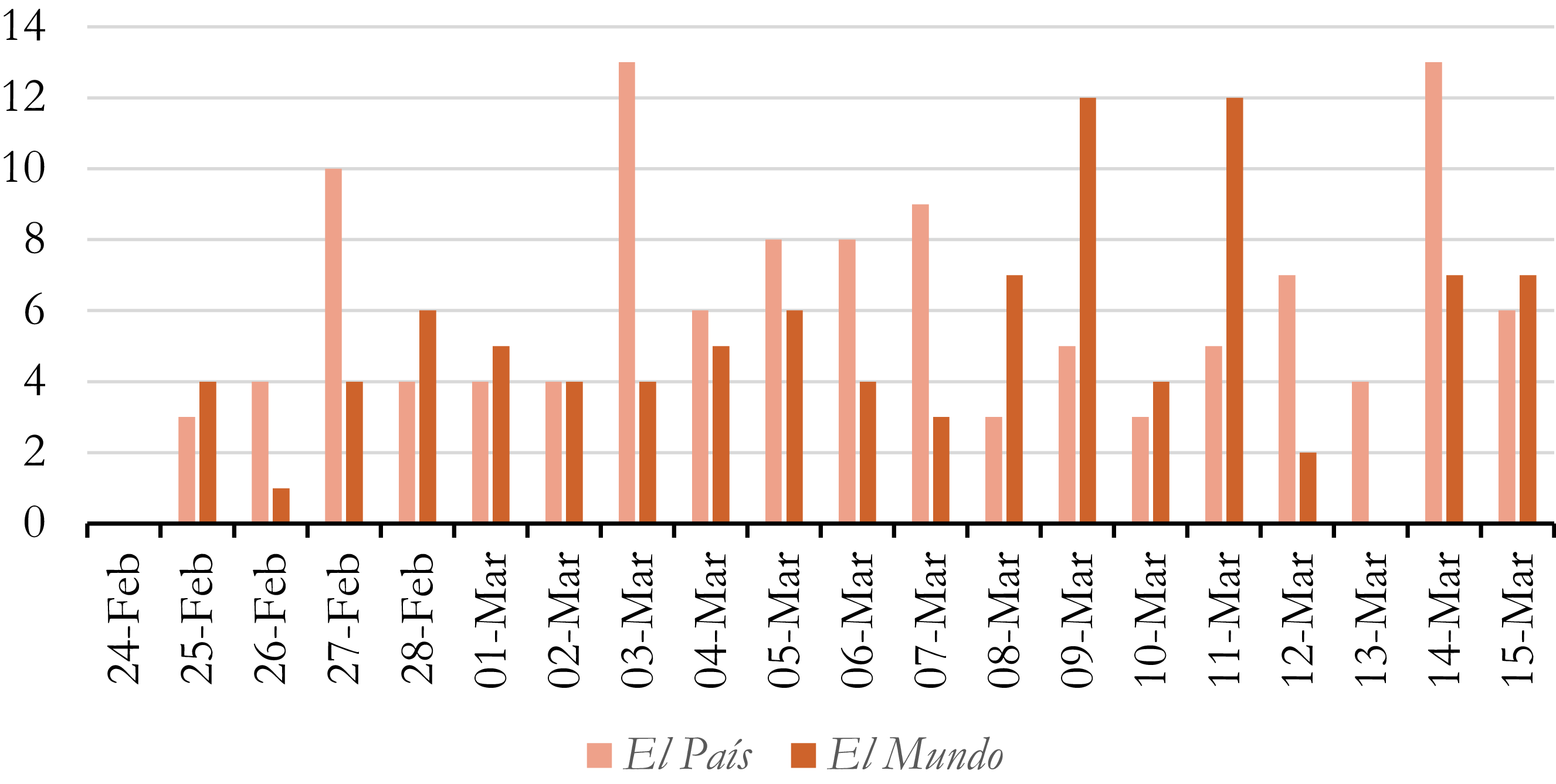
Data collection covers the texts that were published on February 24, 2022, because that was the day when Russia escalated its aggression against Ukraine. Since that day, the EU has been unconditionally supporting Ukraine. We considered a longer temporal coverage. However, the constant exposure to photographs that depict traumatized living beings can cause a numbness—a “Compassion Fatigue”—because readers may become used to them (see Sontag Reference Sontag1977; see also Moeller Reference Moeller and Bleiker2018, 76). Therefore, our data collection spans up to March 15, 2022. In total, the query yielded 216 texts: 97 (44.91%) from El Mundo and 119 (55.09%) from El País (see Figure 1):
News Coverage of the Russo-Ukrainian War’s Refugees by El Mundo and El País (February 24–March 15, 2022).
Source: Elaborated by the Authors

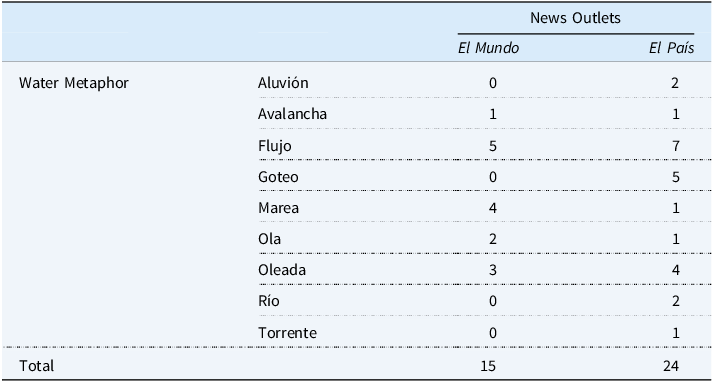
In NVivo, we searched the Spanish words for “deluge” (i.e., Aluvión), “avalanche” (i.e., Avalancha), “cascade” (i.e., Cascada), “stream” (i.e., Corriente), “jet” (i.e., Chorro), “flow” (i.e., Flujo), “trickle” (i.e., Goteo), “tide” (i.e., Marea), “wave” (i.e., Ola), “surge” (i.e., Oleada), “river flood” (i.e., Riada), “river” (i.e., Río), “torrent” (i.e., Torrente) and “tsunami” (i.e., Tsunami)—throughout each text.Footnote 8 To be added, the aforementioned words had to be employed to describe Russo-Ukrainian War’s refugees. For example, we did not code the words “avalanche” (i.e., Avalancha) or “wave” (i.e., Ola) when these were complemented by “[…] of solidarity […]” (i.e., “[…] de solidaridad […]”). Instead, these had to be complemented by “[…] of refugees […] ” (i.e., “[…] de refugiados […]”). Quantitatively, El País employed more Water Metaphors to describe Russo-Ukrainian War’s refugees than El Mundo (see Table 1).
Usage of Water Metaphors by El Mundo and El País (February 24–March 15 2022)

Table 1 Long description
A table with 10 rows and 3 columns comparing the usage of water metaphors by El Mundo and El Pais. The columns are labeled 'Water Metaphor', 'El Mundo', and 'El Pais'. The row labels are Aluvión, Avalancha, Flujo, Goteo, Marea, Ola, Oleada, Rio, and Torrente. The values in the table are as follows: Row 1: Aluvión, El Mundo 0, El Pais 2; Row 2: Avalancha, El Mundo 1, El Pais 1; Row 3: Flujo, El Mundo 5, El Pais 7; Row 4: Goteo, El Mundo 0, El Pais 5; Row 5: Marea, El Mundo 4, El Pais 1; Row 6: Ola, El Mundo 2, El Pais 1; Row 7: Oleada, El Mundo 3, El Pais 4; Row 8: Rio, El Mundo 0, El Pais 2; Row 9: Torrente, El Mundo 0, El Pais 1; Row 10: Total, El Mundo 15, El Pais 24.
Out of the 119 texts of El País, 17 (14.29%) employed Water Metaphors to describe the Russo-Ukrainian War’s refugees. Out of the 97 texts of El Mundo, 13 (13.40%) did so. Due to word count constraints, we do not detail each occurrence where a Water Metaphors has been employed to describe the Russo-Ukrainian War’s refugees.
Furthermore, recognizing photography as “[…] worldmaking, not just world mirroring […]” (Mitchell Reference Mitchell2005, xv), we also adopt a Visual Framing Approach (see Bleiker and Kay Reference Bleiker and Kay2007; Messaris and Abraham Reference Messaris, Abraham, Reese and Grant2001). Publication dates and occurrences of Water Metaphors were used to locate the accompanying photographs within each news story because these could not be collected through LexisNexis. It means that we observed them on the websites of El Mundo and El País. Photographs that depict someone who was not a Russo-Ukrainian War’s refugee were not considered. We qualitatively analyzed elements such as salience, composition, gaze and spatial positioning of the Russo-Ukrainian War’s refugees, who (e.g., Children) they are, how (e.g., Sad) they are and what (i.e., Sitting) they are doing to assess whether the photographs connoted personal or collective feelings and/or behaviors that echoed or disrupted the accompanying Water Metaphor(s). Due to budgetary constraints, we were unable to obtain licenses for all photographs of the Russo-Ukrainian War’s refugees. Guided by our ethical commitment to depicting forcibly displaced people responsibly (Campbell Reference Campbell2004; Chouliaraki Reference Chouliaraki2006), we selected Figures 2, 3, 4, 5 and 6 based on their representativeness of the Sentence-Images that El Mundo and El País constructed about Russo-Ukrainian War’s refugees. We preserved the original captions that accompanied each photograph. We proceed to discuss our results.
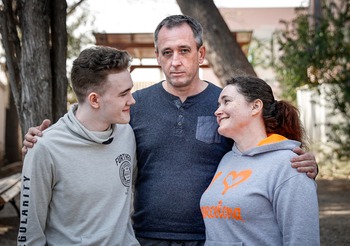
El matrimonio ucranio de Vadim y Olga Volkor, con su hijo Viktor, en el albergue municipal de Rocafort (Valencia). La pareja salió de Odesa, donde vivían, huyendo de la invasión rusa.Footnote 33
Source: Torres (Reference Torres2022).

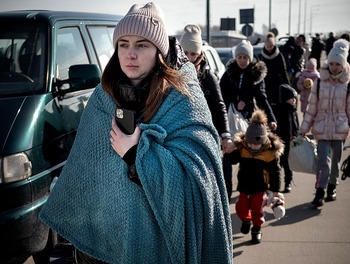
Una mujer atraviesa el paso fronterizo de Krakovets.Footnote 34
Source: Rojas (Reference Rojas2022b).

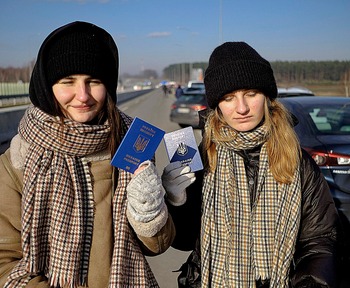
Las hermanas Irina y Alina en su camino a Italia.Footnote 35
Source: Rojas (Reference Rojas2022a).

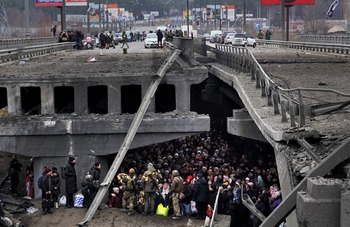
Ucranios intentan pasar por debajo de un puente destruido en Irpin, cerca de Kiev, este sábado.Footnote 36
Source: de Vega (Reference de Vega2022).

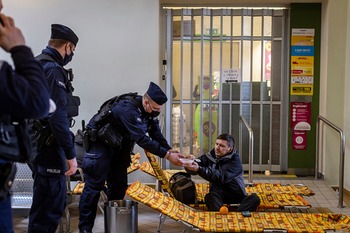
Oficiales de la policía sirven sopa a un ucraniano, en Przemysl (Polonia).Footnote 37
Source: Radwanski (Reference Radwanski2022).

Results
As we coded each Water Metaphor that has been employed to textually describe the Russo-Ukrainian War’s refugees and examined their accompanying photographs, we observed the co-construction of two types of Sentence-Images: First, “Contingent Waters”, who are only moving because Russia’s then-President—Vladimir Vladimirovich Putin—has made them do it. Otherwise, they would not be leaving Ukraine. Second, “Safe Waters” who are moving and voluminous but undangerous because they are mostly orderly, mostly women and children, and are like “Us”. Consequently, we—the “Western European Us”—should and can absorb such “Contingent Safe Waters”. Acknowledging that both Sentence-Images overlap, we proceed to thematically discuss both Contingent Waters and Safe Waters.
Contingent Waters
Under the headline of Europa se prepara para acoger a los refugiados del conflicto en Ucrania Footnote 9 , El País (25/02/2022) reported that “Europa se prepara para la acogida de refugiados ante el previsible flujo migratorio que acarreará el ataque de Rusia a Ucrania” (i.e., “Europe is preparing for the welcoming of refugees in the face of the predictable migratory flow that Russia’s attack on Ukraine will bring about”), then quoted Germany’s then-Minister of the Interior—Nancy Faeser—about their willingness to support “[…] los países afectados masivamente, especialmente a Polonia, si se producen oleadas de refugiados” (i.e., “[…] the massively affected countries, especially Poland, if surges of refugees occur”). An accompanying photograph depicts the “flujo” (i.e., Flow) and “oleada” (i.e., Surge) of the Russo-Ukrainian War’s refugees orderly walking behind each other. The last male adult looks back, generating a sense that there was a hesitancy to leave and a desire to go back.
Under the headline of El chef José Andrés: de un bistró de lujo a cocinero en tiempos de guerra Footnote 10 , El Mundo (02/03/2022) reported that the Spanish-American chef—José Ramón Andrés Puerta—who had volunteered to cook for the Russo-Ukrainian War’s refugees, declared that:
Al caer la noche, José Andrés se permitía una última reflexión antes de volver al confort de su hotel, abrumado por las imágenes que había visto en la frontera: un flujo interminable de civiles que huían de la “tragedia”. “¿No hemos aprendido de los horrores del pasado? […] No podemos permitir que existan más Putin, gente que piensa que tienen el monopolio de la vida”, decía al borde las lágrimas. Footnote 11 (El Mundo 02/03/2022)
The responsibility for the “[…] flujo interminable […]” (i.e., “[…] endless flow […]”) of the Russo-Ukrainian War’s refugees was directly attributed to Russia’s then-President Putin. The “[…] horrores del pasado […]” (i.e., “[…] horrors of the past […]”) very likely alluded to World War II; thus, the unnamed collectiveness who cannot “[…] permitir que existan más Putin, gente que piensa que tienen el monopolio de la vida” (i.e., “[…] allow more Putins to exist, people who think they have a monopoly on life”) would be the “Western” collective self.
Under the headline of Filippo Grandi: “En Ucrania hay un drama colosal, es la peor crisis política desde el 45” Footnote 12 , El Mundo (15/03/2022) likewise mobilized the memory of World War II. When asked what he had seen at the borders of Ukraine with Moldova, Poland and Romania, the then-High Commissioner of the United Nations High Commissioner for Refugees (UNHCR)—Filippo Grandi—answered:
Es difícil incluso describirlo. Es una avalancha de gente. Es una masa de seres humanos traumatizados, sobre todo por la velocidad a la que se han sumido en la desesperación. Te dicen que hace una semana la suya era una vida normal. La mayoría son de las ciudades, gente de clase media que hasta el otro día enviaba a sus hijos a la escuela. Están en shock. En la frontera con Moldavia, los hombres ucranianos acompañaban a sus familias hasta la frontera y luego volvían a luchar. Estas separaciones fueron una de las cosas más dramáticas y terribles que he visto nunca. Los que pasan son mujeres, niños y ancianos, algunos discapacitados. Footnote 13 (El Mundo 15/03/2022)
Following up, El Mundo’s then-columnist—Paolo Valentino—asked whether by “[…] distribución natural […]” (i.e., “[…] natural distribution […]”), Mr. Grandi had meant that the Russo-Ukrainian War’s refugees tend to decide on their destination based on where they know someone. Among other elements, he answered: “Si los rusos siguen bombardeando, sobre todo las ciudades veremos otras oleadas de personas huyendo” (i.e., “If the Russians keep bombing, particularly the cities, we will see other surges of people fleeing”). Almost towards the end, El Mundo’s then-columnist asked which States had “¿[…] más problemas para acoger?” (i.e., “[…] more problems to welcome?”) the Russo-Ukrainian War’s refugees. He mentioned Moldova and added that: “[…] Si Odesa, que tiene un millón de habitantes, fuera atacada, habría una ola en esa dirección […]” (i.e., “If Odessa, which has a million inhabitants, were attacked, there would be a wave in that direction”) (El Mundo 15/03/2022).
Remarkably, this was the text where more Water Metaphors were employed. Yet, Mr. Grandi conditioned an “avalancha” (i.e., Avalanche), an “oleada” (i.e., Surge) and an “ola” (i.e., Wave) of the Russo-Ukrainian War’s refugees to newer attacks by Russia. Subsequently, he complemented such descriptions by revoking the dangerousness that all these phenomena could have evoked. He discursively removed all male components by claiming that the men (i.e., Hombres) were staying back to fight for Ukraine. Consequently, the people who were crossing the borders were “mujeres” (i.e., Women), “niños” (i.e., Children) and the “ancianos” (i.e., Elderly), some of them “discapacitados” (i.e., Disabled). Importantly, by equating “[…] una vida normal […]” (i.e., “[…] a normal life […]”) to being people “[…] de las ciudades […]” (i.e., “[…] from the cities […]”), “[…] clase media […]” (i.e., “[…] middle-class […]”), who “[…] enviaba a sus hijos a la escuela […]” (i.e., “[…] sent their children to school […]”), Mr. Grandi embedded the Russo-Ukrainian War’s refugees within a logic of Western-coded respectability that whitens the “European Oriental Other”, so they can be annexed to the category of “Western European Us”.
The only accompanying photograph depicts Mr. Grandi. Indeed, the photographic absence of the Russo-Ukrainian War’s refugees marked this and many other texts. For example, El Mundo’s then-editor—Leticia Blanco—described the movement of the Russo-Ukrainian War’s refugees as an “oleada” (i.e., Surge) (El Mundo 11/03/2022a). In both cases, El Mundo and El País did not allow the Russo-Ukrainian War’s refugees to be seen, thus creating a “System of Invisibility”.
When photographs did accompany the Water Metaphor “oleada” (i.e., Surge), El Mundo and El País used photographs that highlighted order, despite precarity. For example, when El País (26/02/2022) reported that “[…] los países de la UE creen que se puede producir una gran oleada de refugiados” (i.e., “[…] EU Member-States believe that a large surge of refugees could occur”), the accompanying photograph depicts at least three couples and at least two women and their children lying down on the ground. When El Mundo (11/03/2022b) reported that “España, al igual que el resto de Europa, se prepara para adoptar medidas para afrontar la oleada de refugiados a las que nos enfrentamos tras la invasión rusa” (i.e., “Spain, like the rest of Europe, is preparing to adopt measures to deal with the surge of refugees we are facing following the Russian invasion”), the accompanying photograph depicted Russo-Ukrainian War’s refugees lining up within a barricade. At the center, a woman holds a girl. Although they wear hats, we can clearly see their physiognomy, unlike the others behind them.
Under the headline of ,Ucranios y rusos conviven en un centro de refugiados valenciano: “El problema es Putin” Footnote 14 , El País (07/03/2022a) directly attributed the cause of “goteo” (i.e., Trickle) of the Russo-Ukrainian War’s refugees to Russia’s then-President Putin.
El timbre del albergue municipal de acogida de refugiados de Rocafort, en Valencia, no para de sonar desde que Rusia invadió Ucrania. Los vecinos traen bolsas con ropa de segunda mano, mantas e incluso juegos de mesa en solidaridad con el goteo de familias ucranias que llegan día tras día al recinto huyendo de la barbarie. Footnote 15 (El País 07/03/2022a)
In an accompanying photograph, an adult male (i.e., Father/Husband), an adult female (i.e., Mother/Wife) and a teenage male (i.e., Son) hold each other. The father demonstrates not only concern but also bravery by directly looking at the camera. Meanwhile, mother and son smile and look at each other. What could be considered a detail compellingly revokes their dangerousness: The mother wears a hoodie where it can be read “I [Love] Barcelona” (see Figure 2):
Fearing being the next to be aggressed by Russia, Poland was reportedly united to welcome the Russo-Ukrainian War’s refugees. El País (10/03/2022) reported that:
En un país tan políticamente dividido como Polonia, la guerra en Ucrania ha dado una tregua. El miedo a ser la siguiente pieza de Putin (pese a la cláusula de defensa mutua de la OTAN) y el aluvión de refugiados (es el país que más ha recibido: 1,7 millones de los 2,8 millones) han dejado las divergencias en segundo plano.Footnote 16 (El País 10/03/2022)
Few Water Metaphors can mean danger on the scale of “aluvión” (i.e., Deluge). Furthermore, especially considering that Spain has been historically shaped by Christianity, it could be reasonable to suggest that such a Water Metaphor may evoke other emotions besides fear. In the Christian mythology, God drowned all living beings—except Noah and the ones who embarked on his Ark—because he had regretted his own doing. Therefore, “aluvión” (i.e., Deluge) could be understood not only as destructive but also as a punishment through the word of God.
Yet, an accompanying photograph depicts the Russo-Ukrainian War’s refugees sitting, standing and moving around. A woman wearing a yellow vest and a face mask distributes food to a seated elderly man. Other people, mostly women and children, wear warm clothes, which suggests a low temperature. In the background, the setting resembles a temporary shelter, with banners, boxes and supplies that can be seen. The environment appears to be as busy as quiet and reassuring rather than exhibiting turmoil. Consequently, this could equally be discussed under the Sentence-Image of “Safe Waters”. However, because the text emphasized the risk that was believed to be posed by Russia’s then-President Putin to Poland, we have decided to discuss it under the category of “Contingent Waters”.
Safe Waters
Similarly, El Mundo (03/03/2022) and El País (06/03/2022a) reported a “[…] marea humana […]” (i.e., “[…] human tide […]”) of Russo-Ukrainian War’s refugees. Under the headline of Europa recibe a los hijos y las mujeres de Ucrania Footnote 17 , El Mundo (27/02/2022) photographically portrayed the “mareas” (i.e., Tides) of the Russo-Ukrainian War’s “hijos” (i.e., Children) and “mujeres” (i.e., Women) refugees. In an accompanying photograph, only women and children are recognizable (see Figure 3):
Another accompanying photograph depicts two sisters—Irina and Alina— (see Figure 4). Interestingly, however, El Mundo’s then-correspondent—Alberto Rojas—preceded it with a dialogue between them:
ALBERTO ROJAS: ¿Dónde pensáis ir ahora? Footnote 18
IRINA & ALINA: A Italia. Nuestra abuela vive allí. Footnote 19
ALBERTO ROJAS: ¿Os puedo hacer una foto? Footnote 20
IRINA & ALINA: Claro. ¿Quieres que sonriamos o que nos mostremos tristes? Footnote 21
ALBERTO ROJAS: Depende de vosotras. ¿Cómo os sentís ahora? Footnote 22
IRINA & ALINA: Cansadas. Footnote 23
Such dialogue between the photographer and the photographed blatantly challenges the passiveness of the Russo-Ukrainian War’s refugees. Ms. Irina and Ms. Alina not only declared that they have an EU-based “abuela” (i.e., Grandmother)—thereby positioning themselves closer to the “Western European Us”—but also demonstrated an acute awareness that their portrayal matters. They not only agreed to be photographed but also asked which emotions he wished to capture. Having apparently decided to convey that they were “cansadas” (i.e., Tired) by closing their eyes, they hold up their passports, documents that embed them with a legality that the “West” routinely questions when those seeking refuge are deemed “less-than-Off-White”.
“Flujo” (i.e., Flow) also appeared under the category of “Safe Waters”. Under the headline of Madrid ya recibe a los primeros refugiados ucranianos en su centro de Vallecas Footnote 24 , El Mundo reported that the Delegate for Families, Equality and Social Welfare—Pepe Aniorte—declared that:
“Se espera que se puedan ir multiplicando estas llegadas y estaremos preparados, pero el Ministerio tiene que asumir sus funciones y cumplir con su parte para que exista el flujo de que puedan ir derivando a otras ciudades”, afirmó el delegado de Familias, Igualdad y Bienestar Social, Pepe Aniorte, que apuntó que el perfil de los refugiados que han llegado es principalmente el de mujeres con hijos pequeños o aquellos que tienen familiares en España. Footnote 25 (El Mundo 02/03/2022a)
Mr. Aniorte did not comment about the Russo-Ukrainian War’s refugees as mere Ukrainians but as “[…] mujeres con hijos pequeños […]” (i.e., “[…] women with young children […]”) and “[…] aquellos que tienen familiares en España” (i.e., “[…] those who have relatives in Spain”). Family ties widen them by approximating the “Oriental European Other” to the “Western European Us”. In summary, a “flujo” (i.e., Flow) of Russo-Ukrainian War’s refugees that does not disturb the homogeneity of Spain.
Only El País reported a “río” (i.e., River) of Russo-Ukrainian War’s refugees (El País 07/03/2022b).
En los aledaños de la estación, bajo las tres imponentes cúpulas y la bandera de Ucrania, fluye un río en movimiento constante compuesto por personas, abrigos de colores y maletas. Footnote 26 (El País 07/03/2022b)
Although describing the Russo-Ukrainian War’s refugees as a “río” (i.e., River) that does move, they were humanized. But more than that, they bring colors through their “abrigos” (i.e., Coats) and “maletas” (i.e., Suitcases). An accompanying photograph depicts children, women and pets wearing warm clothes, walking, and taking the bus.
Holy Waters
Subjacent to the Sentence-Image of “Safe Waters”, the Russo-Ukrainian War’s refugees were also portrayed as undangerous to the alleged homogeneity of Spain because their culture (i.e., Religion) makes them “Holy Waters”.
Under the headline of Un millón de refugiados de guerra: el gran éxodo de los peluches Footnote 27 , El Mundo (03/03/2022) photographically portrayed “[…] la marea humana que no cesa llega ya a los 875.000 según datos de ayer proporcionados por ACNUR” (i.e., “[…] the human tide that does not cease has already reached 875,000, according to data from yesterday provided by UNHCR”) with one girl who has a stuffed animal around her neck smiling at the camera, thus revoking any volume and dangerousness that such “marea” (i.e., Tide) of Russo-Ukrainian War’s refugees could have evoked to Spain.
What has brought this occurrence to the Sentence-Image of “Holy Waters” was its headline. We understand that metaphors that have been historically consolidated among the myths of Christianity may have a deep penetration across a largely Christian society like Spain. Therefore, “éxodo” (i.e., Exodus) and its accompanying photograph have the power to subtly tell readers that those “Oriental European Others” should be welcomed because—like Israelites were by a Pharaoh according to the Christian mythology—they are being persecuted by a “more Oriental”, “less European”, thus more “Other” and “less-than-Off-White” tyrant: Russia’s then-President Putin.
Under the headline of Huida desesperada de miles de civiles a las puertas de Kiev ante el avance del Ejército ruso Footnote 28 , El País (05/03/2022) reported a “torrente” (i.e., Torrent) of Russo-Ukrainian War’s refugees that was also described as an “éxodo” (i.e., Exodus).
El padre Tadeus imparte la bendición a dos feligreses a los que ha sacado en su coche de Irpin tras varios días de asedio de las tropas rusas. La despedida es rápida en la carretera que lleva a Kiev. Esta vía se ha convertido en un torrente por el que escapan miles de personas. Vestido con sotana y estola, este sacerdote católico de 62 años se da media vuelta y regresa decidido en sentido contrario del que toma el éxodo que huye de la guerra y que está vaciando el casco urbano. El cura asegura que no tiene intención de dejar su iglesia. Footnote 29 (El País 05/03/2022)
Going beyond describing the movement of the Russo-Ukrainian War’s refugees as an “éxodo” (i.e., Exodus), this occurrence also reported that a Catholic priest called Tadeus blessed those who were leaving the city of Irpin, Ukraine. An accompanying photograph depicts him blessing an elderly woman. However, that was not the only accompanying photograph (see Figure 5):
In another accompanying photograph, the countless and unrecognizable Russo-Ukrainian War’s refugees precede dissensus. The dangerousness that a “torrente” (i.e., Torrent) of Russo-Ukrainian War’s refugees could have evoked evaporates by observing their surroundings. Although the destroyed highway demonstrates how damaging the war has been to Ukraine, the Russo-Ukrainian War’s refugees walk beneath it like a river emerging beneath a headwater: Life despite destruction. Soldiers at the edge do not seem to be there to control them, but to help them, as a second photograph depicts them extending their hands to a woman. This photograph could have been the one that French BFM TV’s Philippe Corbé may have seen when claiming that the cars that were being used by Russo-Ukrainian War’s refugees to leave Ukraine “[…] look like ours […]”: On the destroyed highway, at least two Western cars are recognizable—one German and one French. Taken together, these elements narrate a story about the need to support resilient Russo-Ukrainian War’s refugees who consume like “Us” (see Figure 5).
Ukrainians ≠ Syrians
Collaterally, we observed that El Mundo and El País constantly alluded to Syria to draw parallels between how Russia—epitomized through its then-President Putin—has been operating against Ukraine. With one rare exception, however, their allusions did not reproduce the same Orientalist discourses of U.K. ITV News’ Lucy Watson, U.S. CBS News’ Charlie D’Agata and French BFM TV’s Philippe Corbé. El Mundo (28/02/2022) reported that:
Muchos enemigos de Putin en el Cáucaso han prometido mandar soldados. Habrá que ver si se unen también los buscavidas, mercenarios y soldados de fortuna que suelen aparecer en este tipo de conflictos rebotados de lugares como Siria o Irak.Footnote 30 (El Mundo 28/02/2022)
An Orientalist discourse was echoed when El Mundo’s then-correspondent—Alberto Rojas—suggested that “[…] buscavidas, mercenarios y soldados de fortuna […]” (i.e., “[…] hustlers, mercenaries and soldiers of fortune […]”) tend to come “[…] de lugares como Siria o Irak” (i.e., “[…] from places like Syria or Iraq”) (El Mundo 28/02/2022).
Similarly, El Mundo and El País textually described the movement of Russo-Ukrainian War’s refugees as an “ola” (i.e., Wave) (El Mundo 28/02/2022; El País 06/03/2022b) and an “oleada” (i.e., Surge) (El Mundo 11/03/2022b; El País 25/02/2022). For example, El Mundo (28/02/2022) reported that: “Es la segunda gran ola de refugiados con destino a la UE que provocan los aviones de Putin desde sus bombardeos indiscriminados sobre ciudades sirias en 2015 y 2016” (i.e., “This is the second major wave of refugees heading to the European Union that the airplanes of Putin have provoked since his indiscriminate bombings of Syrian cities in 2015 and 2016”). Initially, one may claim that they were equally portrayed as the Syrian Civil War’s refugees were. After all, the “[…] second major wave […]” thus also are “dangerous waters”. In an accompanying photograph, however, a dissensus emerges:
An accompanying photograph depicts a standing Polish male Police Officer handing soup to a seated Ukrainian adult male Russo-Ukrainian War’s refugee. In a room, sitting down and surrounded by two other male Polish Police Officers, that Russo-Ukrainian war’s refugee was anything but wildly dangerous (see Figure 6).
Afterwards, El Mundo also alluded to Syria to highlight the discrepancy between how the EU and its Member-States—especially Hungary and Poland—and the Spanish Far-Right party VOX were reacting to the Russo-Ukrainian War’s refugees, and how they had reacted to the Syrian Civil War’s refugees between 2015 and 2016.
Vox está dispuesto a apoyar “cualquier medida” destinada a defender “la soberanía y la integridad territorial” de Ucrania ante la invasión rusa, incluido el envío de armas, según explicó ayer su portavoz, Jorge Buxadé. Mostró su respaldo a la a política de asilo de la UE y su decisión de abrir las fronteras a los ucranianos que huyen de la guerra. Tras remarcar que Hungría y Polonia decidieron hacerlo “sin que nadie se lo pidiese”, destacó que Vox apoya la acogida de estos refugiados. “Son europeos en su forma de vida, su cultura y su fe” y su intención es poder regresar a su país en cuanto sea posible, explicó.Footnote 31 (El Mundo 01/03/2022)
Considering the Far-Right zeitgeist, we understand that VOX’s odd solidarity towards the Russo-Ukrainian War’s refugees has the same roots as that of the Swedish Far-Right: Whiteness (see Palmgren, Åkerlund and Viklund Reference Palmgren, Åkerlund and Viklund2023). In a post-racial racist society, VOX does not need to explicitly say that the Russo-Ukrainian War’s refugees should be welcomed because they are white, or at least enough to be absorbed by Spain. Instead, VOX claims that Russo-Ukrainian War’s refugees can be welcomed because those “Oriental European Others” share the same culture with “Western European Us”. El País (03/03/2022) sought to explicate such a dynamic by reporting that:
Desde que comenzó la invasión por parte de Rusia, hace solo ocho días, cerca de un millón de ciudadanos, la mayoría mujeres y niños, ha cruzado la frontera de alguno de los países vecinos. Están llegando a Polonia, sobre todo, pero también a Hungría, Eslovaquia o Rumania. El éxodo es muy parecido al que provocó la guerra de Siria pero esta vez, afortunadamente, los desplazados no han tenido que vagar por los bosques, ateridos de frío, para acabar ante una alambrada de espino […]. En este cambio de actitud puede haber influido la mayor cercanía cultural de quienes piden asilo y el hecho de ser vistos por la población como víctimas de una amenaza común, en contraste con la xenofobia y el racismo que en ocasiones se percibió en la crisis anterior hacia los desplazados de Siria o Afganistán.Footnote 32 (El País 03/03/2022)
One slightly unrelated occurrence stood out during our textual analysis. In the early days of the Russo-Ukrainian War, El País’ then-correspondent—Cristian Segura—reported that two Russo-Ukrainian War’s refugees, Leyla Prosvietova and Tomasz Jachnicki, “[…] querían subrayar, en voz baja, que no estaban de acuerdo con que hubiera jóvenes africanos en los trenes que salían de Ucrania” (i.e., “[…] wanted to emphasize, in a low voice, that they did not agree with young Africans being on the trains leaving Ukraine”). For Ms. Prosvietova, they “[q]uitan sitios a mujeres y niños ucranios” (i.e., “[…] take places away from Ukrainian women and children”). Interestingly, El País’ then-correspondent proceeds by citing that a woman like “[…] la marfilense Samira, que estudiaba Ciencias Empresariales en Kiev […]” (i.e., “[…] Samira from Ivory Coast, who was studying Business Sciences in Kyiv […]”). She was among the young Africans who were trying to leave Ukraine (El País 28/02/2022).
In a world where Black people need to negotiate their humanity, El País’ then-correspondent seems to have added that Samira was pursuing a degree to strategically attempt to legitimate that she deserved to leave a warzone as much as Ms. Prosvietova and Mr. Jachnicki: In other words, Samira was portrayed as being civilized despite being Black. Should the holder of a Ph.D. be able to take a train to leave a warzone before those who have an M.A.? Should the latter be able to leave before those who have a B.A.? How many degrees should one hold to have a chance to escape death?
Conclusion
Having the Russo-Ukrainian War as the background, we addressed one overall question: How have Spanish news outlets textually and photographically portrayed the Russo-Ukrainian War’s refugees? Since Said (Reference Said1978)’s concept of Orientalism would not be enough to grasp the positionality of Ukraine, we also grappled with the concept of Off-Whiteness (Baker et al. Reference Baker, Iacob, Imre and Mark2024) to understand and explicate the Sentence-Image of the Russo-Ukrainian War’s refugees on the pages of the two leading Spanish news outlets—El Mundo and El País—between February 24 and March 15, 2022.
We observed that even though Water Metaphors may textually read the same, by taking an Aesthetic approach to analyze their accompanying photographs, we conclude that (1) The Russo-Ukrainian War’s refugees were “waters” that were only moving because of Russia’s then-President Putin. Otherwise, they would not be moving. This corroborates their construction as “Contingent Refugees” in the German press (see Sambaraju and Shrikant Reference Sambaraju and Shrikant2023). (2) The Russo-Ukrainian War’s refugees were “waters”, but undangerous. Families, especially women and children, were constant characters. Similarly to nineteenth-century photography of the Middle East, by showcasing orderly Russo-Ukrainian War’s refugees (e.g., Lining Up), both El Mundo and El País echoed “[…] a system of representation that creates an essentialized difference between the ‘Orient’ and the ‘West’” (Woodward Reference Woodward2003, 363). Furthermore, Christianity-rooted terms (e.g., Exodus) and characters (e.g., Priests) brought the Russo-Ukrainian War’s refugees closer to “Western European Us” (see Palmgren, Åkerlund and Viklund Reference Palmgren, Åkerlund and Viklund2023). This corroborates their construction as “Vulnerable Victims”, “Innocent Victims” and “Persistent/Resilient Ukrainians” by the Finnish press (see Martikainen and Sakki Reference Martikainen and Sakki2024).
Conclusively, the portrayals of the Russo-Ukrainian War’s refugees showcase the Sentence-Image at work: Despite the textual employment of Water Metaphors, broader textual and photographic analyses demonstrated that El Mundo and El País rendered the Russo-Ukrainian War’s refugees as “Contingent Safe Waters”: Refugees whose movement should be understood and whose presence could be welcomed.
Future research could surely analyze whether El Mundo’s and El País’ portrayals of the Russo-Ukrainian War’s refugees differ from or resemble the manner in which they have been portrayed by other non-English-speaking news outlets across the EU. Such research, however, may merely mirror the conclusion that the Russo-Ukrainian War’s refugees have been positively, or at least neutrally, portrayed. On the other hand, little scholarly spotlight has been shed on the experience of the Russo-Ukrainian War’s Black refugees across the EU.
Acknowledgments
We thank the Guest Editors—Dr. Amal Abu-Bakare, Professor Anna Agathangelou and Professor Christian Kaunert—for welcoming our contribution to this Special Issue; the then-Editor-in-Chief—Benjamin Gonzalez O’Brien—for managing our submission so smoothly; and the anonymous reviewers for their thoughtful engagement with our research.
Funding statement
Licensing costs paid to Unidad Editorial Información General, S.L.U. (i.e., El Mundo), Ediciones El País, S.L.U. (i.e., El País) and Getty Images were covered by the University of the West of England (Bristol, England/U.K.)’s School of Social Sciences and its Social and Public Policy Research Group (SPPRG).
João Raphael da Silva works as a Lecturer in Criminology at the University of the West of England (Bristol, England/U.K.). While he was pursuing a Ph.D. in Social Work and Social Policy at Ulster University (Belfast, Northern Ireland/U.K.), he was a Visiting Ph.D. Researcher at the Centre of Discourse Studies (Barcelona, Spain) during the summer of 2022. His research largely concentrates on the Radical Environmentalist and Animal Rights movement and how deviance and/or criminality are discursively constructed. His work has been published in Studies in Conflict & Terrorism, Critical Studies on Terrorism, Behavioral Science of Terrorism and Political Aggression and Crime, Media, Culture.
Marcelle Trote Martins is a Lecturer in Critical Global Politics at the University of Manchester. She has a Ph.D. in Politics from the University of Manchester. Her work focuses on the visual politics of memory and trauma and the mobilization of wounded/suffering bodies in (post)conflict societies. Her publications include articles in International Political Sociology, Journal for Cultural Research and Brazilian Political Science Review. Her book ‘Affective Imageries: Visual Politics of Wounded Bodies in Timor-Leste’ is published by Lexington/Rowman & Littlefield.

 Open access

