


Electroconvulsive therapy (ECT) is a generally well-tolerated and effective treatment for mood disorders.Reference Carney, Cowen, Geddes, Goodwin, Rogers and Dearness1 Most neurological adverse effects of ECT concern amnesia, headache, disorientation and transient post-ictal neurological deficits. The substantial fluctuations in cardiovascular parameters and alteration in brain perfusion during ECT administration could theoretically elicit a stroke.Reference Nagler2 However, true cerebrovascular complications directly following ECT are an extremely rare complication according to series of case reports.Reference Lee3, Reference Bruce, Henry and Greer4 However, long-term effects of repeated administration of ECT on stroke risks have not been investigated. We examined the association between ECT and long-term risk of incident stroke (including both cerebrovascular accidents and transient ischaemic attacks (TIA)) in patients with a first-time hospital diagnosis of affective disorder. Since ECT may be used in patients with antidepressant resistance with post-stroke depression,Reference Rabheru5 we also explored the frequency of ECT and associated risk of recurrence in patients with a history of stroke.
Method
Study population
All citizens in Denmark with a first-time hospital contact for an affective disorder from 1 January 2005 to 31 December 2015 were included in this cohort study. In total, 174 534 in- or out-patients above 10 years were identified by record linkage with the Danish National Patient Registry (DNPR)Reference Schmidt, Schmidt, Sandegaard, Ehrenstein, Pedersen and Sorensen6 using ICD-8 or ICD-10 (432–434, 436 and F30.0–F39.9).7, 8 Of them 11 939 had been diagnosed with stroke before or at study entry according to the DNPR, which was screened for all admissions because of intracerebral haemorrhagic stroke (431; I61), ischaemic stroke (432; 433; 434; I63), unspecified stroke (I64) and TIA (436; G45) occurring between January 1979 and December 2015. In the present study, ischaemic strokes and unspecified strokes were analysed together because Krarup et al Reference Krarup, Boysen, Janjua, Prescott and Truelsen9 have shown that most unspecified stroke diagnosis in the DNPR actually are ischaemic strokes. The study was approved by the Danish Data Protection Agency.
Electroconvulsive therapy (exposure)
From the DNPR we retrieved information on all ECTs registered for patients and treatment was defined at the time of first ECT registration. The relevant codes and classifications have been described previously.Reference Schmidt, Schmidt, Sandegaard, Ehrenstein, Pedersen and Sorensen6, Reference Hundrup, Osler and Jørgensen10 The number of ECT sessions was counted from study entry until censoring, and dichotomised (≤10 or >10 sessions) based on the median number of ECT sessions necessary for remission.Reference Hundrup, Osler and Jørgensen10
Subsequent stroke (outcomes)
All patients were followed for admissions with stroke as main diagnosis (ICD-10: I61; I63; I64 and G45) from date of inclusion until end of October 2016. For patients with a previous stroke a re-event was defined as a new admission within at least 28 days after the last event as recommended in a previous Danish study.Reference Thorvaldsen, Asplund, Kuulasmaa, Rajakangas and Schroll11 However, since many re-events occur during the first month,Reference Arsava, Kim, Oliveira-Filho, Gungor, Noh and Lordelo Mde12 we repeated the analyses using a less conservative definition by counting all readmissions as a result of stroke occurring after 7 days.
Covariates
The following covariates were included based on a literature review on factors associated with selection of patients for ECT and risk of stroke: gender, age, level of education, comorbid alcohol misuse, hypertension, coronary heart disease, obesity and diabetes. (see supplementary material for details; available at https://doi.org/10.1192/bjp.2018.150)
Statistical analysis
Differences in the distribution of ECT and cerebrovascular events in relation to covariates were examined using the simple chi-square test. The associations of first ECT with recurrent or incident strokes were analysed using Cox proportional hazard regression (hazard ratio (HR) and 95% CIs) with age as underlying timescale. The analyses of recurrence were based on the 11 939 patients with at least one previous stroke before inclusion as a result of an affective disorder diagnosis, whereas the analyses of incidence were based on the remaining 162 595 patients. To preclude potential immortal-time bias, ECT was entered as a time-dependent variable by splitting the data-set according to time of first ECT. Patients were followed from age at study entry (date of first registered affective disorder) until the age of first registration of stroke, emigration, death or end of follow-up (November 2016), whichever came first.
We also performed a propensity-score calibration matching with a one-to-one match on the nearest neighbour. The propensity score was estimated as the relative hazard of the exposure (ECT) conditional on the baseline covariates in a Cox regression. Competing mortality risks were accounted for by using the Fine–Gray competing risks regression by means of the stcrreg command in Stata, which specifies a model for the cumulative incidence and generates subdistribution hazard ratios (SHRs). Since, this approach is not appropriate when the exposure is time varying, it was only used in the propensity-score matched sample, where patients were entered at time of ECT. To account for acute mortality we also repeated the analyses with a lag period of 1 and 2 years after study entry. The proportional hazard assumption was examined graphically and showed no signs of violation. We performed various additional analyses. First, we excluded TIA diagnoses and restricted the analyses to in-patient diagnoses. Second, we restricted the analyses to 30 and 180 days post-ECT to assess the short-term risk of stroke after ECT (For results see supplementary material). The analyses were performed in Stata_14.
Results
ECT and incident stroke
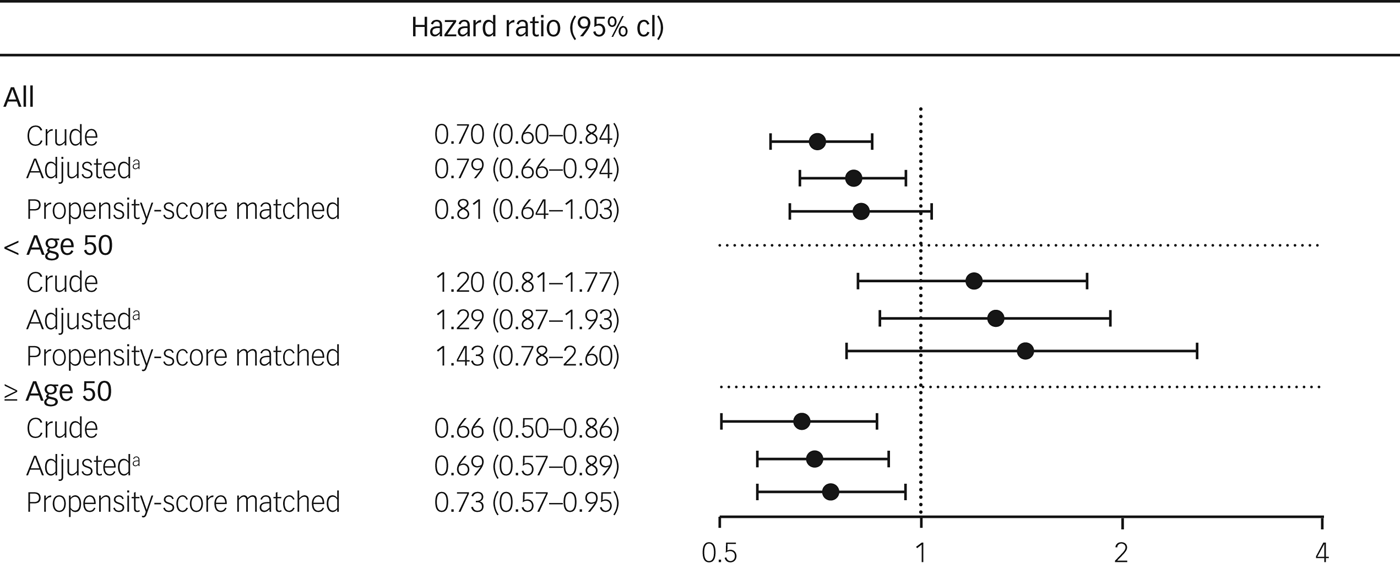
In the 162 595 patients with no history of previous stroke, 5781 (3.6%) were treated with ECT (supplementary Table 1). The mean follow-up was 5.1 years (range 0.1–12.0) during which 3665 patients had a first-time stroke diagnosis registered in the DNPR (incidence rate (IR) 42.8/10 000 person-years, 95% CI 41.5–44.3). In all patients the age-standardised incidence of stroke was slightly lower among patients treated with ECT (n = 165, IR = 38.8/10 000 person-years) than those not treated with ECT (n = 3500, 42.7/10 000 person-years). This difference varied in relation to age. Figure 1 gives the crude and adjusted hazard ratios (HR) for patients ≤50 or ≥50. In the younger patients, ECT was not associated with stroke (HR = 1.20, 95% CI 0.81–1.77), whereas in the older patients ECT was associated with a lower risk of stroke before and after adjustments (HR = 0.66, 95% CI 0.50–0.86). However, the SHR suggested that the estimates for elderly people might be influenced by the presence of competing mortality risk (SHR = 0.86, 95% CI 0.67–1.10).
Associations (hazard ratios and 95% CI) between electroconvulsive therapy and stroke in relation to age at study entry in a cohort of 162 595 patients diagnosed with affective disorders from 2005 to 2015 in Denmark.
a. Adjusted for gender, educational level, subdiagnosis, comorbid hypertension, coronary heart disease, diabetes, obesity and alcohol misuse.
Among the patients treated with ECT, 2755 (47.7%) had more than ten sessions and this was not associated with risk of incident stroke neither before (HR = 0.86, 95% CI 0.61–1.20) or after (HR = 0.86, 95% CI 0.61–1.20) adjustments. The HRs did not change materially when follow-up was started 1 or 2 years after study entry. Neither did the results change when TIA and out-patients diagnoses were excluded (data not shown).
ECT and recurrence
Of the patients with a previous stroke, 228 (1.9%) were treated with ECT (supplementary Table 1). ECT was most common among those with a previous TIA or who had only one previous stroke. During follow-up, 2330 (19.5%) patients had a recurrent stroke following the definition of 28 days or more from latest event after inclusion, yielding a rate of 62.9 (95% CI 60.4–65.5) events per 1000 person-years with the highest rate in patients >70 years (supplementary Table 1) and among those with <1 year since last stroke.
Of the 2330 patients who had a new event, 26 occurred among patients treated with ECT. In patients treated with ECT the risk of recurrence was lower than in non-ECT patients (HR = 0.61, 95% CI 0.41–0.91), but the association was attenuated after adjustment for covariates (HR = 0.69, 95% CI 0.46–1.00; P = 0.05). Among those treated with ECT 44.3% had >10 sessions and this was not associated with risk of recurrent stroke. The results were similar when readmissions occurring after 7 days were included.
Discussion
This register-based cohort study of patients with affective disorders showed that ECT was not associated with stroke incidence or stroke recurrence. A presumed reduced risk of incident stroke in older patients treated with ECT might be explained by competing mortality risk.
Our findings align with previous studies, predominantly case reports showing that stroke is an exceptionally rare complication of ECT.Reference Lee3, Reference Bruce, Henry and Greer4 In the present study we extended these findings by showing that ECT was also not associated with an elevated risk during long-term follow-up. This is remarkable since ECT is often used in elderly people with treatment-refractory depression where vascular pathology is commonly involved in the pathogenesis.Reference Aizenstein, Baskys, Boldrini, Butters, Diniz and Jaiswal13 Perhaps the vascular pathology in vascular depression is not in itself a risk factor for stroke.
Arguably, selection bias may have influenced our findings. Plausibly the health status of the patient has played a role in the decision to administer ECT.Reference Kerner and Prudic14 However, we aimed to reduce this risk of bias by conducting a propensity-score calibration matching. A second limitation of our study could be the variation in the quality of stroke diagnosis. Although three validation studies have shown high predictive values (<80%) for overall and ischaemic stroke in the DNPRReference Krarup, Boysen, Janjua, Prescott and Truelsen9, Reference Luhdorf, Overvad, Schmidt, Johnsen and Bach15, Reference Johnsen, Overvad, Sorensen, Tjonneland and Husted16 stroke as a secondary diagnosis among out-patient clinics seem to have low predictive values.Reference Luhdorf, Overvad, Schmidt, Johnsen and Bach15 Consequently, we only used stroke as the main diagnosis as our outcome.
The strengths of this study are the large sample size, use of nationwide population-based registers in a country with free access to healthcare and a nearly complete coverage of hospital contacts. The registration of ECT is mandatory and has high completeness.Reference Hundrup, Osler and Jørgensen10
In conclusion, our findings suggest that ECT as currently practised does not increase the risk of incident or recurrent stroke. Our study provides evidence to inform patients about the long-term risks of having ECT.
Funding
The work was supported by the Danish Council for Independent Research, grant-ID: DFF–6110–0195.
Supplementary material
Supplementary material is available online at http://dx.doi.org/10.1192/bjp.2018.150.




eLetters
No eLetters have been published for this article.