




During the third century CE, the Sasanian Dynasty managed to conquer the central territories of the Kushan empire located in the north of the Hindu Kush. This conquest had a significant impact on the longer-term history and cultural evolution of the ancient Iranian world.Footnote 1 Despite being incorporated into the Sasanian empire, the former Kushan Bactria-Tukhāristān, now known as Kušānšahr—the Kingdom of the Kushans, managed to maintain its language and distinct culture. Kušānšahr was the only province in the Sasanian realm to mint its own coinage. It was able to do so due to its independent imperial tradition. The unification of the western and some eastern regions of the Iranian world under a single rule resulted in a cultural amalgamation, which was particularly noteworthy in the domain of religious and ritual practices.
It appears that the ‘Kushan pantheon’ that the Sasanians encountered after the conquest can be deemed essentially a Bactrian pantheon, which the Yuezhi—the political ancestors of the Kushans—adopted after their settlement in Bactria.Footnote 2 It seems that Zoroastrian religious beliefs and rituals, which included the veneration of the sacred fire, were introduced by the Achaemenids and persisted in Bactria until the emergence of the Kushan empire in the first century CE. However, they did not supplant the native Bactrian cults and local deities (such as Oxus/Oaxšo), which were still prevalent when the Yuezhi migrated to their new homeland in the second century BCE, nor did they lose significance following the introduction of the Greek religion in the Hellenistic period. During their imperial phase in the second century CE, the Kushans extended their support to all the religious traditions present in their diverse and far-reaching empire. To some extent, they assimilated them into their new, imperial pantheon. While Zoroastrian elements were integrated in a manner similar to the way Buddhism was incorporated,Footnote 3 the former’s prominence in Bactria resulted in its stronger presence within the Kushan pantheon compared to the latter. The architecture of Kushan temples in Bactria (as known from Surkh Kotal) is a continuation of Seleucid temple architecture of the Hellenistic period, and the worship conducted therein was Bactrian cults that were shaped, at least in part, during the Hellenistic period and under strong Greek influence. However, as the Kushans expanded their empire and came to reign over vast territories with diverse religious populations, their rulers were glad to acknowledge and incorporate the worship of local, and especially Indian, gods. Such a practical and inclusive approach towards religious practices is one of the characteristic features of the post-nomadic polities of Eurasia.Footnote 4 Nevertheless, it is beyond doubt that the primary facet of the Kushan religion remained the Bactrian one.
The main cultic practices of the Kushans can be traced back to the Greco-Bactrian era and were centred on the veneration of anthropomorphic statues of deities. This eastern Iranian tradition reached its peak during the Kushan reign and was later encountered by the Sasanians following their conquest of Bactria-Tukhāristān in the third century. In contrast, the Sasanian cult was a direct descendant of the one maintained by the rulers of Pars since the Achaemenian period and was characterised by its aniconic nature and focus on the worship of a continuously burning sacred fire. This distinction in religious practices between the eastern and western Iranian world had its roots in the Hellenistic period, when Bactria, in contrast to Pars, was profoundly influenced by Greek culture.Footnote 5 Upon the Sasanian conquest, the ‘aniconic west’ encountered the ‘iconic east’, resulting in the creation of a unique and complex cult. Some reflections on this cult are the subject of this article.
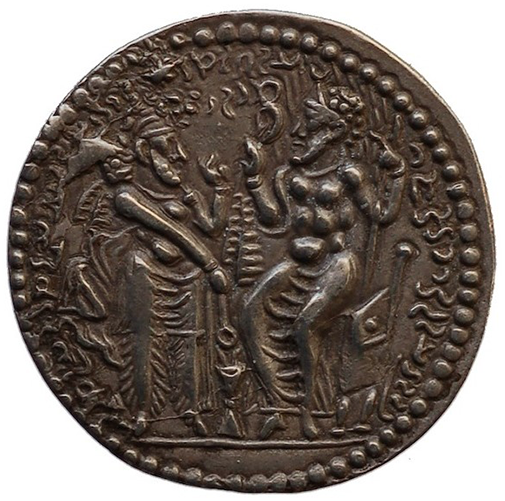
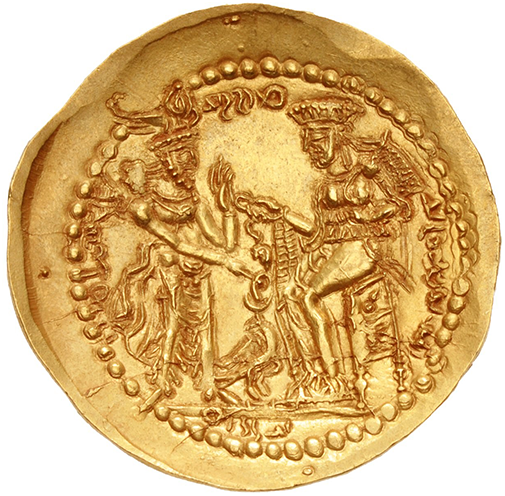
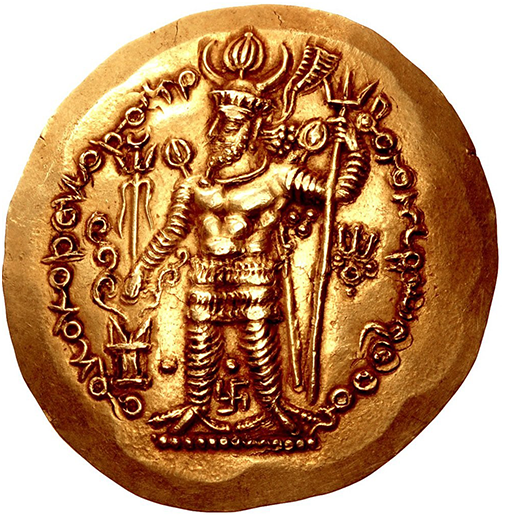
In addition to the remains of temples and a small number of wall paintings,Footnote 6 the most important source for understanding the official religion and worship practices during the Kushano-Sasanian period comes from the coins produced by the Kushanshahs. The study of the Kushano-Sasanians is predominantly numismatic, but the absolute and relative chronology of the rulers and the number of kings in question are still matters of ongoing debate.Footnote 7 The coinage of the Kushans portrayed a multitude of almost 30 different gods and goddesses. In contrast, Sasanian official iconography employed only three deities—Ahura Mazdā, Mithra, and Anāhitā—while Kushano-Sasanian coins depicted five gods: Anāhitā, Nana, Ardoxšo, Mithra (Bactrian Mihir), and Oēšo. The central themes of the iconography of the Kushano-Sasanian coinage continue to be a standing king making a libation or placing some frankincense on a portable incense burner and divine investiture—this being the quintessential Kushan representation.Footnote 8 However, unlike the Kushan coins, certain Kushano-Sasanian issues portray the king and the investing deity holding a diadem on the same side of the coin (Figure 1). There are two depictions of divine investiture in Kushan iconography but both appear on seals and show the Kushan king kneeling in front of a deity twice his size.Footnote 9 Similar composition is attested on coins of Huvishka where a karalrang, an important title in the Kushan administration meaning ‘margrave’, is depicted kneeling in front of the goddess Nana.Footnote 10 However, the Kushano-Sasanian rulers are the same size as the deities and do not kneel in front of them like their Kushan predecessors. In this sense, the Kushano-Sasanian investiture scenes are closer to the Sasanian issues that combine a king and a deity on the reverse. But in contrast, with the Sasanian investiture, there can be little doubt that the Kushano-Sasanian compositions represent real cultic statues. The Kushano-Sasanian rulers were depicted worshipping these enthroned statues with the primary ritual of the former Kushan cult, which involved pouring incense over a small, portable altar. Furthermore, in addition to the typical Sasanian investiture scene, in which the god Mithra extends a diadem to a ruler placed on the other side of a fire altar,Footnote 11 two new modes of divine representation appear on Kushano-Sasanian coinage and are not indebted to Sasanian prototypes. First, most gods are depicted enthroned, which reflects the existing tradition of depicting divine statues in the same way within the Kushan temples. In Sasanian art, deities were not represented in this manner. Second, some Kushano-Sasanian deities were depicted as busts on top of a fire altar, which will be discussed in detail below.
The Kushano-Sasanian king Ohrmazd I making an offering before a statue of burzāwand yazad. Source: Trustees of the British Museum.

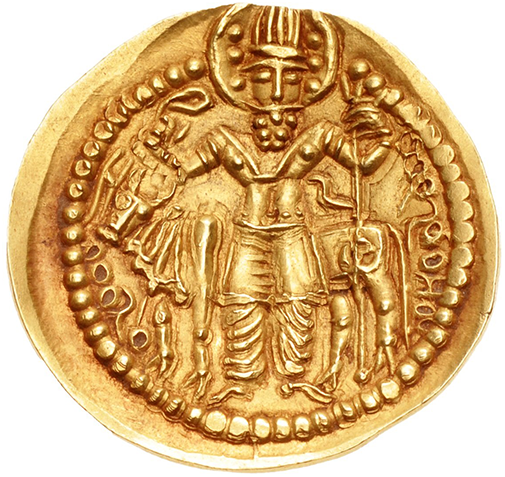
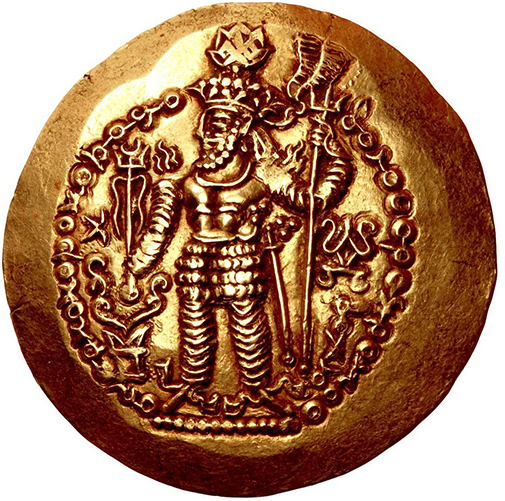
Two additional observations attest to the mutual religious acculturation between the Kushans and the Sasanians. Firstly, the deities, including the Sasanian-Persian goddess Anāhitā, were equipped with weapons, a clear continuation of the Kushan traditions. This contrasts with their iconography in Sasanian Iran, where gods were never depicted carrying arms. Secondly, the Kushan gods, Oēšo and Mithra (although Mithra was also an important Sasanian god), were given a Sasanian appearance in their hairstyle and garments (Figure 2).Footnote 12
Oēšo in Sasanian garments. Source: Classical Numismatic Group—Triton XXV, Lot 620.
The cultural fusion is further evident from the continuation of the Kushan practice of labelling gods on coins. Notably, the Kushano-Sasanians not only preserved this practice but also began to identify some gods in Middle Persian alongside the Kushan Bactrian language. Inscriptions on the coins of some Kushano-Sasanian rulers refer to them as mazdēsn ‘(Ahura) Mazdā-worshipping’, indicating their affiliation with Zoroastrianism, the predominant religion in Sasanian Iran.Footnote 13 However, it is noteworthy that Ahura Mazdā, who is typically portrayed bestowing kingship with a royal diadem in investiture scenes in the west, is absent from the Kushano-Sasanian coinage. Although, it must be noted that also in early Sasanian Iran, Ahura Mazdā does not appear on coins, where only Mithra and a female character (most probably Anāhitā) are represented.Footnote 14 Anāhitā, a Persian goddess brought to Bactria by the new Sasanian rulers, is indeed the main deity of investiture on the first coins issued by the Kushano-Sasanians. She had not been previously attested in Kushan Bactria on coins, inscriptions, or personal names. The continuous worship and significance of Nana, who was the head of the royal Kushan pantheon under the Kushano-Sasanians, provides compelling evidence that Anāhitā was not identified with her in the Kushan pantheon, as is often suggested, and that they were separate and distinct goddesses. Nevertheless, it appears that under the new regime, Nana may have been displaced from her position as the source of kingship that she had held under the Kushans, at least based on the evidence from the coinage.
The selection of Anāhitā as the principal deity of investiture and the bestower of kingship on the Kushano-Sasanian coins may have significant chronological implications as well. The female figure that is most likely to be identified as Anāhitā appears for the first time in Sasanian Iran on the coins of Ohrmazd I (270–271 CE). Another female figure, often interpreted as Anāhitā, is also attested on the coins of Wahrām II (274–293 CE).Footnote 15 The peak of this trend is seen in the relief of Narseh (293–302 CE), who is the only Sasanian king to replace Ahura Mazdā with Anāhitā as the deity who grants him kingship in the most representative and monumental medium (i.e. rock relief). It is evident that Narseh held a particular devotion to this goddess, and his reign marked the pinnacle of her popularity in the royal court and ideology.Footnote 16
Two suggestions can be made based on the aforementioned evidence. Firstly, the appearance of Anāhitā for the first time on Sasanian coins during the reign of Ohrmazd I provides additional support for the dating of the earliest Kushano-Sasanian coins to the period after 270 CE.Footnote 17 Secondly, the reign of Narseh, during which Anāhitā replaced Ahura Mazdā in investiture relief and appeared in the royal inscriptions, suggests that at least some of the Kushano-Sasanian coins depicting Anāhitā as the primary goddess were likely minted around this period. This can be attributed to the strong devotion of the royal Sasanian house towards Anāhitā. One type of Kushano-Sasanian coin depicts Anāhitā wearing a Sasanian-style crenellated crown, similar to the goddess depicted on Ohrmazd I’s coin and Narseh’s rock relief.Footnote 18 She is portrayed with a diadem that she offers to the king and a spear. Anāhitā is represented both standing and seated on a throne with a high back.Footnote 19 It is also noteworthy that on the Kushano-Sasanian coins, she has the same title bānūg (lady) as in Narseh’s Paikuli inscription.
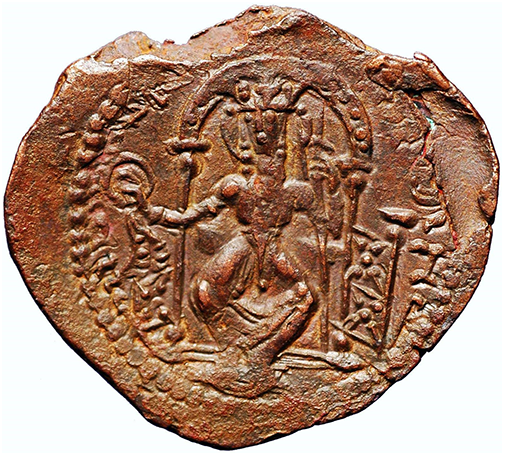
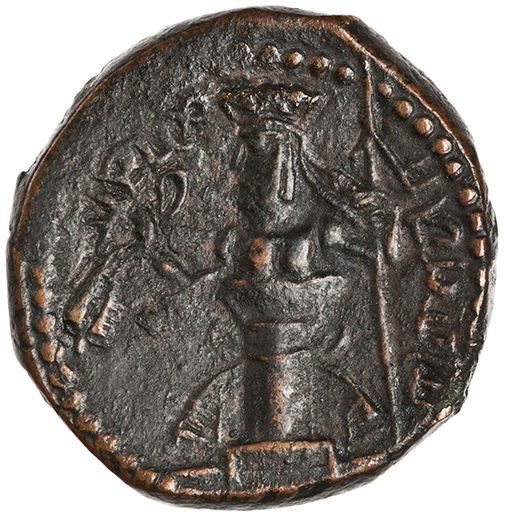
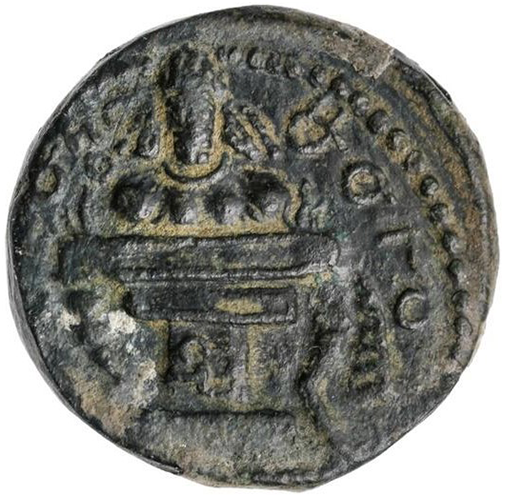
The Kushano-Sasanian coins feature four varieties of iconographic types of Anāhitā, more than any other deity. In one type, the goddess is enthroned frontally under the arch of a temple, offering a royal diadem and holding a spear (Figure 3).Footnote 20 She has a halo surrounding her head, her crown consists of three vegetal elements, and her depiction is reminiscent of the goddess on the coins of Sasanian Ohrmazd I. In another type, Anāhitā stands with a spear and wears the same headdress, presenting the tall Kushan crown to the ruler (Figure 4).Footnote 21 In a third type, the king is shown making a libation before a statue of Anāhitā, who now holds a bow and wears a trapezoid crown (Figure 5).Footnote 22 The fourth type shows the goddess with the same crown as a bust rising from an altar, offering a royal diadem, and holding a spear (Figure 6).Footnote 23 The latter representation has no known prototype in Sasanian iconography and will be discussed further below. While Ardoxšo, a goddess from the Kushan pantheon, is also depicted on the Kushano-Sasanian coins,Footnote 24 the most dominant deity is Oēšo, one of the most important Kushan gods and probably Nana’s consort in the Kushan pantheon. Oēšo is no longer identified by his familiar Kushan name but rather by a new title borzoando iazado/bago borzando in Bactrian or burzāwand yazad in Middle Persian, meaning ‘the exalted god’.Footnote 25 Some Kushanshahs are shown standing and making a libation before the trident of Oēšo, while holding the same divine weapon as their Kushan predecessors did. Even when the reverse of the coin depicts the king worshipping Anāhitā, the obverse still shows him making a libation to the symbol of Oēšo (Figure 5).Footnote 26
Anāhitā under an arch of a temple. Source: zeno#163457.
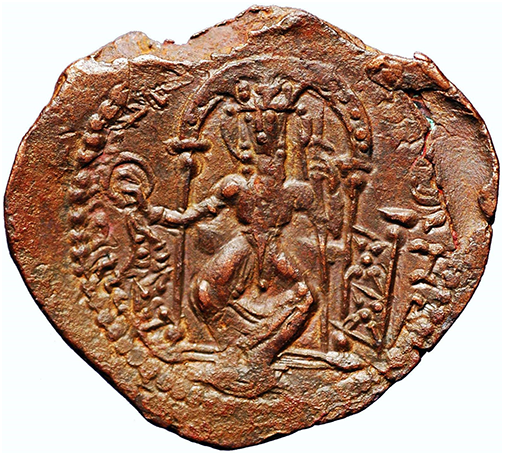
Anāhitā presenting the Kushan crown to the Kushano-Sasanian king. Source: Classical Numismatic Group—Auction 106, Lot 594.

The Kushano-Sasanian king making an offering before a statue of Anāhitā. Source: Classical Numismatic Group—Triton XXV, Lot 621.

Bust of Anāhitā rising from the fire altar. Source: 1944.100.3610, American Numismatic Society.

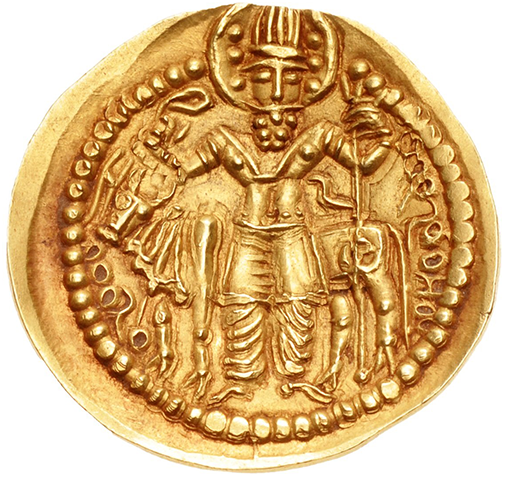
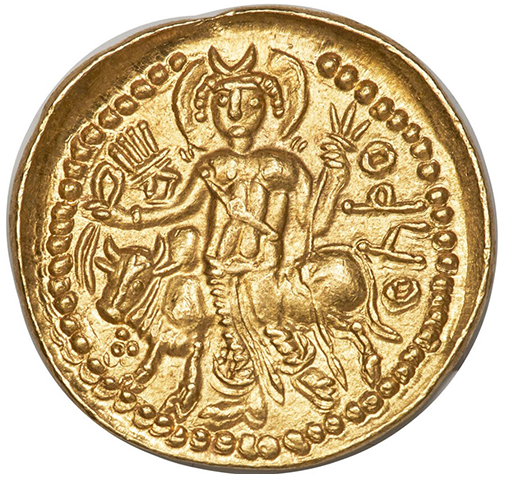
One variation of Oēšo’s representation maintains the traditional Kushan style by portraying the deity standing beside a bull, holding a diadem and a trident (Figure 7).Footnote 27 The crescent moon prominently displayed on his forehead is likely a symbol of his relationship with Nana. In another depiction, Oēšo is portrayed enthroned, wearing a long garment with an exposed chest, while holding a diadem and a spear (Figure 1).Footnote 28 Notably, in most representations, a fiery halo surrounds him, emphasising his divinity.Footnote 29
Oēšo with a crescent moon. Source: Heritage World Coin Auctions—Hong Kong Signature Sale 3087, Lot 30039.

There is a certain symmetry between the official divine iconography of the Sasanian Dynasty—if we include also the rock reliefs in addition to coinsFootnote 30—and that of the Kushano-Sasanian coins. Both depict a triad of deities, with Anāhitā and Mithra consistently represented in both traditions. However, while Ahura Mazdā is the third god in Sasanian Iran, Oēšo occupies this position in Bactria. It is possible that the new Sasanian rulers of Bactria considered Oēšo as the equivalent of Ahura Mazdā in the local pantheon.Footnote 31 Alongside these three main gods, there are also singular depictions of Nana and Ardoxšo on rare coins issued by Kushanshah Pērōz I.Footnote 32
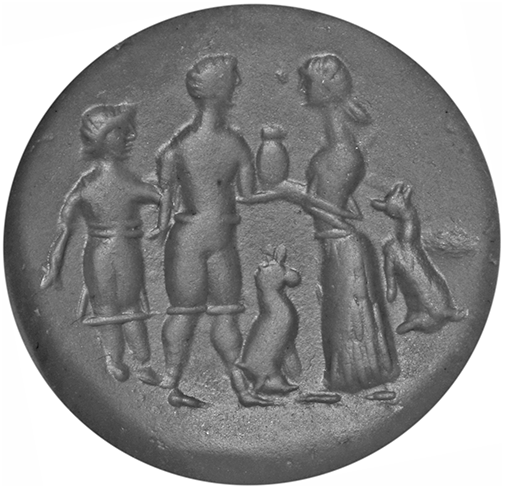
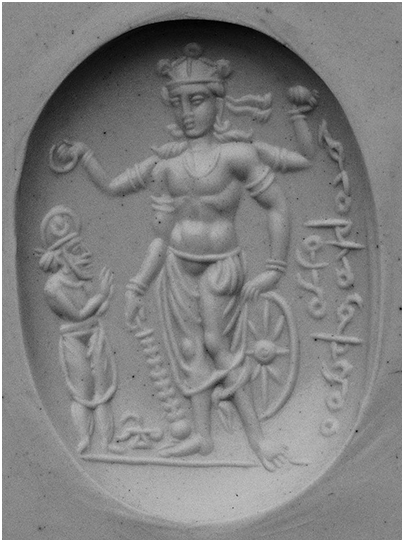
Additional evidence indicates that the veneration of other gods from the Kushan pantheon also continued in Kušānšahr beyond those depicted on coins. A recently published Bactrian inscription from the fourth century CE records a donation of a silver plate by a certain Sen-gul to the ‘god Mana’, indicating an offering made to the temple of this god. The inscription suggests that the sanctuary of the god Mana (who is likely to be Manaobago from the Kushan pantheon) owned vineyards and villages.Footnote 33 Other evidence for the continuation of the worship of certain gods from the Kushan pantheon during the Kushano-Sasanian period includes a seal of probable Kushano-Sasanian manufacture that portrays Daēnā as the anthropomorphic personification of good deeds, accompanied by two dogs, meeting two souls of the deceased (Figure 8).Footnote 34 Another seal of possible Kushano-Sasanian attribution features an image of Mithra rising from the mountain, corresponding with the description of Mithra surveying the world from Mount Hara in an Avestan passage.Footnote 35 It is noteworthy that these rare pictorial representations, which can be matched with the preserved Zoroastrian texts, emerged from the interaction between the institutionalised aniconic Zoroastrianism of the Sasanians and the established Kushan tradition of anthropomorphism in religious imagery. Such depictions are not found in Sasanian Iran. Furthermore, another seal, probably dating from the Kushano-Sasanian period and inscribed in Bactrian, portrays a high-ranking figure dressed in Sasanian-style garments venerating a large, standing statue of Viṣṇu (Figure 9).Footnote 36 It is interesting to note that in this depiction, the deity is twice the size of the worshipper, like in the Kushan investiture scenes. The worshipper is also shown making the same gesture of folded hands. However, unlike those scenes, he is standing, not kneeling in the presence of the god. This is similar to the depictions of the Kushano-Sasanian kings. Based on the personal names found in the collection of Bactrian documents dating from the Kushano-Sasanian period to the Arab conquest, we see that some old Kushan gods such as Iamšo, Nana, Oēšo, and Oaxšo continued to be popular deities in Bactria long after the end of Sasanian rule in the fourth century.Footnote 37
Daēnā on the Kushano-Sasanian seal. Source: Courtesy of Aman Ur Rahman.

A Kushano-Sasanian worshipper before the statue of Viṣṇu. Source: Trustees of the British Museum.

The Kushano-Sasanian iconography further introduced a notable feature in the form of the lotus blossom or lotus bud that adorns the royal crowns (Figures 10–11). This element gradually gained prominence and became an essential part of Kushano-Sasanian headdresses.Footnote 38 It is possible to discern a fusion of Kushan and Sasanian traditions in the appearance of this symbol. Conceptually, the lotus flower finds its origins in the tree-like feature present on some Kushan and Sasanian royal headdresses.Footnote 39 However, it also bears a clear visual reference to the Sasanian royal korymbos. In India, the lotus is a significant solar symbol associated with the Sun god, Sūrya, among other deities.Footnote 40 Hence, in the Kushano-Sasanian crowns, it most likely held solar significance. Although the crowns of the Kushano-Sasanians appear to have been inspired by the Sasanian korymbos, they were adapted to the Indian cultural and visual tradition. It is also possible that the lotus flower signifies the continuation of the association between the ruler and the Sun god that was already important in the Kushan era. Regardless, the lotus flower stands out as a unique innovation of the Kushano-Sasanian period, not derived from either the Sasanians or the Kushans. Its existence may suggest a more pronounced Indian influence on the Kushano-Sasanians than is commonly recognised.
A Kushano-Sasanian ruler wearing a lotus bud crown. Source: Classical Numismatic Group—Triton XIX, Lot 2159.

A Kushano-Sasanian ruler wearing a lotus blossom crown. Source: Classical Numismatic Group—Triton XIX, Lot 2164.

In my opinion, the most striking evidence of the fusion of cults in Kušānšahr is found in a novel form of divine representation on coins that lacks any prototypes in the Kushan or Sasanian traditions. The deities Nana, Oēšo (Figure 12), and Anāhitā were portrayed as busts emerging from an altar, which is not the customary Kushan incense burner but the Sasanian fire altar. If this is indeed a genuine Kushano-Sasanian creation,Footnote 41 then it must have had profound significance and meaning. The fact that the busts emerged from the Sasanian fire altar probably implies that these gods were connected to the sacred fire and were venerated with Zoroastrian rituals. This likely reflects the merging of the Kushan practice of worshipping anthropomorphic statues of gods with the aniconic Sasanian worship centred on the sacred fire, which occurred after the Sasanian conquest of Bactria.
Bust of bago borzando on a fire altar. Source: Spink—Auction 389, Lot 52.

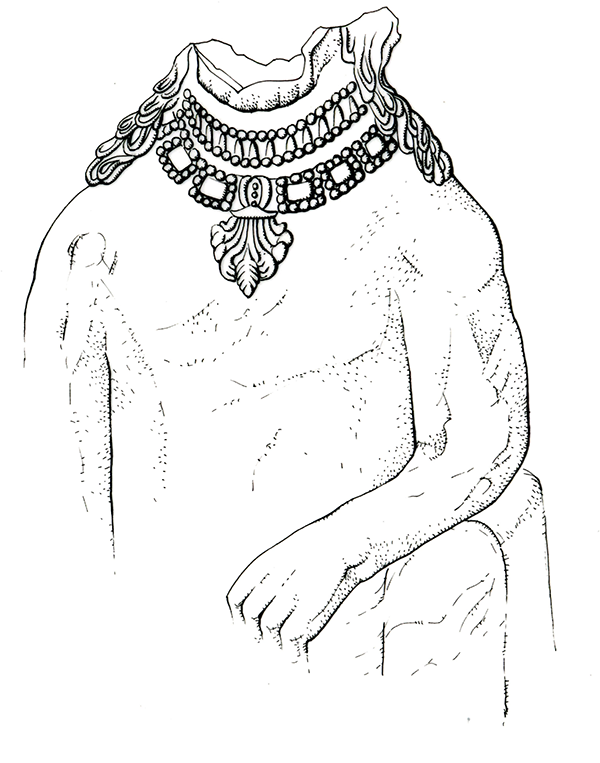
It is remarkable that in the Bactrian temples in the Kushano-Sasanian era we find exactly such a combination of divine statues and the Zoroastrian fire cult. At Surkh Kotal, the former Kushan sanctuary was supplanted by ‘Temple B’, where an ever-burning fire was maintained. This was most likely the case for ‘Temple D’ at the same location as well.Footnote 42 Nevertheless, the trident symbols on the stairs, which appear to date to the same time as Temples B and D, suggest that Oēšo was still worshipped at Surkh Kotal in the Kushano-Sasanian period.Footnote 43 In another Bactrian sanctuary from the Kushan period, at Dilberjin (the so-called ‘Dioscuri Temple’), a fire altar was erected during its third stage.Footnote 44 Additionally, the cella of this temple housed a tripartite platform, which likely supported three divine statues. The excavations of the second sanctuary at Dilberjin, labelled ‘Temple X’, also uncovered a throne with the remnants of three divine statues.Footnote 45 One of these statues was likely that of Oēšo (Figure 13), while another was female, perhaps representing Nana.Footnote 46
The right-hand statue from Temple X, painted clay, Dilberjin, Afghanistan, 3rd century CE. Source: Drawing with elements of reconstruction by Alena Ruban after Kruglikova, ‘Raskopki’, fig. 8.

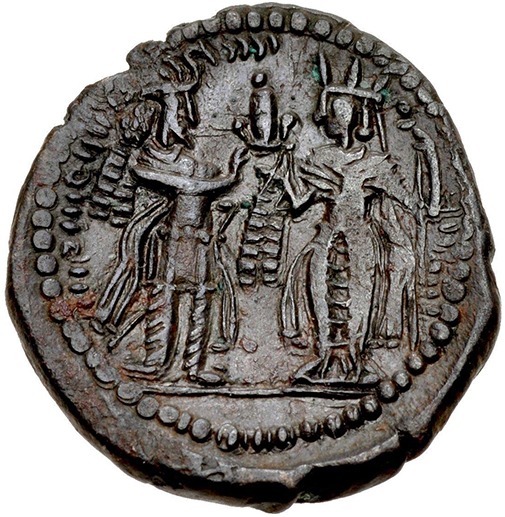
The Dilberjin temples’ findings suggest that a triad of gods was venerated in the city in the Kushano-Sasanian period, though the identity of its third member remains unknown. Nonetheless, this discovery offers valuable insights into the new religious practice that was centred on the veneration of anthropomorphic divine statues, coupled with the perpetual burning of a sacred flame. It is this combination that is vividly expressed on the Kushano-Sasanian coins, depicting the busts of the triad—Oēšo, Nana, and Anāhitā—rising from the Sasanian-style fire altar. It is tempting to suggest that the same divine triad was actually worshipped in Dilberjin temples.
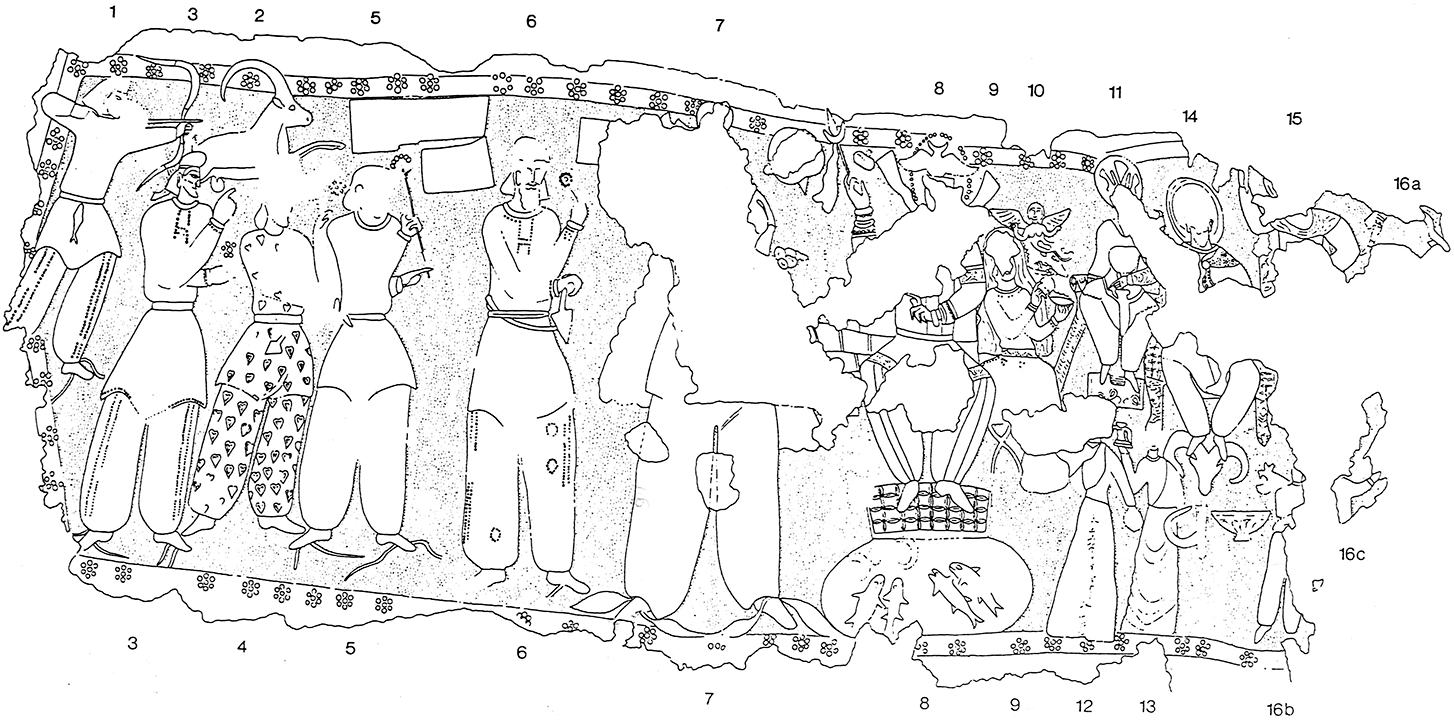
Finally, the painting from Ghulbiyan in northern Afghanistan depicts a group of deities, with three of them seated on thrones (one of whom is female), being the focus of a ritual procession (Figure 14).Footnote 47 Although the theme of religious procession bears some similarities to certain Sasanian reliefs, where a group of high-ranking courtiers led by a king faces an anthropomorphic deity, there are striking differences. Unlike the Sasanian scenes that probably depict a symbolic coronation ceremony,Footnote 48 the flowers carried by the characters in Ghulbiyan indicate a ritual, festive procession. Additionally, in contrast to the symbolic divine representations in the Sasanian reliefs, we observe actual, enthroned divine statues in Ghulbiyan. The attributes associated with the gods depicted in the painting do not align with those of the deities featured in Kushan or Kushano-Sasanian representations, making their identification uncertain. The gods represented in Ghulbiyan may be local deities.
The Ghulbiyan painting. Source: Drawing courtesy of Frantz Grenet.

Conclusions
The evidence discussed above demonstrates that, following the Sasanian conquest, the Kushan cultic practices focused on the veneration of anthropomorphic images of gods continued to thrive under the new Persian rulers. Furthermore, the Persian authorities actively promoted this worship and commissioned statues for the newly introduced Persian gods, such as Anāhitā. At the same time, local Bactrian deities were given the Sasanian hairstyle and garments, indicating a shift in the cultural orientation of the ruling elite. The coexistence of both Middle Persian and Bactrian languages in coin inscriptions demonstrates that this acculturation extended beyond just visual representations. The aniconic Sasanian cult did not replace the local ritual customs, but rather a mixed cult that combined offerings before anthropomorphic statues of gods and the veneration of the constantly burning fire under the same roof emerged in the Kushano-Sasanian Bactria.
In the fourth century CE, the Sasanians lost Kušānšahr to the Hunnic tribes. However, the personal names from the Bactrian documents, as well as other evidence, indicate that the veneration of local Bactrian and Zoroastrian gods, alongside the Kushano-Sasanian cult, persisted in Bactria under the new nomadic rulers. These Hunnic tribes likely adopted the local religious practices, similar to how the Yuezhi, the forebears of the Kushans, had done nearly 500 years earlier. During the turbulent fifth century CE, Bactrian migrants introduced this new cult to Sogdiana in the north. Thus, the mixed cult that emerged in Kushano-Sasanian Bactria in the third and fourth centuries CE had a lasting impact on the Central Asian religious landscape.
Acknowledgements
The first version of this paper was presented at the conference ‘Religious Dynamics in Sasanian Iran’, held at the Israel Academy of Sciences and Humanities, Jerusalem, on 27 October 2022, to mark the first anniversary of the passing of my teacher, Professor Shaul Shaked. I am very grateful to the participants of this conference for their valuable remarks and comments.
Conflicts of interest
None

 Open access

