


According to promissory representation, governing parties’ performance in terms of keeping and breaking campaign promises has electoral consequences: Voters reward or punish governing parties for keeping or breaking their campaign promises. This retrospective sanctioning provides the crucial impetus for office-seeking parties to keep their promises, therefore contributing to high-quality democratic representation. This chapter examines the electoral consequences of promise breaking in the context of economic globalization. Demonstrating that promise breaking has electoral consequences even in the context of globalization is crucial to our argument. If it were the case that parties did not have to worry about negative electoral consequences of breaking promises, they may not feel compelled to adapt their electoral appeals to the constraints of globalization.
This chapter revisits a key finding from previous research on voters’ responses to governing parties’ performance in terms of promise keeping, which we discuss extensively in Chapter 2 (e.g., Cruz et al. Reference Cruz, Keefer, Labonne and Trebbi2024; Matthieß Reference Matthieß2020; Naurin and Oscarsson Reference Naurin and Oscarsson2017; Naurin, Soroka, and Markwat Reference Naurin, Soroka and Markwat2019; Thomson Reference Thomson2011).Footnote 1 That previous research provides consistent evidence that promise making and keeping plays an important part in voters’ electoral choices. While most voters may not have deep knowledge of the detailed policy proposals made by political parties, they are able to assess accurately whether key campaign promises are fulfilled or broken. Surveys in several countries (including Ireland, Sweden, Portugal, Canada, and the United Kingdom) have shown that voters can identify whether specific promises were kept, such as promises to reduce class sizes or increase police numbers. Furthermore, electoral support for governing parties is tied to their ability to keep campaign promises. Conversely, breaking promises undermines voter trust and support, especially on highly salient issues like immigration or health care, often leading to electoral punishment. These findings are noteworthy, particularly given the fact that voter reactions to promise keeping are complex and influenced by individual preferences and political ideology.
We move beyond previous research on the electoral punishment for promise breaking by examining this topic in the context of economic globalization. In the next section we argue that this punishment is particularly severe in the context of globalization. The subsequent sections then examine this argument with different research approaches. First, we use evidence from a large-n quantitative analysis of the performance of governing parties with respect to promise keeping and the conditions under which this is linked to changes in their electoral support. We then turn to a preregistered survey experiment that we fielded in the United States. Whereas the cross-national analysis has high external validity by capturing broad patterns across diverse contexts, the survey experiment has high internal validity by allowing us to identify causal relationships under controlled conditions. The design of the experiment removes concerns that the observational results might be driven by other factors, such as partisanship. It also provides an opportunity to test the conditions under which promise breaking is particularly costly for political parties. Finally, we explore citizens’ perspectives on promise breaking in a more qualitative way, by hearing directly from voters who experienced an iconic case of promise breaking under international economic constraints: the French Socialist government of the early 1980s. Taken together, we find strong evidence that promise breaking is costly and reduces support for political parties. These costs are not reduced when globalization constraints make the promised policies less feasible. On the contrary, in many cases, governing parties are punished more severely for promise breaking when they are constrained by economic globalization.
Severe Punishment for Promise Breaking under Globalization
As globalization has weakened governing parties’ control over macroeconomic outcomes, promise keeping has become a more salient criterion for voters’ evaluations of their performance. In a landmark study, Kayser (Reference Kayser2007) explores how increasing economic openness has weakened the relationship between economic performance and electoral outcomes. He argues that globalization has diminished the ability of voters to hold governments accountable for economic conditions because external factors, such as global trade flows and international financial markets, have a greater impact on national economies. As a result, the traditional connection between domestic economic performance and voting behavior – where voters reward incumbents for economic prosperity and punish them for economic decline – has weakened in open economies.
Hellwig (Reference Hellwig2015) offers similar results in his study on the effect of globalization on democratic accountability. He argues that globalization contracts the “policy space” governments have, complicating the traditional model of retrospective voting, where voters assess incumbents based on economic performance. His empirical analysis demonstrates that as economic conditions are more strongly influenced by global factors, voters often struggle to determine whether negative economic conditions are the result of government policy failures or external forces. This confusion leads to a reduction in the electoral consequences for governments that fail to deliver economic prosperity, particularly in countries deeply embedded in the global economy. Similarly, Hellwig and Samuels (Reference Hellwig and Samuels2007) suggest that as globalization shifts responsibility for economic conditions from national governments to global forces, voters may become confused about who to blame for poor economic performance. When it is unclear whether economic hardship stems from domestic mismanagement or external global pressures, incumbents face fewer electoral consequences for negative economic outcomes.
It is because voters are less able to use general economic performance to inform their vote choices in more globalized contexts that they put more emphasis on the ability of governing parties to keep the promises they made. While voters acknowledge globalization constraints, they also expect their representatives to have the knowledge and foresight to make promises that consider international constraints. Voters increasingly value governing competence when casting their votes, and the ability to make feasible campaign promises and fulfill those promises is a strong indicator of competence. Conversely, governing parties that fail to keep their promises are perceived as incompetent. This emphasis on governing competence is also found in Katz and Mair’s (Reference Katz and Mair1995) cartel party thesis, which we discuss in Chapter 2. The cartel party thesis argues that as parties become more integrated into the institutions of the state and less ideologically polarized, they increasingly seek to differentiate themselves in terms of governing competence rather than offering starkly alternative policies. An important part of signaling such governing competence consists of proposing specific policy measures that can be carried out.
Campaign promises often focus on policy instruments (rather than policy outcomes), such as passing new legislation, instituting tax reforms, or increasing funding for public services, which are in principle within the formal control of governing parties. In contrast, the outcomes these policy instruments are intended to achieve, including broad macroeconomic outcomes, may be more affected by global dynamics than by what any one national government does. It is precisely this distinction that makes voters less forgiving of governing parties’ promise breaking than of poor macroeconomic outcomes. While voters may understand why economic conditions prevent achieving full employment or high rates of growth, they are less forgiving if the government fails to pass the job-creation initiatives it promised. The distinction between inputs (policy actions) and outputs (economic results) means that voters expect their leaders to at least deliver on the policy changes they campaigned on, even if achieving the broader goals remains difficult in a globalized context.
Failing to deliver on specific campaign promises reflects poorly on three aspects of governing competence: anticipation of future constraints, control over the political process, and integrity. The ability to anticipate well means that parties should be able to craft policy proposals that can be implemented given the future constraints that knowledgeable policymakers should be able to foresee. In a globalized world, where economic interdependencies and international challenges are complex, competent leaders must demonstrate expertise and strategic foresight. Globalization is not a new phenomenon; politicians are aware of its challenges, and voters expect leaders to anticipate how global markets, international agreements, and geopolitical factors will affect domestic policy. They expect leaders to understand the nuances of international negotiations, trade agreements, and economic policies. When promises are broken due to the constraints of globalization, it signals a lack of competence or control. The ability to anticipate is even more important for policymakers in a globalized world, where the stakes are often higher, and the consequences of poor anticipation – whether in terms of broken promises or ineffective policy – can be severe. Failure to manage global economic shifts might result in mass job losses, stagnation, or welfare cuts. Voters may care more about broken promises in a globalized context because failing to deliver reveals a lack of anticipatory skills on the part of the governing politicians.
The ability to control and manage the national political process is another key aspect of governing competence. This refers to the ability to garner sufficient support for their proposed policies within the executive and legislative branches and within the wider political system. It includes the ability to overcome bureaucratic resistance to new initiatives and to form coalitions of legislators. It also includes the ability to overcome opposition within the wider policy communities affected by some campaign promises. Managing the political process also includes the ability to formulate policy proposals that incorporate credible policy expertise. Failure to fulfill key campaign promises may indicate incompetence, either in terms of the lack of ability to maneuver adeptly through the political process or in terms of the ability to formulate sensible policies that withstand the scrutiny of policy experts.
Parties’ governing competence also involves integrity, which is manifest in the trust that citizens have in them. Governing parties that habitually break their campaign promises are perceived as untrustworthy by citizens. In response to a broken promise, citizens may believe that the government either misrepresented what it could achieve or failed to take the necessary steps to deliver on its promises. This is particularly critical in a political environment where public trust in political institutions is already fragile, and broken promises can deepen voters’ disillusionment. Thus, while globalization may complicate a government’s ability to achieve certain economic outcomes, voters are likely to hold leaders more accountable for their failure to implement promised policies, as this is seen as an issue of integrity.
In sum, although globalization may reduce the extent to which governing parties are held to account for general economic performance, it increases the importance of promise keeping because voters expect leaders to act with foresight, managerial control, and integrity. Broken promises, especially in a globalized world where stakes are high, suggest weak governing capacity on several dimensions, making voters more likely to care about promise breaking in this context.
Consequently, we expect that (1) voters punish political parties that hold executive office when these parties break their campaign promises, and (2) this punishment is stronger when countries are more deeply integrated into the global economy.
Why Scapegoating Globalization Does Not Work
The counterargument to our theoretical expectations, particularly the second one, is that governing politicians may be able to deploy a tactic of scapegoating effectively. In other words, they may be able to explain to the public that they were unable to do what they promised due to the constraints of globalization and that voters may give them a pass as a result. The evidence for effective scapegoating is that politicians can under certain circumstances attribute blame for negative outcomes or unpopular policies to external forces to shield themselves from voter backlash. For instance, Chaudoin, Milner, and Pang (Reference Chaudoin, Milner and Pang2015) argue that politicians often scapegoat international organizations to justify policies that may be necessary but unpopular, such as trade liberalization or economic austerity. Vreeland (Reference Vreeland1999) provides evidence that governments use the International Monetary Fund (IMF) as a scapegoat, in the hope that the implementation of unpopular IMF programs become less costly politically. The European Union (EU) is particularly ripe for strategies of blame shifting and scapegoating (Heinkelmann-Wild et al. Reference Heinkelmann-Wild, Rittberger, Zangl and Kriegmair2025; Schlipphak and Treib Reference Schlipphak and Treib2017). Blame shifting often occurs in policy areas such as immigration, economic reform, and regulatory compliance, where national governments argue that their hands are tied by international agreements. Hobolt and Tilley (Reference Hobolt and Tilley2014) also provide evidence that blame shifting can affect voters’ perceptions. In the European context, they show that when national governments blame the EU for unpopular policies, citizens tend to punish the EU in elections rather than their own governments. This dynamic was particularly evident during the Eurozone crisis, where many citizens blamed the EU for imposing austerity measures that caused economic hardship.
Scapegoating is, however, unlikely to work effectively as a tactic for avoiding electoral punishment for promise breaking. The evidence for effective scapegoating refers mainly to policies that were not the subject of specific campaign promises but to general policies. The act of promise making is of great theoretical and practical significance in modern democracies. It is therefore one thing for party leaders to say that global forces compelled them to take some unpopular policy measures, but another thing for them to say that global forces are a valid excuse for breaking the campaign promises that brought them to power.
Moreover, the little evidence we have on the use of scapegoating to mitigate punishment for promise breaking suggests that it does not work (or works only under a narrow set of conditions). Bonilla (Reference Bonilla2022) uses experimental analysis to explore how different explanations for failing to deliver on campaign promises influence voters’ perceptions. Her findings indicate that the penalty for breaking a promise cannot be avoided easily. Excuses have some ameliorating effect, but none of the excuses improve people’s opinions of candidates substantially. Candidates who follow through on their promises are generally far more popular.
Comparative Analysis
We begin with a comparative analysis of the electoral consequences of breaking promises and find – in line with previous research – that breaking promises is electorally costly. In addition, we show that promise breaking is particularly consequential in countries that are integrated into the global economy. Our analysis is based on a sample of political parties in executive power across sixty-nine elections in fourteen countries between 1977 and 2015. The sample includes parties that held executive office in Austria, Bulgaria, Canada, France, Germany, Ireland, Italy, the Netherlands, New Zealand, Portugal, Spain, Sweden, the United Kingdom, and the United States. The data on promise keeping was collated by Matthieß (Reference Matthieß2020), drawing on studies from the Comparative Pledges Project, which we discuss in Chapter 4.
The Dependent Variable: Changes in Political Parties’ Vote Share
Our argument connects governing parties’ inability to fulfill the promises they made during election campaigns to voters’ decisions to punish those parties in the election following the government period in which those parties broke their promises. We expect voters to punish political parties for breaking their campaign promises by withholding their support during elections. Governing parties should suffer a greater loss in their overall vote share when they break higher proportions of their promises. Focusing on vote shares is an established practice in the economic voting literature (Alesina, Roubini, and Cohen Reference Alesina, Roubini and Cohen1997; Duch and Stevenson Reference Duch and Stevenson2008, Reference Duch and Stevenson2010; Kayser Reference Kayser2007; Lewis-Beck and Stegmaier Reference Lewis-Beck and Stegmaier2000; Powell and Whitten Reference Powell and Whitten1993). It is also the approach used in the one study of the effect of promise breaking on electoral outcomes at the aggregate level, which we replicate and extend (Matthieß Reference Matthieß2020).
Our main dependent variable is Change in Vote Share, which is measured as the change in the absolute vote share of each incumbent political party from the previous election to the current election. Data are from the Manifesto Project (Volkens et al. Reference Volkens, Krause, Lehmann, Matthieß, Merz, Tegel and Wessels2019). A party’s vote share is measured as the proportion of votes won in an election. Our variable ranges from −0.34 to 0.15, with a mean of −0.046. This means that governing parties, on average, lose about 4.6 percent of their vote share from one election to the next. The fact that governing parties tend to lose votes after their governing period has been referred to as the “cost of ruling” (Paldam Reference Paldam1986).
Principal Explanatory Variables
Our main explanatory variable is the proportion of campaign promises of each governing party that remain unfulfilled at the end of their term in executive office:
Broken Campaign Promises are the proportion of campaign promises that a political party in government has broken in the government period prior to the election in question. The variable ranges from 0 to 1. Data are from Thomson et al. (Reference Thomson, Royed, Naurin, Artés, Costello and Ennser‐Jedenastik2017), supplemented by data collated by Matthieß (Reference Matthieß2020).
In addition to the main effect, we contend that economic globalization has affected the electoral consequences of promise breaking. We expect that promise breaking becomes a more important factor in voters’ electoral decisions when countries are more integrated into the global economy. As in Chapter 4, we use the Konjunkturforschungsstelle Economic Globalization Index:
Globalization is the extent to which a country is integrated into the international economy, including information on trade in goods and services, trade regulations, tariffs and agreements, foreign direct investment, investment restrictions, and capital account openness. Data are from Dreher (Reference Dreher2006).
Control Variables
Previous research on promise keeping has identified several important variables that could influence the change in governing parties’ vote share in addition to their ability to fulfill their campaign promises. We follow Matthieß (Reference Matthieß2020) in the choice of our main control variables:
Previous Vote Share measures the absolute vote share of the incumbent political party in the previous election. Data are from the Manifesto Project. Parties with larger absolute vote shares experience larger changes (most likely declines) in their vote shares than parties with smaller absolute vote shares.
Ideological Distance (Median) measures the distance of the political party from the ideological median. The distance is calculated by the difference between a party’s left–right score and the median position of all political parties in each country. The variable is standardized so that it ranges from 0 (the political party is located at the median position) to 1 (furthest away from the median position). Data are from Volkens et al. (Reference Volkens, Krause, Lehmann, Matthieß, Merz, Tegel and Wessels2019). We calculate the median position of all political parties in the country based on their vote shares.
EMI (log) is measured as the log of the Economic Misery Index (EMI), which is calculated as the sum of the unemployment and the inflation rate.Footnote 2
We present descriptive statistics for all variables in the online Supplementary Material. To ease interpretation, we standardize Previous Vote Share and EMI (log) to a mean of 0 and a standard deviation of 1.
Promise Breaking Is Electorally Costly …
To test our main argument, we use an ordinary least squares estimator and cluster the standard errors by country. We start with the main effect regarding the association between promise breaking and change in vote share. To analyze whether the effect is conditional on the level of economic integration, we introduce an interaction between Unfulfilled Campaign Promises and Globalization.
We present the coefficients from the model graphically in Figure 6.1.Footnote 3 The explanatory variables are arrayed along the vertical axis, with the reference value omitted. The marginal effects are plotted on the horizontal axis. The estimated coefficients are denoted by a dark-gray circle, and their 95 percent confidence intervals are marked by bars of the same color. The dashed vertical line represents a coefficient of 0, corresponding to no effect.
Unfulfilled promises and change in vote share
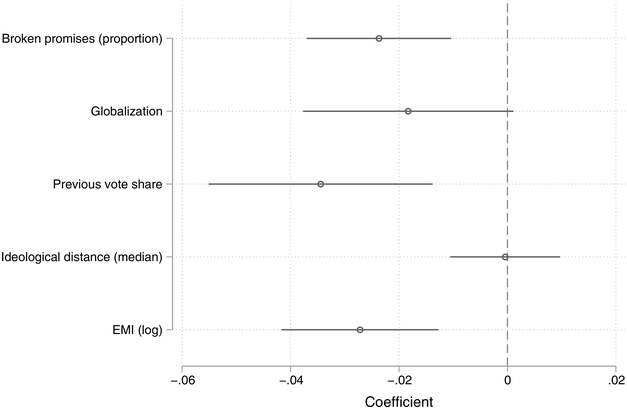
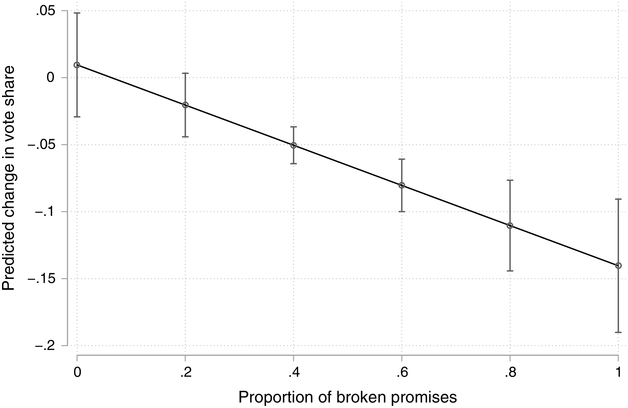
Broken Promises (Proportion) has a strong and robust negative association with Change in Vote Share. A 1 standard deviation increase in the proportion of broken campaign promises decreases a governing party’s vote share by over two percentage points. Figure 6.2 depicts predicted values for the effect of unfulfilled campaign promises on political parties’ change in vote share. Governing parties that fulfill all their promises do not experience significant changes in their vote share between elections. We might have expected a positive effect when governing parties keep all, or almost all their promises, as voters might reward political parties for keeping their promises. The prediction of no change in vote share may indeed be seen as a reward, given that on average political parties in government lose about 4.6 percent of their vote share between two elections. However, this really means the absence of a punishment rather than the presence of a reward. As governing parties fail to keep more promises, the sanctioning effect emerges. Governing parties that fail to keep about 40 percent of their promises can expect a 5 percent decline in their vote share; parties that break all their promises are expected to experience a whopping 15 percent decline in their vote shares, all else equal.
Predicted values for the effect of broken promises on change in vote share
The findings for the control variables are in the expected direction and in line with findings in existing research. Governing parties that received higher absolute vote shares lose proportionally more votes at the next election. Similarly, in line with the economic voting literature, more economic misery leads to a greater loss in governing parties’ vote shares at subsequent elections. Notwithstanding governing parties’ weaker control over economic outcomes under globalization, they are still punished for governing amid poor economic conditions. We do not find any effect of parties’ ideological positioning on vote share.
… Especially When Countries Are Highly Exposed to Globalization
The results so far indicate that promise breaking is costly. Further analysis reveals that it is particularly costly when countries are deeply integrated into the global economy. We introduce an interaction between our standardized measure of Globalization and the Broken Promises measures, which we present in graphical form. Figure 6.3 shows the effect of Broken Promises on Change in Vote Share for different levels of a country’s integration into the global economy, with the full model presented in the online Supplementary Material.
Marginal effect of broken promises on change in vote share for different levels of globalization
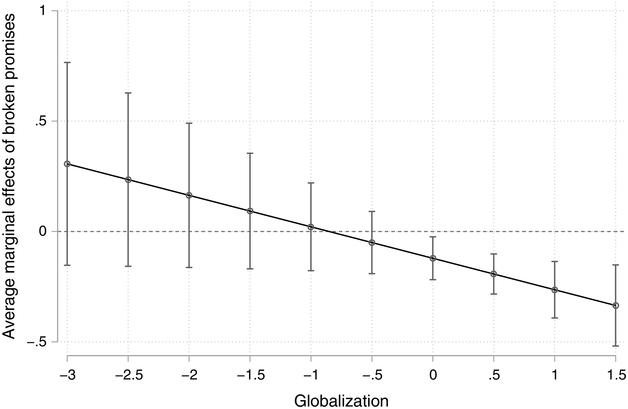
As expected, the sanctioning effect is more pronounced when countries are deeply integrated into the global economy. It is significant only for countries at higher levels of integration. This finding shows that globalization has not let governing parties “off the hook” for promise breaking. On the contrary, it is particularly since the onset of globalization that promise keeping has become a more important feature of voters’ assessment of governing parties’ performance. The negative effect of broken promises is significant for values of Globalization that are at or above the mean of integration across countries. In line with findings by Hellwig (Reference Hellwig2015), to the extent that voters find it difficult to use the economy as a benchmark for assessing performance, they rely more heavily on other factors including noneconomic policy performance and the ability of governing parties to keep their campaign promises.
Survey Experiment
To further analyze the political consequences of promise breaking, we use an original preregistered survey experiment that we fielded online in the United States with YouGov in the summer of 2024.Footnote 4 Respondents were recruited by YouGov, an international survey firm. YouGov uses a combination of quotas to closely match the US population of adults of 18 years or older by age, gender, education, race, 2020 presidential vote, and region, based on the last census. The sample includes 4,277 respondents after removing respondents who failed the attention checks. The sample is well balanced across various important characteristics.Footnote 5 In this chapter, we focus on a sample of 1,407 respondents who receive a version of the questionnaire in which a fictive politician makes a clear promise and then either breaks or keeps that promise. We examine other parts of the sample in Chapter 10.
Focusing on the United States allows us to prioritize internal validity through a controlled experimental design that directly tests the micro-level mechanisms linking promise breaking and electoral punishment. While this necessarily entails a trade-off in terms of external validity, our aim in this part of the chapter is not to generalize across all democracies but to isolate causal effects in a theoretically rich and substantively important setting. The United States is well suited for this purpose: As the world’s oldest democracy and one that is exposed to globalization, it offers a critical context in which the tensions between campaign promises and international economic constraints are highly salient. In addition, it allows us to build directly on a prior experimental study (Simas, Milita, and Ryan Reference Simas, Milita and Ryan2021), extending its framework to explicitly incorporate the role of globalization in shaping voters’ responses.
Institutional differences – particularly the fact that US parties are generally less coordinated than those in parliamentary systems – may limit the generalizability of findings to other contexts. Nonetheless, the strength of this approach lies in its ability to uncover whether and how voters respond to different types of promise violations when globalization is invoked as a background condition. Moreover, this experiment does not stand alone. It complements the large-n cross-national study of elections and promise keeping that we also conduct in this chapter. Together, these analyses combine the inferential leverage of experimental design with the broader scope of comparative data, advancing our understanding of how globalization shapes democratic accountability across different institutional and national contexts. It also complements experimental studies of promise breaking in other country contexts (Bonilla Reference Bonilla2022, Reference Bonilla2025; Naurin and Oscarsson Reference Naurin and Oscarsson2017; Naurin, Soroka, and Markwat Reference Naurin, Soroka and Markwat2019). Future work could expand this approach to additional cases to assess how our findings carry across different settings, but this chapter offers a crucial first step in uncovering the causal logic behind voters’ responses to promise breaking in a globalized environment.
We use the survey experiment to test whether promise breaking is costly, and the conditions under which those costs are strongest. Our main theoretical interest lies in whether sanctioning is significant even in the face of globalization shocks that may “excuse” the breaking of a promise. To do so, we provide some respondents with information on globalization shocks in the form of unexpected events related to the international economy that may make it more difficult for politicians to keep a particular promise. The survey allows us to compare respondents’ approval of politicians who break (or keep) their promises with and without globalization shocks. Our theoretical argument implies, and the evidence supports, that globalization shocks do not lower the political costs of breaking promises in the form of politicians’ approval ratings. In further analyses, we also explore whether the sanctioning effect is stronger for voters who care more about promise keeping, which it indeed is.
We first collect information on respondents’ party identification and their position on providing tax incentives for large companies in their state. We use corporate tax incentives as the policy focus for several reasons. First, it is an electorally salient issue that routinely features in state and national campaigns, making it familiar and meaningful to respondents. Second, it is an area where globalization-related pressures – such as international tax competition and capital mobility – create clear, comprehensible constraints that make the logic of promise breaking readily interpretable to survey participants. Third, it provides a plausible and realistic test case for our theory: it is policy-relevant without being so emotionally charged that affective polarization overwhelms evaluative judgment. This makes it particularly well suited for isolating the effects of promise breaking, especially under globalization constraints, without conflating those effects with strong prior beliefs or identity-driven reactions.
For party identification we ask respondents:
In politics today, do you consider yourself a Republican, a Democrat, an independent or something else?
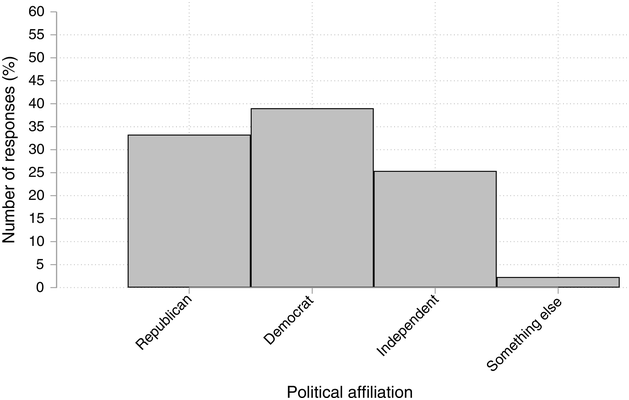
Figure 6.4 presents descriptive statistics. Our sample contains an almost even number of Republicans and Democrats with a lower number of Independents.
Political affiliation
For respondents’ preferences on tax policies, we ask:
We are interested in your opinion about tax incentives or tax breaks for large companies. Some argue that tax incentives for large companies are good because they encourage companies to stay in the state, contributing to economic growth and job creation. Others argue that tax incentives are bad because they often fail to produce jobs and they reduce government revenues for policies to stimulate economic growth, create jobs, and provide public services including education. State legislatures consider tax incentives for large companies on a regular basis. In general, are you in favor or against tax incentives for large companies in your state?
Possible responses were strongly in favor, somewhat in favor, neither in favor nor against, somewhat against, strongly against.
Figure 6.5 presents descriptive statistics. Almost two thirds of respondents in our sample are somewhat or strongly in favor of tax incentives (62.7 percent), but there is variation in favor and against tax incentives across the sample.
Support for tax incentives
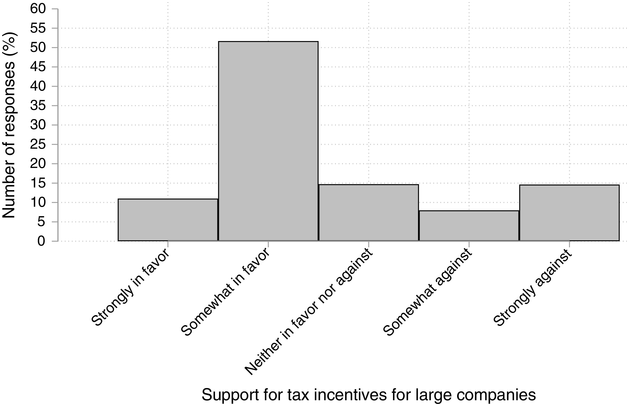
Figure 6.5 Long description
A histogram where the x-axis shows varying levels of support for tax incentives, namely strongly in favor, somewhat in favor, neither in favor nor against, somewhat against, and strongly against, while the y-axis shows number of responses from 0 to 60%. An obvious majority are somewhat in favor at more than 50%.
Based on this information, we present the respondents with a hypothetical political candidate (Gary Clark) who is running for state elections and makes statements about corporate tax policies:Footnote 6 Each respondent was assigned with a candidate of their own preferred political party (Republican/Democrat) and with statements that align with their preferred corporate tax policies.Footnote 7 For example, Democrats who oppose tax breaks receive a Democrat candidate who opposes tax breaks, and Republicans who oppose tax breaks receive a Republican who opposes tax breaks. These two design choices allow us to isolate the direct effect of promise breaking by holding constant factors such as partisanship and policy agreement. While prior research shows that voters are less likely to punish parties for breaking promises they favor or from parties they identify with, our objective here is not to test the moderating role of those factors. Instead, we aim to estimate the baseline electoral penalty for promise breaking in a controlled setting. Future research could usefully explore how this penalty varies by voters’ ideological alignment or partisan attachment. The results are the same if we estimate the models by Democratic and Republican respondents separately. Respondents who oppose tax incentives receive the following clear promise, in which Gary Clark pledges to end tax breaks:
We need to make sure that large companies pay their fair share in our state, so that we can invest in policies that promote economic growth and give hard-working Americans the chance to join or maintain their place in the middle class. I will fight to end tax breaks for large companies in our state.
Respondents who support tax incentives receive the following clear promise, in which Gary Clark proposes to expand tax incentives:
We must promote economic growth, create new jobs, and give hard-working Americans the chance to join or maintain their place in the middle class. I will fight to expand tax incentives for large companies in our state, so they stay and grow, and contribute to this goal.
We then inform the respondents that Gary Clark won a seat in the state legislature and that the state legislature must vote on a bill that will introduce new large tax incentives for large companies.Footnote 8
Our second treatment involves a globalization condition for half of our respondents (the control group does not get any treatment and serves as our sample for testing our first hypothesis). The globalization condition introduces a globalization shock that makes the policy that Gary Clark favored (and the respondent preferred) less feasible. Half of the respondents who oppose tax incentives are treated with the following information (the other half receives no information):
Between the election campaign and the vote, large companies began moving their operations to foreign countries that offered new tax incentives. This threatened to increase unemployment and the state’s ability to fund public services because of falling tax revenues. This was a big part of the debate on the bill introducing new large tax incentives for large companies. Some people who were previously against tax incentives for large companies now argued in favor of them in this new situation.
Half of the respondents who favor tax incentives are treated with this alternative information (the other half receives no information):
Between the election campaign and the vote, the global economy and our main overseas markets took a significant downturn. This threatened to increase unemployment and the state’s ability to fund public services because of falling tax revenues. This was a big part of the debate on the bill introducing new large tax incentives for large companies. Some people who were previously in favor of tax incentives for large companies now argued against them in this new situation.
It is important to note that we do not use this treatment to test our broader theoretical expectation that voters place greater emphasis on promise keeping in more globalized contexts. We cannot directly test this hypothesis in the experiment as all respondents are exposed to the same treatment and we lack variation in levels of globalization. Instead, the goal of this treatment is narrower: to assess whether politicians can avoid electoral punishment by providing a plausible, externally imposed justification – here, a credible constraint stemming from economic globalization – for breaking their promise.
Our third treatment is Gary Clark’s vote on the bill. We randomize respondents such that half of the respondents are informed that Gary Clark voted in favor of the bill, and half of the respondents are informed that Gary Clark voted against the bill. This means that across the possible positions in favor or against tax incentives, individuals are randomly confronted with a situation where Gary Clark breaks his promise and a situation where Gary Clark keeps his promise.
After we provide respondents with Gary Clark’s vote, we ask them to evaluate him on his “likeability.” Respondents rate Gary Clark on a scale from 0 to 10 where 0 is “dislike a great deal” and 10 is “like a great deal.” We follow Simas et al. (Reference Simas, Milita and Ryan2021) and choose to measure likeability rather than asking directly whether respondents would vote for the candidate because likeability is a widely used proxy in political psychology for overall candidate evaluation and avoids conflating respondents’ judgments with partisan or strategic considerations. Asking about vote choice can introduce noise unrelated to the treatment (e.g., respondents factoring in broader political preferences, tactical voting, or assumptions about candidate viability). In contrast, likeability captures an immediate evaluative reaction to the candidate’s behavior – in this case, promise keeping or breaking – which is especially useful for isolating the perceived integrity or appeal of the candidate independent of party or ideology.
We also ask respondents whether the following phrases describe Gary Clark:
1. Someone who represents his constituents well.
2. A politician who is open minded.
3. A person who lacks integrity.
4. A politician who keeps his campaign promises.
5. A politician who adapts well to changing circumstances.
6. A politician who is competent.
Breaking Promises Causes Voters to Punish Politicians …
To test the empirical implications of our argument, we use parsimonious difference-between-means tests. We start with a test of our main expectation that promise breaking is generally costly to politicians. Figure 6.6 presents the findings of a difference-between-means test for the likeability of politicians who keep their promises compared with politicians who break their promises both in the absence of information about an unhelpful globalization shock (top graph) and in the presence of objective information about an unhelpful globalization shock (bottom graph).Footnote 9
Main experimental results.
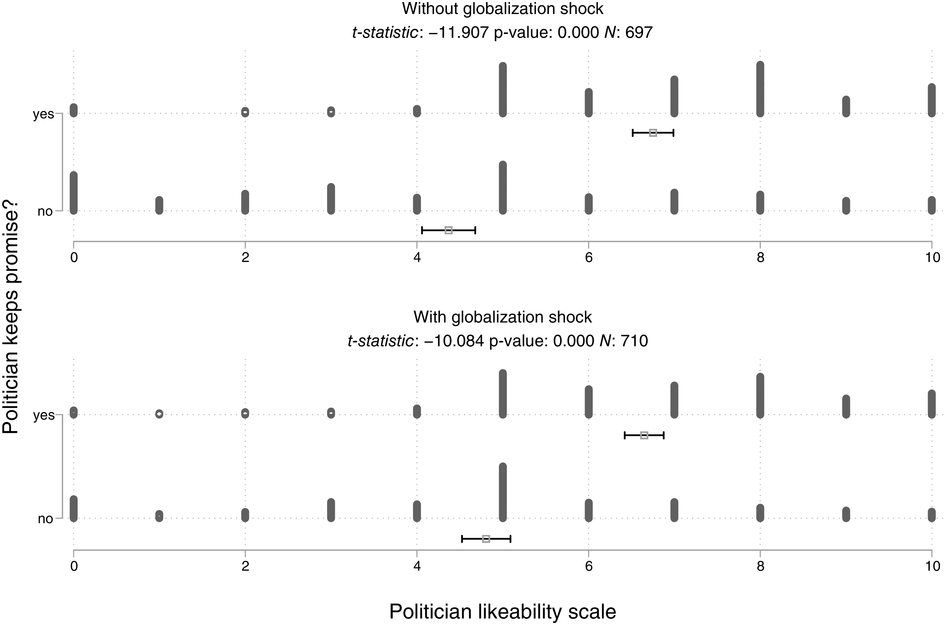
Figure 6.6 Long description
Two horizontal bar graphs comparing general response distribution where the x-axis outlines the politician likeability scale from 0 to 10 and the y-axis represents the frequency within each rated sample, in this case labeled yes and no regarding whether the politician keeps his promise. The top graph is without globalization shock and has 697 observations, a t-statistic of negative 11.907, and a p-value of 0.000. The bottom graph is with globalization shock and has 710 observations, a t-statistic of negative 10.084, and a p-value of 0.000. The mean for each sample is represented by a light gray square with black bar confidence intervals. Both graphs show very similar results.
The findings in Figure 6.6 provide strong support for our expectation that promise breaking is costly for politicians, with or without globalization shock. Respondents who are treated with a politician who breaks his promise tend to rate that politician significantly lower on the likeability scale than respondents who are treated with a politician who keeps his promise (p<0.001). The effect is substantially large. On a scale from 0 to 10 (where 0 implies that respondents do not like the politician at all, and 10 that the respondents like the politician very much), a politician’s likeability decreases from 6.75 to 4.37 if he breaks his campaign promise when no globalization shock occurs (Figure 6.6, top graph, p<0.001). This first finding reinforces the results of our observational study and those of previous studies.
Table 6.1 shows that these results are robust to different outcomes.Footnote 10 Respondents who are informed that Gary Clark voted against their preference on tax policies are significantly less likely to believe that Gary Clark represents his people well, is open-minded, has integrity, is good at keeping promises, and is competent than respondents who are treated with a Gary Clark who fulfills his promise.
| Broken | Fulfilled | Diff | p-value | |
|---|---|---|---|---|
| Represents people well | 4.72 | 6.73 | 2.01 | 0.00 |
| Open minded | 5.21 | 6.22 | 1.02 | 0.00 |
| Lacks integrity | 5.70 | 3.55 | −2.15 | 0.00 |
| Good at keeping promises | 3.98 | 7.04 | 3.06 | 0.00 |
| Adapts well to changing circumstances | 5.30 | 6.14 | 0.84 | 0.00 |
| Competent | 5.13 | 6.80 | 1.66 | 0.00 |
Note: The table presents the results of difference-between-means tests, comparing the treatment group where the politician keeps his promise to the treatment group where the politician breaks his promise. All items asked respondents to rate the politician on a 0–10 scale.
… Even When Adverse Globalization Shocks Occur
We also find that respondents consider information about a globalization shock that makes the preferred policy less feasible, but they still hold their politicians accountable. As shown in the bottom graph of Figure 6.6, respondents rate politicians who break promises significantly lower than those who keep their promises, even when an unhelpful globalization shock occurs. Like the scenario without globalization shock, the penalty for breaking promises is substantial with the politician’s likeability dropping from 6.65 to 4.81 on a scale from 0 to 10 (p<0.001).
The findings support our argument that blaming globalization does not allow politicians to evade the political costs of breaking promises, even if presented to voters in the form of objective information rather than an excuse made by a promise-breaking politician. However, Figure 6.6 does provide some indication that the globalization shock might ameliorate the political costs slightly.
In additional exploratory analysis, which we did not preregister, we compare the means for Politician Likeability in situations where the politician breaks the promise and no globalization shock occurs in situations where the politician breaks his promise, but a globalization shock does occur. The results presented in Figure 6.7 indeed show that the information reduces the punishment effect significantly (p<0.042) but the effect is substantively very small. Politicians who break their promises but can reference a negative globalization shock receive an average likeability score of 4.81. If they cannot justify their failure to deliver on their promises by referencing a globalization shock their likeability declines to 4.37. These effects are in line with previous findings on blame avoidance (Bonilla Reference Bonilla2022). While the difference is small in substantive terms, we might expect the difference would be even smaller when politicians cannot rely on the objective information of a globalization shock. Overall, these findings support our argument that politicians cannot evade sanctioning by referencing negative globalization shocks that constrain their ability to deliver on their promises.
Globalization shock’s limited benefit
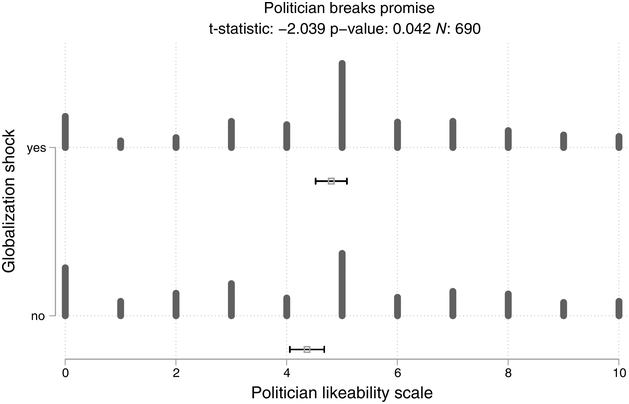
Figure 6.7 Long description
The x-axis shows the politician likeability scale from 0 to 10 and the y-axis distinguishes between with and without globalization shock, specified by yes and no labels. The mean for each sample is represented by a light gray square with black bar confidence intervals. The plot has 690 observations, a t-statistic of negative 2.039, and a p-value of 0.042.
… And When Promise Keeping Is More Important to Voters
Finally, we explore whether the punishment for promise breaking is particularly strong when respondents care a lot about promise keeping. Before the experimental treatments were applied, we ask respondents whether politicians can be right to break their campaign promises when circumstances change between the election campaign and their time in office. Figure 6.8 presents a histogram of the responses. Almost two thirds of respondents (64 percent) do not believe that politicians can be right to break promises if circumstances change after an election. This again reinforces the prominence of promise keeping in the minds of citizens, which is consistent with the theory of promissory representation.
Importance of promise keeping and retrospective sanctioning
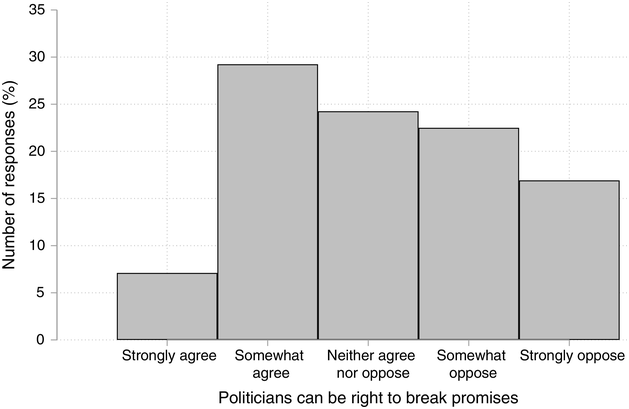
Figure 6.8 Long description
A histogram where the x-axis shows varying agreement with the idea that politicians can be right to break promises, namely strongly agree, somewhat agree, neither agree nor oppose, somewhat oppose, and strongly oppose, and the y-axis shows the number of responses from 0 to 35%. An obvious minority strongly agree at less than 10%.
Figure 6.9 compares respondents who believe that politicians should generally keep their promises even when circumstances change (top row) with respondents who believe politicians can be right to break promises when circumstances change (bottom row).Footnote 11 We indeed find that promise-breaking politicians are liked significantly less by respondents who believe that politicians should generally keep their promises even when circumstances change. When politicians break their promises, respondents who do not consider promise keeping important still rate them relatively favorably, giving an average likeability score of 5.46. The likeability declines to 4.68 for respondents who believe that promise keeping is important. The effect is statistically significant (p<0.001).
Respondents’ beliefs about promise keeping and retrospective sanctioning
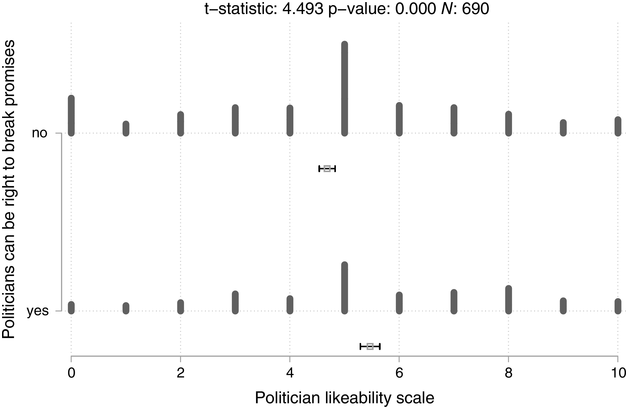
Figure 6.9 Long description
The x-axis shows the likeability scale from 0 to 10 and the y-axis distinguishes between respondent sentiment regarding broken promises, labeled yes if politicians can be right in doing so and no if they can't. The mean for each sample is represented by a light gray square with black bar confidence intervals. The plot has 690 observations, a t-statistic of 4.493, and a p-value of 0.000.
Citizen Perspectives
The previous sections reveal important patterns in democratic accountability. However, these approaches necessarily abstract away from the rich, contextual, and personal ways in which voters experience political betrayal. To further explore the enduring consequences of breaking campaign promises, this section shifts our analytical lens from aggregate patterns and causal effects to individual-level experiences, examining how French citizens who voted for the Socialist Party candidate François Mitterrand in 1981 made sense of the broken campaign promises that followed his election. Through semistructured interviews with eighteen French citizens who supported François Mitterrand in 1981, we examine the complex emotional terrain that lies between the moment when promises are broken and the electoral sanctions that may follow years later. This approach allows us to understand not just that voters punish promise breaking, but how they interpret, rationalize, and emotionally process these experiences of broken campaign promises. The analyses in this section move beyond overt punishment by citizens to demonstrate that memories of broken promises can linger for many decades and have lasting effects on citizens’ views on politics.Footnote 12
The French governing Socialist Party’s dramatic policy reversal in 1983 is an exemplary case of promise breaking under the constraints of economic globalization (Hellwig Reference Hellwig2015). François Mitterrand won the 1981 presidential election to become the first Socialist president of the Fifth Republic. The Socialist Party’s election manifesto was called the 110 Propositions for France, and it contained a range of radical leftist policies including increasing welfare payments, nationalizing banks and key industries, and introducing large job creation programs (Lacombe Reference Lacombe, Gueniffey and Lorrain2018). As the new government began to implement many of these measures, their fiscal and inflationary consequences soon became apparent. These pressures were difficult for the government to reconcile with the constraints of France’s membership of the European Monetary System (EMS) according to which the value of the French Franc was supposed to remain within a narrow range of other EMS currencies. Some of Mitterrand’s advisors called for France to exit the constraints of the EMS and further devalue its currency, but these calls were resisted by a coalition supportive of the European project (Burlaud Reference Burlaud2017). Those in favor of remaining in the EMS argued that exiting it would only worsen the country’s economic woes. France’s dependency on oil imports meant that currency devaluation would have led to even higher import prices. A short period of intragovernment debate was resolved in March 1983, when the government decided to remain in the EMS and implement a series of austerity measures including tax increases and spending cuts. This case “offers the clearest illustration of the triumph of international constraints over national sovereignty. In 1983, just two years after securing election on a pledge to undertake a ‘rupture with capitalism’ and to lift state intervention to new heights … Mitterrand reversed course” (Levy Reference Levy1999: 19).
The negative electoral consequences of this U-turn have been documented extensively. There was an immediate sharp drop in Socialist Party membership as members became disillusioned by the party’s inability to influence government policies (Burlaud Reference Burlaud2017). The Socialist Party experienced a dramatic loss in electoral support between the 1981 presidential elections and the 1984 European elections when it lost almost 5 million votes (Levy and Machin Reference Levy and Machin1986). The Socialist Party also fared poorly in the 1986 national legislative elections. Furthermore, many analysts contend that the governing Socialist Party’s broken promises constituted a turning point that fundamentally reshaped French politics. Notably, the French radical-right in the form of the National Front gained popularity around that time. Hargreaves (Reference Hargreaves2012) infers a direct causal link between these developments, noting that it was soon after the Socialist government’s austerity turn of 1983, that a significant portion of the electorate began supporting the National Front, which railed against traditional parties and attempted to refocus the political debate around ethnic differences. In another fundamental shift since the early 1980s, French voters became increasingly skeptical that their national governments could influence economic policies and outcomes, shifting their attention to noneconomic issues (Hellwig Reference Hellwig2015). In short, in line with the analyses presented earlier in this chapter and elsewhere in this book, the French government’s broken promises had a range of clearly quantifiable negative consequences.
The interviews reveal that citizens’ reactions to broken promises are far more layered than simple vote switching or abstention. Most respondents expressed disappointment and disillusionment, yet these emotions coexisted with enduring partisan attachments and a pragmatic understanding of the economic and international constraints that limited government action. Rather than abandoning their political preferences, many reconciled their expectations with perceived realities, maintaining loyalty even as trust eroded. These qualitative findings complement the earlier evidence of electoral punishment, by revealing how disappointment – even disillusionment – can coexist within the same individuals.
Accessing Memories
Semistructured interviews with individual citizens are a well-established method for understanding electoral behavior and citizens’ political reasoning. This method is used in a distinguished tradition in political science research, though its application to retrospective studies of electoral memory presents unique opportunities and challenges.
In-depth interviews with citizens featured prominently in the pioneering work of Paul Lazarsfeld and his colleagues. In their landmark study The People’s Choice (1944), Paul Lazarsfeld, Bernard Berelson, and Hazel Gaudet conducted what is widely recognized as the first systematic panel study of voting behavior during the 1940 presidential election in Erie County, Ohio. Their approach demonstrated the value of combining quantitative surveys with qualitative follow-up interviews to understand vote switching and political reasoning. When respondents changed their vote intentions, they were interviewed in detail about their reasoning, providing insights into the micro-processes of political decision-making that surveys alone could not capture. Through this approach, the researchers captured in vivid and visceral detail how citizens’ votes were influenced by their social environment. For instance, one woman recounted how “[t]he lady where I work wanted me to vote. She took me to the polls and they all voted Republican so I did too” (Lazarsfeld et al. Reference Lazarsfeld, Berelson and Gaudet1944, 157). Similarly, the influential American Voter study by Campbell, Converse, Miller, and Stokes (Reference Campbell, Converse, Miller and Stokes1960) employed extensive face-to-face interviews with voters across multiple presidential elections to reveal the reasoning processes underlying vote choice, particularly through open-ended questions about political attitudes and the factors influencing electoral decisions.
More recent scholarship has demonstrated the value of intensive qualitative research with modestly sized samples of citizens in specific contexts. Katherine Cramer’s The Politics of Resentment (2016) represents a significant contemporary application of semistructured interviews and participant observation in electoral research. Cramer conducted extensive fieldwork across twenty-seven Wisconsin communities, spending time with groups from 2007 to 2012. This involved sustained engagement with citizens in their natural settings, revealing how rural consciousness shaped electoral preferences and political reasoning in ways that large-scale surveys had missed.
The study of citizens’ understanding of campaign promises has particularly benefited from qualitative interviewing methods. Elin Naurin’s book Election Promises, Party Behaviour and Voter Perceptions (2011) employed seventeen in-depth interviews with Swedish citizens to understand why public perceptions of promise keeping diverged so dramatically from scholarly findings. Through careful probing, Naurin discovered that citizens often define promise fulfillment in terms of outcomes they personally experience, while scholars focus on governmental actions. Her interviews revealed that “people emphasize the outcome of politics when they evaluate election promises,” with citizens expecting to see tangible improvements in their daily lives rather than merely policy changes (Naurin Reference Naurin2011: 134). This finding could have emerged only through open-ended conversation that allowed respondents to explain their reasoning in their own terms.
Semistructured interviews are particularly well suited for exploring the emotional and interpretive dimensions of political experience because they allow researchers to probe beyond surface-level responses to understand the reasoning, emotions, and narratives that citizens use to make sense of political events. Unlike structured surveys, which constrain respondents to predetermined categories, semistructured interviews permit the discovery of unexpected themes and perspectives that might not have occurred to researchers in advance. This methodological flexibility is crucial when studying emotional responses to promise breaking, where citizens may employ complex psychological strategies to reconcile their initial support with subsequent disappointment.
Studying citizens’ memories of political events from over four decades ago presents both unique methodological challenges and distinctive research opportunities that make semistructured interviews particularly useful. Research into historical political episodes must depend fundamentally on citizens’ retrospective accounts and the meaning they attach to past events. The challenge of memory decay and reconstruction is well documented in psychological research, yet this apparent limitation becomes a methodological strength when the research question centers on how citizens make sense of political disappointment and promise breaking over time. Citizens’ memories of France in the early 1980s are not simply data to be verified against historical records; they are themselves the primary phenomenon of interest. How citizens remember, interpret, and narrate their experience of broken promises reveals the long-term political consequences of electoral disappointment in ways that contemporaneous data cannot capture. Through careful questioning, interviewers can explore not only what citizens remember about specific events, such as the 1983 austerity turn and specific broken promises, but also how they have come to understand those events considering subsequent political developments. This layered understanding of political memory – encompassing both immediate recollections and evolved interpretations – provides insights into the durability of electoral effects that no other method can achieve. Moreover, the passage of time creates an opportunity for citizens to reflect on political events with a perspective unavailable to contemporary observers. Citizens interviewed today about the Mitterrand presidency can draw connections between 1980s promise breaking and broader patterns in French politics, offering insights into how electoral disappointment shapes long-term political attitudes and party loyalty. This temporal distance allows for a kind of political reflection and analysis that citizens engaged in the immediate aftermath of events may not have been able to articulate.
Respondents were recruited through snowball sampling, a nonprobability sampling method widely used in political science research for accessing specific populations (Tansey Reference Tansey2007). This approach is particularly appropriate when studying populations defined by shared historical experiences, as in this case where the target group consists of individuals who voted in specific French elections over four decades ago. Snowball sampling has been validated in political science research for studying hard-to-reach populations and those with shared characteristics (Heckathorn Reference Heckathorn2011). The sampling process began with two initial contacts known to Emma Suissa, the research assistant who conducted the semistructured interviews. Emma Suissa is a native French speaker and political science undergraduate student at the time of writing. From these initial “seed” contacts, the sample expanded through referrals to eventually include eighteen respondents. This sample size aligns with established practices in qualitative political research, where samples of twelve to twenty-five respondents are typical for in-depth interview studies (Mosley Reference Mosley2013).
The final sample of eighteen respondents achieved substantial demographic variation while maintaining focus on the target population of citizens who voted for Mitterrand in the second round of the 1981 presidential election. The sample included nine women and nine men, with ages ranging from 70 to 88 (mean age 79 years). This age distribution reflects the requirement that participants be old enough to have voted in the 1981 elections. The sample incorporated both working-class and middle-class respondents, including individuals from working-class backgrounds who had achieved middle-class status during their careers. Occupationally, the sample encompassed a diverse range including manual workers (e.g., a carpenter), white-collar professionals (e.g., executive assistants, librarians, archivists), and business managers, reflecting the broader socioeconomic diversity of the French electorate during this period. The eighteen interviewees included two married couples who were interviewed together, though each couple was interviewed separately. This had the advantage that it allowed the couples to reminisce together, which stimulated the memory process. However, because they were interviewed together, these interviewees cannot be considered independent observations and in both cases each husband-and-wife couple expressed the same views and themes. While the respondents represent a diverse range of people, they are clearly not a random sample of French citizens. The purpose of this study is not to make statistical generalizations to the population but rather to explore the meaning of citizens’ long-term emotional responses to broken promises.
The semistructured interview protocol was designed to explore citizens’ emotional responses to promise breaking, their memories of key political events, and the behavioral consequences for their subsequent voting decisions. The French text of the protocol used in the interviews and the English translation can be found in the online Supplementary Material. The protocol was structured around core thematic areas that directly address our central research concern: understanding how citizens experienced and responded to the French Socialist Party’s dramatic policy reversals following the 1981 elections. The interview guide incorporated prompts about major events of the early 1980s to assist respondents in recalling the specific context of the period. The protocol avoided leading questions about promise breaking, instead allowing themes to emerge naturally from respondents’ own narratives about their political experiences during this period. Questions were designed to elicit responses regarding key dimensions: retrospective evaluations of the 1981 campaign promises, perceptions of the government’s performance during the 1981–1986 period, and the influence of these perceptions on subsequent attitudes and voting behavior. This structure enables analysis of both the immediate emotional responses to promise breaking and its longer-term attitudinal and behavioral consequences, addressing a key gap in existing research on promissory representation.
All interviews were conducted by research assistant, Emma Suissa, in the period July to September 2025. The use of a native speaker was essential for capturing the nuanced emotional content of respondents’ recollections and ensuring that subtle aspects of political discourse and memory were not lost in translation. This approach follows established best practices in cross-cultural political research, where linguistic and cultural familiarity can significantly enhance data quality. The interviews were conducted in an informal, conversational style designed to encourage open reflection and storytelling about political experiences. All interviews were digitally recorded with explicit informed consent from participants. The recordings were subsequently transcribed verbatim to preserve the exact language used by respondents, which is crucial for analyzing emotional content and political discourse.
The analysis of interview transcripts followed a thematic analysis approach designed to identify patterns in how citizens experienced and responded to promise breaking (Braun and Clarke Reference Braun and Clarke2006). Thematic analysis was selected as the primary analytical method because of its flexibility in handling the complex emotional and cognitive content of political narratives while maintaining systematic rigor in identifying patterns across cases. This analysis followed the process established by Braun and Clarke (Reference Braun and Clarke2006): familiarization with the data, generation of initial codes, searching for themes, reviewing and refining themes, defining and naming themes, and producing the final list of themes. The themes covered personal narratives concerning political attitudes and emotional responses to political events. An initial list of themes was generated by large language model (LLM) analysis, which represents an emerging practice in qualitative research, where LLMs can assist in identifying patterns and themes while providing a point of reference for human analysis. The LLM analysis was conducted using Anthropic’s Claude 3.5 Sonnet, and the specific prompt used is provided in the online Supplementary Material. The LLM analysis does not replace human judgment but provides an additional analytical perspective that could highlight themes or patterns that might be overlooked by a single human coder. We then compared and integrated the themes generated with the help of the LLM with a list of themes we generated independently. After formulating the final list of themes, each transcript was tagged with the themes it contained to enable comparison across respondents and identification of both common patterns and significant variations (Guest, MacQueen, and Namey Reference Guest, MacQueen and Namey2012). Throughout the analysis, particular attention was paid to selecting representative quotations that exemplify key themes while preserving respondent anonymity.
Mapping Emotional and Cognitive Responses
The semistructured interviews with eighteen French citizens who voted for François Mitterrand in 1981 reveal a complex and nuanced pattern of responses to the Socialist government’s dramatic policy reversals following the 1983 austerity turn.Footnote 13 Rather than a uniform reaction of electoral punishment, our thematic analysis uncovers six distinct but often overlapping dimensions of citizens’ emotional and cognitive processing of broken campaign promises. These themes illuminate the various ways in which voters navigate the tension between democratic expectations, performance, and economic constraints. Table 6.2 summarizes the themes, which we discuss and illustrate one by one.
| Theme | Number of interviewees (out of 18) |
|---|---|
| Theme 1: Disappointment in Mitterrand and/or the Socialist Party Government of the 1980s | 11 |
| Theme 2: Disillusionment and loss of trust in political parties | 12 |
| Theme 3: Memories of better times | 18 |
| Theme 4: Economic constraints and realism | 14 |
| Theme 5: Persistent Socialist identity | 17 |
| Theme 6: Migration to far-left or far-right parties | 2 |
Note: Frequency of themes extracted from interviews with eighteen French citizens.
Theme 1: Disappointment in Mitterrand and the Socialist Party Government
The first theme captures the immediate emotional responses of citizens who experienced direct disappointment with Mitterrand’s failure to fulfill his campaign promises. This theme was present in the transcripts of interviews with eleven of the eighteen interviewees, indicating that most of them felt some degree of personal letdown with the Socialist government’s performance during the 1980s. However, this disappointment was distinct from broader systemic disillusionment with politics as this theme focuses specifically on Mitterrand and his government’s policy reversals rather than democratic institutions more generally.
Marie-Claire exemplifies the intensity of this disappointment, repeatedly emphasizing her emotional response:
Tout ce que je retiens de Mitterrand, c’est qu’il n’a pas tenu … Ah oui, déçu, déçu, déçu. (All I remember about Mitterrand is that he didn’t keep [his promises] … Oh yes, disappointed, disappointed, disappointed).
The repetition in her language conveys not merely cognitive dissatisfaction but genuine emotional pain at the experience of broken trust. Similarly, Philippe expressed feeling both “Déçu, déçu. Déçu et trahi, bien sûr” (“Disappointed, disappointed. Disappointed and betrayed, of course”), using the stronger term “betrayed” to indicate that his disappointment carried moral dimensions beyond simple policy disagreement.
Henri’s disappointment focused on specific policy reversals, particularly the abandonment of nationalization promises:
Il n’a pas tenu ses promesses. C’était quoi les promesses? Il devait nationaliser … Et quoi d’autre? Oui, c’est plus une politique de rigueur (He didn’t keep his promises. What were the promises? He was supposed to nationalize … And what else? Yes, it became more of an austerity policy).
This quote illustrates how disappointment often stemmed from citizens’ clear recollection of specific commitments that were subsequently abandoned.
Notably, not all respondents experienced this theme despite supporting Mitterrand in 1981. Some respondents demonstrated a more pragmatic attitude toward promise keeping, suggesting that individual personality and expectations shaped the emotional impact of policy reversals. The prevalence of this theme nonetheless indicates that most citizens who invested hope in Mitterrand’s Socialist vision experienced genuine disappointment when that vision was abandoned for austerity measures.
Theme 2: Disillusionment and Loss of Trust in Political Parties
Building beyond specific disappointment with Mitterrand, the second theme encompasses broader systemic disillusionment with political parties and democratic representation itself. This theme appeared in the transcripts of twelve of the eighteen respondents, indicating that the 1983 policy reversals often catalyzed more fundamental skepticism about the capacity of any political party to deliver on campaign promises.
Bernard captured this systematic skepticism:
On ne peut pas avoir confiance totalement aux promesses de nos formations politiques. Parce que tant qu’il soit eu, on change de proposition (We can’t have complete confidence in the promises of our political formations. Because as soon as they’re elected, they change their proposals).
This quote reveals how the specific experience of Socialist broken promises generalized into a broader skepticism about the reliability of campaign commitments across the political spectrum.
Henri’s analysis extended this disillusionment to understanding its broader electoral consequences:
Il a bluffé un peu les Français … Il y en a beaucoup qui ont été vraiment déçus et qui n’ont plus voté socialiste après (He kind of bluffed the French … Many were really disappointed and never voted Socialist again).
This observation suggests that Theme 2 represents not just individual attitude change but a collective erosion of trust that had lasting consequences for French electoral politics. Meanwhile, Monique’s disillusionment focused specifically on the Socialist Party’s contemporary condition:
Le parti socialiste, il m’a tellement déçu … Il n’y a plus de vrais socialistes (The Socialist Party has disappointed me so much … There are no real Socialists left).
Her language suggests that the 1983 experience fundamentally altered her understanding of what the Socialist Party represented, creating a sense that authentic left-wing politics had been permanently compromised.
The significance of this theme lies in its institutional implications. Unlike Theme 1’s focus on specific personalities or governments, Theme 2 represents a more profound challenge to democratic representation itself. Citizens experiencing this disillusionment may continue to participate in electoral processes while maintaining systematic skepticism about politicians’ capacity to deliver on their commitments, a pattern that could undermine the foundation of democratic accountability.
Theme 3: Memories of Better Times
Despite disappointment and disillusionment, all eighteen respondents had positive recollections of the early 1980s period, making this the most universal theme in our analysis. These memories encompassed both the political excitement surrounding Mitterrand’s 1981 victory and personal or family economic security during the early years of his presidency. The universality of this theme suggests that even citizens who became highly critical of Mitterrand’s later performance retained fond memories of the hope and prosperity that characterized the initial period.
The political dimension of these memories often focused on the historic significance of Mitterrand’s election. Jacqueline and Marcel vividly recalled the celebration:
Enfin ça a été vraiment une explosion de joie … On était tous très heureux … on a bu champagne… c’était un jour de gloire … je me rappelle vraiment cette image quand il a défilé sur les Champs-Élysées (It truly was an explosion of joy … We were all very happy … we drank champagne … it was a day of glory … I really remember that image when he paraded on the Champs-Élysées).
This quote captures the euphoric atmosphere surrounding the first Socialist presidency of the Fifth Republic and suggests that these memories remained emotionally significant despite subsequent disappointments. Marie-Claire’s recollection emphasized the community dimension of the celebration:
Et puis Mitterrand, on a fait une fête. … On habitait un immeuble et plein de gens de l’immeuble sont venus (And then when Mitterrand won, we threw a party. We lived in an apartment building and lots of neighbors came).
These memories reveal how Mitterrand’s victory created moments of social solidarity and shared political identity that transcended individual voting behavior.
The economic dimension of these memories focused on personal and family prosperity. Colette fondly recalled:
On vivait bien. On avait un bon salaire. C’était la belle vie (We lived well. We had a good salary. It was the good life).
Henri similarly remembered:
La situation économique, pour nous, elle était bonne. Il y avait de l’emploi. Il n’y avait pas de problèmes (The economic situation, for us, was good. There were jobs. There were no problems).
The persistence of these positive memories despite subsequent disappointment suggests their importance in maintaining citizens’ connection to democratic politics. These recollections may serve as a psychological resource that enables citizens to maintain hope for political change even when experiencing systematic disillusionment with political parties. The universality of Theme 3 indicates that the early 1980s represented a genuinely positive period in these citizens’ political lives, creating a benchmark against which subsequent political experiences were measured.
Theme 4: Economic Constraints and Realism
A substantial majority of respondents (fourteen of eighteen) demonstrated understanding of the economic constraints that limited the Socialist government’s ability to fulfill its campaign promises. This theme reveals that citizens’ disappointment with broken promises was often tempered by realistic appreciation of the international and domestic economic pressures that forced policy reversals. The prevalence of this theme challenges simplistic ideas of electoral punishment by showing that many voters developed sophisticated understanding of how economic globalization constrains national government autonomy.
Michel expressed perhaps the most articulated version of this understanding:
On sait bien que les promesses, ça n’engage que ceux qui les reçoivent, pas ceux qui les donnent. Donc non, … il y avait le principe de réalité qui s’appliquait déjà. Et puis en 88, bon, c’était … En Angleterre, il y avait Thatcher. Enfin c’était un peu le tournant neoliberal (We know well that promises bind only those who receive them, not those who give them. So no, … the principle of reality was already at work. And then in ‘88, well, in England there was Thatcher. It was somewhat the neoliberal turn).
His reference to the “principle of reality” and Thatcher’s neoliberal policies demonstrates sophisticated understanding of how international economic trends constrained French policy options.
Jacqueline and Marcel similarly recognized the role of economic pressures in forcing policy adjustments:
Peut-être se sont-ils rendus compte, au bout de 2 ans, que les raisons économiques ont fait qu’ils ont modifié un peu leur programme … tourné un peu la barre à droite (Maybe they realized, after two years, that economic reasons forced them to adjust their program … to steer a bit to the right).
Their language suggests empathy for the government’s difficult position rather than simple condemnation of broken promises.
Monique demonstrated understanding of how globalization specifically constrained socialist policies:
Il y a le début de la mondialisation et du coup ils privatisent … alors que Mitterrand avait promis de nationaliser (Globalization was beginning and so they privatized … whereas Mitterrand had promised to nationalize).
This quote reveals awareness that domestic policy promises could be undermined by international economic forces beyond national government control.
Brigitte explicitly linked policy reversals to European constraints:
En 1983, sous la pression de l’Europe, … il est obligé de faire une politique de rigueur (In 1983, under pressure from Europe, … he was compelled to implement an austerity policy).
Her use of “obligé” (compelled) suggests understanding that the government faced external compulsion rather than free choice in abandoning its socialist program.
The prevalence of this theme indicates that these French citizens developed sophisticated understanding of economic globalization’s impact on national politics. Rather than simply punishing governments for broken promises, many of them recognized the constraints facing elected officials. This understanding may help explain the persistence of democratic legitimacy despite widespread promise breaking, as citizens distinguish between governments that betray their commitments willfully and those that face genuine external constraints.
Theme 5: Persistent Socialist Identity
Despite experiencing disappointment and developing broader disillusionment with politics, almost all respondents (seventeen of eighteen) maintained persistent left-wing or Socialist identities that continued to influence their voting behavior. This near-universal prevalence makes Theme 5 the second-most common pattern in our analysis, suggesting that political identity demonstrates remarkable resilience in the face of broken promises and policy failures.
Many respondents expressed their persistent identity through continued Socialist voting despite their criticisms. Monique exemplified this pattern:
Je votais toujours socialiste, bien sûr (I always voted Socialist, of course).
The casual certainty in her language (“bien sûr”) suggests that continued Socialist voting remained natural and obvious despite her expressed disappointments with the party.
Michel expressed a strong version of persistent identity:
Interviewer: “Vous avez toujours été à gauche?” Respondent: “Oui, j’ai toujours voté à gauche, sauf aux municipales. Mais sinon, j’ai toujours voté à gauche, oui. Oui, je suis viscéralement de gauche” (Interviewer: “Have you always been on the left?” Respondent: “Yes, I have always voted left, except in municipal elections. But otherwise, I have always voted left, yes. Yes, I am viscerally on the left”).
His use of “viscéralement” (viscerally) suggests that his left-wing identity operated at a deep emotional and physical level that transcended rational political calculations.
Marie-Claire’s identity manifested partially through rejection of right-wing alternatives:
Toujours à gauche. À gauche, socialiste. Toujours. … De ma vie, je ne voterai jamais Le Pen. Jamais (Always on the left. Left, Socialist. Always. … In my life, I will never vote Le Pen. Never).
Her emphatic rejection of the far-right demonstrates how persistent Socialist identity could be maintained through negative positioning against unacceptable alternatives.
Jacqueline and Marcel articulated their persistent identity through consistent voting behavior across multiple elections:
À chaque fois qu’on devait voter, à chaque fois, on a voté de gauche … On a revoté Mitterrand … On a voté Hollande … on est restés fidèles à nos idées premières (Every time we had to vote, we voted left … We voted for Mitterrand again … We voted for Hollande … we remained true to our original convictions).
Their language emphasizes fidelity to original political convictions despite changing political circumstances.
The near universality of Theme 5 reveals the deep rootedness of political identity among this group of Socialist voters. Even respondents who expressed strong disappointment or systematic disillusionment typically continued to identify with left-wing politics and vote for Socialist candidates. This persistence suggests that political identity serves as a psychological anchor that enables citizens to maintain democratic engagement even when experiencing repeated disappointments with political performance.
Theme 6: Migration to Far-Left or Far-Right Parties
In sharp contrast to the near-universal persistence of Socialist identity, only two respondents migrated toward far-left or far-right parties following their disappointment with Socialist broken promises. This low prevalence suggests that while broken promises may create conditions for political extremism, most citizens who experience disappointment with mainstream parties do not abandon democratic center-left politics entirely.
The two cases of migration followed different patterns. Colette migrated toward the far-right. Her shift from Socialist to Rassemblement National (formerly Front National) represents the type of electoral migration that analysts have linked to working-class disillusionment with mainstream left parties. By contrast, Bernard migrated toward the far-left, switching to Communist voting:
Interviewer: “Comment avez-vous voté aux élections législatives de 86?” Respondent: “Je pense que j’ai voté communiste” (Interviewer: “How did you vote in the 1986 legislative elections?” Respondent: “I think I voted Communist”).
His migration represents a different pattern, maintaining left-wing identity while seeking more radical alternatives to disappointing Socialist performance.
The rarity of Theme 6 has significant implications for understanding democratic stability under conditions of promise breaking. While broken promises clearly create potential for political extremism, the overwhelming majority of disappointed voters remained within the democratic mainstream. This pattern suggests that other factors, such as persistent political identity (Theme 5) and understanding of economic constraints (Theme 4), may serve as protective factors against extremist migration.
Overlapping Themes and Patterns
The complexity of citizens’ responses to broken promises becomes most apparent when examining theme overlap. Respondents averaged 4.1 themes each, with none expressing fewer than three themes and one respondent expressing all six themes simultaneously. This high degree of overlap indicates that voters’ responses to promise breaking involve multiple psychological processes that operate simultaneously, sometimes in tension with each other.
The most common pattern involved citizens who experienced both disappointment (Theme 1) and persistent Socialist identity (Theme 5), a combination present in 10 of the 11 respondents who felt disappointed. This pattern suggests that disappointment with specific political leaders or policies does not necessarily undermine deeper partisan attachments. Citizens can maintain loyalty to political movements while criticizing their representatives – a distinction that may be crucial for understanding democratic resilience.
Another frequent combination involved understanding economic constraints (Theme 4) alongside either disappointment or disillusionment. Of the fourteen respondents who expressed either disappointment or disillusionment, ten expressed an understanding of economic constraints. This pattern appeared in respondents who developed sophisticated appreciation of globalization’s impact on national politics while simultaneously feeling frustrated by governments’ inability to deliver on promises.
The universality of positive memories (Theme 3) combined with high rates of disappointment and disillusionment is perhaps the most psychologically complex pattern. Citizens retained fond recollections of the early 1980s while simultaneously developing critical perspectives on Mitterrand’s later performance and broader skepticism about political parties. This combination may serve a protective psychological function, enabling citizens to maintain hope for political change by preserving memories of when democratic politics delivered meaningful improvements to their lives.
The demographic composition of our interviewees, mostly middle-class citizens with a mean age of 79 years, provides important context for interpreting these thematic patterns. These respondents came of age during the postwar economic boom and experienced the 1981 election as adults with established political identities and economic security. Their responses to broken promises may therefore reflect generational characteristics that distinguish them from younger cohorts who lack similar experiences of political hope and economic prosperity. The predominance of middle-class respondents (fifteen of eighteen) may help explain the high prevalence of understanding economic constraints (Theme 4) and persistent Socialist identity (Theme 5). Middle-class citizens often possess educational and professional backgrounds that facilitate sophisticated political analysis, enabling them to appreciate complex economic relationships between globalization and domestic policy constraints. Their economic security may also have provided psychological resources for maintaining political engagement despite disappointment and disillusionment. There were no noteworthy differences between men and women in our sample regarding the themes they exhibited.
The advanced age of our respondents raises important questions about generational differences in response to broken promises. Citizens who experienced the hope and prosperity of the early 1980s as adults may possess emotional and cognitive resources for managing political disappointment that younger citizens lack. The universality of positive memories (Theme 3) in our sample may reflect this cohort’s unique historical experience of witnessing significant positive change through democratic politics.
Contemporary French citizens who have experienced primarily promise breaking and economic constraint throughout their adult political lives may develop different patterns of response to democratic disappointment. Younger cohorts as well as less prosperous citizens may be more susceptible to systematic disillusionment (Theme 2) and extremist migration (Theme 6) because they lack compensating experiences of successful democratic performance. This generational hypothesis suggests that the protective factors evident in our analysis – positive memories, understanding of constraints, and persistent identity – may be less available to citizens whose political socialization occurred entirely during periods of economic globalization and governmental constraint.
These thematic patterns illuminate the remarkable complexity of citizens’ responses to broken campaign promises, revealing that democratic accountability operates through multiple psychological mechanisms that often work simultaneously and sometimes in different directions. Rather than the simple disappointment followed by electoral punishment, French citizens’ responses to Socialist promise breaking involved processes of emotional processing, cognitive adaptation, and identity maintenance that appear to have preserved democratic engagement on the part of most interviewees. The prevalence of understanding economic constraints alongside persistent political identity suggests that citizens can develop sophisticated appreciation of globalization’s impact on democratic representation without abandoning democratic participation entirely – a finding with significant implications for understanding democratic resilience in an era of constrained governmental autonomy.
Discussion
The findings presented in this chapter show that retrospective sanctions for promise breaking take place even or especially when countries are deeply integrated into the global economy. In line with previous work, our research shows that voters’ support for governing parties is closely tied to those parties’ record of keeping their campaign promises. Moving beyond previous studies, this chapter demonstrates that globalization creates conditions in which voters place even more emphasis on promise keeping. In a globalized world, voters expect their leaders to demonstrate foresight by crafting realistic promises that consider international constraints, mastering the political process for driving through their proposals and demonstrating the integrity to keep promises reliably. When leaders fail to fulfill their campaign promises, voters are unforgiving, because they view it as a marker of incompetence, which is particularly salient in the context of globalization. Furthermore, the qualitative analyses revealed that promise breaking is associated with disillusionment among citizens, even when those citizens understand the complexity of international economic constraints and maintain partisan loyalties. In this respect, the quantitative analyses do not fully capture the negative electoral consequences of promise breaking.
The finding that voters dislike promise breakers and are willing to punish them at the ballot box even in the context of economic globalization presents a significant dilemma for political parties. Globalization makes it more likely that parties break promises and at the same time increases the severity of electoral punishment for doing so. This forces parties to adapt, often in ways that have serious implications for promissory representation. Parties cannot solve this dilemma by making fewer or even no promises (see the findings in Chapter 4) or by using blame-shifting strategies as indicated by this chapter’s findings. Instead, they adapt partly by making more ambiguous electoral appeals, which make it more difficult for voters to discern whether they indeed broke their promises after the election as a more effective strategy of blame avoidance. Chapters 9 and 10 of this book turn to this strategy of vagueness, which has serious negative consequences for democratic representation.
Before turning to parties’ responses to voters’ retrospective sanctioning, the following chapters analyze how political parties adapt to economic integration by adjusting the contents of their electoral appeals. Chapter 7 examines how globalization influences the types of policy issues that parties choose to emphasize as an important part of their ideological positioning. As countries become more deeply integrated into the global economy, they face pressure to adapt their electoral appeals, particularly in areas related to economic governance and market regulation. This has led parties to shift their positions along the traditional left–right economic spectrum, with many mainstream parties moderating or recalibrating their positions to meet voters’ evolving expectations. In parallel, as set out in Chapter 8, we also observe an increased use of populist appeals, especially by center-right parties, as they seek to address voters’ anxieties about sovereignty, inequality, and globalization’s dislocations without fully abandoning their traditional economic stances.
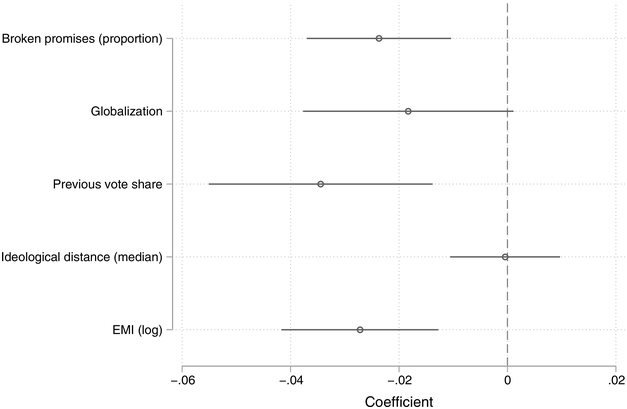
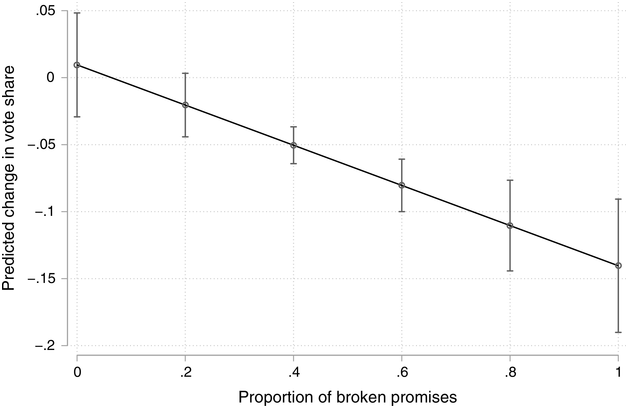
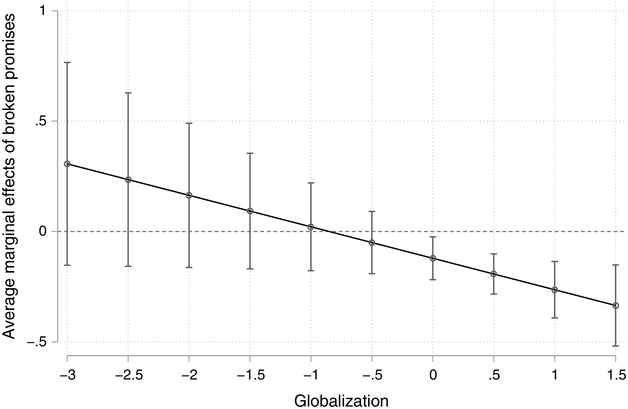
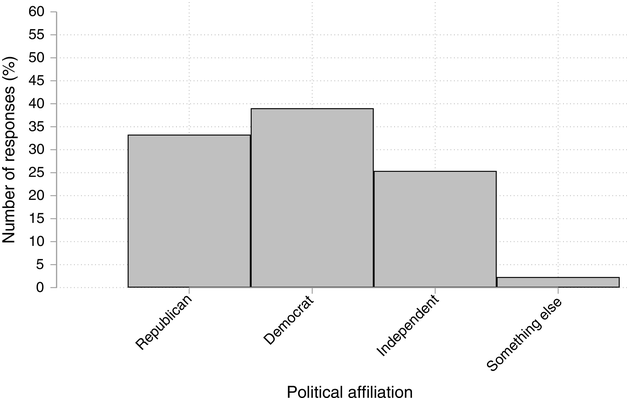
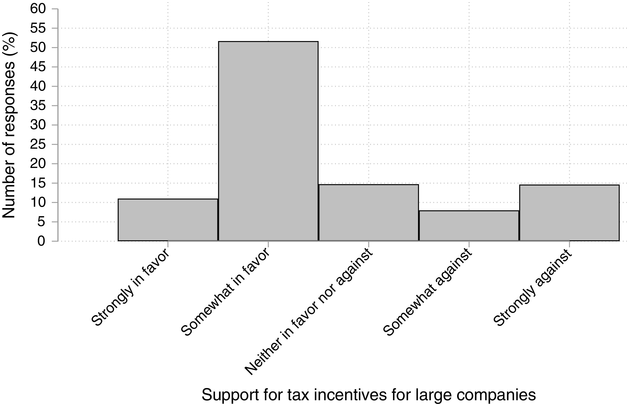
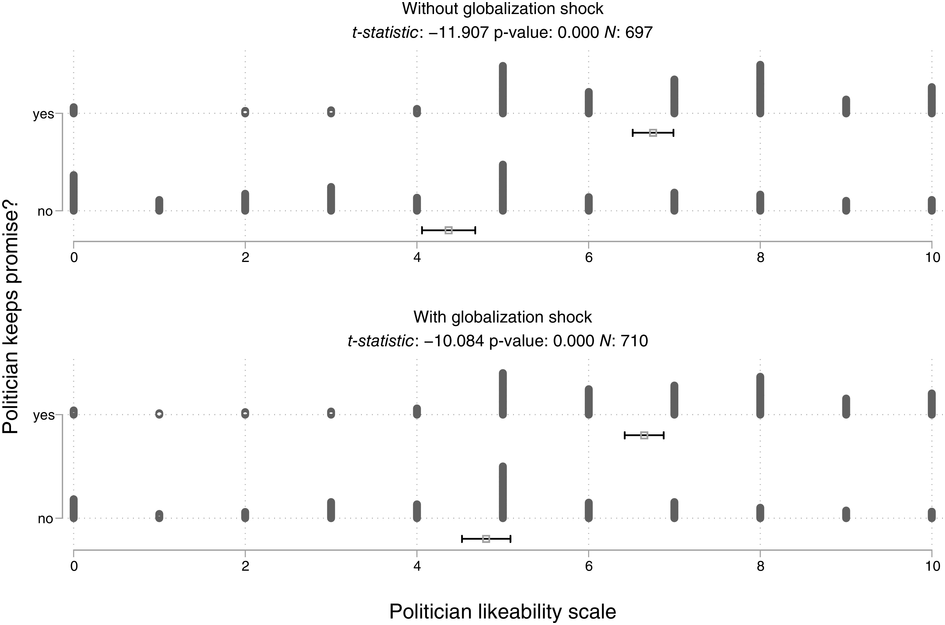
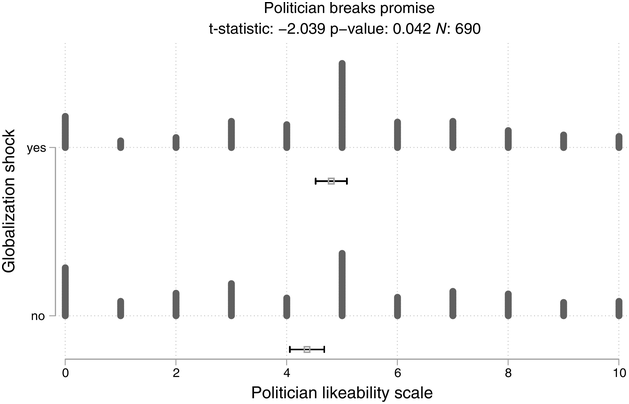
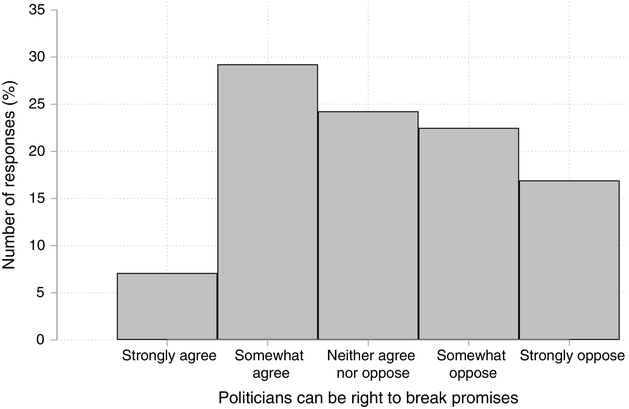
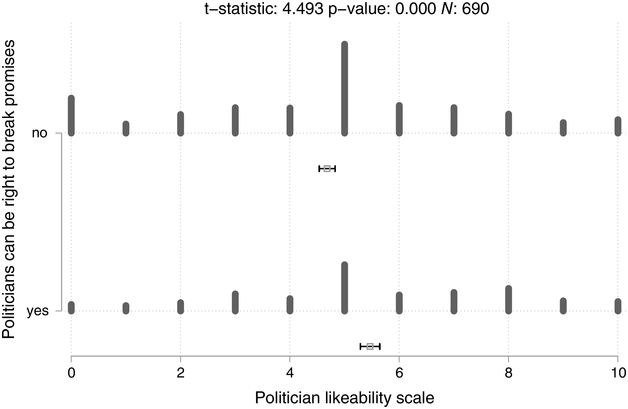

 Open access