


Background and objectives
The COVID-19 pandemic had a devastating impact on many long-term care (LTC) homes around the world, exacerbating and highlighting problems in the way that national health systems provide care to older persons (Estabrooks et al., Reference Estabrooks, Straus, Flood, Keefe, Armstrong, Donner, Boscart, Ducharme, Silvius and Wolfson2020; Heckman et al., Reference Heckman, Kay, Morrison, Grabowski, Hirdes, Mor, Shaw, Benjamin, Boscart, Costa, Declercq, Geffen, Sang Lum, Moser, Onder and van Hout2021). Early in the pandemic, Canada had a higher proportion of COVID-19 deaths in LTC homes than all other OECD countries, with older residents in LTC and retirement homes representing nearly 80 per cent of all COVID-19 deaths in Canada (Stall et al., Reference Stall, Brown, Maltsev, Jones, Costa, Allen, Brown, Evans, Fisman, Johnstone, Juni, Malikov, McGeer, Rochon, Sander, Schwartz, Sinha, Smith, Tuite and Hillmer2021b). The highest proportion of LTC COVID-19 deaths (81%) among OECD countries (where the average was 38%) occurred in Canada (Canadian Institutes for Health Information, 2020).
In the final report published by Ontario’s LTC COVID-19 Commission, the commissioners acknowledged:
When COVID-19 struck Ontario, it devastated the long-term care sector. At the time of writing, 11 staff and almost 4,000 residents had lost their lives. Deaths among long-term care residents represent more than half of all of Ontario’s COVID-19 deaths, even though long-term care residents make up only 0.5 per cent of the population. Many more residents and staff were infected, with a reported 14,984 resident and 6,740 staff cases by March 14, 2021. (Marrocco et al., Reference Marrocco, Coke and Kitts2021, p. 11)
Policy makers and health leaders had no roadmap to follow when the pandemic struck, and this paucity of knowledge included uncertainty about the likely effects of preventing family members from entering LTC homes when the homes were experiencing a COVID-19 outbreak. A rapid review carried out in 2021 of English-language literature on the presence of essential caregivers (who usually, but not always, are family members) in LTC homes during periods of infectious disease outbreaks found only two research studies (along with 13 policy documents) on the subject (Palubiski et al., Reference Palubiski, Tulsieram, Archibald, Conklin, Elliott, Hsu, Stolee, Sveistrup and Kothari2022). As additional health services researchers share their findings from studies conducted in the first 2 years of the pandemic, we are gaining an understanding of the measures taken and the results achieved. For the purposes of this paper, we are especially interested in the policies that affected the ability of essential caregivers to enter LTC homes and provide support to residents during periods of lockdown. In the spring of 2020, Ontario (and other Canadian provinces) issued directives whereby all LTC homes were required to lock down their facilities from visitors.
Scholars have known for some time that relatives and friends provide important care and support for older people living in LTC homes, and that these caregivers play relatively undefined and even unrecognized roles in the homes (Barken & Lowndes, Reference Barken and Lowndes2018). Past studies have found that caregiver relationships with LTC staff can be adversarial and can work to the detriment of the well-being of residents (Hoek et al., Reference Hoek, van Haastregt, de Vries, Backhaus, Hamers and Verbeek2021), and that these caregivers’ ‘…skilled caring expertise tends to be invisible’ (Barken & Lowndes, Reference Barken and Lowndes2018, p. 61). Some have argued that it is vital to find ways to create a collegial partnership among paid and unpaid caregivers in LTC settings (Gallant et al., Reference Gallant, Hardy, Beogo, Conklin, Connelly, Kaasalainen, Keefe, Robitaille, Yous, Fanaki and Cameron2022).
Preventing caregivers from entering LTC homes during the pandemic left residents isolated and deprived of access to their families, who previously had provided daily care to their loved ones (Bardon, Reference Bardon2021). Decades of believing that families are the major transmitters of infections in LTC homes based on little evidence led to the imposition of these visiting restrictions in Canadian and international LTC homes, despite the recognition of the importance of their resident–family communication during the pandemic (Hado & Friss Feinberg, Reference Hado and Friss Feinberg2020). Recent data from LTC homes and hospitals in several countries show that visitors had little or no impact on the spread of COVID-19 among residents, and that residents were more likely to receive the virus from temporary staff or the staff who are in contact with multiple residents and may practice poor hand hygiene and PPE application (Low et al., Reference Low, Hinsliff-Smith, Sinha, Stall, Verbeek, Siette, Dow, Backhaus, Devi, Spilsbury, Brown, Griffiths, Bergman and Comas-Herrera2021; Nguyen et al., Reference Nguyen, Howick, McLafferty, Anderson, Pravinkumar, Van Der Meer and Megiddo2021). Moreover, visiting restrictions are not included among the recommendations by some studies to reduce the risk of spreading COVID-19 in LTC facilities (Stall et al., Reference Stall, Brown, Maltsev, Jones, Costa, Allen, Brown, Evans, Fisman, Johnstone, Juni, Malikov, McGeer, Rochon, Sander, Schwartz, Sinha, Smith, Tuite and Hillmer2021a).
We now know that LTC residents, their families, and staff were impacted by visitor restrictions in various ways. In the case of residents, studies show that social isolation significantly impacts personal health and quality of life (QoL), and that visiting restrictions led to a decline in physical health, and increases in isolation, loneliness, and mood disorders (Bethell et al., Reference Bethell, Aelick, Babineau, Bretzlaff, Edwards, Gibson, Hewitt Colborne, Iaboni, Lender, Schon and McGilton2021; Ferdous, Reference Ferdous2021). Furthermore, responsive behaviours increased in residents with dementia, resulting in an increase in prescribing of antidepressants and antipsychotic medications (Ferdous, Reference Ferdous2021; Hugelius et al., Reference Hugelius, Harada and Marutani2021; Low et al., Reference Low, Hinsliff-Smith, Sinha, Stall, Verbeek, Siette, Dow, Backhaus, Devi, Spilsbury, Brown, Griffiths, Bergman and Comas-Herrera2021; Smaling et al., Reference Smaling, Tilburgs, Achterberg and Visser2022).
According to Dupuis-Blanchard et al. (Reference Dupuis-Blanchard, Maillet, Thériault, LeBlanc and Bigonnesse2021), five key drivers impacted the experiences of Canadian families during the pandemic: lack of workforce, communication deficits with staff to receive news about their residents, concerns about the quality and quantity of care, staying on top of changing directives, and the autonomy of residents. After being prohibited from visiting residents, families started developing negative emotions, including guilt, fear, stress, and worry about their residents (Hugelius et al., Reference Hugelius, Harada and Marutani2021; Low et al., Reference Low, Hinsliff-Smith, Sinha, Stall, Verbeek, Siette, Dow, Backhaus, Devi, Spilsbury, Brown, Griffiths, Bergman and Comas-Herrera2021). In particular, families of residents living with dementia were worried about the quality of care provided to their residents (Hindmarch et al., Reference Hindmarch, McGhan, Flemons and McCaughey2021; Smaling et al., Reference Smaling, Tilburgs, Achterberg and Visser2022).
Staff, on the other hand, faced additional workload and burn-out caused by the absence of families providing daily care and emotional support to residents (Hugelius et al., Reference Hugelius, Harada and Marutani2021; Low et al., Reference Low, Hinsliff-Smith, Sinha, Stall, Verbeek, Siette, Dow, Backhaus, Devi, Spilsbury, Brown, Griffiths, Bergman and Comas-Herrera2021; Smaling et al., Reference Smaling, Tilburgs, Achterberg and Visser2022). Staff turned into residents’ substitute family and reported exhaustion from excessive work and emotional fatigue (Palacios-Ceña et al., Reference Palacios-Ceña, Fernández-Peña, Ortega-López, Fernández-Feito, Bautista-Villaécija, Rodrigo-Pedrosa, Arnau-Sánchez and Lizcano-Álvarez2021).
Our project is based on a partnership we formed with three Ontario LTC homes that were implementing a designated care partner intervention to allow some family members to enter LTC homes during pandemic lockdowns. We used a variety of methods to support the implementation process, measure impacts, and mobilize the knowledge gleaned through our partnership. This paper reports some of the results from one such method, which was an Ontario-wide survey of family caregivers who supported a resident of an Ontario LTC home. The survey was intended to produce an understanding of the nature of the care provided by Ontario’s family caregivers. The results of the quantitative survey are presented in a separate paper. Here, we are concerned with the extensive responses we received to the one open-ended qualitative question that was included in the survey.
Research design and methods
Ethics approval for our study was obtained from the Research Ethics Board of the Bruyère Research Institute (reference number M16-21-002). All research participants who contributed data to this study gave written informed consent by responding to the following question that was presented to them at the start of the survey: ‘I agree to participate in this study on family caregiving in long-term care. I understand that my participation is voluntary and that my name will not be associated with my responses’.
We developed an online survey whose purpose was to shed light on the roles, tasks, and experiences of essential caregivers as they supported residents in Ontario LTC homes. The development of our survey was based on a literature review on essential caregivers’ roles and experiences in residential care settings. We adapted items from the Family Involvement Questionnaire – LTC to record the frequency and time spent by essential caregivers in visiting and providing care to the resident (Fast et al., Reference Fast, Houlihan and Buchanan2019). The survey was supplemented with additional items related to social activities, meals, and financial matters (Fast et al., Reference Fast, Houlihan and Buchanan2019), as well as questions concerning direct and indirect care tasks (Keating et al., Reference Keating, Fast, Dosman and Eales2001). The survey also included items derived from research that was pertinent for the Ontario context (Cohen et al., Reference Cohen, Zimmerman, Reed, Sloane, Beeber, Washington, Cagle and Gwyther2014; Fast et al., Reference Fast, Houlihan and Buchanan2019; Keating et al., Reference Keating, Fast, Dosman and Eales2001; Reid et al., Reference Reid, Chappell and Gish2007; Tsai et al., Reference Tsai, Tsai and Huang2012). The qualitative portion of the survey, which we report on in this manuscript, asked the following question: We are interested in hearing more about your experience. You are welcome to use the space below to share your interpretations, feedback, and reflections on the level of involvement and importance of family members (or other care partners) in providing hands-on care for residents in long-term care homes.
Because the questions were derived from previously developed instruments capturing family involvement in nursing homes, we were able to rely on the significant testing of questions that had already been conducted by previous research teams. For example, the ‘Family Involvement Questionnaire – LTC’ instrument developed by Fast et al. (Reference Fast, Houlihan and Buchanan2019) involved 410 family members in the process of validating the questions that ultimately were included in the instrument. In addition to this, we pilot-tested our survey with an unpaid adult–child caregiver and used the think-aloud method (Ericsson & Simon, Reference Ericsson and Simon1984) to identify questions that were unclear or irrelevant for LTC in Ontario. Two members of the research team reviewed the caregiver’s comments and revisions were agreed on and implemented. The resulting final survey was then created and administered using Microsoft Forms.
We recruited participants through Family Councils Ontario, a not-for-profit organization supporting essential caregivers and family councils in LTC homes across Ontario. We also advertised the study through the Ontario Caregiver Organization, an organization supporting over 3.3 million caregivers in the province, as well as the Ontario Health Coalition, whose mandate is to protect and improve the public health care system. Finally, we directly approached 22 LTC homes that one member of our team had collaborated with on previous research projects; of these, 6 agreed to distribute the survey to family members and designated care partners of residents in their facility. Data were collected between April 8 and June 11, 2021.
The research protocol was approved by the Bruyère Research Institute Research Ethics Board (Protocol #M16-21-002).
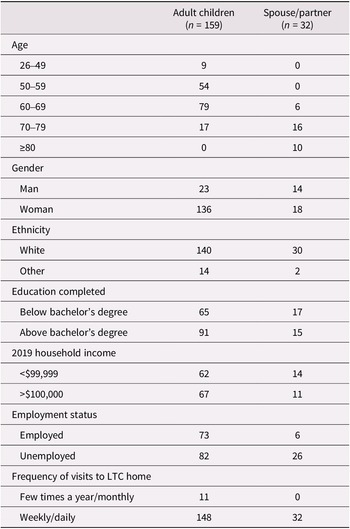
The survey was completed by 192 Ontario caregivers, of whom 71 per cent (n = 159) were children of an LTC resident and 15 per cent (n = 32) were the spouse of a resident. Table 1 provides a summary of the demographic characteristics of survey respondents.
Sociodemographic characteristics of survey respondents

Note: Not all respondents answered all demographic questions.
The 119 respondents who answered the open-ended question provided a large volume of qualitative data about the experiences of caregivers during the first wave of the COVID-19 pandemic, when visitation rights were suspended in Ontario LTC homes, and during the second wave when visitation rights were restored. When placed in a Word document, the raw data that we received in answer to this question consisted of 23 single-spaced pages (or 13,381 words) of commentary. Some comments were brief, consisting of a few sentences, while others ran to lengthy paragraphs. For example, among the 25 lengthiest submissions were those that contained the following number of words: 604, 471, 464, 462, 432, 379, 373, 315, 295, 285, 256, 255, 254, 252, 224, 223, 211, 204, 193, 176, 165, 163, 162, 160, and 159 (and many others ran between 100 and 160 words). To gain an appreciation of the length of these open-ended commentaries, note that the paragraph you are reading contains 160 words. This suggests that many people who filled out this survey had a great deal to contribute in their own voice.
We applied qualitative coding and theming procedures to determine what the data might reveal about the experiences of our survey participants. We used a process that is consistent with recommendations from qualitative methodologists, and in which several of our team members are proficient (Conklin et al., Reference Conklin, Kothari, Stolee, Chambers, Forbes and Le Clair2011;Hsieh & Shannon, Reference Hsieh and Shannon2005; Saldaña, Reference Saldaña2013). We applied an exploratory holistic coding method that allowed us to sort the data into meaningful clusters before undertaking a full thematic analysis (Hsieh & Shannon, Reference Hsieh and Shannon2005; Saldaña, Reference Saldaña2013), and then used a theming procedure that allowed us to identify and describe the broad patterns of ideation, behaviour, and social structuring that were revealed through participant experiences (Conklin, Reference Conklin2021). Figure 1 provides a visual summary of our analytical process.
Our analytical process.

The first step described below relied on a pen-and-paper technique, and subsequent steps made use of MS Word’s structured table functionality. This type of approach is often used when it aligns with the experience and expertise of the lead analyst (Mattimoe et al., Reference Mattimoe, Hayden, Murphy and Ballantine2021), and it can also help analysts to become more immersed in the data, to arrive at more informed choices concerning codes and themes (Mattimoe et al., Reference Mattimoe, Hayden, Murphy and Ballantine2021; Saldaña, Reference Saldaña2013), and to enhance rigor by slowing the analytical process and allowing for a more thoughtful interaction with the data (Maher et al., Reference Maher, Hadfield, Hutchings and De Eyto2018).
To start with, one analyst created an MS Word Analysis Working Document (termed working document hereafter) where all the raw data were imported. The analyst then coded the data. This was done by printing the data file, reading through the file, circling portions of data, and writing down potential code names in the margins. On three occasions during the coding process, the analyst returned to the start of the printed document, reread the data, and considered the wording of the code names, making small adjustments to some code names. When completed, code names had been assigned to 235 data elements.
The analyst then returned to the working document and created a new section with a two-column table. The left column was reserved for code names and the right column for individual segments of coded data (with each code name and data element occupying a separate row). The analyst then sorted the table into clusters of similar codes. To do this, the analyst printed out a list of all code names. The analyst then created a new section of the working document, and copied and pasted the code table into this section. The analyst then created a new left-most column for the table. The analyst then read through the coded table, assigning numbers to the new column to identify codes that had similar or complementary meanings.
Before proceeding further, a second analyst undertook a detailed review of the work done to this point, considering whether any codes were improperly assigned, or whether other discrepancies or errors were evident. This second analyst identified eight concerns, mostly having to do with other ways in which a piece of data might be coded. The second analyst also identified some additional codes that could be added to the initial coding table. The two analysts met to discuss the concerns, and reached an agreement on how each concern should be handled. In addition, as part of this step, the two analysts considered whether numeric clusters associated with fewer than 10 codes should be integrated or combined with the codes associated with another number. As a result of these steps, 246 data elements were now sorted into 13 categories of meaning.
The first analyst then copied the coded and sorted table into a new section of the working document, and reorganized the tables so that all code names and data elements associated with the same number were contiguous with each other. The first analyst then performed a more granular sort on each of the numeric code clusters. For example, the analyst reviewed all codes associated with the number 1, and added a letter (A through D) to further sort the codes into more granular sets of meaning. In the case of these ‘1’ codes, 1A was associated with codes that involved simple assertions about families being on the care team; 1B was associated with codes asserting the importance of the care provided by family members; 1C was associated with codes linking family care with resident well-being or health; and 1D was associated with codes asserting the importance of family presence for monitoring care and well-being. The first analyst then created a working title for each cluster, a count of the number of coded data segments in the cluster, and a brief description of each granular subcode.
In the next step, the analyst used the following procedure to synthesize the data into theme names and descriptions. First, the analyst copied the two cluster tables from the previous step into a new section of the working document. The analyst then merged all the data cells (in the right-most column) for each subcluster of codes (in other words, the cells for the 1A codes, the cells for the 1B codes, etc.). Then, the analyst read through the code names and data for the cluster. At this point, the analyst began to write a description that synthesized the meaning of the 1A codes, drawing on wording from the code names and the data, and incorporating quotations to ensure that the description remained close to the data. This procedure was continued with each subcluster of codes (1B, 1C, etc.). When all subclusters were complete, the analyst wrote a brief paragraph as the overall theme description, in some cases simply drawing on the topic sentences for each subcluster description. Finally, after reviewing the results of this work, the analyst gave a name to the theme. This was then repeated for the 13 other code clusters.
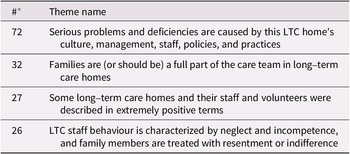
In the next analytical step, the analyst performed some comparisons on the themes. This was done by creating tables showing the number of instances of the coded data for each theme, the theme name, and the theme description. The tables were sorted to compare the data in terms of the number of occurrences of data elements associated with different themes. This step allowed us to determine whether the experiences of these participants were largely homogenous, or whether there were diverse and even inconsistent experiences evident in the data. As evident in Table 2, which shows an output from this analytical step, the data clearly suggest a diversity of experience.
A comparison of the four dominant themes

* Number of times the codes associated with this theme appear in the data.
The final analytical step involved creating a general commentary on the themes. This was done by reviewing the work produced in the previous steps and noting the interesting features about the patterns evident through the theming. At the conclusion of this step, the entire working document was shared again with the second analyst, who reviewed the work and provided comments and suggestions. The resulting final working document was then shared with the full investigator team for review and discussion. The findings that resulted from this analysis form the basis for the next section of this paper.
We provide the full working document as Supplementary File 1, so readers can examine the complete details of our analytical process.
Results
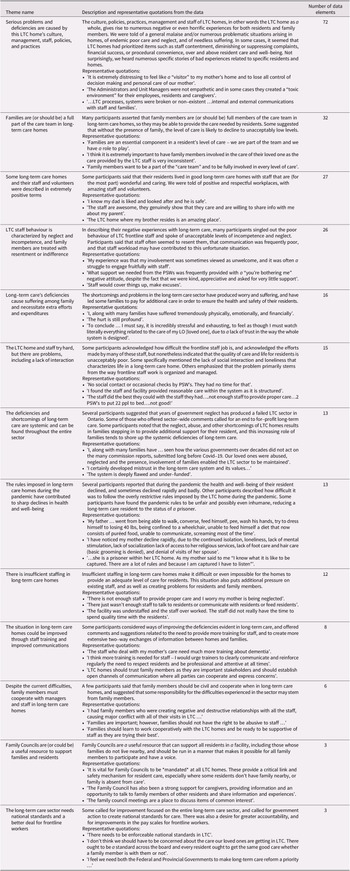
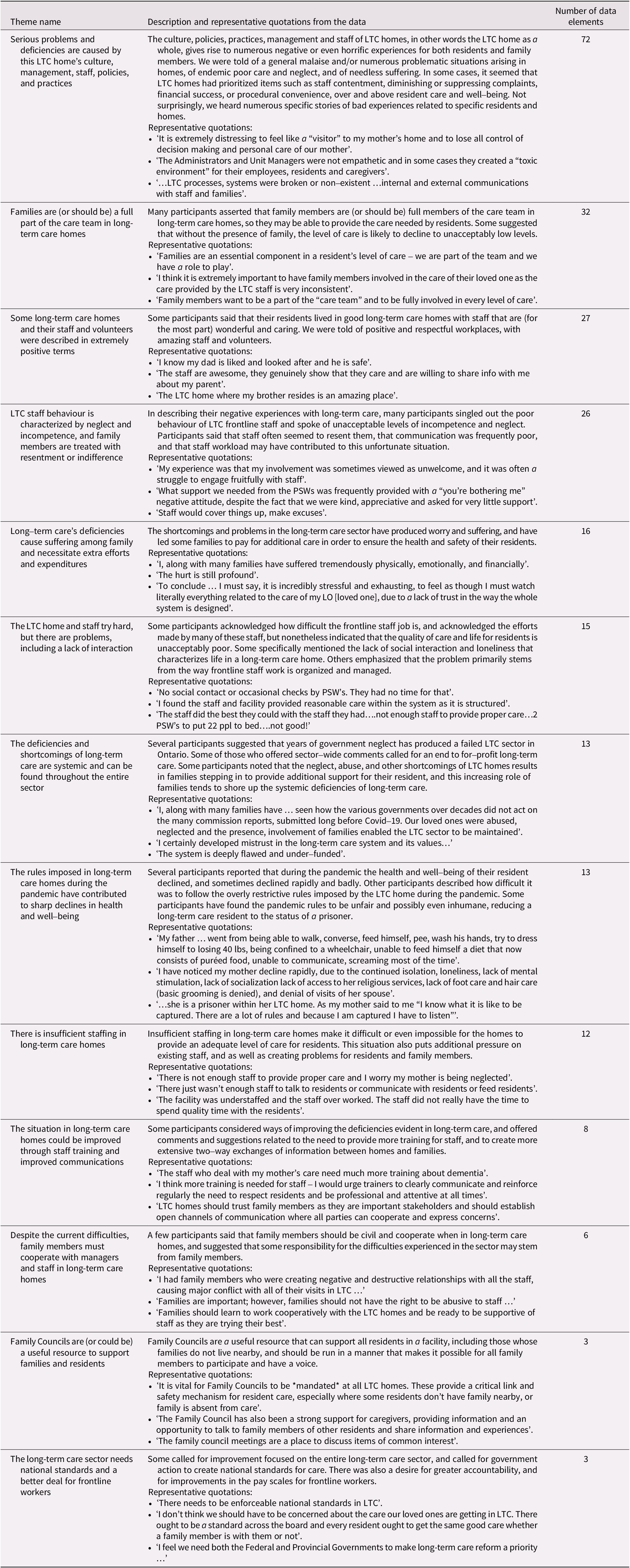
Table 3 shows the theme names and descriptions that emerged from the analysis, along with representative quotations.
Theme names and descriptions
Discussion and implications
An overall tendency made evident through our analysis is that participants often described general or specific experiences, and then explained the meaning or significance that they attributed to those experiences. It was interesting to see that the quality of their experiences (negative or positive) was sometimes attributed to specific individuals who worked in the LTC home, and at other times to broader organizational or even systemic factors that shaped the behaviour of individual actors. For example, the themes ‘Serious problems and deficiencies are caused by this LTC home’s culture, management, staff, policies, and practices’ (associated with 72 data elements) and ‘LTC staff behaviour is characterized by neglect and incompetence, and family members are treated with resentment or indifference’ (26 data elements) tend to attribute negative experiences to specific actors or structures within individual LTC homes. However, the themes ‘The LTC home and staff try hard, but there are problems, including a lack of interaction’ (15 data elements) and ‘The deficiencies and shortcomings of long-term care are systemic and can be found throughout the entire sector’ (13 data elements) offer a situationist interpretation (Ross & Nisbett, Reference Ross and Nisbett2011), suggesting that the attitudes and behaviour of decision makers and frontline workers in the LTC home are heavily influenced by external pressures that often emanate from the provincial Ministry of Health and LTC.
Overall, the themes indicate that participants have observed three distinct tendencies within the LTC sector of Ontario’s health system. One tendency concerns deficiencies within the sector; the second concerns attempts to cope with the deficiencies and produce positive outcomes within the sector; and the third concerns a tendency towards change and improvement. The suggestions for improving the deficiencies of LTC include integrating families more fully with the LTC staff team, increasing the number of frontline staff, providing more staff training, improving the two-way communication between homes and families, making better use of Family Councils to support families and residents, providing better compensation for frontline staff, and creating national standards for LTC.
Viewing the data as revealing conflicting impulses within the system suggests that a force-field analysis may be useful (Shrivastava et al., Reference Shrivastava, Shrivastava and Ramasamy2017). This analysis offers a way of considering the array of forces that might promote or impede change within a human system. Reconsidering our themes in this manner produces Figure 2.
The thematic data presented through force-field analysis.

Finally, the thematic analysis draws our attention to the importance of essential caregivers. The essential role of caregivers in providing care to residents is clear throughout the data. The second strongest theme is the assertion that essential caregivers should be an integral part of the care team. Even many negative comments include statements confirming the vital caregiving role played by family and close friends.
The people who contributed qualitative data to our survey were responding to an invitation to tell us about their experiences as essential caregivers, and about the level of involvement and importance of essential caregivers who provide hands-on care to residents in LTC homes. As the themes discussed above indicate, their answers delineate a pattern with three major strands of meaning. First, the care provided by essential caregivers is perceived to be essential. Second, the care offered by the management and staff of many LTC homes is seen as deficient. Third, the deficiencies arise at least in part from the design and operation of the existing system of LTC, suggesting that policy makers must take action to improve the care provided in Ontario LTC homes.
Our findings are consistent with those of Kemp (Reference Kemp2021), who found that families’ contribution to care has been invisible and taken for granted. Essential caregivers such as family members have been viewed as ‘visitors’ and during the pandemic were prohibited from visiting their residents based on a biomedical model prioritizing infection control. However, the pandemic has shed light on the importance of the care provided by essential caregivers. It highlighted selfhood, human connections, and partnerships between formal and informal care partners and care receivers. Kemp wrote that ‘Families do more than visit’ (Reference Kemp2021, p. 147), and this is surely correct.
Our findings are also consistent with recent studies establishing the importance of this full role played by essential care partners in LTC homes. As others have found, our study shows that visitation restrictions had severe negative impacts on both residents and their families, including strong emotionality and trauma (Cornally et al., Reference Cornally, Kilty, Buckley, O’Caoimh, O’Donovan, Monahan, O’Connor, Fitzgerald and Hartigan2022; Thirsk et al., Reference Thirsk, Stahlke, Perry and Gordon2022). Our work also offers additional support for studies showing the negative impact of a lack of social interaction, declines in the health of residents, and the importance of the advocacy and monitoring role played by family (Cornally et al., Reference Cornally, Kilty, Buckley, O’Caoimh, O’Donovan, Monahan, O’Connor, Fitzgerald and Hartigan2022). Like Cornally et al. (Reference Cornally, Kilty, Buckley, O’Caoimh, O’Donovan, Monahan, O’Connor, Fitzgerald and Hartigan2022), our findings point to the importance of care provided by both essential caregivers and LTC frontline staff and indicate that the people playing these roles would benefit from forging a mutually supportive partnership to improve the care and support received by residents.
We suggest that our most important finding is that essential caregivers have taken on two vital roles in order to shore up significant gaps in the current system. First, they provide care to LTC residents. They do this by providing psychosocial and emotional support for residents, and they sometimes also take responsibility for aspects of basic care. Our data suggest that providing psychosocial and emotional support is a role that is happily assumed by essential caregivers, and is often merely an extension of relationships that have long existed between essential caregivers and residents. However, our data also suggest that many essential caregivers have found it necessary to assume responsibility for providing some of the basic care that is the responsibility of frontline staff.
Second, essential caregivers also play a monitoring and advocacy role that many of our participants describe as vital to the health and well-being of residents. They notice changes or anomalies in the resident’s condition and share their observations with LTC staff. Moreover, they also notice problems or omissions in the care provided to a resident, and if the problem is not addressed they escalate their advocacy by complaining to supervisors and managers and demanding the situation be rectified.
This latter point is important because Ontario’s Ministry of Health and LTC has attempted to assure the quality of care in LTC homes primarily through the creation and strengthening of a compliance regime. For example, on October 26, 2021, 18 months after the COVID-19 pandemic hit Ontario, the ministry announced that it would continue to ‘fix’ LTC by investing $20 million before the end of the year to hire 193 inspections staff (which would double the number of Ontario LTC compliance inspectors) and by improving the inspections program. The Ministry news release that contained this announcement claimed that this measure would ‘…ensure every resident experiences the safest and best QoL, and … [would] hold homes to account for the care they provide’ (Ontario Government News Release, 2021).
However, some studies suggest that Ontario’s reliance on compliance may produce adverse unintended consequences. For example, Hande et al. (Reference Hande, Keefe and Taylor2021) have pointed out that ‘[m]ore than two decades of research emphasize LTRC staff’s difficulties in abiding by rigid regulations while also trying to respond to resident needs and preferences in order to approximate a balance of safe care and QoL …’ (p. 540), and that ‘…current Canadian funding levels do not adequately support staff to exercise the flexibility recognized in these promising policies. Thus, staff may remain stuck between a rock and a hard place when deciding which policies to follow and which activities to abandon because of time, funding, and staffing constraints’ (p. 549). Others have pointed out that the use of compliance regulations does not seem to enhance the adoption of best practices in the care of older adults (Crick et al., Reference Crick, Devey-Burry, Hu, Angus and Backman2020).
Our findings thus draw attention to the fact that the current situation has produced two informal or unpaid roles that are carried out by family and friends: the role of caregiver and the role of advocate. To some extent, the caregiver role is to be expected, given that an essential caregiver is an appropriate person to provide some of the relational care and support that residents need. However, the current LTC system is exploiting this role by requiring that many essential caregivers take on a basic care role that is properly the responsibility of the LTC home. Moreover, family and friends are also acting as informal compliance inspectors, noticing gaps and shortcomings in the care that is provided and in the health and well-being of residents, and reporting these deficiencies to staff and managers.
One might argue that the current system seems broken both in terms of the delivery of its core service to older Ontarians, and also in terms of the compliance safeguards that have been established to assure the quality of the core service. In both cases, essential caregivers must plug the gaps of this broken, malfunctioning system. The fact that the system’s current performance is predicated on two informal and unpaid roles is a clear indication that something is wrong, that there is a gap in the system that is being filled in an emergent and often haphazard manner that is bound to produce unfair results and frequent failures. We suggest that the solution is not to invest further in a compliance regime that has for decades failed to deliver the expected results. Instead, investments must be made in the LTC homes themselves, especially to increase the staffing levels and training of PSWs and other frontline workers.
Our findings provide support for the claims that the problems in LTC are systemic. The data were provided by people who act as essential caregivers to residents in Ontario LTC homes. Our coding and thematic analysis shows that essential caregivers have similar experiences of LTC, experiences that highlight deficiencies, neglect, suffering, and chronic understaffing. Moving forward, we agree with Mackenzie (Reference Mackenzie2022) who recommends that health care leadership guide staff, policymakers, and LTC home operators through a cultural shift embracing family members as care partners whose importance is no less than frontline staff. To start this cultural shift, the health care sector should promote and strengthen the principle that residents are moved to LTC homes not to be cured but to live in physical comfort while engaging in the activities they enjoy.
Limitations
This paper reports findings from a survey that was made available to caregivers throughout Ontario, and people who were aware of the survey made their own decision about whether or not to complete the survey. It is not possible for us to determine if many or most of those who self-selected to complete the survey did so because they shared certain characteristics or opinions. This makes it impossible for us to determine the extent to which our survey respondents are representative of the larger population of caregivers.
Supplementary material
The supplementary material for this article can be found at http://doi.org/10.1017/S071498082400014X.
Acknowledgements
The authors wish to acknowledge the efforts of the 119 Ontarians who contributed the qualitative data on which this article is based. The authors would also like to acknowledge the invaluable support that they received from Healthcare Excellence Canada, the Canadian Institute of Health Research, the Centre for Aging and Brain Health Innovation, the Ontario Centres for Learning, Research, and Innovation in Long-Term Care at Bruyère, and the Ontario Caregiver Organization.