


Introduction
Zoos and aquariums (hereafter ‘zoos’) are committed to wildlife conservation and seek to lead activities for protecting species around the world (AZA 2017). Organizations in the Association of Zoos and Aquariums (AZA) address critical wildlife issues and engage their millions of visitors to participate in environmental conservation. With the expansion of zoos into the roles of conservation centres and educational institutions, zoos provide a unique opportunity to study efforts to promote conservation within institutions and through their collaborations with other organizations (Rabb & Saunders Reference Rabb and Saunders2005).
Environmental problems are complex and require the input and participation of many organizations. Despite zoos’ organizational missions to impact conservation (Miller et al. Reference Miller, Conway, Reading, Wemmer, Wildt and Kleiman2004, Patrick et al. Reference Patrick, Mathews, Ayres and Tunnicliffe2007), an individual zoo cannot solve endangered wildlife and environmental issues on its own. Instead, zoos focused on endangered species can form collaborative alliances to pool resources and enhance the scope of their impacts. Collaborative alliances are necessary when complex problems cannot be resolved by a single organization’s activities (Gray & Wood Reference Gray and Wood1991). Networks facilitate mobilization and allocation of resources (Diani Reference Diani, Diani and McAdam2003a), influence other stakeholders to participate (Shumate & O’Connor Reference Shumate and O’Connor2010b) and influence the movement themselves (Klandermans Reference Klandermans, Morris and Mueller1992).
Zoos can develop partnerships with each other and with environmental organizations to work collectively towards shared conservation goals. Conducting joint projects and communicating about strategic partnerships can promote conservation to combined audiences, thus increasing support for their work and having larger collective impacts (Shumate & O’Connor Reference Shumate and O’Connor2010b). Furthermore, inter-organizational collaboration can enhance the conservation impacts of zoos by pooling resources, coordinating strategic action and supporting joint projects (Hutchins & Smith Reference Hutchins and Smith2003). For example, zoos can collaborate to reinforce shared messages about conservation in order to reiterate their themes to shared or repeated visitors, since a single visit might be too short to cause behaviour changes in their audiences (Smith et al. Reference Smith, Broad and Weiler2008). Additionally, zoo partnerships with non-governmental organizations (NGOs) can help in situ conservation of wildlife and support conservation communications with local communities (Crudge et al. Reference Crudge, O’Connor, Hunt, Davis and Browne‐Nuñez2016).
Collaborative partnerships are known to be beneficial for non-profits and businesses to develop economic, social and environmental value (Whetten et al. Reference Whetten, Rands and Godfrey2002, Austin & Seitanidi Reference Austin and Seitanidi2012). Yet, how strategic partnerships in zoos promote their conservation interests has yet to be studied. In order to assess zoos’ potential for conservation impact, this study analyses their organizational commitment to conservation via an analysis of collaborative partnerships. By mapping the partnerships within conservation projects that are communicated with zoo stakeholders, we examine the role zoos play in conservation collective action.
Social network analysis (SNA) is a useful technique for studying conservation collective action. Conservation governance networks are becoming increasingly complex (Bixler et al. Reference Bixler, Wald, Ogden, Leong, Johnston and Romolini2016), so studying their patterns of partnerships could reveal zoos’ potential for impact in the field. In addition, SNA can inform conservation projects (Kreakie et al. Reference Kreakie, Hychka, Belaire, Minor and Walker2016) and facilitate strategic conservation planning (Mills et al. Reference Miller, Conway, Reading, Wemmer, Wildt and Kleiman2004).
Prior studies of collaboration among non-profit organizations studied networks’ relationships with organizational features (Guo & Acar Reference Guo and Acar2005). Distinct non-profit characteristics are related to their partnerships; for example, older and more highly funded organizations are more likely to develop formal collaborative partnerships (Guo & Acar Reference Guo and Acar2005). Applying this research method to zoos reveals the state of their collaborations and the organizational factors that help to explain their role in conservation actions. This study uses two different theoretical lenses for analysing organizational networks to interpret zoos’ approaches to conservation: the multi-organizational field (MOF) theory (Curtis & Zurcher Reference Curtis and Zurcher1973) and the symbiotic sustainability model (SSM) (Shumate & O’Connor Reference Shumate and O’Connor2010b) (Fig. 1). By contrasting distinct theories from unique disciplines, we examine whether zoos’ conservation partnerships form networks that reflect collaborative social movements or business-style competition.
Research purpose to compare and contrast the predictive ability of two network theories to explain the level of collaboration or competition in zoos’ conservation networks. Note that the theory of multi-organizational fields (Curtis & Zurcher Reference Curtis and Zurcher1973) predicts a network with all nodes connected, while the symbiotic sustainability model (Shumate & O’Connor Reference Shumate and O’Connor2010b) predicts distinct, small groups with similar organizations not connected.
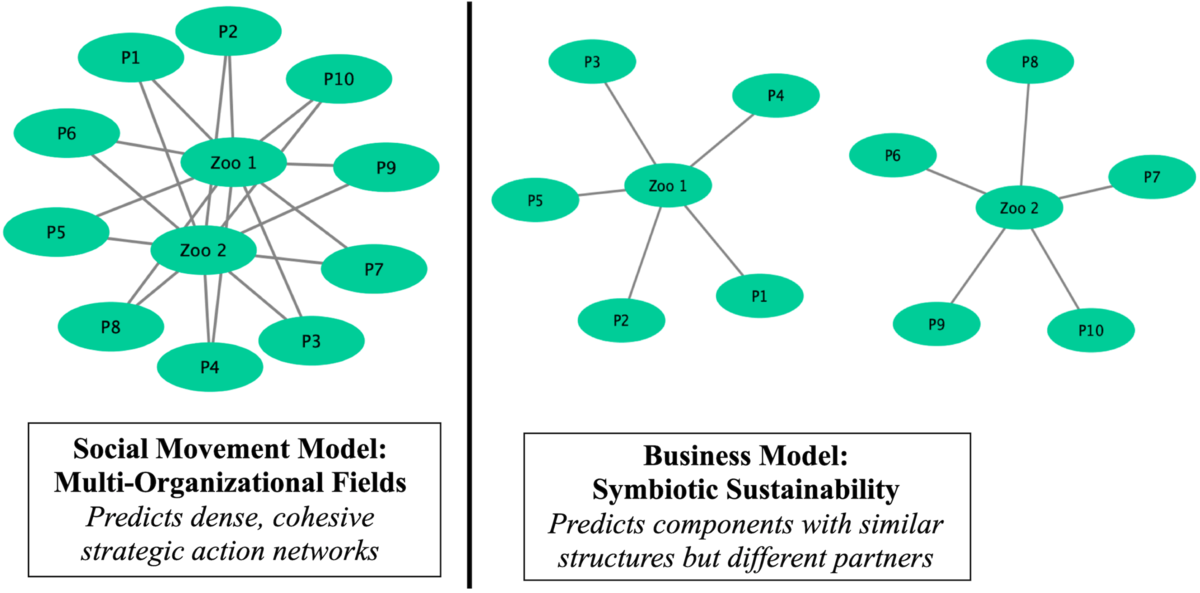
The MOF theory highlights the abilities of organizations to participate in collective action and influence social change through collaborative, inter-organizational relationships (Curtis & Zurcher Reference Curtis and Zurcher1973, Fligstein & McAdam Reference Fligstein and McAdam2012). A MOF can be defined as the total possible number of organizations with which the focal organization might establish specific links (Klandermans Reference Klandermans, Morris and Mueller1992). Organizations create MOF networks of partners and shared identities to influence strategic action through relationships in order to share resources, create change and promote a social movement (Evans Reference Evans1997, Fligstein & McAdam Reference Fligstein and McAdam2012).
In contrast, the SSM (Shumate & O’Connor Reference Shumate and O’Connor2010b) is a framework for analysing partnerships between organizations that fill different identity niches. Industries and organizations can benefit from creating and communicating about their partnerships. The interdisciplinary SSM examines impacts of partner choice and the number of partnerships in corporate–NGO alliances, suggesting organizations strategically select a limited number of alliances with specific types of partners in specific industry niches to promote their interests (Shumate & O’Connor Reference Shumate and O’Connor2010b). A study of environmental group networks found that ties to other types of groups increased involvement, while ties to similar organizations with shared goals reduced overall participation (Kitts Reference Kitts1999).
Studying the properties of networks and the interactions between organizations can reveal characteristics of emerging organizational fields that are the foundations for social movement (Diani & Mische Reference Diani, Mische, Della Porta and Diani2015). The MOF theory predicts that organizations within strategic action fields contribute more to promoting a movement than those separate from the MOF (Rucht Reference Rucht, Snow, Soule and Kriesi2004). In contrast, the SSM integrates theoretical foundations in business with community ecology (Hawley Reference Hawley1986) to delineate organizational identity niches, which include resource, functional and ideological identities (Shumate & O’Connor Reference Shumate and O’Connor2010b). By bridging across niches, the SSM predicts both for-profit corporations and mission-centred NGOs can overcome competitiveness to develop legitimacy and satisfy stakeholder demands (Shumate & O’Connor Reference Shumate and O’Connor2010a).
MOF research assesses the potential for collective action through the construction of interactions and relationships. The MOF theory has been used to examine information exchange and joint action between organizations (Ellingson et al. Reference Ellingson, Woodley and Paik2012) and leveraging increased support for causes (Bartley Reference Bartley2007). Alternatively, prior research using SSM has focused on relationships between organizations of similar identities: corporate–corporate (e.g., Flanagin et al. Reference Flanagin, Monge and Fulk2001) or NGO–NGO (e.g., Doerfel & Taylor Reference Doerfel and Taylor2004). This study instead uses the SSM in order to study cross-sector partnerships.
Network structures represent the strategic actions in which many organizations communicate and interact (Mann Reference Mann2015). Using MOFs, we measured organizational characteristics of zoo networks that support high potential for collective action (Bodin & Crona Reference Bodin and Crona2009), including degree and betweenness centrality, density of the networks and the individual clustering coefficients (Table 1). We examined whether conservation action networks of zoos have created MOFs. The MOF theory would predict that zoos with stronger organizational conservation identities or commitments would report larger numbers of conservation alliances.
Definitions of the node-level metrics for the two network theories and predictions of metric outcomes if the theories have explanatory power.
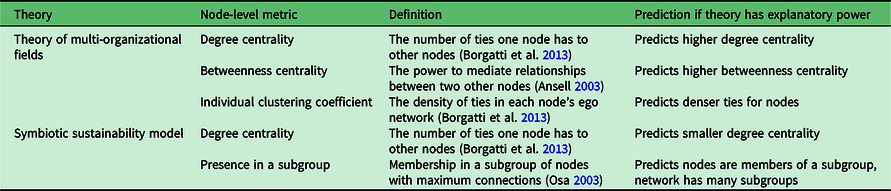
For the theoretical comparison, we applied the SSM to the zoo conservation action network as zoos partner extensively with field conservation NGOs as well as with each other. Using this model, we studied how competition of similar organizations and opportunities for self-promotion to stakeholders influence the development of conservation partnerships. In order to examine whether the SSM holds explanatory power, node-level metrics include degree centrality, clustering coefficients, types of alliances and belonging to subgroups (Table 1). The SSM would predict smaller and less dense networks as organizations compete for resources and communicate about their distinctive qualities.
Aims of this study
This study assesses zoos’ conservation projects and whether their collaboration is developed to create a competitive edge for the organization, or if their partnerships provide evidence for collective action for conservation. Most research on zoos has primarily focused on zoo exhibits, messaging and educational impacts on individual conservation behaviours. Examining collaboration processes can reveal current trends in partnership development influencing organizations’ strategic management (Thomson & Perry Reference Thomson and Perry2006).
The first objective is to assess whether zoos’ conservation partnerships form networks that reflect a collaborative social movement (MOF) or business-style competition (SSM). We compare the theoretical explanatory power of the social network theories from business and social movement fields. By mapping the partnerships within conservation projects that are communicated to zoo stakeholders, we examine the role zoos play in conservation collective action. The primary research question for this study is: does the pattern of zoo conservation networks reflect MOFs or distinct symbiotic sustainability partnerships? In addition, we examine applied questions about zoos’ partnership types and their roles within the relationships: what are the range and frequency of types of organizations that partner with zoos in conservation? Do partnerships more often form between organizations with different roles on the conservation project or organizations with similar, amplifying roles?
Assessing zoos’ conservation partnerships can provide new opportunities for increased conservation emphasis in these institutions. Displaying the social network pattern of conservation collaborations between all AZA institutions and their partners reveals the structure of conservation networks in this industry. SNA based on theoretical models can explain organizations’ approaches to collective conservation action and their potential for impact on conservation.
Methods
Data on organizational partnerships were collected through content analysis of all 234 accredited AZA institutions. Including all AZA institutions ensures the findings reflect the entire industry and each organization’s experiences. Every zoo and aquarium’s website was examined for communications about their conservation projects and the partnerships within them. We conducted a content analysis to code and categorize zoo activities, projects and partnerships from their websites, similar to other studies using content analyses in zoos to study their public communications about their strategies (e.g., Patrick et al. Reference Patrick, Mathews, Ayres and Tunnicliffe2007, Moss & Esson Reference Moss and Esson2013). Such content analyses enable the summary, categorization and synthesis of extensive data (Schreier Reference Schreier, Flick, Scott and Metzler2014) across organizations’ websites in order to be able to understand their approaches to communicating about their partnerships.
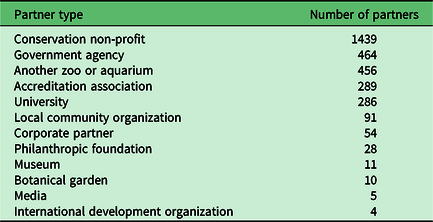
Partners were placed in a matrix for a SNA of all AZA institutions based on: (1) number of partners; (2) name of partner organization to highlight partners shared between organizations; and (3) a deductive coding of activity type for the zoos and their partners, recorded for each project (Table 2) (Maynard Reference Maynard2019). A coding guide with descriptions for each variable was developed and pilot tested by three coders over several weeks before starting data collection. Inter-coder reliability was calculated with Krippendorff alpha score results of 0.72, which is above the required threshold of 0.66 for this exploratory study (Krippendorff Reference Krippendorff2004).
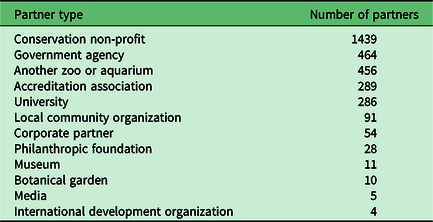
Category and count of zoo and aquarium partners on conservation projects.
Social network analysis metrics
Each model has different assumptions and predictions for how organizations connect and function. These expectations lead to different, relevant social network variables measuring the organizations’ relationships and the structure of the whole network. Different node-level network metrics are predicted to behave differently under the two theoretical frameworks (Table 1). Metrics that support the relevance of either to the network will inform their explanatory power for interpreting the pattern of conservation partnerships.
Centrality is a group of concepts relating to a node’s location in the network and its structural importance (Freeman Reference Freeman1978, Borgatti et al. Reference Borgatti, Everett and Johnson2013). Two measures of centrality – degree and betweenness centrality – are relevant to the models in this study.
Degree centrality is the number of ties one node has to other nodes (Borgatti et al. Reference Borgatti, Everett and Johnson2013). Degree centrality in this case indicates the number of conservation partners a zoo has, ranging from 0 to the total number of partners. This centrality measure can be a function of networking capacity, organizational resources or power in the network (Ansell Reference Ansell, Diani and McAdam2003, Diani Reference Diani, Diani and McAdam2003c). As a result, degree centrality is a relevant node-level metric to both models in this study, but they have contrasting expectations of this measure.
Degree centrality for the SSM predicts a limited but consistent number of partnerships across groups; strategic partnerships are limited by resources and industry (Shumate & O’Connor Reference Shumate and O’Connor2010b). Nodes are predicted to function similarly in strategic ways, so the frequency of ties should have a threshold (Shumate & O’Connor Reference Shumate and O’Connor2010a). In this study, the SSM would hypothesize that zoos report a limited number of alliances with similar organizations (e.g., other zoos or NGOs) (Table 1).
In contrast, degree centrality through the MOF theory predicts that more functional, leading organizations have more ties. A MOF is the total possible number of organizations with which the focal organization might establish specific links (Klandermans Reference Klandermans, Morris and Mueller1992). Thus, a fully connected network is possible under this model. Higher degree centrality under the lens of this theory would expect more partners relative to the number of nodes. The theory interprets nodes with high degree centrality as having more power and a larger leadership role in the MOF.
The MOF theory also incorporates betweenness centrality, while the SSM does not. Betweenness centrality is the power to mediate relationships between two other nodes (Ansell Reference Ansell, Diani and McAdam2003). This measure is seen as a surrogate of social capital and the capacity for bridging of resources or information (Borgatti et al. Reference Borgatti, Everett and Johnson2013). Betweenness centrality for this study quantifies for each node their social capital and brokerage power, such as their influence on the network and potential resources (Kropczynski & Nah Reference Kropczynski and Nah2011). As such, the MOF theory predicts higher betweenness centrality scores, which would be closer to 1 on the low to high 0–1 scale.
An additional node-level metric for the SSM is the categorical variable of whether the node is a part of a subgroup, and which one, in order to take into account relationships with other nodes (Table 1). Membership in a subgroup of nodes or different components can help to identify types of relationships (Osa Reference Osa, Diani and McAdam2003). The distinction of relationships is important for the SSM’s expectation that not many nodes are connected due to limitations of organizational strategy and resources (Shumate & O’Connor Reference Shumate and O’Connor2010b).
The individual clustering coefficient is an informative metric for these network analysis theories. This node-level measurement calculates the density of ties in each node’s individual or ego network (Borgatti et al. Reference Borgatti, Everett and Johnson2013), and it can add to the understanding of the characteristics of the whole network from the perspective of each of the nodes. For example, this metric contributes to the centrality measures for the MOF theory to further expect more influential organizations with more of a role to play in the MOFs to have a higher individual clustering coefficient closer to 1 on the low to high 0–1 scale.
In addition to studying the factors influencing individual organizations’ location in the network with the node-level metrics, examining the whole network is important to understand the overall pattern of collective mobilization (Diani Reference Diani, Diani and McAdam2003b). If the SSM (Shumate & O’Connor Reference Shumate and O’Connor2010a) has strong explanatory power for this case study, zoos would behave as leaders in distinct networks as conservation is a driver of business competition. There will be many subgroups with zoos reporting a limited number of alliances.
By contrast, MOF scholars proposed that ‘the more connected a strategic action field is to other strategic action fields, the more stable that strategic action field is likely to be’ (Fligstein & McAdam Reference Fligstein and McAdam2012, p. 166). Environmental social movement researchers, with the MOF model (Klandermans Reference Klandermans, Morris and Mueller1992), would expect zoos, aquariums and their conservation partners to have a cohesive and highly connected network between organizations. If this theory has strong explanatory power for this case study, the whole network will resemble a dense network with a large number of ties.
Social network analysis
In order to test the two theories’ explanatory power for the conservation network, the structure of the collaborations between zoos and their conservation partnerships was examined using SNA. Techniques compared the node-level metrics and whole network structures for the two theoretical models (Table 1). Analysis used Cytoscape v. 3.6.1 and UCINET v. 6.667.
Results
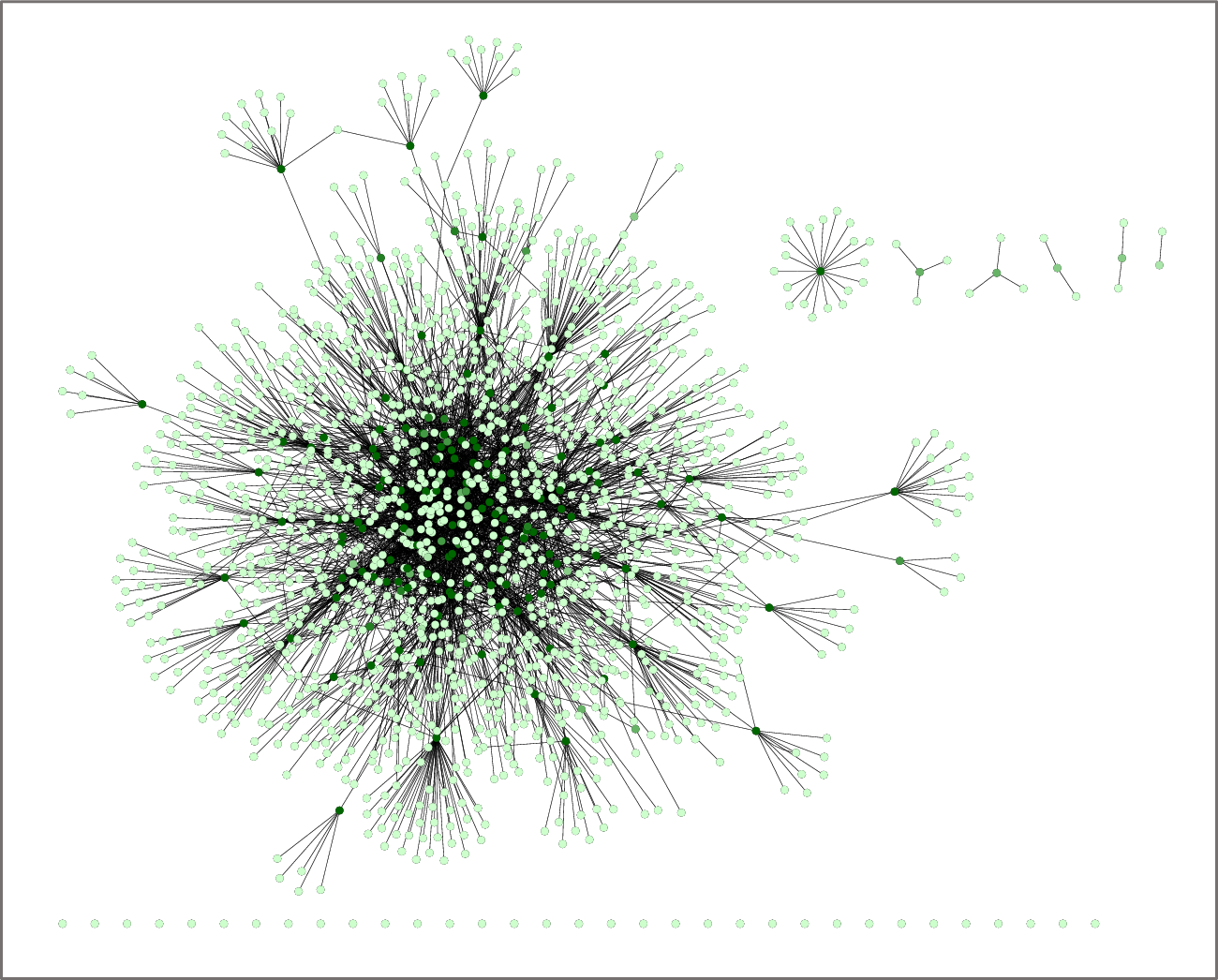
The conservation network has 1679 nodes representing an organization and 3018 partnerships communicated on AZA organizations’ websites. The current structure of conservation networks across the AZA has 40 components: 1 large component, 6 small components and 33 disconnected zoos (Fig. 2). The average number of neighbours in the network is 3.35. The majority of the conservation network across all AZA organizations and their partners exist in a single component, with more connected zoos towards the centre of the network.
The structure of conservation networks across all Association of Zoos and Aquariums organizations and their partners. Darker nodes represent an organization with more than six conservation partners. Unconnected nodes with no conservation partners communicated about to their audiences are shown at the bottom of the figure, disconnected from the other organizations.
Network theory comparison
The MOF theory expects a cohesive network with high centralization and high average individual clustering coefficients (Table 1). The zoo conservation network was found to have an average degree centrality of 3.55, an average betweenness centrality of 0.000053 across the network and an average clustering coefficient of 0.008, on a scale from 0 to 1 (Table 3). These low scores suggest that this network is not very connected. Visually, a large subset theory’s expectation that the organizations work together in a greater MOF. However, the network metrics reveal that the network is less dense than would be supported by this social movement theory; nor is it as cohesive.
Average node-level statistics and network-level statistics.
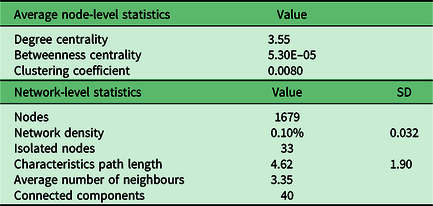
In contrast, the SSM predicts the whole network to have low density and the organizations to occur in many separate subgroups. The conservation network was found to have a density of 0.10% and the sample elicited 40 connected components (Table 3). The SSM predicts lower degree centrality for a manageable number of partnerships between organizations while they compete. The degree centrality of 3.55 supports this.
Zoo partnership types
The type of organizations that AZA institutions partner with ranged across 12 categories (Table 2). Conservation non-profit organizations, such as field conservation organizations, were the most frequent type of partners, with 1439 partnerships documented in the sample. Government agencies, such as US Fish and Wildlife Service, led to 464 partnerships, and other zoos and aquariums were the next most frequent partnerships with 456 ties between the nodes. Additionally, the accreditation associations, such as AZA or World AZA (WAZA) for zoos and aquariums around the world, had 289 ties for their active partnerships in conservation projects. Universities provided many opportunities for conservation collaborations in zoos as well, with 286 ties. Other, less frequent categories included local community organizations, corporate partners, philanthropic foundations, museums, botanical gardens, the media and international development organizations (Table 2).
The content analysis recorded the type of activities for each project for the organizations: 61.8% of zoos and their partners had distinct roles in the partnerships, completing different types of conservation activities, while 38.2% had shared niches as they collaborated on the same activities.
Discussion
Partnerships are beneficial for non-profits and businesses to develop environmental, economic and social programs (Whetten et al. Reference Whetten, Rands and Godfrey2002, Austin & Seitanidi Reference Austin and Seitanidi2012). Strategic partnerships in zoos could expand their conservation interests and help achieve their goals. Our study of zoos and their conservation projects was the first study of zoo conservation networks and how they form collaborations with other zoos and a variety of external organizations. Conservation governance networks are increasingly complex with diverse organizations joining collaborations (Bixler et al. Reference Bixler, Wald, Ogden, Leong, Johnston and Romolini2016). Studying zoos’ patterns of partnerships communicated to their audiences revealed the roles of zoos in the conservation field. These findings mirrored similar studies, such as Bodin and Crona (Reference Bodin and Crona2009), who studied cross-scale interactions of actors in natural resource governance to reveal the network’s structure and the actors’ potential for large-scale impacts on the issues. This network analysis found differences in the explanatory power of the contrasted network theories, as well as trends in zoos’ partnerships.
The study was based on zoo partnerships communicated on websites, so some conservation partners could be missing. For the 33 disconnected organizations, whether they have conservation partners that they do not communicate about could influence the network density and theoretical interpretations. Despite being unable to determine missing partnerships across the AZA population, the trends of conservation network structure were informative of the trends of zoos’ approaches based on how they actively communicate their partnerships. The SSM expects one reason partnerships are formed is to provide a communication opportunity for the partners (Shumate & O’Connor Reference Shumate and O’Connor2010b). Future research could explore this assumption further by collecting primary data about network connections through network interviews or case studies on high-centrality institutions. The study was also limited to reviewing the whole-network sample of the zoos and their diverse partners in order to answer the research question comparing the two network-level theories. Future research could assess the influence of organizational attributes, such as size or region, and project attributes, such as species focus or project location, in order to examine other factors that explain how zoos’ form conservation partnerships, which could influence their potential for impact. Whether organizations with high centrality have more characteristics supported by social movement theory over business theory or whether the state of demographic patterns and region influence the networks at the node level could be explored in future research.
Network theories
By mapping the partnerships within conservation projects that are communicated to zoo stakeholders, we see that zoos play a competitive role in conservation rather than having a fully connected, cohesive approach to collective action. Low degree centrality, betweenness centrality and clustering coefficients suggest that this large network is not very connected. Thus, the business model of strategic partnerships with the SSM provides a better explanation for the conservation network structure for zoos in the AZA. Despite the single, interconnected component of the majority of the sample, most zoos and aquariums are not working together collaboratively on wildlife conservation in a coordinated level expected by social movement researchers. The MOF model predicted that if these organizations are working together on a common cause and are potentially leaders in their community of organizations, then they will be interconnected in a dense network (Curtis & Zurcher Reference Curtis and Zurcher1973). The disconnected organizations instead reinforce the SSM, and the presence of competition prevents all organizations from collaborating (Shumate & O’Connor Reference Shumate and O’Connor2010b). It may be expected that zoos follow the business approach to conservation as they seek to be unique and partner with the conservation organizations of their choosing to support their desired wildlife, regions and issues. Yet, an opportunity for increased strategic conservation collaborations for the AZA community could exist if they consider increasing their conservation impact and leadership potential across the field of conservation organizations, as predicted by the social movement theory (Curtis & Zurcher Reference Curtis and Zurcher1973). However, the whole-network metrics used for the analysis may be sensitive to the size of a network such as this, so the interpretation of the low-density but large network may not be unexpected.
Zoo network applications
SNA has been useful for informing conservation projects (Kreakie et al. Reference Kreakie, Hychka, Belaire, Minor and Walker2016) and facilitating strategic conservation planning (Mills et al. Reference Miller, Conway, Reading, Wemmer, Wildt and Kleiman2004). In this study, zoos approached conservation partnerships more often as an opportunity to engage different types of organizations with distinct roles in the conservation activities. This contrast in partnership style reinforces the predictions of the SSM in expecting organizations to seek strategic, resourceful partnerships (Shumate & O’Connor Reference Shumate and O’Connor2010b) rather than establishing partnerships to add to collective access to resources and progress on an issue, as expected by MOF theory (Curtis & Zurcher Reference Curtis and Zurcher1973).
The competitive framework of zoos behaving as businesses was reinforced in the types of partnerships zoos were more likely to form. Field conservation organizations and government agencies provide distinct approaches to the conservation projects, with activities including on-the-ground landscape management and conservation research. In contrast, almost a third of the partnerships had a shared activity between the zoos and their partners, so opportunities for collaborative and shared work for conservation also helped some zoos to participate in conservation. Both collaboration strategies can be useful for engaging stakeholders and increasing the capacity of a project through increased resources, but the selection of distinct partners with different activities could augment a zoo’s potential through new unique skills and resources. Kitts (Reference Kitts1999) found that environmental groups partnered with other types of groups showed increased involvement in projects, while ties to similar organizations with shared goals reduced participation. Zoos could be behaving similarly to other environmental organizations.
Theoretical limitations
The two contrasting theoretical perspectives endeavour to explain networks and organizational strategies. The reality of the important factors in the organizations could have multiple explanations, highlighting possible limitations to this study. This is a complex conservation field with organizations behaving as both collaborators and competitors in different situations that may change over time.
The network theories have important limitations and several assumptions on which their interpretations are built. The MOF theory assumes that relationships can explain social action and the creation of movements, even when the relationship is absent between organizations (Curtis & Zurcher Reference Curtis and Zurcher1973, Fligstein & McAdam Reference Fligstein and McAdam2012). It assumes an organization is aware of all organizations in a field with or without direct relationships; however, the large network with widespread actors in this study might not meet this expectation. As such, this could be a factor in the weakness of this theory in interpreting the SNA findings.
In contrast, the SSM predicts that organizations are behaving as competitive businesses and are limited to mobilizing resources at a sustainable rate (Caniglia & Carmin Reference Caniglia and Carmin2005). As such, this theory expects a threshold for the number of relationships organizations form in order to support efficient use of resources. However, this competitive pressure may not eliminate the organizations’ interests in communicating or partnering with other like-minded organizations. This assumption may not take into account the incentive that bolsters organizational partnership formation: how communications impact the creation and sustainment of organizational reputation (Shumate & O’Connor Reference Shumate and O’Connor2010b).
Conclusions
Zoos are active conservation organizations with thousands of conservation partners. The network of zoo partnerships revealed a sense of competition driving a low-density network with many subgroups. These partnerships strategically engage diverse organizations and can explain the current practices of conservation projects in zoos to support competitive differences between institutions. However, if zoos want to support their claims of being leaders of conservation across their communities (AZA 2014), they can use the MOF theory to inform their strategies to build wider-scale partnerships through relationship-building in order to become integral organizations in the conservation movement network.
Acknowledgements
We thank the many people who advised on the research and reviewed the manuscript, in particular: A Adams, A Savage, Z Gezon, M Schook, J Soltis, H Brown and B Lowe. We also thank the Association of Zoos and Aquariums community for welcoming this research and providing the context for applying the behaviour classifications to the conservation planning framework. LM was supported by the School of Natural Resources and Environment at the University of Florida.
Financial support
This research received no specific grant from any funding agency, commercial or not-for-profit sectors.
Conflict of interest
The first author acknowledges the potential for conflict of interest as an employee of one of the 234 organizations included in the study’s sample; however, she collected and analysed the data prior to being employed at this institution, and no changes were made to these results after beginning to work at this organization. As such, while it is important to declare, the conflict of interest does not interfere with the study. No other authors have any potential conflicts of interest to declare.
Ethical standards
None.