

Introduction
Corporate leadership is still a man’s world. Despite substantial progress made in women’s professional work, men still dominate the total number of executive positions,Footnote 1 women are sidelined in “feminized” leadership portfolios,Footnote 2 and men and women are restricted by an acceptable range of work behaviors.Footnote 3 Corporate leaders are rewarded for performing traditionally “masculine” behaviors, and are expected to pursue hierarchical success, exhibit strength and endurance, suppress tender emotions, work as if they don’t have domestic responsibilities, and use their brilliance for the benefit of the company.Footnote 4 Men have ready access to, and are supported in, their masculinity at work, while women struggle to balance this with assumptions about their inherent femininity.Footnote 5 In other words, executive work is gendered not only by employing (mostly) men, but by reproducing an exemplar of corporate masculinity.
Australia’s mid-century “company man”—a hardworking manager who exchanged loyalty for lifelong employment and structured promotional success—is the blueprint for modern executive managers. Although some aspects of corporate work have changed over recent decades, ‘line’ and C-suite executives are still governed by the occupational structures laid down in the mid-twentieth century.Footnote 6 The 1950s to 1970s were critical for the development of these modern corporate leadership roles, with the decline of earlier ‘personal capitalism’—in which “owners managed and managers owned”—was replaced by an “entirely modern” managerial class.Footnote 7 Professionals were centered as the locus of corporate control and tasked with administering the day-to-day operations of the largest companies.Footnote 8 The company man, who was first documented in American companies in the 1950s, soon became the top echelon of the Australian mid-century corporate hierarchy.Footnote 9
Despite the wealth of research on gender and work, we know little about the way mid-century executives’ work was defined by their gender. Historical research on corporate leaders has examined social mobility, professional communities, political interference, and marginalization based on gender, race, and class.Footnote 10 Business historians have confirmed the dominance of men in corporate management, the exclusion of women and other minorities, and the recent, often triumphant, entry of women to corporate leadership in recent decades.Footnote 11 However, men in business history are rarely analyzed as men. In contrast, studies of women’s business are deeply gendered and are justified on the basis that women act as women by conforming with a distinct, feminine business identity.Footnote 12 Women are thus seen as the sole “havers” of gender, with gender introduced into a business or workplace when women enter.
To redress this imbalance, this article applies hegemonic masculinity to analyze the gender of Australia’s mid-century company man. Western civilization—originating with the ancient Greeks but later co-opted by Christian teachings, and, even later, evolutionary biologists—argued that masculine and feminine behaviors were expressions of biological traits. Men, under patriarchy, were considered naturally suited to be the ‘head of the household,’ and were responsible for representing their wives and children in the public sphere, and competing with other men to secure outside resources. Women, on the other hand, were ‘covered’ by the protection of their husband, and were naturally suited to performing the domestic and caring work necessary to convert these outside resources into a living in the private sphere.Footnote 13 Since the 1960s, these “separate spheres” have been widely discredited, with gender scholars highlighting how, as Simone de Beauvoir famously wrote, “one is not born, but rather becomes, a woman.”Footnote 14 Indeed, gender is not simply something we have, but is something we do depending on the social context and gender norms of our time.Footnote 15
In patriarchal societies, those perceived as “real” men have more power and privilege than women and less masculine men. As Raewyn Connell argues, the legitimation of “real men,” and their subordination of women and other men, depends on their performance according to the set of values and behaviors of the culturally dominant ideal man.Footnote 16 This is not the only form of masculinity available, and may not even constitute a majority of men, but is an aspirational form that holds power in a particular time and place.Footnote 17 Operating, in part, through the reproduction of exemplars, the hierarchy of masculinity is reified through “cultural consent, discursive centrality, institutionalization, and the marginalization or delegitimation of alternatives.”Footnote 18 Analysis of the social construction of gender, and hegemonic masculinity specifically, is limited in business history, but has boundless potential.Footnote 19
Masculinity, social constructionists argue, is attained through dominance and antifemininity.Footnote 20 Dominance is performed through hierarchical success, deference, the ability to control others, and the ability to secure resources. Antifemininity is the aversion to, and devaluing of, anything coded as feminine through restricted emotionality, toughness, self-reliance, homophobia, and sexual conquest. Psychologist Robert Brannon, writing in the mid-1970s about the dominant postwar ideal of Western masculinity, argued that dominance and antifemininity create a constellation of public desires and behaviors: Be a Big Wheel describes men’s desire to achieve success, status, and power at work, with little interference from outside or personal sources (which are signs of weakness). Be a Sturdy Oak associates success with the ability to exhibit toughness, strength, endurance, and stamina, even in activities that involve mental rather than physical labor. No Sissy Stuff denotes confidence, toughness, and the suppression of tender, feminine emotions. Give ‘em Hell focuses on competition, with the workplace a “gladiatorial arena” where winners dominate and exploit losers.Footnote 21 Although Brannon’s absolute ranking of men has been criticized for reinforcing masculine stereotypes, this article uses these contemporaneous metaphors, alongside hegemonic masculinity, to organize and analyze the empirical material.Footnote 22
Indeed, the “ideal man” reflects the assemblage of masculine characteristics, behaviors, and performances that are rewarded in a particular time and place. In Western settler colonies such as Australia, hegemonic masculinity has reflected existing structures of privilege, such as being white, rich, heterosexual, tall, and strong. Masculinity also intersects with Australian national identities such as strength, independence, and self-reliance garnered on the rural frontier.Footnote 23 There are class differences, with the ideal wealthy man characterized by competitiveness and flamboyance, and working-class men preferencing egalitarianism and the anti-authoritarian “larrikin.”Footnote 24 National institutions such as coverture laws dictated women’s and men’s legal status in marriage, and minimum wage legislations preferenced the male breadwinner earning enough to support a wife and children.Footnote 25 In the post-World War II decades, national culture and institutions encouraged nuclear family formation and the division of labor between husbands and wives.Footnote 26 The postwar decades additionally elevated the ANZAC and emphasized the rugged, “primal masculinity” of aggression, competition, and survival.Footnote 27 With men and women home from war, the workplace became the new battlefield in which masculine hierarchies were determined.
Executives of large Australian companies provide a lens through which we can observe the entangling of corporate management and masculinity in the mid-twentieth century. Historical research presents an opportunity to explore historically and locationally specific masculinities.Footnote 28 It also expands the international historical literature on managerial capitalism by finding that Australian executive management was gendered by integrating claims to managerial authority with key tenets of hegemonic masculinity.Footnote 29 Company men were rewarded for, and evoked a desire to be, a big wheel, mastering the public sphere through hard work, and using their success to dominate others. They were sturdy oaks, using their brilliance and strength for the benefit of their company and to protect Australian society. They were also stoic and humble, invoking antifemininity through restricted emotionality. Executives’ masculinity reflected their historical context, emphasizing the rugged individualism of the bushranger and the primal aggression of the ANZAC. Masculinity was also constituted along lines of class, with the occupational characteristics of company men contributing to the preference for grounded, practical, humble men, and an aversion to the extravagance of wealthy men, or the flamboyant competitiveness of entrepreneurs. This illuminates the entangling of masculinity and executive work in mid-century Australian corporations, and provides important insight into the barriers that women and other minorities face in the workplace today.
Methods
This article captures an elite group of managers, or those with “cumulative and centralized” power through their position title.Footnote 30 For replication and comparability, the sample of companies is based on the standard history of Australian big business.Footnote 31 The sample consists of the top executives of Australia’s top 100 “non-financial” companies, and top 25 financial firms, ranked based on total assets, in four benchmark years in the middle decades of the twentieth century (1930, 1952, 1964, 1986). This was the crucial period for the development of Australian managerial capitalism and the composition of corporate leadership.Footnote 32 All companies in the sample were incorporated legal entities, most were listed on one of the six Australian stock exchanges, though some were unlisted or rarely traded their shares.Footnote 33
Data on company leaders were based on contemporary trade publications that compiled information from annual reports and company surveys to inform investors.Footnote 34 Data captured executive managers who were employed to manage day-to-day and strategic operations, rather than independent directors who monitored managers on behalf of shareholders. In most cases the top executive also sat on the board and was given the title of “Managing Director.” However, the work of managers, as shown below, is historically situated, with titles of “managing director” or “general manager” common in earlier years, and “Chief Executive Officer” (CEO) prominent later. It was common for the managing director to also lead the board, and so dual titles (“Chairman and Managing Director”) were common (see Appendix 1, Table A1). As these were the largest companies in the economy, executives were responsible for managing substantial operations and a large number of employees.Footnote 35 Some women executives were identified in the 1986 sample, though none were CEO or Managing Director.
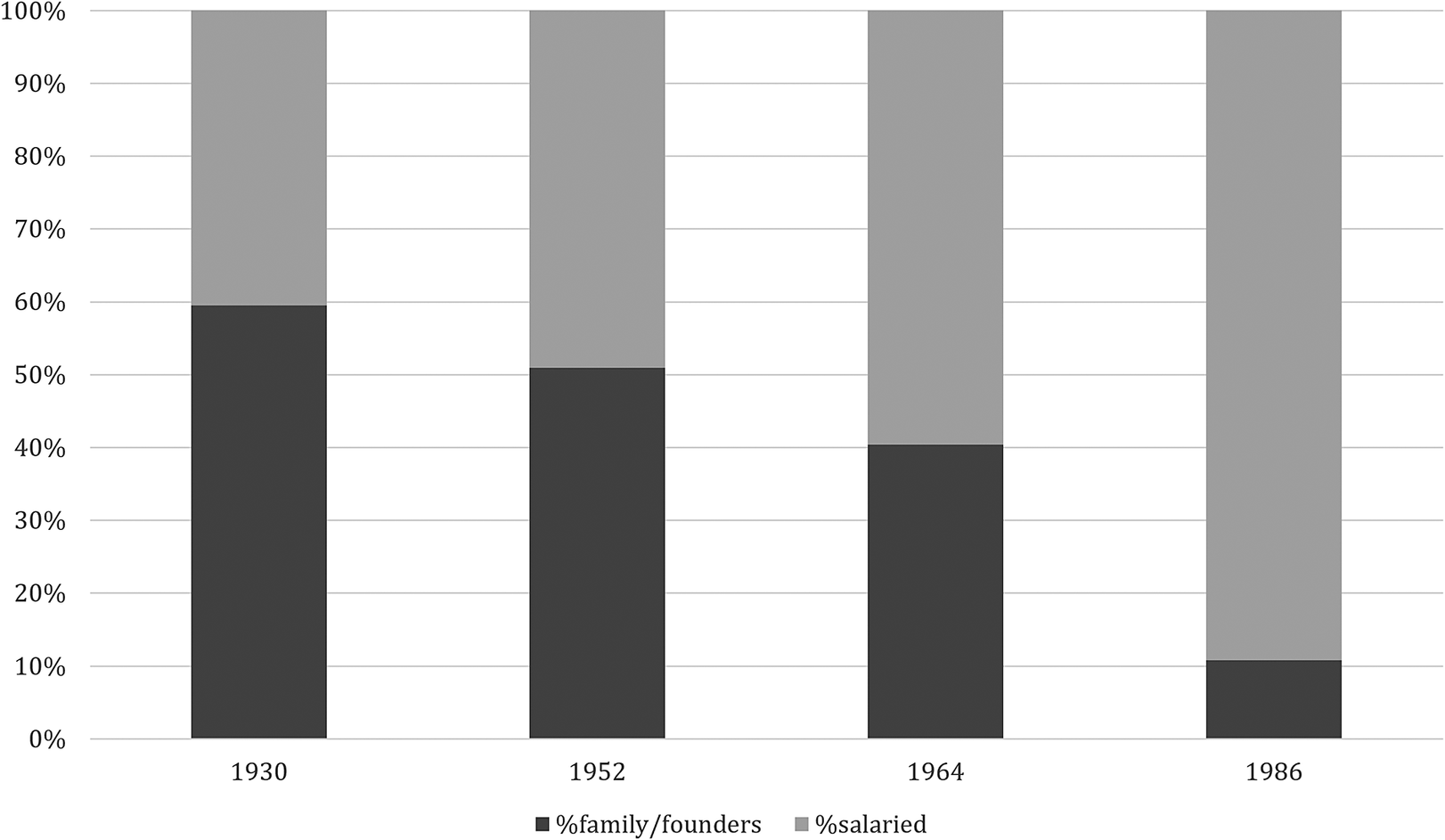
From this sample of Managing Directors and CEOs, company men were defined by their career profiles. They were salaried managers, rather than family members or company founders (Table 1, Figure 1).Footnote 36 They also had a specific career profile: they served for decades with the same company (including predecessors or subsidiaries), and were promoted internally from entry-level roles to executive leadership (Table 2, Figure 2). Information on executives’ life and career was compiled from the Australian Dictionary of Biography, a database of peer-reviewed biographies on prominent Australians. Contemporary secondary sources such as obituaries or media profiles were accessed via the digitized newspaper repositories of Trove (pre-1980s coverage) and Factiva (post-1980s coverage).

Figure 1. Long description
The Y-axis represents percentages from 0 percent to 100 percent in increments of 10 percent. The X-axis lists four years: 1930, 1952, 1964, and 1986. Each year has a stacked bar divided into two categories: percent family/founders (dark gray, bottom) and percent salaried (light gray, top).
* In 1930, family/founders account for approximately 60 percent and salaried for 40 percent.
* In 1952, family/founders decrease to approximately 51 percent and salaried increase to 49 percent.
* In 1964, family/founders decrease further to approximately 41 percent and salaried increase to 59 percent.
* In 1986, family/founders drop significantly to approximately 11 percent while salaried professionals dominate at 89 percent.
The trend shows a steady decline in family or founder leadership and a corresponding increase in salaried professional management over the 56-year period.
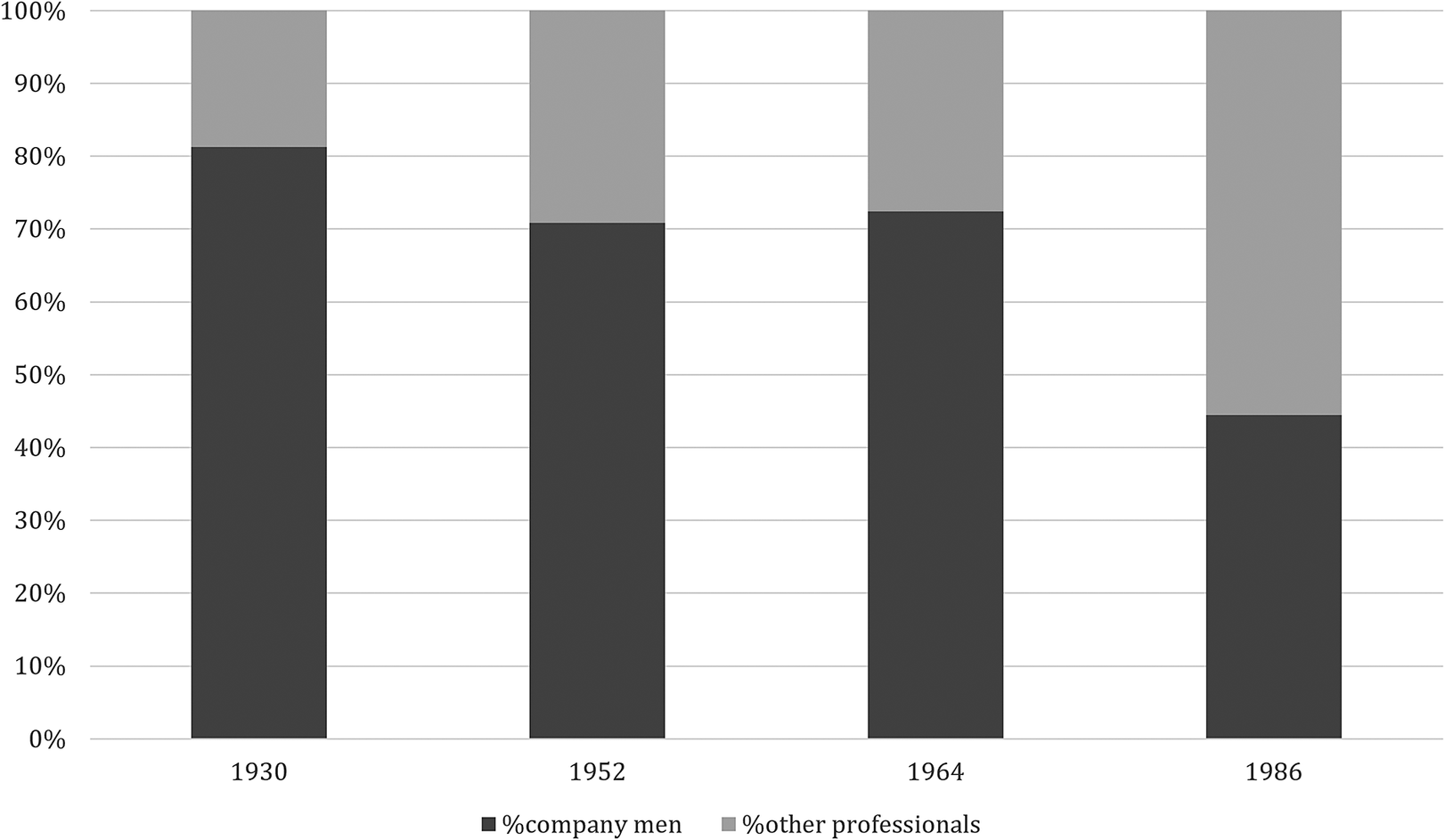
Figure 2. Long description
The Y axis represents percentages from 0 percent to 100 percent in increments of 10 percent. The X axis lists four years: 1930, 1952, 1964, and 1986. A legend at the bottom identifies dark gray segments as percent company men and light gray segments as percent other professionals.
* In 1930, company men account for approximately 81 percent, while other professionals account for 19 percent.
* In 1952, company men decrease to approximately 71 percent, while other professionals increase to 29 percent.
* In 1964, company men slightly increase to approximately 72 percent, while other professionals are at 28 percent.
* In 1986, a significant shift occurs where company men drop to approximately 44 percent and other professionals become the majority at 56 percent.
Composition of top company Managing Directors/CEOs

Table 1. Long description
The table consists of six columns and five rows including the header.
Columns from left to right: Year, Total sample, Family/founders, percent family/founders, Salaried, and percent salaried.
Data rows:
* 1930: Total sample 42. Family/founders 25 (60 percent). Salaried 17 (40 percent).
* 1952: Total sample 53. Family/founders 27 (51 percent). Salaried 26 (49 percent).
* 1964: Total sample 52. Family/founders 21 (40 percent). Salaried 31 (60 percent).
* 1986: Total sample 74. Family/founders 8 (11 percent). Salaried 66 (89 percent).
The data shows a significant trend where the percentage of family/founder C E O s decreased from 60 percent to 11 percent, while salaried C E O s increased from 40 percent to 89 percent over the 56-year period.
Note: Sample based on the listed “Managing Director” or “CEO” of top 100 “non-financial” companies, and top 25 financial firms, ranked based on total assets. Fleming et al.’s (2004) The big end of town has been used for the sample of firms, and contemporaneous trade publications used to determine the top manager. Based on their career path, managers were either family members and company founders (“family/founders”) or worked for the company in return for a salary (“salaried”).
Professional profile of salaried Managing Directors

Table 2. Long description
The table consists of seven columns and four rows of data. The columns are: Year, Total sample (salaried), Total with data, Company men, percent company men, Other professionals, and percent other professionals.
* 1930: Total sample 17, Total with data 16, Company men 13 (81 percent), Other professionals 3 (19 percent).
* 1952: Total sample 26, Total with data 24, Company men 17 (71 percent), Other professionals 7 (29 percent).
* 1964: Total sample 31, Total with data 29, Company men 21 (72 percent), Other professionals 8 (28 percent).
* 1986: Total sample 66, Total with data 54, Company men 24 (44 percent), Other professionals 30 (56 percent).
The data shows a trend where the percentage of company men (internal promotions) decreased from 81 percent in 1930 to 44 percent in 1986, while other professionals (external hires) increased from 19 percent to 56 percent.
Note: “Company men” were defined as salaried managers who served for decades with the same company, and were promoted internally from entry-level to executive leadership. “Other professionals” were those who changed between industries or companies throughout their career. Percentages reported as a proportion of the working sample (“total with data”).
By relying on media and biographical data, this article captures the public construction of masculinity for Australia’s corporate leaders.Footnote 37 Company men, consciously or unconsciously, performed their gender in a way that maximized their success within broader gender regimes at work. Colleagues and subordinates then likely praised executives who acted in a way that aligned with their own expectations of men in leadership. Journalists and biographers reproduced shared myths, norms, stories, values, and customs regarding masculinity, success, and professionalism. Stories about exemplary men then legitimated a set of behaviors that rewarded subsequent “real men” who performed their gender in this manner.Footnote 38 The empirical material that follows is thus not an objective account of men’s leadership behaviors, nor a reflection of their inner world. Instead, it analyzes the constellation of stated desires, public performances, perceptions, remembering, and re-tellings, and explores the traits considered—by men themselves, and others—as important for masculinity and corporate success.Footnote 39
Managerialism and the “Company Man”
The twentieth century witnessed major changes in Australian corporate leadership. Primary industries, once the backbone of Australia’s economy, gradually gave way to secondary and tertiary industries as engines of growth. By the postwar decades, a growing urban population expanded the supply of labor and entrepreneurship, as well as the number of potential customers for manufactured products. Improvements in inter-state communication and transportation enabled businesses to operate offices, warehouses, and factories across multiple locations. Businesses were protected from international competition by high tariffs and the tyranny of distance, and so local manufacturers could leverage the latest international technologies to produce goods for a local population desperate for novelty and modernity. The proportion of GDP produced in manufacturing more than doubled between 1913–14 and 1962–63, as did the number of top manufacturing companies.Footnote 40
Mid-century companies were pressured to “modernize.” The success of the postwar technocracy—which elevated central planning and Australia’s technical expertise—contributed to the belief that family control was antiquarian, and management control was necessary for future prosperity.Footnote 41 Expansion of the shareholding population, and new capital issues from companies seeking to improve manufacturing capacity, diluted the ownership of founding families. Expanded share ownership also introduced the specter of hostile takeover, with companies pressured to modernize simply to stay the hand of aggressive companies seeking to acquire economies of scale, or diversify into new markets.Footnote 42 Companies gradually replaced founders and family members with salaried managers: the proportion of family members and founders managing top companies declined from 60 to 11 percent between 1930 and 1986, and the number of salaried executives increased from 40 to 89 percent over that same period (Table 1).
The expansion of manufacturing required new ways of managing. Scientific management, or ‘Taylorism,’ pioneered by Frederick Winslow Taylor in Gilded-Age United States, gradually contributed to fragmentation of work done on the factory floor.Footnote 43 Engineer-managers assumed control over production and replaced the ‘rule of thumb’ approach with ‘scientific’ methods to define an optimal way to complete each task. Although the application of scientific management was uneven—depending on the type of task, industry, workplace, and extent of industrial action—companies aspired to introduce rationalism and specialization to their production process.Footnote 44 This increased the expertise required of managers, with prospective managers recruited after school or university, in operational specialties like science and engineering. This granted them authority to maintain infrastructure, supervise process, and ensure safety in the extraction and transformation of new resources.Footnote 45 Peter Cottrell, for example, trained in engineering and, in the 1960s, managed the factory of appliance manufacturer Email. Cottrell recalled using his engineering experience to introduce principles of scientific management, conducting time and motion work studies to optimize the assembly line. He recalled frustration with the antiquated method of assembly when he arrived:
You’d be trying to build a refrigerator and you get it down the line, and you’d find bits weren’t available to finish it. […] The refrigerator would be taken off and dropped on the floor, ‘til you could find the bits and so you’d end up with, you know, the refrigerators partly completed all around the place. You know, those are no-nos in a modern production factory.Footnote 46
New managerial companies required a new class of executive manager. Most of the new salaried executives between 1930 and 1964 (71–81%) were company men, and they comprised a major proportion of total executives (Table 2, Figure 2). These company men were defined by their decades-long tenures with the same company, and internal progression from entry level to executive management. Harry Hey, for example, joined the research division of Electrolytic Zinc in 1917. He supervised the company’s pilot plant in Tasmania that aimed to recover zinc and lead concentrates from the ores of the Read-Rosebery mines, which eventually led to his promotion to technical superintendent, then general manager, managing director, and chairman.Footnote 47 Gerard Osborne, similarly, trained as a chemist and worked in the laboratories at food manufacturer Kraft Holdings before being promoted into production management roles.Footnote 48 Norman Jones joined Broken Hill Proprietary Co. (BHP) as a cadet and rotated through the company’s Australian operational sites before management positions based at their Melbourne head office. Company men were trained in operational specialties, including chemists working in manufacturing companies; drapers working for retail firms; journalists managing media companies; and bank tellers promoted to run major financial institutions. Companies rewarded managers for their loyalty and achievement, with gala dinners, awards presentations, and the infamous “gold watch” features of mid-century corporate life.Footnote 49
Although management in the mid-twentieth century was considered a practical skill, companies also introduced professionalization initiatives to ensure consistency. New tertiary business education opportunities increased in the postwar decades, and the number of business students at university expanded fivefold in the decade from 1964 to 1974.Footnote 50 The first Australian Master of Business Administration (MBA)—an American degree dedicated to applying theories of scientific management—was awarded at the University of Melbourne in 1965.Footnote 51 Managers established their own professional society in 1941, and management consultancies expanded in the 1960s and 1970s.Footnote 52 Some companies administered their own management training to promising future executives, while others outsourced this work. Australian Paper Manufacturers, for example, sent middle-manager John Wilson to Harvard’s Advanced Management Program in 1954, before his appointment as managing director in 1959.Footnote 53 In 1955, Ampol Petroleum sent Walter Leonard to the same course, and on his return he established a management training program, in the Harvard image, for Ampol employees.Footnote 54 Norman Jones commissioned an external review of BHP by American consultants Cresap, McCormick & Paget in 1966, and helped to establish the Australian Administrative Staff College at Mount Eliza, Victoria. He argued that it was “vital and necessary to train middle and top management” to meet the needs of Australian corporations.Footnote 55
From the 1980s, the ‘management rush’ displaced company men with a new group of professional executives. A series of crises in the 1970s—including oil shocks, the collapse of the Bretton Woods system, stagflation, environmentalism, and decolonization movements—decreased trust in the postwar technocracy.Footnote 56 At the same time, Australia began the clunky transition to a global, post-industrial economy, which increased the share of activity in tertiary services industries, and encouraged corporations to manage operations across multiple countries, in unrelated industry codes, and financed through a dizzying array of local and international sources. Postwar theories of organizations were cast aside in favor of neoliberalism, which argued that profit and share price were the only measures that really mattered. Managers were now principally accountable to shareholders and were responsible for perfecting the company’s market performance. The work of management became disconnected from hands-on experience, and new business schools produced a generation of “economic rationalists” who implemented best practice “strategy” to all organizations, regardless of industry or sector.Footnote 57
These changes disrupted the work of managers who had found comfort in the “quiet life” of trade protections, and realized that they lacked the skills to manage risk and performance in a new, globalized, free-market environment. Company men were soon eclipsed by “professional” managers who had shorter tenures and experienced external career progression before appointment to senior positions (Table 2). Companies increased the number of executives, maintaining the old focus on getting the product to market, but adding in new executives for functional roles. The typical team in the 1980s consisted of the C-suite, led by the CEO. Operational executives, responsible for a ‘division’ or, colloquially, a business ‘line,’ resembled the company men of the mid-twentieth century by progressing through the ranks from entry-level operational roles. However, now over half of all executive roles managed business ‘functions’ such as legal, HR, finance, marketing, communications, and contracting professional services to operational divisions.Footnote 58
Company men thus comprised a specific class of corporate managers who formed a bridge between workers and owners, and between earlier personal capitalists and the professional executives who followed. By 1986, ‘company men’ (44%) were outnumbered, for the first time, by ‘professional’ corporate executives (56%) (Table 2, Figure 2). Although many of the structures and incentives of corporate management, particularly for ‘line’ managers, were maintained, changes in the typical career path were notable. Kevin Gosper, who led Shell in the 1980s, noted that his internal career path was “quite unusual these days,”Footnote 59 and Dean Wills, who managed drinks manufacturer Amatil, argued that it made him “a bit of a dinosaur.”Footnote 60
The Ultimate Breadwinner
This section analyzes the qualitative data on company men’s motivations, and the traits considered, by themselves and others, to be important for corporate success. Revealing the way managerial authority was intertwined with key tenets of hegemonic masculinity, it is organized according to three of the salient themes delineated by Brannon in his work on postwar masculinity. Be a Big Wheel describes men’s desire to master the public sphere through hard work and the use of hierarchical success to dominate subordinates. Be a Sturdy Oak analyzes men’s use of brilliance and strength for the benefit of the company and to protect Australian society. No Sissy Stuff examines men’s humility and restricted emotionality, the preference for grounded, practical masculinity, and the aversion to extravagance or competitiveness.
Be a Big Wheel
Company men were outwardly committed to hard work in the pursuit of success. Devotion to work—which, of course, required their wife’s devotion to the homeFootnote 61—was necessary for men to master the public sphere and dominate others through success, status, and security of economic resources.Footnote 62 Essington Lewis, for example, was remembered for working tremendously hard, ignoring warnings that he might jeopardize his own health. On Lewis’s death, a peruse of his personal papers found the handwritten phrase I AM WORK.Footnote 63 James Vernon reflected a similar intertwining of work and personal identity, commenting “I was a part of [Colonial Sugar Refining Co.] CSR. It didn’t occur to me to go anywhere else.”Footnote 64 John Francis Williams was described as a “committed and hard-working manager,” who was “totally absorbed in his work,” and Walter James Young a manager who had an “enormous capacity for hard work.”Footnote 65 Harry Watts, who died during his tenure as Managing Director of Woolworths in the late 1980s, was remembered for having “devoted his life since leaving school to the service of this company.”Footnote 66
Company men often invoked romantic or religious language to describe their commitment to work. Such devotion suggests an intertwining of men’s work and personal identities that was necessary for managerial success, and to fulfill expectations of their mastery over the public sphere.Footnote 67 Norman Jones, for example, spoke of his career in the way that some may speak of a lover, arguing that “my time with BHP was not work for me, it captivated me.”Footnote 68 Retailer Clarence Edwards was similarly devoted, commenting that his “heart is in England when it is not in [retail company] David Jones.”Footnote 69 James Thompson’s biographer evoked religious surrender when describing his devotion to the Australasian Temperance & General Mutual Life Assurance Society, arguing that “the Society was his life and he remained in harness until death.”Footnote 70 Maurice Mawby demonstrated devotion through fealty, using the motto Palma non sine pulvere (“no prize is won without effort”) for his coat of arms when he was knighted in 1963.Footnote 71
Corporate leadership in the mid-twentieth century required company men progress from entry level to upper management roles. Their managerial authority was intertwined with ideals of masculine dominance, and successful managers were those who could control others at the apex of their organization.Footnote 72 This differed markedly from the anti-authoritarianism common among working-class Australian men.Footnote 73 James Vernon, for example, managed CSR as a “strongly hierarchical organization,” and junior staff regarded him with “awe.”Footnote 74 Essington Lewis was most at ease in an environment of “hard work and discipline,” and encouraged deference from employees by training new candidates for promotion “in his own image.”Footnote 75 John Francis Williams managed The Herald in a manner “as autocratic as any owner-baron,” and was “feared and respected by his subordinates.” Edwin Neil, of Myer Emporium, cultivated a culture of deference, as he worked in the “manner of a Christian patriarch, at times severe, at times lenient.” Stressing “the desirability of good health and manners, and the avoidance of strong drink,” Neil encouraged “loyalty and enthusiasm by inspections, lectures and exhortations.”Footnote 76 Edward Cornwall, an engineer with City Electric Light Company, was remembered for being a “high-principled, hard-working disciplinarian,” with his staff reportedly remarking “Ted, you are a cranky old devil, but we still love you.”Footnote 77 Stan Wallis, managing director of Amcor, chose to continue his executive career well past retirement age because he enjoyed “running the show,” being the “centre of attention” and “get[ting] his own way.”Footnote 78 Roy Deicke was similarly remembered as a man with “steely resolve,” with a colleague reportedly remarking: “If Roy wanted something, he got it.”Footnote 79
The mid-century reassertion of militarism demonstrates the intertwining of management and dominance. At a time of concern for the ‘softening’ of the Australian urban middle-class domestic man, the ANZAC of World War I and World War II elevated a rugged, “primal masculinity” of aggression and survival.Footnote 80 Company men were often involved in military leadership, with a 1964 survey finding that 40 percent of Australian “leaders of commerce” were ex-military officers.Footnote 81 Militarism integrated an autocratic management style with the dominance of subordinates, with Walter James Young (1930) known as the “Napoleon of Finance” for his control of the money circulating among pastoral company Elder Smith.Footnote 82 James Thompson was similarly a man who could “inspire fear” while also being “respected for his straightforwardness.” He was remembered by employees for his ready adoption of the “trappings of authority,” his “distinctive walk peculiar to sergeant-majors on parade,” and his ability to “roar like a bull” when the “occasion demanded it.”Footnote 83
Success, for company men, required they use hands-on experience to earn the ability to control subordinates. The class identity of company men—in which they connected workers and professionals—demanded manhood be obtained, and deference earned, through progression from entry-level to upper management roles.Footnote 84 Brian Loton, for example, was recruited as a cadet of industrial giant BHP and was instructed in the “BHP way” by rotating through the different departments at the company’s Newcastle Steelworks. His “methodical” progression “through BHP’s executive ranks” was necessary for him to earn deference and “respect from all his associates.”Footnote 85 Although Frank Richardson, of Cox Brothers department store, considered himself a “merchant prince,” he also identified publicly as a “self-made man” who had commenced his retailing career at the age of 10 behind the counter of his grandfather’s store in rural Victoria.Footnote 86 Sir Theo Kelly’s career was similarly praised for reading “like a fairy story,” having joined retailer Woolworths as a clerk as a young man.Footnote 87
Be a Sturdy Oak
Success for company men was derived from the deployment of personal aptitude for the benefit of the company. While this work was professional, certainly, it was also masculine, with “brilliance” a form of mental toughness that could be used to assert dominance over others.Footnote 88 Felix Lloyd, for example, was considered “one of the best business brains in the city,” James Niall the “greatest living asset” of his company Goldsbrough Mort & Co, and Frank Richardson an “investment” who paid substantial “dividends” for retailer Cox Brothers.Footnote 89 Clarence Edwards was similarly remembered as a perfectionist with intuitive aptitude for drapery. One of the firm’s senior employees recalled that Edwards was an “expert in practical details” and that he used this to assert control over employees:
He would walk in and look round, and in a flash he’d spot anything that was wrong with a garment on display. He had a sort of sixth sense for it.Footnote 90
Executives’ integrated management aptitude with hegemonic constructions of Australian men as practical, physical, and grounded.Footnote 91 Internal career progression, often in physically demanding workplaces, was used to advocate for men’s managerial prowess, while simultaneously rewarding performances of strength and stamina. Milton Alder, for example, was remembered as “energetic” as he aged, and Charles Holmes-Hunt was described as “an amazingly energetic and well-preserved man.”Footnote 92 Richardson was praised for the “hours he spent every week and the thousands of miles he travelled in the name of company business.”Footnote 93 Gerard Osborne was remembered as a “dynamic leader,” and a colleague recalled: “He’d be in the factory any time after 6 o’clock in the morning, and he walked around in it an awful lot. He knew all his people by name.”Footnote 94 Niall’s biography invoked the rugged individualism of the bushranger—a central figure in Australian masculinity—to justify his authority managing remote pastoral stations for Goldsbrough Mort:
In 1878 he was bundled off to take control of Gooyea, another of Cudmore’s stations, in Queensland. Niall arrived hungry, penniless, and with his nose broken after a show-down with the quarrelsome coach-driver. A daring horseman, he had to return to Adelaide for treatment after a near-fatal accident. Restored, he then took sheep to Wirraminna station, near Port Augusta, where he stayed for two years in drought conditions. While forming Kingoonya station for Green, Short & Co. near Port Augusta, he took up some country for himself, laboriously sinking wells, one of which became the main water-supply for the transcontinental railway.Footnote 95
For company men, work was their main contribution to civic life. Reflecting the masculine desire to protect others and the assumption that they were responsible for civilizing the public sphere, men were memorialized for their contributions to Australian society.Footnote 96 This was particularly prescient in the context of the Cold War, with fears of communist incursion contributing to the belief, in Australia and elsewhere, that men’s work in capitalist enterprises was necessary for national prosperity.Footnote 97 The Advocate dubbed Henry Somerset “the man whose name spells progress in Burnie.”Footnote 98 Brian Loton was praised for his contribution to mining company BHP, and to “this great country which we all share.”Footnote 99 James Vernon’s “name will always be associated with CSR, the company where he spent his entire working life and which he ran at the highest point in its history.”Footnote 100 Retailer Felix Lloyd was eulogized for deploying brilliance not only for his own benefit, “but for the benefit of the community.”Footnote 101 On his retirement, retailing executive Clarence Edwards was similarly remembered as “one of the men who changed the pattern of everyday living in our city” and “played a big part in making Australian women among the best dressed in the world.”Footnote 102
Company men expressed a desire to contribute to the development of Australian society. They evoked paternalism, not for their immediate family, but for employees, customers, and other stakeholders, shouldering responsibility for the company’s success as a way of ensuring the prosperity of all Australians. James Vernon, for example, spoke proudly of his career at sugar refinery CSR, and the “ever-present feeling that I was taking part in the development of a great Australian company, working with people with whom I shared a common view.”Footnote 103 BHP executive Essington Lewis was motivated by “a nation with a common purpose, displaying [his own] virtues of hard work and discipline.”Footnote 104 Journalist and newspaper executive John Francis Williams was similarly compelled by a “strong sense of duty to the shareholders and his readers.”Footnote 105 Manufacturing executive Peter Cottrell described his sense of responsibility to the town of Orange, in rural New South Wales, arguing “In those days, I don’t think they realized how much money [the factory] was bringing into the community. […] We worked so determinedly, you know, like that, to make Email perform.”Footnote 106 Maurice Mawby believed that his work in the mining industry was for the good of all Australians. He stated:
In the ultimate sense development is concerned with people: the development of human personality and understanding is really the objective of all economic endeavours.Footnote 107
No Sissy Stuff
Company men were calm and stoic. They were publicly restricted in positive and negative emotions, which supported their managerial authority as well as reifying masculinity through the display of strength and antifemininity. James Niall, for example, was praised for his composure, with a “heart and brain good enough for any crisis.”Footnote 108 James Vernon was a “methodical and analytical man” who enjoyed the “fine, patient work of cabinet-making.” He was considered an effective manager, helping subordinates “relax,” by “sitting back in his chair and filling his pipe while he considers your questions.”Footnote 109 Somerset had “severe features,” a “serious manner,” and exhibited a “no-nonsense approach to his work.”Footnote 110 Charles Holmes-Hunt, similarly, could appear “austere and pompous” to outsiders, though he was “greatly respected and admired by employees.”Footnote 111 Robert Blackwood’s associates similarly described him as a friendly man who “was not one to show emotion.”Footnote 112 Charles Booth was “seldom animated,” and moved at a “leisurely and deliberate pace.” He observed restraint at the office:
No Christian names except for one or two of his closest colleagues; strict punctuality for all meetings; and the secretarial staff knew that he would not tolerate split infinitives, or allow papers to be perforated with multiple pin-holes.Footnote 113
Although masculinity, for company men, was acquired through career success, they were expected to shoulder these achievements with humility.Footnote 114 Contrasting with the extravagance of family companies or the flamboyant competitiveness of founder-entrepreneurs, company men were expected to be connected to the practical necessities of day-to-day operations. Walter James Young, for example, was described as a “quiet, modest, kindly man,” who “in all his brilliant career, has never wished to figure in any more spectacular role than that of the quiet man who went on with his job.”Footnote 115 Felix Lloyd “never sought the limelight,” Clarence Edwards was remembered as a “modest” gentleman, and John Lonergan an executive who had his “head unturned by success.”Footnote 116 Milton Alder was considered “unusually shy and modest,” and “All who knew him found in him uncompromising integrity, absolute honesty of thought and extraordinary quickness of mind.”Footnote 117 Executives’ humility was contrasted against the extravagance and competitiveness of entrepreneurs, with Edwin Neil, for example, considered a “careful, religious, conservative man,” whose experience with day-to-day operations “complemented [entrepreneur Sidney Myer’s] intuitive flair and energy.”Footnote 118 John Francis Williams was similarly considered “difficult,” “prickly,” “obstinate,” “skeptical,” and “practical,” and his work for The Herald “curbed” the “extravagances” of entrepreneur Keith Murdoch.Footnote 119
Conclusions
This article applies the concept of hegemonic masculinity to shed new light on the entangling of management and masculinity in Australia’s mid-century corporations. It contributes to the gender studies literature by exploring the impact of historical, national, and occupational contexts on the expression of the ideal man. It also presents a new approach to the study of men in business history by applying gender studies research to uncover the social construction of gender in corporate leadership. It argues that executive work was gendered not only by employing men, but by reproducing a contextually situated exemplar of corporate masculinity. Consciously or unconsciously, executive men performed their gender in a way that maximized their success within the mid-century corporate gender regime: those who were successful were rewarded with pay and promotions, and were then memorialized by journalists and biographers. Although we know little about their inner world, the empirical material captures the public life cycle of this social construction: the stated desires of the men themselves, the opinions of their colleagues, and the stories written about them by others.
Mid-century corporate masculinity was a hierarchy in which ‘real men’ were those who successfully integrated claims to managerial authority with dominance and antifemininity. Company men were rewarded for, and evoked a desire to be, a big wheel, mastering the public sphere through hard work, and using their success to control others. They were sturdy oaks, using their brilliance and strength for the benefit of their company and to protect Australian society. They were also stoic and humble, preferring to get on with the job rather than engage in competition and flamboyance. This form of masculinity was shaped by the requirements of their occupation and the social and economic context of postwar reconstruction. As executives, they were expected to demonstrate mastery of their profession, exhibit managerial authority, and earn the respect of employees. Successful company men were grounded, practical, and humble, and they were, materially and rhetorically, set apart from the extravagance and competitiveness of entrepreneurs, or the larrikin anti-authoritarianism of working-class men.Footnote 120
By illuminating the integration of executive work and masculinity, this article also provides insight into the barriers that women and other minorities face in corporate leadership today. This research suggests that enduring challenges like limited diversity in management positions,Footnote 121 gendered segregation of leadership work,Footnote 122 and a limited range of acceptable behaviorsFootnote 123 arise from the historical path dependencies of the occupation itself. Indeed, modern corporate management still carries the image of its ideal occupant, and prospective leadership recruits—male and female—are largely expected to act as the company men of the mid-twentieth century: working as if they don’t have domestic obligations, limiting their range of emotions, and focusing on individual achievement, success, and power.Footnote 124 This article identifies the occupational and cultural foundation of these contemporary problems, and in doing so can help reshape them with a focus on equality for all.
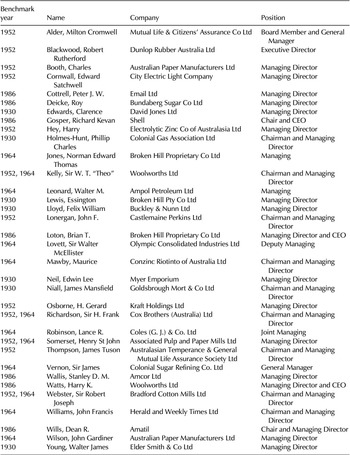
Appendix 1

Table A1. Long description
The table contains 34 entries organized by four columns.
* 1952, Alder, Milton Cromwell, Mutual Life and Citizens’ Assurance Co Ltd, Board Member and General Manager.
* 1952, Blackwood, Robert Rutherford, Dunlop Rubber Australia Ltd, Executive Director.
* 1952, Booth, Charles, Australian Paper Manufacturers Ltd, Managing Director.
* 1952, Cornwall, Edward Satchwell, City Electric Light Company, Managing Director.
* 1986, Cottrell, Peter J. W., Email Ltd, Managing Director.
* 1986, Deicke, Roy, Bundaberg Sugar Co Ltd, Managing Director.
* 1930, Edwards, Clarence, David Jones Ltd, Managing Director.
* 1986, Gosper, Richard Kevan, Shell, Chair and C E O.
* 1952, Hey, Harry, Electrolytic Zinc Co of Australasia Ltd, Managing Director.
* 1930, Holmes-Hunt, Phillip Charles, Colonial Gas Association Ltd, Chairman and Managing Director.
* 1964, Jones, Norman Edward Thomas, Broken Hill Proprietary Co Ltd, Managing.
* 1952 and 1964, Kelly, Sir W. T. Theo, Woolworths Ltd, Chairman and Managing Director.
* 1964, Leonard, Walter M., Ampol Petroleum Ltd, Managing.
* 1930, Lewis, Essington, Broken Hill Pty Co Ltd, Managing Director.
* 1930, Lloyd, Felix William, Buckley and Nunn Ltd, Managing Director.
* 1952, Lonergan, John F., Castlemaine Perkins Ltd, Chairman and Managing Director.
* 1986, Loton, Brian T., Broken Hill Proprietary Co Ltd, Managing Director and C E O.
* 1964, Lovett, Sir Walter McEllister, Olympic Consolidated Industries Ltd, Deputy Managing.
* 1964, Mawby, Maurice, Conzinc Riotinto of Australia Ltd, Chairman and Managing Director.
* 1930, Neil, Edwin Lee, Myer Emporium, Managing Director.
* 1930, Niall, James Mansfield, Goldsbrough Mort and Co Ltd, Chairman and Managing Director.
* 1952, Osborne, H. Gerard, Kraft Holdings Ltd, Managing Director.
* 1952 and 1964, Richardson, Sir H. Frank, Cox Brothers Australia Ltd, Chairman and Managing Director.
* 1964, Robinson, Lance R., Coles G. J. and Co. Ltd, Joint Managing.
* 1952 and 1964, Somerset, Henry St John, Associated Pulp and Paper Mills Ltd, Managing Director.
* 1952, Thompson, James Tuson, Australasian Temperance and General Mutual Life Assurance Society Ltd, Chairman and Managing Director.
* 1964, Vernon, Sir James, Colonial Sugar Refining Co. Ltd, General Manager.
* 1986, Wallis, Stanley D. M., Amcor Ltd, Managing Director.
* 1986, Watts, Harry K., Woolworths Ltd, Managing Director and C E O.
* 1952 and 1964, Webster, Sir Robert Joseph, Bradford Cotton Mills Ltd, Chairman and Managing Director.
* 1964, Williams, John Francis, Herald and Weekly Times Ltd, Chairman and Managing Director.
* 1986, Wills, Dean R., Amatil, Chair and Managing Director.
* 1964, Wilson, John Gardiner, Australian Paper Manufacturers Ltd, Managing Director.
* 1930, Young, Walter James, Elder Smith and Co Ltd, Managing Director.
Note: This table lists the persons mentioned in text, the year that they were identified as part of the sample (1930, 1952, 1964, or 1986), the company they worked for, and their executive position in that year. Company and position listings were based on trade publications that compiled information from annual reports and company surveys to inform investors. Information on their career was found from the Australian Dictionary of Biography, Trove and Factiva.



 Open access

