

Key Findings
1. Togo’s first national mapping of Macrotyloma geocarpum production zones.
2. The Kara region holds the highest varietal and ethnobotanical diversity.
3. Female-led production, mostly among low-educated rural households.
4. Ritual and medicinal uses differ significantly by ethnic group.
5. Sharp cultivation decline threatens crops’ genetic conservation.
Introduction
Sub-Saharan Africa is facing an alarming rise in food insecurity, exacerbated by undernutrition, declining soil fertility and decreasing arable land allocated to food production (Adoukonou-Sagbadja et al. Reference Adoukonou-Sagbadja, Dansi, Vodouhè and Akpagana2006). In response to these challenges, several authors and organizations have advocated for the diversification of food crops and the valorization of native plant species to ensure nutritional security and agricultural sustainability (Falque Reference Falque2011; FAO 2011; Guilloux Reference Guilloux2024). Crop diversity, closely tied to indigenous knowledge systems, plays a vital role in strengthening the resilience of agricultural systems (Jarvis et al. Reference Jarvis, Meyer, Klemick, Guarino, Smale, Brown, Sadiki, Sthapit and Hodgkin2000; Cocks Reference Cocks2006). Despite this, many traditional African crops, which are nutritious and adapted to harsh growing conditions, are neglected and at risk of genetic erosion (Akpavi et al. Reference Akpavi, Chango, Tozo, Amouzou, Batawila, Wala, Gbogbo, Kanda, Kossi-Titrikou, Dantsey-Barry, Talleux, Butaré, Bouchet and Akpagana2008; Rudebjer et al. Reference Rudebjer, Meldrum, Padulosi, Hall and Hermanowicz2014; Ayenan and Ezin Reference Ayenan and Ezin2016a). Among these neglected species is Kersting’s groundnut (Macrotyloma geocarpum), one of Togo’s oldest indigenous legumes, now largely absent from modern diets. This crop is particularly valued for its high protein and micronutrient content, as well as its tolerance to abiotic stress and its contribution to soil fertility (Bilabina Reference Bilabina1991; Dakora and Muofhe Reference Dakora and Muofhe1997; Amouzou et al. Reference Amouzou, Adaké, Batawila, Wala, Akpavi, Kanda, Odah, Kossi-Titrikou, Butaré, Bouchet and Akpagana2006).
Yet, in Togo, very few scientific studies have explored its genetic, ecological, or nutritional diversity. Existing research focuses mostly on ecological frequency and distribution (Akpavi Reference Akpavi2010) while the crop continues to be progressively abandoned in favour of more commercially profitable crops like soybean (Ayenan and Ezin Reference Ayenan and Ezin2016a). The ongoing loss of cultivated areas poses a serious threat to the genetic resources and future survival of Kersting’s groundnut, even though it holds promise for local food systems and income generation. In addition, no official database exists concerning its varieties, and varietal classification is still based solely on seed colour (Mergeai Reference Mergeai1993).
In Togo’s context of renewed interest in promoting local consumption following a national initiative launched in 2020 (Degbe Reference Degbe2020), the need to document and conserve local crops such as Kersting’s groundnut is more pressing than ever. Togo is divided into five administrative regions and four agroecological zones, each with specific climatic conditions, farming systems and ethnic groups. These diverse contexts provide an ideal framework to analyze how climate, ecology and culture jointly influence the cultivation and distribution of the crop. This is the first ethnobotanical study on Kersting’s groundnut covering the entire country. It is therefore expected to contribute to the sustainable conservation and promotion of this crop in Togo, while providing an essential baseline for future genetic and agronomic characterizations on this underutilized legume. The specific objectives are:
1. To identify and map the production areas of Kersting’s groundnut across Togo’s five regions and four agroecological zones;
2. To collect and classify cultivated accessions based on farmers’ knowledge and varietal traits;
3. To analyze the socio-demographic and cultural factors associated with its cultivation, varietal diversity and uses.
Material and method
Study areas
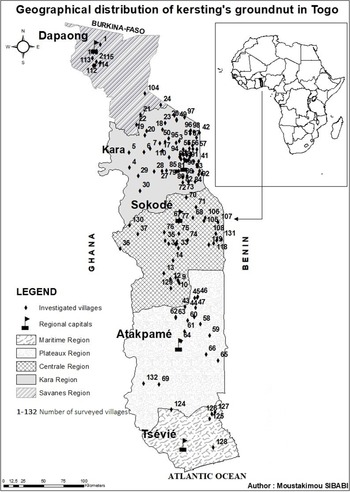
In collaboration with field agents from the Institute for Technical Advice and Support (ICAT), the study was conducted throughout Togo. Togo is administratively divided into five regions: Savanes, Kara, Centrale, Plateaux and Maritime (Fig. 1). These regions fall into four major agroecological zones, each characterized by distinct climatic and ecological conditions (Agboh and Badjaré Reference Agboh and Badjaré2007):
Geographical distribution of Macrotyloma geocarpum in Togo.

The Dry Savannah Zone (Savanes and northern Kara) is characterized by a Sudano–Guinean climate with a unimodal rainfall regime (April to November), a dry season from November to March, and ferruginous tropical soils.
The Humid Savannah Zone (Centrale and northern Plateaux) consists of vertisols or vertic soils, wooded and shrubby savannahs and remnants of semi-deciduous forests, particularly in the Togo Mountains.
The Forest Zone (central and southern Plateaux) encompasses the Atakora range (Kuma, Danyi, Akposso–Akebou, Agou and Haïto). It experiences a mountain climate with a short dry season and is dominated by Sudanian–Guinean forests interspersed with savannahs.
The Coastal Zone (Maritime region), located along the Atlantic Ocean, has a subequatorial climate with bimodal rainfall and covers approximately 6395 km2, or 11% of the national territory.
Togo has more than fifty ethnic groups, which can be classified into three main families: the Adja–Ewé, mainly in the Plateaux and Maritime regions (in southern Togo), the Kabyè–Tem in the Kara and Centrale regions (in northern Togo) and the Para–Gourma, also in the Central region but also in the Savanes region (in northern Togo) (Laré and Massanvi Gblem-Poidi Reference Laré and Massanvi Gblem-Poidi2018; Tete-Benissan Reference Tete-Benissan2024). This cultural heterogeneity informs varied agricultural practices and local knowledge systems.
With a combined population of over 8 million (Laré and Massanvi Gblem-Poidi Reference Laré and Massanvi Gblem-Poidi2018; INSEED 2024a, 2024b), agriculture is the dominant economic activity across all agroecological zones (ARISE IIP 2022). Major crops include maize, rice, soybeans, yams, cassava, beans, cotton, coffee and cocoa. Despite its recognized nutritional and agronomic potential, Kersting’s groundnut is considered a neglected and underutilized species, cultivated only by a small proportion of farmers, mainly for household consumption and occasionally for sale.
Sampling technique and data collection
Kersting’s groundnut is a rare and underutilized crop, and no official database currently exists regarding its distribution in Togo. However, because of its agronomic similarity to Bambara groundnut, notably its underground growth habit, the initial survey points were selected based on known production areas of Bambara groundnut. From these initial contacts, a snowball sampling approach was employed to identify additional respondents. This method, as described by Biernacki and Waldorf (Reference Biernacki and Waldorf1981), involves expanding the sample by using referrals from initial participants (Biernacki and Waldorf Reference Biernacki and Waldorf1981). Villages and producers were identified with the assistance of local extension agents from Institut de Conseil et d’Appui Technique (ICAT), Comités Villageois de Développement (CVD), traditional chiefs and local farmer group leaders. These community intermediaries facilitated first contact and built trust with respondents. Farmers were invited in advance and asked to bring samples of Kersting’s groundnut varieties they currently cultivate.
Data were collected using semi-structured group interviews, individual interviews and home or field visits, following established ethnobotanical methods (Akpavi et al. Reference Akpavi, Chango, Tozo, Amouzou, Batawila, Wala, Gbogbo, Kanda, Kossi-Titrikou, Dantsey-Barry, Talleux, Butaré, Bouchet and Akpagana2008; Akpavi Reference Akpavi2010). Before administering the questionnaire, the study objectives and procedures were explained in local languages with the help of translators. Verbal informed consent was obtained from each participant. The two main phases of the survey were the administration of the questionnaire and the collection of memberships. The questionnaire was structured as follows: The group-level questionnaire focused on the types and characteristics of local varieties cultivated according to ethnic group, as well as indigenous knowledge and the perceived status of Kersting’s groundnut. The individual-level questionnaire collected data on respondents’ sociodemographic profiles and their individual knowledge and use of Kersting’s groundnut. These interviews allowed researchers to map the geographical distribution of the crop, identify current producers, document endogenous knowledge, update the status of the crop across regions and better understand the drivers behind its progressive disappearance.
Data analysis
Geospatial analysis
The geographical coordinates of all the villages surveyed were recorded using a GPSMAP 66S (GARMIN) and then georeferenced in ArcGIS 10.5. A distribution map was produced to visualize the spatial distribution of groundnut cultivation across the five administrative regions of Togo (Fig. 1). The names of the villages numbered 1–132 on the map were listed in Table S1.
Statistical analysis
The data collected were analyzed using R software version 4.3.2. Descriptive statistics (frequencies, means) were used to analyze quantitative variables (proportion of producers by region, gender, age group and number of local varieties identified). Varietal diversity was quantified based on seed colour.
The relationship between growing regions and socio-demographic characteristics (age, gender, farming experience, level of education, household size) was examined using correlation analyses. Given the non-normality of some distributions, the analysis of differences in the number of local varieties held by gender was performed using the non-parametric Mann–Whitney test. The correlation between modes of use of the ground lentil and demographic variables (gender, age, region, ethnicity) was studied using Fisher’s exact test under the conditions described by Crawley (Reference Crawley2012).
A correspondence analysis (CA) was performed to identify the axes of differentiation between cultivars and to highlight the specific traits associated with ethnic groups.
To quantify the proportion of each reported use category, the fidelity level (FL) was calculated for each region according to Friedman et al. (1986) using the formula. This method makes it possible to quantify the relative importance of each of Kersting’s groundnut uses perceived by respondents, by identifying those that are most widely recognized or valued in each group.
 \begin{equation*}{\text{FL = }}\left(\text{F}/\Sigma \text{F} \right){{ \times 100}}\end{equation*}
Where F represents the number of respondents for a given use that motivates the cultivation of Kersting’s groundnut, and ΣF is the sum of the number of respondents for all uses.
The current status of Kersting’s groundnut was assessed using a four-cell analysis (Ayenan et al. Reference Ayenan, Danquah, Ahoton and Ofori2017). The practice of cultivating was evaluated in four groups: many households in a large area; few households in a large area; many households in a small area; many households in a small area.
Results
Geographical distribution of Kersting’s groundnut across Togo
A total of 132 villages, located within 96 cantons and spread across 22 prefectures in the five administrative regions of Togo, were surveyed. In these villages, 238 producers of Kersting’s groundnut were identified.
Production percentages
The analysis reveals that the Kara region, situated in the Dry Savannah Zone, had the highest proportion of producers, accounting for 60.5% of the total (67 villages). The region’s agroecological conditions are characterized by a unimodal rainfall pattern, and ferruginous soils appear favourable for the cultivation of Kersting’s groundnut.
The Centrale region, part of the Humid Savannah Zone, represented 16% of the surveyed producers in 29 villages. The Plateaux region, which includes both forest and savannah zones, accounted for 12.6% of producers in 19 villages.
The Savanes region, located in the northernmost part of the country and within the Dry Savannah Zone, contributed 8.8% of the respondents in 11 villages.
Finally, the Maritime region, part of the Coastal Zone, registered the lowest number of producers, with only 2.1% in 5 villages.
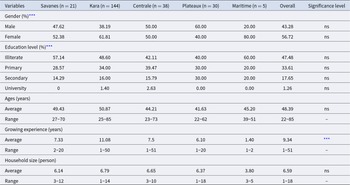
Sociodemographic characteristics of Kersting’s groundnut producers
A total of 238 producers were interviewed, representing 16 distinct ethnic groups, including Kabyè (48.3%), Nawouda (10.5%), Lamba (10.1%), Moba (8.0%), Adja (4.6%), Temberma (4.2%), Ewé (3.4%), Konkomba (3.4%), Gangan (1.7%), Ana (1.3%), Bassar (1.3%), Fon (0.8%), Mina (0.8%), Tem (0.8%), Agouna (0.4%) and Ifè (0.4%). Among these, the Kabyè constituted the largest proportion of respondents, indicating their strong involvement in the cultivation of Kersting’s groundnut. In contrast, the Agouna and Ifè ethnic groups were the least represented in the sample. As shown in Table 1, most of the surveyed producers were women (56.7%). Their age ranged from 22 to 85 years, with an average of 48.39 years. Most of them were adults (79%). Respondents under 30 years old (6%) and elderly people over 60 years old (15%) were the least represented, categorized respectively as young and elderly participants. With a maximum of 18 members per household, the average household size was 7 people. Analysis of schooling levels revealed that 47.5% (including 36.5% women) of Kersting’s groundnut producers in Togo had no formal level of education. Among the 53% who had attended school, the majority (33.6%, including 17.6% women) had attained only the primary level, 17.6% (2.5% women) reached the secondary level and just 1.26% of men had attained the university level. The maximum experience of producers was 51 years (± 9), with a minimum of 1 year, an average of 9 years and a mode of 2 years. Most producers (44%) had between 0 and 5 years of experience, while only 4% had between 15 and 20 years. The land areas allocated to Kersting’s groundnut cultivation varied between 0.03 and 2 hectares (± 0.1), with a mode of 0.06 hectares. Most producers (46%, including 26% of women) cultivated the crop on 0.06 hectares; 23% on 0.03 hectares; and 21% on 0.12 hectares. Notably, only 10% of producers cultivated Kersting’s groundnut on larger plots ranging from 0.25 to 2 hectares, highlighting the predominance of small-scale production.
Sociodemographic characteristics of Kersting’s groundnut producers by region

*** indicates p < 0.001; ns: not significant.
The average age of the surveyed producers is 48.39 years, with a range of 22–85 years. No significant differences in average age are observed across regions. In terms of gender distribution, women predominated among Kersting’s groundnut producers in Kara, whereas men were more represented in the Plateaux region. However, the association between gender and region was not statistically significant (p > 0.001), and no significant differences were observed in household size across regions. Regarding farming experience, a gender disparity was observed beyond 20 years of experience, with more women reporting long-term involvement in Kersting’s groundnut cultivation. The most experienced producers were primarily found in the Kara and Centrale regions. Indeed, the correlation coefficients were very low, ranging from −0.040 (experience) to 0.012 (total land owned), indicating no linear relationship between these factors and the area under cultivation. Furthermore, all p-values were greater than 0.05, confirming the lack of statistical significance (Table 1). Therefore, neither age, household size, farming experience, nor total land owned appeared to significantly influence the size of plots allocated to Kersting’s groundnut cultivation in Togo.
Endogenous knowledge of producers about Kersting’s groundnut
Local nomenclature
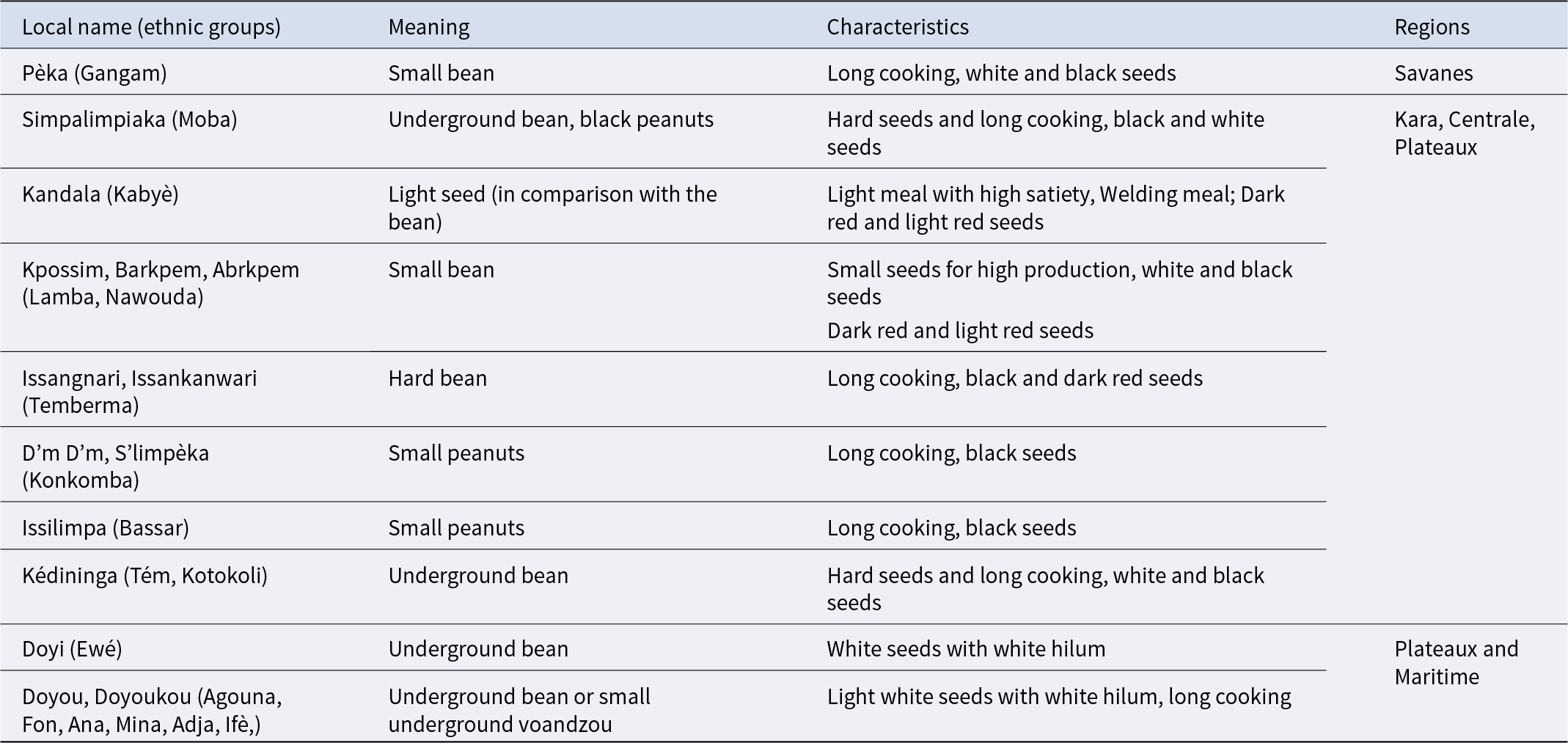
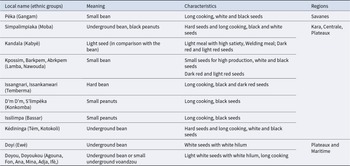
Kersting’s groundnut was known by various local names depending on the ethnic groups, each with different meanings as shown in Table 2. In the North, the names vary as much as the ethnicities, while in the South, the names ‘Doyi’ and ‘Doyou’ were most common among the Ewé, Agouna, Fon, Ana, Mina, Adja and Ifè. Kersting’s groundnut seeds are generally recognized by their underground production method. Northern ethnic groups particularly add the criteria of hardness and seed size to differentiate them from beans and cowpeas. The different varieties were identified based on colour in the North. However, varietal names were not commonly used by producers. In the South, identification was not associated with colour, likely because southern ethnic groups know and produce only the white variety.
Local names and characteristics of groundnut according to ethnic groups
Diversity and varietal distribution of sampled accessions
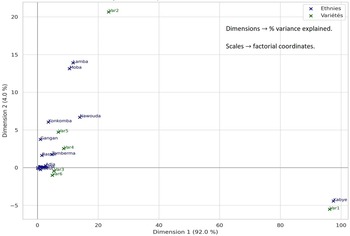
Based on the seed colour of the collected accessions, the number of varieties per household reported was six in the Kara and Savanes regions, four in the Centrale and Plateaux regions, and two in the Maritime region. The distribution of cultivated varieties varies significantly between regions (p < 9.41−9). However, varietal diversity is more present in the North, particularly in the Kara and Savanes regions (4.86% and 19.05% respectively). In fact, more than 50% of producers had only one accession, and it was only in these two regions that producers had more than two different accessions (Fig. S1). Factor analysis revealed that the first two dimensions alone explain approximately 96% of the total inertia (92% for the first, 4% for the second), which guarantees a good quality of data representation. The Kabyè ethnic group stands out for its strong specificity in favour of Var1. The Nawouda, Lamba and Moba ethnic groups display intermediate behaviours, while the other groups are closer to the centre, suggesting less diversity or shared practices. In terms of varieties, Var1 largely dominates the structure of space (nearly 90% contribution), followed by Var2 (Fig. 2). White varieties (Var1 with black hilum) and black-coloured varieties (Var2) are more cultivated in the Savanes, Kara and Centrale regions. White varieties with red hilum (Var6) and black-spotted varieties were also observed in the accessions from these three northern regions of Togo, but in smaller quantities. Red varieties (Var4 and Var5), which are less dominant, are found only in the Savanes and Kara regions. These varieties are mainly cultivated by women from the Kabyè (Fig. S2), Nawouda and Moba ethnic groups. White varieties (Var3, shiny and dull, completely white seeds) were found in the Plateaux and Maritime regions. These varieties are different from the white varieties found in the North (Fig. S3). However, some northern producers living near Benin cultivate the white variety found in the South. Similarly, northern producers living in the South continue to cultivate their original varieties.
Analysis of correspondences between ethnic groups and varieties.

About the number of local varieties cultivated, it was found that there is no significant correlation with the respondents’ age or household size (p > 0.05). However, a weak but statistically significant positive correlation was observed between the number of local varieties cultivated and growers’ experience (p < 0.009), suggesting that more experienced producers tend to cultivate a slightly greater number of varieties. Furthermore, gender appears to influence varietal diversity: while most of both men and women grow only one local variety (over 80%), women were proportionally more likely to cultivate two to four local varieties than men. Although the correlation analysis did not show a statistically significant relationship between gender and the number of cultivated varieties (p > 0.05), the distribution pattern (Fig. S2) suggests a slight tendency for women to cultivate a greater diversity of Kersting’s groundnut varieties than men.
Utilizations of Kersting’s groundnut in Togo
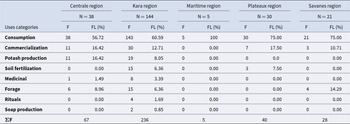
The primary and unanimous reason for cultivating Kersting’s groundnut in all five regions was consumption (Table 3). The seeds are consumed differently depending on the region and ethnic group. For instance, northern Togo ethnic groups consume the seeds similarly to beans. The seeds are generally crushed raw, and the flour is used to make various types of fritters and porridge. The seeds can also be boiled together with rice and red potash (watché) or boiled and mixed with cassava flour, accompanied by red oil or peanut oil and pepper. Kersting’s groundnut is also a bridging food in northern Togo due to its high satiety and is preferred over beans by producers who describe it as sweeter and less light. Some even speak of its superior nutritional value. Furthermore, varietal preferences for consumption depend on the varieties available in their locality. In the South, consumption typically involves incorporating boiled Kersting’s groundnut seeds into tomato sauce or white sauce, with or without meat/sausage. This dish can be accompanied by bread or white rice.
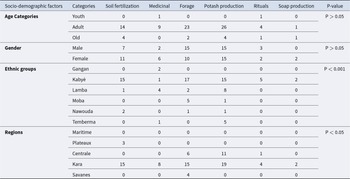
Uses categories of Kersting’s groundnut across the region
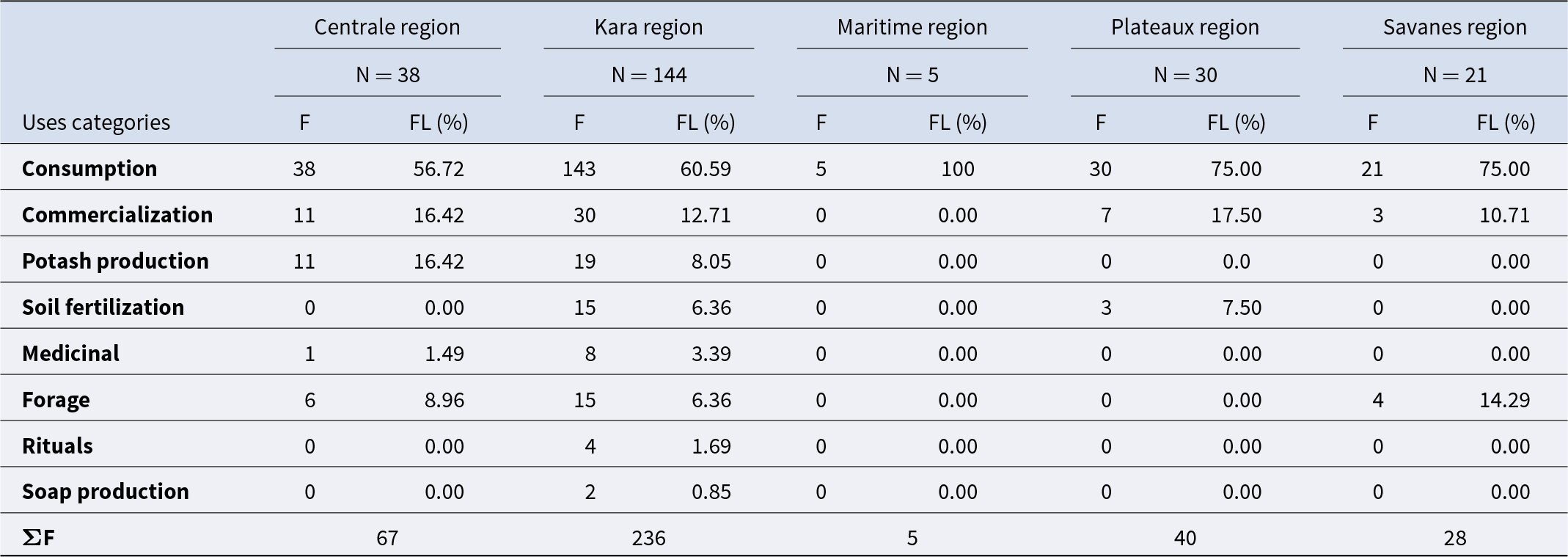
N: number of respondents; FL: fidelity level in percentage; F: number of respondents for a modality of use or reason that motivates the culture; ΣF: sum of the number of respondents for all modalities of use or reason.
The second reason for cultivation was commercialization, which is more significant in the Plateaux region in the South, the Centrale and Savanes regions in the North (Table 3). However, there is a distinct difference in the commercialization modes between the North and South. Southern producers sell their harvest at higher prices and on a larger scale, reaching Benin, whereas northern producers sell their harvests in smaller quantities at local markets to a targeted audience (often for ritual needs). Only a few truly benefit from sales profits.
Many producers, especially the elderly, are aware of the uses of Kersting’s groundnut beyond consumption and sale. However, these practices are gradually disappearing over time.
Cultural and ritual uses of Kersting’s groundnut
According to the verbal accounts provided by elderly people during the survey, in the North, Kersting’s groundnut seeds are used in various rituals, such as liberation and union rituals for twins, funerary rituals for stillborn and the elderly, reincarnation rituals (bobo), ancestor invocation rituals for different purposes, as well as during the traditional Kèna festival of the Kabyè. Certain localities emphasize specific varieties, often black and white (with black hilum). The black variety is more commonly used by healers to prepare potions intended to cure illnesses of unknown origin. These rituals are more widespread among the Kabyè and Nawouda, and to a lesser extent among other northern ethnic groups. In the South, Kersting’s groundnut can be used as funeral food, particularly for the elderly and affluent, as well as during twin ceremonies.
Medicinal and other uses of African Kersting’s groundnut
The uses of other parts of Kersting’s groundnut were discussed by respondents, revealing that their usage is strongly linked to the region and thus to the ethnic groups (Table 4).
Uses of Kersting’s groundnut

- Cooking water: In the far North (Kara and Savanes), the water collected after the first cooking is used as a medicinal drink. This water treats dysentery, stomach aches and constipation in children, and some believe it also cures hiccups. The emphasis is on the black seed cooking water.
- Pods: Used for making traditional potash in the far North. The mixture for preparation often includes bamabra groundnut pods. The pods are reduced to ashes, mixed with water and filtered to obtain potash. Emphasis on potash production is more significant among the Kabyè. The pods are also used in the preparation of traditional soaps (Table 4).
- Leaves: Left in the fields to fertilize the soil and used to feed livestock.
Among the five regions, the fidelity level analysis for each use category underscored a notable specificity in the Kara region. It is the only region where Kersting’s groundnut seeds and pods are used respectively for rituals (1.69%) and traditional soap making (0.85%). The use of pods for traditional potash production and medicinal purposes is specific to the Kara (8.05% and 3.39%) and Central (16.42% and 1.49%) regions. The use of Kersting’s groundnut leaves as livestock feed is specific to the northern regions, namely Central (8.96%), Kara (6.36%) and Savanes (14.29%). However, the use of leaves as natural fertilizers was reported only in the Kara (6.36%) and Plateaux (7.50%) regions. It is worth noting that in the Plateaux region, only producers of Kabyè origin use leaves for fertilization (Table 4). The two main uses (commercialization and consumption) are familiar across all five regions (Table 3).
Despite the diverse uses of Kersting’s groundnut reported across regions and ethnic groups, its current cultivation remains highly marginal. Indeed, when producers were asked to assess the status of the crop in their localities, 90% stated that only a few households cultivate it on small plots, while 10% mentioned a few households cultivating it over larger areas. These findings highlight a worrying decline in cultivation, despite the crop’s cultural, medicinal and nutritional significance. This limited and shrinking presence reflects both the lack of institutional support and the progressive erosion of traditional agricultural knowledge associated with the crop.
Discussion
Geographical distribution of Kersting’s groundnut and distribution of producers
Previous research on Kersting’s groundnut in Togo remains scarce. Agossou et al. (Reference Agossou, N’Danikou, Hotegni, Kakpo, Coulibaly, Oselebe and Achigan-Dako2023) conducted surveys in only three northern villages in 2023, while Akohoué et al. (Reference Akohoué, Sibiya and Achigan-Dako2019) carried out broader fieldwork in Benin and Togo in 2019, but in the Togolese context, their sampling was limited to four villages (one in Savanes and three in Kara, near the Benin border). Although both studies highlighted the importance of conserving Kersting’s groundnut, their restricted sampling provided only a partial understanding of its geographical distribution and producer diversity. In the present study, we sought to address this gap by extending our analysis to all five regions of the country, thereby enabling a more comprehensive assessment of local production variations and revealing new trends in distribution. Only 238 producers were identified across 132 villages throughout the different regions of Togo. This very small number, in a country where agriculture is the main economic activity, clearly indicates the alarming decline of Kersting’s groundnut. Similar findings were reported in Ghana, where farmers attributed the dwindling production mainly to the difficulty of harvesting the pods (75%), the non-staple status of the crop (20%) and its low profitability (5%) (Adu-Gyamfi et al. Reference Adu-Gyamfi, Fearon, Bayorbor, Dzomeku and Avornyo2011). Likewise, (Akohoué et al. Reference Akohoué, Sibiya and Achigan-Dako2019) highlighted that farmers in Benin, Togo and Burkina Faso face pronounced production constraints such as the unavailability of quality seeds, soil infertility and high labour requirements, which have contributed to the progressive abandonment of Kersting’s groundnut cultivation (Akohoué et al. Reference Akohoué, Sibiya and Achigan-Dako2019; Coulibaly et al. Reference Coulibaly, Agossou, Akohoué, Sawadogo and Achigan-Dako2020a). Taken together, these studies and our findings underscore the limited scale and fragility of this neglected crop across West Africa.
Within Togo, however, the distribution of producers is far from homogeneous. Most of the identified producers are in the Kara region, particularly in the prefectures of Kozah, Doufelgou and Kéran. This high concentration may be partly explained by the agroecological characteristics of the Kara Region, which lies within the Dry Savannah Zone, known for its ferruginous tropical soils and unimodal rainfall pattern conditions generally favourable for the growth of Kersting’s groundnut, a drought-tolerant legume adapted to low-input systems (Agboh and Badjaré Reference Agboh and Badjaré2007). Outside the Kara region, which is considered the crop’s area of origin, the Kabyè ethnic group remains the most represented, especially in the Centrale region. This geographical concentration, along with farmers’ testimonies attributing the origin of Kersting’s groundnut to the Kabyè people, underlines the progressive and effective disappearance of this crop, particularly in the southern parts of the country.
Moreover, the results of the 1978 and 1986 surveys positioned Kersting’s groundnut in the northern part of Togo (around Mango and Lama-Kara) with occasional presence in the Centrale and Plateaux regions due to the progressive migration of the Kabyè and Moba ethnic groups (Mergeai Reference Mergeai1993). Thus, the Maritime region, which is a coastal area, has very few farmers. This region is, therefore, the most affected by the disappearance of Kersting’s groundnut. This situation may also be related to agroclimatic constraints. The Maritime Region falls within the Coastal Zone, characterized by high humidity and a bimodal rainfall pattern, which may be less suitable for underground legumes like Kersting’s groundnut, and could partly explain the crop’s marginal status in this area.
These findings are in tandem with those reported by Akpavi et al. (Reference Akpavi, Woegan, Dourma, Tozo, Batawila, Wala, Gbogbo, Kanda, Kossi-Titrikou and De Foucault2011), whose work focused on endangered food plants among the main ethnic groups in Togo. In their study, Kersting’s groundnut was already identified as an endangered species, but to varying degrees across different ethnic groups in the five regions. The authors classified the ethnic groups into three clusters: Group 1 included those from the Maritime and Plateaux regions; Group 2 comprised those from the Centrale and Kara regions; and Group 3 included those from the Savanes region. The frequency of occurrence of Kersting’s groundnut was 50% in Group 2, 44.44% in Group 3 and only 16.67% in Group 1. Based on these findings, the crop was considered highly endangered in Group 2, moderately endangered in Group 3, and endangered in Group 1 (Akpavi et al. Reference Akpavi, Woegan, Dourma, Tozo, Batawila, Wala, Gbogbo, Kanda, Kossi-Titrikou and De Foucault2011). However, our recent data suggests a shift in trend in 2023, where Kersting’s groundnut appears far more endangered in the southern regions than in the north. This shift may also be explained by a combination of ethnocultural continuity in the north, particularly among the Kabyè people. In contrast, in the south, the abundance and accessibility of Kersting’s groundnut imported from Benin on local markets have led populations to prefer market purchases rather than engaging in cultivation. Indeed, several constraints hinder the production of this legume, such as the labour-intensive nature of harvesting due to its underground pods, the lack of structured markets and the absence of technical support or value chain development. In this context, households find it more convenient and less burdensome to buy the crop from markets rather than produce it themselves.
Moreover, the current lack of knowledge about Kersting’s groundnut in certain regions of Togo may be attributed to its long-standing abandonment. In these areas, the crop appears to have been discontinued for so long that, from a generational perspective, it has virtually vanished from local memory. As a result, it is almost impossible today to find any trace of the plant, a situation comparable to what has been reported in northern Burkina Faso, where Kersting’s groundnut has similarly disappeared from the collective memory (Tamini Reference Tamini1995). By covering all five regions of Togo, this study provided a more complete overview of the factors influencing Kersting’s groundnut cultivation. The integration of agroecological, sociocultural and historical dimensions has allowed a more nuanced understanding of the spatial dynamics shaping the survival or disappearance of this underutilized species.
Sociodemographic characteristics of Kersting’s groundnut producers
Kersting’s groundnut cultivation, although traditional, is not influenced by age or household size. However, unlike these factors, educational level is a determining parameter in agricultural practices, as supported by previous studies (Miassi et al. Reference Miassi, Dossa, Adegbola, Enete and Akdemir2020; Akdemir et al. Reference Akdemir, Miassi, Açıksarı and Keskin2021; Vissoh et al. Reference Vissoh, Agoyi, Dohou and Miassi2023). It is noteworthy that a majority of Kersting’s groundnut producers in Togo are uneducated. Establishing producer groups should be promoted to facilitate access to agricultural credit and training in the best agricultural practices. Furthermore, the correlation between gender and Kersting’s groundnut cultivation cannot be neglected. With 56.7%, Women are the main practitioners and marketers of this crop. This fact aligns with the findings of Dansi et al. (Reference Dansi, Vodouhè, Azokpota, Yedomonhan, Assogba, Adjatin, Loko, Dossou-Aminon and Akpagana2012), who attributed the higher commercial profitability of Kersting’s groundnut to women in Benin. This could be explained by the nature of the crop, which requires a great deal of patience during harvest, as acknowledged by the farmers themselves. However, this finding contradicts the work of Touré et al. (2023), which shows a strong male presence in the practice of this crop, but with fewer than 100 producers. In any case, other studies have revealed that the cultivation of Kersting’s groundnut demands significant labour input (Amujoyegbe et al. Reference Amujoyegbe, Obisesan, Ajayi and Aderanti2007; Kafoutchoni et al. Reference Kafoutchoni, Agoyi, Sossou, Agbahoungba, Agbangla, Assogbadjo and Sinsin2022).
Unfortunately, there is a continuously growing labour shortage that is not limited to Togo. This increasing labour shortage has also been observed in Benin, Burkina Faso and Ghana, respectively, in 2023 and 2020 (Coulibaly et al. Reference Coulibaly, Agossou, Akohoué, Sawadogo and Achigan-Dako2020b; Vissoh et al. Reference Vissoh, Agoyi, Dohou and Miassi2023). This scarcity of labour has intensified the abandonment of Kersting’s groundnut cultivation in favour of crops perceived as more profitable.
Diversity and varietal repartition of Kersting’s groundnut
According to ethnic groups, Kersting’s groundnut is referred to by various names. These different local names reflect the plant’s long history and cultural significance across diverse communities. However, this variability in naming is not particularly associated with colour, which remains the sole criterion for distinguishing traditional varieties in the North. Based solely on this criterion, it can be hypothesized, as Mergeai (Reference Mergeai1993) suggested, that the genetic diversity of Kersting’s groundnut varieties in Togo is likely less dense than that in Benin and Ghana. In the Kara and Savanes regions, producers typically classify varieties as white (with black hilum), red and black, with the white type being the most common. However, additional phenotypes such as speckled black (black hilum) and dark red were observed among the collected accessions. The Kabyè ethnic group stands out, contributing over 90% of all samples, with a clear preference for Var1. Intermediate levels of varietal diversity were noted among the Nawouda, Lamba and Moba groups, while other ethnic groups showed overlapping practices or limited differentiation. These results confirm a strong correlation between ethnicity and variety selection, influenced by cultural factors. The men and women tend to cultivate a single variety, though this tendency is more pronounced among men, possibly reflecting women’s greater involvement in crop management and seed conservation at the household level. This pattern, however, may increase the risk of genetic erosion.
Interestingly, northern varieties grown in southern regions are cultivated exclusively by northerners, while southerners appear unfamiliar with northern types. Farmers near the Benin border report cultivating the white variety from Benin, which they recognize as originating from that country. The greatest varietal diversity was found in the Kara region, especially in Kozah and Doufelgou prefectures. Ethnicity and farming experience were positively correlated with variety diversity (p < 0.05).
In summary, white (black hilum) and black varieties dominate in northern Togo. Northern producers, particularly the Kabyè, claim to be the originators of Kersting’s groundnut, referring to it as ‘Kabyè food’. In contrast, southern producers often associate their varieties with Benin.
Cultural uses and status of Kersting’s groundnut
The study also showed that some farmers in the North continue cultivating Kersting’s groundnut exclusively at the request of traditional guardians or spiritual leaders. These cases were found in the Bassar, Binah, Doufelgou and Kozah prefectures. Producers acknowledge the importance of Kersting’s groundnut in rituals and therapeutic treatments, often providing or selling it when needed. The most common therapeutic use in the North involves using the first boiling water from black seeds to treat dysentery, stomach aches and constipation in children.
These traditional uses, especially among northern ethnic groups, underscore the crop’s cultural importance and the role of spiritual beliefs in preserving varietal diversity. Ritual practice also varies by ethnicity. For example, during funerals of elders, the Kabyè and Nawouda prepare Kersting’s groundnut dishes as offerings in the mortuary room, symbolizing nourishment for the deceased on their journey to the ancestral world. The crop is seen as sacred, much like Bambara groundnut, and black seeds are particularly significant in these rites. By continuing this ritual, they seek protection and blessings from their ancestors for the preservation of the crop, avoiding famine. Black seeds are particularly emphasized in these rituals. The December 1985 survey in northern Togo revealed the existence of this practice among the Kabyè and Moba peoples. Kersting’s groundnut, by its mode of production, constituted an essential viaticum for the final journey of the deceased. At that time, only the Moba people associated voandzou, whose seeds also ripen in the ground (Mergeai Reference Mergeai1993). These traditional practices, still present to this day, effectively highlight the link between animist activities and the preservation of the genetic diversity of Kersting’s groundnut in Togo.
Similar cultural connections have been reported in other West African countries. In Benin, Kersting’s groundnut is often used in spiritual ceremonies (Ayenan and Ezin Reference Ayenan and Ezin2016b). In Burkina Faso, Tamini described a ritual where its seeds, mixed with other grains, are placed on lepers’ graves under a calabash fragment, which is later broken to prevent curses such as crop failure (Tamini Reference Tamini1995). In Ghana, Amuti (Reference Amuti1980) documented that Kersting’s groundnut was the only food served to children during their mother’s funeral (Amuti Reference Amuti1980). Despite the persistence of such traditions, it remains difficult to obtain detailed information about their meaning or the specific symbolic role of black seeds.
In Togo’s markets, southern and Beninese varieties are more prevalent and expensive. These varieties are abundant because they are primarily imported from Benin, where they were traditionally reserved for dignitaries, family heads and special occasions. They are also one of the preferred dishes of Vodou priests (Mergeai Reference Mergeai1993; Vissoh et al. Reference Vissoh, Agoyi, Dohou and Miassi2023). Conversely, Togolese origin varieties remain rare and largely unknown to much of the population, with small producers limited to local markets.
Finally, although Kersting’s groundnut holds important cultural, medicinal and nutritional value across various regions and ethnic groups, its cultivation remains extremely limited. When asked about the crop’s status, 89.2% of producers reported that only a few households still grow it on small plots, while 10.8% indicated that it is cultivated by a few households over larger areas. According to the respondents, this marginalization is largely due to the crop’s demanding nature, which requires patience, close management and timely harvesting on small plots to avoid losses. These constraints, combined with a lack of institutional support and the gradual erosion of traditional farming knowledge, have contributed to the crop’s steady decline and its growing disinterest among producers.
Conclusion and perspectives
A wide variety of local names and varietal classifications for Kersting’s groundnut among different ethnic groups and regions of Togo has been revealed. These findings reflect the deep cultural integration and agronomic value of the crop. However, the study also highlights its alarming decline in cultivation, particularly in southern regions, which threatens its genetic diversity and long-term survival. By covering all five administrative regions and mapping the cultivation areas across four agroecological zones ranging from dry savannahs in the north to forest and coastal zones in the south, this research provides the first nationwide overview of the crop’s distribution. The findings demonstrate how climate and agroecological conditions, combined with ethnocultural factors, influence varietal diversity and usage patterns. Most producers identified are women with limited formal education, pointing to the need for targeted support and capacity building. This first phase of research lays a solid foundation for the conservation and revitalization of Kersting’s groundnut in Togo. Future work will focus on in-depth studies of the production system and the agromorphological and molecular characterization of the collected accessions. These efforts will support sustainable strategies for the genetic conservation and promotion of this culturally significant but neglected crop.
Supplementary material
The supplementary material for this article can be found at https://doi.org/10.1017/S1479262125100348.
Acknowledgements
The authors express their gratitude to the funders. We thank the ICAT agents and local communities for their support during fieldwork. We also thank the University of Kara and ITRA for institutional support. Furthermore, the authors acknowledge the use of the AI tool ChatGPT (OpenAI, GPT-4o, June 2024 version, https://chat.openai.com) for assistance with English editing, language refinement and code debugging in R used for data analysis. The authors verified and validated all AI-assisted content and analyses to ensure scientific integrity. No figures were generated by AI tools, and all analyses were performed and interpreted by the authors.
Author contributions
KKP and EMB contributed to the study design and field coordination. MS designed the study, collected data, performed analysis and wrote the manuscript. AT, KA and KKP provided technical support and revised the manuscript critically. KK and AMEH contributed to data collection. All authors read and approved the final manuscript.
Funding statement
This document has been produced with the financial assistance of the European Union (Grant no. DCI-PANAF/2020/420-028), through the African Research Initiative for Scientific Excellence (ARISE), pilot program. ARISE is implemented by the African Academy of Sciences with support from the European Commission and the African Union Commission. The contents of this document are the sole responsibility of the authors and can under no circumstances be regarded as reflecting the position of the European Union, the African Academy of Sciences and the African Union Commission.
Competing interests
The authors declare none.
Ethical standards
All procedures performed in this study involving human participants were conducted ethically according to local institutional guidelines. The surveys were conducted in collaboration with field agents from the Institut de Conseil et d’Appui Technique (ICAT), under the coordination and institutional coverage of the Institut Togolais de Recherche Agronomique (ITRA). The ICAT agents officially introduced the research team to the local communities and producers. Informed consent was obtained from all individual participants included in the study.
Data availability
The datasets used and/or analyzed during the current study are available from the corresponding author upon reasonable request.


 Open access

