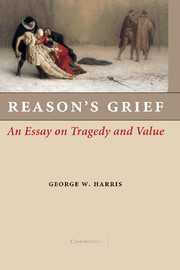
Book contents
- Frontmatter
- Contents
- Acknowledgments
- An Aesthetic Prelude
- 1 The Problem of Tragedy
- 2 The Dubious Ubiquity of Practical Reason
- 3 Nihilism
- 4 Pessimism
- 5 Monism: An Epitaph
- 6 Moralism and the Inconstancy of Value
- 7 Moralism and the Impurity of Value
- 8 Best Life Pluralism and Reason's Regret
- 9 Tragic Pluralism and Reason's Grief
- 10 Postscript on the Future: The Idea of Progress and the Avoidance of Despair
- Bibliography
- Index
7 - Moralism and the Impurity of Value
Published online by Cambridge University Press: 30 July 2009

Book contents
- Frontmatter
- Contents
- Acknowledgments
- An Aesthetic Prelude
- 1 The Problem of Tragedy
- 2 The Dubious Ubiquity of Practical Reason
- 3 Nihilism
- 4 Pessimism
- 5 Monism: An Epitaph
- 6 Moralism and the Inconstancy of Value
- 7 Moralism and the Impurity of Value
- 8 Best Life Pluralism and Reason's Regret
- 9 Tragic Pluralism and Reason's Grief
- 10 Postscript on the Future: The Idea of Progress and the Avoidance of Despair
- Bibliography
- Index
Summary
Even worthless ground, given a gentle push
from heaven, will harvest well, while fertile soil,
starved of what it needs, bears badly.
But human nature never seems to change;
evil stays itself, evil to the end,
and goodness good, its nature uncorrupted
by any shock or blow, always the same,
enduring excellence.
Is it in our blood
or something we acquire? But goodness can be taught,
and any man who knows what goodness is
knows evil too, because he judges
from the good.
But all this is the rambling nothing
of despair.
Euripides, HecubaThe dangers of moralism run deep and in more than one direction. The direction just surveyed is one fed by a current of arrogance: elevate virtue and dignity the way the Stoics and Kantians do and things of great importance will fade from view, sucked into the turgid waters of the moralizing mind. Pulling in another direction is a different current of moralism: the passion for purity. Perhaps the most passionate and intelligent moralizer in intellectual history, Immanuel Kant, argued that the foundation for morality must involve a value that is unqualifiedly good. He went on to assert that such a value could not in itself ever lead a well-motivated person to do the wrong thing. If a well-motivated person ever does the wrong thing, it must be traceable to something independent of what is good about that person. The same point could be made in terms of virtue, Stoic or otherwise.
Information
- Type
- Chapter
- Information
- Reason's GriefAn Essay on Tragedy and Value, pp. 174 - 198Publisher: Cambridge University PressPrint publication year: 2006
Accessibility standard: Unknown
Why this information is here
This section outlines the accessibility features of this content - including support for screen readers, full keyboard navigation and high-contrast display options. This may not be relevant for you.Accessibility Information
Accessibility compliance for the PDF of this chapter is currently unknown
and may be updated in the future.