1 Making a Martyr
MATTEOTTI. By your own admission, therefore, no Italian voter was free to decide according to his own will (Noise, protests and interruptions from the right). No voter was free to decide on the question …
MARAVIGLIA. Eight million Italians voted!
MATTEOTTI … of whether they approved or disapproved of the policy or, more precisely, of the regime of Fascist government. No one was free, because every citizen knew in advance that even if he dared to affirm the contrary by a majority vote, there was a force at the disposal of the government that would annul his vote and response.
A voice on the right. And what about the two million votes cast by minorities?
FARINACCI. You could have started a revolution!
MARAVIGLIA. We would have had two million heroes!
MATTEOTTI. There is an armed militia to enforce the government’s policy … (Loud and prolonged applause on the right and cries of ‘Long live the militia!’)
The Italian socialist leader Giacomo Matteotti is known more for his tragic end than for the life he led. A provincial councillor, mayor, socialist organiser, and parliamentarian, he was also a distinguished lawyer. Had Matteotti lived, his legal knowledge and commitment to justice, equality, freedom and democracy would no doubt have put him among the writers of the Italian Constitution. Instead, seat number fourteen on the far left of the Chamber of Deputies – the seat from which Matteotti rose to give the defiant speech against Fascist corruption cited above – remains empty in perpetuity, a memorial that makes absence visible and puts memory of democratic rupture at the heart of the institution meant to defend it.
Born in 1885 in Fratta Polesine, Rovigo, Giacomo Matteotti was one of the leading figures in Italian socialism of the twentieth century. Educated in Law at the University of Bologna, he was deeply influenced by his studies of European penal systems and repeat offending and published his writings on the subject (Matteotti, Reference Matteotti1910). He began his political life in the Polesine region, becoming an organiser of the Partito Socialista Italiano (PSI, Italian Socialist Party) local branch. In 1910, he was elected to the Rovigo regional council and became mayor of Villamarzana and Boara Polesine in 1912 and 1914, respectively. Alongside his staunch commitment to improving conditions for local workers, many of whom faced poverty and hunger, he retained a committed anti-war stance, describing Italy’s participation in World War I as the ‘ultimate disgrace’ (Matteotti, Reference Matteotti and Modena1985, p. 51). His 1914 speech condemning war to the Rovigo council led to criminal charges. Drawing on his legal training, he successfully contested the charges by invoking parliamentary immunity (Matteotti, Reference Matteotti and Modena1985, p. 51). Despite his stance, he was drafted into military service in 1916 but never fought. Instead, he was posted to non-combat roles and was later interned in Sicily (Gobetti, Reference Gobetti2000, p. 31), where he spent time writing and reflecting on political issues. When he was released in 1919, he returned to political life and was quickly elected to the Italian Chamber of Deputies. He would be re-elected in 1921 and 1924.
An active member of the Chamber, Matteotti drew up new laws, participated in important debates, sat on committees and proposed motions. He continued to campaign for local workers, helping farmworkers and peasants secure the renewal of agrarian contracts (Caretti, Reference Caretti2004, p. 27). Matteotti’s beliefs were rooted in reformist socialism. A ‘consistent and rigorous reformer’ (Canali, Reference Canali2009, p. 148), he saw reform as a means to overturn capitalist society and better the lives of workers without resorting to revolution. Disillusioned by the PSI’s move towards Communism after the Russian Revolution, he left the party in October 1922 – just a few days before Mussolini’s March on Rome – and founded the Partito Socialista Unitario (PSU, Unitary Socialist Party) with other leaders including Filippo Turati, Claudio Treves and Giuseppe Modigliani. Matteotti became secretary of the party, which advocated for gradual democratic change in pursuit of social and economic progress. Though the party enjoyed the support of historic socialists like Treves and Turati, as well as the leaders of the Confederazione Generale del Lavoro trade union, these two wings of support were also its ‘major defect’ because while the political wing was staunchly opposed to Fascism, labour leaders had made ‘dangerous compromises with the fascists in order to protect union structures from attack’ (De Grand, Reference De Grand1989, p. 51).
Matteotti was also a father and a husband. In 1916, he married Velia Titta, and they had three children: Giancarlo, Matteo and Isabella, born in 1918, 1921 and 1922, respectively. It is easy to forget this part of Matteotti’s life, eclipsed by his place in history, but a trip to the archive brought this into sharp relief. Leafing through the Matteotti family album at the Fondazione Nenni in Rome, I was drawn in by the familiar semiotics of family photos. In one, Giacomo holds the hand of one of his young sons, pointing at something in the distance. Surrounded by cows brought out to pasture, mountains behind, his other son – a toddler – looks down at the grass. You can almost picture Velia holding the camera, their youngest daughter a babe-in-arms. Ordinary photographs of a man who led an extraordinary life. From one page to the next, they stop.
*
At the time of his murder, Matteotti was preparing a dossier of Fascist criminal activity based on evidence he had gathered. He had long been engaged in a battle to draw national and international attention to the crimes of Fascism through documentary evidence – even before the March on Rome. In March of 1922, he edited a lengthy report documenting Fascist violence in 410 towns and cities across the country, the financial repercussions, and the impact on the fabric of Italian civil life. A shorter version had been produced a year prior, in June 1921, in time for the opening of the Chamber in July and it was distributed among deputies. Its original preface acknowledged the incompleteness of this hastily produced work: ‘the following pages, already overflowing with unspeakable atrocities, already exuding such horror, will contain only a small part of the bloody reality’ (Matteotti, Reference Matteotti1922, p. 5). When it was published in 1922, it ran to 500 pages of photographs, statistical data and analysis. In early 1924, Matteotti published Un anno di dominazione fascista (Matteotti, Reference Matteotti1924a), which condemned Fascist violence, highlighted the many discrepancies between the PNF’s announced policies and those implemented in its first year of rule in 1923, and provided detailed financial analysis of government spending. By 1924, translations of Matteotti’s work were underway into English and Belgian, and in April 1924, he had visited London to discuss the threat of Fascism with the British Labour Party. These international contacts would ensure the posthumous publication of his translated works and some, including Arthur Henderson of the British Labour Party and Belgian socialist deputy Joseph Van Roosbroeck, would participate in the unveiling of the first Matteotti monument at the House of the People in Brussels in 1927.
Matteotti approached his work meticulously, documenting abuses of the legal system, evidencing financial corruption (and presenting statistics to refute every claim made by the regime), and identifying a parallel police force under PNF control. According to Mack Smith, ‘Mussolini had found a combative, resolute, and well-prepared adversary’ (Reference Mack Smith1981, p. 69). Indeed, Matteotti’s understanding of the extent of the Fascist threat was unusual among Mussolini’s opponents, and he had seen it early:
Matteotti’s insights into the links between unscrupulous business manoeuvrers, the government, and the fascist press revealed to him how instrumental bribery was in raising funds to finance a press that was still struggling to obtain adequate resources. No other opposition leader had made the same connection. They typically denounced the corruption of the fascist government along the traditional rhetorical lines of moralism, and their attacks were not well-documented like Matteotti’s.
On 30 May, ten days before his assassination, Matteotti denounced Fascist violence and electoral fraud during the recent general election, which had seen the Fascists secure 65 per cent of votes, taking 374 seats to the opposition’s 180. This outcome was determined by the recently adopted Acerbo Law, introduced in 1923, which stated that, provided the party with the largest share of the votes took at least 25 per cent, it would be rewarded with two-thirds of the seats in parliament. During the same parliamentary sitting, Mussolini had made a number of provocative requests to parliament, asking for blanket approval to be given to the newly elected members of the majority and to several thousand laws (Canali, Reference Canali2009, p. 151), and proposing that the many complaints about the election (around a million legal breaches were recorded) be wiped (Mack Smith, Reference Mack Smith1981, p. 76). As the epigraph to this section makes clear, Matteotti’s speech was brazenly interrupted several times by Fascists. He closed his intervention with a call to annul the election. It was widely reported that as he exited the Chamber, he instructed his colleagues to begin preparing his funeral oration (Canali, Reference Canali2009, p. 151).
On the afternoon of 10 June 1924, as he did every day, Matteotti left his home in the Flaminio area of Rome to visit the Chamber of Deputies library where he was preparing his party’s response to the administration’s budget. Five men waited in a Lancia car on the embankment beside the Tiber. Their names were Amerigo Dumini, Albino Volpi, Giuseppe Viola, Augusto Malacria and Amleto Poveromo, and they belonged to the Fascist Ceka – ‘a centralized, repressive, criminal organization that already existed during the two-year “legalitarian” period (1922–24)’ (Canali, Reference Canali2024, p. 67). They received orders from Cesare Rossi, director of Mussolini’s Press and Propaganda Office, and Giovanni Marinelli, administrative secretary of the Partito Nazionale Fascista (PNF, National Fascist Party) and one of the financiers of the March on Rome. When they saw Matteotti approach, the men attacked him and forced him into the car, which sped out of Rome. Matteotti was brutally assaulted with a knife and died in the back of the car. His corpse would not be found until 16 August, as Italians returned from the distraction of Ferragosto. Matteotti had been buried in the thick undergrowth of the Quartarella woods with the metal file the assassins had used to dig his grave.
The Matteotti affair was a turning point in Fascism’s use of violence, which was now mandated from above. Targeted, symbolic squadristi violence had already changed the fabric of Italian life. According to the historian Alessandro Saluppo (Reference Saluppo2020, p. 291), ‘The viciousness and capillary character (almost private) of violence destroyed communities, scattered families and bankrupted people’s sense of reality. At the same time, violence, terror and apprehension became the foundation on which fascist power was grounded.’ Relentless waves of violence had united the Fascist squads, leaving shock and fear in their wake. Localised resistance led to new waves of squadristi violence, frightening many into submission (Saluppo, Reference Saluppo2020, p. 294). Persistent punitive attacks caused significant physical harm, but they had a psychological impact too, prompting terror and apprehension (Saluppo, Reference Saluppo2020, p. 296). After several years of local squadristi violence, the assassination of a prominent national leader sent a clear message to those who opposed Fascism formally: resistance would lead to physical harm, no matter the visibility of the victim.
The details of Matteotti’s death on 10 June 1924 are now well known and its impact has been documented by scholars (see, among others, De Felice, Reference De Felice1965; Rossini, Reference Rossini1966; Borgognone, Reference Borgognone2013; Canali, Reference Canali2024; Fracassi, Reference Fracassi2024). We now know that orders for his murder came from the top, largely thanks to the work of historian Mauro Canali (Reference Canali1997), who was able to access important archival materials in the 1990s to prove Mussolini’s responsibility including the papers of the preliminary trial that had been smuggled out of Italy by the exiled antifascist historian and writer Gaetano Salvemini, who was convinced they contained evidence of Mussolini’s culpability. At the time of his kidnap, Matteotti was carrying a folder of documents thought to be part of his preparation for a speech he was due to make in parliament on 11 June, the day after his murder (Canali, Reference Canali2024, p. 156), in which he was expected to denounce Fascist corruption. Indeed, he had already penned an article for the magazine English Life, which criticised Fascist leaders in the strongest terms for receiving money from Sinclair Oil in return for a monopoly on drilling on Italian soil (his article would be published posthumously) (Matteotti, Reference Matteotti1924b). This 11 June speech was the most likely reason for the timing of his assassination, but as Canali’s work (Reference Canali2024, p. 101) has shown, Matteotti’s clear and sustained opposition to Fascism meant it was easy to present his kidnap as the actions of unruly fascists: ‘Matteotti’s May 30 speech in which he denounced fascists certainly played into this strategy, and Mussolini took full advantage of it to assert that the crime was not premeditated; it gave him an ideal opportunity to deflect responsibility from the regime.’ Indeed, the regime survived the delitto by blaming the murder on the violent actions of an uncontrollable sub-stratum of the party – a narrative furthered by the postwar institutional far right, as the final section of this Element shows. A letter from the poet and writer Ada Negri to Mussolini, her friend, ten days after Matteotti’s kidnap, shows how quickly this framing took root. In a letter published by Renzo De Felice, Negri wrote, ‘The faith that good Italians have in You is limitless, as is the certainty that You will know, at any cost, how to purify the environment and use surgical precision to the very end. You have been betrayed; but You are infinitely stronger than the betrayal and the traitors.’ (De Felice, Reference De Felice1974, p. 30). The international press immediately bought into this framing, too.Footnote 2 Writing in The Times on 18 June, a correspondent declared: ‘There is no doubt that Fascismo has greatly suffered from what is happening, but I think that it may perhaps recover if it is purified from the bottom’ (Times, 1924c).
This Element is not about what happened on 10 June 1924. Instead, it is about how what happened is remembered, and how and to what effect public memories of Matteotti have been mobilised nationally and internationally over the last century. In this section, I examine the immediate response to Matteotti’s disappearance within Italy – a reaction so strong it threatened to topple Fascism – and the myth of his final words. This section also outlines the Fascist party’s framing of the assassination as the act of violent squadrismo, and the outcome of the first trial. Section 2 examines performances of grief in Italy after Matteotti’s assassination as acts of resistance against Fascism and analyses the role these expressions of grief played in the international antifascist movement in its earliest days. By foregrounding the emotional response to political assassination both within and beyond the nation, the section contributes to broader discussions of grief as an act of resistance (Kaur, Reference Kaur2021; Segal, Reference Segal2016) – a topic that remains pertinent as the fascist threat rises in the twenty-first century.
When Fascism fell in Italy in 1943, Matteotti’s memory re-emerged in public space in powerful and material ways, as shown in Section 3.Footnote 3 Long honoured in secret, he was now remembered by partisans and Allied soldiers fighting for Italy’s liberation through speeches, ceremonies, slogans and publications. For partisans, Matteotti’s memory re-nationalised Italy’s liberation story, while Allied forces honoured him as a democratic, reformist defender of parliamentary order and not a revolutionary communist. The third section analyses the period 1943–1947 closely, demonstrating that as the Italian Republic emerged, state and civic leaders drew on the language of sacrifice and martyrdom to honour Matteotti’s death and position Italians as victims, not perpetrators, of Fascism.
The final section examines how Italy’s institutional far right – parties directly descended from Mussolini’s Salò Republic, including the Movimento Sociale Italiano (MSI, Italian Social Movement), its successor Alleanza Nazionale (AN, National Alliance) and Fratelli d’Italia (FdI, Brothers of Italy) – the largest party in the current governing coalition – have engaged with Matteotti’s memory throughout the postwar period. An evergreen reminder of Fascism’s inherent brutality, Matteotti’s memory exposes as false the historical narrative put forward by these parties that downplays the centrality of state violence to their ideological forefathers. The section examines these narratives alongside historiographical developments, particularly regarding the extent of Mussolini’s culpability and renewed scholarly attention to Matteotti’s intellectual and political foundations.
1.1 You Can Kill Me, But Not My Idea’: Myth and Absence
In the weeks after Matteotti’s disappearance, the whereabouts of his body captured the collective imaginary in Italy and abroad. As historian Sergio Luzzatto writes (Reference Luzzatto2006, p. 7), ‘The longer it took to find his corpse, the more charismatic a guide he would become to his followers.’ In a retrospective article documenting the ‘Passion Days’ of summer 1924, a title that reflects the framing of Matteotti’s death as sacred sacrifice, the Almanacco Socialista Italo-Americano described the public calls for the return of Matteotti’s body: ‘The people call loudly for justice to be done and demand that, just as Mary was not denied the body of Christ, nor should the elderly mother, the wife and the children be denied the body of Giacomo Matteotti’ (Reference Matteotti1925, p. 24). The lack of concrete proof of Matteotti’s fate created a space for rumour, conjecture and myth. Letters between socialist leader Filippo Turati, one of the co-founders of the PSU alongside Matteotti, and the Jewish anarchist revolutionary Anna Kuliscioff, also his partner, point to the quickly emerging myth of Matteotti’s final confrontation with his assassins in the two weeks after his kidnap (Turati and Kuliscioff, Reference Turati and Kuliscioff1945). On 16 June, L’Unità had published a story saying an anonymous (but extremely reliable, the paper assured its readers) source had overheard one of Matteotti’s assassins, Albino Volpi, recount Matteotti’s behaviour as he was beaten. Describing Matteotti’s response as ‘bold’ and ‘heroic’, Volpi had said he and his fellow assassins might have taken pity on their victim had he only shown humility (L’Unità, 1924). Instead, Volpi had continued, Matteotti had repeatedly shouted ‘Assassins, barbarians, cowards!’, before making his final declaration: ‘You can kill me, but you will never kill the idea that is within me … My idea will never die … My children will be proud of their father … The workers will bless my corpse … Long live Socialism!’ Turati immediately wrote to Kuliscioff, asking if she was aware of Matteotti’s final words. In her reply, Kuliscioff questioned whether these words had been spoken by Matteotti: ‘they are plausible’, she conceded, ‘but I think they were invented. The call for his sons’ revenge makes me doubt their veracity. This is not in Matteotti’s style, and he would not have wanted to name his sons in front of his assassins’ (Turati and Kuliscioff, Reference Turati and Kuliscioff1945, p. 22).
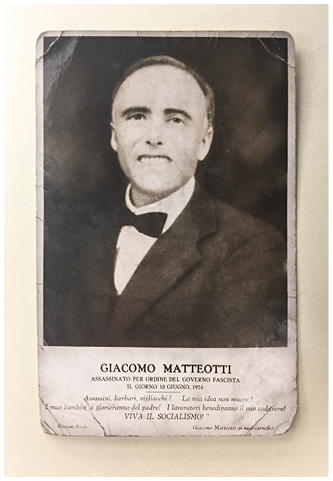
This eavesdropped account of Matteotti’s dying words was quickly picked up by other newspapers (Il Mondo, 1924), and his brave declaration was printed in commemorative material produced immediately and sent internationally (see Figure 1). Turati repeated them during the ceremony he led in Montecitorio on 27 June – a day of nationwide commemorative events held for Matteotti – suggesting they were true to Matteotti’s spirit and predicting their inclusion on commemorative plaques in the future (little did he know it would take more than two decades to become reality):
And he speaks. And he repeats these holy words, choked in his throat, which were handed to the people by one of the assassins, which are His even if he did not utter them, which are true even if they were not reality, because they are His soul; words that will be engraved in bronze on the plaque we will erect here, or on the monument we will raise in the piazza as a warning to future generations.
Commemorative postcard containing Matteotti’s final words sent from Paris to New York in 1924. Image reproduced with thanks to the Immigration History Research Center Archives, University of Minnesota.
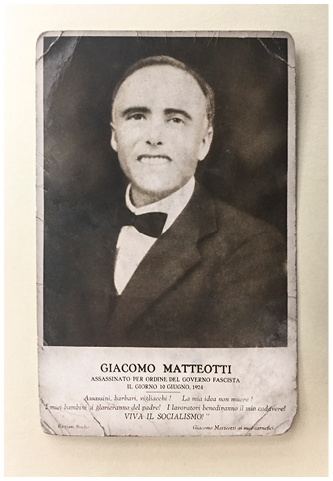
Figure 1 Long description
A postcard featuring a black-and-white photographic portrait of Matteotti in a suit smiling at the camera. Beneath the image, the text reads: GIACOMO MATTEOTTI, Murdered on the orders of the fascist government. 10 June 1924. Murderers, barbarians, cowards! My ideals will not die! My children will be proud of their father! Workers will bless my body! LONG LIVE SOCIALISM!
Matteotti’s mythologised final declaration became a cornerstone of the martyr narrative (King, Reference King2023) – incontrovertible proof of his antifascist conviction in the face of death. As De Soucey et al. argue (Reference DeSoucey2008, p. 102) in their embodied theory of martyrdom, the martyr’s body is a vessel that ‘aids those who seek to shape memory by providing a material form in which to embed moral authority’. In Matteotti’s case, the long absence of his body amplified the weight of his final words, which encapsulated his moral authority in the collective imaginary. His defiance was immortalised by a narrative that resonated globally, and it was upheld by antifascist communities beyond Italy as an example of political courage and sacrifice that would become a foundational story of the Italian Republic two decades later, as Section 3 shows. In the introduction to the English translation of Matteotti’s A Year of Fascist Domination (Reference 74Matteotti1924c), published shortly after his assassination by the Independent Labour Party Publication Department, the Austrian socialist Oskar Pollak identified the international reach of Matteotti’s memory: ‘And never has another word become more true than those prophetic words of the dying hero – they killed him, but they were unable to kill the ideal for which he stood. They tried to stop a fighting force, and they have stirred a whole nation. They wanted to silence a single man, and they have raised a worldwide movement of horror and protest.’
While myths consolidated, the regime moved to suppress Matteotti’s memory, as the next section explores in detail, banning commemoration. But during the ventennio, antifascists across the Italian diaspora – from Australia to Venezuela, and across European cities including Paris, London and Vienna – kept his memory alive. As Matteotti’s widow, Velia, wrote in a letter to the New York-based antifascist writer Girolamo Valenti, the organisation of international commemoration ceremonies was an antifascist duty given the restrictions imposed on Italy (Velia Matteotti, Reference Matteotti1925). Exiled antifascists, the international socialist community, and individuals opposed to dictatorship globally became custodians of Matteotti’s memory, hosting events, funding monuments, printing postcards and depicting him in art. Through this memory work, Matteotti was constructed as an international antifascist martyr, a unifying symbol with resonance beyond Italy.
On 3 January 1925, Mussolini gave a speech in parliament in which he acknowledged his political and moral responsibility (though he did not take direct responsibility for ordering the crime). Performing what historian Ruth Ben Ghiat (Reference Ben-Ghiat and Canali2024, p. ix) has described as a ‘one-man mock trial’, he turned an equivocal acceptance of responsibility into a defiant performance of government lawlessness (‘Tornata di sabato 3 giugno 1925’, 1925, p. 2030): ‘I declare here before this assembly, before all the Italian people, that I assume, I alone, the political, moral, historical responsibility for everything that has happened. […] If Fascism has only been castor oil or a club, and not a proud passion of the best Italian youth, the blame is on me!’ The next month, Roberto Farinacci – ‘the leading spokesperson of the extremists’ in the Fascist party (Mack Smith, Reference Mack Smith1981, p. 81) – was appointed PNF secretary, a clear sign of the party’s direction. Violence intensified, opposition members were attacked, and the party was purged of any members showing the slightest sign of disloyalty. December that year would seal the dictatorship, and Mussolini became head of Government. In the absence of the opposition, who had boycotted parliament as part of the ‘Aventine Secession’ (named after the plebeians of ancient Rome who withdrew to the Aventine Hill in protest against patrician rule in 494BC), this made him answerable only to the King (Macdonald, Reference Macdonald1998, p. 23). On the same day, a press law was introduced that made it illegal for any journalist not on a register drawn up by the Fascists to write. These changes were part of the ‘leggi fascistissime’ (the very fascist laws), which included the outlawing of opposition parties, and marked the irreversible turn to dictatorship. The ‘legalistic’ period of Fascism was over.
1.2 Burying the Case
If the PNF narrative that blamed unruly subversives for Matteotti’s murder were to hold sway, the regime needed a trial. ‘Two capable and determined magistrates’, Mauro Del Giudice and Guglielmo Tancredi, president of the Office of Public Prosecutors and deputy attorney respectively, had begun their investigations immediately after Matteotti’s disappearance, building a case ‘on the basis of a theory of wilful murder’ (Canali, Reference Canali2009, p. 152). Not only did their investigation implicate the Fascist Ceka in prior crimes, but it also led to the arrest of the perpetrators and instigators of the crime, including Rossi and Marinelli, who were identified as the Ceka’s political directors (Canali, Reference Canali2009, p. 152). In response, the regime quickly promoted Del Giudice and Tancredi – a promotion that took them off the case (Manzati, Reference Manzati1969, p. 55) – replacing them with Nicodemo Del Vasto (Farinacci’s brother-in-law) and Antonio Albertini, who pursued a charge of involuntary manslaughter. They were able to downgrade the charge by splitting the crime into two acts – kidnapping and killing – to argue there was no premeditation: ‘whoever ordered the kidnapping did not order to kill; whoever killed, did so involuntarily’ (Canali, Reference Canali2024, p. 119).
Though the trial was expected to take place in Rome, it was relocated to the Abruzzan town of Chieti for reasons of public security (Sechi, Reference Sechi1945, p. 73). The choice of town was strategic. Dubbed ‘the chamomile town’ by the journalist Alberto Mario Perbellini, correspondent for the Bologna daily Il Resto del Carlino, to denote the excessively calm nature of the city (Benegiamo, Reference Benegiamo2006, p. 19), Chieti was out of the public eye. PNF secretary Roberto Farinacci quickly appointed himself Dumini’s lawyer. When he arrived in Chieti, he was welcomed with parades and a town hall reception and gifted a handmade courtroom toga by the local Fascio Femminile (Benegiamo, Reference Benegiamo2006, p. 67) – Women’s Fascist League – theatrical displays of support that revealed the extent to which politics had infiltrated justice. The chamomile city had turned black.
In his deposition, Dumini claimed the attack was not premeditated but spontaneous – provoked by the presence of Matteotti, who Dumini claimed had played a part in the recent assassination of his friend, Nicola Bonservizi, head of the Fascists in France. Dumini said he had kidnapped Matteotti to find out exactly what had happened to Bonservizi (Sechi, Reference Sechi1945, pp. 41–42). But when the group were about 10 km outside of Rome, his accomplices ordered he stop the car, and he looked back to see Matteotti vomiting blood. The deputy died shortly after. Not knowing what to do, he continued driving, eventually stopping in an isolated spot where they buried the body. All the tools that were submitted as evidence had only been used to bury Matteotti, he claimed. The court dismissed Dumini’s version of events and argued that because there were five people in the car – Dumini, Viola, Volpi, Poveromo and Malacria – it was unclear who had dealt the fatal blow, so none could be held responsible (Sechi, Reference Sechi1945, p. 66). It ruled that Matteotti’s death was not premeditated, and there was no causal link between the kidnap and the killing. Furthermore, those who ordered the crime could not be punished because they did not ask for Matteotti to be killed and could not be condemned for not having given clear orders not to kill, because previous kidnappings had not ended in death. The sentence was declared: non-premeditated homicide (Sechi, Reference Sechi1945, p. 72).
The trial ended on 24 March. It would be another twenty-one years before a second trial would take place in postwar Italy. Viola and Malacria were acquitted; Dumini, Volpi and Poveromo were sentenced to 5 years, 11 months and 20 days, but served just two months in jail thanks to an amnesty on political crimes introduced soon after. Rossi, who had been accused of having organised the delitto as the ‘true mastermind’ (Canali, Reference Canali2009, p. 147) of the Ceka, resigned as head of Mussolini’s press office. Emilio De Bono, Mussolini’s head of the state police, also resigned (during his 1923–1924 tenure, there were no records of any violence towards members of the parliamentary opposition). Mussolini also resigned as Interior Minister. Thanks to court corruption, strategic resignations, the timely introduction of new laws and an amnesty, the regime emerged stronger than ever.
Four days later, on 28 March 1926, ceremonies were held across Italy to celebrate the seventh anniversary of the foundation of the Fasci di Combattimento. While Mussolini remained in Rome to oversee events in the capital, crowds in Milan listened to Roberto Farinacci, the second most powerful man in the Fascist party and Dumini’s lawyer. A correspondent for the British newspaper The Times was among the audience. During his speech, Farinacci announced his decision to step down as Secretary General, explaining that when he had accepted the position in early 1925, he had promised to hold it until he had achieved his aim to ‘smatteottizzare’ (de-Matteotti-ize) Italy – a task he had now completed. ‘Smatteottizzare’, the correspondent for The Times explained, ‘has become a very common word in the Fascist Press, Signor Farinacci meant that his task was to cure the nation from the “sentimental” effects of Signor Matteotti’s murder’ (Times, 1926). But Farinacci’s confidence was misplaced. The ‘sentimental effects’ of Matteotti’s death may have been suppressed in Italian public space, but signs of grief were ever more visible abroad.
2 Networks of Compassion and the International Antifascist Movement
‘But, you see, Your Excellency, a man can but killed, but his memory cannot.’
In April 2024, two olive trees were planted in Rome’s Garden of the Righteous – an international memorial to those who defended human dignity and resisted genocide, persecution and totalitarianism. A plaque was laid on the freshly turned earth beneath each tree. One honoured Giacomo Matteotti, the other Alexei Navalny: two men who, the organisers said, had ‘sacrificed their lives for democracy in distant historical and geographical contexts’ (The Ark [@KovchegLive], 2024). The socialist leader Giacomo Matteotti was murdered on 10 June 1924 in Rome. Navalny died a century later in a remote Arctic penal colony where he had been imprisoned. Both men were outspoken opponents of authoritarian leaders – Benito Mussolini and Vladimir Putin – and they paid for it with their lives. In Matteotti’s case, the assassins were members of Mussolini’s Ceka and though Navalny’s death was officially attributed to natural causes, Putin’s regime was widely considered responsible.
A month before these trees were planted, on 1 March 2024, thousands had defied a heavy police presence to gather at the Church of the Icon of the Mother of God in Moscow, honouring Navalny with chants against the government. Russian authorities had warned against ‘unauthorized memorials’ and by nightfall hundreds had been arrested for laying flowers (Gozzi, Reference Gozzi2024). Mourners also gathered around the world, in cities including London, Paris, Rome, Madrid, Berlin, Kappara, Copenhagen and Stockholm, where they laid flowers, lit candles, and bowed their heads in grief at Navalny’s death and what it meant for Russia (Reuters, 2024). This response to Navalny’s death – where public expressions of grief became an act of resistance – echoed the international reaction to Matteotti’s assassination a hundred years earlier. The murder of Matteotti marked a turning point in Mussolini’s use of political violence and his death was mourned internationally as both the death of a political leader and an unthinkable threat to democracy. The parallels in public response to tell us something about the importance of collective expressions of grief in international resistance to authoritarianism, which remains as powerful today as it was a century ago.
2.1 Emotional Resistance
Public grief surged in the weeks between Matteotti’s abduction and the discovery of his body six weeks later. Attesting to the strength of collective emotion, the New York-based publication Almanacco Socialista Italo-Americano described the summer of 1924 as ‘the days of passion’, drawing on Christian language of suffering. In Rome, a mass for Matteotti at Santa Maria del Popolo drew a crowd so full of emotion that, The Times reported, when his widow entered the church, ‘the whole congregation prayed loudly, and bitterly protested against the murder’ (Times, 1924c). As another British correspondent declared, the murder had ‘profoundly shaken the balance of Italian politics, and so deeply moved the conscience of the nation’ (Times, 1924b)
Immediately after Matteotti’s disappearance, crowds of mourners had gathered in Rome at the site of his kidnap on the Arnaldo da Brescia to lay wreaths and red carnations – material symbols of an emerging antifascist commemorative culture – beneath a large cross graffitied onto the wall of the riverbank. The Fascist regime had quickly moved to suppress Matteotti’s memory, banning these flowers and commemorative ribbons, and stating that nobody could gather within ten metres of the kidnap site (Caretti, Reference Caretti1994, pp. 43–44). The police threw the offerings left at this makeshift shrine into the river below (Matteotti, Reference Matteotti1924d, p. 5). As scholars have noted (Caretti, Reference Caretti1994; Zaghi, Reference Zaghi2001; King, Reference King2021), these conflicts around memory and the regime’s efforts to suppress it, which Caretti terms the ‘denied memory’ of the murder, are a significant part of the story. With such tight controls, commemoration became an act of defiance, and it was met with grotesque provocation. Fascists in Rome could be heard singing ‘we’ll make sausages with Matteotti’s flesh’ as they marched below the window of Matteotti’s apartment (Del Buono and Tornabuoni, Reference Del Buono and Tornabuoni1972, 88).
The regime’s suppression of Matteotti’s memory pushed popular expressions of mourning out of public space and into the private realm. The home was a space in which grief could be expressed through individual and collective mourning practices – familiar, ritualised expressions of grief that conveyed a dangerous political position. Some turned their homes into places of private refuge outside the watch of the regime. In a letter to Velia Matteotti nine days after her husband’s kidnap, Aurelio Ballotta, a lawyer living in Rovigo who had known Matteotti personally, described ‘a continuous and deeply moving pilgrimage of poor and humble workers, who came dozens of kilometres by bicycle to share their pain with us’ (Caretti, Reference Caretti1994, p. 127). Others fashioned shrines to Matteotti in their homes, surrounding his parliamentary portrait with flowers and candles, creating ritualistic spaces in which to grieve a murder that represented the death of a man and an assault on democracy – a mourning ritual so prevalent it was depicted in a 1924 drawing in Avanti! (Scalarini, Reference Scalarini1924). The inclusion of Matteotti’s photograph within domestic shrines contributed to the development of what Caretti (Reference Caretti1994, p. 309) terms a ‘cult of Matteotti’s image’. Worship of this image was not without risk, as files held in the regime’s Central Political Registry make clear. Born in Lisignago in Trentino in 1892, Leopoldo Brugnara was classified as a ‘dangerous socialist’ and ‘political dissident’ in 1928 due to his many expressions of resistance to the regime (Prefettura della Provincia di Trento, 1928). He first came to the regime’s attention because he had a photograph of Matteotti in his home surrounded by red carnations, which he illuminated with a small lamp. Fascist authorities also suspected Brugnara of being behind graffiti declaring ‘the file driven into Matteotti’s heart will break your chains’, which had appeared in Lisignago in 1924. In the years 1926–1929, Italians were arrested, exiled or referred to the Special Tribunals for singing songs, possessing pamphlets, or writing slogans relating to Matteotti (Caretti, 2004, pp. 168–169). They were also penalized for possessing photographs, drawings, medallions or stamps with his image. Some sought more creative ways to resist the regime by repeating the name of its most vociferous opponent. In his memoir, Francesco Stefanile, a soldier born in Naples in 1922, recalled that his father had named their family dog ‘Matteotti’ – a gesture that led to both his father and a friend being fined by the Fascist authorities in the late 1920s for saying the dog’s name in public (Stefanile, Reference Stefanile1999, p. 5).
On 27 June 1924, many took to the streets in Italy to defy the regime’s suppression of public mourning. Some vocalised their sorrow, while others conveyed mourning through rituals of silence. At 10 am, workers across the country downed their tools in a strike organised by the labour union Confederazione Generale di Lavoro. Simultaneous ceremonies took place in major Italian cities, including Milan, where men removed their hats as the clock struck 10. Trams and buses came to a standstill in the area around the Duomo to the dissatisfaction of some, who shouted ‘Viva Mussolini!’ (Turati and Kuliscioff, Reference Turati and Kuliscioff1945, p. 41). At the same time, crowds gathered at the site of Matteotti’s kidnap. An article in the British paper Western Gazette (1924) described the rotation of mourners seeking to pay their respects; each group spent five minutes kneeling in prayer before making way for the next, leaving the embankment and proceeding past Matteotti’s house silently. Defying the regime’s bans, opposition parties returned briefly to Montecitorio to hold a commemoration ceremony led by Turati. Kuliscioff wrote to him later that day, and reflected on the individual expressions of grief she had witnessed in Milan, which ranged from tears to trembling hands, and ritualistic silences that interrupted normal time:
What an emotional day, filled with renewed anguish. My hands are shaking and my eyes are misty! […] At 10 o’clock, an unforgettable tribute was paid by the people to the memory of the martyr in Piazza del Duomo and in the Galleria. As the clock struck 10, everyone present at the religious ceremony took off their hats, the ladies with handkerchiefs over their eyes, the trams stopped, as did the carriages and buses. […] The news at the Chamber of Labour is impressive and everywhere work has been suspended in complete silence and contemplation.
Turati was also struck by what he had seen: ‘The commemoration was grand, moving and emotional. Many faces, old and young, were crying, faces that one would think were impervious to tears. But what sorrow, my dear!’, he wrote in his reply (Reference Turati and Kuliscioff1945, p. 42).
These embodied performances of grief in public space like the laying of a flower, the removal of a hat, or the bowing of one’s head visibly disrupted the strict ‘emotional regime’ (Reddy, Reference Reddy2001) being constructed by Mussolini in the early stages of his power. In his framework for analysing and historicising emotions, historian William Reddy uses the term ‘emotional regime’ to denote the modes of emotional expression and range of emotions promoted in a particular cultural context. He argues that ‘strict regimes offer strong emotional management tools at the expense of allowing greater scope for self-exploration and navigation’, identifying the infliction of ‘intense emotional suffering’ on those who fail to express the appropriate ‘normative emotions’ of such regimes (Reference Reddy2001, p. 126). Historian Hannah Malone describes the Fascist regime as ‘templating’ emotions (Reference Malone and Frevert2022, p. 224), ‘fusing the nation into a cohesive whole and binding citizens to the state’ by promoting emotions like ‘pride, discipline, and optimism’ through rituals, symbols and monuments. When it came to honouring the dead, mournfulness and sorrow were rejected in favour of positive and nationalist emotions, as shown in the regime’s approach to monuments.Footnote 4 World War I-era monuments honouring the dead in mournful visual rhetoric were often destroyed, and by the mid-1920s, the regime had already begun to honour the World War I dead as heroes within a triumphalist narrative that converted Italy’s losses into heroic acts of sacrifice. This would continue with the movement of soldiers’ bodies from their original resting places near battlefields into large ossuaries along Italy’s northeastern borders in the late 1920s (Malone, Reference Malone and Frevert2022, p. 223), during which time the regime also repatriated fallen Blackshirts in large transnational ceremonies like that held in New York and Naples in 1927, representing Fascist ideology as above and beyond the nation state and revealing imperialist ambitions (King, Reference King2021).
At the time of Matteotti’s assassination, the Fascist regime was yet to construct large ossuaries like Redipuglia – built between 1935 and 1938 in the Friuli-Venezia Giulia region of northeastern Italy, it held the remains of more than 100,000 World War I soldiers – but Mussolini had already imposed ‘tight political control’ on the memory of the fallen (Malone, Reference Malone and Frevert2022, p. 222). This was exemplified by his use of Rome’s Vittoriano monument, which originally contained an altar to the fatherland and had been chosen to house the Tomb of the Unknown Soldier after World War I, as a backdrop for his early speeches. Malone (Reference Malone and Frevert2022, p. 223) writes: ‘Fascism transformed a monument of sorrow into one of triumph and an instrument of reconciliation into a symbol of the victory of a single party’. Originally a non-partisan symbol of unity after the destruction of war, Mussolini’s claiming of this space converted the body of the soldier – unnamed and without rank – into a symbol of ‘the Fascist subordination of the individual to the nation’. According to Fascism’s emotional template, the grief of female relatives for the fallen was permitted if this pain was ‘conquered or interiorized’ and experienced primarily in solitude (Malone, Reference Malone and Frevert2022, p. 227).
Not everyone conformed to Fascism’s emotional regime. Reddy’s work identifies the ‘relationships or localized organizations’ that provide those living under an emotional regime with ‘emotional refuge’, which may ‘make the current order more livable for some people, some of the time. For others, or in other times, they may provide a place from which contestation, conflict, and transformation are launched’ (Reddy, Reference Reddy2001, p. 128). Performances of grief in Italian public space after Matteotti’s assassination disrupted Fascism’s emotional regime and represented early acts of antifascist resistance. For some, private shrines around Matteotti’s parliamentary portrait in the home provided an enduring emotional refuge throughout the ventennio, allowing antifascists a space in which to express their grief at the destruction of Italian democracy. Although at the time of Matteotti’s murder, the emotional regime of Fascism was not yet fully developed, the emotions approved by the Fascist state were clear. As early as 1921, squadristi had sworn a proud oath to serve the Patria by all means (including violence); the Roman salute adopted by Gabriele d’Annunzio during his 1919 occupation of Fiume had become part of the Fascist movement – a sign of discipline and hierarchy; and, from 1923, students had performed a patriotic ritual honouring the Italian flag in schools with Fascist songs (Falasca-Zamponi, Reference Falasca-Zamponi2008, p. 110). Oaths, rituals, songs and chants had a didactic role, encouraging feelings of pride, loyalty and love of the nation and subsuming individual emotions into ‘appropriate’ collective expressions that tied specific emotions to the state, as Malone’s work has shown. Consider, briefly, an article in the Fascist paper Il Popolo d’Italia (1924, p. 2), which acknowledges Velia Matteotti’s mourning after her husband’s kidnap, but made clear the expectations on mourning: ‘The tragic death of the Honourable Matteotti brings a woman in mourning clothes to Rome’s streets, and we solemnly acknowledge her grief. We cannot forget that every province has countless fascist women who bear their mourning with silent dignity, proud to offer it to their country’. Fascist grief was supposed to be proud, controlled and patriotic, like that of the mourning Fascist mothers. But antifascist grief after Matteotti’s assassination was mournful and often spontaneous. It was also embodied and expressed physically. As the letters sent between Kuliscioff and Turati make clear, many Italians reacted to this assassination with expressions of grief including trembling hands, tears and shouts; felt individually, their grief was nonetheless expressed collectively through public rituals. These expressions of grief – individual and collective – can be considered early acts of antifascist resistance, and they occurred outside of Italy, too.
2.2 Transnational Grief and Early Antifascism
In the days after the kidnap, Matteotti’s widow received letters from all over the world. Some antifascists who had already fled the regime penned letters grieving what the assassination meant for Italy. Recognising the murder as a symbolic turning point, they drew on the language of grief (‘dolore’) and mourning (‘lutto’) to express a double loss – of a man, and of democracy. Writing from St Quentin in northern France (Caretti, Reference Caretti1994, p. 24), the socialist councillor and deputy Antonio Spagnoli, who had left Italy with the rise of Fascism, framed his letter as an intermediary of wider popular grief: ‘Speaking on behalf of thousands and thousands of fellow workers residing in the devastated regions of France, I join you in mourning the horrific murder.’ Mario Magnani wrote from Albertville, USA, to say Mussolini and his men must not go unpunished for Matteotti’s murder for the sake of Italy’s international standing: ‘These are the feelings of all of us Italian workers who have fled, and I am expressing them to you so that you may realise how great the pain caused by this tragic loss has been’, he wrote (Caretti, Reference Caretti1994, p. 197). Not only did letters provide a place in which to extend condolences, but these communications also bound an emerging antifascist community through shared grief, building on existing transnational solidarity that had emerged in the first decades of the twentieth century.
Historian Lisa McGirr has examined how the case of Italian immigrant anarchists Nicola Sacco and Bartolomeo Vanzetti, who were accused of murder and robbery in 1920 and later executed in the electric chair, ‘developed from a local robbery and murder trial into a global event’, tracing the ways ‘the movement in the men’s favour crystallized into a unique moment of international collective mobilization’ (Reference 75Portelli2007, p. 1085). McGirr describes the Sacco and Vanzetti case as ‘an important moment of transnational movement building’ post-World War I (Reference 75Portelli2007, p. 1087), sustained by the concomitant rise of global radical institutions in pursuit of worker solidarity, mass communications technologies and improved literacy through mass education and increased leisure time. In many ways, the mechanisms that facilitated popular mobilisation after Matteotti’s assassination mirrored those evident in Sacco and Vanzetti’s case: both responses were characterised by the involvement of international organisations including the Labour and Socialist International; left-wing print culture – including newspapers, radical pamphlets and protest posters – played a central role in disseminating the stories and coordinating the popular response, and the political implications of both crimes prompted widespread condemnation from politicians and intellectuals globally. So intertwined were the popular responses to both cases that they sometimes appeared to compete. In 1926, more than 3,000 antifascists attended a commemoration ceremony held for Matteotti at Cooper Union Hall in New York. During the speeches, one man shouted: ‘It’s our duty to commemorate the dead, but we mustn’t forget the living. Today we must remember that Sacco and Vanzetti find themselves face-to-face with the electric chair and if the people don’t try to free them through serious action, they will be assassinated’ (Il Proletario, p. 1). But unlike the ongoing Sacco and Vanzetti case, Matteotti’s fate was known relatively quickly, and the popular response was characterised by profound expressions of grief. These emotional expressions were part of international popular mobilisation and as explicit acts of resistance, they helped to build the early antifascist community.
Historian Barbara Rosenwein introduced the term ‘emotional communities’ to denote groups comprised of people who ‘adhere to the same norms of emotional expression and value – or devalue – the same or related emotions’ (Reference Rosenwein2006, p. 2). These communities, she writes, are those ‘in which people have a common stake, interests, values, and goals’ (Reference Rosenwein2006, p. 24) and are labelled communities to ‘stress the social and relational nature of emotions’ (Reference Rosenwein2006, p. 25). They are constituted by ‘constellations – or sets – of emotions’ (Reference Rosenwein2006, p. 26) and by those emotions discarded or overlooked. Grief, sadness, reverence and anger were among the emotions expressed by members of the antifascist community as it emerged following Matteotti’s assassination. These emotions dominated the letters of national and international socialists, many of which have been published by Caretti (Reference Caretti1994). The Yugoslavian Socialist Party expressed ‘the irreparable loss that has affected not only the Italian socialist movement, but the entire Socialist International’ (Caretti, Reference Caretti1994, p. 219). The French Parti Socialiste described its ‘fraternal grief’, the Swiss Socialist party spoke of ‘their pain and their protest’; socialist representatives of the Czechoslovakian parliament expressed ‘pain and fear’; while the Tunisian socialist federation sent its expression of ‘pain and faith in the victory the martyr’s blood has forged’ (Caretti, Reference Caretti1994, pp. 206–209). This language of grief and mourning also featured in letters from socialists in the Netherlands, Hungary, Britain and France. Maximalist socialists in Italy expressed acute pain, describing ‘excruciating pain’, ‘painful feelings of anguish’ and ‘renewed pain for the poor and oppressed of Italy’ (Caretti, Reference Caretti1994, pp. 146–147).
Several letter-writers pointed to a particular understanding of Italy’s suffering having experienced political assassinations within their nations, underscoring the powerful affective tie that strengthened this community. In France, Matteotti was compared with Jean Jaurès, co-founder of the French Socialist Party, journalist and historian. A prominent anti-war activist, Jaurès was shot in 1914 by a nationalist named Raoul Villain in a café in Montmartre, Paris. A few months after Matteotti’s murder, Jaurès’s remains were moved to the Panthéon, France’s national mausoleum, in November 1924 in a spectacular ritual designed by the state to prevent the descent of France into civil war by honouring the left’s iconic martyr (Ben-Amos, Reference Ben-Amos2000). In a letter written by the Hungarian leader József Farkas shortly after Matteotti’s kidnap (Caretti Reference Caretti1994, p. 208), Matteotti’s death was compared to that of Béla Somogyi, the Jewish editor of the journal of the Social Democratic Party, who was abducted and murdered in 1920. A prominent critic of Hungary’s White Terror – a period of repressive violence during the country’s communist republic – Somogyi was killed by counter-revolutionary soldiers. Ten days after Matteotti’s kidnap, Farkas wrote: ‘We know this style of counterrevolution from our own experience. Cowardly assassins killed our comrade Somogyi in a very similar way, and so we feel your pain more directly’ (Caretti, Reference Caretti1994, p. 208). In 1925, Somogyi and Matteotti were commemorated together in a ceremony attended by 2,000 people (Caretti, Reference Caretti1994, p. 208).
In his work on the socialist death cultures of Belgium and the Netherlands from 1880 to 1940, historian Christoph De Spiegeleer (Reference Spiegeleer2014, p. 200) describes commemoration of foreign martyrs as a means of galvanising support for the global movement, ‘for the imagined community of socialist martyrs was an international one’, proof that the movement’s ideological aims were applicable around the world. This international framing had been part of socialist culture from its beginnings; Henk te Velde’s (Reference 77Velde2013, p. 37) work on early socialism and twenty-first-century populism considers the origins of socialist parties in the late nineteenth century and highlights early socialists’ uncertainty about entering formal politics having originated as ‘a party of outsiders’. He writes: ‘The religious language was connected to this phase. It signified that their movement was more than ordinary politics: it was a “faith”, with a “Messiah” and so on’. In the interwar period, this international response to Matteotti’s death also reflected the transnational quality of antifascism, which was in large part organised by exiles in its earliest days. Many prominent antifascists had been forced to flee Italy and subsequently moved from country to country (the so-called fuoriusciti), maintaining political and familial ties with Italy but creating new networks as they moved. Honouring the victims of political assassination as martyrs created shared antifascist symbols that transcended national borders, strengthening important affective ties in the interwar period. Astrid Erll’s concept of ‘travelling memory’ provides a useful framework to understand the role played by antifascist exiles in disseminating memory beyond Italy. ‘Memories do not hold still’, she writes (Erll, Reference Erll2011, p. 11) and are instead produced through ‘people, media, mnemonic forms, contents, and practices [that] are in constant, unceasing motion’ (Erll, Reference Erll2011, p. 12). Fascism’s persecution of its opponents displaced antifascists, leaving many with no option but to flee Italy. We might understand these fuoriusciti within Erll’s framework as ‘carriers’ who disseminate memory internationally (Erll, Reference Erll2011, p. 12), those ‘individuals who share in collective images and narratives of the past, who practice mnemonic rituals, display an inherited habitus, and can draw on repertoires of explicit and implicit knowledge’. Reflecting the religious framework that had defined commemoration of socialist martyrs internationally, reverence of Matteotti’s memory was a means for exiled antifascists to articulate their political identity in the diaspora, and galvanize antifascist resistance internationally – indeed, the first monument to Matteotti was planned for New York, where the Blackshirt presence was strong. The monument was supported by a fundraising campaign spearheaded by the US-based Italian language antifascist newspaper Il Nuovo Mondo, which raised $8,321 in just two months (Il Nuovo Mondo, 1926) to create, according to the trade unionist Frank Bellanca, ‘a project befitting all emigrants and exiles around the world’ (Bellanca, Reference Bellanca1926, p. 1). It was, however, never built, likely due to the rising tide of support for Fascism in New York and the violent Fascist-antifascist struggle (King, Reference King2021, p. 749).
This dynamic, which put Matteotti’s memory at the heart of the international antifascist struggle, is evident in the writings of prominent fuoriusciti like Gaetano Salvemini, the socialist historian, and writer who joined the PSU in the wake of the Matteotti affair. In 1925, he fled to Paris, where he joined Carlo and Nello Rosselli to found the first clandestine antifascist publication Non Mollare, and, in 1929, they collectively co-founded the international antifascist movement Giustizia e Libertà. Shortly after entering exile in 1926, Salvemini wrote to Velia Matteotti, reflecting on the period of ‘physical exhaustion and moral depression’ he had endured between 1921 and 1924, which had caused him to turn away from active politics. ‘But when he was killed’, Salvemini continued, ‘I felt partly responsible for his death. He had done his duty: and for that he had been killed. I had not done my duty: and for that they had left me alone. If we had all done our duty, he would not have been killed. If we had all done our duty, Italy would not have been trampled on and dishonoured by a band of murderers. So I made my decision. I had to return to my place in the battle’ (Caretti, Reference Caretti1994, p. 118). Matteotti’s memory acted as a moral compass for exiled antifascists like Salvemini in continuing the fight from abroad. Salvemini continued to play a central role in raising awareness of Fascist violence internationally, as Matteotti had before him. He published The Fascist Dictatorship in Italy in 1927, and convinced Giuseppe Emanuele Modigliani, acting as the lawyer for the Matteotti family as civil plaintiffs in the first trial, to send him a set of the preliminary investigation documents, a copy of which he donated to the LSE archive shortly before his move to the United States – documents that led historian Mauro Canali (Reference Canali1997) to identify Mussolini as directly responsible for the murder.
Correspondence from fuoriusciti reveals the paradox of travelling memory under exile. On the second anniversary of Matteotti’s death, Velia received a letter (Caretti, Reference Caretti1994, p. 294) from an exiled antifascist in Sydney in which he imagined a return to the homeland and a spiritual pilgrimage to Matteotti’s tomb:
From this distant land, which I chose for my voluntary, silent exile, more than nine thousand miles from my native Veneto soil, my spirit, crossing infinite spaces, reaches the tomb of the Slain One in a moving, devout pilgrimage to the modest cemetery of Fratta, to lay my personal tribute of prayers, which are the flowers of love and gratitude cultivated in the eternal garden. […] millions of Italians at home and abroad and millions of foreigners today think back on the Man, the Leader, the Brother with moving, intense desire, hastening the day when it will no longer be a crime to extol his intelligent, proud and good work, nor will the people be prevented from sometimes taking a long, silent procession to the places that witnessed the unfolding of the heinous crime, or to the tomb that holds his torn remains; nor will it be forbidden to erect monuments to his memory, monuments that will be altars to freedom, emancipation and brotherhood among people.
The liturgical language and elegiac imagery in this imagined commemorative re-enactment convey the paradox of travelling memory in exile: though the mobility of fuoriusciti meant Matteotti’s memory was honoured internationally and ensured widespread engagement, this geographic dislocation intensified exiles’ longing to return to the original commemorative sites suppressed (and surveilled) by the Fascist regime. Travelling memory among exiles was intertwined with a nostalgic longing that expressed hope for Italy’s regeneration, and the possibility that one day Italians could commemorate Matteotti back home became a mobilizing resource in this transnational struggle.
Beyond the fuoriusciti, the broad international antifascist community converted mourning rituals into effective – and affective – occasions to honour the values for which Matteotti had died. This was evident in the mock funerals and commemoration ceremonies organised by diasporic communities in cities including London and Paris. Given Italians’ strong diasporic presence, ceremonies were particularly prevalent in the US, occurring in major cities like Philadelphia, Boston, Washington, DC, and Chicago, and smaller ones, including Torrington and Woonsocket, and in Argentina, where Italians made up almost a sixth of Argentina’s population in 1924 (Bertagna, Reference Bertagna2024). In New York, the three-and-a-half-hour ceremony took place in front of Matteotti’s portrait, which was draped in black to signal mourning (King, Reference King2021, p. 747), while the event in London’s Trafalgar Square, which attracted 1,500 people (Times, 1924a), began with Ernest E. Hunter, chair of the Independent Labour Party, reading out letters of sympathy to an audience who removed their hats in respect for the dead (The Manchester Guardian, 1924). On 27 September 1924, the newspaper Il Lavoro published an article about a ceremony held on 17 September in Baltimore and organised by Locale Italiana 51 of the Amalgamated Clothing Workers of America labour union. The article describes a ‘sacred silence’ in the Brith Sholom Hall as the crowd – ‘moved and reverential’ – stood in darkness waiting for the ceremony to begin (Betussi, Reference 68Betussi1924). Violins began to play Chopin’s funeral march, and the stage curtain lifted, revealing a portrait of Matteotti illuminated by a single spotlight. His image glowed in the light of red electric lamps; surrounded by red roses, the rest of the stage was dressed in black to represent mourning. Betussi described the emotion among mourners: ‘Everyone is moved by the terrible torture suffered by the martyr’s body, whose effigy shows the features of this proud man’ in front of a crowd ‘with their heads bowed in sorrow and reverence, sharing their universal grief’. Mourners then walked silently towards the portrait. Once they reached the stage, ‘with emotional and sorrowful faces’, some placed red wreaths beneath the portrait. Flowers had been provided by the Baltimore Joint Board of the Amalgamated Clothing Workers of America (ACWA), the Circolo Educativo Italiano and the Italians, and women, of Henry Sonneborn & Co., a national suit-maker. The support lent by an American company to this event commemorating a prominent Italian antifascist was significant given the many public expressions of approval made for Mussolini by the American business community, which had ‘responded to Fascism with hearty enthusiasm’ (Diggins, Reference Diggins2015, pp. 146–147). This collective performance of grief thus sent a particular message within the US national context.
Betussi described the strength of emotions felt by attendees:
Tears cannot be held back; there are moments when even the strongest man gives in to his emotions. Everyone, without exception, shed tears. It felt like they needed to cry, to let their emotions out, and in that moment of anguish, pain, and new promises of vindication, the name of G. Matteotti took its place as a symbol of faith and supreme hope in every proletarian heart.
With the ritualistic procession of mourners to lay flowers, sacred silences and the incorporation of signifiers of socialism – red lamps, flowers and banners –, the event had much in common with Matteotti’s funeral in Fratta Polesine in August 1924, though a large portrait took the place a body would typically occupy. However, there were two significant differences: the involvement of American businesses, and the use of English. The Sonneborns, the founders of Henry Sonneborn & Co., a clothing manufacturer – at the time the largest in the nation – were an important Jewish family, and the ceremony to honour Matteotti was held in Brith Sholom Hall – a significant building for the Jewish community in Baltimore. Jewish Americans and Italian Americans were among the largest immigrant minorities in the US during the interwar period; they ‘lived in adjoining or overlapping neighborhoods, shared the workplace and a common militancy in labor unions especially in the garment industry’, and ‘were also victims of equally derisive epithets and frightful prejudices’ in US society (Luconi, Reference Luconi2006, p. 107). The participation of Jewish and Italian workers in this collective expression of what Betussi termed ‘global suffering’ demonstrates the role grief played in building early support for antifascism in diasporic communities as an occasion to unite against persecution.
In Italy and beyond, these public performances of grief were collective, embodied and participatory, and they continued throughout the ventennio, with ceremonies as far away as Australia, the United States and Venezuela, as well as in European cities such as Paris, Vienna and London. Like the condolence letters sent to Matteotti’s widow, these public performances of grief helped to construct early antifascist networks throughout the Italian diaspora. The depth, breadth and role of the international response to Matteotti’s murder have been underestimated in scholarship, which has resulted in a general understanding that the response was Italian, clandestine and confined to domestic spaces in Italy. But his memory played a more significant role abroad, with ceremonies held, monuments erected or streets dedicated in countries including Australia, the United States, Argentina, Venezuela, Austria, France and the United Kingdom, among others. The antifascist community undertook the duty to remember Matteotti at a time when Italy could not, organising annual events throughout the ventennio. It did not take long for these temporary and embodied performances of grief to find concrete and permanent form.
2.3 Monumental Expression
In its May Day Appeal of 1926, the Executive Committee of the Labour and Socialist International, a federation for socialist and Labour parties born from the merger of the Vienna International and the Second International at a conference in Hamburg in 1923, stated its intention to honour the memory of Matteotti in public space. Pointing to the international resonance of Matteotti’s memory, the Committee wrote: ‘The more intense the struggle of the working-class in all countries against fascism became, the more it tended to find symbolic expression in the figure of the martyr of Italian socialism.’ The Committee chose the Maison du Peuple (House of the People) in Brussels, which had been commissioned by the Belgian Workers’ Party and unveiled in 1899, as the location ‘in the conviction that the time cannot be far off when his monument will be able to find a place on the soil of an Italy liberated from fascism’ (Labour and Socialist International, 1928, p. 19). On 11 September 1927, the first monument to Matteotti was inaugurated. Its design opposed the Fascist regime’s monumental language of heroic death. Funded by the International Matteotti Fund, a fund managed by the Labour and Socialist International (LSI) to support workers in countries without democracy, 3,858.60 Swiss Francs were spent on the construction of the monument (Labour and Socialist International, 1932, p. 59). The monument was installed in the Salle Blanche, which was renamed Salle Matteotti that day, in front of international socialist politicians, including Arthur Henderson of the British Labour Party and the Belgian socialist deputy Joseph Van Roosbroeck. Several hundred antifascists exiled in France arrived in Brussels on a single train; they walked from the station led by prominent fuoriusciti including Filippo Turati and Claudio Treves, holding aloft red flags and singing the Internationale (Il Nuovo Mondo, 1927). This was an international monument.
The day before the ceremony, Le Mouvement Syndical Belge, the official newsletter of the Belgian Trade Union Commission, wrote:
Everywhere, in every country, the working class, mindful of its sacrifice, will summon its energy and gather its strength to push back the fascist backlash. On this solemn day of 11 September, it will affirm its aspirations for freedom and peace and proclaim, as a warning to the ruling classes, its determination to no longer allow its best defenders to be killed with impunity. […] The monument erected to Matteotti, victim and martyr, is a proud testament to the proletarian will to fight, and it is this determination that gives 11 September its true meaning.
Both the LSI and the Belgian Trade Union Commission acknowledged the mobilising role of Matteotti’s memory, referring to the collective struggle inspired by his memory. For this relatively new federation of socialist parties, Matteotti’s memory united international representatives of a wide movement in protest, inspiring ongoing political struggle across national borders.
The design of this first monument to Matteotti contrasted starkly with the Fascists’ representation of death as heroic and nationalist. Designed by the Belgian socialist sculptor, painted and engraver, War Van Asten, the monument is notable for its depiction of workers’ grief and its international outlook. Carved in white Vosges sandstone, a pillar stands at the centre of the half relief; a flaming heart emerges from its top, and the words ‘This flaming heart beats for freedom’ run vertically through its core. Crucially, there is no reference to the Italian nation; instead, Matteotti’s death is connected to the universal notion of freedom. This central pillar is flanked by a working man and woman, with their heads bowed in mourning, demonstrating the place of public grief in early antifascist memory culture. At the base of the pillar, the word LIBERTÉ appears; beneath it, a pedestal centres a relief of Matteotti’s image, with the flaming heart inscription translated into Italian and Flemish on either side (Labour and Socialist International, 1928, p. 22). We therefore see the iconography of classical, religious martyrdom in the monument, which depicted hope for the freedom of workers after the martyr’s sacrifice and centred this permanent representation of popular mourning. Moreover, the monument was international in outlook, incorporating three languages, and contrasted with the nationalist and heroic qualities that defined the Fascist regime’s relationship to death and monumentality. Grief, here, was mournful and international, and Matteotti was upheld as a martyr for workers globally.
The day Matteotti’s monument was unveiled in Brussels, the antifascist writer, journalist and sociologist Mario Mariani arrived in Belgium. He had been violently attacked in his home by members of the Fascist secret police, including Albino Volpi, one of Matteotti’s assassins (Mariani, Reference Mariani1927, p. 23), in 1926, and fled to Switzerland then France, and finally to Belgium. While in Paris in 1927, Mariani published a pamphlet titled Matteotti – the third instalment in his 16-part weekly series I quaderni dell’antifascismo, which captured his reflections on ‘five years of fascist terror’ (Mariani, Reference Mariani1927). The first part of Mariani’s pamphlet was a direct address to Mussolini and reflected on the dictator’s efforts to suppress all memory of Matteotti: ‘But, you see, Your Excellency, a man can but killed, but his memory cannot’, he warned (Mariani, Reference Mariani1927, p. 3), before continuing (Reference Mariani1927, p. 4):
I once wrote that three thousand Matteottis without parliamentary badges lie buried and unburied behind hedges, in farmhouses, in the poor fields of Italy. But they have no names. You have burned two or three hundred labour offices, two or three hundred cooperatives, ten thousand houses of your opponents, you have sent a hundred thousand enemies to prison or put them under house arrest, you have forced half a million free men into exile. Well, all these miseries, all these victims no longer have a name. They are called Giacomo Matteotti.
Due to the adverse fortune that smiled on him in death, Giacomo Matteotti has become, Honourable Mussolini, THE UNKNOWN MARTYR of the Italian revolution.
Mariani’s description of Matteotti as ‘the unknown martyr’ created clear linguistic associations with the ‘unknown soldier’ paradigm of the World War I, which was widely understood across Europe and, as Malone’s work has shown (Reference Malone and Frevert2022), had quickly been instrumentalised by the Fascist regime. The term thus reclaimed the commemorative language circulating after World War I that had been appropriated by the Fascists, attesting to the strength of the symbol Matteotti had become as a diametric opposition to Fascism’s commemorative culture. As in the Tomb of the Unknown Soldier, whereby one soldier stood in for all those who had died during World War I, Mariani’s term suggested that by 1927 Matteotti’s name had become a metonym for all victims of Fascism – a fact that became clear in the postwar era when Matteotti was upheld as the paradigm of antifascist sacrifice. Literary scholar Laura Wittman has demonstrated the role of the Tomb of the Unknown Soldier – a new type of memorial invented by France, Italy and Britain – in interpreting the unprecedented mass deaths of World War I. She argues that the body of the unknown soldier selected for these tombs was both ‘a representation of the body of the nation and of the human body, both felt to be ruptured, perhaps permanently, by the war and by modernity’ (Wittman, Reference Wittman2011, p. 3). For antifascists, Matteotti’s body also represented rupture – the irrevocable rupture of Italian democracy after the assassination of a staunch political opponent, and the rupture of the physical body after years of violence – experienced or anticipated – that had torn through Italian cities, towns and villages.
Parallels with the unknown soldier extended to the treatment of Matteotti’s body. In 1921, the unknown soldier’s corpse had been carried by train from Aquileia to Rome, accompanied by a ‘representative group of mourners that had travelled with it, which included politicians and officers, but also mothers, mutilated veterans, and foot soldiers’ (Wittman, Reference Wittman2011, p. 167) traveling in respectful, reverential and sacred silence. This train stopped at stations along the route, in a journey that reflected the Christian tradition of traslatio – the Latin term denoting the formal ceremonies held to honour the movement of sacred remains and relics to a significant resting place. Public interest in Matteotti’s body had grown in the six weeks between his disappearance and the discovery of his body. The exiled antifascist anarchist Armando Borghi described the response to the eventual discovery of Matteotti’s corpse, drawing on religious language to convey the mystique of this now sacred body: ‘It was like witnessing a resurrection. Such was the passion that had been stirred up around the mystery of the missing corpse that we all had the illusion for a moment that the handful of bones gnawed by dogs and foxes […] represented the return of Matteotti’ (Borghi, Reference Borghi1924). Like the unknown soldier, the body of the ‘unknown martyr’ had been carried by train to its final resting place. Determined not to turn the journey of Matteotti’s body into a traslatio, and to minimise the mystique of this inconvenient body, Mussolini ordered that Matteotti’s remains be brought to his hometown of Fratta Polesine, Rovigo, overnight on 20 August. A train carried the body, and mourners stood at various stations along the way to pay their respects, but despite Velia’s request that Blackshirts not be present on the train or at stations, several squadristi surrounded the carriage holding Matteotti’s body. As the train stopped at Bologna station, they shouted threats and insults at antifascists. This body was disruptive; rather than unifying the nation, it exposed divisions, creating an antifascist spectacle of mourning and a powerful reminder that the regime did not have the unanimous support it suggested.
2.4 Conclusion
In the wake of Matteotti’s murder, individual and collective performances of grief disrupted the emotional regime being built under Fascism. In Italy, mourning rituals – the practices of grief – became acts of resistance against state violence, and they challenged the proud, patriotic and controlled mourning practices that had been imposed by the Fascist regime in memorials and ceremonies dedicated to the fallen of World War I and the so-called Fascist Revolution. Alongside the private shrines to Matteotti that many created in their homes – stories of which would return after Fascism fell, as discussed in the next section – events like those held on 27 June across the Italian peninsula were important opportunities for ‘emotional refuge’, to use Reddy’s term (Reference Reddy2001, p. 128), offering a space to contest the violent destruction of democracy and reject the regime’s prescriptive approach to emotional expression. Letters from abroad, international monuments and commemoration ceremonies in the Italian diaspora helped to build networks of compassion that united antifascists beyond Italy, led by the fuoriusciti who longed for the day a monument to Matteotti could be built on Italian soil.
This international engagement with Matteotti’s memory continued throughout the ventennio. Custodians of memory held ceremonies, erected monuments and established antifascist circles in Matteotti’s name, which offered language classes and social activities for Italians in the diaspora (King, Reference King2021). In 1926, for example, a new public housing complex in Vienna was given Matteotti’s name by the socialist mayor Karl Seitz, revealing continued expressions of solidarity between European socialist groups. Matteottihof included a laundrette and several shops, as well as a bronze relief of Matteotti and a large sgraffito of a woman with two children standing against a futuristic industrial landscape, framing Matteotti’s sacrifice within a narrative of progress. A memorial to Matteotti was unveiled five years later at a ceremony attended by international socialist leaders including Filippo Turati, now in exile, and the Belgian socialist statesman Emile Vandervelde. They listened to workers’ orchestras who played songs from the Italian labour movement, such as Bandiera Rossa, and several pieces written for the occasion by non-Italians (Rásky, Reference Rásky1992, pp. 183–184). Designed by Mario Petrucci, it included a classical muscular male torso, his head turned towards the sky. Its design situates Matteotti’s sacrifice alongside the sacrifice of the fallen soldiers of World War I through a visual tradition of memorialisation that emphasised male strength. As historian George Mosse (Reference Mosse1990, p. 74) notes in his analysis of Europe’s post-World War I memorial language: ‘Fallen youth symbolized what all youth should be: Greek in their harmony, proportions, and controlled strength – controlled in this case because they obeyed a higher ideal.’ The monument’s design reveals the place of Matteotti’s memory within much broader post-war commemorative culture by the 1930s. As the Fascist government entered its second decade, the sustained work of international custodians of memory to honour Matteotti ensured his name was a recognisable martyr of antifascism – a powerful unifying symbol able to bridge the divisions within the antifascist movement in Italy once Fascism fell.
3 Narratives of National Suffering
138 days after Mussolini’s execution, Corriere della Sera put an end to a rumour circulating in liberated Italy (1945). First broken by Chicago Sun, the rumour had it that one of the sons of the murdered socialist deputy Giacomo Matteotti had fired the bullet that had killed Mussolini, avenging his father’s murder twenty-one years earlier. Though entirely false – Matteo and his brother, Carlo, were in Rome and Venice, respectively, that day – the son of the most prominent antifascist martyr was the one figure worthy of putting the final nail in Fascism’s coffin and securing the nation’s freedom. The rumour provided a neat symbolic conclusion to the Fascist period, an act of redemption that put Italy’s antifascist lineage in the spotlight and re-nationalised the nation’s liberation story by making an Italian citizen its protagonist.
The timing of the story is significant. Fierce debates were underway in government and on the streets about the country’s future as a monarchy or a republic, and the Allies continued to play a large role in national governance, particularly with regard to the upcoming elections for local administrations and government. Postwar Italy was not yet autonomous and remained subject to the influence of foreign powers. The country’s liberation had occurred thanks to both Resistance and Allied intervention, and political negotiations (and concessions) between the two groups were tense. As historian Alessandro Portelli (Reference 75Portelli2007, p. 169) notes, without the Resistance: ‘Italy would have been only the object, not the subject, of its liberation – which is not a good start for the foundation of a free country.’ The insertion of Matteotti’s memory into the story of Italy’s liberation re-nationalised the narrative, but it also underlined the values of reformist, rather than revolutionary, democracy – the very values for which Matteotti had died. As such, it appealed to those who wished to celebrate Italy’s historic antifascism and to Allied forces, opening up shared symbolic space.
The period under consideration, 1943–1947, begins with Mussolini’s resignation because, as historian Claudio Pavone (Reference Pavone and Levy2013, p. 11) writes, ‘The fact that Mussolini’s overthrow and the Armistice did not coincide created the feeling that, if the war was not over, Fascism was not well and truly over either.’ This distance cleaved open a space in which the symbols of historic antifascism would play an essential propagandistic role in the day-to-day fight to end Fascism fought by partisans and Allied forces. This section analyses the daily uses of Matteotti’s memory to encourage participation in the Italian Resistance, and to unite partisans and Allied forces alike. It also considers the uses of Matteotti’s memory by those involved in the construction of the new Republic, who drew on the image of private reverence of Matteotti’s memory during the dictatorship to suggest that Italians had retained the moral courage to honour their antifascist values despite the repressive regime – a narrative that transposed suffering and sacrifice onto the Italian people, positioning the nation as victim rather than perpetrator of Fascism.
3.1 ‘Morte Mussolini, Viva Matteotti!’
On 25 July 1943, radio speaker Giovanni Battista Arista announced Mussolini’s resignation and the appointment of Marshal Pietro Badoglio as head of state and Prime Minister. The announcement followed several defeats at the hands of the Allies who, on 10 July, had landed on the Sicilian coast with 150,000 soldiers, beginning their invasion of Axis-controlled Italy – the start of what historian Roberto Battaglia terms ‘the formidable Allied war effort’ (Reference Battaglia1964, pp. 59–60). Pietro Nenni, who had been secretary of the socialist party during the dictatorship and spent much of the ventennio in exile in Spain and France, described the atmosphere in his diaries: ‘On the walls there are nothing but words of condemnation against Mussolini and cheers for Matteotti. The symbols of fascism have already been chiselled off public buildings and it seems that they never had the slightest hold on people’s hearts.’ (Corriere della Sera, 1943). Pamphlets were immediately distributed declaring ‘M Mussolini, W Matteotti’ – a diametric opposition that positioned Mussolini as Italy’s betrayer and Matteotti as its redeemer. In Milan that day, the plaque identifying Corso del Littorio was removed and Corso Matteotti was written in its place (Caretti, Reference Caretti1994, p. 72). These symbolic topographical changes occurred in the years 1943–1945 as individual cities were liberated. For example, five days after Rome’s liberation in 1944, Ponte Littorio, the bridge nearest to the site of Matteotti’s kidnap, became Ponte Matteotti at the commemoration ceremony held on the twentieth anniversary of his murder (L’Osservatore Romano, 1944). The overwriting of Fascist heroes with antifascist figures in Italy’s topography became official policy in the new Republic.
This immediate incorporation of Matteotti’s name into public space hinted at what was to come: the foundation of the new Republic on the principles of democratic (not insurrectionary) antifascism, with Matteotti as the figurehead. It also underlines the powerful propagandistic role Matteotti’s memory played in the period between Mussolini’s resignation and the armistice. Dock workers in Genova chose the nineteenth anniversary of the discovery of Matteotti’s body to stage a walk-out in the name of peace in August 1943, underlining Matteotti’s place as an evergreen symbol of Fascist brutality (Daily Mail, 1943). Shortly after Badoglio declared the armistice on 8 September, forty-five days after taking power, Matteotti’s name was formally incorporated into the fight for Italy’s liberation when the Partito Socialista Italiano di Unità Proletaria (PSIUP, Italian Socialist Party of Proletarian Unity) established its underground military wing, the Brigate Matteotti (Matteotti Brigades), on 11 September – one of two Resistance formations to use ‘political names inspired by unity between the parties of the left’, alongside the Gramsci division of the Brigate Garibaldi (Pavone, Reference Pavone and Levy2013, p. 223). The Brigate Matteotti were strongest in Lazio but also operated in regions including Veneto and Emilia Romagna. The diaries of the three Bologna divisions show the use of Matteotti’s memory as a guiding figure in the antifascist fight – a powerful propagandistic symbol even for those too young to have known Matteotti alive. The PSIUP produced a pamphlet for these younger members of the Brigate Matteotti, reminding the newest recruits of their duty to honour the sacrifice made by the murdered socialist, ‘who assigned you the noble mission of Italy’s rebirth’ (Onofri, Reference Onofri1975, p. 230) and celebrating Matteotti’s courage as captured in his dying words:
But even in this final moment, as the martyr gave his life for his ideals, Giacomo Matteotti showed cold-bloodedness and indomitable courage, and while his executioners were murdering him, he proclaimed a warning to his adversaries and future generations, with the calm and strength that is the privilege of the righteous alone: ‘Kill me, but you will never kill the idea that is in me … my idea will not die … my children will be proud of their father … The workers will bless my corpse … Long live socialism.
Maurice Fagence, war reporter for Daily Herald, was also struck by the pervasiveness of Matteotti’s memory. In Matteotti Left an Army, the journalist described his advance into Italy’s north, where he met ‘Matteotti’s followers in scores of thousands’ (Fagence, Reference Fagence1944). He entered a house that had been occupied by German troops and met forty men ‘with membership cards inscribed “Matteotti” […] The spirit of Matteotti which lived throughout Italy’s years of shame still lives in Northern Italy. The dead Matteotti is an army on his own. He lives. He fights’.
Thanks to sustained commemoration around the world, Matteotti’s name was easily recognisable shorthand for antifascism and, as such, proved a useful symbol able to transcend language barriers. New Zealanders Roy Johnstone and Jim Locke were on the run in the Veneto region in September 1943, having escaped from a prisoner of war camp in San Dona di Piave, where they had been sent after being captured in North Africa (McCurdy, Reference McCurdy2003). Cold and tired after two nights in a maize field, the soldiers spotted an elderly man working his land. They hesitated. Just a few days earlier, they had been fighting against the Italians before Italy’s surrender. Knowing little Italian, Johnstone considered how to make his antifascist commitment clear. He approached the man and asked: ‘Conoscere Matteotti?’ [‘To know Matteotti?’ – sic]. The elderly man called to his wife, who entered their home and returned with a portrait they had kept hidden for decades, perhaps within a shrine: that of the murdered socialist.
3.2 A Unifying Martyr for Democratic Antifascism
By the summer of 1944, there were more than 82,000 people in the Resistance, primarily in Piedmont, Liguria, Veneto, Emilia, Tuscany and Lombardia (though this figure does not reflect all forms of resistance, it does give some idea of scale) (Ginsborg, Reference Ginsborg2003, p. 48). In December that year, Resistance fighters secured 160 million lire a month in assistance from Italy’s allied government. In concession, the Comitato di Liberazione Nazionale (CLN), the political organisation representing the Resistance after Italy’s surrender to the Allies in September 1943, promised to obey the Allies upon Italy’s eventual liberation and hand over all local governments currently under Resistance control. The Protocols of Rome also included an agreement to disband partisan units and hand over arms to the Allies. This was a major political defeat for the Resistance and weakened their negotiating position when Italy’s liberation finally occurred (Ginsborg, Reference Ginsborg2003, p. 55). Despite a harsh winter and high levels of malnutrition, the partisan movement survived and its numbers had risen to 100,000 by April 1945 when the Allies launched their final assault to liberate Italy. Genova, Turin and Milan declared a popular insurrection against the Nazis and Fascists between 24 and 26 April, with Genova’s uprising against the Nazis described by Battaglia as ‘the model insurrection’ in Europe, both militarily and politically (Reference Battaglia1964, pp. 539–540). On 25 April, Mussolini fled to the Swiss border. He was arrested on 27 April and shot by partisans. His body and that of his mistress were strung up in Piazza Loreto, Milan, for all to see.
Forty-six days later, 16,000 people gathered in Pescia, a city in the province of Pistoia, Tuscany, to participate in the unveiling ceremony for the first monument to Matteotti in Italy – an event that brought together antifascists from across the political spectrum. Matteotti had a connection to the city. In October 1920, the PSI had won a majority in the Pescia council and Alberto Sainati, a carpenter, became the town’s mayor, with Arduino Borelli, a barber and member of the PSI, appointed assessor. The new socialist council proposed an income tax to fund community projects – a move the Lucca prefecture rejected. The council thus sought support from the league of Socialist councils and from Matteotti. After Italy’s liberation, Borelli, who had been a partisan during the Resistance, was asked to oversee organisation of the 10 June 1945 commemoration and he made a monument in his hometown a priority. It was designed by Alfredo Angeloni, a sculptor known for his funerary monuments who was nominated to the Order of the Crown of Italy in 1921. The monument to Matteotti included a bronze bust and Matteotti’s mythologised words – a permanent memorial to antifascist sacrifice for the first time on Italian soil.
Organised on the twenty-first anniversary of Matteotti’s assassination, this event marked the start of broad institutional engagement with Matteotti’s memory in Italian public space. It was significant for the breadth of participation, including representatives of the Communist, Socialist, and Christian Democrat parties, and members of the CLN, many of whom stood on stage alongside the relatives of victims of Mussolini’s Repubblica Sociale Italiana (RSI, Italian Social RepublicI). As those in Pescia admired the first monument to Matteotti in Italy, the first free commemoration ceremonies for the murdered deputy were held across the country, honouring Matteotti in the martyrological terms that had immediately been established in 1924 and had been sustained throughout the dictatorship by antifascists abroad. In Rome’s Montecitorio, busts were unveiled of three prominent victims of Fascism – Matteotti, Gramsci and Amendola – in the presence of many surviving parliamentarians from Matteotti’s party, antifascist groups and government members (Corriere d’Informazione, 1945c). In Florence, Nenni led a ceremony, in Turin, large crowds listened to Innocenzo Porrone, a lawyer and prominent antifascist (Corriere d’Informazione, 1945b), while in Milan, mayor Greppi led the event which he described as ‘a ritual; better still, a religious rite’ (Corriere d’Informazione, 1945d), highlighting the fusion of secular and religious discourses that characterised Matteotti’s memory (and repeating a phrase first spoken by Turati at his 1924 commemoration for Matteotti). One of Matteotti’s assassins, Dumini, claimed to have accompanied the Allied commanders for whom he worked undercover as a driver to the commemoration ceremony in Piacenza (he operated under a false name while trying to organise his escape from Italy) (Dumini, Reference Dumini1951, p. 249). Matteotti’s memory was quickly becoming a foundation of Italy’s new democratic institutions, part of the broader canonization of antifascist martyrs in the Republic.Footnote 5
The largest ceremony took place in Matteotti’s hometown of Fratta Polesine. People came from Polesine, Emilia Romagna, Veneto, Piemonte and Lombardia by bicycle, foot, coach and car (Corriere d’Informazione, 1945a). In reverence of democracy itself, some carried Matteotti’s parliamentary portrait (perhaps long hidden inside their homes). The commemorative march began at Matteotti’s family home, which German soldiers had used as an infirmary during the occupation (locals had saved his possessions, which were returned as soon as Nazis forces left). Ovidio Rigolin, who had organised Matteotti’s funeral, led the procession, and many participants walked the same route through Fratta to the cemetery that they had in 1924. Each tree along the route bore a banner featuring his name or image; mourners were thus guided through space by markers of Matteotti’s sacrifice along a secular via crucis. When attendees reached the tomb, they saw a group of police officials giving an honour salute, signalling the custody of memory by civic institutions. Among the crowd were members of the Allied forces, including British soldiers who formally saluted Matteotti’s tomb (The Manchester Guardian, 1945).
Crowds then moved to the central piazza to hear speeches. These public declarations afforded the Allies a chance to celebrate collaboration between partisans and Allied soldiers, while offering members of the Resistance a public opportunity to pay tribute to the Allies for the role they had played in Italy’s liberation while asserting their role as temporary. Cries of ‘Long live the Allies!’ rang out as General Dunlop, regional commissioner for the Allied Military Government in Veneto, appeared on a balcony overlooking the piazza alongside Matteotti’s son, Matteo (The Manchester Guardian, 1945). Dunlop gave a short speech in Italian expressing his pleasure at having participated in Italy’s liberation alongside Italian partisans who, he said, would protect Italy’s freedom with dignity, before expressing his praise for Matteotti and for the Allies. Dunlop’s speech acknowledged the involvement of partisans and Allies in Italy’s liberation, with Matteotti as a bridge between the two. Moreover, Matteotti’s memory underlined Fascism as the original instigator of violence, and thus clearly differentiated the violence of Fascists and partisans along the lines of morality.Footnote 6 Dunlop’s words were followed by contributions from the local CLN, who recalled Matteotti’s life and work, before paying tribute to the Allies for the role they had played in Italy’s liberation. At this point, the Allies were actively involved in rebuilding Italian democracy, and representatives took part in commemoration ceremonies across Italy. Matteotti’s memory was expedient because it celebrated the values of democratic antifascism, and not the insurrectionary, revolutionary and armed antifascism of the Resistance. However, for Italian antifascists, these ceremonies were spaces to reassert Italian antifascism through the symbol of Matteotti’s sacrifice and opportunities to negotiate control of Italy’s self-governed future. Speaking in Florence, Nenni implored the Allies to trust in Italy’s latent antifascism, asking that they ‘believe in us, have faith in this new Italy, relax their scrutiny, so that Italians can make this resurgent Italy a great democracy’ (Avanti!, 1945).
The following day, Corriere d’Informazione documented the ceremony in a description that represented Italians as stoic, silent (and silenced) custodians of Matteotti’s memory during Mussolini’s decades in power:
A very different light emanated from it and guided people in a solemn and silent march. Hidden but never extinguished, it remained in the depths of our souls and hearts. Now, at last, it can burn brightly. Italians no longer visit Matteotti’s tomb furtively, spied on by police, as happened to his own family if they dared approach it, but in crowds, in a great gathering of grateful and reverent spirits surrounding the great spirit who, for so long, was a symbol of martyrdom and faith.
This image of collective suffering caused by the suppression of Matteotti’s memory in public (though it remained in Italians’ hearts and souls) transposed ideas of suffering and sacrifice onto the Italian people – a narrative furthered by representatives of Italy’s new civic institutions during the construction of the Republic. The image of private reverence celebrated Italians’ daily acts of symbolic resistance to Fascism despite little formal opposition for more than twenty years. For Italian antifascists in attendance, Matteotti’s memory re-nationalised Italy’s liberation story and dated collective suffering (and sacrifice) back to 1924, suggesting Italy’s potential to secure its own freedom had been there all along and that the Italian people had been victims of an oppressive dictatorship. Matteotti’s memory played a significant symbolic role in the shared narrative of international cooperation presented by the two major groups involved in Italy’s postwar reconstruction, symbolising Italians’ suffering at the hands of the regime.
3.3 A Nation Built on Sacrifice
On 2 June 1946, Italy held its first free election since the advent of the Fascist regime, asking the electorate to vote for a monarchy or a republic, and to elect deputies to form an Assemblea Costituente (AC) to govern the country and draw up its constitution. Results in favour of the Republic were proclaimed in Italy’s Court of Cassation on the afternoon of 10 June – the anniversary of Matteotti’s kidnap – tying Italy’s democratic rebirth to his sacrifice. The same connection was drawn that evening when Ferruccio Parri and Pietro Nenni commented on the referendum results at a ceremony marking the twenty-second anniversary of Matteotti’s death: ‘This afternoon’s High Court ceremony was like a funeral. We here are really celebrating our victory’ (The Manchester Guardian, 1946). On 18 June, the results were validated, and Italy was officially declared a Republic.
On 27 June, in an edition of the weekly newsreel La Settimana Incom, Nenni outlined his vision for Italy, suggesting the proclamation of the new Republic might ‘Finally appease the memory of Giacomo Matteotti and those who died in the criminal fascist war’ (Interviste. La repubblica nelle dichiarazioni di De Gasperi, Sforza, Nenni, Giannini e Orlando, 1946). This framing of the new Republic as a means to avenge the many antifascist deaths continued the following year when Piero Calamandrei, who sat on the committee for the new constitution, gave a progress update on the project to the AC on 4 March 1947. He imagined how Italians would discuss the AC’s work in a century’s time, proposing that Italians would remember not only the AC members on the Chamber benches,
‘but a whole people of the dead, the dead whom we know one by one, who fell in our ranks, in prisons and on the gallows, in the mountains and on the plains, in the Russian steppes and the African sands, in the seas and deserts, from Matteotti to Rosselli, from Amendola to Gramsci, to the young partisans, to the sacrifice of Anna-Maria Enriques and Tina Lorenzoni, in whom heroism reached the threshold of sainthood’.
Calamandrei reminded deputies the constitution was not the epilogue to a revolution but its prelude, and a way to honour antifascist sacrifice, stating the dead had died to ‘bear witness’ to their faith in justice and resistance: ‘We are left with a task a hundred times easier: to translate their dream into clear, stable and honest laws: a more just and humane society, solidarity among all men, united in eradicating suffering. In truth, our dead ask very little of us. We must not betray them.’ Calamandrei’s words were evidence of the transposition of the religious concepts like sacrifice and renewal at the heart of martyrdom onto the project of the new Republic. Through references to sacrifice, and a commitment to building and protecting a more just society after Fascist violence, he showed that honouring Matteotti’s memory had become a question of democratic duty.Footnote 7
This was made explicit on the twenty-third anniversary of Matteotti’s murder when the new AC held an official commemoration ceremony in Montecitorio. Standing in the hall where Matteotti had once denounced Mussolini, deputies from various parties in the AC repeatedly linked Matteotti’s memory to Italy’s reconstruction. Christian Democrat Umberto Merlin said Matteotti’s sacrifice was ‘the strongest cement with which the Italian people are rebuilding […] the eternal fortunes of the immortal homeland’ (‘Seduta Pomeridiana di Martedì 10 Giungo 1947’, 1947). Repeating the trope of sacrificial blood and subsequent renewal common to the Catholic martyr paradigm, he twice referred to Matteotti’s ‘generous blood’ in his interjection. Giuseppe Canepa of the PSI reflected on the role of blood and pain in Italy regaining freedom (‘from what noble blood the Republic has risen’) (1947, p. 4601), and Rubilli reminded deputies ‘the salvation of our homeland’ came from Matteotti’s blood (1947, p. 4604).
This link between bloodshed and the patria was reminiscent of Risorgimento-era rhetoric (Riall, Reference Riall2010). Further building on Risorgimento imagery during this period of reconstruction, Matteotti was frequently described as a ‘martyr for liberty’. Forlenza and Thomassen have demonstrated the ways Risorgimento-era notions of suffering and regeneration were resurrected after the Resistance and ‘provided the triumphant anti-fascist with the lexicon and symbology for the task at hand’ by representing the Resistance as a ‘second Risorgimento’ that could provide the ‘ideological foundation of post-fascist democracy’ (Reference Forlenza and Thomassen2016, p. 180). A means to underline the patriotic aspects of the partisan fight, Cooke (Reference Cooke2012) has termed the postwar framing of the Resistance as a second Risorgimento a ‘never-ending rhetorical topos’. Crucially, this rhetoric was also a means of ‘rekindling the Risorgimento’s anti-Germanic tradition’ (Forlenza and Thomassen, Reference Forlenza and Thomassen2016, p. 144), and it positioned Nazi occupiers rather than Italian Fascists as the common enemy through the image of a fight against a foreign oppressor. Matteotti’s description as a ‘martyr for liberty’ was therefore part of a broader narrative of regeneration that underlined the process of rebirth after sacrifice that lies at the heart of the martyrological narrative (though his memory did rather complicate the narrative of the foreign Nazi as the violent oppressor). Nevertheless, Matteotti’s bloodshed was framed as an act of patriotic sacrifice that Italians were to honour through the construction of the new Republic, as those who died during the Risorgimento wars were honoured through the new nation.
Despite the framing of Matteotti as a patriotic martyr for liberty by representatives of Italy’s new civic institutions, the emerging Cold War context saw some socialists attempt to reclaim Matteotti’s memory as a symbol of their socialist tradition, foreshadowing the claims to memory that would follow in the coming decades. Following the split in the PSIUP at the twenty-fifth congress of the socialist party, the so-called Scissione di Palazzo Barberini, in January 1947, Saragat resigned as president of the AC, as did Nenni, who had been minister for foreign affairs since October 1946 (Biondi, Reference Biondi2013). Concerned that some members of the PSIUP were too close to communism, the split saw Saragat create the Partito Socialista dei Lavoratori Italiani (PSLI), and the PSIUP return to its original name PSI. This split in the left led to competing claims to Matteotti’s memory as parties sought to demonstrate their socialist heritage, prompting Alfonso Rubilli of the Partito Liberale Italiano to remind deputies on the twenty-third anniversary of Matteotti’s kidnap that his memory ‘does not belong to just one party; it belongs to all parties, it belongs to history, it belongs to humanity’ (‘Seduta Pomeridiana di Martedì 10 Giungo 1947’, 1947, p. 4603). Speaking in Montecitorio on the anniversary, Gaetano Sardiello of the Partito Repubblicano Italiano stated, ‘It is no longer yours alone, socialist friends, it is not ours, nor does it belong to one side or the other: it belongs to Italy, it belongs to the triumph of civilisation and freedom throughout the world’ (‘Seduta Pomeridiana di Martedì 10 Giungo 1947’, 1947, p. 4607). Despite these reminders of Matteotti’s universalism, election posters produced by Saragat’s PSLI for the Roman administrative elections of October 1947 centred Matteotti’s parliamentary portrait and invited the electorate to cast their votes for Matteotti by voting for the PSLI, underlining the new party’s socialist and reformist heritage.
3.4 Conclusion
By the thirtieth anniversary of Matteotti’s murder in 1954, Matteotti’s final declaration – that mythologised statement of antifascist commitment – was so pervasive that in the French edition of his memoirs published in 1973, Dumini, one of Matteotti’s assassins, reflected on the place of Matteotti’s words in the collective imaginary. Describing their inclusion in the hundreds of thousands of posters that adorned the walls of Italian cities in June 1954, he stated that these words were the fruit of journalistic speculation and not a reflection of reality. ‘Fortunately, they restricted themselves to this sentence, because they could also have made him shout, “Long live socialism!” and sing the workers’ anthem’, Dumini quipped (Reference Dumini1973, p. 121).
In postwar Italy, Matteotti’s memory was a symbol of the democratic foundations upon which the new Republic had been built, and, against a backdrop of emerging Cold War tensions, government institutions celebrated him as a defender of parliamentary, reformist socialism. Matteotti’s memory was politically expedient as Italy reconstructed its democratic foundations. It appealed to Italian antifascists, who sought to emphasise the role of the Resistance in Italy’s liberation, and to the Allies, who supported the celebration of a democratic reformist (rather than revolutionary) figure, opening a shared symbolic space. During the construction of the Republic, representatives of the new antifascist state presented the Republic as a way to honour antifascist sacrifice through Italy’s democratic rebirth, and underlined Italians’ private reverence of Matteotti’s memory in the face of the regime’s repressive measures to ban commemoration. This recurring narrative and imagery positioned Italians as silenced custodians of Matteotti’s memory unable to publicly express their antifascism for fear of violent reprisal and transposed the martyr’s experience of suffering and sacrifice onto the collective, suggesting the Italian nation had retained the moral courage to honour its antifascist commitment in these daily acts of private resistance against a repressive regime. The strength of Matteotti’s memory would pose a problem for institutional far-right parties in the new Republic – the subject of the next section.
4 Negotiating Reminders of Fascist Violence
‘Today we are here to commemorate a free and courageous man who was killed by fascist squads for his ideas. Honouring his memory is a fundamental reminder to us each day, 100 years after that speech, of the value of freedom of speech and thought in the face of those who claim the right to dictate what we are permitted to say and think, and what we are not.’
Five weeks before the centenary of Matteotti’s speech denouncing Fascist corruption, another speech caused a political scandal. Antonio Scurati, historian and writer of the M pentalogy – a wildly successful series of historical novels about Mussolini – had been due to deliver a monologue on 25 April, the day Italy celebrates its liberation from Fascism, on the state broadcaster, Rai. Scurati had intended to start with a discussion of Matteotti’s murder and Mussolini’s culpability, and the many Nazi-Fascist massacres of 1944, including the Fosse Ardeatine, Sant’Anna di Stazzema and Marzabotto – mass murders that killed thousands of Italians (Scurati, Reference Scurati2024). ‘These two concomitant anniversaries of mourning – the Spring of 1924 and the Spring of 1944 – proclaim that fascism was, throughout its entire historical existence and not just at the end or occasionally, an irredeemable phenomenon of systematic political violence characterized by murder and massacres. Will the heirs to that history recognize it once and for all?’, Scurati had planned to ask, in a direct appeal to Meloni’s party, Fratelli d’Italia.
Scurati was initially told his speech was being cancelled for ‘editorial reasons’. But Rai quickly changed tack, citing a ‘larger than expected fee’ – a claim Scurati rejected (Giuffrida, Reference Giuffrida2024), suspecting his speech, which had been pre-circulated to Rai, had been censored.Footnote 8 Though Scurati did not appear on Rai that day, his words were nonetheless spoken in full by Serena Bortone, presenter of Chesarà, a talk show on Rai 3 (she was suspended for six days). Several Italian newspapers printed Scurati’s speech, which Meloni also posted on her Facebook page, giving two reasons for doing so (Agenzia Nova, 2024): ‘1) Those who have always been ostracised and censored by the public service will never ask for anyone to be censored. Not even those who think their propaganda against the government should be paid for with citizens’ money. 2) Because Italians can freely judge its content.’
The next month presented another inconvenient anniversary for Fratelli d’Italia. On the centenary of Matteotti’s final speech in parliament, prime minister Meloni had been expected to address the Chamber. A ceremony was held in Montecitorio, which culminated in a performance of passages from Matteotti’s speech on Fascist fraud recited by the actor Alessandro Preziosi, who spoke from Matteotti’s former seat in parliament. Emilio Gentile, the historian of Fascism, had provided historical context and acknowledged an important historiographical development: ‘One hundred years after the assassination of Giacomo Matteotti, we know the perpetrators, the instigators and the motives.’ According to La Stampa, President of the Senate Ignazio La Russa had gently shaken his head in response (Martini, Reference Martini2024). The prime minister did not speak but later released a written statement: ‘Today we are here to commemorate a free and courageous man who was killed by fascist squads for his ideas. Honouring his memory is a fundamental reminder to us each day, 100 years after that speech, of the value of freedom of speech and thought in the face of those who claim the right to dictate what we are permitted to say and think, and what we are not’ (Agenzia Nova, 2024).
Meloni’s reaction to these two speeches – Scurati’s and Matteotti’s – reveals FdI’s strategic response to the uncomfortable anniversaries that have arisen with the passing of the centenary: to avoid the term antifascism, attribute violence to squadristi, and proclaim the party a champion of free speech. La Stampa described the prime minister’s intervention as a ‘svolta’ (Martini, Reference Martini2024) – a turning point – because of her attribution of blame to ‘fascist squads’, and for The Guardian her description of Matteotti as a ‘free and courageous man killed by Fascist thugs’ was ‘an important step’ (Stille, Reference Stille2024). But this was nothing new; Meloni was simply continuing a strategy started by the postwar neofascist party the MSI, and continued by its successor, Alleanza Nazionale (AN, National Alliance). Politically expedient as it divorces violence from ideology, her framing of the murder as the result of unruly squadristi reflects a historiographical issue. Historian Mauro Canali has identified the failure of antifascist historiography to examine the ‘structures and repressive mechanisms’ that facilitated Matteotti’s murder, instead pursuing research to demonstrate the ‘inevitability of fascism’s recourse to crime’. As such, Matteotti’s death became disconnected from its historical and political context and ‘appeared like a monstrous mushroom growing in the desert’ (Canali, Reference Canali2024, p. 239). As this section will show, Italian far-right parties have taken advantage of the contextual lacunae created by antifascist historiography in the first decades of the new Republic, engaging with Matteotti’s memory within an apolitical – and ahistorical – narrative that attempts to neutralise his antifascism and put his memory at the service of postfascist politics.
4.1 Matteotti and the Resistance
Throughout the 1950s and 1960s, changes in the place of Resistance memory culture within the national narrative shaped public and institutional memory of Matteotti. In the early postwar years, Matteotti’s name became increasingly visible in public and political life. A powerful symbol of stoic, non-violent and Italian resistance to Fascism, as discussed in the previous section, he was a unifying figure for socialists, and a useful symbol for the Partito Comunista Italiano (PCI, Italian Communist Party) at a time when the memory of the partisans enjoyed weak institutional support because of the association with armed insurrection (Cooke, Reference Cooke2011, pp. 55–56). A ceremony held on the thirtieth anniversary of his death reflected this relatively broad engagement with Matteotti’s memory and exposed political tensions over ownership of his legacy. Speakers from the DC and the PCI reflected on the contemporary relevance of Matteotti’s memory in the postwar period, including prime minister Mario Scelba, a Christian Democrat who gave his name to the 1952 law banning exaltation of Fascism, who said that the only way to honour Matteotti’s memory was to continue to fight against Fascism. PCI Senator Umberto Terracini caused debate when he claimed Matteotti’s ‘moral and spiritual qualities’ meant he was closer to the communists than previously thought, describing communists as the direct heirs of the fight against Fascism – a claim that raised indignant protests from the centre left (Corriere della Sera, 1954). Cooke describes the ‘irenic gloss’ given to the Resistance during this period by the Church and the PCI, both of whom wished to remember the Resistance as nonviolent and unified (Cooke, Reference Cooke2011, p. 66). Association with Matteotti’s memory was one way to do so.
The centre left found an unexpected ally to share in their consternation at the claims laid to Matteotti’s memory by the PCI. All members of parliament had stood during the thirtieth anniversary speeches in parliament except those belonging to the MSI (Avanti!, 1954) – a party founded by former members of Mussolini’s Salò Republic in 1946 with the aim of fighting communism and rethinking Fascism. The MSI’s paper, Il Secolo d’Italia, objected to what it deemed the insertion of Matteotti’s memory into the ‘calendar of resistentialist celebrations’ on the tenth anniversary of the liberation of Rome, a year that included other commemorative events to honour those slain by Nazi-Fascists, including at the Fosse Ardeatine massacre of 1944. For Il Secolo, commemoration of Matteotti’s memory as part of these ten-year celebrations was ‘a rather audacious insertion’, perhaps even ‘a contamination’ (Il Secolo d’Italia, 1954), because Matteotti’s values appealed universally, they argued. Initiating the universal framing that would define the institutional far-right’s engagement with Matteotti’s memory over the coming decades, Il Secolo declared Matteotti’s commitment to his political fight worthy of ‘respect and reverence’, and celebrated the inclusion of Matteotti’s final words (‘You can kill me, but not the idea that is in me’) on commemorative posters:
This is a truly universal formula, which, on the tenth anniversary of the Resistance, that is, on the tenth anniversary of the fratricidal massacres in the north, should be hammered into the consciousness of Italians. The socialist and anti-fascist Matteotti was killed, but the idea that was in him was not. Three hundred thousand fascists were killed, but the idea that was in them was not.
Plaques affixed throughout the decade give a sense of the competing framing of Matteotti’s memory throughout the 1950s. Continuing a process that started as soon as Fascism fell, Matteotti’s name was imprinted into Italian public space through memorial plaques, building dedications and street names. Cementing the link between Matteotti’s memory and the new institutions of democratic government, many commemorative plaques were installed on civic buildings. The exterior of Palazzo Pretorio, a civic office building in Pietrasanta, Lucca, is one such example. Unveiled in 1955, the building itself was in Piazza Matteotti. But although many associated Matteotti with liberal antifascism and democratic institutions, other examples incorporated revolutionary language typically associated with the insurrectionary Resistance, revealing the intertwining of Resistance culture with narratives of Matteotti’s sacrifice. For example, the memorial unveiled on 5 June 1955 in Campi Bienzio, Fiesole, reads:
To the citizen, the socialist, the man
GIACOMO MATTEOTTI
who taught the Italian people
the dignity of resistance
to tyranny
the right to insurrection
for freedom
with his words, actions and death
sealing with martyrdom
his lesson of democratic civilisation.
Institutional memory of the Resistance (and its martyrs) would strengthen towards the end of the decade, resulting in less use of this language to remember Matteotti – a reformist – as the two strands of antifascist memory culture diverged, but in the early to mid-1950s Matteotti’s memory was frequently associated with the partisan Resistance. We can see the connection between these two memory cultures by mapping all places bearing Matteotti’s name in public space. To do so, I ran a data query on Overpass Turbo.Footnote 9 The results include streets, piazzas, parks, monuments and memorials bearing Matteotti’s name, as well as cafes restaurants, schools, bus stops, public transport hubs and roundabouts.Footnote 10 Matteotti is the most visible twentieth-century Italian political figure in public space. Though the results are predominantly concentrated in Italy, his name can be found in Uruguay (Plazuela Matteotti) and Florida (Matteotti View), and in parts of southern and western Europe. His name features across the whole of Italy, though it is most visible north of Rome, primarily in Lombardia (in the area surrounding Milan, rather than in the city itself), the nearby mountainous areas, and in Piedmont. Matteotti’s name is thus most visible in the northern regions of Italy associated with occupation and Resistance, despite dying decades before the Resistance began, telling us something about the association of Matteotti’s name with the partisan fight.
As the MSI gained momentum during the 1960s, emboldening neofascist supporters, Matteotti’s memory returned to the symbolic battleground. In 1960, the DC minority government (which had been led by Tambroni since the spring) had only survived its first vote of confidence thanks to the support of the Monarchists and the MSI (Ginsborg, Reference Ginsborg2003, pp. 225–226). Bolstered by the DC’s reliance on his party, Arturo Michelini, the erstwhile moderate leader of the MSI, provocatively declared that the party congress would be held in Genoa that year – a city that had been awarded a gold medal for its role in the Resistance. The party then ‘added fuel to the flames’ with the announcement that Carlo Emanuele Basile, who was the city’s last prefect during the RSI and was responsible for the death of many workers and antifascists, would take part in the congress (Ginsborg, Reference Ginsborg2003, pp. 256–257). Tens of thousands of Genoese citizens marched in protest on 30 June, resulting in violent clashes with the police. While police reinforcements were drafted, Resistance veterans formed a committee ready to protect the city. The city’s prefect consulted Tambroni, and the congress was postponed. Tambroni gave police the right to shoot in emergency situations; ten demonstrators were shot dead during antifascist protests in Sicily and Reggio Emilia in the space of three days.
The choice of Genoa for the MSI congress was considered an insult to antifascist memory. It reveals the ongoing symbolic battle around Italy’s recent history that occurred in the political arena during the 1960s, and Matteotti’s memory was to become part of it. On 22 November 1960, three men hacked the marble plaque marking the site of Matteotti’s kidnap on the Arnaldo da Brescia from its wrought-iron case, covered it with a blanket and fled the scene (Corriere d’Informazione, 1960). Witnesses called the police and the twenty-four-year-old culprit was identified by his numberplate (police found the missing plaque in his car). Though he did not disclose the motive, he did declare himself a member of the MSI youth division in Monteverde, Rome. He had committed the attack with two others, young neofascists aged eighteen and twenty. The following day, a steady stream of visitors laid flowers and paid their respects at the site of Matteotti’s kidnap; the MSI declared the attack on the plaque an ‘irresponsible gesture contrary to the tradition and spirit of the party’ (La Stampa, 1960).
This attack foreshadowed what was to come. In 1964, events were held across the country to mark the fortieth anniversary of Matteotti’s death. In Fratta Polesine, there was a continuous pilgrimage to his tomb throughout the day. Mauro Ferri, a member of the PSI, addressed mourners (Avanti!, 1964), reminding them that throughout the ventennio Matteotti had been a symbol of antifascist resistance across Europe. His assassination was also the subject of the Wednesday evening edition of Almanacco di storia, scienza e varia umanità broadcast on Rai as part of the Programma Nazionale, which brought the anniversary to televisions across the country (La Stampa, 1964b). Several commemorative events took place in Rome. Within parliament, Christian Democrat Cesare Merzagora, acting head of State following the resignation of Antonio Segni, described the endurance of Matteotti’s memory as an example of the ‘supreme sacrifice offered in defence of freedom, which may be obscured for years or decades but can never die’ (La Stampa, 1964a). He said it was important to remember the ethical and civic meaning of Matteotti’s death, which occurred because of his defence of Italian democracy (La Stampa, 1964a). Given the Cold War tensions, emphasis on Matteotti’s democratic, reformist socialism was unsurprising. Speaking at a ceremony at the site of Matteotti’s kidnap, Saragat welcomed this celebration of Matteotti’s identity as a reformist socialist, which he said was a sign of the evolving perception of socialism as distinct from Communism (Statera, Reference Statera1964).
The changing relationship between the Italian state and Resistance memory, which gained increasing traction in narratives of national identity during the 1960s, impacted institutional engagement with Matteotti’s memory. In 1965, celebrations of Italian liberation were for the first time organised by a national committee. Some events, including a speech praising the partisans from Saragat, who had gained his recent presidency by showing he was prepared to move towards the PCI (Cooke, Reference Cooke2011, p. 91), were broadcast on national television. Cooke describes the twentieth anniversary celebrations as a ‘national multimedia event’ that took a variety of formats including concerts, mass gatherings and documentaries (Reference Cooke2011, p. 94). Pietro Nenni, who had been an important custodian of Matteotti’s memory, gave the first speech to commemorate the 8 September 1943 armistice, and Rome’s liberation was celebrated in parliament. Memory of the Resistance had ‘been allowed to travel to the Pantheon’ by the 1960s (Cooke, Reference Cooke2011, p. 112), but it also flourished through public demonstrations and marches that took in significant sites of mourning like the Fosse Ardeatine memorial. Towards the end of the decade, the student movement drew on Resistance memory to encourage pursuit of the new revolution. The iconography and slogans of the Resistance were co-opted by left-wing political extremists of the Years of Lead, who presented themselves as the new partisans. Resistance memory was beginning to take over as the founding myth of the Republic. The notable strengthening of the PCI also boosted Resistance memory, and the 1960s witnessed the incorporation of insurrectionary antifascism into national memory through monument-building, national celebrations and commemorations of popular insurrection. The first official commemoration of a popular insurrection took place in 1963 in Naples, and the following year, the March 1944 strikes were remembered in parliament (Cooke, Reference Cooke2011, p. 94). This shift in the state’s focus onto insurrectionary resistance reduced the prominence of Matteotti’s memory in the national narrative, and he would soon be reclaimed as a symbol of socialist heritage.
4.2 Claims and Conflict
On 28 May 1974, a bomb placed by neofascists inside a bin exploded during an antifascist protest in Piazza della Loggia, Brescia, killing 8 and injuring 103. The country had witnessed an escalation in this kind of attack known as stragismo (denoting the high number of casualties and fatalities), and on 4 August 1974, a bomb exploded on a crowded train, killing 12 and injuring 44 (Bull, Reference Bull2011, p. 4). The context of the Brescia bombing is important, as it occurred during the period of the ‘historic compromise, which aimed to increase collaboration between the PCI, the DC and the PSI – the three major political parties. However, it was seen as a betrayal by left-wing extremists. Given this context of rapprochement between opposing political parties, the planting of a bomb by right-wing extremists at a democratic, antifascist demonstration was highly symbolic, and revealed the re-polarisation of Italian politics (Bull, Reference Bull2011, p. 74). It had repercussions for the way Matteotti was remembered.
Political violence had returned to Italy, so security was tight at the ceremony held to mark the fiftieth anniversary of Matteotti’s death, just two weeks after the Brescia bombing. The roads around the Arnaldo da Brescia were barricaded off, and there was a large police presence; agents could be seen on the roofs of nearby buildings on both sides of the Tiber. One journalist wrote: ‘Fifty years on, the atmosphere of political assassination still lingers: confirmation of this can be seen in the cautious apprehension of those who are supposed to protect us’ (Corriere della Sera, 1974). As it had at the time of Matteotti’s kidnap, commemoration took place under the threat of political violence. Nevertheless, the event went ahead and, a monument to Matteotti at the site of his kidnap was unveiled.
Designed by Pistoia-based sculptor Jorio Vivarelli, who had been a prisoner of war in 1943 and interned in Bulgaria, Hungary, Austria and Germany, the monument featured a twisted base structure like a fallen tree trunk from which a 16-m shoot emerges (Figure 2). A figurative representation of the persistence of Matteotti’s beliefs after death (it is called L’idea, la morte), it typifies the martyrological narrative that defines Matteotti’s memory. Socialist organisations and associations had financed the monument, which was an initiative of the Partito Socialista Democratico Italiano (the name since 1952 for the former PSLI, formed by Saragat in 1947) and the PSI, and their names featured on the nearby plaques. We can see a shift away from the literal representation of the man that had characterised the early monuments to Matteotti, as seen in Pescia and Brussels, and a return to the exaltation of socialist sacrifice. This reclaiming of Matteotti’s memory by socialist groups and organisations characterised many of the rituals of commemoration during the Cold War. Important figures in the socialist movement including Nenni and Saragat attended the fiftieth anniversary ceremony. Matteotti’s sons, Matteo and Giancarlo, were also present. Matteo had been a government deputy for both the Partito Socialista Democratico Italiano (Italian Democratic Socialist Party, or PSDI, of which he was secretary from 1954 to 1957) and the PSI, and served as PSDI minister for foreign trade at this point. He was therefore a firm part of the socialist tradition. Giancarlo had served as a PSIUP deputy, and a member of the European Council, but sat on the management board for energy company Eni at the time. Crowds held aloft red flags as speeches were given. The first speaker was Flavio Orlandi, secretary of the PSDI, who called for Italians to reclaim political freedom in the wake of the Brescia massacre. He declared ‘the chapter symbolised by Matteotti’s sacrifice has not yet closed’ (Corriere della Sera, 1974), connecting the political violence of the 1970s to that of the 1920s. The next speaker was Bruno Pittermann, president of the Socialist International, who warned that citizens’ lives were in danger in Italy during this period of political unrest but also in Latin America, where dictatorship threatened civil liberties, and said Europe must collaborate to prevent the return of dictatorship on the continent. The ceremony closed with a speech from Saragat, who upheld Matteotti’s memory as a guiding force for socialists. Describing him as ‘a masterpiece of moral conscience’, he warned attendees that more work needed to be done to resolve economic and social ills and expressed his hope that the centre-left government would remain strong, with enough constitutional opposition to drive the government to deliver its aims. He closed with reference to the Brescia bombing and told attendees ‘Let’s take our inspiration from Matteotti’ in the fight against terrorism. The Internazionale played out over speakers.
The memorial at the site of Matteotti’s kidnap typifies the martyr narrative.
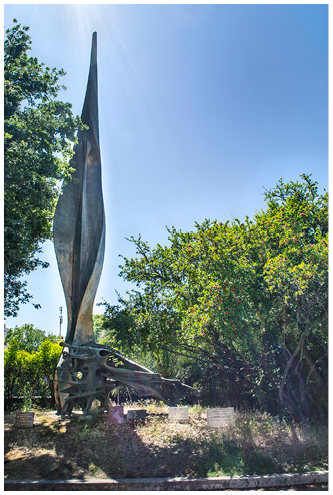
Just hours after its unveiling, and under the cover of darkness, unknown vandals (described as heirs of a ‘bloody assassin like Dumini’) drew black swastikas on the monument (Corriere della Sera, 1974). Memory wars were once again fought on the Arnaldo da Brescia, as they had been in the 1920s. It is no coincidence that this attack on the new monument, and the theft of the commemorative plaque in 1960, occurred after political ‘flashpoints’ – the Genoa congress, and the Brescia bombing – both of which involved attacks on antifascist culture. These attacks were both symbolic – in the MSI’s decision to hold its annual congress in Genoa, a city awarded a gold medal for its role in the Resistance, and include a speech by Carlo Emanuele Basile, the last prefect of the city under Mussolini’s RSI – and literal, as in the case of the Brescia bomb set by far-right militants. Within this broader context, the Arnaldo da Brescia came under attack because in the years since Matteotti’s murder, it had taken on a ‘totemic quality’ in the eyes of its attackers – a term introduced by Robert Bevan (Reference Bevan2006, p. 9) in his examination of the active attacks that occur on the built environment where ‘the erasure of the memories, history and identity attached to architecture and place – enforced forgetting – is the goal itself’. A secular shrine to antifascist sacrifice that had been a stage for collective mourning since the day of Matteotti’s kidnap, this space remembered Fascist violence and antifascist sacrifice. Its symbolism was clear amidst renewed political violence.
Matteotti’s memory was upheld throughout the 1970s as part of both national and international socialist heritage as evidenced by cultural and scholarly production, which increasingly emphasised his ideological development and commitment to workers’ rights. To mark the fiftieth anniversary of his death, the Fondazione Giacomo Matteotti published Scritti e discorsi, a selection of Matteotti’s writing and speeches, some of which had not been seen before (Giacomo Matteotti, 1974). That same year, Antonio Casanova produced Matteotti: una vita per il socialismo – the first biography of Matteotti (Reference Casanova1974). Additional studies examined Matteotti’s earlier political work in the Polesine region, including Ives Bizzi’s study (Reference Bizzi1975) of workers’ struggle in the region, and the Rovigo administration’s volume Giacomo Matteotti, which highlighted his local speeches in the province (Amministrazione provinciale di Rovigo, 1974). While these texts focused on Matteotti’s ideological formation and political significance locally and nationally, the fiftieth anniversary ceremony was steeped in the symbols of international socialism: red flags, the Internationale anthem, and the presence of international socialist leaders. Matteotti’s memory was reclaimed within a socialist tradition defined by its opposition to both fascism and communism – the twin poles of the Years of Lead violence.Footnote 11 This reclamation also served a political purpose for the newly formed PSU born from the union of the PSI and the PSDI, which was in decline following heavy losses in the 1968 and 1973 general elections. The PCI, on the other hand, was strong. Within this context, Matteotti was honoured as a powerful symbol of reformist socialism, and his commemoration once again became a platform to perform or resist political identity in the face of growing ideological division.
This renewed focus on Matteotti’s ideological formation aligned with broader shifts in the historiography of Italian Fascism. As Claudia Baldoli notes in her comprehensive examination (Reference Baldoli2023, p. 51), the violent impact of neofascist groups like Ordine Nuovo – linked to state-sponsored massacres that threatened Italian democratic stability – prompted scholarly interest in works that dissected Fascism’s rise. Historians therefore welcomed Adrian Lyttleton’s The Seizure of Power (Reference Lyttelton1973), which analysed Fascism’s conquest of power and was quickly translated into Italian (Reference Lyttelton1974). The following year, Emilio Gentile released his own examination of Mussolini’s intellectual and political influences and the ideology of Fascism itself (Reference Gentile1975). The re-emergence of state violence and political polarization saw scholars and socialist organisations turn their attention to the intellectual contributions of Fascism’s most principled opponent. This turn to Matteotti’s political lessons in life, rather than death, continued throughout the following decade. The 1980s saw Matteotti’s memory promoted by formal organisations dedicated to socialist heritage, and his life became the subject of academic study, at conferences and in writing. The decade saw a fuller understanding of his ideological background develop for two reasons: firstly, the foundation of many socialist associations in the 1980s, many of which were established under the name of historic socialist leaders, and secondly, the donation of the Matteotti family archive. Considering the prominence of the socialist party at the time, and Benedetto Craxi’s position as prime minister from 1983 to 1987, this impetus to protect socialist heritage is unsurprising. Today, these foundations are the primary memory agents relating to Matteotti and some hold important archival documents. Among these are the Fondazione di Studi Storici Filippo Turati, the Florence-based not-for-profit foundation established in 1985 to promote historical research, which is convened by Stefano Caretti, who has published much of the collection in his many publications on Matteotti (for example, Caretti, Reference Caretti1994, Reference Caretti2004; Matteotti and Caretti, Reference Matteotti and Caretti2021); and the Fondazione Pietro Nenni, founded by the PSI’s Giuseppe Tamburrano in 1985 as an institute of political and historical study. In 1986, the former was recognised by a Decree of the President of the Republic, which acknowledged its role in researching, documenting and sharing knowledge about the workers’ movement and Italian socialism. Its first president was Sandro Pertini. The foundation holds the Matteotti archive: a collection of personal documents, correspondence, political writings, press material, material culture collected at his funeral, as well as the archives of the rest of his family. This incorporation of Matteotti’s memory into historical institutions led to an increase in publications and conferences linked to Matteotti’s life and his political writings. In 1984, the Fondazione Giacomo Matteotti organised a conference about Matteotti in Rovigo, ahead of the centenary of his birth in 1985. That year, his portrait returned to the PSI membership card, and a collection of his previously unseen writings and speeches were published (Matteotti, Reference Matteotti and Modena1985). In its opening pages, the trade unionist and former socialist partisan Luciano Lama noted the ‘widespread ignorance, if you will, a very partial knowledge of the life and work of the anti-fascist leader, knowledge concentrated almost exclusively on the last few years of his life and especially on his death, which gave him the aura of martyrdom’ (Matteotti, Reference Matteotti and Modena1985, p. 5).
4.3 Illusions of Remembrance
Although Il Secolo had initiated the universal framing of Matteotti’s memory as early as the 1950s, the MSI did not formally engage with Matteotti’s memory until its entrance into government in 1994 – a development that forced its leaders to confront anniversaries that challenged the historic narrative put forward by far-right leaders including Giorgio Almirante and Gianfranco Fini that Fascism had been positive for Italy until the Racial Laws of 1938. But Matteotti’s death in 1924 proves violence was an intrinsic part of Fascism from its earliest days. Since entering government, leaders like Fini, and now Giorgia Meloni, have been asked to repudiate the ventennio – something they have refused to do, since the ideological roots of their parties lie in the Fascist period. They have never celebrated antifascism, instead engaging with the memory of fallen antifascists like Matteotti within their broader calls for a process of ‘reconciliation’ that would see all Italians remembered – fascist and antifascist alike, as the introduction to this section made clear. Their consistent attribution of blame for Matteotti’s murder to uncontrollable squadristi exonerates Mussolini and the Fascist gerarchs who ordered Matteotti’s assassination, denied its occurrence, and ensured light sentences for the assassins they had paid.
This approach to Matteotti’s memory began on the seventieth anniversary of his murder in 1994, when the MSI acknowledged Matteotti’s memory formally. Earlier that year, in January, Alleanza Nazionale had entered the political arena – a new name for the MSI, which was not yet formally dissolved, and a new logo for the same people. As Franco Ferraresi (Reference Ferraresi1996, p. 199) notes, ‘at a time when disgust with the old system was at its peak and a major concern of the electors was the promise of something new Fini was able to “sell,” as a significant novelty, the group he led in the 1994 elections—Alleanza Nazionale, or AN—which in fact was nothing more than the old MSI’. This followed Fini’s failed efforts to become the first directly elected mayor of Rome in the winter of 1993 – a race he narrowly lost to Francesco Rutelli, who had been put forward by a coalition of Progressives. Bolstered by his evident popularity despite the defeat, Fini sought ways to evidence his party’s shift towards moderate conservatism ahead of the general election in March 1994, and memory became part of his symbolic strategy. In December 1993, he visited the Fosse Ardeatine memorial and left a bunch of white carnations at the scene – a move welcomed by some on the left as an important gesture, including the Partito Democratico della Sinistra’s Pietro Ingrao, but rejected by others, like former partisan Armando Cossutta of the Partito della Rifondazione Comunista, as pure propaganda (Manno, Reference Manno1993). Fini visited the memorial without alerting any media, and, crucially, not on the anniversary itself (the date he chose was, incidentally, the 80-year anniversary of the founding of Mussolini’s Fascio d’azione rivoluzionaria movement). The next day, he stood before the MSI central committee in Rome’s Ergife hotel and said: ‘We are no longer the neofascist party, we are the new democratic right’. He then described the emotion he felt at the Fosse Ardeatine (Martini, Reference Martini1993), placating any sense of ideological betrayal his audience might have felt by comparing his reaction to how he felt at the foibé – the large sink holes in the Istrian peninsula where bodies (many of whom supported fascism) were concealed after their deaths at the hands of Yugoslav partisans, which have ‘become a powerful identity myth for the Italian post-fascist and nationalist movements’ (Cossu, Reference Cossu, McCrone and McPherson2009, p. 167). During the meeting, members voted on Fini’s proposal for the MSI to adopt a new name in the next general election and to adopt a new logo. The motion passed.
In March, media magnate Silvio Berlusconi, leader of the conservative right Forza Italia party, was elected prime minister, bolstered by anti-establishment sentiment after the Tangentopoli scandal and the dissolution of the First Republic. Forza Italia had formed the Freedom Alliance coalition with AN, the Northern League and the Centro Cristiano Democratico, filling the void left by the now decimated Christian Democracy party that had dominated the first Republic and taking an overall majority in the Chamber of Deputies (but not the Senate). AN won 13.4 per cent of the vote and took up forty-eight seats in the Chamber (one of the newly elected deputies was Alessandra Mussolini, who won a seat in Naples). With this electoral success, Fini’s efforts to tiptoe around his party’s Fascist heritage reduced. As Carlo Ruzza argues (Reference Ruzza2009, p. 143), the fact that the party had entered government without having formally confronted its Fascist past ‘served to encourage the belief that no real discussion was needed’, particularly given the collapse of the First Republic, which had been built on the antifascist tradition.
Immediately after the election, Fini gave several interviews in which he was asked to reflect on his party’s connection to historic Fascism. When asked by La Stampa his opinion of Mussolini just days after the election, Fini replied: ‘I would still say that he is the greatest statesmen of the century’ – a statement that sparked fierce debate in Italy and drew international criticism (Cowell, Reference 70Cowell1994). On 2 June, he gave an interview to La Stampa, which focused on the party’s relationship to Fascism and discussed questions of historical memory. Fini told journalist Pierluigi Battista: ‘Until 1938, that is, until a few moments before the signing of the Racial Laws, I believe it is very difficult to judge fascism in a wholly negative light’ (Battista, Reference Battista1994b). He also spoke of the social progress achieved by the regime by 1938 compared to the pre-Fascist period, conceding the regime had suppressed freedoms, but adding: ‘At certain times, history is guided by values that differ from those of today. There are periods when freedom is not among the most important values’ (this statement would be explicitly rejected by the president of the Chamber, Irene Pivetti, on the Matteotti anniversary the following week). Speaking on the fiftieth anniversary of the Allied landings at Anzio, Fini acknowledged the arrival of troops had helped restore freedom to Italians, but suggested this moment also marked the beginning of Europe starting to ‘lose a part of its cultural identity’ (Battista, Reference Battista1994b) – a fact that angered Berlusconi as he accompanied president Bill Clinton to a US cemetery near Anzio that day (Corriere della Sera, 1994a). Not a single AN deputy was invited to the dinner with Clinton at the Quirinale the next day.
Fini was not the only politician to make comments in the media that raised questions about his party’s engagement with its past. In an interview in his home with Corriere della Sera (Merlo, Reference Merlo1994), Massimo Abbatangelo, the AN candidate in the upcoming European elections, stood beside a bust of Mussolini and declared: ‘I agree [with Fini], he was the greatest statesman of the century’. Abbatangelo had been investigated in connection with the 1985 bombing of an express train near Florence, which killed 16 and injured 267; he was convicted of having supplied explosives to the perpetrator (Beccaria, 2011). Berlusconi had echoed some of this rhetoric in his defence of Fini, telling the Washington Post that he condemned the dictatorship and the Second World War, but Mussolini had done good things in Italy for a while – ‘a fact confirmed by history’ (Caretto, Reference Caretto1994). Against rife debates in the media regarding AN’s violent roots, as the anniversary of Matteotti’s final speech in parliament approached, parliamentarians and the media debated whether the MSI should be involved in official events planned for the 10th June anniversary, presided over by President Oscar Scalfaro of the DC. Alessandra Mussolini, granddaughter of the Fascist dictator, said she would attend the ceremony ‘if this gesture calms tensions, initiates new conversations, and provides an opportunity for genuine national reconciliation’ (Battista, Reference Battista1994a). She lamented the ‘climate reminiscent of 1945’ that had resurfaced in Italy, preventing AN from coming to terms with its own past peacefully. ‘It is a pity’, wrote La Stampa’s Pierluigi Battista, ‘that the analogy with 1945 omits one crucial detail: AN’s presence in the government’.
The ceremony was planned for 10 June, two days before the European elections (AN came third). It was to be held in the aula dei gruppi parlamentari and not in the Chamber of Deputies, as around 100 deputies had requested – a decision made by the president of the Chamber, Irene Pivetti of the Lega Nord. Responding to heavy criticism, Pivetti had justified her decision saying the Chamber had only been used for commemorative purposes twice in the Republic’s history: to honour the fortieth anniversary of the Italian Constitution and after Sandro Pertini’s death. Speaking to Corriere della Sera (1994b), Enzo Mattina expressed his disappointment, stating: ‘The assassination of Giacomo Matteotti represents a historic moment that deserves to be commemorated with great political and civil significance, now more so than ever.’ In the end, MSI deputies said they would not attend the ceremony, but Fini had promised a formal condemnation of the murder (Battista, Reference Battista1994a).
That came on the seventieth anniversary in an editorial titled ‘Us, Matteotti, and those Others Killed in 1924’ published on the front page of Il Secolo d’Italia, the MSI mouthpiece, by Gennaro Malgieri, the paper’s editor. Malgieri (Reference Malgieri1994) described Matteotti’s murder as ‘a horrendous crime’, which, he said was ‘born and nurtured within certain ranks of the National Fascist Party’, implying financial incentives for his murder: ‘Whatever the commercial and political implications of the “Matteotti case” may be, the fact remains that Matteotti was the innocent victim of an underground war being fought within a fringe group of fascism in collusion with certain financial circles.’ His article thus attributed the violence to unruly subversives rather than the top of the regime – framing that continues today. The paper honoured Matteotti ‘as an example of a dissident whom the regime, wrongly, did not grant the right to dissent’ (something Meloni would echo thirty years later in her free speech discussion on the centenary of Matteotti’s denunciation of Fascist violence). Evidencing the institutional far-right’s strategy to engage with the memory of antifascism within a broader call for the nation to commemorate the Fascist dead, too – part of the so-called ‘pacification’ of memory, a term often used by Meloni today – Malgieri wrote: ‘in the post-war years no one has ever counted those, who in that crucial year, fell under the blows of “subversives”, as they were called then. Yet they were no less innocent than Matteotti, not lesser victims of the climate of civil war of that time, no less dear to their comrades than the socialist deputy’. The paper then reminded readers of the death of Armando Casalini in 1924 (among the ‘eleven fallen fascists we remember’ in this issue of the paper), who was shot in Rome: ‘a gentle man, a family man, a politician of Republican origins and Mazzinian culture’, the paper wrote, asking: ‘Why has the veil of oblivion been pulled over him?’ Malgieri concluded with a call to remember the dead, drawing parallels with other national memorials: ‘So that our country of a hundred cities and a thousand factions might finally have its own Arlington, its own Valley of the Fallen. For all the Matteottis and all the Casalinis. A temple of tragedy, which might also be a temple of love.’ Malgieri’s comparison to Arlington Cemetery in the US, which has a section for fallen Confederate soldiers, and the Valley of the Fallen in Madrid, Spain, a memorial intended as part of the nation’s reconciliation after the civil war (which, in reality, became a neofascist shrine), presented Fascist-antifascist conflict as a civil war, not an ideological one, suggesting broadening the nation’s memory culture was part of a national reconciliation process.
The next intervention made by Chamber president Irene Pivetti drew a long round of applause. She explicitly connected Matteotti’s murder to the ‘repugnant Racial Laws’ and to the decision to fight alongside the Nazis during World War II: ‘Horrible choices, the seeds of which were already evident in that crime’ (Corriere della Sera, 1994c), she said, clearly challenging Fini’s recent declaration that Fascism had been positive until 1938. Her tone was explicitly antifascist. Pivetti called for Matteotti’s memory to be upheld as inspiration to ‘hold sacred the instruments of democracy’ that guarantee popular sovereignty and freedom, rejecting Fini’s recent declaration that freedom is not always the most important value: ‘Woe betide anyone who overshadows this essence of democracy that resides in the Chamber of Deputies: fair and even heated debate, exchange and confrontation between the majority and the opposition, the fundamental value of freedom is at stake’.
Matteotti’s death remains an inconvenient reminder for the institutional far right that Fascist violence started at the top, and was not confined to unruly subversives. It directly challenges the narrative advanced by far-right parties since the 1990s that suggested Fascism became a negative force in Italy only after the Racial Laws of 1938, which had been introduced by a pragmatic Mussolini to placate Hitler. This version of history allows parties, including AN and FdI to claim a break with the past while placating their more ‘nostalgic’ supporters. Since the fiftieth anniversary of Matteotti’s murder in 1994, the institutional far right has continued a rhetorical strategy that presents Matteotti as a man of integrity by honouring his final words, which are removed from their antifascist context, placing his memory within a broader call for national reconciliation that would include commemoration of fallen fascists. The claim that Matteotti was murdered by a minority of violent squadristi persists – a framing first put forward by the Fascist regime itself to deflect attention from the premediated nature of the crime and the orders from the top – denying Mussolini’s responsibility and ignoring the explicitly antifascist nature of Matteotti’s politics. Instead, the notion of ‘freedom’ is invoked, without asking exactly what Matteotti wanted freedom from: Fascism itself.
It is important to note that it was not until the mid-90s that historians could prove Mussolini’s responsibility for ordering the murder. As Mauro Canali’ (Reference Canali2024, p. 4) notes, the two major historical works published in the 1960s to address the Matteotti murder – Renzo de Felice’s 1965 Mussolini il fascista and Giuseppe Rossini’s Il delitto Matteotti tra il Viminale e l’Aventino, published two years later – both ‘suspend judgement regarding Mussolini’s direct responsibility. They do not answer the question, “Did he give the order?”’ Canali recognised the archival limitations at the time de Felice and Rossini were writing, when a law governing records ‘conceived to protect privacy’ (Canali, Reference Canali2024, p. 5) meant the documents of the preliminary investigations for the two Matteotti murder trials in 1926 and 1947 were inaccessible. Canali, though, was able to track down a copy of these documents in the mid-90s, which had been deposited at the London School of Economics by the prominent antifascist fuoriusciti Gaetano Salvemini. Canali also consulted documents held in the National Archives and Records Administration, Washington, DC, which reveal the agreement between the American oil company, Sinclair Oil and the Fascist government, which gave the US company a monopoly to drill for oil on Italian territory and exploit its findings in exchange for money – a corrupt agreement which, Canali argues, Matteotti was due to expose the day before he was murdered.Footnote 12 Moreover, Canali was able to consult the documents at the Archivio Centrale dello Stato that Mussolini had intended to take with him during his escape from Italy in 1945, which were uncatalogued until 1969 but contain correspondence between Dumini and Mussolini and records of payments made by Mussolini to the assassins (and their relatives) and ‘provide evidence of Mussolini’s guilt’ (Canali, Reference Canali2024, p. 10). Analysis of this newly available documentation in the mid-90s ‘proves that his death was no accident – it was a crime that was carefully premediated, planned, and carried out in cold blood. Mussolini’s personal responsibility from the start can now be fully documented’ (Canali, Reference Canali2024, p. 6). It is thus even more astonishing that the institutional far right continues to engage with Matteotti’s memory in the way of AN, attributing responsibility to out-of-control squadristi.
4.4 Legislating Against Oblivion a Century Later
The French historian Pierre Nora introduced the term lieu de mémoire, site of memory, to denote places – literal or figurative – ‘where memory crystallizes and secretes itself’ (Reference Nora1989, p. 7). Nora’s work showed that physical places, flags, anthems and archives can be thought of as lieux de mémoire that tell us something about French national identity. These sites, he wrote, had proliferated because there ‘are no longer milieux de mémoire, real environments of memory’ due to the disappearance of traditional ‘repositories of memory’ like peasant culture or the oral tradition in the age of modernity. Sites of memory are, he wrote, ‘moments of history torn away from the movement of history, then returned; no longer quite life, not yet death, like shells on the shore when the sea of living memory has receded’. Thanks to memorials, the dedication of public buildings, publications of his writings, cultural products including film and theatre, and the annual organisation of commemorative events in the postwar decades, by the centenary of his assassination Matteotti had become one of Italy’s most prominent lieux de mémoire, representing stoic, non-violent and, crucially, Italian resistance to Fascism.
But how much does this memory resonate at a grassroots level today? In his preface to Contro il fascismo, a 2018 publication of two of Matteotti’s most important speeches, historian Sergio Luzzatto wrote that if it weren’t for the ‘postmen, satnavs and Google Maps, Matteotti would have disappeared from our public and private lives’, addressing the presence of Matteotti’s memory in public space thanks to the dedication of streets and piazzas to him in the postwar period (Reference Luzzatto and Matteotti2018, p. 5). These physical sites of remembrance are examples of what Vinitzky-Seroussi (Reference Vinitzky-Seroussi2011, p. 52) terms ‘banal commemoration’: everyday sites that represent ‘the routine, unmarked, habitual ways in which citizens are reminded of their nation and […] of their past’. But the high visibility of these sites brings significant risk, giving a false sense of engagement – a concern evident in many of the events, publications and speeches organised around the centenary, many of which – like Luzzatto’s plea for readers to look at the ‘man not the martyr’ (Reference Luzzatto and Matteotti2018, p. 19) – included explicit calls to counter the threat of a one-dimensional, mythologised view of Matteotti exacerbated through repeated focus on his death.
These new interpretations took place in the context of a Fratelli d’Italia government – a party directly descended from the MSI, and the first far-right government to lead Italy since Fascism fell. The party came to power the same year Italy marked the one-hundredth anniversary of the March on Rome – an event that saw scholars revisit Fascism’s violent roots (for example, Foot, Reference 71Foot2022; Guerrazzi, Reference Guerrazzi2022; Millan, Reference Millan2022), with Matteotti’s murder an evergreen example. The 1922 March on Rome and Matteotti’s assassination were understood as essential in helping us to understand the consolidation of Fascist power, and several new biographies were published with titles that connect the Fascist dictator and the antifascist hero. Among them were Il nemico di Mussolini. Giacomo Matteotti, storia di un eroe dimenticato (Breda and Caretti, Reference Breda and Caretti2024), Mimmo Franzinelli’s Matteotti e Mussolini. Vite parallele: dal socialismo al delitto politico (Reference Franzinelli2024), Claudio Fracassi’s (Reference Fracassi2024) Matteotti e Mussolini. 1924: Il delitto del Lungotevere and Mirko Grasso’s L’oppositore: Matteotti contro il fascismo.Footnote 13 These recent biographies, like that of Maurizio Degl’Innocenti (Reference Degl’Innocenti2022), Federico Fornaro (Reference Fornaro2024), Massimo Salvadori (Reference Salvadori2023) and Antonio Funiciello (Reference Funiciello2024), seek to understand Matteotti’s life and his political significance. Indeed, Enzo Fimiani’s Un’idea di Matteotti. Un secolo dopo (Reference Fimiani2024), proposes a radical re-reading of Matteotti’s life and death within its strict historical context to prevent the watering down of his memory that could leave Matteotti ‘an emblem that ends up emptied of authentic meaning’ (Reference Fimiani2024, p. 12). He articulates his concern that Matteotti might become ‘tucked away – well-placed, but equally dust-covered – in the pantheon of “fathers” of something (perhaps even “of the fatherland”), within the broader history of unified Italy’ (Reference Fimiani2024, p. 10), and warns (Reference Fimiani2024, p. 11) against allowing Matteotti’s memory to drift so far from its historical and political origins as to become ‘inoffensive’ and ‘harmless to collective and state memory – incapable of stirring consciences or awakening the Italian civic spirit’. Ultimately, he writes, if Matteotti is reduced to a ‘weak, bland, and generic’ symbol of freedom (Reference Fimiani2024, p. 11), we could ‘witness a kind of memorial passe-partout, useful in all Italian [political] seasons and across all political traditions’ (Reference Fimiani2024, p. 12).
Institutional far-right parties have navigated these calls to engage with Matteotti’s memory through recourse to the universal language of freedom and celebration of his political conviction. They have taken the opportunity to engage with memory of Italy’s most prominent antifascist martyr to call for ‘national reconciliation’, which would see the nation commemorate fallen Fascists, too, continuing the strategy that began with the postwar MSI’s rejection of any association of Matteotti’s memory with antifascist resistance, instead celebrating Matteotti’s final words as a ‘universal formula’, and continued with AN’s celebration of Matteotti as a ‘dissident’ on the seventieth anniversary of his death. Meloni’s framing of Matteotti as a reminder of the value of freedom of speech is only its latest iteration. But despite this increasingly universal framing from the current government, over the past decade, legislation has been introduced to preserve and celebrate Matteotti’s memory in its historical, political and geographical context. In 2016, the Casa Museo Giacomo Matteotti – a museum in Matteotti’s former home in Fratta Polesine – was given national monument status, following a motion proposed by Diego Crivellari, a Partito democratico (Pd, Democratic Party) deputy (Crivellari, Reference Crivellari2016). In 2017, the draft law to support the protection of Matteotti’s memory was finally approved, having been proposed three years prior, with funds earmarked for initiatives to promote the study of Matteotti’s life and work. This legislative impetus continued as the centenary of Matteotti’s death approached. In 2022, a bill proposed by Senator Riccardo Nencini was unanimously approved by the Senate (it would take another two years to be applied after stalling in the Chamber due to the early curtailment of the previous administration). Article 1 aimed to promote knowledge and study of Matteotti’s work and its national and international significance, while Article 2 had a pedagogical aim, supporting conferences, education and training initiatives (Camera dei deputati, 2024). The legislation also provided funds to support the collection, conservation, restoration and digitisation of documents relating to Matteotti’s life and work, and the publication of previously unseen materials. In 2023 and 2024, €400,000 was earmarked to support initiatives each year. But by March, none of this money had been disbursed by the government – a delay raised by PD deputy Lia Quartapelle in parliament (Amabile, Reference Amabile2024), who questioned the government’s motives. ‘They passed a law to establish a Day of Remembrance for the Foibé massacres to promote awareness of that part of history’, she said. ‘Who knows what would have happened to the memory of Matteotti without our intervention.’
4.5 Conclusion
In 2024, a letter went on display to the public for the first time. Penned on 25 July 1925 by Amerigo Dumini, the lead assassin in the Matteotti crime, it was included in the exhibition Giacomo Matteotti. The Life and Death of a Father of Democracy on the centenary of Matteotti’s murder. Dumini wrote: ‘We must defend ourselves because we do not intend to face terrible and irreparable punishment for a crime that we committed – certainly – but which was imposed on us and which we carried out – like so many others before it – with blind discipline and after we were guaranteed absolute immunity from criminal prosecution’ (Ginzberg, Reference Ginzberg2024). Just six days after it was written, Mussolini issued an amnesty on political crimes, resulting in Dumini’s release. This letter was one of many previously unseen historical documents included in the Palazzo Braschi exhibition in Rome, and it put Mussolini’s responsibility for Matteotti’s death front and centre, reflecting the work of its curator, Mauro Canali, whose 1997 book had pinned the Matteotti crime to Mussolini for the first time. The exhibition was structured around four key themes: Matteotti’s life before national politics, his parliamentary career from 1919 to 1924, his kidnap and murder and, finally, his myth. While the exhibition was well received in Italy, one journalist from Il Foglio could not help but note an important absence: despite having visited the recent exhibition on Enrico Berlinguer, prime minister Meloni did not attend, missing an important opportunity to come to terms with one of the heaviest aspects of Fascism’s legacy (Giacomotti, Reference Giacomotti2024).
Despite the delays in the disbursement of government funding for the centenary, this exhibition, along with the nationwide programme of commemorative events on the centenary, marked an important shift in public understanding of the victim and orchestrator of Matteotti’s murder. This shift has been facilitated by changes including increased legislation to protect Matteotti’s memory and political life, historiographical developments and the increased accessibility of archival collections. This public emphasis on Mussolini’s responsibility extended abroad, too. In early 2025, the London School of Economics (LSE) completed its digitisation of a set of preliminary inquest documents that the exiled antifascist Gaetano Salvemini had smuggled out of Italy in 1926 and deposited at the university library (Matteotti Documents, 2025), making them globally accessible.Footnote 14
For as long as Italy has been a Republic, Matteotti’s memory has been mobilised by actors including the state, socialist and communist parties, and even the MSI. In the years immediately following 1945, Matteotti’s nonviolent opposition and commitment to reform over revolution made him a unifying symbol for socialist and communist groups as Italian democracy was rebuilt. His name was embedded in public space, where he was honoured as a democratic reformist in plaques and memorials affixed to institutional spaces, or remembered in more revolutionary terms in public space in areas typically associated with partisan Resistance, dating Italy’s culture of resistance back to the start of Fascism to suggest the antifascist spirit had been there all along. In the late 1960s, as the MSI gained support and political violence escalated with the creation of neofascist terrorist groups, Matteotti’s memory was attacked by those who continued to revere Fascism by desecrating the spaces associated with its historic enemy. With the rise of state-sponsored neofascist terrorism and communist terrorist groups in the 1970s, Matteotti’s memory was reclaimed by socialists as a powerful symbol of reformist and democratic socialism, distinct from the two violent revolutionary poles tearing Italy apart. This shift was echoed in scholarship dedicated to Matteotti’s ideological legacy and culminated in the 1980s with the institutionalisation of his memory by recently created socialist associations and institutes and the donation of the Matteotti family archive – developments that enabled some scholars to study Matteotti’s political thought and the construction of Matteotti’s myth during the ventennio. A marked increase in public funding over the past two decades has supported important public history projects, including the restoration of Matteotti’s former home in Fratta Polesine between 2006 and 2009 and its reopening as the Casa Museo Giacomo Matteotti (Giacomo Matteotti House Museum). Restored again in 2024 with support from the philanthropic organisation Fondazione Cassa di Risparmio di Padova e Rovigo, the museum now offers an immersive visitor experience that tells the story of Matteotti’s life. But despite this progress, many of the scholarly works published on or around the centenary of Matteotti’s death, along with government and consiglio interventions, reveal a broader anxiety: that the focus on Matteotti’s death in antifascist historiography after Italy’s liberation has created a one-dimensional myth, which could reduce the affective power of antifascist memory at a time of far-right resurgence.
5 Reflections
In 2016, I attended the annual commemoration ceremony held at the site of Matteotti’s kidnap on the Arnaldo da Brescia in Rome. Representatives of various socialist organisations and institutes gathered with historians and politicians to hear messages sent by Giorgio Napolitano, former president of the Republic, the defence minister Roberta Pinotti, and trade union leaders from Cgil, Cisl and Uil. Vittorio Craxi, the socialist politician and son of Bettino Craxi, was among the speakers. He emphasised Matteotti’s status as a ‘martyr of the Republic’ and situated his memory within a broader pantheon of international martyrs, drawing a powerful parallel between Matteotti and Chokri Belaid, a Tunisian lawyer and socialist politician who led the left-wing Unified Democratic Nationalist Party in opposition to the Ben Ali regime and the subsequent Islamist-led government. Like Matteotti, Belaid was a vocal critic of authoritarianism and political violence, and he paid with his life. He was shot in his home in 2013 and died in the hospital. Belaid’s death sparked mass protests and was considered a defining moment for Tunisian democracy. Craxi referred to Belaid as ‘the Tunisian Matteotti’, a term that had originally been used by Italian media in 2013 (Cremonesi, Reference Cremonesi2013; Sacchelli, Reference Sacchelli2013). The 2016 ceremony reflected the continued resonance of Matteotti’s example within the struggle for democracy around the world. More recently, some have turned to Matteotti’s example to understand the warning signs of emerging authoritarianism, reinvigorating Matteotti’s memory as a warning. Just weeks after Donald Trump’s first inauguration in 2017, one X user wrote: ‘Let’s crowd-fund security protection for conspicuous Trump critics. Call it the “Giacomo Matteotti” Murdered Critic Protection Fund’ (@dickytrope, 2017). With the politically motivated shooting of two Democratic lawmakers in their homes in Minneapolis in June 2025, six months into Trump’s second term, a Bluesky user described his presidency as in its ‘Matteotti phase’ (@joycedivision.bsky.social, 2025).
Global political trends have injected renewed urgency into the commemoration of Matteotti as an antifascist, rather than a socialist. This was palpable at the centenary commemoration on the Arnaldo da Brescia I attended in 2024. Among the many attendees from local government, Rome’s mayor Roberto Gualtieri, a handful of senators, parliamentarians, historians, leaders of Italian socialist organisations and members of ANPI, Italy’s national partisan association, were Laura and Elena Matteotti, two of Matteotti’s granddaughters. Former senator Vincenzo Vita of the PD explicitly connected Matteotti’s lesson to the contemporary political landscape: ‘Matteotti became the number one enemy of fascism, and the right way to pay tribute to him is to multiply our anti-fascist commitment, applying it to today’s reality. Fascism is changeable and reappears in different guises’ – a sentiment echoed by the president of ANPI, who described nationalism, anti-intellectualism and fascism as resurgent in Europe.
For a century, Matteotti’s memory has been a battleground claimed and contested by those seeking to define freedom and negotiate the legacy of Fascism. A symbol to galvanize an international network of antifascists united by grief and compassion, his memory later became part of the way Italy narrated its experience of Fascism as one of coercion, and a foundational symbol of an antifascist Republic built on Italian sacrifice. More recently, scholars, legislators and cultural figures have critically engaged with Matteotti’s life and work, documenting his ideological legacy. But with a party directly descended from the leaders of Mussolini’s Salò Republic at the helm of today’s government, the universalising language of freedom and dissent typical of Founding Father narratives threatens to undermine the mobilising power Matteotti’s memory has long held among antifascists – in Italy, and abroad. Fearing the weakening of his memory, scholars, public intellectuals and politicians have warned against one-dimensional mythologisation. Perhaps the best defence lies not in resisting this myth, but in its critical deconstruction through scholarly inquiry that interrogates the construction and contestation of Matteotti’s afterlife in the antifascist Republic.
Acknowledgements
I would like to thank the series editors, Antonio Costa Pinto and Federico Finchelstein, for their support of this draft. I am also very grateful to the two reviewers for the time they spent offering thoughtful feedback on the Element, which is much improved thanks to their insight. Thank you.
Thank you to Ellen Engseth at the Immigration History Research Center Archives, University of Minnesota, for permission to reproduce the postcard of Matteotti in this Element. I am grateful to have spent time at the IHRCA when I first worked on Italian American commemoration of Matteotti during my Grant-in-Aid Award some years ago.
I first started thinking about the international commemoration of Matteotti during an AHRC-funded doctoral research fellowship at the Kluge Center, Library of Congress, in 2016, so I was delighted to be able to finish writing this Element when I returned nine years later. Enormous thanks to all the Kluge staff, especially to my friend Travis Hensley, for everything you do to create such an open, engaging and supportive environment for international scholars at all career stages. The Kluge Center is a special place. This Element is dedicated to the Center and those who work there.
Series Editors
Federico Finchelstein
The New School for Social Research
Federico Finchelstein is Professor of History at the New School for Social Research and Eugene Lang College in New York City. He is an expert on fascism, populism, and dictatorship. His previous books include From Fascism to Populism in History and A Brief History of Fascist Lies.
António Costa Pinto
University of Lisbon
António Costa Pinto is a Research Professor at the Institute of Social Sciences, University of Lisbon. He is a specialist in fascism, authoritarian politics, and political elites. He is the author and editor of multiple books on fascism, including The Fascist Zenith: War and Dictatorship under Axis Rule.
Advisory Board
Giulia Albanese, University of Padova
Mabel Berezin, Cornell University
Maggie Clinton, Middlebury College
Sandra McGee Deutsch, University of Texas, El Paso
Aristotle Kallis, Keele University
Sven Reichardt, University of Konstanz
Angelo Ventrone, University of Macerata
About the Series
Cambridge Elements in the History and Politics of Fascism is a series that provides a platform for cutting-edge comparative research in the field of fascism studies. With a broad theoretical, empirical, geographic, and temporal scope, it will cover all regions of the world, and most importantly, search for new and innovative perspectives.