





Management Implications
The handheld weed wiper appears to be a promising alternative control tool for an integrated Sporobolus indicus var. pyramidalis (giant smutgrass) long-term management plan in grasslands sprayed with glyphosate and hexazinone. Bidirectional wiping increases S. indicus var. pyramidalis mortality and control; hence, these herbicides should be applied bidirectionally to optimize S. indicus var. pyramidalis management when using this technology. However, because glyphosate is considerably cheaper compared with hexazinone, glyphosate is likely to be the preferred option. Mowing S. indicus var. pyramidalis plants to a 15-cm stubble height 21 d before herbicide application decreases herbicide efficacy, especially when there is little difference between the height of the target species and the desirable forage. Therefore, mowing before S. indicus var. pyramidalis treatment with either glyphosate or hexazinone using a weed wiper during the peak growing season is an unjustified expense and is not recommended. Future research should investigate the effects of additional concentrations, application timings, weed-wiper height, and different wiper applicators and models, as well as other weed control methods integrated with the use of weed wipers for short- and long-term S. indicus var. pyramidalis management in Florida.
Introduction
Giant smutgrass [Sporobolus indicus (L.) R. Br. var. pyramidalis (P. Beauv.) Veldkamp] is an invasive species and one of the most problematic grass weed species in grasslands in Florida (Rana et al. Reference Rana, Wilder, Sellers, Ferrell and MacDonald2012; Shay et al. Reference Shay, Baxter, Basinger, Schwartz and Belcher2022; Webster Reference Webster2011). It is a perennial tussock-type grass that is commonly found in open areas, disturbed waste areas, and bahiagrass (Paspalum notatum Fluggé) pastures. Moreover, the Florida Exotic Pest Plant Council (FLEPPC) lists S. indicus var. pyramidalis. as a Category I species, implying that this species is increasing in number and causing ecological harm (FLEPPC 2019).
Cattle tend to avoid mature S. indicus var. pyramidalis, although young plants can be grazed. According to Mullahey (Reference Mullahey2000) and Ferrell and Mullahey (Reference Ferrell and Mullahey2006), cattle will readily consume tender regrowth of S. indicus var. pyramidalis when it is managed intensively, mowed, or burned. After mowing and burning, cattle will graze on S. indicus var. pyramidalis for about 2 wk, before the weed becomes unpalatable. Additionally, young S. indicus var. pyramidalis shoots have similar nutritive value as P. notatum (Mullahey Reference Mullahey2000). Several weed control methods have been investigated, such as cultivation (McCaleb et al. Reference McCaleb, Hodges and Kirk1963), burning (Walter et al. Reference Walter, Newman, Gamble, Mudge, Deal, Baseggio and Fluke2013), and grazing management (Mullahey Reference Mullahey2000; Walter et al. Reference Walter, Newman, Gamble, Mudge, Deal, Baseggio and Fluke2013); however, effective management has mostly been accomplished using herbicides (Rana et al. Reference Rana, Wilder, Sellers, Ferrell and MacDonald2012; Shay et al. Reference Shay, Baxter, Basinger, Schwartz and Belcher2022).
Glyphosate and hexazinone are the only two active ingredients labeled for use in grasslands in Florida that provide effective control of S. indicus var. pyramidalis. Hexazinone is absorbed by plant roots and foliage and is primarily translocated through the apoplast and xylem (McNeil et al. Reference McNeil, Stritzke and Basler1984; Shaner Reference Shaner2014). It is the only selective chemical control option that can be broadcast over the tops of P. notatum and bermudagrass [Cynodon dactylon (L.) Pers.] pastures (Mislevy et al. Reference Mislevy, Martin and Hall2002). Although effective S. indicus var. pyramidalis control with hexazinone at 1.12 kg ai ha−1 has been reported previously (Ferrell et al. Reference Ferrell, Mullahey, Dusky and Roka2006; Rana et al. Reference Rana, Sellers, Ferrell, MacDonald, Silveira and Vendramini2015; Wilder et al. Reference Wilder, Sellers, Ferrell and MacDonald2011), it can be prohibitively expensive for some cattle operations, with costs exceeding US$100 ha−1 (Ferrell et al. Reference Ferrell, Mullahey, Dusky and Roka2006). Furthermore, Ferrell et al. (Reference Ferrell, Mullahey, Dusky and Roka2006) observed that control with hexazinone should not be employed until the S. indicus var. pyramidalis density is greater than 35%, which may result in forage losses until this economic threshold is attained.
Glyphosate is a broad-spectrum, nonselective, postemergence herbicide (Shaner Reference Shaner2014). In addition, it translocates efficiently in plants, primarily in the symplast (Shaner Reference Shaner2014), resulting in the death of both the aboveground and belowground portions of susceptible treated plants (Larsen Reference Larsen, Beestman and Vander Hooven1987). These characteristics make glyphosate highly effective against perennial and annual weeds; however, due to glyphosate’s lack of selectivity, its use is generally limited to preplant, post-directed, and postharvest applications for weed control (Nandula et al. Reference Nandula, Reddy, Poston, Rimando and Duke2008). Nevertheless, glyphosate can be selective if specialized equipment such as a weed wiper is used to apply the herbicide to specific plants while avoiding others.
Herbicide application with weed wipers provides an excellent opportunity to selectively manage difficult to control weed species in pastures. Weed wipers can be useful in pasture production systems, because cattle consume forage and typically avoid weeds, resulting in a height difference between weeds and desirable forages, allowing for targeted, accurate placement of herbicides on weeds (Johnson Reference Johnson2011). An additional advantage of this system is that it could allow for selective weed control in mixed swards of grass and legume forages and allows application adjacent to susceptible crops (Johnson Reference Johnson2011; Moyo et al. Reference Moyo, Harrington, Kemp, Eerens and Ghanizadeh2022). The amount of herbicide used by weed wipers is lower compared with broadcast application of herbicides and eliminates spray-particle drift concerns surrounding broadcast applications. However, the uniformity and quantity of herbicide output from weed wipers are constrained by the lack of a precise and easy to use mechanism for assessing herbicide deposition compared with known quantities in calibrated broadcast systems (Harrington and Ghanizadeh Reference Harrington and Ghanizadeh2017).
Additionally, effective management of hard to control perennial invasive plants has long been recognized as requiring long-term integrated weed management (IWM) strategies (Benz et al. Reference Benz, Beck, Whitson and Koch1999; Miller Reference Miller2016). The integration of mowing with systemic herbicides has been shown to effectively control other difficult to control perennial and invasive species (Allen et al. Reference Allen, Holcombe, Hanks, Surian, McFarland, Bruce, Johnson and Fernandez2001; Beck and Sebastian Reference Beck and Sebastian2000; Renz and DiTomaso Reference Renz and DiTomaso2006). Mowing has been suggested to enhance control of herbicide applications, because it changes the canopy structure of plants and improves herbicide contact on lower leaves (Hunter Reference Hunter1996), where it can preferentially be translocated to the root system (Renz and DiTomaso Reference Renz and DiTomaso2006). In addition, mowing may influence some physiological, biological, and morphological characteristics of plants, thus altering herbicide deposition patterns, absorption, or translocation in resprouting shoots (Renz and DiTomaso Reference Renz and DiTomaso2006). Thus, we hypothesized that mowing before glyphosate and hexazinone application with weed-wiper equipment will provide greater S. indicus var. pyramidalis control than either herbicide applied alone. Although hexazinone is not labeled to be applied with a weed wiper in grassland systems, and we did not expect it to be as foliarly active as glyphosate on S. indicus var. pyramidalis, we were still interested in investigating how it would perform in this study.
Given the need to develop new alternative IWM strategies to effectively manage S. indicus var. pyramidalis infestations, the objectives of this study were to determine (1) the effects of herbicide (glyphosate and hexazinone), wiping method (uni- and bidirectional), and concentration (v/v basis) on S. indicus var. pyramidalis control using handheld weed-wipers; and (2) the effects of mowing before uni- or bidirectional glyphosate or hexazinone application with field-scale weed-wiper equipment.
Material and Methods
Handheld Weed-Wiper Dose–Response Experiment
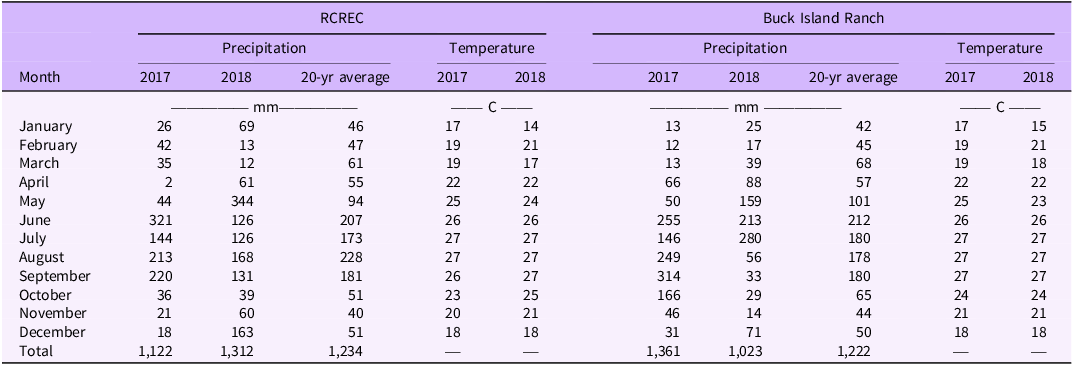
Field experiments were conducted in P. notatum pastures located at Bowling Green, FL, in 2017 (27.609578, 81.867939) and 2018 (27.606644, 81.867797). Both locations were naturally infested with S. indicus var. pyramidalis, with ground cover ranging from 20% to 50% throughout the experimental areas. The predominant soil at the 2017 site was a Sparr fine sand (loamy, siliceous, subactive, hyperthermic Grossarenic Paleudults) with 1.75% organic matter and soil pH of 4.8; whereas the predominant soil at the research site in 2018 was a Farmton fine sand (sandy, siliceous, hyperthermic Arenic Ultic Alaquods) with 1.5% organic matter and soil pH of 5.2. Monthly rainfall and yearly totals for 2017 and 2018 were obtained from the weather station located at the Range Cattle Research and Education Center (RCREC; ∼20 km from the experimental area) and are presented in Table 1.
Monthly rainfall (mm), yearly totals (mm), and average temperature (C) recorded at the weather stations located at the Range Cattle Research and Education Center (RCREC), near Ona, FL, and Buck Island Ranch, near Lake Placid, FL, in 2017 and 2018
Treatments consisted of a 2 × 2 × 5 factorial arrangement of two herbicides (glyphosate and hexazinone), two wiping methods (unidirectional or bidirectional), and five concentrations (% v/v basis) distributed in a randomized complete block design with four replications. A nontreated control was also included. Experimental units were 3 by 8 m, and all S. indicus var. pyramidalis clumps within plots were treated when the total number of clumps was fewer than 10, whereas a maximum of 10 clumps per plot was treated in highly infested plots.
Unidirectional applications consisted of one pass (wiped once) of the handheld wiper from the lower third (15-cm height) to the top of the S. indicus var. pyramidalis canopy, whereas bidirectional applications consisted of the same procedure but were employed twice in opposite directions. Glyphosate (Cornerstone®, 356 g ae L−1, Winfield Solutions, St Paul, MN) and hexazinone (Velpar® L, 240 g ai L−1, DuPont, Wilmington, DE) concentrations were 6.25% v/v, 12.5% v/v, 25.0% v/v, 50.0% v/v, and 100% v/v. Each concentration treatment for each herbicide was applied using a different nap paint roller (Wagner’s Smart Roller, 18.5-cm roller length and 650-ml reservoir, Plymouth, MN) to avoid contamination from other treatments. Once the paint roller tubes were filled with the appropriate herbicide solution, the roller was saturated by using the trigger mechanism. The trigger was deployed between each S. indicus var. pyramidalis clump to ensure uniform application.
Herbicide treatments were applied on August 16, 2017, and August 6, 2018.
Because applications using a weed wiper are not as precise as applications with conventional broadcast sprayers, uniformity among treatments was inspected by constantly ensuring that the roller was evenly wet. Plants were approximately 45-cm tall at the time of application in both years. Natural rainfall within the first 7 DAT at the RCREC was 50 and 47 mm for 2017 and 2018, respectively, and occurred within 4 DAT in both years. Sporobolus indicus var. pyramidalis control was assessed at 30 and 60 DAT by determining the percentage of plant mortality using pre- and posttreatment plant counts. Differences in pre- and posttreatment plant counts were used to determine the percentage of plant mortality. Plants were considered dead when completely lacking green tissues. Assessments beyond 60 DAT were not conducted, as previous research has shown that S. indicus var. pyramidalis control at 120 and 365 DAT was comparable to control at 60 DAT (Mislevy et al. Reference Mislevy, Martin and Hall2002). The number of S. indicus var. pyramidalis plants treated in each plot was recorded before herbicide application and were assessed for mortality at 30 and 60 DAT.
Normality, independence of errors, and homogeneity of variance were visually examined for percent plant mortality at 30 and 60 DAT, and no transformation was necessary. The effects of herbicides and their interaction with herbicide concentration were modeled using nonlinear regression models in R software v. 3.4.3 (R Core Team 2014). The effective concentration needed to provide 70% plant mortality (ED70) was derived from a two-parameter log-logistic regression model using the ED function in the drc package in R (Equation 1): $Y = exp[b(log \ x - log \ e)] $
where Y is the response variable (percent plant mortality at 30 and 60 DAT), x is herbicide concentration (% v/v basis), b is the relative slope at the inflection point, and e is the inflection point (ED70) of the fitted line. Model selection was based on Akaike’s information criterion (AIC) in the qpcR package in R (Ritz and Spiess Reference Ritz and Spiess2008). Additionally, a lack-of-fit test at the 95% level (P ≤ 0.05) comparing the nonlinear regression models to ANOVA was conducted to test the appropriateness of model fit (Ritz and Streibig Reference Ritz and Streibig2005). Differences among parameter estimates were compared using standard error (SE), t-, and F-tests at the 5% significance level (Knezevic et al. Reference Knezevic, Streibig and Ritz2007).
ATV-mounted Weed-Wiper Experiment
Experiments were conducted at four sites in P. notatum pastures located in Myakka, Lake Placid (Buck Island Ranch), and Ona (RCREC), FL, in 2017 and 2018. Research locations that shared the same pasture were adjacent to each other. Specifics of each research site including their soil characteristics, application dates, and basic S. indicus var. pyramidalis information are provided in Tables 1 and 2. Natural rainfall recorded within the first 7 d after herbicide applications was 68, 24, 8, and 30 mm for Myakka, Buck Island (site 1), Buck Island (site 2), and RCREC, respectively, as recorded by weather stations located at the RCREC and Buck Island Ranch.
Research sites, locations, and soil characteristics
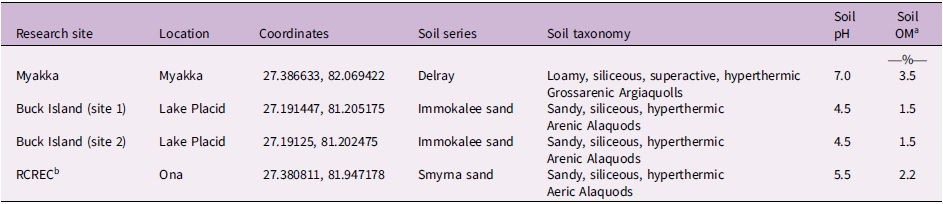
a OM, organic matter.
b RCREC, Range Cattle Research and Education Center.
Each experiment was established in a randomized strip-plot design replicated four times, with mowing treatment as the horizontal strip and wiping treatment randomized as the vertical strip, similar to the experimental design described by Kyser et al. (Reference Kyser, Hazebrook and DiTomaso2013). Wiping treatments consisted of two herbicides (glyphosate and hexazinone) at three concentrations each (17.5% v/v, 35% v/v, and 70% v/v for glyphosate and 15% v/v, 30% v/v, and 60% v/v for hexazinone) applied using two methods (uni- and bidirectionally).
Mowed plots (horizontal strips) were 80-m wide by 18-m long (1,440 m2). These were crossed by the vertical wiping treatment strips, which were 6-m wide by 36-m long (crossing both mowed and not mowed strips), making individual herbicide treatment subplots 6-m wide by 18-m long (108 m2, experimental unit) with a 12-m aisle between replications. Therefore, each replication included a total of 24 experimental units plus 2 nontreated controls (mowed and not mowed) per replication. Mowing was performed 21 d before herbicide application to a stubble height of 15 cm. Herbicide treatments were applied using an ATV-drawn roto-type weed wiper (Grass Works Manufacturing, Strafford, MS). Mowing and herbicide application dates, as well as other relevant application information, are provided in Table 3. Cattle were removed from the pasture where the experiments were established before mowing and then allowed access 1 wk before herbicide treatment application to potentially increase the difference in height between the S. indicus var. pyramidalis and P. notatum plants. The ATV-drawn roto-type weed-wiper height was adjusted to minimize contact and damage to P. notatum (Table 3).
Dates for mowing operations, treatment applications, treatment assessments, initial Sporobolus indicus var. pyramidalis cover and height, and weed-wiper height at Myakka, Buck Island, and Range Cattle Research and Education Center (RCREC) in Florida

a DAT, days after treatment.
Diagonal line transects were established in each subplot, and the number of S. indicus var. pyramidalis plants touching the lines was counted before herbicide application. The same line transects were evaluated at 35 and 90 DAT to determine the number of live S. indicus var. pyramidalis plants posttreatment. Plants were considered dead only when they completely lacked green tissues. Differences in pre- and posttreatment plant counts were used to determine percent plant mortality.
Data were subjected to ANOVA to test for location, mowing treatment, wiping treatment, and the effects of their interactions. Due to a location by mowing treatment by wiping treatment interaction, each location was analyzed separately using replication by mowing treatment as the error term for the vertical factor (mowing treatment), replication by wiping treatment for the horizontal factor (wiping treatment), and replication by mowing treatment by wiping treatment for the mowing treatment by wiping treatment interaction. The nontreated control was excluded from the analysis. Treatments were considered different when P ≤ 0.05, and the interactions not discussed were not significant. Means were separated using Fisher’s LSD test at a 5% level of significance when appropriate. When necessary, percent plant mortality data were arcsine square-root transformed to stabilize error variances; however, original values are reported (Beck and Sebastian Reference Beck and Sebastian2000).
Results and Discussion
Handheld Weed-Wiper Dose–Response Experiment
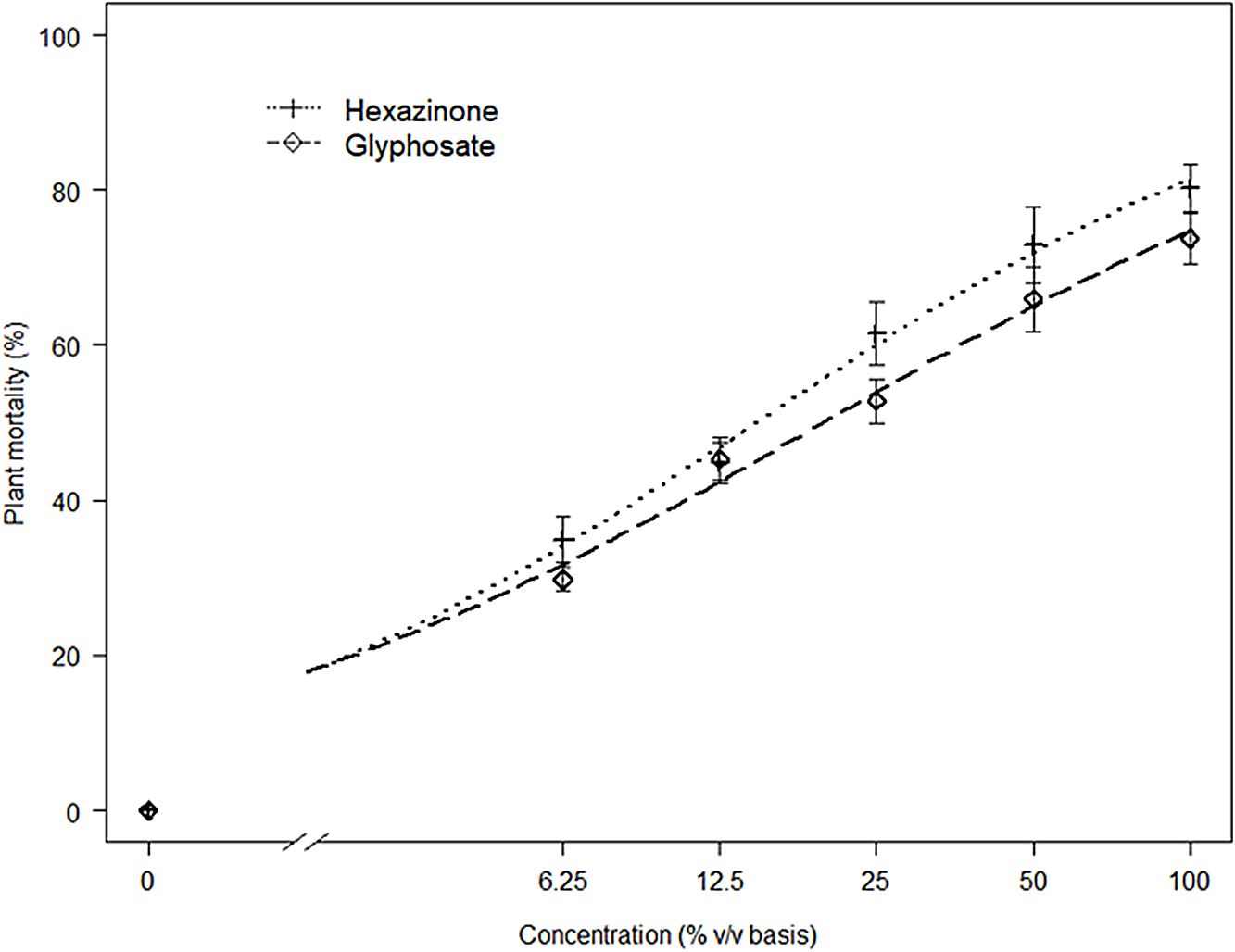
There were no significant differences between herbicides at 30 DAT (Figure 1; Table 4); however, at 60 DAT, hexazinone effectiveness was greater than that of glyphosate (Figure 2; Table 5). Sporobolus indicus var. pyramidalis mortality increased as concentrations increased for both hexazinone and glyphosate when averaged over wiping methods. For example, glyphosate resulted in 29%, 45%, 53%, 66%, and 74% mortality at 6.25% v/v, 12.5% v/v, 25% v/v, 50% v/v, and 100% v/v, respectively. Similarly, hexazinone resulted in 35%, 45%, 62%, 73%, and 80% mortality at 6.25% v/v, 12.5% v/v, 25% v/v, 50% v/v, and 100% v/v, respectively. The ED70 values (Table 5) determined for both glyphosate and hexazinone (70.2% and 44.1%, respectively) suggest that hexazinone exhibited better efficacy against S. indicus var. pyramidalis mortality at 60 DAT.
Percentage of Sporobolus indicus var. pyramidalis mortality (30 d after treatment) in response to glyphosate and hexazinone increasing concentrations applied with a handheld weed wiper in studies conducted under field conditions in Florida in 2017 and 2018. Dashed and dotted lines represent predicted values. Data were fit to a two-parameter log-logistic regression model: Y = exp[b(log x – log e)], where Y is the response, x is the concentration rate, b is the slope of the inflection point, and e is the inflection point of the fitted line (equivalent to the concentration necessary to promote 70% of S. indicus var. pyramidalis mortality [ED70]).

Log-logistic regression parameter estimates (±SE) for percentage of Sporobolus indicus var. pyramidalis mortality at 30 d after treatment (DAT) from the handheld weed-wiper experiment, Florida, 2017 and 2018
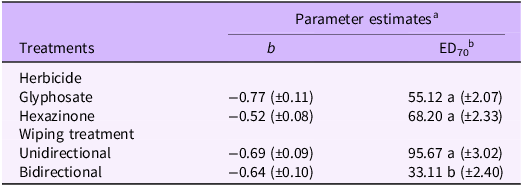
a Log-logistic model: Y = exp[b(log x – log e)], where Y is the response (% of plant mortality), x is the concentration rate, b is the relative slope at the inflection point, and e is the inflection point of the fitted line (equivalent to the concentration in kg ae ha−1 to cause 70% response [ED70]).
b ED70 estimates followed by the same letter within herbicides and within wiping method are not different according to t- and F-tests at the 5% significance level. Lack-of-fit test: P = 0.6383 for herbicides; P = 0.4867 for wiping method.
Percentage of Sporobolus indicus var. pyramidalis mortality (60 d after treatment) in response to glyphosate and hexazinone increasing concentrations applied with a handheld weed wiper in studies conducted under field conditions in Florida in 2017 and 2018. Dashed and dotted lines represent predicted values. Data were fit to a two-parameter log-logistic regression model: Y = exp[b(log x – log e)], where Y is the response, x is the concentration rate, b is the slope of the inflection point, and e is the inflection point of the fitted line (equivalent to the concentration necessary to promote 70% of S. indicus var. pyramidalis mortality [ED70]).
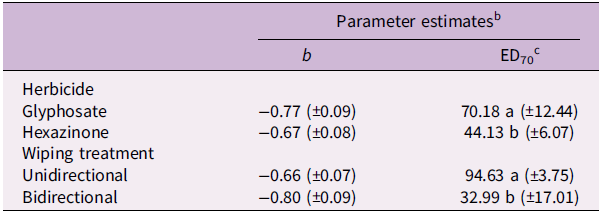
Log-logistic regression parameter estimates (±SE) for percentage of Sporobolus indicus var. pyramidalis mortality at 60 d after treatment (DAT) from the handheld weed-wiper experiment, Florida, 2017 and 2018. Data were averaged across years and herbicidesa
a Data were averaged across years and herbicides.
b Log-logistic model: Y = exp[b(log x – log e)], where Y is the response (% of plant mortality), x is the concentration rate, b is the relative slope at the inflection point, and e is the inflection point of the fitted line (equivalent to the concentration in g ae ha−1 to cause 70% response [ED70]).
c ED70 estimates followed by the same letter within wiping method are not different according to t- and F-tests at the 5% significance level. Lack-of-fit test: P = 0.894.
When averaged over herbicide treatments, wiping S. indicus var. pyramidalis plants bidirectionally provided greater S. indicus var. pyramidalis mortality compared with wiping plants unidirectionally at 30 DAT (Figure 3). Sporobolus indicus var. pyramidalis mortality ranged from 44% to 83% for the bidirectional wiping method, whereas mortality ranged from 30% to 72% for the unidirectional wiping method. Additionally, ED70 values based on plant mortality at 30 DAT were approximately 95.7% and 33.1% for the uni- and bidirectional wiping methods, respectively (Table 4). At 60 DAT, S. indicus var. pyramidalis mortality increased with herbicide concentration, and efficacy was greatest for the bidirectional method (Figure 4). Additionally, ED70 values observed at 60 DAT were 94.6% and 33.0% for uni- and bidirectional wiping methods, respectively (Table 5). Therefore, regardless of herbicide, treatments applied bidirectionally exhibited greater efficacy at 30 and 60 DAT compared with unidirectional treatments.
Percentage of Sporobolus indicus var. pyramidalis mortality (30 d after treatment) in response to wiping method (unidirectional vs. bidirectional) and increasing concentrations applied with a handheld weed wiper in studies conducted under field conditions in Florida in 2017 and 2018. Solid and dashed lines represent predicted values. Data were fit to a two-parameter log-logistic regression model: Y = exp[b(log x – log e)], where Y is the response, x is the concentration rate, b is the slope of the inflection point, and e is the inflection point of the fitted line (equivalent to the concentration necessary to promote 70% of S. indicus var. pyramidalis mortality [ED70]). Data points were averaged across years and herbicides.

Percentage of Sporobolus indicus var. pyramidalis mortality (60 d after treatment) in response to wiping method (unidirectional vs. bidirectional) and increasing concentrations applied with a handheld weed wiper in studies conducted under field conditions in Florida in 2017 and 2018. Solid and dashed lines represent predicted values. Data were fit to a two-parameter log-logistic regression model: Y = exp[b(log x – log e)], where Y is the response, x is the concentration rate, b is the slope of the inflection point, and e is the inflection point of the fitted line (equivalent to the concentration necessary to promote 70% of S. indicus var. pyramidalis mortality [ED70]). Data points were averaged across years and herbicides.

Collectively, these data indicate that the bidirectional wiping method and increasing concentrations enhanced the efficacy of both glyphosate and hexazinone. Although herbicide absorption and translocation were not investigated in this study, we hypothesized that wiping target plants in opposite directions (bidirectional wiping method) resulted in a significant increase in herbicide deposition on the leaf surface, leading to greater absorption, translocation, and ultimately greater mortality. Conversely, effective control was not expected when wiping hexazinone. As stated previously, hexazinone is classified as a soil-applied herbicide with limited translocation that occurs mainly through the xylem (Shaner Reference Shaner2014), and at least 6 mm of rainfall within 1 wk of application is necessary for effective S. indicus var. pyramidalis control (Dias Reference Dias2019). Glyphosate, however, is classified as a foliar herbicide with symplastic translocation, occurring mainly through the phloem (Shaner Reference Shaner2014). Therefore, we hypothesized that glyphosate would exhibit greater herbicidal efficacy than hexazinone using this application method. Although the reasons why hexazinone and glyphosate performed similarly in this study are unclear, we assume that the rainfall pattern after the application was likely sufficient to transfer lethal hexazinone concentrations to the root zone of the S. indicus var. pyramidalis plants, as rainfall was 213 and 168 mm during the months of application in 2017 and 2018, respectively.
ATV-mounted Weed-Wiper Experiment
Mowing
Mowing before herbicide application was detrimental to herbicide performance. When plots were not mowed, S. indicus var. pyramidalis mortality was 2.1-, 1.5-, 1.2-, and 1.6-fold greater at Myakka, Buck Island (site 1), Buck Island (site 2), and RCREC at 35 DAT, respectively (Table 6). Similar to the data at 35 DAT, data at 90 DAT indicated pre-herbicide mowing was generally detrimental to herbicide efficacy. Additionally, plots not mowed had significantly increased mortality compared with plots mowed before herbicide application in the locations, except at Buck Island (site 2; Table 6).
Sporobolus indicus var. pyramidalis mortality at 35 and 90 d after treatment (DAT) on mowed and not-mowed plants at the Myakka, Buck Island (site 1), Buck Island (site 2), and Range Cattle Research and Education Center (RCREC) research locations in Florida, 2017 and 2018 a

a Means within locations and DAT followed by the same lowercase letter are not significantly different according to Fisher’s LSD test at P ≤ 0.05.
We hypothesized that pre-herbicide mowing would enhance the overall S. indicus var. pyramidalis management with glyphosate and hexazinone applied with a weed wiper. However, we rejected this hypothesis, as mowing before herbicide application with a weed wiper was detrimental rather than beneficial. Similarly, Mislevy et al. (Reference Mislevy, Martin and Hall2002) and Ferrell and Mullahey (Reference Ferrell and Mullahey2006) have shown that mowing before broadcast application of hexazinone did not improve S. indicus var. pyramidalis control. We postulate that mowing before herbicide application decreased the total available leaf area, leading to less herbicide being deposited on the target plants, resulting in decreased efficacy. Similarly, Teuton et al. (Reference Teuton, Unruh, Brecke, MacDonald, Miller and Ducar2004) attributed decreased herbicidal efficacy on torpedograss (Panicum repens L.) control after mowing, likely due to the decreased residual leaf surface area, which would decrease the amount of herbicide uptake and efficacy. Additionally, it is possible that cattle grazed the tender regrowth of S. indicus var. pyramidalis in the mowed strips, resulting in little or no height differential between the target and non-target species. Several authors have also stated that many questions remain regarding the influence of mowing on herbicide efficacy. For example, Beam et al. (Reference Beam, Barker and Askew2005) suggested that mowing height and frequency could have contributed to decreased perennial ryegrass (Lolium perenne L. ssp. multiflorum (Lam.) Husnot.) control with nicosulfuron in Virginia. Similarly, Beck and Sebastian (Reference Beck and Sebastian2000) stated that inconsistent results prohibited them from concluding that mowing before spraying consistently improves Canada thistle [Cirsium arvense (L.) Scop.] control. Therefore, mowing before herbicide application should be thoroughly examined to preclude any unwanted weed management costs.
Wiping Method
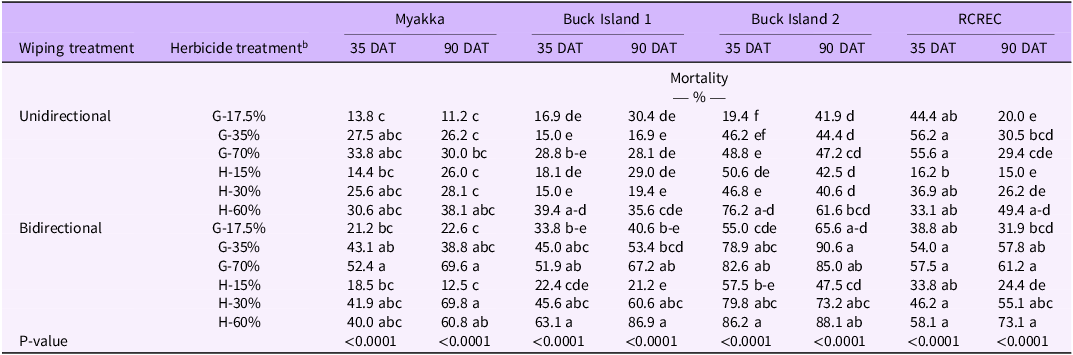
Sporobolus indicus var. pyramidalis mortality was greater when plants were wiped bidirectionally versus unidirectionally at all locations at both 35 and 90 DAT (Table 7). Herbicides wiped bidirectionally caused greater mortality compared with the same treatments applied unidirectionally.
Sporobolus indicus var. pyramidalis mortality at 35 and 90 d after treatment (DAT) in unidirectional vs. bidirectional wiping treatments at the Myakka, Buck Island (site 1), Buck Island (site 2), and Range Cattle Research and Education Center (RCREC) research locations in Florida, 2017 and 2018 a
a Means within locations and DAT followed by the same lowercase letter are not significantly different according to Fisher’s LSD test at P ≤ 0.05.
b Abbreviations: G-17.5%, glyphosate at 17.5%;, glyphosate at 35%; G-70%, glyphosate at 70%; H-15%, hexazinone at 15%; H-30%, hexazinone at 30%; H-60%, hexazinone at 60%.
Although the effects of the wiping method were not individually investigated as a factor in the ATV-wiper experiments, the data indicate that the wiping method (uni- vs. bidirectional application) plays an important role in S. indicus var. pyramidalis control, as bidirectional applications of herbicides resulted in enhanced mortality. A previous study by Lemus et al. (Reference Lemus, Mowdy and Davis2013) reported similar results, stating that the control of S. indicus var. pyramidalis control with glyphosate at 33% and 50% (356 g ae L−1) was 3.25- and 1.12-fold greater when bidirectionally wiped compared with unidirectional applications at 365 DAT. Furthermore, the manufacturer’s label states that performance may be improved by applying the herbicide twice in opposite directions (Anonymous 2019).
Interaction of Mowing and Wiping Treatment
A location by mowing by wiping treatment effect was observed for S. indicus var. pyramidalis mortality at 35 DAT (P = 0.0157) and 90 DAT (P = 0.0002); therefore, the results are presented separately by location (Tables 8 and 9). The greatest S. indicus var. pyramidalis mortality recorded in not-mowed plots among all unidirectionally wiped treatments was 49%, 44%, 84%, and 70% at Myakka, Buck Island (site 1), Buck Island (site 2), and RCREC, respectively (Table 8). Conversely, not-mowed plots had the greatest S. indicus var. pyramidalis mortality of 69%, 89%, 98%, and 73% when wiped bidirectionally at these locations, respectively. Treatments with the greatest mortality at 35 DAT were Bi-glyphosate-35%, Bi-glyphosate-70%, Bi-hexazinone-30%, and Bi-hexazinone-60% applied to not-mowed plots. Sporobolus indicus var. pyramidalis mortality recorded for these treatments ranged from 58% to 69%, 58% to 89%, 83% to 98%, and 61% to 73% at Myakka, Buck Island (site 1), Buck Island (site 2), and RCREC, respectively.
Sporobolus indicus var. pyramidalis mortality at 35 d after treatment (DAT) with different wiping treatments applied to mowed and not-mowed plants at the Myakka, Buck Island (site 1), Buck Island (site 2), and Range Cattle Research and Education Center (RCREC) research locations in Florida, 2017 and 2018 a

a Means within locations followed by the same lowercase letter are not significantly different according to Fisher’s LSD test at P ≤ 0.05.
b Abbreviations: UNI-G-17.5, unidirectional glyphosate at 17.5%; UNI-G-35%, unidirectional glyphosate at 35%; UNI-G-70%, unidirectional glyphosate at 70%; UNI-H-15%, unidirectional hexazinone at 15%; UNI-H-30%, unidirectional hexazinone at 30%; UNI-H-60%, unidirectional hexazinone at 60%; BI-G-17.5%, bidirectional glyphosate at 17.5%; BI-G-35%, bidirectional glyphosate at 35%; BI-G-70%, bidirectional glyphosate at 70%; BI-H-15%, bidirectional hexazinone at 15%; BI-H-30%, bidirectional hexazinone at 30%; BI-H-60%, bidirectional hexazinone at 60%.
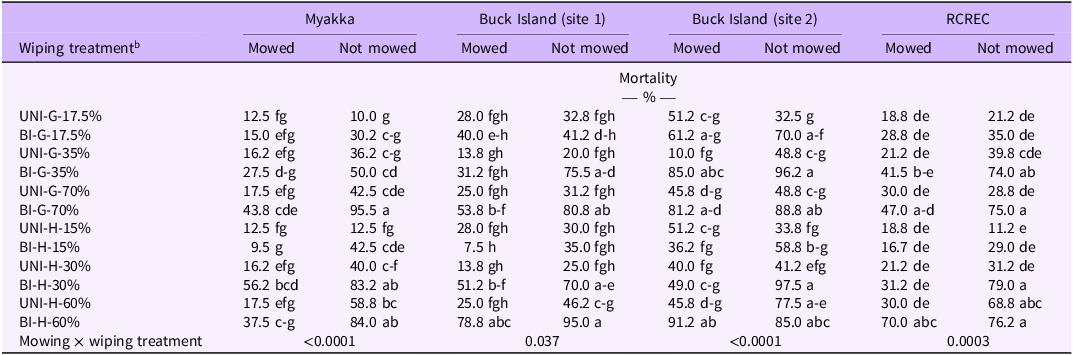
Sporobolus indicus var. pyramidalis mortality at 90 d after treatment (DAT) with different wiping treatments applied onto mowed and not-mowed plants at the Myakka, Buck Island (site 1), Buck Island (site 2), and Range Cattle Research and Education Center (RCREC) research locations in Florida, 2017 and 2018 a
a Means within locations followed by the same lowercase letter are not significantly different according to Fisher’s LSD test at P ≤ 0.05.
b Abbreviations: UNI-G-17.5, unidirectional glyphosate at 17.5%; UNI-G-35%, unidirectional glyphosate at 35%; UNI-G-70%, unidirectional glyphosate at 70%; UNI-H-15%, unidirectional hexazinone at 15%; UNI-H-30%, unidirectional hexazinone at 30%; UNI-H-60%, unidirectional hexazinone at 60%; BI-G-17.5%, bidirectional glyphosate at 17.5%; BI-G-35%, bidirectional glyphosate at 35%; BI-G-70%, bidirectional glyphosate at 70%; BI-H-15%, bidirectional hexazinone at 15%; BI-H-30%, bidirectional hexazinone at 30%; BI-H-60%, bidirectional hexazinone at 60%.
Wiping bidirectionally with herbicides significantly increased mortality at all locations (Table 9). The treatments causing the greatest mortality at 90 DAT included Bi-glyphosate-70%, Bi- hexazinone-30%, and Bi-hexazinone-60% applied in not-mowed plots. Sporobolus indicus var. pyramidalis mortality from these treatments ranged from 83% to 96%, 70% to 95%, 85% to 98%, and 75% to 79% at Myakka, Buck Island (site 1), Buck Island (site 2) and RCREC, respectively. These results corroborate previous work conducted by Lemus et al. (Reference Lemus, Mowdy and Davis2013) in Mississippi. Those authors reported that glyphosate at 33% (356 g ae L−1) wiped twice onto not-mowed plants provided 65% S. indicus control 365 DAT. However, S. indicus control was 90% when glyphosate at 50% v/v was wiped twice.
Additionally, lower mortality was observed at Myakka and RCREC compared with the other two locations at 90 DAT (Table 9). Several factors were likely responsible for this variability, including rainfall patterns and application timing, as well as variations in the target plants such as size and maturity stage. Total rainfall recorded at Myakka, Buck Island (site 1), Buck Island (site 2), and RCREC during the month of herbicide application was 213, 131, 249, and 56 mm, respectively, which was equal to 7% below, 28% below, 40% above, and 69% below the 20-yr monthly average, respectively (Table 1). Lack of or excessive rainfall after herbicide application has been suggested to decrease hexazinone efficacy (Ferrell and Mullahey Reference Ferrell and Mullahey2006; Rana et al. Reference Rana, Sellers, Ferrell, MacDonald, Silveira and Vendramini2015). In addition, wiping treatments were applied on September 27, 2018, at the RCREC site, whereas they were applied at the beginning of August at the Myakka and Buck Island (site 1), and on August 28, 2018, at Buck Island (site 2) (Table 3).
Hexazinone was applied in August, which is the peak rainfall month in southern Florida. Rainfall is required for hexazinone to be incorporated into the soil root zone and absorbed by plants (Dias Reference Dias2019; Wang et al. Reference Wang, Awaya, Zhu, Motooka, Nelson and Li2019). Thus, applying hexazinone early in the season when P. notatum is growing slowly due to limited rainfall would likely result in decreased hexazinone efficacy compared with what was observed in these experiments. However, due to the limited growth of P. notatum, the increased height differential between S. indicus var. pyramidalis and P. notatum would likely result in increased glyphosate deposition onto S. indicus var. pyramidalis plants, ultimately resulting in increased control with glyphosate; therefore, we would expect results to be significantly different if this work were conducted earlier in the growing season. However, this would need to be validated with further research.
Finally, it is noteworthy that several factors can significantly change the outcomes of the interaction between mowing before herbicide application and herbicide application, including the period between these two events, the number of consecutive mowing events before herbicide application, application timing, edaphoclimatic conditions before and after herbicide application, and weed species growth habit and life cycle. Therefore, mowing before herbicide application is a complex interaction that requires further investigation.
Funding statement
This work was supported by the USDA National Institute of Food and Agriculture, Hatch project 10006034, the Florida Cattle Enhancement Board, and the USDA Natural Resources Conservation Service.
Competing interests
The authors declare no conflict of interest.


 Open access

