Introduction
Freshwater species and habitats are among the most threatened in the world as demand for water in irrigation, industrial, and domestic use continues to increase worldwide (Strayer and Dugeon Reference Strayer and Dudgeon2010, Reid et al. Reference Reid, Carlson, Creed, Eliason, Gell, Johnson, Kidd, MacCormack, Olden, Ormerod, Smol, Taylor, Tockner, Vermaire, Dudgeon and Cooke2019). Species dependent on freshwater habitats thus often have substantially higher extinction risk than terrestrial animals (Strayer and Dugeon Reference Strayer and Dudgeon2010, Darwall et al. Reference Darwall, Holland, Smith, Allen, Brooks, Katarya, Yichuan, Clausnitzer, Cumberlidege, Cuttelod, Dijkstra, Diop, García, Skelton, Snoeks, Tweddle and Vié2011). Creating protected areas that encompasses intact, whole-water catchment management can be an effective conservation strategy (Saunders et al. Reference Saunders, Meeuwig and Vincent2002). Unfortunately, freshwater habitats have commonly been protected only incidentally as part of their inclusion within terrestrial reserves (Saunders et al. Reference Saunders, Meeuwig and Vincent2002). Little is known about the representation of threatened freshwater species in protected areas nor the role of these protected areas to ensure the long-term persistence of species that depend on freshwater (Saunders et al. Reference Saunders, Meeuwig and Vincent2002).
The estimated areal extent of a species’ distribution constitutes the core of most assessments of species global conservation status (IUCN 2014, Syfert et al. Reference Syfert, Joppa, Smith, Coomes, Bachman and Brummitt2014). Reliable assessments of rare species’ habitat area are difficult given that they are by definition uncommon, and often difficult to detect (Thompson Reference Thompson2004, Lomba et al. Reference Lomba, Pellissier, Randin, Vicente, Moreira, Honrado and Guisan2010). Until recently, tremendous field effort and financial support was needed to obtain key information for determining rare species’ conservation status, often involving long-term studies (Thompson Reference Thompson2004). The development of species distribution modelling approaches reliant only on species presence data, such as maximum entropy (MAXENT; Phillips et al. Reference Phillips, Anderson and Schapire2006), has created new opportunities, because potential habitat can be identified even with low numbers of occurrences (Guisan et al. Reference Guisan, Broennimann, Engler, Vust, Yoccoz, Lehmann and Zimmermann2006, Pearson et al. Reference Pearson, Raxworthy, Nakamura and Peterson2007). Model predictions developed using small sample sizes can be informative concerning the location of potentially suitable habitat, which is an important criterion in creating protected areas, particularly for rare and threatened species (Pearson et al. Reference Pearson, Raxworthy, Nakamura and Peterson2007).
The Rufous-throated Dipper Cinclus schulzi is a threatened bird species categorised as ‘Vulnerable’ on the IUCN Red List on the basis of its small population size and restricted range (BirdLife International 2019). The population size of the species has been inferred by expert opinion based on non-systematic surveys to be 3,000–4,000 individuals of which an estimated 2,000–2,700 were thought to be mature individuals (Tyler and Ormerod Reference Tyler and Ormerod1994, Tyler and Tyler Reference Tyler and Tyler1996, BirdLife International 2019). For Bolivia, estimates vary from 1,000 to 2,000 individuals, while in Argentina, the population size has been estimated to be no more than 2,000 individuals (Tyler Reference Tyler1994, Tyler and Tyler Reference Tyler and Tyler1996, BirdLife International 2019). The Rufous-throated Dipper is endemic to the Southern Yungas of north-western Argentina and southern Bolivia, with an estimated extent of occurrence of 147,000 km2 (BirdLife International 2019). However, the species is highly specialised in its habitat requirements, and occurs only in association with well-oxygenated, unpolluted running waters of mountain rivers (Tyler and Tyler Reference Tyler and Tyler1996). Rufous-throated Dippers nest in narrow watercourses that have vertical rock formations (Sardina Aragón et al. Reference Sardina Aragón, Politi and Barquez2015) and breeding pairs maintain year-round territories (Sardina Aragón Reference Sardina Aragón2016). This species’ ecology is among the least known of the five dipper species of the family Cinclidae (Tyler and Ormerod Reference Tyler and Ormerod1994). Information about its distribution is vague, and information about its abundance is speculative, which hinders conservation and management efforts (Buckland et al. Reference Buckland, Marsden and Green2008).
The purpose of our study was first, to map potentially suitable habitat of Rufous-throated Dipper in north-western Argentina; second, to estimate population size based on the potentially suitable habitat, and third, to assess the potentially suitable habitat within strict protected areas in Argentina. Together, these three elements constitute critical information for directing conservation actions for this poorly known, endemic and ‘Vulnerable’ species.
Methods
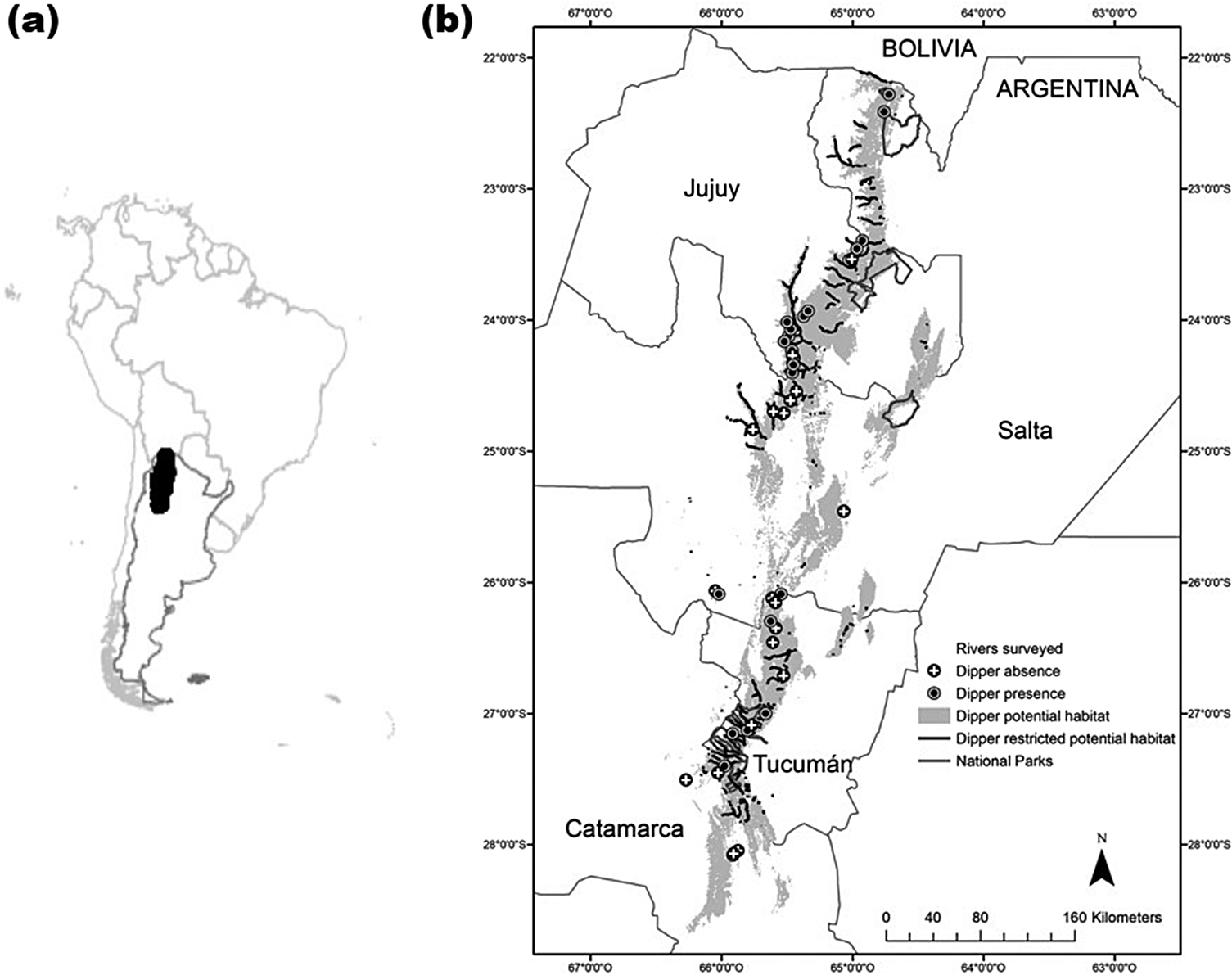
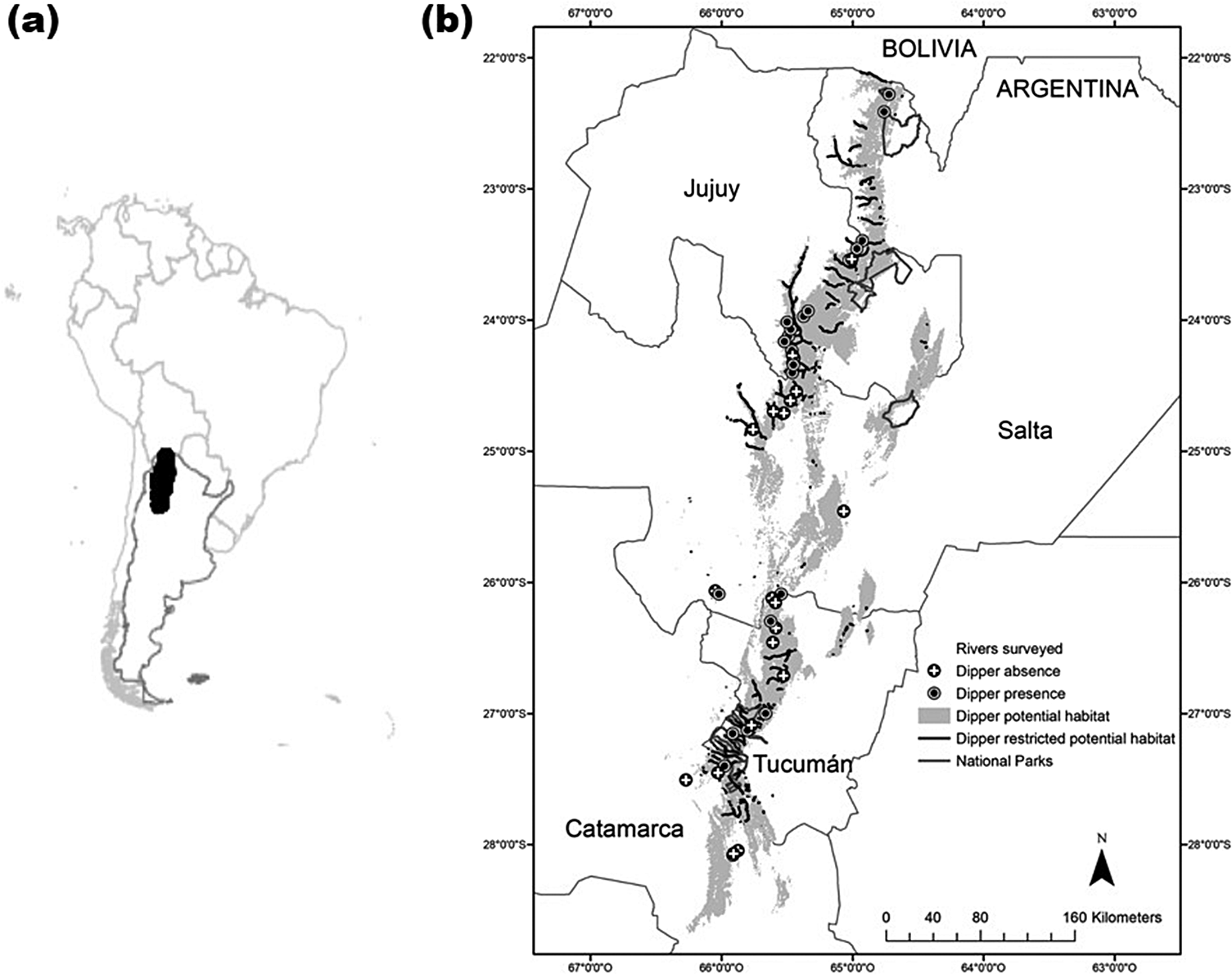
The Southern Yungas are mountain forests located on the eastern slopes of the Andes from southern Bolivia (14°S latitude) to north-western Argentina (29°S latitude; Figure 1) with an elevational gradient that varies between 400 and 3,000 m asl (Cabrera and Willink Reference Cabrera and Willink1980). The Southern Yungas is a biodiversity hotspot as well as a distinct biogeographic unit that harbours numerous endemic species (Myers et al. Reference Myers, Mittermeier, Mittermeier, Da Fonseca and Kent2000). In Argentina, the Southern Yungas has an extent of 32,000 km2, is one of the most threatened forest ecoregions of the country and is where most of the rivers of north-western Argentina originate (Politi and Rivera Reference Politi and Rivera2019).
Distribution of Southern Yungas in north-western Argentina (a), rivers surveyed (showing presence or absence of Cinclus schulzi) and MAXENT species distribution using the > 10th percentile presence threshold probability value of potential habitat of Cinclus schulzi in permanent rivers (b).
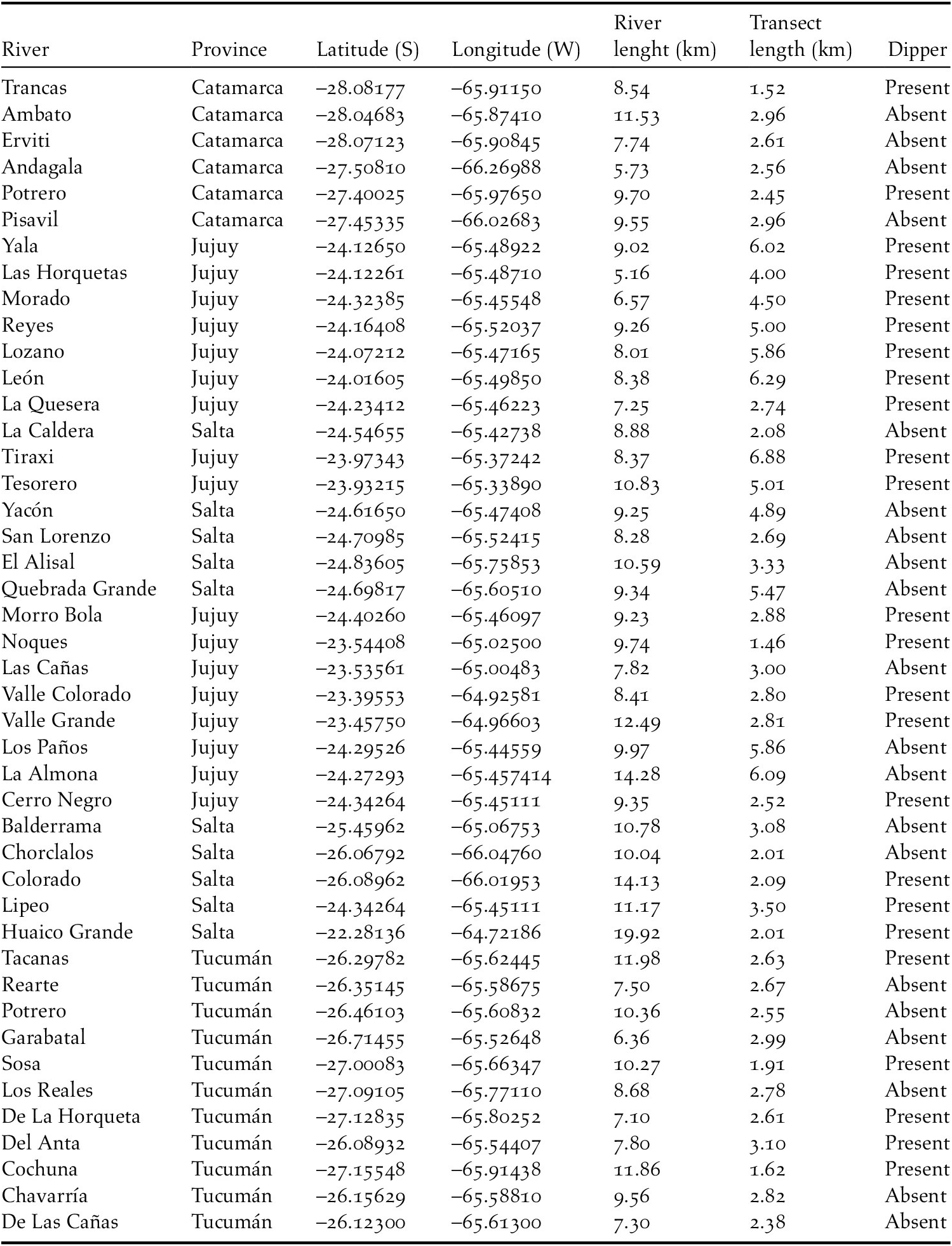
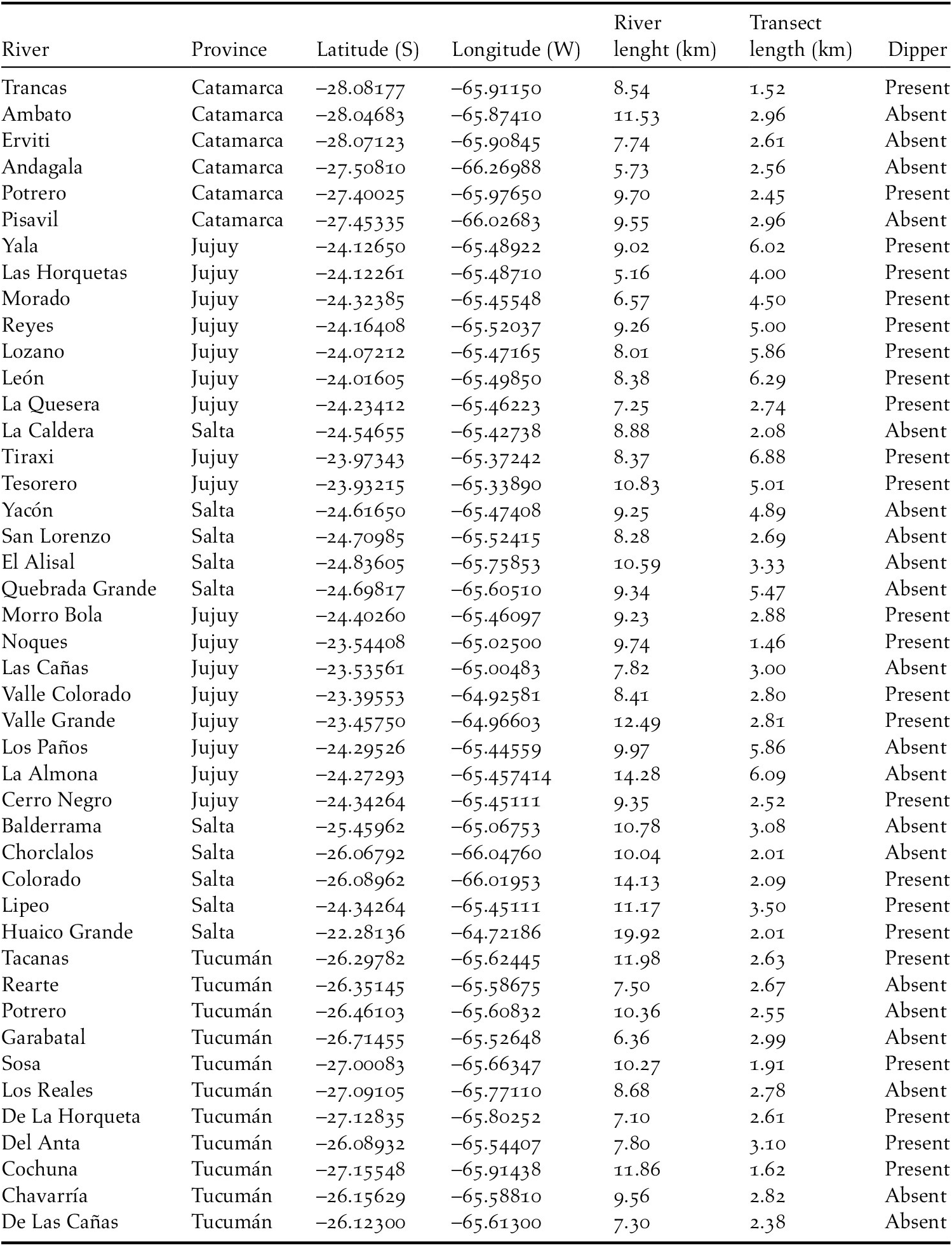
We surveyed 44 rivers in the Southern Yungas of Argentina to record presence of the Rufous-throated Dipper (Table 1). Rivers studied encompassed the latitudinal gradient. Rivers selected for surveys had access from near-by roads. At each river we walked upstream transects of variable length depending on the accessibility of the river (Table 1). Surveys were conducted during the Rufous-throated Dipper non-breeding season (April to September) from 2010 to 2013. We surveyed during the non-breeding season because that it is the period when all rivers are accessible. In most rivers during the rainy season, from October to March, water levels rise and have intense flows. For each Rufous-throated Dipper sighting, we recorded the coordinates (using a global positioning system unit, GPS) and the number of individuals. We only included dippers flying upstream to avoid double counting (Osborn Reference Osborn1999). We determined Rufous-throated Dipper density as the number of dippers detected per km surveyed (mean ± SE). For each river, we recorded the following habitat variables at the beginning and end of each transect: 1) elevation (m asl) (determined with a GPS); 2) river width (m) (determined by measuring the distance between shores with a metric tape); 3) water depth (cm) (measured at five points along the river width using a graduated stick of 180 cm); 4) water flow (cm/sec) (determined by the time it took a Styrofoam sphere to travel downstream 10 m in the river); 5) rock cover (%) (visually estimated as the percentage of a 2 x 2 m plot covered with emergent rocks); and 6) slope (%) (measured with a clinometer). We compared river characteristics between reaches with and without Rufous-throated Dipper presence using Kolmogorov-Smirnov tests (Quinn and Keough Reference Quinn and Keough2002).
Rivers and transect surveyed to record Cinclus schulzi presence in north-western Argentina.
We assessed the potential distribution of Rufous-throated Dipper using maximum entropy modeling of species geographic distributions (MAXENT; Phillips et al. Reference Phillips, Anderson and Schapire2006). To minimise sample bias, we included records along the latitudinal range surveyed, but only included records of Rufous-throated Dipper that were at least 2 km apart, so the map was based on the occurrence of 31 Rufous-throated Dipper records from data collected. This number of records is sufficient for MAXENT modelling (Guisan et al. Reference Guisan, Broennimann, Engler, Vust, Yoccoz, Lehmann and Zimmermann2006, Pearson et al. Reference Pearson, Raxworthy, Nakamura and Peterson2007, Wisz et al. Reference Wisz, Hijmans, Li, Peterson, Graham and Guisan2008). As predictors, we used eight 1-km resolution bioclimatic variables that have proved useful for mapping species distributions in this region (Pidgeon et al. Reference Pidgeon, Rivera, Martinuzzi, Politi and Bateman2015; Martinuzzi et al. Reference Martinuzzi, Rivera, Politi, Bateman, de los Llanos, Lizárraga, de Bustos, Chalukian, Pidgeon and Radeloff2018), including: annual precipitation (BIO12), annual mean temperature (BIO1), seasonality of precipitation (BIO15) and temperature (BIO4), extreme data for precipitation of wettest quarter (BIO16), precipitation of driest quarter (BIO17), maximum temperature of warmest month (BIO5) and minimum temperature of coldest month (BIO6); representing conditions of the years 1950 to 2000 (Hijmans et al. Reference Hijmans, Cameron, Parra, Jones and Jarvis2005). We also included two topographic variables: elevation (DEM2) and slope (DEM3), since the species occurs in a mountainous region. We generated 10,000 pseudo-absences as background data for model training in MAXENT and selected 100 km as the universe of pseudo-absence locations, because it produced the most accurate and biologically meaningful results after testing different buffer sizes (VanDerWal et al. Reference VanDerWal, Shoo, Graham and Williams2009). To run MAXENT, we set all other options to default and assessed model performance with a 10-fold cross-validation and the area under the receiver operating curve (AUC) (Phillips Reference Phillips2017). We transformed predictions from MAXENT using the 10th percentile presence logistic threshold (i.e. we use that value as the threshold probability) into a binary map of suitable versus unsuitable habitat to create a map of the species’ potential distribution (McFarland et al. Reference McFarland, Rimmer, Goetz, Aubry, Wunderle and Sutton2013). Given that the Rufous-throated Dipper is restricted to fast-flowing, rocky mountain, forested rivers (Ormerod and Tyler Reference Ormerod, Tyler, Del Hoyo, Elliott and Christie2005), we refined the species distribution map by including only pixels that overlapped with rivers. We used the river layer available from the governmental Geographic Information System datasets including rivers classified as permanent (i.e. watercourse that have year-long water) (IGN 2014).
We estimated the Rufous-throated Dipper population size by multiplying the number of individuals detected per km surveyed by the extent of the species’ restricted potential distribution. We estimated the area of occupancy by considering a watercourse width of 50 m (Sardina Aragón et al. Reference Sardina Aragón, Politi and Barquez2015) multiplied by the extent of the species restricted potential distribution. We could have been more restrictive in estimating the area of occupancy if we had only included river width (i.e. 4–8 m), but that would represent only the foraging habitat and we would have not incorporated the breeding habitat. Nests are located in watercourse cliffs that may up to 20 m from the water (Sardina Aragón et al. Reference Sardina Aragón, Politi and Barquez2015).
Finally, we estimated the extent of potential habitat of the Rufous-throated Dipper inside National Parks, using shapefiles of protected areas under the National Park Administration (e.g. Calilegua, El Rey, El Nogalar, Baritú, and Aconquija) obtained from the Biodiversity Information System (https://sib.gob.ar/). We used protected areas of the National Park Administration because these areas have the highest protection level in the region, restrict most human economic activities, and are adequately enforced.
Results
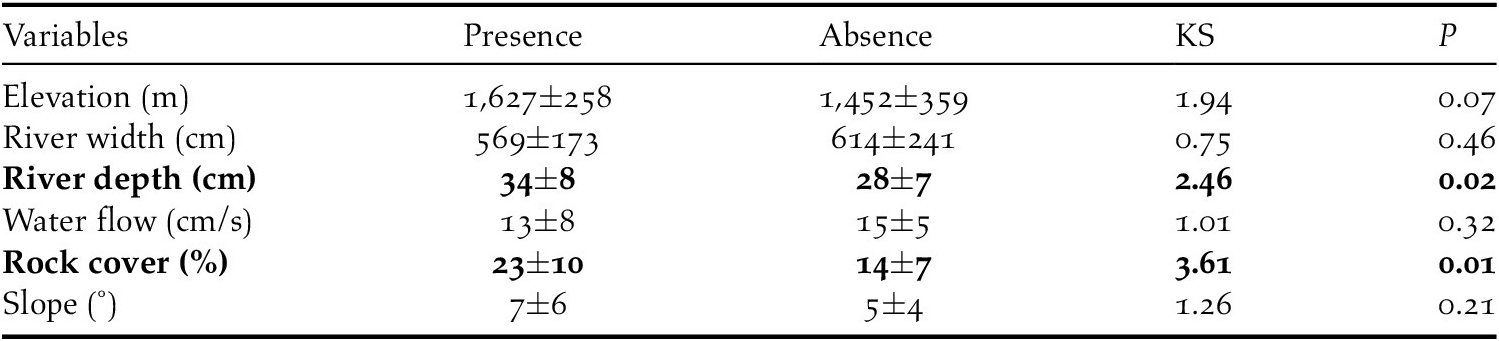
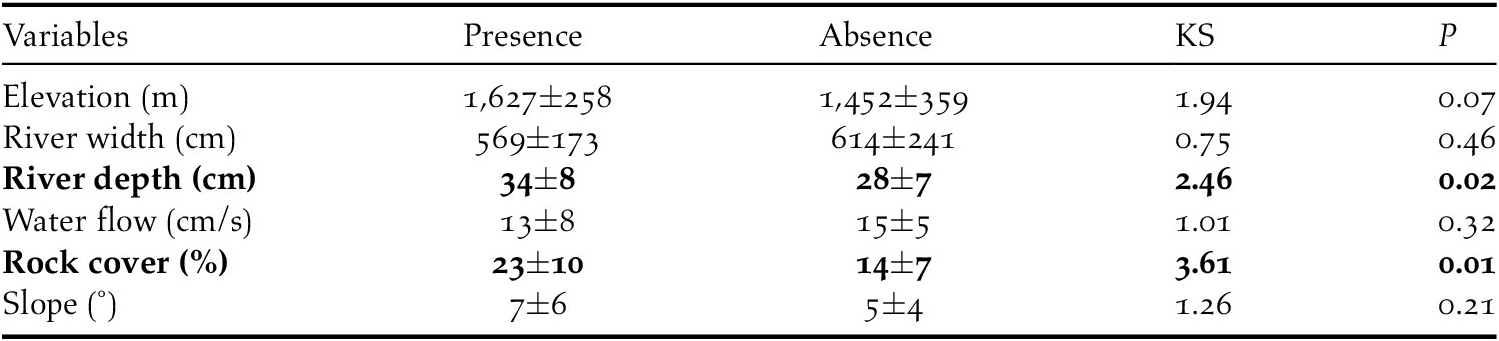
In total we surveyed 148 km of river, apportioned as 3.36 ± 1.45 km/river; min 1.46 km, max 6.88 km (Table 1). We recorded 131 Rufous-throated Dippers in 24 of the 44 rivers surveyed. The density of Rufous-throated Dipper in the rivers surveyed was 0.94 ± 1.55 individuals/km. Rivers with Rufous-throated Dippers were significantly deeper and had more rock cover than rivers without Rufous-throated Dippers (Table 2).
River characteristics in north-western Argentina with Cinclus schulzi presence and absence. Kolmogorov-Smirnov test statistic (KS) and resulting P-value are shown.
The AUC value of the species distribution model was 0.94. Elevation (DEM2: 32% contribution) and extreme precipitation during the wettest quarter (BIO16: 22% contribution) were the two most important predictors of Rufous-throated Dipper habitat. The threshold probability value > 0.34 results in 2,815 km of potentially suitable habitat for Rufous-throated Dippers of rivers with year-round water (Figure 1), which corresponds to an estimate of 2,657 ± 4,355 individuals.
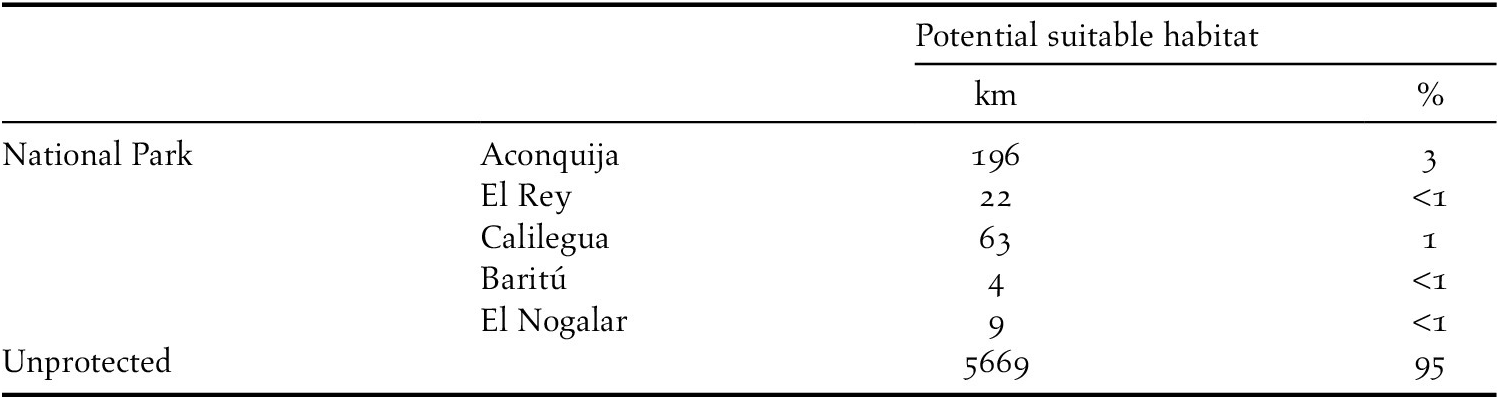
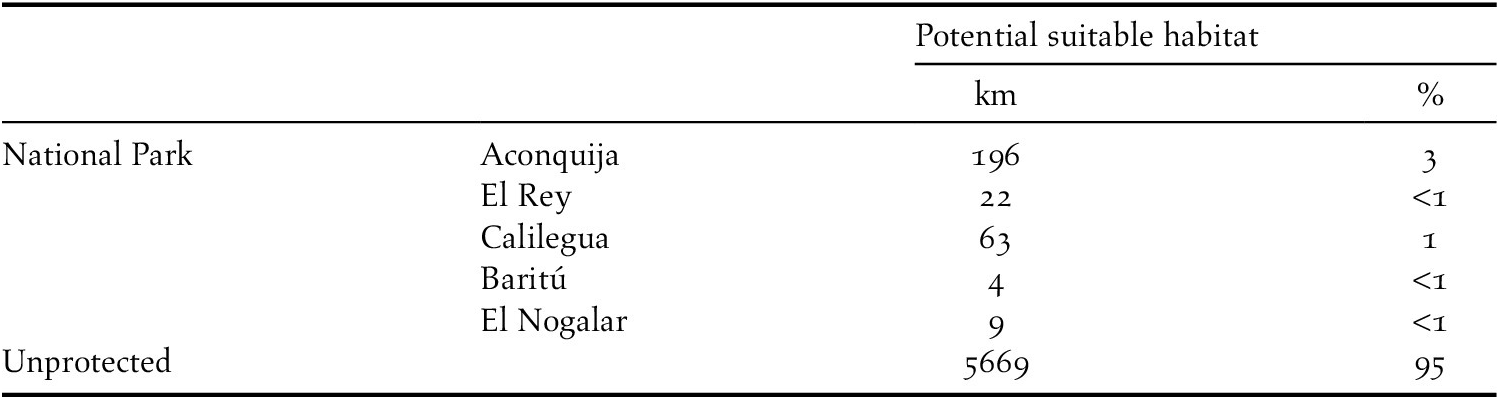
The suitable potential habitat in Argentina suggests an estimated area of occupancy of 141 km2 for permanent rivers. Of the rivers with potential suitable habitat for Rufous-throated Dippers, less than 5% are within National Parks (Table 3).
Cinclus schulzi potential suitable habitat within National Parks and on unprotected river catchments of north-western Argentina.
Discussion
Rufous-throated Dipper extent of occurrence covers the entire latitudinal range along the Southern Yungas of Argentina. Our estimated area of occupancy in Argentina (141 km2) is considerably below the threshold established by IUCN’s Red List criteria to classify a species as ‘Vulnerable’ (< 2,000 km2; BirdLife International 2019). However, our analysis of Rufous-throated Dipper population size in Argentina suggests that if potential habitat is occupied, the population size may well be larger (2,657 ± 4,355 Dippers) than previously suggested for Argentina based on expert opinion (< 2,000 individuals; Tyler and Ormerod Reference Tyler and Ormerod1994).
We are confident that we adequately detected Rufous-throated Dippers if they were present during our surveys. This is because the species is restricted to rivers, and in these discrete linear entities the dipper is easily detected, as it does not flush easily, and is highly territorial (Tyler and Ormerod Reference Tyler and Ormerod1994). However, we might have overpredicted the area of potential habitat with our distribution model based on bioclimatic and topographic variables, given that we found significant differences in river depth and rock cover in rivers with and without Rufous-throated Dipper. Quantification of these two variables requires field measurement, and it was not possible for us to assess these variables in all rivers. Therefore, it is highly likely that that not all the rivers mapped contain adequate suitable habitat for the species. Future studies should attempt to validate Rufous-throated Dipper presence on inaccessible rivers with suitable potential habitat. Furthermore, we surveyed 35% of the total river length (~140/418 km) of the 44 rivers we studied; a more rigorous approach would be to fully assess the extent of potential suitable habitat that each river harbours. Finally, a more refined model of the species’ potential suitable habitat would include factors not assessed here, but that can influence habitat quality (Van Horne Reference Van Horne1983, Thorn et al. Reference Thorn, Nijman, Smith and Nekaris2009, Sousa-Silva et al. Reference Sousa-Silva, Alves, Honrado and Lomba2014). For example, food availability and water quality have been shown to influence habitat quality in other dipper species (Ormerod et al. Reference Ormerod, O’Halloran, Gribbin and Tyler1991, Ormerod and Tyler Reference Ormerod and Tyler1991, Reference Ormerod and Tyler1992), but this information is still lacking for Rufous-throated Dipper. Although nesting sites for Rufous-throated Dipper have been described (Sardina Aragón et al. Reference Sardina Aragón, Politi and Barquez2015) there is no association of the availability of nesting sites with nesting success and habitat quality. Knowledge of the ecological requirements and potential factors limiting Rufous-throated Dipper population size should be addressed in future studies.
The potential suitable habitat map for the Rufous-throated Dipper that we developed indicates areas with suitable habitat in Argentina that we did not survey, making these areas priority localities for survey (e.g. south-western Salta Province and eastern Jujuy Province). In eastern Jujuy Province, the Santa Bárbara mountain range is isolated from the western mountain range, resulting in a discontinuous distribution of the Southern Yungas forest (Bellis et al. Reference Bellis, Rivera, Landi and Politi2014). We speculate that the Rufous-throated Dipper has not been able to colonise this eastern mountain range and is probably absent, but future research is needed to confirm this. Furthermore, systematic surveys in Bolivia are needed to estimate the species’ global population size and extent of occurrence, however some surveys of Bolivian localities have been carried out (Martínez et al. Reference Martínez, Gómez and Naoki2011, Flores Bedregal et al. Reference Flores Bedregal, Herrera Carrasco and Capriles2015).
The non-breeding season is probably an adequate period to conduct dipper surveys. We obtained similar dipper density to previous results found in other studies (Tyler and Tyler Reference Tyler and Tyler1996, Sardina Aragón et al. Reference Sardina Aragón, Politi and Barquez2015). Based on previous knowledge of the species, breeding pairs are highly territorial year-round, therefore we assume that non-breeding season habitat probably adequately represents suitable potential habitat in the breeding season (Sardina Aragón Reference Sardina Aragón2016). However, it would be good to confirm this by resampling accessible rivers during the breeding season.
Another key finding from our study is that the Rufous-throated Dipper potential suitable habitat in Argentina is not adequately represented within existing National Parks (< 5% is protected). For some species or habitats, a 10% representation might be sufficient, but for species with very limited distribution range the proposed conservation target is up to 100% (Kukkala and Moilanen Reference Kukkala and Moilanen2012, Pidgeon et al. Reference Pidgeon, Rivera, Martinuzzi, Politi and Bateman2015). Our results highlight the need to create new National Parks that protect the species’ potential suitable habitat (i.e. south-west of Salta Province) and to enlarge existing protected areas to encompass entire river catchments (e.g. Calilegua and Baritú National Parks). In north-western Argentina, unprotected river catchments are threatened primarily by reservoir construction, hydroelectric and irrigation schemes, and eutrophication that modify and reduce water flow (Tyler and Tyler Reference Tyler and Tyler1996). Conservation planning in the region has generally not been systematic, and our maps of suitable dipper habitat can guide discussions of where new protected areas can be created to contribute to the conservation of this vulnerable and endemic species (Margules and Pressey Reference Margules and Pressey2000). We are aware that protected areas may not be the only solution for all the challenges that freshwater rivers and its biodiversity face and that other conservation options may need to be employed. For example, BirdLife International´s Important Bird and Biodiversity Areas (IBAs) are a strategy to link policy and local engagement to bird conservation (Waliczky et al. Reference Waliczky, Fishpool, Butchart, Thomas, Heath, Hazin, Donald, Kowalska, Dias and Allinson2019). However, at the global scale, IBAs inside protected areas are in better condition, with lower pressures, than those outside protected areas (Butchart et al. Reference Butchart, Scharlemann, Evans, Quader, Arinaitwe, Bennun, Besançon, Boucher, Bomhard, Brooks, Burfield, Burgess, Clay, Crosby, Davidson, De Silva, Devenish, Dutson, Díaz Fernández, Fishpool, Foster, Hockings, Hoffmann, Knox, Larsen, Lamoreux, Loucks, May, Millett, Parr, Skolnik, Upgren and Woodley2012). In order to have a successful conservation programme, protected areas are a central pillar, but other considerations should also be taken into account, such as economic, sociocultural, political, and enforcement components (Flores Bedregal et al. Reference Flores Bedregal, Herrera Carrasco and Capriles2015, Waliczky et al. Reference Waliczky, Fishpool, Butchart, Thomas, Heath, Hazin, Donald, Kowalska, Dias and Allinson2019).
Our study expanded the scientific knowledge of a little known, and endemic species in Argentina. Overall, our country-level analysis of occupancy and population size of the Rufous-throated Dipper suggests that the IUCN Red List classification of the Rufous-throated Dipper as ‘Vulnerable’ is warranted. We hope that our study will stimulate surveys in Bolivia to obtain a global assessment, and that it promotes new research in Argentina to fill in gaps in knowledge about this species (e.g. how well connected are populations among rivers). The underrepresentation of Rufous-throated Dipper potential habitat in strict protected areas, and its small population size, require that urgent efforts be taken to ensure the long-term conservation of this species.
Acknowledgements
This work was supported by Conservation Leadership Programme (CLP; ID 06034810); and Beca Conservar la Argentina (Aves Argentinas; ID: 05-2011). We are grateful to the Provinces of Jujuy, Salta, Tucumán, and Catamarca and the National Parks Administration for permits to carry-out research. We thank park ranger Gonzalo Cristófani for help in the field. We also thank T. Dodman and S.J. Ormerod for comments that improved the manuscript.