


1. Introduction
Livestock are a critical source of wealth, income and food for millions of livestock-owning households in many Low- and Middle-Income Countries (LMICs). Livestock support diverse functions in the well-being of livestock-owning households, including nutrition – especially protein, which is critical for childhood growth and development – generation and storage of assets, draught power, transport, soil nutrients, social security and social capital, and insurance (Glatzel et al., Reference Glatzel, Tankari, Shah, Choudhury, Badiane and von Braun2020).
The livestock sector accounts for approximately 30–80 percent of the agricultural Gross Domestic Product (GDP) of most African countries (AU-IBAR, 2015). Moreover, it is projected that by the year 2050 the population of Africa will reach 2.2 billion and the per capita meat consumption is projected to rise from 19 kg to 26 kg per year and milk from 44 kg to 64 kg per year. This increasing demand is likely to drive further development of the livestock sector, already the fastest growing agricultural subsector in Africa (Pica-Ciamarra et al., Reference Pica-Ciamarra, Baker, Morgan, Zezza, Azzarri, Ly, Nsiima, Nouala, Okell and Sserugga2014; Ritchie, Rosado, and Roser, Reference Ritchie, Rosado and Roser2017; Suzuki, Reference Suzuki2019).
In Tanzania, 95% of livestock are kept by smallholder households rather than in commercial farms, in contrast to the situation in high-income countries (World Bank, Reference Bank2014), and the livestock sector forms the basis of the livelihoods of almost one out of three people (Glatzel et al., Reference Glatzel, Tankari, Shah, Choudhury, Badiane and von Braun2020). Tanzania’s annual gross value of livestock production has fluctuated substantially in recent years, but has trended upward since 2001 toward an estimated $448 million in 2020 (Knoema, 2022).
The livestock sector in sub-Saharan Africa faces numerous challenges such as disease and poor animal health that have led to unrealized economic potential. Poor access to quality veterinary care, limited diagnostic infrastructure, and poor extension services in rural areas are some of the reasons for poor animal health and high disease prevalence (Boto and La Peccerella, Reference Boto and La Peccerella2009; FAO., 2019).
One health challenge that contributes to low livestock productivity but receives relatively little attention is abortion in livestock (Keshavarzi et al., Reference Keshavarzi, Sadeghi-Sefidmazgi, Ghorbani, Kowsar, Razmkabir and Amer2020). Abortion is the premature expulsion of the fetus before the completion of the gestation period, which can be caused by several factors broadly classified as noninfectious or infectious causes (NADIS, 2022). Whilst noninfectious causes include genetics, nutrition, and other environmental factors, (NADIS, 2022), infections are thought to be a major cause of abortion (Mark L. Anderson, Reference Anderson2007), although determination of attribution to a specific pathogen is challenging and only occurs in approximately 20%–45% of cases (Anderson et al., Reference Anderson, Blanchard, Barr and Hoffman1990; Amouei et al., Reference Amouei, Sharif, Sarvi, Bagheri Nejad, Aghayan, Hashemi-Soteh, Mizani, Hosseini, Gholami, Sadeghi, Sarafrazi and Daryani2019; Campero et al., Reference Campero, Moore, Odeón, Cipolla and Odriozola2003; Derdour et al., Reference Derdour, Hafsi, Azzag, Tennah, Laamari, China and Ghalmi2017). Common pathogens that result in livestock abortions worldwide include Neospora caninum, Toxoplasma gondii, Chlamydia abortus, Coxiella burnetii, Brucella abortus, Rift Valley Fever Virus and Blue Tongue Disease Virus, (Akoko et al., Reference Akoko, Pelle, Lukambagire, Machuka, Nthiwa, Mathew, Fèvre, Bett, Cook, Othero, Bonfoh, Kazwala, Shirima, Schelling, Halliday and Ouma2021; Mohabati et al., Reference Mohabati, Khalili, Mostafavi and Esmaeili2021; Odendaal et al., Reference Odendaal, Davis, Fosgate and Clift2020; Semango et al., Reference Semango, Hamilton, Kreppel, Katzer, Kibona, Lankester, Allan, Thomas, Claxton, Innes, Swai, Buza, Cleaveland and de Glanville2019), with several of these pathogens also detected as the cause of livestock abortion in northern Tanzania (Thomas et al., Reference Thomas, Kibona, Claxton, de Glanville, Lankester, Amani, Buza, Carter, Chapman, Crump, Dagleish, Halliday, Hamilton, Innes, Katzer, Livingstone, Longbottom, Millins, Mmbaga, Mosha, Nyarobi, Nyasebwa, Russell, Sanka, Semango, Wheelhouse, Willett, Cleaveland and Allan2021).
Livestock abortion is reported to lead to considerable economic losses. For instance, Neospora caninum causes estimated losses of $ 33.1 million for the dairy industry and $ 12.9 million for the beef industry in the Pampa region of Argentina (Moore et al., Reference Moore, Reichel, Spath and Campero2013) with a livestock industry worth approximately $13 billion (Deryng, Reference Deryng2021). In Turkey, estimated losses of $ 509 per animal are attributed to abortions caused by bovine herpesvirus 1 (BoHV-1) (Can, Ataseven, and Yalçın, Reference Can, Ataseven and Yalçın2016). Based on data from Mexico, which has a $ 26.1 billion livestock sector (Ministerie van Landbouw, 2022), the cost of an abortion during the first trimester was estimated at $262, whereas fetal loss between days 91 and 180 was estimated to cost between $483 and $1098 for pregnancies over 181 days (Albuja et al., Reference Albuja, Ortiz, López and Hernández Cerón2019).
Aggregate economic losses due to abortion have been estimated in a few countries in Africa, including Swaziland, where annual economic loss arising from abortion due to Brucella spp. was estimated to be approximately $2.8 million (Akakpo, Têko-Agbo, and Koné, Reference Akakpo, Têko-Agbo and Koné2009). As with many other LMICs, there are no published data on the economic losses due to livestock abortions in Tanzania. Furthermore, there are very few studies globally that estimate the economic impact of abortions based on rigorous epidemiological and economic data collected from a randomly selected population (Deka et al., Reference Deka, Magnusson, Grace and Lindahl2018).
This study estimates the direct economic burden of abortion to livestock-owning households based on an economic analysis of livestock abortion gross and net loss using data collected through a syndromic surveillance platform entitled “Supporting Evidence-Based Interventions in Tanzania (SEBI-TZ),” and additional expert survey data. The SEBI-TZ project enhances our understanding of young and adult stock mortality, including reproductive losses, and was based on the collection, collation, and analysis of data on the incidence and etiology of livestock mortality, reproductive losses, and their impact on productivity in Tanzania in the context of sub-Saharan Africa.
We estimate the gross economic losses from an abortion as the economic value of a lost calf and the difference in milk offtake with an abortion versus without an abortion. We then estimated the net loss of abortion using the implicit value of pregnancy from market sales of pregnant and nonpregnant stock. We then use these gross and net per-pregnancy losses to estimate population-level losses for the region in which the samples were collected. To do so we augmented study data with population data from the Tanzania National Sample Census of Agriculture 2019/2020 report (hereafter termed as ‘Census data’) (Ministry of Agriculture, 2020).
Our approach is novel in at least one notable dimension. While several studies estimate the gross cost of livestock abortion from loss of a newborn and change in milk production (Eski, Demir, and Gunaydin, Reference Eski, Demir and Gunaydin2021; Gädicke, Vidal, and Monti, Reference Gädicke, Vidal and Monti2010), to our knowledge only Gadicke et al. (Gädicke et al., Reference Gädicke, Vidal and Monti2010) distinguishes between net and gross losses due to differences in production, using a stochastic enterprise budget model applied to commercial dairies in Chile. In contrast, we distinguish between net and gross losses by augmenting our abortion data with market data analysis. Specifically, in addition to collecting data on abortions, value of young livestock, and differences in milk production and milk value, we estimate the difference in the market price of pregnant versus nonpregnant animals using hedonic regression. We interpret this difference as the net value of a pregnancy, accounting for benefits of a successful birth, husbandry costs for the mother and the newborn, and the likelihood of an abortion. From this information we estimate the net loss of an abortion based on the husbandry costs implicit in the market value of a pregnancy. To our knowledge this approach is novel in the literature on livestock production and losses.
The next section presents a theoretical model of the value of pregnancy, develops definitions of gross and net abortion losses estimable from data on individual abortions, and describes the approach used for estimating aggregate losses. Materials, methods, and data are then described, followed by results and discussion.
2. Model of the value of livestock pregnancy and costs of abortion
Given pregnancy, a livestock abortion results in an economic loss equivalent to the expected net benefit of a successful birth relative to the expected net benefits from an abortive pregnancy. We focused on the two most relevant categories of value: the loss of the value of birthed offspring and the difference in milk production value. Production costs differ as well. Husbandry and feeding of a pregnant animal differs from nonpregnant stock (Lukuyu et al., Reference Lukuyu, Gachuiri, Lukuyu, Lusweti and Mwendia2012), and feeding and caring for newborns represent an up-front investment. We define the value of pregnancy in two ways as shown in Equation (1):
 $$\eqalign{ & V\left( {{\rm{Preg}}} \right) = V\left( {{\rm{Female|Preg}}} \right) - \;V\left( {{\rm{Female}}|{\rm{Not}}\;{\rm{Preg}}} \right) \cr
& \quad \quad \quad \quad = d\left[ {\alpha V\left( {{\rm{Preg}}|A = 1} \right) + \left( {1 - \alpha } \right)\left( {V\left( {{\rm{Preg}}|A = 0} \right) - {C_n}} \right) - {{\rm{C}}_{\rm{p}}}} \right]. \cr} $$
$$\eqalign{ & V\left( {{\rm{Preg}}} \right) = V\left( {{\rm{Female|Preg}}} \right) - \;V\left( {{\rm{Female}}|{\rm{Not}}\;{\rm{Preg}}} \right) \cr
& \quad \quad \quad \quad = d\left[ {\alpha V\left( {{\rm{Preg}}|A = 1} \right) + \left( {1 - \alpha } \right)\left( {V\left( {{\rm{Preg}}|A = 0} \right) - {C_n}} \right) - {{\rm{C}}_{\rm{p}}}} \right]. \cr} $$
First, the ex ante value of pregnancy V(Preg) is the difference between the value of a pregnant female, V(Female|Preg), and an otherwise similar nonpregnant female, V(Female|Not Preg), evaluated before the pregnancy outcome (Equation (1), line 1), and estimable with market data. Second, the ex ante value of pregnancy can also be described in terms of the expected value of the ex post net benefits of a pregnancy (Equation (1), line 2). The value αV(Preg|A=1) + (1−α)V(Preg|A=0) is the expected benefits from a pregnancy prior to the delivery outcome, where α is the probability of abortion given pregnancy; V(Preg|A=1) is the value of benefits from an abortive pregnancy, and V(Preg|A=0) is the value of benefits from a successful pregnancy. The discount factor d = (1+r d )−T d accounts for the number of days T d between the market transaction and the due date, and r d is the daily discount rate. C n are costs incurred to care for a live newborn up to the time it can be sold on the market, and C p are additional expected costs of supporting a pregnancy.
Equation (1) implies a relationship between the ex ante value of pregnancy measurable by the difference in livestock prices and the elements of the expected net value accrued ex post after either a successful birth or abortion. We next explain the basis for estimating the value accrued ex post after a live birth or abortion and then show how husbandry costs may be inferred using both ex ante and ex post information.
2.1. Ex post value of pregnancy depending on outcome
The primary value of a successful birth is the sum of the present value of the newborn animal and the milk offtake provided by the pregnancy. The value of the milk consumed by the newborn is implicit in the value of the newborn, and in the event of abortion, the abortus is assumed unused and costless to dispose. Given our data, the gross present value of a calf at successful birth is estimated as the present value of a one-year-old calf, discounted and adjusted for the probability of calf death:
 $$V\left( {{\rm{calf\;}}|A = 0} \right) = \left( {1 - {\pi _d}} \right) \times {P_c} \times {\rm{\delta }},$$
where π d is the probability that a successfully birthed calf dies before it is 12-month-old, so (1−π d ) is the probability that it lives to 12 months. P c is the market price of a 12 months-old-calf, representing the value of a calf at that age, and δ = 1/(1+r a ) is the one-year discount factor where r a is an annual discount rate (Haacker, Hallett, and Atun, Reference Haacker, Hallett and Atun2020). We discount to one year because we use the market value of one-year-old animals, and the temporal reference point as noted before is the due date for a pregnancy.
Milk offtake for household use may differ after an abortion versus a successful birth because of (a) a difference in production, (b) the fact that a calf is consuming milk in the one case but not the other, and (c) because our data suggest that households sometimes do not milk for human consumption from recently abortive stock. When milk is taken for human consumption, we assume that it is acquired daily so its value can be modeled as a daily annuity. The present value of milk offtake depending on status is
 $$V\left({\rm milk}|A,F\right)=M\left(A,F\right)\times P_{m}\times \sigma,$$
where F ∈ (Offtake=1, No offtake=0) indicates whether a household milks a livestock for human consumption in the household or for sale and σ = (1−(1+r d )−T m )/r d is the daily annuity formula where r d is the daily discount rate and T m represents the number of days of milk offtake attributable to an individual pregnancy (until milk is no longer produced or is attributable to the next pregnancy cycle). M(A,F) is the average amount of offtake for human consumption conditional on abortion status, and P m is the market price received by livestock owners for their milk (this price also represents the opportunity cost of household consumption). Our data suggest that sometimes households choose not to use milk for consumption after an abortion. In this case M(A=1, F=0) = 0.Footnote 1 The difference in the present value of milk offtake value after a successful birth versus an abortion is:
 $$\Delta V\left({\rm milk}\right)=\Delta M\times P_{m}\times \sigma,$$
where ΔM = M(A=0, F=1) − M(A=1, F) is the difference in milk offtake after an abortion versus after a successful birth. For a household that does not consume milk from abortive stock, the difference in milk offtake is equal to the value of milk from a non-abortive stock: ΔV(milk) = V(milk|A=0, F=1) − 0 = V(milk|A=0, F=1).
The ex post gross value of pregnancy conditional on birth outcome is the sum of the value of the newborn (or abortus), and the value of milk offtake:
 $$V\left({\rm preg}|A,F\right)=V\left({\rm calf\ }|A,F\right)+V\left({\rm milk}|A,F\right).$$
In Equation (5) we have augment the notation for the value of pregnancy in Equation (1) to indicate offtake status F. The ex post gross economic loss from an abortion is equal to the difference between the gross value of a pregnancy given a successful birth and the gross value of a pregnancy given an abortion:
 $$\eqalign{ & V\left( {{\rm{preg}}|A = 0,F = 1} \right) - \;V\left( {{\rm{preg|}}A = 1,F} \right)\; = V\left( {{\rm{calf}}\;{\rm{|}}A = 0,F = 1} \right) + \;\Delta V\left( {{\rm{milk}}} \right) \cr & \quad \quad \quad \quad \quad \quad \quad \quad \quad \quad \quad \quad \quad \quad \quad \quad \quad \quad = V\left( {{\rm{abortion}}\;{\rm{loss|preg}}} \right), \cr} $$
where ΔV(milk) is defined in Equation (4). Equation (6) shows that the gross loss of value due to an abortion is the ex post value of a newborn and the difference in the value of milk offtake. In Equation (6), the value of a pregnancy given an abortion, V(preg|A=1, F), depends on if the household uses milk after an abortion. If not, the gross value of pregnancy ending in abortion is zero: V(preg|A=1, F=1) = 0 and the net value of pregnancy would necessarily be negative if additional husbandry costs were incurred during pregnancy. We next define the net value of pregnancy and the net loss associated with abortion.
2.2. Husbandry costs and net abortion loss
Rearranging Equation (1) after substituting the second row of Equation (6) provides the implied combined expected costs of pregnancy and newborn care (EC):
 $$EC=V\left({\rm preg}|A=0\right)-\alpha V\left({\rm abortion\ loss}|{\rm preg}\right)-V\left({\rm preg}\right)/\delta$$
Equation (7) is estimable with our data. However, to estimate the net loss we need to estimate C
p
and C
n
separately, which requires an additional assumption and manipulation. First, define ex post total husbandry costs given a successful birth as C = C
n
+ C
p
. Then note that another representation of expected husbandry costs is EC = C
p
+ (1−α)C
n
= C − αC
n
. Now we introduce the additional assumption: define the unknown share of C accrued through raising a newborn as ρ. Then C
n
= ρC and C
p
= (1−ρ)C. Substituting these two values provides $C={EC \over 1-\alpha \rho }$
,
$C={EC \over 1-\alpha \rho }$
, $C_{n}=\rho {EC \over 1-\alpha \rho }$
, and
$C_{n}=\rho {EC \over 1-\alpha \rho }$
, and $C_{p}=\left(1-\rho \right){EC \over 1-\alpha \rho }$
. So, for estimable values of EC from equation (7), an estimate of α, and an assumed ρ ∈ (0,1), we can estimate C
p
and C
n
. Next, we turn to estimating the net value of pregnancy and net loss abortion loss.
$C_{p}=\left(1-\rho \right){EC \over 1-\alpha \rho }$
. So, for estimable values of EC from equation (7), an estimate of α, and an assumed ρ ∈ (0,1), we can estimate C
p
and C
n
. Next, we turn to estimating the net value of pregnancy and net loss abortion loss.
The ex post net value of a successful pregnancy is the value of a successful birth minus pregnancy and newborn husbandry costs:
 $$NV\left({\rm preg}|A=0,F=1\right)=V\left({\rm preg}|A=0,F=1\right)-C.$$
Given an abortion the cost of pregnancy (C p ) are incurred but C n is not, so the ex post net value of pregnancy given abortion is
 $$NV\left({\rm preg}|A=1,F\right)=V\left({\rm preg}|A=1,F\right)-C_{p}.$$
The ex post loss from an abortion given a pregnancy is the difference in the ex post net value of a successful pregnancy and an abortive pregnancy:
 $$\eqalign{ & NV\left( {{\rm{abortion}}\;{\rm{loss}}|{\rm{preg}}} \right) = NV\left( {{\rm{preg}}|A = 0,F = 1} \right) - {\rm{N}}V\left( {{\rm{preg}}|A = 1,F} \right) \cr
& \quad \quad \quad \quad \quad \quad \quad \quad \quad \quad = V\left( {{\rm{abortion}}\;{\rm{loss}}|{\rm{preg}}} \right) - {C_n}, \cr} $$
$$\eqalign{ & NV\left( {{\rm{abortion}}\;{\rm{loss}}|{\rm{preg}}} \right) = NV\left( {{\rm{preg}}|A = 0,F = 1} \right) - {\rm{N}}V\left( {{\rm{preg}}|A = 1,F} \right) \cr
& \quad \quad \quad \quad \quad \quad \quad \quad \quad \quad = V\left( {{\rm{abortion}}\;{\rm{loss}}|{\rm{preg}}} \right) - {C_n}, \cr} $$
where V(abortion loss|preg) is defined in Equation (6).
2.3. Population-level abortion losses
We estimate the aggregate economic losses with pregnancy and abortion rate estimates from our study in combination with Census data (Ministry of Agriculture, 2020) that provides the number of reproductive-age animals and other useful data. Abortion loss is calculated as
 $${L_{ijkl}}=v_{ijkl}\times A_{ij}$$
 $$A_{ij}=\alpha _{ij}\times G_{ij}$$
 $$G_{ij}=g_{ij}\times R_{ij,}$$
where L ijkl is total abortion loss (net or gross) for livestock species i (cattle or small stock; we loosely refer to small stock sheep and goats as a “species” for conciseness); breed j local or nonlocal, which we use to be synonymous with indigenous versus hybrid or improved breeds; v ijkl is the per-abortion loss for stock species and breed i and j; k indicates whether a household consumes milk after an abortion, and the l index indicates whether v represents either a gross loss or net loss (net of husbandry costs) per animal. The per-pregnancy loss values v ijkl are calculated based on Equations (6) and (10) and supporting equations. Using compound index ij to indicate a stock type (species, breed), A ij is the number of abortions for stock type ij, α ij = A ij /G ij is the abortion rate for stock ij, G ij is the number of pregnancies in the region for stock ij, g ij = G ij /R ij is the pregnancy rate for stock type ij, and R ij is the number of reproductive-aged female animals of stock type ij.
Summing over all stock types provides the total abortion loss (net or gross):
 $$L_{kl}=\sum _{i=1}^{2}\sum _{j=1}^{2}\left(\alpha _{ij}\times g_{ij}\right)\times \left(v_{ijkl}\times R_{ij}\right),$$
where (α ij × g ij ) is the abortion rate per reproductive-age female of stock type ij and (v ijkl × R ij ) is the value of the population of reproductive-age female of stock type ij for household type k. The elements of (α ij × g ij ) are estimated from our data but can also be calculated for any population given local stock numbers and price data, and so can be calculated for any population to which α ij and g ij apply with sufficient accuracy.
Given the proportion of households who choose not to consume milk after an abortion (f), total losses are
 $$L_{l}=fL_{nl}+\left(1-f\right)L_{ml}.$$
Index k from Equation (14) takes one of two values in Equation (15): k = n indicates values for households that choose not to consume milk after an abortion (F=0) from Equation (4), and k = m represent households that do (F = 1). Again, l indicates net or gross loss.
Given aggregate abortion losses based on Equation (15) and our sample estimates of v ijkl , α ij , g ij , and f, aggregate losses are estimable for any population given data on the number of reproductive-age female animals R ij and either the pregnancy rate g ij or the number of pregnancies G ij . In our application, the Census data do not provide data on the number of pregnancies G ij , but it does provide data on the number of animals born by category, so we use these data to scale our estimates to be consistent with the numbers born reported in the Census data. This process is described in the next section. The accuracy of the aggregate estimates for any population therefore depends on whether our estimates of v ijkl , α ij , g ij , and f are sufficiently close to the values and rates in a focus population, and the precision and accuracy of our estimates and supporting population data.
Aggregate losses L
l
for a population can be compared for scale as a percent of any economic metric of interest for that population as $l_{l,z}=100\times {L_{l} \over V_{z}^{N}}$
, where V
z
N
is any aggregate monetary metric of interest relating to livestock category z in regions N. In our application, we compare (in U.S. Dollars) losses to the value of reproductive-aged female stock and the value of juveniles born in the last year, for northern Tanzania and for Tanzania as a whole.
$l_{l,z}=100\times {L_{l} \over V_{z}^{N}}$
, where V
z
N
is any aggregate monetary metric of interest relating to livestock category z in regions N. In our application, we compare (in U.S. Dollars) losses to the value of reproductive-aged female stock and the value of juveniles born in the last year, for northern Tanzania and for Tanzania as a whole.
3. Empirical materials and methods
The SEBI-TZ project implemented as a real-time surveillance platform in northern Tanzania. The study area is characterized by a diversity of agro-ecological systems, livestock management practices, and integration of livestock with crop agriculture comprising a range of ethnicities, including the Maasai tribe, for whom livelihoods are traditionally based on extensive livestock production with limited crop agriculture (“pastoralists”), the Waarusha and Iraqw tribes who have traditionally combined extensive cattle grazing and crop production (“agropastoralists”), and the Meru and Chagga tribes who have traditionally reared small numbers of livestock that are closely integrated with crop-based agriculture (“smallholders”) (de Glanville et al., Reference de Glanville, Davis, Allan, Buza, Claxton, Crump, Halliday, Johnson, Kibona, Mmbaga, Swai, Uzzell, Yoder, Sharp and Cleaveland2020). Approximately 20% of livestock in Tanzania resides within the Arusha, Kilimanjaro and Manyara regions, with approximately 5.9 million, 3.0 million and 5.1 million heads of cattle, sheep and goats respectively (de Glanville et al., Reference de Glanville, Davis, Allan, Buza, Claxton, Crump, Halliday, Johnson, Kibona, Mmbaga, Swai, Uzzell, Yoder, Sharp and Cleaveland2020).
3.1. Data collection
The SEBI-TZ study was undertaken between October 2017 and September 2019 in 13 randomly selected wards in Arusha, Kilimanjaro and Manyara. Full details of sampling are described elsewhere (Thomas et al., Reference Thomas, Kibona, Claxton, de Glanville, Lankester, Amani, Buza, Carter, Chapman, Crump, Dagleish, Halliday, Hamilton, Innes, Katzer, Livingstone, Longbottom, Millins, Mmbaga, Mosha, Nyarobi, Nyasebwa, Russell, Sanka, Semango, Wheelhouse, Willett, Cleaveland and Allan2021). Briefly, sensitization meetings were held with livestock owners in each ward within the study area. During these meetings, livestock owners were encouraged to report any abortion or peri-natal mortality event observed in cattle, sheep or goats to their local livestock field officer (LFO). LFOs are veterinary technicians employed by the Tanzanian Ministry of Livestock and Fisheries to provide basic veterinary services and implement animal health surveillance and veterinary public health measures in Tanzania.
LFOs were asked to report cases of abortion or peri-natal mortality (hereafter termed as an abortion ‘case’) to the project team and, in response to this event, LFOs or members of the SEBI-TZ study field team visited the household to collect data and samples. Livestock abortion was defined as the termination of pregnancy by the expulsion of a fetus prior to the end of the known gestation period. Peri-natal mortality was defined as the birth of a calf, lamb or kid that died prior to, during or within 48 hours of parturition. Both abortions and peri-natal mortality were treated as abortion cases for this study.
For economic analysis, additional data were collected in parallel with the SEBI-TZ data by a separate research team, including data from households who did not report any abortions during the study period, as well as various livestock market data described below. These data were collected through the following surveys.
3.1.1. Household survey one (HS1)
HS1 was carried out within 72 hours of a reported abortion event at a SEBI-TZ household. A household in which an abortion event occurred were included as a “case household” by virtue of an abortion event occurring during the study period. Survey HS1 included a wide range of questions focusing on household demographics, livestock management, breeding history, animal illness history, and the abortion case that triggered the household visit.
3.1.2. Household survey two (HS2)
The same case households that suffered abortion events that triggered an HS1 survey were revisited 28 days after the case occurred and a survey carried out to collected follow-up data on HS1 topics as well as topics such as the fate of aborting dam, animal replacement information, information on milk yield, feeding practice and abortus handling.
3.1.3. Household survey three (HS3)
To assess predisposing risk factors, a survey of “comparison households” was carried out. This is the control group. Comparison households were defined as households in the same village as a case household, but which had not had an abortion or peri-natal mortality event in the 12 months preceding the commencement of the study. To select comparison households, a list of all livestock-owning households in each village was generated by the LFO in collaboration with the village administration. Three households per case were then selected from this list using a random number generator. If three comparison households were not available in the same village the research team collected HS3 data from as many comparison households as were willing and available. The geographic co-ordinates of all households were captured using a hand-held GPS (Garmin Etrex). The HS3 survey contains the same questions as HS2 except for specific abortion event questions. HS3 was carried out in a comparison household the same day on which an HS2 was carried out in a corresponding case household (28 days after HS1 was carried out).
Our case and control survey datasets are based on two surveys per case household (HS1 and HS2) and one survey per comparison household (HS3). All surveys were conducted with the household heads. However, when needed, input and clarification was sought from other household members.
3.1.4. Livestock market price survey (LMS)
For the local breeds, data on price and selected characteristics of livestock for sale were collected from livestock markets, of which four were visited in the Kilimanjaro region (Moshi Urban, Moshi Rural, Mwanga and Hai) and two were visited in the Arusha region (Longido and Monduli). The livestock markets were selected for convenience based on their locality in either pastoral or agropastopral settings, their accessibility, and researchers’ prior knowledge of the markets. In the livestock markets, young animals (less than twelve months of age) were identified and data were collected from their owners. These animals were not selected randomly; rather young animals were identified by the research team and the owners were asked if they were willing to answer questions about sale prices and for the animals to be examined. The age of the selected animals was approximated by the team and confirmed by asking their owners and observing the dentition of the animal. In each livestock market we aimed to collect data from a minimum of twenty young animals of each species. This number was determined by budgetary and time considerations. From each animal that was selected the following data were collected: the owner’s lowest acceptable sale price (in Tanzanian Shilling (TZS)), body condition score (BCS) (ranging from 1 (emaciated) through to 5 (obese)) (Edmondson et al., Reference Edmonson, Lean, Weaver, Farver and Webster1989), breed, gender, pregnancy status and age (determined from eruption of incisors).
3.1.5. Livestock keeper price survey
Exogenous and crossbreeds (non-local breeds) are not frequently sold in primary and secondary livestock markets, so we collected the data for these breeds by visiting twenty privately owned farms within the study area where such breeds were kept. These farms were identified by LFOs and were selected based on accessibility and convenience for a visit by the research team. Since the targeted farms kept between two and fifteen animals, we collected price and demographic data for all animals in each farm visited. All the owners of the farms visited consented to participate in the study.
3.1.6. Expert survey
Some parameters used in the cost estimation model were obtained through a survey carried out by the research team targeting livestock owners and LFOs from pastoral, agro-pastoral and urban settings in northern Tanzania. for each setting, twenty surveys were carried out. Respondents were selected from the database of livestock owners and LFOs which the study team had visited over the course of this study based on convenience and availability for a telephone call.
Parameters collected from this survey include estimated milk offtake for human consumption (M(A, F)). Specifically, for each stock type we collected data on milk offtake with successful birth (M(A=0,F=1)), and the difference in milk offtake following an abortion versus after a successful birth (ΔM(F=1)). From these data we calculated the average reduction in milk offtake after abortion (local cattle 0.31, non-local cattle 2.40, local small stock 0.25 and non-local small stock 0.79 liters per day). This amounts to a 10%, 30%, 8.3%, 26.3% reduction in milk as a proportion of local, non-local cattle, local and non-local small stock milk offtake, respectively. We used this percentage to estimate the with-abortion milk offtake as ΔM(F=1) * M(A=0, F=1) for each category of stock.
We also collected data on the market price per liter received by livestock owners for their milk (p m ) and used the averaged reported prices for each stock type. Other parameters include the number of days of milk offtake attributable to an individual pregnancy (T m ) either after a successful birth or an abortion (T m (days, A)) and period between sale date and due date of a pregnant animal (T d (days)). These parameters are presented in Table 1 below.
Summary descriptions variables and model parameters for the abortion cost estimation and their definitions. Index i indicates species (cattle or small stock) and index j indicates breed (local or nonlocal; synonymous with indigenous or hybrid/improved). Compound index ij is referred as type for conciseness

We assumed a conservative annual discount rate of 2.5%, and that one quarter of the total husbandry costs of a successful pregnancy (i.e. ρ = 0.25) are attributable directly to the newborn (for example, newborn vaccination costs) and three quarters are attributable to the pregnancy (for example, extra feed and food supplementation). This implies that the cost of newborn husbandry is C n = 0.25C and the cost of pregnancy (independent of birth success) is C p = 0.75C. We chose to assume ρ < 0.5, hypothesizing that most resource costs are incurred to support the mother after pregnancy prior to weaning. We report results with different ρ to illustrate implications of the distribution of husbandry costs.
3.1.7. Data for aggregate estimates
We combine data from our study and from the Census data (Ministry of Agriculture, 2020) to estimate aggregate effects for both northern Tanzania (Arusha, Kilimanjaro and Manyara regions) and all of Tanzania. Census data were collected for a twelve-month period between 1st October 2019 and 30th September 2020. We use the following information from the Census data: The number of local and Table 4.11 nonlocal Table 4.58 reproductive-age female cattle (heifers and cows; Table 4.6 & 4.7, pp. 593–594) and reproductive-age female goats and sheep (Table 4.33, p. 644 and Table 4.55 on p. 679); the number of male and female calves born (Table 4.10 pp. 599–600), male and female goat kids born (Table 4.37, p. 649), and male and female sheep lambs born (Table 4.50, p. 677, indigenous only); average prices for cows, heifers, male and female calves (Table 4.11, pp. 601–602); average prices for adult male (billy, not castrated), female and kid male and female goats (Table 4.38, p. 650); and average prices for adult male (ram, not castrated) and female sheep and male and female lamb (Table 4.58, p. 683). Missing Census stock values were replaced with zero. Missing price values were replaced with the average of the non-missing regional prices by stock type.
3.2. Data, parameters, and empirical methods
Parameters collected, calculated, or estimated to calculate abortion loss as represented by Equations (1) through (15) are described in Table 1 and usage is described below.
Parameters in Table 1 and values in Table 2 of the Results section are either calculated as sample averages (often by category), or calculated from information received from the literature. The exception is V(Preg), the ex ante value of pregnancy, which we estimated with hedonic regression analysis using market price data from the LMS survey. The market price premium of a pregnant over a nonpregnant stock reflects expected but uncertain future benefits from that pregnancy. The expected present value of a pregnancy V ij (Preg) (the left-hand-side of Equation (1)) and an element on the right-hand-side of Equation (7) is estimable using a hedonic regression on market prices.
Parameter estimates used in model estimation
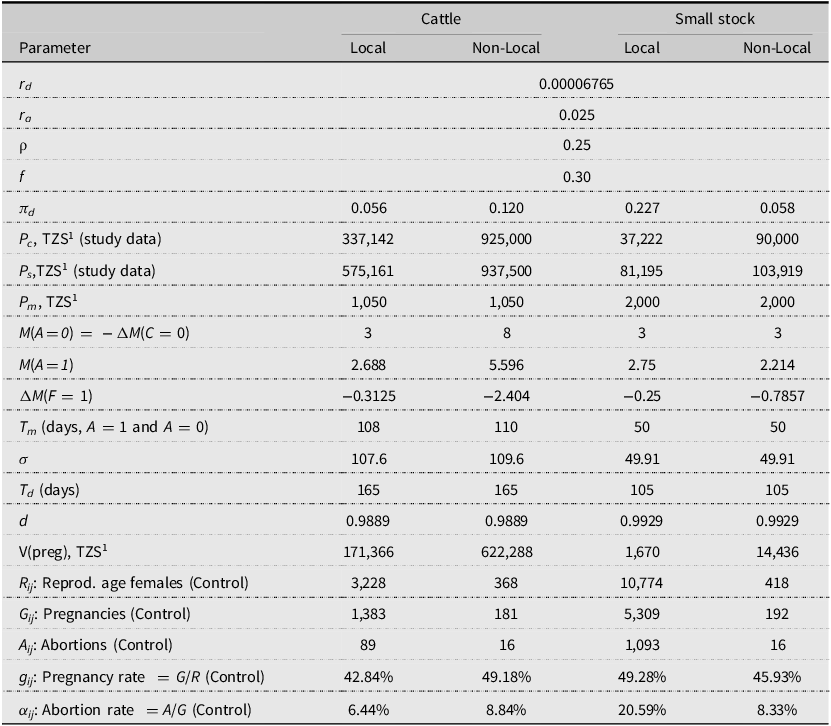
1 Divide this value by 2,300 TZS/$to calculate an estimate in $.
Consider a hedonic regression explaining the factors affecting the market price of stock with various characteristics X and associated parameters β x , and a dummy variable P that takes the value of 1 for pregnant stock, and zero otherwise. The value of pregnancy may differ across breeds, so we include dummy variable H taking the value 1 for a non-local (hybrid) breed and zero for a local breed (the two categories that we include in the regressions). Preliminary analysis suggests the random error of the model approximates a lognormal distribution, so use the natural logarithm of the market price P s as the dependent variable, providing a Gaussian random error term ε. The regression written compactly is
 $$\ln \left(P_{s}\right)={\beta }_{x}^{{\rm '}}{X}+\beta P+\lambda H+\gamma \left(H\times P\right)+\varepsilon.$$
The parameter β represents the percentage price premium for a pregnant animal of local breed at the time of sale relative to an otherwise similar nonpregnant animal. The approximate percentage price premium for a hybrid pregnant animal is β + γ. The parameter λ is the approximate percentage premium for a nonpregnant hybrid breed compared to a local breed. The Stata glm package with a log link function was used to estimate the model for cattle and small stock separately. The price premium (value of) pregnancy in levels rather than percentages EPV(Preg) in Equations (1) and Equation (7) was calculated using the Stata Margins routine (StataCorp, 2021). Sheep and goat data were combined and termed as ‘small stock’. If factors other than calf and milk loss affect the ex ante value of a pregnancy, our estimates of the pregnancy premium and by extension C p and C n will implicitly reflect these unobserved factors.
Aggregate loss estimates for northern Tanzania and all Tanzania are calculated using a combination of Census data, which provides data by region for 31 regions in Tanzania, including Zanzibar, and our study data. First, our process generates estimates for each northern Tanzania region (Arusha, Kilimanjaro and Manyara region), which we aggregate to the northern Tanzania study area, and finally data for all regions (including Zanzibar) are aggregated to represent Tanzania as a whole.
Based on Equations (14) and (15) and given available data, there are two ways to estimate the number of abortions for each stock type (by region): A ij = α ij × G ij , or A ij = (α ij ×g ij ) × R ij . All right-hand side elements α ij , g ij , G ij , and R ij are available from our study sample. Of these, only the number of reproductive females R i is also available in the Census data. While the number of pregnancies G ij are not included in the Census data, the number of livestock born (B) during the census period is provided, but only by species (cattle, small stock), not differentiated by breed.
When we estimate the number of pregnancies by species as G i = g i R i (Equation (13)) using g i from our sample and R i from the Census, aggregate pregnancies for each species is smaller than the Census-reported number of stock born. This cannot be true and must be an artifact of sampling error. Given that our sample is more limited than the Census sample, we carry out a scaling process to generate pregnancy estimates using Census data on births, and then estimate abortions based on these scaled pregnancy estimates. To do so we first estimate the number of births by species as
 $$B_{i}^{0}=\left(1-\alpha _{iL}\right)G_{iL}^{0}+\left(1-\alpha _{iN}\right)G_{iN}^{0},$$
where indexes iL and iN represent Local and Nonlocal breeds for species i, G
ij
0 = g
ij
R
ij
estimated pregnancy rates based on the number of reproductive-aged females in the Census and our pregnancy rate estimates, and α
ij
and g
ij
are abortion and pregnancy rates from our sample, respectively. Superscript 0 on G
ij
0 and B
i
0 identifies them as preliminary unscaled estimates. We then define scaling factor $\gamma _{i}={B_{i}^{c} \over B_{i}^{0}}$
, where B
i
c
are Census-reported births for each region. The number of abortions consistent with Census-reported births is
$\gamma _{i}={B_{i}^{c} \over B_{i}^{0}}$
, where B
i
c
are Census-reported births for each region. The number of abortions consistent with Census-reported births is
 $$A_{ij}=\alpha _{ij}\left(\gamma _{i}G_{ij}^{0}\right)=\alpha _{ij}\left({\gamma _{i}}g_{ij}R_{ij} \right),$$
where the terms in parentheses are different representations of adjusted pregnancy estimates. The estimates of A ij (Equation (18)) and L kl (Equation (14)) are calculated for each of the 31 Tanzanian regions, and these are summed over northern Tanzania regions or for all Tanzania.
For context and scale, we compare abortion loss estimates to (a) the value of reproductive-age females and (b) the value of juveniles. The Census provides market price estimates to generate value estimates for each stock type for each region. Let V z n represent the value of some category of livestock z for region n. In our case, V z n = the total value of reproductive female stock or V z n = the total value of juvenile stock. For a set of regions n ∈ N, the aggregate value of a category of livestock is
 $$V_{z}^{N}=\sum _{n=1}^{N}\sum _{i=1}^{S}P_{i,n}^{z}z_{i,n},$$
where the inner sum is the market value of stock category z (price P
i, n
z
times quantity z
i, n
) over stock types i ∈ S for each region n ∈ N, and the outer summation sums over all regions. Losses as a percent of V
z
N
is calculated as $l_{k,z,N}=100\times {L_{k} \over V_{z}^{N}}$
.
$l_{k,z,N}=100\times {L_{k} \over V_{z}^{N}}$
.
3.3. Ethical considerations
All questionnaire respondents provided written informed consent. Livestock owners involved in the market survey provided verbal consent for anonymized collection of market data. The protocols, questionnaire and consent procedures for the SEBI study were approved by the ethical review committees of the Kilimanjaro Christian Medical University College (No. 535 & No. 832); National Institute of Medical Research (NIMR) in Tanzania (NIMR/HQ/R.8a/Vol.IX/1522 & NIMR/HQ/R.8a/Vol.IX/2028); and by the ethics review committee of the College of Medical, Veterinary and Life Sciences, University of Glasgow, UK (200140152 & 200170006).
4. Results and discussion
In total, data were collected for 154 cases and 342 controls in 35 villages/streets in northern Tanzania consisting of pastoral, agro-pastoral and smallholder livestock keepers in urban, peri-urban and rural settings. Estimates of parameters described in Table 1 are given in Table 2. These estimates were used in equations defined in the Model section to generate the outputs summarized in Tables 3 and 4.

Data for calculating and interpreting the number of abortions in Northern Tanzania (Arusha, Kilimanjaro, and Manyara regions). Analogous all Tanzania data are presented in Appendix Table A.3.1

1 Census data Tables 4.7 and 4.8. Summed over three northern regions.
2 Pregnancy rate from study sample: g ij = 100 × G ij /R ij .
3 Abortion rate from study sample: α ij = A ij /G ij .
4 Abortions as a percent of reproductive animals = (A ij /R ij ) × 100 = (α ij ×g ij ) × 100.
5 Number of pregnancies is calculated as the number of reproductive-age females from Census data times the pregnancy rate from our study (This table and Table 2). G ij 0 = R ij × g ij .
6 Number of animals born. Census data provided the number cattle, sheep, and goats born, but not broken down to local versus nonlocal. Table 4.10 for calves born and Table 4.37 for goats and sheep. Estimates for individual breed are B ij 0 = γ j (1−α ij )g ij R ij (Equation (17)).
7 The number of pregnancies scaled to be consistent with Census data birth estimates is calculated.
G ij = γ i G ij 0 Summed over three northern regions.
8 The number of abortions is calculated as A ij = G ij α ij = γ i g ij α ij R ij .
9 Scaling factor γ j such that B i c = γ i B i 0, where B i c is the number of births for species i reported in the Census data and B i 0 = B iL 0 + B iN 0 is the sum of local and nonlocal births for species i.
Table 2 illustrates several important patterns in our study data. Based on market price data P c and P s , twelve-month-old stock animals are worth less at market than older animals, local breeds are consistently less valuable than non-local breeds, and small stock (sheep and goats) are worth about an order of magnitude less than cattle. Milk price per liter tended to be lower for local breeds than nonlocal breeds, but this may reflect different herd compositions between rural, urban, and peri-urban settings in which milk prices were collected.
Our control group data suggest that abortion rates α ij are lower for local cattle than non-local cattle (6.44% versus 8.84%). This is consistent with studies reporting a four-times higher risk of abortion in non-local breed cattle in Ethiopia in comparison to local breeds (Deresa, Tulu, and Deressa, Reference Deresa, Tulu and Deressa2020) and a study in Nigeria (Yakubu, Awuje, and Omeje, Reference Yakubu, Awuje and Omeje2015) reporting a breed effect in relation to cattle abortion. However, our control group data suggest that abortion rates are lower for non-local breed small stock than local small stock (8.33% versus 20.59%). It seems unlikely that non-local breeds would be more resistant to local causes of abortion and hypothesize that this effect in small stock might reflect a greater level of care provided to non-local stock. Interestingly, our case subsample shows in contrast that abortion rates are lower for local than nonlocal small stock (108/1,642 → 6.6% versus 27/31 → 87%). We rely on the control arm data to calculate abortion rates due to the risk of sample selection bias in the case arm given that herds with higher abortion rates are more likely to enter the case arm precisely because they have higher abortion rates. By design this selection problem does not apply to the control arm.
We observed a drop in milk offtake associated with abortion, as indicated by ΔM(F=1) < 0 (Table 2). This observation is consistent with previous research that noted a drop in milk production in animals that had a new or repeating abortion (Keshavarzi et al., Reference Keshavarzi, Sadeghi-Sefidmazgi, Ghorbani, Kowsar, Razmkabir and Amer2020). In addition to reported milk yield decline, about 30% of households surveyed reported that they do not use milk from an animal that had an abortion. Reasons for this are not investigated in the present study but we speculate that it may be because of the perceived harm to consumers that might occur from consuming or selling milk that might contain abortigenic pathogens (Infonet Biovision, 2022). Regarding the value of milk lost due to an abortion, the difference in milk offtake following an abortion compared to a successful birth was considerably higher in non-local breeds of cattle and small stock. This implies that abortions in non-local livestock lead to higher loss in milk production and value following an abortion. This is most likely because of the higher milk productivity of non-local breeds of livestock compared to the local breeds.
The ex ante value of pregnancy, V(preg) was inferred from regression analysis that estimates a higher market price for a pregnant female than an otherwise similar nonpregnant female. This price premium has been documented elsewhere (Troxel et al., Reference Troxel, Gadberry, Cline, Foley, Ford, Urell and Wiedower2002). Data used for the analyses are summarized in Appendix Table A.1.1 and regression results in Tables A.2.1. and A.2.2.
4.1. Ex post losses per abortion
Table 3 provides the estimates of primary interest in this article, including the value of newborn (and loss thereof given abortion) inferred from data applied to Equation (2), the estimated value of milk offtake loss from Equation (4), and the gross and net losses from an abortion depending on whether a household chooses to consume milk offtake after the event of an abortion based on Equations (6) and (10).
Gross and net abortion losses are generally larger for nonlocal (hybrid and exotic) stock because they are more valuable in the marketplace, produce more milk, and based on our data, nonlocal cattle suffer higher abortion rates (although the small stock local breed abortion rate is larger than the small stock nonlocal rate in the control arm data). For example, if a household uses milk from a cow after an abortion, estimated gross abortion loss per abortion for local and nonlocal cattle are TZS 345,807 ($ 150.35) and TZS 1,070,751 ($ 465.54; data row 6 in Table 3, rounded to the nearest 1,000 TZS and 1 $). For local and nonlocal small stock, gross loss per abortion is TZS 53,028 ($ 23.06) and TZS 161,148 ($ 70.06) for local and nonlocal small stock, respectively, if milk is used.
If a household chooses not to use milk after an abortion, estimated gross abortion losses are higher, illustrating the importance of milk in the livestock breeding enterprise. For example, a household faces a gross loss of from one nonlocal cattle abortion of TZS 1,714,686 ($ 745.52), compared to the loss shown above of TZS 1,070,751 ($ 465.54) if milk is utilized after an abortion. (Table 3 data row 8; this comparison assumes that milk is not different in quality and or market value after an abortion than before.)
Netting out the implicit husbandry costs associated with reproduction, the net abortion losses are lower than gross losses. If a household chooses not to use milk after an abortion, net abortion loss is an estimated TZS 519,222 ($ 225.75) and TZS 1,417,741 ($ 616.41) for local and nonlocal cattle, and TZS 199,854 ($86.89) and TZS 277,645 ($ 120.72) for local and nonlocal small stock, respectively. The small value on the local small stock estimate follows from the combination of a low market value of pregnancy in small stock (from the regressions shown in Table A.3), a relatively high abortion rate, and the (as with the rest) assumed cost share ρ. Note that the estimated net loss for local small stock is negative if a household chooses to use milk after a sheep or goat abortion (TZS -29,983; $ -13.04, based on ρ = 0.25. Net losses for local small stock abortions turns positive if ρ is more than less than 0.1627 (newborn costs less than 16.27% of all husbandry costs). More generally, a larger newborn share of husbandry costs is associated with lower net abortion loss. The negative sign on net loss for ρ > 0.1627 suggests that when the share of newborn husbandry costs is sufficiently high, abortions are financially beneficial because the household receives milk offtake without net negative costs of newborn husbandry. Regardless, without additional data we have little basis for knowing ρ.
4.2. Aggregate level losses for northern and all of Tanzania
We provide estimates of aggregate losses for northern Tanzania and for Tanzania as a whole, including metrics that relate abortion losses to the scale of the livestock industry in these regions. Table 4 summarizes the non-monetary data and calculations for the three regions of northern Tanzania in which our study data were collected, including pregnancy and abortion rates, the number of reproductive females, pregnancies, and births, and estimated number of abortions. Values for northern Tanzania and for all Tanzania were calculated in the same way: they were calculated for each region, then depending on the metric either summed or averaged over the applicable regions.
Table 4 shows that there were approximately 3.08 million reproductive-aged cattle, over 4.3 million reproductive-aged small stock during the 12-month reporting period (1 October 2019 through 30 September 2020), and approximately 1.5 and 2.3 million cattle and small stock born, respectively. Abortion rates α and pregnancy rates g were calculated from our study control group. Because pregnancy rates hover just under 50% for all stock types, abortions per reproductive-aged animal are approximately half of the abortion rates and range from just under 4% (for local cattle) to about 14% (for local small stock). To make full potential use of the Census data (which is based on a much larger sample than our trial data), we scaled our pregnancy estimates to be consistent with the Census data on the number of animals born. These numbers indicate that there were approximately 1.6 million cattle pregnancies and 3 million small stock pregnancies in northern Tanzania over 12 months. Based on these numbers, we estimate 106,788 cattle abortions and about 594,676 small stock abortions, most in local stock due to the larger numbers of pregnancies in local animals.
Table 5 provides estimates of the aggregate losses for the gross and net losses for northern Tanzania and all Tanzania. Values are calculated using data from Table 2 through 6 and based on Equation (15, relying on Equations 11 through 14).
Aggregate gross and net losses due to abortion at the population-level in the three regions of northern Tanzania (North TZ), and losses for all of Tanzania (All TZ). $=2,300 TZS. Based on reproduction and abortion rates from this study and census data for the 12-month period from 1 october 2019 through 30 september 2020

Table 5 shows that total gross losses for Northern and all of TZ were about $60 million and $263 million, respectively. Net losses are estimated at $28.3 million and $131 million, for northern and all of Tanzania, respectively. Aggregate gross losses are dominated by local stock losses, which comprise about 89% of northern Tanzania losses ($52.8 million of $59.5 million) and 92.1% in all of Tanzania. Similarly, net losses comprise about 82% local breeds for northern Tanzania and 88% for all of Tanzania. These large percentages are mainly due to the large proportion of stock value that local breeds represent. Small stock losses represent about 59% and 54% of gross losses in northern and all of Tanzania, respectively, and about 37% and 31% of net losses in northern and all of Tanzania.
Appendix table A.4.1 shows sensitivity of aggregate losses for all of Tanzania in response to increases or decreases in decreases or increases in abortion rates (α), pregnancy rates (g), the share of husbandry costs to newborn (ρ), and the share of households who chose not to consume milk after an abortion (f), the ex ante value of pregnancy (Vpreg), and the annual discount rate (r a ). For example, that when abortion and pregnancy rates α ij and g ij (for each stock type and breed) are 10% lower or higher than our baseline abortion rate estimates, total gross and net losses decrease or increase by 10%, respectively. Higher market premiums for pregnant animals are associated with higher net losses because higher premiums imply a higher net value of successful birth, all else constant. Aggregate losses vary inversely to the price of milk (P m ) and the price of newborns (P c ), but are more responsive to differences in the price of milk – gross losses increase by about 6% with a 10% increase in the price of milk. Differences in the assumed discount rate affect results very little due to the short duration of intertemporal effects. More details are provided along in Appendix table A.4.1.
Our sensitivity analysis results suggest that the aggregate results are sensitive to parameter or input estimate measurement error (e.g. recall bias) in direct proportion to these errors or less. Nonetheless, our study data are subject to recall bias as most recall-based sample data are. It is difficult to speculate on the characteristics recall bias that might exist, but herd owners may be more likely to recall particularly costly or salient abortion events and forget others. For example, abortion events in local small stock of low value may be overlooked or forgotten in survey response more often than a valuable non-local cattle abortion event. Sampling error is also certainly a consideration that affects our estimates due to the relatively small sample, and the nature of this simulation exercise and our available information does not allow estimation of credible confidence intervals on most results.
Another caveat relates to our application of data and a model for Northern Tanzania. To the extent that the relationships and parameters we have built based on our Northern Tanzania study, our results for the rest of Tanzania may be inaccurate in unknown ways.
Another important limitation is our lack of information about the share of husbandry costs attributable to the newborn (ρ). We show that certain ranges of this parameter result in estimates of net abortion loss that are negative, implying that abortions are beneficial. While not conceptually impossible, it does seem implausible that livestock abortions can systematically be beneficial in this context even if a large proportion of the benefits of pregnancy are from associated milk production.
Finally, our analysis is based on observed abortions. Because many abortive pregnancies may go unnoticed by herd owners, the total number of abortions (observed plus unobserved) could be substantially higher than our estimates. For example, observed livestock abortions are estimated to account for between 20% and 30% of all cases (Bronner et al., Reference Bronner, Hénaux, Vergne, Vinard, Morignat, Hendrikx, Calavas and Gay2013). While we do not have an estimate of unobserved abortions for Tanzania, the implication is that total abortions are almost certainly higher than our estimates, which should be interpreted as an estimate of observed abortions, not total abortions.
Table 6 provides additional context for interpreting the scale of results in Table 5. In the first two lines it repeats the totals for gross and net losses for northern Tanzania and Tanzania as a whole. The subsequent two rows show the sum of the value of reproductive-aged cattle and small stock, and the last four rows provide the gross and net losses as a percent of the value of both reproductive-aged stock and of juvenile stock as reported by the Census data (Ministry of Agriculture, 2020).
Gross and net losses as a proportion of the value of reproductive-age female stock, and of juvenile stock as reported in the census data (Ministry of Agriculture, 2020)

For context, the value of all reproductive-aged female stock (cattle and small stock, local and non-local combined) is worth approximately $ 687 million in northern Tanzania and $1.8 billion for all of Tanzania. Gross abortion losses of an estimated $ 59.5 million average about 9% of the value of reproductive females in northern Tanzania regions. Estimated gross losses summing to about $ 263 million averages 15% of the value of all reproductive female stock for all regions of Tanzania as well. Net losses amount to $ 28 million and $ 130 million, or 4% and 7% of the value of reproductive females for northern and all of Tanzania.
Juvenile stocks are worth about $238 million in Northern Tanzania and $1 billion in all of Tanzania. Gross loss and net losses amount to about 26% and 13% respectively of the value of all juvenile stock for the north and for all Tanzania. Thus, gross losses are a bit under one quarter of all live juvenile value and net losses just under one sixth.
Our overall net loss estimates due to abortion in livestock in Tanzania of $131 million are about one-third of annual national loss due to Tick Born Diseases (TBD) estimated at $364 million by Kivaria in Reference Kivaria2006 (Kivaria, Reference Kivaria2006). Foot and mouth disease was estimated to cause annual burden ranging between $351,000 and $531,000 (Häsler et al., Reference Häsler, Limon, Queenan, Rushton, Madege, Mlangwa and Mghwira2021), mastitis was estimated to cause $4,700 with an estimated loss of $21.5 per quarter (Komba and Kashoma, Reference Komba and Kashoma2020) and PPR was estimated to cause direct economic loss of $19.1 million in sheep and goats in one region of Kenya (Kihu et al., Reference Kihu, Gitao, Bebora, John, Wairire, Maingi and Wahome2015)
5. Conclusion
We estimate annual national gross loss due to known livestock abortions of about $263 million and net loss of $131 million. This loss is equivalent to the value of about one quarter and one sixth of all juvenile stock value for the gross and net losses in Tanzania, respectively. A study in Swaziland reported annual economic loss arising from abortion due to Brucella spp. to be approximately $2.8 million (Akakpo et al., Reference Akakpo, Têko-Agbo and Koné2009). This is approximately two-percent of the net loss we report for all Tanzania, but our figures represent losses for all diseases and our study is done about ten years later. Our findings also suggest that losses due to abortion in livestock are approximately 36% of the loss due to TBD. This represents a substantive financial loss for low-income rural households, and, given that the livestock sector contributes approximately 7.1% to the Tanzania’s GDP (Ministry of Agriculture, 2020), it represents an important economic loss for livestock-dependent countries like Tanzania. Nonetheless, we have only studied the direct losses due to abortion associated with milk and newborn value loss. We have not accounted for prevention or treatment costs that may be associated with abortion events and abortigenic agents. Additionally, we have not accounted for unobserved abortions, which are likely to be a significant proportion of all abortion cases. Given this the estimates made are likely to be conservative.
To our knowledge, this is the first study of its kind that provides comprehensive economic data and analysis on abortion from a population-based study in Africa. Although there are limited data available on the occurrence of livestock abortion in sub-Saharan Africa, the farming systems represented in this study are broadly similar to livestock systems and farming practices found elsewhere in Africa and we expect that similar levels of economic loss may be occurring across the continent as a result of livestock abortion. Our general approach is transferrable to the extent that the variable estimates and parameters used in estimation are available for other regions.
These findings suggest that investments that lead to improved control of abortigenic agents, for example through establishment of surveillance systems, strengthening of veterinary services, and improvement of access and uptake of these services, may reduce the substantial losses that occur due to abortion. Lastly, timely dipping to prevent Tick Born Diseases among other diseases as well as vaccination against various abortion-inducing diseases could reduce mortality losses estimated at $65.2 million up to around $20 million (‘Ministry of Livestock and Fisheries’, 2022). While the promise of reducing abortion by investing in prevention and pre-abortion animal healthcare generally is substantial, investment in abortion prevention represent an important category of health-related costs that are beyond the scope of this study(Bennett, Christiansen, and Clifton-Hadley, Reference Bennett, Christiansen and Clifton-Hadley1999; Surve et al., Reference Surve, Hwang, Manian, Onono and Yoder2023).
Supplementary material
To view supplementary material for this article, please visit https://doi.org/10.1017/aae.2024.6
Data availability statement
The datasets generated for this study are available on request to the corresponding author.
Author contributions
Conceptualization, J.Y., J.B., S.C., and F.L.; Methodology, G.S., J.Y., T.K., J.R.C., J.B.,S.C., and F.L.; Investigation, G.S., T.K. ; Formal Analysis, G.S., J.Y.,S.S.J., and F.L.; Data Curation, J.Y., G.S., and S.S.J.; Writing—Original Draft, G.S., J.Y., and F.L.; Writing—Review and Editing, G.S., J.Y.,T.K., J.R.C., J.B., B.T.M., S.S.J., S.C., and F.L.; Supervision, J.Y., J.B., B.T.M., S.C. and F.L; Validation, J.Y.; Visualization, J.Y. and F.L.; Funding Acquisition, B.T.M., and S.C.; Project administration J.R.C., B.T.M., S.C., and F.L.
Financial support
This study was supported by the Supporting Evidence Based Interventions project, University of Edinburgh (grant number R83537). GS was supported by the Wellcome Trust and DELTAS Africa Initiative (Afrique One—ASPIRE/ DEL-15-008). Afrique One-ASPIRE was funded by a consortium of donors including the African Academy of Sciences Alliance for Accelerating Excellence in Science in Africa, the New Partnership for Africa’s Development Planning and Coordinating Agency, the Wellcome Trust (107753/A/15/Z), and the UK government.
Competing interests
The authors declare that the research was conducted in the absence of any commercial or financial relationships that could be construed as a potential conflict of interest.


 Open access

