

Introduction
Work plays a key role in people's lives, providing positive aspects such as salary, new relationships, and the notion of who we are and our purpose in life (Andreassen, Reference Andreassen2014). Despite the various reasons that may underlie the increased workload, there are people who feel driven by internal factors to work excessively and compulsively (Van Wijhe, Peeters, & Schaufeli, Reference Van Wijhe, Peeters and Schaufeli2014), regardless of their own health, family, and entertainment (Tahir & Aziz, Reference Tahir and Aziz2019). To describe this phenomenon, the term workaholism, developed by Oates, in 1968 is used (Van Wijhe, Peeters, & Schaufeli, Reference Van Wijhe, Peeters and Schaufeli2014).
The only way to achieve career success for many individuals involves dedicating their life to work at the expense of other experiences (Serva & Ferreira, Reference Serva and Ferreira2006). The management and planning of individual careers has undergone dramatic changes due to alterations in the social, economic, technological, and organizational environments (Baruch, Reference Baruch2004; Visagie & Koekemoer, Reference Visagie and Koekemoer2014). This is particularly relevant during the coronavirus disease 2019 (COVID-19) pandemic that resulted in an abrupt and profound change in society, which caused variations in workplace practices (Bakó, Reference Bakó2020). As a consequence, organizations and employees had to quickly adapt by working from home (Tavares, Santos, Diogo, & Ratten, Reference Tavares, Santos, Diogo and Ratten2021). While career success has been a long-standing priority and a topic of interest to both individuals and organizations, the pandemic has emphasized its importance in today's global society due to the interest in managing work/life balance. This concept is mostly evaluated through objective criteria, such as promotions, salary, status, and subjective criteria, such as career satisfaction (Visagie & Koekemoer, Reference Visagie and Koekemoer2014). In this sense, individuals tend to perceive that by working compulsively to achieve professional goals, they will more easily achieve career success.
Career success perception involves understanding the way individuals value the upward trajectory of their careers with regard to the effort they invest into their performance (Levy, Reference Levy2015). It is different from career satisfaction that focuses on beliefs about how well a person has managed his career based on job opportunities. Past research by Andreassen, Hetland, Molde, and Pallesen (Reference Andreassen, Hetland, Molde and Pallesen2011) suggests that it is crucial to discriminate between different workaholic features when examining the link between workaholism and potential outcomes. Burke and MacDermid (Reference Burke and MacDermid1999) found a negative relationship between workaholism and career satisfaction. This differs from research by Gordon (Reference Gordon2021) who suggests that there is a positive relationship between workaholism and career success. The workplace changes due to COVID-19 may possibly shift some of these historical dynamics as more individuals live and work from home thereby making it more difficult to differentiate leisure from work pursuits. In addition, many individuals due to the changes from COVID-19 such as travel restrictions and working from home may have reassessed the way they measure career success. Therefore, when determining the work-related behaviors associated with workaholism, it is important to highlight its link with career success perception.
This investigation is considered innovative and pertinent given the current economic and social climate. In addition, it is particularly relevant at this time given that the COVID-19 pandemic can be seen as a career shock that will have a major influence on people's work and careers (Akkermans, Richardson, & Kraimer, Reference Akkermans, Richardson and Kraimer2020). Due to the COVID-19 restrictions regarding working from home requirements, there is less delineation between a person's home and workplace. This may mean that workaholics have had further difficulty in separating their work needs with their home life. As a result, it is important for organizations to understand the effect of the COVID-19 pandemic on individual's wellbeing. More studies are needed in order to assess the impact that the pandemic may have on careers because this is not yet known. Moreover, at the moment there is little existing information about the speed of recovery and how certain employment sectors will be affected over time. However, all the changes that the pandemic has brought, and even those that may lie ahead in the labor market, can greatly influence career development, and have negative effects on the way people imagine and manage their career development. In the next section, we will discuss in more detail the theoretical framework of this study, which is focused on workaholism.
Theoretical framework
Workaholism
The concept of workaholism was initially proposed by the American psychologist Oates (Reference Oates1968), having described his uncontrollable need to work by analogy and similarity with the addiction he saw in his alcoholic patients. Workaholism is associated with overwork. However, the number of hours worked should not be a determining factor for its definition since people can work a lot for various reasons, such as financial problems, unstable marriages, social pressure, or the desire for career advancement (Schaufeli, Shimazu, & Taris, Reference Schaufeli, Shimazu and Taris2009; Schaufeli, Taris, & Bakker, Reference Schaufeli, Taris and Bakker2008a). There are many definitions that have been proposed over the years, and there is no consensus for conceptualizing the workaholism construct (Andreassen, Reference Andreassen2014; Ng, Sorensen, & Feldman, Reference Ng, Sorensen and Feldman2007; Scott, Moore, & Miceli, Reference Scott, Moore and Miceli1997; Snir & Harpaz, Reference Snir and Harpaz2006; Spence & Robbins, Reference Spence and Robbins1992). Most definitions refer to the concern people have about work in their daily life. This is evident in the definition proposed by Snir and Zohar (Reference Snir and Zohar2000) who define workaholism as an individual's considerable allocation of time to work-related activities and thoughts, which is not derived from external necessities. This means any definition of workaholism should include a reference to thoughts and actions evident in a person's activities. This is supported by Machlowitz (Reference Machlowitz1980, p. 11) who defines workaholics as people ‘who always devote more time and thoughts to their work than the situation demands… what sets workaholics apart from other workers is their attitude toward work, not the number of hours they work.’
The behavioral aspect of workaholism is also evident in the research by Mudrack and Naughton (Reference Mudrack and Naughton2001) who conceptualize workaholism as involving behavioral tendencies to perform non-required work and having a calculating work style. In this study, the definition proposed by Andreassen et al. (Reference Andreassen, Hetland and Pallesen2014, p. 8) is used to define workaholism as ‘being overly concerned about work, to be driven by an uncontrollable work motivation, and to spend so much energy and effort into work that it impairs private relationships, spare-time activities and/or health.’ This enables a focus on how work influences an individual's motivations, relationships, and activities. Thereby it offers a holistic understanding of workaholism. The phenomenon of workaholism has been discussed both as an addiction and a pathology (Ng, Sorensen, & Feldman, Reference Ng, Sorensen and Feldman2007; Oates, Reference Oates1968) or as a behavioral pattern (Scott, Moore, & Miceli, Reference Scott, Moore and Miceli1997). Spence and Robbins (Reference Spence and Robbins1992, p. 161) characterize workaholism as an addiction and suggest that ‘the workaholic feels driven or compelled to work, not because of external demands or pleasure in work, but because of inner pressures that make the person distressed or guilty about not working.’ In a similar perspective to Oates (Reference Oates1968), Schaufeli et al. (Reference Schaufeli, Shimazu and Taris2009) define workaholism through the behavioral (work excessively hard) and cognitive (working compulsively) dimensions.
In the literature, it is possible to identify several characteristics associated with workaholics. For example, Spence and Robbins (Reference Spence and Robbins1992) characterize these people based on three dimensions: extremely involved with work, they feel compelled or driven to work due to internal pressures, and they feel little pleasure at work. Scott, Moore, and Miceli (Reference Scott, Moore and Miceli1997) see workaholism as a behavioral pattern and define workaholics as individuals who spend many hours of their time in work activities, giving up important areas of life such as family, friends, and leisure; often persist in thinking about work even when they are not working, and working far beyond what is imposed and expected of them, both in terms of the role they play in the organization, and in terms of their economic needs (Schaufeli, Taris, & Bakker, Reference Schaufeli, Taris and Bakker2008a, Reference Schaufeli, Taris and van Rhenen2008b). Looking at workaholism as a dependency, the theoretical model conceptualized by Ng, Sorensen, and Feldman (Reference Ng, Sorensen and Feldman2007) proposes three dimensions of workaholism: affective, cognitive, and behavioral. The affective component is related to the passion that workaholics have with work. The cognitive dimension is present in most definitions of the concept and addresses the issue of obsession with work. Excessive involvement with work, whether related to the number of hours and not separating work from personal life, is part of the behavioral component of workaholism (Ng, Sorensen, & Feldman, Reference Ng, Sorensen and Feldman2007). The study developed by Spence and Robbins (Reference Spence and Robbins1992) defined and measured workaholism through the individual's work involvement, drive, and work enjoyment. In addition, Spence and Robbins (Reference Spence and Robbins1992) identified six profiles of workers: enthusiasts, workaholics, enthusiastic workaholics, disengaged workers, relaxed workers, and disenchanted workers. Scott, Moore, and Miceli (Reference Scott, Moore and Miceli1997) criticized the definition of the concept proposed by Spence and Robbins by stating that the phenomenon of workaholism should involve behavioral patterns and outlined three types of workaholics: the compulsive-dependent, the perfectionist, and the performance-oriented.
One of the biggest challenges about research on workaholism is to understand the reasons why people become addicted to work, and how this phenomenon can be triggered by numerous and complex reasons (Andreassen, Reference Andreassen2014). Ng, Sorensen, and Feldman (Reference Ng, Sorensen and Feldman2007) compiled the antecedents that have been identified in the literature and concluded that there are three theoretical perspectives, which are based on individual, socio-cultural dispositions and behaviors reinforced by the environment. With regard to the first perspective, these authors suggest that self-esteem is one of the most important dispositional influences and that it is related to workaholism. Performance based on self-esteem is associated with the cognitive component of this phenomenon and not with the behavioral one, that is, with the tendency to work excessively (Van Wijhe, Peeters, & Schaufeli, Reference Van Wijhe, Peeters and Schaufeli2014). Individuals with personality traits that predispose them to an orientation toward achievement may become more dependent on work. In addition, values related to achievement should also be considered as contributors to workaholism, as they predispose individuals to focus excessively on achievements and career success and, therefore, believe that one of the best tasks in life, if not the best, is work.
The sociocultural perspective suggests that workaholism may be caused by experiences in the family, or in the workplace. In this sense, dysfunctional family experiences and vicarious workaholism learning at home are positively related to workaholism. Vicarious learning refers to the fact that people, when they see that their relatives work excessively, will behave in the same way. This addictive reinforcement also applies in the workplace. Employees can be influenced by certain behaviors adopted by superiors, such as excessive working hours and personal lifestyle. In addition, the existence of a competitive environment will increase the number of hours worked by employees. It should also be noted that individuals who have greater self-efficacy at work than in extra-labor activities experience workaholism. Moreover, an individual with a higher level of self-efficacy will likely be more addicted to work (Líbano, Llorens, Salanova, & Schaufeli, Reference Líbano, Llorens, Salanova and Schaufeli2012). The last theory addresses the result of positive reinforcement of the workaholic behaviors. When employees perceive that workaholism is rewarded, they will tend to increase these behaviors. This perspective focuses on the behavioral dimension and not so much on the affective and cognitive dimensions. Mazzetti, Schaufeli, and Guglielmi (Reference Mazzetti, Schaufeli and Guglielmi2014) observed that workaholism increased when individuals had characteristics that predisposed them to this phenomenon, and when they perceived that they were facing a climate of overwork in the workplace.
The strong involvement in work and the excessive hours worked can have negative or positive consequences for the individual and/or the organization, depending on the concept adopted by the researchers (Clark, Michel, Zhdanova, Pui, & Baltes, Reference Clark, Michel, Zhdanova, Pui and Baltes2016; Ng, Sorensen, & Feldman, Reference Ng, Sorensen and Feldman2007). The obsession, the internal drive to work, and the constant thoughts about work, even when individuals are not working cause a decrease in mental and physical health (Clark et al., Reference Clark, Michel, Zhdanova, Pui and Baltes2016; Meier, Aziz, Wuensch, & Dolbier, Reference Meier, Aziz, Wuensch and Dolbier2020; Ng, Sorensen, & Feldman, Reference Ng, Sorensen and Feldman2007; Schaufeli, Taris, & van Rhenen, Reference Schaufeli, Taris and van Rhenen2008b; Scott, Moore, & Miceli, Reference Scott, Moore and Miceli1997; Spence & Robbins, Reference Spence and Robbins1992; Tahir & Aziz, Reference Tahir and Aziz2019). These consequences are also related to the lack of time for free activities, such as reading and physical exercise. A study of 2,714 workers from the Netherlands and Spain found a negative relationship between workaholism and perceived health and happiness (Líbano, Llorens, Salanova, & Schaufeli, Reference Líbano, Llorens, Salanova and Schaufeli2010). Marital conflicts (Clark et al., Reference Clark, Michel, Zhdanova, Pui and Baltes2016) and conflicts between family and work (Líbano et al., Reference Líbano, Llorens, Salanova and Schaufeli2012; Tahir & Aziz, Reference Tahir and Aziz2019) also have a positive correlation with workaholism. Another one of the negative effects of this phenomenon on the cognitive level is the increase in perfectionism and the loss of confidence in co-workers. The concern of individuals with work, in order to obtain a good performance, prevents them from delegating tasks to colleagues (Ng, Sorensen, & Feldman, Reference Ng, Sorensen and Feldman2007; Scott, Moore, & Miceli, Reference Scott, Moore and Miceli1997; Spence & Robbins, Reference Spence and Robbins1992).
Career success perception
Career success can be defined as the combination and sequence of positions occupied by an individual throughout their life (Super, Reference Super1980). Career success can also be understood as a set of perceptions, attitudes, and behaviors that lead to the development of a set of skills to deal with different situations in companies in constant transformation (Costa, Reference Costa2013; Dyke & Murphy, Reference Dyke and Murphy2006). Characteristics such as occupational mobility, professional stability, or a structured life at work define the concept of career success (da Costa & Vieira, Reference da Costa and Vieira2014). According to Baruch (Reference Baruch2004), the wish to have a more structured and balanced lifestyle between work and personal life is also present in the construction of career success. According to Chanlat (Reference Chanlat1995), there are two career models, the first called traditional, in which careers have greater stability in employment and a vertical linear progression, and the second called modern is characterized by instability, discontinuity, and horizontality. In this sense, Baruch (Reference Baruch2004) reinforces the idea that careers are now more flexible, open, and less controlled by organizations, with individuals themselves being the managers of the development of their skills and their professional paths (Malvezzi, Reference Malvezzi2000).
The concept of perception is defined as ‘the process by which individuals organize and interpret their sensory impressions in order to make sense of the environment’ (Robbins, Reference Robbins2009, p. 28). In the organizational environment, the perceptions of employees may differ, as some may view their workplace as an excellent place, due to good benefits, excellent remuneration, and stimulating projects while others view the organization in a negative way due to the high stress environment (Andreassen, Ursin, & Eriksen, Reference Andreassen, Ursin and Eriksen2007; Robbins, Judge, & Sobral, Reference Robbins, Judge and Sobral2010). Since this concept depends on the experiences, interest, and motivations of each individual, it is a very subjective concept (Robbins, Judge, & Sobral, Reference Robbins, Judge and Sobral2010). da Costa and Vieira (Reference da Costa and Vieira2014) found in their study some difficulties regarding how to analyze the perceived work attitudes of each employee, since it involved not only expectations and frustrations, but also factors regarding actual performance in the workplace. This means that even though individuals can have the same work roles and qualifications their performance may differ due to subjective work assessment reports. Thus, the definition of perceived success in one's career is stated as ‘the person's interpretation of their achievements in relation to the different dimensions of the career’ (Costa, Reference Costa2013, p. 7). As for the concept of success, it is defined by Judge, Cable, Boudreau, and Bretz (Reference Judge, Cable, Boudreau and Bretz1994) as the set of positive psychological and professional results and accomplishments achieved by individuals through work experiences. These researchers also report that success is an evaluative term, being influenced by the ones who are judging.
Career success can be both objective and subjective (Sturges, Reference Sturges1999). Objective success is considered when it is evaluated by other individuals based on visible criteria (Arthur, Khapova, & Wilderom, Reference Arthur, Khapova and Wilderom2005; Judge et al., Reference Judge, Cable, Boudreau and Bretz1994). On the other hand, the individual can also assess the success of their path, called subjective success, which can be measured by feelings of accomplishment and satisfaction (Arthur, Khapova, & Wilderom, Reference Arthur, Khapova and Wilderom2005; Judge et al., Reference Judge, Cable, Boudreau and Bretz1994). Costa (Reference Costa2013) suggests that the evaluation of one's career should be considered in a holistic way, that is, that it should encompass, in addition to the current role, all the positions and functions previously performed by the individual.
In the literature, objective career success is determined by salaries, promotions, and social status (Heslin, Reference Heslin2005a; Judge et al., Reference Judge, Cable, Boudreau and Bretz1994). Job and career satisfaction are included in subjective success (Heslin, Reference Heslin2005b; Judge et al., Reference Judge, Cable, Boudreau and Bretz1994). Thus, job satisfaction refers to the feelings that the employee has in relation to their work. This can be determined through several factors such as interesting projects, fair rewards, performance recognition, variety of tasks, and autonomy (Robbins, Reference Robbins2009). Career satisfaction comes from an individual's appreciation of the goals and successes (Spurk, Abele, & Volmer, Reference Spurk, Abele and Volmer2011).
Traditionally, the assessment of career success was measured taking into account upward mobility and external indicators of achievement (Baruch, Reference Baruch2004; Oliveira, Reference Oliveira2018; Poon, Briscoe, Abdul-Ghani, & Jones, Reference Poon, Briscoe, Abdul-Ghani and Jones2015; Visagie & Koekemoer, Reference Visagie and Koekemoer2014). However, with the appearance of modern careers, subjective factors should have a more relevant weight in the evaluation of one's professional career (Arthur, Khapova, & Wilderom, Reference Arthur, Khapova and Wilderom2005). This is due to individuals tending to take into consideration their work/life balance, level of satisfaction, autonomy, and freedom (Baruch, Reference Baruch2004). Thus, for a clearer understanding of this concept, several researchers suggest that, in evaluating success, two dimensions – objective and subjective – must be present, and not just one of them (Arthur, Khapova, & Wilderom, Reference Arthur, Khapova and Wilderom2005; Baruch, Reference Baruch2004; Judge et al., Reference Judge, Cable, Boudreau and Bretz1994; Poon et al., Reference Poon, Briscoe, Abdul-Ghani and Jones2015).
Visagie and Koekemoer (Reference Visagie and Koekemoer2014) concluded in their research that a successful career means achieving goals, exceeding personal and organizational expectations (i.e., contributing to the organization and adding value to the business) and job satisfaction. The perception of career success was studied with different variables: engagement, job satisfaction, quality of life at work, organizational commitment, well-being at work, and performance. Pauli, Comim, and Tomasi (Reference Pauli, Comim and Tomasi2016) conducted a study of public sector teachers and concluded that engagement and job satisfaction positively influence the perception of career success. Moreover, Venelli-Costa, Rodrigues, Kilimnik, and Mesquita (Reference Venelli-Costa, Rodrigues, Kilimnik and Mesquita2018), in a sample of doctors, showed that there is a strong relationship between factors of quality of life at work and the perception of career success.
The perception of career success and organizational commitment was studied by Venelli-Costa, Chiuzi, and Dutra (Reference Venelli-Costa, Chiuzi and Dutra2013), in a sample of management professors from private universities and concluded that the intrinsic dimension of perceived success in career has direct effects on the behavioral intentions of commitment to the organization while the extrinsic dimension showed no relationship with the organizational commitment. Another study by da Costa and Vieira (Reference da Costa and Vieira2014), in a sample of teachers from the private sector, found that the dimensions of well-being at work (job satisfaction, work involvement, and affective organizational commitment) showed a positive correlation with the perception of career success, while performance showed a relatively low correlation with the perception of career success. Agapito, Filho, Siqueira, and Matias (Reference Agapito, Filho, Siqueira and Matias2015) studied a sample of professionals from public and private organizations and found that the dimensions of well-being at work have a strong and significant impact on the professionals' turnover intent, but the perception of career success correlated with low turnover intentions of the professionals.
Considering the strong competitiveness in the labor market and the continuous changes apparent in organizations, an absolute dedication and a life almost exclusively focused on work seem to be the rule of survival in modern organizations and the only way to achieve career success (Ng, Sorensen, & Feldman, Reference Ng, Eby, Sorensen and Feldman2005; Serva & Ferreira, Reference Serva and Ferreira2006). From the interviews conducted by Serva and Ferreira (Reference Serva and Ferreira2006), it was concluded that the organizational requirements imposed on managers are related to the occurrence of the workaholic phenomenon in the management of contemporary organizations. Workaholism causes a decrease in job satisfaction, as individuals, when they focus excessively and compulsively on work, do not have time to have fun in the workplace and, as such, do not feel satisfaction for what they do (Líbano et al., Reference Líbano, Llorens, Salanova and Schaufeli2012). On the other hand, workaholics who feel more satisfied with work and career are those who find the act of working pleasurable and feel guilt or anxiety when they are not working (Ng, Sorensen, & Feldman, Reference Ng, Sorensen and Feldman2007). With regard to career perception, individuals who work long hours are rewarded with better salaries and promotions and, in this way, experience extrinsic career success (Ng, Sorensen, & Feldman, Reference Ng, Sorensen and Feldman2007). However, according to these authors, this success can lead to a decrease in physical health and negatively affect the social relationships of workaholic individuals (Schaufeli, Taris, & Bakker, Reference Schaufeli, Taris and Bakker2008a, Reference Schaufeli, Taris and van Rhenen2008b). In another study by Raeisi-e-Sadat and Feiz (Reference Raeisi-e-Sadat and Feiz2015) a positive relationship was found between subjective career success and workaholism. The study conducted by Burke and MacDermid (Reference Burke and MacDermid1999) also found a positive relationship between work enjoyment and job and career satisfaction, and between work involvement and job satisfaction, but the drive dimension showed a negative relationship with job and career satisfaction. Gordon (Reference Gordon2021), in a sample consisting of hospitality managers, concluded that there is a significant and positive relationship between workaholism and the dimensions of subjective career success (career satisfaction and job satisfaction). In the study by Raeisi-e-Sadat and Feiz (Reference Raeisi-e-Sadat and Feiz2015), it was concluded that career training, career development, and career management predict and define the dependent variable of workaholism. This implies that an individual's perception of their career based on how hard they work is linked to the training and education that they have received in the workplace. This means that while an individual can be a workaholic, the perception of whether they have had a successful career is based on their ability to utilize previous career training. On the other hand, in the study by Gordon (Reference Gordon2021), workaholism is considered a moderating variable between the recovery experience (in terms of psychological detachment from work and an increased interest in relaxation) and the dependent variable subjective career success. This means that an individual needs to take rest in order to rethink and reassess their career performance.
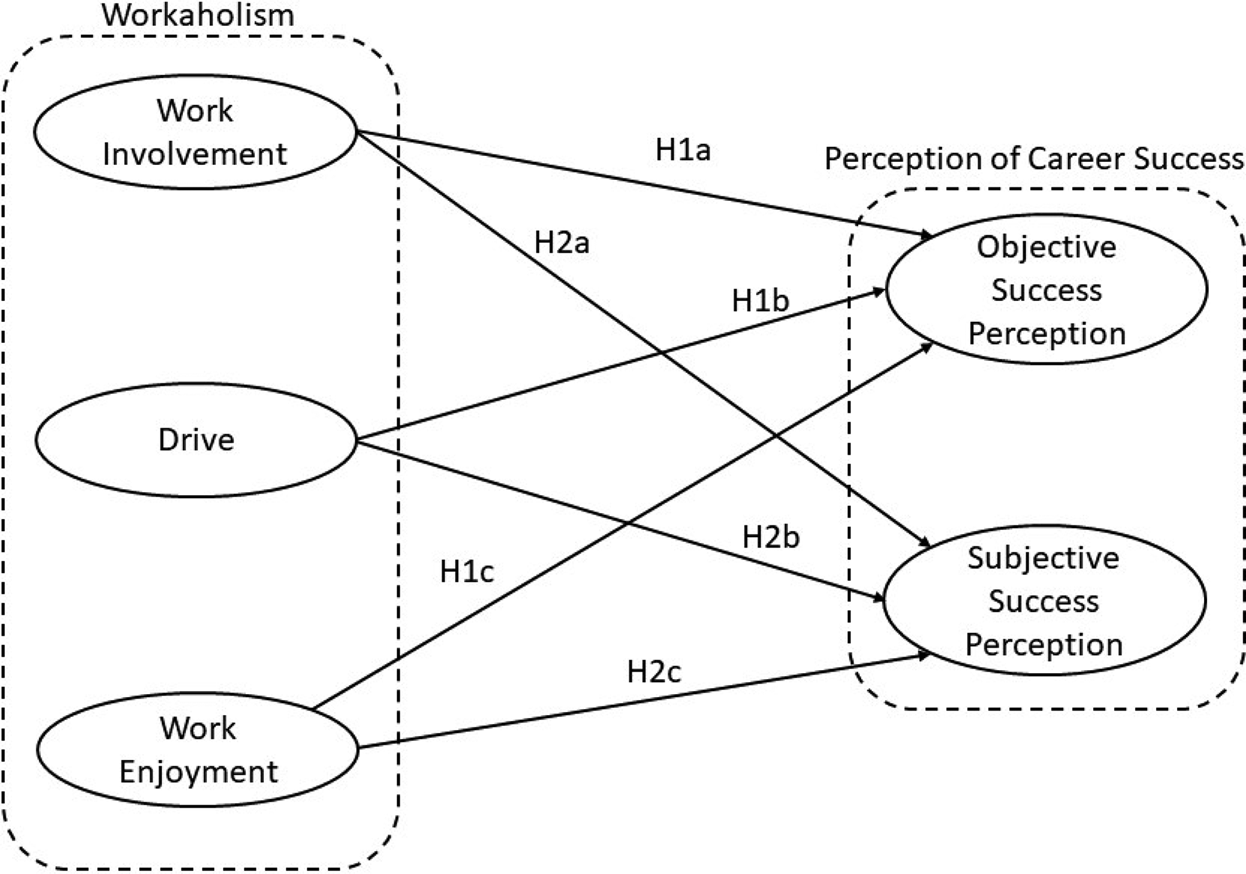
An individual's commitment to their work influences the degree of success they perceived is obtained from their career (Brady, Vodanovich, & Rotunda, Reference Brady, Vodanovich and Rotunda2008). Those who have a compulsive need to work regardless of the context are often viewed by others as more successful in their career (Levy, Reference Levy2015). This objective view of career success is evident in performance reports that demonstrate the amount of work an individual does relative to their overall ranking in their organization (Brady, Vodanovich, & Rotunda, Reference Brady, Vodanovich and Rotunda2008; Graves, Ruderman, & Ohlott, Reference Graves, Ruderman and Ohlott2006). When an individual believes that their need to continually work leads to better career outcomes, they will likely perceive a positive effect on career success. Therefore, both objective and subjective views of career success are influenced by an individual's motivation to constantly work. In this study, we consider there to be a positive relationship with workaholism and career success perception because of the limited employment opportunities during the COVID-19 pandemic. This means that the more an individual works the more likely they will consider it to have a positive benefit to their career development. Thus, taking into account the literature review and the objectives of the present study, the following research hypotheses were formulated and the respective conceptual model is represented in Figure 1.
Hypothesis 1: Workaholism, namely the dimensions (H1a) work involvement, (H1b) drive, and (H1c) work enjoyment, positively influences the perception of objective career success.
Hypothesis 2: Workaholism, namely the dimensions (H2a) work involvement, (H2b) drive, and (H2c) work enjoyment, positively influences the perception of subjective career success.
Conceptual model.
Method
Population and sample
The target population of the present study is comprised of individuals in Portugal who were working in a professional context, and the sample consists of 234 individuals who have the characteristics of the study population. For data collection, the non-probabilistic sampling method of convenience and snowball sampling was used. This sampling method was used due to the easier operation of data collection and cost reduction. The respondents' ages are between 20 and 79 years old, with an average of approximately 43 years old (DP = 10.60), and most are female (n = 141, 60.3%). With regard to education level, 70.5% (n = 165) have higher education, 25.2% (n = 59) secondary education, 3.0% (n = 7) vocational education, and just 1.3% (n = 3) basic education. Regarding the marital status, 141 (60.3%) individuals are married or live in a de facto union, 65 (27.8%) are single and the rest are divorced/separated or widowed (12.0%, n = 28).
Most individuals have children (63.7%, n = 149). The length of service in the organization varies between 1 month and 50 years, with an average of approximately 13 years (DP = 11.46). Most individuals work in the tertiary or services sectors (76.1%, n = 178) and the rest in the secondary sector or industry (23.9%, n = 56). Regarding the size of the organization, 35.5% (n = 83) of respondents work in a large company, 23.1% (n = 54) in a medium company, 21.4% (n = 50) in a small enterprise, and 20.1% (n = 47) in a small company. In the local context, a large company is an organization with more than 250 employees, a medium company 100–249 employees, and a small company is less than 100 employees.
Data collection instrument
The data collection instrument used in this investigation was a questionnaire survey, which consists of four parts: workaholism, perception of career success, sociodemographic data (gender, age, education, marital status, and whether they have children), and professional data (activity sector, length of service, and organization size). The initial questionnaire was pilot tested in a small sample of individuals in order to receive feedback about its content. After the pilot test was conducted the questionnaire was further refined by changing the ordering of the questions to make it easier to respond. The instrument used to assess workaholism was the Workaholism Battery scale (WorkBAT), by Spence and Robbins (Reference Spence and Robbins1992) and validated by de Sousa (Reference de Sousa2012) for the Portuguese population.
The WorkBAT scale is composed of three dimensions: Work Involvement, which analyzes the need for individuals to use their time efficiently both in the context of work and in their life; Drive, which allows obtaining information about internal motivation, as well as the frequency with which individuals think about work, and Work Enjoyment that assesses the degree of enjoyment arising from work (Andreassen, Hetland, & Pallesen, Reference Andreassen, Hetland and Pallesen2010). According to Spence and Robbins (Reference Spence and Robbins1992), the distribution of the 25 items (Table 1) by the three dimensions follows this structure: Work Involvement (items W1, W6, W8, W12, W13, W15, W21, and W24), Drive (items W3, W5, W14, W18, W20, W22, and W25), and Work Enjoyment (items W2, W4, W7, W9, W10, W11, W16, W17, W19, and W23) with items W1, W6, W8, and W11 reverse scored. Each of these items was measured on a Likert scale from strongly disagree to strongly agree.
Workaholism scale items
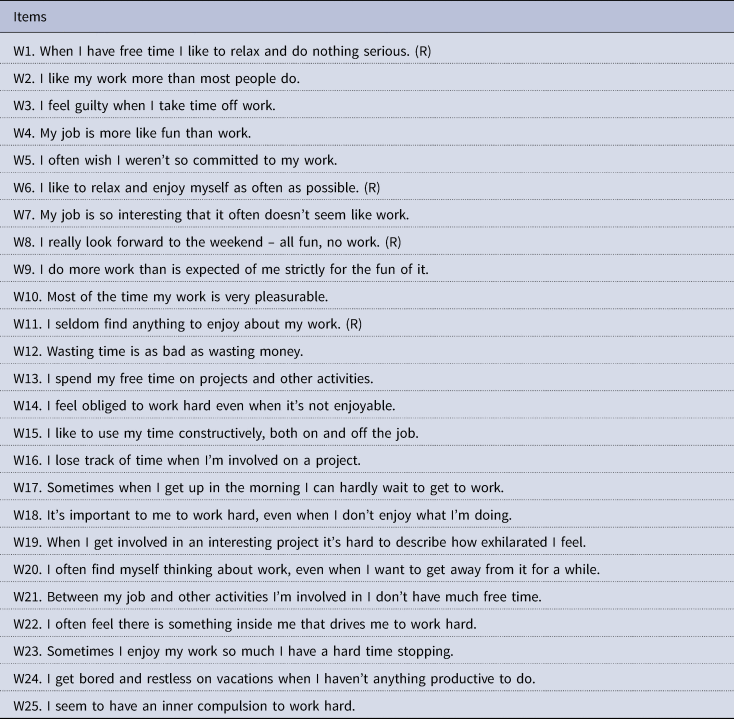
Source: Own elaboration adapted from Huang, Hu, and Wu (Reference Huang, Hu and Wu2010).
Note. (R) – reversed item.
To assess the perception of career success, the reduced version of the Career Success Perception scale was used, which has been validated by Costa (Reference Costa2011). Note that some terms have been slightly altered in order to be understood by the Portuguese population (e.g., the term income has been replaced by remuneration). The scale consists of 10 items (Table 2) and two dimensions: Extrinsic or Objective (items S1, S2, S3, S4, and S5) which contains the factors satisfaction with remuneration and promotion, and the Intrinsic or Subjective dimension (items S6, S7, S8, S9, and S10) that includes the factors competence, identity, contribution, cooperation, development, values, creativity, and employability. To measure items responses, a 5-point Likert scale was used (1 – strongly disagree to 5 – strongly agree).
Career success perception scale items
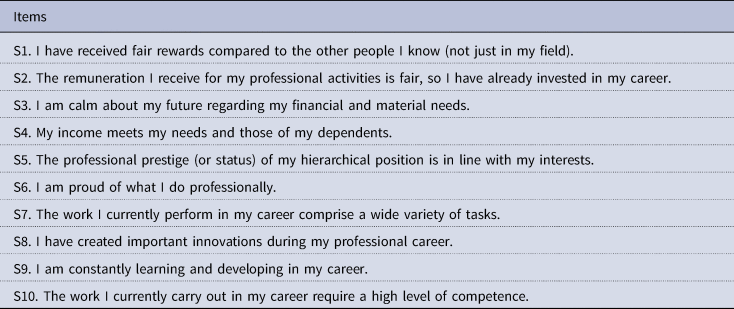
Source: Own elaboration adapted from Costa (Reference Costa2011).
Procedures
The data collection process was carried out using technological means (Tenenhaus, Vinzi, Chatelin, & Lauro, Reference Tenenhaus, Vinzi, Chatelin and Lauro2005). This choice was due to the COVID-19 pandemic situation that the country and the world were going through at the time of the study. Thus, an online survey questionnaire was utilized to collect the data as social distancing requirements did not permit in person data collection. Google Forms tool was used to create the questionnaire with the link being shared on the social networks Facebook and WhatsApp and sent by email to some contacts. Data collection took place between 6 and 26 August 2020. Participants were informed of the study objectives and were guaranteed anonymity and confidentiality as well as informed of the fact that the data were intended solely for statistical purposes of the present investigation.
For the statistical treatment of the data, software R, version 4.02 was used (R Core Team, 2020). Descriptive statistics was used to describe the sample as to its sociodemographic and professional characteristics. To assess the structure of the scales under study, an exploratory factor analysis (EFA) was applied using the principal component method. The Kaiser criterion (eigenvalues greater than 1) and the varimax method were used to extract the factors (factorial loads with values above .50 were considered satisfactory). To ascertain the adequacy of the sample, the Kaiser–Meyer–Olkin index (KMO > .8) was used, which revealed a good suitability of the sample, and the Bartlett sphericity test (p < .05) as proposed by Pestana and Gageiro (Reference Pestana and Gageiro2014).
Structural equation modeling with partial least squares (PLS–SEM) is recommended to test and validate exploratory models that are at an early stage of theoretical development (Hair, Ringle, & Sarstedt, Reference Hair, Ringle and Sarstedt2011). PLS–SEM model is more flexible in relation to the sample size and to the absence of assumptions regarding the distribution of data (Nitzl, Roldán, & Cepeda, Reference Nitzl, Roldán and Cepeda2016). To validate the model's results, according to Henseler, Ringle, and Sinkovics (Reference Henseler, Ringle and Sinkovics2009), it is necessary to go through a process composed of two stages: (1) validation of the external model and (2) validation of the internal model. The loadings must present values greater than .708, to indicate that the construct explains more than 50% of the variance of the indicator, thus providing an acceptable reliability of the item (Hair, Risher, Sarstedt, & Ringle, Reference Hair, Risher, Sarstedt and Ringle2019). The indicators with external loads between .40 and .70 should be eliminated only if they result in an increase in reliability above the value considered adequate (Hair, Ringle, & Sarstedt, Reference Hair, Ringle and Sarstedt2011). The reliability is analyzed by calculating the values of Cronbach's alpha and composite reliability and must have values greater than .7 (Hair et al., Reference Hair, Risher, Sarstedt and Ringle2019). Convergent validity was assessed by the value of the average variance extracted (AVE), which must have values greater than .5, so that the latent variable is able to explain, on average, more than half of the variance of its indicators. To assess the discriminant validity, it is necessary to find out if the correlations between the latent variables are lower than the AVE square root (Hair, Hult, Ringle, & Sarstedt, Reference Hair, Hult, Ringle and Sarstedt2017).
In the structural model evaluation (validation of the internal model) it is important to analyze the determination coefficients (R 2), as well as the predictive relevance (Q 2), the size and significance of the path coefficients, the sizes of the effects f 2 and q 2 (Hair et al., Reference Hair, Hult, Ringle and Sarstedt2017). In order not to avoid collinearity problems between the predictor constructs, the variance inflation factor (VIF) values must be close to 3 or less (Hair et al., Reference Hair, Risher, Sarstedt and Ringle2019). According to Cohen (Reference Cohen1988) in social and behavioral sciences a coefficient of determination (R 2) of 2% is classified as a small effect, 13% is a medium effect, and 26% is a large effect. Values of Q 2 greater than zero indicate that the exogenous construct has predictive relevance for the considered endogenous construct (Hair et al., Reference Hair, Hult, Ringle and Sarstedt2017). The values of f 2 and q 2 of .02, .15, and .35 indicate the weak effect, moderate effect, and strong effect of an exogenous construct, respectively, in an endogenous construct (Cohen, Reference Cohen1988). Effect size values less than .02 indicate that there is no effect (Hair et al., Reference Hair, Hult, Ringle and Sarstedt2017).
Results and discussion
An EFA was applied to the Workaholism scale, where the KMO measure and Bartlett's sphericity test revealed a good sample adequacy (χ2(105) = 1,377.851, p < .001, KMO = .864). The factorial solution presented the same number of dimensions as the original scale. However, the number of items in each dimension was eventually reduced. Thus, the Work Involvement dimension was left with three items (W12, W13, and W15), the Drive dimension was left with five items (W14, W18, W20, W22, and W25), and the Work Enjoyment dimension was left with seven items (W2, W4, W7, W9, W10, W17, and W23), which together explain 58.45% of the total variance. For the Career Success Perception scale, an EFA was also applied. The KMO measure and Bartlett's sphericity test revealed a good sample fit (χ2(45) = 1,168.424, p < .001, KMO = .855). The factorial solution presented the structure obtained by Costa (Reference Costa2011), consisting of two factors: Objective Success Perception and Subjective Success Perception, which together account for 65.31% of the total variance.
Measurement model evaluation
Table 3 shows some items with loadings below .708 (W4, W9, W12, W14, and W18). The loadings for the remaining items are between .730 and .851. The Cronbach's alpha and composite reliability values of the Work Involvement, Work Enjoyment, Objective Success Perception, and Subjective Success Perception constructs present adequate reliability (Table 3). As with several studies (Andreassen et al., Reference Andreassen, Hetland, Molde and Pallesen2011; Malinowska & Tokarz, Reference Malinowska and Tokarz2014; Tahir & Aziz, Reference Tahir and Aziz2019), the dimension of work involvement obtained a low Cronbach's alpha (.599), but the value of composite reliability is considered adequate (.776), confirming its consistency. In the study by Malinowska and Tokarz (Reference Malinowska and Tokarz2014), this dimension was not considered for analysis because it obtained a low Cronbach's alpha value. However, in the present study the analysis with this dimension is deemed adequate given the satisfactory composite reliability value. Regarding the AVE values presented in Table 3, most are greater than .5, which indicates adequate convergent validity.
Estimation of the measurement model parameters
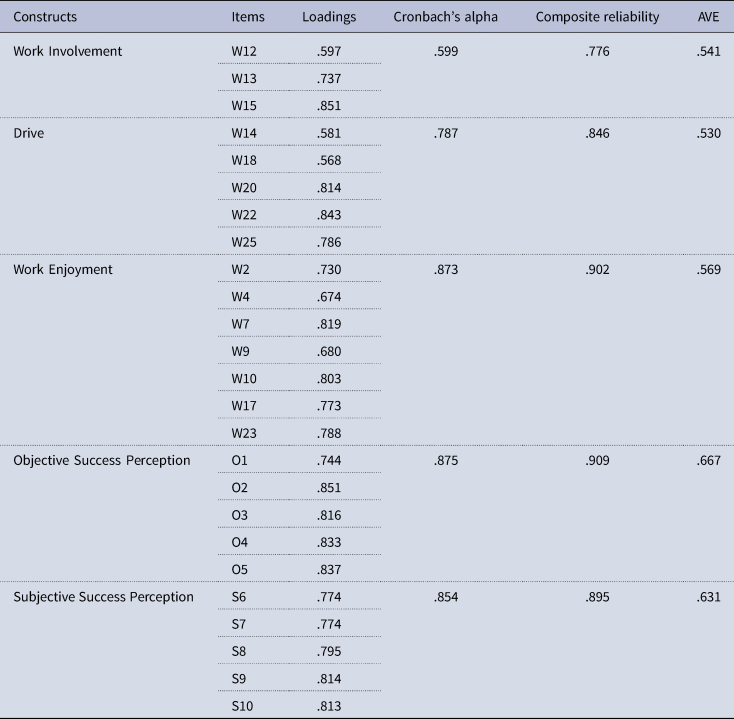
Source: Own elaboration.
In Table 4, the discriminant validity of the model is tested by the means of cross-loadings, confirming the adequacy of the model since the loading of each indicator (which is shown in bold in Table 4) is greater than all their cross-loadings.
Discriminant validity: cross-loadings

WI, Work Involvement; D, Drive; WE, Work Enjoyment; OSP, Objective Success Perception; SSP, Subjective Success Perception.
Source: Own elaboration.
Table 5 shows that the square root AVE values (in bold in Table 5) are higher than the correlations between the constructs, demonstrating the existence of discriminant validity. It is also emphasized that there is a significant correlation between the latent exogenous and the latent endogenous constructs. This is due to Cohen's criteria (1988) absolute values of correlations between .30 and .49 being considered moderate and values above .5 are considered high. Thus, there were no estimation problems with the reliability and convergent and discriminant validity of the external model proving to be adequate.
Discriminant validity: Fornell–Larcker criterion test
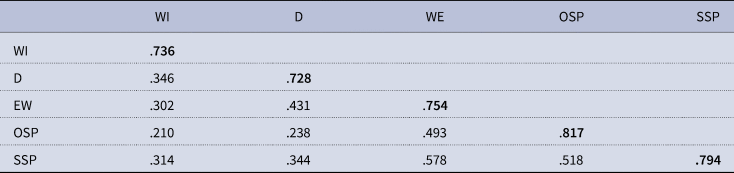
WI, Work Involvement; D, Drive; EW, Work Enjoyment; OSP, Objective Success Perception; SSP, Subjective Success Perception.
Source: Own elaboration.
Structural model evaluation
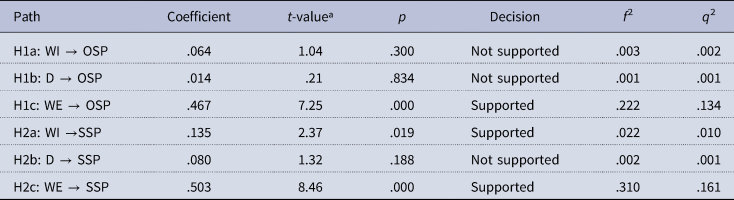
An analysis of VIF values showed that there are no collinearity problems, given that these ranged between 1.176 and 1.315, less than 3 as recommended by Hair et al. (Reference Hair, Risher, Sarstedt and Ringle2019). Then the coefficient of determination (R 2) showed that the three dimensions of Workaholism explain 24.7% of the variance of the objective success perception and explain 36.1% of the variance of the subjective success perception. These values in the social and behavioral sciences according to Cohen (Reference Cohen1988) are considered and modeled as a large effect. Since all Q 2 values are considerably greater than zero (.165 and .227, respectively, for the objective and subjective success perceptions) it is concluded that the three dimensions of Workaholism have predictive relevance of the model in relation to the endogenous latent variables: objective success perception and subjective success perception. Table 6 shows the results of the analysis of the structural model. Empirical results show that work enjoyment has a significant and positive influence on the objective success perception (β = .467, t = 7.25, p < .001, f 2 = .222, q 2 = .134), which supports empirically hypothesis 1c. Thus, it can be said that hypothesis 1 is partially supported, which is in line with what is presented in the literature that workaholics who feel more satisfaction with work and career are those who consider the act of working pleasurable and feel guilt or anxiety when they are not working (Ng, Sorensen, & Feldman, Reference Ng, Sorensen and Feldman2007).
Results of the structural model analysis
WI, Work Involvement; D, Drive; WE, Work Enjoyment; OSP, Objective Success Perception; SSP, Subjective Success Perception.
Source: Own elaboration.
ª t-values were obtained with bootstrapping procedure (5,000 samples).
Hypotheses 2a and 2c are also supported empirically, that is, work involvement (β = .135, t = 2.37, p < .05, f 2 = .022, q 2 = .010) and work enjoyment (β = .503, t = 8.46, p < .001, f 2 = .310, q 2 = .161) have a positive and significant influence on the perception of subjective career success. Thus, it can be said that hypothesis 2 is partially supported, being corroborated in the investigations of Raeisi-e-Sadat and Feiz (Reference Raeisi-e-Sadat and Feiz2015) and Gordon (Reference Gordon2021), where a positive relationship was found between subjective career success and workaholism. The fact that there is no statistical evidence to affirm that feeling driven to work influences the subjective career success perception can be justified, given that in the study by Líbano et al. (Reference Líbano, Llorens, Salanova and Schaufeli2012), workaholics are not satisfied with their work. Also, in the Burke and MacDermid (Reference Burke and MacDermid1999) study a negative relationship was found between drive and job and career satisfaction. Although some researchers (Arthur, Khapova, & Wilderom, Reference Arthur, Khapova and Wilderom2005; Baruch, Reference Baruch2004; Judge et al., Reference Judge, Cable, Boudreau and Bretz1994; Poon et al., Reference Poon, Briscoe, Abdul-Ghani and Jones2015) consider that in assessing success both dimensions (objective and subjective) should be analyzed. According to Arthur, Khapova, and Wilderom (Reference Arthur, Khapova and Wilderom2005), in modern careers, subjective factors should have a more relevant weighting in the assessment of the professional path, as individuals tend to consider the level of satisfaction, balance between work and personal life, autonomy, and freedom (Baruch, Reference Baruch2004). This fact may justify the non-existence of significant influence of the work involvement and drive dimensions in the objective perception of success dimension.
Conclusion
Individuals that have higher levels of achievement and conquest values tend to focus too much on work and on career success, thus facilitating the emergence of workaholic behaviors. When these individuals realize that workaholism can reward them, apparently, they tend to increase these behaviors. The measures used in the present study showed adequate reliability and convergent and discriminant validity. The workaholism measure replicated the structure proposed by Spence and Robbins (Reference Spence and Robbins1992) that comprised of the following three dimensions: work involvement, drive, and work enjoyment. The measure of perception of career success is comprised of the two dimensions proposed by Costa (Reference Costa2011): objective success perception and subjective success perception. The main objective initially proposed was achieved, having been able to demonstrate, through the application of structural equations modeling with partial least squares, that work enjoyment influences the perception of career success in both objective and subjective dimensions and work involvement influences only the subjective dimension of career success perception. Thus, we can infer those individuals who are committed and involved with their work evaluate their career through the subjective criterion, meaning that they feel satisfied, for example, with the achieved goals and with the level of autonomy they have. On the other hand, individuals who enjoy their work assess their career success through subjective and objective criteria, such as their salary levels and/or the hierarchical position occupied. We did not find a statistically significant correlation between the work drive dimension and the two dimensions of perceived career success. A possible explanation for this result may be because individuals who, for internal reasons, feel the impulse to work and who are often thinking about work, may, for example, be easy targets of burnout and stress conditions, which leads them to feel physically and mentally drained, and to have a difficulty in achieving their aim for a successful career or to evaluate their careers as successful. In the academic field, the present study contributes to the increase of scientific knowledge in the workaholism and the career success areas. In the organizational field, especially in the area of human resources management, it is expected that the results achieved here will motivate companies to adopt strategies that optimize their resources and reduce costs. That is, it is expected that companies will be able to obtain advantages in terms of productivity and competitiveness, without affecting the health and well-being of their employees.
Managerial implications
Organizations can utilize the findings in this study to foster perceptions of career success among employees. This can be done by highlighting the need for individual to engage in work activities that can potentially benefit them in the future. An example of this could be to develop collaborative activities between different sections of an organization in order to increase workplace efficiencies that foster the development of mentor partnerships to aid in a person's career success. Alternatively, in order to encourage individuals to enjoy their work, organizations can introduce more extracurricular activities that are beneficial in terms of building team cohesion. In light of the COVID-19 pandemic this is particularly important as more people have shifted to working from home. In terms of career success, organizations need to implement more online and digital activities that can be conducted from any geographic location.
The findings of this study suggest that there are positive and negative effects of workaholism in terms of career success. This means managers need to be aware of the interventions they can make in how their employees manage their work/life balance. This can include focusing more on work practices that enable workaholics to be more efficient in their allocated work hours and to make them aware of the negative effects of working too much. Managers could introduce new work policies that embed fun activities that enable employees to see work in a different way. This might also increase employees overall performance and happiness at work. In addition, the findings can be used by professional coaches in career and executive development in terms of teaching individuals to focus both on objective and subjective career success measures. For example, more attention can be placed on teaching skills about how individuals can better manage their time in order to achieve a better work/life balance. This can include highlighting how being too focused on work can have a detrimental effect on overall work enjoyment.
Professional coaches can also provide guidelines and case studies on how successful individuals have managed their work practices. It is noteworthy the importance of individuals to enjoy their work because this enjoyment increases their motivation and consequently increases their perception of subjective and objective career success. As the COVID-19 pandemic has changed the way people work and live it is important to utilize the services of professional coaches in order to encourage better work performance. This could be conducted through online workshops that integrate psychological support services with detailed career plans.
Limitations and future research suggestions
The participants in this study were all Portuguese so there may be some geographic and cultural limitations. As Portugal is in the European Union the findings can be generalized to some extent to other European countries, but some caution is needed due to existing cultural differences. Therefore, it would be useful for future research to replicate this study in other European contexts but also international contexts including Asia, Africa, and South America. This would provide useful information about cultural perceptions of workaholism and career success. Culture does have an impact on work preferences so more research is needed to cross-culturally compare other contexts. Moreover, there may be differences between developed and developing countries in light of the COVID-19 pandemic affecting work conditions so further research is needed in these contexts. It may be that some cultures have positive views about workaholism due to its association with economic growth while other cultures have more of a relaxed attitude to work. Comparisons could also be made in terms of perception of career success and how the COVID-19 pandemic has altered individual's career plans. Due to the limited ability of people to travel to work conferences and activities this may have impacted their work conditions and made them more reliant on work as a source of enjoyment.
Further research could also delve deeper into how career success is perceived in different cultures. It would be useful to use a mixed methods approach that incorporates both qualitative and quantitative data. As this study utilized quantitative data it would be helpful for future research to focus on interview or case study data to see how career success changes over time. This could include longitudinal data on how people's perception alters based on economic and social context. In addition, the WorkBAT scale in this study could be supplemented with other newer scales emerging in the literature that include a COVID-19 consideration such as the scale used by Santos, Sousa, Gonçalves, and Sousa (Reference Santos, Sousa, Gonçalves and Sousa2022). As there are many ways to measure workaholism, other scales might show the same or different results. Thus, it would be good to triangulate the findings from this study with other studies that have used alternative scales. To do this might be complex but worth considering in order to obtain robust findings.
Finally, given the COVID-19 pandemic has influenced individual's work patterns particularly in terms of more people working from home, it would be useful to conduct in the future a longitudinal analysis on how work behaviors are changing. To do this research could focus on understanding how digital technology has been used in work place settings before, during and after the COVID-19 pandemic in order to understand whether people have become more digitally literate. This would complement this study that was based on one point in time with different points of time in order to analyze whether work behaviors have changed. This would provide some interesting analysis on the effects of working from home due to COVID-19 restrictions on workaholism.
Conflict of interest
The authors have no competing interests.
Patrícia Gomes has a master in human resources management from the Higher Institute of Management and Administration of Leiria and a degree in social communication from the Coimbra Superior School of Education. Her research interests include internal communication, career success, and organizational commitment.
Ana Diogo is a coordinator professor of social and human sciences, specialized in social sciences research methodologies, at the Higher Institute of Management and Administration of Leiria, Portugal. She has a PhD in psychology, specialization in organizational psychology, and a master's and a licentiate degree in human resources management. She has authored and co-authored a few journal articles and chapters in books, including Teleworking in Portuguese communities during the COVID-19 pandemic: Why shift work is not good for you, and Burnout in the drivers of the long course trucks, and others that are under review or in progress. In addition, she has genuine research interest in workaholism, emotional intelligence, gender inequalities at work, and other topics concerned with work and people's well-being.
Eulália Santos is an invited assistant professor at the School of Education and Social Sciences of the Polytechnic Institute of Leiria, Portugal. She has a PhD in mathematics from the University of Aveiro, a master in mathematics from the University of Aveiro, and a degree in applied mathematics from the University of Évora. She is authored and co-authored some journal articles and book chapters, in the following areas: optimization and operational research, finance, management, tourism, wine tourism, human resources, and marketing. She has a research interest in analysis and data processing in different areas such as management, tourism, and marketing.
Vanessa Ratten is an associate professor of entrepreneurship and innovation at La Trobe University (Australia). She is the Program Director of the Masters of Management course and teaches corporate venturing and managing innovation. She has published seven sole authored books including Sport Entrepreneurship: Developing and Sustaining an Entrepreneurial Sports Culture (Springer). She has also edited more than 20 books including Entrepreneurship and the Community: A Multidisciplinary Perspective on Creativity, Social Challenges, and Business (Springer).


 Open access

