


Introduction
Participating and attending group sports and mega sporting events has been celebrated from the ancient Greeks to the modern era. 1 Large sporting events increase the solidarity of countries while embracing cultural diversity of athletes and host countries, creating a sense of national pride and community. 2,3 The Fédération Internationale de Football Association (FIFA) World Cup 2026™ will be the 23rd, edition of this engaging and exciting soccer tournament and a historical first to feature 48 teams and three host countries—the United States, Mexico and Canada. 4
Mass gatherings substantially increase transmission of infectious diseases. Reference Al-Tawfiq, Gautret, Benkouiten and Memish5 Physical proximity, the sharing of food, drinks, utensils and celebratory embraces (after goals, victories) are potential mechanisms of transmission. Infectious diseases can spread through various pathways, including respiratory droplets, aerosol particles, fecal-oral routes, direct contact (ie, touching and sexual transmission) and indirect contact with contaminated surfaces. This risk is augmented as mass gatherings that concentrate people with diverse health statuses, levels of vaccination, and recent travel from a wide range of countries that may have variable infectious disease endemicity not present in a specific host country—all resulting in an environment where susceptible individuals are exposed to a wide range of potential pathogens. Reference Vignier and Bouchaud6,Reference Hoang and Gautret7 Thus, a competitive “mega sporting event”, such as the World Cup or the Olympics, requires healthcare personnel (HCP) and public health officials to support preparedness efforts and to have awareness of implications for players, coaches, event staff, officials, volunteers and spectators—both in and out of the stadium.
In a time of post COVID-19 pandemic global disruption, policy challenges and limited resources in public health preparedness and response, this review aims to support public health and healthcare facility preparedness for mass sporting events. Our commentary will briefly review infectious risks of previous World Cup and large sporting events; outlines our expert assessment of anticipated risks during World Cup 2026™; reviews the importance of hospital based and public health preparedness, and discusses opportunities for further collaboration both on and off the field.
Infectious diseases and previous sporting events
In planning for the World Cup™ 2022, the World Health Organization (WHO) and the Qatar Ministry of Health promoted the “Sport 4 Health Program,” emphasizing the importance of sports in physical and mental well-being for athletes and spectators, as well as the crucial role of health systems planning for mega sporting events. 8 Building on the WHO’s preparation and involvement in the 2020 Tokyo Olympics and the intensive planning for the COVID-19 pandemic, guidance for event organizers from both WHO and Qatar as the 2022 host country ranged from how and where to seek medical care, healthier food options, touch points of food and beverage sales and consumption in “fan zones”—in essence strategic, tactical and operational planning for all on and off the field. 8,Reference McCloskey, Saito and Shimada9
Pre-event, event and post event planning, response and analysis have large-scale impact on disease epidemiology and transmission. Other organizing bodies for mega sporting events have written about the establishment of robust multi source preevent syndromic surveillance programing. Others have evaluated asynchronous and synchronous healthcare impact during mega sporting events citing increases in presentations such gastrointestinal illnesses and respiratory infections. Reference Minooee, Wang and Gupta10–Reference Duarte Muñoz and Meyer13 Respiratory infections—including COVID-19, influenza, RSV, rhinovirus, and human metapneumovirus—have affected substantial proportions of participants, with 45% of athletes and 32% of staff impacted during the 2018 Winter Olympics, and COVID-19 alone historically affecting 3.0–3.3% of athletes, staff, officials, and spectators during Summer Olympics. Reference Yan, Fang, Li, Jia and Zhang14,Reference Jooste and Schwellnus15 In a retrospective review examining stool samples from 2022 FIFA World Cup attendees, nearly 20% of all samples were positive. Of these, predominant bacterial etiologies included Salmonella spp. at 40%, Escherichia coli at 25.7%; norovirus was the predominant viral pathogen. Reference Shams, Alyafei and Nafady-Hego16 While this study did not directly evaluate routes of transmission, prior studies have identified contaminated food, inadequate water and sanitation infrastructure as key contributors to transmission. Reference Minooee, Wang and Gupta10
Water-borne exposures can also generate significant outbreaks, as seen in the 1998 Springfield triathlon where 11.8% of competitors met criteria for suspected leptospirosis. Reference Yan, Fang, Li, Jia and Zhang14 Together, these examples highlight the diverse infectious risks inherent to mass-gathering sporting events.
Still others have studied supposed “legacy” benefits of such events. Reference McCartney, Thomas and Thomson17 Legacy benefits include improvements in employment, the economy, housing, the environment, and general pride that persist even after hosting—many of which may have indirect health impact. Reference McCartney, Thomas and Thomson17,Reference Bauman, Kamada and Reis18 This 2026 FIFA World Cup™ requires particularly intensive preevent and event coordination, given the vast geographic spread of the tournament spanning three separate host countries, and eleven cities in the U.S. alone. 4,Reference Alhussaini, Elshaikh, Hamad, Nazzal, Abuzayed and Al-Jayyousi19
Assessing current day risks and needs
Current state of preparedness
In March 2025, the U.S. established a 2026 FIFA World Cup™ planning taskforce to facilitate the rigorous geographic coordination required. 20 The U.S. Centers for Disease Control and Prevention (CDC) and the U.S. Department of Homeland Security (DHS) cites the potential for more than 3–5 million visitors. 21,22 The Federal Emergency Management Agency (FEMA) via DHS provided $625 million in grant funding to the 11 U.S. cities in hosting states to enhance security and preparedness efforts for the “safe execution” of tournament events—which are expected to span 38 d. 22
In 2025, the Philadelphia Department of Public Health produced a comprehensive health advisory document for the FIFA Club World Cup™ games in 2025, outlining the need for syndromic surveillance, public health reporting and screening tools. 23 Other states including, California, New Jersey and Massachusetts have begun medical readiness planning highlighting public health risks, delegating responsible parties, and creating a detailed planning checklists and exercises ahead of the tournament. 24–26 New York Department of Health with the support of National Special Pathogen System (NSPS) and the National Emerging Special Pathogen Training and Education Center (NETEC) conducted full scale tabletop exercises for mass sporting events, including one specifically focused on a response to a Middle East Respiratory Syndrome (MERS) case. 27 The multi-jurisdictional Council of State and Territorial Epidemiologists has also developed planning workgroup for applied epidemiologists in exploring FIFA World Cup™ preparedness. 28 Lastly, other 2026 host countries, Mexico and Canada, are creating guidance and implementation. 3,29
Building on these high-level national preparedness frameworks, local communities and healthcare facilities will need to conduct community specific needs assessments, and create corresponding response plans economic and public health planning. With the potential influx of millions of visitors, both domestic and international, the mantra “think global, act local” is apt for system planning.
Anticipated infections
Using a consensus approach based on expert opinion and in review of previous infectious disease risks at prior mega sporting events, the authors compiled a “Top 10” list (Table 1) of infections as a convenient reference for clinicians, hospitals and public health officials in World Cup™ host cities.
Top 10 infectious disease considerations at mass gatherings for sporting events in 2026

**Please refer to the CDC reports of outbreaks in the USA and international settings.
***This table does not include agents of bioterrorism.
****Abbreviations: ETEC (Escherichia coli - Enterotoxigenic), HIV (Human immunodeficiency virus).
^Vaccine Preventable Disease.
Pathogen transmission is variable between organisms but can inform prevention strategies and diagnosis. As mentioned, food borne illnesses have been noted by a number of groups as a problem at events similar to the World Cup as well as at large mass gatherings, with norovirus and E. Coli being well described examples. Reference Minooee, Wang and Gupta10,Reference Shams, Alyafei and Nafady-Hego16,Reference Courtot-Melciolle, Jauvain and Siefridt30 In addition to ensuring sufficient personal protective equipment (PPE), hospitals should pay special attention to use of alcohol based hand sanitizer, expanded use of soap and water and the critical role that that environmental service personnel play for prevention and control of diarrheal illnesses.
Some host World Cup cities have raised appropriate concerns about sexually transmitted diseases. 29 Authors of this manuscript are particularly concerned about HIV and also chlamydia, syphilis and gonorrhea. Public health should encourage condom use during sexual contact—and possibly even make condoms available at large gatherings. Hospitals should be equipped to understand what testing modalities for sexually transmitted infections (STIs) are readily available on site as part of rapid testing panels, and provide patient education on measures for STI prevention. While variable sociopolitical climates may have led to decreased vaccination rates in many residents and nonresidents of World Cup host cities, the authors believe strongly that all athletes, spectators, event volunteers and staff should have up to date vaccine status. This is especially important for COVID-19, influenza, meningococcal disease, measles and other diseases spread by the respiratory route. Vaccine preventable illnesses are also outlined in Table 1.
In addition to varied health and individual vaccination statuses, the hyperlocal endemicity of pathogens in host cities and countries should be considered for domestic and international visitors. Acquisition and transmission of certain infections by visitors can be bidirectional; vector-borne illnesses, such as Lyme disease, endemic to Northeastern region of the U.S. or dengue infection in Mexico exemplify the importance of geography and endemicity. Reference Minooee, Wang and Gupta10 For example, a person from Mexico might come to the U.S. already infected with Dengue—and that same visitor might contract Lyme Disease in the U.S. and return to Mexico with an infection endemic to the Northeast U.S.
Accordingly, public health and frontline healthcare facilities should, in parallel, take detailed travel histories and remain aware of variable clinical presentations. Furthermore HCP should remain vigilant for pathogens of high consequence—even if these are considered to occur less frequently. More exhaustive lists of threats including biological, chemical, radiation threats and agents of bio-terrorism are available and should be considered but are beyond the scope of this commentary. 23 For emphasis in this commentary, Table 2 lists high consequence infectious diseases such as viral hemorrhagic fevers and other specific infections. Features of these infections, many of which have been reported at mass gatherings, may require immediate or urgent reporting to public health, may require emergency management planning and resources, utilization of regional special pathogen centers, specialized resources for diagnosis or medication management, or may have limited countermeasures. 23,Reference Chan, Levine and Herstein31–Reference Yaffee, Isakov and Wu33
High consequence infectious disease pathogens

^Vaccine Preventable.
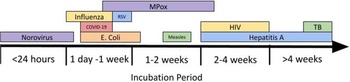
Lastly, thoughtful consideration of incubation periods of both these frequent but high consequence pathogens (Figure 1) may aid in pre-event, event, and postevent planning.
Incubation period of anticipated infectious diseases during and after mass gatherings.

Anticipated infection prevention and control needs
Infection prevention and control (IPC) programing adheres to certain cornerstones and basic principles that are of particular importance in World Cup host cities. One central conceptual approach is the “identify, isolate and inform”. 32 This strategy addresses the need for adequate screening of persons who might have a communicable infectious disease; containing the infectious threat as quickly as possible (ie, through isolation of the potentially infected person); and informing appropriate medical staff to make certain that appropriate isolation methods are in place and perhaps most importantly informing the appropriate infection control and/or public health personnel. 32 The Identify-Isolate-Inform strategy has been successfully utilized in prior outbreaks in traditional healthcare settings, aiding with clear communication pathways to ensure timely and efficient transitions of care from emergency medical services (EMS) or emergency department (ED) teams to public health authorities and hospital epidemiology personnel. Reference Yaffee, Isakov and Wu33 This strategy can similarly be applied in less conventional healthcare settings like walk-in and retail clinics and first aid -stations at event sites.
In the healthcare settings, standard precautions are the hallmark of prevention for communicable diseases. 34,Reference Banach, Johnston and Al-Zubeidi35 In addition to making certain that front line providers (EMS and ED) are familiar with the concepts and practices involved with standard precautions, planners should also ensure adequate and accessible supplies of PPE such as gowns, gloves and respiratory protection. The U.S. Occupational Safety and Health Administration (OSHA) requires respirator fit testing annually, and Hazmat and biological PPE training for first line responders at least annually. 34,Reference Banach, Johnston and Al-Zubeidi35 Ensuring that fit testing for respirators is up to date, or that just in time training is provided, is essential in the evaluation of potential patients with diseases such as measles and TB. Evaluation of these patients would optimally occur in negative pressure isolation rooms, availability of which should be reviewed in IPC planning. Lastly, ensuring vaccination status is also critical for immunity again measles, meningococcal disease, hepatitis B and other vaccine preventable illnesses. 34,Reference Banach, Johnston and Al-Zubeidi35
Emergency and public health response
Healthcare facilities closest to World Cup™ event sites as well as level 1 trauma centers nearby should review and familiarize themselves with disaster management and mass casualty response plans. 36 Authors of the disaster management plan should review these protocols and consider conducting disaster planning exercises prior to the World Cup™.
EMS personnel frequently serve as the initial point of contact for health-related concerns at mass gatherings, initiating early assessment, treatment, triage, and arranging transport when escalation of care. 36 Concomitantly, local hospitals must be ready to manage large-scale trauma and other acute conditions associated with major events, including intentional (ie. biothreats) and naturally occurring (ie. weather-related) incidents, though in depth discussion of these issues are beyond the scope of this manuscript. 36 Mass gatherings increase the volume and density of attendees, and communicable disease transmission can place additional strain on already overburdened EDs. 36 EMS and ED personnel require coordinated preparedness to manage patient surges and communicable disease threats. During expected patient surges, the Incident Command System (ICS) provides structured leadership and a standardized framework to respond to public health threats. Reference Qiu, Crilly, Zimmerman and Ranse37,Reference Farcas, Ko, Chan, Malik, Nono and Chiampas38
During mass gatherings, some EDs implement targeted surveillance to monitor key syndromic indicators that facilitate rapid detection of emerging pathogens. 36 Effective communication among ED staff, hospital epidemiologists, and antimicrobial stewardship program (ASP) leadership further strengthens the ability to detect, isolate, and manage patients presenting with suspected communicable diseases and prevent transmission multidrug-resistant organisms (MDROs) during high-risk events. Reference Banach, Johnston and Al-Zubeidi35,Reference Qiu, Crilly, Zimmerman and Ranse37
For patients diagnosed with exposure to communicable diseases, recommended postexposure prophylaxis (PEP) has been shown to be highly effective in preventing infection. Ensuring stockpiling of PEP for common communicable diseases is critical for protection of at-risk patients and HCP during possible exposure incidents. 34,Reference Banach, Johnston and Al-Zubeidi35
Rapid triage and immediate placement of patients with high-risk symptoms or exposure histories into risk-stratified isolation remain foundational to transmission prevention. Reference Yaffee, Isakov and Wu33–Reference Qiu, Crilly, Zimmerman and Ranse37
Additional recommended preparedness strategies include the establishment of clear case definitions for common communicable diseases, training of triage and ED staff on signs and symptoms of anticipated communicable diseases, widespread availability of rapid diagnostic testing and PEP, and streamlined personal protective equipment (PPE) protocols for front line workers. Reference Yaffee, Isakov and Wu33–Reference Qiu, Crilly, Zimmerman and Ranse37
Given existing constraints on ED staffing, physical space, and resource availability, mass gatherings require proactive operational planning. Reference Yaffee, Isakov and Wu33–Reference Qiu, Crilly, Zimmerman and Ranse37 This includes strategies to rapidly mobilize additional staff, expand clinical care into nonclinical or other clinical areas, and ensure a reliable and easily available supply of resources. Such measures enhance ED and hospital capacity to manage the complex demands of large-scale events and also plan for pathogens of high consequence events, even if they occur infrequently. Reference Yaffee, Isakov and Wu33–Reference Qiu, Crilly, Zimmerman and Ranse37
Collaboration on and off the field
Role of the built environment
Deliberate structural planning of stadiums and viewing spaces can accommodate maximal ventilation and air circulation. According to the FIFA president, the 2026 World Cup™ will preferentially use covered stadiums due to the risk of extreme heat and storms. 39
Official FIFA “fan fest” sites, like Liberty State Park in New Jersey, are outdoor or semi-covered spaces; however, communicable disease risk still needs to be mitigated, given that large crowds, food, and alcohol may be involved. In fact, encouraging socialization and congregation is an economic priority for local governments, small businesses, and the professional soccer industrial complex.
Stadiums range in capacity from 45,000 to nearly 90,000 and are generally well-ventilated by complex HVAC systems with centralized air handling and ductwork to control temperature and humidity to ensure air quality, player and fan comfort, and safety. Stadiums also employ zone-based cooling and large-scale circulation fans. Reference Szucs, Moreau and Allard40 Communicable disease outbreaks impacting spectators are relatively infrequent and have typically involved athletes or staff in close contact. Reference Hoang and Gautret7 However, stadiums also include enclosed and less ventilated areas like player locker rooms, restrooms, concession stands, elevators, and souvenir shops. Similar to COVID-19 pandemic adaptations by nonhealthcare facilities, installation of alcohol-based sanitizer dispenser units in high-traffic areas such as entryways, food courts, shops, restrooms, and locker rooms can be scaled up. While major upgrades to public transportation ventilation systems are unlikely, smaller upgrades, like the installation of sanitizer units at high-touch/high-traffic areas and touchless entry (already employed by the New York City Metropolitan Transit Authority), can be undertaken. Likewise, patrons should go cashless and paper ticket-less via apps to minimize the exchange of pathogens through banknotes, coins, and tickets, which can harbor microorganisms for up to several hours. Reference Meister, Kirchoff, Bruggemann, Todt, Steinmann and Steinmann41
To minimize long lines and congestion in poorly ventilated restrooms, temporary bathrooms (eg, porta potties) and handwashing units can be installed in separate areas, and increased staffing to turn over and disinfect bathrooms multiple times per event. While portable toilets can spread communicable diseases if not handled properly, this approach has successfully employed at large multicity stadium music concerts without known large-scale outbreaks of diarrheal illness.
Role of technology and communication
Mass sporting event gatherings are not exclusively limited to stadiums. Other parallel venues and fan zones include indoor/outdoor live watch parties, bars and restaurant gatherings, and on a smaller scale, in private homes, where gatherings are frequently multi-generational. 42 The 2026 FIFA World Cup™ is expected to draw such diverse and heterogeneous audiences, offering a variety of platforms to engage in public health messaging. 42 As part of the larger public-private coordination with local governments and health departments, mass messaging can be disseminated via text, social media, television commercials, and displayed on monitors at matches, encouraging individual risk mitigation with hand hygiene, surgical masks for compromised hosts, and even preemptive vaccination against respiratory illnesses. For example, before the Eras Tour stop in Toronto, the public health department engaged in a social media campaign encouraging vaccination and mask use for respiratory symptoms they couldn’t “shake off”. Reference Dangerfield43
Local hospitals and health departments can coordinate with event organizers to create mobile clinics for respiratory viral vaccines and testing, STI screening and treatment, and cooling and hydration stations to prevent heat-related illnesses. Community based collaborations can additionally boost revenue for local hospitals, pharmacies, and laboratory vendors; associated foot traffic may also provide an otherwise local economic boost. Lastly, social meet up and discovery apps - may receive increased traffic around World Cup™ 2026 events and should engage in responsible messaging regarding safe sex practices and STI risk mitigation, including access to contraceptives, testing, and treatment. Reference Cao, Gupta and Wang44
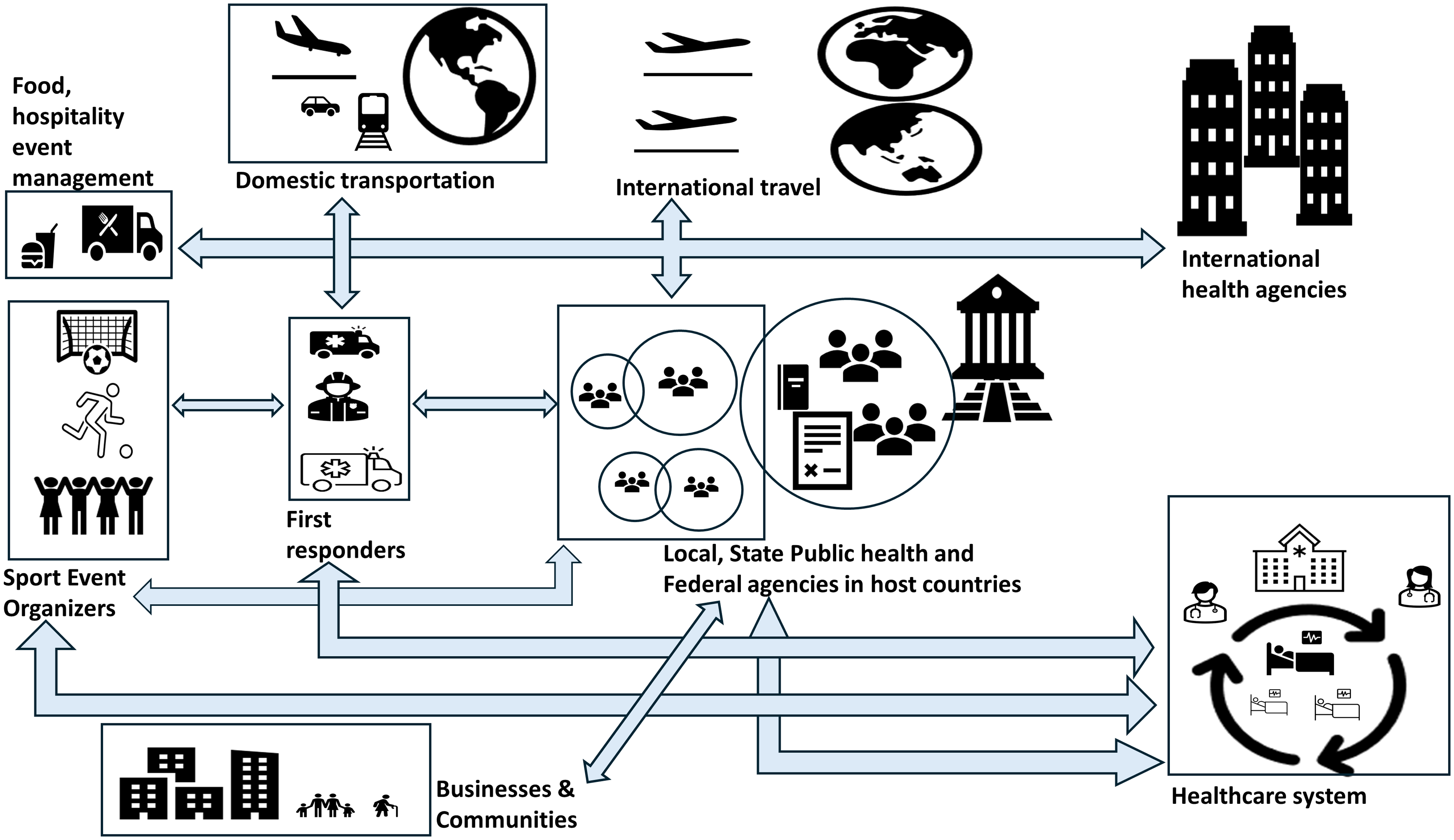
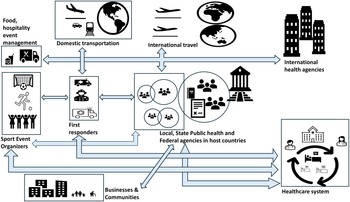
For fans or athletes who require inpatient care, especially those from abroad, translation services may be required for prevention messaging and when seeking care. While outbreaks among spectators is less frequent, hospital epidemiologists and infection prevention teams should recognize their role in internal hospital based communication, and the need for coordinated messaging with local and state public health officials. Reference Shenoy, Banach and Batshon45 Figure 2 outlines involved stakeholders and the need for closed loop communication. In a world where social media can quickly propagate information, local and state health officials should prepare to act swiftly when coordinating national, international, and interagency communication.
Required stakeholders for coordinated communication.
Conclusion
The demand for live, mega sports events is increasing, and advanced planning and preparation remains critical. The 2026 FIFA World Cup™ tournament spanning three host countries will bring with it excitement, enthusiasm, and as prior mass gatherings have consistently demonstrated, the reality of communicable disease transmission. Stadiums, fan zones, healthcare facilities and public health entities should engage in preevent planning, promotion of preventative health activities and consider event and post event logistical considerations. Clinicians should remain especially vigilant for quick spreading gastrointestinal and respiratory infections. Hospital based infection prevention teams, emergency rooms and emergency management teams should be ready to deploy required countermeasures, have situational awareness of disaster planning and be familiar with incident command structures. Closed loop and coordinated communication are of critical importance in an increasingly interconnected world and ubiquitous use of social media. With thoughtful planning and response programs in place, these authors hope athletes play, and all can watch and enjoy this historic FIFA World Cup™ and events like it, together, safely.
Acknowledgements
The authors want to acknowledge dedicated athletes, committed fans, and diligent healthcare and public health personnel.
Author contribution
Manuscript conceptualization: TM, PM DJW; Manuscript writing: TM, PM, KGT, KSK, PN, GB, ADH, DJW; Manuscript editing: TM, PM.
Financial support
No financial support was provided for this commentary.
Competing interests
The authors do not report any conflicts of interest relevant to this commentary. This work represents the views of the authors and not of their employers or affiliated organizations.



 Open access

