



1 INTRODUCTION
Observations of quasars at z > 6 reveal the existence of supermassive black holes (SMBHs) of a few billion solar masses within the 1 Gyr after the Big Bang (Fan et al. Reference Fan, Strauss, Richards, Hennawi, Becker, White and Diamond-Stanic2006; Willott et al. Reference Willott2007; Jiang et al. Reference Jiang2008, Reference Jiang2009; Mortlock et al. Reference Mortlock2011; Venemans et al. Reference Venemans2013; Bañados et al. Reference Bañados2014; Venemans et al. Reference Venemans2015; Jiang et al. Reference Jiang, McGreer, Fan, Bian, Cai, Clément, Wang and Fan2015; Wu et al. Reference Wu2015).Footnote 1 How do they form and what are their formation mechanisms are still open questions [see previous reviews on this topic Volonteri (Reference Volonteri2010), Volonteri & Bellovary (Reference Volonteri and Bellovary2012), and Haiman (Reference Haiman, Wiklind, Mobasher and Bromm2013)].
The presence of SMBHs a few hundred million years after the Big Bang suggests that their seeds must have formed at z ⩾ 15. The mass scale of BHs depend on the formation mechanism and may vary from 10-105 M⊙. These seed BHs must have grown via intense accretion and/or merging to reach a few billion solar masses. In order to form a SMBH of 2 × 10⁹ M⊙ at z = 7.02, a seed black should have an initial mass of about 400 M⊙ and continuously accrete at the Eddington limit throughout its lifetime. Therefore, more massive seeds forming at z ⩾ 15 can preferably explain the presence of quasars at z ⩾ 6.
In this review, we mostly provide a theoretical overview of the field and discuss various astrophysical processes involved in the formation of seed BHs. We discuss the three most popular BH formation scenarios, involving the (i) core-collapse of massive stars, (ii) dynamical evolution of dense nuclear star clusters, (iii) collapse of a protogalactic metal free gas cloud, also known as the Direct Collapse Black Hole (DCBH) formation channel.
2 BLACK HOLE FORMATION MECHANISMS
Various mechanisms to form black holes have been proposed in the literature since the seminal work by Rees (Reference Rees1984). They can be classified into three broad categories, which are introduced below and discussed in detail in the following sections.
The most natural way to form a BH is the collapse of a massive star into a BH known as the ‘stellar mass BH’. The final mass of BH depends on the metallicity, mass, and rotation speed of a star and is ultimately associated with the properties of a native gas cloud (Ciardi & Ferrara Reference Ciardi and Ferrara2005; Bromm Reference Bromm2013). BHs may have formed in the dense nuclear clusters via stellar dynamical processes or relativistic instabilities (Baumgarte & Shapiro Reference Baumgarte and Shapiro1999; Portegies Zwart et al. Reference Portegies Zwart, Makino, McMillan and Hut1999; Devecchi & Volonteri Reference Devecchi and Volonteri2009). The mass of resulting BH depends on the mass and compactness of a stellar cluster, its dynamical evolution, and binary fraction, etc. An alternative scenario could be the monolithic collapse of a protogalactic gas cloud into a massive BH so-called the direct collapse model (Rees Reference Rees1984; Loeb & Rasio Reference Loeb and Rasio1994; Volonteri & Rees Reference Volonteri and Rees2005; Begelman, Volonteri, & Rees Reference Begelman, Volonteri and Rees2006; Spaans & Silk Reference Spaans and Silk2006; Latif, Zaroubi, & Spaans Reference Latif, Zaroubi and Spaans2011a; Ferrara et al. Reference Ferrara, Salvadori, Yue and Schleicher2014). The key requirement for this scenario is to have large gas accretion rates of ⩾ 0.1 M⊙ yr−1 (Hosokawa et al. Reference Hosokawa, Yorke, Inayoshi, Omukai and Yoshida2013; Schleicher et al. Reference Schleicher, Palla, Ferrara, Galli and Latif2013). Such high gas accretion rates can be achieved in massive primordial halos of ~ 108 M⊙ illuminated by a strong Lyman Werner (LW) flux where in-situ star formation remains suppressed or via dynamical processes such as a merger of metal rich galaxies or ‘bars within bars’ instabilities (Begelman et al. Reference Begelman, Volonteri and Rees2006; Mayer et al. Reference Mayer, Fiacconi, Bonoli, Quinn, Roškar, Shen and Wadsley2015).
Primordial black holes may have born during the early stages of Big Bang but there is no observational evidence for their existence (Alcock et al. Reference Alcock2000; Afshordi, McDonald, & Spergel Reference Afshordi, McDonald and Spergel2003; Tisserand et al. Reference Tisserand2007; Ricotti, Ostriker, & Mack Reference Ricotti, Ostriker and Mack2008). In fact, the constraints from microlensing and spectral distortions of the cosmic micro wave background limit their masses below 1 000 M⊙.
3 STELLAR MASS BHs
The first generation of stars so-called population III (Pop III) stars are formed in minihalos of 105-106 M⊙ at z ~ 20–30. Collapse in these halos is triggered by the molecular hydrogen cooling which brings the gas temperature down to about 200 K. In the absence of dust and metals, the cooling ability of the primordial gas is considerably reduced and the gas temperature is about a factor of 10–20 higher compared to the contemporary star formation in molecular clouds (Abel, Bryan, & Norman Reference Abel, Bryan and Norman2002; Bromm, Coppi, & Larson Reference Bromm, Coppi and Larson2002). The thermal Jeans mass scales with T 3/2 and therefore stellar masses are expected to be higher. The fraction of molecular hydrogen gets boosted during the collapse by three-body processes and gas cloud becomes fully molecular. In the mean time, gas becomes optically thick to molecular hydrogen cooling and consequently gas temperature rises until the protostar begins to form (Palla, Salpeter, & Stahler Reference Palla, Salpeter and Stahler1983; Omukai Reference Omukai2000).
The protostar borns in the dense core embedded in molecular hydrogen gas cloud and grows by accretion or even by merging of dense clumps. In the case of efficient fragmentation, more than one stars are expected to form per halo and we discuss this in detail in the following subsections. Initially, the radius of a protostar increases during the adiabatic accretion phase up to 10 M⊙ and then subsequently star enters in the Kelvin–Helmholtz (KH) phase by radiating away its thermal energy. The interior temperature of star continues to increase until the hydrogen burning starts around 100 M⊙, accretion stops and star enters the zero age main sequence (ZAMS) (Stahler et al. Reference Stahler, Palla and Salpeter1986; Omukai & Palla Reference Omukai and Palla2001, Reference Omukai and Palla2003; Yoshida et al. Reference Yoshida, Omukai, Hernquist and Abel2006).
The final mass of a star depends on the properties of natal gas clouds such as its mass, spin, formation redshift, and mass accretion rate (Latif et al. Reference Latif, Schleicher, Schmidt and Niemeyer2013e; Hirano et al. Reference Hirano, Hosokawa, Yoshida, Umeda, Omukai, Chiaki and Yorke2014). The stars with masses below 9 M⊙ do not have enough massive cores to collapse but instead end their lives as white dwarfs. However, Pop III stars with masses between 25–140 M⊙ and above 260 M⊙ are expected to directly collapse into a BH (Heger & Woosley Reference Heger and Woosley2002; Heger et al. Reference Heger, Fryer, Woosley, Langer and Hartmann2003). This is true for the single stars formed out of zero metallicity gas. However, the presence of metals and rotation may affect their final fates as we discuss below. In the following subsections, we discuss our current understanding of the initial mass function (IMF) of Pop III stars, the role of metals, and rotation during the formation and evolution of stars and their implications for BH formation. Finally, we summarise the expected properties of Pop III remnant BHs.
3.1. Pop III initial mass function
Understanding the IMF is a key challenge in the study of primordial star formation and the masses of stellar BHs are strongly associated with it. The first numerical simulations (Abel et al. Reference Abel, Bryan and Norman2002; Bromm et al. Reference Bromm, Coppi and Larson2002) suggested that primordial stars were massive with typical masses of a few hundred solar. The latter studies also showed that Pop III stars were born in isolation with typical mass accretion rates of 10−4-10−2 M⊙yr−1 (Yoshida et al. Reference Yoshida, Abel, Hernquist and Sugiyama2003, Reference Yoshida, Omukai, Hernquist and Abel2006; O’Shea & Norman Reference O’Shea and Norman2007; Yoshida, Omukai, & Hernquist Reference Yoshida, Omukai and Hernquist2008). However, during the past few years, high resolution simulations including a detailed treatment of physical processes found that a protostellar disk formed as a consequence of gravitational collapse becomes unstable and fragments into multiple clumps, see Figure 1. This may lead to the formation of multiple stars per halo (Turk, Abel, & O’Shea Reference Turk, Abel and O’Shea2009; Stacy, Greif, & Bromm Reference Stacy, Greif and Bromm2010; Clark et al. Reference Clark, Glover, Smith, Greif, Klessen and Bromm2011; Greif et al. Reference Greif, Bromm, Clark, Glover, Smith, Klessen, Yoshida and Springel2012; Latif et al. Reference Latif, Schleicher, Schmidt and Niemeyer2013e). These simulations were evolved only up to a few tens to 5 000 yr, about a factor of 100 lower than the time required for a protostar to reach the main sequence and also did not include the stellar UV feedback.
The evolution of a protosetllar system in four different minihalos. Density projections of hydrogen nuclei are shown for the central 10 AU. Each row represents the minihalo whilst each column shows the time evolution after the formation of a central star. Adopted from Greif et al. (Reference Greif, Bromm, Clark, Glover, Smith, Klessen, Yoshida and Springel2012).

However, simulations taking into account the UV feedback from the protostar show that it shuts accretion onto the protostar by photoevaporating the protostellar disk and the central star cannot grow beyond 40 M⊙ (Hosokawa et al. Reference Hosokawa, Omukai, Yoshida and Yorke2011; Stacy et al. Reference Stacy, Greif and Bromm2012). These simulations either employed an approximate treatment for the radiative feedback or performed only two dimensional simulations. Hirano et al. (Reference Hirano, Hosokawa, Yoshida, Umeda, Omukai, Chiaki and Yorke2014) have derived the stellar mass distribution for one hundred minihalos under the assumption that only single star forms per halo by including the radiative feedback from a star as well as stellar evolution. They found that stellar masses range from 10–1 000 M⊙ and depend on the properties of their natal halos, also see Susa et al. (Reference Susa, Hasegawa and Tominaga2014). Latif & Schleicher (Reference Latif and Schleicher2015a) employed an analytical model to study the properties of a protostellar disk around a primordial star and argue that although the disk is susceptible to fragmentation but the clump migration time is shorter than the KH timescale and therefore clumps may be able to migrate inwards. In fact, 3D radiation hydrodynamical simulations by Hosokawa et al. (Reference Hosokawa, Hirano, Kuiper, Yorke, Omukai and Yoshida2015) show that clump migration leads to intermittent accretion (also see Vorobyov & Basu Reference Vorobyov and Basu2010; Vorobyov, DeSouza, & Basu Reference Vorobyov, DeSouza and Basu2013) and disk fragmentation does not halt the formation of massive stars. Therefore, stellar masses may range from a few tens to a few hundred solar.
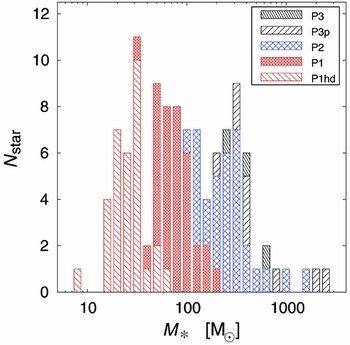
The most recent simulations of Stacy et al. (Reference Stacy, Bromm and Lee2016) found that disk fragmentation leads to the formation of a stellar cluster with a top heavy IMF. In their simulations, the most massive star reaches 20 solar masses in 5 000 yr after its formation and some of the sinks get ejected from the disk before ionisation front breaks out. However, these simulations were evolved only for 5 000 yr after the formation of the first sink and therefore final masses of Pop III stars are still uncertain. In Figure 2, we show the stellar mass distribution from Hirano et al. (Reference Hirano, Hosokawa, Yoshida, Umeda, Omukai, Chiaki and Yorke2014) which gives an upper limit on the expected stellar masses as their calculations do not take into account the multiplicity of stars per halo. These results suggest that the typical mass of Pop III stars is about 100 M⊙ with the exception of a few cases of a 1 000 M⊙.
The stellar mass distribution of 110 first stars assuming that single star forms in each minihalo. Each colour represents different stellar evolution path, see Hirano et al. (Reference Hirano, Hosokawa, Yoshida, Umeda, Omukai, Chiaki and Yorke2014) for details. Adopted from Hirano et al. (Reference Hirano, Hosokawa, Yoshida, Umeda, Omukai, Chiaki and Yorke2014).
3.2. Effects of metallicity and rotation
Both the metallicity and the rotation speed of stars play a vital role in defining their fates and have important implications for the formation of stellar mass BHs. In the presence of trace amounts of metals, dust cooling becomes important at high densities, and triggers the formation of multiple low mass stars (Ferrara, Pettini, & Shchekinov Reference Ferrara, Pettini and Shchekinov2000; Schneider et al. Reference Schneider, Ferrara, Salvaterra, Omukai and Bromm2003; Omukai et al. Reference Omukai, Tsuribe, Schneider and Ferrara2005; Schneider et al. Reference Schneider, Salvaterra, Ferrara and Ciardi2006). Numerical simulations show that for Z/Z⊙ ⩾ 10−5 dust cooling induces fragmentation and fosters low mass star formation (Dopcke et al. Reference Dopcke, Glover, Clark and Klessen2011, Reference Dopcke, Glover, Clark and Klessen2013; Smith et al. Reference Smith, Wise, O’Shea, Norman and Khochfar2015). Similarly, the dark matter halos with higher spin have a longer collapse timescale which results in enhanced fragmentation. Moreover, higher rotation decreases the mass accretion onto a protostar and consequently the final stellar mass gets reduced (Hirano et al. Reference Hirano, Hosokawa, Yoshida, Umeda, Omukai, Chiaki and Yorke2014; Dutta Reference Dutta2016).
The presence of metals and rotation does not only influence the formation of the first/second generation of stars by reducing their final masses but also strongly affects their evolution. Stellar evolution models show that mass loss from the stellar winds is metallicity dependent, scales with $\dot{m}_{{\rm loss}} \propto {\it Z}^{0.5}$
and consequently metal rich stars show much higher mass loss compared to the metal poor stars (Nugis & Lamers Reference Nugis and Lamers2000; Kudritzki & Puls Reference Kudritzki and Puls2000; Baraffe, Heger, & Woosley Reference Baraffe, Heger and Woosley2001; Heger et al. Reference Heger, Fryer, Woosley, Langer and Hartmann2003; Meynet & Maeder Reference Meynet and Maeder2005). Similarly, fast rotation enhances the surface enrichment of CNO cycle elements which in turn derive the mass loss by stellar winds from metal poor stars. For example, a fast rotating 60 M⊙ star can lose 30–55% of its initial mass for Z/Z⊙ = 10−8-10−5 (Heger, Langer, & Woosley Reference Heger, Langer and Woosley2000; Meynet & Maeder Reference Meynet and Maeder2000; Meynet, Ekström, & Maeder Reference Meynet, Ekström and Maeder2006b; Meynet et al. Reference Meynet, Hirschi, Ekström, Maeder, Lamers, Langer, Nugis and Annuk2006a; Chiappini et al. Reference Chiappini, Frischknecht, Meynet, Hirschi, Barbuy, Pignatari, Decressin and Maeder2011). Furthermore, an enhanced rotation modifies the Eddington limit known as the ΩΓ limit (Langer Reference Langer1998; Meynet & Maeder Reference Meynet and Maeder2000) and prevents the star from growing beyond 20–40 M⊙ by making it more compact (Lee & Yoon Reference Lee and Yoon2016). Such rapidly rotating low metallicity stars may also produce gamma-ray bursts (Yoon & Langer Reference Yoon and Langer2005).
$\dot{m}_{{\rm loss}} \propto {\it Z}^{0.5}$
and consequently metal rich stars show much higher mass loss compared to the metal poor stars (Nugis & Lamers Reference Nugis and Lamers2000; Kudritzki & Puls Reference Kudritzki and Puls2000; Baraffe, Heger, & Woosley Reference Baraffe, Heger and Woosley2001; Heger et al. Reference Heger, Fryer, Woosley, Langer and Hartmann2003; Meynet & Maeder Reference Meynet and Maeder2005). Similarly, fast rotation enhances the surface enrichment of CNO cycle elements which in turn derive the mass loss by stellar winds from metal poor stars. For example, a fast rotating 60 M⊙ star can lose 30–55% of its initial mass for Z/Z⊙ = 10−8-10−5 (Heger, Langer, & Woosley Reference Heger, Langer and Woosley2000; Meynet & Maeder Reference Meynet and Maeder2000; Meynet, Ekström, & Maeder Reference Meynet, Ekström and Maeder2006b; Meynet et al. Reference Meynet, Hirschi, Ekström, Maeder, Lamers, Langer, Nugis and Annuk2006a; Chiappini et al. Reference Chiappini, Frischknecht, Meynet, Hirschi, Barbuy, Pignatari, Decressin and Maeder2011). Furthermore, an enhanced rotation modifies the Eddington limit known as the ΩΓ limit (Langer Reference Langer1998; Meynet & Maeder Reference Meynet and Maeder2000) and prevents the star from growing beyond 20–40 M⊙ by making it more compact (Lee & Yoon Reference Lee and Yoon2016). Such rapidly rotating low metallicity stars may also produce gamma-ray bursts (Yoon & Langer Reference Yoon and Langer2005).
3.3. Stellar tracks leading to BH formation
Stellar evolution calculations suggest that the growth of primordial stars is significantly different from the present-day counterparts. Larger mass accretion rates, about two-three orders of magnitude higher than normal stars, and the absence of heavier elements makes the evolution of Pop III stars significantly different from ordinary stars (Omukai & Palla Reference Omukai and Palla2001; Schaerer Reference Schaerer2002; Omukai & Palla Reference Omukai and Palla2003; Schaerer Reference Schaerer2003). Stellar evolution also strongly depends on the time evolution of the mass accretion rates. Deuterium burning and pp cycle do not generate enough energy to counteract the KH contraction. The hydrogen burning from the CN cycle significantly increases the stellar luminosity and a protostar quickly reaches the ZAMS. Therefore, more massive stars of the order of a hundred solar masses are expected to form from a zero metallicity gas whilst for Z/Z⊙ ⩾ 10−2 radiation pressure on dust grains becomes important and leads to the formation of low mass stars (Omukai & Palla Reference Omukai and Palla2003; Hosokawa et al. Reference Hosokawa, Yoshida, Omukai and Yorke2012b).
The mass loss from stars become significant even in the presence of trace amount of metals whilst for primordial stars such losses are minimal. Stellar evolutionary tracks leading to the formation of BHs are indicated in Figure 3. The primordial stars with masses between 40–140 M⊙ and above 260 M⊙ are expected to directly collapse into BHs of similar masses (Heger & Woosley Reference Heger and Woosley2002; Heger et al. Reference Heger, Fryer, Woosley, Langer and Hartmann2003). For a trace amount of metals, all stars above 40 M⊙ directly collapse in a BH but with increasing metallicity the mass loss starts to increase. Moreover, the fraction of massive stars collapsing into a BH depends on the shape of the IMF and is about twice for top-heavy IMF compared to the Salpeter IMF (Heger et al. Reference Heger, Fryer, Woosley, Langer and Hartmann2003). Although numerical simulations suggest that some of the Pop III stars might be rotating at ⩾ 1 000 kms−1, i.e. close to their break up limit (Stacy et al. Reference Stacy, Bromm and Loeb2011), stellar evolution calculations including rotation (Ekström et al. Reference Ekström, Meynet, Chiappini, Hirschi and Maeder2008) indicate that the mass loss from the fast rotating Pop III stars is still very low. In a nutshell, metal free stars with low rotation speeds are favoured for the formation of stellar mass BHs as they retain most of their mass until they collapse into a BH.
The fate of single stars as a function of their initial mass and initial metallicity. The tracks for the formation of direct BHs from the stars are highlighted by the black colour whilst the white region in the bottom right indicates the range for a pair instability supernova. Adopted from Heger et al. (Reference Heger, Fryer, Woosley, Langer and Hartmann2003).

3.4. Expected properties of stellar mass BHs
The current numerical simulations indicate that the formation of massive primordial stars up to a 1 000 M⊙ is possible with the characteristic mass scale between 10–100 M⊙. This suggests that BH seeds of a few hundred solar masses can be formed at z = 20–30. In order to reach a few billion solar masses by z = 7, they must continuously grow at the Eddington limit. The three-dimensional numerical simulations studying the growth of stellar mass BHs show that feedback from a BH photo-evaporates the gas the in its hosting halo and consequently accretion onto a BH gets halted (Johnson & Bromm Reference Johnson and Bromm2007; Alvarez, Wise, & Abel Reference Alvarez, Wise and Abel2009). They further found that the BH accretion rate is about 10−10 M⊙yr−1, i.e. several orders of magnitude below the Eddington limit which makes their growth extremely difficult. Moreover, the progenitor star creates an HII region, evacuates the gas from a minihalo and accretion remains halted for about 108 yr. Park et al. (Reference Park, Ricotti, Natarajan, Bogdanović and Wise2016) found that stellar mass black holes cannot coevally grow with budge via accretion until it reaches the critical mass of 106 M⊙. There is a growing consensus that the stellar mass BHs require various episodes of super Eddington accretion to reach a billion solar masses by z ⩾ 6 (Madau, Haardt, & Dotti Reference Madau, Haardt and Dotti2014; Volonteri, Silk, & Dubus Reference Volonteri, Silk and Dubus2015; Pacucci, Volonteri, & Ferrara Reference Pacucci, Volonteri and Ferrara2015; Inayoshi, Haiman, & Ostriker Reference Inayoshi, Haiman and Ostriker2016a).
4 BH SEEDS FROM DENSE STELLAR CLUSTERS
The self-gravitating stellar systems with negative heat capacity are susceptible to a gravitational collapse where the core collapse timescale (t cc) is comparable to the two-body relaxation time (Binney & Tremaine Reference Binney and Tremaine1987). In such a scenario, the core of the cluster collapses resulting in a higher stellar density at its centre and the run-away stellar collisions lead to the formation of a very massive star (VMS) which later may collapse into a massive seed BH of up to a 1 000 M⊙. This mechanism provides an additional route for the formation of massive BH seeds. The earlier studies suggested that dense stellar clusters with ⩾ 107 stars are required for the run-away collapse to occur and subsequent growth of a massive object (Lee Reference Lee1987; Quinlan & Shapiro Reference Quinlan and Shapiro1990). It was found that the binary heating stops the core collapse in less massive stellar clusters (Heggie Reference Heggie1975; Hut et al. Reference Hut1992). Moreover, the t cc has to be shorter than the typical timescale for the massive stars to reach the main sequence (~3 Myr), otherwise mass loss from the supernova may halt the core collapse.
However, later studies found that the mass segregation instability can lead to the formation of a massive black hole seed even in less massive clusters (Spitzer Reference Spitzer1969; Vishniac Reference Vishniac1978; Begelman & Rees Reference Begelman and Rees1978). This comes from the fact that massive stars sink into the centre of a cluster on a dynamical friction timescale and speed-up the collapse. This phenomenon is expected to get accelerated significantly in multi-mass systems like realistic nuclear clusters. If the mass segregation occurs within the first 3 Myr, then stellar dynamical processes can lead to the formation of a VMS. As we discuss in the following sections, this mechanism strongly depends on the compactness and dynamical evolution of a stellar cluster and is particularly expected to occur in low metallicity clusters where mass loss from stellar winds is expected to be minimum (Hirschi Reference Hirschi2007; Glebbeek et al. Reference Glebbeek, Gaburov, de Mink, Pols and Portegies Zwart2009). These dense nuclear clusters can form in halos of about 108 M⊙ at z ~ 15 enriched by trace amount of metals (Omukai, Schneider, & Haiman Reference Omukai, Schneider and Haiman2008; Devecchi & Volonteri Reference Devecchi and Volonteri2009).
Another potential way could be the merging of many stellar mass BHs or a supra-exponential growth of stellar mass black holes in a cluster by dense cold gas flows Alexander & Natarajan (Reference Alexander and Natarajan2014). However, the gravitational recoil velocities are about the order of ~ 1 000 kms−1 which are much larger than the escape velocity of halos (10 km s−1) and therefore lead to the ejection of BHs from the shallow DM potentials at earlier comic times (Haiman Reference Haiman2004; Tanaka & Haiman Reference Tanaka and Haiman2009). Alternatives could be the run-away merging of stellar mass black holes in the core of a dense cluster mediated by the extremely large inflows of gas (Davies, Miller, & Bellovary Reference Davies, Miller and Bellovary2011; Lupi et al. Reference Lupi, Colpi, Devecchi, Galanti and Volonteri2014) or collapse of a dense stellar cluster due to the relativistic instability (Shapiro & Teukolsky Reference Shapiro and Teukolsky1986).
4.1. Binarity of early star formation
Observations of contemporary star formation suggest that about 50% of the stars are born in binaries or multiple systems (Sana, Gosset, & Evans Reference Sana, Gosset and Evans2009; Sana, James, & Gosset Reference Sana, James and Gosset2011). In the context of primordial stars, recent numerical simulations show that the first generation of stars may also have formed in multiple systems due to the fragmentation of protostellar disk (Turk et al. Reference Turk, Abel and O’Shea2009; Stacy et al. Reference Stacy, Greif and Bromm2010; Clark et al. Reference Clark, Glover, Smith, Greif, Klessen and Bromm2011; Greif et al. Reference Greif, Bromm, Clark, Glover, Smith, Klessen, Yoshida and Springel2012; Latif et al. Reference Latif, Schleicher, Schmidt and Niemeyer2013e; Latif & Schleicher Reference Latif and Schleicher2015a; Stacy et al. Reference Stacy, Bromm and Lee2016). Some of the clumps from disk fragmentation migrate inward and merge with the central protostar whilst the rest survive to form a multiple system (Greif et al. Reference Greif, Bromm, Clark, Glover, Smith, Klessen, Yoshida and Springel2012; Stacy et al. Reference Stacy, Bromm and Lee2016). In fact, numerical simulations suggest that up to 35% of Pop III stars may have formed in binaries; thus, the probability for a PopIII star to have a companion is about 50% (Stacy et al. Reference Stacy, Greif and Bromm2010; Stacy & Bromm Reference Stacy and Bromm2013). This may also suggest the formation of X-ray binaries at earlier cosmic times (Mirabel et al. Reference Mirabel, Dijkstra, Laurent, Loeb and Pritchard2011; Ryu, Tanaka, & Perna Reference Ryu, Tanaka and Perna2016).
Simulations of the first galaxies show that supernovae from Pop III stars quickly enrich halos with metals where gas can be cooled down to the cosmic microwave background temperature (T CMB) by dust and metal line cooling at z = 15 even in the presence of UV flux (Tornatore et al. Reference Tornatore, Ferrara and Schneider2007; Smith et al. Reference Smith, Turk, Sigurdsson, O’Shea and Norman2009; Greif et al. Reference Greif, Glover, Bromm and Klessen2010; Wise et al. Reference Wise, Turk, Norman and Abel2012; Whalen et al. Reference Whalen2013; Johnson, Dalla Vecchia, & Khochfar Reference Johnson, Dalla Vecchia and Khochfar2013a; Safranek-Shrader, Milosavljević, & Bromm Reference Safranek-Shrader, Milosavljević and Bromm2014a; Bovino et al. Reference Bovino, Grassi, Schleicher and Latif2014; Pallottini et al. Reference Pallottini, Ferrara, Gallerani, Salvadori and D’Odorico2014). Stellar clusters of Pop II stars are expected to form above the critical value of the metallicity, i.e. Z/Z⊙ ~ 5 × 10⁻⁴(Schneider et al. Reference Schneider, Ferrara, Salvaterra, Omukai and Bromm2003; Omukai et al. Reference Omukai, Tsuribe, Schneider and Ferrara2005; Cazaux & Spaans Reference Cazaux and Spaans2009; Latif, Schleicher, & Spaans Reference Latif, Schleicher and Spaans2012). The recent three-dimensional cosmological simulations suggest that the first bona fide stellar clusters form at z = 15 where cooling is triggered by the metal lines (such as CII and OI) and stellar masses range from 0.1-10 M⊙ (Safranek-Shrader, Milosavljević, & Bromm Reference Safranek-Shrader, Milosavljević and Bromm2014b; Safranek-Shrader et al. Reference Safranek-Shrader, Montgomery, Milosavljević and Bromm2016). Although current cosmological simulations are unable to constrain the binary fraction in the first stellar clusters due to the numerical constraints but the binary fraction is expected to be higher for metal poor stars (Komiya et al. Reference Komiya, Suda, Minaguchi, Shigeyama, Aoki and Fujimoto2007; Machida Reference Machida2008).
4.2. Compact stellar clusters
The compactness of a stellar cluster is the key property for the stellar dynamical processes to occur as it determines whether a seed BH can form or not. This requirement arises from the fact that the time for the core collapse should be shorter than the time for massive stars to go off supernova (~3 Myr) otherwise latter may halt the core collapse, also see Yajima & Khochfar (Reference Yajima and Khochfar2016). The more compact the cluster shorter the core collapse timescale. For a given cluster mass, the number of collisions and the increase in mass per collision strongly depend on the half-mass radius of a cluster (Portegies Zwart & McMillan Reference Portegies Zwart and McMillan2002). The mass of a VMS almost linearly increases with the initial central density of a cluster (Katz, Sijacki, & Haehnelt Reference Katz, Sijacki and Haehnelt2015).
In the context of BHs, the first compact nuclear cluster are expected to form in massive halos of 108 M⊙ at z > 10 with Z/Z⊙ ~ 10−5-10−3. In the presence of a LW flux, the formation of H2 at low densities remains suppressed and gas initially collapses isothermally to form a self-gravitating accretion disk at the centre of a halo (Devecchi & Volonteri Reference Devecchi and Volonteri2009). Fragmentation occurs only in the nucleus of the disk above densities of 103 cm−3 due to the metal line cooling and forms a compact cluster of 105 M⊙ with half-mass radius of about 1 pc. On the other hand, for higher metallicities, fragmentation already occurs at densities < 103 cm−3 and results in the core collapse time longer than 3 Myr (Omukai et al. Reference Omukai, Schneider and Haiman2008; Devecchi & Volonteri Reference Devecchi and Volonteri2009; Devecchi et al. Reference Devecchi, Volonteri, Rossi, Colpi and Portegies Zwart2012).
Semi-analytical models suggest that large accretion rates and efficient star formation are required for the formation of a such compact nuclear stellar and conditions for their formation are feasible in the first massive halos polluted by a trace amount of metals at z > 10 (Devecchi & Volonteri Reference Devecchi and Volonteri2009). Latif et al. (Reference Latif, Omukai, Habouzit, Schleicher and Volonteri2016) have performed 3D cosmological simulations to study the impact of trace amount of dust and metals in massive halos of 108 M⊙ and found that a dense cluster may also form for Z/Z⊙ ⩾ 10−4 in the presence of a strong UV flux. The study of first nuclear clusters in still in infancy as their formation cannot be resolved in numerical simulations due to the enormous range of spatial scales. In future, more work is required to asses how compact and massive the clusters can be formed at high redshift.
4.3. Dynamical evolution
The dynamical evolution of dense stellar clusters has been studied via direct N-body simulations which show that the mergers between stars destroy binaries and avoid three body binary heating (Portegies Zwart et al. Reference Portegies Zwart, Makino, McMillan and Hut1999). Moreover, in contrary to the previous studies, stellar collisions are fostered by the dynamically formed binaries which increase the star collision rate (Portegies Zwart et al. Reference Portegies Zwart, Makino, McMillan and Hut1999; Portegies Zwart & McMillan Reference Portegies Zwart and McMillan2002). Consequently, stellar collisions can occur even in a low mass system with 12 000 stars and may lead to the formation of a BH of up to ~ 1 000 M⊙. This was further confirmed from the Monte Carlo simulations by Gürkan, Freitag, & Rasio (Reference Gürkan, Freitag and Rasio2004) where they explored a range of IMFs and cluster structural parameters. Their followed-up work including stellar dynamics showed that core collapse occurred on ~ 3 Myr timescale irrespective of the cluster size, mass, concentration, and a VMS reached up to 1 000 M⊙ (Freitag, Gürkan, & Rasio Reference Freitag, Gürkan and Rasio2006). Moreover, the mass of a VMS is about 10−3 times the cluster mass and is mainly contributed by the stars in the mass range of 60–120 M⊙ (Goswami et al. Reference Goswami, Umbreit, Bierbaum and Rasio2012).
Metallicity also plays an important role in the dynamical evolution of a stellar cluster as mass loss from stars can deeply affect the core collapse. Schulman, Glebbeek, & Sills (Reference Schulman, Glebbeek and Sills2012) and Downing (Reference Downing2012) found that the size of cluster depends on the metallicity and metal rich clusters expand more rapidly. For more massive clusters, Sippel et al. (Reference Sippel, Hurley, Madrid and Harris2012) found that both metal poor and metal rich clusters are structurally similar and no significant differences in their half-mass radii were observed. The effect of metallicity seems to be more important in intermediate mass young clusters and leads to the differences in the core radius as well as in the half-mass radius (Mapelli & Bressan Reference Mapelli and Bressan2013). These differences arise from an interplay between the mass loss from stellar winds, dynamical heating, and three-body interactions. Therefore, low metallicity young clusters forming at z > 10 are preferred for the formation of a massive seed black hole.
4.4. Expected properties of seed BHs
The BH mass resulting from the core collapse of a dense stellar cluster depends on its initial stellar mass, initial stellar density, compactness, cluster geometry, fraction of primordial binaries, and the IMF of a cluster. The N-body simulations exploring the range of above mentioned parameters show that clusters with different geometries, fractal distributions, and density profiles converge within 1 Myr and do not significantly influence the mass of a VMS. However, the final mass of a VMS strongly depends on the compactness for a given cluster mass and almost linearly increases with initial central density. Recently, Katz et al. (Reference Katz, Sijacki and Haehnelt2015) used a combination of hydrodynamical cosmological simulations and direct N-body simulations to estimate the mass of a VMS forming via stellar run-away collisions in a metal poor stellar cluster. They found that a VMS of ⩾ 400 M⊙ can be formed in a stellar cluster of 104 M⊙ at z = 15 and may reach up to a 1 000 M⊙ for a cluster mass of a few times 105 M⊙.
The IMF of a stellar cluster influences the number of collisions between stars and the mass of a VMS tends to increase for a top heavy IMF but the probability of producing a VMS remains the same. Similarly, the introduction of primordial binaries and the initial mass segregation significantly change the evolution of a cluster but the mass of a VMS differs only by a factor of 3 which is less significant than the changes in the central density and the mass of a cluster (Katz et al. Reference Katz, Sijacki and Haehnelt2015). The mass of a seed black hole forming from the core collapse of a cluster can be estimated as follows (Portegies Zwart & McMillan Reference Portegies Zwart and McMillan2002):
 $$\begin{equation}
M_{{\rm BH}} = m_{*} + 4 \times 10^{-3} f_{{\rm c}} M_{{\rm c}0} \gamma \ln \Lambda _{\rm C}.
\end{equation}$$
$$\begin{equation}
M_{{\rm BH}} = m_{*} + 4 \times 10^{-3} f_{{\rm c}} M_{{\rm c}0} \gamma \ln \Lambda _{\rm C}.
\end{equation}$$
Here, m * is the mass of a massive star in the cluster, f c is the fraction of dynamically formed binaries, M c0 is the birth mass of the cluster, ln Λc is the Coulomb logarithm, and γ ~ 1, is the ratio of timescales, see Portegies Zwart & McMillan (Reference Portegies Zwart and McMillan2002) for details. For a M c0 = 104 M⊙, m * = 100 M⊙, f c = 0.2, ln ΛC = 10, M BH ~ 180 M⊙ whilst for M c0 = 105 M⊙, the expected black hole mass is ~ 900 M⊙.
Devecchi et al. (Reference Devecchi, Volonteri, Colpi and Haardt2010, Reference Devecchi, Volonteri, Rossi, Colpi and Portegies Zwart2012) employed an analytical model to estimate the expected mass range of seed BHs forming via dynamical processes in nuclear stellar clusters at z ⩾ 10. Their estimates for BH masses are shown in Figure 4 and indicate that BHs of up to a 1 000 M⊙ can be formed. Simulations self-consistently modelling the formation and evolution of a nuclear stellar cluster are necessary to better understand the dynamics of the first dense nuclear clusters.
The mass function of BHs formed via stellar dynamical process in the first nuclear cluster at z ~ 15. Adopted from Devecchi et al. (Reference Devecchi, Volonteri, Rossi, Colpi and Portegies Zwart2012).

5 DIRECT COLLAPSE BHs
One of the most promising way to explain the existence of z > 6 quasars is to form a massive BH seed of 105-106 M⊙ directly via the gas dynamical processes (Rees Reference Rees1984; Haehnelt & Rees Reference Haehnelt and Rees1993; Loeb & Rasio Reference Loeb and Rasio1994; Eisenstein & Loeb Reference Eisenstein and Loeb1995; Bromm & Loeb Reference Bromm and Loeb2003; Koushiappas, Bullock, & Dekel Reference Koushiappas, Bullock and Dekel2004; Begelman et al. Reference Begelman, Volonteri and Rees2006; Spaans & Silk Reference Spaans and Silk2006) known as the DCBH. The key requirement for this scenario to work is that gas should efficiently shed angular momentum and rapidly collapse avoiding fragmentation. The basic idea behind this mechanism is to bring large inflows of gas to the centre of the halo on a short timescale of the order of 1 Myr and let the huge reservoir of the gas to collapse into a single massive object without fragmenting into stars. The recent calculations suggest that large mass accretion rates of ⩾ 0.1 M⊙yr−1 (see our explanation below) are required for this mechanism to work (Begelman Reference Begelman2010; Ball et al. Reference Ball, Tout, Żytkow and Eldridge2011; Hosokawa et al. Reference Hosokawa, Yorke, Inayoshi, Omukai and Yoshida2013; Schleicher et al. Reference Schleicher, Palla, Ferrara, Galli and Latif2013; Ferrara et al. Reference Ferrara, Salvadori, Yue and Schleicher2014; Sakurai et al. Reference Sakurai, Hosokawa, Yoshida and Yorke2015). Such large accretion rates can be obtained either via thermodynamical processes by keeping the gas warm as the accretion rate ∝T 3/2, (Bromm & Loeb Reference Bromm and Loeb2003; Volonteri, Lodato, & Natarajan Reference Volonteri, Lodato and Natarajan2008; Regan & Haehnelt Reference Regan and Haehnelt2009; Shang, Bryan, & Haiman Reference Shang, Bryan and Haiman2010; Johnson et al. Reference Johnson, Khochfar, Greif and Durier2011; Latif et al. Reference Latif, Schleicher, Schmidt and Niemeyer2013c; Ferrara et al. Reference Ferrara, Salvadori, Yue and Schleicher2014), or through highly dynamical processes such as the ‘bars within bars’ instability (Shlosman, Frank, & Begelman Reference Shlosman, Frank and Begelman1989; Begelman et al. Reference Begelman, Volonteri and Rees2006) and galaxy mergers (Mayer et al. Reference Mayer, Kazantzidis, Escala and Callegari2010).
The thermodynamical way to form a DCBH requires that halos should be metal free otherwise trace amount of metals can cool the gas which later leads to fragmentation and star formation. Even in primordial halos the formation of molecular hydrogen should remain suppressed to keep the gas warm and cooling should mainly proceed via atomic lines. Alternatives could be the trapping of Lyman alpha photons which could stiffen the equation of state and suppress in-situ star formation (Spaans & Silk Reference Spaans and Silk2006; Latif et al. Reference Latif, Zaroubi and Spaans2011a). However, it has been found that cooling can still proceed via the 2s–1s transition and compensates the effect of Lyman alpha trapping (Schleicher, Spaans, & Glover Reference Schleicher, Spaans and Glover2010; Latif et al. Reference Latif, Schleicher, Spaans and Zaroubi2011b). Lodato & Natarajan (Reference Lodato and Natarajan2006) suggested that a few percent of pre-galactic disks forming in the dark matter halos at high redshift may form a massive object depending on the properties of hosting halos such as spin, mass, and cooling properties. Particularly, low spin halos are more prone to forming a massive central object. Tanaka et al. (Reference Tanaka, Li and Haiman2013), Tanaka & Li (Reference Tanaka and Li2014) have proposed that extreme streaming velocities may facilitate direct collapse by enhancing the critical mass of halos to collapse, suppressing in-situ star formation and consequently avoid metal enrichment in atomic cooling halos. They argue that this scenario may not need external UV flux to suppress star formation, but Latif, Niemeyer, & Schleicher (Reference Latif, Niemeyer and Schleicher2014b) show that the impact of streaming is not significant in atomic cooling halos forming at z = 15. Inayoshi, Visbal, & Kashiyama (Reference Inayoshi, Visbal and Kashiyama2015) propose that high velocity collisions of two protogalaxies shock heat the gas which later cools isobarically, molecular hydrogen gets collisional dissociated (Inayoshi & Omukai Reference Inayoshi and Omukai2012) and consequently an isothermal collapse may form a supermassive star (SMS). However, Visbal, Haiman, & Bryan (Reference Visbal, Haiman and Bryan2014a) and Fernandez et al. (Reference Fernandez, Bryan, Haiman and Li2014) show that these scenarios require additional mechanism to suppress the formation of molecular at high densities.
Begelman & Shlosman (Reference Begelman and Shlosman2009) argue that fragmentation can also be suppressed in the presence of supersonic turbulence even in metal rich halos and may not require above mentioned conditions. Mayer et al. (Reference Mayer, Kazantzidis, Escala and Callegari2010) propose that merging of two metal rich galaxies brings large accretion rates of ~ 104 M⊙yr−1 driven by the gravitational torques and a compact stable nuclear disk forms which later may collapse into a massive BH. Ferrara, Haardt, & Salvaterra (Reference Ferrara, Haardt and Salvaterra2013) argue based on one-dimensional model that such disk rapidly cools and becomes unstable in about 100 yr. So, the central core cannot grow beyond 100 solar masses. In the recent study, Mayer et al. (Reference Mayer, Fiacconi, Bonoli, Quinn, Roškar, Shen and Wadsley2015) improved on their previous work by employing radiative cooling for both optically thin and thick regimes instead of effective equation of state as in Mayer et al. (Reference Mayer, Kazantzidis, Escala and Callegari2010). Their new findings suggest that inclusion of cooling fosters the formation of compact nuclear disk and central core is stabilised by the shock heating and high optical depth of the gas. It is expected that in such scenario the core may directly collapse via general relativistic (GR) instabilities into a massive black hole. Bonoli, Mayer, & Callegari (Reference Bonoli, Mayer and Callegari2014) employed galaxy formation model in Millennium simulations using the recipe of Mayer et al. (Reference Mayer, Kazantzidis, Escala and Callegari2010) that major mergers of gas rich and disk dominated galaxies form massive BH. They found that most of the > 1011 M⊙ halos at z ~ 4 meet this criteria. Latif & Volonteri (Reference Latif and Volonteri2015) and Latif & Schleicher (Reference Latif and Schleicher2015b) show that complete isothermal monolithic collapse of a protogalactic gas may always not be necessary to form a massive central BH.
The gas has to shed angular momentum to collapse to high enough densities to form a massive BH otherwise collapse gets halted by the angular momentum barrier. Eisenstein & Loeb (Reference Eisenstein and Loeb1995) and Koushiappas et al. (Reference Koushiappas, Bullock and Dekel2004) proposed that BHs can either form in DM halos with low angular momentum or in the tail of low angular momentum gas within the halo. However, even then gas has to transport angular momentum quite efficiently to form a massive central object. The recent simulations suggest that the triaxility of DM halos exerts gravitational torques which helps in the transfer of angular momentum via ‘bars within bars’ instabilities (Choi, Shlosman, & Begelman Reference Choi, Shlosman and Begelman2013, Reference Choi, Shlosman and Begelman2015). In the following subsections, we discuss physical processes involved in the formation of DCBHs via isothermal collapse, how and under what conditions they are formed and what are their typical masses.
5.1. Birthplaces of DCBHs
The potential embryos for the formation of DCBHs via isothermal collapse are the first massive metal-free halos with T
vir ⩾ 104 K and masses of > 107 M⊙ at z ~ 15. They have sufficient gas reservoir to feed a massive object and their potential wells are deep enough to foster a rapid collapse required for the formation of a DCBH. Moreover, their virial temperature is high enough for the atomic line cooling to operate. The formation of a DCBH mandates that they should be of a primordial composition and the formation of H2 remains suppressed (Shang et al. Reference Shang, Bryan and Haiman2010; Petri, Ferrara, & Salvaterra Reference Petri, Ferrara and Salvaterra2012; Latif et al. Reference Latif, Bovino, Van Borm, Grassi, Schleicher and Spaans2014c; Yue et al. Reference Yue, Ferrara, Salvaterra, Xu and Chen2014). In the absence of H2 cooling, collapse proceeds isothermally with T ~ 8000 K and warm gas flows towards the centre at the rate of $\rm \dot{\it m} \sim {c_s^3}/{G} \sim 0.1\;M_{\odot } yr^{-1} \left( {\it T}/{8\,000\;K}\right)^{3/2}$
, where c
s is the thermal sound speed.
$\rm \dot{\it m} \sim {c_s^3}/{G} \sim 0.1\;M_{\odot } yr^{-1} \left( {\it T}/{8\,000\;K}\right)^{3/2}$
, where c
s is the thermal sound speed.
The suppression of molecular hydrogen requires the presence of a strong LW flux (Omukai Reference Omukai2001; Omukai et al. Reference Omukai, Schneider and Haiman2008; Shang et al. Reference Shang, Bryan and Haiman2010; Latif et al. Reference Latif, Schleicher, Schmidt and Niemeyer2013a). As we discuss in the next subsections that constraint of a strong LW fluxes requires that DCBH hosting halo should form in the vicinity (about few kpc) of a massive star forming galaxy (Dijkstra et al. Reference Dijkstra, Haiman, Mesinger and Wyithe2008; Agarwal et al. Reference Agarwal, Khochfar, Johnson, Neistein, Dalla Vecchia and Livio2012; Habouzit et al. Reference Habouzit2016b). In mean time, it has also to avoid the metal pollution for the above mentioned reasons. Under these conditions, an isothermal monolithic collapse is expected to occur which later may lead to the formation of a DCBH.
5.2. UV flux constraints
One of the main constraints for the formation of DCBHs via isothermal direct collapse is the suppression of molecular hydrogen formation which requires the presence of a strong LW flux (Omukai Reference Omukai2001; Omukai et al. Reference Omukai, Schneider and Haiman2008; Shang et al. Reference Shang, Bryan and Haiman2010; Petri et al. Reference Petri, Ferrara and Salvaterra2012; Latif et al. Reference Latif, Schleicher, Schmidt and Niemeyer2013a). The gas phase reactions in primordial gas can lead to the formation of a trace amount of H2. The main pathway for H2 formation is
 $$\begin{equation}
\mathrm{H + e^{-} \rightarrow H^{-} +} \gamma,
\end{equation}$$
$$\begin{equation}
\mathrm{H + e^{-} \rightarrow H^{-} +} \gamma,
\end{equation}$$
 $$\begin{equation}
\mathrm{ H + H^{-} \rightarrow H_{2} + e^{-}.}
\end{equation}$$
$$\begin{equation}
\mathrm{ H + H^{-} \rightarrow H_{2} + e^{-}.}
\end{equation}$$
The formation of H2 can be suppressed either by directly dissociating H2 or indirectly via the photo-detachment of H−. The destruction channel for H2 depends on the stellar spectra. The photons with energy between 11.2–13.6 eV can be absorbed in the LW bands of H2 and photo-dissociate it shortly after putting it into an excited state, this is known as the Solomon process. Whilst the low energy photons with energy above 0.76 eV can photo-detach H−. The reactions for the both processes are the following:
 $$\begin{equation}
\mathrm{H_{2}} + \gamma _{{\rm LW}} \mathrm{\rightarrow H + H},
\end{equation}$$
$$\begin{equation}
\mathrm{H_{2}} + \gamma _{{\rm LW}} \mathrm{\rightarrow H + H},
\end{equation}$$
 $$\begin{equation}
\mathrm{H^{-}} + \gamma _{0.76} \mathrm{\rightarrow H + e^{-}}.
\end{equation}$$
$$\begin{equation}
\mathrm{H^{-}} + \gamma _{0.76} \mathrm{\rightarrow H + e^{-}}.
\end{equation}$$
The stars with hard spectrum of T rad = 105 K are more efficient for the direct dissociation of H2 whilst the stars characterised with T rad = 104 K are more effective in the photo-detachment of H−. The complete quenching of H2 requires a critical value of UV flux (J crit 21) which depends on the shape of a radiation spectrum. The previous studies used idealised spectra to compute the J crit 21 and found that J crit 21 = 30–1 200 for T rad = 104 K and J crit 21 = 1 000 for T rad = 105 K (Omukai Reference Omukai2001; Shang et al. Reference Shang, Bryan and Haiman2010; Van Borm & Spaans Reference Van Borm and Spaans2013; Latif et al. Reference Latif, Bovino, Van Borm, Grassi, Schleicher and Spaans2014c; Johnson et al. Reference Johnson, Whalen, Agarwal, Paardekooper and Khochfar2014). It has been found that the strength of J crit 21 is about an order of magnitude above the background UV flux and can only be achieved in the close vicinity of a star forming galaxy (Dijkstra et al. Reference Dijkstra, Haiman, Mesinger and Wyithe2008; Agarwal et al. Reference Agarwal, Khochfar, Johnson, Neistein, Dalla Vecchia and Livio2012; Habouzit et al. Reference Habouzit2016b). Moreover, such flux is mainly provided by Pop II stars due to their long lives and higher abundance. Recently, realistic spectra of the first galaxies was computed using the stellar synthesis code STARBURST (Leitherer et al. Reference Leitherer1999) and it was found that J crit 21 depends on the mode of a star formation (either bursty or constant) as well as on the age and metallicity of stars (Sugimura et al. Reference Sugimura, Omukai and Inoue2014; Agarwal & Khochfar Reference Agarwal and Khochfar2015; Agarwal et al. Reference Agarwal, Smith, Glover, Natarajan and Khochfar2016a). Sugimura et al. (Reference Sugimura, Omukai and Inoue2014) show that such spectra can be mimicked with T rad= 2 × 10⁴ − 105 K.
Recent estimates of J crit 21 from three-dimensional cosmological simulations (Latif et al. Reference Latif, Bovino, Grassi, Schleicher and Spaans2015)Footnote 2 for a realistic Pop II spectra vary between 20 000–50 000 considering a uniform isotropic background UV flux and are shown in Figure 5. Similar values of J crit 21 have been obtained for anisotropic source (Regan, Johansson, & Wise Reference Regan, Johansson and Wise2014b, Reference Regan, Johansson and Wise2016a). Moreover, the presence of X-rays may further influence the J crit 21 depending on its strength (Latif et al. Reference Latif, Bovino, Grassi, Schleicher and Spaans2015; Inayoshi & Tanaka Reference Inayoshi and Tanaka2015; Regan, Johansson, & Wise Reference Regan, Johansson and Wise2016b) and also an accurate modelling of H2 self-shielding is required (Wolcott-Green, Haiman, & Bryan Reference Wolcott-Green, Haiman and Bryan2011; Hartwig et al. Reference Hartwig, Glover, Klessen, Latif and Volonteri2015).
The estimates of critical value of UV flux (J crit 21) both from one zone models and three-dimensional simulations including variations from halo to halo, dependence on the radiation spectra, and the impact of X-ray ionisation. Adopted from Latif et al. (Reference Latif, Bovino, Grassi, Schleicher and Spaans2015).

5.3. Metal pollution
One of the key requirements for the formation of DCBHs via isothermal collapse is that the hosting halo should be metal free. The metal enrichment is expected to be patchy in the early universe and therefore some halos may remain unpolluted even down to z = 6 (Tornatore et al. Reference Tornatore, Ferrara and Schneider2007; Trenti et al. Reference Trenti, Stiavelli and Michael Shull2009; Maio et al. Reference Maio, Khochfar, Johnson and Ciardi2011; Ritter et al. Reference Ritter, Sluder, Safranek-Shrader, Milosavljević and Bromm2015; Pallottini et al. Reference Pallottini, Ferrara, Gallerani, Salvadori and D’Odorico2014; Habouzit et al. Reference Habouzit, Volonteri, Latif, Dubois and Peirani2016a). In fact, observations show that pockets of extremely metal poor gas (Z/Z⊙ ~ 10−5) can exist down to z = 7 (Simcoe et al. Reference Simcoe, Sullivan, Cooksey, Kao, Matejek and Burgasser2012). So, it is conceivable that primordial halos where star formation is suppressed in the presence of LW background may stay metal free at z ⩾ 10.
However, the DCBH host halo is expected to form in the surrounding of a star-forming galaxy to receive a strong LW flux and therefore has to avoid the possible pollution by the supernova winds. Dijkstra, Ferrara, & Mesinger (Reference Dijkstra, Ferrara and Mesinger2014) employed an analytical model to study the impact of metal pollution by the supernova winds and found that it can significantly affect the expected abundance of DCBHs. Visbal, Haiman, & Bryan (Reference Visbal, Haiman and Bryan2014b) propose that metal pollution can also be avoided in a synchronised pair of halos. In such a case, star-forming halo forms first whilst the DCBH host halo forms later and rapidly collapses before it gets enriched by the supernova winds. Moreover, such pair of halos is expected to be in a clustered environment where metals might be ejected in a preferential direction with low density and metal pollution may be avoided (Ritter et al. Reference Ritter, Sluder, Safranek-Shrader, Milosavljević and Bromm2015; Pallottini et al. Reference Pallottini, Ferrara, Gallerani, Salvadori and D’Odorico2014). It has been recently found that some of the DCBH host halos may get tidally disrupted in such a scenario (Chon et al. Reference Chon, Hirano, Hosokawa and Yoshida2016).
Cosmological hydrodynamical simulations including both star formation and supernova feedback show that a significant fraction of halos remains metal free down to z = 10 with mass range between 2 × 10⁷ − 108 M⊙ (Latif et al. Reference Latif, Omukai, Habouzit, Schleicher and Volonteri2016; Habouzit et al. Reference Habouzit, Volonteri, Latif, Dubois and Peirani2016a), see Figure 6. These results provide an upper limit on the fraction of metal free halos in the above mentioned range as simulations are unable to resolve halos below 107 M⊙. In future, cosmological hydrodynamical simulations self-consistently taking into account the metal pollution as well as radiations from the star forming galaxies are required to better understand the metal pollution in the DCBH host halos.
Fraction of halos with metallicity below the given value in the figure legged and masses between 2 × 10⁷-108 M⊙. Adopted from Latif et al. (Reference Latif, Omukai, Habouzit, Schleicher and Volonteri2016).

5.4. Formation of a supermassive/quasi star
SMSsFootnote
3
are considered as potential cradles for the formation of DCBHs (Begelman Reference Begelman2010; Volonteri & Begelman Reference Volonteri and Begelman2010; Ball et al. Reference Ball, Tout, Żytkow and Eldridge2011; Hosokawa, Omukai, & Yorke Reference Hosokawa, Omukai and Yorke2012a; Hosokawa et al. Reference Hosokawa, Yorke, Inayoshi, Omukai and Yoshida2013; Schleicher et al. Reference Schleicher, Palla, Ferrara, Galli and Latif2013; Johnson et al. Reference Johnson, Whalen, Li and Holz2013b; Ferrara et al. Reference Ferrara, Salvadori, Yue and Schleicher2014). They may collapse via GR instabilities into a DCBH whilst retaining ⩾ 50% of their initial mass (Baumgarte & Shapiro Reference Baumgarte and Shapiro1999; Shibata & Shapiro Reference Shibata and Shapiro2002; Montero, Janka, & Müller Reference Montero, Janka and Müller2012; Reisswig et al. Reference Reisswig, Ott, Abdikamalov, Haas, Mösta and Schnetter2013) or may evolve towards a ZAMS and later collapse into a massive BH (Ferrara et al. Reference Ferrara, Salvadori, Yue and Schleicher2014). The stellar evolution calculations suggest that the formation of such objects requires rapid accretion with $\dot{\it m} \ge 0.1\; {\rm M}_{\odot } {\rm yr}^{-1}$
(Begelman Reference Begelman2010; Ball et al. Reference Ball, Tout, Żytkow and Eldridge2011; Hosokawa et al. Reference Hosokawa, Yorke, Inayoshi, Omukai and Yoshida2013; Schleicher et al. Reference Schleicher, Palla, Ferrara, Galli and Latif2013). For such high accretion rates, the radius of star monotonically increases with mass due to the shorter accretion time in comparison with the KH contraction timescale (Hosokawa et al. Reference Hosokawa, Yorke, Inayoshi, Omukai and Yoshida2013; Sakurai et al. Reference Sakurai, Hosokawa, Yoshida and Yorke2015). Consequently, their surface temperatures remain as low as 5 000 K, they produce weak UV stellar feedback and can grow up to
$\dot{\it m} \ge 0.1\; {\rm M}_{\odot } {\rm yr}^{-1}$
(Begelman Reference Begelman2010; Ball et al. Reference Ball, Tout, Żytkow and Eldridge2011; Hosokawa et al. Reference Hosokawa, Yorke, Inayoshi, Omukai and Yoshida2013; Schleicher et al. Reference Schleicher, Palla, Ferrara, Galli and Latif2013). For such high accretion rates, the radius of star monotonically increases with mass due to the shorter accretion time in comparison with the KH contraction timescale (Hosokawa et al. Reference Hosokawa, Yorke, Inayoshi, Omukai and Yoshida2013; Sakurai et al. Reference Sakurai, Hosokawa, Yoshida and Yorke2015). Consequently, their surface temperatures remain as low as 5 000 K, they produce weak UV stellar feedback and can grow up to $\rm 3.6 \times 10^8 \; \dot{\it m} \;M_{\odot }$
. The energy released by the nuclear burning remains subdominant compared to the energy produced by the stellar contraction.
$\rm 3.6 \times 10^8 \; \dot{\it m} \;M_{\odot }$
. The energy released by the nuclear burning remains subdominant compared to the energy produced by the stellar contraction.
Schleicher et al. (Reference Schleicher, Palla, Ferrara, Galli and Latif2013) found that for $\rm \dot{\it m} \ge 0.14\; M_{\odot } yr^{-1}$
the core of a SMS collapses into a BH and forms a so-called quasi star, also see Begelman, Rossi, & Armitage (Reference Begelman, Rossi and Armitage2008). It comes from the fact that accretion timescale is considerably shorter than the nuclear burning timescale and therefore the core collapses into a black hole (Begelman et al. Reference Begelman, Volonteri and Rees2006; Begelman Reference Begelman2010). A possible advantage of such composition is that a central BH may accrete at the super-Eddington rate but overall accretion is limited by the Eddington rate of a quasi star. Ball et al. (Reference Ball, Tout, Żytkow and Eldridge2011) have found that about 10% of the stellar mass is accreted onto the BH before the hydrostatic equilibrium breaks down and results are sensitive to the choice of boundary conditions. Dotan, Rossi, & Shaviv (Reference Dotan, Rossi and Shaviv2011) quantified the potential impact of radiation-driven winds from the envelope of a quasi star and found that winds can be so strong that they may blow away the envelope before the BH doubles its mass. The effect of winds from the radiation dominated objects was reconsidered by Fiacconi & Rossi (Reference Fiacconi and Rossi2016b) by solving the equations of motion and including the previously neglected advection energy term. They found that the super Eddington accretion onto the newly born BH within quasi stars is likely responsible for vigorous mass loss and limits the BH growth. In the follow-up study, Fiacconi & Rossi (Reference Fiacconi and Rossi2016a) explored the impact of rotation in quasi-star scenario via simplified analytical model and found that for ⩾ 105 M⊙ massive SMSs the quasi-star phase may be skipped whilst the growth of less massive objects may get prevented. However, 3D radiation hydrodynamics simulations are necessary to validate these findings.
$\rm \dot{\it m} \ge 0.14\; M_{\odot } yr^{-1}$
the core of a SMS collapses into a BH and forms a so-called quasi star, also see Begelman, Rossi, & Armitage (Reference Begelman, Rossi and Armitage2008). It comes from the fact that accretion timescale is considerably shorter than the nuclear burning timescale and therefore the core collapses into a black hole (Begelman et al. Reference Begelman, Volonteri and Rees2006; Begelman Reference Begelman2010). A possible advantage of such composition is that a central BH may accrete at the super-Eddington rate but overall accretion is limited by the Eddington rate of a quasi star. Ball et al. (Reference Ball, Tout, Żytkow and Eldridge2011) have found that about 10% of the stellar mass is accreted onto the BH before the hydrostatic equilibrium breaks down and results are sensitive to the choice of boundary conditions. Dotan, Rossi, & Shaviv (Reference Dotan, Rossi and Shaviv2011) quantified the potential impact of radiation-driven winds from the envelope of a quasi star and found that winds can be so strong that they may blow away the envelope before the BH doubles its mass. The effect of winds from the radiation dominated objects was reconsidered by Fiacconi & Rossi (Reference Fiacconi and Rossi2016b) by solving the equations of motion and including the previously neglected advection energy term. They found that the super Eddington accretion onto the newly born BH within quasi stars is likely responsible for vigorous mass loss and limits the BH growth. In the follow-up study, Fiacconi & Rossi (Reference Fiacconi and Rossi2016a) explored the impact of rotation in quasi-star scenario via simplified analytical model and found that for ⩾ 105 M⊙ massive SMSs the quasi-star phase may be skipped whilst the growth of less massive objects may get prevented. However, 3D radiation hydrodynamics simulations are necessary to validate these findings.
The numerical experiments employing a Jeans resolution of four cells did not observe any fragmentation (Bromm & Loeb Reference Bromm and Loeb2003; Wise et al. Reference Wise, Turk and Abel2008; Regan & Haehnelt Reference Regan and Haehnelt2009; Prieto, Jimenez, & Haiman Reference Prieto, Jimenez and Haiman2013; Latif et al. Reference Latif, Schleicher, Schmidt and Niemeyer2013a) whilst the simulations employing both higher Jeans (64 cells per Jeans length) as well as spatial resolution show that fragmentation occasionally occurs (Latif et al. Reference Latif, Schleicher, Schmidt and Niemeyer2013c, Reference Latif, Schleicher, Schmidt and Niemeyer2013d; Regan, Johansson, & Haehnelt Reference Regan, Johansson and Haehnelt2014a; Becerra et al. Reference Becerra, Greif, Springel and Hernquist2015). They further found that a self-gravitating accretion disk forms in the centre of the halo (see Figure 7) which becomes marginally unstable and fragments into multiple clumps but most of the clumps get merged with the central clump. Large accretion rates of 0.1 − 1 M⊙yr−1 are observed in these simulations and seem to be sufficient for forming a massive central object. Moreover, subgrid scale turbulence and strong magnetic fields amplified via the small scale dynamo help in suppressing fragmentation, see Latif et al. (Reference Latif, Schleicher, Schmidt and Niemeyer2013c, Reference Latif, Schleicher, Schmidt and Niemeyer2013b), Latif, Schleicher, & Schmidt (Reference Latif, Schleicher and Schmidt2014a). These simulations did not include H− cooling which becomes important at densities of 108–1016 cm−3 and also cooling was artificially switched off to mimic the formation of a protostar. Both idealised (Van Borm et al. Reference Van Borm, Bovino, Latif, Schleicher, Spaans and Grassi2014; Inayoshi, Omukai, & Tasker Reference Inayoshi, Omukai and Tasker2014) and cosmological (Latif, Schleicher, & Hartwig Reference Latif, Schleicher and Hartwig2016) simulations employing a detailed chemical model have been performed. Particularly, they included the H− cooling and opacities for H− bound-free emission, free–free absorption as well as the Raleigh scattering of hydrogen atoms. These simulations show that H− cooling does not halt the formation of a SMS and may lead to a binary formation in some cases but realistic opacities help in stabilising the collapse on small scales (Latif, Schleicher, & Hartwig Reference Latif, Schleicher and Hartwig2016).
Self-gravitating accretion disks formed at the centre of a massive primordial halos illuminated by a strong LW flux as a consequence of isothermal collapse. Each panel represents a halo of above 107 M⊙ forming at z = 10–15 and shows the density projection in the central 300 AU. Adopted from Latif et al. (Reference Latif, Schleicher, Schmidt and Niemeyer2013c).

Cosmological simulations using sink particles (also without sinks) confirm the formation of a SMS of 105 M⊙ within a 1 Myr after its birth (Latif et al. Reference Latif, Schleicher, Schmidt and Niemeyer2013d; Shlosman et al. Reference Shlosman, Choi, Begelman and Nagamine2016). Moreover, stellar evolution simulations employing both constant (⩾ 0.1 M⊙yr−1) and time-dependent mass accretion rates show that a SMS can be formed and resulting UV feedback is too weak to hinder the mass accretion (Hosokawa et al. Reference Hosokawa, Yorke, Inayoshi, Omukai and Yoshida2013; Sakurai et al. Reference Sakurai, Hosokawa, Yoshida and Yorke2015, Reference Sakurai, Vorobyov, Hosokawa, Yoshida, Omukai and Yorke2016). The present studies suggest the formation of a SMS as a potential outcome (Hosokawa et al. Reference Hosokawa, Yorke, Inayoshi, Omukai and Yoshida2013; Sakurai et al. Reference Sakurai, Vorobyov, Hosokawa, Yoshida, Omukai and Yorke2016) but do not consider the effect of rotation. However, it is not yet clear if the final outcome of an isothermal collapse is always a SMS or a quasi star or even a massive BH. In future three-dimensional cosmological hydrodynamical simulations including the UV feedback from a SMS and coupled stellar evolution will be required to asses it.
5.5. Birth mass function
The studies investigating the formation of a SMS could not evolve their simulations long enough to assess its final fate due to the numerical constraints (Hosokawa et al. Reference Hosokawa, Yoshida, Omukai and Yorke2012b, Reference Hosokawa, Yorke, Inayoshi, Omukai and Yoshida2013). So, it is not clear whether a SMS directly collapses into a BH via GR instabilities provided that accretion continues with ⩾ 0.1 M⊙yr−1 or it evolves to a ZAMS (if the mass accretion onto the SMS stops) and later collapses into a massive BH. It is also not well understood what is the birth mass function of DCBHs. Moreover, previous works ignored the effect of rotation on the evolution of a SMS which can play important role in determining its final fate. Ferrara et al. (Reference Ferrara, Salvadori, Yue and Schleicher2014) used an analytical model to investigate the fate of an accreting SMS and found that it becomes GR unstable when its equation of state drops below a critical value (Chandrasekhar Reference Chandrasekhar1964; Montero et al. Reference Montero, Janka and Müller2012) whilst the presence of rotation halts the collapse. The mass of a SMS can be estimated as (Ferrara et al. Reference Ferrara, Salvadori, Yue and Schleicher2014)
 $$\begin{equation}
{M_{*}} \le 8.48 \times 10^{5} \left( \frac{\dot{m}}{{\rm M}_{\odot }\, {\rm yr}^{-1}} \right)^{2/3} No \;Rotation
\end{equation}$$
$$\begin{equation}
{M_{*}} \le 8.48 \times 10^{5} \left( \frac{\dot{m}}{{\rm M}_{\odot }\, {\rm yr}^{-1}} \right)^{2/3} No \;Rotation
\end{equation}$$
 $$\begin{equation}
{M_{*}} \le 6.01 \times 10^{5} \left( \frac{\dot{m}}{{\rm M}_{\odot }\, {\rm yr}^{-1}} \right) Rotation
\end{equation}$$
$$\begin{equation}
{M_{*}} \le 6.01 \times 10^{5} \left( \frac{\dot{m}}{{\rm M}_{\odot }\, {\rm yr}^{-1}} \right) Rotation
\end{equation}$$
SMSs more massive than these limits are expected to directly collapse into a BH.
Ferrara et al. (Reference Ferrara, Salvadori, Yue and Schleicher2014) used merger tree simulations to compute the birth mass function of DCBHs by following the growth of a SMS. Depending on the mass accretion onto the proto-SMS they determined whether it forms a DCBH via GR instabilities or a protostar contracts and evolves into a ZAMS SMS. The mass distribution of DCBHs is shown in Figure 8 and depicts that typical masses of DCBHs are ~ 2 × 10⁵ M⊙ whilst the masses of SMSs vary from 2 × 10⁴-105 M⊙. The final mass further depends on whether the merged minihalo/accreted gas was metal free (dubbed as the sterile case) or metal enriched (fertile case). Overall, the masses of DCBHs are in the range of 104 − 5 M⊙.
The mass distribution of DCBH seeds (dotted histogram) and SMS (yellow histogram). The upper panel shows the case of fertile mini halos whilst the bottom panel sterile mini halos. The results are computed from merger tree simulations and averaged over 50 milky-way merger histories with ± σ error bars. Adopted from Ferrara et al. (Reference Ferrara, Salvadori, Yue and Schleicher2014).

6 FUTURE OUTLOOK
In this review, we mainly focussed on the formation mechanisms of SMBH seeds and other aspects such as their number density and growth are covered in the complementary reviews. However, for the sake of completeness, we briefly mention them here. The number density of seed BHs depends on their formation mechanism, see Agarwal et al. (Reference Agarwal, Khochfar, Johnson, Neistein, Dalla Vecchia and Livio2012), Dijkstra et al. (Reference Dijkstra, Ferrara and Mesinger2014), and Habouzit et al. (Reference Habouzit2016b). Due to the special conditions required for the formation of heavy seeds, their number density is expected to be smaller compared to the lighter seeds. Depending on the seed BH mass (10-105 M⊙), they require 10–20 e-foldings to reach billion solar masses at z ⩾ 6, see Johnson & Haardt (Reference Johnson and Haardt2016) for a detailed discussion on the early growth of seed BHs. This may be achieved via prolonged episodes of accretion and/or merging in rare massive halos forming at earlier cosmic times as found in large cosmological simulations (Sijacki et al. Reference Sijacki, Springel, Di Matteo and Hernquist2007, Reference Sijacki, Vogelsberger, Genel, Springel, Torrey, Snyder, Nelson and Hernquist2015; Di Matteo et al. Reference Di Matteo, Khandai, DeGraf, Feng, Croft, Lopez and Springel2012, Reference Di Matteo, Croft, Feng, Waters and Wilkins2016).
Although tremendous progress has been made during the past decade both from the theoretical and the observational perspectives to understand the formation mechanisms of SMBHs, there are still many open questions. Theorists have proposed several models but direct observational evidence is required to constrain them. This might have been provided for the first time by the recent discovery claim made by Pacucci et al. (Reference Pacucci, Ferrara, Grazian, Fiore, Giallongo and Puccetti2016). This work has suggested a novel method to identify BH seeds in deep galaxy surveys that, in addition to detecting two such sources in the currently available data, seems optimal also for future JWST searches. To conclude, we briefly summarise in the following some of the most urgent questions concerning the formation mechanisms of seed black holes:
-
• How massive are the first stars and what is their IMF?
-
• How compact and massive are the first nuclear star clusters?
-
• What is the binary fraction of Pop III and Pop II stars?
-
• Is the formation of a VMS in a dense stellar cluster viable and what is the typical mass of the resulting black hole?
-
• What are the intermediate stages in the direct collapse BH scenario? a SMS, a quasi star, or none of these?
-
• How abundant are black seeds in various formation mechanisms?
-
• Under what conditions seed BHs can grow to the SMBHs scales of a few billions solar masses?
-
• How can we observationally constrain different BH formation models?
Several ways have been suggested to observationally constrain the BH formation models. One of these is to probe the low luminosity active galactic nuclei (AGNs) at z > 6 and measure their mass accretion accretion rates and BH masses. In fact, ATHENA X-ray observatory is expected to detect about 400 low luminosity AGNs with L X ⩾ 1043 ergs−1 at z ⩾ 6 and will provide direct constraints on BH formation mechanisms (Aird et al. Reference Aird2013). The low yields of AGNs at z > 6 will rule out the PopIII seed formation scenario as they are expected to be more abundant compared to the heavy seeds, see Figure 1 and discussion in Aird et al. (Reference Aird2013). For example, an AGN with L X = 4 × 1043 ergs−1 observed at z ⩾ 10 needs to be powered by a SMBH of > 107 M⊙. For an Eddington limited growth within the age of universe at z = 10, this requires a seed BH of 105 M⊙. Such observations can directly constrain the masses, growth rates, and duty cycles of seed BHs.
The recent detection of gravitational waves from the merging of a BH binary by LIGO (Abbott et al. Reference Abbott2016) has opened the possibility to constrain the population of stellar mass BHs in the early Universe. Depending on the IMF, Pop III BH binaries may produce distinct features in the gravitational wave background in 10–100 Hz band and yield constraints on the abundance of Pop III BHs (Hartwig et al. Reference Hartwig, Volonteri, Bromm, Klessen, Barausse, Magg and Stacy2016b; Inayoshi et al. Reference Inayoshi, Kashiyama, Visbal and Haiman2016b; Ricotti Reference Ricotti2016). Alternative strategies rely on secondary indicators such as measuring the occupation fraction of MBHs in low mass galaxies or constraints from growth timescales of BHs (Volonteri Reference Volonteri2010; Greene Reference Greene2012). In fact, recent observations of low mass galaxies indicate the potential presence of a 105-106 M⊙ BHs at their centres (Reines et al. Reference Reines, Sivakoff, Johnson and Brogan2011; Satyapal et al. Reference Satyapal, Secrest, McAlpine, Ellison, Fischer and Rosenberg2014). Confirmation of such AGNs with future observations and precise measurements of their BH masses will tremendously help to distinguish the BH formation models.
Recent detection of the brightest Lyman alpha emitter at z = 6.6 (CR7) by Sobral et al. (Reference Sobral, Matthee, Darvish, Schaerer, Mobasher, Röttgering, Santos and Hemmati2015) shows strong Lyman alpha and He-1640 Å line luminosities and no metal line emission. Numerous studies suggest that CR7 may potentially host a DCBH (Pallottini et al. Reference Pallottini2015; Hartwig et al. Reference Hartwig2016a; Agarwal et al. Reference Agarwal, Johnson, Zackrisson, Labbe, van den Bosch, Natarajan and Khochfar2016b; Dijkstra, Gronke, & Sobral Reference Dijkstra, Gronke and Sobral2016; Smidt, Wiggins, & Johnson Reference Smidt, Wiggins and Johnson2016; Smith, Bromm, & Loeb Reference Smith, Bromm and Loeb2016). However, further observations are required to confirm this hypothesis. Upcoming space and ground-based telescopes such as JWST, ATHENA, WFIRST, and SKA will be able to directly probe seed BHs in the high-redshift universe and provide direct observational constraints.
ACKNOWLEDGEMENTS
The authors gratefully acknowledge R. Schneider, R. Valiante, and M. Volonteri for stimulating this review. This project has received funding from the European Union’s Horizon 2020 research and innovation programme under the Marie Sklodowska-Curie grant agreement N o 656428. This research was supported in part by the National Science Foundation under Grant No. NSF PHY11-25915.



