



Introduction
Mass vaccination programmes are considered to be one of the most important public health interventions in human history [1–Reference Hinman3]. This is evidenced by the dramatic decline in the incidence of vaccine-preventable diseases after the implementation of mass vaccination programmes in many parts of the world. However, even in countries with long-standing vaccination programmes, such as the Netherlands, outbreaks of vaccine-preventable diseases still occur [Reference Greenwood4–Reference Hanratty8]. Vaccine-preventable diseases such as measles, pertussis, polio, and mumps, mostly resurge in communities with insufficient vaccination coverage [Reference Muscat9–Reference Sane13]. In the Netherlands, the national vaccination coverage for diphtheria–pertussis–tetanus–poliomyelitis (DPTP) has also slightly declined from 95.8% for birth cohort 2011 to 93.5% for birth cohort 2014, the lowest in well over two decades [Reference van Lier14]. If this concerning trend continues, these infectious diseases might re-emerge. It is, therefore, necessary to continue monitoring and evaluating vaccination programmes, including long-standing programmes. Evaluating the effectiveness of long-standing vaccination programmes may help inform health care professionals and parents in a time of increasing vaccine hesitancy.
Evaluation of vaccination programmes is complex as they are often implemented on a large scale and adequate control groups are difficult to identify [Reference Halloran and Struchiner15]. Nevertheless, the literature on vaccine impact is extensive, especially for recent vaccines. Few recent studies have evaluated the impact of long-standing vaccination programs, e.g. against diphtheria, on a population-level, in part due to the lack of detailed historical data and analysis methods. The recent literature generally focusses on contemporary [Reference Moore16] and potential future mass vaccination programmes [Reference Baguelin17, Reference Amirthalingam18]; long-standing programmes are often neglected and their effectiveness is taken for granted. Studies evaluating the impact of these long-standing vaccination programmes tend to compare pre- vs. post-implementation disease occurrence, often many years apart, without taking secular trends into account [Reference Galazka, Robertson and Kraigher19–Reference van den Hof22]. More detailed analyses are hampered by a lack of data repositories with a high temporal and geographic resolution on infectious diseases. Recently, a major effort was put into constructing a comprehensive database on infectious disease notifications in the USA, project Tycho [Reference van Panhuis21]. Using this extensive historic database, going back to 1888, van Panhuis et al., were able to estimate the number of cases averted by mass vaccination programmes in the USA. Here we extend on their work using more elaborate methods applied to the Netherlands.
Our main objective was to estimate the impact of long-standing mass vaccination programmes in the Netherlands. To take secular trends into account, long time series of infectious disease notifications, including pre-vaccination periods, are required. We constructed a comprehensive database on infectious disease notifications over the past century in the Netherlands. Infectious diseases have been notified to public health authorities in detail since the 19th century; these data were previously archived but had not been digitised in databases usable for epidemiologic research. We focused on four infectious diseases: diphtheria, poliomyelitis, mumps and rubella, and estimated the impact of mass vaccinations in terms of notified cases averted. For these infectious diseases, detailed data are available from both the pre-vaccination and vaccination period, and they are among the first diseases for which mass vaccinations were introduced in the Netherlands.
Methods
Vaccination programmes in the Netherlands
In the Netherlands, mass vaccination programmes started in 1953 with vaccination against diphtheria, which was combined with pertussis and tetanus (DTP) in 1954. Vaccination against poliomyelitis commenced in 1957 with a staggered catch-up campaign for everyone born since 1945. In 1962, vaccination with the combined DPTP vaccine started. Rubella vaccination was initially restricted to 11-year-old girls when vaccination started in 1974, and extended in 1987 with the measles–mumps–rubella (MMR) vaccine to include boys and girls at 14 months of age with a revaccination at 9 years of age.
Notification data
We collected data on disease notifications in the Netherlands from 1919 to 1988 from various archived periodic reports by the Healthcare Inspectorate (IGZ) and the National Institute for Public Health and the Environment (RIVM). These disease notifications were transcribed in tabular format independently by two researchers. For the period 1988–2015, individual-based records were available from databases kept by the RIVM [Reference van Vliet23]. The reporting period of notifications varied over the study period, with weekly, 4-weekly or monthly notifications available for most of the study period. Periods with only weekly or 4-weekly notifications were converted into monthly periods to keep the data in a consistent format. As these periods can cross months, we assumed cases were notified uniformly over a period and redistributed cases to months accordingly.
To estimate the impact of a mass vaccination programme on notified cases, data both prior to, and following the implementation of vaccination programmes is required. We, therefore, focused on vaccine-preventable diseases for which ample data were available: diphtheria, poliomyelitis, mumps and rubella. Diphtheria has been notified to public health authorities since 1872, poliomyelitis since 1923, mumps since 1975 and rubella since 1951. For diphtheria we constructed a time series of monthly notified cases from 1919 up to 1915 (earlier data were as of yet unavailable), for poliomyelitis from 1923 up to 2015, for rubella from 1951 up to 2015 and for mumps from 1976 up to 1998 and from 2008 up to 2015 (mumps was not a notifiable disease from April 1999 to June 2008). We considered including other vaccine-preventable diseases for which mass vaccinations were implemented in the 20th century. For pertussis and measles, data were available starting 1976. This period does not include the pre-vaccination period (mass vaccinations started in 1954 and 1976, respectively), thus precluding impact estimation. For tetanus data were available starting 1951 and mass vaccination started in 1954. This pre-vaccination period of 3 years and the notified cases therein were deemed too short and too few for proper analysis. For these reasons, pertussis, measles and tetanus were not included in the analysis.
Poisson regression modelling of notified cases
A latent process model was fitted to monthly pre-vaccination notification data and projected into the vaccination period to construct a counterfactual. A separate model was fitted to data for each vaccine-preventable disease. To adequately capture infectious disease dynamics in the pre-vaccination period, each model included a seasonal term and a term for the overall secular trend. Auto-correlation was taken into account using an order-1 auto-regressive term. As some infectious diseases show clear multi-year cycles, we used wavelet analysis and inspected the local and global power spectrum in the pre-vaccination period to investigate the need to include any multi-year harmonic terms (Figs S1–S5 and Tables S1–S6). We used a Morlet wavelet on the time series, after log-transformation and adding a constant of 1 to each observation [Reference Grenfell, Bjornstad and Kappey24, Reference Cazelles25].
Let Y t be the observed number of notifications in month t, t = {1, …, n} and n is the total number of months in the pre-vaccination period, and follows a Poisson distribution,
 $$Y_t\ \sim {\rm Poisson(}\mu _t{\rm )}$$
The regression model can then be described as
 $${\rm log(}\mu _t{\rm )} = \log (\,p_t) + \beta _0 + \beta _1t + \mathop \sum \limits_{\,j = 1}^k \left[ {\alpha _j\sin \left( {\displaystyle{{2{\rm \pi} t} \over {12\tau _j}}} \right) + \gamma _j\cos \left( {\displaystyle{{2{\rm \pi} t} \over {12\tau _j}}} \right)} \right] + x_t,$$
where p t is the general population of 0- to 20-year-olds at time t entered as an offset (the population most at risk of infection), β 0 is an intercept term, β 1 is the coefficient of the secular trend (transformed to indicate a percentage change: β 1 = 1 − exp(β 1) × 100; adding a quadratic term did not improve model fits, data not shown). Seasonality and multi-year cycles are entered as the sum of k harmonics with frequencies of τ years, where τ is a set of integers based on the dominant frequencies in the pre-vaccination period (see Figs S1–S5) and at least contains a seasonal term, i.e. τ = 1. The term x t is the log incidence rate of infection and cannot be observed; as such it describes the latent autocorrelation process defined as
 $$x_{t \gt 1} \sim{\rm Normal}\left( {\rho x_{t - 1},\; \sigma ^2} \right)$$
 $$x_1 \sim{\rm Normal}\left( {0,\sigma ^2{\left( {1 - \rho ^2} \right)}^{ - 1}} \right)\; $$
The model was defined in a Bayesian framework where the priors for the marginal variance and ρ are defined as
 $$\sigma ^{ - 2}\left( {1 - \rho ^2} \right) \sim{\rm Gamma}\left( {1,{10}^{ - 5}} \right)$$
 $$\log \left( {\displaystyle{{1 + \rho} \over {1 - \rho}}} \right) \sim{\rm Normal}\left( {0,0.15} \right)$$
 We assumed vague priors for the unknown coefficients δ = {β 0, β 1, α j, γ j} specified as 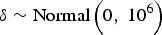 ${\bi \delta} \sim {\rm Normal}\left( {0,\; {10}^6} \right)$. The model was fitted using Integrated Nested Laplace Approximations (INLA; implemented through the R-INLA package available at http://www.r-inla.org).
The pre-vaccination period used in the analysis was chosen as the longest possible time-window without destabilising events that could potentially affect disease incidence, such as World War II (1939–1945). For diphtheria, the model was thus fitted to notified cases in the pre-vaccination period July 1948 to December 1952, after the epidemics during the World War II had died down. For poliomyelitis, this was the period January 1947 to July 1957 (the vaccination programme was implemented throughout the second half of 1957), and for mumps January 1976 through December 1986. The rubella vaccination programme was implemented in two stages: first 11-year-old girls in 1974, followed in 1987 by girls and boys age 14 months and 9 years. Two models were therefore fitted for rubella. The first model was fitted to the period January 1951 through December 1973, when no vaccination took place. The second model was fitted to the period January 1974 through December 1986, when only 11-year-old girls were vaccinated. We varied the length of the pre-vaccination period, and in some instances model formulation, used for fitting our models, to investigate its impact on our results (see Fig. S6).
Constructing counterfactuals
Each model was inspected for statistically significant exponential linear trends (indicated by coefficient β 1 in the model). To reduce uncertainty in the counterfactuals, any non-significant trend term was removed and the model refitted. We focused on the impact of vaccination programmes on disease notifications in the first 13 years after a vaccination programme was introduced. We choose 13 years as this is the time between the start of mass vaccination against rubella for 11-year-old girls in 1974 and the switch to universal vaccination for both boys and girls in 1987 (for mumps the extrapolation period was slightly shorter as mumps was not a notifiable disease from April 1999 until June 2008). The parameter estimates from the fitted models were used to construct counterfactuals (i.e. the situation if no vaccination programme had been implemented) by drawing 10 000 samples from the posterior distributions of the expected value μ t for each month t. The median and 95% credible intervals were derived from the distributions of posterior samples. All statistical analyses were performed using R Statistical Software (Version 3.2.0; R Foundation for Statistical Computing, Vienna, Austria).
Results
Figure 1a–d show the case notification time series of diphtheria, poliomyelitis, mumps and rubella, along with the vaccination coverage. Diphtheria showed regular outbreaks each year and the incidence declined prior to World War II, during which several outbreaks occurred. After mass vaccination started, notifications declined to near zero levels. Poliomyelitis showed irregular outbreaks and after the start of mass vaccination few outbreaks occurred. Mumps notifications showed a gradual decline and stabilised at low levels after the start of mass vaccination. In 2010, a resurgence of mumps occurred after mandatory notification resumed in 2008. Similar to poliomyelitis, rubella showed irregular outbreaks, and since the vaccination programme was extended to include boys and girls in 1987 nearly no cases of rubella were reported. For each vaccine-preventable disease, vaccination coverage increases rapidly to well above 90% or was already high at the start of the programme.
Notified monthly cases for (a) diphtheria, (b) poliomyelitis, (c) mumps and (d) rubella, the Netherlands, 1919–2015. Notified cases are shown in black, grey areas represent periods of missing data. Dashed line indicates vaccination coverage and represents the coverage at 11 months of age for diphtheria and poliomyelitis (the primary series and first booster) and at 14 months of age for mumps. For rubella, the dashed line shows the coverage at 11 years of age up to 1977 and the coverage at 14 months of age thereafter; no vaccination data is available for cohorts born prior to 1970 and for the cohorts 1978–1984.

Each vaccine-preventable disease showed a seasonal cycle with peaks predominantly during fall and winter (Fig. S1–S5). In the pre-vaccination period, poliomyelitis showed a strong 4-year cycle in major epidemics, and mumps showed a three-year cycle. We found a 4-year cycle for rubella before mass vaccination; after mass vaccinations started for 11-year-old girls, a three-year cycle became apparent as well. For diphtheria, the pre-vaccination period used for fitting was too short to adequately assess the presence of periodicities other than an annual cycle. Using harmonic terms, these annual and multi-year cycles were incorporated in the regression models. The final models are presented in Table S1 and model selection in Tables S2–S6.
Figure 2 show model fits to pre-vaccination notification data as well as the expected notified cases had vaccination programmes not been implemented. Each model showed a good visual fit to the pre-vaccination data. Diphtheria and mumps exhibited an exponential decline in the pre-vaccination period with a median monthly decline of −0.52% (95% credible interval (CI) −0.89 to −0.17) and −0.90% (95% CI −1.22 to −0.56), respectively (Table 1). We did not find a trend for poliomyelitis (median monthly decline −0.62%, with a 95% CI −0.67 to 1.83). For rubella, no trend was observed before the implementation of mass vaccination for 11-year-old girls (median monthly decline of −0.10%, 95% CI −0.48 to 0.28). However, after the start of vaccination and before the transition to MMR in 1987, there was a trend with a decline of −1.44% (95% CI −2.10 to −0.85). Posterior distributions for the expected number of notified cases in the counterfactual showed broad credible intervals but overall mimicked pre-vaccination patterns well.
Notified monthly cases, model fits and counterfactual for (a) diphtheria, (b) poliomyelitis, (c) mumps, (d) rubella restricted vaccination programme of 11-year-old girls and (e) rubella extended vaccination programme of both boys and girls at 14 months and 9 years of age, the Netherlands. Observed notified cases are shown in black, median model fit is represented by the grey dashed line, and 95% credible interval in grey shaded area; vertical solid lines indicate the start of mass vaccination. Extrapolated model results for pre-vaccination period into the vaccination period are indicated by grey dashed line with 95% credible interval.

Impact of vaccination programmes in the first years following the implementation of mass vaccination, the Netherlands

Log-linear Poisson regression models were fit to pre-vaccination notified cases of diphtheria, poliomyelitis, mumps, and rubella. Models took into account secular trends, auto-correlation and harmonic, seasonal, and multi-annual cycles.
CI, credible interval.
a For mumps the counterfactual period is slightly shorter than 13 years because mumps was not a notifiable disease between March 1999 and June 2008.
b For rubella two models were fitted: one to the period prior to mass vaccination of 11-year-old girls in 1974 (the restricted programme), and another to the period following this restricted programme but prior to extension with the measles–mumps–rubella vaccine in 1987 to both boys and girls of 14 months of age and revaccination at 9 years of age.
In the first 13 years after diphtheria mass vaccinations started, a median of 18 900 (95% CI 12000–28600) notified cases were averted (Table 1). For poliomyelitis, this was 5000 (95% CI 2200–13500) and for mumps 1800 (95% CI 1000–3200). Vaccination of 11-year-old girls against rubella averted a median 13 700 (95% CI 1400–38300) cases. Switching to the extended programme averted 700 (95% CI 80–2300) cases in the first 13 years. In terms of overall effectiveness, 82.4% (95% CI 74.9–87.6) of cases have been averted by mass vaccination against diphtheria. For poliomyelitis this was 92.9% (95% CI: 85.0–97.2), for mumps 79.1% (95% CI 67.1–87.4), for the restricted vaccination programme against rubella 49.9% (95% CI: 9.3–73.5) and for the extended programme 68.1% (95% CI 19.4–87.3). Varying the pre-vaccination period used for fitting the models for diphtheria, poliomyelitis and mumps did not substantially impact our results (Fig. S6). For rubella, limiting the fitting period to 1969–1974 and 1976–1987 or shorter resulted in credible intervals for the number of cases averted that overlap with zero.
Discussion
Our analysis shows a substantial impact of mass vaccination programmes against diphtheria, poliomyelitis, mumps and rubella on the number of notified cases in the first 13 years following mass vaccinations in the Netherlands. Our findings are in line with other studies on the population-level impact of vaccination programmes in the Netherlands and other countries in that we show vaccination programmes have been highly effective. Contrary to many pre- vs. post-implementation comparisons for long-standing vaccination programmes, we take secular trends into account and thereby provide a more accurate representation of the cases averted by vaccination [Reference Roush and Murphy20, Reference van Panhuis21, Reference Gomes, Gomes and Paulo26, Reference Peltola27].
Notifications of diphtheria and mumps were already declining before the implementation of mass vaccinations. This was not the case for poliomyelitis and rubella. For diphtheria, this decline may be due to unregistered vaccination before the start of mass vaccination; vaccination against diphtheria was already widespread before mass vaccinations started in 1953 [Reference Hoogendoorn28]. Despite this early uptake, major diphtheria epidemics swept across the Netherlands during the World War II (Fig. 1). Another reason for the decline in the post-war period may be that the observed decline is due to the aftermath of these war-time epidemics.
Other factors than vaccination could have contributed to the decline in notified cases as well. During the 20th century, the Netherlands experienced several sociodemographic, epidemiologic and economic transitions characterised by improvements in nutritional status, hygiene, housing conditions and medical care. These changes are reflected in the decrease in mortality from infectious diseases, including vaccine-preventable disease, in the late 19th and early 20th century [Reference Wolleswinkel-van den Bosch29–Reference Querido31]. However, these factors generally have gradual effects; the sudden and rapid decline in notified cases after the start of mass vaccination, suggests that vaccination played a major role. We are unsure as to why diphtheria and mumps showed a gradual decline over time, whereas polio and rubella did not. Further study of pre-vaccination patterns of these diseases and comparison with other (non-vaccine-preventable) infectious diseases could elucidate this conundrum.
It is unlikely that the pre-vaccination downward trends for diphtheria and mumps would hold on the long-run in the absence of vaccination. As the naturally acquired immunity would decline outbreaks become more likely, and consequently, the incidence of disease may have been higher than our model extrapolations. Similarly, the resurgence of mumps in 2010 is likely due to gradual loss of population-immunity over the preceding period of high vaccination coverage, and cannot be explained by our model. Had vaccination not been implemented, this resurgence may have been substantially weaker. Such questions would better be addressed with SEIR-type models, trying to unravel the mechanisms of loss of immunity. Because our models do not directly account for the population-immunity we restricted our extrapolation to the early years following vaccine implementation. Nevertheless, the estimated impact of vaccination programmes for diphtheria, mumps and rubella (after the switch to universal vaccination) is likely underestimated.
We did not take underreporting of cases into account and implicitly assumed a constant reporting rate over time. Although difficult to verify, underreporting may have changed over time, especially around the start of a vaccination programme and the years thereafter. It is possible that underreporting increased as diseases became rarer and people less familiar with them. We would then overestimate the impact of vaccination programmes. The opposite is also possible: underreporting would decline as a result of an increased focus on these diseases. As far as we know, there were no major changes in case definitions or the registration of notifications around the time vaccination programmes started. Because the magnitude and direction of a potential change in reporting rates are unknown, we did not take it into account. More complex mathematical models, tracking the number of infected and susceptible individuals in the population could be used to estimate the amount of underreporting [Reference Wallinga, Teunis and Kretzschmar32, Reference Metcalf33].
We could not take the geographic spread of notified cases into account. This may be important as the Netherlands shows regions of distinct vaccination coverage heterogeneity, with areas of low-vaccination coverage where people refuse vaccination based on religious beliefs [Reference Knol6, Reference Wielders12, Reference van den Hof34]. It is likely that many of the reported cases in the vaccination era originate from these areas. Our purpose in this study was to quantify the population-level effectiveness of vaccination programmes as a whole, but it would be informative to perform similar analyses on regional data and to stratify the effectiveness by coverage level. Such analyses require detailed information on the geographic location of notified cases, which are unfortunately not yet available for the Netherlands.
A future study could focus on the severity of infection and the impact of vaccination programmes on disease burden. For most infectious diseases a major part of the burden is associated with long-term sequelae such as encephalitis, meningitis and hearing loss in the case of mumps, paralysis in the case of poliomyelitis and congenital defects in the case of rubella [Reference Plotkin, Orenstein and Offit35]. Although notified cases tend to be more severe, we lacked access to detailed information on the severity or age of notified cases. We, therefore, did not assess the morbidity burden averted by vaccination programmes. Recent studies in England showed considerable declines in measles and mumps hospital admissions, encephalitis and viral meningitis after the introduction of MMR vaccination in 1988 [Reference Iro36–Reference Martin38]. Similar reductions are likely to be present in the Dutch situation as well.
Maintaining high vaccination coverage is important to limit transmission of vaccine-preventable diseases and prevent their resurgence. Continuous monitoring and evaluation of vaccination programmes are therefore important. However, our scientific understanding of the dynamics of disease transmission, as well as the evaluation of disease-control programmes and public health education efforts, are hampered by a lack of historical infectious disease data repositories with sufficient temporal and geographic resolution [Reference van Panhuis21]. In an earlier approach to solve this problem, Panhuis et al. constructed a comprehensive database—aptly named Project Tycho – on infectious disease notifications in the USA and estimated the impact of mass vaccination programmes [Reference van Panhuis21]. Here we extended on their work for the situation in the Netherlands using a more advanced model taking autocorrelation and secular trends into account.
In summary, we evaluated the early impact of mass vaccination programmes against diphtheria, poliomyelitis, mumps and rubella in the Netherlands. This study reveals their effectiveness in a number of averted cases and provides additional insight into their overall population-level impact and importance to public health.
Acknowledgements
This work was supported by the Dutch Ministry of Health, Welfare and Sport, the Netherlands. The funders had no role in study design, data collection and analysis, interpretation of data, decision to publish or preparation of the manuscript.
Declaration of Interest
M.J. Postma received grants and honoraria from various pharmaceutical companies, including GlaxoSmithKline, Pfizer and Sanofi Pasteur MSD, who are potentially interested in the subject matter of this Article. There are no other potential conflicts of interest.
Supplementary material
The supplementary material for this article can be found at https://doi.org/10.1017/S0950268818000481



