

In 2023, Zimbabwe held an election in which the winning candidate, Emmerson Mnangagwa from ZANU-PF, defeated Nelson Chamisa from the Citizens Coalition for Change by 52.60 percent to 44.03 percent. What was most telling about this election was not that the margin of victory was similar to 2018, when the same candidates faced off, or that SADC observers pointed out serious irregularities in the voting process.Footnote 1 Instead, what was notable was the continuation of Emmerson Mnangagwa’s presidency, and in turn, ZANU-PF dominance was an afterthought by many observers and neighboring states.Footnote 2 Even in the Southern African region, where democratic consolidation has been difficult, the ease with which Mnangagwa could stay in office, largely unchallenged, would be hard to envision elsewhere but seemed inevitable in Zimbabwe. Thirteen years earlier, in 2006, the most extensive diamond discovery in over 100 years occurred in the Marange region in eastern Zimbabwe. This rapid increase in the once virtually nonexistent Zimbabwean diamond sector has led to speculation that, in the future, a fourth of the world’s diamond production could be produced in Zimbabwe.Footnote 3
To understand the institutionalized corruption and military interference that has led to the dominance of the Mnangagwa faction and general decline of Zimbabwean democratic institutions, further solidified in the election of 2023, it is essential to understand how the role of a previously unrealized diamond sector before 2006 became a vast windfall of wealth for factions within ZANU-PF and ultimately contributed to continued ZANU-PF rule as seemingly inevitable, even as democratic institutions and state capacity decline.
The central question of this study is: Why, in contrast to other states in Southern Africa, have Zimbabwean democratic institutions stagnated or even declined since independence in 1980? Given just about every major indicator, Zimbabwean institutions have become less democratic than other comparable states in Southern Africa, such as Botswana, Namibia, South Africa, and Zambia.Footnote 4 Compared to these states, Zimbabwe now has by far the highest level of institutionalized corruption and military involvement in politics, culminating in a successful coup in 2017.Footnote 5 This is despite Zimbabwe having a comparatively high level of democratic institutions, living standards, and state capacity well into the 1990s.Footnote 6 While other states in Southern Africa have faced many of the same socio-economic challenges since the 1990s and have often lacked the state capacity to deal with them, state institutions in Zimbabwe have taken a distinctly less democratic course in which state capacity has rapidly declined. To borrow a metaphor used by Levitsky and Ziblatt (Reference Levitsky and Ziblatt2019) to describe the Trump administration and democracy during his first term, while Botswana, Namibia, South Africa, and Zambia have all, to various degrees, been like a race car constantly running against the rails of “democratization” Zimbabwe is the only state to go completely off the rails.
This research argues that the large number of alluvial diamonds discovered in 2006 quickly led to a resource boom in the previously minimal diamond sector, which should be central to any account explaining Zimbabwe’s modern political economy and institutional nature. This research shows that diamond wealth has contributed to an extreme case of the resource curse in Zimbabwe that has negatively impacted democratic institutions. Consistent with previous literature that has predominantly examined the oil sector (Collier and Hoeffler Reference Collier and Hoeffler1998; Collier, Hoeffler, and Rohner Reference Collier, Hoeffler and Rohner2009; Jensen and Wantchekon Reference Jensen and Wantchekon2004; Karl Reference Karl1997; Ross Reference Ross2001, Reference Ross2003, Reference Ross2008, Reference Ross2012, Reference Ross2015; Sachs and Warner Reference Sachs and Warner2001), this study finds that diamond wealth contributes to many dynamics associated with the resource curse. However, diamond wealth, particularly the diffuse-distant type of alluvial diamond mining in Zimbabwe (Le Billon Reference Le Billon2001), and the timing of the resource boom that led to a vast amount of previously unrealized resource wealth entering into Zimbabwe’s political economy, led to an ongoing unique governance challenge that contributed to Zimbabwe being at the far end of the “bell-curve” even in comparison to other states in which resource curse dynamics are clearly present. While Zimbabwe would likely face many of the same problems and issues with democratic consolidation as neighboring states do, even without diamond wealth, the economic choices and policies available to political actors have been shaped by the rapid inflow of proceeds from the diamond sector in a way that has undermined state capacity and democratic institutions. Furthermore, in addition to sanctions, dependence on the resource sector has constrained political actors in choosing which foreign states to partner with. Thus, providing the conditions in which Zimbabwe has turned to trade with China, Russia, and the United Arab Emirates in the diamond sector and lessening pressure to democratize.Footnote 7
Rapid growth in diamond wealth has had widespread implications for Zimbabwe’s political economy and institutional structure. In this study, I will examine how the rapid growth of Zimbabwe’s diamond sector has influenced political institutions. Recent books and articles on Zimbabwe’s politics have speculated that diamond wealth is a game-changer (Alao Reference Alao2012; Bratton Reference Bratton2014; Compagnon Reference Compagnon2011; Gallagher Reference Gallagher2017; Kabwato Reference Kabwato2012; Kavanagh Reference Kavanagh2014; Ndawana and Nganje Reference Ndawana and Nganje2024; Ndlovu-Gatsheni and Ruhanya Reference Ndlovu-Gatsheni and Pedzisai2020; Southhall Reference Southhall2013), but there are few large scale studies on this phenomenon. These studies have important insights into Zimbabwe’s political system but do not specifically focus on the diamond trade or resource sector. Thus, filling this gap and gaining a better understanding of the relationship between resource wealth and the institutional trajectory that can result is the goal of this study.
Since diamonds played only a minimal role in the Zimbabwean economy before 2006 and the government has pursued many different strategies in the diamond sector since, this case provides an ideal natural experiment for understanding variation in diamond sector strategy and institutional trajectory. Natural resource wealth has led to a wide variation in outcomes for states. In some cases, natural resource wealth can be positive for states, as economic development, rising salaries, infrastructure, and political stability benefit from the economic base that natural resource wealth can provide. Some research on the resource sector would predict that despite apparent problems in Zimbabwe’s diamond sector, the state is still better off finding diamonds than otherwise (Dunning Reference Dunning2005; Heilbrunn Reference Heilbrunn2014; Luong and Weinthal Reference Luong and Weinthal2010; Smith Reference Smith2004). This research explores this possibility but finds that the case of Zimbabwe is inconsistent with the literature’s hypothesis. On the other hand, there are also many countries where natural resource wealth has led to weak institutions, economic stagnation, and perpetual conflict, and Zimbabwe falls into this category.
Previously, most research on the resource curse has gone into how oil wealth influences state institutions, but as Ross (Reference Ross2006, 296) points out, “we need more work on the puzzle of non-fuel minerals.” Furthermore, Ross (2004, 349) identifies a gap in the literature by saying, “the link between non-fuel minerals and civil war is ambiguous, in part because mineral wealth has received less scrutiny than oil wealth.” This shows the need for research that looks in-depth at the relationship between diamonds and political institutions to see whether theoretical arguments made by scholars examining the oil sector extend to other resource sectors as well. Here, the ownership structure in Zimbabwe’s diamond trade, the mode of exchange, and the influence of opposition political parties will be systematically examined to understand the relationship between diamond wealth and democratic institutions. These findings will be compared with other states in the Southern African region, predominantly Botswana, Namibia, South Africa, and Zambia, to explain variation in both resource sector politics and democratic institutions between states and within specific states over time. Zimbabwe’s case is ideal for developing a theoretical basis for understanding how natural resources influence states as it varies considerably both from comparable neighboring states and temporally within domestic politics. Thus, explaining what is different about Zimbabwe and how different policies in the diamond sector have contributed to varying outcomes in political institutions over time is the central goal of this study.
Diamonds gave ZANU-PF factions a way to fund themselves and gain support from foreign autocratic regimes, especially China and Russia. This study will demonstrate that diamond wealth gave factions within ZANU-PF options to stay in power unavailable to other ruling parties in the region. Without the options made available by the massive inflow of diamond wealth, it is far less likely that the Mugabe administration and ZANU-PF would have been able to perpetuate their rule, particularly during the crucial 2008 election and after the coup that led to the transition from Mugabe to Mnangagwa.
While diamonds shaped the institutional choices of political actors after 2006, the political context that ZANU-PF elites found themselves in also shaped the diamond sector. While it would appear as though diamond wealth would be generally stable, especially once diamonds are discovered, this is in no way the case as their political relevance or opportunities for diamond wealth can be shaped by the institutional environment as well.Footnote 8
Low-Capacity Democracy in Zimbabwe
At independence in 1980, initially, Zimbabwe was set up to be a competitive multiparty democracy. However, in 1987, the two largest parties, ZAPU and ZANU, merged to form ZANU-PF, the dominant political actor. Much international media attention has focused on Robert Mugabe. While the president’s office is Zimbabwe’s most powerful political institution, factions within ZANU-PF have been the most consistent force that has shaped socioeconomic outcomes. During Mugabe’s presidency, he often played factions off against each other. He was somewhat constrained or emboldened by the power distribution between factions during his nearly forty-year rule. Particularly during the crisis surrounding the 2008 election, the conditions that would have brought the downfall of most governments were present. However, ZANU-PF navigated the GNU from 2009–2013 and used its hold on diamond wealth to perpetuate its hold on power, an outcome that may have even surprised those within ZANU-PF (Kabwato Reference Kabwato2012).
During Mugabe’s tenure, three factions became increasingly important, especially since the post-2006 period. One was the Mujuru faction, led by the former First Vice President from 2004 to 2014, Joice Mujuru, and her husband, a former Commander of the Zimbabwe Defence Forces from 1981 to 1992, who died in 2011 Solomon Mujuru. Another was the Mnangagwa faction, led by current president Emmerson Mnangagwa. This faction used influence in the military and increased economic power to stage a successful coup in November 2017 and end the Mugabe presidency. Finally, the G40 faction led by Robert Mugabe’s wife, Grace Mugabe, became increasingly important in the years leading up to the 2017 coup, especially as Robert Mugabe appeared to be increasingly siding with them.
The rivalry between ZANU-PF, the Movement for Democratic Change (MDC), and its successor, the Citizens Coalition for Change (CCC), has often gotten much media attention, especially during the 2009–2013 unity government period. However, even when the MDC was part of the government, the party’s influence on the resource sector was consistently hampered by ZANU-PF. Nonetheless, the MDC and CCC have had a wide range of support. In 2018, MDC party nominee Nelson Chamisa narrowly lost an election with significant irregularities (Malunga Reference Malunga2018a, Reference Malunga2018b). In 2023, Chamisa would lose again as the CCC candidate by a conspicuously similar margin, with many of the same irregularities. The fact that an opposition party exists in Zimbabwe that can attract a sizeable number of voters has probably been the most relevant way to put pressure on different factions within ZANU-PF to pursue particular policies. Also, at times, factions within ZANU-PF have seen it as being in their interest to take a more favorable line toward the MDC and CCC to gain support from foreign interests. So while the MDC and CCC have had minimal institutional power, except notably during the 2009–2013 unity government and some periods through the legislature, the parties have mattered as a focal point to those who oppose ZANU-PF rule and a significant outlet in which government policies have been criticized.
While initially, there was some enthusiasm toward the Mnangagwa presidency, given Mugabe’s longstanding controversial rule, this soon changed after a contested election in 2018 and a general economic decline (Ndlovu-Gatsheni and Ruhanya Reference Ndlovu-Gatsheni and Pedzisai2020). The election in 2023 was, in a sense, even more controversial after delays in the opposition party CCC’s stronghold of Harare on election day, a surprise announcement of election results similar to those of 2018 in the middle of the night, and SADC monitors arguing that the election had significant irregularities (SADC 2023). Nonetheless, likely fatigue from neighboring countries and a general sense of inevitability of the continuation of ZANU-PF rule led to the 2023 election lacking the international attention that past elections have had, especially those in 2008 and 2018. Likely, the changing structure of the Zimbabwean economy in recent years under the Mnangagwa presidency, along with closer economic ties to Russia and China, played a role in this.
The Mnangagwa presidency has been viewed as more authoritarian and tied to the military than even Mugabe’s rule was. Constantine Chiwenga, a military general who was central in orchestrating the coup that removed Mugabe from power, became the first vice president in December 2017. Chiwenga has become the rival faction leader with extensive economic interests and is seen as a likely candidate to replace Mnangagwa (Mhaka Reference Mhaka2018), although this has become less likely after Mnangagwa won another controversial election in 2023.
While Zimbabwe was already on a particular institutional trajectory by 2006, diamond wealth allowed factional competition within ZANU-PF to intensify, and institutional processes that were already underway intensified. Since 2006, diamond wealth has facilitated the conditions under which political elites have continuously competed for economic power and have seen political power as the continuation of economic power. Increasingly, public office is a continuation of an economic strategy, and officeholders see their positions in economic terms relative to other political factions, especially within ZANU-PF. This institutional process has accelerated even more after the removal of Mugabe in 2017. As former finance minister and MDC leader Tendai Biti said, “Before with President Mugabe it was power for the sake of power now the prime motive of attaining state power is to continue extracting to continue personal accumulation” (Mail and Guardian Reference Mail and Guardian2021).
In order to define institutions, this study will use a definition given by Tilly (Reference Tilly2007, 20) that differentiates between high and low-capacity democratic regimes:
High-capacity democratic: Frequent social movements, interest group activity, and political party mobilizations; formal consultations (including competitive elections) as high points of political activity; widespread state monitoring of public politics combined with relatively low levels of political violence.
Low-capacity democratic: As in high-capacity democratic regimes, frequent social movements, interest group activity, and political party mobilizations plus formal consultations (including competitive elections) as high points of political activity, but less effective state monitoring, higher involvement of semi-legal and illegal actors in public politics, and substantially higher levels of lethal violence in public politics.
This study will focus on two central continuums in this definition. One is the nature of institutions, be they democratic or authoritarian, and the other is capacity, either high-capacity or low-capacity. Some high-capacity states, such as Sweden or Japan, are also some of the most democratic; others, such as China or Cuba, are the most authoritarian. On the other hand, some low-capacity states, such as Angola and Mozambique, are clearly authoritarian. In contrast, others have some democratic institutions, albeit of lower quality than high-capacity democratic states, such as India or Indonesia.
Given this categorization, Zimbabwe and most states in Southern Africa fall clearly in the category of low-capacity democratic.Footnote 9 This study will primarily focus on these states: Botswana, Namibia, South Africa, and Zambia, which fall clearly into this category and are thus most comparable with Zimbabwe. Other states that are often included in the southern African region, such as Angola, Mozambique, and Eswatini, have never democratized and have most of their political power concentrated in the executive branch (Booth Reference Booth2019; Hodges Reference Hodges2004, Reference Hodges, Chabal and Vidal2008; De Oliveira Reference Oliveira and Soares2015; Pitcher Reference Pitcher2020), thus making them clear cases of low capacity authoritarian states that have stagnated mainly in this level of institutional development. However, as Zimbabwe has become more authoritarian over time, there have been more similarities, and while not focusing as much on these cases, some comparisons will be made when useful.
Post-1980, Zimbabwe has historically had some of the procedures associated with democracy: elections, opposition parties in parliament, a biased but sometimes independent judiciary, and some ability for the press to criticize the government. However, all these factors declined in recent years, especially since the end of the unity government in 2013 and even more so after Mnangagwa replaced Mugabe in 2017 and won a disputed election in 2018 and 2023.
The Opaque State
To build on the previous discussion of Zimbabwe’s low-capacity democratic institutions and to go further in explaining the nature of Zimbabwe’s institutions, this study introduces the idea of the opaque state to describe the Zimbabwean political economy, particularly in the diamond sector. To define the concept of an opaque state, the definition of institutions given by Hall and Taylor (Reference Hall and Taylor1996, 538) is useful: “the formal or informal procedures, routines, norms and conventions embedded in the organizational structure of the polity or political economy.” The opaque state is thus when these factors associated with institutions have been blurred largely beyond recognition, even to state actors themselves. This does not mean that opaque institutions are always totally unintelligible, just that they consistently and often deliberately lack transparency, are difficult to monitor and likely even more difficult to predict. This is particularly notable given the low-capacity democratic nature of Zimbabwe in that many voters, or for that matter, even those within government, do not understand institutional processes and are thus less likely to be able to hold political leaders to account, even if competitive elections take place. While most states lacking state capacity have poorly defined institutional processes, since 2006, Zimbabwe has been at the far end of this continuum, as any sense of policy predictability that may have existed has declined.
The idea of an opaque state is particularly useful for examining Zimbabwean political economy because of the vast size of the informal economy. While it is impossible to get a valid measure of the informal economy in Zimbabwe, most estimates have it as at least as large as the formal economy, possibly far larger (Mukwedeya Reference Mukwedeya2012; Sebele-Mpofu and Moyo Reference Sebele-Mpofu and Moyo2021). While an informal economy exists everywhere, Zimbabwe has one of the largest in the world (Chiumbu and Nyamanhindi Reference Chiumbu and Nyamanhindi2012; Makochekanwa Reference Makochekanwa2012). The informal economy is by far the biggest “employer” in the country, with estimates placing workers in the informal sector at 90 percent of the overall workforce (Dudzai and Wamara Reference Dudzai and Kiiza Wamara2021).
With the advent of sanctions on many elite politicians within ZANU-PF, at times, those working for them in the informal economy can even be viewed as “patriots” or “nationalists” (Masaka Reference Masaka2012). The inability to collect tax revenue from the large informal economy likely led to the Zimbabwean government’s decision to keep printing money to fund itself, leading to hyperinflation. This informal economy also often interacts with the formal economy. Thus, Zimbabwe is characterized by a deep web of economic interactions of varying legality, much of which avoids taxation or direct state regulation despite often having ties to political officials (Sebele-Mpofu and Moyo Reference Sebele-Mpofu and Moyo2021; Tanda and Genc Reference Tanda and Genc2024). At independence in 1980 through the 1990s, the informal economy in Zimbabwe was relatively small, maybe even under 10 percent, and likely did not reach the 50 percent level till well into the 2000s (Makochekanwa Reference Makochekanwa2012). Nonetheless, the informal economy has now become institutionalized, with the resource sector playing a predominant role, and this dynamic is likely to persist into the foreseeable future, thus contributing to the opacity of Zimbabwean institutions.
One way to view an opaque state is simply one in which “the left hand does not know what the right hand is doing,” even for those at the top of the political system and even less for ordinary citizens. A good example of this in the Zimbabwean context is when Mugabe met with Tsvangirai in 2008 and claimed little knowledge of electoral violence that had taken place between ZANU-PF and MDC supporters and that it was outside of his control, and it appears that Tsvangirai may have believed him (Barclay Reference Barclay2010; Holland Reference Holland2012). Furthermore, it was widely reported that Mugabe was willing to step down as president after losing in the first round of the 2008 election (McGreal Reference McGreal2008). However, the Mnangagwa faction, specifically then military chief Constantine Chiwenga (The Washington Post 2008), argued that the choice was not his alone and insisted he continue as president. By this period, Zimbabwe’s ruling party had become deeply factionalized. While the president in Zimbabwe is usually the most important political actor, the office lacks the unitary cohesion that exists in most neighboring states, as the balance of power between factions within ZANU-PF often determines what political preferences get reflected in policy in different regions of the country.
To further explain the concept of an opaque state, I will use a historical institutionalist approach, specifically focusing on the idea of “critical juncture” to research how the large diamond find in 2006 has influenced Zimbabwe’s political institutions. The general idea behind historical institutionalism is that “history matters” or that the institutional choices that actors make can constrain the feasible options that actors have in the future (Thelen Reference Thelen1999). Thus institutions can be “path dependent” in that they can be placed on a particular trajectory that will perpetuate itself over time until there is a “critical juncture” in which institutions will choose a different direction, which will then become “path dependent” (Thelen Reference Thelen1999).Footnote 10 Zimbabwe, before the early 2000s, was institutionally similar to neighboring countries, if not even further along. After some of the political dynamics that took place in the early 2000s, further accelerated by the large diamond find in 2006, Zimbabwean institutions became more opaque, thus representing an institutional critical juncture that has once again created a path-dependent process in which opaque low-capacity democracy persists.
Many of the characteristics of the alluvial diamond trade that make it difficult for any government to regulate, it is also difficult for any specific faction within ZANU-PF to maintain permanent control over the trade. Thus, the nature of alluvial diamonds contributes to the fractured nature of Zimbabwe’s ruling party. This can be contrasted with states in which oil wealth is the dominant resource in which it is easier for a single faction to maintain control of the trade. Even in cases where oil wealth has had a detrimental effect on a states institutional development, it has still often led to political stability in a relative sense. While a general lack of transparency is common in any resource sector, alluvial diamonds are unique because they allow a large amount of wealth to be moved in a small space with little accounting. Examining diamond smuggling is a big part of understanding the diamond trade in Zimbabwe, and official statistics only give a “bird’s-eye view” of the diamond trade. Diamond smuggling is, by definition, hard to measure. Still, it will nonetheless be examined thoroughly in this study. Some strategies or political dynamics in the diamond sector led to a higher level of diamond smuggling in some periods than others, particularly in 2006–2009 along the Mozambique border (Duri Reference Duri2012; Martin and Taylor Reference Martin and Taylor2010, Reference Martin and Taylor2012).
Diamonds in Zimbabwe
The mining sector has been essential to the institutional structure of states in Southern Africa. Zimbabwe has long been known for high levels of gold production, along with platinum group metals, chrome, coal, nickel, copper, and iron (Ministry of Mines and Mining Development 2021). Official output in the mining sector has varied over time, peaking for most resources in the 1990s and declining in the 2000s, except diamonds (Saunders Reference Saunders2008). In recent years, the gold sector has made a comeback, although much of this production is not included in official numbers (International Crisis Group 2020). This study will examine how the institutional trajectory brought about by a high level of mining in Zimbabwe influenced policy in the diamond sector and how rapidly growing diamond wealth changed Zimbabwe’s economy and political structure more broadly.
In a seminal paper, Le Billon (Reference Le Billon2001) lays out a four-part theory of how different political geographies in the resource sector can lead to different types of conflict: point-proximate, point-distant, diffuse-proximate, and diffuse-distant. Point resources are located in a contained area, often associated with large mining companies. In contrast, diffuse resources are spread out over a large geographical area and are often related to alluvial or informal mining. On the other hand, point resources are found near a state’s capital city or political power center, and diffuse resources are found where state capacity is weak. Diamond mining in Zimbabwe falls into the category of diffuse-distant in that diamonds are located over a large geographical area where state capacity is weak.Footnote 11
Despite the importance of mining to Zimbabwe’s socioeconomic development, minimal diamond production occurred until 2006. Zimbabwe was an initial member of the Kimberley Process, and there was one mine named River Ranch where diamonds were produced, but the diamond sector received little interest until 2006. Similar to other states in Southern Africa, De Beers historically had a dominant influence on Zimbabwe’s mining sector. Before 2006, De Beers was in control of diamond exploration in the Marange region, and some actors have long alleged that De Beers was already secretly mining for diamonds in the area (Martin and Taylor Reference Martin and Taylor2010, Reference Martin and Taylor2012). Briefly, in 2006, African Consolidated Resources was given the mining rights in Marange until it became clear that a high level of diamond wealth was located there. After this, the government set up a “monopsony” for diamonds and encouraged small-scale mining in the region, leading to a “diamond rush” as many miners traveled to the area to mine for diamonds (Martin and Taylor Reference Martin and Taylor2010, Reference Martin and Taylor2012).
In 2008, the Zimbabwean government pursued a different strategy through the Joint Officers Command (JOC), directly taking over the diamond field and mining for diamonds. At the same time, while forcing miners from the diamond fields, allegedly over 200 miners were killed. This led to international attention on Zimbabwe’s diamond trade and created the most significant crisis for the Kimberley Process certification scheme as an international agreement. While Zimbabwe joined the Kimberley Process in 2003, it received heavy scrutiny from the agreement during the 2008–2011 period. By mining diamonds directly, factions within ZANU-PF with close ties to the Zimbabwean military, mainly the Mnangagwa faction, appear to have benefited the most. However, the military was inefficient in mining for diamonds, smuggling continued, and international scrutiny led the government to end this policy in 2011 and allow private companies into the sector.
From 2011 to 2016 many private companies moved in to mine diamonds. Many, if not most, of these companies had been tied to different factions within ZANU-PF. Furthermore, similar to a broader pattern in the mining sector in Southern African states, a few Chinese-owned companies started to mine for diamonds on a large scale in the Marange region (Global Witness 2012a, 2012b). In a surprise move in 2016, the government decided to nationalize the diamond trade again, removing many privately owned companies from the diamond fields (Global Witness 2017).
While much of Zimbabwe’s diamond production since 2006 has been in the Marange region, there is one notable exception. The RZN Murowa diamond mine, which is majority owned by Rio Tinto, an Australian mining company under its subsidiary RioZim. The company’s official name and corporate strategy in Zimbabwe have changed periodically, such as from Murowa Diamonds to RZM Murowa (RZM Murowa Reference Murowa2024). Despite being small for a kimberlite mine (Kjarsgaard et al. Reference Kjarsgaard, de Wit and Heaman2022), Murowa has consistently produced gem quality diamonds and sold them on the global market. With all of its production from just one kimberlite mine, Murowa Diamonds has been the smallest active diamond company in Zimbabwe since 2018, behind the government-owned ZCDC, Chinese-owned Anjin, and Russian-owned Alrosa (ZELA 2022). The Murowa mine differs from diamonds produced in the Marange region in that it is a kimberlite mine, with much of the production coming from underground in a geographically compact area in the Midlands province (Kjarsgaard et al. Reference Kjarsgaard, de Wit and Heaman2022; Manduna 2023b). However, it is similar in that the mine opened in 2004 and began production at about the same time as the Marange diamond fields. Thus, while many of the governance challenges are not the same as with the vastly dispersed alluvial diamonds in the Marange diamond fields, production from this mine has been part of making Zimbabwe a large diamond producer, thus providing a useful point of comparison. Furthermore, Rio Tinto is active in many countries and resource sectors; thus, it is important to understand its varying roles in different political and economic contexts.Footnote 12
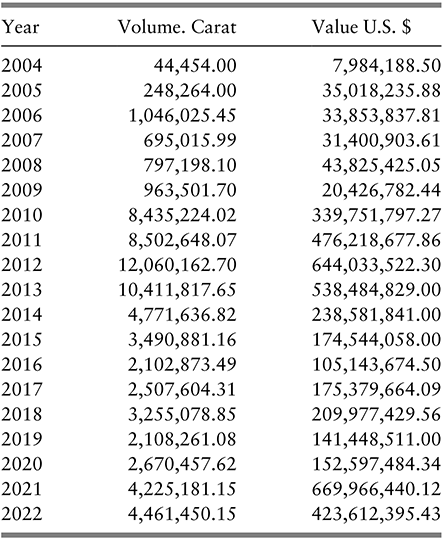
Diamond Wealth will be primarily defined as government dependence on proceeds from this sector. Furthermore, it will examine how certain groups stand to gain or lose from the diamond sector’s growth. While on the surface, diamond wealth should not vary drastically during different time periods, the case of Zimbabwe provides an example of how sharp increases and fluctuations in resource wealth can influence the state. Most of Zimbabwe’s diamond trade has occurred since 2006, so there is a precise critical juncture in diamond wealth. Furthermore, looking at Table 1.1, it is clear that since 2006, Zimbabwe’s official diamond production has significantly varied year to year, reflecting patterns in ownership structure and informal diamond mining that have also varied over time considerably.

To understand how Zimbabwe’s diamond wealth has influenced institutions three central areas will be focused on: ownership structure, mode of exchange, and involvement of opposition political parties. These phenomena will provide a lens through which to structure this study, as all three have experienced a high level of variation since diamonds were discovered in 2006. Furthermore, these are important points of comparison with other cases specifically: Botswana, Namibia, South Africa, and Zambia that have not experienced nearly as much variation in their resource sector during this time period.
Ownership structure in Zimbabwe’s diamond trade has changed at least six times since 2006, thus proving an interesting level of variation to explain. These changes often reflected the diamond wealth captured by different factions within ZANU-PF and the relative power distribution between factions during a particular time period. With ownership structure in the diamond trade, factions within ZANU-PF have been concerned with not just absolute gains but also relative gains in relation to other domestic political actors. Foreign companies have also played a prominent role in ownership structure in various time periods. Still, compared to other states in Southern Africa, they have been more beholden to domestic political actors. To better understand ownership structure, this study will use a four part framework developed by Luong and Weinthal (Reference Luong and Weinthal2006, 244–245): state ownership with control, state ownership without control, private domestic ownership and private foreign ownership.Footnote 13
At the state level, Zimbabwe has pursued aspects of all four of these ownership structures since 2006. Given the informal nature of alluvial diamond mining, and the unique ability for diamonds to be smuggled outside of state control at a high rate, ownership structure only captures some diamond production in any given period. Furthermore, factions within ZANU-PF have also coopted or even encouraged informal diamond mining (Towriss Reference Towriss2013). Thus, diamond production outside of formal state control has also become an institutional feature of Zimbabwean political economy. This study will examine how different strategies in ownership structure varied over time, how this influenced informal diamond mining, and the effect of these dynamics on the development of Zimbabwean institutions.
When studying modern African political economy, there is a need to understand not just the process by which goods are produced but also how goods are exchanged and the legal frameworks and political power that accompany certain patterns of exchange. Thus, this study will examine the mode of exchange in the diamond sector and examine the trade and export of Zimbabwean resources. As pointed out in seminal studies by Bates (Reference Bates1981, Reference Bates1987), to understand the domestic politics of African states, the mode of exchange between government actors, urban workers, and rural farmers is essential to understanding economic inefficiency in Africa. The same can be said of examining the relationship between government actors, international diamond companies, and local mine workers. It is how diamonds have been exchanged and the patterns of power and dependence that reinforce an unequal mode of exchange that place mineworkers and local communities in a situation where they get only a fraction of the wealth from diamonds that originate in these regions. While diamond exports were minimal in Zimbabwe until 2006, to some degree, the mode of exchange that has long existed in terms of raw material exports continued for diamonds as well.
Similar to other resources, such as gold, most diamonds mined in Zimbabwe have not been beneficiated for jewelry or industrial instruments, thus selling for a small fraction of their potential value (Nzenzema, Zinyama, and Nhema Reference Nzenzema, Zinyama and Nhema2015). This has left Zimbabwe’s diamond sector, like other Southern African states, dependent on exporting diamonds abroad at the low end of the value chain. Thus, this mode of exchange, which has continued past patterns in Zimbabwe, has also changed with significant exports of diamonds post-2006, is an important area to examine. Along this line, this study will examine the Kimberley Process to understand how this international regime’s behavior has influenced government policy and the mode of exchange since its implementation in 2003. While the Kimberley Process’s decision-making structure has mostly stayed the same, how it has responded to challenges from Zimbabwe has changed. This was particularly the case post-2008 when Zimbabwe became a crucial case for the identity of the international agreement as an institution, shaping the ability for Zimbabwe to access the global diamond market. Thus, this case represents an important area of inquiry into how an international regime can influence both local policy and the mode of exchange for exporting diamonds. Given the global nature of the diamond trade, especially in the Southern African region, where diamonds are usually exported without beneficiation, the mode of exchange is an essential part of understanding how diamond wealth has influenced state institutions in Zimbabwe.
Finally, this research will examine opposition to ZANU-PF rule and policy in the diamond sector. We will focus heavily on opposition political parties, specifically the largest MDC and its successor CCC, civil society groups, nongovernmental organizations, and independent media. While these groups have had little direct institutional or economic power in Zimbabwe, they have had support from significant parts of the population in Zimbabwe and are often favored by the international community. Factions within ZANU-PF have found it useful to co-opt popular policies or even act favorably toward the MDC to gain domestic and international legitimacy. Opposition to ZANU-PF policies in the diamond sector has brought about a wide-ranging critique and documentation of policies. Thus, a strong counternarrative to official policy in the diamond sector has been longstanding in Zimbabwe and has sometimes even influenced the sector directly, especially when factions within ZANU-PF have seen coopting a particular narrative as being to their advantage.
Research Design
For this study of Zimbabwe, I will use a case study methodology defined by Creswell (Reference Creswell2013, 97) as “a qualitative approach in which the investigator explores a real-life, contemporary bounded system (a case) or multiple bounded systems over time, through detailed, in-depth data collection involving multiple sources of information (e.g. observations, interviews, audiovisual material, and documents and reports), and reports a case description and case themes.” Case study methodology will be ideal in this case for explaining temporal variation and exploring what variables influence the relationship between diamond wealth and state institutions. Furthermore, this methodology will be useful in generalizing the findings from Zimbabwe to other states in which resource extraction is an essential factor of their economy, especially other states in Southern Africa. Using Seawright and Gerring (Reference Seawright and Gerring2008) choosing Zimbabwe as a case, in terms of diamond wealth and state institutions, can be thought of as an extreme case. It is an extreme case both in the vast amount of diamonds discovered mined over a short amount of time and in the trajectory of state institutions in comparison to neighboring states such as Botswana, South Africa, Namibia, and Zambia.
Case study methodology is particularly appropriate for studying resource curse dynamics and state institutions. Much previous research in the resource politics literature has used statistical techniques and country-level data to establish measures of central tendency or test particular variables. While these studies have been essential in understanding overall patterns in resource politics and for estimating the values of resource-wealthy states on variables of interest, there are limits to how much these studies can explain the complexity of any given case, given regional and measurement biases (Alssadek and Benhin Reference Alssadek and Benhin2023). Furthermore, Smith and Waldner (Reference Smith and Waldner2021, 78) persuasively argue that the inclusion of oil-wealthy Middle Eastern states often biases statistical studies on the resource curse and say, “Do not assume that the only credible method is cross-national statistics using perhaps the latest econometric technique in the elusive hope of establishing exogeneity. Case-study research and deep contextual knowledge have produced a great deal of what we think we know about the resource curse and should never be discounted.”
In a meta-analysis of the resource curse literature, Alssadek and Benhin (Reference Alssadek and Benhin2023, 13) sum up an essential gap in the literature that this study intends to elucidate in Southern Africa:
Most of the above mentioned studies have paid less attention to a comparative analysis of the resource curse phenomenon. They have focused on natural resource-rich countries as a whole or on one specific group. This is a gap in the literature and future studies could fill this gap by assessing and comparing the resource curse at different developmental levels (developing versus developed) and regional groupings (MENA, Latin America, Asia and Pacific, Europe and North America and SSA). Such assessment may help to identify which groups of countries experience the resource curse or blessing. The regional-level analysis also considers the homogeneity of countries regarding quality of institutions, language, and religion, thereby providing more precise and interesting findings.
Thus, along this line, this research examines Zimbabwe from a comparative perspective with other diamond-wealthy states in Southern Africa, particularly Botswana, Namibia, and South Africa in Chapter 6. This helps to understand the temporal variation within Zimbabwe’s diamond sector and how this is similar or different from other comparable cases.
Plan for the Book
This study will be organized as follows. Chapter 2 will present a comprehensive literature review that will outline the theoretical schools that examine the relationship between resource wealth and institutions. Next, I will focus on building on these past studies and contributing to them. Furthermore, there will be a discussion on the contribution of this study to the research on African politics, resource politics, and Zimbabwe specifically. Chapter 3 will focus on the temporal variation that has taken place in ownership structure in Zimbabwe’s diamond trade. Since ownership structure has varied significantly since 2006, within the same state, this provides a natural experiment that can help illuminate the relationship between diamond wealth, ownership structure, and institutional trajectory. In Southern Africa, ownership structure in the diamond sector has been consistent for most states, even across different regimes and historical periods. Thus, post-2006 Zimbabwe provides an interesting level of variation in ownership structure that is important to examine for understanding Zimbabwe’s trajectory in the diamond sector and the trajectory of the diamond sector in Southern African states more broadly. Given the mode of exchange for diamonds in Southern Africa, in which most are exported for only a fraction of their eventual value after beneficiation, this is a critical component in understanding the relationship between diamond wealth and institutions in Zimbabwe that will be examined in Chapter 4. To some degree, Zimbabwe’s diamond trade followed longstanding patterns. However, given the political dynamics since 2006, this changed where Zimbabwean diamonds have been exported to (Global Witness 2017). Furthermore, with the growth of Chinese companies in Southern Africa and with China as one of the world’s largest importers of diamonds, this is likely to be an essential dynamic in understanding diamond exports in the future. As the influence of foreign companies in Zimbabwe’s diamond sector has grown, this has likely affected institutions in Zimbabwe as well. By examining the Kimberley Process in this study, the goal will be to understand how an international agreement mediates the effect of diamond wealth on state institutions, by influencing the mode of exchange. While the Mugabe government is often notorious for ignoring international agreements, in the case of the Kimberley Process, it is notable that the Zimbabwean government had to change some of its policies to allow the trade of diamonds with other states in the agreement. Furthermore, factions within ZANU-PF could use the Kimberley Process as an opportunity to compete for market share and selectively choose policies in line with the Kimberley Process that benefited them. Thus, while the Kimberley Process is often viewed as a weak agreement, it has been a critical component of understanding the impact of diamond wealth on Zimbabwe’s institutions since 2006.
Factions within ZANU-PF have long dominated policy in the diamond sector. However, many actors have critiqued this within both the domestic political process of Zimbabwe and in the international community. Chapter 5 will focus on these dynamics and examine whether these efforts have changed state policy or made institutions more responsive to different stakeholders in the diamond sector. Furthermore, this study will try to understand the pathways through which actors outside of ZANU-PF can influence state policy or at least change the cost and benefits associated with different policies in Zimbabwe’s diamond trade. Here, civil society, nongovernmental organizations, media, and most importantly, the MDC on the diamond trade will be examined.
Chapter 6 will situate the case of Zimbabwe within the region of Southern Africa. Here, there will be a focus on other neighboring states with a large amount of diamond and resource wealth, particularly Botswana, Namibia, South Africa, and Zambia. The final chapter will compare and contrast Venezuala with Eritrea and Venezuela, two resource-wealthy states with some similarities to Zimbabwe. Furthermore, this chapter will examine what the Zimbabwean case would predict regarding the global relationship between resource wealth and state institutions. Is there something about diamonds or other nonfuel resources that is different in their influence on state structure, or have theories that have been developed to understand the relationship between oil and state structure apply more broadly as well?
Conclusion
While the relationship between oil wealth and state structure has received much attention in the academic literature, the relationship between other resources and state structure has received far less. Thus, this study hopes to fill this gap and better understand whether the theoretical development for understanding oil wealth and state structure apply more broadly. Given that Zimbabwe’s diamond find in 2006 was the largest in over 100 years (Zimwara Reference Zimwara2014) and the temporal variation in state policy since 2006, this case provides a straightforward natural experiment to understand better the role of nonfuel minerals on the institutional trajectory of states. By examining Zimbabwe’s ownership structure in the diamond trade, the global mode of exchange in the diamond trade, and democratic opposition to state policy, the case of Zimbabwe is ideal for understanding the mechanisms through which resource wealth can influence institutions. Thus, this study should inform academic debate and contribute more broadly to our understanding of African politics, international political economy, and resource politics.