


INTRODUCTION
The improvement of agricultural production around the world is a challenge that must be overcome by increasing crop yield, in order to guarantee food and energy supply. In this context, the soybean crop plays an important role since it is a source of food and energy and one of the major global commodities. Brazil, the USA and Argentina are the main producers. In these countries, soybean yield is affected by several abiotic and biotic factors leading to yield gaps. In the present study, the objectives were to present an overview of the yield gap concept and to determine the magnitude of soybean yield and yield gaps in the main producing regions in Brazil, their main causes and possible solutions to reduce these gaps and improve yields.
Food and energy security: land expansion and yield increase
Food, fibres and energy demand are increasing due to a growing population, which make agriculture a strategic activity in many countries around the world. The main challenge for agriculture in the near future is to produce more with less rural labour force, since 0·67 of population is going to live in cities in 2050 v. 0·46 in 2014, a value estimated by the FAO (2014). The other challenges for food, fibre and energy production are the efficient use of inputs and sustainable methods to adapt crops to climate change in order to maintain or increase yields (FAO 2009).
The future world food demand faces three major challenges: the world population will continue to rise: 9·55 billion people are estimated for 2050 (FAO 2014). The increase in the per capita income will lead to changes in people's diets, from 2860 kcal in 2015 to 3070 kcal in 2050 (Alexandratos & Bruinsma Reference Alexandratos and Bruinsma2012) – mainly towards more meat consumption – which further increases the pressure on land availability. Finally, continued competition exists for land allocated to bioenergy or food crops. Regardless, food production needs to increase by 70% until 2050. For this, it is necessary to create local policies, markets and food chains to improve food production at a regional level, reducing international trade and enabling bioenergy generation with the exceeding production in locations with high yields (FAO 2009). Bioenergy should be carefully considered in this context, since the IPPC (Reference Stocker, Qin, Plattner, Tignor, Allen, Boschung, Nauels, Xia, Bex and Midgley2013) classify bioenergy as having potential negative consequences for food production and supply.
In developing countries, land is still available for agricultural expansion, with appropriate soil and climate. Here, the challenges are associated with the dissemination of agro-technology and adapted management for obtaining higher yields. Among the developing regions around the world, Latin America is the one with the highest potential for agricultural land expansion (54%) in order to achieve the food, fibre and energy demand projected to 2050 (FAO 2014). However, land expansion for agricultural use often conflicts with contrary land use targets, such as conservation of natural resources, unique ecosystems, biodiversity and other ecosystem services. For this reason, these developing regions, which usually have a population increase higher than developed countries, will need to increase their crop yield in terms of marketable crop production per unit of area and time (Cassman Reference Cassman1999).
Increasing crop yield will remain a critical and essential component for a global strategy to secure food and energy supply while also protecting natural resources and environmental quality for future generations (Lobell et al. Reference Lobell, Cassman and Field2009). Brazil has a total area of 850 million hectares (ha). The legal Amazon Rainforest reserve and other natural biomes represent 503 million ha, while pastures and crops cover 211 and 71 million ha, respectively. Available land for agricultural expansion is estimated as c., 65 million ha (IBGE 2009), targeting expansion of agriculture mainly to degraded pasture and marginal lands.
Soybean is one of the main crops in Brazil, having huge social and economic importance. It is used as food, animal feed and to produce biodiesel and it is considered highly relevant to analyse its yield patterns in order to identify the magnitude and causes of yield gaps, and to look for possible technological solutions in the short, medium and long term.
Yield types and their conditioning factors
The relationship between different yield levels determines the yield gaps and their determining factors. Specific yield levels are used by different authors. Lobell et al. (Reference Lobell, Cassman and Field2009) used the highest yield as the definition of potential yield, followed by experimental yields, maximum farmer's yields and average farmer's yields (Yaar). Bhatia et al. (Reference Bhatia, Singh, Wani, Chauhan, Kesava Rao, Mishra and Srinivas2008) and Battisti et al. (Reference Battisti, Sentelhas and Pilau2012) classified yield levels as potential, attainable and actual, as also used by van Ittersum et al. (Reference van Ittersum, Cassman, Grassini, Wolf, Tittonell and Hochman2013), who used the term exploitable yield instead of attainable yield, showing that the difference between exploitable and actual yields is the maximum that the farmer can gain under rainfed conditions through better crop management. Liang et al. (Reference Liang, Carberry, Wang, Lu, Lu and Xia2011) used potential yield (Yp) and the maximum and minimum yields from field experiments for evaluating the importance of technology on crop systems. Hall et al. (Reference Hall, Feoli, Ingaramo and Balzarini2013) evaluated the yield gap by comparing Yp with yields from trial experiments, commercial field and reporting surveys at a county level.
Six different conceptual types of yields can be considered, based on previously cited work. The highest yield is the potential which has a theoretical characteristic, since it is difficult to reach in the field. Potential yield can be determined in different ways, but in general is assumed as yield obtained without growth limitations such as water, nutrients, pests, or diseases (Fig. 1), being influenced only by the interaction between the genotype and environmental factors, such as solar radiation, temperature and photoperiod (van Ittersum & Rabbinge Reference van Ittersum and Rabbinge1997).
Types of yield and respective production factors. Adapted from Rabbinge (Reference Rabbinge, Chadwick and Marsh1993); van Ittersum & Rabbinge (Reference van Ittersum and Rabbinge1997); Lobell et al. (Reference Lobell, Cassman and Field2009); Hall et al. (Reference Hall, Feoli, Ingaramo and Balzarini2013); van Ittersum et al. (Reference van Ittersum, Cassman, Grassini, Wolf, Tittonell and Hochman2013).

The Yp is determined or estimated by crop models or field experiments with all crop management factors under control and without water stress. When crop models are used, perfect management is assumed, without any limiting factors, while in field experiments it is necessary to have complete control of the environment in order for Yp not to be underestimated (Lobell et al. Reference Lobell, Cassman and Field2009; van Ittersum et al. Reference van Ittersum, Cassman, Grassini, Wolf, Tittonell and Hochman2013; Hoang Reference Hoang2013).
Following Yp, the next yield level is that cultivated under irrigation, including the best farmer's (Ybfi) and average farmer's (Yafi) yields, where the limiting (water stress) and reducing (crop management) factors are considered together with the determining factors. The differences between them are caused by crop management and irrigation scheduling (Fig. 1). The different levels of irrigation technology and crop management are important factors separating farmers in the two groups, the best with higher levels of technology (Ybfi) and the average with medium levels (Yafi). According to Hoang (Reference Hoang2013), factors such as type of labour and region of production are responsible for crop efficiency and farm infrastructure affecting the yield level.
The third yield level is attainable yield (Ya), which is limited only by water availability in the soil; it can also be called water-limited yield (Lobell et al. Reference Lobell, Cassman and Field2009). It is the Yp penalized by the water deficit, and thus influenced by soil water holding capacity, rainfall, evapotranspiration, surface slope and crop sensitivity to water deficit (Gilbert et al. Reference Gilbert, Holbrook, Zwieniecki, Sadok and Sinclair2011; Battisti & Sentelhas Reference Battisti and Sentelhas2015). Attainable yield is a theoretical value since it also depends on crop management. van Ittersum et al. (Reference van Ittersum, Cassman, Grassini, Wolf, Tittonell and Hochman2013) consider a lower yield level limited by water and nutrient availability, whereas crop models only consider nitrogen nutrition to penalize crop yield.
Below Ya, two further levels consider different factors of crop management: best farmer's yield (Yabr) and average farmer's yield (Yaar) for rainfed conditions. These yields are obtained when Ya is penalized by reducing factors associated with crop management, such as pest, disease and weed control, and soil preparation and fertilization. In conclusion, the final yield obtained in the field will be the result of the interaction of determining, limiting and reducing factors.
The Yp and Ya can be obtained from crop simulation models or from field experiments with optimum management. At this point, it is important to be aware that in field experiments, Yp only can be achieved once limiting factors are controlled. Considering that, Hochman et al. (Reference Hochman, Gobbett, Holzworth, McClelland, van Rees, Marinoni, Garcia and Horan2012) and van Ittersum et al. (Reference van Ittersum, Cassman, Grassini, Wolf, Tittonell and Hochman2013) recommend the use of a relative level, near to 80% of Yp or Ya, to represent what happens under irrigated or rainfed conditions, respectively.
Yield gap – definition, concepts and importance
The yield gap is the difference between different yield types for a specific condition considering spatial and temporal scales. It is important to look for what the researchers want to identify when considering the yield gap. In general, the yield gap is a value expressed by the difference between potential and the average farmers’ yields. So, in this case it is defined as the total yield gap, which includes all determining, limiting and reducing factors.
Figure 1 presents different types and levels of yield gap and the factors that affect them. For example, the difference between Yp and Yafi shows that the yield gap is due to sub-optimal crop management and irrigation scheduling. Rodrigues et al. (Reference Rodrigues, Martins, da Silva, Carlesso and Pereira2013a ) showed that irrigation management, water distribution uniformity, soil salinity, crop variety, soil-water conservation and fertility, pests and diseases can affect soybean yield. In particular, soybean Asian rust pressure is increased when the crop is irrigated.
In rainfed crops, the yield gap can be obtained by the difference between Ya and Yaar, since in this condition the maximum possible yield is Ya (van Ittersum et al. Reference van Ittersum, Cassman, Grassini, Wolf, Tittonell and Hochman2013). While the difference between Yp and Ya defines the yield losses caused by water deficit, the difference between Ya and Yaar shows how much of the losses are due to crop management. According to van Ittersum et al. (Reference van Ittersum, Cassman, Grassini, Wolf, Tittonell and Hochman2013), such an approach will depend on the type of Ya considered, i.e. limited only by water deficit or by water and nutrient restrictions.
The proposal to split farmer's yield into two types, with best and average levels of technology, defines a framework in which the farmers that employ a low standard of technology can compare their own performance with those that use higher levels of technology. This learning process can be enhanced by analysis of the best and average farmers’ yields, identifying the main differences in crop management between them. After that, actions to improve crop performance in the fields can be defined according to the investments required. In this kind of analysis, market, polices, infrastructure and institutional factors should also be evaluated to define the feasibility of the investments (van Ittersum et al. Reference van Ittersum, Cassman, Grassini, Wolf, Tittonell and Hochman2013).
Lobell et al. (Reference Lobell, Cassman and Field2009) described two main reasons for understanding yield gaps: firstly, it helps to inform projections of future yields for different regions and crops because close proximity of yields to their upper limits may indicate that growth rates are likely to slow in the future; and secondly, knowledge of factors that contribute to the yield gaps is useful for efficiently targeting efforts to increase yield and production. The focus is on reducing the yield gap in regions with greater potential than others to support higher yields in a sustainable manner, where potentials are associated with favourable climate, soil and access to technologies, such as irrigation (van Ittersum et al. Reference van Ittersum, Cassman, Grassini, Wolf, Tittonell and Hochman2013).
Soybean production in Brazil
Brazil is one the most important soybean producers in the world, representing >0·25 of the soybean market in 2011, with <0·25 of soybean cropping area in the world (Fig. 2). The total area cultivated in the world increased from 24 million ha in 1960 to 106 million ha in 2012, while in Brazil this increase was from 0·24 to 25 million ha. Such increase of the soybean area in Brazil was due to suitable growing conditions in the country for soybean production and for the expansion of the crop to the north (low latitudes), with the selection of cultivars less sensitive to photoperiod and with long juvenile periods (Destro et al. Reference Destro, Carpentieri-Pípolo, de Kiihl and de Almeida2001). The prolonged juvenile periods are important for low latitudes, allowing the crop to extend the vegetative phases, giving it more time to fix carbon and accumulate nitrogen, increasing Yp (Sinclair et al. Reference Sinclair, Neumaier, Farias and Nepomuceno2005).
Soybean area (a) and production (b) in Brazil and their relation with world area and production from 1961 to 2012. Source: FAO (2013).

One of the ways to evaluate the Brazilian performance for soybean production is by correlating the Brazil/world relative production and relative area (Fig. 3). Brazil has seen an increase in both production and area since 1961, however with yield increasing more than the production area. This trend is clear evidence that the yield gap reduction possibly occurred due to improvements in soil fertility, mechanization, better commodities prices, investment in research and development of new technologies, crop breeding and adoption of public policies such as agro-climatic risk zoning.
Relationships between Brazil/world relative soybean area and relative soybean production. Source: FAO (2013).

In Brazil, soybean is produced from the south to north, in 14 states (Table 1). The average yields from 1990 to 2011 varied considerably. The Mato Grosso state had the highest yield, with 2778 kg/ha, followed by Rondônia, Paraná, Distrito Federal and Goiás, with yields above the national average (2400 kg/ha). The lowest yield was in Rio Grande do Sul state, with 1880 kg/ha, which is associated with frequent droughts during neutral and negative El Niño Southern Oscillation (ENOS) events (Alberto et al. Reference Alberto, Streck, Heldwein, Buriol and Medeiros2006), when less rainfall is received in Southern Brazil (Berlato et al. Reference Berlato, Farenzena and Fontana2005).
Average soybean yield between 1990 and 2011, and yield, area and total production in the 2010/11 growing season in the main Brazilian production states

Source: IBGE (2013).
Total Brazilian soybean production was 82·2 million tonnes in 2013, with Mato Grosso, Paraná, Goiás, Mato Grosso do Sul and Rio Grande do Sul being responsible for c., 0·81 of it. It is important to highlight that land expansion for soybean production is limited in southern states (Rio Grande do Sul and Paraná), whereas in other states such as Mato Grosso it is still occurring and yield has increased substantially.
MATERIALS AND METHODS
A simple crop model was calibrated using crop yield and phenology data obtained from 17 different counties in the states of Rio Grande do Sul, Santa Catarina, Paraná, São Paulo and Mato Grosso do Sul, Brazil. Field experiments for soybean cultivar competition were developed by the Pro-Seeds Foundation between the crop seasons of 2008/09 and 2010/11, with 101 Brazilian soybean cultivars sown between 27 October and 24 December.
The FAO crop yield model Agroecological Zone (Kassam Reference Kassam1977) was used to estimate Yp, while the water deficit yield depletion model (Doorenbos & Kassam Reference Doorenbos and Kassam1979; Rao et al. Reference Rao, Sarma and Chander1988) was used to estimate Ya. The Yp was estimated considering only the interaction between the genotype and solar radiation, photoperiod and temperature, according to the following equation:
 $${\rm Yp} = \; \mathop \sum \limits_{i = 1}^m 1{\rm GP} \times C_{{\rm LAI}} \times C_{{\rm RESP}} \times C_{\rm H} \times (1 - C_{\rm W} )^{ - 1} $$
where Yp is in kg/ha; GP is gross photosynthesis (kg DM/ha day); C LAI is the depletion coefficient to leaf area index (LAI); C RESP is the depletion coefficient associated to the maintenance respiration process (function of the air temperature); C H is crop harvest index; C W is the water content in the harvested part of the plant; i is the day in the crop cycle; and m is the number of days of the crop cycle from sowing to harvesting, which was adjusted for each region (R. Battisti, personal communication). The crop cycle was adjusted for the main maturity groups of each region, ranging from early (Groups 6–7) in the southern locations to late (Groups 8–9) in northern locations.
Gross photosynthesis was estimated for the fraction of the day with clear (GPc) and overcast (GPo) sky, where daily GP was obtained from their sum; GPc and GPo are given by the following equations, adapted from Doorenbos & Kassam (Reference Doorenbos and Kassam1979):
 $${\rm GPc} = ({\rm 1}0{\rm 7} {\cdot} {\rm 2} + {\rm 8} {\cdot} {\rm 6}0{\rm 4} \times {\rm SRo}) \times {\rm cTc} \times (n/N)$$
 $${\rm GPo} = ({\rm 31} {\cdot} {\rm 7} + {\rm 5} {\cdot} {\rm 234} \times {\rm SRo}) \times {\rm cTo} \times ({\rm 1} - n/N)$$
where SRo is the extraterrestrial solar radiation (MJ/m2 day), and cTc and cTo are dimensionless coefficients associated with the efficiency of the photosynthetic process, being a function of the crop type and its metabolism to atmospheric CO2 fixation and temperature-dependent. These equations have been used with very good performance for soybean (Battisti & Sentelhas Reference Battisti and Sentelhas2015), maize (Andrioli & Sentelhas Reference Andrioli and Sentelhas2009) and sugarcane (Monteiro & Sentelhas Reference Monteiro and Sentelhas2014).
The value of C RESP was 0·5 when average temperature was >20 °C and 0·6 when average temperature was <20 °C (Doorenbos & Kassam Reference Doorenbos and Kassam1979). The CW index was considered as 13%, as recommended by seed companies for reducing losses during the storage process, whereas CH was taken as 0·33, obtained from the calibration process with mean actual yield for each location, using the same procedure of Battisti & Sentelhas (Reference Battisti and Sentelhas2015), and C LAI was of 0·4693 calculated to a maximum leaf area index of 4 during the crop cycle.
After calculating Yp, Ya was estimated by considering the effect of water deficit on crop growth, estimated using the equation presented by Doorenbos & Kassam (Reference Doorenbos and Kassam1979) and Rao et al. (Reference Rao, Sarma and Chander1988), with water deficit sensitivity index (Ky) values being calibrated until the lower absolute mean error between estimated and observed yield was observed:
 $${\rm Ya\; = \; Yp\;} \times \mathop \prod \limits_{i{\rm = 1}}^n a\left( {{\rm 1} - {\rm Ky}_i \times \left( {{\rm 1} - \displaystyle{{{\rm ETa}_i} \over {{\rm ETc}_i}}} \right)} \right)$$
where Ya is in kg/ha; ETa i is the actual evapotranspiration, determined through the crop water balance (Thornthwaite & Mather Reference Thornthwaite and Mather1955), which has inputs of rainfall, maximum crop evapotranspiration and soil water holding capacity; and ETc i is maximum crop evapotranspiration, which is the product between reference evapotranspiration, estimated by the Priestley & Taylor (Reference Priestley and Taylor1972) method, and kc for each i phase, to all n phenological phases, as follows: establishment (KcS−V2 = 0·56), vegetative growth (KcV2−R1 = 1·21), flowering/yield formation (KcR1−R5 = 1·5) and repining (KcR6−R8 = 0·9) (Farias et al. Reference Farias, Assad, de Almeida, Evangelista, Lazzarotto, Neumaier and Nepomuceno2001). Calibrated Ky for each crop phenological phase were: KyS−V2 = 0·06; KyV2−R1 = 0·17; KyR1−R5 = 0·89; KyR6−R8 = 0·08.
The representative soil type of each location was determined using the maps presented by IBGE (2012). The soil water holding capacity for each type of soil was determined by pedotransfer functions presented by Lopes-Assad et al. (Reference Lopes-Assad, Sans, Assad and Zullo2001) and Reichert et al. (Reference Reichert, Albuquerque, Kaiser, Reinert, Urach and Carlesso2009), having as inputs the clay, silt and sand contents.
The calibration process considered 984 actual soybean yield data, whereas the model performance was evaluated with 143 independent actual yield data. For evaluating the performance of the calibrated model the following indices and errors were used: coefficient of determination (R 2); agreement index (d); mean error (ME); mean absolute error (MAE); and mean absolute percentage error (MAPE) (Willmott et al. Reference Willmott, Ackleson, Davis, Feddema, Klink, Legates, O'Donnell and Rowe1985).
The yield gap was determined from the difference of attainable and actual (Yaar) yields in order to identify the yield gap caused by crop management and between Yp and Ya to identify the yield gap caused by water deficit. Potential and attainable yields were simulated for the main sowing window of each region (MAPA 2012). The weather data were obtained from the National Water Agency and National Institute of Meteorology, considering maximum and minimum air temperature, effective hours of sunshine and rainfall.
Actual yield were obtained from the Brazilian Geographical and Statistical Institute (IBGE) and Brazilian Food Supply Company (CONAB) for the period between 1980 and 2011. These data had their technological trend removed according to the procedure presented by Heinemann & Sentelhas (Reference Heinemann and Sentelhas2011). The evaluated locations and their respective states were: Cruz Alta, Rio Grande do Sul; Campos Novos, Santa Catarina; Campo Mourão, Paraná; Assis, São Paulo; Dourados, Mato Grosso do Sul; Uberaba, Minas Gerais; Jataí, Goiás; Formosa, Goiás; Correntina, Bahia; Primavera do Leste, Mato Grosso; Tapurah, Mato Grosso; Peixe, Tocantins; Bom Jesus, Piauí; Santana do Araguaia, Pará; and Balsas, Maranhão (Fig. 4).
Brazilian locations used in the present study for soybean yield gap estimates and their respective Köppen's climate classification. Adapted from Alvares et al. (Reference Alvares, Stape, Sentelhas, de Moraes Gonçalves and Sparovek2013). (Colour online).

The yield gap causes were determined based on the water deficit observed along the simulated crop cycles and by the difference between Yp and Ya. For the yield gap caused by crop management, expressed by the difference between attainable and actual yields, the main causes were identified through the literature, which make references to the problems faced by soybean growers in different parts of the country.
RESULTS
Model test
The results of the yield model calibration process for estimating soybean yield showed a very good performance, presenting good precision (R 2 = 0·76) and accuracy (d = 0·87). Figure 5 presents the results from the comparison between observed and estimated soybean attainable yields for the independent data set, including different locations, years and sowing dates. The results show that the model can be used to study soybean yield variability in Brazil, with MAE of 284 kg/ha, corresponding to MAPE of 8·4%. The tendency was towards a slight overestimation, with ME of 7 kg/ha. The average estimated yield was 3544 kg/ha while the observed yields averaged 3351 kg/ha.
Relationship between observed and estimated attainable yields (Ya) for Brazilian soybean cultivars, with groups of maturity ranging from early (Groups 6–7) to late (Groups 8–9).

Soybean yield gaps in Brazil – magnitude and causes
Yield gaps were estimated with the yields defined as potential, attainable and actual. The probability of occurrence of these yields and the respective yield gaps are presented in Fig. 6 for 15 regions, as averages of 32 years (1980–2011). The results show that in more than half of these years, Yp exceeded 4709 kg/ha, while the mean Ya was 3428 kg/ha and the mean actual yield was 3028 kg/ha. For the higher values, potential, attainable and actual yields were greater than 5332, 3866 and 3347 kg/ha, respectively (Fig. 6a ), in 0·10 of the years.
Probability of occurrence of actual, attainable and potential soybean yields (a) and causal factors for the yield gap (b), in the fifteen studied locations in Brazil.

Differences between attainable and actual yields were, on average, 464 kg/ha, which represents the yield gap caused by crop management, while the yield gap caused by water deficit, which is estimated by the difference between Yp and Ya, was 1378 kg/ha. The probabilities of occurrence of yield gaps are shown in Fig. 6b . The maximum yield gaps reached 2048 and 4053 kg/ha when caused by crop management and by extreme water deficit, respectively. Negative probability values of yield gap by crop management were observed, which may be related to inconsistencies or in the weather data used or in the yields reported by IBGE and CONAB. This kind of problem was also observed by van Ittersum et al. (Reference van Ittersum, Cassman, Grassini, Wolf, Tittonell and Hochman2013), evaluating the yield gaps for maize and wheat at a global level.
In relative terms, the average soybean yield gap was ~42%; ~29% caused by water deficit and ~13% by crop management (Fig. 6). In west Kenya, van Ittersum et al. (Reference van Ittersum, Cassman, Grassini, Wolf, Tittonell and Hochman2013) reported a yield gap of ~69% for rainfed maize, where the greatest difference was assigned to the use of low inputs in production. On the other hand, the yield gap in irrigated maize in Nebraska, USA, using maximum yield as the potential, was only ~11% (Grassini et al. Reference Grassini, Thorburn, Burr and Cassman2011), similar to the Brazilian soybean yield gap when considering only crop management. In India, Bhatia et al. (Reference Bhatia, Singh, Wani, Chauhan, Kesava Rao, Mishra and Srinivas2008) found soybean yield gap due to crop management of 54%, and 28% by water deficit, similar to the present results.
Analyzing the data from each one of the 15 locations in Brazil, the results show that Yp ranged from 4210 to 5600 kg/ha, with the greatest values occurring in Southern Brazil including Cruz Alta, Campos Novos, Campo Mourão, Dourados and Assis, where Yp was >4900 kg/ha as a result of the longer photoperiod and higher solar radiation during the growing season. For the other locations, Yp ranged between 4210 and 4900 kg/ha (Fig. 7a ).
Potential (a), attainable (b) and actual (c) soybean yields for the main producing regions in Brazil. (Colour online).

The two locations evaluated in Mato Grosso state, the main area for soybean production in the country (Primavera do Leste and Tapurah), had lower Yp between 4210 and 4550 kg/ha, caused by lower solar radiation and shorter photoperiod. Comparing Cruz Alta, RS (28°37′ S) with Primavera do Leste, MT (14°36′ S), for soybean sown on 15 November and with a crop cycle of 120 days, the average extraterrestrial solar radiation is 41·42 and 40·13 MJ/m2 day, respectively, while average photoperiod is 13·35 and 12·64 h/day.
Cruz Alta had the greatest potential yield, but the lowest Ya (2800–3050 kg/ha) among the 15 locations, which was caused mainly by the water deficit that normally occurs in this region during the grain filling phase. The second range of Ya, between 3050 and 3300 kg/ha, includes the locations of Correntina, Bom Jesus, and Balsas, in North-eastern Brazil, and Assis and Campo Mourão, in the centre-south of the country. The other locations achieved Ya between 3300 and 3800 kg/ha.
Actual yield is additionally affected by crop management, such as sowing uniformity, weeds, insect and disease control and fertilization, among others. It is possible to see the good correlation between attainable and actual yield for many locations, as in Cruz Alta, which again had the lowest actual yields, ranging from 2200 to 2500 kg/ha (Fig. 7c ). The locations with highest yields were Jataí and Tapurah in Mid-west Brazil and Santana do Araguaia in the northern region, with average yields ranging from 3100 to 3400 kg/ha. These values are closer to the average actual yields for the states where these locations are, as shown in Table 1.
The yield gaps due to water deficit are presented in Fig. 8. The highest yield gaps were observed mainly in the south, with >2050 kg/ha in Cruz Alta, and between 1600 and 2050 kg/ha in Campo Mourão, Assis and Dourados. Campos Novos was an exception in Southern Brazil, with a yield gap between 1050 and 1600 kg/ha, associated with the altitude of nearly 1000 m a.s.l. At such altitudes, evapotranspiration is lower and rainfall tends to be higher. Tapurah, Jataí, Santana do Araguaia and Uberaba had the lowest yield gaps due to water deficit, between 500 and 1050 kg/ha, due mainly to well-distributed rainfall during the growing season. The other locations presented yield gaps between 1051 and 1600 kg/ha.
Soybean yield gap caused by water deficit in the main producing regions of Brazil. (Colour online).

The soybean yield gap caused by water deficit depends on the climate of the region as well as its inter-annual variability during soybean growth. As an example of the climate variability and its impact on soybean yield, Fig. 9a shows soybean yields in a neutral year (crop season 2010/11), with yields >1200 kg/ha and with most of the regions having yields >2000 kg/ha. In contrast to this, Fig. 9b shows the crop season of 2011/12, a La Niña year, when rainfall was reduced in Southern Brazil, resulting in yields <1200 kg/ha in the soybean regions of Rio Grande do Sul state. Other regions, such as west of Santa Catarina and Paraná and southwest of Mato Grosso do Sul, were also impacted by La Niña but to a lesser degree.
Soybean yield in the crop seasons of 2010/11 (a) and 2011/12 (b), in Brazil. (Colour online).

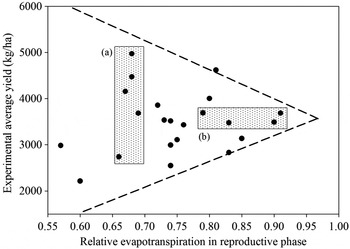
Although water deficit was the main yield factor causing a gap, other factors can also contribute to yield reduction. This statement is supported by the results presented in Fig. 10, which are from experiments conducted in 23 sites in Southern Brazil by the Pro-Seeds Foundation (2013). From Fig. 10, two conditions can be postulated: one showing that yield can vary substantially (from 2900 to 5000 kg/ha) with the same relative evapotranspiration during the reproductive phase (from 0·65 to 0·70), shown by box (a); and the second is when a similar yield (c., 3500 kg/ha) can be obtained in a huge range of relative evapotranspiration in the reproductive phase (from 0·80 to 0·95), as shown by box (b). These results show that crop management can cause variations in soybean yield with the same soil water availability – box (a) – and that crop management, such as sowing date, use of appropriate cultivars, fertilization and disease, pest and weed control, when done in a rational way, can improve crop resilience, making plants more tolerant to water deficit (Sentelhas & Monteiro Reference Sentelhas, Monteiro and Monteiro2009).
Relationship between relative crop evapotranspiration (ETa/ETc) in the soybean reproductive phase and experimental average yields for 23 sites in southern Brazil. Source: Adapted from Pro-Seeds Foundation (2013).
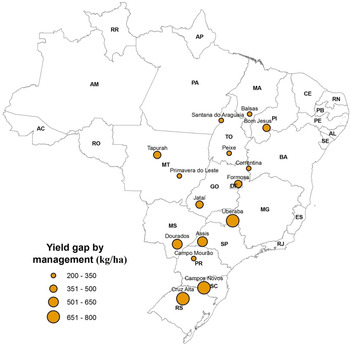
The part of the yield gap caused by crop management was obtained by the difference between attainable and actual yields. The results show that the greatest gaps were more concentrated in South-central Brazil, with the exception of Campo Mourão (Fig. 11). In the soybean locations in the mid-west, north and north-east regions, the yield gap caused by crop management was <500 kg/ha.
Soybean yield gap caused by crop management in the main producing regions of Brazil. (Colour online).
When evaluating the integrated effects of water deficit and crop management on soybean yield gaps (Fig. 12), special attention should be given to Southern Brazil, which had total yield gaps >2000 kg/ha. The same is true for Bom Jesus in North-east Brazil. For the other locations the yield gaps were smaller but always >900 kg/ha, which is a considerable loss for every crop season.
Total soybean yield gap in the main producing regions of Brazil. (Colour online).

Therefore, the main factor that reduces soybean yield in Brazil is related to in-season weather stresses by water deficit, which is also prevalent in other parts of the world where advanced technology is applied (Bhatia et al. Reference Bhatia, Singh, Wani, Chauhan, Kesava Rao, Mishra and Srinivas2008; Farias et al. Reference Farias, Assad, de Almeida, Evangelista, Lazzarotto, Neumaier and Nepomuceno2001; Sinclair et al. Reference Sinclair, Messina, Beatty and Samples2010). Regarding crop management, the main factor reducing yields in the long term could be associated with an imbalance of soil fertility, since soybean is cultivated as a monoculture, as suggested by the studies of Franchini et al. (Reference Franchini, Debiasi, Sacoman, Nepomuceno and Farias2009) and Hörbe et al. (Reference Hörbe, Amado, Ferreira and Alba2013). Diversity of crops is an important aspect for improving soil structure, increasing the water and nutrient availability. Pest, disease and weed control is not generally responsible for considerable yield gaps, but the excessive use of agrochemicals reduce financial income and environmental quality; however, attention should be given to the increasing nematode problems in soybean fields, which are hard control (Matsuo et al. Reference Matsuo, Sediyama, Oliveira, Cruz and Oliveira2012), as well as stink bugs, caterpillars (Chrysodeixis includens), weeds (Conyza bonariensis; Digitaia insularis) and Asian rust (Phakopsora pachrhizi).
DISCUSSION
Possible solutions to reduce soybean yield gaps in Brazil
Irrigation
Soybean is a crop that tolerates water deficit very well when compared with maize, but is sensitive to water stress during yield formation, i.e. flowering and grain filling (Torrion et al. Reference Torrion, Setiyono, Cassman and Specht2011). Irrigation could be used during the critical crop phases and in years with reduced rain. This strategy should be considered where Yp and the yield gap from water deficit are greater, as in Cruz Alta, RS.
Kuss et al. (Reference Kuss, Köing, Dutra, Bellé, Roggia and Sturmer2008) observed yield increases in irrigated over rainfed crops of 26 and 15% for plant densities of 25 and 40 plants/m2, respectively: these results emphasized the importance of plant population when considering the use of irrigation as a tool to reduce yield gap. Another important result found by these authors, was that for rainfed conditions the increase of population from 25 to 40 plants/m2 increased yield by 18%.
In Brazil, the use of irrigation in soybean crops is uncommon, only covering c., 0·05 of the cultivated area. The main limitations to improve the use of this technology in soybean fields are associated with: the bureaucracy of environmental laws, since Brazil does not have a well-defined national irrigation plan; lack of infrastructure regarding water and energy availability; and lack of accessible credit for irrigation (IICA 2008).
Breeding
Another alternative could be to select soybean cultivars which are more tolerant to water deficit or have higher water use efficiency. For Brazilian soybean cultivars, Battisti & Sentelhas (Reference Battisti and Sentelhas2015) used a crop simulation model and experimental data to identify four groups of soybean cultivars with different tolerance to water stress. The cultivars more tolerant to water stress presented a lower potential yield, and the less tolerant group had a greater potential yield. In the same way, Gilbert et al. (Reference Gilbert, Holbrook, Zwieniecki, Sadok and Sinclair2011) found different limited transpiration rates as a function of vapour pressure deficit for different soybean lineages, so the cultivars could be allocated according to the local soil water availability during the growing season.
Sinclair et al. (Reference Sinclair, Messina, Beatty and Samples2010) evaluated the benefits of modifying five soybean traits for water-deficit conditions as rooting depth extension, rate of leaf area development, stomata conductance at high soil water content, maximum transpiration rate and drought-tolerant nitrogen fixation, for the main production regions in USA; however, they observed that the manipulated traits giving better yields in drought condition do not perform well during a rainy season or in irrigated conditions. For stomatal conductance at high soil water content and reduced maximum transpiration rate, Sinclair et al. (Reference Sinclair, Messina, Beatty and Samples2010) showed benefits for most of the regions. The main trait that brought benefits to soybean in a dry season without yield reduction in the rainy season was drought-tolerant nitrogen fixation. The kind of study undertaken by Sinclair et al. (Reference Sinclair, Messina, Beatty and Samples2010) is of extreme importance for defining the main soybean cultivar traits that can be selected to reduce the yield gap caused by water deficit under both present and future climate scenarios.
Sowing date
Agro-climatic zoning and climatic risk zoning for defining the best sowing dates for soybean are also important operational tools used to reduce the yield gap from water deficit. Climate risk zoning is developed based on historical climate data, where the aim is to define the best suitable sowing dates in order to lower the probability of yield losses due to water deficit during reproductive soybean phases. In Brazil, the Ministry of Agriculture, Livestock and Food Supply (MAPA 2012) defines suitable sowing dates as those at which at least 60% of crop evapotranspiration is covered by water supply during the yield formation phase (flowering and grain filling) in at least 0·80 of years.
Crop simulation models also have great importance for improving yield and reducing gaps, since by simulations it is possible to identify the best sowing dates for a given level of yield, considering not only the most sensitive crop phases to water deficit, but all of them. These models also allow evaluation of crop responses to weather/climate and monitoring of soil water balance for decision making, defining whether the conditions are favourable for pest and disease control, soil management and irrigation.
Specifically for soybean rust, Rodrigues et al. (Reference Rodrigues, Juliatti, Pedrini, Fernandes, Justino, Heinemann, Fraisse, Farias, Pavan, Costa, Vale and Rezende2013b ) used a crop simulation model to evaluate the risk of soybean rust occurrence in Southern Brazil and to define the best sowing dates based on that. Another example is the study development by Del Ponte et al. (Reference Del Ponte, Godoy, Li and Yang2006, Reference Del Ponte, Maia, dos Santos, Martins and Baethgen2011) which estimated soybean rust severity as a function of accumulated rainfall in the last days of the crop cycle, supporting the timing of chemical pest control and for identifying how the ENOS can affect the disease and crop yield. All of these studies are examples of how to use models to improve soybean crop production and reduce the yield gap.
Soil improvement
Besides the use of irrigation and crop management, it is also possible to optimize soil quality by increasing soil water storage and fertility, improving the capacity of plants to explore the soil's deeper resources. This is of major importance for the Brazilian Cerrado where soils have low natural fertility and impeding layers, limiting root growth (Lopes & Guilherme Reference Lopes and Guilherme1994). When the soil exhibits good fertility and favourable physical properties, soybean roots develop well (Torrion et al. Reference Torrion, Setiyono, Cassman, Fergusson, Irmak and Specht2012), reducing the water deficit and increasing availability of nutrients. One step further is precision agriculture, which is another important tool to improve soil fertility, where site-specific fertilization will improve yield and reduce production costs. Hörbe et al. (Reference Hörbe, Amado, Ferreira and Alba2013) found an increase in net income and yield when different seed rates were used as a function of the soil fertility zones, classified as high, medium and low. Beyond chemical correction, precision agriculture could also identify problems with soil compaction, which reduces water infiltration and soil water holding capacity.
Reduction of soil compaction in order to increase soil hydraulic conductivity, macro porosity and water storage is another way for improving the soil to enhance yields. According to Franchini et al. (Reference Franchini, Debiasi, Sacoman, Nepomuceno and Farias2009), the soil layers between 0·1 and 0·2 m is the main zone where soil compaction normally occurs: however, when they used crop rotation in Southern Brazil, a reduction of soil compaction and consequent yield improvement were observed in relation to the mono-crop system. Franchini et al. (Reference Franchini, Crispino, Souza, Torres and Hungria2007) and Hungria et al. (Reference Hungria, Franchini, Brandão-Junior, Kaschuk and Souza2009) highlighted that with crop rotation there is a varied supply of biomass to the soil microbiology both in quantitative and qualitative terms. These managements help to improve root growth and consequently water available to the crop, reducing drought during soybean growth and the yield gap by water deficit.
Crop rotation
An important aspect to improve yield and keep it stable is to encourage the use of crop rotation. There are many benefits for the medium and long term, such as improvements in soil quality, disrupting the dynamics of diseases, pests and weeds, decrease of production costs, yield stability in extreme climatic conditions through use of different crops and cultivars, and wider sowing windows (Franchini et al. Reference Franchini, Costa, Debiasi and Torres2011). According to Franchini et al. (Reference Franchini, Costa, Debiasi and Torres2011), the use of many different crops in the same area improves soil biology and makes nutrient cycling and nitrogen fixation more efficient. In tropical environments, no-tillage system benefits include: improved soil structure and porosity, effective erosion control, conservation of soil moisture in the soil surface, lowering of daily maximum soil temperature at soil surface to a level more favourable for plant growth, maintenance for soil organic matter, improved water use efficiency, and reduction of incidences of weeds, diseases and pests (Phillips et al. Reference Phillips, Thomas, Blevins, Frye and Phillips1980).
Dissemination
Farm experiments can be used to compare alternative crop management practices in a series of farmer's fields, being the most conceptually straightforward way to show how to improve yield and reduce yield gaps at a regional level. Furthermore, the knowledge on yield-reducing factors and the different ways to overcome them need to be disseminated in various ways, starting from young farmer's education in agricultural colleges and ending with professional field days and agricultural TV programmes.
CONCLUSION
The results presented in this study show that soybean production in Brazil can be improved rationally without area expansion. There is a huge opportunity to reduce yield gap of this crop by increasing the actual yield through the adoption of different strategies, as described previously. In this way, the yield gap could be reduced to a maximum of 10% of potential yield, with average actual yield achieving >3800 kg/ha in all producing regions (Fig. 13), which is more than the maximum average values obtained now. Such a target is ambitious, but possible if advanced and sustainable technology could be applied.
Possible future soybean yield considering a reduction of the yield gap to a maximum of 10% of potential yield (Yp) for the main producing regions in Brazil. (Colour online).

The authors would like to thank the Brazilian Research Council (CNPq) for the support to this study through the fellowship for the first author and a Master's Scholarship for the second.



