St. Petersburg
Nikolai Kirilov is not the face of global democratic activism. His passion is music.
Slender, with thin blonde hair and serious gray eyes, the forty-year-old Russian is a professional violinist who plays for St. Petersburg’s Capella Orchestra. During the day, he works for the Symphony Orchestra of the State Academy of St. Petersburg. He believes in the virtues of democratic governance and political freedom, but has never considered himself a “politically active” citizen.
“I don’t want to be interested in politics,” he says. “But it’s impossible in Russia. We have to dig around to look for the truth; propaganda is everywhere.”
Russia’s lack of transparency and freedom of speech irks him and he had wild daydreams of leaving the country when the Russian government, under false pretenses, launched a full-scale military invasion of Georgia in 2008 and forcibly seized Crimea and the Donbas region from Ukraine in 2014. But he could not leave his friends and family behind.
Once, Nikolai traveled to Nizhny Novgorod in Central Russia to protest when Russian Orthodox clergy confiscated land from a local university to build a new cathedral – part of the Church’s nationwide push to acquire public spaces in Russia since around 2010.1 He was not injured during the demonstrations, but he witnessed police officers brutally beating a nonviolent woman who was marching alongside him.
Nikolai has stayed off the streets since then, even after Russian President Vladimir Putin invaded Ukraine on February 24, 2022. His mother was born in Ukraine and her side of the family still lives there, but he has learned to avoid public defiance. The day after the outbreak of war, however, Nikolai was chatting privately with colleagues during their lunch break at the Academy, when he shared that he was against the war. It was a casual chat and everyone returned to their work shortly after.
But three days later, on March 1, he was summoned to the director’s office.
“The Academy is a state organization,” Nikolai said he was told, “and if you are against the special operation, then you are against the state. We don’t have any laws under which we can fire you. But if you don’t leave, I’ll turn your life into a nightmare.”
After being coerced into writing a letter of resignation, Nikolai returned to his apartment, placed his violin and some clothes into a bag, and boarded a flight to Belgrade, Serbia – the only major European city accepting Russian flights after the invasion of Ukraine.
When I interviewed Nikolai over coffee at the Kafe Moskva in Central Belgrade, he recounted his dream to play in an orchestra again and study classical music in Vienna.
His face gaunt, he peered longingly toward the entrance where a suited pianist slowly, reverently played Tchaikovsky’s Swan Lake under a brushed gold chandelier. Each note resonated against the large glass windows and art deco molding, above the din of the salon’s guests in their red velvet chairs. Many of them had politics on their minds.
Belgrade
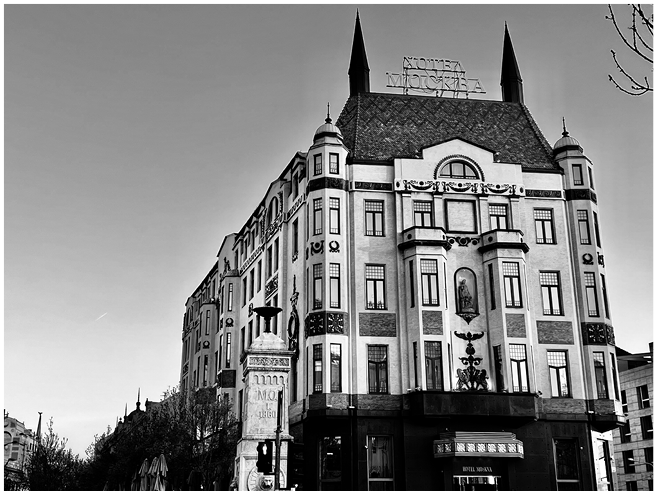
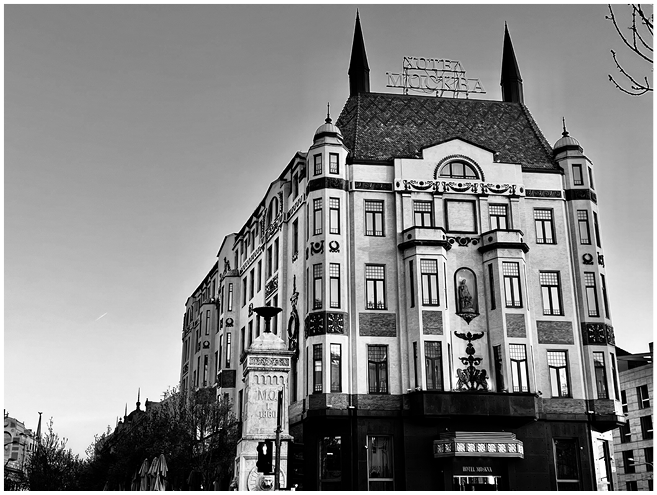
Outside Kafe Moskva (Figure 1.1), the unfolding, undulating melody escaped the revolving door to its sunlit patio, where Ivana Dumanić sat overlooking the Terazijska Fountain – a rare moment of solace in what had been a turbulent week for her.
Hotel Moskva, Belgrade, Serbia.
Ivana is not an icon of democratic activism either. A mother of three, the forty-year-old freelance forestry engineer with curly orange hair had packed the family’s belongings into bags and boxes that now filled her living room in the Vračar municipality of Belgrade. She was moving to Rijeka, Croatia, to reunite with her husband after Serbia’s president, Aleksandar Vučić, had been reelected eight days before.
A former prime minister who served as information minister in 1998 under the genocidal strongman Slobodan Milosevic, Vučić has nudged Serbia toward increasingly autocratic rule. International watchdogs and opposition parties regularly accuse his government of extensive corruption, nepotism, media control, attacks on political opponents, and ties with organized crime.2 Still, he won a second term and his party won a parliamentary majority by a landslide on April 3, 2022 in what Ivana calls “a diagnosis” of her country’s state.
“There will be no amelioration,” she said, unzipping her vermillion coat. “I love my country but I have no more reasons [to stay]. I do not want my children to live like me, to grow up at protests … I want a better life, where you don’t need personal connections to go to the doctor’s office or to get a job in one’s own field of expertise … I had hoped earlier, hoped that it would get better, hoped for a change, for an enlightenment. But it didn’t happen,” she said with finality. “And that’s it.”
Ivana’s husband previously ran a company that provided emergency plumbing repairs to public institutions. He was hired by the city of Belgrade while Dragan Đilas, now the country’s liberal opposition leader, was mayor. Her husband won the contract without being a member of Đilas’ party, without even voting for him.
“It wasn’t much money but it was all clean, transparent,” Ivana explained. “Then came [Vučić and] the Serbian Progressive Party [SNS], and it wasn’t like that anymore. [Our municipality] now has its own contractor who is politically appointed and who chooses people close to him [for subcontracting]. It is just a terrible grabbing of money, constant blackmail.”
“‘If you don’t give us a cut, you’re not getting any,’” she impersonated. “It is humiliating. There was constant nudging to join the party in order to get a better deal. They asked us to get them a list of 50 ‘secure’ votes for SNS. ‘You are working for us!,’” she mimicked them again, pointing at her chest emphatically. “We were not working for Vračar municipality anymore, but for SNS.”
Ivana and her husband decided to cancel their subcontract.
“We went to live with my parents. It wasn’t suitable housing, but we didn’t have money to rent an apartment because we lost [all our business]. Then, we decided that we are starting over. The children may eat slightly lower quality food, but we will not be humiliated.”
At that moment, Ivana and her husband resolved that he would go abroad until Serbian politics changed. He eventually found work with an energy company in Hungary and has resided there ever since. Ivana has shuttled between Belgrade and Budapest for years, but the family ultimately resolved to move to Croatia.
“Hungary was a bit fascist toward foreigners,” she said.
As in Serbia that week, it was suddenly clear that Hungary was not going to change either.
Budapest
The day that Serbian voters returned Vučić to power, Hungarians reelected their Prime Minister Viktor Orbán and his Fidesz Party to a fourth consecutive four-year term in government.
Like Vučić, Orbán had been criticized for democratic backsliding due to reforms that undercut the integrity of Hungary’s elections, judiciary, universities, and press. For related reasons, Orbán’s Fidesz Party defiantly left the European Parliament’s center-right European People’s Party (EPP) in March 2021 after fellow EPP members suspended them two years before. Many Hungarians were wary of Orbán’s proximity to the Kremlin after the Russian invasion of Ukraine, just beyond Hungary’s eastern border. But Orbán capitalized on his control of Hungary’s media and political institutions to persuade voters that the coalition of Hungarian political parties that united to oppose him were too close to Brussels and would bring Hungary into the war. Thanks to strategic gerrymandering, Orbán and Fidesz won 135 of 199 parliamentary seats – a legislative supermajority large enough to amend the constitution.
This dismayed Bogi Bakos, a twenty-three-year-old recent university graduate. But she wasn’t waiting around for her country to democratize anyway.
We met at Auróra, a counterculture courtyard bar with an alternative, intelligentsia crowd. Confident and fluent in English, she wore a black leather jacket over a mesh sports bra, with silver hoop earrings under her straight-cut, blonde hair. Sipping beer with six other friends, neither Bogi nor almost anyone else in her party was planning to stay in Hungary long.
“I think the people from my bubble – the people from the upper-middle class who have a kind of Western way of thinking, are well traveled, well-educated – they are raised in a way that the opportunities [abroad] are in their mind,” she said. “They have the trajectory to leave. Also, it is easier to leave when you are young, because then you don’t have a career yet, you don’t have to leave so many things behind. … Most of my friends already left or plan to leave anyway, so we don’t really have a choice. That’s probably why I was willing to study something I cannot pursue in Hungary. I am studying to become a marine biologist, so I’ll need to live somewhere near the sea,” she added, laughing. She’ll likely head to Spain.
What happens to the people who are left behind?
“I think that change will come in Hungary,” she said distantly. “It’s like going to therapy. Before making the decision that you need to change, something tragic must happen. And I think it’s true for Hungary too. We are not yet at the point of change, but it is really soon. People have been suppressed for a really long time now. The people in the countryside know that they suffer from Fidesz. People in smaller villages, a third of Hungarians don’t have enough money to put aside at the end of the month. They live month by month.
“But the problem with Fidesz’s power is that the system keeps itself alive. People who don’t agree with Fidesz leave and the people who stay are influenced by the government. And their children will be taught to believe what Fidesz tells them, so the system reinforces itself even if the old Fidesz voters die or leave too.”
With this frustration, Bogi was detecting a sorting phenomenon among her countrymen that sustained its increasingly authoritarian government – a phenomenon that reaches well beyond Central and Eastern Europe to the rest of the world (see Figure 1.2). And while it is substantially driven by millions of educated liberals like Bogi, emigrating for reasons other than the political circumstances in their country of origin, it is deepened by the departure of millions more like Ivana and Nikolai, who have to different degrees been exposed to the adverse effects of democratic decline without being persecuted.
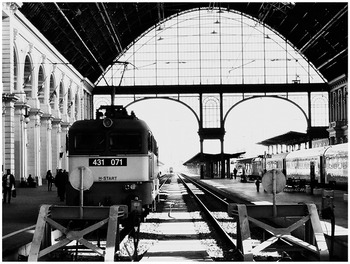
Keleti Train Station, Budapest, Hungary.

Brain Drain
Politics aside, thousands of educated professionals like Bogi, Ivana, and Nikolai leave their countries of origin every day. And when they do, they often move to more developed and stable economies with better employment and income prospects. And so rich markets get richer. And because the emigrants deplete their homeland of resources they would otherwise apply – their talent and intellect, but also their purchasing power and ingenuity – poor markets become poorer. This phenomenon is called “brain drain.”
Brain drain has been extensively studied,3 and it is the principal lens through which governments, researchers, and business actors understand the April 2022 departures of Bogi, Ivana, and Nikolai.
Nikolai is one of hundreds of thousands of Russians, many of them young professionals, who emigrated in the weeks after the invasion of Ukraine. One survey estimated that around 300,000 Russian workers had departed in the first three weeks after the war started – approximating Russia’s yearly total in 2014, 2015, and 2016.4 (Previously, Russia’s highest recent outflow took place in 2020, when 500,000 people emigrated.) Another 400,000 Russians are estimated to have departed when the Kremlin decided to enlist young men off the streets to bolster its flagging military in September 2022. The exodus was the largest since the 1917 Revolution, when millions of members of Russia’s nobility and educated bourgeoisie fled the emerging communist state. Several million Russians left after the Soviet Union’s demise in 1991 too, but did so over several years.5 In a March 26, 2023 speech in Warsaw, US President Joe Biden said the exodus from Russia was “a remarkable brain drain in such a short period of time.”6
“The people who are either leaving or planning to leave are highly educated and generally young,” Elina Ribakova, deputy chief economist at the Institute of International Finance, told the Wall Street Journal at the time. “This is your most productive part of the labor force that is disappearing.”7
In the first month after war began, the tech industry – one of Russia’s fastest growing sectors – lost between 50,000 and 70,000 workers, according to data presented by the Russian Association for Electronic Communications during a March 22, 2022 committee hearing at the State Duma, the lower house of Russia’s parliament; the group anticipated as many as 100,000 more would leave in the following month.8 While some have trickled back to Russia, many will never return.9
Democratic Drain
While much attention has been paid to the skillset of those leaving, there has been less focus on their values.
In this book, I call attention to the fact that many people who choose to depart their countries of origin – whether for economic opportunities abroad or otherwise – are likely to hold more liberal democratic values than those who remain in the country of origin. Emigration thus depletes a country not only of its economic capital but also its political capital.
Just as brain drain leaves countries poorer and less productive, Democratic Drain enables authoritarian political developments – often at the same time. It is unlikely to cause authoritarian turns by itself because there are many other variables present and, as I show, many emigrants leave only once an authoritarian-leaning party or candidate gains power. But any time a disproportionate number of people with liberal and democratic values leave a society, a principal barrier to democratic backsliding is removed.
Some democratically inclined emigrants – or “demigrants” – may be catalyzed to depart by geopolitical events like Russia’s February 2022 invasion of Ukraine, or democratic deconsolidation like Vučić’s reelection in Serbia shortly thereafter. For this subset, their departure may entail significant professional costs. In Ivana’s case, she is seeking economic opportunities outside of Serbia, but she is leaving principally because of political developments in Belgrade. Ivana’s husband had already been abroad for several years before she made the decision to look for employment in Croatia, too. She is disillusioned by the corruption of the Progressive Party and, with its reelection, lost confidence that any change would come. Any economic implications of Ivana’s departure are an externality, a residual effect of Serbian political trends.
However, the departure of highly educated professionals like Bogi and her aspirant contemporaries in Hungary is a far more ordinary, and therefore pervasive, demographic development. Indeed, Bogi is not leaving Hungary because she is concerned about the authoritarian tendencies of the Orbán government and the ruling Fidesz Party, though she is concerned. She is leaving because she is pursuing employment and educational opportunities abroad. And when she departs, she will – passively, not necessarily deliberately – take her political values, preferences, and votes with her. Statistically, she will be less likely to cast ballots in upcoming elections and she will no longer march the streets of Budapest, as she has before, to protest Fidesz policies such as its recent ban on marriages and adoptions by same-sex couples. Here, the political effects are the externality, a residual consequence of Bogi’s departure.
The phenomenon of Democratic Drain has been less recognized by social scientists because most migrants keep their politics hidden from view and their decisions to depart are uncoordinated, independent from one another. When researchers have queried immigrants about the original motivations for their departures, respondents like Ivana often cite the family members they rejoined or, in the case of Bogi, the career they ultimately pursued. Unless they are refugees or asylum seekers, they tend to omit their latent discontent with the status of the political institutions in their countries of origin – a form of recency bias that can mask their underlying sentiments.
As a result, most social scientists who study human mobility argue that immigration is driven by social network ties and opportunities for economic advancement. Other researchers have focused on psychological or demographic predispositions, like the disproportionate number of men in labor migrant flows,10 migrants’ comfort with taking risks,11 or migrants’ higher level of civic engagement.12 Acknowledging the phenomenon of Democratic Drain does not invalidate these findings. Rather, I am calling attention to a pattern that has gone almost entirely unnoticed underneath these more established dynamics.
To the extent this pattern has been previously observed, it is in a limited number of domestic or regional studies.13 In this book, I consider trends in 149 countries and self-governing territories. I examine the trend from the perspectives of prospective migrants, migrants, nonmigrants, and democracy advocates both in the countries of origin and the diaspora. I also examine the mechanics of this trend by scrutinizing migrants’ destination preferences, social networks, and the timing of their decision-making.
Drawing on this body of research, I find that democratic values are an independent and powerful predictor of people’s desire to emigrate. In other words, demigrants make up a substantial share of emigrants. More specifically, I find that people who want to migrate out of nondemocratic states tend to be disproportionately younger, educated, and middle-income, and have more democratic proclivities and less authoritarian personalities. When offered a discrete choice between equally prosperous destination countries with different governments, these prospective emigrants strongly prefer places that feature democratic – as opposed to authoritarian – institutions. I also find that, while emigrants may depart at any time, people with democratic proclivities are especially motivated to leave after election outcomes in which an authoritarian party or ruler is elected or reelected to power, particularly after an earlier period of democratic progress.
Global Implications
At a global scale, the correlation between migration choices and democratic values implies that people around the world are self-sorting into more and less democratic spaces. This introduces a novel condition that may have enabled authoritarian countries to persist in the decades since the end of the Cold War spurred the so-called Third Wave of democratization – a period when the stock of international migrants has grown so significantly worldwide.14
In Europe, Democratic Drain would enable the authoritarian-leaning governments in countries like Hungary, Poland, Serbia, and Turkey, which emerged after periods of more liberal democracy.15 Together, these countries have sent millions of immigrants to Western Europe since the end of the Cold War and they have experienced gradual democratic backsliding since 2015, with the election and endurance of Fidesz in Hungary, the Law and Justice Party in Poland, the SNS in Serbia, and the Justice and Development Party in Turkey.16 As many Eastern European states are inside the European Union’s (EU’s) free mobility zone, migrants are able to leave and return at will, unlike most people aspiring to depart their countries of origin for political reasons or any other. It is thus reasonable to expect that this legal environment would produce Democratic Drain in a more pronounced fashion. In this book, I focus closely on the dynamics in this region.
I also consider countries like Egypt and Tunisia, where Arab Spring revolts deposed authoritarian regimes, only for the countries to return to authoritarian rule as democratic opposition groups could not consolidate sufficient support in the years thereafter. After deposing their governments, pro-democratic voices have been similarly overshadowed by violent civil conflict in Libya and Yemen. Pro-democracy groups also struggled in Arab Spring venues like Morocco, Jordan, and Bahrain, where autocrats were able to stay in power through patronage and public accommodations. Of course, numerous forces interacted to produce this authoritarian stability, but the sheer scale of Democratic Drain, at a minimum, suggests the depletion of the ranks of people who might otherwise espouse liberal and democratic values – those positioned to support institutional change. The Middle East and North Africa have comprised the principal origin of overseas migrants – regular and irregular – to the European continent for decades. And many countries in the region possess postcolonial family and linguistic ties to European states, which has facilitated persistent mobility and likely Democratic Drain. As a result, I also closely examine this region in the chapters that follow.
Still, comparable conditions are present elsewhere among the regions that send millions of migrants to the world’s democracies. A number of Latin American states have struggled to consolidate their democracies despite the end of Cold War-era communist pressures and significant economic development in some regions. Institutional instability plagues many Latin American countries like Peru, Bolivia, and Ecuador; corruption, violence, and rule of law deficits pervade Mexico and Central America; autocrats have governed Venezuela for two decades; and though Brazil voted out its authoritarian president Jair Bolsonaro in 2022, it did so only narrowly. Though Argentina, Brazil, Paraguay, and Uruguay formed a free mobility zone, much of Latin America’s migration remains northbound toward the United States and to Spain.
In Southeast Asia, democratic institutions and norms are declining in the region’s principal countries of emigration. In India, long a robust multiparty democracy, the Hindu nationalist Bharatiya Janata Party has presided over discriminatory policies against the country’s large Muslim minority and undermined freedom of speech. In Pakistan, the military’s grip on political power has allowed it to selectively constrain civil liberties and apply the extralegal use of force against civilians. The Philippines suffers from persistent corruption and political violence, and in the last decade China has clawed back rights and freedoms in Hong Kong. While large numbers of Hong Kongers were able to emigrate to the United Kingdom following a 2020 crackdown, there are fewer legal pathways for Asian migrants to democracies. Large numbers of temporary migrants flow to the Arabian Gulf’s kingdoms and emirates, but there are tighter admissions policies in regional democracies like Australia, Japan, New Zealand, and South Korea.
Individual by Individual
The phenomenon of Democratic Drain is therefore not merely a thought-provoking quirk of immigration demography; it shines light on an individual-by-individual dynamic that could limit the spread of democracy to new spaces and facilitate backsliding in some previously established democracies.
This account can be overlaid onto a rich literature about the more structural causes and constraints of democratic consolidation since the end of the Cold War. In 1991, many political observers believed that democratization was simply inevitable everywhere.17 However, as the Third Wave’s momentum faded without transitions in the Middle East, much of Africa, and parts of Asia, scholars turned increasingly to the question of why authoritarian regimes have persisted, producing one of political science’s largest literatures.18
Modernization theorists predicted that democracy was less likely to take hold without economic development.19 Political scientists like Harvard University’s Samuel Huntington argued that economic development played a central role in Third Wave democratizations by helping create a well-educated middle class that was open to democracy.20 But in the wake of the failure of the Middle East and China to democratize in the 1990s and 2000s, economic explanations largely fell out of favor. These regions had higher per capita incomes than many other countries, but far less democracy.21
Some scholars attribute this struggle to democratize to the way that natural resource wealth allows authoritarian governments to persist. In particular, oil revenues have allowed regimes to build up powerful militaries and effectively bribe citizens (and political opponents) with social benefits and even direct payments for their acquiescence to autocratic rule. While this account offers one of the most persuasive explanations of authoritarian persistence in some states with great natural resources, other nondemocratic regimes have endured without them.
Another prominent account of Third Wave democratization has considered the importance of external forces. In 1991, Huntington noted that the end of the Cold War caused United States foreign policymakers to shift from opposing communism to promoting democracy and human rights. But external actors have been more successful at propping up authoritarian regimes than promoting democracy since the initial post-1991 transitions in Latin America and Europe. A number of authoritarian regimes have continued to receive US support even after the end of the Cold War as America has sought to protect the world’s oil supply and prevent the spread of Islamism.22 Other authoritarian governments have found a new friend in China, which has bolstered weak states to capitalize on access to their markets or natural resources.23
If anything, the post-2010 global wave of populism has actually produced democratic deficits in a number of previously consolidated democracies. Observers have sought to explain this backlash in different ways. One set argues that populist voting is the product of economic grievances related to inequality and diminished socioeconomic stability.24 Others point to a sense of cultural threat derived from increasing ethnic and religious diversity.25 In seminal research, political scientist Daniel Ziblatt has shown the way conservative parties have designed campaigns that strategically divided their societies along lines of race, nationality, ethnicity, or religion to remain competitive amid the expansion of the electorate to immigrants and minorities.26 But this strategy has ended up reinforcing social divisions, emboldening nationalist ideologies, and whetting popular appetite for ever more muscular assertions of the national character and democratic backsliding.
With the notable exceptions of political sociologists Seymour Martin Lipset and Barrington Moore, who have noted the importance of the democratically inclined middle classes, a focus on the role of non-elite individual actors is largely absent from the canon of explanations for democratic political development. In this alternative and complementary perspective, I refocus the lens on personal and household decision-making – the value-based differences of those who leave and remain – and apply it to make sense of broader trends.
My approach follows in the tradition of social theorist Joseph Schumpeter’s “methodological individualism.”27 Sociologist Max Weber later captured its essence when he argued that social trends should be examined as the result of “the particular acts of individual persons,” since they alone can be treated as comprehensible agents.28 Seizing upon this logic later in the twentieth century, Friedrich von Hayek explored how broad economic phenomena can emerge as the unintended consequences of local individual’s actions.29 In other words, the phenomenal outcomes that people together achieve may bear no resemblance to the ones that they intended. Still, he contended, it is critical that we understand their calculations if we are to appreciate the results they produce and why they their behavior persists.
In focusing on individual attitudes and preferences, my findings paint a much fuller picture of the emigrant politics interplaying with global political development. Emigrants’ departures instantiate their acquisition of civil and democratic rights and reflect people’s evaluation of the prospects for liberal democratic institutions in their countries of origin in the context of the transition costs associated with emigrating. Depending on individuals’ circumstances, this calculus will be conditioned by an individual’s perception of their social and economic outlook in another country, the opportunity structures that may facilitate their departure and arrival abroad, and their sense of political efficacy in their country of origin.
Related research has already shown that the emigration of disgruntled citizens may act as a “pressure release valve” and reduce the likelihood of uprisings and revolutions for regime change – under authoritarians or otherwise.30 Political sociologist Jack Goldstone has written that several kinds of demographic change increase the risks of uprisings and revolutions.31 These include the rapid growth of the labor force in weak economies, particularly a rapid increase in educated youths aspiring to elite positions when such positions are scarce; and also unequal population growth rates between different ethnic groups owing to fertility differences or immigration dynamics.32 Emigrants’ departure has been shown to have mitigated pressure on authoritarian regimes in the island nations of the Pacific,33 the Philippines under President Ferdinand Marcos,34 and in Egypt in the late twentieth century.35
But the scale of annual flows from authoritarian-leaning countries to democratic countries worldwide is immense, suggesting the potential scope of a Democratic Drain phenomenon. Between 2015 and 2019, the most recent period for which complete global data is available, over 45 million people moved to a country that was substantially more democratic than their country of origin – more than two in every five global migrants.36 As shown in Table 1.1, since 1990, the average number of people who made such a move is over 37 million per five-year period. Measured more conservatively, Table 1.2 presents estimates of migrants moving from less democratic environments to the world’s most democratic environments annually. I find there were nearly 30 million such people between 2015 and 2019 alone, and an average of 23 million per five-year period since 1990 – about a 27 percent share of global flows. While a portion of these annual flows are humanitarian migrants, the vast majority are voluntary. In this book, I examine the different dynamics of this voluntary emigration, but particularly those among dissidents and demigrants.
| Year | Total migrants moving to a more democratic destination, by five-year period | Share of total migrant flows by five-year period (%) |
|---|---|---|
| 2015–2019 | 45,318,266 | 41.2 |
| 2010–2014 | 43,942,730 | 42.8 |
| 2005–2009 | 37,595,945 | 40.9 |
| 2000–2004 | 34,498,270 | 41.9 |
| 1995–1999 | 33,086,481 | 46.5 |
| 1990–1994 | 28,448,630 | 39.2 |
| Five-year average | 37,148,386 | 42.0 |
| Year | Total migrants moving from less democratic countries to the world’s most democratic countries, by five-year period | Share of total migrant flows by five-year period (%) |
|---|---|---|
| 2015–2019 | 29,512,134 | 26.8 |
| 2010–2014 | 25,234,592 | 24.6 |
| 2005–2009 | 25,599,509 | 27.9 |
| 2000–2004 | 23,069,250 | 28.0 |
| 1995–1999 | 19,682,813 | 27.7 |
| 1990–1994 | 17,728,674 | 24.4 |
| Five-year average | 23,471,162 | 26.5 |
Dissidents
When casual observers of world politics think of liberal democrats leaving their countries of origin for destinations that align with their political values, they conventionally envision dissidents – activists, often elites, who oppose the current regime or government of their countries. Authoritarians are bolstered when dissidents emigrate and, in some cases, the regimes actively facilitate or force their emigration and exile by making dissidents uncomfortable.38 Depending on the country and its leadership, dissidents are subject to harassment and intimidation by authorities, imprisonment, death threats against them and their loved ones, and generally difficult operating conditions. Their work is complicated by ever-changing rules, scrutiny by law enforcement, and political institutions designed to advantage those already in power. Research shows that a lack of political rights generates asylum applications.39
Less commonly, dissidents can also be pulled and pushed abroad, ironically, by the supranational organizations that promote their activism. Organizations like the National Endowment for Democracy, Amnesty International, and United States Agency for International Development advise local democratic activists and often extract them from their context to offer further training and connect them with peers in other countries. Despite their virtuous intentions, many of the selected fellows and trainees become acculturated to Western, liberal environments and a substantial number of leaders stay abroad to pursue broader advocacy directions in those environments, which distract their attention from their original agendas. Others may return to their countries of origin equipped with new vernaculars, political demands, and cosmopolitan ideas that fail to resonate with fellow citizens. A further consequence is that activists’ contact with other émigrés abroad may build a network that facilitates their own future emigration.40
To be clear, dissidents are distinct from humanitarian migrants. Refugees and asylum seekers are classes of migrants formally designated by international law, who leave their countries of origin to escape political persecution and oppression at the hands of governments or some other authority. Many refugees and asylum seekers are fleeing political systems that discriminate against them for their race, ethnicity, religion, sexuality, political beliefs, or ideology. So, yes, many seek the kind of freedom, rights, and self-governance that democracies offer. And when large numbers of them leave, it is reasonable to expect the countrymen they leave behind to comprise a more concentrated assembly of people who tolerate or even support the authoritarians in power – the dynamics behind Democratic Drain.41
However, humanitarian migrants do not necessarily hold more liberal and democratic values than their countrymen. They may oppose certain modes of authoritarianism because they and members of their faction have been its targets. And the traumas of this experience may inspire many to support liberal democracy consequently. But had they been given the opportunity to govern before the trauma of persecution and forced migration, opposition parties in such settings may have been equally likely to govern in such a way that oppresses political opponents and discriminates against other factions too. Some of those that emigrate even support authoritarian parties in destination countries, if those parties reflect their values. And so the effect of humanitarian migrants’ departure on the prospects for democracy in their countries of origin depend on the extent to which those oppressed by authoritarians in power hold liberal democratic values. Alternatively, when democratic activists depart, their organizations and movements are weakened.
Nikolai’s circumstances reveal the growing complexity surrounding conventional legal classifications. On the one hand, the Russian violinist was not imprisoned or physically harmed for his political views. In fact, he never really made his views public; he shared them in a private lunchtime conversation. On the other hand, he lost his beloved job because his views were revealed and his concern with further penalties were enough to depart. His situation reveals the widening continuum between refugee migration and voluntary migration, but more pertinently here, the continuum between dissidents – those who, like Nikolai, experience the effects of democratic backsliding more personally – and demigrants – who experience the effects more sociotropically or indirectly.
Demigrants
Demigrants (“DEM-ə-ɡrənts”) – a term I am introducing – depart under far more conventional circumstances. In a first set of circumstances, people leave voluntarily in response to illiberal or undemocratic political developments – much like Ivana from Serbia. Their emigration may be catalyzed by new government policies that they oppose or by the election of parties and candidates they have contested. Because of the universal foundations of liberalism and democracy, it is more likely that people with liberal democratic values would depart their countries of origin than conservatives whose ideologies are typically more rooted in the primacy of the local nation and its heritage, however these are constructed. To emphasize, these emigrants are not forced to depart according to the legal definition of forced migration related to persecution or violence. Though they may be pressurized by political circumstances, they ultimately choose to leave in search of environments that are more likely to accommodate their values and preferences, or at least protect their freedom to live uninhibited by the authoritarian regimes they flee.
In a second set of circumstances for demigrants, people depart voluntarily in response to a career opportunity or a chance to reunite with family members abroad. They may pursue a better or more specialized education, an investment opportunity, a job, a higher income, or simply the greater economic stability provided by countries with higher standards of living, greater labor protections, and welfare programs. Like Bogi from Hungary, many demigrants are educated and middle-class professionals who are likely to be attracted to the freedom, rights, and strong economies of liberal democratic countries;42 they may even be recruited by companies and agencies in those countries.
Most wealthy economies today design their immigration regimes to facilitate the admission of highly skilled migrants like scientists, engineers, doctors, nurses, and software developers.43 Since around 2005, European states have modified their labor visa standards to almost exclusively admit those with marketable skills. Concurrently, states like Australia, Canada, and the United Kingdom have pursued points-based policies which evaluate migrants on a range of criteria and favor applicants who possess technical skills, higher education credentials, and language fluency. As I show, because these emigrants happen to hold more liberal democratic values than the countrymen they leave behind, these admissions policies simultaneously limit the international mobility of people with lower skills and inadvertently deplete countries of origin of democratic political capital.
And so while Nikolai, Ivana, and Bogi are not the faces of global democratic activism today, their uncoordinated departures from Russia, Serbia, and Hungary – when combined with those of other people with liberal democratic values – enable democratic backsliding in their countries of origin. They should neither be blamed for their decision to depart, nor the democratic backsliding their departure may facilitate. As I have emphasized, decisions to depart are deeply personal and often apolitical. When they are sensitive to political developments, they are often pressurized by state actions designed to discomfort those who might otherwise resist authoritarian power grabs and rights suppression. Democratic Drain is thus a byproduct of voluntary migration flows, but otherwise attributable to the choices that authoritarian-leaning governments deliberately present to dissidents and demigrants.
Democratic Gain?
In recent years, a widespread acknowledgment of brain drain has been complicated by observations of a potentially offsetting, counter-phenomenon: brain gain. Brain gain refers to the benefits that countries of origin enjoy when successful emigrants remit large sums of financial and intellectual capital to their friends and family in countries of origin.44 Financial remittances now comprise over 20 percent of the national economy in countries such as Kyrgyzstan, Nepal, Moldova, Samoa, Lesotho, Armenia, and Haiti. In Tajikistan, such contributions make up a remarkable 51 percent of GDP.45 Less measurably, brain gain also takes place when migrant business owners outsource labor to their homelands or when business ideas and innovation are shared with family and childhood friends to implement at home.46 Or circular migration may occur, when individuals who have had success abroad return home to start a business, bringing with them capital, experience, and more democratic ideas born of living in a democratic county.47
Accordingly, those initially learning of a Democratic Drain phenomenon may point to an analogous “democratic gain” that could take place after emigration. And it is true that some emigrants seek to sustain their engagement with their previous political agendas, or even more actively reinsert themselves into homeland debates with their newfound freedom abroad.48 Researchers have noted the impact that diaspora activists have made on elections, wars, and other political disputes in places of origin like Sri Lanka, Nagorno-Karabakh, and states in the Balkans.49 Elite emigration has been found to invigorate India’s democracy when elites emigrate for opportunities abroad and leave space for countrymen from historically disadvantaged groups to grow.50 In theory, foreign-educated individuals can promote democracy in their home country after being educated in democratic destination states.51 Migration could be a counterbalance to ethnic strife in countries of origin and reduce homeland corruption.52 Indeed, social scientists have found that hermit autocracies endure longer than those that permit exposure to international influences.53
However, the influence of authoritarian states’ diaspora activists has not been especially democratic, as migrants frequently support one warring faction over another. Indeed, where diasporas have influenced homelands in the past, they have been more successful in supporting paramilitary groups, not democratization. For example, the Tamil Tigers of Sri Lanka and the Kosovar Liberation Army – both of which benefited from substantial foreign donations and support in the 1990s and 2000s – were engaged in bloody battles of ethnic conflict. Such examples demonstrate how prospects for “democratic gain” require a country of origin that is in fact receptive to the liberal democratic ideas and political capital that expatriates may seek to remit. Authoritarian states are typically not interested in the transfer of democratic perspectives from their diasporas.54 And often, emigrants find governments in their countries of origin to be inaccessible to their lobbying.55
There are notable exceptions where democrats return to office in their homelands, but they are not examples of people who advocated for liberal reforms from abroad. Ayad Allawi was the prime minister of postwar Iraq in 2004 and 2005, but was effectively installed by the United States military. Mohammed Nur returned to Somalia from London to be the mayor of Mogadishu, but he was appointed by unelected officials. A stronger example comes from the exiled members of Tunisia’s Islamist Ennahda Party, who returned to stand for election after the country’s 2011 Jasmine Revolution deposed the regime of longtime dictator Zine El Abidine Ben Ali and stimulated a series of uprisings around the Arab world. However, the party’s leadership had previously advocated for an Islamic state and justified political violence.
Given the amount of consultation, deliberation, and organization required to build and sustain successful democracies, examples of democratization from abroad are therefore rare. Emigrants are typically consumed by the adjustments they must make to resettle in destination countries. Once abroad, many emigrants have limited capacity for activism. While 141 countries now offer some form of non-resident citizen voting,56 voting rates among diaspora communities are generally very low.57 Some emigrants left to deliberately remove themselves from a dangerous political climate. The vast majority never repatriate. Moreover, many governments slander departed democratic leaders as “treasonous” once they leave their countries of origin. This tarnishes activists’ reputations and debilitates their influence and mobilization efforts.
This maps well onto Albert O. Hirschman’s versatile 1970 classification of “exit, voice, and loyalty,”58 from which many studies of diaspora political engagement also draw. Here, “exit” reflects the choice to emigrate and thereby divest from a government or state – what many scholars have called “voting with your feet.” Meanwhile, “voice” is embodied by those who stay in their country of origin to communicate their dissent to the government and rehabilitate its institutions. But contrary to any suggestion that those who stay are more committed to changing the state where they continue to reside, my research finds that those who wish to emigrate are disproportionately more democratic in their proclivities. In a globalized world where access to and information about other societies is more readily available to people who are democratically inclined, exit supersedes voice.59
Book Outline
With a blend of rigorous statistical analysis and detailed narratives from immersive, interview-based field research around the world, the chapters that follow examine the dynamics and mechanics behind the departure of both demigrants and dissidents – respectively, the mass and elite components of the Democratic Drain phenomenon.
Democracy’s Carriers
Chapter 2 profiles prospective migrants around the world. Based on global polling, I answer three related questions: What are the demographic and psychological attributes of prospective migrants? Do prospective migrants hold more liberal democratic values than their countrymen? Do prospective migrants prefer democratic destinations?
Demographically, I find that prospective migrants are likely to be younger, educated, socially connected, and open-minded adults. And crucially, they hold less authoritarian and more democratic political values than their countrymen. This means that if they leave, the society they leave behind will not only become older, less educated, and more insular; it means that their society will also become less democratic and more authoritarian in its orientation. Taken in the context of what we already know about the extensive consequences of brain drain, these findings show how authoritarian-leaning countries are being depleted of precisely the people who are best placed to contribute to their economic modernization and their political liberalization.
I then ask whether prospective migrants would prefer destinations that align with their democratic political preferences rather than their material motivations. Broadly, the conventional wisdom among both experts and nonexperts is that emigrants prefer destinations that, above all, offer well-paid and stable jobs and perhaps access to welfare benefits. But based on a conjoint survey design in five countries in the Middle East and North Africa, I find that demigrants’ initial destination preferences draw them to democracies that reflect the political and civic values they hold, even if this means sacrificing their material well-being to some extent. This discovery adds a new dimension to Democratic Drain. Not only are many authoritarian countries being depleted of people with democratic values; these individuals are inclined to self-sort into a dichotomized world of free, democratic destinations and increasingly authoritarian holdouts.
Outvoted, Voting Out
Chapter 3 takes a closer look at the mechanics of Democratic Drain. More specifically, I ask when demigrants are likely to depart. There have been numerous historic examples of an exodus following a major turn of political events, such as a brutal crackdown on dissent or freedom, the nationalization of private industry, or the outbreak of civil or international conflict. But elections are far more mundane political events that nonetheless inspire all citizens to consider their country’s future.
Focusing on 127 countries worldwide, I find that people’s interest in emigrating spikes in the immediate aftermath of national elections when an authoritarian-leaning party or ruler is elected to public office. Importantly, this effect is limited only to people who hold expectations of democratic norms and institutional integrity. Those who question the honesty of the election, suspect corruption among public officials, or feel that freedom of speech is constrained are significantly more likely to say they would like to leave when faced with the future deconsolidation of their country’s democratic institutions.
Elections are therefore precipitating events for individuals disappointed by the results and concerned about the political future. Previously unnoticed over the ebb and flow of electoral cycles, Democratic Drain removes the people who are most likely to voice their dissatisfaction and most likely to demand institutional integrity in less democratic spaces.
The Sliding Scale
Chapter 4 engages the average people behind these trends. In particular, I tell the stories of Hungarians compelled to leave after the reelection of Prime Minister Viktor Orbán to a fourth consecutive term with a parliamentary supermajority, and I chronicle the experiences of Serbs crestfallen after the reelection of President Aleksandar Vučić to a second term. Some mundane, some extraordinary, their first-person narratives display the household considerations behind a mass population phenomenon.
I then leverage a unique study of European public opinion to reveal the way that Eastern Europeans who move West under the EU’s free mobility rules likely hold more liberal democratic proclivities than those in their countries of origin who wish to migrate, and how those prospective migrants hold more liberal democratic proclivities than their countrymen who don’t wish to move at all – a sliding scale of liberal democratic views among people with the same origins.
Of course, not all Eastern European countries have elected authoritarian-leaning governments; some have avoided even a flirtation. But elections are not the only political impetus for departure. It was not the 2018 reelection of President Vladimir Putin that drove an exodus from Russia; it was his megalomaniacal invasion of Ukraine in February 2022. I conclude this chapter with the personal accounts of Russians fleeing the Kremlin’s foreign adventures and domestic crackdown, and show how their motivations reflect those of demigrants mobilized by elections or upgrades to their quality of life.
Democratic Gain
Chapter 5 considers the possibility that, while people with liberal and democratic proclivities may leave their countries of origin, they may influence the democratization of their homelands from abroad – the possible “democratic gain” I note earlier. Could emigrants’ advocacy from abroad offset the effects of their departure on prospects for democracy? I study the case of Syria.
Syria is precisely the kind of country where emigrants might be expected to have had far more freedom and capacity to advocate for liberal democratic norms abroad than those who remained under the despotic rule of Bashar al-Assad until December 2024. After the oppressive Assad dictatorship was challenged by opposition groups in 2011, many activists in Syria’s massive diaspora mobilized to support and influence people living in rebel-held territory – a test of would-be “democratic gain.”
However, in a social network analysis of Syrians in regions governed by the Free Syrian Army in 2015, I find almost no evidence of their impact. Despite their presumed prominence in the West, a majority of Syrians could not even name a single pro-democratic leader from abroad – let alone identify their influence. And perhaps most damningly, the departure of former Syrian citizens for other countries was viewed by most respondents as an abandonment of their cause – an offense worse than being previously complicit with the oppressive Assad regime. Taken together with other research showing the limits of democratic diaspora activism, I conclude that the potential for “democratic gain” is severely constrained.
A Human Base
Chapter 6 concludes the book by turning the lens to exiled dissidents to contextualize the impact of demigrants’ departures. Unlike demigrants, who may hold opposing views but depart voluntarily without government involvement, dissidents are often pressured or coerced to leave their countries of origin because of their opposition to the government and its policies. As organizers of democratic movements, they offer a unique perspective about the cumulative effect of people’s emigration over time.
Based on two dozen interviews with activists from across the Middle East several years after the Arab uprisings, I tell their stories and demonstrate what their loss has meant to the pro-democratic movements they left behind. Through their narratives, I discern the extent to which their political agendas rely on rank-and-file supporters who are also positioned to leave as demigrants.
Looking back on this sobering collection of information, I consider the political and policy implications of Democratic Drain. This emergent phenomenon raises questions about how democracies might compensate for the inadvertent effects of global human mobility before the world further sorts into democratic and undemocratic spaces.