


Impact statements
Microplastic pollution is among the most urgent environmental challenges of our time, yet its movement through soil, particularly at the land–sea interface, remains poorly understood. This study provides, to our knowledge, the first documented evidence for the potential of microplastic leakage from polluted coastal soils back into the ocean and presents a simple, low-cost framework for quantifying it. By combining soil core sampling in the field, rainfall simulation and fluorescence microscopy using the accessible Nile Red method to quantify microplastics within leachate, we show that coastal soils can act as temporary sinks – slowly re-emitting large amounts of microplastics into surrounding waters. The methodological workflow developed here offers a globally accessible tool for mapping microplastic leakage, enabling both researchers and citizen scientists to generate comparable data at low cost. This democratization of environmental monitoring bridges the gap between academic research and community participation, enabling schools, local groups and researchers in resource-limited settings to contribute to our shared knowledge of global plastic pollution. Beyond its scientific contribution, this work aims to empower citizens to engage directly at all stages of the research, from sample collection to data analysis, in similar projects of their choice within their local area, fostering environmental literacy and building public trust in science. The findings also provide policymakers with new evidence on the importance of considering soil–ocean fluxes in pollution models. Together, these advances lay the groundwork for an international network of collaborative mapping and monitoring initiatives to better understand microplastic leakage along the world’s coastlines.
Introduction
Plastic pollution is a major global challenge found to exacerbate multiple planetary boundary threats (Villarrubia-Gómez et al., Reference Villarrubia-Gómez, Carney Almroth, Eriksen, Ryberg and Cornell2024). Loss of biosphere integrity through altered habitats, as well as alteration of the geosphere, are often highlighted. The growing amount of marine plastic pollution, including microplastics in the oceans and within marine organisms, calls for the need to better understand the mechanisms of its dispersal, including the geophysical processes involved and quantitative distribution throughout different environmental compartments (Thompson et al., Reference Thompson, Courtene-Jones, Boucher, Pahl, Raubenheimer and Koelmans2024; Villarrubia-Gómez et al., Reference Villarrubia-Gómez, Carney Almroth, Eriksen, Ryberg and Cornell2024; Grattagliano et al., Reference Grattagliano, Grattagliano, Manfra, Libralato, Biandolino and Prato2025). Transported by winds, waves and currents, plastic washes up on coastal shores in Central Norway and sediments there over time (Bastesen et al., Reference Bastesen, Haave, Andersen, Velle, Bødtker and Krafft2021; Cyvin et al., Reference Cyvin, Ervik, Kveberg and Hellevik2021). In addition to the macro- and primary microplastic (MP) accumulating within coastal soil, further macroplastic decomposition driven by both abiotic and biotic factors contributes to an ever-increasing amount of secondary MP (Bastesen et al., Reference Bastesen, Haave, Andersen, Velle, Bødtker and Krafft2021; Cyvin et al., Reference Cyvin, Ervik, Kveberg and Hellevik2021).
On the remote island of Smøla, in our sampling area for this case study, the amount of macroplastic within the soil lies between 0.4 and 20.6% of the total sample dry weight (dw) (plasticdw/totaldw) (Cyvin et al., Reference Cyvin, Nixon, Nemes and Coutrisn.d.; Sledz, Reference Sledz2024); in a bay nearby on the same island, it was 4–65% (Hausken, Reference Hausken2025); and on the neighbouring islands Mausund and Froan, Cyvin et al. (Reference Cyvin, Ervik, Kveberg and Hellevik2021) found concentrations ranging from 3% to 72% plastic in the upper soil level. Based on literature on plastic embrittlement (Chamas et al., Reference Chamas, Moon, Zheng, Qiu, Tabassum, Hee Jang, Abu-Omar, Scott and Suh2020), the latter estimated that the number of 100 μm MP particles (MPs) within their samples would increase by ca. 80.000–2.8 million MPs/kgdw soil annually. Despite considerable variation and uncertainties associated with extrapolative models, it highlights that MPs are rapidly becoming an anthropogenic soil component of significance. The rate of embrittlement and degradation in soil is slow (Chamas et al., Reference Chamas, Moon, Zheng, Qiu, Tabassum, Hee Jang, Abu-Omar, Scott and Suh2020), but the amount of plastic is high, and the possible remediation of secondary MP is therefore also high.
While soil can be theorized to act as a sink for MP (Bläsing and Amelung, Reference Bläsing and Amelung2018), the question of its permanence requires more attention. Should MPs be susceptible to the process of eluviation, often referred to as leaching (Britannica, Reference Britannica2009), they could potentially also be re-emitted to the ocean(s), rivers, lakes and ground water reservoirs. Evidence of such movement exists for groundwater (Liu et al., Reference Liu, Li, Bundschuh, Gao, Gong, Li, Zhu, Yi, Fu and Yu2025). However, MP leakage from coastal soils remains largely unexplored. This case study aims to provide some first insight into the phenomenon.
The broad spectrum of different methods available has different advantages and limitations in terms of complexity, resource requirements, cost and result reliability. Analytical approaches, such as FTIR, Raman spectroscopy and Pyrolysis-GC-MS, are favourable for the analysis of polymer composition and decrease the probability for false positive identification compared to visual techniques (Biswas, Reference Biswas2025). While highly regarded, they are also expensive and require both special equipment and training, which may not be accessible in many developing countries. Additionally, the methods are a little suited for application within a citizen science (CS) context.
Due to the rapid development of the MP-research field throughout the last decades, there is a general lack of standardization within methodological approaches and the ways in which results are recorded (size ranges, units of measurement, number of replicates, etc.), making it difficult to compare studies. The urge for the use of analytical tools can also get in the way of large surveys covering broader spatial and temporal resolutions. This represents a dichotomy between the pursuit of analytical precision and the need for scalable, inclusive monitoring.
Within this methodological landscape, the Nile Red (NR) fluorescence staining technique offers a promising, low-cost alternative for the detection of synthetic polymers (Erni-Cassola et al., Reference Erni-Cassola, Gibson, Thompson and Christie-Oleza2017; Maes et al., Reference Maes, Jessop, Wellner, Haupt and Mayes2017a; Prata et al., Reference Prata, Da Costa, Girão, Lopes, Duarte and Rocha-Santos2019a, Reference Prata, Sequeira, Monteiro, Silva, Da Costa, Dias-Pereira, Fernandes, Da Costa, Duarte and Rocha-Santos2021; Tsuchiya et al., Reference Tsuchiya, Kitahashi, Taira, Saito, Oguri, Nakajima, Lindsay and Fujikura2025). NR binds selectively to hydrophobic surfaces, allowing MPs to fluoresce under UV-light, enabling enhanced optical identification using a standard stereomicroscope. Although the method does not provide chemical polymer characterization and the same high level of precision of analytical methods, it allows for relatively consistent visual quantification of MPs in the 1 mm–100 μm range at a fraction of the cost. Early studies demonstrated its efficiency for screening environmental and biological samples (Erni-Cassola et al., Reference Erni-Cassola, Gibson, Thompson and Christie-Oleza2017; Maes et al., Reference Maes, Jessop, Wellner, Haupt and Mayes2017a; Prata et al., Reference Prata, Sequeira, Monteiro, Silva, Da Costa, Dias-Pereira, Fernandes, Da Costa, Duarte and Rocha-Santos2021), and that with proper controls – such as oxidation for organic matter removal, method blanks to account for contamination and consistent counting criteria – NR-based approaches can provide data of acceptable reliability. Importantly, the method can be implemented in modestly equipped laboratories and educational settings, making it ideal for CS projects, student research and low-cost global mapping and monitoring of MP leakage. Though NR has been criticized as a method for MP identification due to risks of observational errors as a result of false positive/negative illumination and subjectivity (Stanton et al., Reference Stanton, Johnson, Nathanail, Gomes, Needham and Burson2019), there are grounds to argue for its usability in CS projects, enabling the large-scale analysis of MPs in the meso-size range. Furthermore, there may be a worthwhile possibility to develop keys for adjustment and thereby translation of results between high-cost methods like micro-FTIR and the use of NR.
CS is also defined as an important democratization tool within academia (Strasser and Haklay, Reference Strasser and Haklay2018; Cyvin, Reference Cyvin2022). It brings researchers and the general public closer together, providing researchers with great possibilities for high spatiotemporal distribution of sampling and large sample sizes, and offering the public opportunities to learn about both research methods and scientific content. The European Marine Board for Citizen Science Research (European Marine Board et al., Reference European Marine Board, van der Meeren, Busch, Delany, Domegan, Dubsky, Fauville, Gorsky, von Juterzenka, Malfatti, Mannaerts, McHugh, Monestiez, Seys, Węsławski, Zielinski and EMB2017) asks researchers to involve citizens in all aspects of science – not only data gathering, but also analysis, contribution to final results and dissemination. Few authors manage this, as the process is costly and time-consuming. We bring this theme to the surface, providing methodologies that are fit for both CS projects, school projects with research value and research in low-income countries.
The methodology applied for analysis of the particles is of great similarity to the early on, state-of-the-art MP research a decade ago (Cole, Reference Cole2016; Song et al., Reference Song, Hong, Jang, Han, Jung and Shim2017; Maes et al., Reference Maes, Van Der Meulen, Devriese, Leslie, Huvet, Frère, Robbens and Vethaak2017b, Reference Maes, Jessop, Wellner, Haupt and Mayes2017a) and provides an opportunity for easy global monitoring of leakage – a field still in its infancy. It is proven applicable for bachelor’s- and master’s-level projects (Aasen Kveberg, Reference Aasen Kveberg2021; Hausken, Reference Hausken2023) and appears promising for high-school or community science initiatives.
Study aim and contribution
Building upon this rationale, our study contributes to the development of a methodological framework for investigating MP leakage from coastal soils that is suitable for use in both professional and CS contexts, using low-cost, widely available materials to ensure global accessibility. We demonstrate the application of a simple yet robust workflow from extracting soil core samples in the field, to simulation of rainfall in the laboratory, followed by MP quantification in leachate – the process involving filtration, hydrogen peroxide (H2O2) digestion, NR staining and identification under UV-light stereomicroscopy.
This study addresses two main objectives: (1) to quantify and describe the phenomenon of MP leakage from organic-rich coastal soils through a local case study on Smøla island in Central Norway, and (2) to pilot, evaluate and present a CS-friendly methodology that balances accessibility and data quality for global monitoring of MP leakage from organic-rich coastal soils. Our hope is to enable future projects by providing an experience-based instructional manual, including a visual step-by-step guide that can be used by anyone regardless of prior experience, which could aid the formation of a network of comparable setups to investigate this potential source of MP leakage from land back to the ocean further.
Background research
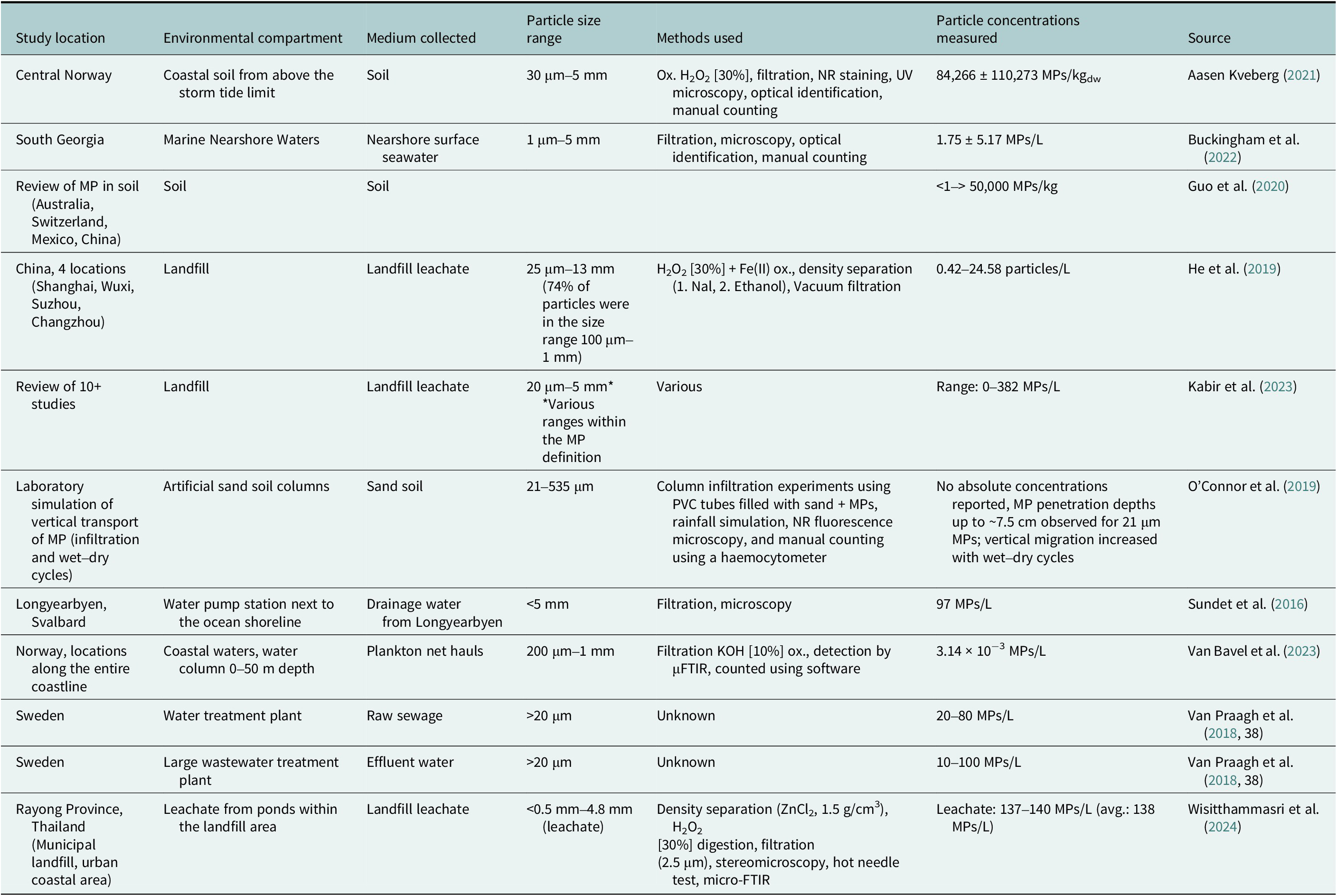
A literature search about MP leakage from soil was conducted with intentions of finding a possible comparison for our case study results, measured in number of MPs per liter leachate water (MPs/L). The search was finalized on 23 October 2025 using Google Scholar, Oria and Perplexity AI (Perplexity, 2025), targeting studies about MPs in soil, MP leakage from soil and, to some degree, MPs in sewage water, with keywords reflecting these areas of interest. Priority was given to publications from the last 10 years, sharing methodological elements, contextual focus or reporting similarities, with snowballing for additional information. The studies were chosen by title and thereafter by abstract, if found applicable. We do not aim to present a structured literature search, but the low number of relevant articles found visualizes the lack of research. A master’s thesis and reports are also included, as they can provide relevant information. Table 1 summarizes the metadata of studies that were found relevant to the discussion of our results.
Presentation of relevant previous research

All but one study related to water samples presents data from the marine environment, landfills or water treatment plants. Aasen Kveberg (Reference Aasen Kveberg2021) is a master’s thesis from Norway investigating similar coastal soil in nearby locations at Mausund, using a closely resembling method for MP analysis. However, it does not provide results on leakage.
The variation in MP concentrations measured in leachate from both landfills (He et al., Reference He, Chen, Shao, Zhang and Lü2019; Kabir et al., Reference Kabir, Wang, Luster-Teasley, Zhang and Zhao2023) and wastewater treatment plants (Van Praagh et al., Reference Van Praagh, Hartman and Brandmyr2018) is notable – from 0 to nearly 400 MPs/L of water. The size range is also of great variety – from 20 μm to 5 mm.
Guo et al. (Reference Guo, Huang, Xiang, Wang, Li, Li, Cai, C-H and Wong2020) highlights how soil is not only a sink but also a possible medium for the remediation of MP back to the environment. They point towards Nizzetto et al. (Reference Nizzetto, Nizzetto, Bussi, Bussi, Futter, Futter, Butterfield, Butterfield, Whitehead and Whitehead2016), simulating leakage from soils around the River Thames and estimating that around 60% of MP will eventually leak into the river.
There are further articles related to plastic and MP leakage that might be of interest to the reader, but due to a lack of overlap in scope, they were not included in Table 1. Some of these are also estimating the leakage of plastic into the ocean, but not focusing specifically on either the leakage from soil or in the form of MP (Chen and Fei, Reference Chen and Fei2023). Others focus on the leakage of plastic to the environment (Alencar et al., Reference Alencar, Gimenez, Sasahara, Elliff, Rodrigues, Conti, Gonçalves Dias, Cetrulo, Scrich and Turra2022), but not within the environment or back to the environment. In this study, we refer to leakage as the vertical transport of particles through the soil horizon and back into the ocean. The low abundance of relevant papers for direct comparison underlines the need for more research in this matrix.
Method
Sample collection and storage
Fieldwork was conducted on Smøla island on the 9th of January 2023. A total of nine soil core samples, three triplicates (1|2|3) from three different locations (A|B|C) were extractedFootnote 1. Within plastic infiltered soil, sometimes described as plastisol or arthropod (Cyvin and Nixon, Reference Cyvin and Nixon2024). The application of regular core drilling methods can be difficult due to the plastic reinforcing the soil structure, thereby making it more or less impenetrable. Therefore, an in-house solution made of a petrol drill, with a sharpened, lubricated (olive oil) boring cone (diameter (d) = 15 cm, length = 35 cm) for concrete was applied (Cyvin et al., Reference Cyvin, Nixon, Nemes and Coutrisn.d.). Shallow soil depth enabled drilling to bedrock.
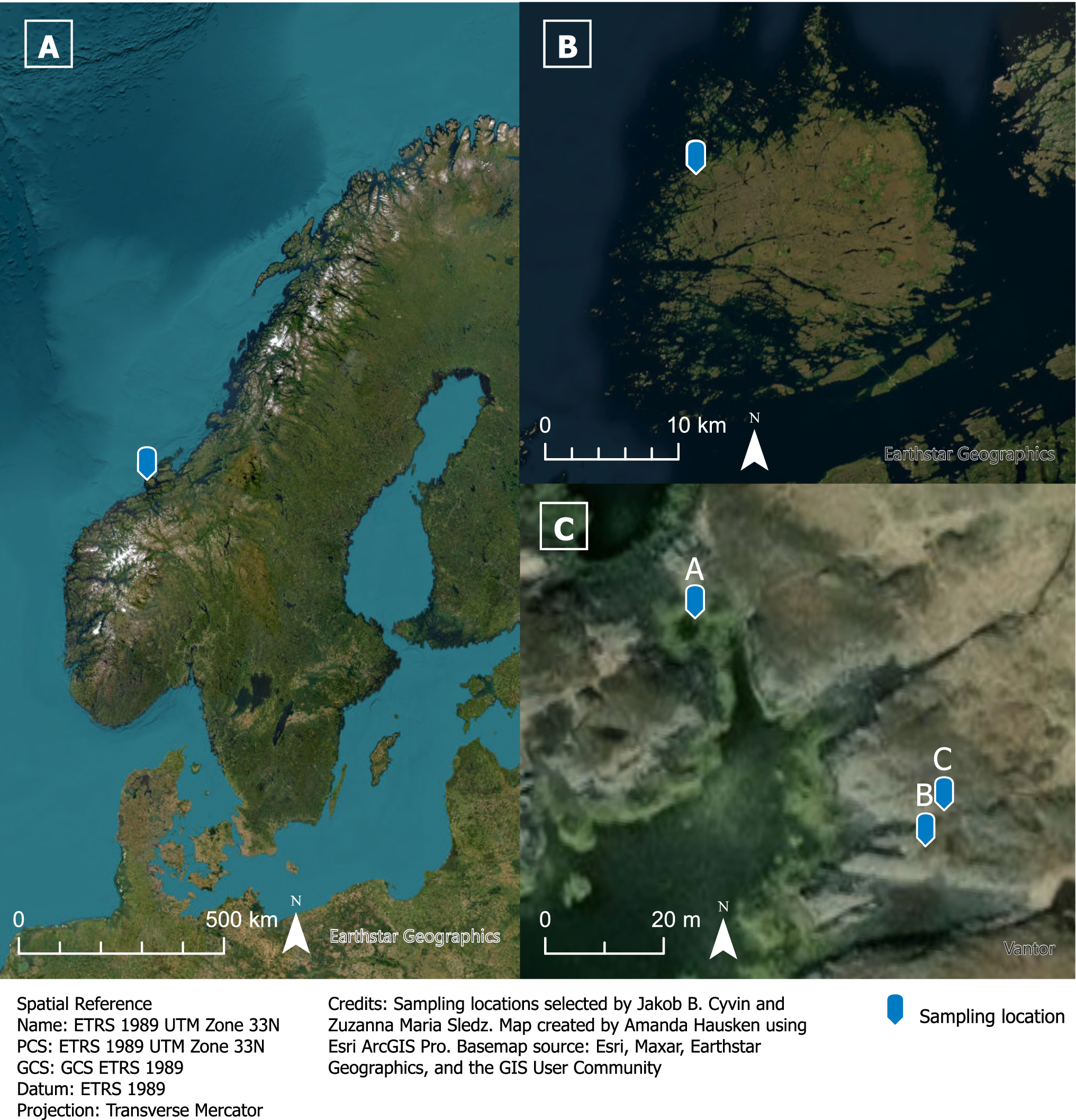
All sampling locations were in bays with a high degree of marine debris accumulation – also referred to as “wreck-bays.” They were above the Highest Astronomical Tide (HAT) level within zone 2 as defined by Bastesen et al. (Reference Bastesen, Haave, Andersen, Velle, Bødtker and Krafft2021), and permanently vegetated with soil depths of ca. 10–30 cm. The choice of sampling locations (Figure 1) was based on accessibility, landowner permission and with intentions to sample cores varying in macroplastic concentration (determined visually by noting surficial macroplastic presence at the site). To ensure soil similarity, all three samples from each location were extracted within the same 1 m2 area. As far as possible, due to regular stones in the ground sometimes inhibiting the possibility for coring exactly where wanted, all three cores within each 1 m2 were sampled along a triangle with the same distance to the centre as to the sides of the square. The locations were all within a 200 m radius of each other.
Satellite view map showing the location of Smøla island on the western coast of Central Norway (a and b), as well as the three sampling locations (A|B|C) in wreck-bays (c).

After extraction, the cores were placed into pre-rinsed PVC tubes. The inner walls of the tubes were coated with animal fat to minimize direct contact between the samples and the container, and to bind the outermost particles of the core. This coating reduced the risk of contaminating the leachate with MPs generated during coring. It also limited preferential water flow along the tube walls instead of through the soil during rainfall simulation, in which water was poured evenly on top of each core and allowed to drain through the profile to mimic natural infiltration. The tubes containing the soil cores collected in the field were sealed with plastic film and transported to the laboratory, thereafter stored in a vertical position for 2 weeks at 2–4°C.
To increase representativity, considering variations found within rainwater in different places (Carroll et al., Reference Carroll, Udall and Nolan1962), it was chosen to use local rainwater collected from a nearby freshly painted metal roof and stored at 2–4°C in glass bottles for this setup.Footnote 2
Experimental setup for quantifying MP leakage
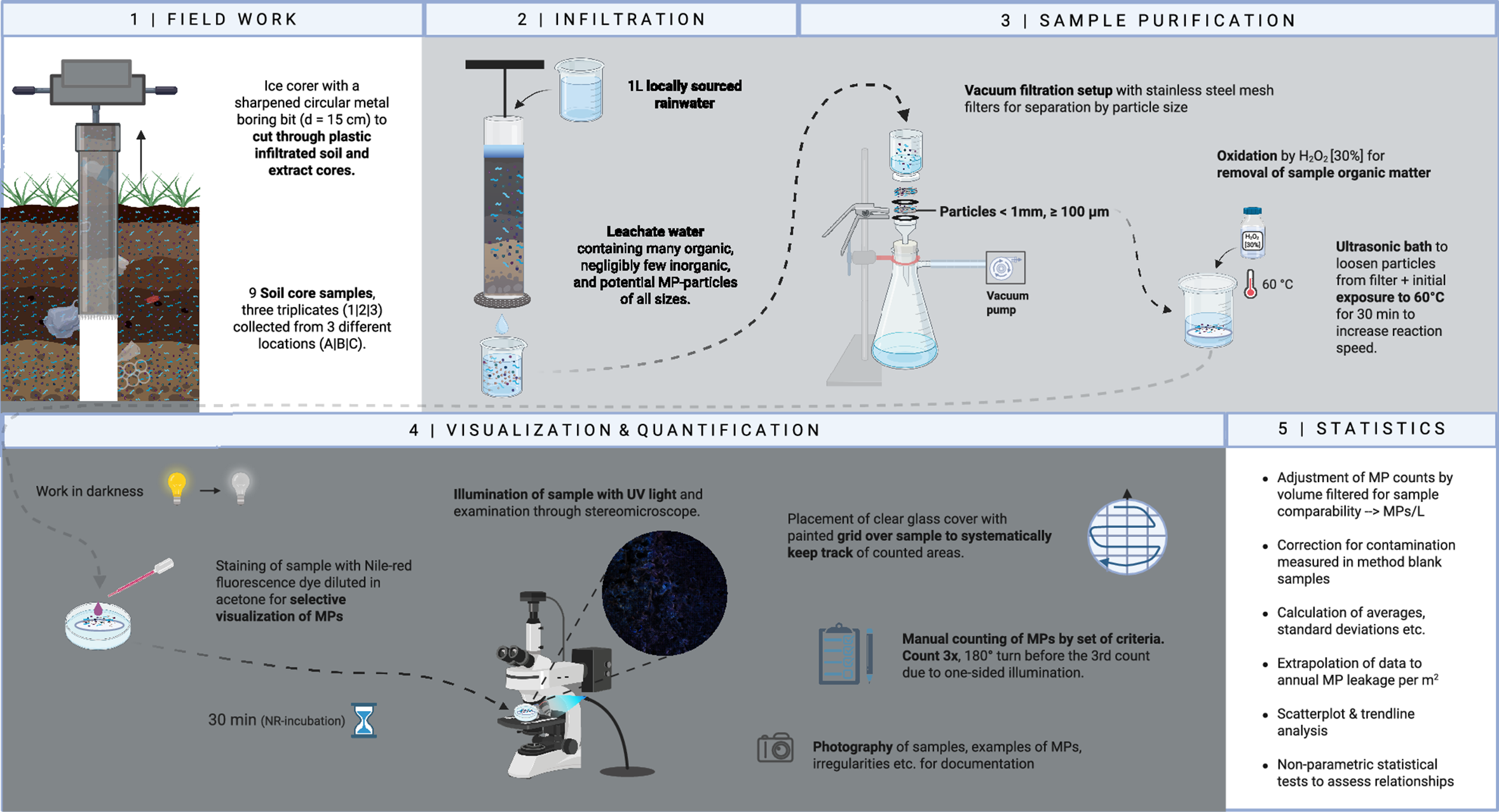
Figure 2 shows a simplified outline of the geophysical process simulation, as well as the following sample purification and MP quantification steps. A generalized version of the process, including practical recommendations, can be found in the Supplementary Material (S1).
Simplified outline of experimental setup and sample processing steps. Created in BioRender. Hausken (Reference Hausken2025) https://BioRender.com/beg4s1z. Specifications of materials, equipment and software used can be found in Supplementary Material S3.

Geophysical process simulation
In the laboratory, the cores were hung vertically, and rainwater was poured on top of their surfaces. The first ~1 L of water leaving the core (hereafter referred to as “leachate”) was collected for further analysis and stored in pre-rinsed glass bottles covered with aluminium foil.
Vacuum filtration for separation by particle size
All nine leachate samples and three method blank samples created with the same local water were processed through a common vacuum filtration setup (Razeghi et al., Reference Razeghi, Amir Hamidian, Mirzajani, Abbasi, Wu, Zhang and Yang2022; Schlawinsky et al., Reference Schlawinsky, Santana, Motti, Martins, Thomas-Hall, Miller, Lefèvre and Kroon2022) (Figure 2). Stainless steel filters were chosen due to their high structural integrity, allowing stacking for efficient separation by different size ranges, and inertness towards most sample treatment chemicals (Schlawinsky et al., Reference Schlawinsky, Santana, Motti, Martins, Thomas-Hall, Miller, Lefèvre and Kroon2022).
Oxidation for removal of organic sample matter
The mass retained from filtering the leachate samples was oxidized with 30% concentrated H2O2 to remove sample organic matter beyond MPs. To increase reaction efficiency, the samples were initially kept at 60°C for 30 minutes and thereafter left at room temperature for 48 hours. The protocol was inspired by Prata et al. (Reference Prata, Da Costa, Girão, Lopes, Duarte and Rocha-Santos2019a), balancing oxidation efficiency and the limitation of false negative results.
Visualization
For the MP visualization, filters were stained with a few drops of NR diluted in acetone, then incubated for at least 30 minutes in a dark room before examination under a stereomicroscope (Nikon SMZ1270, Nikon Instruments Inc. [2023b]) using a UV-light source (UV-light adapter kit by NightSea, 2023; excitation: 360–380 nm, longpass emission filter: 415 nm) (Maes et al., Reference Maes, Jessop, Wellner, Haupt and Mayes2017a).
Microscopy and quantification
Observations were made directly through the microscope, and documentational photos were taken using a camera module (Nikon Instruments Inc., 2023a). Direct observation was chosen as it appeared the most reliable and replicable choice for identification of particles that fit the criteria for being counted as MPs, given sample heterogeneity and observational medium-dependent optical differences. Criteria included particle sizes of 1 mm–100 μm, shapes resembling bits, fibres, sheets, glitter or beads, following a visual reference guide with known plastic (Forskningskampanjen, 2019), significant fluorescence under UV light and a lack of biological structures, as conceptually illustrated in Canva (2023), Supplementary Material S1.
Particles were counted manually at ×9 magnification. Fluorescing particles requiring closer examination to rule out false positive or negative identification were individually magnified at higher levels. A clear photography lens cover with a painted 5 × 5 mm grid helped keep track of counted areas. A particle had to meet all criteria to be counted as MP.
Macroplastic quantification
After the rainfall simulation experiment, the soil cores were dried in a drying closet for 967 hours at 37–41°C until the drying curve flattened. Thereafter, all visible macroplastic pieces (≥5 mm) were manually sorted out from each sample. Macroplastic and soil were weighed separately to determine the weight-based proportion of macroplastic per total sample dw in percent (plasticdw/totaldw*100).
Statistics and calculations
Averages (avg.), standard deviations (SDs) and other key metrics for portraying the results, as well as the extrapolated annual MP leakage per m2, were calculated using applicable functions in Excel (Microsoft Corporation, 2023).Footnote 3
The relationship between MP leakage and soil macroplastic content was examined qualitatively in xy-scatterplots and quantitatively through correlation testing. Statistical tests and data visualizations were performed in the open-source programming language R in R Studio (Posit Software, 2024).
To account for the limited sample size, reducing the impact of non-normality and potential outliers in the distribution, non-parametric or robust methods were applied. A Spearman’s test was conducted to test the correlation between MPs leaked per liter (MPs/L) and the relative amount of macroplastic present in the soil (% of total sample dry weight(dw)), while their linear relationship was explored further using robust linear regression (MM estimator, function: lmrob()) with the robustbase package in R (Maechler et al., Reference Maechler, Todorov, Ruckstuhl, Salibian-Barrera, Koller and Conceicao2025).
The avg. annual precipitation (L/m2) during the previous 5 years(2018–2022) was calculated based on publicly available data provided by The Norwegian Meteorological Institute (MET Norway, 2023) from Smøla – Moldstad. This allowed us to determine annual MP leakage (MPs/m2/year).
Validity and reliability
Given the lack of comparable studies on MP leakage from coastal soils at the time (October 2025), ensuring the internal validity of this first case study was critical. Efforts were directed towards minimizing the risk of false positives/negatives and verifying the method.
Contamination control and assessment
All laboratory equipment, containers and surfaces worked on were rinsed thrice with distilled water and finally with ethanol [70%], and work was done underneath a fume hood whenever possible. Samples were kept covered with aluminium foil or standardized petri dish lids. Clothes made of synthetic materials were avoided.
Three method blanks were created from the same water and exposed to the same treatment as the samples to determine the amount of contamination stemming from the sample purification process. The average MP concentrations found in the blanks could then be subtracted from all sample concentrations.
NR staining verification and counting accuracy
To verify the appropriate effect of the NR staining method on the material aimed to visualize, spikes (controls) were created for four known common plastic types (PET, PE-LD, PP and PS), NR-stained and examined by Royal Blue (RB) and UV microscopy. Fluorescence of the known plastic particles was viewed as an indicator that the NR staining was successful and that MPs within the samples would therefore also be visualized and counted. Examples of non-synthetic materials likely to be contaminants (cotton, wool, paper and human hair) were also NR-stained to confirm whether they would fluoresce. MPs were counted thrice in each sample, and the avg. of the triplicate counts was used to decrease the overall impact of single miscounts.
The verification protocol and counting criteria were chosen with the aim of reducing the risk of false-positive identification of non-synthetic matter of biological origin (e.g., chitin) not removed by the prior digestion step (Prata et al., Reference Prata, Reis, Matos, da Costa, Duarte and Rocha-Santos2019b). Furthermore, validation of sufficient illumination of plastic particles addressed the factor of varying fluorescence across polymer types observed by Maes et al. (Reference Maes, Jessop, Wellner, Haupt and Mayes2017a). Nevertheless, it is acknowledged that detection is influenced by the subjective evaluations of the observer, and that there may remain some risk of false positives/negatives (Prata et al., Reference Prata, Sequeira, Monteiro, Silva, Da Costa, Dias-Pereira, Fernandes, Da Costa, Duarte and Rocha-Santos2021).
Results
MP leakage
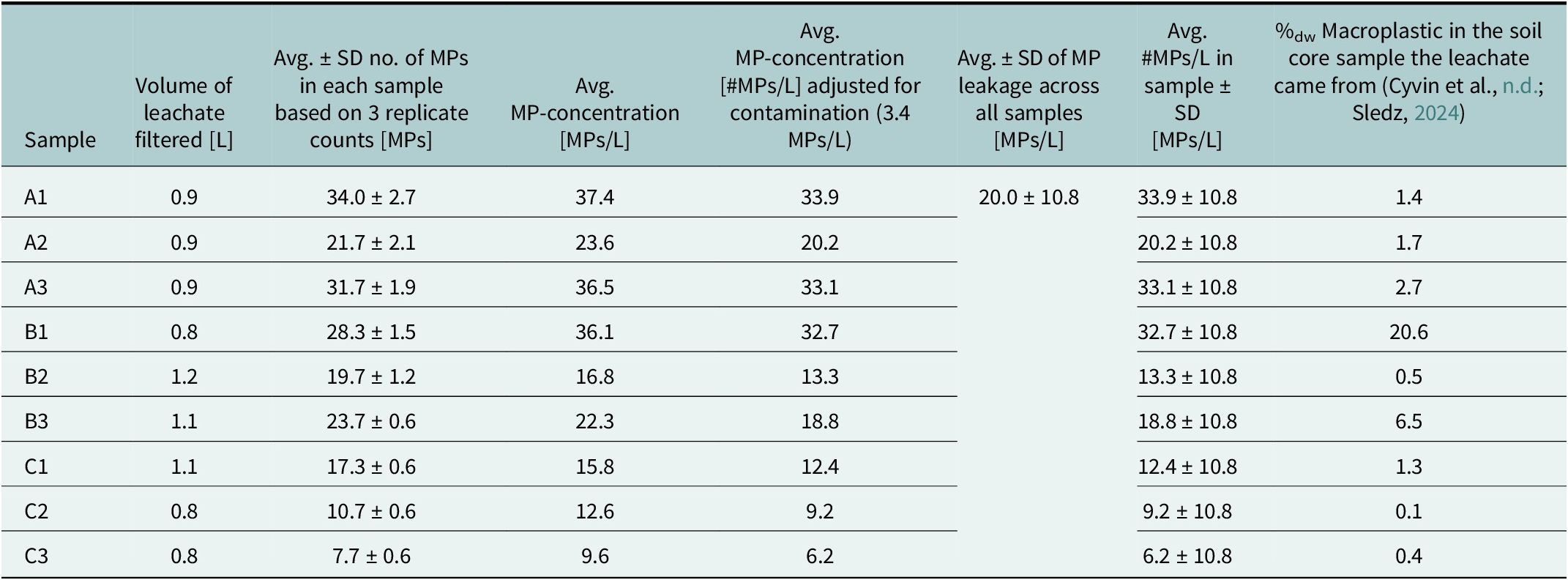
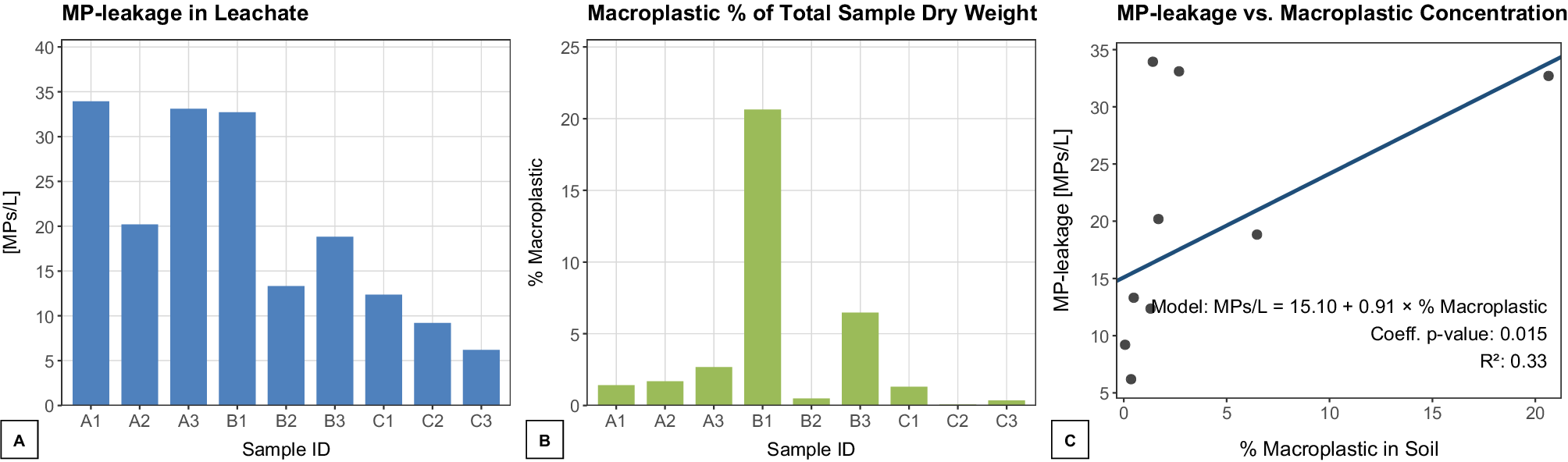
MPs were found in all nine leachate samples. The avg. MP concentration determined from the three method blank samples (contamination) was found to be 3.4 MPs/L and subtracted from each sample concentration as an adjustment for contamination. We could not see a connection between the length of the soil cores (Supplementary Material S2) and the concentration of MP in the leakage water. The adjusted leachate sample concentrations ranged from 6.2 to 33.9 MPs/L with an avg. of 20.0 ± 10.8 MPs/L (Table 2). The bar graph in Figure 3a shows MP concentrations per sample. Based on the avg. annual precipitation over the last 5 years (1,375 L/m2/year), the number of MPs leaked per m2 annually (MPs/m2/year) was determined to be 27,473 MPs/m2/year.
Microplastic and macroplastic concentrations measured per sample

Note: All data recordings and calculations were done including decimals, but are presented rounded to one decimal for readability.
Bar charts for MP-concentration (a) and macroplastic content (b) measured per sample. (c) shows an x–y scatterplot of MP concentration in the leachate depending on the % of macroplastic in the sample.

MP leakage versus macroplastic concentration
The macroplastic content in % of the total soil sample dry weight(dw) was in the range of 0.1–20.6%, with an average of 3.9% ± 6.6%. Figure 3b shows the macroplastic content per sample. A statistically significant positive correlation (ρ Spearman=0.72, p=0.030) was found between soil macroplastic content (%dw) and MP leakage [MPs/L]. The robust linear regression visualized in the xy-scatterplot of the two variables (Figure 3c) also indicated a positive relationship between the macroplastic-content in the soil and the MP concentration in the leachate therefrom (β = 0.91 ± 0.28SE, p=0.015). The fitted model (MPs/L=15.10 + 0.91 × Macroplastic(%dw)) explained 33% of the variance (R 2 = 0.33).
Qualitative observational results
Microscopy and quantification
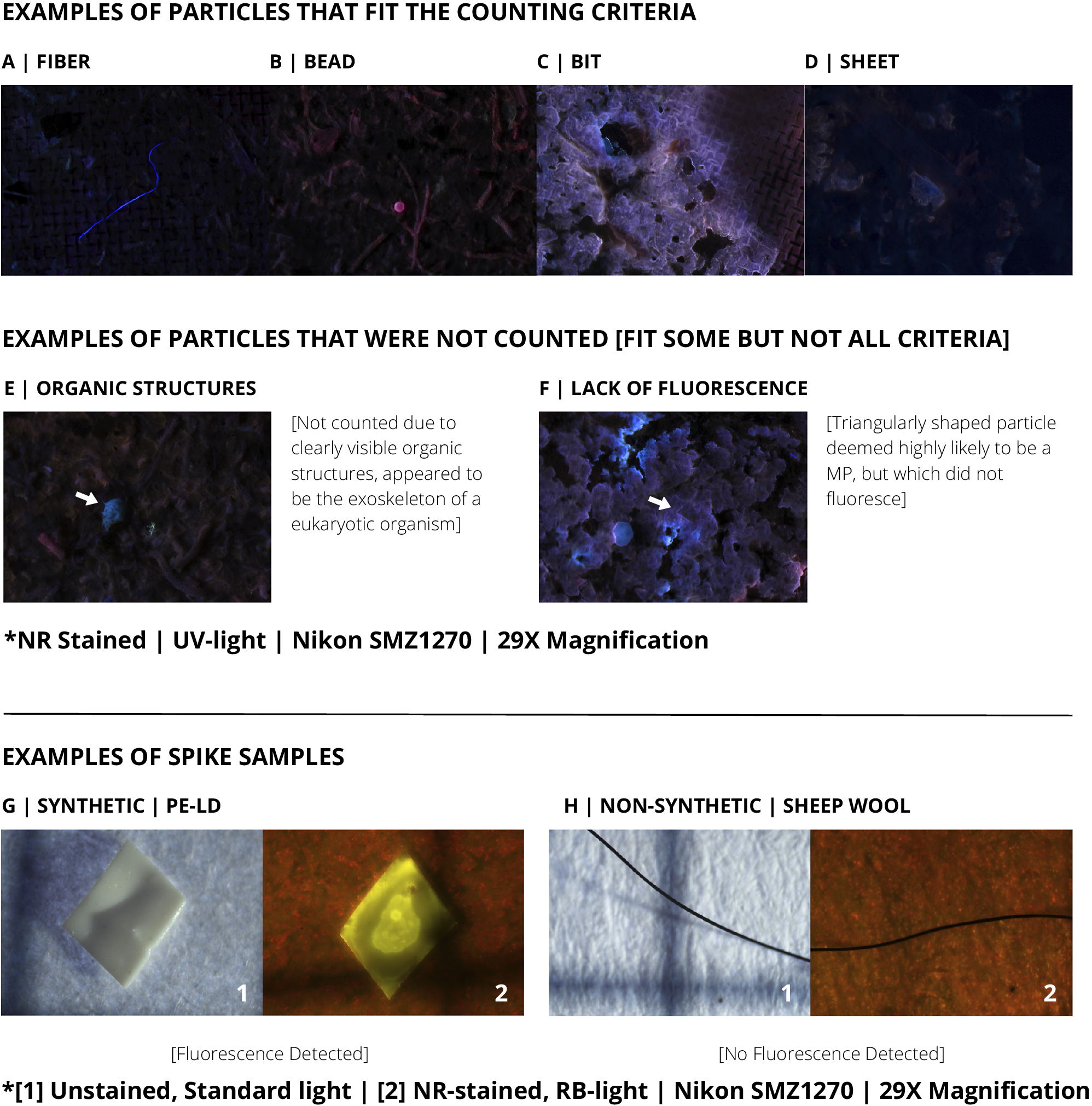
Overall, fibers appeared to be the most prevalent MP type in all samples (and the one that showed the strongest degree of fluorescence), while some samples also contained beads, bits and sheet-like particles (Figure 4a–d). There were also a few particles that met many counting criteria, including fluorescence, but had to be excluded due to size, visible organic structures or other deviations. In a limited number of samples, a very small number of particles resembling MPs in shape and surface structure were observed, which could not be counted as MPs as they failed to meet the fluorescence criterion. Figure 4e,f shows examples of deviations.
(a–f) Examples of particles in the size range 1 mm–100 μm that met all the criteria required to be counted as MPs. (e–f) Examples of particles that were not counted as MPs, as they did not fit all the criteria. Note that everything was determined by direct inspection through the microscope, which provided a slightly different visualization than the camera software used to capture documentational photos. (g–h) Examples of synthetic and non-synthetic spike samples examined under the microscope before and after NR staining for method verification. *Royal blue (RB) light (440–460 nm excitation, 500 nm long-pass emission filter) (NightSea, 2023) was used here instead of UV light due to strong background reflection when using the latter.

Controls
NR staining had no significant effect on the natural materials tested (negative controls). While cotton fluoresced slightly, it was not enough to be counted by the criteria nor comparable with the fluorescence observed in known MPs. The rest of the materials showed no signs of fluorescence at all. Four spike samples with known plastic (PET, PE-LD, PS and PP) were examined as positive controls. While PP emitted slightly less light than the others on the digital image, the particles of all spikes showed clear fluorescence when examined directly underneath the microscope. Thus, the NR staining method was determined to be successful in its ability to visualize these four common plastic types. Examples of control samples are shown in Figure 4g,h.
Method guide results
Throughout the pilot case study with samples from Smøla, experiences with the methodology were compiled into an instructional manual supported by a visual guide (Supplementary Material S1). This resource was designed to facilitate teaching of the method across varying levels of background and expertise, and to serve as a basis for future studies of the phenomenon.
During fieldwork, applying the custom method for cutting plastic-infiltrated soils proved highly valuable for obtaining intact soil cores used in the subsequent infiltration experiments. In teaching university students without prior experience, the introduction of spike samples as visual checks effectively supported the understanding of qualitative controls in experimental design. Including method blank samples for statistical adjustment of results further enhanced awareness of contamination as a challenge and demonstrated quantitative approaches for assessing and correcting it.
For identifying MPs in NR-stained samples under UV-light microscopy, combining existing shape-based guides (Forskningskampanjen, 2019) with conceptual illustrations of biological structures (potential false positives) proved effective for training. Evaluation of multiple drafts of the instructional material by a participating student and supervisor, as well as peer feedback during its presentation at the MICRO2024 conference, informed refinements leading to the release of the first version of the guide and presenting this as part of our study results.
Discussion
There is a clear need for cost-efficient, accessible methods with CS-friendly protocols for researching the phenomenon of MP leakage from coastal soils back into the ocean. Previous research on this leaking microplastic sink is absent in the current literature. This does not mean that the use of high-tech, high-precision methods for analysis of polymer composition, adverse chemicals and colorants is not needed, but we first of all need to understand the broader scope of the problem before going into detail. This situation is comparable to the early years of general MP research, where the focus was on documenting the quantitative distribution of plastic pollution in various environmental compartments. We believe the method presented here to be feasible for high-school- and university-course projects, and in line with previous recommendations regarding the use of NR for MP detection (Erni-Cassola et al., Reference Erni-Cassola, Gibson, Thompson and Christie-Oleza2017; Maes et al., Reference Maes, Jessop, Wellner, Haupt and Mayes2017a; Prata et al., Reference Prata, Sequeira, Monteiro, Silva, Da Costa, Dias-Pereira, Fernandes, Da Costa, Duarte and Rocha-Santos2021). We also see the use of simple methods like the one presented as a tool to gain valuable insights from low-income countries with limited access to expensive analytical tools, empowering local contribution as opposed to parachute research (Cyvin, Reference Cyvin2022).
Case study results
MP leakage from samples
MPs were found in all leachate samples, and although some degree of contamination was detected in the method blank samples (~3.4 MPs/L), its impact was directly accounted for by subtraction, improving data reliability. As no previous studies on MP leakage from coastal soils could be found, the measured concentrations (~20 ± 11 MPs/L, size: 100 μm–1 mm) lack grounds for direct comparison. Considering studies on coastal environments in general (Table 1), concentrations were within the same order of magnitude but clearly higher than those found in nearshore surface waters in other remote areas, such as in South Georgia (Buckingham et al., Reference Buckingham, Manno, Waluda and Waller2022), and deviate by several orders of magnitude from Norwegian coastal waters (Van Bavel et al., Reference Van Bavel, Lusher, Consolaro, Hjelset, Singdahl-Larsen, Buenaventura, Röhler, Pakhomova, Lund, Eidsvoll, Herzke and Nerland Bråte2023). This seems reasonable, as these measurements stem from samples collected in open coastal waters, whereas those of this study stem from simulated runoff through coastal soil-samples collected in wreck bays with considerable plastic accumulation. Interestingly, the concentration magnitude was comparable to that in drainage water from the populated area of Longyearbyen, Svalbard, entering the sea (Sundet et al., Reference Sundet, Herzke and Jenssen2016), as well as effluent water from wastewater plants in Sweden (Van Praagh et al., Reference Van Praagh, Hartman and Brandmyr2018). When it comes to MP concentrations leached through solid matrix, the only available data were from studies of landfill leachate (He et al., Reference He, Chen, Shao, Zhang and Lü2019; Kabir et al., Reference Kabir, Wang, Luster-Teasley, Zhang and Zhao2023; Wisitthammasri et al., Reference Wisitthammasri, Promduang and Chotpantarat2024). He et al. (Reference He, Chen, Shao, Zhang and Lü2019) analysed leachate samples from four landfills in China, finding concentrations of 0.42–24.58 particles/L. Thus, the MP leakage from coastal soils of a remote island in Central Norway appears quantitatively most comparable with that from landfills in China.
It is important to note that the sampling location was selectively chosen and that results, therefore, cannot be considered representative of the general coastline of Norway. The values can also be viewed in the contextual light of MP concentrations found in coastal soils from a very similar nearby area (Aasen Kveberg, Reference Aasen Kveberg2021). The difference in magnitude suggests that coastal soils might indeed, to some extent, act as a sink for microplastics (Bläsing and Amelung, Reference Bläsing and Amelung2018). However, the observed leakage emphasizes that it may only be temporary. We suggest instead considering its role as a potentially noteworthy facilitator of MP breakdown (Cyvin et al., Reference Cyvin, Ervik, Kveberg and Hellevik2021) and redistributor thereof back into the marine environment.
Extrapolation to annual leakage
The extrapolation to annual leakage per m2 based on local 5-year average annual precipitation levels was found to be ~27,000 MPs/m2/year. While this is a large number, it must be interpreted with caution as it is currently still without grounds for comparison, and the result of extrapolation from a pilot study with a limited sample size and geographical representativity. The protocol for oxidation did not fully cover the degradation of all rayon, cotton and chitin, which may have influenced results. We encourage the development of a size- and matrix-dependent key for adjustment of NR results upon micro-FTIR. Nevertheless, without any prior knowledge being available, our results can be considered an educated first estimate, representing MP-leakage in Zone 2 of local wreck bays on Smøla.
There are a number of climatic and stratigraphic variables which may influence site-specific data. For instance, O’Connor et al. (Reference O’Connor, Pan, Shen, Song, Jin, Wu and Hou2019) found that the number of wet and dry cycles impacts MP intrusion-depth in soil. Looking upon a humid and rainy environment at the Central Norwegian coast, this might influence the downwards transport in these areas meeting the bedrock at ca. 30–50 cm depth, most likely causing MPs to migrate horizontally along the bedrock towards the ocean. Further research on MP leakage from various types of coastal sediments influenced by a wide range of climatic conditions, both on a local, national and global level, is therefore needed to gain a better understanding of flux rates and outputs.
MP versus macroplastic results
One of the main results from this study is the observed significant positive correlation between the amount of macroplastic present in the soil cores and the amount of MPs leaving the soil cores. Despite a limited sample size due to the pilot nature of the study, the trend appears reasonable in consideration of previous observations, suggesting an association between increased macroplastic presence and increased MP concentration in soil (Aasen Kveberg, Reference Aasen Kveberg2021; Tiwari and Sistla, Reference Tiwari and Sistla2024). A possible bias of these results is the coring method, where the drilling process could lead to increased artificial breakdown of macroplastic into MP in samples with high plastic concentrations compared to those with lower. Nevertheless, we believe that the use of a thick layer of animalistic fat on the inside of the tube likely prevented most of the MP associated with the cutting process from vertical movement. This assumption should be investigated further, for example, through conducting a laboratory simulation of the process, adding plastic of known colours into soil, and repeating a similar MP leakage study to trace the origins of leaked MPs.
A CS-friendly guide for analysing MP leakage from coastal soil
The guide resulting from our work (Supplementary Material S1) distinguishes itself from previous protocols through its explanatory language use, visual communication and overall pedagogical approach aimed towards applicability across experience levels and language barriers. It encompasses the entire process from extracting soil cores in the field to laboratory simulation of rainfall, MP quantification in leachate and simple data analysis for comparability of key reporting units. It is suitable for ages 14 years and upward and built upon the visions and principles of the European Union Guideline for Citizen Science Research to include citizen scientists in data acquisition, analysis and reporting. While dissemination of results will naturally be up to the individual organizations, our hope is first and foremost to encourage and enable citizen scientists to take part in this research in all its stages, which, from a pedagogical point of view, allows for a greater overall understanding of the scientific process. Not only is this a valuable learning and engagement opportunity for individuals and communities, it can also help build societal trust in science, as knowledge is acquired in more collaborative, democratic and participatory forms. We encourage regional, national or international projects to direct their focus towards quantifying MP leakage from coastal soil, using CS-friendly protocols as the one suggested. We acknowledge that this is a first version of such a guide, that there is likely much room for development and that some degree of modification may be necessary for individual projects. Thus, in its current form, the guide represents an easy tool to “get started” with this type of research, with an underlying core intention that it may help form a network of studies with comparable setups and reporting of results, for a much-needed first global mapping of the state of MP leakage from coastal soils.
Concluding remarks and the way forward
Using a framework of simple, accessible methods, we have documented and quantified MP leakage from plastic-infiltrated coastal soil on the remote island of Smøla in Central Norway. The process involved soil core sampling in the field, rainfall simulation in the laboratory, leachate sample purification using filtration for separation by size and H2O2 oxidation for removal of organic matter. Finally, samples were stained with NR and examined under UV-light microscopy for visualization and manual counting of MPs. The pilot study resulted in the detection of considerable levels of MP leakage, which could be cautiously extrapolated to provide a preliminary estimate of the annual leakage per m2 representative of the local context. While the method can naturally be expected to have lower accuracy compared to that of high-tech analytical approaches, it has, as we see it, the advantage of being cost-efficient and relatively easy to learn, making it accessible and applicable in citizen science contexts, school projects and research in developing countries – in the spirit of democratizing science. Due to the global lack of knowledge about the redistribution of microplastics from soils back to oceans, we see this method as a promising balance between data validity and the future ability to acquire data with large sample sizes and high spatial distribution in the time to come.
Open peer review
To view the open peer review materials for this article, please visit http://doi.org/10.1017/plc.2026.10046.
Supplementary material
The supplementary material for this article can be found at http://doi.org/10.1017/plc.2026.10046.
Data availability statement
Raw data are provided in the Supplementary Material (S2).
Acknowledgements
The authors gratefully acknowledge Zuzanna Maria Sledz for her valuable contributions to the fieldwork, infiltration experiment and sorting of soil samples for the macroplastic concentration data. We also express our sincere gratitude to Dr. Francis Chantel Nixon, Associate Professor at the Department of Geography and Social Anthropology at NTNU, for her support and guidance as PhD supervisor. Finally, we thank the Plastic Research Cooperation Group (PRCG) at the Department of Geography and Social Anthropology, NTNU, for enabling us to present our work and gain valuable peer feedback at MICRO2024.
Author contribution
A.V.H.: Investigation, conceptualization of the citizen science friendly method guide, formal analysis, visualization, writing – original draft and writing – review and editing. J.B.C.: Conceptualization of the case study on Smøla, methodology, investigation, validation and writing – review and editing. All authors have read and approved the final version of the manuscript.
Financial support
This work was supported by the former strategic research area “NTNU Sustainability” at the Norwegian University of Science and Technology (NTNU), and the active project “Marine Plastic Pollution: Environmental Impact and Life Cycle Scenarios” (MAPLE).
Competing interests
The authors declare none
Declaration of AI use
The authors hereby declare that the AI-powered search assistant “Perplexity AI” (Perplexity, 2025) was used in combination with more traditional methods to search for relevant literature, using keyword and phrase-based queries.


 Open access

