


1 Introduction
Language contact – arising from interactions between speakers of different languages – plays a central role in shaping linguistic usage and evolution. It informs both historical and structural analyses of language development and the everyday multilingual practices of speakers (e.g. Matras Reference Matras2009; Assouline Reference Assouline2017; Hans-Bianchi et al. Reference Hans-Bianchi, Truppi and Vogt2024). Contact linguistics explores the linguistic and social phenomena that emerge from such interactions, including borrowing, code-switching, and language mixing (e.g. Myers-Scotton Reference Myers-Scotton2002; Thomason Reference Thomason, Janda and Joseph2003). Borrowing involves the integration of lexical and grammatical elements from a donor into a recipient language, often affecting multiple linguistic levels (e.g. Haspelmath Reference Haspelmath, Stolz, Bakker and Salas Palomo2008; Winter-Froemel Reference Winter-Froemel, Zenner, Backus and Winter-Froemel2019). Code-switching, by contrast, refers to the fluid alternation between languages within discourse and reflects both communicative strategy and cultural identity. While traditionally seen as a precursor to borrowing, recent research challenges this linear view, arguing for distinct processes shaped by prosodic, syntactic, and sociolinguistic factors (e.g. Boztepe Reference 80Boztepe2003; Manfredi et al. Reference Manfredi, Simeone-Senelle, Tosco, Mettouchi, Vanhove and Caubet2015). Poplack’s (Reference Poplack2018) monograph Borrowing: Loanwords in the Speech Community offers a landmark contribution, presenting borrowing as a socially embedded process. Drawing on extensive bilingual data, she distinguishes it from code-switching, which maintains the grammatical integrity of both languages, whereas borrowings are structurally assimilated into the recipient language.Footnote 1
Language mixing, when linguistic elements blend to form hybrid systems, can lead to the emergence of pidgins and creoles – often in colonial and postcolonial contexts (e.g. Thomason Reference Thomason2001: 157–167). By integrating historical, structural, cognitive, and social perspectives, contact linguistics provides a comprehensive framework for understanding language change and variation. Historical approaches trace long-term shifts and the development of contact-induced varieties (e.g. Schreier and Hundt Reference 88Schreier and Hundt2013; Durkin Reference Durkin2014; Pahta et al. Reference Pahta, Skaffari and Wright2018), while structural analyses focus on how linguistic systems adapt through phonological, morphological, and syntactic changes (e.g. Winter-Froemel et al. Reference 90Winter-Froemel, Ellena and Goldschmitt2023). Cognitive and social dimensions further illuminate the mental processes behind multilingual speech and the power dynamics between language communities (e.g. Matras Reference Matras2009; Hans-Bianchi et al. Reference Hans-Bianchi, Truppi and Vogt2024).
Cognitive approaches offer powerful tools for unraveling the intricate mental processes that unfold during language contact. These include how linguistic features are integrated and adapted, how multilingual individuals manage multiple language systems, and the neural mechanisms that support such processing. Together, these insights deepen our understanding of the remarkable cognitive flexibility multilingual speakers exhibit. A central focus is on conceptual integration and semantic transformation. Through metaphors, analogies, and other meaning-making strategies, speakers blend elements from different languages to generate new expressions and interpretations. Cognitive research also emphasizes the role of frequency: The more often a linguistic structure is used, the more deeply it becomes entrenched in the mental lexicon. This helps explain why certain borrowings and patterns are more easily adopted than others (Zenner et al. Reference Zenner, Backus and Winter-Froemel2019: 2–10).
Computational modeling plays a vital role in Cognitive Linguistics, offering empirical support for theoretical claims. Simulations help replicate the cognitive dynamics of language contact, providing measurable insights into linguistic diversity. For instance, Cheung (Reference Cheung2022) employs agent-based models to explore how creole languages evolve and spread, showing how social structures influence lexical change in multilingual settings. Importantly, cognitive approaches do not isolate mental processes from their social context. They recognize that language contact is shaped by the interaction between individual cognition and broader societal forces. This includes the negotiation of linguistic identities, adherence to social norms, and strategies for intercultural communication – all of which contribute to the emergence and evolution of contact phenomena (e.g. Bialystok Reference Bialystok2006; Poplack Reference Poplack2018; Grosjean Reference Grosjean2024).
Investigating the mental representations held by speakers of various languages is a key focus of Cognitive Contact Linguistics. These inquiries investigate the storage, processing, and retrieval of linguistic data within the brain, as well as the impact of language contact on these operations. Contact between languages leads to variations in language usage, necessitating cognitive flexibility from speakers. Multilingual individuals demonstrate this adaptability through code-switching, employing borrowings, and other linguistic variations, seamlessly navigating between different linguistic systems. Research in this field explores the cognitive advantages and difficulties linked to such flexibility (see Zenner et al. Reference Zenner, Backus and Winter-Froemel2019: 2–5; Grosjean and Pavlenko Reference Grosjean and Pavlenko2021).
The frequency with which linguistic structures are used affects their entrenchment in speakers’ mental lexicons. Cognitive Contact Linguistics investigates how repeated exposure to and usage of borrowings and other linguistic features contribute to their cognitive entrenchment and automation. These inquiries assist in comprehending the reasons behind the ease of adoption and integration of certain linguistic patterns over others (e.g. Finzel and Wolf Reference Finzel, Wolf, Zenner, Backus and Winter-Froemel2019; Verschik Reference Verschik, Zenner, Backus and Winter-Froemel2019; Winter-Froemel Reference Winter-Froemel, Zenner, Backus and Winter-Froemel2019; Landmann Reference 85Landmann2023).
Studies in social cognition examine the impact of social interactions and cultural practices on language processing and production. Multilingual individuals frequently acquire unique abilities for intercultural communication and managing linguistic identities (e.g. Marzo et al. Reference Marzo, Zenner, Van de Mieroop, Zenner, Backus and Winter-Froemel2019; Vertommen Reference Vertommen, Zenner, Backus and Winter-Froemel2019). Cognitive contact linguistics offers a comprehensive understanding of the cognitive mechanisms underlying language processing and production in multilingual contexts. The aspects covered in this Element include the study of mental representations (see also Onysko Reference Onysko, Zenner, Backus and Winter-Froemel2019), semantic integration (e.g. Blank Reference Blank, Blank and Koch1999; Landmann Reference 85Landmann2023), linguistic variation (e.g. Marzo et al. Reference Marzo, Zenner, Van de Mieroop, Zenner, Backus and Winter-Froemel2019; Vertommen Reference Vertommen, Zenner, Backus and Winter-Froemel2019), and social cognition (see also Backus Reference Backus and Nicolai2014; Verschik Reference Verschik, Zenner, Backus and Winter-Froemel2019; Landmann Reference Landmann, Caon, Gordon and Porck2024a, Reference Landmann and Belkhir2024b). This allows researchers to gain important insights into the dynamics of language contact and language evolution.
This Element offers a comprehensive introduction to contact linguistics through a cognitive lens, highlighting the value of integrating insights from Cognitive Linguistics into the study of language contact. It raises a range of research questions that future studies may explore, particularly those that benefit from examining how mental processes shape and are shaped by multilingual interaction. Through four detailed case studies, the Element demonstrates how theoretical and descriptive approaches from both fields can be combined to generate new perspectives. As such, it serves as a valuable resource for students and researchers interested in the cognitive dimensions of language contact.
Section 2 forms the analytical core of the Element, focusing on contact phenomena from a cognitive standpoint. Section 2.1 investigates how language contact manifests in processing and production. Following a brief overview of current research and theoretical frameworks, a case study illustrates how mental categorization interacts with contact-induced variation and change. Topics include the flexibility of mental categories, the salience of linguistic features in contact situations, and the cognitive mechanisms behind borrowing and entrenchment.
Section 2.2 shifts the focus to language change across lexical, morphological, and semantic levels. Drawing on a case study of French influence on English vocabulary in the domains of cooking and art, this section explores how contact-induced changes can be reclassified within cognitive typologies. It also examines conceptual blending, metaphor theory, and prototype effects as tools for understanding semantic shifts. In Section 2.3, the discussion turns to discourse and conversational variation. After outlining key theoretical approaches, a case study on English–German code-copying in blogs reveals how bilingual speakers navigate their linguistic repertoires. This section emphasizes the interactive nature of multilingual communication and the cognitive forces that shape code usage and perception among interlocutors. Section 2.4 brings together social and cognitive perspectives to examine loan processes and their long-term linguistic effects. Using Latin-derived proverbs as a case study, it traces the influence of Latin on English across centuries. The analysis highlights how sociocultural and emotive-affective factors contribute to the conventionalization and entrenchment of borrowed expressions, and how sociocognitive models can illuminate these processes. The final section, Section 3, offers a conclusion and forward-looking reflection. It outlines potential directions for future research in Cognitive Contact Linguistics, suggesting theoretical frameworks and methodological approaches that could deepen our understanding of language contact phenomena. An Appendix supplements the main text with datasets from the case studies, along with exercises and self-study questions designed to reinforce key concepts. Solutions are provided to support independent learning and classroom use.
2 Contact Phenomena through the Cognitive Lens
This section explores various manifestations of language contact from a cognitive perspective, structured into four interrelated subsections. Section 2.1 examines how cognitive approaches illuminate the processes of language contact in both language production and comprehension.
2.1 Cognitive Approaches to Manifestations of Language Contact in Language Processing and Production
2.1.1 Introduction
This subsection outlines key cognitive frameworks used to examine language contact phenomena, offering a comprehensive overview of current research and theoretical models. It includes a case study that demonstrates how cognitive principles – particularly mental categorization – can effectively account for contact-induced linguistic variation and change.
The interplay between mental categorization and linguistic variation driven by contact provides valuable insights into both cognitive mechanisms and language evolution. By investigating this relationship, researchers can better understand how language contact shapes linguistic diversity and cognitive capacities. Scholars have developed a range of concepts to describe the processes underlying language interaction, including borrowing, code-switching, transfer, and replication. This section applies these cognitive concepts to explore the principal mechanisms of language contact, illustrated through examples such as the influence of English on German and other multilingual contexts. These examples highlight the complexity and interconnectedness of contact phenomena and the challenges involved in their categorization. The section concludes with a synthesis of the key findings, emphasizing the cognitive dimensions of language contact and their implications for linguistic theory and practice.
2.1.2 State of the Art
Mental categorization describes how the human mind sorts and processes information into various categories. These categories, often shaped by cultural and linguistic backgrounds, affect how individuals perceive and interpret linguistic events. A number of studies investigate the connection between mental categorization and linguistic variation among multilingual speakers. They demonstrate how cognitive linguistics questions the concept of language as a strictly defined entity, asserting that languages interact and develop through usage rather than adhering to fixed boundaries (e.g. Bialystok Reference Bialystok2006; Höder Reference Höder, Braunmüller and Gabriel2012, Reference Höder, Åfarli and Mæhlum2014; Grosjean and Li Reference Grosjean and Li2013; Onysko Reference Onysko, Zenner, Backus and Winter-Froemel2019; Grosjean and Pavlenko Reference Grosjean and Pavlenko2021; Grosjean Reference Grosjean2024). This perspective, which moves away from traditional structuralist approaches toward a notion of language as a dynamic and adaptive system, is based on the idea that language processing is related to activation processes in the brain. It suggests that linguistic categories are shaped by usage rather than rigid boundaries, with repeated exposure and social contexts reinforcing specific linguistic patterns in the mental network (e.g. Bybee Reference Bybee2010; see also Schmid Reference Schmid, Engelberg, Lobin, Steyer and Wolfer2018, Reference Schmid2020). For example, Grosjean and Li (Reference Grosjean and Li2013), Grosjean and Pavlenko (Reference Grosjean and Pavlenko2021), and Grosjean (Reference Grosjean2024) suggest that multilingual individuals engage their languages to differing extents depending on situational factors, introducing the idea of a spectrum of language activation rather than a strict either–or model. This framework highlights the fluidity of linguistic boundaries and their responsiveness to interaction. Similarly, Bialystok (Reference Bialystok2006) shows that bilingualism alters the brain’s cognitive control systems, with the constant management of multiple languages leading to improved attentional regulation and mental flexibility. Their research indicates that multilingualism shapes not just language use but also the neural mechanisms that support it.
Höder introduces the concept of Diasystematic Construction Grammar and assumes that multilingual speakers have both language-specific and nonlanguage-specific constructions that are stored in their memory and deployed depending on sociopragmatic conditions (e.g. Höder Reference Höder, Braunmüller and Gabriel2012, Reference Höder, Åfarli and Mæhlum2014; see also Section 2.2 for a detailed discussion of Höder’s approach). Onysko (Reference Onysko, Zenner, Backus and Winter-Froemel2019) investigates the fluid nature of linguistic categorization, emphasizing its basis in interlingual identification and cognitive efficiency rather than strict divisions between languages. For example, he analyzes the cognitive process of linguistic replication, where speakers consciously or spontaneously transfer linguistic structures across languages (see also Heine and Kuteva Reference Heine and Kuteva2005). According to Onysko (Reference Onysko, Zenner, Backus and Winter-Froemel2019: 32), the identification of similar structures among linguistic elements across different languages is “a consequence of the human instinct to categorize information – in this case to form associative relations based on perceived similarities in the linguistic structures.” His study differentiates replication from mere mental activation and highlights that transmutation is relevant when a speaker conveys conceptual content from one code to another. Onysko (Reference Onysko, Zenner, Backus and Winter-Froemel2019: 31–33) adduces loan translation (calques) as a key example of replication. It occurs when a word or phrase is literally translated while preserving its initial structure, as exemplified by the Italian term ferrovia (< ferro ‘iron’ and via ‘train’), which corresponds to the German Eisenbahn (Onysko Reference Onysko, Zenner, Backus and Winter-Froemel2019: 43).
The likelihood of borrowing utterance types is greatly influenced by their cognitive accessibility and processability. A word might be borrowed into another language because of a semantic gap, that is, when there is no semantically equivalent term in the recipient language. English has consistently been open to incorporating foreign vocabulary, with French and Latin exerting a profound and enduring impact on the language. Numerous lexical items from these languages have gained considerable popularity, such as fashion-related terms such as blouson or haute couture (see also Durkin Reference Durkin2014: 19). Meanwhile, some terms remain specialized, confined to expert discourse. This includes highly specific terminology from fields such as technology or science, which are familiar only to specialists in those areas (see also Durkin Reference Durkin2014: 6).
An example of a rare French borrowing is the botanical term primine, which has been documented since 1832 as a highly specific term for a plant component (see OED).
Structures that are easily comprehended and processed are more prone to be assimilated into another language. The simplicity and clarity of these structures are crucial for their integration (Haspelmath Reference Haspelmath, Stolz, Bakker and Salas Palomo2008). Entrenchment can be a measure of the degree of conventionalization of an item in a speaker’s memory (mental lexicon); from a usage-based viewpoint, well-entrenched items will be called up with ease in usage contexts that are connected with the use of the entrenched expression (e.g. Barlow and Kemmer Reference Barlow and Kemmer2000; Barlow Reference Barlow2013a; Backus Reference Backus and Nicolai2014, Reference Backus, Stell and Yakpo2015). Concepts that are highly entrenched are firmly established in the mental lexicon, utilized often and effortlessly, whereas concepts that are less entrenched are invoked less frequently and with more awareness. A variety of factors determine the extent to which a borrowed concept is entrenched in a language (Zenner et al. Reference Zenner, Speelman and Geeraerts2012, Reference Zenner, Speelman and Geeraerts2014; see also Landmann Reference 85Landmann2023: 405–415):
Frequency of Use: Foreign-language structures/concepts that are used more frequently become more deeply embedded in the mental lexicon.
Cognitive Simplicity: Concepts that are simple to understand and process tend to be anchored more swiftly.
Cultural Relevance: Concepts that hold cultural significance and utility are more likely to be firmly established.
Social Acceptance: The language community’s acceptance and usage of a borrowed concept aid in its anchoring.
The cognitive processes that lead to anchoring a concept involve its frequent activation and use, the creation of associations with preexisting concepts in the mental lexicon, and the concept’s adaptation to the phonological and morphological norms of the target language. These processes facilitate the consolidation and automatic recall of the adopted concept (see also Schmid Reference Schmid, Engelberg, Lobin, Steyer and Wolfer2018). While entrenchment is a cognitive notion, conventionalization is considered a socially relevant factor in language use. An example of a conventionalized borrowing in German is the word computer, which was adopted from English and has become widespread in the German vocabulary. A less-established example would be a technical term such as the aforementioned primine. Although primine is only used in certain professional groups, the term can be cognitively deeply entrenched for speakers of these groups.
Prototype research represents a key area of cognitive linguistics. The term prototypicality refers to the idea that certain examples within a category are seen as more central or typical. These examples serve as cognitive benchmarks for comparing other category members (Geeraerts et al. Reference Geeraerts, Grondelaers and Bakema1994). Initially, researchers conducted semantic analyses of lexical categories or grammatical features (Geeraerts et al. Reference Geeraerts, Grondelaers and Bakema1994; Ramoulin-Brunberg Reference Ramoulin-Brunberg, Fernández, Fuster Márquez and Jose Calvo1994) and subsequently of phonological patterns (e.g., Kristiansen Reference Kristiansen, Kristiansen and Dirven2008), highlighting the importance of central concepts of prototype theory, such as salience and flexibility, for language processing. The importance of social components was only integrated into prototype research with the advent of cognitive sociolinguistics (Kristiansen and Dirven Reference Kristiansen and Dirven2008; Geeraerts et al. Reference Geeraerts2010). More recent research examines how prototype structures differ between linguistic varieties and variants (e.g. Grondelaers and Geeraerts Reference Grondelaers, Geeraerts, Cuyckens, Dirven and Taylor2003; Polzenhagen and Xia Reference 87Polzenhagen, Xia and Sharifian2015; Altendorf Reference Altendorf2016).
Language contact often leads to variations in language use, introducing new linguistic elements and modifying existing ones. Such variations can affect the prototypical structures of a language as speakers absorb new patterns and structures that arise from interactions with other languages. The study by Marzo et al. (Reference Marzo, Zenner, Van de Mieroop, Zenner, Backus and Winter-Froemel2019), for instance, explores how social meanings are structured through linguistic variation, rather than categorizing language itself. Specifically, the researchers investigate the palatalization of sibilants in Citétaal, demonstrating that social meaning follows a prototype structure characterized by salience, family resemblance, and blurred boundaries between categories. One key linguistic example from their findings is the word school, which undergoes palatalization more frequently than other words with similar consonant structures, such as staan. This suggests that certain words – often referred to as “Shibbo” words – are particularly prone to palatalization, reinforcing the idea that linguistic variation is shaped by social meaning rather than purely phonological rules. This points to the need for further research, especially in measuring the weight of different features and expanding the analysis to other linguistic variants beyond sibilant palatalization. Ultimately, the research helps bridge sociolinguistic perspectives with prototype theory, offering new insights into how speakers use variation to express social identity (Marzo et al. Reference Marzo, Zenner, Van de Mieroop, Zenner, Backus and Winter-Froemel2019: 153–154).
2.1.3 Existing Theoretical Approaches
This section concentrates on a number of selected methods and theories that aid in comprehending the cognitive processes involved in integrating and processing linguistic features within multilingual contexts.
Usage-Based Approach
The significance of a usage-based approach to analyzing language change was highlighted in the foundational study by Weinreich et al. in Reference Weinreich, Labov, Herzog, Lehmann and Malkiel1968. Backus (Reference Backus and Nicolai2014: 91–92) assumes that the concept of language knowledge differs in formal and usage-based approaches. Usage-based linguistics is not simply about knowledge of structural patterns or individual units; rather, it is based on the interaction of general cognitive abilities (such as generalization, categorization, and comparison) and the requirements of communication. This theory highlights the significance of the frequency and utilization of linguistic patterns in language contact scenarios. It posits that linguistic structures are reinforced through consistent use and exposure (e.g. Barlow and Kemmer Reference Barlow and Kemmer2000; Barlow Reference Barlow2013a; Backus Reference Backus and Nicolai2014, Reference Backus, Stell and Yakpo2015; see also Tomasello Reference Tomasello2003; Glynn Reference Glynn, Schmid and Handl2010). In situations of language contact, structures that are used frequently are assimilated and adopted more rapidly. In her study “English-Estonian Code-Copying in Blogs: Combining a Contact Linguistic and Cognitive Approach,” for instance, Verschik (Reference Verschik, Zenner, Backus and Winter-Froemel2019) illustrates the value of a usage-based and cognitive perspective (see Section 2.3 for details).
Activity-oriented Approach
Matras (Reference Matras, Chamoreau and Léglise2012) examines the relationship between linguistic uses and communicative requirements, terming it the “activity-oriented approach.” According to Matras (Reference Matras, Chamoreau and Léglise2012: 18–19), social forces do not always influence language use. For example, the use of conjunctions by a bilingual or multilingual speaker may be triggered by cognitive rather than social forces (Matras Reference Matras, Chamoreau and Léglise2012: 18–19), because a particular element, such as a foreign language conjunction, may be more entrenched in the mind/multilingual repertoire of the individual speaker and may replace another in a particular context where language use is less determined by social norms.
Emergentist Approaches
Emergentist approaches consider language as a dynamic system arising from the interplay of cognitive, social, and cultural elements (e.g. Langacker Reference Langacker and Rudzka-Ostyn1988; MacWhinney Reference MacWhinney1999; Barlow and Kemmer Reference Barlow and Kemmer2000). These methods can be used to investigate the emergence of new linguistic patterns and structures through language contact and the associated cognitive processes. Schmid (Reference Schmid2016: 219) explains that in conceptual blending, for example, a blended space is not only a combination of two “input spaces” but also generates what is termed emergent structure, following certain cognitive principles. Conceptual Blending Theory, proposed by Fauconnier and Turner in Reference 81Fauconnier and Turner2002, investigates how our minds amalgamate disparate concepts to forge novel ideas. This cognitive process enables the creation of intricate thoughts from basic ones by fusing elements from diverse origins. It is also applicable in scenarios of language contact, elucidating how individuals amalgamate components from different languages to construct new, cohesive concepts. Conceptual blending allows multilingual speakers to navigate complex linguistic and cognitive challenges by merging and modifying features from different languages. An example provided by Landmann (Reference 85Landmann2023: 303) is feminazi, which not only combines the concepts of feminist and the German-derived term Nazi, but also conveys an additional derogatory implication, as evidenced by its use as a pejorative term for a person (typically a woman) with radical assumptions (see OED).
Cognitive Grammar
Cognitive Grammar explores how cognitive processes shape linguistic structures and meanings. It aids in understanding the integration and utilization of grammatical structures from various languages in situations of language contact. Traditional approaches to grammar research focus on individual languages, viewed as independent systems with mostly nondynamic or changing structures. This contradicts a usage-based perspective, which demonstrates that there are diverse structural elements that can be viewed as the result of language contact (e.g. Höder Reference Höder2019a). Construction Grammar, in particular Diasystematic Construction Grammar, represents an important cognitive linguistic approach to Language Contact. Diasystematic Construction Grammar assumes that the grammatical knowledge of multilingual speakers and language communities is also structured across languages. Central mechanisms are the recognition of patterns between languages, as well as their generalization, abstraction, and classification. These lead to a multilingual repertoire that includes both constructions restricted to specific uses/contexts of a particular language and cross-linguistic patterns (see also Höder Reference Höder, Braunmüller and Gabriel2012, Reference Höder, Åfarli and Mæhlum2014, Reference Höder, Boas and Höder2018, Reference Höder2019a, Reference Höder2019b).
A specific focus of Section 2.2.3 is on cognitive approaches to word formation, taking into account Langacker’s (Reference Langacker1987) seminal framework of cognitive grammar and concepts like Figure/Ground Alignment. Word formations, from a cognitive standpoint, represent semantic extensions. Meaningful elements, such as lexical units and affixes, merge with basic lexical units to form complex words. Utilizing corpora and cognitive methodologies facilitates an exhaustive analysis of all derivatives of borrowings, consistent with Langacker’s (Reference Langacker1987) typology (see Section 2.2.3 for details).
2.1.4 Case Study: How Is Mental Categorization Influenced by Language Contact?
To answer the question of how mental categorization is influenced by language contact, typical examples of four common contact-induced linguistic phenomena are given: borrowing, code switching, transfer/interference, and replication. The results presented are based on Onysko’s (Reference Onysko, Zenner, Backus and Winter-Froemel2019) usage-based approach to redefine these terms and their interaction from a cognitive perspective. In Onysko (Reference Onysko, Zenner, Backus and Winter-Froemel2019), cognitive and psycholinguistic findings on multilingualism are taken into account, which are relevant for the analysis of the interaction between language and the mind. Traditional categories widely accepted in language contact research are reanalyzed through a cognitive lens, leading to a new conception and understanding of the relevant contact phenomena.
The aim of the present case study is to contribute to the development of the framework that can be used to describe contact-induced phenomena and the associated mental mechanisms. Subsequently, Onysko’s (Reference Onysko, Zenner, Backus and Winter-Froemel2019) approach will be outlined in some detail and exemplified using data from the three datasets that underpin the findings of the different case studies discussed in this Element, that is, a sample of fairly common French-derived cuisine and art terms collected from OED, code-switching instances from German–English fashion, beauty and lifestyle blogs and a collection of English proverbs translated from Latin (for details, see also Sections 2.2.4, 2.3.4, and 2.4.4, as well as Section 1 of the Appendix). The outcomes derived from Onysko’s framework will be examined through illustrative examples from these datasets.
Borrowing
The study of language contact and word borrowing has evolved dramatically over the past century, shifting from structuralist classifications to nuanced sociolinguistic and pragmatic paradigms. Lexical borrowing has inspired a vast and multifaceted body of research. The seminal works of Betz (Reference Betz1949, Reference Betz, Maurer and Stroh1959) and Haugen (Reference Haugen1950) are widely regarded as foundational contributions to the classification of loan influences, laying the groundwork for numerous studies in the latter half of the twentieth century. Betz’s typology, developed through his investigation of Latin’s impact on Old High German, has exerted a lasting influence on the analysis of language contact phenomena. From a structuralist perspective, lexical borrowings are classified according to their degree of formal integration into the recipient language. For example, Haugen (Reference Haugen1950) distinguishes between loanwords, which preserve both the form and meaning of the source item, and loanblends, which merge native and foreign elements. Betz (Reference Betz1949, Reference Betz, Maurer and Stroh1959) adds loan creations, in which foreign concepts are rendered using native linguistic resources, as seen in calques. These categories exemplify the systematic adaptation of borrowed elements to the structural norms of the recipient language. Broadening the analytical lens, Thomason (Reference Thomason2001), Winford (Reference Winford2005), and Matras (Reference Matras2009) embed the phenomenon within the wider domain of contact linguistics, engaging with central issues such as borrowability, integration, and the sociolinguistic contexts that facilitate borrowing. In addition, Poplack (Reference Poplack2018) adopts a variationist approach, examining borrowing in bilingual communities through empirical data and usage patterns. This marks a shift toward a sociolinguistic paradigm, where borrowing is viewed not just as linguistic transfer but as a socially embedded practice shaped by speaker agency, identity, and prestige (see also Poplack and Dion Reference Poplack and Dion2012).
Bußmann (Reference Bußmann, Trauth and Kazzazi1996: 55) provides the conventional definition of borrowing as the “[a]doption of a linguistic expression from one language into another language, usually when no term exists for the new object, concept, or state of affairs.” Within the broader category of borrowing, scholars frequently distinguish between various types of lexical transfer. A foundational example is Bloomfield’s (Reference Bloomfield1933) distinction between cultural and intimate borrowing. Cultural borrowing involves the adoption of terms for unfamiliar concepts or objects, typically introduced through intercultural contact. In contrast, intimate borrowing arises “when two languages are spoken in what is topographically and politically a single community” (Bloomfield Reference Bloomfield1933: 461), resulting in deeper linguistic exchange – often from a dominant to a subordinate language (see also Kowalczyk Reference Kowalczyk2023: 117).
Myers-Scotton (Reference Myers-Scotton2006: 208–232) builds on Bloomfield’s framework by introducing sociopragmatic dimensions, showing that linguistic necessity is frequently shaped – or even eclipsed – by social factors such as prestige, identity, and group affiliation. The traditional dichotomy between needed and luxury borrowings has likewise come under scrutiny, as pragmatic and sociocultural influences often blur the line between communicative necessity and stylistic choice. Researchers have observed that so-called luxury borrowings may fulfill identity-related functions, signal modernity, and eventually become integral to everyday usage. To assess the success and integration of borrowings more objectively, scholars have proposed corpus-based and concept-driven approaches (e.g. Poplack Reference Poplack2018; see also Matras and Adamou Reference 86Matras, Adamou, Matras and Adamou2021: 237–251), offering empirical tools to evaluate lexical assimilation beyond anecdotal or prescriptive criteria.
Given the metaphorical nature of the term borrowing, alternative conceptualizations have emerged in the literature, such as copying (see Johanson Reference Johanson, Jones and Esch2002) and incorporation (Akmajian Reference Akmajian2001: 573), which aim to more precisely capture the mechanisms underlying lexical transfer. Onysko (Reference Onysko, Zenner, Backus and Winter-Froemel2019: 38) highlights that, from a cognitive standpoint, neural activation is a routine process arising from patterns of activation that are linked to a specific code. In the words of Onysko (Reference Onysko, Zenner, Backus and Winter-Froemel2019: 38):
[a]t the lexical level, borrowing involves selection from the lexical knowledge base of that code (i.e., the recipient language), while structurally complex form-meaning units (i.e., borrowed grammatical constructions) have become part of the neural activation patterns of the recipient language.
According to Onysko (Reference Onysko, Zenner, Backus and Winter-Froemel2019: 38), the adaptation of borrowed lexical items in form and sound could indicate patterns of “monolingually active language in the mental network […].” Several borrowings analyzed in the context of the different case studies presented in this Element show no or only minimal orthographic and phonological assimilation to the receiving language. An example of this is fines herbes, whose French spelling has been retained in English. OED offers the pronunciation variants /ˌfiːn(z) ˈɛːb/ for British English and /ˌfin(z) ˈɛrb/ for American English, both of which still show foreign influences, including the French stress pattern. An example of a borrowing that has been completely adapted to English is butler, which goes back to the French word buteler, “servant responsible for supervising the wine cellar or serving wine or other drink, cup-bearer, officer with responsibility for the supply of wine to the royal household” (OED). One may argue that cognitively speaking, butler has become a part of the neural activation mechanism of English as the target language.
Code-Switching
Borrowings typically enter a language gradually, often beginning as code-switches before becoming fully integrated through frequent use (see, for example, Myers-Scotton Reference Myers-Scotton2002; Thomason Reference Thomason, Janda and Joseph2003). However, some argue that distinguishing between code-switching and borrowing is methodologically problematic or even unnecessary (e.g. Johanson Reference Johanson, Extra and Verhoeven1993; Thomason Reference Thomason2001). Others view both as points along a continuum of language contact, making strict separation irrelevant (Myers-Scotton Reference Myers-Scotton2002, Reference Myers-Scotton2006; Clyne Reference Clyne2003; Thomason Reference Thomason, Janda and Joseph2003; Treffers-Daller Reference Treffers-Daller2005; Haspelmath Reference Haspelmath, Haspelmath and Tadmor2009).
Early scholarship often portrayed code-switching as a symptom of linguistic deficiency or confusion (e.g. Weinreich Reference Weinreich1953), and borrowing as evidence of limited proficiency. This deficit-based view, however, has been increasingly contested. Contemporary research underscores that code-switching is not merely strategic but also reflects advanced multilingual competence (e.g. Myers-Scotton Reference Myers-Scotton2002, Reference Myers-Scotton2006; Gardner-Chloros Reference Gardner-Chloros2009; Poplack Reference Poplack2018). The shift from simplistic interpretations to more nuanced, agency-oriented perspectives marks a significant evolution in sociolinguistic thought.
Muysken (Reference Muysken2000) advances the discussion on code-mixing by proposing a nuanced model that identifies three core types of mixing: the insertion of individual elements, the alternation of entire language segments, and the shared use of structurally similar forms (“congruent lexicalization”). This approach moves beyond simplistic dichotomies such as “code-switching vs. borrowing” and instead highlights the structural richness of bilingual utterances. By closely examining how linguistic units are combined, Muysken illustrates the grammatical creativity and flexibility multilingual speakers employ. His framework offers a valuable tool for distinguishing different forms of mixing, particularly with regard to their syntactic and morphological integrations.
Rather than focusing on the mere presence of foreign lexical items, Poplack (Reference Poplack2012, Reference Poplack2018) emphasizes their grammatical integration into the recipient language – highlighting process over product (see also Poplack and Dion Reference Poplack and Dion2012). Her Nonce Borrowing Hypothesis (Reference Poplack and Dion2012; see also Poplack Reference Poplack2018: 122–140) argues that many utterances previously classified as code-switches are, in fact, one-off borrowings that follow systematic patterns of assimilation. Poplack draws a clear distinction: code-switching adheres to the grammatical norms of both languages, whereas borrowing conforms to the structural rules of the recipient language. For example, in Fongbe–French bilingual speech, French borrowings appear without articles, reflecting Fongbe syntax (Poplack and Meechan Reference Poplack, Meechan, Milroy and Muysken1995).
Deuchar and Stammers (Reference Stammers and Deuchar2012, Reference Deuchar and Stammers2016), examining Welsh–English bilingualism, juxtapose Poplack’s integration-based model with Myers-Scotton’s frequency-based approach. According to Myers-Scotton (e.g. Reference Myers-Scotton1993), the frequency of use determines whether a foreign word is perceived as a borrowing rather than a code-switch. Finding the two frameworks incompatible, Deuchar and Stammers propose a theory-neutral method that analyzes donor-language items without pre-classification. Their findings challenge the Nonce Borrowing Hypothesis, revealing that verb integration in Welsh depends not only on frequency but also on dictionary presence. Moreover, they demonstrate that the borrowing/code-switching distinction often hinges on the methodological lens applied.
In addition, metaphorical code-switching, particularly in the representation of direct speech in its original language, has moved into the focus of linguistic concern. Investigating this phenomenon offers insights into how speakers navigate authenticity, identity, and narrative structure. It also highlights the performative and symbolic dimensions of multilingual discourse, which are often overlooked in more structural analyses (e.g. Mazzaggio and Moussaid Reference Mazzaggio and Moussaid2023; see also Sebba Reference Sebba2013). From a cognitive standpoint, code-switching is associated with what Onysko (Reference Onysko, Zenner, Backus and Winter-Froemel2019: 39) describes as the “multilingual mode,” where the socially and pragmatically sanctioned employment of various linguistic codes forms the foundation for selection within the network of all concurrently activated codes.
The sample of posts collected from German–English blogs contains numerous instances of single-word code-switching, such as “SisterhoodFootnote 2 im Businessalltag – Warum sich jede Selbstständige ein Frauennetzwerk suchen sollte”Footnote 3 (Josie Loves: Fashion & Beauty & Travel & Lifestyle, September 9, 2024). Examples of inter-sentential code-switching, as illustrated in “The heat goes on! 10 schnelle Tipps gegen Hitze”Footnote 4 (Kiss and Tell, Ein Lifestyle Blog, July 22, 2024), are the minority.
Multilingual speakers can more easily identify the origin of borrowing because of their multilingual repertoires, while monolingual speakers need additional information. In contrast to monolingual speakers, “[m]ultilingual speakers of the borrowing’s source and recipient languages can identify the origin of a borrowing by building associative connections in their multilingual repertoires” (Onysko Reference Onysko, Zenner, Backus and Winter-Froemel2019: 38). Borrowing differs from codeswitching, not just cognitively but also sociolinguistically. Borrowings are accepted words or grammatical structures in a language community, while codeswitching uses elements from another language. The distinction depends on whether a term is habitually used in the community, though this “habitual use” is a somewhat vague concept (Onysko Reference Onysko, Zenner, Backus and Winter-Froemel2019: 39).
Transfer/Interference
Transfer/interference occurs when related language units in different codes are activated together in the mind, leading to the influence of one code on another. This coactivation results in language contact, where formal similarities between units in both codes cause meaning and functions to transfer from one to the other (Onysko Reference Onysko, Zenner, Backus and Winter-Froemel2019: 41). This concept is prevalent in language contact research and is similar to the idea of semantic loan (see Haugen Reference Haugen1950: 214), where a word from one language is adopted by another due to shared mental activation (Onysko Reference Onysko, Zenner, Backus and Winter-Froemel2019: 41). A semantic loan occurs when an existing native word adopts the specific meaning of a foreign word. New Wave is an example of this. Recorded in English since 1960, it initially referred to a new trend, particularly in the arts. Influenced by the French term nouvelle vague, New Wave broadened its meaning to include “a type of French film movement from the late 1950s to early 1960s” (see OED; see also Landmann Reference 85Landmann2023: 49). Thus, a semantic loan may denote both the process of adopting a meaning from a foreign language and the specific sense acquired in this manner.
The phenomenon of transfer/interference is well documented in second language acquisition and is often referred to as the concept of true or false friends. It occurs when learners use a word in a new language (such as English) in a way that reflects its meaning in their native language (such as German). This process can occur in both monolingual and multilingual contexts. It has been suggested that transfer/interference might be more common in multilingual situations, although this hypothesis requires further evidence (Onysko Reference Onysko, Zenner, Backus and Winter-Froemel2019: 41).
Replication
When language elements are consciously activated in the brain, a mixture of contact-induced and intrinsic language changes occurs. In this context, the term replication designates either the reuse of concepts from one language in another using native forms or the adoption of a form from another language and its meaning in the receiving language (Onysko Reference Onysko, Zenner, Backus and Winter-Froemel2019: 41; see also Heine and Kuteva Reference 83Heine and Kuteva2008: 59). Cognitively, the process of replication differs from the direct activation within the mental network. Onysko (Reference Onysko, Zenner, Backus and Winter-Froemel2019: 41–42) points out that “[i]n this case, a speaker performs a process of transmutation; that is, s/he activates code-specific linguistic units whose conceptual content is then rendered in linguistic units specific to another code.” Conscious attention activates language processes that are not fully automatic. This leads to speakers consciously translating grammatical structures from one language to another (Onysko Reference Onysko, Zenner, Backus and Winter-Froemel2019: 42).
Loan translations, also known as calques, are prime examples of replication in language contact. Betz (Reference Betz1949) classified calques into loan translations, renditions, and creations based on how literally they are translated. Originally focused on translating complex words from one language to another, this concept also applies to grammatical patterns and paths of grammaticalization. Research has linked loan translations to other language contact processes such as transfer and codeswitching (Onysko Reference Onysko, Zenner, Backus and Winter-Froemel2019: 42). Onysko (Reference Onysko, Zenner, Backus and Winter-Froemel2019: 42) draws attention to the fact that
[t]his type of replication can also involve more complex expressions such as idioms and syntactic constructions which can be translated from one language to another one. From a diachronic point of view, if a replication has spread among a shared community code, it has turned into a code-specific unit or construction that is part of the automatic, code-specific patterns of activation in a speaker’s mental network.
Numerous examples of this type of imitation can be found in the list of Latin proverbs that have been translated into English. Examples are All that glitters is not gold and Like father, like son. The former reflects the Latin Non omne quod nitet aurum est, ‘not all that shines is gold,’ and the latter was translated from the Latin Qualis pater talis filius, ‘as is the father, so is the son’ (ODP).
While calquing – replicating the meaning from one language in another using native linguistic forms – is common, sometimes a form from a foreign language is used in the recipient language with a completely different meaning. This phenomenon is known as a pseudo loan. Users create new meanings for these forms in the recipient language rather than copying the original meanings. Examples include Handy (meaning ‘mobile phone’) in German (see Onysko Reference Onysko, Zenner, Backus and Winter-Froemel2019: 43).
2.1.5 Summary
Cognitive approaches to the study of language contact phenomena in language processing and production offer significant insights into the mental operations involved in integrating and adapting linguistic features. Utilizing usage-based theory, conceptual blending theory, emergentist approaches, cognitive grammar, and Diasystemic Construction Grammar allows for a thorough comprehension of interactions in multilingual environments.
Analyzing language interactions necessitates the identification of language contact phenomena. Research in this field has concentrated on this task, introducing a variety of terms and concepts to describe the processes underlying different expressions of language contact in practice and development. This section addressed the subject from a cognitive perspective, utilizing concepts like borrowing, code-switching, transfer, and replication to differentiate the main processes involved in language contact. Examples of English influence on German, as well as other cases involving English, were used to illustrate these fundamental forms of contact, their potential interrelations, and the key features involved in their classification.
2.2 Cognitive Approaches to Contact-Induced Language Change at Different Linguistic Levels
2.2.1 Introduction
Section 2.2 concentrates on cognitive approaches to language change prompted by contact at various linguistic levels. It places significant emphasis on the cognitive perspective of contact-induced variations in lexicon, morphology, and semantics. The section includes a review of current knowledge and an in-depth discussion of novel theoretical approaches. It also features a case study, which examines lexical and semantic shifts in English influenced by French through the centuries, particularly in the domains of cooking and art, from a cognitive standpoint. A summary of the findings concludes this section.
2.2.2 State of the Art
Research on the influence of foreign languages on the English lexicon is usually restricted to the analysis of borrowings and their assignment to different spheres of life and subject fields, without comprehensively researching the effects of their adoption into the recipient language. One of the many books related to lexical borrowing that could be mentioned as an example for this approach is Chirol’s study entitled Les ‘mots français’ et le mythe de la France en anglais contemporain (Reference Chirol1973). Some of the existing surveys, including Chirol’s Reference Chirol1973 study, rely on a novel category of dictionary, specifically the “dictionary of new words.” Stein (Reference Stein2002: 10) regards its evolution as a result of the effort to document every word in the language, a tendency that seems to be distinctive of our era. Examples of such dictionaries include Reifer’s Dictionary of New Words (Reference Reifer1955), Ayto’s Longman Register of New Words (Reference Ayto1989, Reference Ayto1990), Fergusson’s Chambers Dictionary of Foreign Words and Phrases (Reference Fergusson1995), Hargraves’s New Words (Reference Hargraves2004), and Delahunty’s Oxford Dictionary of Foreign Words and Phrases (Reference Delahunty2008). Lexical items from new-word dictionaries are incorporated into OED when they fulfill its inclusion criteria. Durkin (p.c. via email, February 9, 2010) states that the most significant of these dictionaries have been reviewed for OED’s archives, and they are all accessible for the OED editors’ reference. Consequently, OED acts as a pivotal instrument in assembling a comprehensive lexicographical collection of borrowed vocabulary.
OED is undergoing revision, with the anticipated Third Edition, set to be the dictionary’s first comprehensive overhaul from top to bottom. OED was initially published in installments from 1884 to 1928, then augmented with a volume in 1933 and four more volumes from 1972 to 1986 (Durkin Reference Durkin2002: 142). These were eventually compiled into a unified sequence, leading to the release of the consolidated second edition in 1989. This edition, along with the OED Additions Series – volumes published in 1993 and 1997 to supplement the second edition – has been digitized and is now available for search online at www.oed.com. The existing text is being updated through quarterly releases of the preliminary findings from the OED revision work.Footnote 5 For example, Landmann’s (Reference 85Landmann2023) analysis uses data from OED. It is the first book-length study to examine the interrelation of use, meaning, and the mind as pivotal to contact-induced linguistic variation and change, with a focus on the impact of French, Spanish, German, and Yiddish on English. The study uses novel theoretical approaches to describe borrowing processes and their linguistic effects and includes the analysis of morphological and semantic changes in borrowed words from a cognitive perspective. Some relevant theories and approaches that provide new cognitive perspectives on these types of developments are discussed in more detail in Section 2.2.3.
2.2.3 Existing Theoretical Approaches
Some borrowed words undergo notable semantic and morphological shifts compared to their original meanings in the source language. While such innovations have traditionally been viewed as rare exceptions, Winter-Froemel (Reference Winter-Froemel, Zenner, Backus and Winter-Froemel2019) argues they are more common than previously thought. Drawing on a corpus of 500 English borrowings in Italian, the research highlights how reanalysis – a process where speakers reinterpret linguistic forms – plays a central role in these changes. A semiotic model is proposed to explain how such innovations can occur unconsciously, driven by perceptual ambiguity. Factors such as conceptual salience and linguistic transparency are shown to influence this process. A particular focus is placed on catachrestic reinterpretation, where borrowed terms acquire new meanings to fill lexical gaps in the recipient language.
In Landmann (Reference 85Landmann2023), much emphasis is placed on the variation of the various borrowings at the morphological and semantic levels. Only those borrowings were selected that not only appear in established dictionaries such as OED but also represent comparatively common terms that are also recorded in balanced corpora of contemporary English such as BNC or COCA. Special attention is paid to their derived forms and meanings in everyday contexts, including informal language as reflected in corpora such as Spoken BNC. The most common word formations derived from the borrowings studied are identified and analyzed through a cognitive lens (see Landmann Reference 85Landmann2023: 270–306). Influential studies such as Langacker’s (Reference Langacker1987) analysis of cognitive grammar using concepts such as figure-ground alignment and the theory of conceptual blending first described by Fauconnier and Turner in Reference 81Fauconnier and Turner2002 serve as the basis for examining the different forms. In addition, more recent studies on cognitive aspects related to word formation processes are considered, for example, the collection of research articles in Onysko and Michel (Reference Onysko and Michel2010), ranging from discussions on the creation and application of metaphorical and metonymic compounds (Benczes Reference Benczes, Onysko and Michel2010), to examinations of online neologisms (Veale and Butnariu Reference 89Veale, Butnariu, Onysko and Michel2010).
Figure-Ground Alignment
Figure-ground alignment is a cognitive concept from Gestalt theory that outlines selective information processing within a context. It is frequently applied in psychology and linguistics to elucidate how individuals differentiate the focus (figure) from the background (ground), which is crucial for information perception and processing (see Langacker Reference Langacker1987). In linguistics, it elucidates the structuring and comprehension of information by speakers and listeners. Figure-Ground Alignment is significant in word formation, aiding in the creation and comprehension of new words. It highlights certain elements (figure) while relegating others (ground) to the backdrop, simplifying complex concepts into digestible units. For example, compounds derived from borrowings such as attaché case and matinee idol, emphasize one element as the main component (figure), with another providing contextual support (ground), clarifying the meaning of the new formation (see Landmann Reference 85Landmann2023: 274).
Cognitive Functions of Blending
The cognitive functions of blendings can be analyzed through Conceptual Blending Theory, a framework first introduced by Fauconnier and Turner in 2002. This theory posits that the lexical elements forming the blendings generate mental spaces within the minds of the speakers involved. Fauconnier and Turner (Reference 81Fauconnier and Turner2002: 40) describe mental spaces as “small conceptual packets constructed as we think and talk, intended for the local understanding of actions.”
Conceptual blending involves the fusion of selected conceptual elements from two mental spaces into a novel, unified conceptual space. According to Schmid (Reference Schmid2016: 219), “[…] this blended space not only receives information from the two input spaces but generates what is called emergent structure following certain cognitive principles.” An emergent structure is not simply a combination of two existing concepts; it carries new, specific implications (Schmid Reference Schmid2016: 219). Landmann (Reference 85Landmann2023: 303) points out that gastropub, for instance, “is not a mere combination of pub and the French-derived items gastronomy or gastronomic, but serves as an original term for ‘a pub that is popular for its excellent food.’”
Diasystematic Construction Grammar
Diasystem Construction Grammar (DCxG) represents a groundbreaking framework within cognitive and constructionist approaches to language, designed to systematically address linguistic variation across dialects, sociolects, and multilingual settings. By including diasystematic principles into construction grammar, DCxG offers a systematic approach to illustrating how speakers process language contact situations, integrating multiple linguistic systems within a cohesive cognitive framework. Its importance for cognitive approaches to language contact lies in its capacity to represent dynamic interactions between linguistic varieties, demonstrating how bilingual and multilingual speakers access, activate, and adapt constructions influenced by contextual cognitive factors. Consequently, DCxG provides significant insights into the cognitive mechanisms governing language adaptation, variation, and evolution in contact settings (see Höder Reference Höder, Braunmüller and Gabriel2012, Reference Höder, Åfarli and Mæhlum2014, Reference Höder, Boas and Höder2018, Reference Höder2019a, Reference Höder2019b).
Höder’s work on DCxG offers profound analyses of language contact phenomena, especially within multilingual and dialectal contexts. One example from his studies highlights contact-induced syntactic variation in Scandinavian heritage. In some North American linguistic communities with heritage speakers of Scandinavian languages that interact with English, Höder studies contact-induced word order changes. For example, heritage speakers of Swedish might preferentially use SVO (subject-verb-object) order as a result of long-lasting language contact with English, despite the fact that V2 (verb-second) word order represents a common syntactic structure in Swedish (Höder Reference Höder, Boas and Höder2018). Höder applies DCxG to illustrate how bilingual speakers cognitively process linguistic variation, emphasizing that these developments are not arbitrary but are systematically integrated into diasystematic constructions, enabling speakers to adapt grammar flexibly across languages (e.g. Höder Reference Höder, Åfarli and Mæhlum2014, Reference Höder, Boas and Höder2018, Reference Höder2019a, Reference Höder2019b).
Cognitive Typologies of Semantic Change
The semantic analysis of the various borrowings in Landmann (Reference 85Landmann2023: 357) is based on Blank’s Reference Blank, Blank and Koch1999 study, which presents a cognitive typology that takes into account variations at the lexical-semantic level, such as sociocultural changes, close conceptual or factual relationships, and emotionally marked concepts. This typology is presented in more detail in Section 2.2.4, along with a new case study that provides illustrative examples of cognitive approaches to diachronic meaning change.
Within Blank’s Reference Blank, Blank and Koch1999 framework, emphasis is placed on metaphorical uses, which have always been a central aspect of cognitive research (e.g. Grady Reference Grady, Geeraerts and Cuyckens2007: 188). The terminological framework of Conceptual Metaphor Theory (CMT), including concepts such as source and target domains and conceptual mapping, has been influential in various research contexts. Metaphors have been studied from a cross-linguistic perspective (e.g., Kövecses Reference Kövecses1986, Reference Kövecses1990, Reference Kövecses and Radman1995, Reference Kövecses2010, Reference Kövecses, Handl and Schmid2011; Baranov and Dobrovol’skij Reference Baranov and Dobrovol’skij1996; Baldauf Reference Baldauf and Zelinsky-Wibbelt2003; McGlone Reference McGlone2007; Gibbs Reference Gibbs2008) and through a psycholinguistic lens (e.g., Gibbs Reference Gibbs1994, Reference Gibbs1996, Reference Gibbs2006; Kutas and Federmeier Reference Kutas and Federmeier2000; Gibbs and Colston Reference Gibbs and Colston2012). These studies explore how metaphors function across different languages and how they are processed and understood by the human mind.
2.2.4 Case Study: Lexical and Semantic Changes due to the Influence of French on English in the Areas of Cooking and Art: A Cognitive Approach
Many cookery and art terms originating from French have been adopted into English over the centuries, influenced by a variety of historical and cultural encounters (Chirol Reference Chirol1973: 37). Most linguistic studies examining the influence of French on English in the field of cuisine and art undertake a chronological analysis of the distribution of the various culinary terms over time, without taking into account the semantic evolution of each French-derived culinary term after its introduction into the recipient language (e.g. Chirol Reference Chirol1973; Bator Reference Bator, Fisiak and Bator2011). Exceptions are the studies by Schultz (Reference Schultz2016, Reference Schultz, Louviot and Delesse2017, Reference Schultz, Kytö and Smitterberg2020), who examines the semantic development of cuisine terms borrowed from French into English in the eighteenth and nineteenth centuries.
This Element investigates an aspect that has been neglected in previous studies: based on a comprehensive corpus of fairly common French-derived cookery and art terms that have been adopted into English throughout its history, the most prevalent semantic tendencies of the words after their adoption into the recipient language are described.
Data and Methodology
OED is a resource for identifying the multitude of cuisine and art terms that show a French etymon in their etymological description. In all, several hundred French-derived culinary and art terms are currently documented in OED. Of these, 143 cookery terms and 67 art terms are also recorded in EFL (English as a Foreign Language) dictionaries such as LDOCE and/or OALD, which generally contain the most widely used words and meanings currently recorded in English. The borrowings found in these sources can therefore be considered relatively common borrowings. These types of items are the focus of the present study, as the primary goal is to pinpoint words and meanings that have evolved into relatively common expressions in modern English, each with its distinct semantic features.
The sample of culinary terms examined is characterized by a great diversity, including terms for soups and sauces (e.g. bisque, jus), dishes (e.g. fricassee, blanquette, coq au vin), desserts and items of confectionary (e.g. compote, baba), food products (e.g. raisin, margarine), and bread and pastries (e.g. baguette, brioche). In addition, it comprises terms for cheese (e.g. fromage frais), drinks (e.g. absinthe), wine (e.g. cru), and adjectives relating to characteristics of wine (e.g. brut, demi-sec). It also contains terms for kitchen styles (e.g. nouvelle cuisine), kitchen utensils (e.g. casserole, carafe), food manufacture (abattoir), a shop selling food (depanneur), individuals engaged in cuisine (e.g. taster) as well as adjectives and adverbs relating to a manner of preparing food (e.g. au jus). The selection of art terms originating from French is equally diverse; it ranges from terms for artistic creations (e.g. collage) and utensils for creating art (e.g. palette), to art exhibitions (e.g. vernissage) and adjectives that refer to artistic styles and movements (e.g. baroque). A comprehensive list of all the French-derived cuisine and art terms under scrutiny can be found in Tables 1a–1c and 2a–2e in the Appendix.
The various borrowings collected from OED have been classified according to their immediate language of origin. For example, kirsch, the name of a cherry brandy, is classified as a French borrowing, although the French form is ultimately an abbreviation of the German compound Kirschwasser (see OED). OED also documents borrowings with a complex etymology, that is, lexical items that have been influenced by more than one foreign language. For example, this holds for tapioca, which goes back to Portuguese, Spanish, and French (see OED). In addition, OED records lexical items that may or may not be borrowed from French. An example is painting, which may be derived from French peinture (see OED). All different types of French-derived cuisine and art terms, including possible borrowings, have been considered in the present study.
Linguistic information and dating of usages and meanings in OED were used to assess the most common semantic developments of the various borrowings. In order to identify typical illustrative contextual uses in present-day English, corpora such as BNC and COCA as well as newspaper articles from Nexis Uni were used in addition to the linguistic documentary evidence in OED.
The Semantic Development of French-Derived Cuisine and Art Terms
As mentioned previously, the results presented in the case study are based on Blank’s (Reference Blank, Blank and Koch1999) typology. Drawing on an analysis of a corpus that includes roughly 600 examples from the Romance languages, supplemented by data from English and German, Blank (Reference Blank, Blank and Koch1999) provides a comprehensive typology of the motivations for lexical semantic change. His 1999 study is a pivotal reference for current research as it covers the main motivations for semantic change from a cognitive perspective and is relevant to the evolution of the meaning of a borrowing after its introduction into the recipient language. Since it currently represents the only existing typology that comprehensively investigates different types of lexical semantic change from a cognitive perspective, Blank’s framework is employed as the primary reference for the case study. Where applicable, references to more recent studies will be incorporated to highlight how individual phenomena are being discussed and reassessed in contemporary research.
Blank (Reference Blank, Blank and Koch1999) identifies six principal types of semantic change and their subcategories, distinguishing between “linguistic” and “cognitive constellations” (Reference Blank, Blank and Koch1999: 70). The proposed categories are reflective of fundamental theoretical notions in cognitive semantics, such as prototype theory (also termed basic-level theory by Blank), and frame semantics (see Blank Reference Blank, Blank and Koch1999: 71). In this case study, prototype theory is prominently exemplified in Section (4b) (see prototypical change), while frame semantics is especially pertinent to the concepts of profiling through metonymic reconceptualization (see frame relation in Section (4a)). Subsequently, Blank’s categories will be delineated with greater specificity and exemplified using instances from the current corpus.
(1) New Concept (Need for a New Name)
The first category identified by Blank (Reference Blank, Blank and Koch1999: 71) is referred to as new concept (need for a new name). According to Blank (Reference Blank, Blank and Koch1999: 71),
[n]ew concepts arise when we change the world around us or our way of conceiving it […], but also when we leave our “habitat” and enter a new one […]. New concepts can of course be verbalized by paraphrase, but it is more efficient, and in most cases more pervasive, to express them by semantic change.
Numerous lexical items in the data set under scrutiny show semantic change due to the existence/emergence of a new concept or referent. Most of the borrowings discussed in this study are terms for new concepts, like the French culinary term blanquette, adopted into English due to the absence of an equivalent term. Blanquette is a borrowing that evolved from a particular use of a French word. In English, it specifically refers to a meat dish with a white sauce (OED). However, in French, the original term has a broader semantic scope, also referring to a type of white wine or items in jewelry and silverware. Therefore, it can be concluded that blanquette underwent semantic narrowing in the course of its borrowing, to fill the corresponding semantic gap in the donor language. A perfect parallel to the example of the semantic narrowing of blanquette following its borrowing from French into English can be found in the discussion of the Spanish word sombrero in Winter-Froemel (Reference Winter-Froemel, Zenner, Backus and Winter-Froemel2019). In English, sombrero has come to denote specifically a ‘Mexican hat,’ rather than the broader meaning of ‘hat’ in the source language. As Winter-Froemel (Reference Winter-Froemel, Zenner, Backus and Winter-Froemel2019:117) explains, this shift can be classified as a case of “catachrestic reinterpretation” – where a borrowed lexical item, despite having a native translation equivalent, is reanalyzed with a more specific meaning to refer to a new concept within the receiving language.
(2) Abstract Concepts, Distant and Usually Invisible Referents
According to Blank (Reference Blank, Blank and Koch1999: 71), “[t]he second type of motivations concerns conceptual domains whose referents are either abstract or usually distant or hard to see and thus rather difficult for us to seize intellectually.” Blank’s method of exploring metaphorical sense developments mirrors the core concepts of Lakoff’s metaphor theory from [1979] (Reference Lakoff and Ortony1993). In cognitive linguistics, a metaphor represents a set of conceptual parallels from a particular source domain (reflecting a speaker’s worldview) that are applied to a target domain, typically more abstract or general (Lakoff Reference Lakoff and Ortony1993: 203).
Metaphorical sense developments are the most common forms of semantic changes in this category. A semantic trend that becomes apparent in the culinary expressions examined is the use of dishes with several different ingredients as a synonym for a mixture, a potpourri of several different elements or things. An example is jambalaya. It has been documented in OED since 1872, designating a “dish composed of rice together with shrimps, chicken, turkey, etc.” A number of metaphorical uses of jambalaya can be found in present-day English, as in:
Financial Times, June 22, 2024: “In my Time of Dying; The Life of a Song”
The many acts who have covered the song in its near 100-year history also include John Mellencamp, who cooks up a swirling, steaming jambalaya of bluesy guitar and fiddle […].
A similar example is ragout, originally denoting a spicy dish typically consisting of minced meat and various vegetables. By metaphor, it came to denote “[a] varied or piquant mixture” (OED). Typical recent usage examples are:
The Guardian, April 22, 2000: “Where money is the root of all happiness”
Victor Pelevin’s new novel, a simmering ragout of modern satire, Buddhism and Egyptology, was originally published in Russia as Generation P.
The Observer, June 13, 2004: “Review: MUSIC RELEASES: CD OF THE WEEK”
Elsewhere, New York places, foodstuffs, shops and habits peek out from the Beasties’ well-seasoned ragout of pop cultural references.
The conceptual link between jambalaya and ragout as dishes made from diverse ingredients and a type of state or condition lies in the similarity of the characteristics of the dish to the newly designated abstract referent. Similar to the original culinary referent, the new metaphorical concept is marked by an assortment of various elements, such as various cultural references.
(3) Sociocultural Change
Semantic change may also be related to sociocultural change. Blank (Reference Blank, Blank and Koch1999: 72–73) outlines that “[c]hanges in our conception of the world can also lead to the transformation of an already existing complex conceptual system by the loss of one or more concepts, by shifting concepts or by introducing new ones.”
The investigation of the changes in meanings in the corpus examined shows that a number of sociocultural developments and trends can lead to semantic variation. Cartoon is an example of a term that has evolved semantically throughout history due to sociocultural changes. According to OED, cartoon originally referred to designs for works of art in the nineteenth century, see:
1867 Evening Standard 14 February Coloured cartoons for church windows in stained glass.
Over time, cartoon broadened in meaning. Sociocultural trends, such as the growing importance of the entertainment industry, including the development of film and cinema over the decades, have significantly shaped and expanded the semantic scope of the term. For example, cartoon has become a fairly common term for a type of animated film. In this meaning, it is frequently used attributively in present-day English, as in cartoon films, see:
Kraus, Rosalind (2000): “‘The Rock’: William Kentridge’s Drawings for Projection”
If the cartoon film belongs fully to the cinema, this is because the drawing no longer constitutes a pose or a completed figure, but the description of a figure that is always in the process of being formed or dissolving through the movement of lines and points taken at any-instant-whatevers of their course.
(4) Close Conceptual/Factual Relation
An additional category established by Blank is close conceptual or factual relation. Blank (Reference Blank, Blank and Koch1999: 74) points out that
[w]hen we speak, it can happen that we use a word in a sense that is different from its usual one. Normally, our interlocutor understands what we mean because the context may help and because the word we have chosen usually refers to a concept that is somehow closely linked to the concept we have made it refer to in this concrete speech act. Close links between concepts make name transfers possible and, when they are considered to be efficient, they might become lexicalized, and the word that has undergone semantic change becomes polysemous.
Within this category, Blank distinguishes between three types of cognitive mechanisms: frame relation, prototypical change, and blurred concepts. These are explained in more detail in the following sections.
(a) Frame Relation
Blank (Reference Blank, Blank and Koch1999: 74) points out that “[a] strong and habitual relation between two concepts within a frame makes speakers express them by using only one word: the frame relation is ‘highlighted’ […].” Most examples that fall into this category are metonymies. Metonymic processes serve to emphasize, detail, or broaden the meaning of the vehicle concept, thereby offering a new perspective (Panther Reference Panther, Ruiz de Mendoza Ibáñez and Peña Cervel2005: 357). The role of conceptual metonymy lies in facilitating mental access to a specific concept through contiguity. An example of a French borrowing with metonymic development of meaning is casserole, which initially referred to a type of pan before it came to be used for the dish prepared in it (see OED), see:
Today. London: News Group Newspapers Ltd (1992)
He was so efficient, I’m wondering if he could do something about the disgusting chick pea casserole they serve on the Intercity 125. I call it the Citizen’s Chunder.
In this example, the corresponding metonymy is due to the conceptual recategorization of UTENSIL/DEVICE as a PRODUCT concept.
(b) Prototypical Change
Blank (Reference Blank, Blank and Koch1999: 75–77) limits the phenomenon of prototypical change to the following cases: first, a lexeme can be used to refer to the prototype of the category it denotes in its general usage, which may result in semantic narrowing. In the second constellation, a lexeme originally designating the prototype of a particular category widens its semantic scope and comes to relate to the overriding category as such (see also Blank Reference Blank, Blank and Koch1999: 75–77). Of the lexical items that underwent prototypical changes in the present corpus, most were first recorded in a more general sense before assuming a more specific meaning. They can be categorized as hyperonyms that came to denote a more specific semantic category. An example is the French borrowing assemblage, which has been recorded in the general sense of “[a] number of things gathered together; a collection, group, cluster” in OED since 1690. Over time, the word has adopted several specialized technical meanings. For example, it has evolved into a fairly common term for “a collection (e.g. of artefacts); a work of art consisting of miscellaneous objects fastened together” (OED), as in:
The Vintage Mac Museum Blog: The Macquarium That Wasn’t Meant (2012)
Like other projects at the Vintage Mac Museum this one was proceeding slowly, the empty assemblage had been sitting in my front foyer for some time. It occasionally elicited questions from visitors, requiring my explaining how a Macquarium worked.
This excerpt from The Vintage Mac Museum Blog exemplifies how assemblage is used in a broader artistic or design context, even beyond traditional fine arts. The term here refers to the empty setup of a Macquarium, reinforcing the idea of collected elements awaiting transformation. Its presence alongside other conceptual discussions about design and repurposing subtly reflects the influence of French terminology, emphasizing sophistication and creativity – qualities often associated with French artistic heritage. This aligns with the idea that the speaker, consciously or subconsciously, employs French-derived vocabulary to evoke a refined aesthetic, reinforcing the prestige of such expressions within artistic and creative discussions.
(c) Blurred Concepts
Blurred concepts occur when one particular concept is unconsciously associated with another (Blank Reference Blank, Blank and Koch1999: 77). Landmann (Reference 85Landmann2023: 344) points out that this “may be due to the fact that the boundaries between a concept and the corresponding categories are blurred in the mind of a speaker.” This could also result in what Blank calls a “co-hyponymous transfer” (Reference Blank, Blank and Koch1999: 77). Blank (Reference Blank, Blank and Koch1999: 77) emphasizes that the animal kingdom is one area in the Romance languages where this type of diachronic semantic change is documented. For example, the Latin word sorex, ‘shrew-mouse’, developed into French souris, ‘mouse’ (see also Blank Reference Blank, Blank and Koch1999: 77). The corpus of French-derived cooking and art terms contains no examples of blurred concepts.
(5) Complexity and Irregularity in the Lexicon
Due to language economy and efficiency, speakers tend to diminish unnecessarily complex and irregular structures in the lexicon:
[a] fundamental speaker-oriented strategy is to communicate at the “lowest possible costs”. Consequently, speakers reduce irregularities or superfluous complexity in the lexicon, most of the time without being aware of it.
Within this category, Blank identifies four lexical phenomena: lexical complexity, orphaned word, lexical gap, and untypical meaning/untypical argument structure.
(a) Lexical Complexity
Blank (Reference Blank, Blank and Koch1999: 77–78) outlines that “[t]he more frequently a word is used, the more speakers tend to reduce its signifiant […].” This is also known as Zipf’s law (see Zipf Reference Zipf1945: 142–144). For example, a phrase or a compound may be shortened, a process commonly referred to as lexical ellipsis. Blank (Reference Blank, Blank and Koch1999: 78) rightly draws attention to the fact that from a semantic point of view, “a simple lexeme also receives the meaning of a complex word of which it is formally a part, so that “absorption” or “incorporation” (of the meaning of the complex lexeme) would be more appropriate terms […].”An example of a term that is often used in its abbreviated form is the French culinary term pâté, which was originally shortened from pâté de foie gras (see OED). Over time, this abbreviated version has become more prevalent, as in:
2010 Frommer’s Vermont, New Hampshire, & Maine vi. i. 156 Caesar salads, … sandwiches, and burgers – plus the occasional wild card like blue cheese-leek tart or homemade pâté.
(b) Orphaned Word
Blank (Reference Blank, Blank and Koch1999: 78) points out that what he calls an orphaned word is related to the process by which “a lexically isolated word, which is the unique member of its derivational class and rather restricted in use, is interpreted by speakers as belonging to another derivational class and, therefore, becomes formally and semantically integrated into this class.” This phenomenon is also known as popular etymology or reinterpretation (see also Blank Reference Blank, Foltys and Kotschi1993). Popular etymology may only concern the orthographic and phonological levels. According to Blank (Reference Blank, Blank and Koch1999: 78), this can be exemplified by the Middle English word soverein and its spelling variant sovereign, the latter of which occurred because of the influence of the Middle English form reign. Landmann (Reference 85Landmann2023: 346) points out that “[w]hen a sense development is involved, a lexical item considered to be similar in form to another lexical unit is used in a meaning that is semantically contiguous to its related form” (see also Blank Reference Blank, Blank and Koch1999: 78–79).
(c) Lexical Gap
Blank (Reference Blank, Blank and Koch1999: 79) points out that a lexical gap is the result of what he refers to as “asymmetry” in the lexicon of a language. He illustrates this phenomenon using the polysemous Latin form eques, which refers to a ‘cavalryman’ or, in a metonymic sense, to a ‘knight’ as a member of the social group that constituted a cavalry in the Roman era (Reference Blank, Blank and Koch1999: 79). According to Blank (Reference Blank, Blank and Koch1999: 79), eques motivated a metonymic change in meaning of pedes, ‘infantryman,’ which adopted the additional sense of ‘plebeian’ as part of the group of people belonging to an infantry. There are no examples of lexical gaps in the collection of French-derived cuisine and art terms under review.
(d) Untypical Meaning/Untypical Argument Structure
Blank (Reference Blank, Blank and Koch1999: 80) points out that
[t]he last lexical constellation that can motivate semantic change concerns words whose meaning is somewhat untypical for the word class they belong to. There is a general tendency to give more prototypical senses to such words.
For example, nouns that are used to designate actions (also referred to as nomina actionis) are less typical than nouns that refer to the result of an action or a location (see also Hopper and Thompson Reference Hopper and Thompson1980: 152–154). Such lexical items thus tend to adopt senses referring to outcomes of an action or localities (see also Blank Reference Blank, Blank and Koch1999: 80). Among the French-derived words being examined, some terms initially described types of actions but later came to denote the resulting state or condition, a shift attributed to metonymic semantic change. For example, the term montage was first used to describe the act of assembling a picture (or film, music, writing), and later referred to the assembled product itself, similar to its French counterpart. In contemporary English, both meanings are widely accepted. The dataset under analysis reveals that borrowings that can denote both an activity and its result are more commonly employed to signify the result (i.e., the outcome of an activity) rather than their original, metonymically transferred sense.
In addition, Blank (Reference Blank, Blank and Koch1999: 80) emphasizes that “[p]rototypical transitive verbs place the most active argument in the subject position,” which might result in “auto-converse” semantic changes (see also Hopper and Thompson Reference Hopper and Thompson1980: 252). According to Blank (Reference Blank, Blank and Koch1999: 80), Latin lucere ‘to be visible’ is an example of a verb assuming the position of the subject in form of Catalan llucar ‘to see.’
(6) Emotionally Marked Concepts
Emotionally marked concepts constitute a further category in Blank’s Reference Blank, Blank and Koch1999 typology. Conceptual domains that fall under this category include eating and drinking, anger and sex (Blank Reference Blank, Blank and Koch1999: 80). A characteristic feature of these domains may be their taboo nature. Pizarro Pedraza (Reference Pizarro Pedraza and Pizarro Pedraza2018: 2) notes that the term taboo is often employed to denote “any socially imposed prohibitions or restrictions, with social or even legal consequences […].” Rather than explicitly stating a taboo subject, a speaker may use a semantic euphemism, often arising from metaphorical or metonymic evolution. Blank (Reference Blank, Blank and Koch1999: 81) highlights that these developments may also stem from semantic narrowing, “ironic antiphrasis” or abbreviations/ellipsis.
In the analyzed dataset, there are some emotionally marked concepts. These reflect euphemisms associated with sociocultural attitudes. An example is macaroon. In its culinary sense, macaroon, the name of an item of confectionary, was derived from the French word macaron in 1611. It has been recorded in a metaphorical sense since about 1631, denoting “[a] buffoon; a blockhead, a dolt” (OED), or, in regional usage, “a fop” (OED), as in:
1974 What a macaroon this guy must be. V. C. Strasburger, Rounding Third 2
The sources consulted do not record any corresponding metaphorical meaning later than 1974. An emotive-affective motivation for the metaphorical use by the speakers may have been the pursuit of politeness in order to avoid explicit insults such as fool or idiot.
2.2.5 Summary
When examining the influence of foreign languages on the English lexicon, research often centers on cataloging borrowings by domain rather than exploring the linguistic consequences of their integration. Yet, several theoretical frameworks offer valuable tools for analyzing how borrowings evolve morphologically and semantically. For example, Conceptual Blending Theory (Fauconnier and Turner Reference 81Fauconnier and Turner2002) explains how lexical components in blendings activate mental spaces, enabling speakers to construct meaning. Langacker’s Figure-Ground alignment further supports word formation by organizing information into cognitively accessible structures. Diasystematic Construction Grammar (DCxG) (Höder Reference Höder, Braunmüller and Gabriel2012, Reference Höder2019a) provides a cognitive approach to language contact, positing that multilinguals possess a structured grammatical repertoire spanning multiple languages. This allows them to identify and generalize both language-specific and cross-linguistic patterns, dynamically activating constructions based on context and cognition.
Blank’s cognitive typology of semantic change (Reference Blank, Blank and Koch1999) identifies six major types and subcategories, distinguishing between linguistic and cognitive motivations such as lexical gaps, prototypical shifts, and frame relations. Though underexplored in borrowing research, this framework is highly applicable to diachronic semantic analysis. One key mechanism is the emergence of new concepts, often triggered by novel environments or shifts in perception, prompting lexical innovation through borrowing. For instance, blanquette in English undergoes semantic narrowing, acquiring a more specific meaning than in its source language. Metaphorical extension, rooted in Lakoff’s theory, also drives change: culinary terms such as jambalaya and ragout evolve to represent complex, layered ideas in cultural discourse. Broader sociocultural transformations further reshape conceptual categories, introducing or eliminating meanings across linguistic systems. As shown in the preceding case study, this research highlights the cognitive mechanisms underlying semantic change, revealing how borrowings undergo adaptation and evolution within multilingual and multicultural settings.
2.3 Cognitive Approaches to Contact-Induced Variation in Discourse and Conversation
2.3.1 Introduction
In today’s globalized world, cross-linguistic communication is increasingly common. Bilingual and multilingual settings introduce unique dynamics that shape interactions, influence discourse, and enrich conversational practices. One key phenomenon in such environments is code-switching – the alternation between languages within a single conversation. This practice can be motivated by a range of factors, including ease of expression, contextual relevance, and communicative clarity. Code-switching often reflects the speaker’s cultural identity and situational awareness, enhancing the depth and nuance of the communicative experience (Verschik Reference Verschik, Zenner, Backus and Winter-Froemel2019: 51).
Section 2.3 focuses on cognitive approaches to contact-induced variation in discourse and conversation. It begins with an overview and literature review, followed by a detailed discussion of relevant theoretical frameworks. The section also includes a case study on English–German code-copying in blogs and concludes with a summary of key findings.
2.3.2 State of the Art
The study of language interaction and its influence among bilingual and multilingual individuals is an intriguing field within cognitive linguistics. It examines how language contact leads to variation in discourse and conversation, affecting communication patterns, sentence structures, and the dynamics of conversation. Backus (Reference Backus and Nicolai2014: 97) rightly points out that “language clearly exists only because it is used in social interaction between people.” A usage-based perspective of contact-induced variation and change should also consider the interactive aspects of communication and sociolinguistic variation (see Geeraerts Reference Geeraerts2016; see also Winter-Froemel Reference Winter-Froemel2011), which has been neglected in current investigations. According to Zenner et al. (Reference Zenner, Backus and Winter-Froemel2019: 8), an important objective of Cognitive Contact Linguistics is “to provide a framework that allows us to include the perspectives of the speaker and hearer, the interaction between the codes they have in their respective repertoire, and (ensuing) issues related to the encoding and decoding of messages.” There are only few studies on these aspects, some of which are presented in more detail in the following passage.
Marzo, Zenner, and Van de Mieroop (Reference Marzo, Zenner, Van de Mieroop, Zenner, Backus and Winter-Froemel2019), for example, examine phonological changes in Citétaal, a Dutch variety influenced by contact and spoken in Belgium’s Limburg province. Their study employs a mixed-methods approach to investigate sibilant palatalization in Limburgian youth discourse. The authors present variationist and interactional surveys based on 20 hours of self-recorded linguistic evidence, then study the mental representation of aspects influencing sibilant palatalization. Specifically, they explore the advantages and limitations of a prototype theoretical approach to the social significance of this contact-induced phenomenon. In “Language alternation and the state-event contrast: A case-study of Dutch-Turkish and Dutch-Moroccan heritage speakers,” Vertommen (Reference Vertommen, Zenner, Backus and Winter-Froemel2019) examines variations in code choice and argument structures between Dutch and Turkish, as well as Dutch and Moroccan Arabic. Investigating argument structures across four corpora that represent two heritage communities in the Netherlands, he concludes that Dutch is generally favored for expressing general states, while Turkish or Moroccan Arabic are more commonly used for events.
In recent years, blogs have become vibrant platforms for multilingual expression, with English often serving as a lingua franca in digital discourse (e.g. Vettorel Reference Vettorel2014; Cutler and Røyneland Reference Cutler and Røyneland2018). As a digital genre, blogs are intrinsically influenced by the features and norms of online communication. Consequently, the digital context plays a pivotal role in any examination of language use within this medium. Language use on the internet often diverges from conventional offline communication, embracing informal styles, inventive spelling, and the integration of visual and interactive elements such as images and hyperlinks. These characteristics encourage flexible and hybrid linguistic practices that blur established boundaries. While an increasing number of studies have investigated language in digital contexts (e.g. Gnach et al. Reference 82Gnach, Weber, Engebretsen and Perrin2023: 13–33; 61–89; see also Cover Reference Cover2023; Androutsopoulos and Vogel Reference Androutsopoulos and Vogel2024), the cognitive dimensions of code-switching remain a relatively unexplored area.
There is a wide range of sociolinguistic studies on online code-switching, yet only a few engage deeply with its cognitive dimensions. For example, Deumert (Reference Deumert2014) draws on multilingual data from South Africa to examine how users construct meaning across languages and platforms. Her ethnographically informed approach foregrounds the poetic and creative aspects of digital language use, while also engaging with global inequalities in access and representation. This perspective is particularly valuable for understanding code-switching as a dynamic, socially embedded practice in online environments. Another example is Androutsopoulos (Reference Androutsopoulos2015), who introduces the concept of networked multilingualism to describe how digital connectivity shapes multilingual language use. Investigating Facebook interactions among Greek-background students in Germany, he demonstrates that online code-switching is highly individualized and context-sensitive, shaped by genre, audience, and digital affordances. Languages including German, Greek, and English are used fluidly to express identity, intimacy, and transnational belonging.
In contrast to these socially oriented approaches, Verschik (Reference Verschik, Zenner, Backus and Winter-Froemel2019) stands out as one of the few studies that explicitly incorporate a cognitive perspective on online code-switching. Analyzing English–Estonian code-copying in blogs, she demonstrates how the Code-Copying Framework aligns with cognitive models of contact-induced language change – particularly the usage-based approach proposed by Backus (Reference Backus and Nicolai2014, Reference Backus, Stell and Yakpo2015). This contribution offers valuable insight into the mental representations and processing mechanisms underlying multilingual digital practices. The copying of English–Estonian codes was influenced by factors such as social significance, linguistic novelty, expressiveness, discourse-level prominence, and frequency (Verschik Reference Verschik, Zenner, Backus and Winter-Froemel2019: 77). According to Verschik (Reference Verschik, Zenner, Backus and Winter-Froemel2019: 51), “[p]ragmatic prominence, perceived novelty, metaphoricity and expressive connotation are factors promoting global copying.” The data indicate that code-switching is more readily explained by semantic factors than by structural or macro-sociolinguistic elements, such as typological proximity, language proficiency, prestige, frequency of use and community type (Verschik Reference Verschik, Zenner, Backus and Winter-Froemel2019: 51; see also Muysken Reference Muysken2000: 247–249). This is attributed to the predominance of idioms, fixed expressions, and syntactically independent units with intense emotional connotations in the English segments/insertions found in the blogs examined (Verschik Reference Verschik, Zenner, Backus and Winter-Froemel2019: 51).
2.3.3 Existing Theoretical Approaches
Variation and change are inherent features of living languages, often overlooked in formal linguistic approaches (Johanson Reference Johanson, Jones and Esch2002: 298). Language contact contributes to this dynamic, enabling speakers showing sufficient competence to introduce elements from one language into another, which may then spread within the speech community (Verschik Reference Verschik, Zenner, Backus and Winter-Froemel2019: 54). Cognitive Linguistics also emphasizes the role of the individual speaker. Linguistic behavior varies across individuals, with multilingual speakers often engaging with foreign linguistic material more consciously than monolinguals (Dąbrowska Reference Dąbrowska2012). As shown in Zabrodskaja and Verschik’s (Reference Zabrodskaja and Verschik2014) study on Estonian nouns in Russian, multilinguals may employ different strategies for integrating new elements. Cognitive and sociocognitive factors influence the entrenchment of contact-induced units: Frequent use strengthens memory anchoring and promotes diffusion within the community (Verschik Reference Verschik, Zenner, Backus and Winter-Froemel2019: 56). This focus on individual linguistic behavior is further supported by Barlow’s (Reference 79Barlow2013b) corpus-based study of White House press secretaries, which reveals consistent speaker-specific patterns in grammar and lexical routines despite shared institutional roles and communicative contexts. His findings underscore the cognitive individuality of grammar use, aligning with usage-based models of linguistic representation.
Verschik’s (Reference Verschik, Zenner, Backus and Winter-Froemel2019) study presents a model for Cognitive Contact Linguistics based on Johanson’s Code-Copying Framework (Reference Johanson, Extra and Verhoeven1993, Reference Johanson, Jones and Esch2002, Reference Johanson, Boeschoten and Johanson2006, Reference Johanson, Siemund and Kintana2008). She outlines six analytical criteria and applies them to blog data, demonstrating the framework’s cognitive relevance. Her qualitative analysis of 91,844 words from 20 lifestyle, fashion, and beauty blogs identifies instances of code-copying from English into Estonian. Building on Johanson’s framework, Verschik develops a cognitive-structural model to examine contact-induced lexical and syntactic features. She argues that no strict cognitive boundary exists between morphosyntactic and lexical changes (Reference Verschik, Zenner, Backus and Winter-Froemel2019: 56), noting that foreign lexical items may influence grammar (e.g. Clyne Reference Clyne2003; Auer and Muhamedova Reference Auer and Muhamedova2005). All bloggers in her study reside in Estonia and speak Estonian as their native language (Verschik Reference Verschik, Zenner, Backus and Winter-Froemel2019: 62). Verschik has also highlighted the methodological advantages of using blogs to study contact-induced phenomena (Verschik Reference Verschik2016; Verschik and Kask Reference Verschik, Kask, Marten and Lazdina2019). These include:
The ability to track language use over time, capturing the emergence and evolution of contact-induced features;
The monologic, asynchronous nature of blogs, which supports bottom-up analysis of individual linguistic repertoires and entrenchment;
The thematic focus on domains such as fashion and beauty, which enables the study of semantic specificity and conventionalized genre patterns. Comparing multiple blogs reveals norms such as mandatory and optional elements in fashion blogging (Verschik Reference Verschik, Zenner, Backus and Winter-Froemel2019: 62).
2.3.4 Case Study: English–German Code-Copying in Blogs
My own case study will examine linguistic evidence according to Verschik’s proposed 2019 model, modifying or extending it where appropriate. Unlike Verschik (Reference Verschik, Zenner, Backus and Winter-Froemel2019), I will examine contact details from German blogs that use a significant amount of English. A key objective of my case study is to identify typical cognitive and structural-cognitive factors that promote copying in the blogs studied, from the pursuit of linguistic creativity, originality and expressiveness to the perception of cross-linguistic similarities by the different linguistic participants involved.
To ensure methodological transparency, the selection of blogs for this case study followed a systematic and replicable procedure. A broad pool of over 100 German-language blogs was identified using publicly available blog directories, keyword-based search queries (e.g. Modeblog Deutsch Englisch, Beautyblog Denglisch), and social media aggregators. The inclusion criteria were: (1) regular publication between January 2014 and fall 2024, (2) thematic relevance to lifestyle, fashion, or beauty, and (3) observable use of English elements in otherwise German posts. From this initial pool, ten blogs were selected based on their consistent engagement with contact phenomena. Selection was not based on the frequency or intensity of English usage alone, but rather on thematic consistency and representativeness across the genre. This ensured that the dataset reflects a range of stylistic and linguistic practices rather than extreme or atypical cases. The final corpus comprises 115 posts totaling 45,354 words. Each post was stored as a separate file and annotated for contact-induced linguistic phenomena. Posts were retained only if they exhibited at least one instance of code copying or code alternation, following Verschik’s typology of “global copies,” “selective copies,” “mixed copies,” and “code alternations” (Reference Verschik, Zenner, Backus and Winter-Froemel2019: 62). The analysis was conducted qualitatively, with attention to cognitive motivations behind copying, such as expressiveness, stylistic innovation, and perceived semantic alignment. The aim was not to quantify frequency but to understand the structural and cognitive mechanisms at play. This approach ensures that the dataset is both thematically coherent and methodologically sound, avoiding bias in blog selection and allowing for meaningful comparison with Verschik’s Estonian-based findings.
Global Copies
In Verschik’s (Reference Verschik, Zenner, Backus and Winter-Froemel2019) typology, global copies refer to content words, such as nouns and adjectives. Verschik (Reference Verschik, Zenner, Backus and Winter-Froemel2019: 62) points out that
[c]ontent words do have specific meaning, as opposed to general meaning. Most often, we need specific words for communication. Because of their function, i.e. naming things, nouns are by far the most specific in their meaning and are the first candidates for global copying […].
As in Verschik’s survey, in the present case study, nouns represent the largest category. The data also includes a considerable number of nominal compounds. As one might expect, most of them are specific terms from the discourse of fashion, beauty, and lifestyle. Typical examples from the blogs examined are:
Ich bin ein wenig gefangen in der Vorstellung, dass ich mich endlich einmal mit der Geschichte von Interior und Designs beschäftige und warum es Marken gibt, die damals schon groß waren und es heute wieder sind.
I’m a little caught up in the idea that I’m finally getting to grips with the history of interior and design and why there are brands that were big back then and are big again today.
Vor allem auf Tiktok finde ich unter dem Begriff schon mehrere Millionen Videos, die mir zeigen und erzählen: Uns steht das Ende von sogenannter “Clickbait-Fashion” bevor und wir kehren zu tragbarer Kleidung zurück.
Especially on Tiktok, I find several million videos under this term that show and tell me: We are approaching the end of so-called “clickbait fashion” and we are returning to wearable clothing.
Similar to Verschik’s 2019 study, adjectives form the second largest group among global copies. They are either specific terms related to fashion, beauty and lifestyle (see example 12) or, as Verschik points out, emotionally charged adjectives such as happy (see example 13):
Wir lieben das Styling und den cleanen Look der Fotos.
We love the styling and the clean look of the photos.
Ja, “Rosa Wolken, alles ist schön und ich bin immer happy” gibt es zu Genüge auf Instagram.
Yes, there are plenty of “pink clouds, everything is beautiful and I am always happy” on Instagram.
Most adjectives in the studied data (i.e., approximately 72%) do not have German morphological endings.
This is consistent with a preference for predicative use, as in example (13) – which corresponds to the German grammatical system in which predicative adjectives are not inflected after a copula verb such as sein (‘to be’). The majority of attributive adjective borrowings follow German inflectional rules, as demonstrated by the use of clean in example (12), which was adapted to German inflectional morphology by attaching the ending -en. Adjectival borrowings with inflectional endings are generally comparatively common and established in the recipient language.
Selective Copies
According to the classification scheme of Verschik (Reference Verschik, Zenner, Backus and Winter-Froemel2019), selective copies are semantic extensions or, in most cases, literal reproductions of idiomatic expressions. The latter category is also called loan translations in traditional terminology (e.g. Betz Reference Betz1949).
Semantic expansion occurs when an existing lexical element in the recipient language takes on a meaning from another language. In the blogs examined, there are only a few instances of semantic extensions. One such example is the use of etwas lieben in the sense of to like something, as in:
Vor kurzem habe ich mir ein Waffeleisen gekauft und bin letztes Wochenende endlich dazu gekommen, es zu benutzen – und ich sag euch eins: ich lieeebe es, denn es backt die fluffigsten und schönsten belgischen Waffeln der Welt.
I recently bought a waffle iron and finally got around to using it last weekend – and let me tell you one thing: I love it because it makes the fluffiest and most beautiful Belgian waffles in the world.
In the meaning illustrated previously, lieben might be influenced from English, particularly from advertising slogans such as McDonald’s I’m lovin’ it. Traditionally in German, ich liebe es conveys a stronger sentiment than ich mag es, which is more akin to I like it. This example highlights the importance of language and culture, particularly the impact of advertising and global media.
Much more common is the word-by-word rendition of a foreign language structure. An example is Schritt für Schritt, which reflects the English step-by-step, as in:
Schreibe deine Ziele auf und mache sie so konkret wie möglich. Wenn du deine Ziele klar definierst, wird es einfacher sein, einen Plan zu entwickeln und Schritt für Schritt voranzugehen.
Write down your goals and make them as specific as possible. If you define your goals clearly, it will be easier to develop a plan and move forward step by step.
Mixed Copies
According to Verschik (Reference Verschik, Zenner, Backus and Winter-Froemel2019: 70), mixed copies are intermediate cases such as hybrid/mixed compounds (e.g. Sommerlook, Lieblingspart), containing a native and a foreign-language element, as in:
Neben meinem lässigen Sommerlook habe ich euch die heißesten Teile der Saison rausgesucht.
In addition to my casual summer look, I have picked out the hottest pieces of the season for you.
Mein Lieblingspart: Wenn das sonnengetrocknete Tomaten-Pesto in den angemachten Joghurt gemischt wird.
My favourite part: When the sun-dried tomato pesto is mixed into the prepared yogurt.
In the analyzed data set, hybrid compound formations represent by far the largest category of mixed copies. Verschik (Reference Verschik, Zenner, Backus and Winter-Froemel2019: 71) points out that “cognitive-structural transparency of compounds is one of the factors facilitating copying.” In some cases, idioms and fixed expressions also represent mixed copies, as is illustrated by example (18):
Oder habt ihr vielleicht auch einmal selbst ganz bewusst eine andere Person im Job geghostet?
Or have you ever consciously ghosted another person at work?
The expression eine Person ghosten corresponds to the English phrase to ghost a person/somebody. In example (18), the past participle geghostet is used, which is adapted to the German language with the corresponding inflectional ending.
Code Alternations
Code alternations comprise linguistic blocks that represent syntactically autonomous units (Verschik Reference Verschik, Zenner, Backus and Winter-Froemel2019: 62). Muysken’s (Reference Muysken2000) typology of code-mixing – which includes insertion, alternation, and congruent lexicalization – is highly relevant to Verschik’s (Reference Verschik, Zenner, Backus and Winter-Froemel2019) discussion of code alternations. Muysken defines alternation as a type of code-mixing where two languages remain structurally independent within a bilingual utterance. This aligns with Verschik’s claim that code alternations represent syntactically independent elements. According to Verschik (Reference Verschik, Zenner, Backus and Winter-Froemel2019: 71), code alternations can include quotations, direct speech paraphrases, or chunks of speech on specific topics. This aligns with Muysken (Reference Muysken2000), who emphasizes that the distinction between insertion (where elements from one language are integrated into another) and alternation (where languages switch at broader syntactic boundaries) is often ambiguous. Muysken’s framework permits congruent lexicalization, enabling elements from both languages to utilize shared grammatical structures. This could explain why quotations, paraphrases, and topic-specific chunks might be classified as alternations rather than insertions. Alternations that comprise entire English sentences or their combinations are common in the German blogs studied. In the context of fashion, beauty, and lifestyle, these types of structures quite often include expressive and emotional fixed expressions and phrases, as in:
Habt ihr schon Erfahrungen mit Debloat Produkten? Let me know!
Do you already have experience with Debloat products? Let me know!
In line with Verschik’s (Reference Verschik, Zenner, Backus and Winter-Froemel2019) findings, certain characteristics of language items, such as their specific or expressive meanings, their clarity and analytical nature, and their prominence in discourse, make them easier to copy. Verschik (Reference Verschik, Zenner, Backus and Winter-Froemel2019: 72–76) creates a cognitive-structural model of copying to show how these characteristics influence the process at different stages. She (Reference Verschik, Zenner, Backus and Winter-Froemel2019: 73) points out that for a language item or combination of items to be used, it must be available and understandable to speakers, implying some knowledge of a different language. Once a language user notices an item, they compare it to their existing knowledge, establishing equivalence or identifying gaps. This process can be unconscious. The nature of this equivalence is debated, with structuralist views clashing with explanations based on mental representation and use. Johanson (Reference 84Johanson, Robbeets and Cuyckens2013), for example, suggests that copying relies on subjective assessment of equivalence, not precise linguistic similarity. The concepts of entrenchment (individual usage) and conventionalization (community-wide usage) are also discussed, highlighting that not all copied elements become widely used (Verschik Reference Verschik, Zenner, Backus and Winter-Froemel2019: 73).
Verschik (Reference Verschik, Zenner, Backus and Winter-Froemel2019: 74) highlights that before the occurrence of language copying, certain cognitive factors enable individuals to notice and compare elements from various languages. These factors comprise the meaning (specific, expressive, pragmatic, social), frequency, and novelty/metaphoricity of linguistic items, making them more noticeable and cognitively salient. Items that appear frequently are more easily noticed, whereas unique and high-frequency items are copied in distinct ways. Factors such as specificity and expressivity have been demonstrated by the examples provided earlier; however, a comprehensive analysis of these factors and their influence on copying still requires further research (Verschik Reference Verschik, Zenner, Backus and Winter-Froemel2019: 74).
Verschik (Reference Verschik, Zenner, Backus and Winter-Froemel2019: 75–76) also discusses factors that help speakers notice and compare language elements before copying them. These factors, labeled structural or structural-cognitive, include transparency and similarity. Multi-word items and idioms are particularly noticeable due to their cognitive prominence. Similarity between languages, like shared tendencies in grammar or common international terms, also facilitates copying. The more frequently copying occurs, the more entrenched and conventionalized these similarities become, further promoting language contact. Additionally, both micro- and macro-sociolinguistic factors drive language contact. Micro-factors involve individual linguistic repertoires and situational contexts, while macro-factors include the status, prestige, and societal attitudes toward languages (Verschik Reference Verschik, Zenner, Backus and Winter-Froemel2019: 76).
2.3.5 Summary
In today’s globalized world, cross-linguistic communication is increasingly common. Bilingual and multilingual settings introduce unique dynamics that shape interactions, influence discourse, and enhance the richness of conversations. A key dynamic in multilingual interactions is code-switching, which entails alternating between languages in a conversation. Reasons for code-switching include ease of expression, contextual relevance, and audience comprehension. It often reflects the speaker’s cultural identity and the particular context, serving to deepen and enrich the communicative experience (Verschik Reference Verschik, Zenner, Backus and Winter-Froemel2019: 51).
The study of language interaction and its impact on bilingual and multilingual individuals is a fascinating area within cognitive linguistics. It explores how language contact results in variations in discourse and conversation, influencing communication patterns, sentence structures, and conversational dynamics. A usage-based approach to contact-induced variation and change should also account for the interactive elements of communication and sociolinguistic variation, which have been overlooked in current research. A key goal of Cognitive Contact Linguistics is to establish a framework that incorporates the perspectives of both the speaker and the listener, the interplay between the codes in their repertoires (Zenner et al. Reference Zenner, Backus and Winter-Froemel2019: 8). There are only a few studies on these aspects.
Verschik’s Reference Verschik, Zenner, Backus and Winter-Froemel2019 study is among the few that investigate these aspects. By examining English–Estonian code-copying in blogs, she shows that the Code-Copying Framework is consistent with cognitive views on contact-induced language change, particularly the usage-based approach advocated by Backus (Reference Backus and Nicolai2014, Reference Backus, Stell and Yakpo2015). Factors such as social significance, linguistic innovation, expressiveness, discourse prominence, and frequency influenced the copying of English elements into Estonian (Verschik Reference Verschik, Zenner, Backus and Winter-Froemel2019: 77). The findings suggest that code-switching (the insertion of segments from another language) is better explained by semantic factors rather than structural or macro-sociolinguistic factors such as typological closeness, language skill, prestige, usage frequency, and community type. This is due to the prevalence of idioms, set phrases, and syntactically autonomous units with strong emotional resonance in the English insertions observed in the blogs (Verschik Reference Verschik, Zenner, Backus and Winter-Froemel2019: 51).
2.4 Combining a Social and a Cognitive Perspective in the Analysis of Loan Processes and Their Linguistic Effects
2.4.1 Introduction
With the emergence of Cognitive Sociolinguistics as a distinct discipline, the role of social factors in shaping language use has received growing scholarly attention (e.g. Geeraerts et al. Reference Geeraerts2010). Analyzing loan processes and their linguistic impact requires an integrated approach that combines both social and cognitive perspectives.
From a social standpoint, intercultural interaction, power relations, and social networks play a crucial role in the diffusion and assimilation of foreign-derived linguistic structures. Cultural norms and communicative practices influence which lexical items and constructions are selected for borrowing. For instance, languages perceived as socially prestigious tend to contribute more borrowings, while frequent intercultural contact fosters lexical adoption to meet communicative needs (e.g. Haspelmath Reference Haspelmath, Haspelmath and Tadmor2009: 35–48). The cognitive perspective, in turn, explores the mental processes involved in the reception and integration of borrowed elements. It examines how individuals perceive, process, and incorporate new words and structures into their mental lexicons. Lexical items that are easier to understand and cognitively accessible tend to be integrated more rapidly and become entrenched through frequent use. Ultimately, the assimilation of borrowings reflects a dynamic interplay between social and cognitive forces: social factors determine which items enter the language, while cognitive mechanisms govern their internalization and retention. Investigating loan processes through this dual lens offers a more nuanced understanding of language contact and change, illuminating how linguistic, cognitive, and social dimensions interact in multilingual contexts (Landmann Reference 85Landmann2023: 405–415).
Section 2.4 focuses on this integrative perspective, offering an overview of current research and theoretical frameworks that bridge social and cognitive approaches to borrowing. It includes a case study that sheds new light on Latin’s historical influence on English, based on an analysis of 165 English proverbs with Latin equivalents. The section concludes with a summary of key findings, highlighting the value of a sociocognitive approach to understanding linguistic outcomes in contact scenarios.
2.4.2 State of the Art
Social implications of linguistic contact phenomena in the study of their mental representation have not yet been comprehensively explored. There are comparatively few studies in Cognitive Contact Linguistics that take cultural and social factors into account. For example, Kempert (Reference Kempert, Hellmich, Förster and Hoya2012) looks at the cognitive impacts of early bilingualism and its significance for educational learning, considering social and cultural contexts to comprehend the influence of bilingualism on cognitive growth. Similarly, Riehl’s study “Multilingualism from a contact linguistics perspective” from 2020 discusses why multilingual individuals should not be viewed as two separate monolinguals. She demonstrates that languages are interlinked and that social and cultural factors are significant. These examples underscore the necessity of factoring in cultural and social elements in Cognitive Contact Linguistics research to fully understand cognitive processes and their effects.
Geeraerts (Reference Geeraerts2010) highlights the growing importance of vocabulary and word meaning within linguistic theory, particularly in cognitive semantics. He further underscores the significance of pragmatic elements that may influence the selection of lexical items for concepts, including contextual or sociohistorical forces (Reference Geeraerts2010: 182–272). Existing research identifies various reasons for the borrowing of linguistic material, including structural, social, and cognitive factors. For example, Haspelmath (Reference Haspelmath, Stolz, Bakker and Salas Palomo2008: 52–53) emphasizes the significance of structural similarities between two languages, which can facilitate the borrowing of grammatical features. In addition, he suggests that societal or individual bilingualism might contribute to the proliferation of borrowed lexical units. He also highlights that a desired social effect, such as the pursuit for linguistic appropriateness can lead to the employment of a foreign-language term as a replacement for a native expression deemed taboo (Reference Haspelmath, Haspelmath and Tadmor2009: 47). Furthermore, the prestige associated with a language can also account for the adoption and spread of a borrowed term from that language within a specific linguistic community (Haspelmath Reference Haspelmath, Haspelmath and Tadmor2009: 35). Haspelmath (Reference Haspelmath, Haspelmath and Tadmor2009: 48) notes that our speech or writing is influenced not just by the ideas we wish to communicate, but also by the impression we aim to make on others, and the type of social identity we seek to project.
In her research on Jewish–English language contact in the United States, Benor (Reference Benor2010) highlights that American Jews often use Yiddish expressions deliberately as an “ethnolinguistic repertoire” to emphasize their cultural identity. In her study “Investigating the Dynamics of the Lexicon: A Socio-Historical Perspective of the Borrowing of Yiddish Words into English,” Landmann (Reference Landmann, Caon, Gordon and Porck2024a) explores how the borrowing from Yiddish aligns with or deviates from prevailing theories of lexical borrowing, especially within the context of the English language. She examines the reasons behind the adoption of words for an existing concept from the source into the recipient language, suggesting that this may serve to establish a cultural distinction rather than being merely a necessity to coin a new term (Reference Landmann, Caon, Gordon and Porck2024a: 215). Landmann (Reference Landmann, Caon, Gordon and Porck2024a: 232) argues that the incorporation of Yiddish vocabulary into English should be investigated within a multifaceted sociohistorical context. For example, her research indicates that the entertainment industry has played a role in disseminating Yiddish throughout the centuries. Additionally, the Yiddish language and culture have been perpetuated via music, literature, and sitcoms, featuring a variety of character archetypes. An example is klutz, “a clumsy person” (OED), which has become established in general English usage (see Landmann Reference Landmann, Caon, Gordon and Porck2024a: 231).
The hypothesis that bilingualism facilitates the dissemination of foreign-origin words, as discussed by Haspelmath (Reference Haspelmath, Haspelmath and Tadmor2009: 52–53), was further corroborated by the findings of Landmann (Reference Landmann, Caon, Gordon and Porck2024a). The prevalence of Yiddish-derived words in American English, for instance, could be attributed to bilingual American Jews who use both English and Yiddish, thus aiding the incorporation of Yiddish terms into American vernacular (Landmann Reference Landmann, Caon, Gordon and Porck2024a: 232). According to Haspelmath (Reference Haspelmath, Haspelmath and Tadmor2009: 48), it is evident that emotional-affective forces, such as the desire to express social identity, can also drive the use of borrowings. Benor (Reference Benor2010) points out that the attitudes of the Jewish community shape their language practices. American Jews selectively employ Yiddish borrowings to signal their connection to Judaism. Specifically, strictly Orthodox Jews intentionally use Yiddish terms in their dialogue (rather than using available English translations) to manifest their ethnic and cultural affiliation (Benor Reference Benor2010; see also Landmann Reference Landmann, Caon, Gordon and Porck2024a: 232).
Landmann’s Reference 85Landmann2023 book-length study examines the interconnectedness of usage, meaning, and cognition in the context of contact-induced language variability, focusing on how French, Spanish, German, and Yiddish have influenced English, as illustrated through case studies. This research utilizes a number of theoretical approaches, such as the application of an integrative sociocognitive model of the dynamic lexicon, to characterize the loan processes and their linguistic effects. It analyzes the diverse sociocultural contexts pertinent to the adoption of the borrowings examined since the nineteenth century. This entails pinpointing borrowings that mirror the significance of linguistic characteristics and culturally ingrained perspectives. By considering the impact of cognitive and social elements on the processes of conventionalization and entrenchment, this study offers a unique addition to the body of existing investigations. Her theoretical approach is described in more detail in Section 2.4.3.
The collective volume Proverbs within Cognitive Linguistics: State of the Art, edited by Belkhir (Reference Belkhir2024), presents a series of groundbreaking studies that provide theoretical and empirical insights into proverb analysis. The work is organized into four sections: The first contains three chapters on the role of proverbs in cognition and culture; the second section, comprising three chapters, offers cognitive and intercultural proverb analyses; the third section includes three chapters focusing on proverbs in specific languages and cultures; and the three chapters of the fourth section explore proverbs and akin expressions, such as idioms and proverbial phrases, from cognitive and cultural perspectives. Additionally, the volume features a study by Landmann (Reference Landmann and Belkhir2024b), examining foreign-derived proverbs in the evolution of English from a sociocognitive angle. Her study examines proverbs of Latin and French origin that have been incorporated into English over time. Resources like OED are crucial for identifying these lexical elements. The study compares how proverbs are treated in lexicographical resources versus their usage in contemporary newspaper articles, questioning the differences between the two. It emphasizes the importance of a sociocognitive approach to understand the emotional and cognitive factors influencing English speakers’ preference for using borrowed proverbs over native equivalents.
2.4.3 Existing Theoretical Approaches
As mentioned earlier, there are few studies that take into account the complex interplay of use, meaning and mind when analyzing contact-induced linguistic phenomena. Schmid’s sociocognitive model of the dynamic lexicon serves as an appropriate foundation for addressing the critical points regarding existing research. It uses relevant findings from various research approaches, as detailed in a preliminary draft (Schmid Reference Schmid, Uhrig and Herbst2015: 5), with the most essential being:
studies on usage-based and emergentist grammar (e.g. Langacker Reference Langacker and Rudzka-Ostyn1988; MacWhinney Reference MacWhinney1999; Barlow and Kemmer Reference Barlow and Kemmer2000), analyses of language change (e.g. Bybee Reference Bybee2010), and research on language acquisition (e.g. Tomasello Reference Tomasello2003),
studies on construction grammar (e.g. Fillmore et al. Reference Fillmore, Kay and O’Connor1988; Goldberg Reference Goldberg2006; Traugott and Trousdale Reference Traugott and Trousdale2013; Hilpert Reference Hilpert2014),
sociocognitive investigations (e.g. Kristiansen Reference Kristiansen, Kristiansen and Dirven2008; Harder Reference Harder2010; Geeraerts et al. Reference Geeraerts2010),
cognitive concepts of entrenchment and its connected aspects as shown by Langacker (Reference Langacker2008: 16–18) or Blumenthal-Dramé (Reference Blumenthal-Dramé2012),
analyses of language as a highly adaptive system (e.g. Blythe and Croft Reference Blythe, Croft, Ellis and Larsen-Freeman2009),
studies on distinctive features of individual language acquisition (Dąbrowska Reference Dąbrowska2012),
exemplar-based studies (e.g. Pierrehumbert Reference Pierrehumbert, Bybee and Hopper2001),
research on formulaic language (e.g. Wray Reference Wray2002),
studies on cognitive neuroscience (e.g. Pulvermüller Reference Pulvermüller2003, Reference Pulvermüller2013), and
studies on sociolinguistic variability (e.g. Eckert Reference Eckert2000; Labov Reference Labov2010).
Schmid (Reference Schmid, Engelberg, Lobin, Steyer and Wolfer2018) presents the inaugural integrative approach to linguistic structure and usage, incorporating cognitive, social, pragmatic, and neurolinguistic approaches to explain the characteristics and variability of linguistic structure. He provides a summary of the typical features of an integrative sociocognitive model of the dynamic lexicon (Reference Schmid, Engelberg, Lobin, Steyer and Wolfer2018: 215–231). Its three essential elements integrate actions in current usage, along with social and cognitive processes. Schmid (Reference Schmid, Engelberg, Lobin, Steyer and Wolfer2018: 216–217) posits that the lexicon is dynamic, constantly evolving in its structure and components, namely the lexical units, making it inherently variable. Schmid (Reference Schmid, Engelberg, Lobin, Steyer and Wolfer2018: 221) characterizes the model he developed as the Entrenchment and Conventionalization Model, which elucidates the causes behind the lexicon’s dynamics. Figure 1 shows Landmann’s (Reference 85Landmann2023) English translation of the model with the corresponding terminology.
Schmid’s (Reference Schmid, Engelberg, Lobin, Steyer and Wolfer2018) Entrenchment and Conventionalization Model,
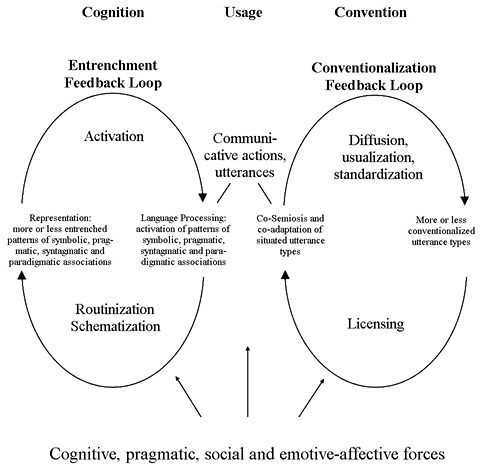
Communicative utterances and actions, which are the specific application of lexical items in both spoken and written usage, lie at the heart of the model. During cognitive processing, linguistic expressions are associated with symbolic, pragmatic, syntagmatic, and paradigmatic patterns. The intensity of processing determines how extensively these patterns are routinized, schematized, and ultimately consolidated within the mental lexicon for representation. Entrenchment affects the level of activation and processing. Linguistic patterns that are deeply ingrained are activated more quickly than those that are less entrenched. The linguistic information stored in the mental lexicon is continually evolving through language usage (see also Schmid Reference Schmid, Engelberg, Lobin, Steyer and Wolfer2018: 221–226).
Co-semiosis, defined as the shared interpretation of an utterance’s meaning by the speakers engaged in the communicative act, is vital in the processes of social conventionalization. It may result in coadaptation, which refers to the reuse of the pertinent speech constituent such as a lexical structure in a given communicative action. The degree of repetition plays a vital role in the level of conventionalization, that is, the spread, standardization, and eventual acceptance of various expressions within a language community (see Schmid Reference Schmid, Engelberg, Lobin, Steyer and Wolfer2018: 221–226).
In his 2020 monograph, Schmid elaborates on his Entrenchment and Conventionalization Model by applying it to the entire linguistic system. He demonstrates how this system is formed, maintained, and consistently shaped by the ongoing interaction among usage, conventionalization, and entrenchment. He demonstrates how linguistic usage is transformed into collective and individual grammars, which in turn influence usage. Schmid’s remarkably broad approach to the subject includes language contact as just one among numerous factors that can lead to variation in the lexicon. A brief portion of the study is devoted to overarching theoretical assertions about language contact as a factor that can influence linguistic change (see Schmid Reference Schmid2020: 119–123).
Schmid (Reference Schmid2020: 120) emphasizes the importance of identifying which aspects of the Entrenchment- and Conventionalization Model are influenced by language contact and the nature of these effects. The main point of interaction and the origin of change induced by contact are evidently found in usage, particularly in personal interactions. According to Schmid (Reference Schmid2020: 120), these interactions provide multilingual speakers with the chance to employ elements from various languages. When innovations resonate with monolingual speakers, which is often the case, they can quickly spread, become commonplace, and be integrated into regular use. In essence, they become as entrenched as prominent innovations coined from native elements within a language (see Schmid Reference Schmid2020: 120). He also emphasizes that the intensity of a linguistic contact and its degree of repetition are decisive aspects in the diffusion and entrenchment of items and structures adopted from a foreign language:
On the other hand, repeated multilingual encounters, and even monolingual encounters involving multilingual speakers, facilitate the usualization, diffusion, and routinization of any kind of utterance type from other languages, from distinctors to units and patterns, and from salient to highly unobtrusive ones.
Landmann’s Reference 85Landmann2023 study concentrates on the processes associated with the dynamics of the lexicon rather than the linguistic system itself, thereby using Schmid’s earlier 2018 model that highlights variability at the lexical level as a foundational basis. The primary objective of Landmann (Reference 85Landmann2023) is to gain a thorough understanding of the social and cognitive dynamics involved in lexical loan processes. The systematic interaction between these aspects of lexical evolution has been largely overlooked in prior research.
Borrowing represents a common form of lexical “innovation” in the recipient language, contributing to variability in the lexicon, as Schmid has outlined. Landmann (Reference 85Landmann2023) explores the variability of different borrowings, their meanings, morphological evolution, and contextual usage in English, particularly in informal social media language. The study demonstrates how Schmid’s model and the interaction of its constituents can explain lexical variation and change. The conclusions drawn in Landmann (Reference 85Landmann2023) stem from empirical analysis, grounded in the assessment of corpus data and pertinent research studies. Overall, the outcomes derive from a comprehensive qualitative analysis of 1,247 borrowings from French, Spanish, German, and Yiddish.
Landmann (Reference 85Landmann2023) has revealed historically significant forces, some of which are intrinsic to Schmid’s model. She highlights that borrowing processes may arise within language contact situations prompted by historical events, including colonization and migration, which may result in societal multilingualism as a macro-sociolinguistic force, as well as military conflicts (Reference 85Landmann2023: 406). Direct linguistic interaction, both historical and contemporary, greatly facilitates the dissemination and standardization of speech forms borrowed from foreign languages. Landmann (Reference 85Landmann2023: 406) cites instances like the intermingling of English with French or Spanish during the colonial era, the exchange between English and German speakers amid the massive immigration to the United States in the nineteenth century, and the current multilingual interactions among English speakers and the French-, Spanish-, German-, or Yiddish-speaking communities in North America and the United States.
Landmann (Reference 85Landmann2023) also identifies a number of social, sociocognitive, and emotive-affective forces that may influence the spread of a word from a foreign language. Social and economic progress, for instance, including the development of science and technology in the age of industrialization, is an important extra-linguistic factor that favors the emergence of new forms of expression in their respective fields. For example, scientific and technological progress in Germany in the nineteenth century led to a significant increase in new lexical expressions related to new discoveries and inventions. Many of these innovations were adopted into English because there were no semantically corresponding equivalents in the recipient language (Landmann Reference 85Landmann2023: 408).
Landmann (Reference 85Landmann2023) also reveals that emotional and affective factors, such as the speaker’s quest for prestige and the desire to impress the listener, can significantly influence language use. This is illustrated by the use of French by English speakers. Landmann (Reference 85Landmann2023: 408) draws attention to the fact that
[a]ccording to the overall conception of Schmid’s Reference Schmid, Engelberg, Lobin, Steyer and Wolfer2018 model, one may argue that the international use of French as a language of communication in nineteenth-century aristocratic and bourgeois circles facilitated not only the adoption of French borrowings into languages like English, but also their co-semiosis, co-adaptation and diffusion. The systematic activation of utterance types of French origin in the borrowing language has strengthened their patterns of symbolic, pragmatic, syntagmatic and paradigmatic associations in language processing and enhanced their intensity of entrenchment and conventionalization.
The use of borrowed items can also suggest sociocultural reservations, biases, and national stereotypes. Many foreign-derived terms exhibit notably significant pragmatic associations with their usage and the contexts in which they are typically situated. Sources that reflect informal usage in social media contexts often provide examples that reflect cultural prejudices or stereotyping, such as those pertaining to Latinos (Landmann Reference 85Landmann2023: 410). Investigating contact-related phenomena based on Schmid’s theories and methods (such as cognitive concepts of entrenchment and related processes, sociocognitive studies, and sociolinguistic variation research) holds the prospect of critically overcoming the singular results of previous studies.
2.4.4 Case Study: A Sociocognitive Analysis of Latin-Derived Proverbs in English
The present case study examines proverbs of Latin origin that have been incorporated into English over time. Resources like the Oxford Dictionary of Proverbs (ODP) are crucial for identifying these phraseological elements. The treatment of proverbs in lexicographical tools with their usage in recent English newspaper articles is compared, questioning how dictionary descriptions, such as those in ODP, differ from current newspaper applications. In contrast to Landmann (Reference Landmann and Belkhir2024b), whose study is limited to 16 Latin proverbs that have retained their original form in English, the present study is based on the evaluation of 165 English proverbs translated from Latin. It thus represents an important addition to existing studies.
Proverbs are often seen as clues that make it possible to better understand a given culture. According to Buja (Reference Buja2018: 86),
[i]n almost every culture, proverbs offer a set of instructions/pieces of advice for people to follow. These words of wisdom seem to stand the test of time; thus, each and every generation learns what a culture considers relevant.
The longevity and frequent use of proverbs can be attributed to their ability to articulate significant issues in vivid and expressive language. Proverbs may serve as cultural symbols, akin to certain objects or culinary recipes that represent a society’s heritage (Buja Reference Buja2018: 86). Proverbs have been defined from various perspectives across disciplines such as psychology, anthropology, and linguistics. A widely recognized definition is offered by Finnegan (Reference Finnegan, Mieder and Dundes2006), who examines proverbs within the African context. According to Finnegan (Reference Finnegan, Mieder and Dundes2006: 14), a proverb is a saying that is relatively fixed in form, characterized by brevity, meaning and pithiness, and noted for the common recognition of its succinctly stated truth. The formula proposed by Finnegan also forms the basis of the concept of proverbs in the present study.
The majority of proverb studies to date have been broad in scope, with little focus on proverbs of foreign origin. Earlier analyses include Holbek’s (Reference Holbek1970) examination of proverb style and Norrick’s (Reference Norrick1985) comprehensive study on the meaning of proverbs, contrasting their literal and figurative interpretations.
Recent studies have been exploring proverbs across various languages from a comparative perspective. Examples include Smith (Reference Smith2011) and Buja (Reference Buja2018). Smith’s research studies cultural identity as it is depicted through proverbs and idioms in English, Spanish and French. Meanwhile, Buja’s work examines the cultural attitudes expressed through Korean and Romanian proverbs. The linguistic focus of the present study is on an area scarcely considered in previous surveys. It aims to investigate proverbs of Latin origin within the history of English from a sociocognitive standpoint, which considers linguistic variations in social contexts through a cognitive lens. Glynn (Reference Glynn, Schmid and Handl2010: 91) suggests that variations in language use should be interpreted by taking into account extra-linguistic factors and the social contexts in which particular linguistic structures occur. From a cognitive perspective, the study of the use of synonyms or near-synonyms is crucial because it provides a means of identifying conceptual structures that emerge from speakers’ preferences.
Data and Methodology
Every Latin-derived proverb under examination has an equivalent English translation. However, some are still used in their original, Latin form even if there is an English counterpart. To understand why speakers choose these synonyms, Latin-origin proverbs with native English equivalents have been qualitatively analyzed to identify the sociocognitive motivations behind their usage. Furthermore, to ascertain the connection between the preferred use of a borrowed proverb over an English synonym and sociocognitive attitudes, evaluations of culture-specific values have been conducted. The main objectives and corresponding research questions (abbreviated RQs) of the present study are:
Aim: To explore the interaction between language usage and social or cognitive attitudes and assessments.
RQs: Which social or sociocognitive values and attitudes affect language usage? What emotional and cognitive factors might influence English speakers’ preference to use borrowed proverbs instead of their native translations?
The 2015 edition of Speake’s ODP features a collection of English proverbs with Latin equivalents. ODP assembles a wide variety of proverbs documented in English, meticulously providing etymological insights into their possible origins. With over 1,100 entries, it consists of the most frequently used proverbs in English, each supported by thorough research, historical context, and illustrative examples (ODP, introduction xi–xiv). For example, ODP states that the proverb Little strokes fell great oaks is equivalent to the Latin phrase Multis ictibus deiicitur quercus, which translates as ‘the oak is felled by many blows.’ ODP posits that this proverb may have been introduced into the English language via Erasmus’ Adages, a collection of ancient proverbs and sayings from 1500. The present analysis of the proverbs under study relies on ODP data, which records their earliest known appearances in English and their potential origins in other languages.
Proverbs with Latin equivalents that trace back to Greek were considered as well. For instance, Constant dropping wears away a stone aligns with the Latin Longa dies molli saxa peredit aqua, meaning ‘length of time eats away stones with soft water’ (ODP). The Latin phrase is said to originate from Greek (see ODP). In addition, proverbs with a Latin root that could have entered English through French were examined. An example is No smoke without fire, mirroring the Latin Flamma fumo est proxima, ‘the flame is right next to the smoke,’ which may have been adopted into English via French (see ODP). ODP comprises 165 proverbs along with their Latin counterparts. Section 2 of the Appendix offers a chronological overview of English proverbs that have Latin equivalents documented in ODP. Contemporary usage examples of the proverbs under study were gathered from newspaper archives available via Nexis Uni, illustrating their significance and common usage in modern English. Nexis Uni provides access to a compilation of newspapers from English-speaking regions spanning the last two to three decades, including prominent publications such as The Independent and The New York Times.
Latin-Derived Proverbs in English: Some Typical Sociocognitive Aspects of Their Use
A plethora of Latin proverbs have been translated into English, highlighting the significant impact of Latin on the evolution of the English language. This influence originates from several sources, notably the Church, since Latin was the ecclesiastical language of the Roman Catholic Church, which had extensive influence throughout Europe during medieval times. Numerous religious texts, initially written in Latin, were later translated into English. Latin was the lingua franca among scholars, with a wide range of scientific and philosophical works originally written in Latin before being translated into English, thus reaching a wider audience. The Roman Empire left behind a significant cultural legacy, including many proverbs and maxims that have been assimilated into the English language (see Durkin Reference Durkin2014: 227–250).
In addition, the Renaissance era saw the recovery and translation of ancient texts into English, igniting a renewed interest in Latin literary and philosophical traditions. These translations have secured the continuous influence of numerous Latin aphorisms and idioms in modern English (Landmann Reference Landmann, Caon, Gordon and Porck2024a: 188, Reference Landmann and Belkhir2024b; see also Durkin Reference Durkin2014: 305–349). The heightened fascination with Latin language and culture during the English Renaissance may also account for the surge in Latin-based proverbs from 1500 to the early decades of the seventeenth century, as depicted in the chronological overview in Section 2 of the Appendix.
A significant number of the Latin-derived proverbs under review can be classified as loan translations, which corresponds to what Onysko (Reference Onysko, Zenner, Backus and Winter-Froemel2019) refers to as instances of replication (see also Section 2.1.4). These proverbs frequently evoke cultural knowledge and are rooted in worldly wisdom, often revolving around universally recognized themes such as life and death, which are fundamental human concerns. An illustrative example is Dead men don’t bite, which has a direct Latin equivalent: Mortui non mordent – literally, ‘the dead do not bite’ (ODP). This saying may have entered English in the sixteenth century, potentially influenced by Erasmus’ Adages (ODP). Most Latin-origin death proverbs present a relatively positive perspective on death – while acknowledging its inevitability, many also offer a sense of consolation. An example is Whom the Gods love die young, which reflects the Latin Quem di diligunt, adolescens moritur, ‘the whom the gods favour, dies young’ (ODP). According to ODP, this proverb was first recorded in English in 1546 and might ultimately go back to Greek. It is still used in the same meaning in present-day English, see:
Mail Online, 28 November 2014; “WHIPLASH: The dangerous side of cricket tragically exposed”
Those whom the gods love, die young. This idiom came to mind on Thursday morning as Aussie batsman Phillip Hughes breathed his last in Sydney, devastating his family, friends and fans. To say that cricket has come to a standstill because of Hughes’s demise would not be an exaggeration.
Several factors may explain why the original Latin proverbs have remained semantically stable over time, without developing linguistic variations. Many of these proverbs encapsulate universal truths about human existence, such as mortality and fate. Their meanings remain relevant across centuries, reducing the likelihood of semantic change. One might also argue that Latin has historically been associated with scholarship, religion, and classical education. Because of this prestige, Latin-origin sayings were preserved with minimal modification to maintain their authoritative tone (see also Durkin Reference Durkin2014: 227–250). Latin proverbs often have a rhythmic or aphoristic quality that makes them easy to recall and transmit across generations. Their brevity reinforces semantic stability. Since these proverbs address timeless themes – life, death, wisdom – they do not require linguistic evolution to remain relevant. Unlike idioms tied to historical or technological contexts, they transcend cultural shifts.
The following provides an overview of the predominant social and sociocognitive values and attitudes that shape language use, specifically concentrating on emotional and cognitive factors that may influence English speakers’ preference for using borrowed proverbs over native equivalents/translations.
The linguistic documentary evidence indicates that Latin proverbs are frequently employed in their original form within English contexts to evoke prestige. They contribute an element of education, sophistication, and tradition to the discourse. These expressions of language carry a sense of authority and knowledge, granting them a distinguished status. Latin proverbs appear more frequently in mainstream English newspapers sch as The Times or The Guardian than in tabloids such as The Sun. The incorporation of Latin proverbs can lend an intellectual and sophisticated flair to articles, aligning with the image and target readership of more serious publications. Conversely, tabloid newspapers often opt for simpler, more accessible language to attract a broader readership (see also Landmann Reference Landmann and Belkhir2024b: 125–130). An example of a proverb that is sometimes retained in its original Latin form for reasons of prestige is Exitus acta probat, which coexists with its more common English translation equivalent The end justifies the deeds (see ODP). One could argue that in the following article, the original Latin form serves as a kind of eye-catcher to make the article more attractive to a “sophisticated” audience:
The Forward, November 19, 2004: “Arafat Died an Uncontrite Terrorist”
Terrorism certainly didn’t begin with Yasser Arafat. […] But Arafat changed the nature of terrorism forever, by killing on a wholesale rather than a retail scale, by internationalizing it, and by employing it as a tactic to gain recognition for a cause. […] [B]y showing a willingness to kill so many innocent people, he managed to persuade naive world leaders that, exitus acta probat, his cause must be compelling and just.
Using foreign-derived proverbs can help add emphasis to a statement. They can also create a cultural or intellectual connection that gives an utterance additional meaning (Landmann Reference Landmann and Belkhir2024b: 125–130). Proverbs of Latin origin such as Manus manum lavat, ‘hand washes hand,’ are often used in the pursuit of rendering a statement more expressive or pointed, as in:
Richmond Times Dispatch (Virginia), September 15, 2013: “Victory”
Virginia’s Supreme Court has awarded a well-deserved victory to a group of property owners. […] Government should not seize one person’s private property simply because it thinks someone else could use it better. That’s precisely what Norfolk was attempting to do: confiscate private property and turn it over for a spiffy new redevelopment plan designed to (in the court’s words) “assist in the orderly expansion of Old Dominion University” – which would kick back 4 percent to the city. (Manus manum lavat.)
Foreign-language synonyms are often used to address certain topics in a less direct or less confrontational way. It is a clever way of avoiding sensitive or taboo topics. Foreign-derived phrases are often used to create a certain distance or to express things more politely or less explicitly. Playing with language can also serve as a rhetorical device to obscure or soften the message without losing the actual content. Latin-derived proverbs may also be employed for the sake of decency and linguistic politeness, allowing one to convey a subject matter in an allusive way, rather than stating it outright (see also Landmann Reference Landmann and Belkhir2024b: 125–129). An example is Pecunia non olet, ‘money has no smell,’ sometimes also abbreviated to Non olet (see ODP). It is frequently used allusively and euphemistically to express that the origin of money is often not questioned as long as it is useful. This proverb is often used to allude to morally questionable but financially rewarding deals, as in:
The Daily Telegraph (London), August 6, 2010: “Come on Liwupu? Well, it does have a certain ring to it”
Even though the season has not yet begun, it’s very difficult to get away from football. This week, even the financial pages offer no refuge. Prominent among the multiplying suitors for the fair hand of Liverpool Football Club has been a China-based consortium led by one Kenny Huang. […] Pecunia non olet. If a Chinese bid does materialise, I don’t think we have any real need to worry about the country using Anfield as a base from which to dominate the UK’s traditional institutions.
The collection of proverbs being examined also contains instances that appear in contexts that suggest a tone of subtle humor on the part of the speaker or author. An example of this is In vino veritas, ‘there is truth in wine,’ which was first recorded in English in 1545 (see ODP). A recent article in The Independent, for instance, using the phrase in its original Latin form, reports a name change to Banksy with the aim of making lucrative advertising for wine, see:
The Independent, March 8, 2024: “Police smash fake Banksy factory as counterfeits sold across the world”
Police in Spain have dismantled an art forgery ring suspected of selling artworks falsely attributed to British street artist Banksy, with some pieces fetching prices of 1,500 euros or higher. […] “So whilst it’s admittedly quite funny that one nutter in Norway legally changed their name to ‘Banksy’ in order to get paid to endorse wine, you should treat any such products with scepticism. Heard of the phrase ‘in vino veritas’? Doesn’t apply here.”
In the above context, the Latin proverb is used allusively and with a slight touch of humor to point out that this is a hoax that, although it has something to do with wine, does not reveal the truth as the proverb suggests.
2.4.5 Summary
Sociocognitive linguistics explores the intricate interplay between language use, meaning, and speaker cognition. Investigating loan processes and their linguistic effects demands a holistic approach that integrates both social and cognitive dimensions. Social factors influence which linguistic elements are adopted, while cognitive mechanisms govern their assimilation and retention. This dual perspective enables a deeper understanding of how linguistic, cognitive, and social forces interact in shaping language contact and evolution.
Theoretical models such as Schmid’s (Reference Schmid, Engelberg, Lobin, Steyer and Wolfer2018) dynamic lexicon offer valuable frameworks for analyzing the cognitive representation of socially influenced linguistic phenomena, accounting for sociocognitive and emotional-affective factors in processes of standardization and entrenchment. The case study highlights prevailing social and sociocognitive attitudes that influence language use, particularly the emotional and cognitive motivations behind English speakers’ preference for foreign-derived proverbs over native equivalents. Linguistic evidence shows that Latin-origin proverbs are often retained in their original form to convey prestige, authority, and intellectual refinement- especially in contexts like newspaper articles aimed at a discerning readership. Such expressions can enhance rhetorical impact, foster cultural or intellectual resonance, and serve pragmatic functions: softening directness, avoiding taboo topics, or expressing ideas with greater politeness or subtlety. Latin-derived proverbs may also introduce a tone of understated humor or stylistic elegance, enriching the communicative intent without altering the core message.
3 Conclusion and Outlook
Cognitive Contact Linguistics is an emerging and rapidly evolving field that investigates the cognitive processes and effects arising from language contact. While foundational studies have laid important groundwork, much of the terrain remains unexplored – particularly regarding how bilingualism influences cognitive abilities and how multilingual individuals navigate complex contact scenarios. This discipline offers compelling insights into the mental mechanisms involved in engaging with multiple languages, going beyond surface-level linguistic shifts to uncover deeper cognitive patterns shaped by contact. Crucially, cognitive processes are not isolated; they are embedded within social interactions, cultural contexts, and linguistic communities. The frequency and nature of language use in social settings significantly affect how linguistic structures are processed, stored, and integrated.
A central concern is the role of linguistic identity within diverse cultural environments. The social dimension of cognitive contact linguistics reveals how individuals adapt their linguistic repertoire in response to interpersonal dynamics, societal norms, and intercultural exchange – factors that shape cross-linguistic patterns in multilingual communication. Longitudinal research is essential to understanding the enduring impact of language contact on cognitive flexibility and memory. By integrating social and cultural perspectives, this approach underscores that language contact is not merely a cognitive event, but a multifaceted process deeply intertwined with identity, interaction, and adaptation.
Cognitive approaches to language contact phenomena offer valuable insights into the mental mechanisms underlying the integration and adaptation of linguistic features. Theoretical frameworks such as usage-based theory, emergentist models, and cognitive grammar (see Section 2.1.3) provide a robust foundation for analyzing multilingual environments. Typologies like Onysko’s (Reference Onysko, Zenner, Backus and Winter-Froemel2019) cognitive framework for borrowing, code-switching, transfer, and replication (Section 2.1.4) offer useful reference points for future research. Despite growing interest, further investigation is needed into loan processes across linguistic levels. Studies on foreign influence on the English lexicon often focus on identifying borrowings by domain, without fully addressing their linguistic integration. Landmann’s (Reference 85Landmann2023) work is a rare example that examines the interplay of usage, meaning, and cognition in contact-induced variation, analyzing the influence of French, Spanish, German, and Yiddish on English. His study explores morphological and semantic shifts from a cognitive perspective and is discussed in detail in Section 2.2.3.
The cognitive effects of language interaction on bilingual and multilingual speakers – particularly in discourse and conversational dynamics – remain a compelling area of study. A usage-based approach to contact-induced variation should also account for interactive and sociolinguistic factors, which are often overlooked. Verschik’s (Reference Verschik, Zenner, Backus and Winter-Froemel2019) analysis of English–Estonian code-copying in blogs demonstrates how the Code-Copying Framework aligns with cognitive and usage-based models of contact-induced change (see Section 2.3.4).
A comprehensive analysis of loan processes must integrate both social and cognitive perspectives. This dual lens reveals the intricate interplay of linguistic, cognitive, and social factors in language contact and evolution. Theoretical innovations such as Schmid’s (Reference Schmid, Engelberg, Lobin, Steyer and Wolfer2018) dynamic lexicon model are instrumental in examining the cognitive representation of socially influenced linguistic change, incorporating sociocognitive and emotional-affective dimensions of standardization and entrenchment (Section 2.4.3).
Symbols and Abbreviations
In this Element, the following symbols and abbreviations are used:
- /…/
phonological transcription
- ‘…’
meaning
- adj.
adjective
- adv.
adverb
- BNC
British National Corpus
- COCA
Corpus of Contemporary American English
- EFL
English as a Foreign Language
- J.L.
Julia Landmann
- LDOCE
Longman Dictionary of Contemporary English (online version)
- n.
noun
- OALD
Oxford Advanced Learner’s Dictionary (online version)
- ODP
Oxford Dictionary of Proverbs
- OED
Oxford English Dictionary
- p.c.
personal communication
- RQ
research question
- Spoken BNC
Spoken British National Corpus 2014
- transl.
translated by
- v.
verb
Appendix
The first part of the Appendix contains two tables and one list with different data sets on which the case studies presented in this Element are based. The data sets also serve as a basis for some exercises that can be found in the second part of the Appendix.
1 Fairly Common French-Derived Cuisine and Art Terms
Tables 1a–1c comprise sixty-seven fairly common art terms that were examined in Section 2.2.4 and grouped into different subcategories, such as artistic creations or persons involved in art. Possible French borrowings are marked with an asterisk placed after their earliest documented use in English.
| Old English (ca 400–1100) | Middle English (ca 1101–1500) | Early Modern English (ca 1501–1700) | Modern English (ca 1701 –) | |
|---|---|---|---|---|
| Artistic creations | – | painting, n. (might have been first recorded in circa 1225)*; drapery, n. (about 1300); portraiture, n. (about 1385); statue, n. (1393) | effigy, n. (1539); portrait, n. (1560); tableau, n. (1660); catafalque, n. (circa 1660); cartoon, n. (about 1684)*; assemblage, n. (1690) | statuette, n. (1738); figurine, n. (1740); caricature, n. (1748); vignette, n. (1751); diorama, n. (1823); objet d’art, n. (1840); oeuvre, n. (1889); trompe l’oeil, n. (1889); collage, n. (1919); montage, n. (1930); mobile, n. (1932) |
| Persons involved in art | – | painter, n. (1240); muse, n. (circa 1390) | artist, n. (1563) | connoisseur, n. (1719); idiot savant, n. (1870); pointillist, n. (1891); Fauve, n. (1915); surrealist, n. (1925) |
| verbs related to the action of producing art | – | portray, v. (about 1330); emboss, v. (about 1385)*; stencil, v. (about 1420) | incise, v. (might have been first recorded in 1541) | sculpt, v. (1864) |
| Old English (ca 400–1100) | Middle English (ca 1101–1500) | Early Modern English (ca 1501–1700) | Modern English (ca 1701 –) | |
|---|---|---|---|---|
| Utensils for creating art | – | varnish, n. (1341) | palette, n. (1622); crayon, n. (circa 1660) | – |
| Manner of creating art | – | legerdemain, n. (circa 1450)* | – | – |
| Artistic movements, forms and styles | – | avant-garde, n. (1470) | grotesque, n. (1561) | genre, n. (1770); Renaissance, n. (1836); art nouveau, n. (1899); pointillism, n. (1899); Cubism, n. (1911); Dada, n. (1918); surrealism, n. (1927); Art Deco, n. (1966). Borrowing reflecting a proper noun: chinoiserie, n. (1841) |
| Artistic arrangement | – | – | design, n. (1565) | – |
| Artistic method/technique | – | – | calligraphy, n. (1590)*; relief, n. (1606); bas-relief, n. (1667) | aquatint, n. (1782); haut-relief, n. (1851); gouache, n. (1882); bricolage, n. (1960); découpage, n. (1960) |
| Old English (ca 400–1100) | Middle English (ca 1101–1500) | Early Modern English (ca 1501–1700) | Modern English (ca 1701 –) | |
|---|---|---|---|---|
| Artistic model or sketch | – | – | bust, n. (about 1660) | maquette, n. (1880) |
| Artistic branch of knowledge | – | – | belles-lettres, n. (1665) | – |
| Adjectives related to artistic movements and styles | – | – | – | baroque, adj. (1765); surrealist, adj. (1918) |
| Artistic attitude/posture | – | – | – | pose, n. (1793) |
| Artistic feature | – | – | – | motif, n. (1837) |
| Artistic workplace | – | – | – | atelier, n. (1840) |
| Artistic exhibition | – | – | – | vernissage, n. (1912) |
Tables 2a–2e contain 143 fairly common culinary terms that were examined in Section 2.2.4 and assigned to different culinary subcategories, such as types of dishes, desserts, and items of confectionery. Lexical items that may only be derived from French are marked with an asterisk placed after their first attested use.
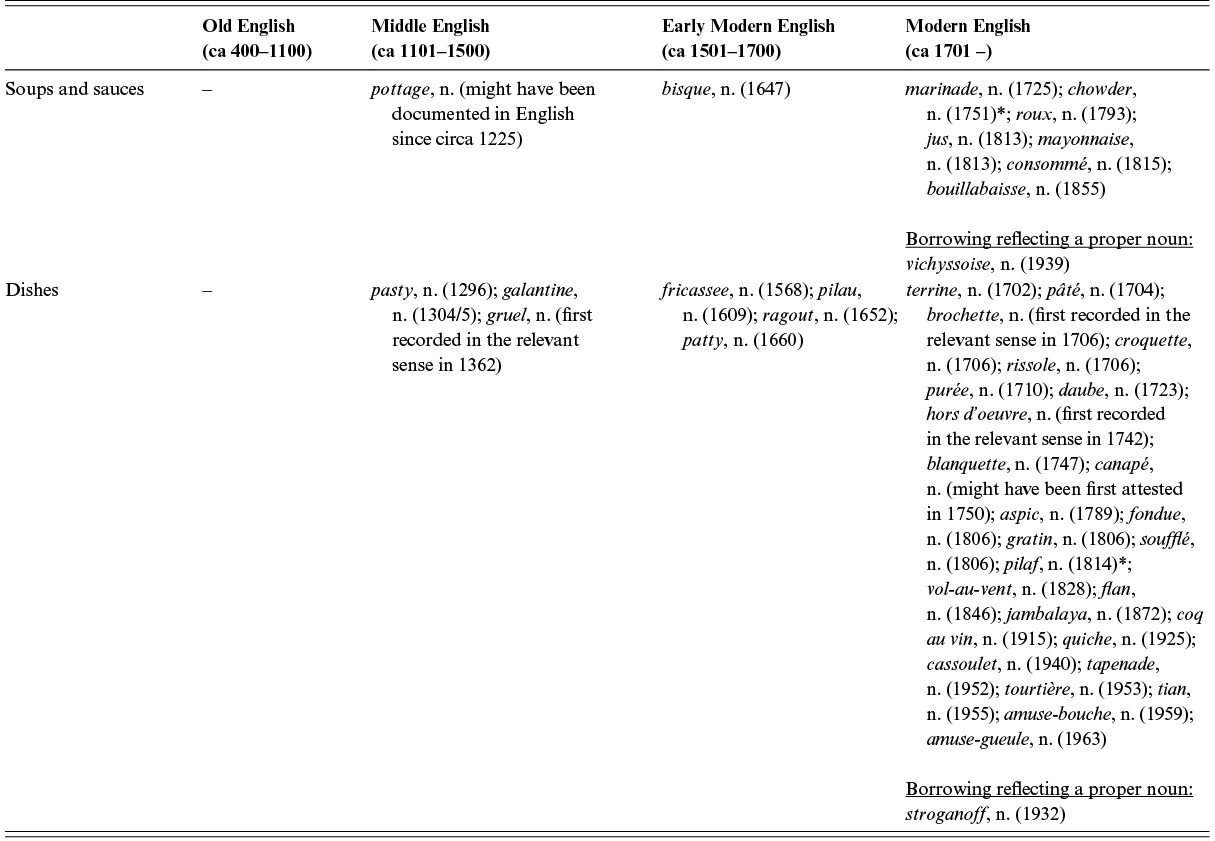
Table 2a Long description
Table presenting French-derived culinary vocabulary for soups, sauces, and dishes across English periods. Includes items such as bisque, marinade, mayonnaise, bouillabaisse, ragout, pâté, soufflé, and quiche, with dates and notes on borrowings from proper nouns.
| Old English (ca 400–1100) | Middle English (ca 1101–1500) | Early Modern English (ca 1501–1700) | Modern English (ca 1701 –) | |
|---|---|---|---|---|
| Desserts and items of confectionary | – | pudding, n. (1287)*; comfit, n. (1334); blancmange, n. (1377); wafer, n. (1377); tart, n. (1381); confection, n. (first recorded in the relevant sense in 1393); macaroon, n. (circa 1425); pastille, n. (1451); fritter, n. (circa 1460) | patisserie, n. (1594); dessert, n. (1600); coulis, n. (1603); compote, n. (1693); | meringue, n. (1706); tapioca, n. (1707); praline, n. (1714); caramel, n. (1725); baba, n. (1813); nougat, n. (1827); gateau, n. (1845); dragée, n. (1853); éclair, n. (1861); petit four, n. (1875); parfait, n. (1884); profiterole, n. (first recorded in the relevant sense in 1884)*; bombe, n. (1892); macaron, n. (1993). Borrowings reflecting proper nouns: madeleine, n. (1829) |
| Food products | – | liquorice/licorice, n. (circa 1275); raisin, n. (first recorded in the relevant sense in 1302); lardon, n. (circa 1325); sage, n. (about 1350); salad, n. (circa 1390); marjoram, n. (circa 1393); lard, n. (circa 1400); muscadel, n. (circa 1440) | parmesan, n. (1519); torte, n. (1555) | fines herbes, n. (might have been first attested in 1750); fondant, n. (1861); margarine, n. (1873); crème fraîche, n. (1936) |
| Old English (ca 400–1100) | Middle English (ca 1101–1500) | Early Modern English (ca 1501–1700) | Modern English (ca 1701 –) | |
|---|---|---|---|---|
| Bread and pastries | – | – | – | baguette, n. (1728); crouton, n. (1806); brioche, n. (1826); croissant, n. (1899) |
| Cheese | – | – | – | Borrowings reflecting proper nouns: Roquefort, n. (1762); Camembert, n. (1878); fromage frais, n. (1976) |
| Drinks | – | cider, n. (circa 1315); perry, n. (circa 1330); liquor, n. (first recorded in the relevant sense in 1340) | muscat, n. (1548) | liqueur, n. (1742); absinthe, n. (1803); vermouth, n. (1806); crème de cassis, n. (1851); kirsch, n. (1869); aperitif, n. (1894); cassis, n. (1907); frappé, n. (1922); pastis, n. (1926). Borrowing reflecting a proper noun: Grand Marnier, n. (1900). Proprietary name: Cointreau, n. (1920) |
| Old English (ca 400–1100) | Middle English (ca 1101–1500) | Early Modern English (ca 1501–1700) | Modern English (ca 1701 –) | |
|---|---|---|---|---|
| Wine | – | claret, n. (circa 1398); vintage, n. (circa 1450) | – | cru, n. (1824). Borrowings reflecting proper nouns: Médoc, n. (1793); Muscadet, n. (1825). Proprietary name: Chardonnay, n. (1911) |
| Adjectives relating to characteristics of wine | – | – | – | brut, adj. (1891); demi-sec, adj. (1926); chambré, adj. (1965) |
| Kitchen style | – | – | – | nouvelle cuisine, n. (1774); cuisine, n. (1786); haute cuisine, n. (1926) |
| Kitchen utensils | – | cauldron, n. (circa 1300); griddle, n. (first recorded in the relevant sense in 1352)*; grater, n. (1390) | ramekin, n. (1653); grill, n. (1685) | casserole, n. (first recorded in the relevant sense in 1725); carafe, n. (1786). Borrowing reflecting a proper noun: bain-marie, n. (1822) |
| Food manufacture | – | – | – | abattoir, n. (1809) |
| Shop selling food | – | – | – | depanneur, n. (1975) |
| Old English (ca 400–1100) | Middle English (ca 1101–1500) | Early Modern English (ca 1501–1700) | Modern English (ca 1701 –) | |
|---|---|---|---|---|
| Individuals involved in cooking, tasting and serving food | – | butler, n. (might have been documented in English since circa 1300); taster, n. (1387) | – | – |
| Verbs relating to the action of preparing food | – | spice, v. (1377)*; parboil, v. (1381); stew, v. (first recorded in the relevant sense in circa 1430); toast, v. (first recorded in the relevant sense in circa 1440); poach, v. (circa 1450) | marinate, v. (1645)*; grill, v. (1668) | braise, v. (1797) |
| Adjectives relating to a manner of preparing food | – | – | – | sauté, adj. (1813); frappé, adj. (1848) |
| Adverb relating to a manner of preparing food | – | – | – | au jus, adv. (first recorded in the relevant sense in 1820) |
2 Chronological Overview of All Latin-Derived Proverbs in ODP
The following list shows a chronological overview of all proverbs in ODP that have a Latin equivalent. In total, OPD contains 165 proverbs with a Latin counterpart. Proverbs that ultimately go back to Greek are marked with an asterisk after their first recorded use. Proverbs that also show a French translation equivalent that might have enhanced the adoption of the Latin original into English are marked with a hash-tag.
(a) Old English (450–1100): 1 proverb
A friend in need is a friend indeed (circa 1035)
(b) 1101–1200: 0 proverb
none
(c) 1201–1300: 8 proverbs
All that glitters is not gold (circa 1220); The cat would eat fish, but would not wet her feet (circa 1225); Prevention is better than cure (circa 1240); Constant dropping wears away a stone (circa 1250)*; Every cock will crow upon his own dunghill (circa 1250); It’s an ill bird that fouls its own nest (circa 1250); Out of sight, out of mind (circa 1250); Today you, tomorrow me (circa 1250)
(d) 1301–1400: 33 proverbs
The sun loses nothing by shining into a puddle (1303)*; Love and a cough cannot be hid (about 1325); Might is right (circa 1327)*; Better late than never (circa 1330)*; Many hands make light work (about 1330)*; Like father like son (circa 1340); The more you get, the more you want (circa 1340); The rotten apple injures its neighbour (1340); While the grass grows, the steed starves (circa 1350); A rolling stone gathers no moss (1362)*; Be what you seem to be (circa 1377)*; Necessity knows no law (1377); Patience is a virtue (1377); Art is long and life is short (circa 1380)*; Nothing comes of nothing (circa 1380)*; Silence means consent (circa 1380); Fortune favours the brave (circa 1385); Of two evils, choose the less (circa 1385)*; There is measure in all things (circa 1385); Familiarity breeds contempt (circa 1386); Eat to live, not live to eat (1387)*; The cowl does not make the monk (1387); A guilty conscience needs no accuser (circa 1390); Between two stools one falls to the ground (circa 1390); Love is blind (circa 1390)*; So many men, so many opinions (circa 1390)#; Time flies (1390); Soon ripe, soon rotten (1393); Clothes make the man (circa 1400)*; Example is better than precept (1400); Like will to like (about 1400)*#; Little strokes fell great oaks (about 1400); Still waters run deep (about 1400)
(e) 1401–1500: 17 proverbs
Ignorance of the law is no excuse for breaking it (circa 1412); The voice of the people is the voice of God (circa 1412); Well begun is half done (circa 1415)*; No smoke without fire (circa 1422)#; Forewarned is forearmed (circa 1425); No rose without a thorn (1430–1440); There is a remedy for everything except death (circa 1430); Man proposes, God disposes (circa 1440)#; No one should judge in his own cause (circa 1449); A bird in the hand is worth two in the bush (circa 1450); Near is my kirtle, but nearer is my smock (1461)#; What’s bred in the bone will come out in the flesh (circa 1470); When in Rome, do as the Romans do (circa 1475); Save us from our friends (1477); He that cannot obey cannot command (circa 1500); Love me, love my dog (circa 1500); Money makes a man (circa 1500)
(f) 1501–1600: 69 proverbs
If you run after two hares you will catch neither (1509); The end crowns the work (1509)#; Virtue is its own reward (1509); Never look a gift horse in the mouth (about 1510); A word to the wise is enough (about 1513); Ill gotten goods never thrive (1519); The quarrel of lovers is the renewal of love (circa 1520); In the country of the blind, the one-eyed man is king (1522); Let the buyer beware (1523); One cannot love and be wise (about 1527); Hunger is the best sauce (1530)#; Like master, like man (1530)#; Never too old to learn (1530); Every man is the architect of his own fortune (1533); Young men may die, but old men must die (1534); An ape’s an ape, a varlet’s a varlet, though they be clad in silk or scarlet (1539)*; Desperate diseases must have desperate remedies (1539); Kings have long arms (1539)*; Let the cobbler stick to his last (1539)*; One swallow does not make a summer (1539)*; While there’s life there’s hope (1539)*; You can drive out nature with a pitchfork, but she keeps on coming back (1539); Morning dreams come true (1540)*; Never speak ill of the dead (1540)*; A liar ought to have a good memory (about 1542); Dog does not eat dog (1543); Call no man happy till he dies (1545)*; Necessity is the mother of invention (1545); The eyes are the window of the soul (1545); There is truth in wine (1545)*; What the eye doesn’t see, the heart doesn’t grieve over (1545); Better be envied than pitied (1546)*#; Fortune favours fools (1546); The leopard does not change his spots (1546); Whom the Gods love die young (1546)*; Dead men don’t bite (circa 1547)*; If you want peace, you must prepare for war (about 1547); A barking dog never bites (circa 1550)#; Jove but laughs at lovers’ perjury (circa 1550)*; Nature abhors a vacuum (1551); He gives twice who gives quickly (1553); There is always something new out of Africa (1559)*; Don’t cut off your nose to spite your face (circa 1560)#; The blood of the martyrs is the seed of the Church (1560); Truth lies at the bottom of a well (1562)*; Eagles don’t catch flies (1563); Experience is the best teacher (circa 1568); The worth of a thing is what it will bring (1569)#; Bear and forbear (1573)*; If you lie down with dogs, you will get up with fleas (1573); One hand washes the other (1573)*; It is good to make a bridge of gold to a flying enemy (1576)*; Little things please little minds (1576); One man’s meat is another man’s poison (circa 1576); A woman and a ship ever want mending (1578); Misery loves company (1578); Time changes and we with time (1578); To err is human (1578); Every man to his taste (1580)#; Fish and guests smell after three days (1580); After dinner rest a while, after supper walk a mile (1582); The pen is mightier than the sword (1582); The end justifies the means (1583); If Saint Paul’s day be fair and clear, it will betide a happy year (1584); Night brings counsel (1590)*#; Four eyes see more than two (1591); Fine feathers make fine birds (1592)#; Knowledge is power (1598); There is luck in odd numbers (1598)
(g) 1601–1700: 18 proverbs
He who excuses, accuses himself (1611)#; Whom the Gods would destroy, they first make mad (1611)*; Brave men lived before Agamemnon (1616); Where bees are, there is honey (1616); Devil take the hindmost (1620); The devil was sick, the devil a saint would be; the devil was well, the devil a saint was he (1629); Self-preservation is the first law of nature (about 1631); Charity covers a multitude of sins (about 1633); The exception proves the rule (1640); Walnuts and pears you plant for your heirs (1640); Love begets love (1648); Union is strength (1654)*; Throw dirt enough, and some will stick (1656); Thrift is a great revenue (1659); God made the country, and man made the town (1667); Marry in May, rue for aye (1675); Make haste slowly (1683)*; Take the goods the gods provide (1697)
(h) 1701–1800: 4 proverbs
The devil finds work for idle hands to do (1715); Death is the great leveller (1732); Caesar’s wife must be above suspicion (1779); There is no accounting for tastes (1794)
(i) 1801–1900: 12 proverbs
First catch your hare (1801); Self-praise is no recommendation (1826); Moderation in all things (1849)*; Absence makes the heart grow fonder (circa 1850); Better the devil you know than the devil you don’t know (1857); A lie is halfway round the world before the truth has got its boots on (1859); Findings keepings (1863); The sharper the storm, the sooner it’s over (1872); Fear the Greeks bearing gifts (1873); Laugh and the world laughs with you; weep and you weep alone (1883); The unexpected always happens (1885); Do not meet troubles halfway (1896)
(j) 1901–2000: 3 proverbs
The style is the man (1901)#; Money has no smell (1914); The grass is always greener on the other side of the fence (1959)
3 Exercises and Concept-Checking/Self-Study Questions
(1) Why is it useful to investigate language contact phenomena from a cognitive perspective?
(2) What is the main claim of a usage-based approach?
(3) Why is a usage-based approach useful in analyzing language contact processes through a cognitive lens?
(4) Define the concept of entrenchment.
(5) Name four factors that might determine the extent to which a borrowed concept is entrenched in a language.
(6) What distinguishes the French borrowing vernissage, pronounced /vɛrnisaʒ/ in English (see OED), from surrealist, which mirrors the French surréaliste? Analyze the two borrowings from a cognitive perspective.
(7) According to Onysko’s (Reference Onysko, Zenner, Backus and Winter-Froemel2019) framework, which mode type is code-switching associated with?
(8) The English proverb Nothing comes of nothing was translated from the Latin Ex nihilo nihil fit, literally meaning ‘nothing comes of nothing,’ in circa 1380 (see ODP). Another example is Time flies, which reflects the Latin Tempus fugit, ‘time flies’ (see ODP). Analyze the examples in line with Onysko’s (Reference Onysko, Zenner, Backus and Winter-Froemel2019) typology.
(9) Why can Langacker’s (Reference Langacker1987) concept of figure-ground alignment serve as a useful framework when analyzing compounds derived from borrowed lexical items such as restaurant car?
(10) Why is the theory of conceptual blending (Fauconnier and Turner Reference 81Fauconnier and Turner2002) crucial for the cognitive analysis of word formations such as gastropub?
(11) Why is the study of metaphors (including borrowed metaphors) a crucial concept in cognitive semantics?
(12) Certain culinary terms of French origin may denote specific foods or, metonymically, dishes incorporating them. Mayonnaise exemplifies this, initially denoting a sauce in 1815 before its metonymic expansion in 1823 to signify a dish featuring the sauce (OED). What cognitive mechanism is involved here? Please refer to Blank’s (Reference Blank, Blank and Koch1999) cognitive typology of semantic change as described in Section 2.2.4.
(13) Consider the following post from a German blog and identify the copy type (i.e. global copy, mixed copy, or selective copy) in line with Verschik’s (Reference Verschik, Zenner, Backus and Winter-Froemel2019) cognitive framework (see also Section 2.3.4):
Da einiges daran zu machen war, haben wir uns das Terrassen-Make-Over als ‘Corona-Projekt’ vorgenommen. (Laura Herz, 20 April 2020)
Since there was a lot to do, we decided to do the terrace makeover as a “Corona project.”
(14) Name a few factors that may affect code copying in blogs, as mentioned by Verschik (Reference Verschik, Zenner, Backus and Winter-Froemel2019) (see also Section 2.3.4).
(15) Why is the combination of a social and a cognitive perspective relevant when examining loan processes and their linguistic effects?
(16) Why is Schmid’s (Reference Schmid, Engelberg, Lobin, Steyer and Wolfer2018: 221) Entrenchment and Conventionalization Model a valuable tool for examining contact-related phenomena from a cognitive perspective (see also Section 2.4.3)?
(17) Name three sociocognitive and/or emotional-affective forces that can promote the adoption and dissemination of a foreign language article in the recipient language.
3.1 Solutions of Exercises and Concept-Checking/Self-Study Questions
(1) Cognitive approaches have greatly impacted research on language contact by providing more profound understanding of the mental processes that are involved in the processing and production of language in multilingual settings.
(2) This approach emphasizes that language knowledge arises from actual usage and observed patterns. People learn language through regular interaction and repeated use, which facilitates the identification and understanding of contact-induced phenomena.
(3) A usage-based approach focuses on the cognitive processes behind language use. It examines how language users perceive, process, and apply new linguistic elements. This helps to understand how people learn languages and switch between them.
(4) Entrenchment relates to the degree to which a concept or linguistic structure is integrated into an individual’s cognitive system. Highly entrenched concepts are solidly embedded in the mental lexicon, used frequently and with ease, while less entrenched concepts are accessed less often and with greater conscious effort.
(5) Frequency of use, cognitive simplicity, cultural relevance, social acceptance.
(6) Vernissage retains foreign influence in both form and sound, whereas surrealist exemplifies a borrowing that has been fully assimilated into English. It could be argued that, from a cognitive perspective, surrealist has integrated into the neural activation mechanisms of English as the recipient language.
(7) According to Onysko’s (Reference Onysko, Zenner, Backus and Winter-Froemel2019) typology, code-switching is associated with the “multilingual mode.” This mode is characterized by the socially and pragmatically sanctioned use of different linguistic codes, which provides the basis for selection within the network of all simultaneously active codes.
(8) Loan translations such as Time flies, also referred to as calques, serve as quintessential instances of replication in language contact, as conceptualized by Onysko in 2019.
(9) Figure-ground alignment plays a crucial role in word formation, assisting in the creation and comprehension of new terms. It accentuates specific elements (figure) while allowing others (ground) to fade into the backdrop, thereby distilling intricate ideas into manageable segments. For example compounds formed from borrowings like restaurant car highlight one part as the primary element (figure), while the other offers contextual backing (ground), elucidating the significance of the novel term (see Landmann Reference 85Landmann2023: 274).
(10) Conceptual blending entails the fusion of selected conceptual elements from two distinct mental spaces into a novel, cohesive conceptual space. This new construct is not merely a mix of two preexisting concepts; it introduces unique, specific connotations (Schmid Reference Schmid2016: 219). Landmann (Reference 85Landmann2023: 303) notes that the term gastropub is not just a blend of pub and the French-derived gastronomy or gastronomic; it originates as a term for a pub renowned for its outstanding food.
(11) Metaphors provide insights into people’s mental thought patterns. They reflect how we understand and express complex and abstract concepts by linking them to more familiar, concrete experiences.
(12) The cognitive mechanism involved in such uses is called frame relation by Blank (Reference Blank, Blank and Koch1999: 74).
(13) According to Verschik’s (Reference Verschik, Zenner, Backus and Winter-Froemel2019) cognitive framework, Terrassen-Make-Over is a mixed copy, consisting of a native and a foreign element.
(14) A few factors that may affect code copying in blogs, as mentioned by Verschik (Reference Verschik, Zenner, Backus and Winter-Froemel2019), include social significance, linguistic innovation, expressiveness, discourse prominence, and frequency. These elements have been identified as influential in the replication of codes.
(15) A thorough investigation of loan processes and their linguistic outcomes requires an approach that includes both social and cognitive aspects. Such an analysis facilitates the comprehension of the complex interactions between linguistic elements, social dynamics, and cognitive processes that shape the integration of loan-related terminology and other linguistic features.
(16) Schmid (Reference Schmid, Engelberg, Lobin, Steyer and Wolfer2018) introduces an integrative approach to linguistic structure and usage, combining cognitive, social, pragmatic, and neurolinguistic perspectives to elucidate the features and variability of linguistic structure. This model offers considerable potential for clarifying loan processes within the interplay of usage, society, and cognition. Prior research has often neglected the systematic interaction among these facets of lexical evolution.
(17) Pursuit of prestige, desire to express social identity, desire to indicate ethnic or cultural affiliation.
Acknowledgement
We acknowledge support for the open access publication from the University of Greifswald.
Sarah Duffy
Northumbria University
Sarah E. Duffy is Senior Lecturer in English Language and Linguistics at Northumbria University. Her research examines how people use metaphor to understand and reason about abstract concepts, with a particular focus on time and individual variation. More broadly, she investigates how metaphor and temporal framing operate in institutional contexts, including education and the legal system. Her work appears in journals such as Cognitive Linguistics, Journal of Experimental Psychology: Learning, Memory, and Cognition, and Metaphor and Symbol, and she is co-author (with Michele Feist) of Time, Metaphor, and Language: A Cognitive Science Perspective (Cambridge University Press, 2023).
Editorial Board
Heng Li, Sichuan International Studies University
John Newman, University of Alberta (Edmonton)
Kimberley Pager-McClymont, University of Aberdeen
Katie J. Patterson, University of Granada
Nick Riches
James Street, Northumbria University
Lexi Webster, University of Southampton
Xu Wen, Southwest University
About the Series
Cambridge Elements in Cognitive Linguistics offers high-quality and accessible works by leading and emerging scholars. Grounded in the cognitive sciences, it extends the theoretical and methodological boundaries of cognitive linguistics by advancing established research and engaging new areas of inquiry in service of the field and its sub-disciplines.
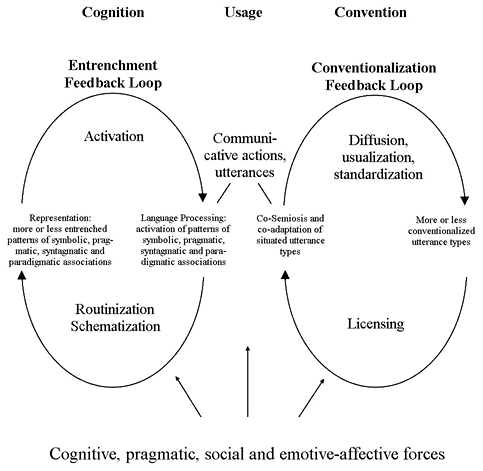
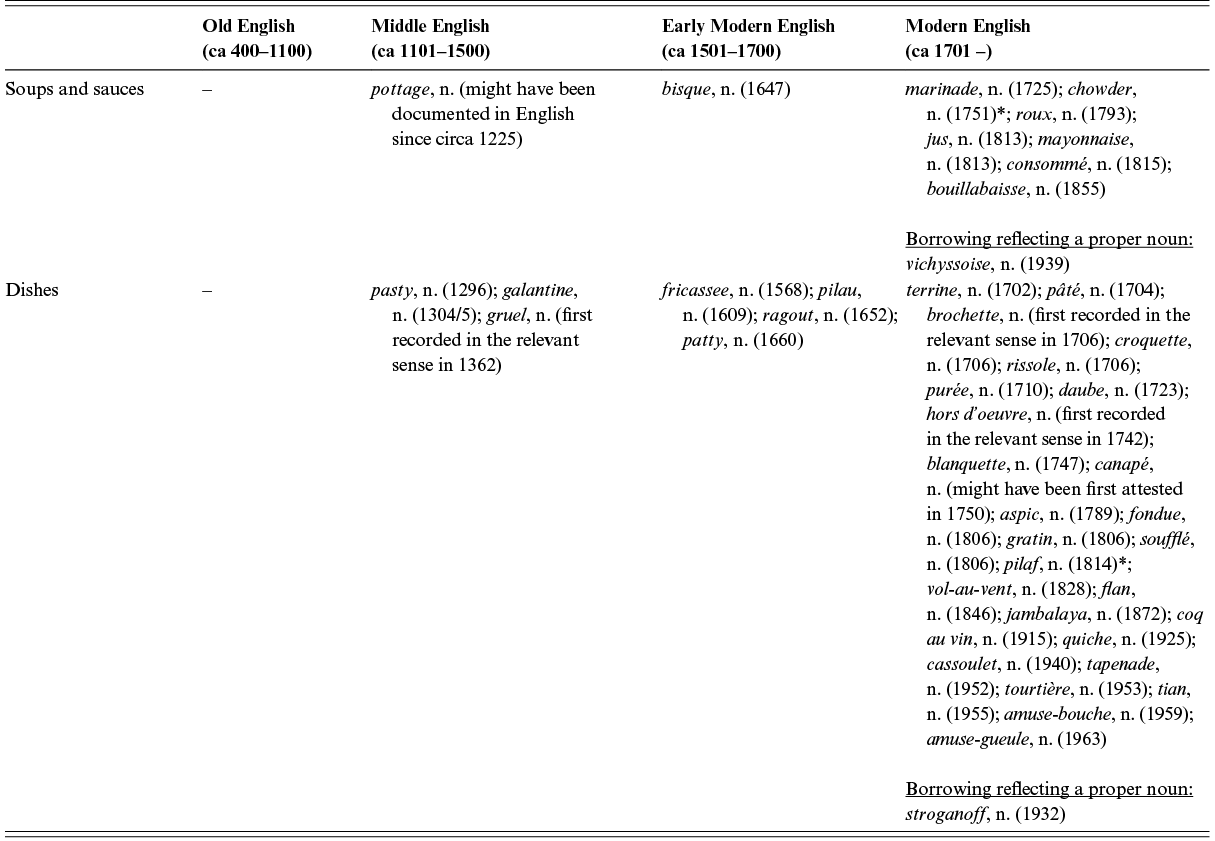

 Open access