

In June 2012, student activists in Nepal declared a campaign against private, for-profit colleges with foreign names, simultaneously decrying the schools’ names and their exorbitant tuition fees. During the campaign, student activists painted over signboards of Pentagon, NASA, White House, Liverpool, and Barcelona Colleges; vandalized buildings and computers belonging to Florida Everest and South Western State Colleges; and burned school buses belonging to Rato Bangala School and Delhi Public School. At the same time, lawyers filed a court case demanding stricter management of private schools by “checking exorbitant fees and deterring naming of schools after English-origin places and clubs” (Himalayan Times, July 23, 2012d). These activists claimed control of the linguistic landscape of Kathmandu, objecting not to English in the classroom but to the material emblems of branded educational institutions.
This article explores the semiotic implications of this movement through analysis of English-language newspaper coverage of events surrounding the protest, in which members of student unions affiliated with but not entirely controlled by political parties anointed themselves the arbiters of legitimate and commodifiable language (Heller and Boutet Reference Heller and Boutet2006). The protests targeted private, for-profit, higher secondary two-year schools, also called colleges, +2, or Ten Plus Two.Footnote 1 Student activists did not target the classroom use of English, which is officially the medium of education at all the schools in question. Instead, they protested the visible emblems of school signs and what they called unfair school fees. It was not the education being sold so much as the advertising and high price of higher secondary schooling-as-commodity, and particularly its place in the linguistic landscape (Shohamy and Gorter Reference Shohamy and Gorter2008), that was called into question. As Agha (Reference Agha2011, 40) argues, it is impossible to understand the place of commodities, such as commodified schooling, in social life without considering the “relationships between sociohistorically specific commodity formulations and their uptake in the activities of those acquainted with them.” This article considers student unions’ uptake, and taking down, of the commodity formulation of school signs in a manner wholly unintended by the creators of these formulations. Through analysis of writing about these events, I aim to shed light on the ways that chronotopic formulations, branding, and claims about morality were simultaneously constructed and disputed.
In a review of research on the semiotics of brand, Manning concludes that “brand and their definitions thus reveal very different things depending on whether they are approached at work as semiotic objects within the economy or as metasemiotic objects that can be interrogated to reveal the folk ontologies and semiotic ideologies latent in economic categories (Reference Manning2010, 46). In this article, I take the latter approach, using metasemiotic discourse about branded schools to investigate the ways student protesters, and to a lesser extent their interlocutors, interacted with and objected to certain forms of school branding. I examine the discursive construction in newspaper reports of competing “cultural chronotopes” (Agha Reference Agha2007b), semiotic representations of time and place peopled by certain social types. Activists called into question a chronotopic representation of progress marketed through gaudy school signboards that linked English language, symbols of Euro-American prestige, and forms of capitalism that sell education to those who can pay. Their suggested replacements for such school names drew from a chronotopic representation of Nepal as unchanging and morally pure. These protests, short-lived though they were, demonstrate a concern for the future linguistic community of Nepal and the kinds of people who will inhabit it.
Method
I draw from newspaper articles to analyze reports of events that took place between early July and mid-August 2012.Footnote 2 Newspaper articles were collected by searching the online archives of three major English-language daily newspapers (Himalayan Times, Kathmandu Post, and República) and one weekly (Nepali Times) for articles mentioning these events during a somewhat broader period than the eventual focus of the article. Additional Google searches for articles appearing during this period with key terms not limited to particular news sites provided additional reports of these events. After compiling this corpus of newspaper articles, I reconstructed the timeline of events that follows, found all school names mentioned in these articles, and identified all passages that provided an explanation for these events, as discussed below.
Nepal: Politics, English, and Schools
The events described in this article took place during a prolonged period of transition in Nepal, described in one of the articles surveyed as “a deadlock within a stalemate” (Nepali Times, July 20, 2012b). Formerly the world’s only officially Hindu kingdom, in the two decades before 2012 Nepal had moved from an autocratic monarchy to a multiparty democracy in 1990; through a ten-year civil war between Maoist insurgents and the government army from 1996 to 2006; held elections for a constitutional assembly that included the Maoists as one of the political parties, and ended the monarchy in 2007; and was in the midst of a contentious peace process and the writing of a new constitution that would only be completed in 2015. These protests occurred during a particularly uncertain moment in this history: the first constitutional assembly, whose members were elected following the conclusion of the conflict, had been dissolved on May 12 after failing to meet several deadlines for the promulgation of the new constitution, but there were not yet concrete plans for the election of a new constitutional assembly to continue the work. The prevailing mood of political commentators and journalists was of hopelessness and frustration with the high-level political actors who seemed to be willing to abandon ideological positions and campaign promises in order to gain power and enrich themselves (Lal Reference Lal2012; Mahato Reference Maharjan2012; Nepali Times, July 20, 2012a, July 20, 2012b).
In the midst of political transition, the years preceding 2012 had included debate over the image of the nation of Nepal and its citizens. The 1990s had seen a significant increase in ethnic politics, especially demands by groups that came together under the umbrella term “indigenous nationalities” for increased social, economic, and political power and for support for their religions, cultures, and languages (Gurung Reference Gurung2003; Hangen Reference Hangen2007; Middleton and Shneiderman Reference Middleton and Shneiderman2008). This countered previous governments’ privileging of high-caste Hindus from the hills rather than Nepal’s northern mountains or southern plains, in the creation of a national image based on Hinduism, monarchy, the Nepali language, and Nepal’s glorious history of resisting colonization by nearby major powers (Burghart Reference Burghart1984; Onta Reference Onta1996). While the 1990s and first half of the 2000s may have seen advances for these multicultural voices, by the second half of the 2000s any advances for multiculturalism were faced by a backlash that returned to an older version of Nepali nationalism centered on high-caste Hinduism (Maharjan Reference Maharjan2012). In the face of previously marginalized groups organizing and making claims to rights and privileges, high-caste Hindus, previously holders of an unquestioned dominant position in Nepali politics, felt threatened and responded by forming their own organizations (Adhikari and Gellner Reference Adhikari and Gellner2016). Maharjan’s (Reference Maharjan2012) analysis of media coverage of the dramatic events of Indian Idol 3, in 2007, in which a Nepali-speaking contestant from Darjeeling won India’s popular music competition show thanks to an outpouring of support from Nepalis around the world, demonstrates the resurgence of an older form of national unity based on assimilation. The summer of 2012 was a time of instability in not only political governance but also for Nepali national identity.
Another result of political instability and conflict, and economic stagnation, was massive migration from Nepal. In the 2011 national census, over 29 percent of Nepal’s households had at least one absentee living abroad; over 55 percent of households received remittances from abroad, with remittances constituting over 30 percent of the income of such households, and 25 percent of the national GDP (Central Bureau of Statistics 2014, 149). These numbers more than doubled between the censuses of 2001 and 2011 (Sharma et al. Reference Sharma, Pandey, Pathak and Sijapati-Basnett2014, 32). In addition to those abroad at the time of the census, migration researchers estimated that nearly half of all households in Nepal either had at least one migrant abroad or someone returned from time abroad, most of them in India, the Gulf region (especially Qatar, Saudi Arabia, and the UAE), and Malaysia (Sharma et al. Reference Sharma, Pandey, Pathak and Sijapati-Basnett2014, 32). Going abroad became a likely occupational path, especially for young men. Kathmandu was the political, social, and imagined center of Nepal, but many young people imagined their futures taking them abroad.
The expectation (for some, aspiration) of working abroad was one of many factors increasing demand for English-language education. As in the rest of South Asia, English has long played a role in Nepal’s schools, and English proficiency has been a mark of prestige. Unlike other South Asian countries, though, Nepal was never colonized by an external power, creating a somewhat different historical relationship with both schooling and English than elsewhere (Bista Reference Bista1991; Des Chene Reference Des Chene2007; Weinberg Reference Weinberg2013). Despite the absence of a colonial past, English has been a language of prestige in schooling since the mid-nineteenth century, when the first government-run school in Nepal was established on the royal palace grounds by a prime minister recently returned from a trip to England who had observed the global power and reach of the English language. Widespread schooling was only established in Nepal in the 1950s; again, the role of English was debated, with English considered as a medium of instruction, but ultimately rejected in favor of a Nepali-medium policy aimed at promoting national unity and development (NNEPC 1956). While English was taught as a subject beginning in increasingly earlier grades throughout the following decades, most schooling continued to take place in Nepali.
English-medium instruction in Nepal expanded rapidly along with private schooling in the 1990s and beyond. English proficiency could be bought with school fees that mirrored the perceived quality of English instruction at a school, and began to serve as “simultaneously the key to a better future, an index of social capital, and part of the purchase price of a ticket out of Nepal” (Liechty Reference Liechty2003, 213). Caddell (Reference Caddell, Srivastava and Walford2007) describes this as a de facto multitiered education system; this was particularly true in the case of access to English education, as government schools were required to teach in the Nepali language at the same time that private schools boomed by selling English instruction. Educational disparities created by the private school system made these schools a particular target of Maoist insurgents, who forced private schools to close and extorted money from teachers and owners throughout the conflict (Caddell Reference Caddell, Srivastava and Walford2007). By 2012, the Maoist party had ceased overt attacks on private schooling, but as we will see in this article, unease around private school profits remained and was expressed by representatives of multiple political parties, not just the Maoists.
Timeline of Events
In order to lay the groundwork for the rest of this article, this section lists the major events that took place in a brief protest movement. Between July and August 2012, student union protests regularly featured in major newspapers, beginning with the announcement of a planned protest and ending with the Ministry of Education’s promulgation of a new set of guidelines regarding school names.
July 5.—Student unions made an official announcement of their protest. This was the first appearance of news coverage about this set of protests. The Himalayan Times (July 6, 2012) reported that this meeting was led by the Nepal Students Union (NSU), the student wing of the Nepali Congress Party, while República’s report (July 6, 2012) noted that it was a joint meeting of eight student unions, led by the NSU. At the meeting, students announced that they were going to protest against Plus Two colleges with foreign names by removing their “hoarding boards,” or billboards. They claimed that the Education Act, the major educational law of the land, banned non-Nepali school namesFootnote 3 and that the student unions had previously approached government and nongovernmental authorities about this issue but received no response.
July 6.—As threatened, NSU members began removing hoarding boards. Depending on the account, students removed or painted enamel on between five and seven signs (Himalayan Times, July 7, 2012a, July 7, 2012b; Kathmandu Post, July 7, 2012). Whatever the exact numbers, there is agreement that NSU students conducted some mild, and peaceful, vandalism; college officials expressed outrage. Then the story disappeared from the newspapers for over a week.
July 15.—Students from the All Nepal National Independent Students Union (Revolutionary [ANNISU-R]), the student wing of the Communist Party of Nepal-Maoist’s most recently splintered faction,Footnote 4 broke windows, computers, and other accessories at South Western State College and Everest Florida College and set fire to a school bus belonging to Rato Bangala School.
July 18.—The ANNISU-R warned of an impending two-day school strike that would close all Plus Two colleges (Himalayan Times, July 19, 2012, July 21, 2012).
July 21–22.—The strike closed private Plus Two schools for two days. In addition to the strike, on July 22, ANNISU-R members burned two school buses that belonged to Delhi Public School (a private school in the southeastern city of Dharan) that were transporting students to school. In an event that grabbed fewer headlines on the same day, two lawyers filed a case at the Supreme Court demanding stricter management of private schools “by checking exorbitant fees and deterring naming of the schools after English-origin places and clubs” (Himalayan Times, July 22, 2012a, July 23, 2012d; Zee News, July 24, 2012).
July 23.—Police and the United Nations (UN) responded to the bus burning. Dharan police briefly arrested the ANNISU-R student leader accused of leading the bus burning in Dharan and then released him (Himalayan Times, July 24, 2012a, July 24, 2012d). The UN office in Nepal released a statement expressing concern that the recent attacks had violated child rights and a national commitment to preserving schools as zones of peace (Himalayan Times, July 24, 2012g; BBC, July 25, 2012).
July 24.—Eight student unions jointly announced protests against not only private Plus Two schools but also against schools run by the Council for Technical and Vocational Training (CTEVT), the government body that controls technical and vocational education (República, July 25, 2012a, August 12, 2012; Times of India, August 12, 2012; Kathmandu Post, August 13, 2012; Open Equal Free, August 14, 2012). The combined student unions, which included both the ANNISU-R and the NSU, announced a protest program including a sit-in outside the CTEVT offices, a gherao (a protest practice of surrounding a building) of the Ministry of Education offices, and an interaction program (Himalayan Times, July 24, 2012).
July 25.—The Higher Secondary Education Board (HSEB), the government agency in charge of Plus Two education, ordered private Plus Two colleges to remove their hoarding boards.
July 27.—The Higher Secondary Schools Association-Nepal (HISSAN), the organization of private Plus Two colleges, announced that they had reached a verbal agreement with student unions to stop violence targeting schools (República, July 26, 2017).
August 6.—The Department of Education announced that they had recommended to the Ministry of Education that all higher secondary schools replace English and foreign names with Nepali names within six months.
August 12.—A group of seventeen student groups shut schools affiliated with CTEVT across the country and padlocked the CTEVT offices.
August 13.—The same group of seventeen student groups unlocked CTEVT’s offices after a positive meeting with the organization.
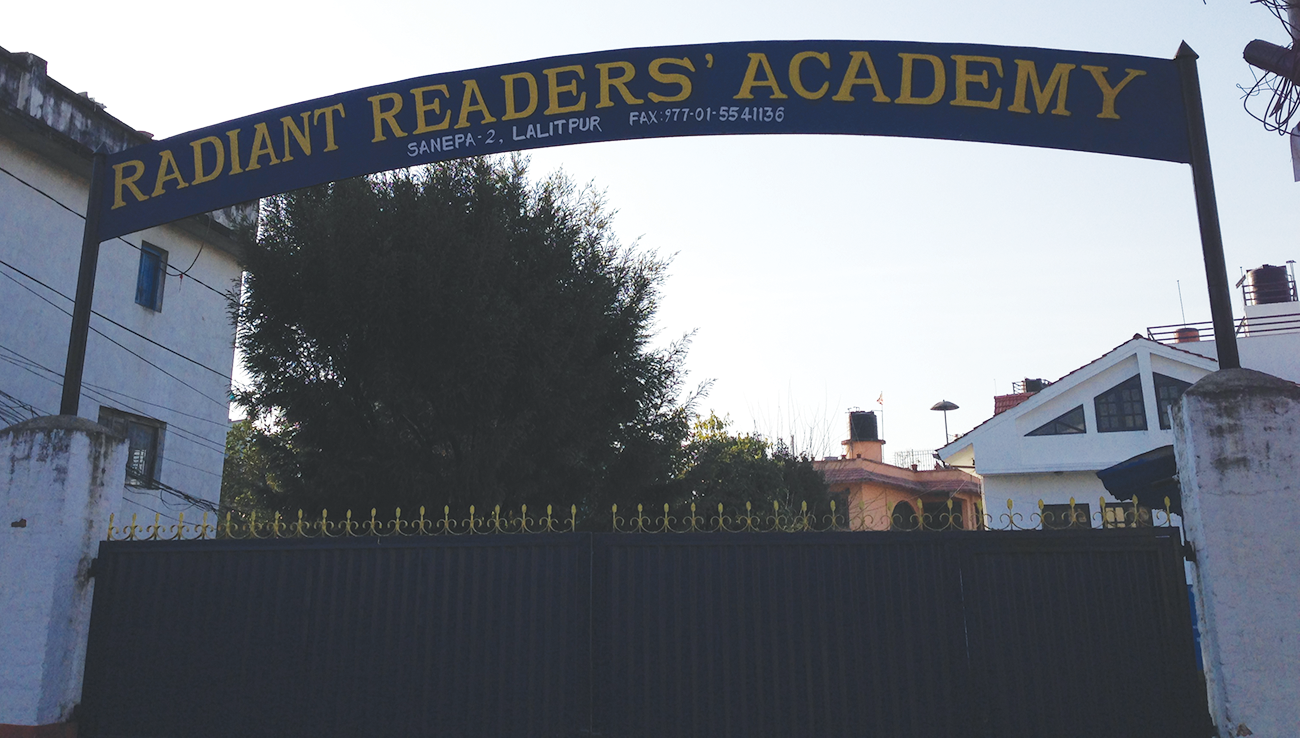
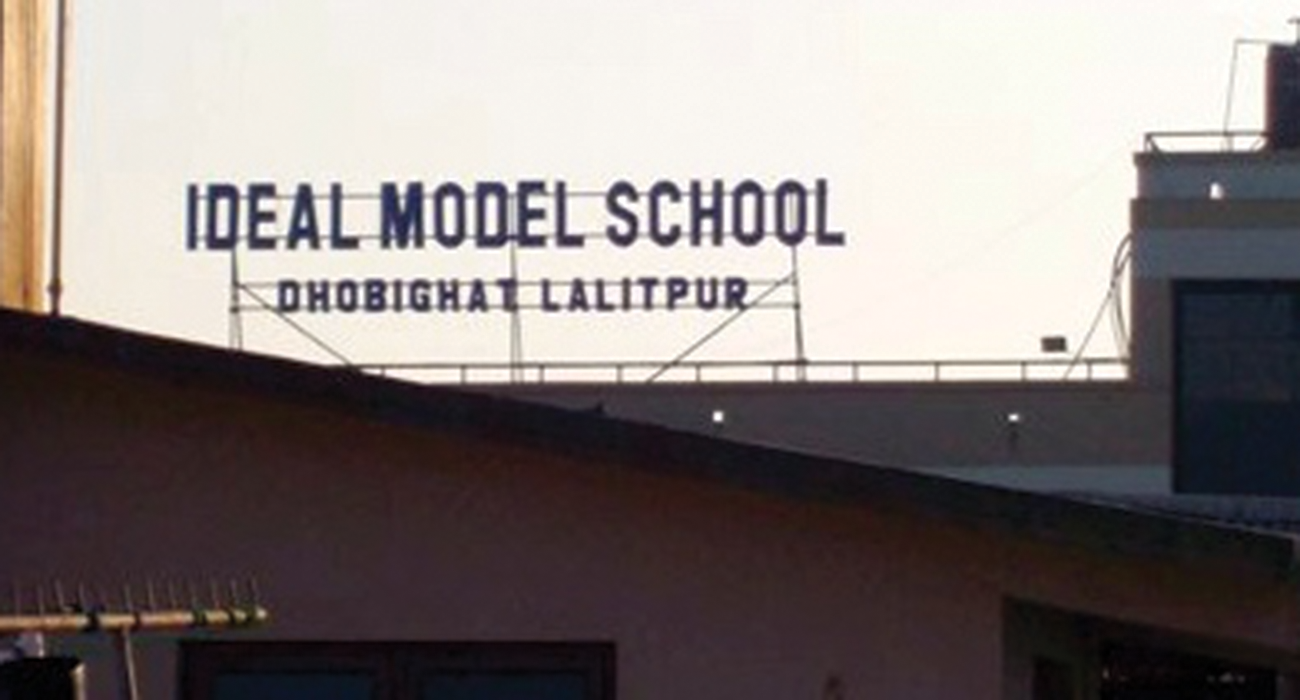
After this final protest against CTEVT, the protests against higher secondary schools dropped from the news. They have emerged sporadically since then, often with a single act of protest against a school or set of schools. School signs are still present, and as much in English today as they were prior to these events, though they are now largely limited to signs on the schools themselves rather than billboards around the city. Figure 1 shows a sign advertising Radiant Readers Academy, taken in January 2016, and figure 2 shows a sign on top of the Ideal Model School (the photo was taken in April 2011, and the same sign was still standing as of January 2016).
Radiant Readers Academy
Ideal Model School
Which Schools?
Exemplars
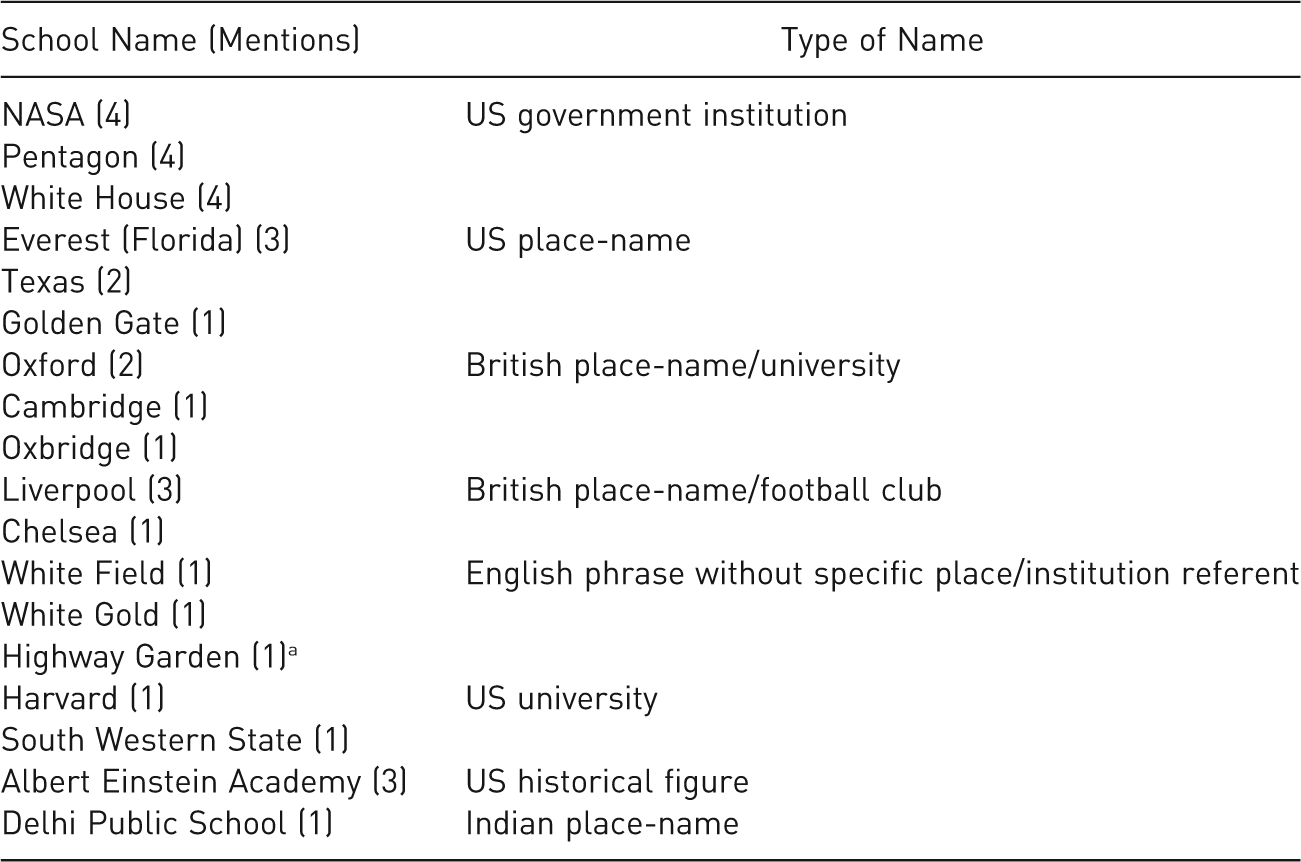
During these protests, school names were frequently used as examples in newspaper reports. These demonstrate which schools were presented as having objectionable English/foreign school names. Notably, all but one of these names mentioned a specific place or institution in the United States or England. The one exception was from an Indian news article that opened with the line “Nepal’s Maoist government has banned secondary schools from using foreign names like ‘Delhi Public School,’ ‘Oxford’ and ‘White House’ over fears that the education system is losing its Nepali identity” (News24, August 7, 2012). It seems that the “prototypical referent” (Agha Reference Agha2007a), when newspaper reporters or student protestors were asked to come up with examples of schools with foreign names, was of schools named for US or British universities and US government institutions and place-names, as shown in table 1.
Examples of Foreign-Name Schools
a Highway Garden was provided as an example of the kind of school not targeted in protests.
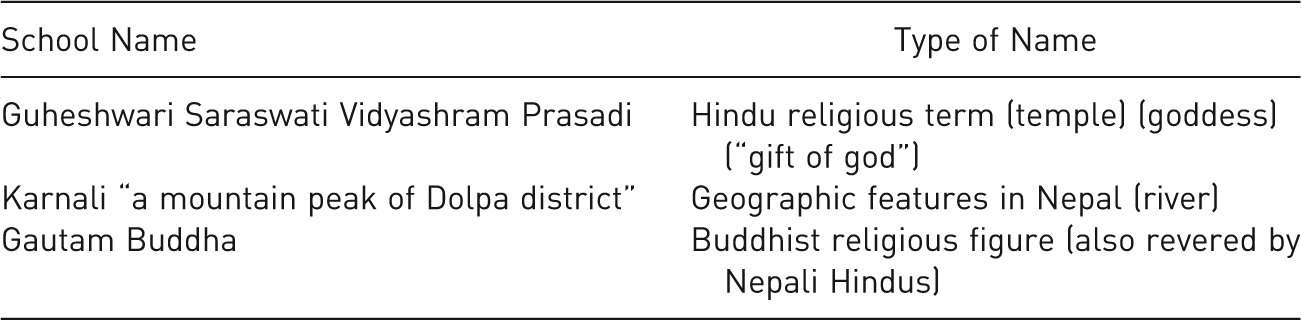
Less frequently, news articles provided samples of proper Nepali school names. These were either actual schools or suggestions of names that could be given to schools that currently have English names. The six school names listed in table 2 demonstrate that the Nepali names belonged to different classes than the English names; four were religious terms, and the other two were geographic features of Nepal. Of the religious terms, three were Hindu religious terms.Footnote 5 While Gautam Buddha is largely associated with Buddhism, he is also worshipped by Nepali Hindus (Gellner Reference Gellner, Sutherland, Houlden, Clarke and Hardy1988), and the location of the historical Buddha’s birth in Nepal is now a point of Nepali nationalist pride (Dennis Reference Dennis2015). The appearance of religious terms such as temples and goddesses is a marked change from the categories of English-language school names. In addition, while several of the English school names included place-names, most were named for cities or universities,Footnote 6 while the Nepali names were natural geographic features such as rivers and mountains.
Nepali School Names
Targets
Throughout the two months of protests, reporters, opinion writers, and college heads expressed the opinion that students’ actions were not truly motivated by the causes of removing foreign school names and reducing school fees. Instead, they claimed, students were running a fundraising drive in which they extorted money from schools with the threat of violence as motivation for schools to pay protection money (Himalayan Times, July 16, 2012a; Kathmandu Post, July 16, 2012b; Nepali Times, July 20, 2012b, July 20, 2012c; República, July 17, 2012a, July 19, 2012a; Nepali Times, July 25, 2012). School administrators further supported this argument by pointing out that the timing of the protest coincided with the collection of school fees, and therefore an influx of cash at private schools. While this explanation was strenuously disavowed by student leaders (Himalayan Times, July 18, 2012), it remained popular in the press.
The schools that were targeted in these attacks, though, support claims that school’s names were not the deciding factor in whether or not they were a target of vandalism or violence. As several editorials pointed out, only a handful of the hundreds of schools with English-language names were targets. Schools with English names that were “collections of random English words, such as Highway Garden” were rarely targeted, while several of the schools that were vandalized had Nepali names (Asia News, July 18, 2012; República, July 19, 2012a; Spotlight Nepal, July 27, 2012). Table 3 presents the names of the schools that were targeted by having signs taken down or painted over, school property destroyed, or school buses burned.
Schools Affected by Student Vandalism
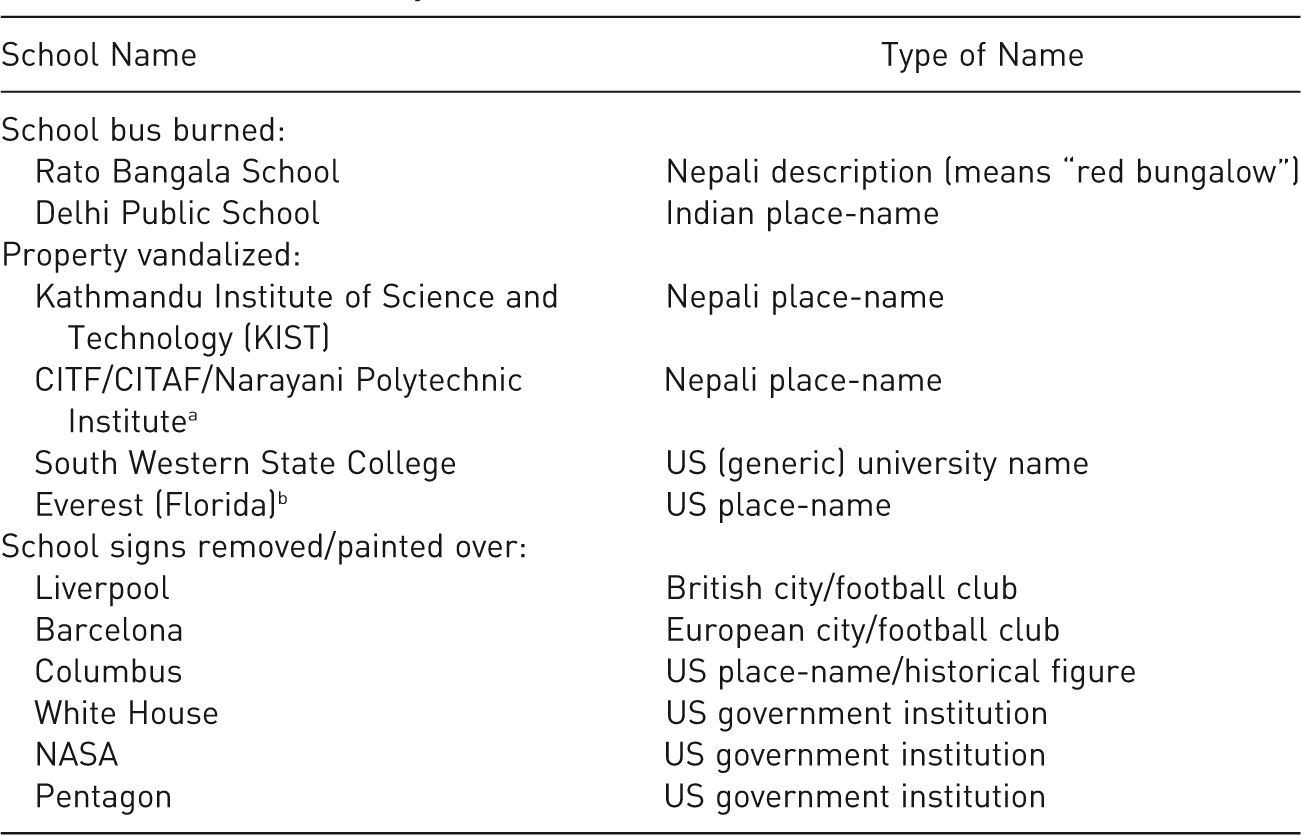
a It is unclear from the newspapers what school this was; while several articles report vandalism of a school in Chitwan district, it appears that there is neither a CITF nor CITAF school affiliated with CTEVT. It is possible this was the Chitwan Institute of Technical Science (CITS), while another article identified the school as Narayani Polytechnic. In either case, it fits the category of Nepali place-name.
b The official name of this school is Everest Florida Secondary School, but several articles referred to the school as Florida College. One Himalayan Times article (July 7, 2012) explained that “some Plus Two colleges have added Nepali names before foreign names: Florida HSS has put Everest and Barsha HSS (Barcelona) has added Kathmandu, but ‘Everest’ and ‘Kathmandu’ figure indistinctively in the hoardings.” All other articles referred to Kathmandu Barsha Higher Secondary School as Barcelona.
From this list we see that certain categories of names were particularly common targets for the protestors: US government institutions, US place-names, and football clubs (Barcelona and Liverpool) made up the “foreign” element of this list. These schools may also have presented particularly appealing targets due to high brand recognition in the city; many of these are prominent high schools that appear often in reports of school sports or other educational activities. Thus, while the exemplary school names provided in news articles fell neatly into contrasting chronotopic formulations, the schools and brands that were attacked had a somewhat less clear set of indexical links.
School Signs
The foreign names in table 1 and the Nepali names in table 2 paint pictures of the English-speaking world and Nepal. I argue that these imaginaries of the foreign and the domestic are tied to Kathmanduites’ understandings of migration. A key feature of higher secondary schools is that they purport to sell access to an internationally acceptable level of education, especially in the English language. The middle name of many of these schools, International, which is so common that newspaper accounts frequently omitted it, is meant to indicate that the level of education is in line with international colleges and promises access to the rest of the world. The signs’ “indexical selectivity” (Agha Reference Agha2007a) additionally plays a role in establishing the effect of promising international-level education. The signs of English-language colleges, written in Roman script with only English on the sign, are opaque to anyone who does not read English (see figs. 1 and 2). The intended audience of the signs should recognize not just the English words but also that they refer to prestigious places in other areas of the world. At the same time, the intended audience is not foreign-educated Nepalis or foreigners in Nepal who find these signs hilarious for their use of soccer clubs and government agencies as college brand names. Rather the signs target students and parents who recognize the school signs and names as promising the kind of education they desire, but crucially not those who recognize the anomalous nature of these school names.
To make sense of the students’ representations of schools and choices of objectionable versus appropriate school names, I employ Bakhtin’s (Reference Bakhtin, Emerson, Holquist and Holquist1981) notion of “chronotope,” or social space-time. A term originally developed by Bakhtin while studying novels, the analytic of chronotope has been employed by linguistic anthropologists studying topics as varied as decisions regarding migrating from Mexico to the United States (Dick Reference Dick2010); travel writing about Papua New Guinea (Stasch Reference Stasch2011); and US politicians’ apologies for having committed adultery (Jackson Reference Jackson2012). The applicability of this analytic to varied contexts demonstrates the ubiquity of conflations of space and time in semiotic behavior. Agha (Reference Agha2007b, 321) defines a chronotope as “a semiotic representation of time and space peopled by certain social types.” Crucially, this is not merely a linkage between time, space, and social types; instead, as Bakhtin (Reference Bakhtin, Emerson, Holquist and Holquist1981) notes, different time-space scales actually enable different kinds of character development. For instance, in Woolard’s (Reference Woolard2013) analysis of three bilingual Catalan-Castilian speakers’ orientations to the two languages, the three “fundamentally different chronotopes” they employ “charter different visions of personal as opposed to social responsibility for their current linguistic situations and selves” (221). A key characteristic of chronotopes is that it is they are always enacted and construed within a participation framework; that is, a chronotope is always created by particular people in a place at a certain time. Chronotopes do not exist outside of their formulations by people. At the same time, all semiotic behavior, according to Bakhtin, is chronotopic because all semiotic behavior, which includes all discursive behavior, occurs in and indexes space and time. Chronotopes, while only created through semiotic behavior, are therefore elements of all such behavior.
This observation, though, is “of vanishingly little interest when extracted from a frame of contrast” (Agha Reference Agha2007b, 322). Since all semiotic and, therefore, all discursive behavior invokes chronotopes, chronotopes matter only when they are relevant to social action, which almost always means when there are conflicting chronotopes invoked in a single context. As we shall see, this is the case in the newspaper coverage of the school sign protests. However, while we can identify dominant competing chronotopes in this case, Bakhtin is careful to point out that chronotopes are not hermetically sealed off from each other, but rather they are “mutually inclusive, they co-exist, they may be interwoven with, replace or oppose one another, contradict one another or find themselves in ever more complex interrelationships” (Reference Bakhtin, Emerson, Holquist and Holquist1981, 252). By employing the analytic of chronotope, I suggest that we can learn something about what was going on in these protests and their media coverage by looking at the portrayal of time, space, and kinds of people—particularly in relation to economic systems—that appeared in newspaper coverage of this chain of events.
How do school names work? Linguistic anthropologists have discarded the philosophical notion that there is an inherent link between proper names and the objects they pick out in the world (Rymes Reference Rymes1996). However, while names are not inherent properties, they are not arbitrary. This is demonstrated by patterns in school names, and the chronotopes they outline. In the case of private +2 schools, names did not behave merely as descriptors or arbitrary signs but rather as part of schools’ brands. This is illustrated by the placement of hoarding boards advertising the schools alongside similar boards advertising cars and cosmetics and exemplified by a quote from a school administrator: “the government should give us compensation to change the school names—it’s our brand and we have put huge investment over the period of time” (Asia Calling, August 18, 2012).
As complex and changing semiotic phenomena, brands are well suited to the modes of analysis developed by semiotically inclined linguistic anthropologists. Moore’s (Reference Moore2003, 331) Peircean analysis of the phenomenon of brand demonstrates that brands are “an inherently unstable composite” of material and intangible values. In late modernity, he argues, anything can be branded, including experiences and events. As Agha (Reference Agha2011) points out, objects and experiences move in and out of commodity formulations during their life cycle, so schools may be heavily branded in information targeting potential students and their parents but less so at other times, for example, during the school day.
The branding of schools, through material advertisements in the forms of billboards and newspaper ads, markets not just a school experience but also a promise of future academic and professional success. In particular, schools are part of a booming market selling access to the global economy through English (Blommaert Reference Blommaert2009). Nakassis’s (Reference Nakassis2012) study of counterfeit branding is particularly apt for this case in which school owners used US and European brands to elevate the status of their products, just as clothing vendors in the Tamil Nadu markets that Nakassis studies and in Kathmandu’s bazaars and tourist areas increase the value of their clothes by attaching the names and logos of international brands. Like garments made locally but marked as branded through the attachment of a brand or brand-like emblem, schools mark themselves as branded commodities by employing the aesthetics of brandedness: “the reckoning of commodities, or elements of them, by their loose affiliation to authorized brand instances through fractional similitude with them (in a formal structural or design sense)” (Nakassis Reference Nakassis2012, 704). Schools named for locations in Europe and the United States, or for agencies of the US government, bore only the slightest “fractional similitude” with the originators of the names; however, the indexical link to desirable attributes of places outside of Nepal remained. Thus, while no one would mistake Oxbridge International Higher Secondary School in Kathmandu for a British university, its deployment of signs and logos creates an aesthetic of brandedness that elevates the school above the run-of-the-mill minimally branded or Nepali-name school. School signs advertise schools as commodity, as experience, and as promise through the co-occurrence of several signs: English writing, smiling or serious students wearing tidy uniforms, perhaps a modern-looking school building, a mysterious or impressive-looking logo, and so on.
Branding, like other semiotic behavior, draws on and produces chronotopic formulations; in the case of brands, these chronotopic formulations are intended to inform potential consumers about the thing being sold and to increase their desire for whatever it may be. Manning (Reference Manning2010) follows Munn in referring to a similar concept as “space time,” noting that “brands can align themselves with respect to social imaginaries such as the nation by situating themselves within local or global trajectories of circulation … or they can gesture to diasporic, aspirational, or exotic elsewhere on the horizons of imaginative geographies of alterity (Reference Munn1986, 38–39). In India, for example, Mazzarella notes trends to advertise through what he labels “auto-Orientalism”, or “the use of internationally recognized signifiers of Indian ‘tradition’ to facilitate the aspirational consumption, by Indians of a culturally marked self” (Reference Mazzarella2003, 138) but also a tendency to advertise Western products through association with value that resides elsewhere. Advertising draws on recognizable chronotopic formulations which allow potential consumers to draw the indexical links between the metasigns (school names) or object signs (physical billboards, schoolbuses labeled with school names) of branded schools and the forms of distinction promised through their names. Invoking recognizable chronotopic formulations is part of what makes a brand successful.
The combination of tangible and intangible elements of branding contributed to making the protests possible. The thing being sold by schools is largely intangible; while it may be represented physically by a diploma with the backing of state authority (Bourdieu Reference Bourdieu and Richardson1986), the product sold by schools is more in line with the selling of an experience, and the promise of the imparting of some set of knowledge and skills. School signs are multimodal representations of this promise, involving both discursive and nondiscursive semiosis. School advertising involves an array of signs, such as images of neatly uniformed and attractive school buildings (and the attractive buildings themselves); numbers representing pass percentages on important exams; abstract school symbols and crests; and the names of the schools themselves, with their discursive ties to other locations. Additional elements that allowed the school signs to advertise branded schools included the size and placement of signs, with the most expensive advertising space located in busy intersections or near expensive shops. As in all forms of semiosis, there were many elements, or semiotic partials, that comprised the signs; student protesters, though, metonymically reduced the brand to the partial of the name. Student protesters did not have objections to the product being sold, that is, the education that students received at these schools, including the English medium of instruction. Instead, the primary objection that protesters provided was the brand name that these schools had chosen and the ability of schools to charge high fees because of the value added by the use of an English name for the school. This provides evidence that students were protesting the commodity form of schooling; their objection was to the function of English-language brand names slapped on schools, part of the advertising of schools during which schooling is a commodity. The use of English in the teaching and learning taking place within a school, a part of the brand’s lifecycle when it is not a commodity, was not part of the student protesters’ focus.
Students then further focused the protest against the object signs of schools: their billboards. While name and brand remained intangible, protestors could physically target the tangible manifestations of brand in the form of school signboards by painting over objectionable words or tearing down the signs. Student protestors targeted segments of the commodity chain in which schools were functioning as brands, with the object signs of branding, the billboards, the main target of physical protests. This separation did not remain intact, though, as acts of vandalism moved beyond the school signs themselves and onto cotextual markers of expensive school status, such as computers, school buses, and aquariums and chandeliers at reception desks (República, July 17, 2012a; Spotlight Nepal, July 27, 2012).
English Futures
Having briefly discussed the function of brand and the ways that the partials that comprised brand were disaggregated by student protestors, we turn now to the chronotopic formulations created by the school names. The first identifiable chronotope at play here is a familiar one, of English tied to modernity, mobility, and money. As in many parts of the world, English-medium private education has become a commodity in which urban middle-class Nepalis who are trying to enhance their prestige and social standing invest to raise their class standing (Liechty Reference Liechty2003; in India, see Bhattacharya Reference Bhattacharya2013, Reference Bhattacharya2016; LaDousa Reference LaDousa2014; Proctor Reference Proctor2014). From the founding of the English-medium Durbar School in the mid-nineteenth century, which was meant to provide children of elite families access to English, the English language has indexed access to the knowledge and power of places outside of Nepal (Phyak Reference Phyak2013; Weinberg Reference Weinberg2013).
Turning to the school signs, then, let us examine the names employed as examples of problems by the students (see table 1). Three of these, and the three mentioned in the largest number of articles, are the names of United States government institutions (NASA, Pentagon, White House), while an additional three (Florida, Texas, Golden Gate) are names of places in the United States. Three others (Cambridge, Oxford, Oxbridge) are either British universities or an amalgam of two British university names, with another two that are British place-names previously transformed into brands by the popular soccer clubs in those locations. Two more are US universities, one a famous and historic university (Harvard), the other the generic-sounding South Western State. The last three include a seemingly meaningless name (White Field)—a category severely underrepresented, from my observations, when compared with the apparent predominance of similarly meaningless names in the city’s scholastic landscape—an Indian place-name (Delhi), and a famous scientist (Albert Einstein).
Several of these relate to US and British dominance in fields of education, science, and politics. The football clubs seem to have come in for particular scrutiny in the common phrasing of objecting to “private schools named after English cities and football clubs.” The prototypical referent when newspaper reporters or student protestors were asked to come up with examples of schools with foreign names was of schools named for US or British universities and US government institutions and place-names. All of the objectionable names were recognizably foreign, with most referring to a specific location in the United States or England. Many referred to institutions or places associated with learning, power, and science. I argue that these are indicators of the participation of this strand of branding in a familiar chronotope of US and UK advancement; this is particularly dominant as one of the major promises of these schools is to teach English. This chronotopic representation is identifiable thanks to the metasemiotic work of student protestors who singled these colleges out as representative of English-name schools. By arguing that these names pick out a chronotopic representation of the world, I suggest that they identify a time, place, and model of personhood. In this case, the chronotope is one of modernity defined by movement toward Anglo-American ideals. It is peopled, presumably, by students who have studied English and +2 subjects at such schools. This is a potential future oriented toward the advances of, and possibilities of advancement, elsewhere.
Unchanging, Spiritual Nepal
The names that were suggested as alternatives to foreign names belonged to remarkably different realms (see table 2). These include Sanskrit/Hindu religious terms, figures, or places, such as Guheshwori, Saraswati Vidyashram, and Prasadi; geographic features, including Karnali and an unspecified peak in Dolpa district; and Gautam Buddha. Several lie in the realm of religion or call upon the religious indexical values of Sanskrit.
It is worth emphasizing the conservative vision of Nepal presented by these supposedly revolutionary student groups. By 2012, Nepal was no longer a Hindu nation under a monarchy that derived part of its authority from Hindu religious rituals (Mocko Reference Mocko2015) and had not been an officially Hindu nation for five years. These proposed improved school names are notable for their emphasis on Sanskrit roots and mountains, congruent with historical Nepali nationalist discourse (Burghart Reference Burghart1984; Onta Reference Onta1996; Chalmers Reference Chalmers2003); segments of Nepal’s population who continue to advocate for adequate representation are notably absent in this retrenchment of an older model of Nepaliness. Historian Harsha Man Maharjan (Reference Maharjan2012) has argued that since the conclusion of the conflict in 2007, “the Nepali media’s use of old symbols of national identity … represented an attempt to retreat from multiculturalism and to reprioritize a common national culture” (30–31). The students as well, while representing themselves as revolutionaries, were participating in a conservative turn in representations of Nepali nationalism.
In a study of Mexican (non)migration to the United States, Dick identifies a discursive “modernist binary that configures the United States as a land of socioeconomic mobility and progress, but also of moral dissolution, and Mexico as a land of morality and family, but also of socioeconomic stagnation” (Reference Dick2010, 276). The school names discussed in this article create a similar binary between the English-speaking world (the United States, Europe, and possibly India) and Nepal. The outside world includes famous universities, well-known cities, and glamorous soccer teams. They allude to long histories of higher education (Oxbridge, Harvard) and to scientific innovation (NASA, Albert Einstein). The Nepali name offerings, by contrast, are timeless, with natural or supernatural referents. This is also reminiscent of the auto-Orientalism trope in Indian advertising (Mazzarella Reference Mazzarella2003), with the students proposing that proper school names would draw on names that index tradition and religion. There is apparently nothing created by Nepali people worth honoring in a school name; this is perhaps related to a popular discourse of (under)development that teaches every Nepali schoolchild about Nepal’s status as a peripheral, underdeveloped country (Pigg Reference Pigg1992; Liechty Reference Liechty2010). Rather, what Nepal has to offer is the potentially morally superior pristine natural environment and a range of deities.
The Foreignness of School Fees
I have argued that expensive private schools in Kathmandu, like the ones discussed in these news articles and protests, sell the promise of a future of economic opportunity and greater opportunities to migrate, especially to English-dominant places like England or the United States. The explicit linkage made in coverage of these events, though, was not between schooling and economic opportunity or migration, but between foreign names and exorbitant school fees. Table 4 shows a compilation of all the reasons that protesters gave for their actions in newspaper articles, whether they were given as direct or indirect quotes from protestors. While this omits the external explanations provided by commentators, such as the donation drive/extortion explanation mentioned above, it provides a complete catalog of protestors’ proffered reasons for the protest.
Reasons Given for Protests
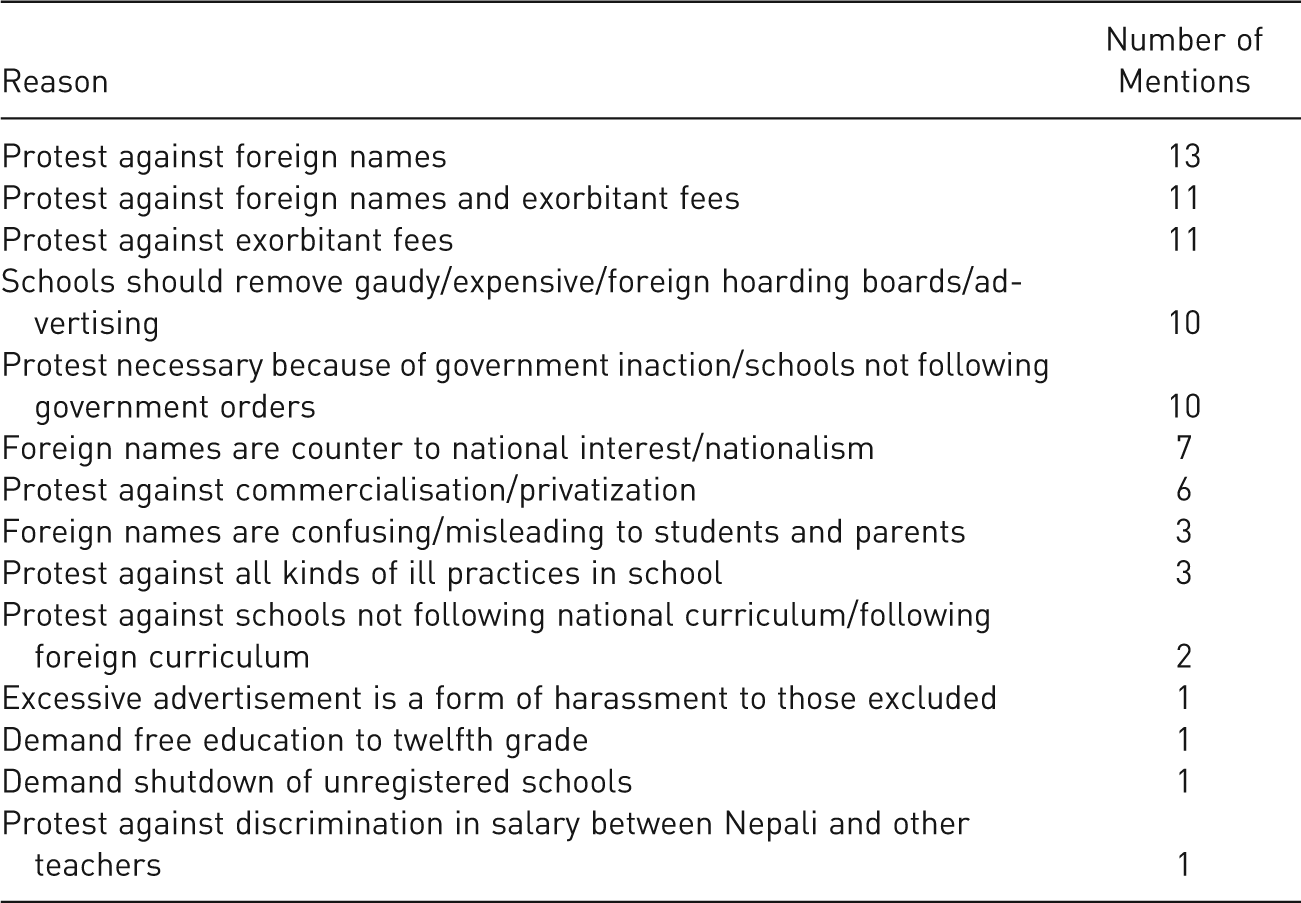
The protestors’ reasons for their actions (table 4) were not all of one kind. Some were demands, others complaints about certain behaviors, and others were explanations for student unions’ turn to protests. A few complaints appeared in only one article, though they could be grouped in as part of the protest against general “ill practices” in higher education. In a handful of articles, students issued explicit calls against privatization or commercialization of schooling, including the accusation that private schools were destroying community schools. A similar number of articles cited national pride or national identity as the root of the protest. Mismanagement in higher education, nationalism, and concerns about privatization all seem to be part of this story.
The most common complaints, though, had to do with foreign names and high fees, beginning with objections to schools’ foreign names, with no explicit reason provided for what was wrong with those names. Likewise, another common theme was protesting exorbitant fees and calling for a “scientific” and regular set of school fees. Equally common, though, was the appearance of these two themes together in the same sentence. Usually, they were linked only by collocation, without an explanation of how high fees and school advertisements might be connected to each other. In fact, only one article in the corpus explicitly described a link: “Prime Minister´s Office (PMO) had directed the Ministry of Education to take necessary steps to curb extravagant advertisements by private plus two schools, arguing that the students will have to bear the unnecessary publicity cost at the end of the day” (República, July 25, 2012a).While this was the only article in the corpus that described a causal relationship between advertisements and school fees, the frequent collocation of complaints about foreign names and exorbitant fees seems to imply a relationship between the two.
Drawing from the analysis of school names, it seems that the protest movement, which was most commonly explained by student leaders as being against foreign names and exorbitant fees, was closely tied to the binary chronotopes discussed above, between unchanging and morally superior Nepal and the fast-changing and questionably moral English-speaking world. If Nepal is unchanging and morally pure, then exorbitantly high fees, an immoral change that limits access to quality schooling, must be an intrusion from the outside. Conversely, foreign names bring with them rapid change toward unfettered capitalism that goes against the moral centering of Nepal. Much as eighteenth-century European crowds questioned the morality of profiting from the sale of bread (Thompson Reference Thompson1971), the student activists in Kathmandu rejected the morality of the sale of education, or at least its inflation through indexical appeal to a chronotope of Western innovation as a model of progress. The repetition of foreignness next to exorbitant school fees implies that it is un-Nepali to overcharge for school. Commercialization of schooling was represented as a foreign phenomenon, imported from the outside along with school names like Oxbridge and Barcelona.
Conclusion
With private schooling a relatively recent development in Nepal (private higher secondary schools were introduced only in 1992), it seems that the student protesters were questioning the morality of profit, or perhaps excessive profit, on schooling. They labeled the sale of education—or at least the inflation of its price through indexical appeal to Western modernity—an unacceptable act in Nepal. Usually the links between the school signs and the high fees were not spelled out, but rather co-occurred in statements about “foreign names and exorbitant school fees.” While only occasional demands surfaced in the news coverage for free higher education, there seemed to be consensus among the student protesters (who, it must be recalled, came from multiple political parties) that there was a level of branding and therefore inflation that was not acceptable.
This investigation of talk about a student movement provides some insights into one encounter with the encroachment of capitalism into the educational sphere. Through an analysis of news coverage I have attempted to show resistance to the commercialization of schooling, through a protest movement and discursive formations that located such commercialization as a foreign phenomenon linked to dubious morals. This was exemplified by the discursive construction of two chronotopic formulations, one of the West as a place of progress and innovation, which contrasts with a second formulation of Nepal as a place of tradition and religion. While private school owners hoped to tempt parents and students to choose their schools, despite high fees, through the indexical links that they offered to Euro-American progress, students invoked an opposing moral opposition between the two chronotopic formulations. Student protestors employed a representation of Nepal as a land of spiritual purity and majestic landscapes, drawing on old tropes of Nepali nationalism to reject the appropriateness of high school fees in Nepal, and the implication that progress involves foreignness and English language. The multimodal and mass-mediated semiotic processes that allowed for the creation of and circulation of brands, in this case as school brands, allowed student activists to contest the common assumption that the future involves English and emblems of progress that draw from lands far from Nepal.



