





Impact statement
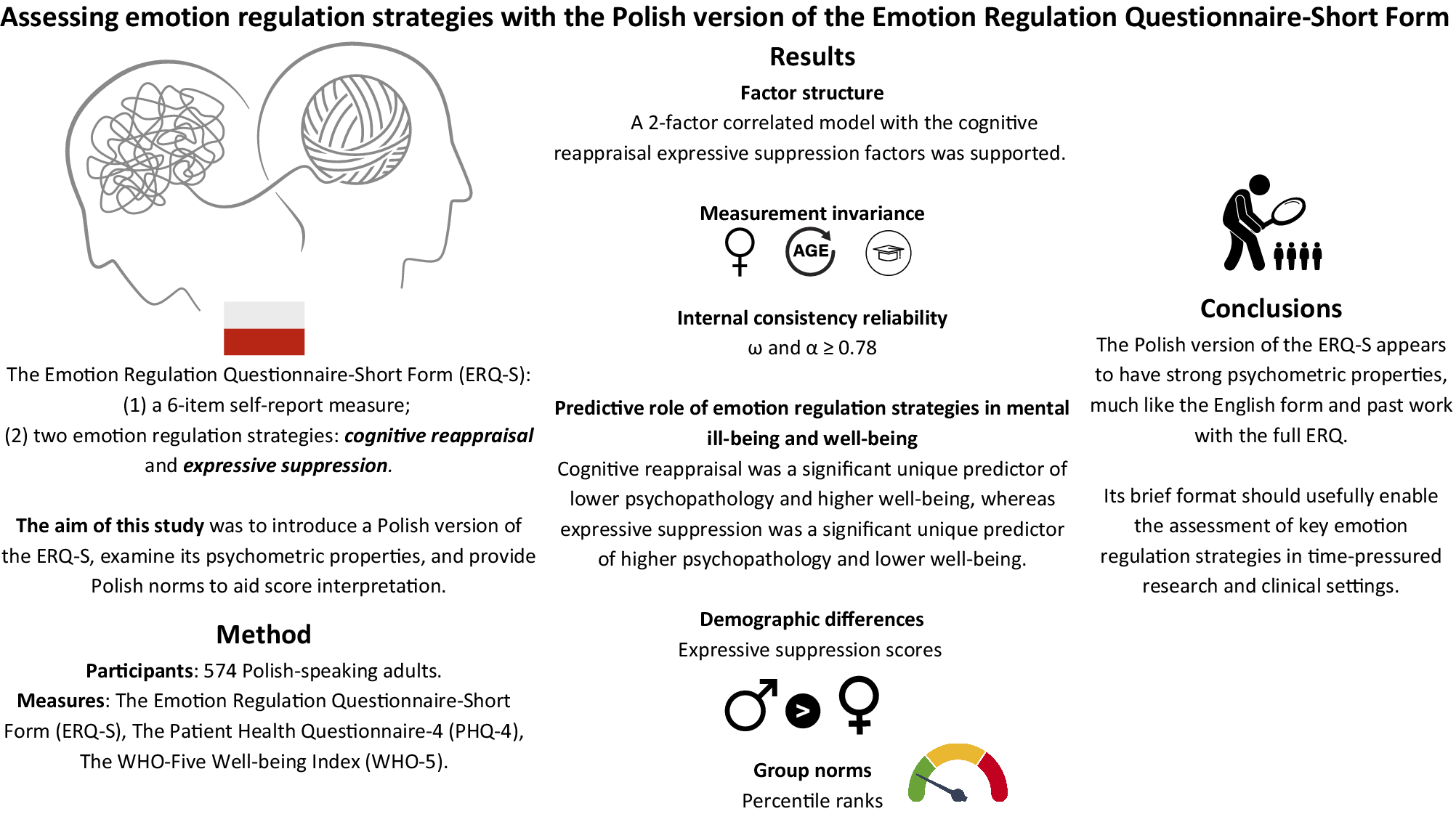
Emotion regulation plays a crucial role in people’s emotional life. Therefore, its psychometric assessment is important in both research and clinical practice. Traditionally, most emotion regulation tools have been relatively lengthy, impacting their utility in time-pressured settings. Recently, the Emotion Regulation Questionnaire-Short Form (ERQ-S) was introduced in English as a brief measure to address this gap. In this study, we introduced the first Polish version of the ERQ-S and demonstrated that it has strong psychometric properties as a measure of two emotion regulation strategies, cognitive reappraisal and expressive suppression. The ERQ-S conformed well to its intended 2-factor structure in factor analysis and was invariant across gender, age and education categories. Moreover, the ERQ-S was able to maintain good reliability despite its brief format. We also highlighted that cognitive reappraisal was significantly associated with lower psychopathology symptoms and higher well-being, whereas the opposite pattern was present for expressive suppression. Overall, our findings further demonstrate the utility of the ERQ-S as a brief and robust measure of cognitive reappraisal and expressive suppression. To help facilitate interpretation of ERQ-S scores, we calculated percentile rank norms for Polish adults. The Polish version of the ERQ-S therefore can be recommended for use among Polish-speaking people around the world.
Introduction
Emotion regulation plays a crucial role in people’s emotional life, with strong emotion regulation being associated with better overall well-being, and emotion regulation difficulties contributing to the development of a wide range of psychopathologies, including anxiety and depression disorders (Hu et al., Reference Hu, Zhang, Wang, Mistry, Ran and Wang2014; Gratz et al., Reference Gratz, Weiss and Tull2015; Brewer et al., Reference Brewer, Zahniser and Conley2016; Menefee et al., Reference Menefee, Ledoux and Johnston2022).
A common model for conceptualizing emotion regulation is the process model of emotion regulation (Gross, Reference Gross2015), which delineates five broad families of emotion regulation strategies, based on how early in the emotion generation process they are activated. Situation selection and situation modification strategies involve changing the emotion-inducing situations one encounters; attentional deployment strategies involve shifting what aspects of an emotion-inducing situation one focuses attention on; cognitive change strategies involve changing the way one is thinking about a situation to change its emotional impact; and response modulation strategies are activated later in the process once the emotional response is more developed, and involve modifying the experiential, physiological or behavioral manifestations of the emotion (Gross, Reference Gross2015).
Assessing emotion regulation is of high importance in both research and clinical practice. For use in time-pressured research and clinical settings, brief and valid emotion regulation tools are required. To date, one of the most widely used measures of emotion regulation (See et al., Reference See, Tan, Tan and Sündermann2022; Stellern et al., Reference Stellern, Xiao, Grennell, Sanches, Gowin and Sloan2023; Zitzmann et al., Reference Zitzmann, Rombold-George, Rosenbach and Renneberg2024) has been the Emotion Regulation Questionnaire (ERQ) (Gross and John, Reference Gross and John2003). The ERQ (Gross and John, Reference Gross and John2003) is a 10-item self-report measure, which evaluates the extent of use of two common emotion regulation strategies: cognitive reappraisal and expressive suppression. Cognitive reappraisal is a cognitive change strategy involving reappraising the way one is thinking about a situation to change its emotional impact (e.g., looking at the situation from a different point of view), whereas expressive suppression is a response modulation strategy involving suppressing the behavioral expression of the emotion (e.g., trying to not show others how you are feeling; Gross and John, Reference Gross and John2003).
These two emotion regulation strategies are of high clinical relevance (Gross and John, Reference Gross and John2003). Cognitive reappraisal is generally considered an adaptive strategy, as its habitual use is associated with a wide range of positive outcomes, including lower psychopathology symptoms and better well-being and interpersonal functioning. In contrast, expressive suppression is generally considered a maladaptive strategy, as its habitual use is associated with poor long-term outcomes, such as higher psychopathology and lower well-being (Gross and John, Reference Gross and John2003; Preece et al., Reference Preece, Becerra, Robinson and Gross2020, Reference Preece, Becerra, Hasking, McEvoy, Boyes, Sauer-Zavala, Chen and Gross2021, Reference Preece, Petrova, Mehta and Gross2023; Sörman et al., Reference Sörman, Garke, Isacsson, Jangard, Bjureberg, Hellner, Sinha and Jayaram-Lindström2022).
Much of what is known about cognitive reappraisal and expressive suppression comes from work with the ERQ. The ERQ has shown good psychometric properties, including strong factorial validity with a theoretically informed 2-factor structure (i.e., cognitive reappraisal and expressive suppression factors) that works well across general community (e.g., Cabello et al., Reference Cabello, Salguero, Fernández-Berrocal and Gross2013; Preece et al., Reference Preece, Becerra, Robinson and Gross2020; Olalde-Mathieu et al., Reference Olalde-Mathieu, Licea-Haquet, Reyes-Aguilar and Barrios2022; Sörman et al., Reference Sörman, Garke, Isacsson, Jangard, Bjureberg, Hellner, Sinha and Jayaram-Lindström2022), clinical (e.g., Andrea et al., Reference Andrea, Galiano, Rosellini and Brown2023) and student (e.g., Balzarotti et al., Reference Balzarotti, John and Gross2010; Zhang and Bian, Reference Zhang and Bian2020) samples, and is invariant across various demographic groups (e.g., Ng et al., Reference Ng, Huebner, Maydeu-Olivares and Hills2019; Preece et al., Reference Preece, Becerra, Hasking, McEvoy, Boyes, Sauer-Zavala, Chen and Gross2021). Both scale scores have displayed good internal consistency and test–retest reliabilities (e.g., Gómez-Ortiz et al., Reference Gómez-Ortiz, Romera, Ortega-Ruiz, Cabello and Fernández-Berrocal2016; Olalde-Mathieu et al., Reference Olalde-Mathieu, Licea-Haquet, Reyes-Aguilar and Barrios2022) and have been associated with other outcomes in expected directions. For example, ERQ cognitive reappraisal scores are robustly associated with better well-being and lower depression and anxiety, whereas the opposite pattern is present for ERQ expressive suppression scores (e.g., Preece et al., Reference Preece, Becerra, Robinson and Gross2020, Reference Preece, Becerra, Hasking, McEvoy, Boyes, Sauer-Zavala, Chen and Gross2021; Sörman et al., Reference Sörman, Garke, Isacsson, Jangard, Bjureberg, Hellner, Sinha and Jayaram-Lindström2022).
To further optimize the utility of the ERQ in time-pressured settings, Preece et al. (Reference Preece, Petrova, Mehta and Gross2023) recently introduced a 6-item short form called the Emotion Regulation Questionnaire-Short Form (ERQ-S). It is comprised of 3 cognitive reappraisal items and 3 expressive suppression items. To date, the psychometric properties of the ERQ-S have only been explored in one study (Preece et al., Reference Preece, Petrova, Mehta and Gross2023), where the English version displayed strong performance in general community and college student samples from the United States, performing similarly to the full ERQ in terms of factor structure, internal consistency and relationships with a marker of depression and anxiety. Due to its short length, the ERQ-S might be a good option for assessing emotion regulation in clinical or research settings requiring brief assessments (e.g., busy clinical wards and studies where emotion regulation is assessed as a large battery of measures and there is a need for short measures to reduce participant fatigue). However, further work is needed to establish its psychometric performance. There is also a need for extensions into other cultures and language versions.
With this in mind, our aim in this study was to introduce the first Polish version of the ERQ-S and examine its psychometric properties in a Polish sample. We were also interested in providing general community norms for Polish adults to help facilitate the interpretation of ERQ-S scores. Based on the theory and past work on the ERQ-S and ERQ, we had several hypotheses (H).
H1. The intended 2-factor structure of the ERQ-S is a good fit to the data in confirmatory factor analysis.
H2. The ERQ-S’s factor structure demonstrates measurement invariance across gender, age and education categories.
H3. The ERQ-S has good internal consistency reliability.
H4. Higher levels of cognitive reappraisal correlate negatively with markers of anxiety and depression symptoms and positively with well-being, whereas higher levels of expressive suppression correlate positively with these psychopathology symptoms and negatively with well-being (refer to Preece et al., Reference Preece, Becerra, Robinson and Gross2020; Reference Preece, Becerra, Hasking, McEvoy, Boyes, Sauer-Zavala, Chen and Gross2021; Reference Preece, Petrova, Mehta and Gross2023; Sörman et al., Reference Sörman, Garke, Isacsson, Jangard, Bjureberg, Hellner, Sinha and Jayaram-Lindström2022).
Method
Participants
Our sample consisted of 574 Polish-speaking adults (340 females, 227 males and 7 nonbinary) recruited from the general population in Poland, with ages ranging from 18 to 69 years (M = 25.47, SD = 9.03). Table 1 displays detailed demographic characteristics of the study sample, including education categories.
Demographic characteristics of the study sample
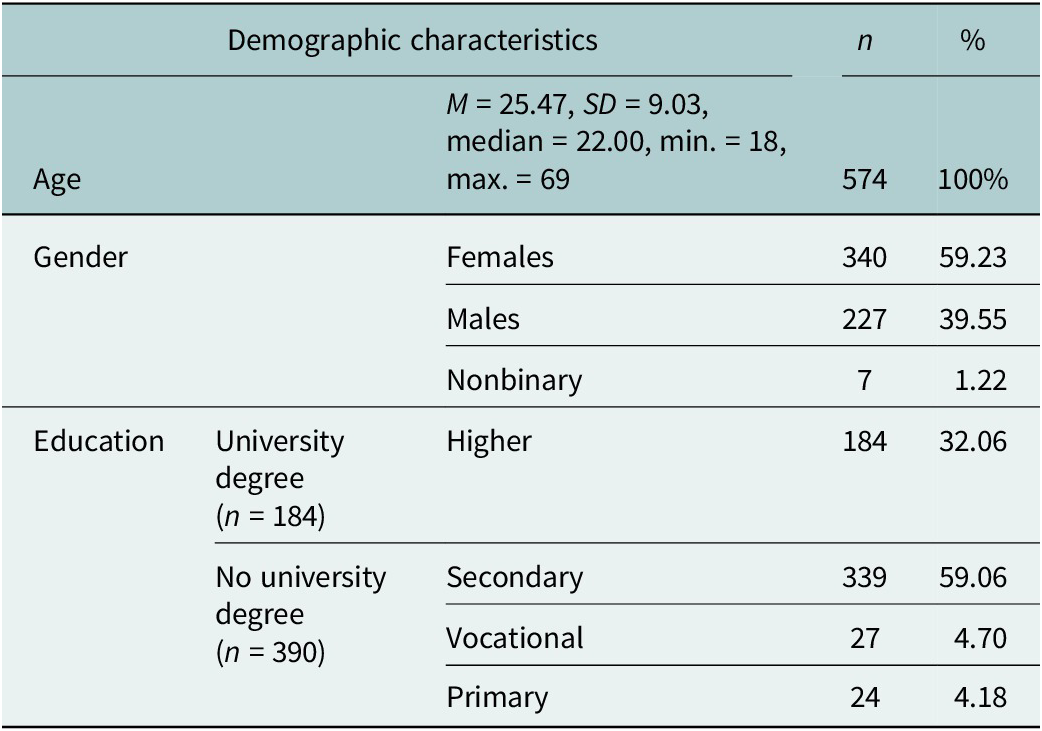
Abbreviations: M = mean; SD = standard deviation.
Procedure
The study was conducted in accordance with the Declaration of Helsinki Ethical Principles. The Ethics Committee of the Faculty of Psychology of Kazimierz Wielki University approved the study (No. 1/13.06.2022, later revision November 28, 2023).
In this study, respondents were recruited using a purposeful sampling method with a maximum variation design (Palinkas et al., Reference Palinkas, Horwitz, Green, Wisdom, Duan and Hoagwood2015). Participants were invited to complete a study in December 2023 via Facebook and Instagram, where we posted a link with an invitation to complete an online anonymous and voluntary survey (hosted on the Google Forms platform) with an appended consent form. No reimbursement was provided for the respondents. Participants provided their written informed consent digitally before completing the survey. Our inclusion criterion was Polish-speaking people aged 18 years or over, who signed their informed consent.
Measures
The Emotion Regulation Questionnaire-Short Form. The ERQ-S (Preece et al., Reference Preece, Petrova, Mehta and Gross2023) is a 6-item self-report measure of two emotion regulation strategies: cognitive reappraisal and expressive suppression. Items are scored on a 7-point Likert scale ranging from 1 (“strongly disagree”) to 7 (“strongly agree”), with higher scores indicating higher usage of these strategies.
The Polish version of the ERQ-S was developed using a standard translation procedure (Wild et al., Reference Wild, Grove, Martin, Eremenco, McElroy, Verjee-Lorenz and Erikson2005). First, the original English version of the ERQ-S was translated into Polish by four independent translators. Based on their translations, a common Polish translation was developed. Second, we translated it back into English by an independent translator. This back translation was compared with the original version by one of the developers of the original ERQ-S. Minor corrections were made, resulting in the final Polish version of the ERQ-S (see Supplementary Materials for a copy of the Polish ERQ-S with its scoring instructions).
The Patient Health Questionnaire-4 (PHQ-4). The PHQ-4 is a 4-item self-report measure of anxiety and depression symptoms over the previous two weeks (Kroenke et al., Reference Kroenke, Spitzer, Williams and Löwe2009). The PHQ-4 has two subscales: anxiety (e.g., “Feeling nervous, anxious, or on edge”) and depression (e.g., “Feeling down, depressed, or hopeless”), with two items in each subscale. The total PHQ-4 score represents an overall level of psychological distress. All PHQ-4 items are scored on a 4-point Likert scale, ranging from 0 (“not at all”) to 3 (“nearly every day”), with higher scores indicating higher levels of symptoms. We used the Polish version of the PHQ-4 (Larionow and Mudło-Głagolska, Reference Larionow and Mudło-Głagolska2023).
The WHO-Five Well-being Index (WHO-5). The WHO-5 is a 5-item self-report measure of positive well-being (WHO, 1998; Topp et al., Reference Topp, Østergaard, Søndergaard and Bech2015). Items (e.g., “I feel cheerful and in good spirits”) are scored on a 6-point Likert scale, ranging from 0 (“at no time”) to 5 (“all the time”), with higher scores indicating a higher level of well-being. We used the Polish version of the WHO-5 (Cichoń et al., Reference Cichoń, Kiejna, Kokoszka, Gondek, Rajba, Lloyd and Sartorius2020; Larionow, Reference Larionow2023).
The PHQ-4 and WHO-5 are widely used, and psychometrically sound brief measures of anxiety and depression symptoms (Caro-Fuentes and Sanabria-Mazo, Reference Caro-Fuentes and Sanabria-Mazo2023) or subjective well-being (Topp et al., Reference Topp, Østergaard, Søndergaard and Bech2015; Sischka et al., Reference Sischka, Costa, Steffgen and Schmidt2020), respectively. The Polish versions of these questionnaires have shown good psychometric properties (Cichoń et al., Reference Cichoń, Kiejna, Kokoszka, Gondek, Rajba, Lloyd and Sartorius2020; Larionow, Reference Larionow2023; Larionow and Mudło-Głagolska, Reference Larionow and Mudło-Głagolska2023); therefore we felt these measures would be appropriate for assessing correlates of the Polish ERQ-S.
The sociodemographic questionnaire . All participants filled out a sociodemographic form on age, gender (females, males or nonbinary) as well as education degree. To avoid participants’ fatigue, the first part of the respondents (n = 302) completed all the measures (i.e., the ERQ-S, PHQ-4 and WHO-5), and the second part completed only the ERQ-S.
Analytic strategy
Statistical analyses were carried out using Statistica v. 13.3 and R v. 4.3.0 with the lavaan statistical package. JASP v. 0.18.1 was used for calculating internal consistency reliability and an analysis of covariance (ANCOVA).
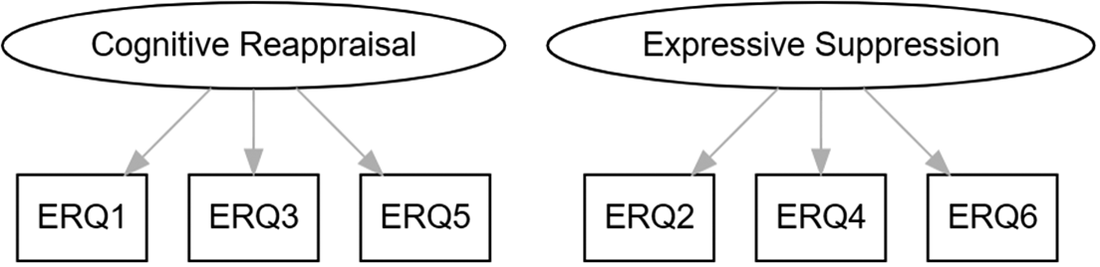
Factor structure and measurement invariance . Confirmatory factor analysis with maximum likelihood estimation (robust standard errors and the Satorra–Bentler scaled test statistic) was used. We tested the theoretically informed 2-factor model of the ERQ-S, where items 1, 3 and 5 were specified to load on a “cognitive reappraisal” factor, and items 2, 4 and 6 on an “expressive suppression” factor (see Figure 1). The two factors were allowed to correlate.
The tested confirmatory factor analysis model for the ERQ-S (the two factors were allowed to correlate).
To assess model goodness-of-fit, we used a variety of common fit indexes: the comparative fit index (CFI), the Tucker–Lewis index (TLI), root mean square error of approximation (RMSEA) and standardized root mean square residual (SRMR). CFI and TLI values ≥0.90 indicate acceptable fit and values ≥0.95 excellent fit. RMSEA and SRMR values ≤0.08 indicate acceptable fit and values ≤0.06 excellent fit (Hu and Bentler, Reference Hu and Bentler1999).
The measurement invariance of the factor structure was also examined across two gender categories (females vs. males), two age categories (younger people aged 18–24 vs. older people aged 25–69) and two education categories (no university degree vs. university degree; refer to Table 1). When dividing our sample into two age groups, we based the categorizations on the United Nations definition of youth, defining it as individuals between the ages of 15 and 24 (The United Nations Department of Economic and Social Affairs, 2013).
Configural, metric and scalar invariance models were tested. Models were compared in terms of the CFI, when an absolute difference in CFI (ΔCFI) of less than 0.01 supports invariance across the configural, metric and scalar levels (Cheung and Rensvold, Reference Cheung and Rensvold2002). Additionally, we applied criteria by Chen (Reference Chen2007), with ΔCFI of ≤0.01 for indicating invariance in all invariance models (i.e., metric and scalar), absolute differences in RMSEA of ≤0.015 and SRMR of ≤0.030 for indicating metric invariance, as well as with absolute differences in RMSEA of ≤0.015 and SRMR of ≤0.010 for indicating scalar invariance (Cieciuch and Davidov, Reference Cieciuch and Davidov2015).
Internal consistency reliability. McDonald’s omega (ω) and Cronbach’s alpha (α) reliability coefficients were calculated. Values ≥0.70 were judged as acceptable, ≥ 0.80 as good and ≥ 0.90 as excellent (Groth-Marnat, Reference Groth-Marnat2009).
Concurrent validity. For assessing concurrent validity, we calculated Pearson correlations between ERQ-S scores, PHQ-4 scores (anxiety and depression symptoms) and WHO-5 scores (well-being).
Predictive role of emotion regulation strategies in psychopathology and well-being. We conducted four separate multiple regression analyses in two steps using the forward entry method. In each regression, the criterion variable was either (1) anxiety symptoms (PHQ-4 anxiety), (2) depression symptoms (PHQ-4 depression), (3) total levels of psychopathology symptoms (PHQ-4 total score) or (4) well-being (WHO-5 total scores). In the first step of our regression models, we added age and gender as predictors to control demographic effects. In the second step, the two emotion regulation strategy scores of the ERQ-S were added as predictors.
Demographic differences . We computed Pearson correlations between ERQ-S scores and age in groups of females and males separately, as well as in the total sample. We used an ANCOVA with age as a covariate for comparing the ERQ-S scores between females and males, as well as between people with no university degree and people with a university degree. Age was used as a covariate in order to control its potential effects.
Group norms . We calculated percentile rank norms (Baumgartner, Reference Baumgartner2009) for the two ERQ-S scale scores in the total sample (n = 574).
Results
Descriptive statistics
Table 2 presents descriptive statistics for all study variables. In the total sample, across all the variables’ total or subscale scores, skewness ranged from −0.40 to 0.42, whereas kurtosis scores ranged from −1.13 to −0.53, indicating that the study variables were reasonably normally distributed. At the item level, all ERQ-S items were also reasonably normally distributed (see Supplementary Table 1).
Descriptive statistics and internal consistency reliability coefficients for the study variables
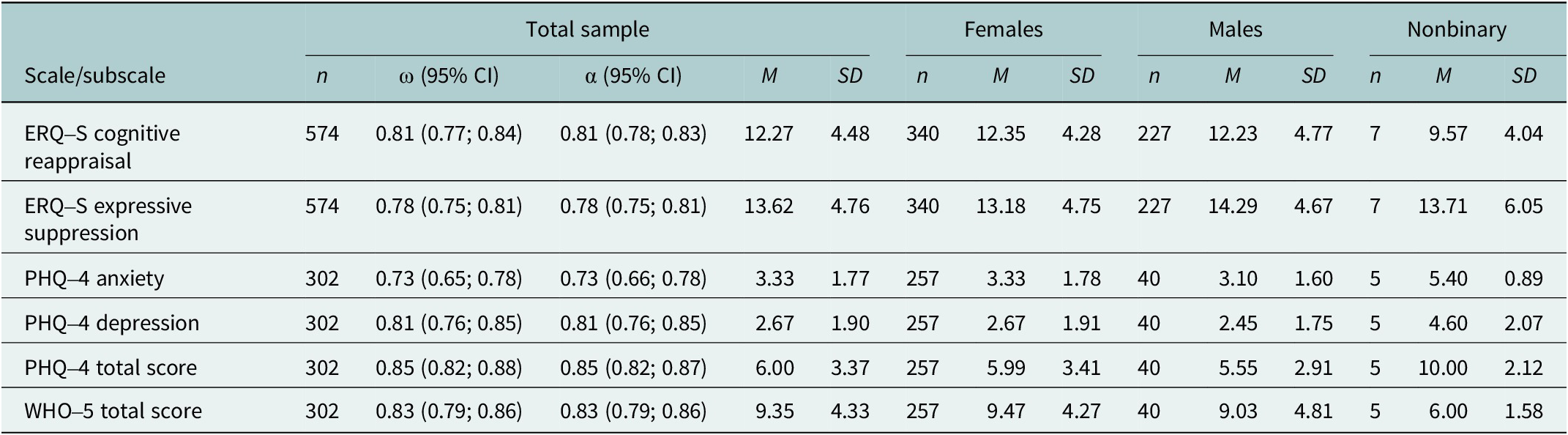
Abbreviations: ERQ-S = Emotion Regulation Questionnaire-Short Form; PHQ-4 = Patient Health Questionnaire-4; WHO-5 = WHO-Five Well-being Index; M = mean; SD = standard deviation, α = Cronbach’s alpha; ω = McDonald’s omega; 95% CI = 95% confidence interval.
Factor structure and measurement invariance
In the total sample (n = 574), the intended 2-factor ERQ-S model was a good fit to the data (Table 3). Supplementary Table 1 displays standardized factor loadings of all ERQ-S items, which loaded well on their intended “cognitive reappraisal” and “expressive suppression” factors (loadings ≥0.683, all ps < 0.001). The estimated correlation between the cognitive reappraisal and expressive suppression factors was −0.139 (p = 0.008).
Goodness-of-fit index values for the 2-factor model in the total sample, and measurement invariance across gender, age and education groups
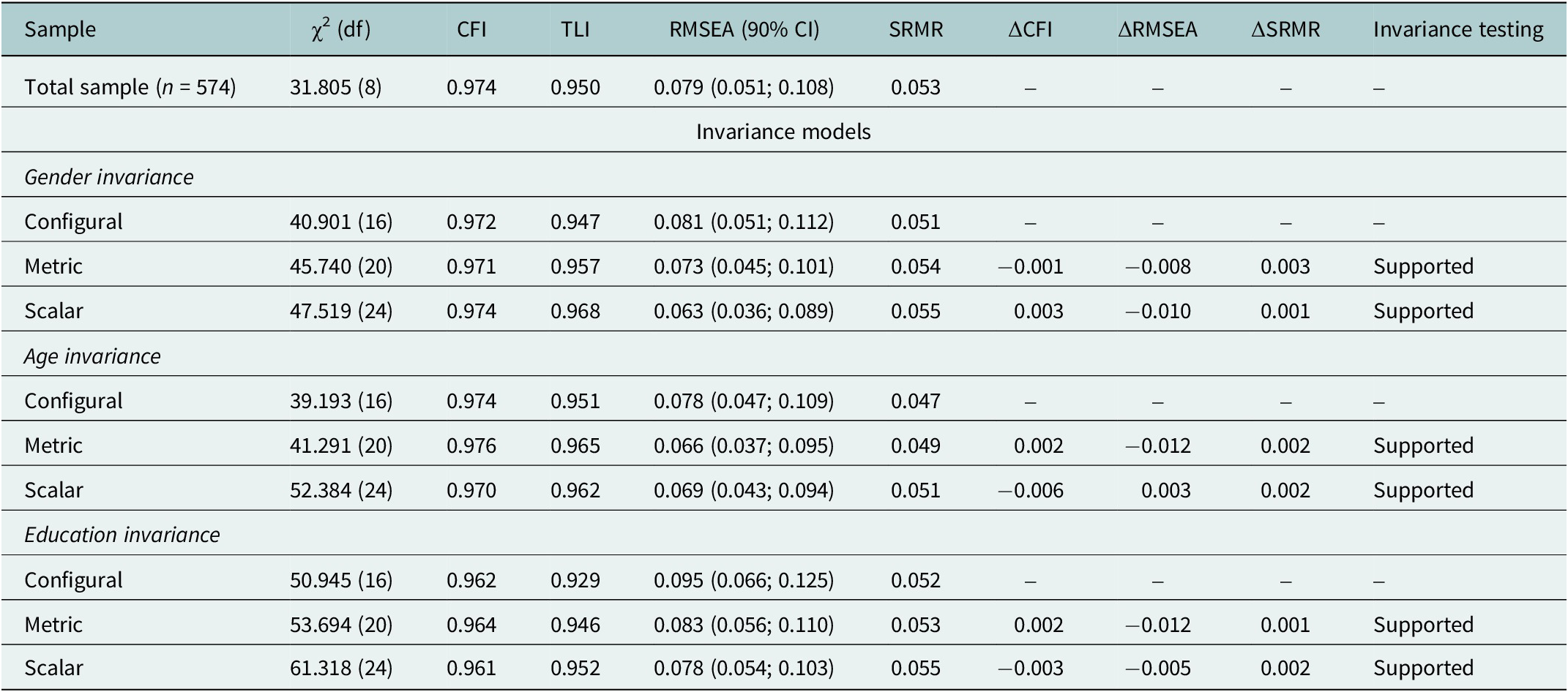
Abbreviations: χ2 = chi-square statistic; df = degrees of freedom; CFI = comparative fit index; TLI = Tucker–Lewis index; RMSEA = root mean square error of approximation; 90% CI = 90% confidence interval; SRMR = standardized root mean square residual.
We tested the configural, metric and scalar invariance of this 2-factor model across gender, age and education categories (Table 3). In all these analyses, the ΔCFI values were less than an absolute value of 0.01, indicating full metric and scalar invariance was supported for the ERQ-S across gender, age and education categories. Similarly, a more conservative measurement invariance analysis of ΔRMSEA and ΔSRMR strongly supported the full metric and scalar invariance across all the tested demographic categories.
Internal consistency reliability
As demonstrated in Table 2, both ERQ-S scale scores had good internal consistency reliability (ω and α ≥ 0.78).
Concurrent validity
Our correlational analyses (Supplementary Table 2) revealed that the ERQ-S cognitive reappraisal score was negatively correlated with psychopathology symptoms (r from −0.23 to −0.31, all ps < 0.001) and positively correlated with well-being (r = 0.37, p < 0.001), whereas the ERQ-S expressive suppression score was positively correlated with psychopathology symptoms (r from 0.24 to 0.26, all ps < 0.001) and negatively with well-being (r = −0.19, p < 0.001).
Predictive role of emotion regulation strategies in mental ill-being and well-being
Our regression analyses indicated that the two emotion regulation strategies, as measured by the ERQ-S, were statistically significant predictors of psychopathology symptoms and well-being (see Table 4). At step 1, gender and age explained from 2.5% to 5% of the variance in psychopathology and well-being, whereas the two ERQ-S subscales explained a significant additional 6.6% to 13.0% of the variance. Across these regressions, cognitive reappraisal was a significant unique predictor of lower psychopathology and higher well-being, whereas expressive suppression was a significant unique predictor of higher psychopathology and lower well-being.
Regression models for predicting mental ill-being and well-being (n = 302)
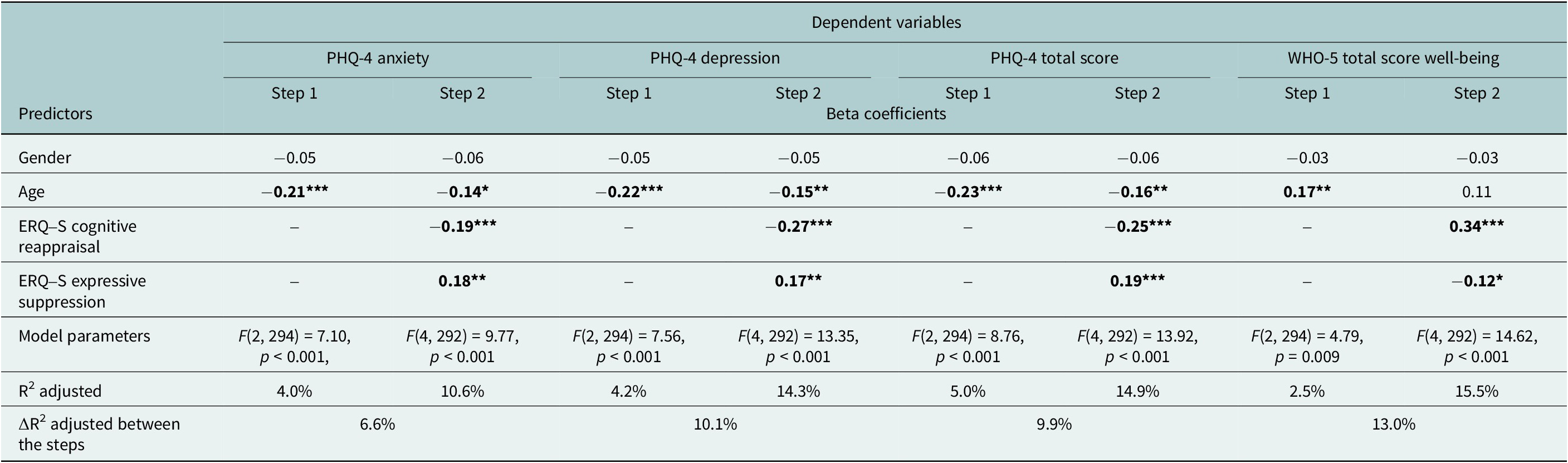
Note: *p < 0.05; **p < 0.01; ***p < 0.001. Gender was coded as following: females = 1; males = 2. Significant predictors are shown in bold.
Abbreviations: ERQ-S = Emotion Regulation Questionnaire-Short Form; PHQ-4 = Patient Health Questionnaire-4; WHO-5 = WHO-Five Well-being Index.
Demographic differences
To explore demographic differences, we computed Pearson correlations between the two ERQ-S scale scores and age in the total sample and two gender groups separately (Supplementary Table 2). In females, age was positively correlated with the cognitive reappraisal subscale (r = 0.13, p < 0.05), whereas age was negatively correlated with the expressive suppression subscale (r = −0.21, p < 0.001). In males, there were no statistically significant correlations between age and the two ERQ-S strategies.
Two sets of ANCOVAs were used to compare ERQ-S scores across two gender (females vs. males) and two education categories (no university degree vs. university degree). Our results revealed no statistically significant gender differences in cognitive reappraisal scores, F(1, 564) = 0.01, p = 0.922. There were statistically significant gender differences in expressive suppression scores, F(1, 564) = 5.90, p = 0.015, η2 = 0.01; males reported using expressive suppression more often than females, though the effect size of this difference was small (η2 = 0.01). Cognitive reappraisal (F(1, 571) = 0.39, p = 0.533) and expressive suppression use (F(1, 571) = 0.29, p = 0.590) did not differ significantly across the education categories.
Group norms
As gender differences were statistically significant only for the expressive suppression subscale with a small effect size, we calculated percentile rank norms for the ERQ-S in the total sample of Polish adults (see Supplementary Table 3). Based on the guide of using test scores of Flanagan and Caltabiano (Reference Flanagan, Caltabiano, Canter, Paige, Roth, Romero and Carroll2004), the percentile rank norms classification with low, average and high levels of characteristics was used. According to this guide, percentile ranks of ≤15 indicate low levels (with a label “low”), percentile ranks from 16 to 84 indicate average levels (with a label “average”) and percentile ranks of ≥85 indicate high levels (with a label “high”) of measured constructs. Our empirically derived percentile ranks were referred to using this percentile rank norms classification.
In our norms, percentile ranks of ≤15 indicate low levels of usage of the two emotion regulation strategies, percentile ranks from 16 to 84 indicate average levels and percentile ranks of ≥85 indicate high levels. For example, if the participant has an ERQ-S cognitive reappraisal score of 11, and this refers to a percentile rank of 36, all that means that this participant tends to use the cognitive reappraisal strategy more often than 36% of people in a reference group. In order to simplify the interpretation of these norms, we present labels “low,” “average” and “high” for percentile ranks for each ERQ-S strategy (Supplementary Table 3).
Discussion
In this study, we introduced the Polish version of the ERQ-S and examined its psychometric properties. Overall, the validity and reliability of this questionnaire were supported, thus supporting that the ERQ-S seems to be a strong option for the brief assessment of key emotion regulation strategies.
Psychometric properties. We found good support for the intended 2-factor structure of the ERQ-S, corresponding to the two targeted emotion regulation strategies (i.e., cognitive reappraisal and expressive suppression). These results are in line with the original validation study of the ERQ-S (Preece et al., Reference Preece, Petrova, Mehta and Gross2023), as well as the large body of previous factor analytic work on the full ERQ (e.g., Balzarotti et al., Reference Balzarotti, John and Gross2010; Cabello et al., Reference Cabello, Salguero, Fernández-Berrocal and Gross2013; Ng et al., Reference Ng, Huebner, Maydeu-Olivares and Hills2019; Preece et al., Reference Preece, Becerra, Robinson and Gross2020, Reference Preece, Becerra, Hasking, McEvoy, Boyes, Sauer-Zavala, Chen and Gross2021; Sörman et al., Reference Sörman, Garke, Isacsson, Jangard, Bjureberg, Hellner, Sinha and Jayaram-Lindström2022). Moreover, we also tested the invariance of the ERQ-S across different gender, age and education categories and found that the ERQ-S was invariant across these different demographic groups. Thus, the ERQ-S appears to perform similarly across (1) females and males, (2) younger and older people as well as (3) people with a university degree and those without a university degree. This means that the ERQ-S can meaningfully assess differences in emotion regulation strategy use across these demographic groups.
Despite the brevity of the two 3-item ERQ-S scales, the Polish version of the ERQ-S showed good internal consistency reliability, reaching thresholds desired for use in both research and clinical settings. The two ERQ-S scale scores also correlated in expected directions with psychopathology symptoms and well-being, explaining significant variance in these clinically relevant outcomes, which is in line with results from the previous ERQ-S study (Preece et al., Reference Preece, Petrova, Mehta and Gross2023) as well as work with the full ERQ (e.g., Balzarotti et al., Reference Balzarotti, John and Gross2010; Cabello et al., Reference Cabello, Salguero, Fernández-Berrocal and Gross2013; Preece et al., Reference Preece, Becerra, Robinson and Gross2020, Reference Preece, Becerra, Hasking, McEvoy, Boyes, Sauer-Zavala, Chen and Gross2021; Sörman et al., Reference Sörman, Garke, Isacsson, Jangard, Bjureberg, Hellner, Sinha and Jayaram-Lindström2022). Cognitive reappraisal, as assessed by the ERQ-S, therefore appears to be a broadly adaptive strategy, whereas expressive suppression appears to be a broadly maladaptive strategy (Hu et al., Reference Hu, Zhang, Wang, Mistry, Ran and Wang2014). In our study, the links between the ERQ-S subscales and the examined correlates (i.e., psychopathology symptoms and well-being) were small to moderate, supporting the results of previous meta-analytic studies where other emotion regulation measures, including the full ERQ, were used (Aldao et al., Reference Aldao, Nolen-Hoeksema and Schweizer2010; Kraiss et al., Reference Kraiss, ten Klooster, Moskowitz and Bohlmeijer2020). Overall, the ERQ-S therefore appears to maintain the good clinical relevance of the full form (Gross and John, Reference Gross and John2003).
Demographic comparisons . Controlling for age, our results revealed no statistically significant gender differences in cognitive reappraisal scores on the ERQ-S, whereas there were statistically significant gender differences in expressive suppression scores (males reported higher scores than females) with the small effect size, which is in line with the past works (e.g., Zhang and Bian, Reference Zhang and Bian2020; Olalde-Mathieu et al., Reference Olalde-Mathieu, Licea-Haquet, Reyes-Aguilar and Barrios2022). Controlling for age, no statistically significant education differences in ERQ-S scores were noted, supporting the conclusions presented in previous reports (Nakagawa et al., Reference Nakagawa, Gondo, Ishioka and Masui2017).
As for age differences in habitual use of the two emotion regulation strategies, past research with the ERQ had shown a mix of findings. For example, positive relationships between age and these two strategies (e.g., Nakagawa et al., Reference Nakagawa, Gondo, Ishioka and Masui2017; García et al., Reference García, Vergara-Barra, Concha-Ponce, Andrades, Rincón and Valdivia-Devia2023) or a negative link with expressive suppression (Olalde-Mathieu et al., Reference Olalde-Mathieu, Licea-Haquet, Reyes-Aguilar and Barrios2022) were indicated in some studies. In others, no significant differences were found between younger and older people in expressive suppression scores, but significantly higher cognitive reappraisal scores in younger people were indicated (Oriyama et al., Reference Oriyama, Mukai, Harada and Masumoto2024). Our previous studies have shown that associations with age and emotional variables can differ across gender categories (Larionow et al., Reference Larionow, Mudło-Głagolska and Michalak2022, Reference Larionow, Preece and Mudło-Głagolska2023a, Reference Larionow, Preece and Mudło-Głagolska2023b; Larionow and Mudło-Głagolska, Reference Larionow and Mudło-Głagolska2022). Therefore, we assessed links between age and ERQ-S scores in the total sample, and in females and males separately.
Our correlational analysis indicated that older females tended to have more favorable emotion regulation (i.e., higher levels of cognitive reappraisal and lower levels of expressive suppression), whereas males tended to have relatively stable levels of emotion regulation strategy use regardless of age. This conclusion is limited, because our study was cross-sectional and not longitudinal. Notwithstanding, these findings are in line with the previous Polish studies on age–gender correlational patterns within psychosomatic variables (e.g., alexithymia, emotional reactivity and somatic complaints), which indicated a shift to a more favorable emotional functioning in females with age (but not in males; e.g., Larionow and Mudło-Głagolska, Reference Larionow and Mudło-Głagolska2022; Larionow et al., Reference Larionow, Mudło-Głagolska and Michalak2022, Reference Larionow, Preece and Mudło-Głagolska2023a, Reference Larionow, Preece and Mudło-Głagolska2023b).
Group norms and their interpretations . To help facilitate interpretation of ERQ-S scores, we calculated percentile rank norms for our total sample of Polish adults. Our data indicate that in a Polish context, a score of ≤7 on the ERQ-S cognitive reappraisal scale is an indicator of “low usage” of this strategy, whereas a score of ≥19 in expressive suppression is an indicator of “high usage” of this strategy. An individual with low cognitive reappraisal scores and/or with high expressive suppression scores is potentially in a high-risk group for mental disorders, with poorer emotion regulation skills (Cutuli, Reference Cutuli2014).
The norms provided here may therefore help to identify people in need of emotion regulation-focused interventions and therefore guide the targeting of psychological interventions. The ERQ-S might be used for assessing emotion regulation strategies before and after treatment, or as part of clinical trials. Being a short measure, the ERQ-S can be also administered in general population studies for screening assessments of emotion regulation. Longitudinal and cross-cultural studies may benefit from the use of the ERQ-S due to its brevity and the cross-cultural applicability of the emotion regulation construct.
Limitations of the study and future directions . This was a study based on self-report measures, which can have several disadvantages, including vulnerabilities to social desirability and response biases (Demetriou et al., Reference Demetriou, Ozer, Essau, Cautin and Lilienfeld2015). Surveys like ours, which are anonymous and where participation does not have reimbursement, can help reduce some of these concerns, though it still remains an important consideration. Based on our cross-sectional study, no conclusions can be drawn regarding the cause-and-effect relationship of emotion regulation strategy use and other study variables. The test–retest reliability of the Polish ERQ-S was not examined in this study.
The psychometric properties of the questionnaire were assessed in a general community sample, without testing in clinical samples, so future work in clinical samples will be important. Therefore, future research will be required to test the generalizability of our findings in different samples and settings. To help reveal possible psychological mechanisms underlying the development of positive and negative mental health outcomes, future studies focused on ERQ-S emotion regulation profiles (i.e., a combination of various emotion regulation strategies), and their relationships with markers of ill-being and well-being, will be useful.
Being a short measure, the ERQ-S can be used in clinical wards or large-scale epidemiological studies where many questionnaires of different constructs may need to be administered, thus requiring each measure to have a minimally optimal item set. There can also be applications in ecological momentary assessment research designs, where questionnaires often need to be administered multiple times a day over several days, thus necessitating short formats (Koval et al., Reference Koval, Kalokerinos, Verduyn and Greiff2020). Use of short measures of emotion regulation, like the ERQ-S, can enable the inclusion of more measures of other constructs while accounting for participant fatigue, hence enabling more complex studies or research designs (Preece et al., Reference Preece, Petrova, Mehta and Gross2023).
Conclusions
The Polish version of the ERQ-S appears to have strong psychometric properties, much like the English form (Preece et al., Reference Preece, Petrova, Mehta and Gross2023) and past work with the full ERQ (Gross and John, Reference Gross and John2003). Its brief format should usefully enable the assessment of key emotion regulation strategies in time-pressured research and clinical settings.
Open peer review
To view the open peer review materials for this article, please visit http://doi.org/10.1017/gmh.2024.97.
Supplementary material
The supplementary material for this article can be found at http://doi.org/10.1017/gmh.2024.97.
Data availability statement
The data that support the findings of this study are available from the corresponding author, P.L., upon reasonable request.
Acknowledgements
The authors would also like to thank the participants of this study for their effort.
Author contribution
P.L. (80%): conceptualization, formal analysis, data curation, investigation, methodology, writing, reviewing and editing, and project administration.
D.A.P. (15%): writing, reviewing and editing.
K.M.G. (5%): data curation and investigation. All authors approved the final article and agreed to the authorship order.
Financial support
This research received no specific grant from any funding agency, commercial or not-for-profit sectors.
Competing interest
The authors declare no competing interests exist.
Ethics statement
The study was conducted in accordance with the Declaration of Helsinki Ethical Principles. The Ethics Committee of the Faculty of Psychology of Kazimierz Wielki University approved the study (No. 1/13.06.2022, later revision 28.11.2023).


 Open access


Comments
Dear Victoria Lane,
We have reworded some parts where possible. The remaining similarities are unavoidable (e.g., decoding of abbreviations in the table notes, statistical terms and usual statistical descriptions and constructions etc.), and rewording them will just make them similar to something else. Standard definitions and psychometric descriptions are always going to show up. Additionally, the significant majority of the similiarities are from our previous psychometric papers on other questionnaires. And this is also because of the same style of writing papers by the same authors (in our case, by us).
As we submit the paper before 31 December 2023, please could you provide an APC waiver (100%) for this paper?
There is also a preprint of this paper published in ResearchGate and Academia.
Best regards,
Paweł Larionow