





Introduction
Harmonia axyridis (Pallas) (Coleoptera: Coccinellidae), commonly called the multicoloured Asian lady beetle, is a generalist predator native to Asia (Essig Reference Essig1965). The multicoloured Asian lady beetle was introduced to North America in 1916 as a biological control agent (Gordon Reference Gordon1985), and it has since become the dominant coccinellid in most habitats in the United States of America and in Ontario, Canada. Its establishment had unintended consequences, as the beetle has become a nuisance in urban environments and a serious pest of wine and juice grapes (Ker and Pickering Reference Ker and Pickering2005).
In autumn, the beetle undertakes long-distance dispersal flights from feeding habitats to overwintering sites (Hodek et al. Reference Hodek, Iperti and Hodkova1993) in response to temperature changes (Nalepa et al. Reference Nalepa, Kennedy and Brownie2005). It enters vineyards in the autumn and feeds on previously damaged grapes (Koch Reference Koch2003), but direct yield loss from their feeding is negligible. Instead, economic loss occurs when the beetles are harvested with grapes and release defensive compounds, which can compromise the quality of wine (Pickering et al. Reference Pickering, Lin and Ker2005). The aroma and taste of wine produced from grapes contaminated with multicoloured Asian lady beetle are characterised by atypical sensory attributes and a reduction in varietal attributes (Pickering et al. Reference Pickering, Lin, Riesen, Reynolds, Brindle and Soleas2004). Sensory thresholds for the beetle in wine vary because they are influenced by many factors, including wine style, differences in wine processing techniques, and individual (i.e., consumer) sensitivities (Pickering et al. Reference Pickering, Lin and Ker2005; Galvan et al. Reference Galvan, Kells and Hutchison2008a). The tolerance for the beetle in harvested bins is up to the discretion of the individual winery. Many wineries around Niagara, Ontario, Canada employ a low-tolerance approach, based primarily on the number of the beetles observed on the surface of harvested bins during their precrush inspection (R. Brewster, personal communication). This is a problem for grape growers, because wineries may reject their grapes if a single lady beetle is found. To address this concern, Pickering et al. (Reference Pickering, Ker and Soleas2007) recommended that the wine industry adopt a “safe” limit of 200–400 multicoloured Asian lady beetles per tonne of grapes (0.75–1.5 beetles per vine) to protect against wine taint.
Although migration of the beetle into vineyards can occur en masse (Glemser et al. Reference Glemser, Dowling, Inglis, Pickering, McFadden-Smith, Sears and Hallett2012), populations in vineyards vary from year to year (Bahlai and Sears Reference Bahlai and Sears2009). The most common method for controlling the beetle is the use of broad-spectrum insecticides before harvest, but these products represent a potential threat to nontarget organisms and to human health. In Canada and the United States of America, current regulations emphasise the replacement of broad-spectrum pesticides with reduced-risk products (United States Government Publishing Office 1996; Health Canada 2002). Many studies have investigated the potential of natural repellent compounds as alternatives for insect pest control (Riddick et al. Reference Riddick, Aldrich, De Milo and Davis2000; Nerio et al. Reference Nerio, Olivero-Verbel and Stashenko2010). Repellent compounds are those that elicit avoidance behaviour in an organism (Dethier et al. Reference Dethier, Browne and Smith1960). Essential oils have been used as insect repellents because they are generally nontoxic to mammals (Cook et al. Reference Cook, Khan and Pickett2007), and many natural compounds generally are comparatively less persistent under field conditions (Ujváry Reference Ujváry2010).
Repellent compounds may be an effective management method for this species because of their natural dispersal. Adult multicoloured Asian lady beetles are good at flying, and they can rapidly disperse from field and greenhouse crops, especially in the absence of food (Hodek et al. Reference Hodek, Iperti and Hodkova1993; Tourniaire et al. Reference Tourniaire, Ferran, Gambier, Giuge and Bouffault1999; Seko et al. Reference Seko, Yamashita and Miura2008). Feeding on grapes alleviates the beetles’ nutritional stress as they prepare for overwintering (Berkvens et al. Reference Berkvens, Bonte, Berkvens, Deforce, Tirry and De Clercq2008; Galvan et al. Reference Galvan, Koch and Hutchison2008b), and for this reason, they likely remain in vineyards; however, if the beetles encounter a repellent compound in vineyards, we believe they could be driven to disperse.
In this study, we performed laboratory and field trials to test compounds for repellency of the multicoloured Asian lady beetle. The compounds we tested are either already registered for use on grapes for another purpose or they are known repellents of other insects (Isman Reference Isman2000). Additionally, many of the products would likely be considered reduced-risk pesticides (United States Government Publishing Office 1996; Health Canada 2002). This research was done to improve the management of multicoloured Asian lady beetle in vineyards by providing growers with an alternative to broad-spectrum insecticides.
Material and methods
Laboratory trials
Test compounds
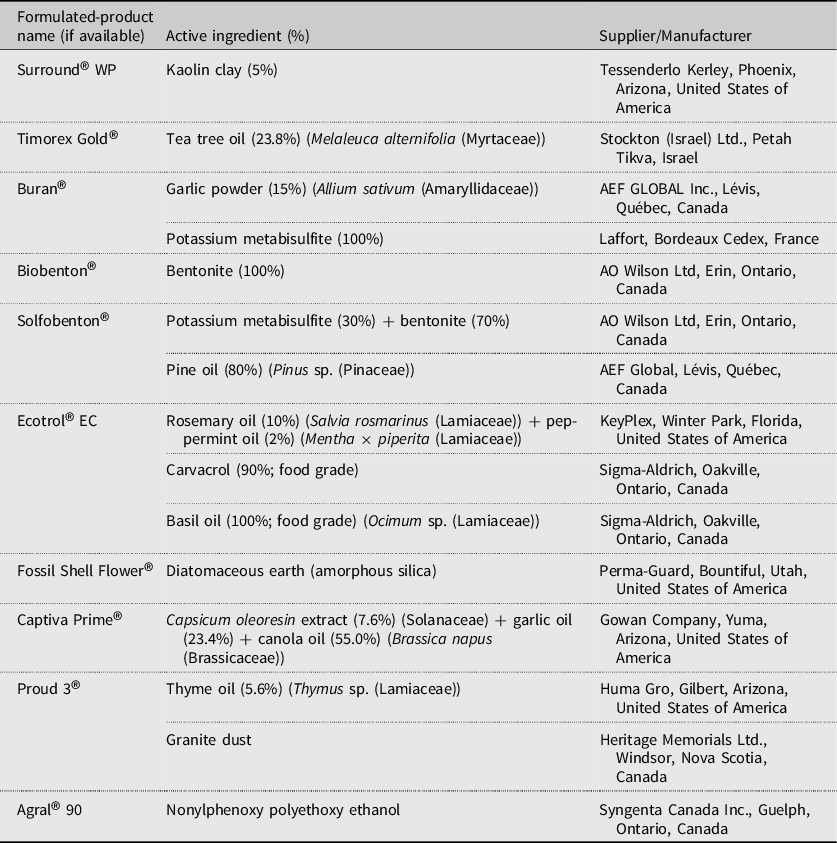
Fifteen compounds with potential repellent activity were tested in laboratory trials (Table 1). Products are referenced by their formulated name when available; otherwise, they are referenced by the active ingredient(s) (Table 1). Products were initially tested for short-term residual repellency, approximately 0 hours after application. Products that showed a repellency of at least 50% were further evaluated for residual repellency at 24, 48, and 72 hours after application. Labelled products were tested at the highest label rate (Table 2). Rates of unlabelled products were determined based on reports in the literature (Bekele et al. Reference Bekele, Obeng-ofori and Hassanali1996; Bin et al. Reference Bin, Ahmad, Aslam and Mamat2016; Maier and Williamson Reference Maier and Williamson2016; Park et al. Reference Park, Jeon, Lee, Chung and Lee2017; Werle et al. Reference Werle, Addesso, Sampson, Oliver and Adamczyk2017; Bendre et al. Reference Bendre, Bagul and Rajput2018) and through preliminary laboratory trials (unreported; Table 2). Timorex Gold, potassium metabisulfite, and Fossil Shell Flower were tested at multiple rates in short-term trials to help determine potential use as a commercial repellent. The insecticide Mako (Belchim Crop Protection, Guelph, Ontario, Canada), which uses the active ingredient cypermethrin, was included as a positive control because it is registered for use on multicoloured Asian lady beetles in Ontario vineyards. Control grapes were treated with water.
Products evaluated for their effect on multicoloured Asian lady beetles in short-term laboratory trials.
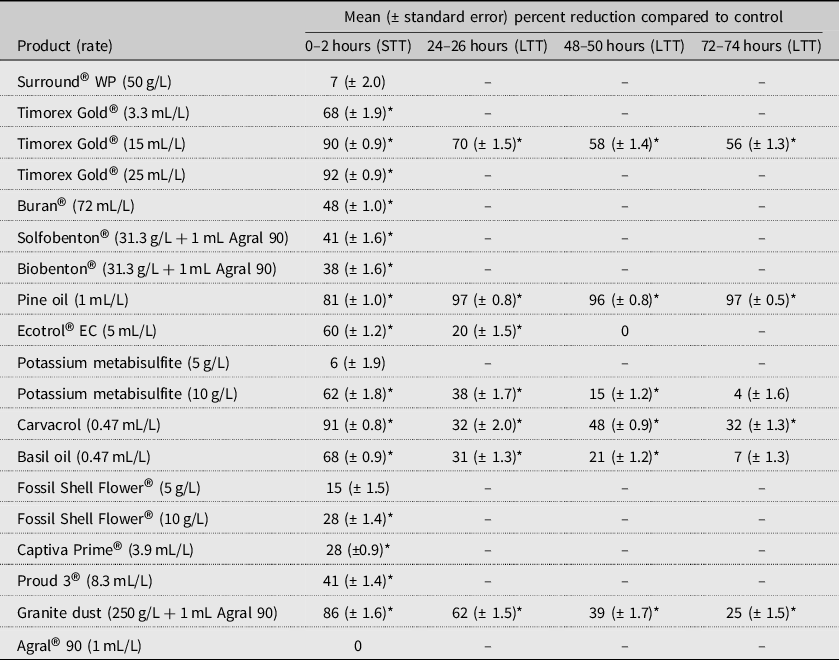
Mean (± standard error) per cent reduction in the number of multicoloured Asian lady beetles on grape clusters treated with repellent compounds compared to clusters treated with water only. In short-term trials (STT), beetles were exposed to grapes after treatment (0–2 hours postapplication). In long-term trials (LTT), beetles were exposed to grapes 1 day (24–26 hours postapplication), 2 days (48–50 hours postapplication), or 3 days (72–74 hours postapplication) after treatment application. Treatments that were significantly different from the control are indicated by an asterisk (*) (α = 0.05). When more than one rate was tested per product, rates are specified; otherwise, see Table 1 for the rates tested.
Experimental design
Laboratory trials were conducted from 2017 to 2019. Multicoloured Asian lady beetles were collected from southern Ontario from August to October in each testing year, such that a permanent rearing colony was not established. A voucher specimen was deposited at the University of Guelph Insect Collection, accession number debu01089389. Studies have shown that the behavioural response of the ladybeetle Stethorus punctum picipes (Casey) (Coleoptera: Coccinellidae) to plant volatiles is affected by seasonal changes (James and Price Reference James and Price2004; James Reference James2005). For this reason, multicoloured Asian lady beetles were maintained in mesh cages outdoors so that their physiological state and behavioural response to test compounds would be the same as their counterparts in vineyards. The lab-maintained beetles were fed a mixture of aphids. Twenty-four hours before the start of an experiment, arbitrarily selected adult beetles were removed from the mesh cages and placed in holding containers, without food, in groups of 15.
Short-term repellency trial
The repellency of each compound was evaluated using a two-choice experiment with treated and untreated grapes (variety: Cabernet franc), similar to methods previously used to evaluate multicoloured Asian lady beetle and repellents (Riddick et al. Reference Riddick, Aldrich, De Milo and Davis2000, Reference Riddick, Brown and Chauhan2008). Grapes were collected from a commercial vineyard in Niagara, Ontario and washed with soap and water to remove potential pesticides. Grapes from the same cluster, with berries left on the rachis, were used in each experimental container (36 cm L × 24 cm W × 8 cm H; Ziplock®, SC Johnson & Son, Inc., Racine, Wisconsin, United States of America). Treatment and control clusters were of similar ripeness (based on colour) and size (based on number of berries). Because multicoloured Asian lady beetles are unable to feed on intact grapes, the grapes were damaged by cutting 5–8 mm incisions in the skins using scissors. Each cluster was dipped into the corresponding treatment solution, dried on a rack for five minutes, and then placed in experimental containers, as described above. Each container received a control cluster and a treated cluster placed at opposite ends of the container and separated by approximately 15 cm. A ventilated lid was placed on each container to prevent the accumulation of volatile compounds. A group of 15 multicoloured Asian lady beetles was released in each experimental container, at which point the observation period started. The number of beetles on each cluster was counted at 5, 10, 20, 30, 40, 50, 60, 90, and 120 minutes. Beetles were considered to be on the grapes if any part of their body was touching a grape or rachis. Each treatment was replicated 9–10 times.
Long-term repellency trial
Products that showed a repellency of at least 50% in short-term repellency trials were further evaluated for repellency at 24, 48, and 72 hours after application. The methods used were similar to the short-term trials, but store-bought table grapes were used instead of commercial vineyard grapes. Dried, product-treated grapes were placed in experimental containers for 72 hours. Multicoloured Asian lady beetles were added to experimental containers 24 hours after treatment application, and the number of beetles on each cluster was recorded at 10, 20, 30, 40, 50, 60, 70, 80, 90, 100, and 110 minutes. After this observation period, the beetles were removed from the experimental containers and returned to the holding containers. This process was repeated at 48 and 72 hours after treatment application using new beetles. Each treatment was replicated 10 times.
Field trials
Test compounds
The following treatments were evaluated: Biobenton® (31.3 g/L), Solfobenton® (31.3 g/L), pine oil (1 mL/L), Ecotrol® EC (5 mL/L), Buran® (72 mL/L), Timorex Gold® (3.3 mL/L), potassium metabisulfite (10 g/L), Agral® 90 (1 mL/L), Mako® (0.25 mL/L and 600 L/ha; Belchim Crop Protection Canada Inc. 2019), and a water control (see Table 1 for a complete list of products tested, active ingredients, and manufacturers or suppliers). Full-canopy treatments were applied at 800 L/ha (excluding Mako) using a calibrated CO2 backpack sprayer at 40 psi.
Experimental design
Field trials were conducted in two commercial vineyards with high multicoloured Asian lady beetle populations in 2017: a Riesling block in the Beamsville Bench designated viticultural area (Beamsville, Ontario, Canada) and a Pinot noir block in the Creek Shores designated viticultural area (St. Catharines, Ontario, Canada; see http://www.vqaontario.ca/Appellations [accessed 8 November 2020]). Row and vine spacing were 2.4 m × 1 m in the Riesling block and 2.3 m × 1.2 m in the Pinot noir block. Each plot consisted of a panel of five vines. Treatments were replicated five times in a randomised complete block design.
Treatments were applied in the morning once the canopy had dried. The Riesling and Pinot noir blocks were sprayed on 24 and 26 October 2017, respectively. Treatment panels were at least one panel away from the edge of the row to avoid potential edge effects. Additionally, treatment panels were always separated by an untreated panel within the same row.
The number of multicoloured Asian lady beetles on vines (fruiting zone and canopy) was counted at 2–6 hours (Day 0) and 24–28 hours (Day 1) after spraying. Counts were performed on five vines per panel. Counting was done by two technicians examining the same vine, one on either side of the row. This counting technique increased accuracy by limiting the potential for double counting or overlooking beetles. Vines were examined carefully to avoid disturbing the beetles.
Temperature, humidity, and precipitation in the block were recorded every hour using an ONSET HOBO remote monitoring system (Hoskins Scientific, Burlington, Ontario, Canada). The daily mean wind speed (km/h) at 10 m off the ground was obtained from Weather Innovations Consulting LP (Riesling: Beamsville station; Pinot noir: St. Catharines Third Avenue station, https://www.weatherinnovations.com [accessed 13 December 2017]; Chatham, Ontario, Canada). It was our intention to continue to evaluate these products in further field trials, but this did not occur due to low beetle populations in 2018 and 2019.
Statistical analyses
Laboratory trials
Statistical analyses were performed using SAS 9.4 (SAS Institute, Cary, North Carolina, United States of America) using a type I error rate (α) of 0.05. The numbers of multicoloured Asian lady beetles on control and treated clusters were expressed as a proportion of the total number in each container. Data were subjected to an analysis of variance using SAS’s PROC GLIMMIX, with time intervals as a repeated measure. Analysis of residuals was performed to test the validity of model assumptions. Treatment means were separated using Tukey’s multiple comparisons test.
Field trials
The number of multicoloured Asian lady beetles per panel was subjected to an analysis of variance using PROC GLIMMIX. Analyses were performed on both locations and days, with the latter as a repeated measure. The fixed effects of treatment, location, day, and their interactions were examined. Blocks were designated a random effect nested within location. Least-square means were used to determine treatment effects for individual days and overall. Ecotrol EC and Solfobenton were replicated four times in the Riesling and Pinot noir trials, respectively, due to problems that occurred during spraying. These replicates were considered missing-response values during analysis. No significant interactions involved the effect of treatment with either location or day; therefore, the effect of treatments was compared directly. Analysis of residuals was performed to test the validity of model assumptions.
Results
Laboratory trials
Results from the laboratory trials are shown in Table 2. In the short-term trials, multicoloured Asian lady beetles were significantly repelled by Timorex Gold at each rate (3.3 mL/L: F 1,8 = 48.5, P < 0.001; 15 mL/L: F 1,9 = 303.7, P < 0.001; 25 mL/L: F 1,8 = 55.0, P < 0.001), Buran (F 1,8 = 16.0, P < 0.001), Solfobenton (F 1,9 = 74.7, P < 0.001), Biobenton (F 1,8 = 20.1, P = 0.002), pine oil (F 1,8 = 75.5, P < 0.001), Ecotrol EC (F 1,8 = 20.5, P = 0.002), potassium metabisulfite 10 g/L (F 1,9 = 50.4, P < 0.001), carvacrol (F 1,9 = 108.4, P < 0.001), basil oil (F 1,9 = 96.1, P < 0.001), Fossil Shell Flower 10 g/L (F 1,9 = 10.7, P = 0.010), Captiva Prime (F 1,9 = 7.6, P = 0.022), Proud 3 (F 1,9 = 35.9, P < 0.001), and granite dust (F 1,9 = 199.4, P < 0.001), whereas no repellent effects occurred with Surround WP (F 1,8 = 0.52, P = 0.493), potassium metabisulfite 5 g/L (F 1,9 = 0.24, P = 0.636), Fossil Shell Flower 5 g/L (F 1,9 = 2.4, P = 0.156), and Agral 90 (F 1,8 = 1.6, P = 0.236).
In long-term trials, multicoloured Asian lady beetles were significantly repelled at every time point using Timorex Gold 15 mL/L (24 hours: F 1,9 = 173.8, P < 0.001; 48 hours: F 1,9 = 266.5, P < 0.001; 72 hours: F 1,9 = 175.2, P < 0.001), pine oil (24 hours: F 1,9 = 93.4, P < 0.001; 48 hours: F 1,9 = 133.0, P < 0.001; 72 hours: F 1,9 = 151.8, P < 0.001), carvacrol (24 hours: F 1,9 = 32.9, P < 0.001; 48 hours: F 1, 9 = 103.0, P < 0.001; 72 hours: F 1,9 = 34.0, P < 0.001), and granite dust (24 hours: F 1,9 = 185.8, P < 0.001; 48 hours: F 1,9 = 97.5, P < 0.001; 72 hours: F 1,9 = 28.0, P < 0.001). Potassium metabisulfite 10 g/L was repellent at 24 hours (F 1,9 = 55.5, P < 0.001) and 48 hours (F 1,9 = 9.2, P < 0.0141) but not at 72 hours (F 1,9 = 0.6, P = 0.479). Similarly, basil oil was repellent at 24 hours (F 1,9 = 77.9, P < 0.001) and 48 hours (F 1,9 = 25.3, P < 0.001) but not at 72 hours (F 1,9 = 1.9, P = 0.197). Ecotrol EC was repellent at 24 hours (F 1,9 = 10.5, P = 0.010) but not at 48 hours (F 1,9 = 0.2, P = 0.664), so 72 hours was not tested. Residual analysis showed that model assumptions were met.
Field trials
The number of beetles found on panels was significantly influenced by treatment (F 10,174 = 3.4, P < 0.001) and day (F 1,174 = 6.3, P = 0.013), but location was not significant (F 1,8 = 0.9, P = 0.364). Interactions involving treatment were not significant (location × treatment: F 10,174 = 0.8, P = 0.588; day × treatment: F 10,174 = 0.4, P = 0.927); however, the location × day interaction was significant (F 1,174 = 33.3, P < 0.001).
Panels treated with Mako had significantly fewer beetles on Day 0 (Table 3) compared to the control. Panels treated with Biobenton, Solfobenton, and Mako had significantly fewer beetles on Day 1 (Table 3) compared to the control. When counting periods were combined and analysed, panels treated with Biobenton, Buran, and Mako had significantly fewer beetles compared to the control (Table 3).
Mean (± standard error) number of multicoloured Asian lady beetles (MALB) present on grape vines after application of potentially repellent compounds. Treatment effect relative to the control is displayed as per cent difference. Trials were conducted in a Riesling and a Pinot noir block in 2017. Counts were conducted 2–6 hours (Day 0) and 24–28 hours (Day 1) after spraying. Treatments that were significantly different from the control are indicated by an asterisk (*) (α = 0.05).
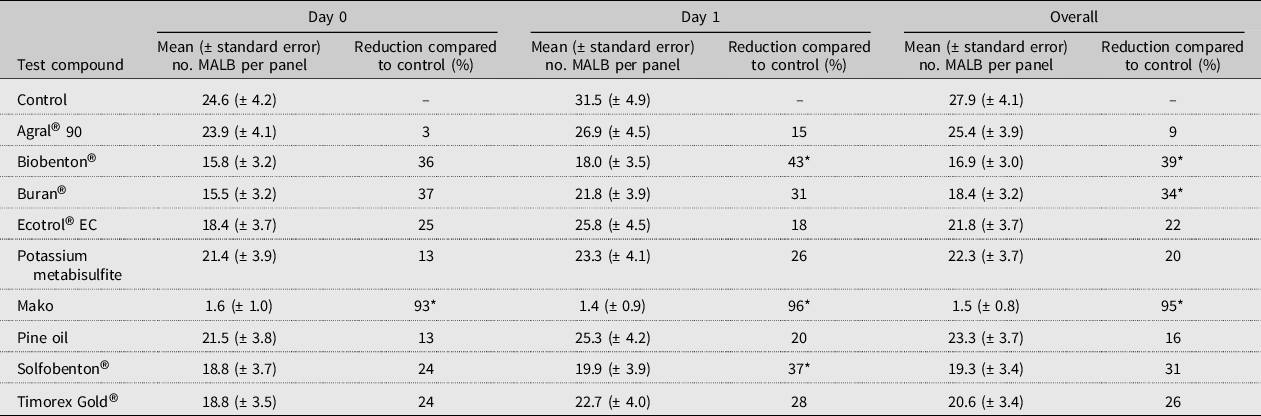
The relative reduction of numbers of beetles was more often higher on Day 1 compared to Day 0 (Table 3). Likewise, no treatments were significantly repellent on Day 0 (excluding Mako), whereas Biobenton and Solfobenton were both repellent on Day 1. Residual analysis showed that model assumptions were met.
Discussion and conclusion
The majority of products (13 of 15) tested in short-term repellency trials reduced the number of multicoloured Asian lady beetles on grapes. Some of the products evaluated in our study are known repellents, but of these products, only potassium metabisulfite had previously been tested on this species (Glemser et al. Reference Glemser, Dowling, Inglis, Pickering, McFadden-Smith, Sears and Hallett2012). Carvacrol, Timorex Gold (highest rates), pine oil, and granite dust were highly effective and reduced the number of the beetles on grapes by more than 80%. The same granite dust was repellent to cabbage looper (Trichoplusia ni) (Lepidoptera: Noctuidae), diamondback moth (Plutella xylostella) (Lepidoptera: Plutellidae), and two-spotted spider mite (Tetranychus urticae Koch) (Trombidiformes: Tetranychidae) (Faraone et al. Reference Faraone, MacPherson and Hillier2018, Reference Faraone, Evans, LeBlanc and Hillier2020). In our study, granite dust was more repellent than Fossil Shell Flower was. We find this interesting because the use of diatomaceous earth for pest management is well documented (Subramanyam and Roesli Reference Subramanyam and Roesli2000): for example, Nwaubani et al. (Reference Nwaubani, Opit, Otitodun and Adesida2014) found that Sitophilus oryzae (Coleoptera: Curculionidae) and Rhyzopertha dominica (Coleoptera: Bostrichidae) avoided wheat (Poales) treated with diatomaceous earth.
In long-term repellency laboratory trials, pine oil was the most repellent compound, and it remained consistently repellent over the 72-hour test period. Interestingly, it appears to be more repellent when used in long-term experiments than it does when used in short-term experiments. We see no clear explanation for this difference. Five products – Timorex Gold, potassium metabisulfite, basil oil, granite dust, and Ecotrol EC – decreased in repellency from 24 to 72 hours. Products may lose repellency over time due to degradation, volatilisation, or sorption. For example, Riddick et al. (Reference Riddick, Brown and Chauhan2008) found that the repellent effect of terpenoids derived from catnip oil (Lamiales) and grapefruit seed (Sapindales) on multicoloured Asian lady beetle decreased significantly 24 hours after application. Tea tree oil, when applied to livestock, is repellent to adult horn flies, Haematobia irritans (Linnaeus) (Diptera: Muscidae), for up to 24 hours after application, but by 48 hours, no repellency remains (Klauck et al. Reference Klauck, Pazinato, Stefani, Santos, Vaucher and Baldissera2014). Because these products decrease in repellency over time, their potential impact on wine might be reduced.
In contrast to laboratory trials, few products were significantly repellent in our field trials (Table 3). In field trials, the reduction in multicoloured Asian lady beetle numbers was statistically significant in plots treated with Biobenton, Buran, and Solfobenton. When conducting behavioural assays, effects observed in the laboratory are not necessarily observed in the field (Wallingford et al. Reference Wallingford, Cha, Linn, Wolfin and Loeb2017). For example, multicoloured Asian lady beetles are highly attracted to β-caryophyllene in controlled laboratory experiments (Brown et al. Reference Brown, Riddick, Aldrich and Holmes2006; Verheggen et al. Reference Verheggen, Fagel, Heuskin, Lognay, Francis and Haubruge2007) but not under field conditions (Nalepa et al. Reference Nalepa, Kidd and Hopkins2000). The future use of these products to mitigate multicoloured Asian lady beetle in vineyards is possible, because some are already registered for use on grapes to control other pests in Canada. Although Biobenton and Solfobenton were both repellent in short-term laboratory trials, they were not repellent until Day 1 in our field trials. The slower response time of the beetles to these compounds in the field may have been due to environmental conditions, because cooler temperatures and mild winds are not ideal for multicoloured Asian lady beetle flight (Nalepa et al. Reference Nalepa, Kennedy and Brownie2005). Therefore, adults may have taken comparatively longer to move away from Biobenton and Solfobenton in the field.
The beetles were repelled by potassium metabisulfite at 10 g/L in our laboratory trials, but the same rate was not repellent in the field. In contrast, Glemser et al. (Reference Glemser, Dowling, Inglis, Pickering, McFadden-Smith, Sears and Hallett2012) found that the 5 g potassium metabisulfite/L treatment was significantly repellent to the beetles in the field. In our study, the mean wind speed was higher (data not shown) than that during the experiments conducted by Glemser et al. (Reference Glemser, Dowling, Inglis, Pickering, McFadden-Smith, Sears and Hallett2012). It is possible that the stronger wind may have increased the dissipation rate of repellent sulfur dioxide from treated vines, relatively reducing the effectiveness of potassium metabisulfite in our study.
Mako is currently used in Ontario to control multicoloured Asian lady beetle before harvest. Mako-treated panels in our study had a mean of 1.5 beetles each. Interestingly, the majority of those beetles at both sites were dead and stuck within the cluster between grapes. Such dead beetles are a potential source of wine contamination that may have previously been unrecognised. Our observation is particularly noteworthy because dead multicoloured Asian lady beetles can adversely affect wine quality for three to six days after death (Pickering et al. Reference Pickering, Spink, Kotseridis, Brindle, Sears and Inglis2008).
The most effective repellent in our field trails was Biobenton, which reduced the beetle’s numbers by 39%. Based on these results, if a winery accepted a “safe” level of 1.5 beetles per vine, Biobenton would be suitable for use if the initial beetle population did not exceed 2.4 beetles per vine. This represents a relatively low multicoloured Asian lady beetle population in Niagara vineyards, given that the mean number of beetles found per vine was 4.9 (24.6/panel; Table 3) in our study, and Glemser et al. (Reference Glemser, Dowling, Inglis, Pickering, McFadden-Smith, Sears and Hallett2012) reported 18 beetles per vine. This suggests that the use of repellents to mitigate wine taint becomes increasingly difficult with larger beetle populations. Similarly, Rodriguez-Saona and Stelinski (Reference Rodriguez-Saona and Stelinski2009) reported that behaviour-modifying controls are most effective when pest populations are small.
There was a significant interaction between location and day, which indicates that the response of multicoloured Asian lady beetles differed in locations across days. Differences in the environment during our trials may explain this effect. The Riesling trial received 4.6 mm of precipitation between counting periods (i.e., after the two to six hour period), whereas the Pinot noir trial did not receive any precipitation (data not shown). It is likely that treatments were washed off in the Riesling trial, reducing their effectiveness before the second counting period. Re-application of treatments was not possible due to space limitations in the vineyard and the growers’ need to harvest grapes.
Although most of the compounds tested were not significantly repellent in field trials, all provided some repellency compared to the untreated-grape controls. Therefore, some of these products may be used along with other control tactics to improve the integrated pest management of multicoloured Asian lady beetle in vineyards. To improve the effectiveness of these compounds, future studies should both test higher rates and test use of multiple compounds simultaneously. We believe that environmental factors, such as wind and temperature, influence how the beetles respond to repellent compounds, and we recommend that future studies examine these interactions.
Acknowledgements
The authors thank Sheena Morrison, Laura Finlay, Irina Perez, Dominic Pieroni, and Aleyna Burns for their technical support in the laboratory and field and also grower cooperators for providing vines for field trials. Funding for this project was kindly provided by Ontario Grape & Wine Research Incorporated, the Canadian Agricultural Partnership, and the Canadian Grapevine Certification Network.


 Open access

