


Dear Editor,
The mounting challenges facing paediatric ear and hearing services in the UK
Paediatric healthcare in the UK is in a concerning state. According to a Nuffield Trust report, as of March 2023, there were over 400,000 children waiting for planned paediatric hospital care in England, a significant increase of over 158,000 children since April 2012. This increase is all the more alarming given the significant reduction in paediatric research and funding.1 There has been a global decline in the publication of paediatric clinical trials, with the trend particularly evident in Europe. In the UK, this decline has been observed over the past two decades. Only 5 per cent of the UK's annual public and charitable research expenditure of approximately £2.2 billion is allocated to paediatric research, which is equivalent to less than £10 per child per year.2 Since the outbreak of the coronavirus disease 2019 (Covid-19) pandemic, research output related to paediatric ENT diseases has declined by over 50 per cent.Reference Grantham-Hill, Eyre, Ramanan, Modi, De Wildt and Lim3
Paediatric ear and hearing health services in the UK face significant challenges due to chronic and worsening staff shortages.4 This has resulted in a gap between the need for paediatric ENT services and the available resources, leading to longer waiting times for diagnosis and specialist appointments for children. Delay in treatment is especially harmful to children, for whom early intervention is crucial in managing ear and hearing issues effectively. This situation is particularly challenging in urban areas where the Covid-19 pandemic has created a backlog in addition to other service pressures, making access to specialist care even more difficult.Reference Macdonald, Clements, Sobti, Rossiter, Unnithan and Bosanquet5
It is against this backdrop that teleotology has emerged as a promising solution, offering a digital-first approach to paediatric ear and hearing care. It is important to note that, while teleotology and teleaudiology are related, they focus on different aspects of care: teleaudiology is primarily concerned with hearing health, whereas teleotology focuses on ear health, the focus of this article.
Teleotology aligns with The NHS Long Term Plan's aims to reduce face-to-face appointments by 30 per cent through telemedicine.6 Teleotology also aligns with recommendations made in the ENT Getting It Right First Time (GIRFT) report which recommends maximising audiology services to manage chronic ear disease and provide post-operative care.Reference Marshall7 The report also suggests making optimal use of clinical outpatient resources to reduce unnecessary consultant-led follow-ups. By providing clinicians with more information with which to make decisions, employing a teleotology approach can greatly enhance the triage process, ensuring those most in need are prioritised.
This article argues for research into the application of teleotology in paediatric ear and hearing care in NHS settings. Adopting a teleotology approach could improve the quality and accessibility of paediatric ear and hearing care, thereby enabling timely and effective treatment for children and young people.
Embracing the digital shift
Although teleotology is increasingly used worldwide, only two studies have evaluated its effectiveness for NHS patients, both of which involved only adult participants.Reference Cottrell, George, Coulson and Chambers8,Reference Forde, Dimitrov, Doal, Patel, Clare and Burslem9 The studies demonstrated that a teleotology approach is a cost-effective and efficient approach to community-led ear and hearing care. A teleotology approach may be beneficial in several areas of the ear and hearing pathway, provided that appropriate patient selection is made and a clearly defined remit is in place [Table 1]. The authors believe that this model of care should also be explored for children and young people in NHS settings.
Roles and tasks that might benefit from teleotology
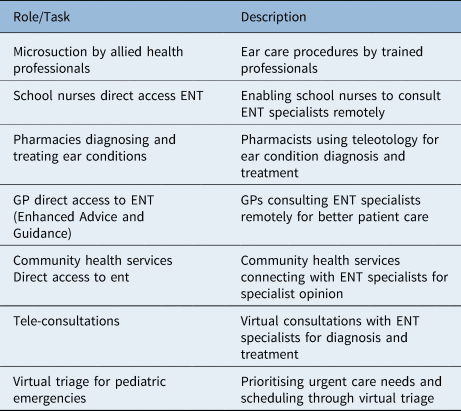
The recent expansion of non-medically trained Primary Care Network (PCN) multidisciplinary roles in general practice under the Additional Roles Reimbursement Scheme (ARRS) has significantly increased the pool of referring professionals to secondary and tertiary ear and hearing care services. A pertinent example involves “Pharmacy First”, an NHS England directive enabling pharmacies in England to provide treatment for seven common health conditions without the need for patients to visit their GP.10 Amongst these common conditions is earache. Earache can be caused by a variety of conditions but is most commonly caused by otitis media. It can be difficult to distinguish between acute otitis media, which requires treatment with antibiotics, and otitis media with effusion, which is usually treated without medication. Despite its very common occurrence, even experienced healthcare professionals such as General Practitioners and Paediatricians, can have difficulty distinguishing between the two conditions.Reference Pichichero and Poole11 This can lead to mismanagement such as inappropriate prescription of antibiotics, which can contribute to antibiotic resistance.Reference Cullas Ilarslan, Gunay, Topcu and Ciftci12 As more care is provided in non-traditional settings, such as pharmacies, ensuring that there are clear pathways to access an ENT specialist opinion is critical to ensure the best clinical care is provided and patient safety is maintained. Adopting a teleotology approach would facilitate this and help to optimise patient care pathways.
Comparison to adult services
Paediatric ear and hearing services differ significantly from adult services in several key aspects. Firstly, the specialist nature of paediatric care makes it less accessible due to the scarcity of specialised resources. For example, conducting an age-appropriate hearing assessment for children can require more than one audiologist. This can limit the number of paediatric patients that can be seen in a clinic compared to an adult clinic where typically only one audiologist is needed per patient. In addition, paediatric services often need to work together with community organisations such as schools, and maintain proactive communication with parents and caregivers, which is not typically a factor in adult care. Moreover, the focus and goals of care in paediatric and adult services are distinct. In paediatric care, the primary emphasis is on screening and early intervention to identify and address issues as early as possible, in contrast to adult ear and hearing services, where the focus is often on diagnosing and treating existing conditions.
Rethinking paediatric ear care
Teleotology provides a unique opportunity to address the specific challenges and considerations involved in providing ear and hearing care for children and young people. Originally designed to address the disparity in access to specialist ear and hearing care for children residing in rural areas, teleotology has become increasingly useful for children residing in urban areas, who face unique challenges due to dense populations, diverse socio-economic conditions and varying access to healthcare.Reference Eikelboom, Mbao, Coates, Atlas and Gallop13 Children in urban areas are often exposed to higher levels of air pollution, which has been linked to increased incidence of otitis media with effusion.Reference Tsitiridis, Skoulakis and Hajiioannou14,Reference Chadha, Gulati, Garg and Agarwal15 A major advantage of teleotology over the current standard care pathway is that it enables early identification of patients who require more specialised care, allowing a significant proportion of cases to be managed in primary care. This approach not only streamlines patient care, but also optimises resource allocation in secondary care, ensuring timely and appropriate treatment for those most in need.
Despite the undoubted success of the universal new-born hearing screening (UNHS) programme, there still are approximately 45,000 children with a disabling hearing impairment living in the UK.16 It is possible for children with mild hearing loss to pass the UNHS, and some may develop late-onset or progressive hearing loss (PHL). The School Entry Hearing Screening (SES) is a crucial public health intervention used to identify children with late-onset or PHL. Unfortunately, the system is not standardised, partly due to limitations in resources and concerns about the cost-effectiveness of the approach.Reference Bamford, Fortnum, Bristow, Smith, Vamvakas and Davies17,Reference Fortnum, Ukoumunne, Hyde, Taylor, Ozolins and Errington18 However, the authors suggest that a teleotology/teleaudiology approach is perfectly suited for this task, with the potential to decrease costs and improve access to hearing services at the community level, thereby maintaining a crucial service.Reference Yousuf Hussein, Swanepoel, Mahomed and Biagio de Jager19
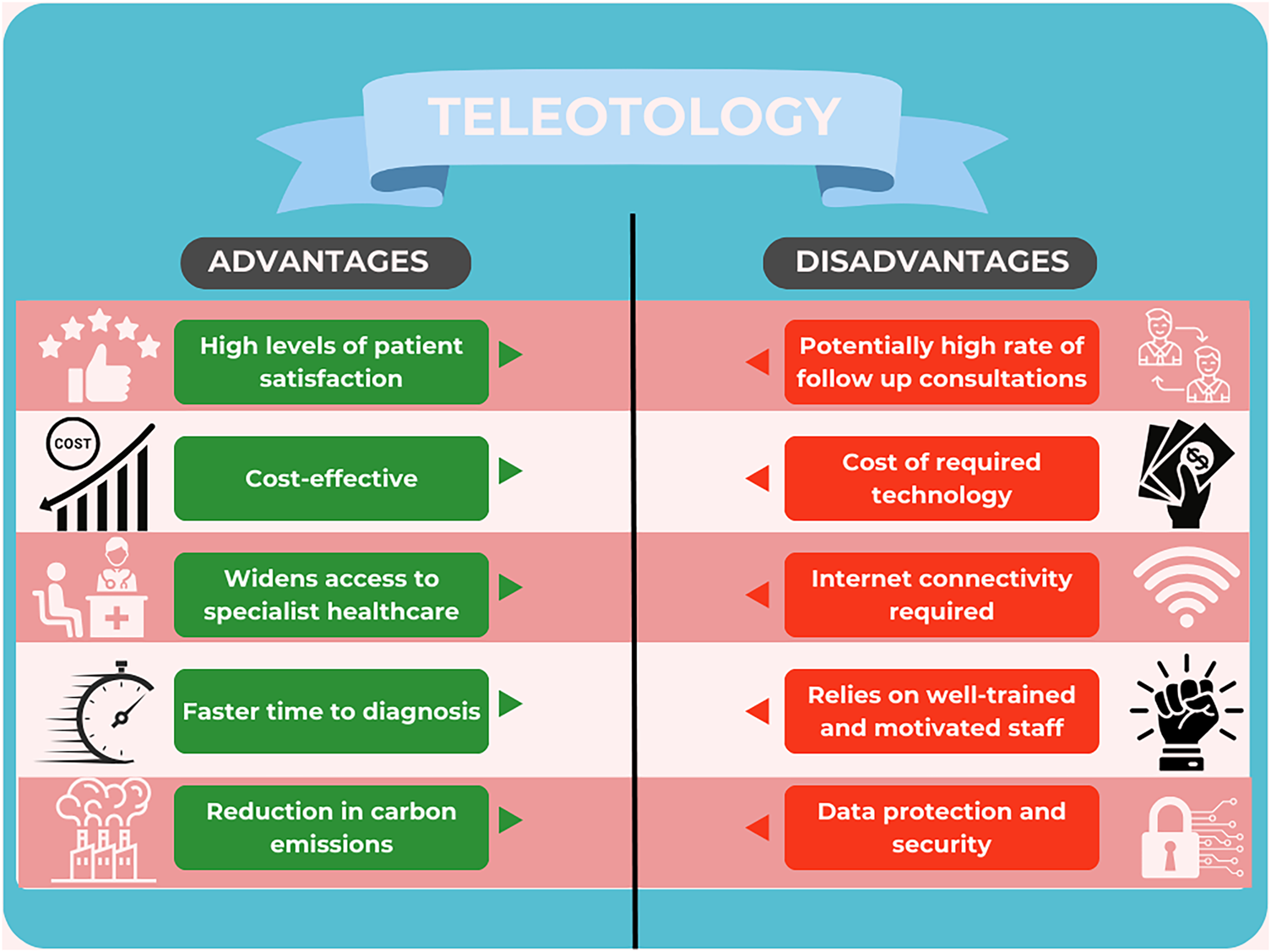
Teleotology expands access to ear health screening and assessment, providing cost-effective access to specialist healthcare. It can result in high levels of patient satisfaction, reduce ear health inequalities, and decrease carbon emissions associated with providing healthcare, among other benefits [Figure 1].Reference Harris and Dodson20–Reference Purohit, Smith and Hibble24 If modifications are made specifically for children, such as child-friendly user interfaces on mobile hearing assessment devices, healthcare access disparities might be significantly reduced. For instance, some parents of children with special needs find it challenging to attend hospital outpatient appointments.Reference Erkkola-Anttinen, Irjala, Laine, Tähtinen, Löyttyniemi and Ruohola25 In such scenarios, parents could be trained on how to use telehealth devices. This would enable them to complete virtual or telehealth appointments at a time and place that suits them. This patient-centred approach could result in improved attendance at follow-up appointments and greater compliance with treatment plans.
Advantages and disadvantages of teleotology.
Considerations for effective teleotology deployment
The implementation of a teleotology service necessitates the availability of certain essential resources. The most pivotal of these is a secure and user-friendly telemedicine platform. The availability of diagnostic equipment, including digital otoscopes and audiometers, is also of critical importance, as it enables remote examination and diagnosis. Advancing technology has led to the development of portable, easy-to-use smartphone and tablet devices, which now provide access to these solutions. One factor that initially prevented widespread uptake was the cost and speed of internet connectivity, but high-speed internet connectivity is now ubiquitous in the developed world. In order to protect patient information and adhere to regulations such as the Data Protection Act (2018), it is imperative that robust data security measures and compliance protocols are in place. Finally, comprehensive training programmes for healthcare providers are essential to equip them with the skills needed to utilise teleotology tools and platforms effectively.
While these resources form the foundation of a teleotology service, several additional resources can enhance its efficacy and patient experience. Integration with electronic health records (EHR) systems facilitates more effective data management and continuity of care. Mobile health applications offer patients the convenience of conducting preliminary assessments and providing data to clinicians ahead of consultations, streamlining the care process. Advanced analytics and artificial intelligence (AI) tools further elevate teleotology by offering data-driven insights that enhance diagnosis and treatment planning. AI algorithms can assist in the diagnosis of ear conditions, while predictive analytics can personalise patient care, thereby improving outcomes.
It is important to not take a one-size-fits-all approach when integrating teleotology into existing pathways in order to avoid failure. The NHS is not a single entity, but rather a collection of hundreds of organisations of varying sizes at different levels (central, national, regional, and local) with distinct roles and responsibilities. A thorough assessment of local needs and available infrastructure will highlight any necessary technological upgrades and identify staff who require upskilling. This will also determine an organisation's overall readiness to adopt a ”joined-up” approach to implementing teleotology services. Ultimately, implementing any digital health transformation project depends on the acceptance and “buy-in” of service users and healthcare professionals. Therefore, supporting staff with appropriate training, and educating patients about the goals and remit of teleotology services, will play an important role in successful integration.26
It is crucial to recognise the potential limitations of a teleotology approach if not appropriately used. Although the Wachter Review (2016) recommended that all NHS Trusts should be supported to go paperless by 2020, many NHS Trusts are currently behind on this target.Reference Wachter27,Reference Best28 This may hinder the implementation teleotology in certain areas due to a lack of digital readiness. This challenge might be overcome by partnering with providers that offer secure cloud-based solutions, that are compliant with NHS data protection standards.
Anywhere from 17 to 64 per cent of patients who have a teleotology appointment may require a follow-up face-to-face appointment, meaning that many of the benefits teleotology brings may be negated if used inappropriately.Reference Gupta, Gkiousias and Bhutta29 Research into the application of teleotology in the paediatric setting should focus on identifying appropriate patient populations and presenting complaints, determining the timing of teleotology consultations, such as for triage or post-operative monitoring, and demonstrating acceptability and feasibility. This will ensure that teleotology is used in the most beneficial way to optimise patient care and improve patient experience.
Conclusion
There is considerable potential for teleotology to have a positive impact on paediatric ear and hearing healthcare services and patient health outcomes, as well as on the environment. Furthermore, it could enable essential public hearing health screening services to evolve to meet demand. The introduction and expansion of teleotology represents a crucial step towards the future delivery of sustainable children's ear and hearing services in both urban and rural areas within the NHS. However, it is not a panacea and further evidence is required to demonstrate the feasibility and acceptability of teleotology for children in urban areas accessing NHS ear and hearing care.



